Tag: questions

  • What to Ask Yourself When You Feel Lost, Unsure, or Confused

    What to Ask Yourself When You Feel Lost, Unsure, or Confused

    “The quality of your life is a direct reflection of the quality of the questions you are asking yourself.” ~Tony Robbins

    I am naturally inclined to do—to go, to move, to take action. Slowing down takes a lot of patience for me. But I often find that moving too quickly actually causes me more confusion.

    One day, my head felt overwhelmed with questions. What had started with a simple idea of little ole me living in a tiny house on wheels (one of those under 200 square feet homes built on a trailer) had turned into a big undertaking of building a tiny house community.

    I had just driven across the country towing a twenty-nine-foot Airstream trailer. It was my first ever purchase on eBay. I had another tiny house in the process of being built and yet another I was about to pick up.

    Things were moving. But I felt like inside I was battling with a doubt that wanted me to come to a screeching halt.

    The predominant question that kept pounding in my mind was: Is this going to work?

    Then I just gave in, sat down, and started to write.

    I wrote down this question and all of the related and unrelated questions that were circulating in the cloud of doubt in my mind.

    In that moment, I discovered a personal practice that I’ve used many times since when I feel lost, doubtful, or unsure of which way to go. It helps me take intentional action toward my goals, and it’s really quite simple:

    I evaluate the questions I’m asking about my work and life and change them to questions that empower me instead of stressing me out.

    We all want something in common, and that is clarityWe want to move forward with integrity and purpose.

    No matter if your life feels like a roller coaster or it’s running as smoothly as ever, there is one thing that never changes: You will always ask yourself questions.

    I personally believe that when you are stretching yourself to grow and pursue a dream, you will have more than one question floating around your mind. They may even bombard you most of the day.

    Questions aren’t inherently bad; they can help us go deeper to understand what we need to do to move forward—if, that is, we ask ourselves the right questions.

    A lot of times, we ask ourselves questions that undermine our confidence in our ability to do the things we know we need to do.

    Some undermining questions include:

    • Is this going to work?
    • Why can’t I figure this out?
    • What’s wrong with me?
    • Why does it seem easier for everyone else?
    • How do I get this person/these people to think/do xyz?

    The problem with the above questions is that they place you in a victim or scarcity mindset instead of giving you a sense of control and empowering you to take responsibility.

    You know a question is undermining if it meets the following criteria:

    1. It makes you feel bad.

    Although empowering questions can be challenging, they won’t make you feel like crap about yourself. An undermining question makes you find fault with yourself, others, or your situation. An empowering question prompts you to focus on patterns that are causing or contributing to your challenges, and it also helps you find a solution.

    One way to convert an undermining question is to flip it to the opposite.

    For example, change “What is wrong with me?” to “What is right with me?” or “What behavior can I improve?” This helps you focus on your strengths, what’s working, and how you can learn and grow.

    2. You can answer it simply “yes” or “no.”

    This might seem counterintuitive, because we ask ourselves questions to find clarity, and what can be clearer than “yes” or “no”? But the reason you are asking the question in the first place is because there’s more to it than that.

    Often we just want a quick answer because it feels uncomfortable being in uncertainty. But there’s something more to explore, and there is greater power in a deeper answer.

    Another way you can convert an undermining question to an empowering one is to change it to something that requires a thoughtful answer.

    For example, like the undermining question I was asking myself about my tiny house community, change “Is this going to work?” to “How is this going to work?” By changing the question, you are presupposing that it will work—you simply need to figure out how.

    3. It defers the power to someone else rather than yourself.

    We all fall into potholes where we defer power, blame, and control to someone else, even those of us far down the path of personal development. When we ask questions to figure out what other people will think about us or how to get someone or a group of people to do something, we are placing our problem-solving energy outside of ourselves, where we have little leverage.

    A way to convert this kind of undermining question to an empowering one is to change the focus to yourself.

    For example, change “How do I get this group of people to do what I want them to do?” to “What actions do I need to take to achieve what I want to accomplish?” This allows you to lead by example, putting all of the power back in your court.

    Changing your undermining questions to empowering ones can help create a lot more peace, expansion, and clarity. And when you answer those empowering questions for yourself, you may feel like you just unloaded a bag of bricks from your head.

    Try this Exercise…

    Here is a simple process for unloading, examining, and finding answers to your own questions:

    Step 1: Unload

    Grab your journal and write down every question you are asking yourself about your business, work, relationships, and life right now. Write until you cannot think of any more questions and you start repeating yourself.

    Step 2: Examine

    Look through your questions. Are any of them undermining? If so, convert them to empowering questions, using the tools above.

    Step 3: Answer

    For the questions you have remaining, take time to journal your own answer to each one. Don’t think, just write and see what comes out.

    You can do this process as often as you like. I find when I do it, I feel clear for a substantial amount of time, and confident, because I know I have a process I can use whenever I feel lost.

  • The One Question You Need to Ask Yourself When Deciding What to Do

    The One Question You Need to Ask Yourself When Deciding What to Do

    Thinking man

    “Tell me, what is it you plan to do with your one wild and precious life?” ~Mary Oliver

    I’ve recently discovered that for fifty-odd years I’ve been asking myself the wrong questions. Uh-oh.

    Maybe you are too.

    The questions we ask ourselves habitually—even when the process is totally unconscious—guide our lives in a very profound way. For me, the two questions that dominated my thinking had very different, but equally pernicious results. They are: What am I supposed to be doing? And What do I feel like doing?

    The first question is all about hitting the numbers. What looks good in the eyes of the world? What would others see as successful, laudable or, at the very least, sensible? What would your mother approve of?

    This question was especially influential in my early life, but I’m still susceptible to a good dose of “compare and despair” angst.

    We love to see how we stack up against everyone else, and that impulse never seems to go away. Instead of comparing grades, test scores, and college acceptances, it’s salaries, vacations and how our kids are doing.

    There’s always some external standard we’re supposed to be hitting.

    The “supposed to” agenda is dictated by the ego, or what I like to call the Social Self. It’s all about getting you to line up and conform to the standards society sets for measuring success and general acceptability. It’s not about what would make you feel happy or fulfilled or even reasonably satisfied. Often it makes you downright miserable.

    I chose a career and two marriages based on that agenda, all of which are now defunct. The truth is, you’re not “supposed” to do anything. Truly. I know that’s hard to swallow. I have to remind myself of it daily, even hourly. There is no right answer. Life isn’t even a test! Who knew?

    Let’s all take a moment to let that one sink in.

    Unfortunately, once I finally figured out that I’m not supposed to do anything, I promptly fell into the next trap for a decade or two. As an antidote to the first question, I swung to the opposite extreme and decided that I would only do what I felt like doing.

    The problem with What do I feel like doing? is that it keeps us stuck in our comfort zones. Honestly, I usually don’t feel like doing things that make me scared and uncomfortable. Or that require a long slog of work with no guarantee of reward at the end.

    It’s hard for me to admit that this question is also wrong, because I’m a big fan of “following your bliss” and doing the things that make you feel good.

    The real problem here is in the timeline. What do I feel like doing? focuses on your feelings in that very moment. Would I rather have a glass of wine and surf the web right now, or work on that thorny chapter in my book that doesn’t want to settle into shape? Hmmm.

    Which brings me to the one question I’ve found that actually does pay to ask: What do I aspire to? This question still focuses on what you really want (not what society tells you to want), but it directs your attention out a little ways.

    What do you want to do in the grand scheme of things, not just in this moment?

    To aspire means “to direct one’s hopes or ambitions toward achieving something.” Some synonyms are: desire, hope for, dream of, long for, yearn for, set one’s heart on. That sounds kind of delicious, doesn’t it?

    Remember, we’re not talking about what would look good to others, but what would feel good to you, which is a tricky distinction for most of us. The key here is to focus on your body’s reactions.

    Thinking about what you aspire to should feel exciting and inspiring. If you feel tense or anxious or stressed out, you’re probably back in ego territory, trying to figure out what you’re “supposed” to do. (Stop that.)

    And don’t let the ego get its sticky hands on your aspirations, either. It’s easy to get sucked back into the idea that we need to achieve something specific—and within a certain timeframe, mind you!—in order to be happy.

    Refuse to go there. Focus on the joy of engaging in a goal that’s meaningful to you, no matter how long it takes or what others might think of it. Take your time and relish the process; that’s what life is really about.

    Asking What do I aspire to? keeps you homed in on your bliss, but defers the gratification just enough to get you off the couch and sitting in front of the computer, or schlepping to the gym, or picking up the phone.

    Go for the glow, follow your bliss, by all means… just not in this very moment. Get used to projecting yourself a little bit forward, and then consulting your body to find out what would feel really good to it then.

    It’s a great question to ask yourself at the start of every day, as a kind of intention-setting ritual. What do I aspire to in this day? How do I want to show up in the world?

    Flash forward to the end of that day and imagine what would make you feel really great to have done. Do the same at the beginning of the month or a new year. Use it to set goals that really matter to you, not just to your mom or your 750 Facebook friends.

    So, what do you aspire to (even if you don’t feel like it in this very moment)? Now go take a baby step or two toward it. I’ll be right there, just as soon as I finish watching this kitten video.

  • How to Be Okay When You Have More Questions Than Answers

    How to Be Okay When You Have More Questions Than Answers

    Orange Sky

    “Sometimes questions are more important than answers.” ~Nancy Willard

    I love the color orange. It makes me think of a beautiful ripe papaya, the calming shade of a monk’s robe, and the tapered candles my grandfather held in his hands to pray.

    I don’t know if it’s simply this or the prayer chants that rose from temples along the rural Lao countryside, but when I think on these things from my childhood, I feel peace.

    Do we romanticize our past? Do we sandpaper out the rough, dark spaces in our memories and label them “the good ‘ole days?” Is that why there is so much longing for simpler times, because our present is too overwhelming and difficult, and the future is uncertain and frightening?

    Perhaps there is some truth to that. If I were to look deeper, I’d realize that not all of my childhood memories were the stuff of children’s story books.

    Orange was also the color that lit up the night sky when B-52’s were dropping bombs over my childhood country. One minute, I found myself admiring fireworks from an outdoor stairway (typical of Lao homes built on poles), and the next moment, I was flung to the ground.

    Someone—a stranger with no thought for his own safety—snatched me from that stairway in the nick of time. When the bombing ceased, we found the stairs and half of the house completely obliterated.

    The house had belonged to my mother’s friend, who sat kneeling on the ground crying. She wasn’t crying because her house went up in flames. She was crying because after being separated from her small children, they were now running toward the safety of her arms.

    After my own mother found me, only then did the stranger who had been protecting me finally let go of my hand. In my confusion, I didn’t remember his name. And now, even the memory of his face is fading.

    But the stranger left an unmistakable legacy. He not only saved a child’s life but also left her spirit intact.

    While there was crying all around me, I stared calmly out at the scene of destruction and could only summon up one overriding emotion: invincibility. I escaped death! From this day forward, I told myself, nothing will ever make me afraid again.

    But memories have a way of dimming over time, don’t they?

    We raced through our pubescent and teen years to become adults. We took adulthood to mean freedom, adventure, and ultimately, reaching the summit of our dreams. We readily followed a prescriptive path. Yet, upon arriving, we learned that the reality was far from the reality we imagined.

    We worship productivity and the pursuit of more. To want anything less would turn us into slackers. It goes against the grain of our culture.

    To want anything different, we would be swimming upstream. We would be alone. And who wants to be alone? As humans, we learned to survive by getting along with others.

    It’s as if we are demonized by our ambitions. We feel the constant need for striving. The call to do more and be more. That we can never be enough. That we can never sit still. We feel compelled to move because if we don’t, we think that we’ll get run over. Then we feel reduced, insignificant.

    We stitch ourselves up every morning, create routines to prop us up, hide behind our busyness. We can’t think on our interior life too much because the act of doing so will force us to become undone.

    So we go searching for answers outside of ourselves. We go on spiritual retreats. We take expensive vacations. But we still come home to our old selves.

    But where else can we go? What else can we do?

    For starters, we shouldn’t seek to self-medicate with things that pollute our bodies, dishonor our spirit, and numb our minds. Secondly, we should not lose ourselves to work in order to shut off the questions that need asking. As Rilke sagely advised, live the questions.

    The answers lie in the questions themselves. You only need to ask the right ones.

    And while you are learning to form those very questions, I offer up these four suggestions.

    1. Allow yourself to feel uneasy.

    For something that is worth figuring out, there is no simple, prescriptive method for arriving at the answers. Yet, we demand this. Instant fixes that will take away our discomfort and pain.

    Don’t settle for Band-Aid solutions. Have confidence in your track record. If you have managed this far to stand on your own two feet, then know that the uneasiness is temporary, much like your circumstances. Remind yourself that you are an amazing human being worthy of your journey.

    2. Believe in something larger than yourself.

    It doesn’t have to be a particular faith or religion. The “something larger” is anything that expands you and gives you hope when things are at their bleakest. On days when you find absolutely no reason to get out of bed, let this one thing guide you.

    For me, it’s the vision of the life I want, the lives I want to touch, the people I want to love. For you, it may be appreciating nature, protecting wildlife, or completing that manuscript.

    3. Peel off complexity until you find the core.

    It helps to think of yourself as an onion. Keep peeling until you get at the core. This may mean ridding yourself of material things or the beliefs and behaviors that no longer serve you.

    4. Create a safe space.

    You need a place that is all your own and signifies simplicity. Go to it. Find healing there. And as the poet Rilke wisely observed, “Perhaps you will then gradually, without noticing it, live along some distant day into the answer.”

    Photo by Gabriel Rocha

  • 5 Questions to Discover Who You Are and What Will Make You Happy

    5 Questions to Discover Who You Are and What Will Make You Happy

    Who I Am

    “It takes courage to grow up and become who you really are.” ~E.E. Cummings

    At twenty-five I was happily married and had a great career, many friends, and lots of money. During that time I also became deeply depressed, was put on medication for anxiety, and entered what would be a very long relationship with psychotherapy.

    It was a real struggle for me to understand why I wasn’t happy when I had everything that I thought was important in life. Was I selfish? Were my expectations too high? I honestly couldn’t understand what was missing and how to fill this huge void that gnawed at me every day.

    When I look back at my life, twenty years later, I realize that I really had no idea who I was or what made me happy. I kept expecting something or someone to answer this question for me.

    The journey to find out who I was and what really mattered to me eventually involved divorce, the loss of my career and most of my possessions, and overcoming a serious illness.

    It pretty much took the loss of everything I thought defined me and made me happy to admit to myself that I honestly didn’t know myself very well at all.

    Who am I? What do I believe in? What is my purpose? What fills me with joy and wonder? These are questions that I am just beginning to understand after forty-five years of living my life, and I have to admit that getting there has been extremely difficult.

    The hardest part for me was just knowing where to begin. After much therapy, meditation, self-reflection, and reading, I asked myself five big questions that served as a launch pad to begin my journey of self-discovery.

    If you are ready to begin the process of truly understanding who you are meant to be, start here:

    1. What or who would you be if you knew you couldn’t fail?

    The risk of failure terrifies most people. How many times have you wanted to change jobs or careers, move to a new city, promote a cause that is important you, or become an expert in a certain area? Think about it. No risk of failure.

    If you were 100% certain that you could be or do anything you wanted and not fail, do you know the answer?

    2. What is your ninety-second personal elevator speech?

    Probably the most important and poorly answered question in most job interviews, this is similar in nature. You can certainly include your career or career accomplishments in your personal speech, but think of this from the perspective of how you might answer this if you were making a new friend or going on a first date with someone.

    How would you describe yourself so that the person asking the question would truly understand who you are and what is important to you?

    3. What are your core personal values?

    Personal values are the things that you believe are important in the way you live. They give you a reference for what is good, beneficial, important, useful, desirable, and constructive. Once you are able to determine exactly what values are most important to you, you can better determine your priorities.

    In fact, having this information about yourself is the key to making sure your daily life is aligned with those values. If you need help defining your personal values, there is a great five-minute assessment tool here.

    4. What makes you genuinely happy?

    This one is closely related to your core personal values. However, ask yourself this question once you’ve really nailed down what those values are.

    For example, if family is one of your core personal values, will taking a job that involves tons of travel make you happy? Take it a step further and really consider dreams you had when you were younger or currently have about what will make you truly happy.

    5. If money were no object, how would you live your life differently?

    Many people equate happiness and success directly to the amount of money they have. How many times have you heard someone say, “If I hit the lottery, I’d…”

    But remember, this question isn’t really about money at all. It’s more about thinking outside the limits we tend to put on our aspirations and actions because things seem out of our reach financially.

    You may not be able to do those exact things, but once you know what those true desires are, you expand your thinking and begin to develop a plan to work towards goals you may have never imagined possible.

    These are tough questions and the answers may not come easily or quickly. In fact, I found myself having to think and re-think my answers several times. This work is hard but necessary in order to really understanding yourself on a deeper level.

    While I can’t say that I now know everything about myself, answering these questions completely changed the negative internal dialogue that was limiting my ability to see myself as I exist today and the me that I can become in the future.

    But the biggest change came from revisiting dreams and aspirations that I had long ago put on the back burner while I was stuck in the process of “getting things done.”

    My dreams of writing about things that are truly meaningful to me, finding a fulfilling and passionate relationship, being more present with my children, and discovering a higher power are all coming true now that I am focusing my energy in the right direction—and that direction was to look within.

    So, find a quiet place and allow yourself plenty of time to go through and really think about each question and then just go for it. Go ahead. Begin your journey. Change direction. Create new dreams or rediscover dreams you left behind. Now that I have started, I haven’t looked back since.

    Photo by varun suresh

  • 4 Powerful Questions to Free You from the Daze of Fear and Inaction

    4 Powerful Questions to Free You from the Daze of Fear and Inaction

    Deep Thought

    “The lives we lead have everything to do with the questions we ask ourselves.” ~Lori Deschene

    You lay in bed night after night, tossing and turning, eager to push forward but unable to shake off the onslaught of what-ifs.

    What if I’m making a huge mistake? What if I fail utterly and miserably? What if I’m overestimating my ability to go through with this? What-if…? What-if…?

    Yet, no matter how crazy your anxiety and fears seem right now, you can snap out of it and make that new start you so desperately desire.

    How do I know?

    Let me tell you a little story…

    The Grand Decision to Quit a Great Job

    Two years ago, on a day that started like any other, I got an unexpected call from my husband from the hospital. “Don’t worry. They just want to run some tests before letting me go,” he said.

    He ended up having a four-hour emergency procedure followed by complications that landed him in the ICU for four days. Then a week of recuperation at home, followed by another mad dash to the emergency room.

    We needed weeks to get back to the “new” normal. Slowly the truth sunk in—my husband will likely live to a ripe old age, but he has a chronic condition and we’ll always have an invisible sword hanging over our heads.

    Something in me changed irrevocably after that incident.

    I set out on a crazy journey that has transformed into a complete overhaul of our lives. Part of the change process was my decision to quit the job that paid well, but sapped the life out of me.

    I planned every waking hour to discover an alternate way to earn a modest livelihood while living a life of purpose. I saved diligently and prepared my family and friends for what was to come.

    Then, ever so slowly, it was time. I set a date to resign.

    The Moment of Truth

    It took me two years from the time of my husband’s hospitalization to get to this point. You’d think I’d be excited and thrilled, right?

    Instead, an intense anxiety attack seized me. It took me completely by surprise. I couldn’t sleep. A slew of what-ifs threatened to wash away my resolute decision.

    In desperation, I brought it up with my mentor Jon Morrow. Jon got me to ask myself a few questions that finally snapped me out of the paralyzing grip of fear and anxiety.

    Question 1: Be a pessimist for five minutes. What’s the worst that can happen?

    My first reaction was: Why, the world will come to an end!

    But even in my crazy, anxious state, that sounded too dramatic and exaggerated. So, I tackled the what-ifs.

    I could be making a big mistake. But I’d still have my resume, work experience, and the good relationship with my (soon to be ex-) colleagues. If it was indeed a mistake, I could always go back and get a regular job. A little humbling, but not quite the end of the world.

    I’ll fail utterly and miserably. At making money—possibly, yes. But with other things—like trying to become a better person, a better parent, and creating a better world starting with my family first—there’s no failing. As for the money, again I could just go back to a regular job. Nowhere near the end of the world.

    I’m overestimating my ability to go through with this. OK, that’s just whining. Enough, already!

    So, ask yourself: What if all your what-ifs came true? What is the worst that can happen?

    Question 2: What will happen if you don’t make the change?

    I suddenly had this vision of a rich bride on the way to the altar to marry a poor bloke she desperately loved, get married, and live happily ever after in a tiny cottage, wearing the same two gingham dresses all her life—or bolt back to the comfort of her rich parents but be wretched for the rest of her life.

    Frankly, neither option looked very enticing.

    But if I had to make a choice, I think I would rather go ahead with the marriage. I could always spruce up that cottage and, heck, maybe even make a fine fashion accessory with the hay from the barn. Or something.

    So, ask yourself: Why did you want to make the change in the first place? What do you stand to lose if you don’t make the change?

    Question 3: What’s the real reason for your anxiety?

    I had no rational reason to feel anxious; I had covered pretty much all the bases.

    Or so I thought.

    As I dug deeper though, I realized my anxiety was essentially an identity crisis.

    I had spent the better part of the last 20 years being an engineer, and in the pursuit of making money.

    And here I was, on the verge of throwing that away. And with it, my old identity.

    While the rational part of me was okay with it, and even looking forward to it, a core part of me found it hard to let go.

    So, ask yourself: Are there any obvious reasons for your anxiety? If not, are there any underlying reasons that you may not have recognized yet?

    Question 4: What little step can you take now to get started?

    I knew switching my identities overnight was unrealistic. So, I took steps to slowly ease into my new identity.

    I took two days off each week and on those days, I wrote articles for blogs that I admired (just like this one) and interacted with their audiences. This let me test-drive being a blogger—my new identity—without actually having my own blog.

    I immersed myself in books on self-help and parenting, the topic of my future blog.

    I interacted with other bloggers through comments, emails, forums, and Facebook groups.

    And with each passing week, my anxiety shrank.

    So, ask yourself: What can you do right now to see the other side of change, in spite of the anxiety? Who can you reach out to that can help you quiet the negative inner voice?

    Finally, at the end of March, I walked into my manager’s office and handed in my two weeks’ notice. I felt calm. I felt in control. We had a nice chat and wished each other luck.

    Bottom Line

    In the end it all comes down to one thing: change isn’t easy.

    Despite your best-laid plans, you will have a few very low points. Your chances of success are often a result of how well you respond to them.

    This—the fear, the anxiety and the panic of starting—is just one of the low points.

    If you can beat this fear, you will not just succeed at making a new start now, but you’ll significantly improve your chances of surviving through all the future lows.

    So, what’s it going to be? Ready to ask yourself some tough questions?

    After all, what’s the worst that could happen?

    Photo by Chang’r

  • 28 Powerful Questions for a Happy Life

    28 Powerful Questions for a Happy Life

    “Keep your head clear. It doesn’t matter how bright the path is if your head is always cloudy.” ~Unknown

    Have you ever noticed that your biggest “aha” moment comes from someone asking a powerful question? Suddenly everything seems to make a little more sense, and you know what you need to do from that point forward, right?

    That’s exactly how it is for me. Someone will ask me a seemingly trivial question and bam! I’m suddenly overflowing with answers, emotions, solutions—I’m practically made of clarity!

    I remember a friend of mine asking me over coffee one rainy afternoon a few years ago, “What are you avoiding, Blake?”

    “What? Nothing. I mean, I guess I don’t want it to fail,” I eventually replied.

    “Yeah, and…” she quipped back. “What happens then?”

    I came to her because her willingness to face challenges head-on amazes me, and I needed her to face my challenge and give me that sage advice I knew she could. I wanted to leave corporate America and venture out on my own, and I wanted her to somehow make that sounds less crazy.

    I wanted to throw caution to the wind and follow what I most passionately believed in.

    I wanted to be my own success story.

    I also wanted someone else to tell me it was going to work.

    Calculating, weighing, analyzing—these things can only take you so far. I subconsciously needed something to get me out of my head and into some clarity. I needed that push.

    We bounced back and forth for what seemed like eternity. When most people have conversations like this, one party inevitably snaps out of the pattern and either says something oddly profound, or simply gets frustrated and tells the other to bugger off.

    I was lucky enough to receive the former rather than the latter.

    “When do you stop calculating risk and rewards and just do it?” she asked. “Because it feels like you’re building a magnificent ship you’re too much of a baby to ever sail. What are more committed to, dreaming it or doing it?”

    Holy cow, I was stunned. She was right. What was I more committed to? What a brilliant question. (more…)

  • When Painful Things Happen and You Can’t Stop Obsessing Over Why

    When Painful Things Happen and You Can’t Stop Obsessing Over Why

    We all have problems. The way we solve them is what makes us different.” ~Unknown

    I used to be a “why” person. Why, you ask? Because after receiving my middle daughter Nava’s diagnosis of a neurological condition, I got really hooked into “why me” mode, and it just ate away at every fiber of my core.

    I obsessed over “why.” Why did it happen? I needed to make sense out of a senseless fluke of nature.

    I was devastated and beside myself with the raging emotions of grief—the anger, bitterness, and resentment—and the dance in my head and the ache in my heart kept circling and banging into the graffitied wall of  WHY in big black letters.

    Here is where I remained for a long year of ranting and raving in a therapist’s office.

    I sought out lectures and classes on the famous theme of “why bad things happen to good people.” (As you may know, there’s a book by the same title.) I was totally stuck in this place.

    I felt so unwound and so out of control that I thought being able to wrap my head around a “real” reason would somehow help me in coping.

    I thought if I understood the “why,” I could deal with it better.

    I often say, and truly believe, that if I can understand where someone is coming from, I can more readily and easily accept our differences and disagreements; that this breeds tolerance and respect, and sets the stage to agree to disagree.

    I somehow thought this to be similar in my acutely grief-stricken situation—that if I could understand where this came from and why this happened to my baby, I could accept it more easily and therefore, cope with it.

    I was drowning in this “why me,” in the unfairness of it and the idea of bad things happening to good people.

    Then of course I went down the path of “what did I do wrong,” looking for that dose of self-recrimination.  And oh, I had plenty of arrows with which to shoot myself. We can all become our worst enemy when we look for that scapegoat. I was it for myself. 

    My therapist became my healer.

    He held my pain for months and months until it was able to wash through me and I could actually air it out. I came to understand and grasp the idea that these are the big unanswerables. There were no answers to the “whys.” (more…)

  • The Tiny Buddha Book, Bonus Gifts, and Win a Kindle or DSLR Camera

    The Tiny Buddha Book, Bonus Gifts, and Win a Kindle or DSLR Camera

    UPDATE: Please note that the pre-order bonus promotion described in this blog post ended on December 8, 2011.

    This is a post that’s been a year and a half in the making, and I couldn’t be more thrilled to finally write these words!

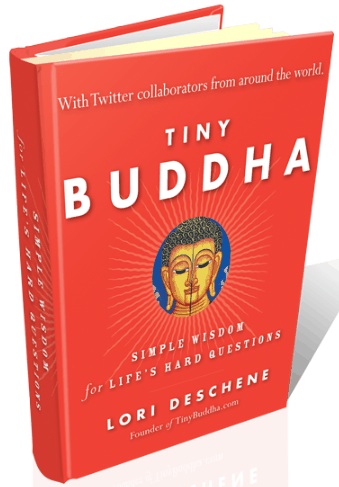
    Today is the official pre-order launch day for my first print book, Tiny Buddha: Simple Wisdom for Life’s Hard Questions, and I have some exciting promotions to share with you!

    In this post you’ll find:

    -Information about Tiny Buddha: Simple Wisdom for Life’s Hard Questions

    -A description of the pre-order bonuses (totaling more than $150 in value) that you will receive if you purchase between now and December 8, 2011

    -Instructions to enter the “Life’s Hard Questions” contest for a chance to win:

    • A Canon DSLR Camera
    • 1 of 2 Kindles, each with a free digital version of my book
    • 1 of 10 free hard copies of my book

    About Tiny Buddha: Simple Wisdom for Life’s Hard Questions

    You may have previously seen information about my eBook, Tiny Buddha’s Handbook for Peace and Happiness. This is a compilation of my most popular posts from the first year of the site, and it’s only available as a digital product.

    Tiny Buddha: Simple Wisdom for Life’s Hard Questions is entirely original, available both in print and as an eBook, distributed through Conari Press. And it started as a collaborative project.

    Last year, I asked @tinybuddha Twitter followers a number of challenging questions, including “What’s the meaning of life?” “What does it take to be happy?” and “How can you make each day count?

    I received more than 1,000 tweeted responses, and narrowed them down to 200 that form the backbone of this book. Tiny Buddha is a combination of their insightful answers, stories from my life, and lessons from wise teachers around the world and throughout time.

    I wrote this book because I lived much of my life feeling paralyzed by pain and uncertainty. While there is much that may always be unknown, we can still empower ourselves to live peaceful, purposeful lives based on what we do know.

    The Pre-Order Bonuses

    Tiny Buddha, Simple Wisdom for Life’s Hard Questions, will ship from Amazon on December 8, 2011 (and will be available in stores by January 1, 2012). (more…)

  • 50 Creative Questions To Create The Life You Really Want

    50 Creative Questions To Create The Life You Really Want

    “If you focus on results, you will never change. If you focus on change, you will get results.” ~Jack Dixon

    The first time I picked up a brush to paint I was 28 years old. I had never painted before, not even as a child. I couldn’t draw (except lousy little doodles) and never even thought I would enjoy painting.

    A friend of mine encouraged me to take a workshop about painting for process. Since she pushed so hard, I went.

    My world exploded open.

    On the first day, we stood next to a long table where cups of colorful bright thick Tempra paint laid in rows with one brush and a cup of water next to each of them.

    The instructors told us to simply choose the color that called to us in the moment without thinking, pick up the brush, dip it into the paint, and bring it to our white paper pinned against a wall. Then we were supposed to do only one thing: PLAY!

    Painting for process is not about having a cathartic experience, throwing paint onto the paper a la Jackson Pollack. It’s about being respectful of the process, holding the brush carefully like a pencil, and being present when connecting the brush to paper.

    The key to the creative process is to let go of the concept of “product.”

    The instructors encouraged us to avoid standing back to look at what we were doing. This would trigger analysis, judgment, and self-consciousness. We were supposed to paint freely, like children, and forget about the demon of outcome.

    If judgments came forward like “My painting is bad,” or “It doesn’t look like I want it to,” or like in my case, “It looks like a cartoon,” we were to ask ourselves three simple questions:

    • What if it could be bad?
    • What if you let go of preference?
    • What if it didn’t matter if it looked like a cartoon or not?

    Keep painting!” my teachers encouraged. “Keep going to a color and bring the brush to the white page.”

    And when I got stuck (and sometimes wanted to curl up in a ball and cry) my kind teachers came over and gently nudged me to keep meeting myself head on. (more…)