Tag: pressure

  • Who Says We Have To Be Happy All the Time?

    Who Says We Have To Be Happy All the Time?

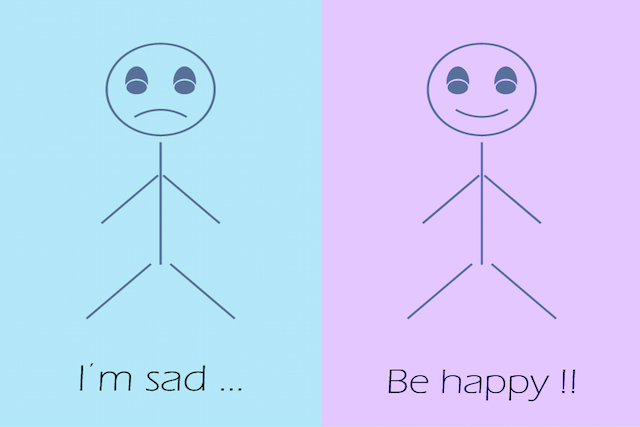
    Im Sad Be Happy

    “Develop a mind that is vast like the water, where experiences both pleasant and unpleasant can appear and disappear without conflict, struggle, or harm. Rest in a mind like vast water.” ~Buddha

    When I think about having to be happy all of the time, I feel a certain kind of pressure. Sure, it’s different now then it was. But that doesn’t mean there aren’t cycles when I question everything.

    Sometimes I can catch myself thinking that everything would magically fall into place if I had all the success I want in my career, the happily-ever-after relationship without any issues, or anything else I seemingly need.

    Happy enough that I didn’t care, I’d walk around like a beaming light where everyone saw my radiance and adored me.

    It’s a noble wish. I can envy those who seem happy all of the time and seemingly have it all together. The problem is, it’s a dream of perfection. On a day when I don’t feel happy or like a dark cloud is passing over my head, I can feel I’ve failed at life.

    The pressure to be happy actually makes me unhappy. And when I feel sorrow or pain or depression, I can fear it’ll never go away. I worry the prize of arriving to this Big Beautiful Happy Life isn’t mine to have in the first place.

    Here are three things I’ve learned to get through the lows that have helped me change the way I view my life and myself.

    1. Moments of real connection often stem from acknowledging our struggles.

    Sometimes when I was in the dumps, I wanted to hide and isolate myself. But shared moments of loving connection didn’t always have to happen when I was my happiest self. 

    When I look at my closest friendships, I realize what helped form them into solid, supportive relationships were through moments of shared vulnerability.

    True intimacy came when I revealed what I was feeling or what I was going through, opening up to a deeper emotional honesty.

    Not feeling afraid to share truthfully what was going on for me allowed another person in more profoundly. And because of this, others felt safer to be real with me. They didn’t worry I’d judge them for how they felt on any given day and I’d have compassion.

    It’s the heart where true connection lies, not just in times of laughter and shared happiness. And forming a loving bond through times of difficulty gave us more appreciation for the shared joys that did arise.

    I learned how to do this though without being in a victim mentality. If I shared what I was feeling with a sense of neediness or wanting the other to help me, fix me, save me, it was harder to be around me.

    But if I shared with a sense of 100% responsibility for my feelings and issues, others trusted I would take care of myself without having to do anything for me.

    I could say, “I’m having a difficult time and this is what I’m learning about myself.”

    My intention for self-awareness and an interest to solve my own problems with humility gave people space to be with me without feeling burdened.

    And this in return (although not expected) allowed reciprocity.

    2. Peaceful acceptance is more important, and more sustainable, than happiness.

    I can be hard on myself.

    This idea of a perfect life—to not be messy, mixed-up, afraid, and feeling small—makes those days when I’m down much harder.

    Now, I just let those dark days be. Or more than that, I know even though those times suck royally, I’m growing.

    Now, I focus on what can make me feel peaceful rather than happy. There’s a lot more room then to get stronger and bring back the fire that seems to have left me.

    I do grounded, simple things that bring me joy—like knitting, reading a good novel, seeing a play, or taking a long walk in a different neighborhood.

    These small moments of taking the day easy and allowing with grace brings me inner-balance, which I discovered is most needed in these kinds of down-and-outs.

    Just chilling out and taking the strain off helps me feel more present, alive, and clear. And that is far more sustaining than the elated, euphoric states I can have when something great does happen for me.

    Those super-over-the-top kind of happy moments are fleeting and transitory. They pass by quickly as I return to daily life.

    Creating peace rather than striving for constant happiness gets me off the hook. Free of drama, stress, and anxiety, I take it easy even if I still feel messed up. Then, I’m even keel and that’s a lovely feeling.

    It’s really kind of refreshing. In reality, I don’t have to do anything or get anything to be happy. I just get to be me.

    3. Periods of uncertainty do pass, but it’s how we hold them in the present that matters most.

    I’ve learned I can feel down when I’m not feeling on purpose or when I’m unsure of what’s next.

    Not knowing what’s going to happen, I can fear I’ll be stuck in the muck, unsafe, unlovable, and not enough.

    That in-between space is uncomfortable and disquieting. If I don’t feel on point, motivated, or like I’m getting what I want immediately, I can think I’ve failed in life.

    As an artist, I can worry my next creative project won’t come or fear I will never fall in love again.

    This kind of future thinking is the death to my happiness—because I can think there’s something wrong with me for not having it all figured out.

    What I do in these times is . . . nothing big.

    I focus on nurturing myself and find the easiest thing I can do. I apply what’s gentle, loving, and kind. I ask my spirit what it needs rather than my ego that’s striving for happiness.

    I accept it as a time to go within rather than seek pleasure without—a gentle time to restore and regenerate, giving myself space to prepare inwardly for the new.

    Truth is, there are sometimes slow moving streams and still pools, and I can’t force a river no matter how much I want to.

    My learning is not to flee from my sense of emptiness but to loosen my grip and relax into the gap. Like a trapeze artist letting go of one bar and reaching for the next, I trust it’s in this very space that the new is discovered.

    I try to honor the passages without forcing anything. As I take tender steps toward my endeavors, I allow the beauty of the next to arise according to its own timing.

    Somehow I’m freer even if I happen to be unhappy. I know it’s not really the truth of my being. And that’s a very cool thing.

    (Kinda’ something that makes me happy . . .)

    What gives you a sense of peaceful aliveness? In what ways can you connect more with others? How might you meet transition cultivating a sense of “easy”? And how might all of this give you more permission to be?

    Be happy image via Shutterstock

  • 5 Vital Lessons for People Who Feel Like They’re Not Good Enough

    5 Vital Lessons for People Who Feel Like They’re Not Good Enough

    Sad Woman Behind Bars

    “What if I fall? Oh, my darling, what if you fly?” ~Erin Hanson

    Like most people, my life has had its share of ups and downs.

    My household growing up could be best described as a roller coaster. There were times of excitement and happiness, then there was the plummeting into darkness, shame, and self-loathing.

    Throughout my childhood and adolescence, I felt that I was a mistake, unloved, and unwanted by my father. His mood swings and verbal abuse would come raging like a storm without any warning, and without any end in sight.

    He often told me that I wasn’t good enough and that I was the reason for all of his problems.

    I was often frightened to go home and face him. When my mother would have to go out of town, I would insist on staying with a friend because I didn’t feel safe being alone with him.

    I was extraordinarily lucky to have such a warm and loving mother that provided me the love and support I needed to keep going. Despite all of her good intentions and love, though, I still found myself falling into a deep hole of depression and severe anxiety.

    Some of the happier times that I remember from my childhood were the years that I was in gymnastics. It made me feel alive and free to express myself.

    However, that too slowly led to destruction, as soon I began competing. My obsessive need to please others caused me such significant levels of anxiety that I decided to quit. I was only twelve, and my dreams of becoming an elite gymnast were over. 

    Though it was a good decision to move on from that life, I was still left with this feeling of shame because I couldn’t mentally handle the pressure. I felt that I had let everyone down, including myself.

    Also, without this release, my anxiety levels continued to increase, leaving me feeling on edge and awkward in my social interactions.

    As I entered adolescence, I found it harder and harder to put myself out there, in fear that others would judge me. I worried that they would think I wasn’t good enough, cool enough, skinny enough, smart enough, or pretty enough.

    I eventually created this hard exterior to prevent people from getting in and knowing the real me.

    I believed for a long time that this wall was there to protect me; however, all it did was prevent me from building relationships with others, or even a relationship with myself.

    For many years I self-medicated in various ways to deal with the pain and to allow myself to let my guard down just enough to find a solid, small groups of friends.

    It wasn’t long before I became so depressed and anxious that my family doctor put me on medications to “fix me.” They numbed me so much, though, that I medicated myself on top of that to feel alive, which of course was a recipe for disaster.

    After years of taking these medications, I couldn’t function without them. I’m became so desperate to feel alive that I took myself off of them cold turkey. This was not a pleasant experience. I went through a period where I secluded myself away from my friends and family and fell back into old habits.

    I eventually managed to pull myself out of that hole after some intense therapy and self-reflection; however, I still struggled daily with my depression and anxiety.

    Fast forward several years, after I graduated from my Masters program, and I found myself happily married, spending time with my close knit friends again, and working daily on myself.

    I had finally cut out everything negative in my life except for chain-smoking cigarettes, and then I became pregnant with our first child.

    My husband and I were ecstatic, but making that final step to quit smoking so suddenly threw me for a loop. Since it wasn’t just me now, I made the decision to try something new, yoga.

    At first it was hard, boring, and frustrating. I didn’t get it. I kept going, though, and about the time I was six months pregnant I was finally getting the hang of it.

    I didn’t just like it; I loved it! It has been just over five years since I walked into that first yoga class, and I am so thankful for everything it has taught me.

    Here are the top five ways that I believe yoga has saved my sanity. It taught me that:

    1. Practice makes progress.

    For someone that struggles with perfectionism, this mantra has been a lifesaver.

    When I first started my practice, I felt frustrated because I couldn’t make my poses look like the advanced yogis in the room. The reality was that those yogis didn’t accomplish those moves in their first class. It took time, patience, and self-acceptance to get there, and those poses could continue to progress from there.

    There is no such thing as perfect but rather always room for growth. Striving for perfection is a no-win battle in all aspects of life, for perfection is a defining wall that we create in our own minds.

    2. We have to acknowledge our own successes.

    I have never been one to take compliments well. I doubted them and worried that they were insincere.

    Even as I became stronger in my practice, I didn’t feel secure enough to attempt difficult poses in a class full of people. I feared that someone would find flaws in them or think I was a show-off.

    It wasn’t until about a year ago that I finally decided to just go for it. Since I made that leap, I have been able to grow so much more in my confidence and praise for myself.

    If you can’t be proud of yourself, how can you expect others to be?

    3. We need to surround ourselves with positive, happy people.

    Ever heard of the phrase “You become who you surround yourself with”?

    The yoga community is filled with joy, support, and kindness everywhere you turn. Although I am still not the most outgoing or social person, I embrace the positive energy every day when I am in a yoga class.

    Everyone there has come there for a purpose—to better themselves. We all have our own stuff going on in our lives, but have taken a moment to come together and to take care of ourselves.

    4. We can conquer our fears.

    The first time I saw someone in crow pose, I convinced myself that I could never do something that difficult. I just knew I would fall on my face and everyone would laugh at me. I resisted even attempting it because I was scared of failure.

    The thing is, though, sometimes we have to fall to then pick ourselves back up and try again.

    Once I started practicing and finding success, I become braver every day on my mat and found that I could, in fact, accomplish much more than I ever believed I could. We are stronger than we think we are.

    5. It’s okay to let ourselves be vulnerable.

    There is a moment at the end of every yoga class when you lie on your mat in shavasana, with your eyes closed, and just breathe.

    The idea of surrendering yourself in a room full of strangers is terrifying. This pose has taken me forever to feel comfortable in. It taught me that it is okay and actually good for the body and mind to let it all go and just be. This is when you can find peace within yourself.

    It has now been twenty years since I quit my gymnastics career, and I have finally found something that has allowed me to get that same sense of freedom that I once felt as a child.

    I know that every day after I finish my yoga class, I have let go of the enormous amount of tension that I constantly carry with me, and I feel content, relaxed, empowered, and proud of myself for what I have just accomplished.

    I truly believe that yoga has saved my sanity and taught me how to love and respect myself. But you don’t need to go to a yoga class to learn these lessons. You can make the choice to let go of the pressure, tackle your fears, and celebrate yourself for being bold, brave, and vulnerable.

    Sad woman image via Shutterstock

  • How to Stop Feeling Inadequate and Let Go of Heavy Expectations

    How to Stop Feeling Inadequate and Let Go of Heavy Expectations

    “No one is useless in this world who lightens the burdens of another.” ~Charles Dickens

    When I was seven years old, my parents had me take an IQ test for an application to a private school near our new home.

    I vaguely remember sitting with the proctor, answering question after question about vocabulary and spatial recognition. To seven-year-old me, the test was nothing more than a fun logic puzzle, and I delighted at each question I knew the answer to, bright eyed and enthusiastic.

    While I don’t recall my exact score, the numbers were unusually high—in fact, so high that the proctor expressed her surprise to my parents that I was not suffering from some form of high-functioning autism.

    From age seven on, I was placed in the most gifted classes in both public and private school. I enjoyed the challenge, and the attention I received, until I became a teenager.

    In my transition to adolescence, I became aware of the incredible teenagers around the world writing novels, promoting peace, and inventing the types of machinery and technology that change the world.

    These individuals inspired me, but secretly implanted a deep sense of fear and angst in my mind.

    For as long as I could remember, people had been telling me, “Avery, you are going to do amazing things with your life,” while I spent my life like any other teenager: school, sports practice, homework, food, bed, repeat. I was not accomplishing any great feats.

    I slowly began to feel like I was failing to fulfill my full potential as a human being.

    Being exceptionally gifted, once a joy and privilege, had become a toxin to my emotional well-being. I was all consumed by my ego telling me that I should be more—or I was wasting my intellect.

    This led me to sporadically start novels, blogs, articles, anything to prove myself worthy of my intelligence. I would give up on each one quickly and move on to my next idea, as unsuccessful as the first.

    No matter what I tried, the world still did not know my name—the only thing, I thought, that could make feel adequate.

    About a year ago, it dawned on me that my pattern of self-dissatisfaction and disappointment was unsustainable.

    No matter what I did, no matter how many people knew my name, it made no difference. I always craved more, and anything less than becoming the next Einstein was a personal failure.

    So, with that in mind, I began the arduous process of redefining success in my life. The only way I could do this, I learned, was to help others realize their own goodness.

    I began with my personal mantra:

    “It is better to change one person’s life than to have 1,000 know your name.”

    I stumbled upon this realization somewhat suddenly, after taking a two-week long trip with my grade. I invested myself in helping my friends with sickness and fear, and I came away changed; I finally felt like I’d accomplished something permanent and meaningful.

    Instead of living for recognition from the world, I began to look for satisfaction through my personal relationships. I no longer needed to change the world to be successful; I just needed to know that I had changed someone’s life for the better.

    Surprisingly, this is a relatively easy task to accomplish with discipline. By investing myself in relationships with my friends, acquaintances, and partner, I began to receive incredible feedback.

    People genuinely began to thank me—not for being kind, but for literally changing their lives.

    The key for me was genuinely listening to others, and caring about their needs and opinions. Helping people came naturally to me, and remains the best gift I can give to others; not some profound piece of writing or technological advancement.

    Typically, the people around me who I listened to had similar issues of inadequacy. I was not alone. They too believed themselves to be failures, unable achieve their potential, whether that potential was straight A’s or a sports scholarship or being kind.

    I could see the innate goodness of the people around me shining through, and it pained me to see them suffer from feelings of inadequacy. I knew, deep down, that everyone around me was good and pure and beautiful, as all children of this earth are.

    As a result, I realized through time that if the people around me were all beautiful and good, as all people are, then I must be good too—just the way I am and always will be.

    By loving others, I had already achieved my purpose on this earth: to be the inherently sympathetic and kind creature that all human beings are.

    I now actively seek people around me who need my care, and indulge them when necessary. Love has taken precedence in my life over material accomplishment, as it truly should. I have closer, more meaningful relationships, more acquaintances, and an exponentially higher self esteem.

    The beauty is, people reciprocate genuine love: the people you help will be there for you in your times of need, too. Love is a self-fulfilling prophecy that can only be positive for all parties involved.

    At the end of the day, people simply want to receive love and attention; and through giving others these things, I not only improved their lives but also my own perception of myself.

    I was able to focus on the immediate positive impact my life was making on that of others, and I finally felt purposeful and that I was leading a meaningful life.

    The truth is, not everyone can change the entire world, and not everyone needs to. All we can do is give as much love in our lives as possible, treat ourselves kindly, and leave the world a more positive place than we entered it.

    That is all I can ask of myself, and I try to leave all other expectations of myself behind—the ones of impermanent success that can only bring me dissatisfaction and suffering.

    Maybe thousands do not know your name, but you have the power to completely change the lives of those around you with love; and that, I’ve learned, is far more gratifying and important.

  • Releasing Pressure and Expectations to Make Room for Life

    Releasing Pressure and Expectations to Make Room for Life

    Free

    “For things to reveal themselves to us, we need to be ready to abandon our views about them.” ~Thích Nhat Hạnh

    My husband and I bought our first house two years ago. Expecting a child and excited to move on to the next stage in our lives, we listed all of the ways we would make the house perfect.

    As first-time homeowners and parents, we assumed this list was manageable. Surely the house could be painted in a weekend! Of course we can get work done while the baby naps!

    Indeed, it seemed manageable and, therefore, (to me) mandatory.

    To kick off the home improvements, we tested a few new paint colors on the wall in the hallway, and they are still there today. For two years I looked at that paint and reminded myself of what I didn’t accomplish. What were once radiant, bold, and playful colors had become glaring, critical, and mocking.

    It can be easy for our expectations to get the better of us. What may have begun as aspirations transform into laws that must be followed precisely. Who we are and how we live are suddenly not enough.  

    Our internal critic bombards us with well-rehearsed and compelling judgments and criticism. Expectations and judgments masquerade as the truth and influence our emotions and our actions. It can be difficult to detect when our expectations don’t really match reality.

    Upon reflection today, it’s clear to me that we had no idea what we were in for when we made that list two years ago; yet, these expectations had become non-negotiable. Where was the room for living in these expectations?

    Discrepancy between our expectations and reality can be uncomfortable. We may blame ourselves and tighten our grip on our expectations. We believe that it is only once they are met that we can let go and be happy.

    It is also tempting to place blame on another person or our circumstances. Again, we believe that if only he/she/it/this would change, we could let go and be happy.

    The trick in all of this is that there will always be new expectations to be met preventing us from letting go and truly embracing our lives.

    While I struggled with this discrepancy between what should be and what really is, my daughter smiled at the paint on the wall. She doesn’t know what we were “supposed to” finish. She doesn’t know how a wall “should” be.

    My moment of clarity came when she looked up at the wall and triumphantly stated, “Green! Red! Purple!”

    I asked myself then how the same paint on the wall could hold such a different meaning to me. If the walls were painted, what would really be different? Not only that, but what did this unfinished wall make possible and what had I been missing all this time?

    I realized then that the wall more accurately reflects the richness of my life than it does any shortcoming of mine. This wall reflects dancing in the living room and weekends at the park, not failure as a person. I was inspired then to frame the paint on the wall rather than wish it were gone.

    It was both liberating and humbling to acknowledge that this isn’t about the paint on the wall at all. This is about me. It is not the paint that needs to be changed, but what I see when I look at it.

    We can be easily persuaded by the false promises that control and perfection make. We can forget that perfection will never be achieved, and we mistakenly believe that this means we are not enough.

    We might even believe that our self-talk, as negative as it may be, is reality. When thinking errors overshadow the good that is within our lives, it can seem that life must always be something else.

    To find release from the emotional toll of the “shoulds” and “good enoughs,” we focus on what must be different: ourselves, a loved one, a stranger, circumstances, or that irksome wall.

    Why is this so hard to change? Change often brings with it the fear of the unknown. Change is not certain.

    However, when we can change this, not only do our expectations change, but so do our happiness, contentment, and gratitude for what is. We are more likely to fully see things as they are when we can detach ourselves from unyielding expectations.

    We are free to live when we make room for life.

    To begin to see your “wall” through different eyes:

    1. Remind yourself that you are enough.

    It isn’t even necessary to be good enough. You are simply enough.

    We might need to remind ourselves of this often. After all, that inner critic has had a lifetime to develop.

    2. Slow down and take notice of your self-talk.

    What has your inner critic convinced you of? Explore this question with curiosity, not judgment or criticism.

    When we can do this with non-judgmental curiosity, we are able to see with clarity and compassion. We can begin to identify those things we tell ourselves that just make us feel worse and don’t change anything anyway. We can reduce our suffering, even in a naturally painful situation.

    3. Reevaluate your expectations.

    Have you made room for life? Do you have new information now that you didn’t have before? Are these expectations compatible with your priorities?

    When we can make our expectations more fluid, we have the freedom to live in the present moment, and enjoy it. We are free to decide what our life is about, and we are free to change our minds about this at any time.

    4. Get at the underlying fear.

    What are you really afraid of these “walls” revealing? Are these fears accurate?

    Quite often, our fears take the form of “what if” and “what this says about me.” Even when there appears to be a kernel of truth behind the fear (after all, it was true that I hadn’t painted that wall), there is more to the story. The belief that we are unworthy, irresponsible, weak, unlovable imposters is simply a fear, not a fact.

    5. Consider how this “wall” might be described in your biography.

    What is the whole story? How boring would the biography be if it were just about a wall?

    Perhaps we are focused on the small, inconsequential details of life. Perhaps we take our lives for granted. Intentionally taking a step back and really looking is how we get to appreciate the fullness of life.

    Although taking these steps requires the conscious effort to make a change, the result is far more rewarding than a newly painted wall could ever be.

    Photo by Graham

  • How to Be Okay When You Have More Questions Than Answers

    How to Be Okay When You Have More Questions Than Answers

    Orange Sky

    “Sometimes questions are more important than answers.” ~Nancy Willard

    I love the color orange. It makes me think of a beautiful ripe papaya, the calming shade of a monk’s robe, and the tapered candles my grandfather held in his hands to pray.

    I don’t know if it’s simply this or the prayer chants that rose from temples along the rural Lao countryside, but when I think on these things from my childhood, I feel peace.

    Do we romanticize our past? Do we sandpaper out the rough, dark spaces in our memories and label them “the good ‘ole days?” Is that why there is so much longing for simpler times, because our present is too overwhelming and difficult, and the future is uncertain and frightening?

    Perhaps there is some truth to that. If I were to look deeper, I’d realize that not all of my childhood memories were the stuff of children’s story books.

    Orange was also the color that lit up the night sky when B-52’s were dropping bombs over my childhood country. One minute, I found myself admiring fireworks from an outdoor stairway (typical of Lao homes built on poles), and the next moment, I was flung to the ground.

    Someone—a stranger with no thought for his own safety—snatched me from that stairway in the nick of time. When the bombing ceased, we found the stairs and half of the house completely obliterated.

    The house had belonged to my mother’s friend, who sat kneeling on the ground crying. She wasn’t crying because her house went up in flames. She was crying because after being separated from her small children, they were now running toward the safety of her arms.

    After my own mother found me, only then did the stranger who had been protecting me finally let go of my hand. In my confusion, I didn’t remember his name. And now, even the memory of his face is fading.

    But the stranger left an unmistakable legacy. He not only saved a child’s life but also left her spirit intact.

    While there was crying all around me, I stared calmly out at the scene of destruction and could only summon up one overriding emotion: invincibility. I escaped death! From this day forward, I told myself, nothing will ever make me afraid again.

    But memories have a way of dimming over time, don’t they?

    We raced through our pubescent and teen years to become adults. We took adulthood to mean freedom, adventure, and ultimately, reaching the summit of our dreams. We readily followed a prescriptive path. Yet, upon arriving, we learned that the reality was far from the reality we imagined.

    We worship productivity and the pursuit of more. To want anything less would turn us into slackers. It goes against the grain of our culture.

    To want anything different, we would be swimming upstream. We would be alone. And who wants to be alone? As humans, we learned to survive by getting along with others.

    It’s as if we are demonized by our ambitions. We feel the constant need for striving. The call to do more and be more. That we can never be enough. That we can never sit still. We feel compelled to move because if we don’t, we think that we’ll get run over. Then we feel reduced, insignificant.

    We stitch ourselves up every morning, create routines to prop us up, hide behind our busyness. We can’t think on our interior life too much because the act of doing so will force us to become undone.

    So we go searching for answers outside of ourselves. We go on spiritual retreats. We take expensive vacations. But we still come home to our old selves.

    But where else can we go? What else can we do?

    For starters, we shouldn’t seek to self-medicate with things that pollute our bodies, dishonor our spirit, and numb our minds. Secondly, we should not lose ourselves to work in order to shut off the questions that need asking. As Rilke sagely advised, live the questions.

    The answers lie in the questions themselves. You only need to ask the right ones.

    And while you are learning to form those very questions, I offer up these four suggestions.

    1. Allow yourself to feel uneasy.

    For something that is worth figuring out, there is no simple, prescriptive method for arriving at the answers. Yet, we demand this. Instant fixes that will take away our discomfort and pain.

    Don’t settle for Band-Aid solutions. Have confidence in your track record. If you have managed this far to stand on your own two feet, then know that the uneasiness is temporary, much like your circumstances. Remind yourself that you are an amazing human being worthy of your journey.

    2. Believe in something larger than yourself.

    It doesn’t have to be a particular faith or religion. The “something larger” is anything that expands you and gives you hope when things are at their bleakest. On days when you find absolutely no reason to get out of bed, let this one thing guide you.

    For me, it’s the vision of the life I want, the lives I want to touch, the people I want to love. For you, it may be appreciating nature, protecting wildlife, or completing that manuscript.

    3. Peel off complexity until you find the core.

    It helps to think of yourself as an onion. Keep peeling until you get at the core. This may mean ridding yourself of material things or the beliefs and behaviors that no longer serve you.

    4. Create a safe space.

    You need a place that is all your own and signifies simplicity. Go to it. Find healing there. And as the poet Rilke wisely observed, “Perhaps you will then gradually, without noticing it, live along some distant day into the answer.”

    Photo by Gabriel Rocha

  • Why Screwing Things Up Is Crucial to Your Well-Being

    Why Screwing Things Up Is Crucial to Your Well-Being

    “Where there is perfection there is no story to tell.” ~Ben Okri

    Somehow I’d gathered my courage and volunteered from the audience during a local improvisational theater show. And before I knew it, I was up on stage with the troupe, being welcomed, supported, and seamlessly gathered into the scene in a way that only professional improvisers can do.

    I left the stage high as a kite from the adrenaline rush, returning to my seat and enthusing to my friend that I wanted to start taking improv classes right away!

    What I didn’t realize until I was several weeks into my first class was something I have since accepted as a truism:

    Improv theater is basically boot camp for perfectionists.

    A group of which I am a card-carrying member in good standing.

    In class, I understood intellectually that I was supposed to relax and go with the flow, but I didn’t know how to actually do that. All my life I’d learned to do the exact opposite—to prepare thoroughly and know exactly what I was doing whenever I went into a new or challenging situation.

    At first I managed to fake it, mentally choosing a few potential characters and situations before every class so that I could appear to be spontaneous in a pinch. Clever me! I was always ready with a funny line or interesting story.

    The problem was, I was also always stressed about it.

    At first I chalked up the rapid heartbeat and shallow breathing to the rush of performance, until I found myself obsessing after class about what I could have done better. Wondering where I could have been funnier, or reached deeper to bring out more poignant emotions, so that I could make sure that everyone liked me and thought I was a fantastic improviser.

    It was okay for everyone else to be fallible, merely human. I had to be better. In fact, I had to be perfect.

    Like so many perfectionists, I’d internalized the message that my self-worth was based on what I did, not who I was. And if what I did wasn’t good enough—well, then, obviously neither was I.

    At its heart, perfectionism is rooted in feelings of shame and inadequacy.

    Those of us who suffer from it are afraid that we’re not worthy of being respected and loved for our natural, unedited selves. There are many reasons why this happens, but the consequence is that we always feel the need to justify ourselves and our actions.

    We also feel we must prove ourselves, over and over again; we’re never good enough just as we are.

    Talk about a recipe for depression, stress, and burnout.

    A 2008 Psychology Today article titled “Pitfalls of Perfectionism” states, “[T]he biggest problem with perfection may be that it masks the real secret of success in life. Success hinges less on getting everything right than on how you handle getting things wrong.”

    What if we really got that?

    What if we practiced the pursuit of passion rather than perfection?

    When we are very young, everything is play. We don’t worry about failing because we’re so excited about trying. As kids, we haven’t yet learned that we’re supposed to think of ourselves as being on trial before the world.

    Think back to the first time you rode a bike. Or jumped off the high dive. The thrill you felt probably far outweighed any curb-slamming or belly-flopping you might have done.

    You didn’t do it perfectly, but you had a blast making the attempt. And because you had so much fun, you did it again, and again, until you improved. But improving wasn’t the goal. The fun was.

    That’s why it’s so important for us all to mess up once in a while. We must re-learn what we knew as children—that screwing up is not the end of the world. That we can recover, and keep trying, and get better.

    We must learn failure resiliency. We need to know deeply, not just mentally, that we can always bounce back.

    And maybe even have some fun in the process.

    If your sense of security comes from trying to be perfect, or even just “the best”—king or queen of the hill—you’ll be disappointed either when you never get there, or when you do and some newcomer knocks you off your throne.

    In other words, if your sense of self-worth is synonymous with your performance, you will never feel safe.

    Now what happens if you allow yourself to appear fallible? A few pretty nifty things:

    • The intense pressure is suddenly off. You can relax a little. Or even, with practice, a lot.
    • You now have room for improvement. If you score 100% right from the start, how can you ever hope to do better than that?
    • People will not expect 100% of your effort all the time. Now you’ve got some leeway when you’re operating at less-than-normal capacity for any reason.
    • People will feel more connected to you because they’ll feel you’re one of them, not up on top of (or trying to climb) some kind of pedestal.

    Now please understand that I’m not arguing for deliberate mediocrity here. I’m not saying that you should be lazy, or that you should stop setting and striving toward goals. That’s probably not in your genetic makeup anyway. After all, here you are reading a life-improvement blog, right?

    What I am saying is that if you can surrender your need to appear so relentlessly perfect (to yourself as well as others!) then you’ll be able to loosen up and enjoy the ride a whole lot more.

    When you leave perfectionism behind, you also get to define success and happiness by your own internal measurements rather than society’s external benchmarks.

    Granted, this takes practice. A lot of it. You can’t shuck all of your conditioning with a single shoulder-shrug.

    But you can gradually learn through experience that it’s okay to be imperfect—like I did on the day that I finally froze up in front of my entire improv class.

    I ran out of stories. I choked completely. Everyone stared at me, and I couldn’t come up with a single thing to do or say. I got dizzy; I felt my face flush and my pulse pound. I finally looked up, helpless, convinced they all thought I was a loser.

    “Sorry,” I mumbled. “I’m out of ideas.”

    And my entire improv class responded, as one, in the way we’d been trained to do from the first day. When a scene or offering flops, everyone throws their hands in the air and lets out a celebratory whoop, as if to say, “We screwed up, and it’s okay!”

    There I was, convinced that because I wasn’t the perfect improviser I expected myself to be, I was a failure. Then I dared to look up from my feet and out into the audience at my classmates.

    They all smiled at me, threw up their hands, and yelled “Whooooo!!!” at the top of their lungs.

    And in that moment, I understood that I was fine exactly as I was.

    Just like you are.

  • How I Found My Inner Balance When I Was Tired of Feeling Anxious

    How I Found My Inner Balance When I Was Tired of Feeling Anxious

    “Within you there is a stillness and a sanctuary to which you can retreat at any time and be yourself.” ~Hermann Hesse

    As a child in ballet I was chastised for my inability to capture attitude or arabesque. With only one foot planted on the ground I reached for anything to prop myself up—the barre, the instructor, an unsuspecting fellow tutu-wearing classmate who would then lose balance herself.

    My days at ballet were short lived, but my trouble balancing was not. This persisted for decades, through college and into the early years of my marriage.

    Now I was no longer just hoping to stand steadily and gracefully on one foot, but instead was trying endlessly to balance hopes with expectations, mental energy with physical willingness, yearning and desire with fatigue and dread.

    Fast-forward through my short-lived childhood aspirations of becoming a ballerina to my first yoga class. Walking into the classroom I instinctively stretched out my mat at the end of the room, right up against the wall. Without thinking about it I created a safety net to hold onto. In case of a fall, the wall would be right there. In case I lost my balance.

    About midway through the practice my instructor set up a metaphor that stuck with me. “Your mat is your world, and you are here, present in the midst of it,” she said. “We all have areas of our life that need attention. Start applying that attention here and now.”

    As she guided us into a new pose she concluded, “If you require strength, then push yourself harder. If you require peace, then take a deep breath.”

    That is when I toppled over—as if on cue, and the wall didn’t catch me either. A sign could not have struck me more clearly. My mat is my world, and I need to find balance.

    But the mat wasn’t actually my world, and outside of the yoga studio there were things calling to me. There were questions I had to answer, decisions I needed to make, people I had to talk to. With two feet planted firmly on the ground I was still in danger of losing balance.

    This lack of balance stretched far beyond my physical abilities. It poured over into my personal life, academic endeavors, and career choices. Imbalance seemingly seeped into every action I attempted.

    I developed an all-or-nothing mentality. I either had a calendar packed with things to do at every waking moment or I let every bit of it go and spent long days in bed, wondering if anyone would call. I was either overconfident in my abilities or completely unsure of myself; I felt loved or I felt hated.

    This perpetual imbalance left me in a constant state of anxiety. I didn’t know what to expect out of myself. So I took a step back, evaluated the role I was playing in my own life, and I found my center.

    In my journey to finding inner balance, I found that there are five fundamental changes I had to make:

    1. Stop being busy.

    Busyness isn’t a packed to-do list; it’s a mentality. If you want to be busy, things you love to do and even otherwise relaxing activities can grow overwhelming as you turn them into tasks.

    Busyness can quickly become a mask to hide behind. I wanted people to think I was busy more than I wanted to do the tasks I had taken on. I let go of the need to be busy and learned to accept and appreciate downtime as space for self-development.

    2. Learn when to let chances pass.

    Opportunities knock, but not all of them are right for you. Job offers will come, friendships will be formed, and investments will be proposed. Not all of them need to be taken. There are things that I have thought I wanted, and when finally faced with the chance to act I felt more obligated than interested.

    Continuing down this road isn’t helping anyone and is only going to drive you towards greater imbalance. Learn to cut your losses and listen to your gut.

    3. Recognize external pressure.

    Not every problem you face is your problem to solve. Friends, family members, and co-workers may inadvertently push their problems onto your shoulders to bear, but you do not need to accept it. External pressure can drive you to make decisions you aren’t comfortable with and can cause you to second-guess yourself.

    Listen to yourself first, and reassert your personal control over your own actions.

    If there was no pressure there would be no need for finding balance. Part of maintaining balance in your life is finding the will to continue in the face of pressure, and learning when it is okay to let it go.

    4.  Stop rushing.

    I once grew pestered with my husband for taking so long to get ready for a day at the beach, and then became flustered by the traffic on our way there. He found it hilarious that I could grow so stressed in this situation. “Hurry up to wait” is what he called it, and he was right.

    I created a deadline where there wasn’t one and forced my desire to rush onto him.

    No one has the right to dictate how anyone else spends their time. You move at your own pace and I, at mine. We all have destinations we are striving to reach, whether they are physical, emotional, or even in our career.

    There are things to learn along the way, so don’t rush the process.

    5. Accept the present.

    The past is loaded with anxiety and thoughts about things you should have or could have done. The future is packed with unknowns and ideals of what should happen. Constantly struggling between the past and future will leave anyone unbalanced.

    The present is the center. To find balance you have to accept the moment you are living in now. The past has already played out, and the future will unravel as it comes. The time worth thinking about is now.

    There are things in life that are going to knock you off your feet, and there are times that you are going to lose balance. Maintaining inner balance isn’t just learning how to stay grounded. It involves finding the strength to get back up after you fall and to try again.

  • Silencing Your Lizard Brain: Stop Feeling Pressured and Inadequate

    Silencing Your Lizard Brain: Stop Feeling Pressured and Inadequate

    Holding Head

    “Serenity comes when you trade expectations for acceptance.” ~Unknown

    Damn lizard brain, I hate you sometimes. Why do you always have this thirst for more? Why must you have such impossibly high expectations for everything?

    It’s good to have standards, but when is it too much?

    Things can be going great for me and I could have the entire world love me, yet it wouldn’t be enough.

    I still wouldn’t be happy even every human on Earth left me a voicemail to tell me I’m wonderful. Instead, I’d be wondering how everyone got my number.

    Why is it never enough? It’s because the moment it slows down, my lizard brain is going to eat at me again. It always wants more.

    My mind needs to be constantly bombarded with success and pleasure.

    It will tell me I’m not good enough; it will tell me how I should probably just give up, because what’s the use if I’m not constantly getting results?  

    Yesterday, I had around ten new people follow me on Twitter, six new people subscribe to my newsletter, and over twenty new comments on an article. Today, I had only four more people follow me, several others unfollow, no new newsletter subscribers, and two new comments.

    Lizard brain, I’m so sorry. I’m sorry I didn’t beat yesterday’s achievements.

    The problem with this is that I set high expectations in at least 10,000 areas on a daily basis. This is draining because it is unrealistic to be able to hit all those marks and exceed all the time.

    This adds up and really affects my happiness, because there are these expectations I feel I have to meet.

    Over the years, I’ve noticed this about myself and try my best to stop my lizard brain during its peak hours.

    You probably have an annoying lizard brain too. It’s the part of you that controls you, makes you afraid, and pushes you because it says you’re a failure.

    If your lizard brain is bothering you, here are some reminders that might help:

    You can’t always win.

    I have to constantly remind myself it is simply impossible to always beat yesterday’s achievements. Think about it. If you land on the moon today, what are the odds of you going to Mars tomorrow?

    Celebrate your victories from today and don’t worry about the next day. You can worry about going to Mars maybe a month from now. You already made it to the moon, relax.

    Celebrate and truly appreciate your accomplishment.

    Besides, you can’t always win. So even when you fall just remind yourself you’re growing and you’re a work in progress. Use your failure as a motivator or a marker for where you need to be.

    You can’t always win. Accept that.

    Stop comparing.

    “The reason we struggle with insecurity is because we compare our behind-the-scenes with everyone else’s highlight reel.” ~Steve Furtick

    Steve Furtick’s quote is gushing with truth. We often compare ourselves to others’ achievements and then we beat ourselves up.

    Well, chances are we’re all just comparing our weakest moments to everybody else’s strongest. See how ridiculous that is?

    You can’t possibly outshine everyone’s highlight reel. You have your own highlight reels too, but they’re not always playing. Stop comparing yourself to others because that is a sure way to feel dissatisfied.

    What you can do instead is focus on your own highlight reels and then work on your behind-the-scenes by learning from them.

    Eventually, others will be in awe at your highlight reels and they won’t even notice when you’re not at your best. It’s okay to slow down every now and then because not every day has to be breaking new ground.

    Don’t let the journey bring you down or the end of the path won’t be as great as it could have been.

    Remind yourself that no one cares.

    This is a harsh truth, but in reality, no one cares. No one will realize how many times you’ve failed or every time you smile funny. Everyone else is the protagonist in his or her own story and you’re just a side character.

    When you remind yourself that you’re not in the center of the universe and not everything revolves around you, things get easier.

    This may be the hardest part for me. For some reason, I always feel like all eyes are on me and that every micro-movement will be noted by literally everyone in the room and eyes will be rolled as I adjust my leg positions. “Ugh, who does Vincent think he is? Sitting all cool like that…”

    See how ridiculous that is? I highly doubt thirty people are constantly watching me for as little as a leg twitch. Chances are people just don’t care or are too busy with their own problems.

    Keep reminding yourself that others have things going on too. You’re not the protagonist in their book; they are.

    Meditate.

    When I’m meditating, my lizard brain just does what it wants, but I act as the detached observer. I let it talk but I don’t interact. I watch it babble on and on as I crack a smile, because when I meditate, I no longer care.

    Then I take it to the next level by focusing in on my breath. I make sure that the only thing I’m worrying about is breathing. My lizard brain doesn’t have anything on me now because it slowly starts to fade away.

    There are tons of extensive guides on how to meditate. Pick a method that seems interesting to you and try it out. You can be the detached observer or the silencer.

    What do you do to silence your lizard brain?

    Photo by Gibson Regester

  • Perfection: A Short Film About the Pressure to Achieve

    Perfection: A Short Film About the Pressure to Achieve

    We push, and strive, and struggle, and succeed, and then want more of that. More of people approving of us. More of people expecting things from us, and us proving that we can deliver. We consent to play the game, to be our best or die trying. What would happen, though, if we decided to stop playing?

  • Are Your Expectations Setting You Up for Disappointment?

    Are Your Expectations Setting You Up for Disappointment?

    “Waking up to who you are requires letting go of who you imagine yourself to be.” ~Alan Watts

    For a long time, I felt like I was standing on a riverbank just watching the water of life go by, too scared to jump in and play. I was waiting for the perfect current to come along that I could ride all the way to the completion of my intensely detailed life goals.

    I didn’t want to move until I felt like success was guaranteed and I was certain it was the “right” thing. Life was flowing, and I wasn’t doing anything. You can never be certain about the future.

    Around this time, I graduated engineering school, and instead of feeling excited and free, I felt like a large weight was dropped on my shoulders. I had a lot of expectations to meet, all of which were self-imposed.

    After all, I had an engineering degree. By the world’s standards, I was bound to be successful, get a great job, and make money.

    The thing is, I couldn’t shake the feeling that the path of engineering in the traditional sense was not right for me. I also couldn’t seem to function with the weight of these expectations. I got depressed, frustrated, and disappointed with myself for not pursuing engineering right way.

    I expected myself to be successful, which eventually escalated into expectations of perfection in all the areas of my life.

    One day, I was on a walk with my dad and he said to me, “Amanda, you just have to jump in the river and swim! You might wash up on the shore of the riverbank a little ways down, but at least you’re moving. Plus, you never know who or what will be there on the shore waiting for you. Just jump in and stop trying to set expectations for the future. Jump in and ride whatever current looks good now.

    That’s exactly what I did. Instead of focusing on what to do, where to go, and how I was going to accomplish everything I thought I wanted in life, I focused on releasing the expectations I had about it all.

    I focused on what I wanted to and could do now. I finally jumped in. 

    The following are some tips and lessons I learned while making the transition from expectation overload to the lightness of exploration.  (more…)

  • 7 Tips to Love Where You Are Right Now

    7 Tips to Love Where You Are Right Now

    Smiling Woman Outside

    “Happiness is not a station you arrive at, but a manner of traveling.” ~Margaret B Runbeck

    It had been months since I’d gotten a good night’s sleep.

    I’d wake up gasping from bad dreams throughout the night, and I’d feel an immediate knot in my stomach as soon as it was time to get up and face the day.

    When the morning beckoned, all I wanted to do was hide under the covers.

    But even when hiding from the physical world, my thoughts could still find me, belaboring on in an incessant stream of “have-tos” and “should-bes.”

    I’d wake up feeling guilty about all the things I hadn’t done the day before, and overwhelmed by the mounting goals that still loomed before me.

    I’d roll out of bed and go straight to the computer, with a frazzled and weary mind, to start attempting to do all the work that all those thoughts kept reminding me about.

    My work was stressing me out to the point where I felt depressed, always anxious, and completely unhappy with where I was in my life.

    If you looked at it all on paper, you might have thought I was living a pretty awesome life: married to my best friend, living in a town I adore in a great little house that we own, successfully self-employed for more than five years, with the freedom to decide how I want to spend my time each day.

    Problem was, I wasn’t present enough to truly enjoy any of it. Instead, I was stuck in my head, wrapped up in a big ball of expectation.

    Caught in a spiral of all the things I had to do so I could be who I should have been, I forgot about the things I wanted to do so I can be who I am.

    I felt jealous of where others were in comparison, weighed down by self-doubt that I wasn’t good enough to accomplish all the things I wanted, and so scrambled, with my energy dispersed into too many things at once.

    Then, I went and saw Ms. Renee, an empath who could see right through me.

    She could see the anxiety, overwhelm, and self-imposed burdens that I had created. She reminded me that I needed to take care of myself in order to have the energy to do this work, and that all I had to do to get out of my head was to get into my body.

    I came home with a whole new attitude and belief in myself, and got dedicated to making some real shifts in my life.

    I made it a priority to meditate regularly, exercise, and get my veggies. I changed course with my business to escape the stressful elements and get closer to what my heart really wanted all along. (more…)

  • 3 Keys to Staying Present under Pressure

    3 Keys to Staying Present under Pressure

    Relaxed Man

    “The only pressure I’m under is the pressure I’ve put on myself.” ~Mark Messier   

    Back when Earth was cooling, I was a broker at Shearson Lehman Brothers. I still have nightmares about the pressure there—the pressure to sell stocks and bonds, to succeed, to be the best in the office, and to forget what is really important in life.

    Now I write books and lead workshops. I live on thirty-three acres with a couple hundred blueberry plants, foxes, incredible people, sunrises, sunsets, and cold dips in a mountain pond all in the foothills of the Smokey Mountains.

    While it would make sense that the Wall Street life was hectic and that these rustic acres should provide relief, peace, and relaxation, that isn’t really the case. Each day there is a temptation to put pressure on myself: to write a chapter, or get work done in the garden, or swim a mile, or do something that I consider worthwhile.

    I have discovered that it isn’t really the situation that causes pressure and stress, but the lack of familiarity and acceptance of who I am and where I am. I can be as crazy in the mountains as on Wall Street, but I can also, with these three keys relax into myself and my environment.

    How About You?

    You’re busy. You live with an amount of activity that would make your grandparents’ eyes bug out. You travel more miles in a week than they would in a year. Unfortunately, you may often lose yourself, and your priorities, in your own busyness.

    The pressure to get things done can be overwhelming. It can make you frantic and compulsive. You jump from doing the dishes to sweeping the floor to answering e-mails without celebrating those clean, shiny pans.

    You live dizzy and busy finding yourself often in a tizzy. All the while who you really are is at peace, deep, calm, and tranquil. You deserve a little dip into that peace, especially when you are under pressure. (more…)

  • Tiny Wisdom: The Power of Flexibility

    Tiny Wisdom: The Power of Flexibility

    “Stay committed in your decisions, but stay flexible in your approach.” ~Tom Robbins

    This is the post that almost wasn’t—and it’s chock full of irony.

    This weekend I spoke at the first annual Bonfire Heights retreat.

    The founder, Darius, promoted this event as a meeting of “ordinary people doing extraordinary things.” Listening to the stories presenters shared, it occurred to me that “ordinary” was a modest assessment. The lineup included the youngest TED speaker ever—a twelve-year old organic farmer; a teenage paraplegic who started a non-profit foundation called Walk and Roll; and multiple CNN Heroes, to name just a few individuals.

    But it wasn’t just their messages that stirred me—it was their humanity. Since this was the first event of its kind, the crowd was relatively small, which allowed for an intimate experience. From community style meals, to S’mores around the bonfire, to impromptu nighttime beach walks, it felt like a family reunion. It felt like love was the only agenda.

    Yesterday, I planned to write during several hours at the airport, since I hadn’t yet prepared a post for today. But I found myself instead immersed in a fascinating conversation about psychology with a new friend.

    At first I resisted somewhat, since there was all kinds of inspiration percolating in my brain, waiting to be expressed in written words. I also knew I’d likely be exhausted by the time I got home. I have written every week day for more than two years. Not doing it just wasn’t an option.

    Until it was.

    My boyfriend would attest that Tiny Buddha has been the other man in my life. All my heart and soul are wrapped up in this site, and I generally make it my first priority. But in this moment, I decided being was more important than sharing. And I gave myself permission to take a day off from what I always do.

    Of course I woke up at 7:30, fired up to share. But I’m happy to sit here knowing that I do this because I want to; not because I have to.

    Sometimes the best way to stay consistent is to release that sense of urgency.

    Photo by geishaboy500