Tag: presence

  • 5 Meditation Retreat Practices to Try at Home for a More Mindful Life

    5 Meditation Retreat Practices to Try at Home for a More Mindful Life

    “Meditation is the ultimate mobile device; you can use it anywhere, anytime, unobtrusively.” ~Sharon Salzberg

    It was the fifth night of my first silent retreat, and 100 of us spilled out of the meditation hall into darkness, flashlights swinging as we made our way along the path to our dorms and sleep.

    Suddenly the wind picked up and quiet excitement rippled through the group as we looked up to see a bank of clouds move and reveal a full moon, beaming a bright white light from the night sky. We stopped and stood, some of us for hours, gazing upwards.

    This is a painfully obvious metaphor, I wanted to say to someone.

    Despite my natural cynicism, despite the sleepiness and agitated thinking that had haunted my meditation for days, as I looked up at the moon I thought: In a world this beautiful, how can I not pay attention?

    Days later, when my weeklong retreat ended and I came home, I was reminded that being on a retreat is a lot different from regular life.

    I can’t see the sky let alone the moon from my house, and my time is punctuated by the sound of email notifications instead of gongs. But is it possible to recapture some of the mindfulness you can cultivate on a meditation retreat? Here are five strategies I am trying, and you can try too.

    1. Enjoy a daily meditative meal (or snack).

    On the first day of our retreat one of the teachers gave an inspiring talk just before lunch. Every mealtime is an opportunity to practice, he said. Try smelling each spoonful of food before you put it in your mouth. Put your silverware down between each bite.

    Lunch that day was the longest meal I have ever experienced. We considered each bite of salad, noting the whiff of vinegar in the dressing and the crunch of the greens. I grew to know the subtle flavor of plain brown rice, and the multisensory experience of holding a mug of hot tea to my lips and inhaling the lightly scented steam before sipping.

    It was reinforcing to be in such a large group enjoying meals together so slowly and quietly, but everyday life presents multiple mindful eating opportunities as well.

    Post-retreat, I try for at least one meditative meal. Where I would once wolf down lunch while scrolling through Twitter, I create space to experience the flavor of the food and note the texture. It works for snacks too—you can really taste the salt on your lips from the first bite of a chip. An added bonus: All that chewing is great for digestion.

    2. Ground yourself by walking.

    Much of the retreat schedule can be summed up as “seated meditation followed by walking meditation.” The sitting-walking pattern helps break up the day and ideally prevents us from dozing off on the meditation cushion.

    Slow meditative walking, with its noting of the “lift, move, step” motions of our feet, felt like a close cousin of seated meditation. Normally paced walking in the hills of the retreat center was still more inspiring, as I tried to tune into each step connecting me to the earth.

    At home, where sitting at a desk dominates my awake time, I am incorporating periods of mindful walking—even if it is just down the hall. Between meetings or projects, I get up and feel the floor under my feet with each step, noting the swinging of my arms, and the way the fabric of my pants moves across my legs.

    Longer walks, taking in the sights of the neighborhood without a distracting podcast, is also part of my new routine. With or without the mental noting of “lift, move, step,” walking can effectively bring our minds back into our bodies.

    3. Befriend a tree.

    One retreat teacher encouraged us to select a tree from the surrounding forests and forge a connection with it. We each considered our tree’s solidity, the sap running through it, the wind in its branches bringing constant change, and the co-arising circumstances that led to its growth. It was common to round a path in the woods and come across someone standing looking up at a tree, seated at its roots, or even swaying in rhythm to its movements.

    Back in the city, I can simply sit on my front steps and contemplate the river birch in the yard without alarming my neighbors. I pay attention to the subtle grays and whites of its bark, the way its leaves almost shimmer in the breeze. I have lived with it for years, but this tree is now a brilliant object of meditation in my daily life. Cheesy as it sounds, the tree has become a friend I greet with a smile every morning.

    4. Embrace mindful chores.

    Just like the summer camp I attended as a kid, my retreat required us all to sign up for a job. My work meditation was to chop vegetables in the afternoon. It became a highlight of my day to carefully peel parsnips or work my way through a box of eggplants, guiding the knife into the flesh to create slices then cubes I would eventually see in the evening meal.

    In everyday life, chopping vegetables can feel like a boring imposition, something to rush through between more exciting activities. But when you have been meditating all day the subtle pleasures of chores become clearer.

    I try to invoke some of that mindfulness at home, feeling the weight of the knife in my hand as I chop, and taking the time to focus all my attention on removing the peel from a carrot. Using vegetables as my gateway I am now experimenting with mindful dishwashing. Soap bubbles can be a revelation if you really pay attention.

    5. Take a break from needing to “be” someone.

    When you are on silent retreat, you’re not just quiet, you’re existing anonymously within a large group of people. It was enormously relaxing not needing to “be” someone for a week—and eye-opening to recognize how much effort goes into conjuring up the ideal “me” to present in social situations.

    In not speaking to one another, or even looking each other in the eye, my fellow retreatants and I could co-exist, focusing on our experiences in the moment instead of mentally rehearsing what we would say at dinner.

    I admit to secretly pondering the backstories of my fellow retreatants, and I was certain that people were judging me whenever I forgot to take off my shoes inside or made other newbie mistakes. But overall, our shared silence created much more space to do what we were doing without extra mental labor.

    The relaxation of silent co-existence can be harder to achieve in the regular world, where our work and family lives can hinge on being visible and vocal.

    Taking “non-being” home for me has meant noticing the relaxing qualities of being alone, rather than looking for distractions, and recognizing the temptation to needlessly make an impression in passing interactions as I go about my day. That jokey comment to the barista might be less about being friendly and more about being noticed.

    I’ve also brought a new kind of attention to gathering places like the grocery store or library, asking myself: Can I navigate among people without comparing, judging, fixing, or asserting an ego that demands attention?”

    As Sharon Salzberg so wisely says, we can use meditation anywhere. I had the privilege of dropping out of the daily grind for a weeklong retreat, and literally saw the clouds part for a moment of insight. In the time since returning, however, I see that many of the retreat’s greatest gifts were the less flashy moments—the practices that provide tools for the other fifty-one weeks of the year.

  • Where Are You Right Now? The Importance of Living in the Present

    Where Are You Right Now? The Importance of Living in the Present

    “The more you are focused on time—past and future—the more you miss the Now, the most precious thing there is.” ~Eckhart Tolle

    Where are you right now?

    Maybe you are at your desk, scrolling through emails, trying to put off the morning’s work in hopes that it will go away if you don’t acknowledge it.

    Maybe you are in your favorite chair with a cup of cheap coffee, enjoying the final moments of morning light.

    Maybe you are walking through your school or office building trying to hurriedly read this from your phone before you bump into someone.

    Wherever you find yourself sitting, or standing, or walking right now, I want to ask you another question:

    Are you really there?

    Where are you right now? Really?

    So much about life in our culture right now has become about the next thing. The next project. The next promotion. The next vacation. The next experience. We’ve become obsessed with growth as it pertains to results, achievement, and living a respected, successful life.

    We’ve forgotten how to be here… now.

    We’ve forgotten about being present.

    Right now, I am sitting on my couch writing this because I wanted to be in the same room as my wife rather than locked away in my office this morning. I am listening to cello music through one earbud in my right ear. I am typing on a writing software that I love, but it doesn’t seem to love my seven-year-old Macbook, so it keeps crashing.

    But earlier this morning, one of my favorite podcasters, Emily P Freeman, posed this question.

    “Where are you?”

    And before I could say, “In the shower after my morning run,” my inner voice (the annoyingly honest one) said:

    “You are ten years in the future.

    You are hoping that you have a thriving business and people who actually listen to you.

    You are looking forward to having the freedom to travel or just spend more time with people you love.

    You are NOT being present, right here, right now, in this shower.

    You are a thousand steps ahead because you want the prize without the work.

    You want the destination without the journey.

    You want the dream without the slow, steady, sometimes frustrating routine.

    You spend all your energy living in the future rather than being present in the moment, so even if/when you get there, you won’t be there either.

    You are always ten years in the future.”

    This is true of me.

    Most of my life I am either ten years in the future, where all my dreams have come true, I do know what I’m talking about, I have proven that I am not an imposter, and other people do kind of listen to me…

    …or I am ten years in the past, finishing up college, learning to be a leader, excited to get married but still free to play sand volleyball any time of the week with my numerous fun friends who are equally free of jam-packed schedules or children.

    If I’m not in one of these two places in my head, then I am typically overwhelmed by one or both of them.

    Overwhelmed by the reality of where I am right now and feeling the guilt and shame that comes with thinking:

    “You should be more than you are by now.”

    That’s the killer right there.

    The idea that I should be MORE.

    MORE successful.

    MORE impactful.

    MORE authentic.

    MORE friendly.

    MORE daring.

    MORE frugal.

    BETTER with my money…of which I have MORE.

    MORE traveled.

    MORE disciplined.

    More more more more more.

    That’s where I am most of the timeashamed that I am not more.

    So I hide.

    I hide behind anger at my boss for his demanding attitude.

    I hide behind consuming entertainment so that I don’t have to create.

    I hide behind junk food that makes me feel less hopeless… until it hits my waistline.

    I hide. Because hiding is easier than feeling the pain, and it’s much easier than having grace for where I am.

    One day, when I was struggling with feeling like I was way behind where I should be, I went to the bathroom. While washing my hands, I looked at the face of the guy looking back at me in the mirror and literally thought:

    “I’d rather have the fun, deep, authentic Kurtis from college, or the wise, disciplined, successful Kurtis of the future. I would take any Kurtis but the one I’ve got.”

    How’s that for sad realizations?

    So let me ask you again: Where are you right now?

    Then let me interject my oh-so-wise advice.

    You know, one of those wise things everyone knows and says but never take their own advice on. Yeah, that kind of advice.

    Where you are today is the most important place you can be.

    That’s right.

    Being present to where you are RIGHT NOW.

    Not where you’ve been.

    Not where you wanted to be.

    Not where you still hope to be one day.

    This moment, in this place, on this couch, in this town, with these people in the midst of these circumstances.

    This is your moment.

    This is the moment that makes you.

    What good is being more successful, more disciplined, more respected, more affluent, or more traveled if anywhere you go you don’t know how to actually BE THERE? To fully feel? To completely live that experience in that space in time?

    What good is it if you cannot breathe in the life that is all around you?

    I have had better moments in my dusty, boring little town of Lubbock, Texas than many have had atop a mountain in Nepal, or on the streets of Venice, or in the seat of a chartered plane, or backstage at a concert.

    I have lived more on my back porch with my dog and the morning light than most people will ever experience by constantly chasing this idea of MORE.

    And the only reason I have been able to embrace these everyday moments and feel alive, if only for a brief time, is because I have worked hard to drop my illusions of more, and practiced being present right here where I am right now.

    Time for more advice. Are you ready?

    Everything in life takes learning, practice, and repetition.

    Learning means looking like an idiot to learn the basics.

    Learning a language means making mistakes and sounding like a three-year-old.

    It means practicing with people better than you.

    It means repeating “The library is at the center of the city” over and over and over and over again.

    And then again.

    Learning to play the cello means plucking the strings for months when you would rather use your bow.

    It means playing “Hot Cross Buns” till you hear it in your dreams.

    It means repeating four notes of music over and over and over and over again until your fingers seem to play it on their own.

    Learning to be a parent, or a friend, or a spouse means making mistakes, asking for forgiveness, trying it differently, then rinsing and repeating that same cycle a million times until you have a mild understanding of how to truly serve this person with your life… and they do the same for you.

    Being present to this moment is no different.

    It takes learning.

    It takes practice and making mistakes.

    It takes disciplined repetition until it almost becomes second nature.

    So where do we start?

    I started with five minutes on a park bench.

    I got to a place where there wasn’t anything asking for my attention.

    No kids needing to be entertained.

    No homework to half-ass.

    No floors to clean or dishes to put away.

    No friends or fun activities to distract me.

    I put my phone on Do Not Disturb, which meant no texts, no calls, and no notifications, and I set my timer for five minutes.

    For those five minutes—which felt like an hour—I sat in complete silence.

    Some of the time I closed my eyes, some of it I watched the grass, the birds, or the water.

    But for the whole five minutes, I did not try to solve a problem, plan ahead, strategize, or prepare myself for anything to come.

    For five minutes, I simply sat and breathed.

    It was very difficult and it was beautiful.

    Do this every day—or multiple times a day if you’re really brave—for at least one week, and you will find yourself less stressed, more focused, and more productive, all because you have started being here.

    This is the best place to start.

    Being here may be one of the hardest things I’ve worked to do in my life. At times it requires us to hold great joy and great pain in the same hand. It sometimes feels like it might pull us apart or drown us in the reality of our struggles.

    But when done regularly, when handled with great care and grace and patience for the process, it is one of the most freeing parts of the journey that I could ever recommend.

    Where you are right now is not perfect. It may not be ideal. But it is your reality.

    And if we don’t start with reality, if we can’t handle this moment with grace, we have no real hope for the future.

    So I’ll ask you again, my friend: Where are you right now?

  • Put Down Your Phone: Why Presence Is the Best Gift You’ll Ever Give

    Put Down Your Phone: Why Presence Is the Best Gift You’ll Ever Give

    “When you love someone, the best thing you can offer is your presence. How can you love if you are not there?” ~Thich Nhat Hanh

    The only thing worse than not listening to someone is pretending to listen.

    Giving the vague murmur of agreement, or a quick nod to communicate “Yes, I’m listening, totally,” when really, we’re not.

    I remember vividly a dinner I had with friends about four years ago. I’d been backpacking in New Zealand for twelve months and had just returned to the UK. Traveling in the car to my friend’s house, I imagined how the night would look…

    There would be lots of laughter (it was always side-splitting when we all got together).

    There would be lots of hugging (I hadn’t seen them for a whole year after all).

    There would be lots of storytelling (I would get to share my epic adventure).

    Did all of this happen? To some extent, yes, but not how I had imagined.

    In fact, I left feeling a little miffed, a little gutted.

    At first, I couldn’t work out why.

    My friends were the same old fun-to-be-around people.

    Despite ‘finding myself’ while traveling (I joke), I felt I was pretty much the same old person.

    So what was different?

    It hit me.

    The constant. Mobile. Phones.

    The entire evening was tainted by endless selfies, videos, status updates, incoming phone calls, outgoing phone calls, and notifications.

    Distraction after distraction after distraction.

    There were moments you could have heard a pin drop as the four of us, faces illuminated by the glow of the mobile phones, sat, hands glued to our devices. Ironically, telling anyone who was on Facebook and Instagram that night what a terrific time we were having.

    To begin with, I was angry with my friends. But soon I realized I was really angry with myself. I was equally guilty, and people in glass houses shouldn’t throw stones after all.

    What could have been, rather, what should have been, an evening of being deeply present with one another, each one of us offering our full and undivided attention, was tainted by technology, spoiled by social media, marred by meddling mobiles.

    Backpacking was more campfires and deep life conversations below the stars, so this evening was felt like a return to reality. Most of us struggle to put our flipping phones down.

    If we stop and think about it, what message does it send to the human beings in front of us when we are busy on our phones?

    I made a vow that evening to get better at this, to be more present with friends and family, anyone I’m communicating with.

    I didn’t want to make anyone feel how I felt that evening—unheard and unimportant.

    Zoom forward to today and, well, I’m much better but far from perfect.

    Technology certainly is a huge barrier to presence, but it’s not the main culprit.

    The main culprit lives between our ears, the mind.

    The mind is a lot like a talking alarm clock, and you have no control over when it goes off and what it will say.

    For example, I can be sitting face to face with someone, physically a few centimeters in distance, but consciously, a world away.

    Instead of listening to what the person sitting across from us is saying, we listen to our thoughts.

    Hey, did I leave the oven on this morning when I left the house?

    I hope my breath doesn’t stink.

    Why is that stranger in the corner laughing—is my underwear tucking into my shirt?

    Or literally, anything else. Anything. Any other thought can pop up at any moment, pulling my focus momentarily away from the person in front of me.

    Luckily for us, people can’t always be certain when we’re not being fully present with them, especially if we’re an expert fake listener, able to give a very convincing response like “Yeah, sure, I get you.” Occasionally, I sense that the person I’m talking to senses I haven’t been listening. I feel bad and forgive myself for being human, before returning to the conversation.

    On the other hand, when someone is really listening to us, fully present with us in the moment, we can be certain. Without a doubt, because we feel it.

    It’s tough to put such moments into words, but you just know.

    Moments when we’re fully present with someone and it’s reciprocated, it’s like magic, like the rest of the world fades into the background. Like the first time you fall in love and you just feel connected; you feel the dance of communication, the resonating, the synchronicity, the oneness.

    That’s it. This, for me, is what presence is all about. The oneness.

    A few of my favorite ways to get present and cultivate oneness are:

    Eye contact

    The eyes truly are the windows to the soul. Giving eye contact really lets people know they’re being heard.

    Listening to understand instead of listening to respond

    We’re stuck in our heads if we’re listening purely to plan our response. Tuning into a person’s words and also how they say the words has greatly helped me to connect with people.

    Limiting distractions.

    Technology, off. The world can wait.

    Remember the good old days when only landline phones existed and if you weren’t at home people would leave a message and patiently wait for a response? Bliss. Nowadays, we’re available on mobile, Facebook, Messenger, Instagram, Snapchat, email… the list goes on. Flight mode is my friend. Anytime I want to get present, flight mode is activated.

    Facial expressions.

    When I really listen to someone, I find I empathize with them so much more. Naturally my facial expressions will reflect this, communicating I understand how they’re feeling. We all wish to feel understood.

    In a few weeks’ time, I’ll be flying back to the UK to spend time with my family. In fact, this will be the first Christmas in six years we’ll all be together (my dear parents, older sister, younger brother, and me).

    A part of me is sad knowing that around the world, there will be families sitting in their living rooms, surrounded by their nearest and dearest, but not really being there.

    Distracted either by their own minds, their mobiles, or maybe their new presents.

    It doesn’t have to be like this. Board games can be played and conversations can be had, with presence, together.

    In truth, we needn’t wait until the holidays to connect in this way, as any moment, any conversation, offers a chance to be present with each other. But the holidays, for me, really are prime opportunities.

    To be surrounded by the ones we love most and be with them more than just physically, but emotionally and spirituality too, well, this is worth more than any gift you’ll give or receive this year. This holiday season, give presence.
  • The Simple Path to a More Fulfilling, Far Richer Life

    The Simple Path to a More Fulfilling, Far Richer Life

    “Let us prepare our minds as if we’d come to the very end of life. Let us postpone nothing. Let us balance life’s books each day. The one who puts the finishing touches on their life each day is never short of time.” ~Seneca

    Many of us say we want a simpler life, but we don’t make any changes because that would require us to make hard choices that go against the flow. We say we want to be less busy and enjoy more of our days, but it feels easier to do what everyone else is doing, even if it’s actually harder.

    The path of least resistance is a well-paved six-lane highway that barrels forward in one direction. The constant hum of traffic tricks you into thinking it’s the best way to get where you want to go. If you’re interested in a simpler life, take the next exit because I’d like to share a new route with you.

    But first, a few important questions…

    Why do we accept rules, expectations, or beliefs forced on us as adults? If this comes at a cost that consumes our soul and leaves us questioning life, why do we view this as a fair trade-off?

    Why do we subject ourselves to the torture of leading chaotic lives? Do we think our sacrifices are worthy and just because they’ll enable our kids to live better lives? Does our reality really reflect the life we want to pass on to our kids? Or are we passing the torch to a relay they don’t actually want to be a part of?

    At some point, we forgot why we work. And the forty-hour work week is something no one questions. It is what it is. How is it that every job needs the same length of time to complete its tasks in a week?

    You need to have a source of income to put a roof over your head, food in your belly, and clothes on your back. I won’t debate you on that. After we fulfill these necessities of life, we start to get lost with everything we think we need to be happy.

    We live in a consumerist culture. As a result, we’ve come to believe that our wants and needs are the same thing. This requires us to make far more money than we really need for a happy life. It traps us in jobs we don’t want. And it forces us to spend our most precious resource (our time) on things that don’t make us happier.

    I know, I’ve been there myself. In my mid-twenties, I was in a job I hated, living with someone who deserved better, in a city I didn’t want to be in. Rather than address the root of my unhappiness, I bought a brand-new shiny sports car. I was depressed and I wanted a car to fulfill an emotional need. Spoiler alert: All I got in return was more depression and a bank-draining monthly payment to remind me you can’t buy happiness.

    I don’t want to spend my life endlessly consuming in an attempt to avoid my feelings and needs. I want to be present in every moment and enjoy as much as I can, like my niece, who’s coming up to her third birthday. She’s already the world’s greatest mindfulness teacher.

    Like a penguin marching through the Antarctic, she waddles forward with purpose. She stops to let that grass tickle her toes. She laughs as the feeling of a breeze kisses her cheeks. She is present with every ounce of her being. I’m with her, but a moment before I’m whisked away by the thought of upcoming projects and emails I “need” to respond to.

    Modern society squashes the whimsical out of you like a fat June bug under a careless foot. The decades of school and meaningless work are like buckets of water drowning a campfire. Only the embers remain. The fire that burned within your soul waits for oxygen to stoke it back to life.

    To reach the simple life you have to make the hard choice to carve your own path. It’s that voice that says don’t settle and points you in the opposite direction of everyone else. It’s the words of Dr. Seuss who urges, “Why fit in when you were born to stand out?”

    Getting started with a simpler life doesn’t require anything you don’t already have. It only requires you to focus on everything worth appreciating in your life as it is right now.

    The purí tribe lived along the northern coast of South America and in Brazil. Philosopher Henry David Thoreau modeled his life after their ability to live simply, present, and fulfilled. Their way of living was in the presence they gave each moment: “For yesterday, today, and tomorrow they have only one word, and they express the variety of meaning by pointing backward for yesterday, forward for tomorrow, and overhead for the passing day.”

    While we can’t all uproot our lives and live in the woods like Thoreau, and modern life is decidedly more complicated than life in the time of the purí, their commitment to presence offers a simple solution to the chaos of an ever-connected life.

    By doing less and being more engaged in everything we do, we’re able to enjoy our lives now instead of waiting and hoping we’ll find happiness and fulfillment sometime in the future, when we’ve accomplished or earned enough.

    But this requires us to tune out the noise of the world, an ever-present buzzing that drowns out the voice of our soul as the years add up.

    As a kid, that voice whispered to us about exploration and adventure. We were driven by curiosity and refused to be idle.

    Everything was exciting.

    Everything was magical.

    Everything was a gift.

    Living this kind of life comes back to our ability to be present like the purí tribe.

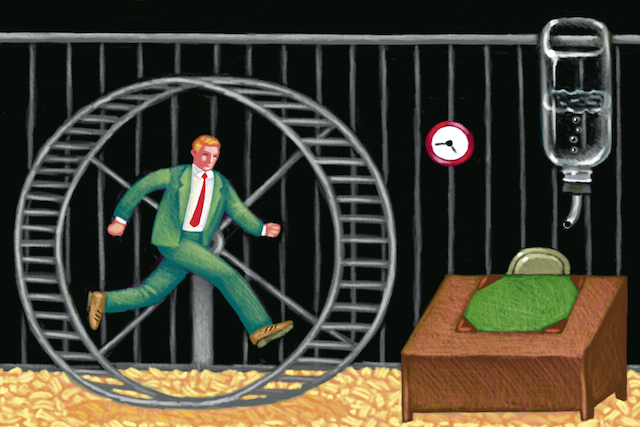
    It’s in these moments of presence that we get a chance to listen and hear what our soul is saying. We know deep down that material things will not make us happier. We know deep down that all the promotions in the world will not fill the void of missing out on life. We know deep down that the rat race is a game we don’t need to be a part of.

    Being present with these uncomfortable feelings is the beginning of a new and rich life.

    Left unchecked the rat race crushes your soul like the grass beneath an elephant stampede. This way of living is toxic for the mind, body, and soul. It’s a disease that fills you with stress, destroys your family, and gives you little to hope for.

    This is the reality I was facing when I was forty pounds heavier and had hit rock bottom with my mental health. I often found myself drinking with the hope that I wouldn’t wake up.

    It wasn’t until I was present with this pain that I could see that I needed help. And it wasn’t until I faced my feelings that I was able to strip away the things that didn’t fulfill me so I could      make space to enjoy the now.

    If you’re living like I once did—distracting yourself from your discontent and missing out on your life as a result—know that things don’t have to continue this way.

    At any time, you can choose to be honest with yourself, let go of the things that drain your spirit, and allow yourself to find joy in the simplicity of the now.

    At any time, you can tune into life’s simple pleasures—the excitement of your dog’s wagging tail, the unexpected smile of a passing stranger, or the way your son’s eyes light up when he smiles—and recognize that this is happiness. And It’s available at any time if you’re not too busy or caught up in your head to appreciate it.

    The purí tribe would point overhead to the passing day as a reminder that this is the only day we have. There’s no sense looking backwards unless that’s the direction you want to go. Each and every day carries a new opportunity to be present and live a rich life.

  • How Happiness Sneaks Up on Us If We Stop Chasing It

    How Happiness Sneaks Up on Us If We Stop Chasing It

    One day a man met a hungry tiger. He ran. The tiger chased him. Coming to a cliff, he jumped, catching hold of a tree root to stop himself falling to the bottom where, horror upon horror, another tiger waited to eat him.

    He hung on for dear life to that thin root.

    Then a little mouse appeared and started to nibble at the root. The mouse was hungry and the fibers started to snap.

    Just then, the man saw a ripe red strawberry near him, growing from the cliff face. Holding the vine with one hand, he picked the strawberry with the other.

    How sweet it tasted! How happy he was!

    Buddhist Koan

    Theres no good time to have a heart attack. They really mess up your plans.

    The timing of mine could have been worse, though. I guess I should be grateful.

    It didnt seem that way: alone, midnight, searing pain in my spine, chest, arms. Raw fear.

    At least I was at home. Thats something to be grateful for.

    Three months earlier Id been directing a show in India. Then a short trip to run a corporate training in Malaysia. I was home in the UK for less than two weeks before Id flown to China for more corporate work.

    Back from China, I drove north to Scotland to sort out my mother, moving her into a care home. A lifetime of books, pictures, clothes, and memories distilled to… almost nothing. How do you fit a lifetime into a small room?

    Through all those trips, in airports, mid-workshops, late in the night, Id had shooting, crippling, breath-stopping chest pains, which I always found some way to ignore. They passed.

    I was in my fifties and fit. I was fine. Theres always some explanation, other than the obvious, when the obvious is too scary to face.

    The day of my heart attack, I drove eight hours from Scotland to England and, exhausted, collapsed to bed.

    I was woken by pain at midnight. At least I woke. That too is something to be grateful for.

    It wasn’t a good time to have a heart attack, but it could have been worse.

    Theres a lot I can be grateful for.

    Looks like a heart attack,” said the paramedic, studying an ECG print-out in the back of the ambulance. Lets get you to the hospital to confirm.”

    “Yes, a heart attack,” confirmed the doctor, some time before dawn. “We’ll find you a bed and work out what to do with you next.”

    Not a good time,” I thought, wires taped to my chest, old men wheezing and muttering in the other beds. Im due in Greece on Tuesday.”

    My clogged arteries didnt much care Id booked my flights. Things happen when they happen.

    ***

    I was in the hospital for ten days. There were daily discussions about how to treat me. My heart attack had not been very bad, but not very good either.

    Open-heart surgery or stenting?

    In the end they couldnt decide, so they left it up to me. Open-heart surgery is more invasive but maybe safer in the long term. Stents could be done in an hour and I could go home. They might not be enough though.

    My choice.

    I chose stents. Attention to my body is the foundation of what I do. I couldnt bear the thought of being cut open. At least, I couldnt bear it as long as there was some other way.

    A good choice?

    Time will tell.

    I had to wait four days between decision and surgery. Four days in the hospital when I should have been in Greece.

    The morning after I chose my treatment, I experienced something very strange. Not another heart-attack, though it happened in the region of my heart. I discovered I was happy.

    Not happy about anything. Not happy because of anything. Just happy.

    Completely, unconditionally happy.

    Id woken at 5am. It was June, so already it was light. The hospital was quiet.

    Sunlight streamed through the window, and I lay looking at the tree outside. My bed was curtained-off, so I was wrapped in privacy.

    I started reading my book, relishing the early hour, and being left alone.

    A bird sang outside.

    I felt spacious.

    I was happy.

    It was simple. It was quiet. There was a bird in the tree outside, singing, because thats what birds do.

    All that existed was a very quiet now.” Book, sunlight, scrubby early-morning birdsong.

    I was alive.

    I didnt know for how much longer, but in that moment, I was alive, and that was enough.

    ***

    Two months later, I spent a week on an island off the Atlantic coast of Ireland. I was taking myself through a disciplined rehabilitation.

    Each day I walked a little further.

    I ate well and slept a lot.

    I worked my stress and anxiety, which Id ignored for decades.

    A small Irish, Atlantic island in summer is warmer than in winter, but not much else changes. Theres wind and rain and wild beauty. I walked, morning, noon, and night. Each day I went further, took more risks. Slowly, I learned to trust my body again.

    On the third day, I stood at the top of one of the larger hills. There was a gale blowing off the sea, and the rain was sheeting down.

    It was viciously cold.

    My waterproof jacket had given up, and spiteful rain ran down my spine.

    I sheltered behind the hilltop cairn, and muttered, This is vile.”

    Then a warmness of the heart.

    Im happy again,” I thought. Once again, not happy because, or happy to, or happy that, or happy for… Just happy.

    ***

    A few times in the eighteen months since, I have felt it.

    A moment of simple happiness.

    What is it?

    We spend so much time seeking happiness through achievement:

    If I can afford this house, Ill be happy.

    If I am in relationship with this person, Ill be happy.

    If I get this job or pass this exam…

    If I live by the sea…

    If I had more friends…

    If I had…

    If I…

    We seek happiness from outside. We see it as a consequence of things beyond ourselves. As if happiness was a perk of a new job, a company car, or access to the gym, or some secret room in a house we want, one day, to occupy.

    But happiness is not a by-product. Happiness is.

    We seek happiness from outside, extrinsically, ignoring that it lives only inside. Happiness is intrinsic.

    The things that come to us from outside, extrinsic rewards, are not in our control. To rely on them for happiness is to put ourselves at the mercy of fate and luck. If we find happiness within, though, it is truly ours. We can learn to nurture it.

    The new house, job, love, car, will not make you happy, though they may distract you from your dissatisfaction for a while.

    Only embracing happiness in this moment will make you happy.

    Like a grouchy old house cat that will not let you pet her, spurns the food you lovingly put out, and hisses if you get too close, happiness will, unexpectedly, curl up on your lap and comfort you from time to time.

    Does that mean that we cannot make ourselves happier? That happiness is arbitrary and we must suffer until it visits us?

    Though we cant force that grouchy old cat to come, we can learn to sit quietly, giving her space and encouragement. We can learn to quieten our mind and allow the happiness of being alive—in this moment—to enter us. We can invite happiness in, by opening to it.

    Not doing things to become happy. Letting ourselves be happy.

    If I stop seeking outside of myself and start experiencing what it is to live this moment, then happiness might curl up in my chest and comfort me.

    Happiness lives on a mountain in a summer gale. It sneaks into an early morning hospital room. It is here now if, between one word and the next, I pause my typing, and I wait.

    It lives inside me, not in things I want, or think I need.

    Its here.

    Now is a good time to be happy.

    Now is the only time there is.

    I am grateful I am here, now.

    I am grateful that, somewhere inside me, now, theres happiness and if I stop looking for it out there, perhaps it will come to sit on my lap.

    How sweet it tasted! How happy he was!

    Buddhist Koan

  • Why We Need to Be Present to Enjoy Our Lives, Not Just Productive

    Why We Need to Be Present to Enjoy Our Lives, Not Just Productive

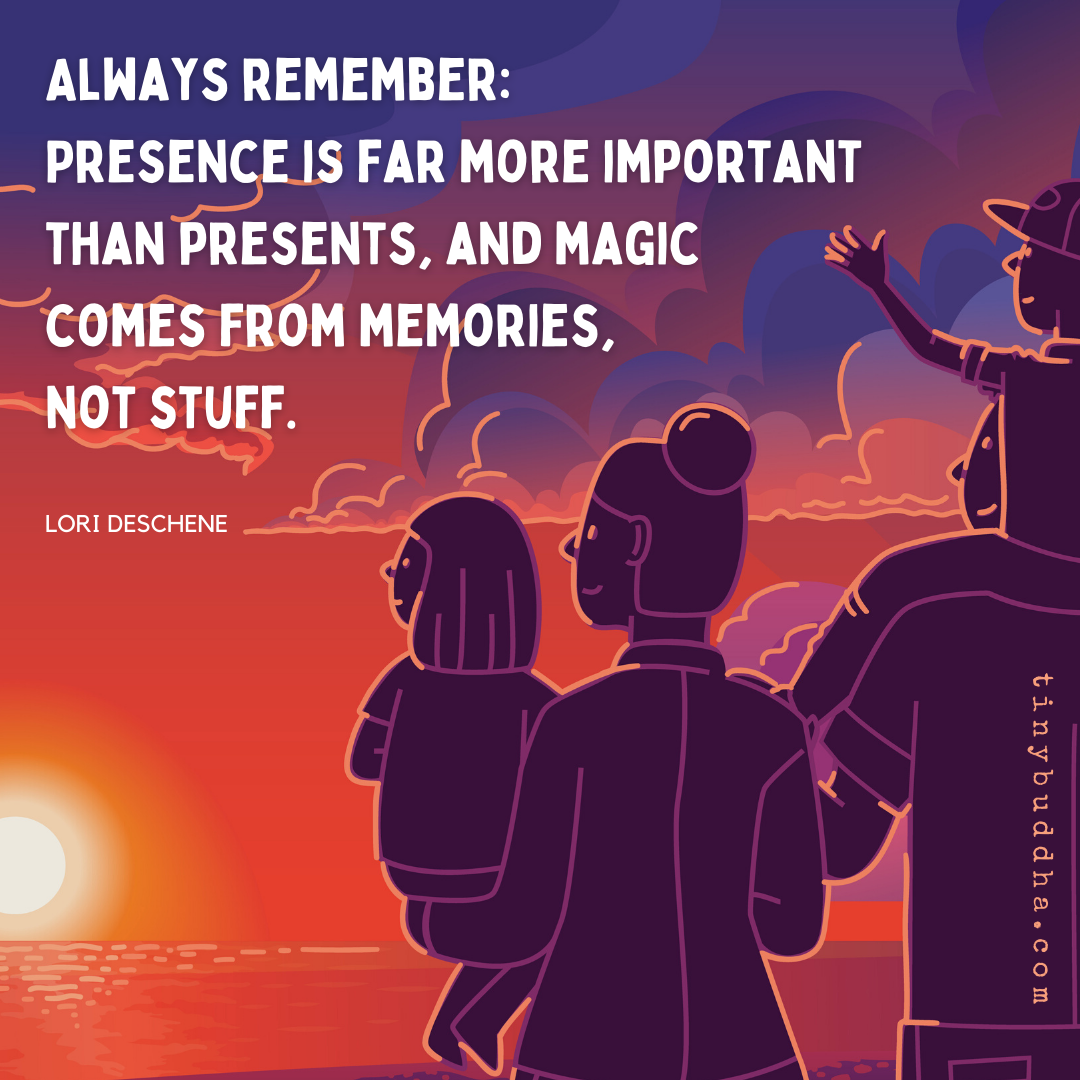
    “Presence is far more intricate and rewarding an art than productivity. Ours is a culture that measures our worth as human beings by our efficiency, our earnings, our ability to perform this or that. The cult of productivity has its place, but worshipping at its altar daily robs us of the very capacity for joy and wonder that makes life worth living.” ~Maria Popova

    I was high on productivity. I had one full-time job, two part-time jobs, and a side hustle. I was getting everything done. Sounds perfect, right?

    Then I started hating my life.

    I had read enough books and articles to tell me how I was not doing enough. Enough self-help gurus had told me that what I needed to do was max out every single hour I had to be minutely close to being “successful.”

    My co-workers often got intimidated by my jam-packed calendar. I don’t exaggerate when I say that every minute of my life was scheduled. Sheldon-level scheduled, with dedicated “bathroom breaks” and everything.

    I ran three to-do lists: daily, weekly, monthly. This was my way of setting out for maximum efficiency. I said “yes” to my boss so often I had become his favorite. Work-life balance, what’s that?

    Tasks were flying off my list like never before—so many horizontal breakthroughs! I wore this as my badge of honor for a while, this art of getting it all done. And why not? I was rewarded for it in money, praise, promotions, awe.

    But then it didn’t feel so great. Instead, I became downright miserable.

    Why Busyness-Productivity Is A Mirage

    I don’t claim that productivity is bad. Doing fulfilling work by minimizing distractions and getting deep focus is truly rewarding.

    But it is crucial to stop and question why you’re doing what you’re doing. It is necessary to pause and reflect on the value of your tasks and actions. Otherwise, productivity translates to useless busyness.

    When I became this productivity freak, I never stopped to ask if any of the things I was doing were giving my life meaning. I was doing a demanding full-time job that didn’t provide me any purpose. My days became a blur of mindless task completions. My mind, heart, and soul were absent from my work. Any given Monday didn’t look so different from a Tuesday three weeks prior.

    And it wasn’t even like I was happy.

    I was meeting all my deadlines, but I was spending no time with my family. There were enough accolades to prove all my achievements but not enough art to fulfill my soul. I answered every email I received within twenty-four hours, but I hardly focused on long-term self-growth.

    On the outside, my life never looked better. But on the inside, I was worse than I had ever been. Distraction, schedules, irritability, and deadlines were the monsters that ruled my life.

    After a month-long burnout, I hit the problem nail in the head. I knew I needed to move on. But how? I resolved to take a calculated leap of faith. I found a client willing to pay me for my freelancing services for at least two to three months and made a thick emergency fund by cutting out on expenses. Then, I quit the unfulfilling full-time job and gave my heart to work that I truly found meaning in. I stopped making productivity my goal. I opted to choose presence instead.

    Presence > Productivity

    I read Annie Dillard’s, The Writing Life, in which she memorably wrote, “how we spend our days, is of course, how we spend our lives.”

    After reading this book, I realized that productivity would only be fruitful when coupled with presence. I knew then that presence was what would make my rewards meaningful.

    What is presence? Presence is the art of being in the moment, the luxury of pausing, the virtue of stillness. It is being alert, aware, and alive to this moment.

    There’s a reason why our culture runs for productivity instead of presence. Productivity helps us shut away from reality. It keeps us “busy” into a future that is yet to manifest.

    It is so much easier and convenient to take the shield of productivity against the beautiful, buoyant, and sometimes disruptively painful present.

    Performing one task after next gives us an excuse to not fully live, not completely concentrate, not unbiasedly accept.

    I used to be that way—trying to avoid the truth that I was not finding my work meaningful. I wouldn’t accept that this job was emptying me slowly, living in denial of a reality I was living. Was I not getting things done? I was, more than ever before. But was I happy? I had never been more unhappy with my own choices.

    Being productive every minute of every day meant I could avoid the fact that many of my friendships were depleting, toxic, and unhealthy. I was lying to myself that it was all to have a good social life. In reality, I would go out of my way to avoid being alone, to avoid answering the big questions pertaining to my life that can only be answered in solitude.

    But coupling our actions with productivity and presence can have an astounding effect on our lives. It can make every task we do driven with intention, purpose, and meaning. Presence is what helps us reap the internal rewards that come with doing fulfilling work.

    Choosing Presence

    If you are anything like me, choosing presence over productivity can take some practice. Productivity was my normal mode of operation. It was easy; it came naturally. But opting for presence in my actions wasn’t so simple.

    The art of being present and intentional in all my tasks was like writing with my non-dominant left hand. I searched for help and stumbled upon Tim Ferris. He often says to think of your epitaph to cut through all the noise and maze of productivity. It is a way to find out what truly matters to you by getting a super-zoomed out version of your life.

    As morbid as it sounds, that is what I did. I imagined what I would like to carve on my epitaph, and the important stuff came into a laser-sharp focus:

    I needed to write. I needed to make time for solitude, for serendipity, for hobbies. I wanted to create more memories with my family. I wanted to let go of draining friendships and put all my energy into relationships that filled me with fulfillment, meaning, and growth. Taking it one step at a time, I decided to hand in my resignation. I landed my first writing gig in under two weeks.

    And hey, it’s not like I don’t struggle to write with my left hand anymore. But I am growing each day. It takes some practice and effort to make room in your calendar to “be present.” I am learning to be uncomfortable by turning the volume down of “getting things done.”

    I have noticed that it is the minor changes that count. It is taking a little more time to craft that email mindfully. It is that courageous “no” to a project that can help you surpass your quarterly KPIs but take away from your family time. It is choosing to take a soothing fifteen-minute walk break over checking off another mindless to-do list task.

    Presence is a process. It requires the discipline to focus on the present moment when productivity pushes you to see a non-existent future. Presence is your un-busy existence of utterly unadulterated joy. It is your creativity’s cradle. It is your time to just be.

    So do it. Make the hard choice. Live your life with presence to help you find joy in the now instead of pushing toward some destination in the future. None of us really know where the future will bring us, but we can all choose to enjoy the scenery along the way.

  • How to Make Everything Easier by Accepting the Present Moment

    How to Make Everything Easier by Accepting the Present Moment

    “The power of now can only be realized now. It requires no time and effort. Effort means you’re trying hard to get somewhere and so you are not present, welcoming this moment as it is.” ~Eckhart Tolle

    Eight years ago, I was very depressed. I wanted nothing more than to stop feeling this way and dreamed of escaping my body. I had struggled with depression for many years, and I was terrified that I might feel that way forever.

    Someone recommended I do a mindfulness-based course. This turned out to be the one of the most helpful parts of my journey. The therapist suggested I needed to learn to sit with my feelings instead of resisting them, but this terrified me. I was afraid of my feelings, and I thought that accepting them meant accepting they would be there forever.

    But as I practiced the skills of mindfulness and distress tolerance, I noticed that when I accepted my emotions they often shifted more easily. Or at least I didn’t make them worse by worrying about them. I realized that I had been making the depression and anxiety worse by resisting my feelings.

    Connect to the Present Moment

    I’m guessing this is a common struggle, and the solution can feel counter-intuitive. Many people fear that if they let themselves feel their emotions they will be taken over by them. However, when I make space for my emotions without acting on them, sometimes there is pain and I might cry, but it is a clean pain rather than a mental anguish, and it doesn’t last as long.

    I also find that connecting to the present moment helps me create a little space in my mind when my thoughts start stressing me out.

    It’s easy to get caught up thinking about the past, worrying about the future, or wishing the future would hurry up and arrive. When I notice this happening now, I ground myself in the present moment by listening to the sounds around me, noticing my feet touching the ground and my breath flowing in and out, and I feel calmer.

    Observe Your Thoughts and Emotions

    I’ve learned to observe my thoughts instead of attaching a story to them. Emotions can’t last forever on their own. I heard that the natural lifespan of an emotion is about ninety seconds. But we can keep them alive for longer by thinking about them, being afraid of them, and resisting them. Emotions, like everything else in life, come and go.

    Once I had the ability to create distance from my thoughts and not be consumed by my emotions, I was able to take action to make my life better, even when I didn’t feel like it. I did my best to embrace life as it was instead of focusing on how I would like it to be.

    This doesn’t mean I didn’t still struggle at times, but embracing the present moment helps me get through these times more constructively. I don’t think my relationship with my partner would have worked if I hadn’t already started learning these skills before we met.

    Stop Resisting the Present

    Fast forward a few years and I am in Colombia, South America, where my partner is from. I was visiting his family when Covid-19 hit.

    Like many people, I no longer had the freedom and independence that I was used to. Instead of living in the city like we had expected, we were staying in his parents’ town, and my partner was working from home. I didn’t have the option to join a Spanish class or get a job like I had planned, and at times I felt lost. After six months of this I was getting desperate, but I couldn’t travel home to Australia even if I wanted to.

    During a tearful conversation, my partner suggested that maybe I was resisting the situation too much. There was nothing we could do about it, and I was just making it worse for myself by resisting reality.

    The next day my sister suggested I read The Power of Now, by Eckhart Tolle. It totally changed my perspective. I was reminded that in the present moment in front of me everything was actually okay. It was when I thought about the future that I got into a dark place.

    Stop the Mental Time Traveling

    Just like when I was depressed, I thought, “I can’t take this anymore! How long is this going to go on?” And just like then, when I accepted the current situation it didn’t seem as bad. I started to enjoy the free time and relish my time there knowing that nothing lasts forever, good or bad.

    I read books, did yoga, lay in the hammock, and studied Spanish. These were all the things that I was doing before, but it felt different. I wasn’t resisting being in Colombia anymore, I was just there. I stopped wishing to be back home or worrying how long it would be. And that allowed me to enjoy the beautiful, unique things about that season.

    I slowed down and let myself stare up at the trees and listen to the birds. I enjoyed the chance to get to know my in-laws and my fiancé’s culture. Sometimes now, when I stop and listen to the silence, I feel a deep sense of peace and joy.

    Take Action When You Can

    Now, if there had been something that I could have done to change things, of course I would have done it. I’m not advocating for passive submission or fatalism. Sometimes we need to take action, set boundaries, and be proactive. In fact, when you stop resisting the present it allows you to see things as they truly are. This can empower you to focus on the actions you can take right now rather than focusing on the future.

    But when there is nothing we can do, accepting this present moment is often more powerful than worrying about all the moments to come. You’ll know what to do when the time to act arrives.

    Surrendering Saves Energy

    If you are struggling with a situation that you can’t control, can you come back to your body and what is around you here and now? Can you make space for any emotions that are present and allow them to move through you? Focus on the one breath you are taking right now. What can you feel, see, smell, taste, and hear?

    Surrendering to the present is like floating on your back instead of thrashing around in the water trying to get out. Trust that eventually you will drift safely to shore. This not only saves energy, it allows you to enjoy any positives in your current situation, because just like the difficult things the good things won’t last forever either. The present moment is all we have, and in a way it’s all that is real.

    It’s a Practice

    I’m not naive enough to think that I won’t have any more bad days. That’s part of being human, especially when we’re tired, hormonal, or stressed. I may forget this lesson and need to learn it again in a new context. I suspect it’s something I will be practicing for the rest of my life, and that’s okay. But I hope that next time I will be able to catch myself a little sooner when I am resisting instead of simply being in the present moment—where I inevitably find peace.

  • Why Presence, Not Time, Is Your Most Important Asset

    Why Presence, Not Time, Is Your Most Important Asset

    “Wherever you are, be there. Lifestyle is not something we do; it is something we experience. And until we learn to be there, we will never master the art of living well.” ~Jim Rohn 

    I have been told again and again that our time is our most precious asset. But I disagree.

    The blogosphere is filled with tips on time management—how to get more for our time. I am willing to bet my life that you have come across many such tips online yourself.

    You have probably even adopted some of them.

    I myself am notorious for scouting the internet to find any new tip to help me manage my time better. And yet I find that I am struggling. Yet I find myself constantly being a prisoner to my devices.

    There is one thing that will beat time any day—presence. Time might be important, but our presence is paramount.

    Tell me if you can relate: You are at a family gathering or a reunion, and you cannot help but notice how disengaged everyone around you is. Your cousin is busy taking selfies while your aunt is on the phone with her friend. Your dad is catching up on all the Donald Trump tweets and your sibling is making a TikTok video.

    So, what do you end up doing? You pull out your phone and start checking Instagram.

    I know it because I have been there myself.

    Social gatherings are no longer what they used to be a decade ago. We are constantly connected now. Anxiety kicks in if we cannot find our phones or if the battery is about to die.

    I am sitting in a cafe typing this, and when I look around, I see a bunch of people sitting but busy on their phones. Present but only physically. Technology has made our worlds smaller, yet at the same time made us more distant.

    We have come to believe that just showing up is enough. As if just being present physically will make things better. It rarely ever does!

    It is infuriating and frustrating at the same time—being there, yet not being present.

    We show up to fit in, but if given a choice, we would rather not be there. Physically, we are in one place, but mentally, we are busy wondering how life might be greener on the other side.

    Mentally, we are busy trying to stay “up to date” with god knows what.

    Presence is a big deal.

    Imagine you’ve made a reservation at a fancy restaurant for a special night. You’ve heard good things about the food and the ambience of the place. You’re excited for one hell of a night, only to be served by a preoccupied server who ignores your table, messes up your order, and ruins your dining experience.

    We have all been there, haven’t we?

    Now, think back to the last time you got someone’s full attention. How did that make you feel? Tell me that the experience wasn’t memorable and pleasant.

    It’s easy to tell the difference when someone is mentally absent versus when someone is fully present because presence cannot be delegated. You simply cannot hand it off to someone and get away with it. 

    You also cannot cut corners with your presence, because then you are as good as not there. You are either there or you are not. There is no in-between!

    All of us have to own our presence and choose to be in the moment.

    In a world that is becoming more isolated, presence becomes a big deal because it is now a scarce commodity. There simply isn’t enough of it going around, which makes it more valuable than time.

    As Maya Angelou said:

    “I’ve learned that people will forget what you said, people will forget what you did, but people will never forget how you made them feel.”

    Unlike gifts, our presence cannot be copied, imitated, or replicated. Just like our fingerprints, our presence is unique to us, and without us, there is a void that nobody can fill.

    Every opportunity you get—and trust me, they get fewer and fewer as you grow older—you should make a choice to be present.

    Your relationship doesn’t need time; it needs you to be present. It needs you to take notice of the smiles, the laughter, the hugs, the sadness. It needs you to be an active participant in the uncomfortable moments, the difficult conversations, and the embarrassing pictures.

    Next time, when you find yourself reaching for your phone, reach for it, switch it off, and put it away. This will allow you to, one, be present and, two, catch up with the people present in the room rather than stay up to date with the ones outside. In most cases, the ones that matter are right there with you.

    Next time, choose presence because time only matters if you’re really there to enjoy it.

  • If You Think You Have to Be a People-Pleaser to Be Kind

    If You Think You Have to Be a People-Pleaser to Be Kind

    “I don’t need a friend who changes when I change and who nods when I nod; my shadow does that much better.” ~Plutarch

    People-pleasing can seem Iike a way of connecting with others. We believe that if we keep people happy, then they’ll like us and want us around. While it may be true that pleasing others will win us approval and a place in their lives, changing and editing ourselves can’t create the connection we long for.

    We confuse people-pleasing with kindness. After all, aren’t we, as people-pleasers, described as too nice? People-pleasing can be seen as giving of ourselves to put others first, but people-pleasing isn’t the kindest way to treat ourselves or the people around us.

    Honesty is Kinder than People-Pleasing

    My friend, Amy, would occasionally invite other people to join us without letting me know. I’d arrive at the park or the coffee shop and find myself unexpectedly part of a group.

    To Amy, this wasn’t a big deal. She was generous about introducing me to new people and for her it was genuinely the more the merrier. I, however, prefer one-on-one interactions to groups, and I really dislike being surprised in social settings.

    The thing is, she never knew it bothered me because I never told her. I was so worried about making sure she liked me that I pretended to be happy about these surprise additions to our outings. I told myself I didn’t want to hurt her feelings.

    Unfortunately, the result was that I resented the other people and didn’t give them a fair chance to see if we might also become friends. It undermined my trust that Amy really saw me and valued my friendship. It reinforced my belief that I wasn’t good enough for someone to want to spend time with just me.

    When I wasn’t honest about how I felt, it wasn’t kind to anyone involved. I knew Amy to be a caring and thoughtful person. Most likely she would have been glad to let me know when she was extending additional invitations and to check in about what I wanted for a particular meet-up if only I’d been honest about how I felt.

    When we people-please, we say and do things that aren’t really true for us. We may accept an invitation that is inconvenient or agree to do a favor we resent doing. We might claim to want to eat at a certain restaurant or do a certain activity even though we’d actually prefer something else.

    We may keep our opinions and beliefs to ourselves unless we’re sure they line up with those of the person we’re trying to please. We might base our decisions—from what clothes we wear to what jokes we laugh at to what career we pursue—on what we think will win approval. We may hide how the other person’s actions are impacting us.

    None of these things are honest. We’re not being kind to others when we try to manipulate them into liking us instead of letting them really see us.

    We get tripped up because honesty can feel unkind if we think it will disappoint someone or make them unhappy. Of course, honesty can be used in an unkind way. People will say intentionally hurtful things and then justify their cruelty under the guise of honesty, but we can be honest with kindness.

    When we are honest in our relationships, we give others a true representation of who we are. We are clear about what we will and won’t do, what we do and don’t want. When we are honest we build trust with others that they can take us at our word and learn to see ourselves as a person who can be trusted.

    Presence is Kinder than People-Pleasing

    When I spent time with Amy, I worried a lot. I watched to see how many cookies she ate before helping myself to another. I worried about whether she was offering tea just to be nice or whether she’d actually be disappointed if I didn’t want to try the new blend she’d been sent as a gift.

    I avoided conversation topics where I wasn’t sure we’d agree. I was cautious when answering her questions about what I was up to. I’d offer only a glimpse and then try to gauge her levels of interest and approval before sharing the next little bit.

    The thing is, I wasn’t able to relax and just enjoy spending time together. It was obvious to her that I was trying to do things the way I thought she wanted me to. She tried to reassure me that it was okay to be myself, which was embarrassing for both of us.

    I appreciated Amy’s ability to ask thoughtful questions and how encouraging she was about anything I did share with her. The main things I remember about the time we spent together, however, don’t tell me much about who she is. I remember more about what I said and did because my focus kept turning to how I was measuring up.

    When we engage in people-pleasing behaviors, we watch the people we hope to please for cues about what they want and need and who they expect us to be. It can seem like we’re being very present with them because we’re paying such close attention.

    Too often, however, our attention is strategic—we’re using it to meet our own ends instead of really engaging with them as people. We watch for how each thing we do or say is received and use that data to continually adjust ourselves to be more pleasing.

    What if, instead, we approached our time with another person with curiosity—seeking to know them for the joy of knowing another human being? Curiosity requires presence—being open and welcoming to what is there instead of what we expect to find. One of the kindest things we can do for someone is to set aside our expectations and see them for who they are—and that includes ourselves.

    Trust is Kinder than People-Pleasing

    It didn’t matter how kind and encouraging I believed Amy to be, I didn’t trust that she would want to be my friend if I ever let her really see me. I didn’t trust that relationships could survive disappointments, differences, or disagreements. I struggled to believe that anyone really wanted to know me and that I would deserve their friendship if they did.

    When I didn’t trust that Amy would want to be my friend unless I went out of my way to please her and I didn’t trust that I was worthy of her friendship, it made for an uneven relationship. I saw her as better than me and was trying to control her perception of me so I could keep a place in her life. Our interactions were based on my striving to please instead of on two humans seeing and supporting each other.

    People-pleasing is characterized by a lack of trust. We people-please because we don’t trust that we are good enough to be wanted just as we are. We don’t trust others to see the value in us and treat us well unless we always give them what they want or stay within the parameters of who they expect us to be.

    A kinder approach is to cultivate trust. As we unhook from people-pleasing, we build trust in ourselves. We develop trust that we can meet our own needs and that we can express our preferences with kindness. We learn to trust that we will be okay if not everyone likes us and that there are new opportunities even after disappointment.

    There is also kindness in trusting others. When we choose to trust someone, we give them a chance to see and support us. We open up the possibility for a mutual relationship.

    Trust others and trust yourself to build a relationship that is genuine and satisfying for you both. Some relationships will not survive if we cease people-pleasing, but those relationships were not built on true kindness to either person. Invest in relationships that are based on kindness instead of control—where you can know and be known.

    Consider your closest relationships. Are they a space where you are honest, present, and trusting? If not, what gets in the way? How can you bring a little more honesty, presence, and trust into your relationships this week?

  • Connecting to the Sacred in the Chaos of Everyday Life

    Connecting to the Sacred in the Chaos of Everyday Life

    “Love is our true destiny. We do not find the meaning of life by ourselves alone—we find it with another.” ~Thomas Merton

    Seth: When Aria and I decided to devote a year to encouraging one another in our mindfulness practice, we couldn’t have known what those twelve months had in store.

    I had always enjoyed good health—“taken for granted good health” is more accurate—and suddenly I was faced with major health challenges of unknown origin. Countless trips to doctors and other professionals provided no explanation for my chronically low energy, nightly insomnia, digestive issues, vocal problems, and eventually a deep depression.

    In happier times two years earlier, I had attended Aria’s wedding in Northumberland, England. It was an incredible weekend—misty morning walks in a labyrinth, pounding rain on the roof of the old stone church during the exchange of vows, shared meals at a long wooden table in the long afternoon light. We both felt that our hearts were so open, and it was easy to focus our attention on what we truly cared about.

    The day after the ceremony we marveled together at the deep sense of connection we experienced throughout the weekend. It wasn’t entirely surprising, of course, given the circumstances and the explicit focus on love. But if it was possible then, why couldn’t we nurture that quality of presence and open-heartedness in our day-to-day lives?

    That shared question led us to our year-long collaboration in finding the sacred in everyday life. For a full calendar year we wrote to each other every day, urging one another to connect with what we held most dear. We took turns—Aria would send me a mindfulness practice one day, and I would send him one the next.

    Aria: During the year I had a surreal realization with profound clarity. Everything that mattered—everything that was truly important—was relational: my wife, our families, our dog, and our friends. These were the foundation stones of my happiness. Everything else—work, money, reputation— seemed like a game. They were fun, but they weren’t issues of life or death.

    Seth’s messages reminded me that sometimes we lose ourselves in the game. We become so immersed in the narrative we’re spinning that we forget it’s just a story. It’s like living in the Matrix. The game seems like it’s more important than everything else, as though it’s the center of our universe.

    Then, now and again we gain that beautiful, tender, precious thing called perspective and let out a sigh of relief. We breathe softly and deeply, connecting on a deeper level to ourselves and simultaneously to something even greater.

    At times, this perspective comes at a cost. The loss of a loved one or the pain of a reality that we don’t want to accept may force it upon us.

    The year that we wrote to one another was challenging in a myriad of ways, from working with children with terminal cancer, to nearby London terrorist attacks, to unexpected deaths. However, there were also highlights, one of which for me was running my first ultra-marathon in South Africa. Wherever we were in the world, and whatever was happening in our lives, waking up to a mindful message from Seth was deeply grounding and uplifting.

    Seth: Aria’s messages were a constant lifeline during the difficulties of that year, providing an opportunity at least daily to check my automatic reactions to difficulties and come back to center.

    I remember in particular walking home one evening after work, wiped out from the day and feeling like I had nothing to give my wife and kids once I got home. I dreaded subjecting my family to my low mood and to the person I’d become.

    As I struggled to walk up a gentle hill in the falling darkness, I remembered Aria’s encouragement that day—to focus on the qualities we want to embody in our interactions with others. I settled on love, joy, and strength, and realized the evening didn’t have to be a complete loss. It ended up being a positive time with the people I love, instead of the sad mess I’d feared.

    Aria: There was something particularly comforting about receiving a thoughtful note from someone who cares deeply about you. Knowing that another person is holding you in mind is profoundly powerful, especially when you’re struggling.

    Sometimes it’s difficult to feel the sunlight. We can see the sun shining, but the rays don’t seem to touch us. We know intellectually that we have much to be grateful for in life, but we can’t feel it.

    During these times, Seth helped me to appreciate that life is to be experienced rather than solved. There is no one way we should be feeling. Our moods ebb and flow, sometimes quickly, other times more slowly. All things change. Acknowledging this gave me the freedom to still act, just without expecting my behavior to change how I felt.

    We can all still take steps, but without tying our happiness to a “successful outcome.” We can return to the basic pillars of wellbeing: wholesome food, quality sleep, meditation, checking in with the present moment, and connecting to the people we love. We can nourish ourselves and let go of any expectations. We can remind ourselves that what will be will be, and at the same time, all will be well.

    Over the course of the twelve months writing to one another, our relationship grew and deepened. Knowing that a friend was depending on me was a big responsibility, but it also provided meaning in my own life.

    It wasn’t always easy: in the beginning I spent hours crafting the next email to Seth. At the end of a long or tough day, sitting down to write may have been one of the last things that my mind wanted to do. However, a little like doing exercise, I always felt better afterward. Ironically, serving someone else nourished my own mind and body. We gain something by giving. Writing to Seth connected me to what I value most: compassion, authenticity, and love.

    Seth: If you’ve craved greater connection to your core self and the people and things you care about, there are many possible avenues. Common approaches include prayer, reading sacred texts or a daily devotional book, and mindfulness practices like yoga or sitting meditation.

    Whatever approach you choose, consider partnering with someone you love for some period of time: a month, six months, a year, even longer. It could be a best friend, a spouse or partner, a sibling—someone you trust implicitly.

    Talk with your loved one about what each of you wants to focus on during the process. We had decided in advance on themes like presence, simplicity, and service. How would you like the other person to encourage you? What kinds of reminders will be most helpful to them?

    Decide together on a format for encouraging one another in your mindfulness practice. For example, you might send each other quotes that you find meaningful, reflections for the day, an invitation to apply mindful awareness in a specific area, or whatever you like. You could also consider doing sitting meditation together—a so-called “medidate.”

    Whatever you choose, allow it to nourish not only your individual and spiritual practice, but the quality of your connection to your loved one. Whatever joys and struggles you experience together, your relationship will never be the same.

  • How My Gratitude Journal Has Made Life More Fulfilling and Fun

    How My Gratitude Journal Has Made Life More Fulfilling and Fun

    “Be kind. Be thoughtful. Be genuine. But most of all, be thankful.” ~Unknown

    Have you ever tried to keep a daily journal?

    How long did you last?

    I’ve tried to keep one many times in my life, and I have failed every time. The longest I’ve ever kept a journal was for a measly two weeks, in a Google Doc, with my college roommates as a way to keep in touch, before I got bored and stopped.

    For the last four months, though, I’ve managed to write in my journal every day. The trick, for me, has been to keep my updates short and sweet and to write less about my daily problems, which tends to make me feel hopeless and overwhelmed instead of relieved, and more about the things I love in daily life.

    I keep a gratitude journal, and it isn’t a drag, like my past diaries. It’s fun and makes me laugh because I limit myself to writing about only two types of things: moments of gratitude and moments of triumph, or wins, as I call them. Occasionally, and I mean only when something bothers me so much that I can’t sleep, I rant.

    Keeping the journal has changed my life, and it’s good value too! Doing it costs me less than five minutes and five dollars, depending on the brand of pen I buy (I’m a sucker for Pentel Energel pens).

    If you’re looking for ways to integrate more gratitude into your life, I can definitely recommend keeping a gratitude journal. I’ve benefited from it in five specific ways, probably more. Here’s how:

    1. I enjoy spending time with loved ones more and see our challenging moments differently.

    I recently realized that one of the impacts of losing my mom is a constant fear of losing other people I love. My mom died five years ago, and I feel anxious about eventually losing my dad all the time. It puts a lot of pressure on me to be fully present for every moment we spend together and to be the perfect daughter.

    Here’s an example: My dad and I see a movie together, and I’ll periodically say to myself throughout the film “This could be the last movie we see together. You need to appreciate every moment!”

    It’s a pressure that will always be part of me, but I write in my gratitude journal because I refuse to let it control my life.

    Writing things like, “I’m grateful that I got to see a movie with Dad today,” relaxes me. It’s like giving myself permission to enjoy the movie because I know that I’m not letting the moment mindlessly slip by.

    My gratitude journal also helps me reframe the challenging moments I have with my dad. For example, I recently wrote, “My win today was setting aside my ego and communicating with Dad after we got into an argument over cleaning out old things.”

    Now, instead of seeing confrontations as disasters to be avoided, I see them as opportunities for us to communicate and strengthen our relationship.

    2. I can find rest, even when I’m upset.

    When I was little, my mom predicted that I would become a sensitive person because I had a big forehead. I have yet to find scientific proof of the relationship between the two, but I’m definitely passionate and I can take certain things very personally.

    What bothers me most is when people don’t follow through on their work. “How can they not have told me that they’d send it to me late?” becomes, “It’s so easy! I would’ve done that for them,” which then becomes, “I don’t trust this person anymore.”

    When I hop onto this train of thought, it’s hard to hop off and it weighs me down as I struggle over how and when to express my frustration.

    Writing in my journal every day helps me deal with the disappointments of daily life. It’s a safe space to rant about whatever is upsetting me. I do a big release of built-up anger and frustration on paper, and then I think critically about a solution to the problem.

    Not too long ago, I furiously wrote about an especially frustrating day at work and, while writing, realized that I had been doing everything right; I just wasn’t receiving the support I needed. Moreover, I saw that it was my responsibility to ask for it. I never would have come to this realization without journaling about it first.

    When I finish ranting and raving, and regain some feeling of control over the situation, I say to myself, “Okay, are you ready to move on?” And I write down one thing, no matter how small, to be grateful for. For example, “I’m grateful to my heart, for pushing oxygen to the rest of my body,” or, “I”m grateful for that awesome chocolate chip cookie I ate for dessert.”

    It’s my way of ending each day on a good note, and it prepares me for sleep.

    3. I wholeheartedly accept joy.

    In her Netflix special, “The Call to Courage,” Brené Brown says, “…joy is the most vulnerable of all human emotions. We are terrified to feel joy. We are so afraid that if we let ourselves feel joy, something will come along and rip it away from us…” (00:45:49).

    I love traveling. I’ve been traveling since I was two and have since been to over twenty different countries. Every time I go somewhere, I’m so overjoyed that I fear something bad happening. I might worry about the plane crashing or an accident happening at home while I’m away, both of which I hope I never have to experience.

    Another example is when I brave unnecessary hardship and call it the price I have to pay for something else, which is often completely unrelated.

    Brown’s research says that we wait for the other shoe to drop to protect ourselves from joy, which is one of the most vulnerable emotions along with love and belonging.

    Writing in my gratitude journal enables me to feel joy without the sense of foreboding. If something good happens to me, I no longer see it as a foreshadowing event to disaster. I just see it as another item to be added to the list of wins or moments of gratitude in my journal, which I can (and should) enjoy.

    4. I am deepening my commitment to certain people and activities.

    My gratitude journal helps me cope with the uncontrollable outcomes I face in everyday life, but it also helps me make healthy decisions about the activities and people I engage with.

    For example, after keeping my journal for several months, I noticed I was often grateful for my yoga practice and my public speaking and leadership club, Boston Toastmasters.

    As a result, I decided to increase my commitment to both activities. Instead of practicing yoga weekly, I now practice daily. I also recently ran for (and won!) an officer position at my Toastmasters club.

    Certain family members and close friends also make regular appearances in my gratitude journal. It reminds me to maintain our relationship and actively update them about my life, even if they live in another state—or country!

    I like having a record of interactions, activities, and people that bring joy or wins; it brings some very important parts of my life into focus.

    5. I am more satisfied with myself and my accomplishments.

    Historically, I’ve been my own harshest critic. Some days, when I refuse to believe that I’ve done enough, I spread myself too thin and completely exhaust myself.

    I was recently awarded a scholarship to go to journalism school. But everyone I shared the news with said something like, “Oh, journalists don’t make much money, you know.” Gee, thanks!

    I started doubting myself, thinking, “How will I take care of myself? I can’t believe I decided to go for journalism. Who am I to think I can write, anyway? There’s no way I’ll be able to make a living on it.”

    By chance, I happened to see the win I’d recorded the day I’d received my acceptance letter: “Today, I won a scholarship to go to journalism school.”

    I may not make a stable living on my writing yet, but I won a lot of money for the one piece I submitted in my application. That’s a big win! And thank goodness I had my gratitude journal to remind me of that; otherwise, I would’ve continued to question my decision, even though I know that this program is exactly what I want to do.

    My wins remind me that I’ve done enough, and in most cases, more than enough. If I see proof that I’ve done at least one thing that day to achieve my goals, then I can relax. Recording wins transformed me from being my own toughest critic into one of my biggest cheerleaders.

    I’ve written 142 entries, and I’m still going strong! In this short period, gratitude journaling has impacted my life in so many ways.

    It’s challenged me to cherish every moment with my family, good or bad. It’s helped me find rest and practice acceptance, especially on difficult days. It’s also become my way to methodically focus and deepen my commitment to certain areas of my life. Most importantly, it has reminded me to celebrate all of my wins, no matter how others see them. It’s changed my life, and it could change yours too.

  • Experience the Benefits of Mindfulness: Join eM Life’s Free One Percent Challenge

    Experience the Benefits of Mindfulness: Join eM Life’s Free One Percent Challenge

    Whether you’re a regular reader here or you just found your way to Tiny Buddha recently, odds are you’re familiar with the practice of mindfulness, but you may not be aware of the many benefits.

    A regular mindfulness practice can not only boost your mood, reduce your stress level, and help you be less reactive, it can also enhance your creativity, improve your sleep, and increase your resilience so you’re better able to handle life’s varied disappointments and challenges.

    And that’s just the tip of the iceberg. Studies have shown that a regular mindfulness practice can also give you a higher pain threshold, lower your blood pressure, and even slow down neurogenerative diseases, such as Alzheimer’s and dementia.

    On a basic level mindfulness is being present and aware of what’s going on within and around you, without judgment. In theory, it sounds simple—it’s simply being where you are. But our minds can be loud and busy, and finding freedom from our thoughts isn’t easy, which is why we need to make mindfulness a regular practice.

    Just fourteen minutes of daily practice—one percent of your day—can help you experience the healing, calming benefits of mindfulness in your everyday life. And eM Life’s One Percent Challenge can help you make this a habit.

    eM Life’s One Percent Challenge

    Each day of this online challenge, you’ll be able to access interactive sessions to help you deepen your mindfulness practice. You can participate live or on demand and immediately exercise the skills you’ve learned with clear strategies for how to integrate them into your daily life.

    By participating in this challenge, you’ll learn to quiet your mind by devoting attention to your breath and body, and to practice awareness so you’re less apt to get swept up worries, fears, and unnecessary drama.

    The One Percent Challenge is a free, simple way to dramatically transform your life. With just fourteen minutes a day, you’ll cultivate a sense of insight and peace and will be better able to mindfully pause, reflect, and make the choices that best support your health and well-being.

    You might even find that after committing fourteen minutes and beginning to experience a positive shift, you feel inspired to practice for longer, which will deepen the benefits.

    Give Back While Giving Yourself Peace

    By participating in eM Life’s One Percent Challenge, you’re facilitating charitable donations to a number of worthy causes. The more people who practice, and the more minutes they complete, the greater eM Life’s donations to the following organizations:

    Mental Health America

    The country’s leading nonprofit dedicated to helping break the stigma around mental health

    ShatterProof

    An organization with a mission to change the conversation about addiction through advocating for research, resources, and change

    The Mardy Fish Children’s Foundation

    An organization that provides children with opportunities to participate in safe and impactful fitness, nutrition, and enrichment programs

    Earn Rewards

    After completing ten, twenty, and thirty days of mindfulness sessions, you’ll unlock wellness-focused rewards, like a 1:1 mindfulness session with one of eM Life’s world-class instructors, a Garmin vivomove® HR Smartwatch, a Mindful Daily Practice Guide to keep your mindfulness journey going, and much more.

    Make this the year you cultivate mindfulness for a more present, peaceful life, and you’ll not only reap the many rewards, you’ll also make a positive difference for countless people in need.

    You can register for eM Life’s One Percent Challenge here. I hope it’s helpful to you!

  • What Expecting to Die Young Taught Me About Living a Happy Life

    What Expecting to Die Young Taught Me About Living a Happy Life

    “I’ve come to trust not that events will always unfold exactly as I want, but that I will be fine either way. The challenges we face in life are always lessons that serve our soul’s growth.” ~ Marianne Williamson

    At the age of nine, I was sitting in a doctor’s office at Baylor University with both of my parents when we were all told I wouldn’t live to see twenty-three. The doctor casually told us my dad would probably never get to walk me down the aisle and I’d likely never make my mom a grandmother, but there was great chicken pot pie in the cafeteria on the first floor.

    Enjoy the rest of your day.

    Eight months later, on my tenth birthday, the possibility of my dad walking me down the aisle was permanently taken away when he died suddenly of an aortic and thoracic aneurysm. He had the same genetic abnormality I have, which caused the aneurysm, so by my logic, confirmed by the doctors, my demise was not far behind.

    I had no idea the day I turned ten, the day I lost my dad, my misguided and broken heart gifted me a license to be entitled and reckless until the day I died. Which, according to the medical community, wasn’t that far away.

    Let me back the medical drama bus up back to the day in Texas at the hospital just for a quick, minor detail to note.

    That day my dad and I were simultaneously diagnosed with a genetic disorder called Marfan Syndrome.

    In a very tiny nutshell, it’s a connective tissue disorder found on the fibrillin one gene. It essentially weakens all connective tissue in the body. The result is a body whose heart, lungs, eyes, and spine are severely impacted. A prominent and common feature with this condition is “abnormal” height. People affected are relatively tall (I’m 6’2”, my dad was 6’9”).

    For precautionary purposes, we both stopped participating in any activities that raise the heartbeat, to decrease the risk of having an aneurysm or potentially causing damage to the face due to dislocation of the lens in the eye.

    No contact sports, no exercising, no gym at school. I was basically told I could walk, bowl, or golf. I hated sports anyway, so I was excited to not have to dress for gym.

    This consequently led to a lifetime of comments like “You don’t play basketball or volleyball?! That’s a shame!” or “Omg, you’re so tall!” As if I wasn’t already painfully aware, but I digress…

    Point being, I was told from a very young age on a fairly regular basis, “You can’t.” So I learned to habitually answer, “I can’t” every time someone asked me to do pretty much anything.

    What possible negative effects could this have?

    I couldn’t see it at the time, but this led to a lifetime of constantly assessing every situation based on whether it was going to speed up my untimely death or not.

    I didn’t learn how to question whether or not I liked things but whether or not it was something that was going to kill me sooner or later. In turn, I missed a million opportunities to get to know who I was as a young woman.

    All I knew and all I was told were all the things I couldn’t do all the time.

    This short-term life span turned my life into a short-term life plan. Soon enough the emotional pains of being a teenager and the new kid in high school, along with unresolved daddy issues, kicked into high gear, and I had no idea how to deal with any of it.

    So, I drank. A lot.

    The rest of high school and most of college was a blur. I got married at twenty-three because, well, time was running out for me. And then, when I was twenty-four, doctors told me my life expectancy had suddenly increased to forty.

    (If there’s one emoji to express how I felt it would be the face with the wide eyes and red cheeks that looks like he would say “Oh sh*t!” if he could talk.)

    I panicked and started trying to speed up the clock. Living wasn’t for me. I wasn’t raised to live; I was raised to die. Live all the places, have a baby, buy the stuff, laugh all the laughs, and then die.

    This is where my excessive drinking turned into full-blown alcoholism and prescription drug addiction.

    I was either going to OD or make my heart explode, but I wasn’t going to stick around. I must note that none of this was planned, intentional, or a suicide mission. In my mind at the time, I literally didn’t know what else to do, not even how to ask for help.

    So, someone asked for help for me. Rehab is a whole other blog.

    I’m thirty-nine now, well past my expiration date, and still learning how to live life today. In my drinking days, life revolved around morbid reflection. In early sobriety, life revolved around morbid projection. Today life revolves around just this day. This hour. This moment.

    When one of my coaches asks me to journal about how I want my life to look in five years or where I want my business to be long term, I still don’t know how to answer that.

    I don’t understand long term. And for the longest time, I always thought that to be a nightmarish curse. Until now. 

    My inability to see life long-term seems to be all the rage these days. There’s Eckhart Tolle, Wayne Dyer, and Deepak Chopra all preaching about being present, being here now, and being there with the spirit of love, and I’m over here wondering how long the two-week wait to hear if this gets published is going to feel or if I’ll be around to see it go live.

    When you think about it, we’re all terminal. No one gets out of here alive. Yet we all run around like we’re going to cheat death.

    We run out of joy staying married to jobs, people, and places we are no longer passionate about. We’ve forgotten how to be happy because we’ve made it so elusive.

    It only feels elusive because we’ve spent our time wrong. We’ve spent our time focusing on how we can create a living for ourselves instead of how to create a life for our hearts, and the only way to do that is to get to know yourself first.

    In designing my life by listening to my heart, I discovered a few things along the way.

    I learned that we habitually state we are human beings, but we spend too much time doing. We get stuck in the how and what next instead of being right where our feet are in that moment. I learned to create space and presence for life to happen organically instead of allowing my mind to race with perceived fears.

    Living in each moment used to mean living as recklessly as possible and constantly challenging the odds just to see if I would make it. Today, living in each moment means being driven by what my heart is calling me to do.

    I’ve learned to take the time to figure out what the voice of my heart sounds like instead of the blazing of doubt in my mind. This finally allowed me to see what felt light and right in my life and allowed everything that feels heavy to fall to the way side.

    Heart driven. Soul led.

    This journey was started by a seed that was planted three decades ago. The seed called “I can’t” grew into a self-fulfilling prophecy filled with destruction, heartbreak, sorrow, and the urge to run from everything.

    When I stopped running (drinking, using, blaming, complaining) and learned to be still with myself and all that had encompassed my life, an entirely new life was born.

    In designing my life and healing my soul, I have found that happiness can be found in big moments like reuniting with my soulmate, winning a competition, or leaping into a new career. It can also be found in the smaller moments like watching my child choose a book instead of watching television, receiving flowers just because, or just being grateful for the sunshine.

    But I have found I am the happiest and most content when I am meditating, creating a safe space for others, and playing. Playing like a child on a daily basis is where it’s at. Whether I’m writing, coaching, baking, or gluing rhinestones on anything I can get my hands on, that’s where I’m at complete peace.

    And that (happiness) seems to be the individual goal of most people I meet, but it doesn’t seem to translate into the collective thinking. That’s where I’ve found the hiccup. The getting tied up in what we see everyone else doing, where everyone else is succeeding, and then wondering why we don’t have that perfect slice of peace pie that everyone else seems to have.

    The hardest thing I’ve learned is there is no special sauce, no magical happiness-to-sadness ratio, and no one-size-fits-all solution. We each have to define happiness for ourselves.

    For me, this means doing the work. It looks like me getting brutally honest with my past, mending my mistakes, giving love to every person I meet, and telling those who are close to me what’s really going on every day.

    This connects me to you and you to me, and this is ultimately the biggest lesson I learned.

    We all want to be seen. We all want to be heard. We all want permission to be ourselves. I’ve experienced what that feels like, and now I’m living a life that I was told would never happen. I stopped believing other people’s opinions of me, my life, and where they think it should be when I realized those opinions and thoughts are about what’s missing from their life, not mine.

    There is no slice of peace pie waiting for you or for me. We each have our own pie to flavor, bake, and share. I guess that would be called Purpose Pie. I sit in gratitude every day I have found my pie and am able to share with all who are hungry.

    All of this because they told me I was going to die and the hospital chicken pot pie was nice.

  • 10 Ways to Give the Gift of Your Presence (The Best Gift You Can Give)

    10 Ways to Give the Gift of Your Presence (The Best Gift You Can Give)

    A couple weeks back I shared a quote on Facebook that really spoke to me:

    “A child is going to remember who was there, not what you spent on them. Kids outgrow toys and outfits, but they never outgrow time and love.”

    I love this quote because it puts things in perspective, and it’s true not only for kids but for all of us. Sure, shiny things are nice and appreciated, but what we all really want is love, and time with the people who mean most to us.

    For those of us who are fortunate, the holidays are all about connecting with family—whether that means the family we were born into, the one we married (or chose not to marry) into, or the one we pieced together with a ragtag group of misfits just like us.

    But being with the people we love isn’t the same as being present with the people we love. Especially if we see these people all the time, it’s easy to be there but not.

    I know, because I’ve fallen into this trap myself. I’ve listened to my boyfriend talk while wondering about completely random, inconsequential things, like when my favorite show will start up again or whether I should cut my bangs.

    Or, on my worst days, I’ve held a full conversation with someone while rehashing painful memories in my head or worrying about the many things I can’t control.

    It’s human nature to sometimes do these things, but there’s no denying it can make a huge difference for the people we love when we’re fully present with them, and that presence is the best gift we can give. How can we do that? Read on…

    1. Take care of your own needs.

    This may seem like an odd start to this list, since the point is to be present with other people. But it’s much more difficult to be present when we’re exhausted, overwhelmed, or deprived of the things we need to function at our best.

    I know this from recent experience. For a number of personal reasons, I haven’t been sleeping well lately, and I haven’t been getting as much exercise as usual because I’ve felt so drained.

    As a result, every time I talk to someone I have to consciously repeat what they said in my head, because my tired brain often interprets their words as something sounding like the teacher from Peanuts. I also have to resist the urge to be short with them, which, I’m embarrassed to admit, I sometimes do when I feel tired and sluggish.

    Especially if you have kids, it might be tough to get a good night’s sleep, tonight in particular. But do what you can to take care of your needs. Eat a healthy breakfast. Get out for a solo walk to clear your head. Set boundaries with people who drain you. As the saying goes, “You can’t give from an empty cup.”

    2. Fully listen—even if it’s a story you heard a million times before.

    Everyone wants to feel important, seen, and heard. Give your full attention instead of just waiting to talk, even if it’s a story you could repeat verbatim because you’ve heard it many times before.

    We often retell the stories that bring us the most joy—or alternatively, rehash the situations that have brought us the most pain.

    You don’t have to be an all-day sounding board for repetitive complaints (boundaries, remember?), but it could make a huge difference to lend your ear, your compassion, and your support, even if just for a while.

    3. Drop the judgmental story and accept people for exactly how they are in the moment.

    I shared a Winnie the Pooh-related meme on Facebook the other day that really resonated with me. The quote reads:

    “One awesome thing about Eeyore is that even though he’s basically clinically depressed, he still gets invited to participate in adventures and shenanigans with all his friends. And they never expect him to pretend to feel happy, they just love him anyway, and they never leave him behind or ask him to change.”

    Accept the people you love who are depressed. Accept the people you love who struggle with anxiety. Accept the people who can’t seem to get into the holiday spirit, maybe because they’re grieving or coping with a pain they never discuss.

    I don’t know about you, but I’ve been all of these people before. And I appreciated the people who didn’t expect anything more than I could be and give.

    It’s such a massive weight off our shoulders to know we can simply show up as we are, without pretending or having to justify why we feel how we feel.

    4. Talk first, tech later.

    These days we’re all essentially living double lives—the one where our feet take us from place to place and the one we’re our hands swipe from dopamine hit to dopamine hit. (For those who are unfamiliar, dopamine is essentially the “feel good” chemical that gets activated when we experience some type of reward—e.g.: social praise.)

    I know how seductive tech connection and social media can be, but try to be fully available to the person right in front of you—even if you’re tempted to text other people “Happy holidays!” during a real-life conversation, or post your ugly Christmas sweater pic on Instagram.

    As I’ve said before, your texts will be there later, but the person in front of you will not.

    5. Don’t be the Ghost of Christmas Past.

    If you’re reliving happy Christmas memories, then sure, go for it. But if you’re comparing this year to years past unfavorably, try to let it all go. Especially if you’re feeling bad about what you did last year versus what you did this year.

    So what if you gave more expensive gifts last year? No one reflects with a calculator in hand; they remember the love and thoughtfulness. So what if more people showed up last Christmas? Time with anyone you love is precious, whether it’s one, ten, or more.

    This is something I’ve had to work on this year. I’ve only missed one Christmas with my family in my entire life, but for personal reasons, I wasn’t able to fly back this year.
    Given that this is my favorite annual tradition, I’ve resisted, at times, that I won’t get to join “the ginzo convention,” as our gatherings have been called. (My apologies to any Italians who are offended; we actually find this more endearing than derogatory.)

    But this year I’ll be with my boyfriend and his parents. And it will be different but no less wonderful. There will be other Christmases with my family, but this is the only opportunity to appreciate and enjoy this year’s plan.

    6. Notice the little things.

    When we’re caught up in our heads, dwelling on the past or anticipating the future, or otherwise distracting ourselves from the moment, we miss the details.

    You can only compliment your sister’s taste in holiday décor if you look up, look around, and take it all in.

    You can only notice your grandmother’s new brooch (or is it only mine who had an impressive gaudy Christmas pin collection?) if you’re not just looking at her but really seeing her too.

    We all love compliments, and the best ones come from people who pay enough attention to notice the little things.

    7. Let people know their presence matters.

    Okay, so this one isn’t really about giving presence but rather appreciating someone else’s. Because really, that’s what this all comes down to—showing people they’re important to us.

    As I mentioned, I didn’t go home this year, and my family knows this has weighed on me. So each of them sent me Christmas cards with gift cards inside. My brother sent his with a Disney gift card, because he knows my boyfriend and I are annual pass holders. But that’s not what touched me most.

    Inside the card, he wrote, “Not home, but not forgotten.” Cue the waterworks.

    Not that I didn’t already know this, but this reinforced that I’m an important part of my family. My presence matters. I matter. I can’t think of a better gift than that.
    8. Sing a song, play a game, watch a home video, or do something that becomes a tradition.

    I don’t know about you, but I look forward to certain holiday traditions every year, and because these are things that only happen once a year, it’s instinctive to be fully present.

    For example, my brother and I watch A Very Brady Christmas—an incredibly cheesy movie that we enjoy nonetheless. And, though this one isn’t an annual tradition, my family and I regularly re-watch one specific home video from my grandmother’s house, from when I was about five.

    My sister, cousins, and I all sang songs (mine being Wudolph the Wed-nosed Weindeer—I was five, remember), and my grandmother had us reenact the story of Jesus’ birth, which she narrated.

    Though I no longer hold the same religious beliefs, it still touches me to watch this, especially since my grandmother’s now gone.

    If you don’t have a holiday tradition, start one now—something everyone will love and look forward to, or love to mock but fully show up for nonetheless.

    9. Get people talking about their passions.

    While it’s a beautiful thing to give people the gift of your presence, it can be equally beneficial to give them the gift of their presence—and most people find it much easier to be in the moment when they’re talking about something they love.

    When someone’s passionate about something, it’s like everything else falls away, kind of like in the movies when the spotlight turns on, the background noise fades, and it’s just the star, the light in their eyes, and they story they can’t not tell.

    One of my cousins is really into theater, and she’s in her early twenties, so she’s just coming into her own and figuring out who she wants to be. Whenever she talks about plays or auditions or the many impressive things she’s doing to give this a go, her enthusiasm is magnetic.

    And not only does this get her excited, it reminds me to keep pursuing what sets my heart on fire—to keep dreaming, keep trying, and keep filling my life with possibilities. So really, this is a gift we give and a gift we get.

    10. If you have trouble being present, just be present with yourself.

    Sometimes, despite our best intentions, we struggle to do all the ‘right’ things. I’ve often been hard on myself when I struggle because I want to do everything perfectly. I want to be perfectly considerate. Perfectly open-minded. Perfectly compassionate. Perfectly present.

    But we’re only human. Sometimes all these great practices are just plain hard to apply. Sometimes we’re tired, or sick, or overwhelmed, or anxious. Sometimes we can’t let go of the pain someone once caused, or can’t stop thinking about pain that might come.

    And I’ve decided that’s okay. It’s okay to not be perfect. It’s okay to briefly be present and then get lost in our head for a bit. It’s okay to accept someone in front of us then judge someone else—so long as we eventually recognize what we’re doing.

    All we can really do in these human moments is be aware, accept ourselves as we are, and give ourselves permission to be perfectly imperfect. The best way to get present again is to accept that we sometimes won’t be, let go when we struggle, and then try again.

    Happy holidays everyone—and thank you for your presence here on Tiny Buddha! You make a difference, and you’re appreciated.

  • One Simple Way to Be a Good Friend (A Lesson from My Childhood Dog)

    One Simple Way to Be a Good Friend (A Lesson from My Childhood Dog)

    Happy Woman and Dog Outside Silhouette

    “To be rich in friends is to be poor in nothing.” ~Lilian Whiting

    For eleven years of my life, I was graced by the presence of an extraordinary dog. Her name was Jenny, and she was a black lab and springer mix with a hyper personality and an almost absurd passion for the joy of being alive.

    She was a gift to our family from a close family friend, and she was by far the most life-changing gift we ever received.

    While there are many stories I could share about her, there is one story in particular that stands above the rest.

    Mrs. Johnson (name changed for privacy) and her husband lived across the street from our house. They had dogs of their own for a number of years, but as they reached retirement age, they chose to no longer have pets. What happened next is the story of a truly beautiful friendship.

    Jenny was an outdoor dog (mostly because of my family’s allergy issues), so she had an unobstructed view of Mrs. Johnson’s yard and house from her doghouse.

    I don’t know exactly when it began, but Jenny started to visit Mrs. Johnson’s yard. At first we thought she was just chasing squirrels or some other favorite canine pastime, but eventually she started coming home smelling like perfume. Yes, she smelled like Mrs. Johnson.

    I started watching Jenny’s visits across the street. They went something like this: Jenny slowly wandered over to Mrs. Johnson’s yard, sauntered up to the side door of their house, and then she waited.

    Mrs. Johnson opened her door, petted Jenny, chatted to her as if she was talking to a human, and then gave her some sort of treat.

    Jenny would then lie down in the Johnson’s shaded side yard and hang out for a while. As soon as one of my family members or I came outside, Jenny would come running home filled with joy and carrying that familiar perfume smell.

    Jenny’s visits across the street became a routine part of our life. Mrs. Johnson adored Jenny, and the feelings were clearly mutual. Jenny began to protect the Johnson’s property as if it was an extension of our own.

    When an unfamiliar car pulled into their driveway, Jenny barked furiously.

    When someone visited the Johnsons and brought their dog with them, Jenny would pace back and forth across her dog pen with a mixture of barking and whining. Another dog at the Johnsons was devastating for Jenny; she would not and could not rest until the dog left with his/her owner.

    When an unfamiliar person came near Mrs. Johnson, Jenny would growl at them. She protected Mrs. Johnson as if she was part of our family.

    As she aged, Jenny developed a significant stress reaction to thunder and fireworks. It was especially challenging for her because she lived outdoors. I used to bring her inside to help her calm down.

    One year on the Fourth of July, we went to the local fireworks display. We had to leave Jenny loose in the yard because she would stay calmer that way. When we got home, Jenny was nowhere to be found.

    We called her name and went looking for her. Then we heard a familiar voice calling to us. It was Mrs. Johnson telling us that Jenny was in her house and was doing fine.

    Jenny knew she could go to Mrs. Johnson when she was stressed or upset, and her friend would be there to make everything all right. We never left Jenny alone during fireworks again, but we were so grateful that Jenny’s friend took care of her that night.

    Toward the end of her life, Jenny experienced a serious illness. We moved her inside to care for her. She was very weak and could barely walk.

    Mrs. Johnson came over to visit Jenny and brought her a small treat. Jenny wagged her tail with a weak thump against the floor and gently took the piece of food from Mrs. Johnson’s hand. She was too sick to eat solid food, so she set the treat down next to her paw and continued wagging her tail while looking at Mrs. Johnson.

    I couldn’t believe what I was seeing. Jenny was suddenly showing signs of new life. Mrs. Johnson’s visit seemed to have a healing effect that only friendship could impart. It was as if Jenny’s will to live had been reignited by her friend’s visit.

    After Jenny passed away, we received a lovely sympathy note from Mrs. Johnson. I will always remember the beginning of that note because her words said it all. She wrote, “I miss my friend.”

    Try as we might to define and describe friendship with words, friendship is really about stories. We learn what friendship is by experiencing it. We discover its power by watching it unfold in our lives. Written words never quite capture friendship’s true essence; we have to live it.

    The beautiful bond between my childhood dog and my neighbor taught me that friendship has nothing to do with talking. Mrs. Johnson and Jenny never had a single conversation, but their bond was as strong as any human friendship. What truly matters in your friendships is presence, specifically your presence in your friend’s life.

    If you want to be a great friend and you aren’t sure what that means, just be there. That’s it. Be present.

    Visit your friend. Be there when he or she needs you. Listen to your friend. You would be surprised how many people feel like nobody ever listens to them. Just the simple act of listening can transform someone’s life.

    Let your friends know that you are there for them by showing up when they experience tough times. Instead of trying to say the right thing, do it. Your actions are what matter.

    Friendship is one of life’s most powerful gifts. Cherish your friends. Protect them. Be loyal to them. Treat them like Jenny would, and you’ll be one of the happiest humans alive.

  • 5 Everyday Places Where You Can Find Presence

    5 Everyday Places Where You Can Find Presence

    Woman Meditating

    “Realize deeply that the present moment is all you ever have.” ~Eckhart Tolle

    Presence. It’s something that used to be an absolute mystery to me.

    During my five years working in the fast-paced world of public relations, I was frequently running from one meeting to the next, nose in my cell phone, barely coming up for air and completely oblivious to the world around me.

    Little did I know, I was missing out on so many moments during my day where I could feel grounded, grateful, and present instead of stressed out and anxious.

    Today, life is much different. I strive to feel present on a daily basis, and while there are still moments where I’m challenged, I’ve found that with commitment and practice, it’s possible to weave small moments of mindfulness into my day.

    I love meditation, but mindfulness doesn’t always have to be closed-eyes, cross-legged experience, either. I’ve found it really helpful to tie my mindfulness practice to everyday activities.

    Here are five places where you can find presence as you go about your daily routine.

    Drinking your morning coffee

    It’s a fair assumption that we all look forward to our morning cup of joe—and as a Brit, I confess I am partial to a cup of tea first thing in the morning. This may not seem like the obvious place to create a spiritual practice, but it’s almost perfect.

    It’s one of the first things you do when you step out of bed and it sets the tone for your day. You can continue racing through this simple activity, if you wish, or you can set aside five minutes (set an alarm on your cell phone) and sit down with your coffee and just be.

    Leave your cell phone alone. Don’t check social media. Ignore your email. Just take in the flavors and aroma of your morning beverage and enjoy the moment.

    In the shower

    My absolute favorite morning ritual is a long shower, and it’s the perfect place to relax and be free. Left unchecked, however, this morning routine can provide a breeding ground for your mind racing through the day’s laundry list of tasks and ‘what ifs.’

    Bring your mind back into the present by becoming aware of the physical sensations of the water on your skin and the smell of the shampoo in your hair. Feel grateful that you have access to fresh, clean water. Breathe in. Relax.

    When you step out of the shower, you will feel rejuvenated not only physically, but in your mind and spirit, too.

    Commuting to work

    Traveling to the office doesn’t have to be a ho-hum activity; it can be an opportunity to fit in a mini-meditation. And granted, this does depend on which mode of transport you take to work and it typically fits a bus or train ride best.

    All you need to do is this—close your eyes and breathe deeply. It sounds simple, I know, but it makes the world of difference.

    If you’re driving, you will of course need to stay alert and aware at all times, so use this as your meditation. Turn off the radio, allow your thoughts to fall away, and simply focus on driving your car as you take in the sights and sensations around you. For me, driving feels incredibly grounding.

    Waiting in line

    Forever short on time during my PR days, I would rush to the bank during my lunch break and inevitably become stressed out at the sight of the long line. I would huff and puff, check my cell phone, and generally panic as I felt my heart rate increase and noticed beads of sweat form on my brow.

    It doesn’t have to be this way. Instead of feeling frustrated at the wait time, take it as an opportunity to relax. Look around you. Connect with your fellow human beings. Smile at the person in line next to you. It can be a simple and beautiful experience.

    During exercise

    I truly believe exercise is a spiritual practice, but if you’re attending a class at the gym after work, it’s so easy to let your mind race and mull over the events of the day and run through your to-do list for the evening.

    Instead, be mindful of which parts of your body you are working and focus on that. Bring your attention to your legs, your shoulders, the muscles in your back. Not only is this meditative, but it also helps bring focus to your workout and improve your form. It’s a win-win.

    By applying these tips, you will invite presence into even the most mundane of daily chores. This not only transforms each moment an opportunity for stillness, it also helps you to be less stressed and more peaceful, no matter what is happening around you.

    Woman meditating image via Shutterstock