Tag: power

  • What Happened When I Stopped Blaming and Embraced Radical Responsibility

    What Happened When I Stopped Blaming and Embraced Radical Responsibility

    “I can respect any person who can put their ego aside and say, ‘I made a mistake, I apologize, and I’m correcting the behavior.’” ~Sylvester McNutt

    I remember I was a teenager when I went through this horrible breakup. I had never experienced heartbreak before, and the pain was excruciating, impacting many areas of my life. For years, I blamed him for the end of our relationship and for not appreciating my love.

    My friends told me it was his loss and that I deserved much better. I nursed that breakup for longer than necessary. I never took responsibility for my part in the breakup and blamed only him for the type of person I became—guarded, insecure, and afraid to love.

    Years later, I realized I had fallen into the common trap of the victim mentality that we all experience at some point in our lives. To be honest, I think I felt like a victim till I was almost forty.

    I was young, and I had to go through all the feelings of grief, betrayal, and disappointment to slowly heal over the years because it always takes time, especially when you are not aware or not ready to admit that “Yes, I did play a part in what happened and how it made me feel.”

    That is radical responsibility. Radical responsibility theorizes that we are 100% responsible for our lives, feelings, and personal growth in response to events.

    This can be misinterpreted as absolving others of responsibility for their actions. However, holding others accountable for their actions is a separate and important process. Radical responsibility focuses on our own internal responses and choices while acknowledging the actions of others. It is a sign of personal growth when we accept our role in what happened instead of solely blaming others.

    For instance, instead of immediately reacting defensively in a conflict, we can pause to examine our contributions to the situation. Did I miscommunicate? Did I react impulsively? Did I mess up?

    Understanding our role allows us to communicate more effectively and constructively resolve conflicts. In relationships, radical responsibility encourages us to take ownership of our needs and boundaries, communicate them clearly, and respond to challenges with self-awareness and compassion rather than assigning blame.

    By embracing radical responsibility, we begin to understand the valuable lessons that can be learned from even the most difficult experiences. It was very challenging for my ego to admit that I had been wrong so many times and that it was not always other people’s faults.

    Experiencing the dark phases in life is necessary to grow and learn that there is more to every story. It’s easy to blame others for everything that goes wrong in your life, and it happens in all relationships, whether family, friends, coworkers, or even strangers. Some of us play the victim more than others because I know I did and still do, and I have to constantly remind myself that I am not an innocent bystander with no say or control in the situation.

    It’s easier to blame others (“She’s terrible,” “Why me?”) than to examine my own role in the situation, acknowledging that I made choices within the context of my circumstances. It takes courage to acknowledge past behaviors like tolerating mistreatment to maintain approval, remaining silent out of fear, or prioritizing social acceptance over self-expression.

    It doesn’t mean everyone is out there to get you or that every time you get hurt, it is only your fault, but that when something happens, we play a big role in what we do or feel.

    For decades, I saw myself as a victim because I told myself that it was always other people’s fault when something went wrong in my life. I never wanted to admit that I also played a role in this. Initially, examining past situations and acknowledging my role wasn’t easy. It was painful to admit to myself that I made those mistakes and decisions because it is always easier to blame others and find fault in anyone but myself.

    My graduate school experience was a prime example. I told myself I went there solely because my then-boyfriend wanted me to. I focused on his driving me to and from classes and his requests for constant contact, framing these as controlling actions—which they were.

    But the truth, however painful to admit, was that I chose that school. I isolated myself from my classmates because that was what he wanted. He didn’t force me to do or not do anything. They were my decisions, made in a desperate attempt to salvage a relationship I feared losing and to avoid conflict.

    Acknowledging this truth and recognizing my role in creating my unhappiness was a long and difficult process.

    At first, I found this self-examination difficult. However, the more I analyzed my role in those situations, the more empowered I felt because I learned how much control I have over the things I do, say, and feel moving forward.

    Reflecting on my role in past situations provided valuable lessons for navigating future challenges. Acknowledging my responsibility, despite external circumstances, brought a sense of freedom and a deeper understanding of my humanity. I felt this sense of freedom and relief because I had been carrying this burden for decades.

    I know myself more because I called myself out on my choices because of my fears and insecurities, and other people may or may not have influenced my decisions. In the end, I did that.

    I knew I was growing up when I was able to admit my mistakes in front of other people.

    Accepting radical responsibility doesn’t mean others won’t try to influence you; it means you’re responsible for your responses. Radical responsibility is a conscious act of personal freedom in which we choose to look at ourselves rather than always pointing fingers at others.

    Embracing radical responsibility is a journey of self-discovery that empowers us to navigate life’s challenges with greater awareness and resilience. By acknowledging our role in shaping our experiences, we move beyond the limitations of victimhood and cultivate a deeper understanding of ourselves and our relationships. This journey fosters self-awareness, improves communication, and ultimately empowers us to create a more fulfilling and authentic life.

    (It’s crucial to acknowledge that radical responsibility does not apply in cases of abuse, assault, or trauma, where individuals are not responsible for the actions perpetrated against them. Survivors of these traumatic experiences may experience guilt, shame, and remorse, which are complex and distinct emotional responses that require specialized support and understanding.)
  • A Beautiful Reminder of How Powerful We Are

    A Beautiful Reminder of How Powerful We Are

    “No kind action ever stops with itself. One kind action leads to another… A single act of kindness throws out roots in all directions, and the roots spring up and make new trees. The greatest work that kindness does to others is that it makes them kind themselves.” ~Amelia Earhart

    When you’re having a particularly rough day, it’s tempting to hang your head in defeat and conclude it’s a cruel world where nothing matters. I had a day like that last month.

    A good friend was diagnosed with a horrendous disease. The horse I had been training with for years was sold and relocated across the country with almost no notice. A shady car mechanic almost had me convinced to replace four perfectly good tires.

    All this in one day.

    Yet that’s not all that happened that day.

    I also went to the bank to use the cash machine. I hadn’t been to that location in months. When I arrived, there was a security guard outside. I said hello. It seemed like he recognized me as having been there before. I completed my transaction and started walking back toward my car. And that’s when the security guard said, “When’s the next free hug day?”

    As it turned out, he remembered me from several months ago when I was wearing a t-shirt with Elmo on the front and the words “free hugs” in big letters. At that time, I had completely forgotten I was wearing that shirt. In fact, I was so caught up in my thoughts that day that I didn’t even notice the security guard standing there until I heard a voice say, “I’ll take you up on that shirt.” That was months ago.

    That small act of kindness—a single hug several months ago—had made an impact. I was getting a beautiful reminder of that now.

    So when the security guard asked, “When’s the next free hug day?” I immediately snapped out of my defeated state of mind and cheerfully answered “every day,” and we hugged for the second time.

    “Thanks, I needed that,” he said. And I guess so did I.

    That’s the power of one person. Each of us has within us the potential to make a positive impact on the world.

    We don’t need to start a non-profit or donate all our possessions to charity (although those things are awesome) to make a difference. Making a positive difference can happen with our every thought, word, and action—no matter how small.

    My interaction with the security guard at the bank was a beautiful reminder that something as small and fleeting as a hug, a smile, or a kind word can have a profound and lasting effect.

    “There’s no such thing as a small act of kindness. Every act creates a ripple with no logical end.” ~Scott Adams

    The truth is, we’ll never know just how far the ripples of one small kindness extend. Maybe that initial hug with the security guard months ago put him in a more lighthearted mood for the rest of the day, which influenced how he interacted with his family that evening, which in turn influenced their actions and outlook the next day, and so on, and so on.

    Maybe the second hug reminded him that the world is full of friendly people, and all that it takes is a tiny, initial gesture to break the ice.

    “The very nature of kindness is to spread. If you are kind to others, today they will be kind to you, and tomorrow to somebody else.” ~Sri Chinmoy

    Although we can never know just how far the goodness of one kind act can spread to others, what we can experience firsthand are the effects a kind act has on ourselves. Studies have repeatedly shown that the person doing the kind act receives as much benefit to their mood and outlook as does the receiver—oftentimes even more so.

    What’s more amazing is that this double benefit is not limited to our kind words and deeds. It applies to our thoughts as well.

    That’s right. Our thoughts are powerful. The quality and quantity of our thoughts affect our physical, mental, and emotional health.

    That’s why things like the placebo effect work. If we wholeheartedly believe the sugar pill the doctor gives us is a powerful medicine to help what ails us, our body will respond according to that belief. Our thoughts directly influence how our body functions.

    Our thoughts also extend out to others.

    Because thoughts, like everything else, are energy, they are broadcast nonstop, twenty-four hours a day, to everyone and everything around us. That’s why things like distant healing and prayer groups can promote healing and positive change. When two or more people synchronize and focus their thoughts, the positive effects are magnified.

    Even in our day-to-day activities, our thoughts have an impact on others. Although we may not be able to read the mind of the sales clerk who approaches us in the store, for instance, on some level we can feel them.

    Our body senses the energy fields of others.

    That’s how we are able to get an immediate sense of someone when we meet them for the first time. Even before either person says a word, we receive an energetic impression of that person. Whether that first impression is positive or negative has a lot to do with their (and our) thoughts.

    We live in an interconnected, interdependent universe. My interaction with the security guard at the bank that day was a beautiful reminder of this.

    So, while we may often feel alone or distracted in this increasingly busy world, it is empowering to realize we can connect with anyone, anywhere, with our thoughts, our words, and our actions. All it takes is intention and attention. That’s how powerful we are.

    We can set an intention to embody kindness and compassion and be a positive force in the world. Then we can give it attention by regularly monitoring our thoughts to ensure they are in alignment with our intention to be the best version of ourselves.

  • FREE 30-Day Take Your Power Back Challenge

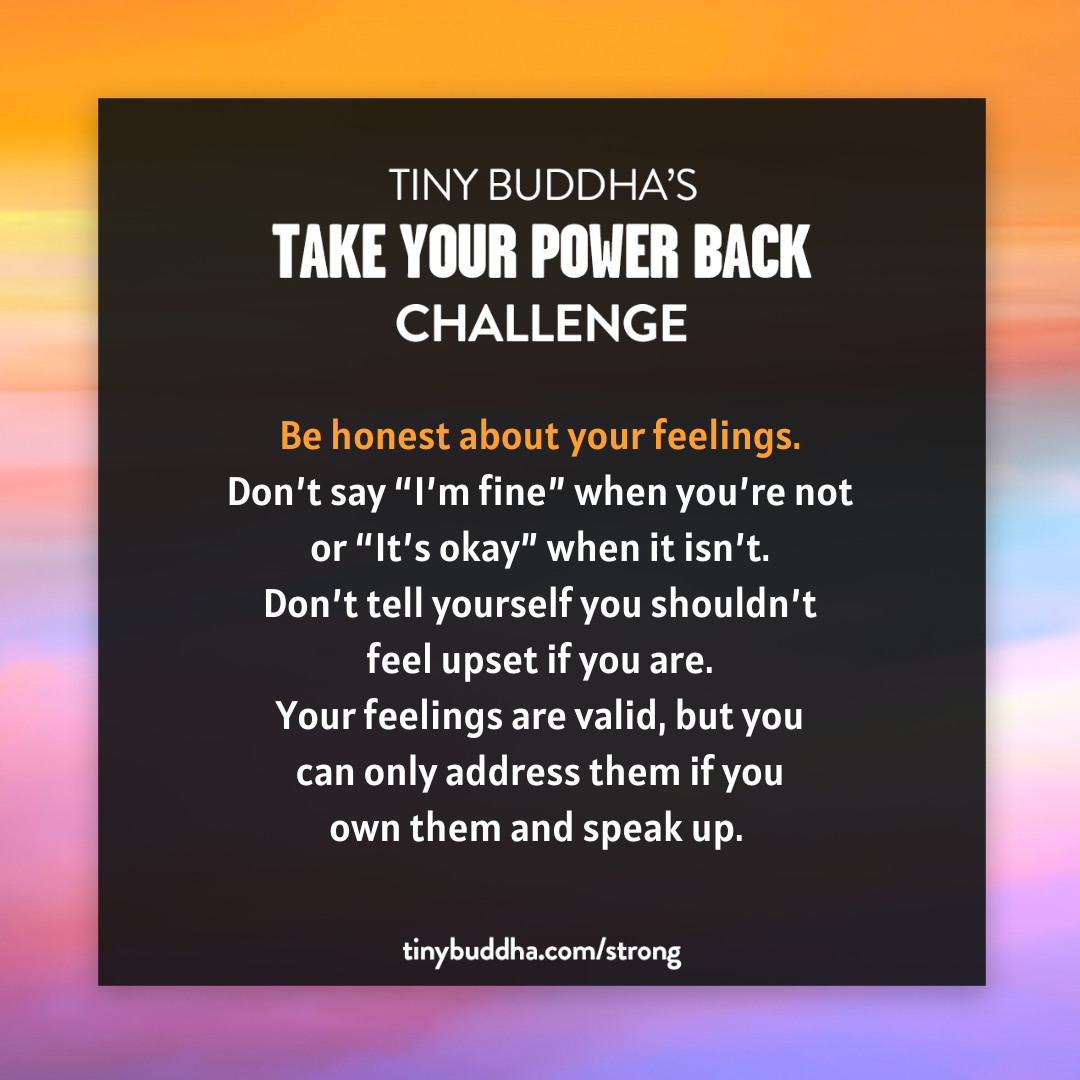
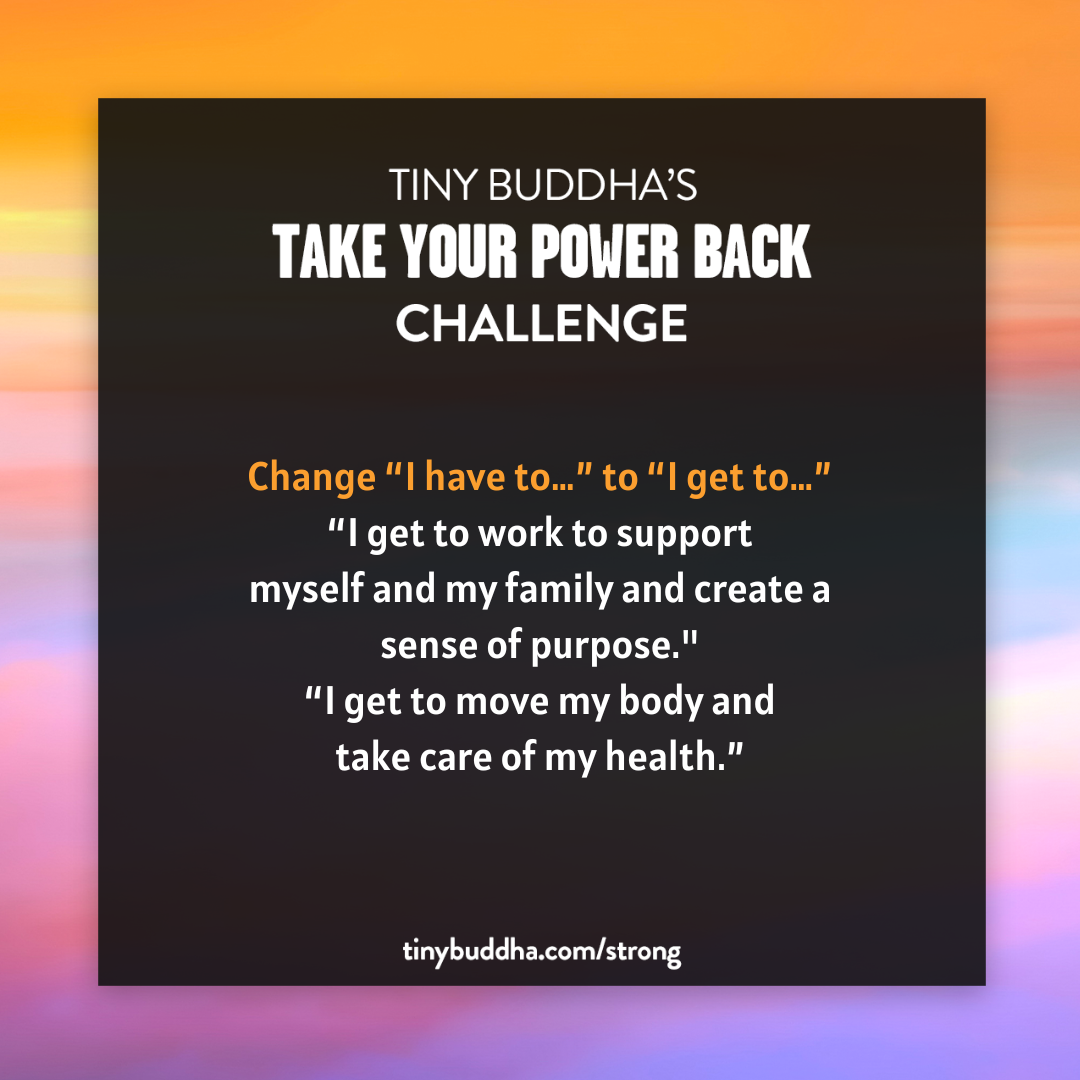
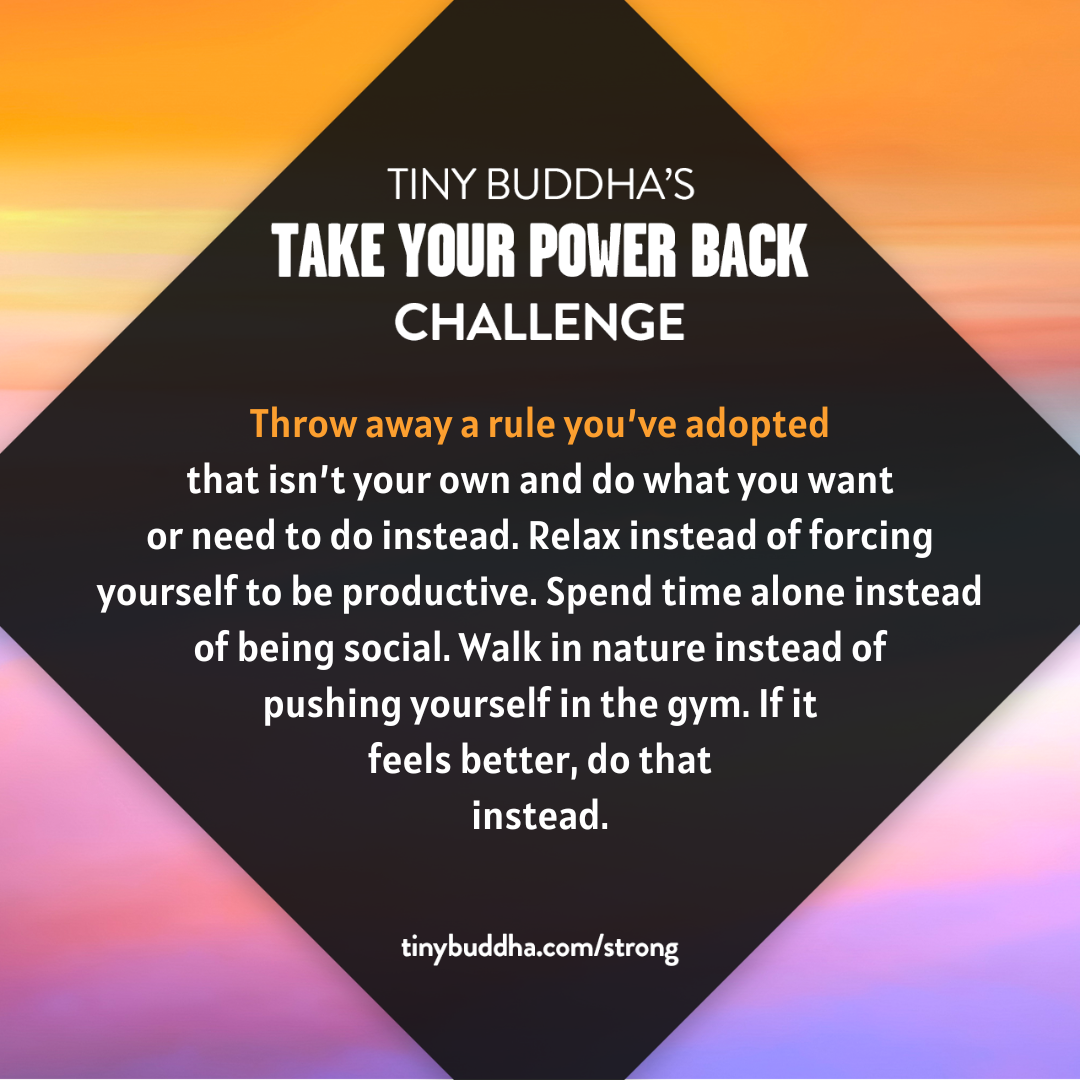
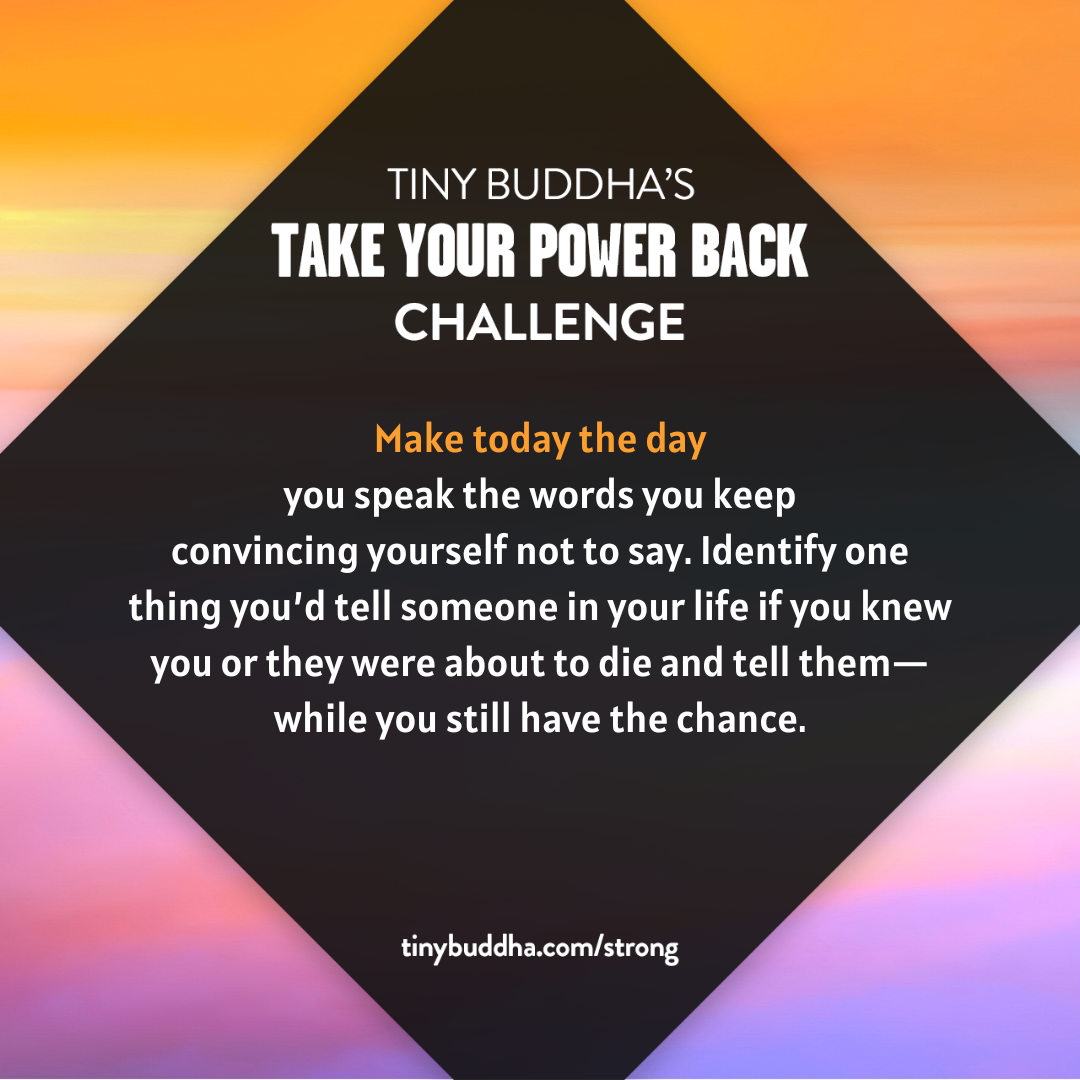
    FREE 30-Day Take Your Power Back Challenge

    Do you ever feel like you’re stuck in a pattern of waiting?

    Waiting on things to change or people to change.

    Waiting for closure or clarity or certainty.

    Waiting for life to get easier. Waiting for your heart to feel better.

    Waiting for an opportunity or a relationship or something you think you need to finally feel happy and at peace.

    I suspect most of us spend years and even decades waiting, feeling powerless over some, if not all, aspects of our lives.

    I know I’ve been there before. This is when I was the most depressed. When I felt completely helpless, like I couldn’t change my life if I wanted, so why even bother trying?

    It made sense that I felt this way as a kid, when I literally wasn’t in control. Maybe you felt this way too. But as adults we have far more power than we may realize. We don’t have to accept things that hurt us or hurt ourselves through our actions and reactions.

    We just have to recognize where we’ve given our power away and start taking it back, one small step at a time.

    One thought at a time. One change at a time. One boundary at a time. One need at a time.

    With this in mind, I recently created a 30-Day Take Your Power Back Challenge—the latest tool in a collection of companions to my new Inner Strength Journal.

    They’re all steps we can take to create change in our lives—many of them minor things that can have a massive impact. I know when I do any of these things, I feel far less anxious and a lot more in control.

    You can find the challenge here, along with the following other free resources:

    • 15 Things You Don’t Have to Do Anymore
    • Take Your Power Back Worksheet
    • 10 Things to Tell Yourself When You’re Going Through a Hard Time
    • Your Daily Support Plan Worksheet
    • 15 Things You Can’t Control (and What You Can Control Instead)
    • Letting Go of Control Worksheet

    I hope they’re all helpful to you! If you’d like to learn more about my new Inner Strength Journal, which was recently a #1 bestseller on Amazon, you can read more here.

  • Abuse is Like an Iceberg: The Cruelty and Pain You Never See

    Abuse is Like an Iceberg: The Cruelty and Pain You Never See

    “What we see is only a fractional part of what really is.” ~Unknown

    On the surface, in the public eye, it can seem trivial. It might look like the seemingly harmless teasing of a child or romantic partner, joking about words they have mispronounced or silly mistakes they have made. Inane mistakes like putting on a shirt backward, burning something in the oven, or losing their keys. Mistakes that everyone makes.

    Abuse might sound like judgmental comments that appear to come from a place of compassion. Comments like:

    My daughter doesn’t apply herself; she’s lazy, and I wish she would care about her education so she can make something of herself.
    At the moment she likes girls, but I’m sure she’ll grow out of it because I just want her to be happy and get married and have a family.
    I wish he would make plans and stick to them instead of changing careers every five minutes; he would be so much happier.

    Sometimes on the surface abuse can sound like frustration:

    I wish she would just pick up after herself; it annoys me that I have to live in a pigsty.
    She doesn’t do well in school, which is embarrassing for me because I am a teacher.
    He never has any time for me; he’s so selfish, and all he thinks about is his work.

    Abuse can also sound like statements of compassionate control:

    If she doesn’t do better in school, I’m not going to pay for her cello lessons.
    If he doesn’t help out around the house, I’m not going to make time for him.
    If she doesn’t try to dress nicely, then why would I make time for date night?

    I’m not saying that all teasing or comments expressing frustration necessarily mean that someone is being abused. I am only drawing your attention to them and encouraging you to look closer.

    The victim might give you subtle hints. Hints like:

    My parents really don’t care what I do; my parents only care if I do well in school and that’s all.
    My partner is only happy when I’m doing things for him.
    I don’t get a lot of me-time because me-time is selfish.

    The victim might show you emails or texts the abuser has written. Oftentimes, these emails or texts may seem benign or contain subtleties that can be easily overlooked. They might have a few verbally abusive comments and a handful of demands, or they might even be disguised as messages of concern.

    Sometimes these messages may be written so persuasively you might find yourself siding with the abuser or wondering why the victim is so upset about something so trivial.

    Beneath the teasing, the frustration, and the deprecating comments disguised as compassion lies a world of abuse that you are not looking for.

    Behind closed doors teasing turns into putdowns and verbal abuse:

    You will never amount to anything.
    You are incompetent.
    You are lazy.
    You are fundamentally a failure.
    You will never be able to support yourself.
    You’re a fag.
    How can you be so dumb?

    These harsh words may come with physical violence, but even on their own, they can be devastating.

    Compassionate control that appears on the surface may be an indicator of neglect or financial abuse.

    I have the money for music lessons, but you’re not doing what I want, so I’m not going to support you. I’m not giving you money for shampoo because it wouldn’t change the fact that you look ugly.

    You have not become the person I had hoped you would become, so I’m not going to pay for your educational opportunities.

    Sometimes you might look at abuse victims, like me, and wonder why we don’t wear better clothes, get regular haircuts, or take better care of ourselves. However, many times these simple choices were not within our power to make.

    Victims of abuse often make self-deprecating comments. Comments like:

    It was no big deal; anyone could have done it.
    I’m not good at a lot of things.
    I can’t do anything right.

    Over the years we have been groomed to put ourselves down before you do. We have internalized the abuse narratives to the point where we no longer see our lack of self-esteem, or our talents.

    Victims of abuse often don’t know how to accept a compliment and at times can feel uncomfortable in the spotlight. We’ve learned to make ourselves small and build you up so that we can keep ourselves safe. We downplay the favors we have given to you or the kindness we have shown you because we have learned the needs of others matter much more than our own.

    We become overly anxious when we made a mistake, when we’ve expressed an opinion contrary to yours, or when we think we might have offended you.

    We put your needs first, and we act overly agreeable and easy to please. We don’t mind where we go or what we eat when we are out with you. We don’t tell you if we’re feeling tired or cold, and we hyperfocus on you because we have learned that our needs don’t really matter to anyone.

    Because we have been gaslit and our reality has been denied over and over, we have learned to downplay the abuse and even to deny it. We might say contrary things about our abuser, such as:

    My mother loves me; she just doesn’t know how to express it.
    Yes, that was a nasty thing that he said, but if I had been kinder to him or done a better job, he wouldn’t have felt the need to say that.

    You might occasionally hear us expressing frustration about the way our parents have treated us. You might hear our longing for love and acceptance, but in response you may find yourself saying:

    Your mother really loves you; she just wants what’s best for you.
    I know you’re frustrated with your dad, but you should really try and forgive him.

    You might hear us expressing frustration about our partners and you may find yourself saying:

    You should be grateful for all that they have provided for you and done for your family.
    I don’t believe you; he or she doesn’t seem like the type of person to do a thing like that.

    Your comments leave us feeling invalidated, so we become silent.

    Abuse was always there in plain sight, but like an iceberg you only saw the tip. A tip you could easily normalize, rationalize, and dismiss.

    If you suspect that someone is being abused, here are some small steps you can take to protect them.

    First, realize that the victim may not know that they are being abused or that the way they are being treated is wrong.

    Oftentimes, they have been groomed to believe that they deserve to be treated poorly and that the abuse is somehow their fault. If they do realize that they are being abused, they may not be in a position to do anything about it; therefore, their denial serves as a temporary coping mechanism. The best thing that you can do is to treat them with kindness and compassion.

    Ask questions that encourage the person to get in touch with their feelings or needs. For example, I noticed that your mother makes a lot of negative comments about your abilities. How does this make you feel? Or, last night when we were out your partner said some harsh things about your appearance. How did you feel about this? I notice that you look thirsty. Would you like some water?

    By encouraging them to get in touch with their feelings, you validate their lived experiences and help them recognize that the way they have been treated is not appropriate or healthy. By encouraging them to focus on their needs, you help them to prioritize self-care even if only in a small way. This allows them to take back the power they have lost and helps them realize that they deserve to be treated better.

    Sometimes the simplest compassionate questions can help them take small steps to decrease the amount of abuse they are exposed to and eventually take drastic actions to remove the abusers from their lives entirely.

    If you witness someone being teased or shamed during a social event, firmly tell the perpetrator that their behavior is not kind or appropriate. If the perpetrator does not stop, invite the victim to walk with you to another part of the room or engage in a different activity to give them a break.

    Never join the perpetrator in teasing or criticizing the victim even if you believe that the teasing is just for fun.

    When you join the perpetrator in teasing you are engaging in a benign form of abuse and reinforcing their power and control. You are unknowingly teaching the perpetrator that you are a person they can use against the victim. Additionally, you are affirming and normalizing the perpetrator’s opinions of the victim, making it hard for the victim to break free from toxic narratives and limiting beliefs.

    Never engage in discussions about the victim with the perpetrator. Oftentimes, abusers use people who are close to the victim to convince them to do things they are not comfortable doing. Sometimes these conversations are disguised as concern for the victims, their well-being, or their financial future. If you suspect that you are being used in this manner, make it clear that you are not comfortable engaging in these sorts of conversations. Keep your communications with them brief yet firm.

    Never confront the abuser or tell them that you think their behavior is abusive. This may prompt them to encourage the victim to cut you out of their life. If you need to call the abuser out on their actions, talk specifically about why you do not like their behavior or why it is not appropriate. If you suspect that the victim is in serious physical danger, contact the police, a social worker, or a local women’s shelter for professional advice.

    Abusers tend to isolate their victims in order to maintain control over their lives. Invite them to activities you both enjoy so you can spend quality time together and give them a break from their home life.

    If you have a friend or family member who cancels plans at the last minute or frequently declines invitations, they may not be making this choice of their own free will. It is important not to take this personally or wall the victim out of your life. This is what the abuser wants you to do.

    Instead, continue to call your friend and invite them to social events even if you  think that they will not attend. Knowing that you are in our lives even in some small way can make us feel less isolated.

    Make it clear to your friend or family member that you are always there if they need to talk and frequently remind them of this. If you feel comfortable you can also let them know that they are always welcome to stay at your home if they ever need a safe place to go. You can also offer to help them create a safety plan should they ever feel unsafe.

    By taking these small steps you are choosing to see the abuse that lies beneath the tip of the iceberg and helping your loved one make it safely to the surface.

  • How I Overcame My Psychic Addiction and Stopped Giving My Power Away

    How I Overcame My Psychic Addiction and Stopped Giving My Power Away

    “If you’re looking for a sign from the universe, and you don’t see one, consider it a sign that what you really need is to look inside yourself.” ~Lori Deschene

    I used to have no idea what I should do. About anything. I would go from friend to friend running polls:

    Should I be a solo singer or in a group?

    Is this guy the one?

    Should I do this job or that job?

    Should I stay in LA or move to Vancouver?

    Should I get bangs?

    On and on it went. It wasn’t that I wanted validation. It was that I had no clue what I should do. Or, if I did know, I would quickly override it with endless doubt. I’d loop:

    “Maybe that isn’t the right decision. What if you’re wrong. Maybe it’s better if you do this.”

    It didn’t stop, and I couldn’t get it right. If only someone would just help a girl out. Surely, they’d know what’s best for me.

    There was a period of time (okay, years) when I had a serious psychic addiction. I would go from tarot reader to intuitive to tea reader to whatever else held the key to my life and purpose. Numerology, astrology, palm reader, random aliens, or angels—you name it, I doled out cash for it. It was my favorite hobby.

    Years back, I went through a breakup, and I had very important questions like, “When is he coming back?”

    I made some serious rounds through the LA tarot circuit. I found one reader that I bonded with at the now-closed Bodhi Tree (still grieving the loss…way longer than that ex). I liked her a lot, and because her readings gave me the kernel of hope I needed, she was the one, and I was hooked. It was like her cards magically tapped into my ex! In the first reading. She said, “Looks like you will be seeing him very soon.”

    Then I saw him on Melrose.

    What?

    Ding, ding, ding. She was the direct line, and I needed more. She just did it so well, tuning into my future.

    Every time I saw her, I knew I would get exactly what I needed. A hit, a bump—I could relax, knowing all was well with my existence. My future was all figured out. The love would return, fame was destined, and money would soon pour in. So I started going more and more. She only worked a few times a week, but I often made sure my name was on that appointment list.

    Then one day, it happened. It was the wake-up call that I needed but hadn’t prepared for.

    I got to the Bodhi Tree before her shift (I knew her schedule, of course), and since they weren’t yet open, I hung out on the sidewalk waiting. I needed to get to her first.

    My heart sped up with excitement when I saw her gliding down the sidewalk. The Tarot Queen, the one who held my future in her hands, walked toward me, obviously flanked with fairies and magic dust.

    Though we were the only two people on the sidewalk, she took a few moments to see me. I smiled, waved with enthusiasm, and walked toward her.

    Her gaze met mine, and we locked eyes. And for just a quick moment, she held my gaze. And then it happened. Her face kind of contorted, and she jumped back a bit. She was surprised or worse, scared when she saw me.

    She was scared to see me.

    Not the “OMG, I didn’t see you, and you startled me” kind but an “Oh no, this person is stalking me” look. She had panicked eyes. She was one thousand percent making a judgment call, and it was that I had gone way too far with the readings, and she was worried, perhaps for herself.

    She had become my drug, and I had come for my fix—she was doling out oracles for a reality that did not currently exist. The future. She played it off that day (oh yes, I got my reading), but it was a sight I couldn’t unsee.

    You know when someone you’re paying rejects you that something is off. It’s like those stories about drug dealers cutting their clients off in the hopes they go to rehab. You almost can’t believe it and assume it’s a myth until you get a first-hand account of one of these unicorn scenarios.

    Of course, an addiction to the need to know isn’t going to land me a DUI, but it wasn’t leading me to self-confidence and rock-solid intuition. Besides, wake-up calls come in all different “hello, notice me” alerts.

    Sometimes you just need a giant slap in the face with a deck of goddess cards to get you back on track.

    Now just to be fully transparent, that was not the end of my psychic run. It was the end of my time with her because I hate to look bad, but it didn’t stop me from getting advice from wherever I could. However, it did make an impression.

    And just to further drive the transparency home, when I was over that guy, there was another. And another that I sought advice for “out there,” whether it was with a Love Tarot deck or a friend that I thought somehow knew something I didn’t. Here’s what I didn’t know…

    No one outside of yourself knows what your answers are.

    No one.

    Not a one.

    Things just take the time they need to take, and we need to learn what we’re meant to learn. It’s the healing and completion that matter, not the time required.

    My overthinking, obsessive mind and love of all things spiritual led me to an amazing teacher that helped me shift to my inner knowing instead of needing constant outside approval.

    She was strongly opposed to psychics. She had spent many years as one but quit when she had the realization that people stopped living when they were told something about their potential future.

    If someone hears “Your soulmate is a blond man with an accent,” they then cease giving anyone else the time of day and might miss an amazing dark-haired guy in the process. That blond could be coming, but he may not. Psychics are sometimes accurate, but they are not perfect. No one is.

    Aren’t we all just swinging in the dark?

    And things change. A clairvoyant might have seen a glimmer of something that you might quickly grow out of or change course from. Nothing is permanent, and we can change our current path in a moment.

    My spiritual teacher used the term “corner store drug dealers” when describing psychics. They provide an easy-to-find, quick fix of the most addictive and popular drug (the who, what, where, when, and why) that comes in the form of your juicy future. One hit at a time.

    After many busy years in that business, she didn’t want to co-sign it anymore. So she walked away because it removed people from their present moment. She wanted to encourage people to tap into their own intuition—something she believed only came from life experience in the “now.” She rarely ever told me something I couldn’t feel for myself, and she did her best to guide me toward my true instinct.

    It was a gift I could never repay. Something I could never have gotten from a reading.

    Does this mean I’m psychic-free? No, I’m not, but I get them for entertainment now. I like to get a reading on my birthday most years. I got one in New Orleans (isn’t that rite of passage?), and I’ll never turn down a tarot party. I’ll get one, but I don’t shift my life to fit the prediction.

    Readings are also helpful when used as a real-life pendulum. Like, “Did I like what she just said? Do I want it to be true”? Great, then move in that direction regardless of any outcome. It’s just a clue to what feels right and good.

    However, despite all this “look at how I’ve changed” wisdom, I recently fell prey to my old ways. This past August I went to a sought-after channeler to celebrate my birthday. As much as I wanted to just toss her expensive words into the fun psychic basket with the rest, I found myself in that all too familiar feeling of my past.

    Maybe it was because it was hard to score an appointment, or because she has a high accuracy rate, or perhaps because I was feeling directionless in general. Regardless of why, when she told me that Nashville was where I’d be by Christmas, I just couldn’t shake her prediction.

    Here’s the catch, my husband didn’t want to go, and he wasn’t budging. But, but, but…I needed to get there. After months of Zillow shopping and spinning out of any intuition I had left, I came up with a genius idea.

    Go back for another reading. Say nothing and see if she still sees Nashville. She was, after all, in a trance, so she would never remember. When a spot opened on her waiting list, I jumped at the chance.

    Drumroll. This session did not include Nashville in the near future.

    I was so relieved. Not because I will or will not eventually live in Nashville. Or Milan or London or anywhere else in the world. But because the choice was mine again. It always was, but I had given my power away to someone else. She’s a lovely person too, by the way—this was all on me. We create our own destiny. We create our futures. No one else.

    Only we truly know our own answers. And we can change our minds whenever we want.

    Even my psychic relapse bestowed a gift. I am even clearer about what feels right for me now. I just needed a reminder that I am the only one making decisions for my life. So any future readings will be a fun check-point for my intuition. And believe me, I’d be thrilled if something came true, but no prediction ever has…

    Well, I did see that ex on Melrose that one time. But other than that, nothing. Not a thing.

  • Where Our Strength Comes from and What It Means to Be Strong

    Where Our Strength Comes from and What It Means to Be Strong

    “Strength doesn’t come from what you can do. It comes from overcoming the things you thought you couldn’t.” ~Rikki Rogers

    A friend recently asked me: Andi, where does your strength come from?

    It took me a while before I had a good enough answer for her. I sat contemplating the many roads I’ve traveled, through my own transformational journey and the inspirational journeys of all my clients who demonstrate incredible strength for me.

    I moved to a different country, alone, at eighteen years old and have changed careers, battled a complex pain diagnosis with my child, and lost loved ones. I am now living through a global pandemic, like all of us, and most recently, I am recovering from a traumatic, unexpected surgery. Life has many surprises for us, indeed.

    So where does strength really come from?

    I wish I knew the precise answer to this question so that I could share the secret sauce with you right now, and you could have full access to all the strength you’ll ever need to achieve whatever it is that you really want. (Even the deeply challenging stuff and the tremendously scary stuff. All of it.)
    I do know this:

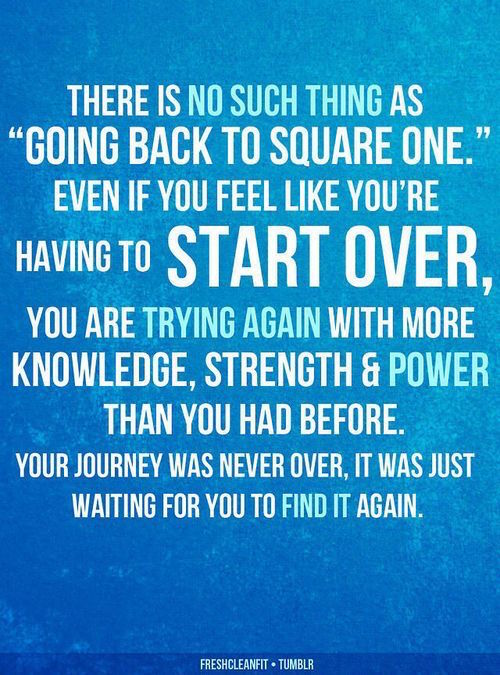
    Strength is a personal measurement for a truly unique, subjective experience. It’s entirely up to you to decide what strong means for you.

    And I also know this…

    Strength comes from doing hard things. It comes from showing up despite the pain or fear and going through the struggle, the endurance, and then building on that, to keep going forward and upward.

    Strength comes from taking the time to notice and acknowledge what you have managed to do and accomplish until now. So much of the time we go through things without realizing what massive effort something took, and we minimize the entire experience because we only focus on the end result and not the process.

    Strength comes from paying close attention to the small but significant steps and wins and incremental gains along the way. Strength comes from tracking progress and celebrating it one tiny bit at a time.

    Strength comes from within—from moments of activating your highest faith and belief. Knowing why you do what you do, even when it’s not easy.

    Strength comes from aligning with your core values and living with integrity even when no one is watching, and you aren’t in the mood. When we connect to what truly matters to us, we are stronger. When we believe there is a bigger plan and are hopeful about an outcome, we feel stronger. Even if we don’t know why.

    Strength comes from without—by surrounding ourselves with people who lift us up and see our worth, even when we sometimes forget. It comes from choosing to envelop yourself with kindness, inspiration, motivation, and gratitude. It comes from selecting role models and learning from them. It comes from seeing ourselves through others’ eyes—especially those who see our greatness and light when all we see is our flaws, weaknesses, and shortcomings.

    Strength comes from grabbing lessons and blessings, often dressed up as awful mistakes and painful failures.

    Strength comes from collecting moments you are genuinely proud of and taking the time to truly recognize these events for what they are and what they enabled you to accomplish. Don’t overlook them. You get to use these strengths in countless ways and in other areas of your life as much as you want to.

    Strength comes from knowing yourself. As you begin to discover and unmask more of you, you get to make choices that honor more of you, and you get to live your purpose and be more of who you really are. When we know better, we do better.

    The strongest people I know have had insurmountable trials. They know what to say yes to and how to say no. They know how to be proud of themselves with humility and honesty. They know how to pick their circles wisely and accept help, compliments, and advice.

    The strongest people I know cry a lot and feel everything.

    The strongest people I know are the kindest.

    The strongest people I know have wells of inner resources that are invisible to the naked eye.

    The strongest people I know can say sorry and forgive others.

    The strongest people I know can forgive themselves.

    The strongest people I know fall down hard, and slowly, with every ounce of courage, bravery, and might, find a way to get back up again, battered, bruised, and aching.

    The strongest people I know have incredible hearts that expand wider with each hurdle.

    The strongest people I know have endured so much and yet still find their smile to light up the world for others.

    The strongest people I know teach me every single day how to try and be just a little bit stronger myself.

  • The Cages We Live In and What It Means to Be Free

    The Cages We Live In and What It Means to Be Free

    “Cages aren’t made or iron, they’re made of thoughts.” ~Unknown

    I recently read Glennon Doyle’s Untamed, and like many who have read it, I felt as if it had changed my life—but not because it made me think of all the things I was capable of (as was the case with many of friends who read it), but because it made me realize how capable I had already been.

    The book on the whole is beautiful and inspiring, but the part that stuck with me the most was the story about Tabitha, a beautiful cheetah that Glennon and her kids saw at a safari park and a lab named Minnie that had been raised alongside Tabitha, as her best friend, to help tame Tabitha.

    Glennon watched as Minnie sprinted out of her cage and chased a dirt pink bunny that was tied to a jeep.  Shortly after, Tabitha, who had been watching Minnie, ran out of her cage and chased the “dirty pink bunny” just like her best friend had just done.

    Born as a magnificent, wild beast, Tabitha had lost her wild by being caged. She had forgotten her own power, her own strength, her own identity, and had become tamed by watching her best friend. But remnants of Tabitha’s inner wild came back to life when she walked away from the pink bunny toward the perimeter of the fence that was keeping her caged in. The closer she was to the perimeter, the more fierce and regal Tabitha became.

    Glennon insightfully notes in the book that if a wild animal like a “cheetah can be tamed to forget her wild, certainly a woman can too.” And that’s when I wondered, had I also forgotten my own inner wild?  Was I spending my time trapped inside a cage when I could be pacing the perimeter instead?

    I beat myself up over that story for days while desperately trying to think of how I could break free of my metaphorical cage so I could find my way to the seemingly elusive perimeter that others seemed to have easily found and were already pacing.

    I questioned why I hadn’t worked harder, pushed further, and done more to create the life I truly wanted, especially when it became painfully clear that the one I was living didn’t fit that description.  And that’s when it suddenly hit me. Like a ton of bricks falling on me out of nowhere:

    I didn’t need to make my way to the perimeter. I was already there. Truth be told, I had been there for most of my life, and it was so familiar to me that I didn’t even notice it anymore.

    As I sat there in the midst of this comprehension, I looked back on my life and suddenly the steps to the perimeter all seemed to fall in place.

    When I fell in a bucket of boiling water at two years old and put aside my own discomfort to comfort my mother who had broken down at the sight of my burned body, I took a step towards the perimeter.

    When I moved to America at the age of seven and couldn’t understand the language and was instantly labeled as “stupid” but kept going anyway, refusing to let them define who I was, I took another step towards that perimeter.

    When I watched my younger sister die of an incurable illness and kept her light alive inside of me by recognizing the beauty of her life and not just the heartache of her death, I moved closer to the perimeter.

    When I said no to becoming a teacher or a doctor—an unfathomable and disgraceful choice for women of my culture during those times—I took another step toward the perimeter.

    When I refused an arranged marriage, again disgracing my family in the process, the perimeter was directly in my sight.

    By the time I took off for law school (much to my parents’ continuing dismay), the perimeter and I were practically face to face.

    For a while I stayed at the perimeter, quietly stalking my surroundings with the same pride and inner fierceness as the cheetah who inspired these ramblings. But I now realize I was never meant to stay at the perimeter—I was always meant to go beyond it.

    Until I did, I would remain trapped inside my own inner chaos. And the calm I was so desperately seeking would continue to evade me. That inner restlessness that just wouldn’t go away, that indescribable lack of fulfillment and the hollow feeling in the pit of my stomach… those were all signs that I was ready to move beyond the perimeter. I was ready to uncage more than just myself—I was ready to uncage my soul.

    That’s why I was repeatedly drawn back to certain people, programs, and even books. I was ready to free myself of all restrictions and for that matter, all perimeters.

    The process hasn’t been easy. And at times, it has been beyond lonely. But it has also been rewarding, deeply healing, and transformative at the same time. And perhaps most importantly of all, it has allowed me to understand that in one way or another, we are all here to break free of the cages that have encased most of us for the majority of our life.

    Some cages are imposed upon us by the thoughts and ideas of those around us, and other times we put ourselves into them, willingly. So we can avoid discomfort, pain, suffering, change, growth, and our own rebirth.

    Sometimes they can even be helpful, but other times they do nothing but hold us back. The steel cages often tell us who to be, where to live, what we “should” do for a living, how to behave, and even who to like or dislike.

    Often, the cages come in different colors, shapes, and sizes. Some are made of gold and filled with expensive toys and bribes to keep us from going outside of them.  Their allure is simply too hard to resist for some people, even though they are often accompanied by gold shackles.

    Others are sparkly and filled with all that glitters. The shine is so intense that their occupants don’t even know they’re in a cage. They’re so fixated with the glitter that they spend their entire lives confined inside and never even realize they’re no freer than the people they’ve been looking down on as being “trapped.”

    And of course, there are some who live in small, dark, and dingy cages that they desperately want to escape but dare not try to because they’re so convinced that it’s safer, easier, and more comfortable to just stay.

    Those are the people that are so afraid of their own power and the taste of true freedom that they probably wouldn’t leave even if the cage door was opened for them.

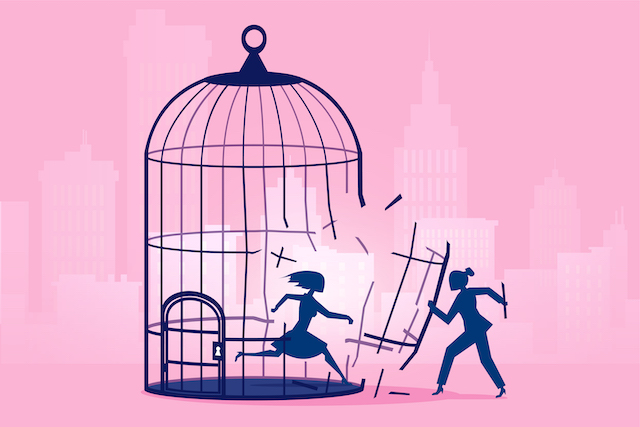
    And then there are the brave. Those that are truly courageous and have no desire to be confined by any cage or any limits. Those are the people who will do whatever it takes to break the cage so they can set themselves and all of humanity free.

    Those are the people who are roaming beyond the perimeter and have uncaged far more than their physical body—they have uncaged their very soul, and along with it, the many lifetimes of memories, wisdom, and truth it holds inside.

    Those are the people I want to run with. Those are the people I want to call my tribe. Those are the people that, when I meet them, I’ll know I have found my home.

  • Never Forget That You Have the Power to Choose

    Never Forget That You Have the Power to Choose

    “If we are peaceful, if we are happy, we can smile, and everyone in our family, our entire society, will benefit from our peace.” ~Thich Nhat Hanh

    Dedicate today to the power of choice. Your choice. You can’t choose everything that you experience in life, but what you can choose is mightier than any circumstance, outcome, or other person’s opinion.

    Where you focus your mind, how you use your words, and how you treat yourself and others are all up to you. One chapter at a time, you write your own story.

    We all have the power to choose what we absorb and what we release. We ultimately decide what we share, what we keep, and what we let go. How long we stay mad and how long we wait to reach for hope, when we say yes and when we say no, and how long we say only what others want to hear are all up to us. Whether we see the world with gratitude or resentment begins with a choice.

    It’s not that anyone chooses pain, though. I can’t think of a single person who’d choose despair or insecurity. No one elects shame to be their shadow. Not even boredom is a choice. We just forget our power sometimes or maybe underestimate the power of our intentions.

    For me, forgetting is a quick slide into control or fear. Every doubt, complaint, and fear leads me directly to more to doubt, complain about, and fear. The pressure builds. Tension rises. And even then, as much as I hate to admit it when I’m steeping in it, I have a choice.

    I can choose how closely I pay attention to my thoughts and how I respond to what I feel. Even if hours go by, days, years, it’s never too late to make a different choice. 

    My husband will be the first to tell you that I can hold on to things. I spent months holding on to a comment a friend made about my writing. I mentioned to her that I felt stuck on a project, and she told me, “It’s not it’s like real work. You don’t actually have to do it.”

    I was seething when she said this but didn’t say a word about it to her. I’d let the comment go for a few days, saying “it’s fine,” but as soon as her name came up? That was all I could think about.

    I can go even further back than that. When I was about six, a little boy on the bus called me a hag. It may seem like a small thing for first graders to tease each other, but I cannot tell you how many ways that one comment has worked its way into my self-image since then. At times I thought it was hopelessly stuck in my psyche. And still, thirty years later, I somehow made the choice to process and resolve that memory.

    It’s never too late to choose.

    When I remember the power of my intention, no matter how long it takes me, I come back home to myself with deepened perspective and goodwill. My choices soften the anger, fear, and sorrow I once felt. Remembering my power to choose restores the gentleness in my step and words. I see a completely new world around me. 

    From that place of remembering, all the positive, empowering choices available to me emerge from the mental fog. I can choose to ask a question, solve a problem, or call for help. I can choose to take a walk, meditate, have a snack, water the flowers, or count my blessings.

    Each positive step leads to more and more positive choices.

    So many things are out of my control, and I’m learning to let go of wanting it to be otherwise. I understand now that this only happens through my choice.

    I’ve historically wanted to follow a plan, not go with the flow. And I’ve depended on those plans going off without a hitch to feel safe.

    Here’s an example: When my husband mentioned finding a new job a few years back, I wanted to know all the details. No, I wanted more than that. I wanted to be so involved in the process that I knew exactly what was going on. When he didn’t get a new job, I wanted to know why and what this meant.

    Of course, life doesn’t work that way, and by hanging my security on details I couldn’t control, I gave away my own power.

    When I could acknowledge that pattern, I opened myself up to choosing differently. If I want more certainty, I can choose to look for the things I trust like my values, strengths, and the learning process rather than the things that could go wrong. If I want to feel more at peace, I can choose to speak to myself with more kindness not more criticism. Above all else, I can choose to have my own back no matter what.

    What I’m learning from this is there’s so much to be deliberate about and so many ways to choose.

    You can choose to set a small boundary when you’re exhausted from keeping the peace.

    I choose to be true to myself. May my honesty restore what’s been depleted.

    You can choose to broadcast loving-kindness when you see the images of suffering in the news.

    May all beings be safe from harm. May all beings return to peace. May all beings find freedom.

    You can choose to acknowledge our shared human experience when you feel most alone.

    In this moment, I remember that in my joy and suffering, I am connected to all of humankind. 

    And when you’re on top of the world, you can choose to bask in it.

    I dedicate this moment to the deep gratitude I feel. I choose to delight in this joy today. 

    There’s always something you can choose. So, choose soothing, however you’re able. Choose to look for things to feel good about. And if nothing else, choose to be as intentional as you can. Always with acceptance for the part of you that forgets. 

    Starting now, starting small, remind yourself of your power to choose. Here’s how:

    Begin with yourself. 

    Offer whatever you have on you right now—your beating heart, your breath, your hands, your eyes reading these words—to your power to choose. With that power, dedicate this moment in time to your health or happiness, to a new story, or anything that resonates with you.

    I dedicate this breath to my happiness. 

    I dedicate this day to my health. 

    With every word I read, may I remember my power to choose.

    From there, if you feel inspired, add on to it with another choice: Take a positive step that supports your health and happiness. Make plans to do the same tomorrow.

    If no step calls out to you, that’s okay. Smile and thank yourself for this choice all the same.

    Next, focus your power to choose on someone you love. 

    For just a moment, offer whatever is within reach to them. 

    I dedicate this hour to the people I love the most. May the beating of my heart bestow health, happiness, and security upon them.

    Again, build on this intention with a choice if it feels right. Pick up the phone, lend a helping hand, or send a quick text.

    If no action is needed or accessible now, that’s okay. Smile and imagine them receiving your dedication all the same.

    You can extend your power to choose as far out as you like. 

    Dedicate every step you take crossing the street to the well-being of all passersby. Then, add on as appropriate with another choice. Smile at them. Make eye contact. Mentally send them positive wishes for their day.

    Devote your commute today to bringing harmony to a challenging relationship. If it feels accessible, make another choice. List their positive traits. Name one way you could respond differently. Forgive if you’re able and willing. If nothing else, choose to be alert to how your attention feeds your internal experience of conflict and choose to nurture something new.

    With your power to choose, give a voice to your deepest wishes for the planet and all who inhabit it. Go as big as you like.

    I dedicate my words today to the message of love. May all who I encounter receive this message and help me spread it through their words. May this message proliferate and reach all beings.

    I send my love to the planet. May I aid in the purification of the air, the restoration of our oceans, and the health of all creatures in whatever way is available to me today.

    And then, take whatever action presents itself to you. If no action is available, that’s okay. Smile and know that you’ve strengthened your power to choose all the same.

    If a choice resonates with you, stay with it. Work with it for as long as it feels right. It could be a day, a week, a month, or more. Expand on it with more choices as is appropriate for you in your current situation.

    Pay attention to what happens as you practice this. Perhaps you’ll notice new ideas flowing more easily. Maybe you’ll feel motivated to take a positive step you’ve put off for a while. If all that happens is feeling more awake and empowered, then it’s well worth the effort!

    No matter what arises in your day or in your heart, remember there’s always something you can choose. May we all remember the power we have.

  • Sometimes We Are the Ones Who Need to Change

    Sometimes We Are the Ones Who Need to Change

    “Setting an example is not the main means of influencing others, it is the only means.” ~Albert Einstein

    When I was younger, I had a lot of opinions about what other people needed to change.

    “Why can’t people conserve more?” “Why can’t people stop throwing cigarette butts on the ground?” “Why can’t so-and-so stop being so annoying?”

    Et cetera, et cetera, et cetera.

    I’ve recently realized that as I focused on all of the things that others needed to do, I was avoiding taking a look at my own very real flaws and failures.

    I used single-use plastic containers for smoothies and coffee. I had a car and drove a lot, often when I could have walked, biked, or taken public transit. I used air travel, frequently. I didn’t ever shop at thrift stores or make an effort to reuse things. And I also, um, was very critical of others, and myself.

    In short, I had plenty of issues of my own.

    There is a quote by Jacob M. Braude that reads, “Think about how hard it is to change yourself. Then maybe you will understand why it is impossible to change other people.”

    Not only was it impossible for me to force another person to change, I was also avoiding the impact I could have made by changing myself. 

    This is true in so many areas of life.

    Consider the person who always dates “horrible” or “crazy” people. We always blame the other person and think, “Why do I have such bad luck with men/women?” It’s rare that a person ever looks at themselves and considers that maybe there is something about them that is attracting this type of person—that maybe, in fact, we even subconsciously choose to get involved with screwed-up people so we can point the finger at them instead of confronting our own intimacy issues and asking ourselves why we are avoiding real relationships (or friendships).

    So many people also complain about how “society” needs to change. Yet all of us doing the complaining make up society.

    If we want change, we are the ones that need to change, every one of us.

    This isn’t necessarily pleasant to hear. Because, of course, as long as we complain about what other people need to do, we avoid the discomfort and effort of looking at ourselves and making changes in our own lives. 

    We complain that people are always on their phones. Yet all of us are on our phones, constantly. We complain that the political process is corrupt, yet how many of us run for office, vote regularly, or even dedicate time to really understanding the issues? We complain that we never talk to our friends, but how many of us make the effort to reach out and really listen to what is going on in someone else’s life?

    I’ve realized that for a very long time, I’ve blamed other people for my circumstances; and maybe circumstances did have an impact in some ways. That job that didn’t work out, those traumas that happened in the past. Yes, they are part of who I am.

    But the truth is that as I look back at my past, almost all of the instances in which I’ve had a conflict or something “bad” done to me by someone else, could have been avoided if I had taken responsibility for myself and not given my power away to someone else.

    For example, I’ve recently taken two international backpacking trips. After the first one, I stayed with relatives temporarily to get re-established in the US, and it ended with conflict and hurt feelings because boundaries and expectations were not clearly defined.

    And while my first reaction was to feel sorry for myself and tell myself how “mean” they were, the truth is that I should have been more proactive about either having a discussion to determine a clear agreement or budgeting better and supporting myself.

    I’ve realized that expecting others to care for me or take responsibility for my life can only end in disappointment and disempowerment for me.

    I think in the past, because I was living according to others’ expectations of me and because I was afraid of intimacy and really diving into life, I subconsciously was not taking full responsibility for myself and on a certain level was expecting other people to care for me and support me.

    It’s scary to take full responsibility for ourselves and our lives. In a way, it’s easier not to try, because what if we fail, or what if people don’t like the real “us,” the one we keep hidden? Because hey, if they don’t like us, at least it isn’t the real “us” they’re rejecting, and we can pretend that we “didn’t really care” anyway.

    So many of us live with our dreams and selves tucked away and just float by with what life gives us, and criticize others or the state of the world instead of working on ourselves or taking steps to fix those things we can change.

    The best realization I have had recently, which has helped me avoid despair in the midst of much dark environmental and political news and trying personal times, is that I can restore my own sense of personal power and commit myself to things that I can change.

    That might mean pledging to never use a plastic bag at the grocery store again, bringing a Mason jar instead of using a disposable cup for beverages, or trying to use more kindness and less judgment toward others in my personal life. I can walk through the fire and take ownership of myself and my life.

    Now, I’m not saying that it’s not worthwhile to fight for causes one believes in or speak out against injustice. But it’s important to look at ourselves first and examine what flaws we may be harboring in our own hearts. As spirituality author Marianne Williamson once humorously wrote, “It amuses me how angry I used to get when people wouldn’t sign my peace petitions.”

    Williamson herself is an example of this principle. One assumes she did not find a great deal of success in angrily yelling at people to sign her peace petitions. Yet once she decided to look inward and change herself, and examine her own human failings and weaknesses, she gained spiritual knowledge that has impacted millions and helped them find peace within their own hearts.

    Ultimately, we can try to communicate and share with others, but we can’t change them.

    On the other hand, we always have the option to look inward, claim our power, and take the step of changing ourselves. We can make ourselves into the type of person we keep wishing others would be and do the things we keep wishing others would do. And while it may be scary, it should also be an encouraging thought.

    Because the truth is that the power for change, either for ourselves or the world, is not anywhere “out there”—it has always been inside of us.

  • How to Stop Losing Yourself and Giving Your Power Away in Dating

    How to Stop Losing Yourself and Giving Your Power Away in Dating

    “Daring to set boundaries is about having the courage to love ourselves, even when we risk disappointing others.” ~Brené Brown

    I was a serial dater for a decade.

    Dating can be fun and exciting, but it can also come with lots of disappointment and emotional pain.

    All those rejections, ghosting, and shattered hopes had a huge impact on me.

    They left me feeling exhausted and heartbroken. Probably because I dated too much but also because I didn’t do much to protect myself and my energy on these dating adventures.

    I’d say yes to many men who were not suitable for me, because I didn’t want to be single. I’d do things that I didn’t fully agree with just to keep the relationship going. I’d dishonor my own values and ideals so I wasn’t lonely. I was too available for men. I didn’t realize the power of no in dating.

    I lost faith in love. I lost my confidence and self-esteem. It took me a while to realize that it was unhealthy; but eventually, I did.

    One day, I understood that the price was too high to pay and it was not worth it. I was losing myself—the most important person in my life. I was betraying myself. I was dishonoring my own needs and wants.

    The pain I experienced during those dating years was the greatest catalyst for my transformation, like it often is in life. We want to avoid the pain at all costs, but the pain makes us find strength for making difficult decisions and the motivation for making radical changes in our life.

    I actually bless all the painful experiences I’ve had. They helped me wake up.

    They helped me to re-evaluate my approach to dating and relationships.

    They helped me step into my power and start to respect myself more in order to find men who would respect me back.

    It was the pain that helped me stop dating compulsively and find a better way. One day, enough was enough. I was ready for something else.

    I took a break to reconnect with myself. During these months, I reviewed all my previous relationships, all the dating I’d done and the men I was attracting.

    It wasn’t looking good. But honesty brings clarity, and clarity gives us an opportunity to make some decisions.

    I made many life changes and promises to myself, but there was one obvious thing that stood out to me.

    My boundaries in dating were way too weak. That’s why I was creating so much heartache in my dating and love life. That’s why I was losing myself in relationships.

    I was giving my power away by being way too accommodating and compromising too much.

    Because of weak boundaries, I allowed myself to stay in dysfunctional relationships for far too long. I was attracting men who couldn’t give me what I wanted. I’d accept the crumbs of love and never ask for more. I never stood up for myself. I never said no when I felt like it. I’d ignore red flags and never challenge men who treated me poorly.

    I needed to start to value and respect myself more. And I found the best way to do this was to strengthen my own boundaries.

    This decision changed the dating experience for me, on so many levels. In truth, it changed the course of my love life.

    I learned to say no in dating, and I said it to many, many men before I was able to say yes to my current partner.

    I became much more selective and careful when choosing the men I dated.

    I developed zero tolerance for mind games, commitment-phobes, guys who just wanted to have fun, inconsistency, indecisiveness, and disrespect.

    And it served me very well.

    I believe that I found the love of my life, after dating aimlessly for ten years, due to the fact that I defined my non-negotiables and I religiously stuck to them, no matter what.

    To help you understand where you are with your boundaries, I will begin by explaining what boundaries are.

    Simply put, boundaries are the limits you set for yourself in dating, in love, and in life. Things you are not willing to tolerate, put up with, accept, or compromise on. Your boundaries are your rules! I also interchangeably call them non-negotiables.

    A few signs of weak boundaries are:

    • Over giving and people pleasing
    • Saying yes when you mean no
    • Losing yourself in relationships
    • Overcommitting
    • Prioritizing others at the expense of your own well-being
    • Compromising, accommodating, and justifying
    • Settling for less than you deserve
    • Feeling taken for granted or resentful

    Your boundaries have a few important roles in dating. They protect your personal space, your values, and your sense of self. Weak boundaries leave you vulnerable and likely to be taken for granted, or even abused, by others.

    Here are five reasons why you need to have strong boundaries in place.

     1. They protect you.

    Without healthy boundaries, you will be hurt way too often. You will allow people into your life who don’t have genuine intentions and who are not looking for the same things that you are. Boundaries help you bring the right people into your life.

    You need to identify what you want, what is good for you, and what kind of partner you want to attract. And you need to start rejecting anyone who doesn’t have the qualities you are looking for. Otherwise, you will be wasting lots of time in dating and random relationships. Not to mention the amount of heartache you are going to experience. You need strong boundaries to protect your own heart.

    2. They communicate your value. 

    People who have strong boundaries radiate more confidence and self-respect; hence, they are more attractive. Boundaries show how much love you have for yourself and how much you value yourself. They help you attract the right people—people who value and respect what you do.

    Lack of boundaries is often linked to feeling unworthy and unlovable. Boundaries tell people how you want to be treated based on what you believe you deserve. They also help others understand how you want to be valued and respected.

    3. They save you time, energy, and sanity.

    Your boundaries help others know where they stand with you and what your expectations are. For example, in dating, when you know what you will accept and what you won’t tolerate, and you openly express it with your potential date (at the right time and in a non-aggressive way), you give people an opportunity to decide whether they will respect your boundaries or not.

    If they won’t, they will quickly disappear from your life and will save you time and energy. It will be either too much work for them or you’ll just thank them because they will be too much work for you. Rather than wasting time on the wrong people and relationships, you move on quickly and open yourself up to some more suitable dating opportunities.

    4. They empower you.

    Boundaries help you honor yourself. They help you honor your needs. They help you take responsibility for your own well-being. They help you become more assertive. They help you stand firmly in your own power.

    When you start being more mindful about your boundaries and start saying no to things/situations that don’t serve you or drain you, you will start putting into place healthy limits around dating, work, and people. You will start to feel proud of yourself. You will feel a sense of empowerment. You will feel like you are more in control of your own life.

    5. They help you love and respect yourself.

    There is no bigger act of self-love than having healthy boundaries. Your boundaries reflect how much you love and value yourself.

    When you communicate your boundaries, you let other people know that you know yourself. You let them know what is in your best interest and you are not willing to compromise on the important things in your life. Having boundaries is about loving and respecting yourself. And when you do, you get love and respect back from others.

    How to Strengthen Your Boundaries

    1. Start to say no when it feels like a no. 

    So often, we say yes to things we really don’t want to do, or don’t have time or energy for. We want to be polite and keep others happy. We do it so we don’t get rejected or lose people. But at the same time, we are being unkind to ourselves and making ourselves miserable.

    Bring more awareness to your day-to-day life and start observing how often you say yes to things you want to say no to. After a while, start actually saying no when you truly mean it.

    Saying no is an ultimate act of self-love. Saying no is empowering. When you start saying no, you’ll start feeling happier, your relationships will improve, and your self-esteem will get a boost, because you’ll be honoring yourself!

    A no doesn’t need to be blunt and rigid. You can find a loving way to say no. Here are a few examples:

    • Let me think about it.
    • I am not quite ready for this.
    • Thanks, but it’s not going to work out.
    • I am not sure I really want it right now.
    • I’d prefer not to.
    • I feel this is not the right time for me.
    • I’m okay for now.
    • I’m not able to commit to that at the moment.

    2. Start being more mindful of what you are saying yes to, and why.

    Anything to please others, out of guilt or fear, or because you want to avoid confrontation, is out of alignment. Start saying yes only to things that serve you, bring you joy, pleasure, or happiness, or agree with you and your values in the first place. Often, when you say yes to something that doesn’t feel like a complete yes, it’s really a no.

    A few questions to explore to define whether your yes is aligned:

    • When do you say yes when you really want to say no?
    • What do you say yes to?
    • How do you feel about it?
    • What would you like to say no to?

    One thing to remember: It’s one thing to set your boundaries and know what they are. It’s another thing to actually honor and stick to them. There is no point in having boundaries if you don’t honor them. If you don’t honor them, nobody else will.

    As hard as it can be initially, over time they will make you feel amazing. At the beginning, you will feel fear—fear of being rejected, of losing people, of being perceived as rude, of hurting others.

    But you will need to learn that how people respond and feel about your boundaries is not your responsibility.

    Your responsibility is to communicate your boundaries in the most loving way possible, without accusing, blaming, and criticizing. The best way to do it is to use “I feel…” statements. Just describe how you feel about the situation, or the person, so it’s more about you, not the recipient.

    Healthy boundaries help you take care of yourself emotionally, physically, and mentally. They help you respect your needs, feelings, and desires. They help you eliminate drama and emotional pain from your dating. They help you create healthy relationships with others.

    People will treat you the way you allow them to treat you. You have the power to set the tone for the quality of your dating, and every relationship in your life, simply by putting some healthy boundaries into place.

  • Your Anger is a Guide: Embrace It and Set Yourself Free

    Your Anger is a Guide: Embrace It and Set Yourself Free

    “Where there is anger there is always pain underneath.” ~Eckhart Tolle

    In the sixth year of marriage, my husband shocked me by telling me that he had decided on an open marriage. This would give him permission to do what he was already doing, having an affair.

    In one of my rare times of anger I argued and struggled with him. I can still see myself hitting him in the chest as he tried to put his arms around me to reassure me of his love.

    As he defended his position, he reminded me that I wasn’t being rational. I stopped protesting because that charge impacted me immediately. Logic and rationality were my guides.

    This surge of anger was new in my life. I had learned to bury my feelings, especially anger, growing up in my Japanese-American family where we hid most emotions.

    Adding to pushing down my feelings, I relied on intellect, my head, and dismissed my heart.

    When he attacked a vulnerable spot—to be rational—I became silent. It was the first of three betrayals I lived quietly through over the years.

    I swallowed two other screams of “No!” when, over the years, I learned about two other women, who intruded not only into my life, but also into my home.

    Why would any woman stand for this?

    Besides suppressing my emotions, I also learned from a young age to make the needs of the group, the others, more important than my own.

    Throughout my life, I let other people’s needs define my life.

    I disregarded my anger and I disregarded my needs.

    Why Burying Anger is a Recipe for Unhappiness

    When you bury anger, more than your anger is involved—you dampen all emotions, including joy.

    In my case, I was the model of a well-adjusted successful professional and, after I divorced my husband, a single mom.

    Inside a deep discontent lived undetected in my heart. It wasn’t until I slowed down in early retirement that I became aware of it.

    When you don’t have anger, you may think that there’s nothing wrong with your life.

    Why We Often Choose to Bury Our Anger

    You learn in childhood that adults don’t like you being angry. When you throw a temper tantrum, large or small, you get punished for it.

    This teaches you that being angry is bad and you should keep it to yourself.

    As an adult, when anger gets the best of you and you show it, people around you don’t respond well to it either.

    Some get frightened by anger. Others get defensive or angry in return. Exchanges full of anger often lead to regret and shame. They can even end a close friendship–a price you don’t want to pay.

    Embracing Your Anger Does Not Mean Throwing Tantrums

    When you express your anger, you think that you’re right and that the other person or situation needs to change. Or you say regretful, stupid things fueled by anger.

    In any case, you believe that someone or something outside you is the cause of your anger. This stance makes it easy to miss the early signal to go inside and investigate. 

    Embracing anger is turning inward to know your heart. It means spending time with your anger to learn what is under it—what’s really going on.

    Treat Every Inner Disturbance as a Clue

    Nothing changed in my life until I started to pay attention to all disturbances in peace I experienced, the little irritations, annoyances that were signs of anger. I began to appreciate whatever anger bubbled up because I saw it as a guide.

    Here’s an instance of a little annoyance I would have disregarded earlier in my life. I was talking with my partner on a walk through downtown about some insights I had about an important relationship. He interrupted me to point out how a new hotel construction was being completed, with details that could be barely seen at night.

    I felt disturbed, but instead of just burying that feeling like I normally would, I asked myself why I felt that way. I realized the annoyance pointed to anger about attention taken away from me. Needing attention from people who matter is a need I have. If I don’t get the attention, I feel like I don’t matter.

    I also recognized that my typical strategy would be to remain silent and let my partner go on. But instead of being silent, I stepped out of the pattern to speak up and stand with a new belief that I am important and deserving of attention.

    In this instance, once noticing the disturbance and realizing what it meant, I said, “What I’m saying is more important to me than what you’re pointing out that I can see another time.”

    My message was accepted with a small apology.

    Attuned to the energy of anger, I found it hidden in jealousy, envy, blame, frustration, disappointment, regret, withdrawal, stubbornness, and shame.

    I even found it in my lack of kindness in talking to my partner, my banging cupboard doors, my prolonged silence, and my criticism and judgment of others.

    When you follow each sign of anger you will find what is buried in your heart. You will discover what you need to resolve lifelong patterns that limited your growth.

    Through Your Anger You Discover Your Needs, Beliefs, and Strategies

    I began to know and honor the needs underlying my anger, such as my needs for acknowledgement and attention as I describe above.

    I also realized I had many limiting beliefs that stemmed back to my childhood, when my needs weren’t met. This is where my feeling of not mattering came from, but now I could recognize it and deal with it.

    Related to these beliefs I also saw the variety of limiting strategies I adopted trying to get these needs met. Some of these were being an over-achiever, a perfectionist, and overly self-reliant.

    To illustrate, I recently felt angry when I didn’t make the cut in auditioning for a voice ensemble. When I stayed with my anger, I found the pain of a wounded young-child who believed she wasn’t worthy, and saw clearly her strategies of people-pleasing and over-achieving that failed to get her what she wanted.

    Not only does your anger guide you to your needs but it helps you recognize the limiting beliefs and strategies that run your life. These were created and adopted early in childhood by a very young child and their limitations deserve examination.

    Deeply Exploring Your Anger Involves a Commitment

    Taking full advantage of honoring your anger involves taking the time to begin a process of discovery.

    This means remembering to remain the adult compassionate witness to what is there, and not identifying with or be taken over by the anger, and finally remaining with the anger long enough until you drop into what is beneath it.

    You may discover child-like vulnerability, fears, helplessness, and pain.

    When you integrate with lost parts of you, you deconstruct the patterns that run your life and free your original innocent heart to shine through.

    You are Richly Rewarded for Embracing Anger

    When you are one with your heart, you know not only your needs for safety, love, and community but your deep longings for meaning and purpose.

    You consciously make choices true to your heart.

    Then your heart opens—to love more and deeply; to reveal its wisdom; to see the world as an innocent child; to be present and accepting for all that shows up; and much more.

    Embracing anger may be counter-intuitive, but in doing so you become aware of old, unconscious reactive patterns. In becoming aware of these patterns you free yourself to choose from a place of power.

    Fully in your power you allow yourself to be fully present to experience life from the only moment you ever have—this present moment.

  • Breaking Free from Manipulative, Narcissistic Parents

    Breaking Free from Manipulative, Narcissistic Parents

    “Authenticity is the daily practice of letting go of who we think we’re supposed to be and embracing who we are.” ~Brené Brown

    I happened to catch the last scene of the movie Moonstruck on TV a few nights ago. The scene marks the happy resolution of various plot threads, and yet I felt as if I was witnessing the sinking of the Titanic.

    It was like watching a demonstration of what I have come to understand as the two ways of being in this world: dominating vs. accepting, narcissism or bullying vs. kindness.

    Having come from a narcissistic family myself, it felt as if the movie was peering straight into my soul.

    In the movie, Loretta Castorini is engaged to Johnny Cammareri, an aging mama’s boy who never married, out of ‘consideration’ for his ailing mother in Sicily.

    In this scene, he bursts in, announcing that he can’t marry Loretta because it would kill his mother, and asks for his engagement ring back. In the next moment, Johnny’s brother, Ronny, promptly proposes to Loretta, borrowing Johnny’s ring to seal the deal.

    The movie centers on Ronny and Loretta, yet seeing the last scene isolated from the rest of the movie drew me to Johnny’s experience.

    There he was, controlled by his mother long-distance from Sicily, giving up his marriage in deference to his mother’s script about who he needed to be in order to support her needs.

    The confusion on Johnny’s face as his brother claims the prize of Loretta’s hand in marriage is heartbreaking. Johnny isn’t quite sure what is happening, and yet he dare not question his mother’s love, nor break free of his supporting role in his mother’s drama.

    His life has been spent, and, unless he wakes up, will continue to be spent, in service to her, at a great cost to him.

    I see myself in Johnny. I was well into middle age before I was able to break free of my father’s domination of my life, and I suspect that, like me, many people delay the beginning of their own lives out of misplaced fealty to the stories their parents scripted for them.

    For years, whether rebelling against my dad’s criticisms or craving approval from outside myself, I had, on a deep level, ceded the central role in my life to my dad.

    Whether we were close or miles apart, communicating or no contact, he was the sun, and I was orbiting his solar system. This is exactly how he wanted it, and I fell into place within the structures and systems of his universe.

    There is so much truth in humor. Johnny’s mother’s threats are played for laughs, and yet they are more than mere melodramatic manipulation.

    An acquaintance of mine energetically supported her narcissistic mother for decades. When she became aware of the family dynamic, she chose to withdraw her energetic support of her mother, and for the first time in her life, focus on herself as an individual.

    The potentially intimidating part is that her mother actually became ill.

    This is not to imply that my acquaintance should have continued to support her mother, it is simply to say that the energetic connection is real, and removing it, as necessary as it may be, is like removing a crutch someone has grown dependent upon.

    It sparks an enormous upheaval and rebalancing for both parties, and yet it must be done in order to achieve greater health and freedom on both sides.

    The saddest part for children of narcissistic parents, and also for partners of narcissists, is losing confidence in our own authentic feelings, hopes, and dreams. The narcissist’s insistence upon pretense, and the demand to suppress authentic experience can be very painful.

    The younger brother, Ronny, was lucky to have been the black sheep of the family; at least he was distanced from his mother’s demands. Nonetheless, he, too, was damaged.

    When we first encounter him in the basement of his bakery, he looks like a hurt animal hiding in his lair. He has a wooden prosthetic hand, as Loretta says, “like a wolf that has chewed off his own paw to escape a trap.”

    To narcissistic parents, a child is not a full-fledged individual, but rather a character in their story, and the roles they offer their offspring are severely limited.

    Whether a “golden child” who can do no wrong, or the “failure” who can do no right, in either role the child will feel that he must perform in order to try to keep or win the parent’s love.

    This is not love at all, but rather a form of abuse, which is worse for being invisible to all but those directly involved. The child is asked to give up her own feelings, thoughts, and needs in order to support the parents’ version of reality.

    The child, meanwhile, resists facing the direness of the situation—the truth of a manipulative or even an unloving parent—for she intuits that she needs her parents’ love in order to survive.

    At the same time, she may feel excruciatingly uncomfortable living inside the parents’ stories. Like Johnny, she may end up not knowing who she really is and what she really wants, having given up her own thoughts, emotions, and needs for so long.

    In the movie, neither brother escapes unscathed: Johnny, the golden child, was hobbled, tied to his mother’s apron strings, and Ronny, the black sheep, was also wounded and cut off from the rest of humanity.

    Like so many rebels among us, Ronny finds solace in the arts, in his case, opera. As a child, my passion for dance sustained me. It was an outlet for self-expression, and an opening for the magic I needed in order to survive.

    Funny to speak of all this in the context of a romantic comedy, yet perhaps the power of the story stems from its basis in profound truth.

    At the end of the final scene, Johnny sits alone as the family excitedly gathers to toast the new couple. He looks stunned, isolated, and lost amid the celebration. Then the grandfather approaches Johnny and extends a glass of champagne, offering the last line in the movie: “You’re part of the family.”

    And with that, Johnny is embraced in the warmth of the family, and I burst into tears. How different is this warm embrace compared to the demands of the narcissistic parent.

    Johnny is played as a buffoonish character, and the audience is fully rooting for Ronny and Loretta. Yet even clownish Johnny is embraced.

    This is love. This is real acceptance.

    This is the tenderness of the movie. This is its big heart, which is depicted, not just in the romantic passion of Ronny and Loretta, but more importantly, in the inclusion of Johnny in the celebration. As the credits begin to roll a toast is raised: “La famiglia!” To family!

    This is the archetypical image of the loving family. And yet many of us did not experience that. And many of us hide a secret shame that our families aren’t like that. I know that I was deeply ashamed for a long time that my story wasn’t pretty like that, until one day I realized that it was not my fault.

    On the day that I accepted my family as it was, and realized that I wasn’t responsible, and rejected the stories they told. On that day I reclaimed my right to my truth about what happened, what I felt, what I thought, and what I experienced.

    Reclaiming our stories—our truth—is how we take our power back.

    If any of this speaks to you, go watch Moonstruck. Johnny hasn’t woken up yet from the spell his mother cast over him. Ronny, with the help of Loretta’s love, breaks out of his hurt isolation and reclaims his life.

    Wake up and face your truth. Sometimes facing the ugliness is the route we must take in order to reclaim our own beauty and power.