Tag: Possibilities

  • How Grieving a Dream’s Loss Built Hope for a New Life

    How Grieving a Dream’s Loss Built Hope for a New Life

    “Our painful experiences aren’t a liability—they’re a gift. They give us perspective and meaning, an opportunity to find our unique purpose and our strength.” –Dr. Edith Eger, The Choice: Embrace the Possible

    The loss of an unrealized dream sent me spiraling down, down into the darkness. A darkness filled with a despair and hopelessness that I had not known before.

    It was safer and more comfortable for me to attribute all my grief to losing a loving mother-in-law suddenly in the beginning of 2023. Her abrupt absence not only in my life but also in my husband’s and daughter’s lives was incredibly hard.

    Though the loss opened the portal of grief, there was more I hid. When I was still in a tender place, intangible losses and a health scare came.

    The loss that completely broke my heart was when my husband and I made the joint decision to end our dream of trying to have a second child. A shared dream since early on in our relationship and a dream of mine since long before.

    Neither of us could have anticipated my unexplained infertility diagnosis and the four-year-long, beautiful, broken, and growth-filled road to parenthood. Throughout the entire journey, I still held onto hope that we would one day have two children.

    The visceral, raw grief that came after we made the decision shocked me. When we had first honestly discussed this idea, I felt excited to build our life as a family of three. I deeply knew our family was complete.

    But once we made the decision, grief I did not want or know how to feel consumed me. Grief for all that had been lost. For all that wouldn’t come into being in the future. Invisible to the outside world.

    At first, my negative, self-critical talk took over, giving me a hard time for what I was going through. Full of self-judgment, regret, anger, and shame. Overcome with grief, I had forgotten I didn’t have to believe that voice and could be kinder to myself.

    Mornings were the toughest. Each day, I would wake up with the weight of unshed tears under my eyes. Though I had slept well, my whole body was heavy and weary. My mind felt foggy. I’d forget small things, which wasn’t like me. Seemingly simple tasks took so much energy.

    After dropping off my daughter at preschool, I would sit in my living room alone. I had no motivation to do anything. If I didn’t have a work meeting to prepare for or immediate deliverables to complete, I’d distract myself on my phone, numbing. This unhealthy morning cycle would continue for a while.

    Once I started working, I would get in a rhythm and focus on the projects in front of me, which I did enjoy.

    My body and psyche knew what had happened was significant. It would take time for my rational mind to catch up. I would need to allow myself to have my full experience of grief.

    An Expanded View of Grief

    Developing an expanded view of grief and processing my experience with a grief therapist began to help.

    One of the first concepts I learned is that there are different types of grief. Through Atlas of the Heart, a book by research professor, author, and podcaster Brené Brown, I understood I was dealing with both acute and disenfranchised grief.

    Acute grief is the intense grief that occurs during the initial period after a loss. I was not familiar with disenfranchised grief.

    Brown writes, “Disenfranchised grief is a less-studied form of grief: grief that ‘is not openly acknowledged or publicly supported through mourning practices or rituals because the experience is not valued or counted [by others] as a loss.’ The grief can also be invisible or hard to see by others.”

    My grief not only felt invisible to the outside, but also, I hadn’t valued the end of an unfulfilled dream as a loss at first.

    A second concept was to focus on integrating grief into my life. My therapist shared that it’s not about moving on after experiencing a loss; it’s about moving forward, integrating our losses with how we live our lives.

    A third concept came from psychologist and Holocaust survivor Dr. Edith Eger’s book The Choice: Embrace the Possible. Though she had been through unimaginable suffering, she gave a message of hope and healing.

    She shared, “When we grieve, it’s not just over what happened—we grieve for what didn’t happen… You can’t change what happened; you can’t change what you did or what was done to you. But you can choose how you live now.” We could choose freedom, joy, and love over suffering.

    What Helped Me Cope and Rebuild

    I began to shift my experience from resistance to instead supporting myself during this period of grief. I started to accept that simply getting through my day was enough. These approaches can be beneficial to anyone experiencing grief, especially if it feels invisible.

    1. Support myself and be supported

    Once I remembered that I could support myself, my entire grief experience became more manageable. I already had tools to be kind and compassionate to myself. It was a matter of intentionally using them.

    I began a practice of noticing and bringing in. Noticing my self-critical voice and, instead of getting caught up in it, bringing in self-compassion and kindness. I would say statements to myself like: It’s okay to feel this way. This is really hard. May I be kind to myself. Sometimes, I visualized wrapping myself in love.

    I began to turn toward myself with kindness and love. To be there for myself. To process my experience through writing.

    I opened up in close relationships and with my therapist, where I did feel listened to and accepted to share my struggles.

    2. Feel my difficult feelings and bring in the light

    One day, when I was meditating, I noticed what was happening in my body. I opened to the intense sensations. Before I knew it, I’d gone through a shorter version of Tara Brach’s RAIN practice. This had been a fundamental practice of mine when dealing with infertility, but I likely hadn’t done the full practice in years. The practice remembered me.

    This framework means:

    • Recognize what is happening.
    • Allow the experience to be there just as it is.
    • Investigate with interest and care.
    • Nurture with self-compassion.

    Once the exercise came back to my consciousness, I spent time each morning feeling my painful feelings.

    One morning, at the end of the RAIN practice, I intuitively brought in light and love. Another time, I started saying a lovingkindness meditation to myself. I began to incorporate bringing in aspects of positivity after feeling my difficult feelings.

    3. Go on awe walks

    My grief was the heaviest in the darkness of the winter in Colorado. Toward the beginning of spring, still overcome with grief, I started going on awe walks. Awe walks, a term from Dacher Keltner, are walks where you shift your attention outward. Your task is to encounter something that amazes and transcends. Every day, I looked for new signs of spring at the trail near my house.

    I would have missed most of the early signs if I hadn’t been seeking them: flower buds, tiny green leaves forming on branches, the first yellow wildflower blooms that peeked out from behind tangled branches. Then one day, I looked up and saw a canopy of green covering the trees overlooking the trail. Spring had fully arrived.

    I discovered that growth starts small; it’s barely noticeable at first. Pay attention to changes happening, to what’s building slowly. It’s the foundation for what wants to come forth. And the bigger message is that winter comes first; only after going through winter is spring possible.

    4. Embrace fallow time

    Toward the end of the spring, I was getting tired of the heaviness of continued grief. I journaled frantically that I wanted a project. Something new to give my attention to. I longed to experience the energy of summer.

    Grief still had more to teach me, though. The next day, my deepest wisdom instead shared with me to embrace “fallow time.” The term is from farming. Allowing the land to lie fallow is a technique where nothing is planted for a period of time. The goal is for the land to rest and regenerate.

    Fallow time was asking me to continue to honor the nothingness where dreams once were. To rest in the space before building the next beginning.

    I opened to allowing the vastness of where there once was something linger without trying to rush to the next thing.

    I discovered that this clearing is where the potential for what’s next would emerge.

    5. Reconnect with hope

    I had attached so much hope to the outcome of having two children. While hope for a realistic outcome is important and kept me going, I found out its limitations when I let go of the dream.

    But hope is so much vaster than that.

    One day, I unexpectedly felt the energy of expansive hope. Called transcendent hope, it is broad hopefulness that something good can happen. This form of hope reignited a light deep within me.

    Hope to build the beautiful life in front of me that I had once longed for, honoring the dreams, losses and imperfectness.

    6. Rebuild possibilities and dream again

    Grieving and dreaming felt at odds with each other initially. It turns out, grief would create an opening and space for what wanted to emerge next. Grief was my winter season, my fallow time. It was like planting flower seeds in the fall that won’t bloom until the next spring.

    I would first need to accept the past and close this chapter of my life. Then, I could connect with the potential of dreaming again.

    The dreams I most wanted to nurture in 2023 were coaching and writing. In the first half of the year, the dreams moved ever so slowly or seemingly not at all.

    During this time, I was taking the Playing Big Facilitator’s Training coaching program but had no energy or motivation to start building coaching as I intended.

    I also kept trying to write a personal essay about aspects of my infertility journey but felt blocked. I started but kept getting stuck. So instead, I journaled, with writing prompts such as a few things I don’t know how to write about.

    Something profoundly shifted within me in September 2023. I became drawn to rebuilding what could be possible in my life.

    The personal essay I had attempted to write for months flowed. A story about choosing to focus on personal growth and well-being amid the challenges of burnout and infertility. The final piece would later be published in Tiny Buddha in 2024: How I Found the Good in the Difficult.

    As Dr. Egar shared in her book, it was about an experience where I had choice.

    September was also the month I started a positive psychology coaching certification program. One reason I selected this coaching program is because positive psychology and mindfulness had been so impactful to me while facing infertility and burnout. Simultaneously, I began offering career, life, and well-being coaching.

    I had to go all the way through the intensity of the grief to understand Dr. Egar’s wisdom: “Our painful experiences aren’t a liability—they’re a gift. They give us perspective and meaning, an opportunity to find our unique purpose and our strength.”

    I received so many gifts when facing infertility and burnout. Transforming my relationship with myself and my life was the most wondrous. This painful time period was the gateway, on so many levels, for me to connect with a greater sense of meaning and overall well-being. To shift to work that felt more fulfilling. To rediscover my creative self-expression, especially writing, which surprisingly impacted my personal life and work. To uncover a dream to coach others in creating change that matters to them.

    My experience in a grief cocoon profoundly changed me. On the other side, I have felt more at home in myself. More at peace with my past challenges. I have sensed wholeness. With a deeper appreciation of integrating it all—the grief, pain, gifts, gratitude, and joy. I am choosing to move forward with renewed hope for fully living my life and honoring my dreams.
  • 5 Tips for Updating Your Career and Life to Match Who You Are Now

    5 Tips for Updating Your Career and Life to Match Who You Are Now

    “All you’re going to lose is what was built for a person you no longer are.” ~Brianna Wiest

    I’ll admit it. I stayed in a failed marriage for five years past its expiration date. I got especially good at faking smiles in public and relegating myself to my laptop most evenings.

    I also sentenced myself to a career that stopped “lighting me up” about a decade before I was ready to wave the white flag of surrender. As in my marriage, I refused to believe its end for ages and tried everything I could think of to keep this dying flame alive. I switched positions and teams, constantly created new goalposts for myself, changed organizations, and even moved to Asia well before I was willing to let my career go.

    And one day, without warning, my sister called from New York to say that our beautiful mother had just crossed over to the other side. On that soft green couch in South Korea, thousands of miles from family, my already deeply unsatisfactory private life imploded. So did the carefully curated and adventurous-looking life that everyone on the outside saw. I was broken.

    Please allow me a “real talk” time out, folks.

    Can we discuss the importance of using our persistent feelings as signals, or guideposts? I’m not suggesting we throw out logic. I’m also not referring to our typically loud and fleeting reactions to everyday stressors. I’m talking about an instinctive knowing, the quiet kind that’s easy to ignore.

    Though I routinely taught this to my own two children and students, my intellectualizing didn’t mean I was actually practicing what I preached. Not by a long shot.

    Not until a powerful wave of grief swept the rug out from under me, that is.

    Deeply empathetic and sensitive, with a mother who was a counselor, I grew up learning how to accept and validate my feelings. I knew to listen to them, to manage them when they didn’t serve me, and to use them to identify opportunities to learn more about myself. So, why on earth would I work so hard to hide them from my own conscious awareness for years when I knew my marriage and career were no longer right for me? I’ve got thoughts on that.

    Perhaps it was because ignoring my feelings and deeper knowing kept me safely in a socially acceptable family structure.

    Perhaps it was because ignoring my feelings and deeper knowing made it easy to receive invitations to holiday dinners with other international families while living abroad.

    Perhaps it was because ignoring my feelings and deeper knowing allowed me to continue to make good money, feel successful as a professional, provide for my children, and travel to new countries a few times a year.

    Perhaps it was because ignoring my feelings and deeper knowing had predictable, albeit routinely unpleasant, results.

    Perhaps it was because I had no idea who I would be if I wasn’t a wife or a teacher.

    But when my mother passed away, my entire world went dark. Suddenly, nothing else mattered.

    Losing my mother was the single hardest experience of my lifetime. It was also the catalyst for my own wake-up call on multiple levels. And perhaps this was what my soul needed to remember how to seek what did matter, and to recognize my own fulfillment as worthy of sitting at the very top spot of that list.

    Layers of grief forced me to experience feelings I’d been bottling up for years. Grief pressed me to listen to my feelings and to ask what there was to learn from the patterns in my life. It begged me to create the space and stillness to finally accept that the career and life I had built were ones I had long outgrown. It also prompted me to finally ask for help.

    I wasn’t happy living a life I had built decades ago because I was no longer that person, and accepting this realization was empowering.

    Eventually, and with the aid of some irrefutable signs from the universe and some excellent coaching, I gave myself permission to pivot from my profession. I could also see that my resistance to change had been the only true thing standing between me and a much more fulfilling life and career. Not anymore.

    Loss is a beast. But on the other side of it, there is inevitably gain.

    If you find yourself at a crossroads in life and crave a pathway for building something new to fit the person you have grown into, I have an annoyingly obvious secret to share. The only person capable of carving this way forward is you. And while this may feel like an impossible and unwelcome challenge, I venture to say that this fact could end up being your greatest gift.

    What if you could see beyond the endings and revel in the endless possibilities ahead?

    What kind of work and contribution to the world would you pursue if none of society’s imposed limits existed?

    If money were no object, what would you spend your time doing.

    What type of life do you want to build for yourself?

    What would future you, nearing the end of their life, look back on and smile contentedly about?

    While I can’t give you any of your answers, my own failures and aha moments have allowed me to compile the following tips for folks like you who may be approaching a career transition.

    If you’ve decided your fulfillment should be at the top of your life list and you’re ready to update your career to match the version of you who is reading this today, try these five tips on for size.

    1. Create some space or spaciousness before life creates it for you.

    Once upon a time, before my whole world stopped with a single sharp loss, my mind loved wasting entire days on unimportant details of daily life. The state of constant busyness I tended to wrap myself in had allowed me to bury the deep feelings of restlessness and dissatisfaction lurking faithfully just below the surface.

    My incessant thoughts were part of my unconscious “living” and were a big part of what prevented me from being aware, present, and authentic in my current reality. I thought my thoughts were me, but I was so far from the truth.

    I may never have stopped this incessant mind-drivel had I not been handed Don’t Believe Everything You Think: Why Your Thinking Is the Beginning and End to Your Suffering by Joseph Nguyen.

    It taught me that if I didn’t choose to actively create internal space by taking up daily yoga and meditation (or another practice), I never would have gotten to know who I truly was. And without that, how on earth would I have created a career shift to match the updated version of myself? (News flash: I would not have.)

    If you choose just one item from this list to try before making a career shift, please let this be the one. Commit to one practice that creates spaciousness in your life and refuse to let go. Because if your new career is going to match the updated version of you, you have got to start with getting to know yourself. And you’ll only achieve this by making space and staying there a while, routinely.

    2. Take stock of the childhood dreams you (mistakenly) labeled as fantasies.

    What did you want to do when you were seven? You may laugh, but this question is so useful in helping us to see what our soul has always been drawn to do (at least, before society stepped in with all of its “shoulds”).

    When we’re young children, we’re not nearly as caught up in our own minds as our adult selves are. As a result, we’re much more easily opened up to our purpose, our desires, and joy-seeking behaviors.

    Make a list of the things you enjoyed doing as a seven-year-old. Do you still do any of these things today? Do any of these things appeal or inspire new, similar ideas? Take stock, and please don’t laugh them off. The key to a glorious, fulfilling future may lie in these former hobbies and interests.

    3. See yourself for who you are now (not for who you used to be).

    Let’s also be sure to get to know the person we have become today.

    If nobody in your family could see into your ballot box for career-choosing, where would your vote go? We no longer need to please our parents! We’re adulting, after all. We aren’t here to please our spouses or our children either (though we can and should darn well love the heck out of them). We are here to please ourselves, and once that’s in place, well, you know the rest.

    For some of us, asking people who are closest to us for feedback can really help to get the ball rolling, too. What do our closest friends or colleagues see as our key strengths and weaknesses? What do they notice us bringing to any room we enter? Keep the feedback that resonates and leave the rest.

    4. Notice what fires you up.

    What do you find yourself getting passionate (either intensely interested or completely annoyed) about? What could you spend your whole day doing (if life wasn’t always “lifing”)? What comes easily to you and allows you to feel in the flow?

    Herein lie clues about your interests and passions, and potentially some of your core skills or gifts. What makes time fly by for you? What conversations do you find yourself drawn to or searching for?

    What do you realize you stand for again and again, regardless of circumstances? What values does this reflect that you hold? Once you’ve answered some of these questions, check to see if the career paths you’re considering would complement, jive with, or fall right in line with at least one of these things.

    5. Test out potential careers before jumping.

    A change as big as a career shift warrants some personal research. And according to professional research, humans are pretty terrible at predicting what will make us happy. We’ve simply got to test our ideas out.

    What if I told you that you could create some ways to test out potential career pivots before making them? Have you considered volunteer work? What about emailing every contact you have to ask if they know anyone working in the field who’d be willing to have a career curiosity call?

    Could you come up with a project that would allow you to test out/try out new skills? What about a job shadow day? Have you considered cold messaging someone via LinkedIn who works in that field?

    Whatever ideas you come up with will inevitably be better than simply jumping at your best guess. Get in there! Get creative. And get started on updating your life and career to match who you are today, not the person you were years ago when you created the life you’re still living now.

  • 4 Things to Try When You Want Change but Don’t Know What to Do

    4 Things to Try When You Want Change but Don’t Know What to Do

    “If you get stuck, draw with a different pen. Change your tools; it may free your thinking.” ~Paul Arden

    For a year and a half, I could feel a career shift coming. I had worked hard to cultivate a career I loved, but I began feeling disconnected from my work. The meaning I had originally felt from it was no longer there. Each time I started a new project, I felt tired and unmotivated.

    At first, I thought it might be burnout. So I took a few weeks off to see if I could reset myself into feeling excited about my work again. But when I returned, I felt the same. The things that I had built my career around, that previously gave me energy and meaning, no longer resonated.

    I thought about the type of work I did daily and couldn’t imagine myself still doing it ten years from now. But what could I imagine myself doing? I had no idea.

    I struggled and strived to figure out what a career shift might look like. I read several books, including Finding Meaning in the Second Half of Life by James Hollis (Ph. D.), but while I resonated with the ideas in several of them, I still felt no closer to an answer.

    I became very intentional about noticing when things gave me energy. At one point, I went to a dinner party where someone brought tarot cards and gave me a reading. It was so energizing! I went home and immediately ordered the same set of tarot cards. I began learning about them and started doing readings with friends and at parties.

    “What does this mean? Should I become a tarot card reader?” I thought. But that didn’t resonate for a variety of reasons.

    By this point, I was telling everyone who would listen that I was “directionless.” It was a new label I used often. When someone asked what I did for work, I would say, “Meh, I’m directionless.”

    Well-meaning friends and acquaintances started offering their opinions of what I should be doing next. I even googled, “How to make a career change.” I felt like I was walking around in a black fog where I could barely make out what was ahead of me. Sometimes I could see a slight shape—a glimmer of something that gave me energy. But what did it mean? And how could I use that information for what was next?

    I went through a cross-country move to a location where I had no friends. Because of this, I had more time to myself than usual. I spent each day going inward and connecting to my body through meditation, simple somatic practices, like stimulating my vagus nerve, and parts work.

    Finally, I realized that the answer was never in my head. It was in my body—wisdom that had been blocked by all the thoughts and old beliefs that had formed, and parts of me that wanted to protect me and keep me safe.

    I found that a part of me didn’t want a career change because it was too scary and unstable. Instead, it wanted to stay with what was known, dependable, and safe. I befriended this part and worked through the fears. As I spent more and more time going inward, the answer appeared clearer and clearer. It had been there all along, and finally, I was able to access it.

    If you’re feeling stuck, here are a few things to try.

    1. Identify parts that may be trying to tell you something.

    If you are feeling stuck, there may be a “part” of you that is keeping you there to protect you. These parts are often created during childhood when we might not have had as many resources as we do now.

    For example, maybe you learned during childhood that being seen by others can be unpredictable and dangerous. So a “part” of you could have been created that helped you make decisions based on that information. Now, as an adult, you likely have more resources, but that information never got to the “part” that was created.

    So, let’s say that you want to write a book and you just can’t seem to move forward. No matter what you do, you’re staying stuck. Why? One reason might be because this “part” knows that if you write a book, you will be seen by others, and based on experience, that can be unpredictable and dangerous. So it prevents you from stepping out and taking risks where you might be seen. You may not even be aware of this part consciously. Yet it could be there, working day and night to protect you.

    2. Meditate.

    Being stuck can sometimes prompt negative thoughts, such as “What if I’m stuck forever?” or “I’m not good enough.” These thoughts can then lead to negative emotions, which can then make us feel even more stuck and overwhelmed. It’s a vicious cycle. Meditation can help you break out of this cycle and receive clarity, which can help you find direction and move forward.

    Set a time each day to meditate. It doesn’t need to be that long—even just ten minutes is enough. If you have trouble sitting silently, you could search for a guided meditation on YouTube.

    Make it part of your routine and do it at the same time each day to keep momentum going. Doing it at the same time each day will help it become part of a habit and make it easier to remember.

    If you start thinking while you’re sitting silently, that’s okay! Just come back to your breath. You don’t need to be perfect. You just need to cultivate some stillness and silence. This practice helps you drop out of your mind and into your body, where so much wisdom lives.

    3. Stimulate your vagus nerve.

    Your vagus nerve regulates your entire nervous system. When your vagus nerve is activated, it helps calm your nervous system, which helps shift you into a more creative, open state of being. It is from this state that you can more easily access wisdom within yourself.

    There are a variety of ways to stimulate your vagus nerve. Because the vagus nerve is connected to your vocal cords, humming or singing is one way to achieve this:

    1. Focus on your breath and notice anything you feel in your body. Maybe you feel pressure on your chest, a pain in your neck, a burning in your throat, etc.
    2. Breathe in deeply.
    3. As you exhale, say “Voo” out loud for the entire length of the exhale.
    4. Sit and notice how your body is feeling now. Is there any difference?
    5. Continue steps two through four until you feel a shift.

    4. Change your environment.

    Have you ever taken a trip to a new place or gone on a great hike and felt a sense of renewed inspiration, clarity, or presence? The reason for this is because we grow when we’re out of our comfort zone.

    Being in a new environment, meeting new people, and having new experiences takes us out of our comfort zone, opens our minds, and provides us with the opportunity to grow and learn more about ourselves. It shakes things up from our normal day-to-day experiences.

    Get out into nature or go on an overnight getaway. It doesn’t need to be something fancy—anything that will get you out of your current space can help shift the stuckness.

    Is there an area of your life where you feel stuck or don’t know what to do? Which of these actions most resonates with you? Or, do you have an action you typically take that works best?

  • 5 Ways to Explore the World and Feel Excited About Life

    5 Ways to Explore the World and Feel Excited About Life

    “Twenty years from now you will be more disappointed by the things you didn’t do than by the ones you did do. So, throw off the bowlines. Sail away from the safe harbor. Catch the trade winds in your sails. Explore. Dream. Discover.”  ~Mark Twain

    In 2022, I wanted to quit my job and didn’t know why. I was about to embark on a six-week trip to a country I’d always wanted to visit—New Zealand—to work in sports TV production. I loved the people I worked with, the company I worked for, and the buzz I got from live TV. Still, it wasn’t enough. I needed to explore these feelings further.

    That word “exploration” was the key. It took me back to 2004, when I was in a hostel in Laguna Beach, an eighteen-year-old girl travelling alone. When I was growing up, I didn’t want to follow the traditional route of going to university just to find a corporate job, climb the career ladder, and retire with a good pension. The perfect path for many was not an option that excited me.

    I was travelling around the U.S. West Coast, hoping to find adventure and opportunities, but I knew I’d need to start seriously thinking about my future and next steps when I returned to London.

    I sat on Huntington Beach and spent some time thinking about what I wanted my life to look like. I wanted to work for a reputable company that could offer me travel opportunities. I couldn’t identify what I wanted to do with any precision, but I knew that was a good starting place.

    A few days later, on July 7, I was awakened in the early morning by a fellow Brit who informed me that terrorists had just attacked London. For the rest of the day, I was glued to the BBC, watching the tragedy unfold. In between the journalism, adverts depicted BBC correspondents working all over the world, and that’s when I thought the BBC might be the company for me.

    Several months later, I returned to London and applied to be a production team assistant for a BBC sister company. To my astonishment, I got the job. I was so excited! A new job, new people, and new opportunities.

    During my first week, I overheard my boss speaking on the phone with a friend in the BBC Sport division. She was preparing to travel to Germany to spend six weeks working on the FIFA World Cup. My mind exploded. That was the job I yearned for. I wanted to work in sports and travel to the most spectacular events on earth.

    I asked my boss if she could find out whom I could contact to get a foot in the door in that department. It wasn’t straightforward, but after several attempts and emails to their senior production manager, I was asked to come in for a coffee and informal chat.

    Fast forward eighteen years. I’ve travelled the globe to work on the biggest sporting events, from World Cups in South Africa and Brazil to the London Olympics, Euros in Poland and Ukraine, umpteen Formula 1 and Formula E races on five continents, sailing regattas off the coasts of Australia and the US, cricket in the Caribbean and New Zealand. And that’s just a partial list.

    Travel has shaped my life in so many ways. It has impacted my outlook on life, perspectives, relationships, and goals. It has taken me out of my comfort zone time and time again and allowed me to be inspired by new things.

    I have loved my job and still do, mostly, to this day. So it was a surprise to me when I felt the urge to hand in my notice.

    Truth be told, throughout my career, I’ve always been restless. I have consistently sought out new opportunities within the framework of my role. I’ve moved between companies, permanent contracts, temporary contracts, and freelancing. I’ve trained to become a teacher, left TV to work on sports documentaries, returned to TV, become a tutor as a side job, and set up my own business.

    It wasn’t that I was unhappy in TV production. I just love exploring and presenting myself with new learning environments. That eighteen-year-old in me who never wanted to follow the common path society can push us down still lives within me. And I wouldn’t change her for the world. If I’d never explored different paths, I never would have had the courage to create a lifestyle around my passions, purpose, and skills.

    Exploration is one of the greatest purposes of humankind. Everything we know about the world comes from those who explored before us. Discoveries in medicine, science, technology, religion, geography, space, and philosophy have changed the world for the better. They have led to greater equality of race and gender, alleviation of poverty, advances in health and education, tolerance and peace, and preservation of the environment.

    The world is constantly changing and developing because of our need to explore and continue learning, growing, creating, building, making, connecting, debating, and trying new things.

    So, if you’re feeling stuck and want more fulfilment in your day-to-day, it might be helpful to remember there’s a whole world out there to discover. Our time on Earth is finite. Life should be lived, explored, and enjoyed. Through exploration, you might just stumble across that sweet spot that lights you up and creates a new path for your future.

    Here are three reasons why I believe exploring and discovering new opportunities could be the recipe for a more fulfilled life:

    1. Exploration is a natural requirement for humanity.

    It is as necessary as warmth, love, food, and shelter. Exploration has been the driving force behind humankind since the dawn of time because it is at the centre of everything we do. We explore everything we do from the moment we are born through play, travel, work, speaking, writing, experimenting, singing, and interacting with each other. Let alone the preciousness of exploring the world through the eyes of our children.

    From religion to literature, politics to science, and design to philosophy, we are constantly asking questions and searching for new ways to develop our minds and abilities. There is no end to exploration. It is the driving force behind our survival as a race.

    2. Exploration creates more self-awareness, which I believe is a critical aspect of meaningful living.

    It allows people to understand their strengths, weaknesses, and areas for growth. By becoming more self-aware, you can gain a deeper understanding of your passions, values, and goals, and can make more intentional choices about how you live your life.

    3. Exploration inspires us and gives us hope for a better future.

    There is a vast world outside waiting to be explored. It offers adventures to be experienced, endless possibilities, stories to be created, and dreams waiting to come true.

    Having a curious and hungry mind allows you to discover goals and options that will bring you more fulfilment and happiness. You can chase your dreams with the comfort of knowing that it’s possible to understand almost anything. By constantly learning, you see what’s possible for yourself and others and alter your perspective of the world.

    Exploration doesn’t have to involve big steps such as quitting your job, moving countries, or travelling the world seeking adventure. Instead, we can seek exploration in our every day, and the good news is there are plenty of opportunities to explore and seek purpose wherever you are in life.

    Here are five ways you can implement exploration into your everyday lifestyle immediately.

    1. Look at your passions and interests and find a way to get more involved in them.

    Whatever interests you—art, animals, baking, singing, decorating, driving, teaching, embroidery, music, or sports to name a few—find a way to go and explore how to implement this into your daily or weekly routine.

    This could be interning, volunteering your time, picking up a book, subscribing to a podcast, emailing someone who is successful in that field, or taking a class. Getting involved in this area will open up your creative channels. The key is to allow yourself permission and time to experiment.

    2. Be spontaneous and get out of the humdrum routine and predictability of your daily life.

    Play a different radio station on your way to work, choose a brand new restaurant or cuisine on the weekend, walk a different route around your park, order something completely different off the menu, or choose a different vegetable to cook with each week. There are always surprises and fascinations in store for us if we are open to exploring new ways; we never know what we will discover.

    3. Connect with new like-minded people.

    You never know what conversation might spark a new thought or perspective. You can find inspiration from one word, a smile, or an interaction that can change your outlook on a situation. For example, buying from a local business instead of a corporate chain allows you to get to know the owner and the story behind their product. Their story might just inspire your exploration journey.

    4. Even if you can’t pack a suitcase and fly to far-off destinations, that doesn’t mean you can’t transport your mind to them.

    Movies, documentaries, TV shows, and books can all transport you into new worlds and cultures. Next time you settle down with a good book or in front of the TV, why not choose a new genre and be open to learning new things?

    5. Your clothes are one way to show the world what you stand for and who you are.

    Fashion has a huge impact on your mindset, mood, and confidence. Experiment with different clothing, mix and match what you already have, and play around with what makes you feel most confident so you’ll want to get out in the world and explore.

    We can open the door to exploration in everyday life. After all, the reason for your exploration is not to discover your life’s purpose. The purpose of your life is to live it!

    Exploration is a continuous journey toward self-improvement and personal growth that allows you to live a life that is fulfilling and meaningful to you. Don’t give up on exploring what you want and pursuing your dreams. Your life is what you make it, and it’s worth trying to make it what you want it to be. So go! Explore and discover. Embrace the journey and enjoy the ride!
  • How Releasing Control Opened Me Up to a Limitless Life

    How Releasing Control Opened Me Up to a Limitless Life

    “What the caterpillar calls the end of the world, the master calls a butterfly.” ~Richard Bach

    I have always wanted to create a family.

    As a child, I lovingly cared for my dolls and fell head over heels for my college boyfriend. Kneeling before me with a ring, he said, “I want you to be the mother of our children.” I swooned as we walked down the aisle at the tender age of twenty-two, convinced I was set for life. I had the husband, and I would have the family.

    I entered into our marriage with the expectation and security of certainty. We had vowed to be together for life, so I believed that was the truth.

    But I had another love besides my husband.

    I was in love with performing.

    After a childhood of classes in the arts, I was accepted into the BFA Musical Theater Program’s inaugural year at Penn State University. I soaked every minute up and graduated with summer work already booked and the plan to move to New York City with my new husband and dive into my career.

    Creating a family could wait. Broadway was calling.

    Except I found myself hitting a ceiling. Despite working consistently as a professional, Broadway eluded me. With the exception of two Broadway shows that closed before I would have joined them, I would choke when I was invited back for a second or third audition, and never make it any further.

    I was a true triple threat, strong in my singing, dancing, and acting, but I didn’t know how to deal with the loud and critical voice in my head. When I needed to deliver my best at these big moments, the critic would become deafening and my voice would crack or I would spontaneously “forget” which leg to step forward on while I was dancing. In those moments, it was as if all my training went out the window.

    Over time I was losing confidence. I literally worked at every level except Broadway. I worked off-Broadway, regionally, did national tours and commercials, and kept auditioning in hopes my break would come.

    And then I found myself at the age of thirty-seven staring into my husband’s eyes as he told me, “I don’t think I love you anymore. I don’t think I want to be married anymore. I don’t think I want to have children.”

    The security and certainty I had clung to in my twenties evaporated in smoke. I lost my marriage and the ability to create the family I had desired for the last fifteen years.

    In the face of my divorce, I felt a great urgency arise. It fueled me to heal emotionally, spiritually, and mentally from my heartbreak and to seek the right support to guide me as a single woman. I worked with love coaches and therapists and joined women’s groups to help me make sense of how to find a life partner.

    And then four and a half years later, I went on a first date with a kind blue-eyed man who took me to the Brooklyn Botanical Gardens and gently opened an umbrella over my head as rain began to fall. In all the dates I had been on, I had never felt like this before, and we quickly fell in love.

    Before I became exclusive with him, I asked how he felt about creating a family and was thrilled when he shared that was his biggest desire as well. We were married a year and a half later and began to try naturally to get pregnant.

    Creating a family was now. There was no more waiting. I had the husband and the security. Certainty had returned to my life again.

    Except after a year of trying, nothing had happened. So, we entered into IVF as I had frozen my eggs after my divorce for this very reason. We followed all the steps, and I was convinced this was going to work. With the number of fertilized eggs, I imagined we had two tries and I was completely open to twins. But on the day of the transfer, only one egg was ready, and the other three became unusable.

    The pressure was unmanageable. I was experiencing migraine headaches from the synthetic hormones and was terrified it wouldn’t work. Which it didn’t.

    I vowed I was done with the drugs and our family was either going to happen through natural causes or through adoption.

    A year later, I found myself staring at a positive pregnancy test.

    My husband and I were giddy beyond belief, and began to read children stories to the growing life inside me.

    Creating a family was now. There was no more waiting.

    Except just before my eleventh week, I stared at an ultrasound with no heartbeat. The white light that had fluttered with such ferocity at seven weeks was now a static white dot.

    While we went back to trying, my heart was broken. Nothing was happening, so we entered into the process of adoption.

    Within two months we were matched with a birth mother, and I wept when we got the call. The birth mother had just entered her second trimester, so we had several months to wait.

    Now we could prepare! I dived into podcasts, books, and workshops, learning everything I could about adoption, about being a trauma-informed parent, and what products felt most aligned with our values. I created a registry, and we both planned to take time off work.

    Everything was set.

    Creating our family was now. There was no more waiting.

    And then a month before the baby’s due date, the birth mother changed her mind. In adoption, they call this a disruption, and that is exactly how it felt.

    I found myself reliving every pillar of my journey. Choosing Broadway over family. The divorce. The failed IVF. The miscarriage. And now the disruption. I wasn’t just mourning the recent loss; I was mourning decades of a desire that had burned in my womb.

    I thought it was the end of the world. End of certainty.

    I found myself feeling completely disoriented. I had planned maternity leave from my business and set up an elaborate schedule for my approaching book launch all around the adoption. I had a nursery filled with a stroller, changing table, clothes, and a glider. I had thought of everything.

    I had planned it all out, because I wanted to believe it was going to happen. I wanted to believe there was no more waiting. I wanted to believe in certainty.

    I pulled an Oracle card from Alana Fairchild that read, “This comes with special guidance for you. More love is rushing towards you like a great cosmic tsunami. You will struggle with this blessing to the extent that you will attempt to hold onto what has been. So don’t. Let go. You’ll perhaps get some water up your nose, but nothing will come to you that you cannot handle. Instead, you’ll have no idea what is going on. Oh, how the tsunami will deliver you into your divine destiny!”

    So I did something new. I surrendered. I surrendered all my plans.

    I started coaching my clients again. We went back to being active again with the adoption agency. I started my book marketing tasks again.

    But none of this had any certainty or definitive timeline. After decades of knowing the exact day and time things were going to happen, I embraced not knowing.

    I embraced waiting. Because it seemed there was nothing else to do.

    It felt like a part of me was dying, the part that had planned my family with such ferocity and certainty.

    In my grief, I turned to the Oracle deck’s guidebook and saw Robert Brach’s quote. As soon as I read it, I began to weep in resonance.

    How I had strived to stay the caterpillar.

    The caterpillar of certainty. The caterpillar of timelines. The caterpillar of planning.

    But the caterpillar couldn’t transform with these values. It needed to be washed up on the waves of love, and finally enter the cocoon to grow into a sacred butterfly.

    Robert’s words speak to that profound moment when we recognize that the way we’ve been living our life doesn’t work anymore. If we want to grow, we have to let go of our clinging, specifically our clinging to certainty.

    Because the truth is, our greatest power comes in the acceptance of not knowing.

    If you “don’t know” then you are actually opening yourself to a limitless life, one that is led by divine timing, instead of what your ego wants to believe is “right.”

    What if experiencing the same thing over and over is actually a divine tap on the shoulder to try something new?

    What if being disoriented and not knowing when your desire will arrive is the softly spun silk surrounding your most vital soul?

    For me, the tsunami washed me up on the shore with sacred wisdom. No longer holding onto a timeline was actually a deep relief. Going through the cycle of trying to control every aspect of creating my family had been so taxing and exhausting.

    I had formed a castle of certainty with bricks and stones, only to discover it was actually made of sand. And when the waves crashed through, I saw it was never meant to last. It was always meant to wash away.

    Now I’m opening to something far more powerful than certainty. I’m opening to trust.

    I don’t know when my family will come. I have no idea how my desire is going to manifest. Perhaps my life has actually been working out beautifully, creating a divine path I may not have “planned” but one that has sparked a vital inner transformation.

    One that has opened me to the possibility of my life unfolding in a new direction. And with that, I can let go of crawling on the ground in vain as the caterpillar. Now I can just open my wings and fly.

    Now I can simply receive.

  • A Simple Plan to Overcome Self-Doubt and Do What You Want to Do

    A Simple Plan to Overcome Self-Doubt and Do What You Want to Do

    “Don’t let others tell you what you can’t do. Don’t let the limitations of others limit your vision. If you can remove your self-doubt and believe in yourself, you can achieve what you never thought possible.” ~Roy T. Bennett

    Ahh yes, self-doubt. Something that affects every single one of us at different times and at different magnitudes—even those that seem supremely confident.

    Why do so many of us experience self-doubt, and how can we overcome it?

    On a personal note, I can tell you my self-doubt comes any time I am trying something new. I’ve learned over the years where this stems from, and it may be similar for you. It comes from my parents.

    Although my parents were always encouraging, they’d also say things like, “Are you sure this is the right move?”, “Are you sure you want to do this?”, and “Be careful.” In fact, every time I left the house, that’s what my dad would say: “Be careful.” “Drive safe.” Not, “Have fun,” “Have a fantastic time,” or something along these lines.

    In my twenties I realized that it had been ingrained in me to always be cautious, which then led to me doubting myself in certain scenarios, though I’ve never been someone who shies away from challenges or holds myself back. Over the years, I learned to identify what contributes to my self-doubt and then push through it.

    Now, this isn’t the case for everyone. Other things that contribute to self-doubt are comparing ourselves to others; feeling a lack of means, intelligence, or other things we think we need to succeed; past experiences; possibly being criticized; and the natural fear that we feel when attempting something new.

    When we doubt our ability, we are allowing fear to settle in and hold us back from forging forward and taking a leap. Without trying, we are feeding the self-doubt, which means it will likely compound the feeling the next time we are faced with or offered a similar opportunity.

    So how can we detach from self-doubt and make sure we are not missing out on what could be an amazing opportunity or journey for ourselves?

    First, we need CLARITY.

    We need to first get clear on where this self-doubt is coming from.

    What is striking this feeling within you that makes you think you shouldn’t try it or you can’t make something happen? Is it the fear of the unknown, or is it the feeling of not having the ability, or something else you think you need to succeed? Are you comparing yourself to someone else in the process? Or do you think you couldn’t handle it if you failed?

    Second, we need to recognize the FACTS.

    What do you know to be true? For example, what do you know about yourself that can help prove that you can attempt or accomplish this? Have you had any similar experiences that prove you can do this?

    If you’re comparing yourself to someone else, what are the facts in this? Meaning, are you comparing yourself to someone who has already succeeded? Or are you comparing yourself to someone who is at the same stage you are? Nobody gets from A to B without experience, practice, and even failure. So, try not to compare yourself to others, as you may not know the complete story to their success.

    There was a time when I was contemplating which direction to take my business degree. I’d majored in marketing because it’s a creative field that allows for variety, which aligns with my values. But as I was working in my first couple of “corporate” jobs, I was enticed by sales.

    My father wanted to steer me away from sales. He said that it’s a hard career, it’s mostly male-driven, and it’s extremely stressful and unpredictable. But what I saw was the fun interaction sales teams had with their clients and prospects. How they were able to basically chat on the phone 80% of the time and attend fun events.

    It was a fact that sales is stressful, unpredictable, and male-dominated, but I knew myself. I knew I was different than my father. I knew I was up for a challenge and taking risks, whereas he was risk adverse. I knew if it didn’t work out, I always had marketing to step into or maybe other options, whereas my father was opposed to change.

    I had to recognize that he was from a different generation. That although what he expressed was true, there were other factors to consider. If I compared myself to the majority of people occupying these roles I likely wouldn’t have attempted it and enjoyed a fifteen-year-plus career in sales and business development.

    Finally, GO FOR IT!

    The best way to conquer self-doubt is to put yourself out there, take action, and see what happens. No success comes without failure. If it works out, you’ll be glad you did it, and if it fails you’ll learn and can progress.

    Without acting on it you will never know. At least if you push through the doubt and try you will understand yourself and your ability a lot more.

    There was a time when I was considering making a big move that I had dreamt of for so long. I loved my friends and family, but I didn’t love where I was living or the lifestyle I was caught up in. When the timing was right I decided to take the leap and move to the other side of the county alone, without a job.

    I heard things like: “Do you really want to go?” “It’s so expensive out there. How will you afford it?” And “It rains so much there, and people get depressed.”.

    If I had listened to others’ fear and angst about the move I would’ve likely lived in a miserable cycle. Instead, seventeen years later, I still feel this was the best thing I’ve ever done for myself, for my life, for my soul.

    The move brought me an even greater awareness of how resilient we are when faced with change.

    And if it hadn’t worked out, I would have had an adventure, and who knows where it may have taken me? Maybe it would have led me to something else I didn’t even know I wanted until I opened myself up to new possibilities. New possibilities I would never have known about had I limited myself based on other people’s fears.

    Don’t let others’ doubt or success deter you from going after what you want or trying something new. Recognize that you can either let your doubt leave you with regret or feel the satisfaction of taking action. Who knows, your action might actually inspire others to ditch their doubt and take a leap into a life they’ll love.

  • How I Turned My Disability into Desirability with a Simple Perspective Change

    How I Turned My Disability into Desirability with a Simple Perspective Change

    “Stop thinking in terms of limitations and start thinking in terms of possibilities.” ~Terry Josephson 

    I was affected by the deadly poliovirus when I was six months old. Most people infected with it die. Even today, there is no cure for it. I miraculously survived, but lost my ability to walk.

    During the first twenty years of my life, I evolved through crawling on the floor, lifting my leg with my hands, wearing prosthetics, using canes, and finally learning to walk, painfully, with crutches. As I grew up, I experienced post-polio syndrome, which weakened the other parts of my body.

    Some forty-five years ago, there were no educational or medical facilities in the remote area of India where I lived. That slimmed my chances of getting any education. When I reached the age to go to school, the only way possible was to wear prosthetic braces weighing forty-five pounds on my leg, which was more than my weight. It was incredibly painful to walk while wearing them. In those braces, I could barely take one baby step at a time.

    Experiencing Victim Mode

    The result was me being bullied, left behind, and teased by my classmates all the time. There were times when I had to drag my iron-casted leg back home alone for over a mile using the strength of my stomach muscles. It used to take me two hours, which felt like a lifetime. That cycle repeated for many years, and my emotional pain grew more and more.

    Every time, I asked, “Why me?” The more I asked, the more unpleasant the answers got in my mind.

    Stepping into Fighter Mode

    That misery got me into a fighter mode. I remember that many of the motivational books I read stressed one thing: “Break the walls.” So I secretly subjected myself to the harshest physical exercises, torturing myself, hoping someday I would get better at my disability. But the more I tried, the more my emotional and physical problems escalated—to the point of a breakdown. Charged with much willpower, I did not realize that perhaps I was fighting against the wrong wall. I failed.

    As I see it now, the actual wall that was limiting me was less my physical disability and more my self-limiting beliefs. I had made up unreal, perceived walls in my mind, thinking that I wouldn’t be accepted unless I walked like ordinary people.

    These made-up walls were the ones that were actually stopping me. I was doubly disabled—externally and internally.

    Spotting the Windows

    Every time I was left behind, I made a pact with myself: If I couldn’t walk with my legs, I would walk faster with something else. But the big question was: with what? But then, a simple perspective shift I call “windows through the wallschanged my life and put me on the path of personal transformation to achieve excellence.

    I gradually realized that my disability gave me some gifts I did not recognize earlier. I had no social interruptions, no spoiler friends, and not much mobility. Because of those three things, I had plenty of distraction-free time at my disposal, which was a gifted environment. What could I do with this unique leverage?

    Reading books was the best thing I could do while being contained in a chair. I remember the first book I read, by Dale Carnegie, was much ahead of my age. Soon I mastered poetry, physics, palmistry, psychology, and philosophy while reading any book I could afford to buy or borrow.

    By rigorous reading and learning through science books, I became an engineer at the age of twenty-one, and a year later, I became a technology scientist. It stunned the people who never believed I could do so. The hunger to learn faster led me to earn two doctorates, more than 100 international credentials, and some of the world’s highest certifications.

    “I couldn’t walk with legs—now I teach people how to walk faster in what they do.”

    My lack of speed made me obsessed with gaining it in another area. That became the unique expertise that took me places. I became a performance scientist, helping people speed up their learning and performance skills.

    Not only this, I leveraged my ability to learn and started sharing my learnings with others. My social isolation did not persist, and soon I had one of the largest friendship circles around.

    With my circumstances, I could engage in daydreams that developed my vivid imagination. Soon, a writer inside me woke up. I wrote dramas, stories, poetry, articles, and many things at a very young age. While I could not afford to buy one book then, I have authored twenty books now.

    While glued to that chair, I had similar leverage as other kids—that is, my hands. I developed my skills in painting, drawing, and sketching and received an international award for my art from back then.

    As I reflect back on it, my disability hardly ever got in my way while achieving these things. Rather, it helped me go faster. When I saw my crisis, my disability, my limitations, I did not see them as walls that I should break. Instead, I chose to spot windows among them—windows of opportunities, leverages, and advantages. I’ve leveraged everything my limitations ever offered me.

    Two Important Lessons

    I learned two important lessons in my journey.

    First, not all the walls that seem to be limiting us are real. We need to find the wall that indeed is limiting us and then break it.

    Second, we don’t always need to break every wall because some have windows. No matter the circumstances, we all should focus on spotting the windows.

    Once we change our perspective, we will be surprised at the number of advantages we find in our adversities, desirability in our disabilities, and leverages in our limitations.

    Are We Enough?

    When we experience a loss, we may feel less than others. That’s okay. Sometimes, the crutch I use as an aid for walking reminds me of what I lack. But that’s okay because I wouldn’t be where I am today if it was not for my disability. I think my loss, my disability, defines who I was yesterday, who I am today, and who I am going to be tomorrow.

    However, some of us have been groomed to chant motivational mantras like “I am enough.” It is like convincing our minds that the glass is full, so our minds might stop looking for possibilities.

    But when we realize our glass is half-empty, we become hungry to find windows of leverages in our misfortunes or limitations to fill it up somehow. That’s when we create new possibilities for ourselves.

    Leverage Your Losses

    Think about the losses that you have experienced due to your adversities, failures, or misfortunes. How could you leverage these losses to go from feeling less than others to being a lesson for others?

  • How Curiosity Can Improve Your Relationships and Your Life

    How Curiosity Can Improve Your Relationships and Your Life

    “I have no special talent. I am only passionately curious.” ~Albert Einstein

    When speaking to a parent recently, she said, “I have made it a rule that my kids read every day for an hour. There are no two ways about it. They now do it and it is great, but I have noticed that they have stopped asking questions, they have stopped being curious, and they look dull, and that bothers me.”

    Strange that reading would dull their curiosity instead of sparking it. But beyond that, this conversation got me curious—about curiosity.

    Why is it important to be curious? And is it even possible to stop being curious?

    Do you remember when you were a child, just grabbing anything and everything and looking at it from all angles, exploring what it was?

    Do you remember being obsessed with asking “Why?” till the crack of dawn because you were fascinated with the mystery?

    Do you remember feeling the wonder in your eye, the sparkle of fascination as you looked at an ant or a worm as if it were magic?

    As I think about it, I feel like there are two fundamental aspects of living—“being” and “doing.”  Curiosity, I feel, is a quality of “being.”

    Curiosity is taking the time to know something, to revel in the moment with wonder and fascination, to go beyond the limitations of the mind, time, perceptions, rules, and expectations.

    A curious mind is a mind that expands and grows, a mind that is fascinated with life, that is fully alive and bubbles with questions and wonders. It is a mind that is keen and observes and is limitless. It is a mind that is sharp and sees beyond the obvious.

    People with curious minds seem to lead fuller lives. If you think about it, they are likely to explore and seize more opportunities because they’re curious about where it could lead, they are likely to connect with more people because they are curious about who and how they are, and they try more new things because they’re curious about how much they can do.

    I actually think we are born curious, born in wonder, born into this magical place of being. So then, at what point do we stop being curious?

    My answer was—when we get caught up in the “doing”!

    Running from pillar to post, taking care of family and work, making ends meet, keeping up with the demands of the world and the ones we place on ourselves, it is not so difficult for the balance of life to tip toward “doing” and more “doing.” Curiosity can take a back seat and monotony can set in sneakily.

    Curiosity, in my opinion, is that polish that adds a shine to each and every single activity, to the “doing.”

    Like Brian Grazer says in his book A Curious Mind, we are born curious and no matter how much battering curiosity takes, it’s right there, waiting to be awakened… and that, to me, is fantastic news.

    So if you would like to awaken your curiosity, feel fascinated, and share this fascination with others, here are a few simple tips.

    1. Drop the label.

    This is a story about the famous Nobel Prize Winner, scientist Richard Feynman. One day when walking in the garden, he asks his father, “What bird is this?” His father says, “It is a brown-throated thrush” and then goes on to say the name in many different languages. Then he looks at Feynman and says, “Now you know absolutely nothing about the bird except the name.”

    A label closes the mind to an exciting world of possibilities.

    He is an “alcoholic,” She is a “liar,” I am a “failure”—all these are labels that can trap us into one way of perceiving the world around us and, in fact, our own selves too.

    There is a lady I know whom I had unknowingly labeled as “annoying.” Every single time she would call, I would say, “She is so annoying.” So it was no surprise that I would get annoyed because I was interacting with the label I had given her and closed doors to any other way of experiencing her.

    Dropping the label helped me notice that she is so much more—she is funny, she is loving, she is dedicated, she is curious, and much more! Now I still get annoyed sometimes, but it is not the only way I experience her. It feels like a buffet of experiences with her, and I feel freer within myself and more loving toward her, and we in fact share a few laughs every so often.

    And all I did was get curious and ask myself, “What else is she?”

    So how do you describe the people and relationships in your life, your work, your circumstances, yourself?

    And what if you could drop the label of something you think you already know? Look at it as if it were new, as if you knew nothing about it. Drop the label and allow your mind to journey through a world of possibilities. What else could it be? How is this happening?

    Think wild and think free!

    2. Go beyond the limitations of “I am bored” and use the power of “but.”

    Have you found yourself saying, thinking, or feeling “I am so bored”?

    Boredom, in my opinion, is poison to curiosity. It limits the mind.

    Oftentimes, feeling bored is not the problem. The problem is when we stop at that and look no further, when we close the door to an exciting world of possibilities.

    A little trick is to trick the mind using the power of “but.”

    Every time you find yourself saying, “I feel bored,” quickly and emphatically add the word “but” after it.

    I am bored, but let’s do something fun! I feel bored, but how do I even know I am feeling it?

    “But” negates everything that is before it and brings focus to what is after it.

    Even if you don’t find a filler after the “but,” just say “but”… and pause…. and see what happens next. Leave that door open.

    If you think about it, “I’m bored” is such a useless thing to say, isn’t it? We like in such a vast world, and we have barely seen anything, how could one get possibly bored? Look at any situation with curious eyes and allow your mind to wander and create what you want to experience.

    3. Question everything with pure fascination.

    Why are the trees green? Why do birds fly? Why is the sky blue? Why am I not getting that pay raise? Why can’t I lose those ten pounds I want to lose? Why am I doing the job I do now?

    The key is asking questions with pure fascination, as if you were trying to solve a mystery.

    Remember, millions of people saw the apple fall, but Newton asked “Why?”

    Growing up, I was teased about having a flat-ish nose. I felt like I had to have a sharp nose, and my grandmother and I would try to stretch my nose out every morning with oil, as if it were made of clay. Then one day, I remember curiously asking her, “Why is a sharp nose better than a flat one? Do they smell things better?”

    Now, I don’t remember what she said, but I can tell you that I love my nose now and am quite curious and fascinated by what a funny thing it is.

    Can you imagine looking at life, relationships, and work with pure fascination? The world becomes a playground of endless possibilities for the mind that is curious and fascinated.

    So what is one thing in your life you could be fascinated with and curious about, and how could that change things for you?

  • How to Reap the Benefits of Post-Traumatic Growth

    How to Reap the Benefits of Post-Traumatic Growth

    “The world breaks everyone and afterward many are strong in the broken places.” ~Hemingway

    We all know of post-traumatic stress (PTS) but how many of us know of post-traumatic growth (PTG), a very hopeful and attainable way of life beyond the loss, adversity, and trauma we’ve experienced? It’s a term that was coined in the 1990s and is becoming more popular now as positive psychology and the specific area of resiliency-building have gained momentum in our society.

    What is post-traumatic growth? It’s positive change and growth that comes about as a result of an adversity or loss. It is channeling our pain into something positive.

    It’s more than simply returning to the life we had before the negative event; it involves psychological shifts and changes in ourselves, our beliefs and attitudes, our actions, the meaning and purpose in our lives, our relationships, to an even greater level of functioning.

    This is not to say we don’t suffer and feel tremendous pain. In fact, we first need to allow ourselves to go through the painful and awful feelings that we’d prefer to squelch down. It’s similar to the grieving process where we have to go through it to come through it.

    It is only later on, as the intensity of our negative feelings lessens and softens, that some small bits of sunlight begin to push through the looming clouds and we begin, very slowly, to move forward and integrate the challenge into our lives. We rebuild a new normal.

    Without having a formal concept or name to put to it years ago, I went through my version of post-traumatic growth as an outcome of my daughter, Nava’s miracle: her survival and complete recovery from a near-fatal medical crisis.

    She was on a respirator in a drug-induced coma for four months and then in a rehab hospital for nine months, relearning and eventually, miraculously, regaining every motor and body function.

    Upon her return home from a year-long hospitalization and rehabilitation, I went back to work and resumed my life back home (as I had been living up at the rehab). Needless to say, I was thrilled to have witnessed this miracle—her survival and recovery—and I, as her mother, felt I had been given a second lease on life as well.

    As time went on, however, I felt uncomfortable inside—empty, bored, and filled with angst, feeling like this just wasn’t enough. And then I’d feel guilty over feeling this way; after all, I had our miracle, what more could I possibly want???

    Going back to life as before felt so small to me. I had just witnessed life at its most fragile, sitting by her bedside listening to every beep and bleep of machines that breathed for Nava and kept her alive, with tubes coming out of every opening in her body, on a bed that rotated in all directions.

    One minute she had been eating a blueberry muffin waiting for a procedure and the next she was on a ventilator fighting for her life. If this didn’t make me realize how our lives hang by the thinnest of threads, then nothing would. And I began to feel my inner stirrings and angst more and more. This was slowly becoming clear to me:

    I had just witnessed something miraculous. I had to do something to honor it. As people do things to honor a life that doesn’t survive, I felt a burning need to do something to honor the awesomeness of a life that did, against all odds. 

    It was clearly not enough to just resume, to pick up the pieces where I had left off. That would be like whitewashing away this most traumatic year in my life, not giving the miracle of life the respect and glory it warranted. Not to mention the miraculous complete recovery as she slowly began breathing and eating on her own after more than half a year with tubes and then a tracheostomy.

    And so began the struggle of what to do. I also felt a strong sense of urgency to do and not waste time on this earth where we’re given an unknown and unpredictable amount of time.

    In hindsight this was my angst to grow and push through. It was all percolating inside, and my frustration then became what to do…

    I attempted many different things that I deemed meaningful: from clowning with Patch Adams to foster-raising a puppy for the disabled, to writing a book (which didn’t go anywhere at that point) and other smaller endeavors. I was in search of something big, though, the way some people start organizations and foundations out of their tragedy. But that didn’t happen.

    But what did happen beyond these random experiences of adventurous do-gooding, as I see so clearly now, is that it was all happening on the inside. So, while I was in frantic and frustrated search for that external something, I was living {and continue to do so} more richly engaged than ever. 

    As I stated above, a sense of urgency to doing what I set my mind to now, rather than putting it off, became my M.O.  When I saw a class in the city I was interested in, instead of waiting until the summer when I was off from my school job, I schlepped into the city once-a-week for the class during the school year. A friend of mine would say, “Whatever you say to Harriet, she’ll run with it, so be careful!”

    Now in all fairness I was always a doer and proactive. But this part of me took on a whole new level as I became much more intentional. My interests in various things soared, and I began to feel like there’s just so much out there to learn and do; the world became my oyster.

    Everything I was exploring had meaning to me, and what didn’t, I eventually threw by the wayside.

    After a few more years at my school job, I left, deciding to do what I truly wanted to do in my professional life: work with people going through grief and loss (in all areas) in a clinical setting—my practice—and support them on their journey in coping and eventual growth.

    As someone who was always interested and in awe of people who lived on well despite their hardships,  I developed and curated my own project of finding and interviewing people to learn and put out there for others to see, the qualities and coping tools that led them to grow and thrive beyond their challenges. This eventually became my book.

    And so post-traumatic growth was firing inside me. How can it work for you?

    Drs. Tedeschi and Calhoun, of the University of North Carolina, who coined this term of PTG have identified five main areas where we can experience post-traumatic growth as an outcome of our adversities:

    Relating to Others

    Increased closeness to others, increased compassion and empathy to those going through difficulties, greater authenticity, and connection.

    Connect with people on a deeper and more real level. Recognize where and with whom you feel more understood, connected, and supported. How are you responding to others in pain? Do you feel more sensitive to those suffering? Has your helping hand been extending more to those in need? Have your relationships taken on greater meaning in your life? Are you making more time for them?

    Appreciation of Life

    Awareness and gratitude for what we have, focus on beauty and goodness, living with more presence and intention; the absence of taking things for granted.

    Begin to take pleasure in the ordinary things of life, for it’s the everyday beauty and pleasures that call, nourish, and fill us.

    What are you noticing now that you rarely noticed before? What are you slowing down to really see? Are you being more mindful and reveling in the now? Awe is a positive emotion that fills us with wonder and boosts our well-being.

    What beauty calls out to you? Is it the mountains that give us a perspective of smallness and humility in their grandness; or the expansiveness of the star-filled sky; or the ocean with its ups and downs of the waves in their calmness and subsequent crashing; or the rise and set of the sun that we can always count on for appearing and then disappearing?

    New Possibilities

    Re-evaluating what’s important and what truly matters/priorities; stepping outside one’s comfort zone and taking risks; openness to new ways of living, to new experience,s and learning/taking on new endeavors.

    Take stock of your life and think about your top values and priorities. What now seems unimportant since your tragedy, trauma, or crisis?

    After processing your grief and emotional pain, what new opportunities are you interested in exploring? How are you looking to expand yourself?  What have you realized means more than anything? How can you better honor those things in your personal and/or professional life? How can you spend your time and energy in ways that reflect your values and what truly matters to you?

    Personal Strength

    Greater confidence and self-esteem, recognizing and appreciating one’s abilities and competence, self-pride, greater resilience, and coping abilities.

    Reflect upon your strengths and allow yourself to feel good that you got through your difficulty in ways you thought you never could.

    How did you cope with pain and hardship in healthy ways? What strengths did you use to help get you through the trauma/adversity? Recognizing those strengths, how can you continue to bring them forth in ways to enrich your life? There’s a very interesting free survey you can take here, that lists and puts your character strengths in order. What are your top five; how do they coincide with the way you see yourself?

    Spiritual Change

    Transcendence to things beyond ourselves, renewed purpose and meaning, questioning and searching as we reconfigure our newly designed tapestry. 

    Consider the existential questions of life on a more personal level. Instead of “what’s the meaning of life,” ask yourself, “What’s my purpose and meaning here, and how do I re-create that for myself? How do I connect to my meaning on a day-to-day basis?”

    How are you redefining success and living well? How do you want to spend your days on earth? What mark/impact do you want to leave/have? How has your perspective broadened beyond yourself? Are you more connected to a purpose?

    Once the bad circumstance(s) happen, growth can occur in the aftermath as we seek to create good, find new ways of living that can be enriching and meaningful, and develop and grow in any of the above areas.

    Creating new goals and finding positive ways to adjust to a new reality is the hope and potential for post-traumatic growth.

    Knowing this possibility for change and growth exists and that we’re not doomed to live out the misery of our challenges and losses can give us something to strive for. To some it comes more naturally, to others it’s something to work toward. Either way it points to a better way to live through and beyond our inevitable life challenges.

  • Create More, Consume Less: How to Feel More Excited About Life

    Create More, Consume Less: How to Feel More Excited About Life

    “Creating means living.” ~Dejan Stojanovic

    We live in a consumer culture. We love to eat, drink, and be merry—while binge watching whatever’s trending on Netflix and getting a dopamine hit for every item added to our cart on Amazon Prime.

    We love to take it all in—information, entertainment, status updates, news reports, substances, and an endless array of stuff. There’s never a shortage of things we can consume, often to keep our minds distracted and our feelings silenced.

    Now don’t get me wrong. I love a good meal, a Jim Beam or two, and an afternoon spent zoned out on my couch, Penn Badgley haunting me hour by hour as his stalking escalates from creepy to criminal.

    And I’m all for staying educated and updated, on issues both important and inane. I’ve spent hours obsessively researching all things health-related, and I’m embarrassed to admit that my search history reveals more than a healthy number of celebrity websites, if such a number exists.

    I also understand the instinct to shut down for a while. Our minds can get intolerably loud, and sometimes, external demands can be overwhelming. A little disengagement can be a good thing in a world that often requires us to be on.

    But there needs to be some kind of balance. If we spend our whole lives ingesting information and scarfing down an assortment of stuff meant to soothe us, we’ll never have the time or space to connect with ourselves and create the things we want to create.

    I’m not talking just about artistic expression, though I personally feel more alive when I’m bringing some type of creative vision to life. I’m talking about filling the void inside with our own curiosity, passion, and awe instead of constantly stuffing it with external pleasures.

    It may not seem like it in the moment when our shows, social media, or shopping carts beckon, but often the greatest pleasure stems from actively working toward a life that excites us.

    What are some things we can create?

    1. A mission statement

    Many of us go through our days without a sense of purpose. We have no idea what we value or what we stand for. We have no idea what we’re really doing with our lives, or why.

    Nothing feels exciting when nothing is fueled by passion or intention.

    In order to feel alive, we need to be connected to what matters to us most individually. I’m not talking about a specific career direction, though that could be a part of it. I’m talking about creating a blueprint for how you want to show up in the world so you can be the person you want to be and make decisions that feel right for you.

    For example, my current mission statement is:

    To live with wonder, courage, compassion, and integrity, prioritizing family, freedom, adventure, and creative expression.

    Knowing what I value, I’m better able to decide which opportunities to pursue and accept and which ones to politely decline.

    This doesn’t have to be set in stone. Mission statements change over time as we grow and evolve. So write, revisit, and revise, as often you deem necessary.

    2. Art

    This is the low-hanging fruit for this list. Yes, art is something you can create! Big shocker! But it clearly has a place here nonetheless.

    Especially if you’re tempted to consume to avoid your feelings, why not channel them into a creative project instead? Creativity is not only calming and healing, it’s a journey back to the simplistic joy of childhood—when you had countless Lego castles, doodle-filled pages, and chalk street art masterpieces to show for your time. And the possibilities are endless.

    You could color, sketch, paint, sculpt, sew, crochet, knit, make jewelry, build something, or write a poem, short story, or song. You could art journal, scrapbook, create a magazine collage, try origami, or make something with unconventional materials (duct tape, wine corks, doll parts from your childhood).

    If you tune into your feelings and curiosity, you’ll find endless inspiration, and if you look around, you’ll find endless materials to use and recycle.

    It’s worth noting that quite frequently, consumption fuels creation. I can’t tell you how many scripts I read and films I watched when preparing to write my first screenplay. Every movie helped me learn and sparked ideas for my own story and its execution.

    Though it’s also wonderful to enjoy art for the sake of it, there’s something thrilling about consuming with a purpose. Not just to be entertained but also to be inspired—so you can create something personally meaningful to you that will hopefully move and inspire other people to live and a love a little louder.

    Little feels more exciting than chiseling a piece of your heart into something beautiful that will endure, while simultaneously motivating other people wake up and live more fully.

    3. A medium for self-expression

    We live in an exciting time for self-expression. No longer do gatekeepers get to decide whose words deserve a platform. Anyone can start a blog, vlog, or podcast to share their thoughts and views with the world.

    The beautiful thing is, it’s not too hard to get started. You don’t need a fancy site or special equipment to get going—though those things are nice to have, and they’re things you could always acquire in time, if you like the medium you choose and decide to see how far you can take it.

    With a little googling you can easily find a way to get set up today, for free, so you can move out from the shadows and share what’s in your heart and on your mind.

    Not only will you give yourself an opportunity to express your feelings and feel truly seen, you’ll likely also help other people through your honesty and vulnerability. Yes, you.

    If you think your voice doesn’t matter, consider this: a blog can reach only one person, and yet be the one thing that saves or changes that person’s life. You never know who you’ll help or inspire by finding the courage to speak up.

    4. Memories

    At the end of it all, when we look back on our lives, we won’t take a mental inventory of the dollars we earned, followers we gained, or items we checked off our to-do list. What we’ll see is a mélange of moments—times when we loved, connected, got outside our comfort zone, and engaged with the world with wonder and enthusiasm.

    These moments generally don’t just fall into our laps. We have to actively create them. And sometimes that means stepping outside the realm of our routine and actually doing the type of things we daydream about.

    There’s a scene in the movie Stepmom (spoiler alert!) where Susan Sarandon’s character, Jackie, knows her cancer is getting worse and her time with her family is limited. So she does something out of character and beautifully touching: She wakes her daughter Anna in the middle of the night and takes her horseback riding, in the snow.

    Anna says she’ll never forget this moment, and how could she? She’s nestled close to her dying mother, on a horse, in nature—when the night’s at its most peaceful and she’s usually asleep and unable to see it. Together they feel completely present and alive in this magical moment of connection and awe.

    We can all create these kinds of moments. We can create magic for ourselves, someone else, or both, if we’re willing to prioritize it and put in the effort.

    5. Possibilities

    I suspect a lot of us feel pretty discontent with our lives. Perhaps Thoreau conveyed it best when he wrote “The mass of men lead lives of quiet desperation.”

    Most of us merely survive and think of thriving as a luxury unavailable to the majority. I’m not going to lie; it’s easier for some to thrive than others. Some of us are born into more ideal circumstances, and some get more advantages.

    But perhaps the problem isn’t just that not everyone gets the same chances, but also that not everyone takes the same chances.

    If we settle into a pit of discontentment and do the same things every day, nothing will ever change.

    The only way to make our lives any better is to find and seize opportunities instead of waiting for them to come to us.

    Make the call. Send the email. Sign up for the course. If you can’t afford it, research scholarships or free or cheap alternatives. Do something to create a new possibility for your life, whether it pertains to your work, your hobbies, or your relationships.

    Then the next purchase you make might be something you need for this exciting new path, not something you want because you’re miserably unhappy with the status quo of your unfulfilling life.

    6. New connections

    We live in an increasingly disconnected world. We spend more time holding devices than hands and look into more screens than eyes, as the Dulce Ruby quote suggests. This is such a lonely way to live. But it doesn’t have to be like this. Not if we prioritize forming and maintaining relationships.

    Of course this isn’t easy. It can be challenging to pull ourselves away from our usual indulgences, get outside our little bubble of comfort, and get present in the world beyond our own door. But it’s oh so worth it.

    One day last year I was a feeling a little down about my limited social circle where I live near LA. I’ve moved a lot, I travel a lot, and I work from home; and I haven’t done a great job prioritizing relationships where I live.

    As I was scrolling through my Facebook feed on this afternoon, trying to distract myself from the sadness in my heart, I decided to do something different; so I navigated to a group for Highly Sensitive People, that contributor Bryn Bamber had actually recommended in a post about sensitivity, and introduced myself, asking if anyone lived near LA.

    Several people responded, including one who’s become a great friend—someone I can relate to on a deep personal level. Someone who gets me, who I get back. And not only did I make a new soul connection, I also opened myself up to new possibilities: because of her, I began volunteering at a nearby community theater, where I hope to volunteer again in the future.

    It can feel awkward to initiate conversation with someone new. Or at least it feels that way for me. But as Frank told Don in The Green Book, “The world is full of lonely people afraid to make the first move.” Make the first move. You just might change two lives.

    In the words of Ferris Bueller, life goes by pretty quickly. Friendships evolve or fade, jobs run their course, kids grow up—and before you know it, we’re looking back at our years, either feeling proud of everything we created or wondering how and why we squandered our time.

    I don’t know about you, but I want to prioritize the things that truly matter to me and fill my hours with purposeful actions that fill my heart with peace, passion, and excitement.

    I want to make beautiful things, share empowering ideas, and collect more moments of awe than there are grains of sand on the beach.

    I also want balance.

    I want abundant movie marathons, occasional retail therapy sessions, and Sunday morning mimosas.

    I want trashy magazines in the tub, an endless rotation of used true crime books, and a full Netflix queue that seems to scream, “I know what you like, Lori. I get you.”

    But I want to consume those things intentionally. Not to avoid or escape anything, but just because they’re fun.

    I think that’s a reasonable goal for all of us. To be a little more intentional, a lot more engaged, and in the end, far more excited about the lives we’re living.

  • Say Yes to What Excites You and Make This the Year You Really Live

    Say Yes to What Excites You and Make This the Year You Really Live

    “I imagine that Yes is the only living thing.” ~e.e. cummings

    During the fall of 2017 I began openly dating, four years after my separation and divorce of a twenty-plus year relationship. It was scary. And I was clear—I didn’t want a commitment, I just wanted the experience and some fun.

    My third round of online dating, I finally went out with some younger men who I assumed lined up with my non-commitment goal. It was different and fun, but also not quite what I wanted.

    In December of that year, my friend, who was interested in getting to know me more and had been asking me to lunch for months, called me out on my non-commitment. I always had the perfect excuse as to why I couldn’t go. But none of them were as valid as the truth: I was scared.

    What if I enjoyed my time with him? What if he liked me and I had to let him down because I wanted nothing to do with a real relationship? My biggest fear is hurting other people, so I didn’t want to even consider that option. Until he said, “Why don’t you stop avoiding and commit to lunch.”

    I really dislike being called out, especially when it’s right. So I went.

    And you know what happened? What I feared. I enjoyed myself—for four hours. It was filled with great conversation and great company. We closed down the restaurant with our lengthy stay. For someone who listens to people all day long as a professional counselor, I thoroughly enjoyed being listened to and heard. It was wonderful.

    And from that moment, my goal for 2018 was born. The Year of Yes.

    For the entire year I would commit to saying yes to opportunities that scared me. Ones that made me squirmy and uncomfortable and that promised to teach me something every step of the way.

    In 2018, I created podcasts, which I had been avoiding. It scared me to put my work out there and expose myself. As I created them I discovered I loved them. They inspired me to continue doing the work I’m passionate about and still do.

    I also opened myself up to doing a number of interviews that completely took me out of my comfort zone. If someone contacted me or an opportunity arose that made my heart beat fast, I said yes without thinking.

    When my voice of inspiration popped up and guided me to write and post, I did. When I felt the pull to take financial risks that made me question my stability, I took them. If it felt scary but exciting, I said yes. And didn’t look back.

    When the days were sunny and I had a ton of work to do, but a fun option presented itself, I chose the fun. Not an ounce of regret.

    I said yes to adventure. I traveled more readily and confidently in 2018 than any other year of my life. I’m an anxious flyer and I jumped on a tiny plane up the coast and large planes across the country. I explored. I stayed open. I was scared, but I did it anyway, and loved it.

    I also said yes to a new relationship—sloooowly. Very, very slowly.

    In that relationship I noticed things in myself I could not have seen on my own. How quickly I want to bail if I’m uncomfortable. How hard it is for me to receive kindness and love and allow it to be a comfortable part of my life. How much I clam up when I want to run and how easy it is for me to shut down, all while teaching others how to do the complete opposite. Which meant I too, had to practice what I preached.

    I learned to communicate like a champ. I shared my feelings when I would normally close them off. I let myself get close to people when I’d rather stay much, much further away.

    I chose to say yes. I said yes to myself. I said yes to my life.

    And I lived.

    I lived in a way I’d been wanting to. I let the yeses guide me to the next step and the next place to grow and enjoy myself. I proved to myself over and over again that the rewards far outweighed the risks of what I thought it would take to be enjoying—truly enjoying—my life.

    I reaffirmed what I believed to be true: When I follow my heart, my intuition, my knowing, life has a way of working itself out. Not without some level of discomfort. Not without experiences of pain. Not without changing some tough habits to shake. But all with a value that lasts and creates experiences I’ve desired all along.

    I learned that my fear was also my thrill. My shaking and restlessness were also my courage. My pause was my inhale before the exhale to true joy.

    We are trained to fear, to hold back and question all the things that can go wrong. We are masterful at saying no to living, to taking chances and being uncomfortable.

    We want proof we will be okay. I know I do. And luckily, it already exists.

    We have years of being afraid of worst-case scenarios that never played out.

    We have memories of taking risks and things turning out even better than we expected.

    There may also have been times when things didn’t work out better than expected, or even close. But when we didn’t get what we wanted, we usually got what we needed—we learned, we grew, and we opened ourselves up to new connections and possibilities.

    From all our assorted adventures, there were pains that helped us grow stronger and triumphs that helped us feel braver.

    We have proof that when we follow what feels right, we’re always on the right path for us.

    We have a life that lovingly and courageously wants to be lived.

    What would happen if you started saying yes? What would your life look like if you let yourself live? If you pushed through your fears and excuses and let your curiosity and excitement lead the way?

    You have all the reasons you can’t. But you also have the reasons you can.

    What will you choose?

  • Think You Can’t Do It? Don’t Let Your Mind Limit or Define You

    Think You Can’t Do It? Don’t Let Your Mind Limit or Define You

    “The limit is not in the sky. The limit is the mind.” ~Unknown

    I was having a conversation with a friend. She was telling me how maybe I should quit my writing and focus on something that wasn’t so challenging for me; that I should accept my limits and work within those boundaries. Her words made me cringe.

    You see, I am dyslexic and I struggled greatly to write this story down. I am probably going to read it twenty times and will still have many mistakes that need editing.

    My job is a daily struggle, and sometimes I break down and cry because it takes me double the time than it would take a non-dyslexic person. But here’s the thing, I’m not quitting, no matter how many times I cry, no matter how many times the editor sends my story back, or how bad I have it with dyslexia. I won’t quit.

    I’ve seen a man with no legs and no arms swimming in the ocean, Albert Einstein was dyslexic, The Beatles were told their music sucked, and I was told I would probably fail in university.

    Am I a story of success? That depends on what you think success is.

    In a world limited by people’s opinions, I was fortunate enough to have parents who pushed me beyond what I thought were the limits imposed by my circumstances.

    I was born with a heavy form of dyslexia that saw me fail over and over again math and Spanish (my native language). Teachers preached to my parents about how I would struggle greatly if I ever decided to go to university.

    I felt like a failure, unable to cope within this non-dyslexic world. My parents, on the other hand, pushed me for greatness, but in my own mind I felt I couldn’t go very far. I let my own fear of failure keep me from going to university after high school finished.

    For three years I searched for forms of making a living that didn’t involved math or Spanish. I became a waitress, a maid, a bartender, and a dog walker, until I realized I didn’t want to live my life with jobs that weren’t personally fulfilling and that left me no sense of satisfaction. I wanted to write. But how could I if I have dyslexia?

    In spite of the great fear I had for my dyslexic mind, I enrolled myself into university. Ironically I chose a career path focused on writing. Journalism.

    I pushed myself beyond what I thought were my own limits. I worked harder than my fellow classmates, and if it took them two hours to do an essay it would take me twelve. But I wasn’t fighting against them; I was fighting against my own self. Pushing and working beyond the pain, frustration, and desperation.

    I spent countless sleepless nights trying to get each essay perfect and flawless, re-writing every sentence to make it correct and still I had flaws, mistakes, errors that made me feel like a failure.

    It came as a surprise to me (but not to my parents) that I actually managed to graduate top of my class and got a freelance writing job in English! Which is not even my native language.

    No, I’m not rich, I haven’t written a bestselling book, and I don’t make much money. But I can tell you this: I love my job, I love writing, I cry when I get sent back stuff, and I get very frustrated, but I keep going beyond my limits only to discover that it is limitless on the other side.

    I keep improving with every mistake I make, and I’ve been fortunate enough to find amazing editors that value the creativity in my writing more than my mistakes.

    Our bodies may have limits. We can only stand certain temperatures; we can only go a limited amount of time without air. But our minds forge their own limits. Those with limited mindsets will work within their limits and stay within the comfort zones that allow them to feel contentment with a sense of conformity.

    But pushing our minds beyond their own limits can give us an indescribable sense of joy by showing us how limitless we truly are. We are what we think we are.

    If you think you can’t run a marathon, you’ll never push yourself to start training; you’ll limit your body by your minds perception.

    If you think you can’t start a new career in a creative field, you’ll overlook opportunities to strengthen your craft and potentially earn from it.

    Doing what you want to do starts with believing it’s possible, no matter how difficult it may be. Achieving what it’s beyond our pre-conceived limits is what strengthens not only our bodies, but also our own minds.

    Muhammad Ali didn’t become the greatest boxer of all time by believing it was easy, but by pushing beyond the pain and frustration, by forging a mind that saw him go beyond what he thought were his limitations.

    I can whine and quit because I have a learning disability, or I can accept I have a disability and work around it, through it, and over it. For many years I saw my self as a failure for having something I never wished I had, but the moment I took responsibility for myself, my life, and my mind, I found the courage and determination to not let it define me.

    Don’t let your mind define you. You are so much greater than what you think you are.

  • The Beauty of Uncertainty: Each Day is a Blank Canvas

    The Beauty of Uncertainty: Each Day is a Blank Canvas

    Every New Day

    “Twenty years from now you will be more disappointed by the things that you didn’t do than by the ones you did do. So throw off the bowlines. Sail away from safe harbor. Catch the trade winds in your sails. Explore. Dream. Discover.” ~Mark Twain

    It occurred to me one day, while staring at my computer at work, that I have always been uncomfortable with the idea of having uncertainty in any area of my life.

    I plan my schedule rigidly, including what social/extracurricular activities I’m going to do over the next week. I take very few risks, and when I do take one, I vow to never do it again. You could say I live life very safely and am a “stick to the rules” kind of person.

    At this moment, I am feeling anxiety from thinking about all the things I have no control over.

    I am about to finish graduate school with a doctorate in biology and I have no idea what I’ll be doing next. Will I actually submit my thesis by the March deadline? What will the peer review process be like for my publication—will it require me to delay my graduation?

    This can even go further into my personal life. Where will I be living next? Who will I be with? Will I get married within the next five years? Will I be happy where I am?

    As I sit here and think of these questions, I feel a huge black cloud hovering above me. When I think of the future I don’t see any clear pictures, but instead, a blank canvas.

    I see uncertainty as something to fear because it is unknown.

    Uncertainty leads to changes in life that we may or may not be prepared for, or expect at all. These changes can be good for us, or they could tear us apart. There is even research on the ethics of uncertainty, so I know that I’m not alone in fearing uncertainty, but…

    Why? Why do we fear not knowing? Why must we try to exert control on every aspect of our lives?

    We make schedules every day, we plan ahead for events, we fall into this routine of life because we know what to expect.

    We like knowing what to expect. We know that on Monday we are going to wake up and go about with our morning routine, go to work, come home, and either have plans with other people or continue with our nighttime routine. It’s back to square one on Tuesday. 

    We feel comfortable knowing that we have something to look forward to. When we lose this control, it results in discomfort, anxiety, and fear, and this can break us apart

    What if you woke up one day and that certainty in life was taken away from you? What if you were essentially placed on a blank canvas and had to paint your life as you go?

    How would you feel? Even writing about living on a blank canvas stirs fear of uncertainty within me. It’s because uncertainty equals risk. You are risking treading into waters that you’ve never waded through before. You don’t know if there are “sharks” out there.

    But, what if you end up liking what’s in the previously unexplored waters? You’re risking change happening. You are risking doing something you didn’t think you’d do, feeling something you didn’t think you’d feel, or being someone you didn’t think you would be.

    Uncertainty sometimes forces us to explore aspects in life we never even knew existed, and that’s what makes uncertainty and change so beautiful.

    Think back to a time when you tried something new or met new people and it/he/she/they became an important part of your life. It’s because you went past your fear of uncertainty and took a risk.

    Not all risks result in negative outcomes. In fact, all the risks you’ve taken up to this point have brought all those things and people into your life that you have today. Or maybe all the risks taken have led you to eliminate what has been toxic in your life.

    Either way, change and uncertainty are crucial in the process of creating the type of life we want to live and the people we want to be. I think we should open our eyes and embrace not having everything figured out all the time. Every once in a while, we should wake up with no plans and just paint as we go.

    If you think about it, the only thing permanent in life is change. The process of growing from a baby into an old man or woman involves necessary (and quite remarkable) changes. Seasons change. Our minds are constantly in a state of change and help us adapt to physical, spiritual, mental, and emotional choices we make in life.

    Change can be good. We should be grateful that we are alive and even have the choice to change and accept changes. We should be grateful for the changes that life forces us to make that ultimately end up painting a better life for us.

    Each day is a new blank canvas. How lucky are we to be able to continually renew like this? To be able to start all over every day?

    All the uncertainty you’ve openly embraced, the fear you put aside to try something new, and the changes you’ve made thus far have made you the person you are this moment, reading this article.

    While there are certainly (no pun intended?) moments in life that you may not think have been for the better, they are guiding you on the path to where and who you’re meant to be. Take risks in life. Wear your heart on your sleeve. Be vulnerable.

    Just like in the Mark Twain quote above, we should explore life, create room to discover new things, and go for our dreams. We should be open-minded, explore the unknown, meet new people, and accept change and uncertainty.

    We should be excited that every day we get to wake up and automatically have a new beginning on that blank canvas. The whole world is at our hands and feet, and we get to move in whichever direction we choose.

    Let’s wake up every morning, grab that paintbrush, and embrace all the colors and strokes we choose to paint, as well as what life paints for us.

    You have all the colors, brushes, and various materials to create what you envision, but make sure to enjoy every moment of the process, especially uncertain ones, in creating your beautiful masterpiece.

    Every new day image via Shutterstock

  • When You Feel Pressured and Overwhelmed by Possibilities

    When You Feel Pressured and Overwhelmed by Possibilities

    Stressed Man

    “Ego says, ‘Once everything falls into place, I’ll feel peace.’ Spirit says, ‘Find your peace, and then everything will fall into place.’” ~Marianne Williamson

    I have exhausted myself with my own expectations. The pressure I have put on myself to be a certain person is consuming my thoughts and eating away at my soul.

    I imagine a point in my life when I’ll have it all together, and I feel a sting in my chest that this has not happened yet.

    I think about the milestones that might get me there and the things that have led me astray. I think about degrees, jobs, relationships—the things that I have been conditioned to believe will guarantee my happiness—and wonder why it hasn’t turned out that way.

    There are so many ways to live, and I feel overwhelmed by all of them, confounded by the endless possibilities.

    Do I want to take this path or that one? Job? Travel? Another degree? Buy a car? Settle down?

    I feel like I’m trying to decorate myself with achievements and using stuff that indicates, somewhat frantically, to the world “Don’t worry, I’m alright! Look at what I’m doing!”

    People tell me what I should be doing, predetermining the best path to a life that is full and whole. It’s like there are certain checkpoints I need to pass to ‘get there,’ presumably to be at peace and content.

    If I take this career path or have this relationship, I’m told, everything will be okay. I take these on and feel like I’m reading someone else’s lines, no longer in my own story, and I can’t hear myself think.

    There was a nagging voice telling me I needed to get out of my comfort zone and have an adventure. I needed to explore the impractical and indulgent part of myself that wanted to write, meet new people, and gain new insights.

    I’m learning to filter out the white noise and listen to myself. So I decided to fulfill my fantasy of living in France, and to later intern in Italy. Now, away from the familiarity of people I know and their ever-consistent opinions (however well meaning), I’m forced to confront the aspects of myself that are uncomfortable.

    On the other side of the world, in a place where no one will tell me what is right or what I should do, I have let all my insecurities surface.

    I’m filtering out what the world has been telling me and deciphering and reconstructing the elements that constitute the sort of life that I—not others—want to live.

    I chastised myself for deviating from ‘the plan’—more study that would currently be just for the sake of studying—even though I felt it was the right thing for me to do.

    Now, I am aware that I compare myself to others who are on their own journey, and instead of berating myself unproductively, I accept my own experience and remind myself there is no such thing as the “right” way.

    How can one route possibly be suitable for everyone? How can I compare myself to others, with different hopes, dreams, experiences, talents, and instincts? I can’t. There is no right way, there is just this way—now—which I can amend or shift if or when I need to.

    If you’re going through something similar, feeling pressured and overwhelmed by possibilities:

    Allow yourself to feel what you need to feel.

    We spend a lot of time fighting our emotions instead of sitting with them and recognizing them for what they are.

    The world is now blissfully quiet, and I allow myself to feel the doubt, confusion, and other uncomfortable feelings that are perhaps residual effects of such a big change. Only then do the feelings settle.

    Stop focusing on what could or should happen.

    I’m re-training my brain to relinquish control over what might happen or what could be a future possibility, and instead focus on what is currently happening in my life.

    I notice that if I focus on current experiences, on being more accepting of myself and the moment, my entire mentality and experience shifts.

    Remember that self-worth starts with you.

    We often rely on external things to fuel our self-worth; we use material goods, careers, or relationships to feel good about ourselves.

    What we don’t always realize is that nothing will fulfill us if we don’t first develop self-love. When we look to ourselves with compassion, understanding, and kindness, we see our experiences in a whole new light.

    As a wise person once reminded me: “If I took away everything—your house, your job, the people you know—all you’re left with is you.” 

    Let go.

    Once we relinquish control over the future and stop believing we will be happy if or when something occurs, we allow ourselves to enjoy the present without frantically grasping at external things to validate our self-worth—be they relationships, career achievements, or other milestones we have set for ourselves.

    The shift is enjoying these should they occur (if that is what you, not others, truly desire), without being dependent on them for happiness.

    If we remember that there is no rulebook for living our life and accept that we are on our own journey, we will be liberated.

    Stressed man image via Shutterstock

  • 4 Tips to Help You Choose When You Have a Lot of Passions

    4 Tips to Help You Choose When You Have a Lot of Passions

    Choices

    “Sometimes the wrong choices bring us to the right places.” ~Unknown

    When I first quit my office job in 2012, I didn’t have a clue what I wanted to do with my life. My idea bank was at zero.

    But for a full year after leaving my job, I committed myself to exploring and doing the things I’d always been too scared to do.

    I took acting classes, traveled, volunteered on farms, started a blog, learned about a more sustainable lifestyle, and was initiated into Reiki.

    After a while I realized my problem had spun a complete 360. My idea bank was full to the brim and now, far from being frustrated at my lack of ideas for the future, I was confused and overwhelmed at the number of choices I had.

    I had countless ideas for what I could do with my life, and I didn’t know where to put my focus.

    Did I want to pursue Reiki and help others in the way it had helped me?

    Did I want to become a coach?

    Did I want to save the planet by devoting myself to environmental causes?

    Did I want to move to a farm, live in a community, and grow veggies?

    Did I want to start walking holidays in the Lake District?

    Did I want to become a private French tutor?

    Did I want to pursue acting?

    Did I want to open a coffee shop? A Vietnamese coffee shop, to be precise…

    Looking back, I see that much of my confusion could have been eliminated early on if I’d have known some of the things I know today. It’s such an incredibly frustrating place to be, being passionate about so many things and not knowing which to choose. It often results in choosing nothing.

    Today, I’d love to share with you some ideas and exercises that helped me sift through the confusion of all the things I was passionate about and to find a way forward.

    1. Begin with the end in mind.

    In his book, The 7 Habits of Highly Effective People, Stephen Covey advises that we “begin with the end in mind.”

    The idea of beginning with the end in mind means knowing your destination in advance so that you can more easily make the choices and take the steps necessary to get you there. When you begin with the end in mind, your daily actions are aligned with your bigger vision.

    Beginning with the end in mind, at its deepest level, literally means looking at the end of your life.

    What do you want to be remembered for? What do you want people to say about you when you’re gone? What would you like to have changed in the world? I absolutely recommend reading Covey’s book and working through this in detail.

    But right now, for today, let’s take beginning with the end in mind at a level that will help you gain some clarity on which of your passions to pursue.

    Really think hard and in detail about the life and lifestyle you want to create for yourself.

    Where do you want to live? Do you want to be location independent? Do you want to sit at a desk or be outside most of the time? Do you want to spend most of your time with people, or alone? What time do you want to get up? Go to bed?

    For example, I was clear that I wanted 100% location independence, and so creating a local Reiki practice would have made no sense.

    I wanted complete control over my schedule, so opening a Vietnamese coffee shop and having set opening and closing times would have been far from ideal.

    If you don’t begin with the end in mind, you can end up creating a life that you don’t really want.

    2. Know your values.

    When I first left my job, I really had no idea what it meant to “know your values.” But over the last couple of years I’ve seen how essential knowing your core values is in creating a life you love.

    When it comes to choosing one passion among many, just like beginning with the end in mind, knowing your values will really help you gain some clarity.

    As an example, one of my most important values is freedom. I want to have freedom of location, freedom of time, and financial freedom.

    Knowing my most important values allows me to constantly make decisions in alignment with the life I want to create and that are ultimately going to make me happier.

    If I value freedom above all else, there’s no way I’m going to tie myself down to a coffee shop.

    If you’ve never thought about your real values, now is a great time to start. Here are a couple of questions to get you started. If you can find a friend, coach, or mentor to ask you these questions, that can also be really helpful.

    Think of a single moment in time you remember being especially rewarding or poignant. 

    What was happening? Who were you with? What was going on? What were the values that were being honored in that moment?

    Maybe you recently took a trip and remember feeling blissfully happy while looking out at a beautiful sunset. In this case, perhaps you value nature, peace, or serenity.

    Repeat this exercise with several other moments that you can remember and draw out as many value words as you can. If you’re struggling to find the words, I recommend checking out this article.

    Think of a single moment in time you felt angry, upset, or frustrated.

    What was happening? Who were you with? What was going on?

    This exercise will often lead you to suppressed or unmet values.

    For example, if I think back to my old job, I remember being really annoyed at having to figure out my holiday dates around thirty other people in the office. Why couldn’t I just go when it was best for me, when I wanted to go on holiday? My value of freedom was being totally crushed here, and it really made me angry.

    Get the idea? Go ahead and give it a try.

    3. Understand that you can still be passionate about something, even if you’re not getting paid for it.

    One of my biggest stumbling blocks and frustrations over the last couple of years has been the misguided belief that I must turn all my passions into a business.

    I had an irrational fear that by picking one, the others would disappear from my life forever.

    But that’s simply not true. Your passions can still be your passions even if you don’t get paid for them.

    I still practice Reiki on myself and others, and that’s enough for me. I don’t need or want to turn it into my business.

    I can go grab or make a cup of Vietnamese coffee whenever I like. There’s really no need for me to open a coffee shop, especially when it’s not in alignment with the ultimate life I want to create.

    I grow veggies on my home balcony, and that fulfills my passion for being connected to the earth and wholesome, healthy food.

    The thought of letting go of turning some of your passions into your future work can feel really painful. It’s so important to understand that you can still have them in your life even if you pick another of your passions to pursue professionally.

    4. Trust that things will fall in to place.

    Finally, at the end of the day, you’ve just got to have a little faith and trust in the whole process. Sometimes things can seem as clear as mud. And that’s okay. Your only job is to keep taking small steps each day. The path will unfold and become clearer as you go. Enjoy the journey.

    Choices image via Shutterstock

  • Stop Fearing Uncertainty & Get Excited About Possibilities

    Stop Fearing Uncertainty & Get Excited About Possibilities

    Man Jumping

    “When you become comfortable with uncertainty, infinite possibilities open up in your life.” ~Osho

    Once, during an AmeriCorps leadership retreat, I was asked to create a motto for my life, a mission statement for my future. I was handed a blank piece of paper and I was terrified.

    At the time, my life was filled with uncertainty. My year of national community service was coming to an end. I didn’t know what my next job would be, let alone what my life’s mission statement should be.

    As I sat, panic stricken, staring into my uncertain future and an empty page, I began to think of all the futures I could have.

    It began negatively, but slowly my dreamer mentality kicked in. I imagined hundreds of possible futures for myself, as an artist, a writer, a teacher, a missionary, a mother, and a million other things.

    That was the point when I realized that my uncertainty was my greatest asset. I had infinite paths available to me, not just one. So I wrote the following on that scary blank piece of paper: I vow to live a life of infinite possibility.

    That sounds like a fairly lofty goal, but what it means for my everyday life is that I refuse to allow fear, failure, or insecurities to limit my future.

    That doesn’t mean I don’t feel all of those things all the time. It just means that when I look at a possible future for myself, I don’t automatically turn one down because I am afraid I won’t succeed.

    It’s a hard thing to embrace uncertainty. Sometimes all we can see is the cloud of doubt and question marks. But when the future isn’t set, when we aren’t destined to become just one thing, we can become anything.

    In my life this means that when I face starting over, whether that is looking for a new job, a new apartment, or a new town, I try to ignore the limits that fear and stress want to put on my life.

    In the years since I stared down that blank piece of paper, I have learned a few tricks to see the possible on the other side of a blank page.

    I try to use my imagination and visualization as much as possible.

    Our creative thinking is often the only thing that can help us see through that pesky cloud of question marks. Whether it is creating a story about my awesome future as a best-selling author, or just imagining what I might look like with a new haircut, imagination and visualization help us see beyond what is to what could be.

    I also find it helpful not to rule any future out initially.

    I don’t think I will ever go to medical school and become a doctor, but I don’t want to limit myself too soon. If I tell myself that certain futures are off limits, I don’t ease uncertainty, I simply limit my possibilities.

    I still have trouble at times spinning the uncertainty of life into possibility. No matter how many stories I tell children about my amazing life as a superhero, I haven’t actually managed to become one…yet. I still feel the panic rise when uncertainty starts to loom.

    Recently, as I tried to imagine my life beyond my current graduate program, I hit a wall of questions. More accurately, when presented with a cloud of questions, I created a wall of doubt. I questioned my skill set and I doubted the existence of any future prospects.

    I stopped seeing the possibilities and only saw catastrophe. I would never find a “real” career; I would never be successful. I felt myself descending into a spiral of negativity. I could only imagine one terrible possible outcome—complete failure.

    In the end, none of my hard-learned lessons about possibility could help me. The weight of the uncertain future was too much; it pulled me down. It took the words of a dear friend to pull me out of the limited and terrible future I created for myself.

    As I was lamenting my terrible uncertainty, and the horrible future that would befall me since I still didn’t know what I wanted to be when I grew up, my wise friend said, “I am so jealous, you can go anywhere.” Just like that it clicked. My friend was jealous of the uncertain future that lay ahead of me.

    Suddenly, I remembered the mission statement I wrote on that paper so long ago. I vow to live a life of infinite possibility. Not an easy life, not a certain life, but a life of possibility.

    Many of my possibilities come from being mobile, but most lives of infinite possibility are lived much closer to home.

    My friend, who has a mortgage and a baby, finds her possibilities in online courses that give her new skills and inspirations. We all have a whole host of possibilities available to us, if we can think creatively and positively.

    Still, these infinite possibilities can become their own source of worry and struggle. Ultimately, I had to pick a path for my life post-graduate school. No matter how many choices we are offered, we all have to pick one direction and just start going.

    As I attempted to whittle down the choices that had made my friend so jealous, I found it was helpful to look at areas of past success.

    I often seek the counsel of those nearest and dearest to me, but when I tried to talk to others about all of these overwhelming choices, everyone became overwhelmed. So instead of discussing the multitude of options, we discussed me. I shared my passions; they shared what they saw as my strengths. A pattern began to emerge.

    I began to see places where my strengths, my passions, and my possibilities overlapped. Then I was able to narrow down my list enough to make a decision.

    I decided to apply to yet another graduate school, but this time one that would allow me to live near my family instead of thousands of miles away. I had taken the unknown, turned it into infinite possibilities, and then chosen the possibility that fit me best.

    Maybe for you, possibility lies in the set of paints that you forgot you loved.

    Maybe finding possibilities means letting go of the pressure to find the right possibility, and enjoying whichever one comes your way for now.

    Maybe you embrace possibility by writing your own life motto and seeing where it takes you.

    Happy man jumping image via Shutterstock

  • Think Like a 5-Year-Old to Start Living the Life of Your Dreams

    Think Like a 5-Year-Old to Start Living the Life of Your Dreams

    Kid Photographer

    “Don’t grow up. It’s a trap.” ~Unknown

    A little over a year ago, my brother and I decided to write a book together. At the ages of nineteen and twenty-nine, this was a really scary thing for us.

    Neither of us considered ourselves “good writers,” and we especially didn’t think highly enough of our writing to imagine that we’d ever write a book.

    I made C’s on most of my papers in high school and college and, quite frankly, my confidence in my writing was pretty low.

    Each time I tried to sit down and write even a two-to-five-page paper, I would spend countless frustrating hours banging my head against the keyboard and writing all night in an attempt to reach the page limit. For me, writing was an extremely painful process.

    I’d made myself believe that I was bad at it. All of the bad grades and papers full of red ink had me convinced that it was a lost cause. They told me I’d never be a good writer.

    So when my brother and I decided to write a book, you can imagine all of the thoughts running through my head…

    “I’m not a good writer. Why would anyone want to read my book?”

    “I can’t even write a three-page paper. How will I ever finish a book?”

    “What if nobody buys the book?”

    And the list goes on and on. These types of thoughts keep most people from going after their dreams. They keep us paralyzed in fear, afraid to take the first step.
    Seth and I had to overcome these insecurities as writers to get started. We pushed past them with childlike curiosity and channeled our inner five-year-olds by asking questions, making mistakes, and reaching out to successful authors for advice.

    I’m going to tell you a few things that helped us through these insecurities, but first I want to ask you a question. When’s the last time you truly thought like a five-year old?

    You know, thoughts like: “I’m going to be an astronaut one day” or “When I grow up I’m going to be the president.”

    As children, we tend to believe that we truly can do anything we want. But a funny thing happens: as you go to school, get a job, and eventually retire, the world’s expectations and beliefs about you shrink your own beliefs.

    This process looks a little like this…

    Belief Funnel

    The things we believed we could accomplish slowly start to melt away and become unfulfilled dreams.

    Our dreams of doing humanitarian work in Africa or playing in a band never see their start because we begin listening to others and accept that these things won’t happen.

    It’s hard not to listen because many of these people have pure intentions. Some of them are people we love, who love us back, but they have no idea what is possible because it isn’t their dream.
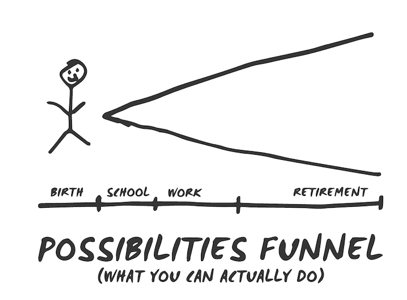

    Nevertheless, we follow the path they suggest based on their own beliefs of what is possible. Unfortunately, it can take years, decades, and even a lifetime to realize how our dreams were derailed and why.

    Possibilities Funnel

    What you can actually do continues to grow, even as your beliefs (what you think you can do) get in the way of that.

    So how do you push past your insecurities and start believing in yourself again? How do you take advantage of the endless possibilities available to you when your beliefs about yourself won’t let you take the first step?

    1. Start thinking like a five-year-old.

    Ignore your doubts and negative feedback from others. Five-year-olds don’t pay attention when someone tells them they might not be a princess and an actress when they grow up. They just keep believing.

    When my brother Seth decided he wanted to be a musician, many people around him suggested he try for something more realistic. Despite the insecurities and the extremely small chance of success, he believed in himself and went for it. Now he plays around the world with his band NEEDTOBREATHE.

    When you start believing and acting on your five0year-old dreams, there’s a good chance you’ll be surprised by how often they come to life.

    2. Be the biggest loser.

    The weird thing about our potential is that it often gets hidden. It gets covered up by doubt and by the discouragement we get from others. We often forget our potential exists, and it takes a friend or coach to remind us of it and encourage us to take action.

    The NBC show “The Biggest Loser” is a classic example of this principle. Before coming on the show, the contestants fail to lose weight on their own because they lack the willpower, the time and, most importantly, the belief in themselves. After getting on the show and working with trainers, they uncover abilities they never knew existed.

    If you’re looking to make a serious change in your life, find a coach or accountability partner to work with. They’ll help you tap into your childlike thinking and uncover beliefs, abilities, and innate talents.

    Because of our lack of experience, Seth and I reached out to several successful authors for help and coaching on our book. Reaching out to people you respect can be a scary process, but each time you do it you’ll learn something new.

    3. Don’t be so scared of failure.

    Many times we quiet our inner five-year-old because of the fear of failure. We fear that if we go for what we actually want, we might fail and look stupid. This was my fear before writing the book.

    The best learning moments in life are when we fail. If you never fail, you’ll never make a difference in the world.

    Think of the people who you admire the most. How many times do you think they’ve failed in their lives? Probably more than they can remember. These people are successful because they failed early and failed often. They got out there, gave it a shot, and learned with each failure.

    Failure means you’re making progress. Don’t be so afraid of it.

    When you were five, falling down and pushing yourself back up was an opportunity to build your muscles. You ran to explore possibilities because at worst you would learn something new and get stronger doing it.

    If anything is b-o-l-o-g-n-a, it’s forgetting how to run and hope and dream the way we did when we were kids. So next time you’re feeling discouraged or insecure, ask yourself: “What would my inner five-year-old do?”

    Editor’s Note: Chandler has generously offered to give away five signed copies of Breaking Out of a Broken System, his new book, co-written with his brother Seth. Each book purchased saves someone’s life through a life-saving malaria pill. Their mission is to save 10,000 lives by selling 10,000 copies.

    To enter to win a copy, leave a comment below. You can enter until midnight EST on Monday, March 10th.

    UPDATE: The winners for this giveaway have already been chosen. Congrats to M, VictoriaP, Tiffany Joi, Priya, and Alex

    Photo by Praveen Kumar

  • When You’re In Transition: Being Patient and Accepting Uncertainty

    When You’re In Transition: Being Patient and Accepting Uncertainty

    “Fear, uncertainty, and discomfort are your compasses toward growth.” ~Celestine Chua

    Change is never easy, yet it’s always around us. Sometimes it hits us over the head (if you experience divorce, a career change, a move, or a loss of a loved one). Other times, it’s hiding around the next corner. And most of the time, it’s happening even we don’t even know it.

    My father firmly believed in the adage the only constant is change. Myself, however, I avoided change as much as I could because I didn’t want to deal with uncertainty.

    After a well-scheduled high school experience, I applied early to college and graduate school just to be sure I knew my futureThat worked well for a little bit. Until it didn’t. Until I realized that these decisions kept me from understanding that I was completely terrified of not knowing what to do next. That all of my early acceptances were actually holding me back from discovering what I really want.

    After completing graduate school, I took my first pause, not knowing which direction I was headed in. To be honest, a pause is a kind word. It could also have been called a bit of a breakdown or simply the hard realization that life is a series of transitions and rarely “just planned out.”

    A few years down the road, I found myself in another career and personal transition. I noticed I wanted to cling to something again to avoid uncertainty. After pouring through more graduate school websites and clinging to the idea that finding certain work was the answer, I realized I needed time to be in transition, even though it terrified me.

    I needed time to heal and time to just be. Because that idea of being in transition made me quite uncomfortable, I knew I needed to sit with it, find my way through it, and finally become friends and a little more comfortable with transitions.

    I once heard that the only way out is through. There are no short cuts. In order to hang (or some days, wallow) in and through the transition, I learned a few tools along the way:

    Break the cycle of caring what other people think.

    For a while, I hated when acquaintances and former colleagues would ask, “What are you doing now?” I would cower under that question and try to invent answers that would be sure to impress them, such as “I am learning astrophysics” or “becoming a ballet dancer” (both utterly and completely untrue).

    On the whole, our society is fixated on success and we are rarely encouraged to take time “out.” Once I stopped judging myself, people’s questions seemed a lot less important to me and I was able to relax into my transition a little more.

    Learn to just hang out. Wherever it is you are.

    Take a day. An hour. A lunch break. Stop with the planning and action-stepping and self-help reading and just chill. Don’t check email. Don’t look for a solution. Turn it off. Whatever it is. It will still be there. Just take a pause and breathe. Because then the real pauses will feel a lot easier and familiar.

    Be cool with the idea that there is no quick fix.

    While looking for the next opportunity (personal or professional), it can be tempting to say yes to something just to end the search.

    A friend of mine used to encourage her other friends to date “the second-best-guy” and to just take any job. That didn’t work for me. At all. The times I tried that left me right back at square one, even more discouraged.

    The real thing takes time to find. The real thing is worth waiting for. The real thing is why we left whatever wasn’t working in the first place.

    Do things that keep you centered and grounded.

    It can be overwhelming to be in transition. It can be hard to make a simple decision sometimes. And it can be oh-so-tempting to self-medicate. Instead of obsessing over writing a resume or an e-mail or wasting time on Facebook, take a walk. Or sing a song or bake a chocolate cake. Or read a book or sing really loudly in the shower. Or do whatever it is that makes you feel centered. Do it every day. Commit to it.

    I may not be exactly where I want to be, but I am feeling closer to it every day and am beginning to welcome transitions, because as their words says, they help us transition to the place we want to be.

    Once we can soften into the transition and take the time—which is a gift—to relax into them, they can soon evolve into a place of respite, a place that is ripe with possibilities and excitement, a place that holds the space for us to become even stronger.