Tag: positive

  • When Trying to Be Positive Brings You Down

    When Trying to Be Positive Brings You Down

    “Serenity comes when you trade expectations for acceptance.” ~Unknown

    How many of us have caught ourselves feeling as though we’re imposters when we’re trying to talk about a difficult situation in a positive light? We’re often fed the idea that how we feel is in how we decide to see life, which, I agree with; however, sometimes I think that idea gets taken to a deceptive extreme.

    In the midst of one of my mini-meltdowns the other day, I called my friend and told her what had been going on in my head the last few months.

    “It’s sounds as though you have some shame issues with your experience. It’s okay to admit that you’re disappointed and angry. You need to allow yourself to accept it. It’s the first step in healing…” my friend asserted as I was invalidating myself while I attempted to explain how I felt about the last year of my life.

    “What a relief,” I thought to myself as she went back and validated every one of my thoughts and feelings.

    Have you ever known something in the back of your mind, but you needed someone else to bring it to the front?

    Any time I talked about my experience, I would always do my best to portray it in the best light possible. We’re supposed to be optimistic about how we see life and our experiences, right? The problem was that I was doing it at the cost of compromising the authenticity of my story.

    I moved halfway across the nation, leaving behind my well paying (but miserable) job, friends, and family in search of finding work that filled instead of drained me. I accepted a one-year position as an intern counselor at a residential boarding school, working with adolescents coming from particularly challenging backgrounds.

    I loved working with the students and learned invaluable lessons from them and their stories.

    I hated constantly feeling as though I wasn’t (good) enough.

    I poured everything I had into that year, and admittedly, there were definitely times I failed because I struggled to find the support I needed while carrying the weight of a massive life upheaval, trying to be “present” for my friends and family back home, and balancing helping to guide the students through their issues while trying to not retrigger my own.

    Additionally, I couldn’t meet all the expectations coming from so many different people and places, so I did the best I could but it didn’t cover everything.

    Though I would tell a friend that is all you can do and that is good enough, like so many others, I am my own worst enemy and consistently felt like a failure.

    I returned to my home state feeling defeated not only regarding my performance at the school, but about returning without having found what I set out looking for.

    I felt even more clueless and lost than before I left, and it was embarrassing. Who leaves everything behind looking for something, and then returns without it?

    My friend continued to gently remind me that not everything is within my control when I’d protest saying things like, “but isn’t how we see life all about our perceptions? Aren’t we supposed to be able to go out and fix things if they aren’t filling our needs or change how we look at them?”

    “So, it wasn’t what you were hoping it would be. That’s not your fault. You need to admit and accept that you feel the way you do, and it’s okay. Trying to cover up what’s really going on might be what’s holding you back from moving forward.”  

    Oh. Right.

    When she said that it seemed like the most obvious thing in the world. It’s okay to say that there were some flaws with the program that had nothing to do with me. It’s okay that the experience wasn’t perfect. It’s okay that I wasn’t perfect.

    I was trying so hard to always put a positive spin on my story that I wasn’t really telling my story anymore, and that subtle lie was corroding my own sense of self-worth.

    All that said, I do believe in doing our best to “look at the bright side,” so to speak, but not before we can honestly assess our experience and accept how we really feel.

    It’s only when we can be truly honest with ourselves about how we feel that we will be able to find the positive lesson, heal, and move on.

  • Developing Self-Compassion When You Don’t Think You’re Enough

    Developing Self-Compassion When You Don’t Think You’re Enough

    sad face

    “He who knows that enough is enough will always have enough.” ~Lao Tzu

    I’m at war with enoughness.

    My stomach isn’t flat enough; I’m not extroverted enough; I don’t have enough money in my wallet; I’m not creative enough; I’m not getting enough work done.

    There are times when the Jaws of Life cannot free me from my expectations and negative self-talk. The battle with enoughness is a vicious cycle. 

    Here’s an example: I’m both shy and introverted, so I’m afraid of being judged and I prefer quiet environments.

    I was easily overlooked in school because I was reluctant to participate verbally in class.

    During work meetings my ideas were mere whispers compared to the loud shouts from some of my extroverted coworkers.

    Because I prefer staying home on Friday nights, my peers often ask me, “What’s wrong?”

    I’ve convinced myself that something must be wrong with me, so when I have the opportunity to do something social, I either don’t go or I walk into the situation feeling self-conscious and inadequate. 

    Both of these choices fuel criticism. “See, I told you so,” my inner critic says. “You really aren’t enough!”

    The Merriam-Webster Dictionary defines enough as “occurring in such quantity, quality, or scope as to fully meet demands, needs, or expectations.”

    When I criticize myself for not being enough or having enough, whose expectations am I trying to meet?

    It’s too easy to point my finger at society—the society that favors those with the loudest voices; equates self-worth with “what I do for a living;” and glamorizes infidelity, drug abuse, and teenage pregnancy. We’re all affected by the society we live in, there’s no question about it.

    With that said, we have to take full responsibility for our lives, and that includes tending to our own impossible expectations. 

    In the words of Mary Oliver, “You must not ever stop being whimsical. And you must not, ever, give anyone else the responsibility for your life.”

    I have good news and I have bad news. Here’s the bad news: No one is coming to save you from your negative self-talk (addiction, abusive relationship, or draining job).

    And the good news? Facing the truth that you’re responsible for your life is incredibly liberating.

    This truth has motivated me to start treating myself better. If you’re anything like me, you’re your own worst enemy, so we could all use a bit more TLC.  Reclaim your self-compassion with the following three steps.

    1. Open your journal and draw a line down the center of the page. 

    For one day, record your self-talk in the left column. Then read over everything you wrote down.

    How many negative things did you tell yourself? How many positive things did you tell yourself? What issues were you especially negative about (for example, body image)?

    The point here is to become more aware of your thoughts. In the right column, write a positive thought next to each negative thought. When you read over the positive list, let the truth of how wonderful and lovable and beautiful you are sink in.

    2. Set realistic goals for yourself. 

    All too often, fueled by our impossible expectations, we set unattainable goals.

    For example, I worked for an English-language newspaper in Germany, and when I went to my first meeting I wanted everyone to like me.

    I had the same goal during the second meeting and all the meetings that followed, so I was hypersensitive to even the tiniest bit of criticism. I continued to be let down, which gave me more reason to criticize myself.

    Be my authentic self during the meetings—now this is a more realistic goal. That way, if my coworker said he didn’t like one of my ideas, for instance, I wouldn’t have taken it as a personal attack.

    3. Every day write down at least one thing (or five things!) you’re grateful for. 

    Remember the children’s book Alexander and the Terrible, Horrible, No Good, Very Bad Day? Just like Alexander, we’ll have days when everything goes wrong. And that’s okay.

    When you sleep through your alarm clock, your computer crashes and you lose your report, and your date cancels at the last minute, be mindful of the simple things: a hot shower, clean socks, or your dog greeting you at the door.

    Shifting your focus from what you don’t have to what you do have will boost your well-being.

    Changing the way we perceive ourselves will change the way we perceive others.

    If we tell ourselves we’re unlovable because we don’t have a significant other, what’s going to stop us from thinking our friend is worthless when she tells us that she is getting divorced?

    Recently during a yoga class, my teacher said something that made me catch my breath (literally):

    If someone says, “I love you,” it reflects the way she feels about herself; similarly, if someone says, “I hate you,” it reflects the way she feels about herself. I’ve never thought of it this way before, but it makes so much sense!

    Practicing self-compassion is not just for our own benefit; practicing self-compassion also benefits the people around us.

    Photo by Juanedc

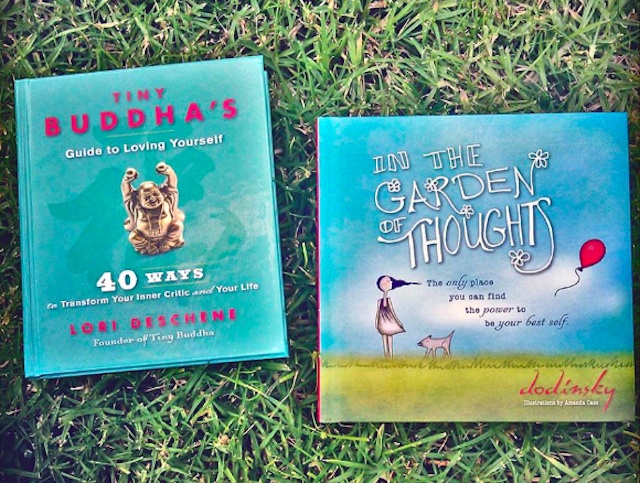
  • Book Giveaway: Guide to Loving Yourself and In the Garden of Thoughts

    Book Giveaway: Guide to Loving Yourself and In the Garden of Thoughts

    Tiny Buddha. In the Garden of Thoughts

    UPDATE: The winners for this giveaway have already been chosen. They are:

    • Vanessa Fisher
    • ljchern
    • kbennett10486
    • Jon

    Today I’m excited to run a giveaway for two books that I believe complement each other nicely—the site’s latest collaborative project, Tiny Buddha’s Guide to Loving Yourself and In the Garden of Thoughts, a New York Times bestselling inspirational book, written by my new friend Dodinsky.

    About In the Garden of Thoughts

    I was fortunate to connect with Dodinsky on Facebook, where he runs a popular page called “Positive Outlooks” that’s followed by over two million people.

    Though his heartening images and quotes were what originally caught my eye, I’m most inspired by his charisma, kindness, and…well, positive outlook!

    Through countless email exchanges he’s revealed a joyful, uplifting presence that never fails to incite a smile.

    His book, In the Garden of Thoughts, is quite similar. It’s tiny but powerful, with beautiful illustrations and positive messages for reflection and inspiration.

    Offering some insight into the book’s title, Dodinsky has written, “I truly believe that within us, there is a Garden of Thought in which we can find solace whenever we are going through a storm. The response to my work shows that there are many on the same path. Each of us needs words that bring comfort, and an understanding that one is not alone when facing adversity.”

    About Tiny Buddha’s Guide to Loving Yourself

    Launched earlier this week on October 8th, Tiny Buddha’s Guide to Loving Yourself is a collaborative book featuring a collection of stories from Tiny Buddha contributors, along with tips to help you feel good about yourself and your life.

    The book shares 40 unique perspectives and insights on topics related to loving yourself, including: realizing you’re not broken, accepting your flaws, releasing the need for approval, forgiving yourself, letting go of comparisons, and learning to be authentic.

    Much like Dodinsky, I started Tiny Buddha and created this book because I believe there is a healing power in recognizing that we are never alone with our challenges.

    And there’s nothing wrong with us for what we’ve been through or what we’re going through.

    No matter how we’ve struggled, no matter what our flaws or weaknesses, we are worthy of being fully seen—and we can make a difference in the world by doing it.

    I hope this books helps you remember, in times of doubt, that you are beautiful, imperfections and all, and you can thrive not in spite of them, but because of them.

    The Giveaway

    Up for grabs are two copies of Tiny Buddha’s Guide to Loving Yourself and two copies of In the Garden of Thoughts (to go to a total of four winners).

    If you’ve already purchased a copy of Tiny Buddha’s Guide to Loving Yourself, you can still enter the giveaway, because I’d like to send a copy to someone you love with a special note from you.

    To enter:

    • Leave a comment on the post sharing the most inspiring thing you’ve seen or heard lately.
    • Tweet: RT @tinybuddha Book Giveaway: Tiny Buddha’s Guide to Loving Yourself & In the Garden of Thoughts http://bit.ly/16AifAx

    If you don’t have a Twitter account, you can still enter by completing the first step.

    You can enter until midnight PST on Monday, October 14th. Have a great weekend everyone!

  • Bounce Back from Unexpected Challenges Stronger and Happier

    Bounce Back from Unexpected Challenges Stronger and Happier

    Jumping

    “True happiness means forging a strong spirit that is undefeated, no matter how trying our circumstances.” -Daisaku Ikeda

    Let’s face it, whether big or small, stressful or simple, we all face challenges every day, some easier to deal with than others. Unfortunately, life doesn’t come equipped with an instruction manual to handle these challenges.

    No matter how much we try to plan in advance, calculate our every move, or predict what the future will bring, we can never prepare enough for the unexpected.

    The past eight months of my life have been filled with more twists and turns than the most popular roller coaster at Six Flags. As a control freak, I was suddenly forced to surrender to circumstance, forced to take a back seat and reflect on what my life was becoming.

    Sometimes it takes physical pain to get to the root of a deeper wound that you are unconsciously inflicting on yourself.

    Ever since the age of three, my heart and soul has thrived on dance. For me, the ability to connect emotionally with others through movement is something that is indescribably fulfilling.

    In May of 2012 I graduated college with my B.F.A in Dance. It marked the closing of four of the most demanding, stimulating, and downright remarkable years of my life. I grew emotionally, physically, and spiritually, molding into my adult self through incredible and trying experiences. I was healthy, in shape, and injury free.

    After graduation, I set my sights high upon New York City, anxious to jumpstart my dance career. I moved in August and set out with a willing heart, determined to make my dreams come true. My approach was frantic, maybe even fanatical.

    I needed a job, I needed to succeed, and I needed to prove myself.

    That’s when life threw a curve ball that stopped me dead in my tracks.

    I was taking a dance class before an audition when… twist, slip, fall, crack… In a blur I was in the ER clutching a broken leg, flooded with fear, anger, and distress. 

    After the initial shock of what happened, it started to sink in that I would be out of dance for a while. Realizing this setback after just arriving to NYC was heartbreaking. In that moment, all I could think about was “Why me?”

    I worked so hard and pushed so much to get to the top of my game, but in a way that was harming my body, physically and emotionally. I had let the competitive nature of the dance and theater scene get the better of me.

    Suddenly, I found myself away from my NYC apartment and newfound life and back home with my parents, trying to heal. As a young dancer whose body is her career, having life abruptly stop was devastating.

    Four months later I was able to return to the city to start again. Slowly progressing, I felt as if everything would heal. Then, another wrench in the plan: a follow up with the doctor revealing the fracture was not healing.
    Just when things were looking up, they felt as if they were sinking down again. I would need surgery, screws to set the broken bone back into place, and another five months of recovery.

    We all face setbacks at some point along life’s journey, and learning to bounce back is what really gives our spirit strength.

    Sometimes accidents happen for very good reasons. In my case, the universe was trying to tell me to slow down, that I have my whole life ahead of me to work and dance and love. Rome wasn’t built in a day.

    Yoga played a huge role in my recovery process, enabling me to overcome the overwhelming sense of failure and depression that came with my injury.

    Unable to do the physical asanas, I discovered the benefits of meditation, learning how to calm my frantic mind, and practicing acceptance toward the cards I had been dealt.

    In college, I started practicing yoga as a way to cross train and escape my hectic class schedule. Since then, the practice has become an anchor for me, its emotional and mental benefits saving me from self-destructive thought patterns and allowing me the chance to release away from, and be at peace with, the pressures of the real world.

    Before my injury, I started working a desk job at Pure Yoga in Manhattan to continue practicing yoga and to further my teaching skills. It was fate getting the job at Pure, as I landed myself right in the middle of an amazing community of loving, caring, and truly remarkable people. 

    Throughout my injury and recovery my friends at Pure have kept my spirits lifted, encouraging me to keep moving forward.

    When I returned to work, yoga was there alongside my friends to help me build back strength. It is so important to have a support system. When things get tough, your friends and family can hold you up—and you shouldn’t be afraid to let them.

    My setback produced another positive, as it led me to complete a 100-hour teaching certification in yoga therapeutics. I quickly became more involved with how important a role yoga plays in healing the body, mind, and spirit.

    Still getting my strength back, I have learned:

    1. Letting go brings abundance.

    Sometimes letting go is the absolute hardest thing to do. But when we hold on too tight, we leave no room for the light to get through.

    It’s like catching a feather: you have to hold out your hand and allow the feather to fall into your reach. You can’t catch a feather by frantically flailing and grasping for it. Once you loosen your grip on a perceived outcome, things start to unfold organically.

    Learning not to force things opens up the possibility for the brilliant and the extraordinary to happen.

    2. Believing in love will lift your soul.

    Believe that there are people in your life who love and believe in you. Believe that you are love, and that your soul has a limitless capacity to give and receive love.

    How does the simple act of believing make you feel? Worthy. Infinite. Content. Express compassion and gentility toward yourself, and to others, and you will open up to the possibilities life has to offer.

    3. Gratitude will ignite a light in the darkest of places. 

    When I first came out of my leg cast, the simple act of being able to put weight on my own two feet made me realize how grateful I am for my health, and how much we all tend to take it for granted.

    Be grateful for running to catch the subway in the pouring rain, because you can feel that rain on your skin and you can feel your feet as they pound the pavement. Experiencing gratitude in simplicity changes everything.

    Each day our yoga is to embody positivity, in every situation. Let go of what does not serve you to let abundance in. Believe in your strength to overcome. Be grateful.

    And don’t forget to breathe.

    Photo by Zach Dischner

  • Get Unstuck: Stop Believing the Negative Stories You Tell Yourself

    Get Unstuck: Stop Believing the Negative Stories You Tell Yourself

    Break Free

    “You may not control all the events that happen to you, but you can decide not to be reduced by them.” ~Maya Angelou

    We’ve all done it, right? Somehow, somewhere, something bad happened to us and since that moment we’ve continued to tell ourselves the story about what might and could go wrong in our future.

    For me, the biggest negative pattern I’ve had to release stems from my parents’ divorce. For as long as I can remember, I’ve been a positive person. When I was a kid I was happy-go-lucky, nothing much bothered me, and life was pretty awesome.

    Also, being an only child I was always close with my parents. The thought that they wouldn’t be together was something that never entered my mind.

    Then they split up when I was 18 and things began to change. I made different choices and I also began to believe that all romantic relationships were doomed.

    A few years later, just after I had split up with my long-term partner, I was in LA spending a lovely afternoon watching US daytime TV. Nothing much was on, but every channel I flicked to seemed to mention the word “marriage” or “divorce.”

    I also happened to be reading Wayne Dyer’s Your Sacred Self at the time, and suddenly it all made sense:

    I had been telling myself stories like “Marriages never last forever” and “All relationships are doomed,” and in essence I was creating my reality.

    I finally realized that my beliefs about relationships had been causing me to attract those exact experiences.

    I was giving these negative stories power and acting on them. I was skeptical that I would be able to have a successful and happy relationship, which caused me to see everything that could go wrong. I ultimately initiated our break-up because I believed that it was inevitable.

    The very experiences we fear keep repeating themselves if we continue to focus on them and give them power. We’ve got to become aware and first change ourselves if we want our reality to change.

    Now that I’m a few years on from that, I have replaced my negative relationship beliefs with new, positive thought patterns.

    Now, I believe my current relationship is a lifetime partnership and as a result, I act in a way that manifests that type of relationship without worry and doubt. I take responsibility for my part of the relationship, and because I have positive thinking patterns I bring my best self to the table. This allows me and my partner to have confidence and faith as we plan our lives together.

    Our experiences reflect our beliefs, so it benefits us to make them positive.

    Here are a few questions to help you get to the root of your negative beliefs so you can make changes in your life:

    1. What are the negative stories you’ve been telling yourself?

    Is there an area in your life where you seem to struggle? Which experiences trigger negative thoughts?

    It’s time to narrow in on the beliefs that are keeping you from living the life that you want.

    2. Where do those negative beliefs come from?

    What happened in your past? Did someone in a position of authority make a negative comment about you that you’ve held on to?

    Just know that you can’t change what has happened or what someone said to you or about you. But you do have the power to decide not to allow those experiences to control your life in this moment.

    3. Why are you holding on to those negative beliefs?

    Which needs are you fulfilling by holding on to these beliefs? For example, are you getting attention by playing the victim?

    By not letting go of negative beliefs, we keep ourselves trapped in a vicious cycle, repeating the same pattern over and over again. Life will continue to give us lessons until we learn, grow, and move past it.

    We need to make a change within ourselves to move forward and break through to a new reality.

    4. What does your future look like if you let go of these beliefs?

    Close your eyes and imagine your future if you didn’t have these thoughts. Notice all the amazing things that you close yourself off from just by holding on to your negative beliefs.

    What can you do in this moment to move toward that future?

    Holding on to past experiences and old beliefs gives you an excuse to continue to repeat the same behavior. It justifies negative thought patterns and keeps you in that loop.

    It’s time to break the pattern and realize you have the power to shape your reality!

    Photo by Hanna Irblinger fotografie

  • Dealing with Dark Days: Help for When You Don’t Feel Your Best

    Dealing with Dark Days: Help for When You Don’t Feel Your Best

    “The problem is not that there are problems. The problem is expecting otherwise and thinking that having problems is a problem.” ~Theodore I. Rubin

    I live in a rainy city. For most of the winter it’s endless grey, weeks in which you’re lucky to get a glimpse of the sun at all.

    It might be drizzling, it might be pouring, or it might be merely fog. It is certainly wet.

    For me and a lot of the people who live here, it’s almost a deal breaker. When I first arrived, I spent a lot of time complaining that it was raining again. When the sun came out, I summarily dismissed it with “yeah, but for how long?”

    Sometimes I still fantasize of moving somewhere nice and hot. Maybe I’ll melt all summer long, but at least there’s sun, right?

    The bottom line is that I like living here. For a thousand reasons, it’s my home. I’m not going anywhere.

    So my choice is this: embrace my decision with a full heart, rain and all, or live in bitterness, fearing the next cloud.

    I can’t change the weather.

    I also live in a rainy mind. Like everyone I’ve met, I have anxieties, fears, and a thousand other difficult moods that arise in me on days when I’ve counted on sunny, focused productivity.

    For the last couple of years, it’s been panic attacks.

    Everything is going so well until something derails and my world becomes scary, my breath comes with difficulty, and I’m falling down the rabbit hole again.

    The hardest part to let go is my plans for the day. I was going to write a blog post, clean the kitchen, or go out with friends, but now I’m crouched in the corner expending all my energy to keep air pumping into and out of my lungs.

    Not fun.

    But recently I realized, I can’t change the weather.

    Sure, I can do things to take care of myself so panic attacks are less likely, but if it’s not one thing it’s another:

    I couldn’t sleep last night, and now I’m tired. My project isn’t coming along like I’d hoped, and now I’m cranky. The other people involved in my plans got sick, and now the plans are canceled.

    Life isn’t always sunny. Life gets rainy.

    And no, that’s not fun. Rain on a day you were hoping for sun is frustrating and sad. It can seem like everyone in the world expects constant sunny positivity from you, and when you can’t manage it, there’s shame and guilt.

    But it’s kind of magical when you decide to look at it like it’s largely outside of your control. What if today’s mini disaster blew in on the wind with the clouds? What if that same wind will blow it out again?

    Maybe today you’ll finally buy some rain boots so you can go for a walk without getting wet. Maybe today you’ll learn that the beach is different in the rain, but still kind of cool. Or you could spend today curled in a ball, cursing the grey.

    Either way, it’s still raining. Either way, you’re still lovable. You don’t have to like the weather, but it’s an option.

    And the funny thing that happens, once you stop fighting your internal weather, is it becomes calmer. It turns out that so much of the problem was the expectation that would things be different than they are, that everything would go smoothly.

    Now when it rains, I tell myself I know that I will see the sun again. It might be two weeks, but it’ll happen. Probably sooner than I think.

    When I feel anxiety creeping up, I remind myself that we all have emotions that are difficult for us. That I will feel calm and happy again, probably pretty soon.

    And then I have the space to make the best of the day I was given, not the one I ordered.

    Some thoughts that help (think of them as affirmations if you like):

    1. This is the weather right now. I can’t change the weather, but I can take it into account to make myself more comfortable.

    2. The sun always comes back. There are always days when things go right. This discomfort is temporary.

    3. Everyone has hard days, even if not everyone talks about them. I’m still normal and lovable when my weather is rainy.

    4. I’m allowed to feel disappointed that things aren’t going the way I wanted. I don’t have to be ready to make the best of it right away.

    5. What if today were supposed to be rainy? What if this were exactly the right thing?

    What helps you on days when things aren’t going according to plan?

  • Becoming More Positive When Negativity Feels Instinctive

    Becoming More Positive When Negativity Feels Instinctive

    “Dwelling on the negative simply contributes to its power.” ~Shirley MacLaine

    If you have ever felt the depths of depression, you know it’s not the same as being sad or having “the blues.” It’s the hopeless, overwhelming feeling of melancholy where nothing, not even the people you love, can pull you out.

    It can feel like being under water in the ocean while the waves keep washing over you, pushing you further and further underneath, while no matter how hard you try, you can’t seem to break the surface to get that much needed air in order to survive.

    Unfortunately, I am no stranger to this foe, this unwelcomed presence of darkness. I suffer from chronic depression, and it has followed me around for many years, letting me know that it will never completely disappear.

    For a long time, I thought of myself as a victim. It always seemed that others had it much easier. I felt so alone. While I knew there were others out there who suffered from mental illnesses, it was hard to not have a “poor me” attitude while living in it.

    I got to the point where I wouldn’t even try to go beyond taking a pill every day to stave off the depression. I felt hopeless most of the time. Even in good times, beneath the surface, there was sadness over the impending doom that I knew would eventually take over again.

    The last major depression I had was a year ago. I had to move back in with my parents (at age 34) when I was jobless, hopeless, and had just hit rock bottom. This has happened more times than I care to admit.

    But this time was different because I was determined to crawl out of that dark place and never fall back in again.

    I had a choice—I could either keep going down the same old traveled road where I knew all the stops and turns, or I could veer off in a new direction, one that might lead to inner peace and happiness.

    I decided to take the road less traveled. It has not been an easy one because I’ve hit plenty of bumps and I’ve also crashed into a wall or three. The biggest challenge was finding decent mental health care, since I had spent years searching for it, to no avail.

    After finally finding a good psychiatrist and getting my medication tweaked, I added some much needed therapy. This has helped me come to terms with the fact that, while my chemical imbalance is something that I was born with, I wasn’t controlling my illness; it was controlling me.

    This last year has truly been a turning point for me. Keeping a journal of my thoughts in both good times and bad has led to an epiphany about the way that I think.

    I realized how hopeless I had been for so many years. I was so jaded that I truly believed I would never lead a happy life due to my mental illness.

    I used to think that happy-go-lucky people had never experienced any hardships. I now realize that while those people actually do have problems, it’s their attitude that gets them through the rough times.

    Unhappiness generally occurs not because of what happens in a person’s life, but because of how that person thinks about what happens.

    I now know that while I cannot change what has happened in the past, my attitude and outlook in the present will help me deal with whatever happens in the future. Having control over my thoughts will make my inner world a place of freedom instead of a prison.

    I’ve become determined to be one of those happy people. But that takes work—lots of work!

    My negative mind rejected the idea of any positivity at first. Slowly but surely, using affirmations in my daily life has provided much needed guidance in my ongoing metamorphosis into a positive person. It takes practice to train your mind and you have to work at it each day, but it can be done.

    So how does someone become a positive person?

    Work on erasing that negative song playing over and over in your mind.

    Replace that track with a positive tune and make sure it is one you can dance to!

    Use daily affirmations. Two that have helped me are:

    “I willingly accept things as they come, even if I don’t like it.”

    How I respond is always my choice.”

    Keep reminding yourself of the good things in life.

    It could be something simple—for example, that you have a roof over your head or that you have plenty to eat.

    Take care of yourself physically and it will help you mentally, as well.

    Exercise, eat well, take vitamins.

    I have to remind myself often that change is not going to happen overnight, and it will take more than a few months to be able to become the positive person I desperately want to be.

    I’m trying to talk to myself in the same compassionate way I would talk to a friend. I am working on seeing each incident in my life as beneficial to me in some way.

    In the last year, I have started yoga. Quieting my mind has proven to be quite a difficult task to master, since my brain is a blabbermouth. However, each breath helps be in the moment. I’m still pretty inflexible, but I have goal poses that keep me motivated.

    I have also started to meditate, which has proven to be even harder since, even though I have no trouble being still physically, that talkative mind of mine won’t quiet. I was frustrated until I started to use some daily affirmations and chants. I’m now able to channel and squash all those negative thoughts that pop up.

    I have also found writing to be a passion. Putting my negative thoughts on paper helps me to identify the distorted thinking that can still occur from time to time. It also helps me spin those thoughts into positives and look at things from a new perspective.

    Negative thoughts may creep back in sporadically, but I remind myself that how I respond is always my choice. If I have problems, they occur because I still have more to learn.

    Since I control my thoughts, I can decide to think positively about anything. My happiness ultimately depends on me.

    When I feel those creepy incessant thoughts start bubbling around in my brain, I remind myself that it took time for me to fall apart, and that means it may take a substantial amount of time to put myself back together again.

    While I hope I’ll never experience depression again, I know that I may. I also know that next time I feel it looming, I won’t go down without a fight. I’ve grown as a person and I am stronger today because of it.

    Many people say that you are who you are and you can’t change. I don’t think that’s true. It may take a long time and there will be days when those negative thoughts creep back in, but anyone can be more positive if they really work at it.

  • Do You Define Yourself and Your Life Negatively?

    Do You Define Yourself and Your Life Negatively?

    Man Sitting

    Growing up on military bases I learned to make friends quickly. My family moved a half dozen times before I was out of the second grade, so I didn’t have many other options. But while living on base it was easy, because all us military brats were in the same boat.

    In third grade my dad retired from the Air Force and we went to live in a small town just south of Nashville, Tennessee. Once we moved everything changed. Instead of living with the sons and daughters of service families, I went to school with the children of the southern nouveaux riche.

    New Kid In Town

    Instead of making friends quickly, I struggled. I was teased and I developed quite the temper. I acted out in class and one day on the playground I tackled one kid and drug him several feet by his hair.

    Though getting picked on was hard, what was worse was what I started doing to myself. But once I started, it was hard to stop. To this day this habit still haunts me in big and small ways.

    Accentuate the Negative

    What I started doing to myself in third grade was defining myself in the negative. I started believing and telling myself I wasn’t likable. I wasn’t like the other kids. I was outside the group.

    Now, in some ways this was true. I was different from the other kids in ways. But my difference was situational, not inherent. I just didn’t realize that.

    I thought there was something wrong with me. I took this thought and internalized it; I turned it into a story about myself, and then I told it again and again.

    A Not So True Story

    It became true for me, perhaps in the same way some of your stories have become true for you. Now I’m 32 years old and I still am afraid that I’m not likable. I struggle to make friends even though I’m social and outgoing.

    I discount the friends I have and struggle to trust that they really like me. All because of this definition that I wrote for myself when I was in the third grade.

    But I know it doesn’t have to be like this. I don’t have to live trapped by these old definitions. For all the definitions I still have I have overcome many others.

    Overcoming Obstacles

    For years I smoked pot and defined myself as a stoner. Now that I don’t smoke and rarely drink, I now prefer being alert and attentive. I no longer define myself as a stoner.

    For years I was argumentative about everything. “Yes, but,” were probably the first word most people heard me say. Though I can still hold my own in a debate, I don’t feel the need to constantly object in every setting. In high school everyone you asked would have said I like to argue. But now people talk about how calm I am.

    The same thing that makes defining yourself powerful is what makes overcoming it possible. The only person who decides how you define yourself is you.

    Sure, people reflect that definition back to you, but if you stop doing it so will they. It’s not an easy thing to change, but it is changeable. And you can do it in 4 steps.

    Notice.

    Start paying attention to moments when you define yourself. When do you stop and ask yourself if it’s really true? And what if it wasn’t true? How can I act in way that free’s me from this definition?

    Record.

    As you start to notice write down your own negative definitions. Getting them out of our heads makes them seem even sillier. It also helps us separate from them. When we create space around our definition we create the potential to change them.

    Redefine.

    Next write down and the start to define yourself in positive ways. Action follows definition, so if you define yourself as a runner, you will become one. If you define yourself as honest, you will work to be more honest.

    Our lives resonate on a deep frequency with what our heart sets forth.  If we strike the chord of our aspirations, our lives will“ vibrate in kind. If we strike the dissonance of our criticism our lives will ring out of tune.

    Stop.

    Stop defining yourself in negative and limiting ways.

    Stop being afraid to see yourself as brave, bold, and courageous.

    Stop letting your old definitions limit who or what you can become.

    Stop keeping your hearts desires locked away.

    Instead, tell yourself and tell the world what your life is about. Not by talking the talk, but by living it. Ghandi once said, “My life is my message” What kind of message do you want to leave behind?

    Photo by Michael

  • How I Found Peace When Anxiety Was Controlling My Life

    How I Found Peace When Anxiety Was Controlling My Life

    “Every day brings a choice: to practice stress or to practice peace.” ~Joan Borysenko

    For five long years during my mid-twenties I was a recluse.

    Anxiety so badly affected my life it became impossible for me to venture outside my front door or to interact socially with other people.

    Fear and panic would envelop my mind and body, rendering me paralyzed from doing the things I dearly wanted to do. My hopes of being a normal human being lay in tatters. Everything seemed impossible.

    Seeing my old friends on Facebook and other people enjoying life, attending parties, finding partners, getting married, having kids, and talking enthusiastically about their travels contributed to my deep reservoir of sadness.

    I couldn’t sleep before four o’clock in the morning and would often sleep my afternoons away in order to find a temporary comfort in the evening hours.

    The loneliness was overwhelming, the despair was consuming, and the anxiety was like a constantly beating drum, reminding me of time ticking away my hopes, dreams, and desires.

    The Japanese have a special word for people who withdraw from the world. I had become a “Hikikomori,” and at the time saw my life as a recluse never ending and maybe even suicide being the eventual outcome.

    Fortunately, these grave predictions would never have to be realized, for with the gradual self-cultivation of determination, I began to fight back against my anxiety disorder.

    It was extremely difficult at first and there were numerous hurdles, but over a period of a few years I managed to achieve the normalcy I had so badly wanted.

    Today I feel as balanced and relaxed as someone who has never known the horrors that inappropriate anxiety and terror can bring. My years as a recluse are long behind me.

    I want to share four techniques that I discovered and mention how I used them to vastly reduce the anxiety in my life. Each one can be, and was, practiced in conjunction with the others.

    1. Stimulate positive feelings.

    For half an hour each day, I began to practice loving-kindness meditation and developed an appreciation for the people and the world around me. I took inspiration for this from a book by the late German Buddhist nun Ayya Khema called Being Nobody, Going Nowhere.

    This stimulated parts of my brain different to those that activate the anxiety response. By doing this I was able strengthen mental muscles related to relaxation and happiness. This also seemed to lessen the space in which my anxiety was able to maneuver, thereby reducing its strength and effectiveness.

    I knew the development of love and acceptance for myself was also crucial to my healing. There’s not a lot else that is more disconcerting and destabilizing than a mind filled with self-hatred or blame.

    2. Bathe in discomfort.

    We are not very good at accepting discomfort. Whether it’s physically or mentally, as soon as an uncomfortable feeling arises we instinctively try to get away from it. The more we do this, the more our levels of intolerance increase. This can become very pronounced in the avoidance tactics most anxiety sufferers evolve.

    The solution for me was to develop a gentle acceptance of discomfort, whether it was an itch on my leg or the unpleasant feelings of apprehension. I slowed down my conscious response to the feeling and observed it for a little while without trying to fix it or run away from it.

    I bathed in the discomfort, even when I was filled with horrendous fear, rather than immediately trying to find distractions such as food, TV, Valium, or alcohol. It was very hard to begin with but I kept going, kept trying, kept persisting.

    By doing this I found I was able to handle discomfort more effectively and appropriately. Fear and panic began to slowly decrease as my mental awareness of the nature of the feelings becomes more refined.

    3. Study the anxiety.

    It’s important when dealing with anxiety to study what you are thinking and what leads to increased mental tension. Humans are very imaginative, and while this has enabled us to survive and prosper as a species, it has also left us at the mercy of our inner-creativity.

    I began to study my anxiety and my thoughts. I constantly questioned whether the fear of impending disaster was legitimate or not. Whether it was likely or unlikely to actually happen? Was it a sensible worry to engage in on that particular day? Or could it have been postponed until the following day?

    If so, then I left the worry for the next day and mentally compartmentalized it so it would not encroach on my then present reality. In the meantime, I used my energies to engage in activities which I believed would positively develop me as a person, however small and insignificant they seemed at the time.

    4. Distract your creative mind.

    As mentioned previously, the mind is great at imagining worst-case scenarios. Inappropriate anxiety and fear are fueled by the creative part of the human brain. If an anxiety sufferer allows this part to run free then all havoc can break loose.

    When fear was present in my mind, which was very often, I began to realize it was important to try and switch my thoughts away from my creative and emotional mind, and instead into the rational and logical realm of my brain.

    This effectively reduced anxiety periods in a surprisingly short amount of time by engaging reason over raw emotion.

    I managed to do this by focusing my complete attention on to logic-based puzzles or games. I did various things including reciting the alphabet backwards, solving a mathematical problem, memorizing 10 foreign language words within ten minutes, or trying to comprehend a riddle.

    Relaxation is Attainable

    Nowadays I live in a foreign country with a woman I love and enthusiastically engage in a job I find highly rewarding. When I look back on the man I once was, sitting alone in a bedroom for years on end, without a shred of hope or happiness, I can’t help but feel immense love and compassion for that person.

    Life is not easy and when you get stuck in a rut, things can quickly become overwhelming and seemingly impossible to escape. An anxiety disorder can disfigure the sense of reality one has and render the world a terribly frightening and cold place.

    However, it’s important to remember that no matter how bad the fear may feel, or how much of a stranglehold anxiety seems to have on your life, things can get better. With a determined spirit, you can move toward a more relaxed, healthier, and happier way of living.

    This will not only benefit you but also those who love you the most.

  • Is Optimism Hard-Wired? 6 Ways to See the Glass as Half Full

    Is Optimism Hard-Wired? 6 Ways to See the Glass as Half Full

    Glass Half Full

    “If you don’t like something change it; if you can’t change it, change the way you think about it.” ~Mary Engelbreit

    My best friend called me on the phone last night. Of course, it’s not unusual to get a call from your best friend. But this call was one that really got me thinking about myself and the way I view life.

    Kent has been my best friend since we were eleven years old. We met during summer camp the year after his dad died. We didn’t even like each other at first, as he was a tall, gangly geek and I was a short, muscular athlete. Somehow, though, we became friends and the relationship has lasted for almost forty years.

    Kent hasn’t had an easy life. After his dad died, his mother had to work as a maid in the local hotels. While that’s an honorable profession, it kept her working during holidays and weekends.

    He hung out with my family on most holidays.  In fact, we jokingly refer to him as the “fourth McKinney son.”

    When we were in our twenties, Kent contracted a (usually) fatal virus.

    He’s been living with it all this time, and has been told to “get your affairs in order” more than once. I’ll never forget the time he called me crying because the doctor had said he only had three months to live.

    “Tim! I have a one-year-old son. What am I going to do? He won’t even remember me.”

    I promised my best friend that I would share all of Kent’s embarrassing stories with his son. And, when I hung up the phone, I cried too.

    Kent didn’t die that year, or any of the other years since. That son grew up to join the Army and is now on active duty.

    Last night we were talking, and Kent mentioned that he was going a get-together with a family who’d lost a son in the Iraqi war. I said, “Oh, that must be so difficult. Those poor people!” My friend simply replied, “I came away from it with a tremendous respect and appreciation for the sacrifice these people made.”

    What? Kent has a son who is in the military! How can he handle being around someone who lost their son? While I was thinking about how hard it would be to be around someone who’d lost a child, my friend was focusing on being grateful.

    And then it hit me. Kent is always like that.

    Even though Kent has lived his entire life with the cloud of mortality over his head, he became a person who ceaselessly volunteers time, money, energy, and everything for those who are less fortunate than him.

    In contrast, my wife and I have a running joke about my pessimism. We joke that we could both walk into a room that has a giant window overlooking the ocean. Upon seeing the window she would exclaim, “Oh my! Look at that gorgeous sunset.” And I would say, “That window is filthy. And what’s with that crack up at the corner?”

    I don’t mean to see the negative side of life first. I’m just hard-wired to do so.

    How can someone like me overcome my natural tendency to be pessimistic? I did some brainstorming and came up with six ways you to see the glass as half full.

    1. Stop comparing yourself to others.

    When a friend of yours gets a raise, a new car, or loses a bunch of weight, don’t reflect it back on yourself. It’s not about you! Just because you didn’t get a raise, are driving an old Volkswagen, and have a spare tire around your middle doesn’t mean that you never will improve. When we compare ourselves to others, we usually fare poorly.

    2. Change your focus.

    Optimism and pessimism are nothing more than feelings. If you sit around dwelling on why your life sucks, you’re going to feel pessimistic. If you shift those thoughts to ones of gratitude, you’ll feel more optimistic.

    3. Look for positive signs everywhere.

    I have another friend who, whenever she sees a penny on the ground, picks it up and thinks of one thing she is grateful for. It doesn’t have to be a penny. You can do this when you see an airplane overhead, a white cat, or some other trigger that will remind you to stop and feel grateful.

    4. Listen to uplifting music.

    It’s almost impossible to be pessimistic when you’re listening to Josh Groban’s “You Raise Me Up.” If you find yourself in a pessimistic frame of mind, put on something that will shift those feelings from negative to positive.

    5. Detach from outcomes.

    The key in being optimistic is to develop the attitude that if one opportunity passes, another one will be along soon. Don’t believe me? Take a look at your life and identify a couple of things that you really wanted and didn’t get. Chances are you can look back at it now and feel glad that you didn’t get it.

    6. Stop saying you are a pessimist.

    Words are powerful. If you start to think of yourself as an optimist, start telling people that you’re an optimist, then it will soon become true. How do I know? Because I’m an optimist, too.

    Photo by Bailey Weaver

  • Reconnect with Your Authentic Self Instead of Denying Your Feelings

    Reconnect with Your Authentic Self Instead of Denying Your Feelings

    “I have just three things to teach: simplicity, patience, compassion. These three are your greatest treasures.” ~Lao Tzu

    I recently took seven weeks off of work and rented a place in Laguna Beach.

    The trip was meant to be a relaxing vacation and possibly a change of residence; it turned out to be a wakeup call.

    I started the trip out by going on my first date since 2010. The pollen count was high, and my sinuses were none too happy. I’m still not sure if it was being on a date or the medication that triggered so much anxiety; maybe it was a combination of both.

    Later that evening, as I replayed the day in my mind, old insecurities came to the surface. That feeling of not being good enough engulfed my being.

    I just smiled, shook my head, and thought to myself, “Really? Does this still ring true for you?”

    The answer was no. But it still came up, so I had to explore it further. So I spent the next two and a half weeks in a battle with the Southern California Pollen Count and my inner self-worth issues.

    Most of my life had been controlled by an underlying sense of anxiety.

    In my teen years and throughout most of my twenties, I numbed it with drugs and alcohol. In 2005, after I celebrated my first year of sobriety, I started to really explore this feeling. I signed up for hundreds of newsletters, spent many hours in the Dana Point Library, and purchased over 100 books that year alone.

    I read, listened, and put into practice anything that came across my path.

    The movie “The Secret” spoke to part of me, and books from Deepak Chopra, Ester and Jerry Hicks, and countless others made me temporarily feel as if it were going to be okay.

    I wanted so badly to just be happy, to be able to really look into the mirror and like what I saw.

    By April 2009, I thought I had it all figured out. My goal-setting exercises were bringing my desires to fruition, my body was as healthy as it has ever been, and my love life was what I had always dreamed it would be.

    A few months later it all fell apart. I found myself again back to square one. It didn’t make sense and all I wanted was to know was: What part of this equation was missing?

    My mission to figure it out was renewed, and the way my life has unfolded since has been a long, strange trip indeed.

    Looking back at my self-education is partially humorous and equally frustrating.

    I now find it humorous that I worked so hard to “fix” something that wasn’t actually broken.

    I find it a bit frustrating to have consumed so much information that perpetuated this seemingly endless cycle of self-help stupidity.

    Two very popular self-help ideals come to my mind.

    1. “You just have to be positive.”

    This may be worst thing you can say to someone who is depressed and sees no way out of it.

    You read books on “how to attract everything you ever want in life.” You understand that positive thinking leads to positive results. Just when you start making progress, something happens and you feel frustrated or angry.

    You find yourself upset at yourself for being upset. You think, “Why can’t I just be happy? What’s wrong with me?” The depression deepens.

    Listen, you don’t have to be positive all the time.

    It’s okay if you get upset or don’t feel happy every waking moment.

    Before you can cultivate a positive mindset, you must first honor where you are and the journey that brought you here. Our general outlook on life is a mixture of genetics and experience. Some reactions are very deeply engrained and will take a concentrated effort over time to change.

    You’re not broken if you can’t see the silver lining, which is why this next bit of wisdom needs another look.

    2. “Just fake it until you make it.”

    It’s a catchy saying, but horrible advice.

    The feelings you have present in your life are valid. The act of faking it is an act of denial, which can have some really negative effects on your psyche.

    You can’t fake your way out of sadness and depression.

    You can put on a happy face, and to some degree it will change your mood. But, during those times when you take away distractions and you have to sit alone with yourself, the act of faking it will make you feel like you’re crawling out of your own skin.

    I didn’t realize that faking it perpetuated anxiety.

    Being really comfortable with myself didn’t actually happen until I began to just sit still on a regular basis.

    At first it was overwhelming; anxiety turned to frustration, to anger and rage, and finally to shame. I felt cracked wide open, exposed and raw.

    The feeling really sucked and it lasted for almost six months.

    But I sat with it. I owned it, and in that space of raw vulnerability I stopped faking it. For the first time in my life it felt okay to be me.

    There is a real power in authenticity.

    It is an act of love to honor where you are right now.

    From my experience with sitting in my own stuff came my life as a writer. My first book followed and my newsletter audience grew.

    Yet, with all that I’ve studied and think I know I still found myself experiencing that old worn out feeling of “you’re just not ever going to be enough.”

    So, how did I find myself in Laguna Beach overwhelmed and feeling less than worthy of love and affection?

    Well, that was actually pretty easy for me to discover. You see, I’m an avid note taker and list maker. It only took a few hours to sort through my 2012 notes to see that I had only half been walking my talk.

    My practice of meditation had taken a backseat to my “trying to achieve things.”

    My practice of mindfulness had eroded; evening meals were consumed along with DVDs and Facebook noise-feeds.

    Three months of sunsets went unseen.

    My reverence for the present moment had once again been lost while my mind searched for fulfillment in the future; the result of which was the rise of my existential anxiety.

    A Simple Plan to Reconnect with Your Authentic Self

    • Still your body and mind. Commit to just five minutes of meditation and build your practice from there.
    • Maintain focused attention on your breathing and honor the task at hand.
    • Witness your reactions to get to the core reasons behind your emotional response.
    • Take time each evening to write down little moments of gratitude, love, and awe that happened throughout your day.
    • Remind yourself that you have nowhere else to be other than where you are right now.

    From my experience thus far the first part of the plan is the most powerful; science backs up that claim. That’s why I am building my daily sitting meditation.

    My dream is to see more authenticity in this world.

    My belief is that this will lead to more compassion, which in turn will lead to more change.

    How about you? Want to change the world too?

    Then please join me by spending just a little bit of time doing absolutely nothing, every day for the rest of your life.

    Who’s in!? Tell me you’re with me!

    Photo by sierragoddess

  • 5 Ways Meditation Can Improve Your Life and Make You Happier

    5 Ways Meditation Can Improve Your Life and Make You Happier

    Meditation

    “If you correct your mind, the rest of your life will fall into place.” ~Lao Tzu

    For most of my life I had the overwhelming feeling that I was lacking something. I felt like I was not good enough, smart enough, or pretty enough.

    I was nothing but an unattractive, chubby girl of little worth. In my late twenties I formed a huge crush that changed my life, for the worse, or so I thought. Against my will, I developed an unbelievable attraction to women. I was horrified!

    Being gay was the cherry on top of my pile of shortcomings. This new realization confirmed the belief that my life would be nothing but disappointment, and it totally crushed the little self-esteem that I had.

    In spite of my overwhelming feelings of inadequacy, I took the scary steps of falling in love and coming out to family and friends, with positive results.

    Even though my fears of judgment and rejection were proven to be fabrications, I was still unable to shake the negative loop that repeated: “You are not good enough. You will fail. You are a disappointment.”

    I convinced myself that any happiness that I experienced was momentary and would be gone in a flash. So when my relationship ended in heartbreak, I was able to bask in the glory of being right.

    My negativity was justified. My feelings of worthlessness were correct. I gave myself permission to be miserable, to struggle in the dark caves of depression, to continue to live in fear.

    But then one day a miracle happened, even with my negative mantra playing loudly in my head: “Loser. Failure. Disappointment.” Even over the deafening chants of pessimism, I heard a whisper: “You can change this.”

    I knew that my life needed changing, but I had no idea how to achieve this. I wanted to find the happiness that I felt belonged to everyone else. I yearned for the elusive joy that kept slipping through my fingers. I was determined to find it and claim it.

    I tried superficial ways of being happy; you know, the methods that my favorite TV characters used to deal with heartache: I shopped, I redecorated, I adopted a kitten, thinking surely these things would bring me joy. And they did, but it was fleeting.

    Next, I tried psychic readings, life coaching, and finally therapy. It was through therapy that I started a meditation class and my life really began to open up. The veil of depression lifted; I felt lighter and optimistic.

    Finally, through the regular practice of meditation, I learned that happiness can’t be brought, predicted, or achieved from outside sources. Happiness comes from the inside out.

    With this realization, meditation has changed my life in five significant ways.

    1. Meditation gives you a great start to your day.

    I am not a morning person. I am not one of those people who spring out of bed before the alarm chimes. I would hit the snooze button, pull the covers over my head, and pretend it was Saturday.

    Once the cruel hand of reality finally slapped me awake, the morning panic would start. Up in a flash, I’d be rushing to get dressed then out the door. I’d skip breakfast and I’d arrive to work late, creeping past the boss’s office.

    But now I wake up at 5:45am in order to meditate. Though I still have to forcibly drag myself from my warm cozy bed, once I sit on my meditation cushion I’m able to relax, breathe, and set my intention for the day.

    Meditation allows you to center yourself and reflect on the day ahead. By setting your intentions, you are able to shape your experiences and your reactions to events around you. It’s a daily reminder that you are in control of your life. You can choose the kind of day you will have.

    2. Meditation increases positivity.

    I practice Loving Kindness (Metta) Meditation. This type of meditation generates and projects loving and positive feelings/energy into the universe. That means sending love, understanding, and compassion to yourself, family, friends, and even strangers.

    I’ve found that spending an hour being positive has made me—wait for it—more positive. Hard to believe, I know, but it’s true.

    Our energy and actions are like boomerangs. If you put out negative energy, if that is what you focus on, that is what will continuously show up in your life, and that is all that you will be capable of seeing. But when you create positive feelings, everything you see seems to change.

    3. Meditation increases self-confidence.

    I have no empirical evidence, but I can say with confidence that as a result of meditation I now have some. Seeing the world in a positive light has resulted in me seeing myself in a positive way.

    I love myself for just being me. I don’t feel the need to pretend to be what I think others want me to be. I have learned that I am not required to chip away at my square-shaped self to fit into a round hole.

    Taking the time to see the world and yourself in a positive light increases self-confidence and confirms that there is a place where you fit, just as you are. There is no need to try to be something that you are not. Meditation is an opportunity to sit with the realization that you are enough.

    4. Meditation reduces anxiety.

    Meditation is about turning off the negative chatter that creates anxiety. It’s about breathing and letting go. By focusing on positive energy and thoughts, you are able to reduce the anxiety that you might be holding onto.

    Through meditation you can relax knowing that any time anxiety rears its ugly head, you have the tools to deal with it. Deep breaths and a quiet moment may be all that’s needed to calm anxious nerves.

    5. Meditation affords you a deeper connection with yourself.

    When I first started meditation, one of the most difficult things to do was to sit quietly with my own thoughts. I knew myself from the outside in, from the labels I wore like fashionable accessories, trying to be what I thought others expected of me.

    There was a disconnection between who I was and who I thought I should be. However, when you sit in silence without external distractions, your inner dialogue is difficult to ignore. The inner voice that tells the truth of who you are gets louder.

    Meditation has a way of making you more mindful of your thoughts, feelings, and sense of who you are. It’s easier to create a life of happiness if you are able to connect with your authentic self. It’s a way for you to get to know yourself, from the inside out.

    You can easily incorporate meditation into your life. All you need is a quiet place to sit and a couple of uninterrupted minutes, and you can even use a guided meditation (there are tons of free ones online).

    The important thing is just to sit quietly without set expectations, free of self-judgment. There is no right or wrong way to do it.

    Don’t get me wrong; I’m not skipping around with my head in the clouds. There are days when I revert to my old thought patterns, allowing the negative mantra to cry out. But the difference is that now I am mindful of this and have the tools to deal with negativity more effectively.

    Five minutes of meditation can have a significant and lasting impact on your physical, emotional, and spiritual well-being. It certainly has on mine.

  • 10 Ways to Deal with Negative or Difficult People

    10 Ways to Deal with Negative or Difficult People

    “Dwelling on the negative simply contributes to its power.” ~Shirley MacLaine

    I love her to death, but it’s draining to talk to her.

    Every time I call this friend of mine, I know what I’m in for: a half-hour rant about everything that’s difficult, miserable, or unfair.

    Sometimes she focuses on the people she feels have wronged her, and other times she explores the general hopelessness of life. She never calls to see how I’m doing, and she rarely listens to what’s going on in my life for more than a minute before shifting the focus back to herself.

    I tell myself I call because I care, but sometimes I wonder if I have ulterior motives–to pump up my ego offering good advice or even to feel better about my own reality.

    I’m no saint, and if there’s one thing I know well, it’s that we only do things repeatedly if we believe there’s something in it for us. Even if that something is just to feel needed.

    I thought about this the other day when a reader wrote to me with an interesting question: “How do you offer compassion to someone who doesn’t seem to deserve it?”

    While I believe everyone deserves compassion, I understand what she meant after reading more. She went on to describe her offensive, sexist, racist boss who emotionally exhausts everyone around him. He sounds a lot more hateful than my friend, who is, sadly, just terribly depressed.

    But these people have one thing in common: boundless negative energy that ends up affecting everyone around them.

    So today I started thinking about how we interact with negative or difficult people. People who seem chronically critical, belligerent, indignant, angry, or just plain rude.

    When someone repeatedly drains everyone around them, how do you maintain a sense of compassion without getting sucked into their doom? And how do you act in a way that doesn’t reinforce their negativity–and maybe even helps them?

    Here’s what I’ve come up with:

    1. Resist the urge to judge or assume.

    It’s hard to offer someone compassion when you assume you have them pegged. He’s a jerk. She’s a malcontent. He’s an–insert other choice noun. Even if it seems unlikely someone will wake up one day and act differently, we have to remember it is possible.

    When you think negative thoughts, it comes out in your body language. Someone prone to negativity may feel all too tempted to mirror that. Try coming at them with the positive mindset you wish they had. Expect the best in them. You never know when you might be pleasantly surprised.

    2. Dig deeper, but stay out of the hole.

    It’s always easier to offer someone compassion if you try to understand where they’re coming from. But that can’t completely justify bad behavior. If you show negative people you support their choice to behave badly, you give them no real incentive to make a change (which they may actually want deep down).

    It may help to repeat this in your head when you deal with them: “I understand your pain. But I’m most helpful if I don’t feed into it.” This might help you approach them with both kindness and firmness so they don’t bring you down with them.

    3.Maintain a positive boundary.

    Some people might tell you to visualize a bright white light around you to maintain a positive space when other people enter it with negativity. This doesn’t actually work for me because I respond better to ideas in words than visualizations. So I tell myself this, “I can only control the positive space I create around myself.”

    Then when I interact with this person, I try to do two things, in this order of importance:

    • Protect the positive space around me. When their negativity is too strong to protect it, I need to walk away.
    • Help them feel more positive, not act more positive–which is more likely to create the desired result.

    4. Disarm their negativity, even if just for now.

    This goes back to the ideas I mentioned above. I know my depressed friend will rant about life’s injustices as long as I let her. Part of me feels tempted to play amateur psychiatrist–get her talking, and then try to help her reframe situations into a more positive light.

    Then I remind myself that I can’t change her whole way of being in one phone call. She has to want that. I also can’t listen for hours on end, as I’ve done in the past. But I can listen compassionately for a short while and then help her focus on something positive right now, in this moment. I can ask about her upcoming birthday. I can remind her it’s a beautiful day for a walk.

    Don’t try to solve or fix them. Just aim to help them now.

    5. Temper your emotional response.

    Negative people often gravitate toward others who react strongly–people who easily offer compassion or get outraged or offended. I suspect this gives them a little light in the darkness of their inner world–a sense that they’re not floating alone in their own anger or sadness.

    People remember and learn from what you do more than what you say. If you feed into the situation with emotions, you’ll teach them they can depend on you for a reaction. It’s tough not to react because we’re human, but it’s worth practicing.

    Once you’ve offered a compassionate ear for as long as you can, respond as calmly as possible with a simple line of fact. If you’re dealing with a rude or angry person, you may want to change the subject to something unrelated: “Dancing with the Stars is on tonight. Planning to watch it?”

    6. Question what you’re getting out of it.

    Like I mentioned above, we often get something out of relationships with negative people. Get real honest with yourself: have you fallen into a caretaker role because it makes you feel needed? Have you maintained the relationship so you can gossip about this person in a holier-than-thou way with others? Do you have some sort of stake in keeping the things the way they are?

    Questioning yourself helps you change the way you respond–which is really all you can control. You can’t make someone think, feel, or act differently. You can be as kind as possible or as combative as possible, and still not change reality for someone else. All you can control is what you think and do–and then do your best to help them without hurting yourself.

    7. Remember the numbers.

    Research shows that people with negative attitudes have significantly higher rates of stress and disease. Someone’s mental state plays a huge role in their physical health. If someone’s making life difficult for people around them, you can be sure they’re doing worse for themselves.

    What a sad reality, that someone has so much pain inside them they have to act out just to feel some sense of relief–even if that relief comes from getting a rise out of people. When you remember how much a difficult person is suffering, it’s easier to stay focused on minimizing negativity, as opposed to defending yourself.

    8. Don’t take it personally, but know that sometimes it is personal.

    Conventional wisdom suggests that you should never take things personally when you deal with a negative person. I think it’s a little more complicated than that. You can’t write off everything someone says about you just because the person is insensitive or tactless. Even an abrasive person may have a valid point. Try to weigh their comments with a willingness to learn.

    Accept that you don’t deserve the excessive emotions in someone’s tone, but weigh their ideas with a willingness to learn. Some of the most useful lessons I’ve learned came from people I wished weren’t right.

    9. Act instead of just reacting.

    Oftentimes we wait until someone gets angry or depressed before we try to buoy their spirits. If you know someone who seems to deal with difficult thoughts or feelings often (as demonstrated in their behavior), don’t wait for a situation to help them create positive feelings.

    Give them a compliment for something they did well. Remind them of a moment when they were happy–as in “Remember when you scored that touchdown during the company picnic? That was awesome!” You’re more apt to want to boost them up when they haven’t brought you down. This may help mitigate that later and also give them a little relief from their pain.

    10. Maintain the right relationship based on reality as it is.

    With my friend, I’m always wishing she could be more positive. I consistently put myself in situations where I feel bad because I want to help, because I want her to be happy. I’ve recently realized the best I can do is accept her as she is, let her know I believe in her ability to be happy, and then give her space to make the choice.

    That means gently bringing our conversation to a close after I’ve made an effort to help. Or cutting short a night out if I’ve done all I can and it’s draining me. Hopefully she’ll want to change some day. Until then, all I can do is love her, while loving myself enough to take care of my needs. That often means putting them first.

    I’ve learned you can’t always save the world, but you can make the world a better place by working on yourself–by becoming self-aware, tapping into your compassion, and protecting your positive space. You may even help negative people by fostering a sense of peace within yourself that their negativity can’t pierce.

  • 3 Ways to Deal with 3 Different Forms of Negativity in the World

    3 Ways to Deal with 3 Different Forms of Negativity in the World

    “The world is full of a lot of fear and a lot of negativity, and a lot of judgment. I just think people need to start shifting into joy and happiness. As corny as it sounds, we need to make a shift.” ~Ellen DeGeneres

    I’ve dealt with a lot of negativity in my life.

    When I was only 20, my dad died of ALS, or Lou Gehrig’s disease. Before that I had to watch him suffer from it for a couple of years as his body slowly lost its functions.

    Also, when I was young I was bullied a lot. Because I was taught to never fight back, I had a lot of pent up anger knowing that my wrongdoers “won” and got away with it.

    To this day, sometimes I have trouble letting go of both big things and small things.

    As such, I tend to develop a train of negative thoughts easily, subsequently affecting my mood.

    Do any of you feel overwhelmed by negativity?

    The Negativity in the World

    The thing about negativity is that it’s rampant.

    You’re bound to encounter people who disagree with you or people who seem out to bring you down.Then there’s the negative state of the world, where bad things happen to good people and innocent people suffer for no reason.

    As such, the negative thoughts tend to enter your mind.

    “Why is life so unfair?”

    “What did I do to deserve this?”

    “What if bad things happen to me?”

    Sounds familiar? (more…)

  • Uncover Hidden Emotions: What’s Really Pushing Your Buttons and Why?

    Uncover Hidden Emotions: What’s Really Pushing Your Buttons and Why?

    “When you judge another, you do not define them. You define yourself.” ~Wayne Dyer

    Lately, I’ve been confronted by envy. It’s one of those negative emotions that I used to avoid taking credit for.

    “I really am happy for everyone,” I would tell potential mates and friends.” And I thought I meant it.

    Instead of feeling envious, which was impossible since I didn’t do envy, I would feel an ambiguous sense of dislike for the person. 

    My elementary school best friend who went on to become a Miss America contender? I made up a story that she was being “fake” by parading around wearing too much makeup. I wanted to be happy for her, but it was too hard.

    There’s another young woman I didn’t like, too. She’s a bestselling author and spiritual teacher who is adored by millions and actually looks cute delivering love from the universe. Why didn’t I like her?

    I couldn’t quite put my finger on it, so I made up another story about how something wasn’t in alignment and I didn’t trust her integrity.

    And the hardest to admit, I suddenly didn’t like an acquaintance I’d known since high school when she started hanging out with a guy I liked. You’d think I could put it all together, but my mind wouldn’t let me see the truth.

    Since this feeling of dislike was subtle and ambiguous, it slipped past my internal radar.

    There’s not doubt you see my pattern, though. What I masked with disdain was really a crown of envy.

    I was unable to admit to myself that I wanted what these women had.  (more…)

  • Empower Others and Make a Positive Difference in Their Day

    Empower Others and Make a Positive Difference in Their Day

    Helping Hand

    “Praise is like sunlight to the human spirit. We cannot flower and grow without it.” ~Jess lair

    One of the more important lessons I learned as a child came from my father.

    One day a beggar knocked on our door looking for a giving hand. Though I was a small child, I still remember how he looked. He was old, with an untamed beard and tattered clothes. He had a wretched odor; I imagine he hadn’t showered in months. He was, more likely than not, homeless.

    I remember how my father treated him. I remember my father inviting him into our home, seating him in our kitchen, opening the fridge, and feeding him a hearty meal. I don’t remember much more than that, yet my father’s actions that day taught me an important lesson. It was a lesson about how to treat others. It was a lesson about empowerment.

    Recently, I have gone on a journey in the world of altruism. I sought out “good people” in order to understand the characteristics that define them. What piqued my interest were not just their acts of kindness, but also an understanding of their inner world.

    The inspiring, kind people who I met throughout my journey are incredibly influential teachers. It is worthwhile understanding their insights, the way they approach life, and more specifically the way they treat others. Meeting them has had a profound effect on my life.

    One of the lessons I learned through my interaction with them was the importance of empowering others.

    Each of our inner circles is growing and encompassing more people: children, significant others, friends, colleagues, and random people we meet and don’t know as intimately. As the circle grows, so too does our influence.

    Every nod, every smile, every interaction can completely change the course of someone else’s day. We can either wield that influence in a positive or negative way. The people who I met chose the former.

    The following I would like to dedicate to those special people who identify with their fellowmen, and use their influence to empower them. (more…)

  • 3 Reasons to Stop Trying So Hard to Be Positive and Peaceful

    3 Reasons to Stop Trying So Hard to Be Positive and Peaceful

    “Freedom is instantaneous the moment we accept things as they are.” ~Karen Maezen Miller

    The world is filled with people who work hard at being positive, peaceful, and more spiritual and then feel bad when they don’t measure up. I know because I used to be one of them. And I still am from time to time.

    That was before I realized something:

    1 It doesn’t work.

    2. Spirituality isn’t something you do; it’s something you are, and you are this right now. Just as beneath the chatter of your mind you are already positive and peaceful too.

    3. You are already as spiritual as you’ll ever be.

    There, article done: My views on trying to be more spiritual.

    Well, okay, there’s more to it than this. Let’s back up—starting with a confession or two.

    Confession 1: It’s after midday, I’m still in bed, and all I’ve eaten today is cheese.

    (That was more like a warm-up confession; I mean, who doesn’t stay in bed with half a block of cheese from time to time? And in all fairness to myself, it was a small block.)

    Confession 2: I try hard, at everything—or at least most things.

    (My husband made me add the last bit because he said I don’t always try hard when we play backgammon.)

    But seriously, or at least half seriously, if there were a lecture on How to Relax More and Not Try So Hard, I’d be in the front row, my hand in the air, with half a dozen questions. I might even take notes and record the lecture so I could listen at home.

    For me, “trying hard” has been a badge.

    We believe that if we’re successful, whatever success looks like in our sphere of influence, we’ll he happy and loved.

    We’re all ‘’try hards”—we all do it; it’s a universal condition. Your trying will look different to my trying, but it’s all the same.  (more…)

  • Feng Shui Basics: How Your Space Can Affect Your Mood

    Feng Shui Basics: How Your Space Can Affect Your Mood

    Screen shot 2013-01-05 at 2.28.43 PM

    “The light is what guides you home, the warmth is what keeps you there.”  ~Ellie Rodriguez

    One day I came home and just sat in my driveway for a while, wondering why I wasn’t happy about going inside my house. I wasn’t depressed, and I had a loving relationship with my family.

    Even though I was married to the love of my life and just had a beautiful baby boy who I couldn’t wait to see every day after a long day of work, something about coming home was simply unpleasant, and it irked me that I wasn’t able to pinpoint it.

    Every time I walked in the front door or roamed around my home, I’d find myself picking at little things, like the lighting and the colors on the wall. My gut told me that something was wrong with the interior look of the house, since we hadn’t touched it since we moved in.

    “Why is it so dark in this room? Who likes this color anyway?” I’d ask.

    I questioned whether that was really the cause, but when a student of mine began talking to me about Feng Shui after class one day, a light bulb went off, and I sought the help of a Feng Shui specialist.

    The interior design of my home was affecting my mood.

    How do you tell your wife that you feel weird about coming home and then blame it on the decoration? Worried that she might think it was a bigger issue, I sat her down and communicated my feelings.

    “Honey, I really don’t know what it is. There’s something about walking through the front door that makes me feel uncomfortable. I think it’s something about the space.”

    She said that she felt the same way and proceeded to talk about the discomfort of the living room, while I complained about the hallway and office. I felt much better knowing that I wasn’t crazy!

    After that, we splurged on new paint and said goodbye to our ugly bare white walls and awkward furniture placement.

    That’s when I started learning about how your physical space can affect your mood and life. (more…)

  • The Real Secret About the Power of the Mind

    The Real Secret About the Power of the Mind

    “What we are today comes from our thoughts of yesterday, and our present thoughts build our life of tomorrow: Our life is the creation of our mind.”  ~Buddha

    Unless you spent the last decade in a Tibetan monastery or under a rock, you probably know about Rhonda Byrne’s book/DVD The Secret.

    This 2006 self-help volume, highly endorsed by the likes of Oprah Winfrey, erroneously educated readers on “The Law Of Attraction,” a hypothesis that suggests we have the power to influence events and circumstances of our live in three simple steps:

    1.Ask the Universe for what you want.” In essence, get your desires very clear in your mind. (Do not limit yourself to any possibility.)

    2. Believe. “Act, speak, and think as though you have already received what you’ve asked for.” When you emit the frequency of having received it, the law of attraction moves people, events, and circumstances for you to receive.

    3. Receive. “Feel the way you will feel once your desire has manifested.” Feeling good now puts you on the frequency of what you want.

    The general public accepted this get-thin/rich/famous/talented-quick scheme and ate it up like a bowl of Cherry Garcia ice-cream.

    One interesting characteristic about people who believe anything they’re told without the benefits of research is that they tend to have a very fickle belief system. So countless people believed The Secret, then slumped into devastated depressions when asking the Universe to make them skinny didn’t actually make those size two skinny jeans glide on and button up.

    But instead of people blaming the gurus who presented this misinformation, they took it personally, given they’d also been told that if their wishes weren’t quickly granted, it was because the wisher just wasn’t wishing hard enough. (more…)

  • Your Thoughts Create Your World: Patrol Your Mind

    Your Thoughts Create Your World: Patrol Your Mind

    “Since you alone are responsible for your thoughts, only you can change them.” ~Paramahansa Yogananda

    In my second year of residency, I went through my internal medicine rotation. I had just been assigned to a particular patient and was responsible for his care during that part of his stay. His medical chart stated he had multiple systemic issues, including more than one terminal condition.

    He had been admitted to the hospital numerous times, but this was our first encounter. As I entered his room, I wasn’t sure what to expect. After all, this was a man with a limited amount of time left.

    In the past, I’d had a few patients turn their anger toward me simply because I came into their space. Others were indifferent. Who could blame them? They were facing difficult circumstances—some of them potentially fatal. I just assumed this gentleman would fall into one of the two categories.

    I was wrong.

    When I walked in, I was met with a heartwarming smile and genuine welcome. This soft-spoken gentleman greeted me in the way one would a friend. I immediately felt a warmth and connection to him, and over the next few days he became the highlight of my day.

    Looking back, I had to wonder what made this man face his situation in a completely different manner than others. He was able to keep the most pleasant disposition despite the fact that his body was slowly shutting down under the strain of his multiple ailments.

    I understand now that he simply made a choice.

    He could have easily chosen to think that life was unfair. He could have chosen to think he had a right to have a nasty attitude. He could have chosen to die bitter and broken.

    He didn’t. He chose to think differently of circumstances most of us would consider dire. He chose not to dwell on the negative but instead made an effort to create positivity around him. If he had the power to choose a higher thought about his situation, it stands to reason that we all do.  (more…)