Source: Collective Evolution

“Most folks are as happy as they make their minds up to be.” ~Abraham Lincoln
Have you ever wondered, “How is that guy always so laid back and freaking happy all the time, no matter what is going on around him?”
It might be a co-worker, a friend, or a family member, but almost everyone has somebody whose baseline level of happiness is just higher than almost everyone else.
I certainly do. Although I have known a few people that fall into this category, the one that stands out most is a friend I met my freshman year in college in my dorm. I’ll call him Andy.
Andy smiled all the time. A huge smile. Raining outside, smiling. Test didn’t go that well, smiling. From the moment I met him, he gave a big handshake with an equally big and goofy smile. When I picture Andy, I always picture him smiling.
It was certainly annoying at times. When I wanted to brood over a test gone bad or a girl I couldn’t get to notice me, smiling Andy made it nearly impossible. But I mostly just wanted to know why he was always so happy so I could be annoyingly cheery too.
Is Andy and the rest of his ilk just delusional?
No, (at least not exactly), they actually know something you don’t, and I’m going to let you in on it. But first, let’s talk about you.
How are things? Things are . . . fine.
If you are like the vast majority of us, your baseline is that things are generally “fine.” You probably could have slept a little longer, but waking up wasn’t terrible. You could eat better, but you do okay. You don’t particularly love your job, but it could be worse.
All that is normal. Right?
Probably, but that doesn’t really mean it’s good. In fact, considering the general happiness level of the average person isn’t particularly high, normal is probably not what you are looking for.
The problem is that while “fine” and “normal” aren’t exactly the “big hairy goals” that everyone likes to talk about, they don’t hurt either.
“Fine” and “normal” are comfortable. Your basic needs are met and, at this point, it happens with almost no intentional engagement from you:
You wake up, get ready, go to work, do some stuff, waste some time, do some more stuff, go home, watch TV, go to bed, repeat.
You might have some exercise thrown in here and there. You hang out with your friends, your significant other, or your kids. But most days look pretty similar to this.
Which is fine.
Except when your time on this planet is over, you don’t want “fine” to be the best description of your life.
You want something more.
Okay, so how to do you get it?
What does that guy know that you don’t? Let’s look closer at the happy guy. What’s his take on life?
Fine isn’t it. He thinks life is great, awesome, brilliant, and extraordinary. And he’s right.
And that’s the secret.
Yes, I realize this seems way too simple. But that’s really it.
His story is different than most of ours.
I don’t mean he lies to himself about what happens day to day. And I don’t mean bad stuff doesn’t happen to him that makes him sad, angry, or annoyed. I mean he gives each moment a different meaning than rest of us.
When he wakes up, he views the day as an opportunity. An opportunity to grow, to create greater connections, to have experiences, to be excellent, and to serve others.
Today is not a rinse and repeat of yesterday or of tomorrow. It is its own thing. And whatever it brings will be particular to it, and that is awesome.
So happy guy attacks the day with an inquisitive mind, curious to see what it will bring and what he can get from it.
That mindset bleeds into the rest of his day. And it has two big effects on how he lives it:
He has perspective—little things don’t bother him, they are just things to observe and move on from. So, the coffee spill, the one-day-delay on the report, or the guy that honked at him at the light, none of it bothers him. He recognizes what matters and what doesn’t.
He rarely, if ever, sees the events of the day as a sign that things are going to end badly. He almost always believes that, while the path may not be clear and may have twists and turns, everything will work out.
It isn’t because he is just blindly optimistic, it’s because he views everything as an opportunity to grow, learn, and move forward.
And when everything that happens gets you a step closer to where you want to go, you can’t help but believe you are moving toward your desired outcome; it’s the only logical conclusion.
How you can become that happy person that confuses everyone?
Every day, find five things that make you smile, and do it as soon as you can. Write down what time you hit number five. Try to break your personal best every day. Look at each day as an opportunity to win this game with yourself.
Why does this matter: You will increase your ability to recognize the little things that make you happy, the things that we mostly overlook in the rush to get to this place or to do that thing.
And, after a while, it won’t stop at five. You will keep doing it all day long habitually.
And this will get you in a mindset that better prepares you to deal with the guy that honks at you or the person that drinks the last of the coffee without making a new pot. It will give you perspective.
For example, here are my five things from today:
Like I mentioned before, a huge piece of why some people that have a happier baseline is that they view the world optimistically.
To start gaining that mindset, and have it carry through your day, it’s critical to get early wins and, almost more importantly, avoid early failures.
Yes, I said avoid failures. Does this mean run scared from all challenges before noon? Absolutely not.
What I mean is, don’t set yourself up to fail from the start of the day.
So if you know you are terrible at getting up early, don’t tell yourself that getting up early is the only way you can make the change you want to make.
If you struggle to get up at 7:00am or 8:00am, getting up when it’s dark at 5:00am to do something that you likely view as hard probably isn’t going to work. You’re setting yourself up to fail, and what’s worse, you’re doing it to start your day.
If you do that, you will probably drag yourself up at 7:30 or whatever time, and you will have already missed two goals for your day, getting up at 5:00am and whatever the thing you wanted to do when you got up was.
So you view the day as a failure before you even start it. Now when challenges happen throughout your day, you are far more likely to view them as difficult, overwhelming, and generally pessimistically because your mindset is that the day is a failure.
So don’t do that.
Instead, set yourself up to win in the morning. Set your goal as something that doesn’t take a mountain of will power right from the start.
And then, rig the game.
Whatever you are trying to change, do your work the night before so that in the morning, you are destined to win.
For example, let’s say you want to eat breakfast at home instead of picking up some unhealthy food on the way in to work or eating a muffin or donut once you get there. Prepare the breakfast the night before, so that all you have to do is eat it, or at a minimum warm it up.
For example, for me, a healthy breakfast is coffee, eggs, and a side of avocado.
So, to set myself up for success, the night before I can get the coffee maker ready to go, crack a couple eggs, scramble them, cover them up, and then pop them in the fridge.
In the morning, all I have to do is turn on the coffee maker, toss some butter in a pan and pour the eggs in, and, in the two or three minutes it takes the eggs to cook, get some avocado. Five minutes total, and I have a healthy breakfast. Easy peasy.
But if I started from scratch, the whole process would take longer, which in my mind would mean I have to wake up earlier or leave the house later to do it. Neither of which sound like great options, so I would likely just skip it. Thus, starting the day with a failure.
Why does this matter?
Getting that win early frames your day. It makes your story about winning and gives you momentum. You will begin to view things less as a hindrance, and more as opportunities to keep winning, to grow, to move toward your goals.
And combining winning each moment with a more attuned sense of the little things that make you smile will make you much less likely to spend so much energy getting riled up about little things that used to annoy you and much more likely to have an optimistic view about how things will turn out.
And soon you will be that happy person that confuses everyone.
And “fine” will no longer be sufficient to describe your life.
Get started now!
Think back on today, what are the first five things that made you smile and what time, approximately, did the fifth one happen? Put your time in the comments. Can you beat my 8:58am?
Happy guy image via Shutterstock

“Happiness is not something ready-made. It comes from your own actions.” ~The Dalai Lama
A while back my sister arrived for a family get-together and remarked, “Your mad laughter is missing. What’s happening?”
My mind trailed back to my childhood and teenage years and showed me images of a girl who could laugh easily, loudly, and madly.
Somewhere along the line I had lost my ability to laugh—truly laugh, with wonder and without worry.
At first I brushed it off because I didn’t even notice myself changing. The change was gradual, imperceptible.
I had come to take life too seriously.
As a child and teenager, I had disappointments. But as I think back, the hope for my future greatly outweighed my setbacks.
Of course, my future didn’t play out exactly as I’d imagined it would, and I encountered a series of disappointments.
My financial situation was far from great. My relationships went through turmoil and turbulence. I let them become set in stone and define my life.
I blamed myself for not being wise enough to make good decisions. I blamed myself for not being smart enough to catch my wrong decisions. I felt miserable. And then I blamed myself for feeling miserable, because strong people don’t waste time feeling miserable, do they?
I became angry and, even worse, I felt entitled to my anger. I felt horribly wronged. I directed my anger at people. I became less capable of experiencing joy, and therefore, giving it too.
Reading Tiny Buddha’s 365 Love Challenges emphasized for me how self-love is the beginning of the expression of love toward everyone else in our world. Still, it’s not always easy to be good to ourselves.
The inner critic is the most active when we need that voice to be appreciative and loving. Instead of spending more time understanding ourselves, we indulge in self-bashing, self-abuse, and harsh judgments about ourselves.
It takes some serious mindfulness and awareness to turn that around.
So, after a few more observations from people who thought I mattered enough to give me feedback about my attitude, I decided to observe my thoughts and myself.
I began to think of what made me feel better, and what helped me keep the feeling longer, so I could get my smile back.
After months of watching myself, I saw that a few things helped me consistently.
I started paying attention to my body. My health had a big effect on my mood, and vice versa. I starting eating what would calm my stomach and keep my body at ease.
Things like procrastinating made me feel bad about myself, so I kept up my schedule with greater caution. I also learned to avoid over-scheduling myself so I didn’t have things piling up, making me feel inefficient and inadequate.
Your body is constantly giving you signals even when you are trying hard to ignore it, so start paying attention.
I started focusing on the results rather than on the source of the problem. If things did not go as planned, I consciously avoided looking to fix the blame and looked at fixing the problem. I felt less overwhelmed and more in power. It also made me more approachable.
Develop the mindset to look for solutions, and avoid “if-only” thinking, since this only keeps you stuck.
No matter how I felt, I always felt better when I got up and freshened up. Wearing well-fitted clothes, clothes that I liked, made me look better and, therefore, feel better about myself almost instantly.
There is a whole lot of science about dressing the part, so pick colors that will soothe and accentuate you own personality.
The simple act of following a ritual—any ritual—gave me a sense of stability and grounding.
Following a ritual that aligned with my beliefs and values made me calmer and more in control over other areas in my life.
I chose the ritual of mantra chanting before having my first meal in the morning, and that uplifted me immensely, giving me the assurance that I could change other areas of my life too.
We smile when we’re happy, right? Wrong! Studies have shown that our external expressions act as a continual feedback loop reinforcing our internal emotions. So, smiling more even when we are unhappy gradually makes us feel happier.
True to this, smiling at strangers while standing in a queue or during a walk made me look beyond my world. To put it simply, it made me feel good, and I kept at it. Not to mention that smiling through a bad situation automatically seemed to defuse it.
Take time to do things that give you more scope for “happy-time,” like seeking the company of children, listening to music, dancing, cooking, reading, cleaning—anything that makes you feel like yourself.
One afternoon, when I was recovering from an intense anger bout, my father called. I did everything I could to hide my anger from him. But during the conversation, he referred to an incident in my childhood and said, “You are always so childlike.”
It threw me off. Here I was, bashing myself for being angry and hurt, and feeling even more angry and hurt for not being able to control it, but a simple conversation with my father reminded me that I wasn’t always this way. The fact that he remembered it so fondly made me like myself. It made me want to let go and try again.
Make time for your old friends, your parents, your friends’ parents, and siblings—anybody who has been a part of your past who sees the best in you.
Formerly, I had the tendency to show indifference to people with whom I was angry (and not necessarily engage in a war of words or palpable anger). However, it still made me miserable, irrespective of whether they noticed it or not. When I consciously resisted the urge to be indifferent to them, I felt more in control.
A kind exchange has the power to set the tone for your day. Kindness is not restricted to a physical exchange; even a gentle conversation over the phone or a kind email made me significantly happier.
There are hundreds of studies to show that kindness can impact your brain in a powerful way and increase your feeling of connectedness.
After accidentally discovering my passion for writing about three years ago, I continued to put up with a stressful job and kept putting off my plans to start doing something that filled my soul.
Making the decision to quit and re-focus wasn’t easy. But making up my mind and letting go felt like I was clearing stale clutter and starting afresh in my mind. I felt invigorated, though it was hard work.
If you are on the brink of a major decision, making it one way or the other will be a great emotional leveler.
I kept putting off my plans because it was not yet there—in my mind. In short, I was afraid of showing my imperfect side to the world. In reality, I was only judging myself.
Waiting for the perfect time to start/launch something is a mistake we all make. Even nature took billions of years to be where it is today. And it will continue to evolve for billions of years from now. Then, why do we have to be perfect today?
Every time I felt angry with somebody, it was because I associated something negative with him or her.
I started consciously associating positive things with them, like remembering the skill they are really good at or the one time they helped me or somebody else, and the negativity seemed to melt away. Of course, it kept coming back, but the more I countered it with positive thoughts, the less power it seemed to have.
So, the next time you are really annoyed with somebody, try remembering a nice thing about him or her. It makes a world of difference.
Forgiveness contributes greatly to our well-being, fulfillment, and happiness. There is really nobody in the world who hasn’t been hurt or let down by somebody they trusted, or at least wishes they had been treated differently.
Everyone—that includes yourself and the people that hurt you—is only standing at one single point in the huge learning curve of life, and our actions spring from what we are exposed to from that particular vantage point. Understanding this was a huge milestone for me in learning forgiveness.
To seriously learn forgiveness as a life skill, spend more time with kids. They are the only people who unerringly practice the art.
—
To sum it up, for renewed happiness: Invest in yourself, take time to understand yourself, be gentle to yourself, do the things you love and, most importantly, give yourself time to heal, no matter how much it hurts!
Want more ideas to strengthen your relationships? Get Tiny Buddha’s 365 Tiny Love Challenges.

“Happiness is not something ready-made. It comes from your own actions.” ~Dalai Lama
I used to be constantly depressed.
After dropping out of college, I worked three jobs a day to help make ends meet. At the same time, my classmates were graduating from college and getting much higher paying, cushier jobs.
I lived in a tiny apartment that had cockroach problems. I constantly complained and could not find the motivation to do anything. I thought about giving up. It was only when I started making these small changes that I started to feel happier.
Religion and spirituality have been shown to help people daily, providing hope, stamina, and faith in something bigger than themselves. It’s a largely recognized practice throughout all cultures, promoting positive ways of being, humanity, love, and morality.
Practicing religion is good for the soul and makes you more aware of those things that are beyond you.
Recognize that the universe is large, and you are a small, but key player in it. Feel significant that you are a part of such a large and wonderful system. Take time each day to pray and focus on the bigger picture, whatever that may be for you.
When I started practicing Buddhism, I found myself better able to put things in perspective. Rather than be bogged down by the immediate circumstances and the heat of the moment, I learned to first take a step back. This helped me get through many days where I would otherwise feel depressed.
Humans are social beings, so it’s important to unwind and spend time with friends. Friends provide a social network for group enjoyment, whether it’s through sharing a meal, watching a movie, or playing games. The opportunities are endless. Plus, they are your support system during tough times.
Friends are not the only means of socializing. Volunteering provides a social outlet with a humanitarian benefit. It’s a good idea to give time helping those causes that are important to you.
Are you an animal lover? Spend time at a shelter or cuddle up with kittens at Cat Haven. You’re a people person? Find a local charity that allows you to feed the homeless or help a child learn to read. If you love politics, volunteer for a candidate you believe in.
When I first started feeling depressed, I became very reclusive and would shun any interaction with those around me. I gradually realized that that was only making things worse.
Now, regardless of how busy I am, I make time to meet with my best friends at least once a week. I invariably felt happier and more relaxed after those meetings.
Your job takes up much of your day, so find ways to enjoy it. Be creative.
Bring headphones to work and listen to music while you’re being productive, which will improve your work performance. Bring flowers or simple green plants to your desk and decorate your workspace, personalizing it to you. Take small walk breaks to stretch your legs and clear your mind. Don’t forget to hydrate. It’s important for the thinking process.
Find ways to use your own set of personal skills to improve a role within your company. Your boss will be grateful. Focus on how your work enhances the lives of others or contributes to the growth of the economy in some way. Changing these small things can help you work more positively.
When presented challenging tasks at work, I used to complain a lot. My happiness and work satisfaction improved significantly when I turned this habit on its head. Instead of avoiding challenges, I looked forward to them; I now see them as a way to help me learn and grow.
Surround yourself with nature. City living oftentimes leads to a lack of greenery, and we can forget that we all need a bit of nature and occasional distance from the fast-paced, often polluted lives we lead. Drive to a nearby park and take a walk. Find a local hiking trail or nearby lake.
Next, be active and have some fun while doing it. You should enjoy moving your body. This can take the form of dance or recreational sport. Maybe you like running alone, so you have time to for self-reflection and deep thinking. Oftentimes you come up with your best ideas when you are outside moving.
Just find what it is you love, and do that. If it’s something you enjoy, it will be easier to create the habit.
Yoga is an essential part of my daily routine. Every morning, upon waking up, I practice for thirty minutes. This daily practice is something that I have total control over. Regardless of how uncertain and stressful the day can be, I can always take solace in the fact that I still have control over this important part of my day.
Staying positive can be difficult some days. We all have troubling times in our lives, but there are many ways to cope with these issues that will not affect your sleep, allowing your body the rest it needs to revitalize and heal itself.
First, write your worries down each night, as if to write them away. Tell yourself these are to be resolved during your waking hours, and you will reflect on them at that time and only then. This permits yourself sleep and offers time for your body to relax, renew and restore.
Secondly, reflect on what you’re grateful for each day by writing an A-Z gratitude journal before bed. This means that you start with the beginning of the alphabet and write one word that you’re grateful for that day that begins with A, and go all the way down the list to Z.
Don’t stress it if you get stumped. This is simply an easy exercise to remind you of what you are grateful for in your life. I do this every day; it never fails to remind me of how fortunate I am in spite of everything I had gone through.
Thirdly, meditate; practice deep breathing and mindfulness and accept the things that “are.” It’s a simple concept, but can be a more difficult practice. It will get easier with practice.
Your home should reflect the people that live in it. Someone should be able to walk into your house and feel like it couldn’t be a home for anyone else but you. It should reflect your personality and emanate positive vibes.
It should be inviting and filled with love. It should reflect the wonderful life that you live, enhancing your hobbies and ideals that are important to you. Fill it with positivity, nature, and your personality.
I take time at least once a month to do a mini house project, which can range from buying some plants for the house to repainting a part of the ceiling.
Everyone is great at something, whether it’s writing, creating websites, drawing, or something else. Find your personal gift and develop that skill. Give time to that skill, and recognize this is part of who you are. Enjoy and embrace it.
Trying something new once in a while can help you discover interesting hidden talents. I didn’t know I was good at social dancing until I randomly decided to go for a class with a friend one day.
In addition, don’t just focus on doing the things you’re good at. Do the things that you love as well, whether it’s reading, relaxing, traveling, or playing sports. Make sure you carve out some time for those activities you enjoy.
Thirdly, it’s vital to spend some time in solitude each day so that you can reflect and grow. This is something that’s important for everyone, even for those that are married and have families. You have to be whole and happy before you can help take care of your extended family and those around you.
Be kind to yourself. Happy living!
Smiling sun via Shutterstock

“You have a choice each and every single day. I choose to feel blessed. I choose to feel grateful. I choose to be excited. I choose to be thankful. I choose to be happy.” ~Amber Housley
What if I told you that you could dramatically and permanently increase your happiness within three days?
And what if I told you that it was much easier than you think, based on a simple and logical approach, completely free, and you already have everything you need to succeed? Would you be interested? I assume you would be, but you might be skeptical.
First, I am going to eliminate any skepticism, and then I will give you a straightforward and simple plan that you can implement for three days that will completely transform you, making you feel happier and leading you into a more grateful and abundant life. Sound good? Let’s begin.
We’ve been taught that happiness is something to achieve, something that we go out and find.
We look for a relationship, job, status, or lifestyle that we believe will make us happy. However, this approach to happiness has one major flaw: we are basing our happiness on things that constantly change and are beyond our control.
By looking outside of ourselves for happiness, we are sure to have it forever slip through our grasp. Anything that might make us happy will not last, and this keeps us forever searching, always in pursuit. It has never worked and never will.
But there are those who are consistently happy. What’s their secret? They have turned their attention inward and have realized one of the most thrilling and exciting aspects of life: that happiness comes from within, and that we can consciously choose to feel happy by directing our thoughts.
Let’s try an exercise to illustrate this.
Take a moment, close your eyes, and put your hands over your heart. Physically feel it beating.
Be grateful for your heart and how it has guided you in your life. Ponder the fact that you didn’t have to earn your heart—it’s a gift. Think about how it’s always working for you, even while you’re sleeping. Really allow yourself to feel this. Take it in…
Did you do the exercise? If not, go back and do it! You deserve a shot at happiness!
Now, how does that feel? You have just redirected your mind to something positive. Positive thoughts lead to good feelings.
With a little practice we can redirect our minds to think positively and to feel good. By following the instructions for the three-day happiness adventure, you will come to understand how to do just that.
Like anyone else, I have had my share of struggle and difficulty. I have had moments of deep sadness, regret, loss, and fear.
For years, I was involved in a relationship that tore me apart inside. I had pain and anger within me and I wanted to run from it, but I felt stuck and trapped.
Eventually, it became too much to bear and I broke free from this detrimental relationship, got rid of nearly everything I owned, and moved to the other side of the world, to China.
While in China, I went on a quest. I investigated Eastern mysticism, religions, and practices such as meditation, tai chi, and yoga. For years I searched, not knowing what I was searching for.
Eventually, a lightbulb went off and I realized what I was looking for. In the end, it’s all about how we feel.
We want a relationship, a job, a car, a higher status, to volunteer, or to fall in love because of how we think it will make us feel. And we want to avoid a breakup, a job loss, poverty, embarrassment, and the dentist because of the pain we think we will feel.
I realized that how we feel is ultimately the result of our thoughts and what we pay attention to. Therefore, happiness and joy rely primarily on our attitude and perspective.
I resolved to direct my mind. I was determined to focus only on that which I loved and was grateful for.
Within a couple days, my entire life transformed. I was astonished by the changes that took place so quickly. And I was completely amazed at my ability to direct my thoughts and attention, a skill that I had left dormant all my life.
Today, I wake up feeling terrific nearly every day. And many days I feel as if I am walking around in total amazement of the beauty around me, and in awe of the power within me. Yet, of course, I still face some difficulty and struggle, but much less than before. And that’s okay; some struggle is necessary.
From difficulty often come our greatest lessons: loss can teach us what is truly precious, discontent can motivate us to imagine and pursue a greater life, and mistakes show us how we can become better. If we never knew sadness, we would never fully appreciate our happiness.
So our goal here is not to become like a happiness drone, constantly in a state of blissful joy, sitting cross-legged in utter contentment forever.
Rather, the goal and the outcome of this three-day happiness adventure is to show you how to spend most of your time feeling good, feeling joyful and grateful.
There is also another empowering outcome from this three-day adventure: it will show you that you are ultimately in charge of your state of mind and how you feel.
In order to see results—truly exhilarating and mind-blowing results—you should give this your all.
You will not see major changes if you do this halfheartedly or give up quickly. But if you really go for it and persist, weaving these exercises into the fabric of your life over the next three days, you will emerge from your cocoon as a butterfly, full of beauty and ready to soar for the rest of your life.
The instructions are simple and nothing needs to be added to this. For the next three days, you are to:
All day, as much as possible, look for what you love and say it out loud.
When something happens that you don’t like or if you find yourself thinking negatively, don’t fight it, don’t try to rid yourself of the negativity, simply look for something you love and point it out. You can say this to others or to yourself, but you should say it out loud as much as possible.
Say: I love the way you smile, I love the color of those flowers, I love the smell of this food, I love how you did that, I love how this texture feels, I love how that tastes, I love taking care of you, I love how kind she is, I love this song, I love that I have a roof over my head, I love that I can so easily get light by flipping a switch, I love that I can read, I love that I have hands to do so much with, I love that there is so much beauty in the world and so on.
Remove all distractions, all books and electronics. Sit only with your mind and list off some things you are grateful for. Say everything out loud.
As you express your gratitude for each thing, person, and experience, take a moment to really feel how it feels to be grateful for that. Don’t rush through this. You can direct your thanks to a higher power, to your heart, or to nothing in particular; it doesn’t really matter.
Allow yourself to feel a sense of gratitude for these.
If you do this for three days, conscientiously and with persistence, you cannot fail to transform your perspective and your outlook. And, by doing so, your life will forever be more beautiful and joyful.
We know that happiness is a choice. Now it’s in your hands. A path to greater happiness has been laid out for you. Will you choose to follow it?
Happy silhouette via Shutterstock

“Gratitude makes sense of our past, brings peace for today, and creates a vision for tomorrow.” ~Melody Beattie
There’s very little that upsets me like feeling stuck and out of control. That’s exactly how I felt at the beginning of this year.
Things were going well in many areas of my life, but I was unhappy living in my boyfriend’s childhood home in a Bay Area suburb, after we’d spent years living in LA and traveling. Though I knew this was ideal for him, it just didn’t feel right for me,
And even if I could wrap my brain around asking him to leave his hometown when he was just settling back in and reconnecting with old friends, I wasn’t entirely sure what would make sense for us both long term, given that we have family on opposite coasts.
Some days I’d start crying out of nowhere, while eating breakfast, working, or watching TV. I’d feel fear, anxiety, and confusion, and then more guilt for being so emotional and unable to identify and own my desires.
One day I realized I’d fallen into a trap I’d fallen into many times before, and an ironic one, at that: because I’d felt trapped in my circumstances, I’d gotten trapped in my emotions.
I was dwelling, overanalyzing, and worrying about worst-case scenarios. No wonder I was so blocked. I was trying to solve a problem from a place of desperation and fear. Always a recipe for disaster.
So I decided to do something I’d done before, but hadn’t in quite a while: I started a gratitude journal.
I knew I needed to nurture more positive emotions on a daily basis, and that everything would get clearer and easier from there.
At first it was a little difficult. I’d write something down—“catching up with my brother,” for example—but it didn’t necessarily change how I felt.
That’s when I remembered that knowing you should be grateful and truly feeling gratitude are two very different things.
In order to actually feel gratitude, I had to dig deeper and reflect upon just how fortunate I was.
People have always seen me as fortunate, even when I was secretly struggling with depression and bulimia, as I’ve always appeared to have a lot going for me.
But I realize I am more fortunate than ever at this point in my life. I just needed a little more to help me access my gratitude, buried as it was beneath layers of fear and anxiety.
Throughout this year, I’ve been building a list of questions that help me identify what I most appreciate about my life and the people in it.
If you too could benefit from nurturing more positive emotions—and let’s face it, we all could—try asking yourself one of these questions and see where they take you.
1. What’s one kind or thoughtful thing someone did for you recently?
2. Who is always there for you, and how do you feel about them?
3. Who has helped you become the person you are today, and what’s the top thing you’d thank them for?
4. Who’s someone who always really listens when you talk, and how does that affect you?
5. How have your spiritual beliefs or practices fulfilled you recently?
6. What’s the best thing that happened today so far?
7. What’s something that inspired or touched you recently?
8. Has anyone done anything recently that made your job easier?
9. What’s one thing you enjoyed about doing your job recently?
10. Can you think of any non-physical gifts you’ve received recently—someone’s time, attention, understanding, or support?
11. What about today has been better than yesterday?
12. Who have you enjoyed being around recently, and why?
13. How have you used your talents and abilities recently, and what have you enjoyed about doing that?
14. What have you learned recently that will help you in the future?
15. What made you laugh or smile today?
16. What’s the last song you heard that you enjoyed? How did it make you feel, and why?
17. Have you experienced any blessings in disguise lately—things that didn’t turn out as you’d hoped and yet turned out for the best?
18. What’s the weather like today, and what’s one good thing about that?
19. How has technology enhanced your life and your connections recently?
20. Have you had an opportunity to help someone recently, and how did you feel about that?
21. What’s one thing you experienced recently that made you feel a sense of wonder or awe?
22. What’s the best thing about your home, and have you taken time to enjoy it recently?
23. If you didn’t get what you wanted today, can you identify something in what you got that’s worth having?
24. What’s improved about your life from this time last year?
25. What choices have you made in the last five years that you’d thank yourself for making?
26. What’s something you did well recently, and what qualities or skills enabled you to do this?
27. Who made a positive difference in your life recently?
28. What’s something you’re looking forward to in the future?
29. What did you learn from the most difficult part of your day yesterday, and how will this lesson benefit you going forward?
30. What’s something you witnessed recently that reminded you that life is good?
31. What’s something you witnessed recently that reminded you that people are good?
32. How many of your basic needs do you not need to worry about meeting today?
33. What event or interaction made you feel good about yourself recently?
34. How have you made personal or professional progress lately?
35. What simple pleasures did you enjoy—or can you enjoy—today?
36. What modern conveniences (i.e.: electronics and appliances) do you enjoy that make your life easier?
37. What’s the most beautiful thing you saw today?
38. What’s something enjoyable you get to experience every day that you’ve come to take for granted?
39. What are three things your arms or legs allow you to do that you enjoy?
40. What’s the kindest thing someone has done for you lately?
41. How do your friends and/or family members show they care about you?
42. What’s the last thing you enjoyed with your senses—a good meal, a song you love, or aromatherapy—and how amazing is it that you were able to experience that?
43. What movie, book, blog, or article affected your life for the better recently?
44. What have you seen in nature recently that made you feel happy, peaceful, or free?
45. How has modern medicine improved your life, recently or overall?
46. How does electricity simplify and improve your life—and can you imagine what life would like be like without it?
47. What’s your favorite thing about your bed, and how often does it enable you to get restful sleep?
48. What’s something you have easy access to that always improves your mood, and how has it improved your life?
49. Who in your life has survived something difficult, and how do you feel when you think about the fact that they’re still here?
50. Have you recently imagined a worst-case scenario that didn’t actually happen?
This last one was crucial for me. Not only did this help me appreciate things that turned out better than I’d anticipated, it reminded me how often this happens—if only I’m willing to act.
And act I did. A couple of months ago my fiancé and I moved back to LA, still far from my family, but in an area I love, near an industry we both love. And we’re now planning to start working on short films together.
We’re also prioritizing visits with our loved ones, together and separately, so we can both still nurture our relationships.
It’s a compromise we can both not only live with, but hopefully one that will enable us to thrive.
I am far happier for having made this choice (and grateful that my fiancé was open to it). And I know I found clarity and the strength to act on this, in large part, because I made the effort to change my mental state.
It’s funny how that happens. We can sit around and stress about our problems all we want, trying to force a solution. But sometimes the best way to fix what isn’t working is to first focus on what is.
Everything gets easier when we move past fear and desperation and nurture a grateful, hopeful heart.
UPDATE: Tiny Buddha’s Gratitude Journal is now available for purchase! You can grab your copy here.

“Happiness is when what you think, what you say, and what you do are in harmony.” ~Mahatma Gandhi
While confiding in a friend one day, I mentioned how I’d been feeling a little blue.
“Snap out of it,” he said, matter-of-factly.
While this wasn’t the first time I’d received advice like this, or heard someone else being on the receiving end of the likes of it, it still left me feeling as if there was something wrong with me because I couldn’t just snap out of it.
He went on: “You’ve just got to be positive.”
If only it was that easy to turn off that negativity switch in your head permanently, and dial up the one labeled “sunshine and rainbows” to 24/7.
Let’s get real here: For someone who’s struggling with challenging circumstances like depression, heartbreak, or even major self-doubt, and isn’t ready to put on the rose-tinted glasses just yet, pretending to be positive isn’t going to work (nor is it healthy).
Forcing yourself to jump on the positivity bandwagon when you really feel like crawling into a cave may even create more feelings of confusion and disconnectedness (I’ve been there, done that), and distract you from the things you should be doing to get better.
Instead of trying to sweep difficult feelings under the rug and put on an upbeat front, here’s what you can do to make them work for you:
Sometimes, life does feels like crap.
It’s okay to feel that way—life doesn’t have to feel happy, positive, and easy all the time. I’m not asking you to wallow in self-indulgent pity indefinitely, but to be present with this emotion, giving yourself time to experience and respect it.
It’s also fine to be okay with the fact that that cheesy, motivational poster your friend emailed to you isn’t making it all better. You don’t need to feel guilty or embarrassed about not connecting with someone else’s way of coping with the hard stuff.
In fact, the “negative” emotions you experience are just as important as the positive ones in helping you cope with life’s ups and downs because they give you vital clues about what’s going on in your life, as well as help you evaluate and give meaning to your circumstances.
Often, these emotions point to the fact that something needs to be fixed, and while not every difficult situation has a straightforward solution, what you can do get through this time is to ask for help.
Take this opportunity to reach out to the people who are important to you—allowing yourself to be vulnerable to someone you care about will also give them permission to help and feel more deeply connected to you.
When I’m running low on my positivity reserves, one thing I find helpful with coping is to give myself compassion. This doesn’t mean skating over painful conflicts or letting myself off the hook when I make a mistake; it means that I:
There’s no need for a fake upbeat façade or over-the-top cheerleading here; just being understanding, kind, and nurturing toward you.
Now that you’ve deleted that cheesy motivational poster, ask yourself, “What steps can I take to help me feel better and get out of this slump?”
This could be:
Taking steps to change instead of faking an upbeat front can do wonders in helping you to lift those heavy, grey clouds off your shoulders.
And remember, small wins add up to bigger wins, and more reasons to start feeling happier, more confident, and in the perfect position to feel positive…when you really mean it.
Rose colored glasses image via Shutterstock

“The mind is not a vessel to be filled but a fire to be kindled.” ~Plutarch
I remember when I first learned about positive thinking. I was to observe my thoughts, then sort them into “useful” and “not useful.”
This made sense to me, and it surprised me how many “not useful” thoughts I encountered. On a daily basis, I was telling myself that I was not good enough, that things could never work out, and that I was on the verge of being fired from my job.
“Not useful, not useful,” my mind kept repeating. And yet the thoughts persisted. Why was this? Why wasn’t my positive thinking working?
I began repeating affirmations. I made a list of everything I hated about myself, then reframed it in the positive and read it every day. I repeated mantras. I watched YouTube videos with subliminal messages.
And yet I was calling myself a worthless P.O.S. on a daily basis.
It was only when I began working with a therapist that I began to see the value of my “negative” thoughts. I told her about my sorting process, and her response was, “That’s good, but you’re missing some in-between steps.”
Those in-between steps involved looking deeply at the negative thoughts, questioning their validity, and then redefining them.
Rather than rejecting a part of my mind, I began to lean toward it, to learn from it. Thoughts that don’t feel good are merely opportunities to redefine, to change reality as you know it, and to help your own mind to suffer less. When you know how to handle them, they are gifts.
Here are some steps you can take to lean toward negative thoughts and redefine them:
However you feel is fine. Really, it is. Emotions are attention-getting devices that the mind uses to help you observe your thoughts. Notice, especially, when you don’t feel good. When do you experience fear, hopelessness, or anger?
Feelings are caused by thoughts. You can access these thoughts by asking “Why?” Why are you afraid? Why do you feel hopeless? Why are you angry? The thoughts behind the emotion can show you your mind’s misunderstandings, because any thought that causes an unpleasant emotion is likely caused by an assumption. And assumptions can be redefined.
And “why?” And ask it again. Why do you think what you do? And why do you think that? What might you be assuming? And what are you basing that assumption on? Who are you considering to be your authority? Question, question, question. Dig deeply, and look at every facet of that assumption. It might be helpful to type or write this out.
The mind can only see evidence for what it already believes. So what experiences, conversations, etc. is your mind using to prove its “negative thought” true? List them. Then ask why they are true? Do they make sense?
What other explanations are there? For example, if a co-worker yells at you and you are assuming it is because you are lazy, what other reasons could there be? Could they be stressed out at home? Pressured by deadlines? List as many other possibilities as possible.
Your mind is subconsciously finding evidence for its assumptions, and now you are going to fight fire with fire. Why should your redefinition be true? Prove it to yourself!
Repetition is how the mind learns. You will need to repeat this process, even if it seems to be verbatim. And you will need to vary the wording, as your mind presents it to you. Eventually, your subconscious mind will accept your redefinitions, and you will see a natural end to your negative thoughts.
For me, this process was life-changing. I began therapy living in a four-bedroom house, working in the job I had held for ten years.
I did not love the job. I did not want to raise my daughter (who has autism) in that school district, which would provide her with minimal help. I did not want to retire in that town, where people used four-letter words in restaurants and teenagers pushed baby buggies down the sidewalks.
So, as I redefined the beliefs I held about myself, I found that the limitations I had placed upon myself disappeared.
I had wanted to move to a warmer climate, but I doubted my ability to land a new job. So I tried. I pulled the right strings and landed a Skype interview 1,300 miles away. The day after the interview (which I had deemed to be a failure) I received a job offer.
We emptied our house, signed it back over the bank, and took whatever our Volvo station wagon would carry to Houston. A year later, we moved onto a small thirty-five-foot sailboat. Our goal now is to be cruising full time within the next five years.
In the meantime, we are enjoying our life in the marina, which is a tight-knit community that will always be “home” to us. And I am not afraid to try new things, to take “risks” and to see exactly what my potential is.
What is the moral of our story? Don’t let your thoughts and fears limit you. They may seem like gospel truth, but nothing actually is. Everything you think, everything you feel, is up for questioning. If it doesn’t make sense to your mind, it can be redefined.
Had I been limited by my beliefs about myself and my fears, I would still be living in that house. Instead, I am free to explore the world, and to re-invent the “American dream” as my family sees fit.
I have learned that I am more than those fears that kept me stuck in that job for ten years, and my life consists of more than that house and the property that we thought was “ours.”
Take nothing for granted, and don’t accept anything as the “way it has to be.” Look closely at your negative thoughts and redefine them in a way that helps you to reach your own potential.
Positive and Negative Thinking image via Shutterstock

Cops in Walpole, Massachusetts want to celebrate kids for all the things they’re doing right, and they came up with the “positive ticket” to do it. It comes with a free ice cream, and it leaves kids with a boost of confidence and a huge smile on their faces.

“When you turn on the television … you run the risk of ingesting harmful things, such as violence, despair, or fear.” ~Thich Nhat Hanh
I passed the rack of newspapers on my way into story time at the library, ignoring the latest headlines. Murder, mayhem, war, disaster—it all calls like a siren at sea. My pace picks up as I turn the other direction.
My two-year old charge, whom I affectionately call Little Man P, is captivated by the animated librarian. She impresses me with her liveliness and ease in handling a room full of kiddos. It is clear she loves her work and those that come to story time.
After everyone else left, she lingered to talk with me and Little Man P. He’s shy and bashful, but loves attention. Since he insists in going out in his superman outfit, he certainly gets noticed.
I’ve enjoyed caregiving most for Little Man P because he has reminded me how to have fun and use my imagination.
There’s hardly a moment he isn’t asking me to tell him a story. He’s more interested in elephants that can climb trees and fire hydrants that can talk than he is in anything else. I tell the librarian how my imagination has come alive since I’ve been babysitting him.
With this comment, she seizes the opportunity to plug a special kids program coming up that weekend at the library. Unfortunately, I wasn’t going to be available to attend. I explained I would be spending a few nights staying with an elderly woman at risk of falling whose husband had to be out of town for a funeral.
I shared with her what I consider to be the greatest downside to working with the older end of the age spectrum. Many, if not all, of my clients are really into the news. I can pretty much count on a newspaper at the table and the television turned on.
Rather than participating in a fun and imaginative weekend program, I’d be stuck listening to CNN running 24/7 in the background. I complained about this with my new librarian friend, commenting how difficult it is to hear all the bad news in the world.
She shook her head sympathetically and muttered an agreement. I went on to express my frustration with the news media for mainly reporting what’s wrong in the world. I asked her, “Don’t you think there are just as many good things going on in the world?”
She agreed, but then said: “Yes, but it seems things are getting worse every day.”
I felt the familiar flare of passion rise up when a topic really pushes one of my buttons.
I passionately exclaimed, “People only think that because that’s all they hear about on the news! Isn’t it just as likely there are an equal amount of miracles happening every day, or good Samaritans doing heroic deeds that we don’t hear about?”
I think my enthusiasm must have turned her off, as she made a rapid exit after my outburst. Our conversation, however, reminded me of why I have such a ban against reading or watching the news. My desire to know what’s right in the world instead was ignited.
Although not everyone agrees with the belief that we focus on is what we create, chances are if you’ve ever thought about buying a certain kind of car, you’ve experienced suddenly seeing that kind of car everywhere.
This phenomena is referred to as frequency illusion. Our minds sift out all the other data we are receiving and starts to see more of something we have just noticed or learned. It is amazing how we will begin seeing things previously unnoticed based on where our thoughts and focus are directed.
I’ll concede, simply watching or hearing about murder, terrorism, or the bad economy isn’t necessarily going to mean we see more of those things as we go about our day to day lives. However, it does increase the likelihood we start living a more fearful life.
As such, we might notice the unusual looking man at the grocery store. Then, when he pulls out behind us in the parking lot, we worry he is following us. Or perhaps we become suspicious of the neighbors who just moved next door because of their race or religious orientation.
Similar to “frequency illusion” is the experience of “selective attention.”
Numerous studies demonstrate when our attention is occupied with one thing, we often fail to notice other things right before our eyes. In one study, few people noticed a woman with an umbrella cross the field while they were counting how many times a football got passed from one player to another.
Likewise, if we are preoccupied with the strange looking man in aisle two of the grocery store, we might not notice the cashier pull money out of her own pocket to help the customer in front of us who didn’t have enough to pay for their groceries. Or see the young man help the elderly woman carry her groceries to the car.
Constant bombardment of all the horrible things happening in our world can only lead to greater and greater distress and mistrust.
What we need instead is more hope, faith, and love. In an information age where what happens on the other side of the world is known immediately everywhere, why does the media report mostly on what’s going wrong?
Imagine a primary news channel devoted predominately to the announcement of miracles or to reporting various good deeds.
What if we were constantly seeing pictures of people helping each other, babies being saved by the latest in modern medicine, or politicians shaking hands in agreement over important issues?
What if we were to hear stories about the rising inner peace movement, or new and innovative programs to assist the elderly, sick or disabled?
Is it possible we would all smile a bit broader and greet strangers with a warm hello?
Perhaps we would feel encouraged to do our own generous act of kindness or join an existing worthy cause.
Would not knowing about some of the things we hear about on the daily news make a huge difference to us in our day-to-day lives?
How can we possibly know if things are getting better or worse when we aren’t given even a 50/50 accounting?
Steven Pinker, in his 2011 book, The Better Angels of Our Nature: Why Violence Has Declined, argues things actually are getting better. He asserts violence has been in decline, despite the ceaseless news about war, crime, and terrorism.
We just can’t see it because no one is focused on what’s right it the world.
Since I’ve stopped watching the news and reading the paper, my life is happier and more fulfilling.
If there is something really important happening in the world, I will hear about it elsewhere. If there is some action I can take to make things better, I will do it. But most the time, I’m quite content to live in my bubble, smiling at people and extending kindness to strangers.
Good news image via Shutterstock

“In essence, if we want to direct our lives, we must take control of our consistent actions. It’s not what we do once in a while that shapes our lives, but what we do consistently.” ~Tony Robbins
Do you ever have to deal with negative people?
Do you ever have days where everybody seems to want to bark at you all day long?
Under those circumstances, you struggle to keep your spirits up, don’t you?
Well, I know the feeling—all too well, unfortunately.
Years ago, I worked in a collection department for an insurance company collecting the unpaid debts of policyholders. Trying to obtain debt was like pulling teeth. But both the customer and I equally felt the pain for one undeniable reason …
People hate debt collectors, period.
Representing the company, I politely answered calls from those who questioned their outstanding balances. No matter how or what I said to appease the masses, they would retaliate. They’d yell my ear off and curse at me. And boy, did it take its toll on me.
By evening, I was mentally exhausted and drained and repeatedly asked myself, “How do I cope with the stress but more importantly the negativity?”
It was like clockwork; my mind was battered and bruised daily. I’d arrive home feeling the ill effects from the entire workweek. I didn’t go out or do anything on the weekends. Depression would engulf me, and I would hit a record low once Sunday afternoon arose.
Anticipating work was like approaching the apex of a roller coaster. You know there’s no going back and there’s only one way out … and it’s down this big drop whether I liked it or not.
Back then, my plan still was to move up the company’s career ladder, so as much as I loathed the job, leaving it to find something more fulfilling never even occurred to me. Instead, I tried to find ways to cope with all the negativity.
Eventually, I succeeded. I developed a safeguard. And even though the work experience wasn’t the best, it did have one positive effect.
I developed a shield against negativity, and to this day, I feel much better equipped to deal with negative people in my life without letting them get me down. Here’s how you can do the same:
Prime yourself before walking out the door. Load up with whatever positives you can get before you tackle a new week. Watch inspirational or funny movies, laugh at jokes, read enriching and influential books, listen to uplifting music, or learn from motivational speakers and teachers.
Stock up as much positivity as you can, because everyday life can sap you of your precious energy. Your commute, job, unexpected challenges, personal problems, and friend and family issues can take their toll if you’re not prepared.
Sometimes, others’ negative vibes subconsciously influence us. It’s not our fault we’re human. If someone is rude toward us, our defenses go up, and we’ll dish out the same in return. We’ll unknowingly become trapped and mirror their negative energy exactly.
If someone’s being negative toward you, and you realize it’s influencing you for the worst, make a conscious effort to get back in the driver’s seat and be in control.
Instead of mirroring their energy, try to help them mirror yours. Be glad that you’re in a more positive state, and reflect the desired positive outcome back at them.
If they raise their voice, you speak calmly. If they’re rude, you act politely. That’s the name of the game. Now it’s just a matter of who caves in first.
Maintain your energy, and stay the course no matter what. You’ll know you’ve got them when they start matching your tone.
Let me first preface this by saying it is not healthy to always listen to someone vent.
You’ll need to set boundaries and not let people treat you like a punching bag, but when you’re dealing with clients or customers, you can’t exactly ignore them. In those cases, just let them vent their frustrations without taking it personally.
Realize their problems are probably not with you specifically but with other issues that caused them torment.
Perhaps they need to vent their frustrations about the company you work for.
Whatever it is, taking it personally would be fruitless. Don’t stand in their way and take the brunt of the onslaught. Just step aside and let them attack the problem head-on to redirect the negativity away from you. That’s how you should visualize it in your head.
Remember, they’re not really attacking you. They’re attacking the problem. The problem itself is not a part of you; it’s a separate entity.
If they’re angry with you personally because you made an error, put your ego away, be honest about it, apologize, and move forward. Never hide anything. It’ll just make the situation and your feelings worse off than before.
Create the least amount of friction as possible by shifting the negativity away from you.
If you do find yourself disagreeing with someone, make the best of it by trying to find a point they thought of that you actually agree with. Then genuinely take the time to compliment them for their idea.
Doing so will subconsciously create a small bond. Believe it or not, this micro-connection is a tiny foundation that you can build upon for a better relationship in the future.
It’s always best to come out of a conversation on a good note rather than leave any potential seed of negativity.
A gift to yourself (it doesn’t necessarily have to be material) is the perfect distraction to help shift your mindset and lift your spirits when you’re down.
You should give yourself a reward, even a small one, at the end of the day or week. For example, it could be as simple as pre-ordering a book that’s piqued your curiosity or perhaps scheduling a dinner with someone you’ve wanted to be closer to.
Whatever it is, it gives you something mentally positive to hold onto and think about to make it through a tough day.
You’ll have to deal with a certain amount of negativity in your life. You can’t really change that. Negative people exist, and even the positive ones can succumb to negativity on a bad day.
But you can change how you deal with it … if you allow yourself to. You can change how you react. Is it easy? It can be. Is it challenging? It can be. The real answer is actually up to you. At its very core, negativity is how you perceive it.
You can choose to keep your spirits up no matter what negative people throw at you. And maybe you can even change their moods while you’re at it.
Is it worth the effort? Unequivocally yes. I gained this valuable life skill that I undoubtedly couldn’t get anywhere else, and I use this skill to this day.
Take control of your life, and lead it where we want to go. Don’t allow others to dictate how you should feel. That’s something you can do for yourself.
Negative and positive image via Shutterstock

“To be beautiful means to be yourself. You don’t need to be accepted by others. You need to accept yourself.” ~Thich Nhat Hanh
If you’re anything like I used to be, your inner critic packs a powerful punch.
You’ve got a vicious voice bad mouthing you for much of the day. And when it’s in one of those moods, wow, are you going to suffer.
It’s no wonder you feel small, disappointed, and ashamed of who you are.
It’s the reason you lie in bed at night feeling like a failure, convinced you’re a nobody, certain you’re a serial mistake maker.
It was exactly why I used to just lie in the dark, a lot. Most days in fact. Not sleeping, not even thinking, just lying.
I was forever longing for my life to go away. I’d gotten so good at beating myself up that each day seemed to present more opportunities to fail, to feel insignificant and never good enough.
Alone in the dark, I could pretend that all my problems disappeared and that I was free of the stress. I could make-believe that the pressure had evaporated.
You see, I’d taken on one of those jobs, one of those supposed leaps up the career ladder. But hell, being the head of a college department turned out to be a bad life choice … given my oh-so critical inner voice.
Every day added to my imagined portfolio of failures. Every day blew another hole in my smokescreen of having any confidence in my ability. And every day, I became more fearful of being exposed as the ‘fake’ I believed I was.
I felt like I was constantly aching yet feeling numb at the same time, which became too painful to bear. I dragged my shameful self into the college and quit. I left my entire library of books on the table along with my resignation.
Four years on, even though I’d tried to move on, even changing countries, I still felt the same. No more confident and no less self-critical.
That’s when I learned that even if I hadn’t packed any belongings, I still took a devastating amount of baggage with me. Even worse, I’d allowed my inner critic to ride passenger.
That voice—that mean, vicious, ever-present voice—had to go if life was going to be worth living.
Consciously and patiently, I set out to understand why this self-critical person had become such a huge part of me. I learned how to recognize and counter the habitual negative messages and destructive behavior patterns. I learned how to beat my inner critic, for the most part.
And now it’s your turn.
Because it’s time you felt free from the pain of constant self-criticism as well. It’s time you finally stopped beating yourself up over everything you say or do. And it’s time you were able to breathe, smile, and be pleased with yourself, just as you are.
How? With one simple, small action at a time.
Some of these ideas will speak to you; some will shout. Others will only mumble. Try a handful that grab your imagination. Add in others from the list over time as you learn to build them into an inner-critic-beating habit.
1. Keep a self-praise journal.
Pocket-size is best. Each time you feel pleased by something you’ve done or said, jot it down. Flip through the pages every time you feel your critical voice starting to pipe up.
2. Write a positive self-message.
Use a permanent marker and inscribe it on the inside of your shoes.
3. Diminish your inner critic’s power.
Repeat a negative thought back in a silly voice.
4. Update your Facebook status:
“Happy to be me. Work in progress.”
5. Send yourself a loving text.
Keep it, and re-read it often. Appreciate yourself.
6. Add a positive self-message to an image.
Put it on your phone and laptop.
7. Draw a caricature.
Give your inner critic a silly feature that makes you laugh. Stick it on your fridge.
8. Make a face or blow a raspberry.
At your inner critic, not yourself!
9. Visualize your inner critic.
Imagine it as an evil gremlin squatting on your shoulder. Each time it speaks up, turn and flick it away.
10. Look in the mirror.
Smile and compliment yourself on one quality or trait you like.
11. Keep a list of self-forgiveness quotes.
Or sign up to receive daily emails from Tiny Buddha.
12. Write a list of qualities others like about you.
Keep it in your purse or wallet.
13. Write a list of qualities you like about yourself.
Add it to your purse or wallet as well.
14. Remind yourself:
“No one can do everything, but everyone can do something.” ~Unknown.
15. End each negative thought with a positive.
For example, “But I’m human and I can learn not to make the same mistake,” or, “But I have the power to change this.”
16. Jot down one thing you’d like to be better at.
Then take one tiny step toward that.
17. Remember “not good enough” doesn’t exist.
“I don’t know a perfect person, I only know flawed people who are still worth loving.” ~John Green
18. Ask yourself why you think you should be good at everything.
We all have our strengths and weaknesses. Concentrate on your strengths.
19. Find one thing each day to reward yourself for.
Make it something you truly look forward to.
20. Apologize to yourself.
Do this every time you recognize self-criticism (tell yourself you’re sorry out loud if you can).
21. Ring someone you haven’t spoken to in ages.
Tell them how much they mean to you. The best way to feel better about yourself is to make someone else feel better.
22. Remember that self-hate is not an option.
You’re the only person you can guarantee you’ll be in a relationship with from birth to death, so learn to love yourself.
23. Remember there’s no shame in messing up.
You’re trying to do something, grow, and contribute.
24. Break the cycle.
Admit you made a mistake and ask, “Now what can I do about it?”
25. Look at a mistake or “failure” in context.
Will it really matter in a week, a year, or ten years from now?
26. Recognize that you make fewer mistakes than you think.
You just criticize yourself repeatedly for the same few.
27. Drown out your inner critic.
Put on your favorite feel-good music.
28. Stop trying to do too much.
Strike one task from your to-do list that won’t stop Earth from revolving if it isn’t done.
29. Reflect on how you’re only on this planet for a short time.
You can either spend it beating yourself up and being miserable or learn to love yourself and be happy.
30. Stop focusing on the one thing you got wrong.
Focus on the many things you got right.
31. Recognize the good you do for others.
The more you beat yourself up, the less good you do.
32. Keep a daily, written tally of positive self-messages.
Increase this by at least one each day.
33. Physically pat yourself on the back.
Do this for everything you’ve done well this week.
34. Look at a satellite image of the earth.
Realize that you are an important part of this amazing creation.
35. Realize that over six billion people in the world don’t care.
Only you care that you made a mistake.
36. Think of a fun, positive adjective.
Adopt this as your middle name so that every time you criticize yourself by name, you’ve described yourself in a positive way.
37. Buy a houseplant.
When you tend it remind yourself you need this much love and attention.
38. Note down kind words from others.
Write them on slips of paper and keep them in a compliment jar. Dip into this whenever you need to counter a negative self-message.
39. Halt a negative self-thought.
Use an act of self-care. For example apply hand cream, or give yourself a neck rub.
40. Stop comparing yourself to others.
Remember Dr. Seuss: “Today you are You, that is truer than true. There is no one alive who is Youer than You!”
Beating yourself up leaves you feeling horrible.
All that constant self-criticism is exhausting. It leaves you aching inside.
Small, simple actions can bring great leaps in breaking this negative cycle—for good.
Let these ideas speak to you. Pick the ones that shout loudest.
Defeat self-depreciating thoughts you’ve heard over and over with conscious, positive acts of self-compassion.
Stop letting your inner critic overpower you. Fight back with self-love.

“See the positive side, the potential, and make an effort.” ~Dalai Lama
Until fairly recently, I was somewhat afraid of talking to girls.
Well, that’s not exactly true. I was afraid of talking to girls if I had a romantic intent. If it was an innocuous conversation, I could be cool as a cucumber.
As you can imagine, this stifled my romantic life somewhat. If I met someone and things were going well, once I realized that she liked me a little and I could move things forward, I would freeze up. Self-sabotage.
This was very frustrating to me, and I know that I’m not the only one who has experienced this phenomenon. In some ways, it looks kind of like a classic case of “fear of success.” But in reality, it was more subtle than that. Consider the following situations:
Scenario #1: Imagine that you see someone who you are attracted to walking down the street. You’d like to go strike up a conversation with this person, but you feel some anxiety. What if they don’t like you? How embarrassing it could be! Your mind fills with all kinds of negative thoughts.
Scenario #2: Now imagine someone on their bike loses control and is barreling down the sidewalk toward them, but the object of your attention doesn’t notice. How much would you hesitate before yelling at them to move out of the way, or even to grab them and help move them out of harm’s way? I’ll bet you didn’t have to think twice.
In each of these situations, the action that you want to take is to talk to someone who you are attracted to. But the intent behind each is incredibly different.
I realized that when I wanted to talk to a girl in a romantic context, the intention behind my action centered on my wanting something from the girl. There was no malice or anything—it’s just that I felt as though I needed to “get” their romantic interest. It’s something I was “taking” from them.
In hindsight, this was such a silly thing to believe! I must have felt that somehow I wasn’t good enough, that she wasn’t going to receive some benefit from talking to me. She would be doing me a favor by giving me attention, and I was somehow imposing a burden upon her.
You can imagine how this intention might make me feel bad about going after what I want.
But that need not be the intent that I go into the interaction with. I’m a pretty cool guy and I have a lot to offer. Instead of my intention being “I want to get her to like me,” why not “I want to make her smile,” or “I want to share my positivity with her”?
When I started going into my interactions with women with a positive intent, the difference was extraordinary.
I used to be far more hesitant, but why would I hesitate to share my positivity with someone? Most people are very welcome to having positive experiences, so why would I be nervous?
That is the power of having a positive intent. But while dating may be one of the most obvious and easy to relate examples, this principle can be extended to many other areas of your life.
It’s far easier to motivate yourself to take any action when you know you are doing so with a positive intent. And when you do take that action, you are more likely to be successful with it.
Let’s say you are considering applying for a job that you think you’d love, but it might be a stretch to get it.
You might be thinking something along the lines of “I want this job because I know I’ll get paid a lot and have a good time doing it. But they are asking for five-plus years of experience and I only have three, so maybe I shouldn’t bother…”
It’s a very understandable intent (who doesn’t like getting paid and enjoying their work?), but it leads to a thought process that isn’t conducive to your success. You can see how much less likely it is that you’ll even apply for this job in the first place. And if you do apply, do you really think your best self will shine through?
Far better would be to have a different intent: “I want this job so that I can make a positive contribution to an organization that I believe in.”
Even if you don’t have all the experience that the job listing is asking for, you still want to contribute to this organization, so why wouldn’t you apply? And if you get an interview, you are far more likely to focus on how you can help the organization, and that will improve your chances of getting an offer.
The next time you are feeling unmotivated or are anxious about doing something, examine your intentions.
Getting yourself to actually pursue what you want could be as simple as reframing your intent.
Regret quote image via Shutterstock
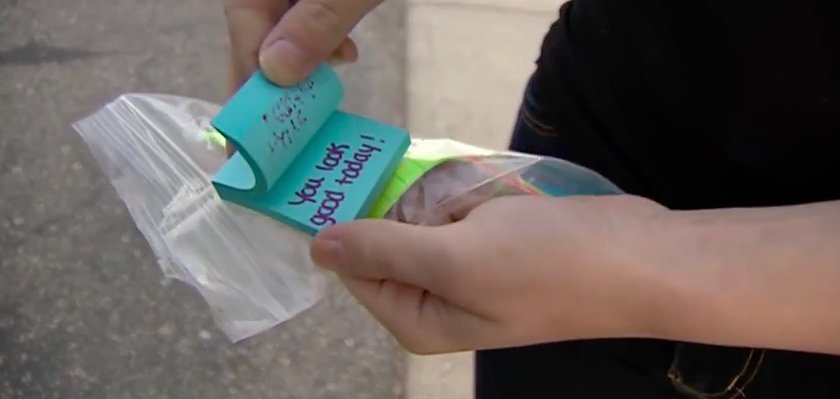
Some people fight fire with fire, others douse it in love. That’s what Caitlin Prater-Haacke chose to do in the face of online bullying, by posting positive post-it notes around her school. And her positivity is spreading far beyond the halls.

“I’ve learned that people will forget what you said, people will forget what you did, but people will never forget how you made them feel.” ~Maya Angelou
We all want to be around people who make us feel lighter and happy. We love seeing and interacting with people who brighten our days.
So, why is it that so many of us spend our days with people who don’t lift us up, people who don’t inspire us, and in some cases, people who tear us down?
It’s tough to remove these kinds of people from our lives, especially if we see them every day.
These people may be your colleagues or bosses, which makes them tough (or nearly impossible) to avoid.
In some cases, these toxic people in our lives are, in fact, our own family members.
That’s makes it really hard to escape the negativity on a daily basis.
I’ve had negative people in my life ever since I can remember.
For example, my aunt—who played a major role in my childhood—would give me destructive criticism when I was young.
She’d say things like, “You look like you’ve gained some weight. Are you really going to eat that cookie?” And “You’re not smart enough to read that book. Why do you even try?” And even “Nobody likes you—you’ll never have friends.”
Those comments hurt me to the core. I felt like I didn’t measure up, like being myself wasn’t enough.
And when I began to think that way, I thought that I didn’t deserve to be loved—by my family, by friends, and by myself.
But then, one day I was watching a TV show. There was a guest on the show and the interviewer asked him, “What’s the key to your long-term success?”
His response was pure gold: He said, “I’m the average of the five people I’ve spent the most time with over the years. You want to know the secrets to my success? Go meet them.”
What I took away from that quote was this: I could control my own success and destiny by surrounding myself with the right kind of people. I was in control of my happiness and the way I felt.
I could eliminate all the negativity in my life by removing certain people and adding new, empowering people in their place.
This was really inspiring to me, but I underestimated how difficult it can be to meet new people.
Sometimes, we don’t know what to say to start a conversation, or we start a conversation and run out of things to say. These are roadblocks to forming great friendships.
After years of hard work and practice, I’ve mastered the art and science of meeting new people. And these are a couple of neat and fun ways you can do so.
The Compliment Game is pretty self-explanatory.
You make it a goal to go up to someone and give them a genuine compliment, followed by a brief question.
For example, I might say, “I really like the color of that shirt. Where’d you get that?”
Or I might say, “Your hair looks fantastic! Did you do something different?”
Or even, “You have great taste in coffee. What do you recommend here?”
Key things to remember: The compliments should be genuine (meaning you actually think what you’re saying is true) and it’s a game, so it should be fun.
You don’t have worry about saying the perfect things or impressing anyone with your super-amazing attention to detail; just have fun with it.
Think about some of the things you’d like to be complimented on.
Maybe you have great taste in books, or are great at finding new music, or maybe you have skill for cooking amazing food. It can be anything, but shy away from flirty compliments; that can make people uncomfortable.
Give others the gift of compliments in the same caliber you’d like to receive.
This is a great way to start a conversation, because once they answer your question, you’ve opened the door for more discussion and potential friendship.
Here’s another game you might try:
Again, the name pretty much explains the game.
Make it a goal that within sixty seconds of entering a room, you will introduce yourself to at least one person.
You don’t have to say anything complicated; you can keep it simply with something like:
“Hi, how’s your morning going?”
“Good morning! How are you?”
“Hi, I don’t think we’ve met. I’m Rob.”
The key here is to be energetic and upbeat.
You’ll notice you get very different responses when you say things in different ways.
For example, saying any of the above introductions with a smile is going to go over much better than if you say it in a flat, monotone voice and with a straight face.
Play around with this, too. The more people you meet, the more likely you are to get to know empowering and inspiring people.
These games can be the first step toward surrounding yourself with five amazing friends or mentors.
Neither you nor I should have to put up with negativity and mediocrity in our relationships.
We owe it to ourselves to forge better friendships and a better future. Let’s not settle for less. Let’s have the relationships, the respect, and the love we desire and deserve.
Friends high-fifing image via Shutterstock