Tag: popular

  • How Dealing with Our Emotions Can Help us Heal Chronic Pain

    How Dealing with Our Emotions Can Help us Heal Chronic Pain

    “The part can never be well unless the whole is well.” ~Plato

    Our bodies are clever. They constantly send us messages that something isn’t right. It’s our job to tune in, listen, and act on these messages.

    That headache, tight shoulders, and backache are all trying to tell us something. But sometimes the physical symptoms we experience are actually tied up in a deeper emotional pain that needs to be dealt with first.

    How do I know this? It was a message I needed to learn, one that I now teach to others.

    Six years ago my life fell apart. Within an eighteen-month period my marriage broke up, I lost my house in a devastating earthquake, and I had to walk away from my physiotherapy practice that I had poured my soul into for four years.

    At the same time I was also experiencing chronic shoulder pain. I was suffering from regular headaches, sciatica, and insomnia. I sought help from a number of different health practitioners. At times I would get temporary relief, but it never lasted.

    As a physiotherapist I knew I was doing everything right to heal my physical pain, so I could not understand why I wasn’t healing.

    Not only was my physical health a mess during this time, but I was also an emotional wreck!

    I felt like a failure. I was ravaged with guilt. I was scared of what the future held. And my self-esteem was at an all time low. I had stopped eating and sleeping. My weight had plummeted and I looked terrible.

    It wasn’t until I stumbled across Louise Hay’s book, Heal Your Body: The Mental Causes for Physical Illness and the Metaphysical Way to Overcome Them, that I began to gain a better understanding of the relationship between our emotional and physical health.

    This one book was the catalyst for change and healing. I realized that if I wanted to heal myself from chronic pain, I was going to have to dig deep to get to the core of all the challenges in my life.

    It was the start of a journey that wasn’t easy and it wasn’t pretty. A lot of the time I wanted to bury my head in the sand. I have always been one to brush emotions to the side. “I’m fine” was my tagline.

    But as I did the work, three key themes became clear.

    First, I had no sense of self-worth. I didn’t see myself as important as other people. I would give everything I had to everyone else and nothing to myself. If I did, I would feel guilty.

    I also have a Type A personality, I’m a high achiever, and I’m a perfectionist. I would constantly push myself to the limit, and the pressure I put on myself was immense.

    Lastly, I realized that I constantly compared myself to those I perceived to be living the perfect life, and I always came up short.

    I recognized that the pain I was experiencing was my body’s way of telling me I needed to slow down, take pressure of myself, and start taking care of myself.

    I knew it wasn’t going to be easy to change my ingrained habits and beliefs, but I also knew that if I didn’t my body would start screaming louder until I ended up seriously ill.

    I started by making small changes. I began to gather knowledge from others. I took what worked for me and discarded the rest. I experimented and added in what made me feel well and healthy.

    Sleep was the first thing I made a priority. I had never realized how important sleep was. It’s the time when our bodies repair and rejuvenate. One good night’s sleep doesn’t help us heal; consistently sleeping well does.

    Self-care was the next thing I needed to address. I had previously thought self-care meant hour-long bubble baths, a day at the spa, or a week’s vacation in the sun sipping champagne. But I came to realize it didn’t mean any of those things.

    I realized that the small things I did throughout my day were just as important—like taking five minutes in the morning to meditate before starting my day, making sure I had prepared a nourishing lunch, spending ten minutes cuddling my dogs after work, and reading a chapter of my book before I went to sleep.

    Small things, consistently done over a long period of time, made for big change.

    I also realized that my body had been sending me the message that my life had been out of balance for years. But I had lost the ability to tune in, listen, and connect with what it was saying.

    I started practicing a simple technique that consisted of meditative breathing, scanning my body for discomfort, and then asking what it was trying to tell me.

    Whenever I would feel discomfort in my body, I would ask myself, “If this pain was an emotion, what would it be?” If I answered “sadness,” I would then ask myself, “What is going on in my life right now to make me feel sad?”

    I would then use practices, such as journaling, to help me work through, and release, whatever was causing me to feel sad, lonely, or fearful. With time, my emotional well-being improved, and so too did my physical symptoms.

    So what are the physical signs that your emotional health may need attention? Here are just three examples that you may be able to relate to:

    1. Tight, tired, and painful shoulders.

    When I meet people with this problem, they often have a similar story. They believe that they need to be, and do, everything for everyone. They are literally “carrying the weight of the world on their shoulders.”

    2. A stiff neck.

    People with stiff necks have trouble turning their head to one side. They’re often dealing with someone close to them making a choice that they don’t agree with. This decision has hurt them and they are finding it hard to “turn the other cheek.”

    3. Back pain.

    While disc ruptures are not uncommon, most people present with muscle spasms. Again, there is often a deep-rooted emotion playing out behind the scenes. In this scenario, it often pertains to money and finances. Their finances are restricting them from doing the things they want to do (as is their back spasm!)

    Our minds and body are so closely connected. But in today’s world, where we are so overstimulated, we have become completely disconnected with ourselves.

    Instead of tuning in to our body to find the answers, we tune into Google.

    Big life stuff (as I like to call it) happens. There’s no escaping it. Even everyday life can cause us to feel stressed and overwhelmed.

    If we don’t learn to deal with our emotions in a healthy way, they become boxed up within our body, until they are expressed in physical pain or illness.

    If you are someone who experiences regular physical pain, and you are aware that your emotional well-being may be one of the reasons for this, then I encourage you to start healing by journaling on the following questions:

    Does your life feel stressful at the moment, and what is causing you to feel this way?

    What is one thing you can let go of, even just for now?

    Do you feel overwhelmed, and what do you keep saying yes to that you could begin saying no to?

    Are you taking on the emotional loads of others in your life? So often we want to help or fix those close to us, but it’s important to remember that they are on their own journey.

    Are there any stories from your past that you are holding on to that need releasing?

    Are “you” last on your list of priorities? If so, how can you make a little more time for yourself?

    Learning to tune in and listen to your body’s messages is the first step toward preventing long-term physical damage. I encourage you to start doing this now, before it ‘s too late.

  • When Mindfulness Hurts: Feeling Is the Key to Healing

    When Mindfulness Hurts: Feeling Is the Key to Healing

    “You start watching your breath and all your problems are solved. It is not like that at all. You are working with the heart of your experiences, learning to turn towards them, and that is difficult and can be uncomfortable.” ~Ed Halliwell

    Can mindfulness be bad for you?

    I had been expecting it: Once you become a regular at it, mindfulness permeates all aspects of your life.

    I only sit in meditation for twenty minutes daily (and a full hour on Sundays), but I carry its effects with me the rest of the time, elevated levels of awareness and all.

    This is not to say that I constantly float on a blissful cloud. In fact, this sudden increase in mindfulness, even for someone used to deep introspection and resolutely committed to lucidity, comes at a certain cost. What I hadn’t expected was the actual weight of mindfulness.

    Three months into the daily practice of mindful meditation, I had to admit that it was not solely eliciting the deep serenity I had hoped for. In fact, I realized that in some ways, I actually felt less happy than before.

    I couldn’t precisely put my finger on it. All I knew was that things seemed heavier, more raw. How could that be? Wasn’t mindfulness supposed to help me transcend the vicissitudes of life? What was I doing wrong? Was I the only one in that odd situation?

    I decided to do some research. It didn’t take long before I discovered evidence that mindfulness can indeed have “side effects.”

    A quick online search showed me that I’m actually in very good company. Mindfulness, and the practice of meditation, has reportedly entailed significant “downsides” for a number of enthusiasts.

    We come to mindfulness in the hope that it will constitute the path to peacefulness, often unaware that this path is paved with cracked and bumpy stones. Only after stepping onto that road do you realize how uncomfortable the process can be.

    Just like therapy, meditating is difficult, sometimes painful.

    The first and most obvious reason is that sitting still, quieting the mind, and focusing on the breath presents a real challenge. Many beginners and non-beginners complain of an overwhelming restlessness or, on the contrary, of an irresistible tendency to fall asleep (I belong to the latter category).

    The second reason is that mindfulness has a way of annihilating our blissful ignorance. It offers an unexpected and unparalleled insight into our areas of vulnerability, the sides of us that we are not always prepared to welcome nonjudgmentally.

    To get the most of it, one must recognize that the practice of mindfulness is dirty, hard work.

    According to Willoughby Britton, a Professor of Psychiatry and Human Behavior at Brown University Medical School, the downsides of mindfulness range from mild to severe, and can manifest in various ways—from unexpected anger and anxiety all the way to depression and psychosis.

    Mindfulness can exacerbate a number of mental health conditions, bring back to the surface traumatic memories, or simply force you to deal with things that had conveniently been swept under the rug.

    Whatever your initial levels of stability (or instability), a lot can emerge in the first stages of the regular practice of meditation. Ready or not, you have to deal with it. It is disconcerting at best. In my case, it was sometimes downright depressing.

    Picture a handful of Band-Aids applied to different spots on your body. Each Band-Aid conveniently covers an injury that you’re happy to ignore (or so you think).

    Mindfulness is like peeling off the Band-Aids, one by one. It hurts.

    Then you discover what’s under them: A bad cut here. A big bruise there. The occasional infected wound. A few badly healed scars. Mindfulness makes it hard to ignore that you are, under all those Band-Aids, actually hurting, or at least not entirely recovered.

    To add insult to the injury, mindfulness has a way of preventing you from applying new Band-Aids. Things that we considered pleasant, and that help us deal with life’s vagaries, lose their appeal once we become aware of their true purpose and associated costs.

    We use, in our daily lives, an arsenal of strategies, often without knowing it: thinking patterns, daily habits, activities we view as pleasurable “add-ons,” such as eating, shopping, staring at a screen, and so on. We don’t perceive those “pursuits” as Band-Aids. Aren’t they the spice of life?

    The regular practice of meditation and a more mindful approach to life, however, sheds some light on our dependence. Any behavior that resists modification might indicate an addiction, even if it was just to chocolate, new running shorts, or social media.

    I am now, more than ever, aware of my coping mechanisms, aware that rather than making life interesting, they mostly patch up an aspect of my existence that requires attention.

    If I feel bored, tired, or stressed, no amount of sweets, sports gear, or Internet surfing will truly fill the void or fulfill the need.

    Where I would mindlessly resolve to an old habit, this new knowledge stops me in my tracks. I pause, observe, notice the underlying emotion or sensation.

    If I’m under work-related stress, such as a quickly approaching deadline, or a recalcitrant passage to translate, I will often have a sudden craving for sweets, or feel the pressing need to check my Facebook page. It’s not a coincidence, I know that now, but I needed mindfulness to realize it fully.

    Now, instead of walking to the cupboard or opening a new tab in my browser, I stay put and take a deep breath. I skip the coping mechanism and refrain applying a new Band-Aid or replacing an old one.

    Even my thought processes are modified. When certain situations repeatedly elicited the kind of stress that requires a Band-Aid, I was forced to reconsider, at least to a certain extent, the choices I had been making in various areas of my life: my career path, other types of commitments, and even some relationships. I realized I had too much on my plate and that I needed to respect my limits.

    Accepting the fact that I indeed have limits was no small feat. Even if I have long been aware of some of my “rationalizations” and “compensations,” I have never faced life with such clarity, honesty, and courage. I am proud of it. I am also unsettled.

    In spite of this, I am still fully committed to continue with my mindfulness practice. The cans of worms I am opening can be a handful, but I was carrying them anyway, and they were wearing me down. I choose to deal with them.

    Things might feel very raw, but they also feel very real. I can already sense a new level of lightness and freedom on the other side of this demanding exercise.

    I invite you to give it a try too. As we move along in our mindfulness practice, I trust that we can all find our own sweet spot, the place where an increased awareness meets a renewed sense of well-being.

    For many, this will mean starting slow. When you incorporate mindful meditation into your life, don’t go for the three-day retreat right away. Not only will it be too demanding, it might even backfire.

    Instead, simply find a quiet place where you can sit for at least five minutes, in silence, every day, and focus on the breath.

    You may feel uncomfortable at first, as the feelings you formerly numbed or avoided emerge. Don’t let that deter you. If you embrace the discomfort, you’ll eventually gain the clarity needed to acknowledge and heal old wounds, break unhealthy patterns, and generally step onto the path to a more authentic life.

  • Calmness Is Contagious, Even If You’re Faking It

    Calmness Is Contagious, Even If You’re Faking It

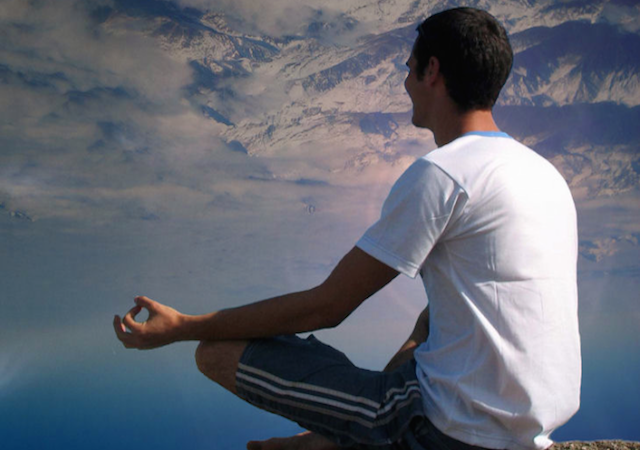
    Man meditating

    “Peace of mind is not the absence of conflict from life, but the ability to cope with it.” ~Unknown

    We had just reached cruising altitude, and my friend and I were settling in for the eight-hour flight from Tokyo to Honolulu. Exhausted after spending the day in the airport, we were excited to finally be in the air with beaches awaiting us at our destination.

    Jered and I were on an adventure around the world flying with standby tickets to any destination that had open seats. Even though we had been trying to get a seat to Bangkok, then Sydney, then Seoul, then Frankfurt, and then Paris, all with no luck, we decided to take the only available seats on the last plane of the day.

    After getting comfortable we decided to pass the time by racing each other in solving our Rubik’s cubes (what can I say; this is what we did for fun). It turns out this odd hobby was about to help me on the road to improving my inner calmness.

    “BANG!” We hit sudden, unexpected turbulence from a winter storm. I only remember two things: my stomach squishing into my throat as we hit an air pocket and a little girl in the aisle flying to the ceiling.

    Thankfully, there was a nearby flight attendant who heroically jumped, caught the girl, and curled up on the floor before she got hurt. 

    The plane was jerking violently in all directions. People were screaming. The pilot was on the intercom saying something, but no one could hear it over the chaos.

    Throughout the maelstrom my friend and I stayed focused on our cubes, continuing to spin their sides as we attempted to solve them before the other could. While my exterior seemed calm and focused, in my mind I was screaming.

    My hands were clammy and it became harder to keep my hold on the plastic toy in my hands. I was afraid I was going to die.

    The worst of it was over in twenty or so minutes, but the flight was still rough for several hours. As the sun started to rise and the flight had been calm for a couple hours, passengers slowly started to liven up again, chatting with the people around them about the experience.

    Having spent the time focused on the cube in front of me, I was surprised when the guy sitting next to me said, “Man, I was freaking out. I was about to lose it, but then I looked over and saw you two just playing with those things. You two were so calm that it helped me calm down too.”  

    This struck me as odd since I felt the same way he did, just internally. But soon other passengers sitting around us around us started chiming in, sharing the same experience. It seems a wave of collective calm slowly rolled over the back of the plane helping to ease some of the tension.

    Without being aware of it, I projected calmness to the people around me. They in turn became calmer. And ultimately my internal fear started to fade away as well.

    It was a surreal experience, but it became clear to me that calmness was contagious, even if I was only faking it.

    In many meditative traditions a calm, clear mind is often said to be like a still pond under a full moon. The smooth surface is transparent, allowing the moonlight to clearly illuminate the bottom of the pond. It is also like a mirror, reflecting back in perfect detail the moon and the night sky.

    Unfortunately, however, our minds are not always clear. The surface is full of ripples that make it hard to see the bottom and distort the image of the moon. While these ripples are sometimes created by the wind or the environment, most of them are caused by rocks dropped into the pond; rocks created in our minds.

    These rocks are emotions like anger, hatred, or fear. Often without realizing it we are constantly throwing these stones into our ponds, never letting it return to stillness.

    Returning to a calm mind is simple. Just stop throwing rocks and let the waves calm down on their own. Despite this, we often try to calm our minds by throwing more rocks into to pond.

    Sometimes when I can tell my wife is upset with me, but tells me nothing is wrong, I start to provoke her, “What’s wrong? I know something is wrong! Why won’t you tell me what’s wrong!?”

    I genuinely want to calm things down but, as you can imagine, I end up making her feel worse because I continue to throw rocks instead of letting things calm down on their own.

    When we do stop throwing rocks, though, the effect can be powerful and lasting. As we are interconnected with others, the stillness of our mind, the refusal to throw rocks, can help others find the same peace.

    When people see that your mind is clear it helps them realize that they too can let go.

    I still think about that flight from time to time, but mostly when I’m flying. I used to be a fearless flyer, but even today I feel pangs of panic, that squirt of adrenaline down the back of my neck, every time a plane bumps or shakes.

    However, as I’ve increased my awareness of my own emotions, I can sense when I’m holding a rock and then I set it down.

    Here’s an exercise to try. Next time there’s something or someone causing you distress: stop talking. Pause and take a moment to take a few deep breaths. Begin to watch your thoughts and note the upsetting ones. Don’t ignore them, just notice them. These are your rocks.

    As you notice anger or hatred forming in your mind, imagine it as a rock. See yourself holding that rock, poised to toss it into your mind. But instead of throwing it, picture yourself gently setting it down beside you. Take a deep breath. Let it go.

    Practice this when you can. Not only does cultivating calmness have tremendous effects on your personal state of mind, you never know how big an effect you may have on the others around you.

    Photo by oddsock

  • How to Create Happiness in Zero Easy Steps

    How to Create Happiness in Zero Easy Steps

    “To experience peace does not mean that your life is always blissful. It means that you are capable of tapping into a blissful state of mind amidst the normal chaos of a hectic life.” ~Jill Bolte Taylor

    I was fifteen when I first noticed that I was depressed. That was also when I became seriously interested in happiness.

    How can I get my hands on it? Where does it come from? Why does it seem so natural to some people?

    I wrestled with those questions for quite a while.

    Fast forward to ten years later and things look a lot different for me. Happiness is now a default instead of a rare state. What a relief.
    A few key lessons have made a world of difference. I’d like to share the most important one today.

    Two Kinds of Happiness

    One kind of happiness comes with positive experiences. It’s conditional. It comes when good things happen and leaves when bad things happen.

    The other kind doesn’t depend on the occurrence of any particular event. It is sustainable and unconditional. It exists underneath both desirable and undesirable experience. It is the canvas on which other emotions are painted.

    It’s also the kind with which most of us are unfamiliar. Why is that?

    My theory is that most self-help, personal development, and psychology resources focus on the first kind of happiness.

    They tell us how to make changes to our habits and routines that improve our lives. They talk about the role of thought and point out that if we change our thoughts we have a different experience.

    There’s nothing wrong with these strategies. I feel fortunate I found them when I did; they got me out of my initial funk and gave me some breathing room.

    And yet, my current experience shows me that there’s something even more satisfying on offer:

    Happiness that doesn’t require work or practice. Happiness that doesn’t have to be learned or earned. Happiness that emanates from a part of us that is untouched by negative thinking, bad habits, or traumatic events. The kind that is synonymous with peace and follows us around wherever we go.

    So…How Do We Get There?

    The difference between conditional and unconditional happiness is how we get there.

    The path to conditional happiness is self-explanatory: certain conditions must be met. It depends on completing your morning routine. On having situations break in your favor. On achieving success. On thinking positively.

    Thinking positive is great, but trying to make it an ongoing habit can be incredibly taxing and neuroticism-inducing. Sometimes positive thinking is as stressful as the negative thinking you’re trying to escape! Controlling thoughts is hard.

    Thankfully, in the second approach, we don’t have to.

    That’s because unconditional happiness is independent of the type of thoughts you’re having. Tapping into this state involves seeing the way our minds and thoughts work together to create our experience. Positive change comes naturally with insight into this system.

    Understanding The System

    Here are a few basic observations about the mind:

    • It constantly produces thoughts.
    • Thoughts come to leave, not to stay.
    • We bring thoughts to life with our consciousness. When we believe and latch onto thoughts, they look real, and we live out the experience of those thoughts.

    Have you ever been walking on a trail, seen a shape that looks like a snake, and freaked out… until you realized it was a stick? It was a stick the whole time. But your experience changed drastically as your thoughts changed drastically.

    The principle in this example is true all the time: We’re living in the feeling of our thinking, not the feeling of the outside world.

    That alone could be (and is) the subject of a book.

    But it becomes most profound when the goal is change.

    Doing Less

    When we think negative thoughts, conventional wisdom says we must change or get rid of them. It’s the strategy most of us adopt.

    However, if the mind is constantly producing new thoughts, that means thoughts will change on their own. It isn’t our job to change our thoughts.

    We often obstruct thoughts from naturally passing in and out of our consciousness. One of the ways we do this is by resisting them; it’s a way of holding on to them. When we allow them to, they pass through on their own, like clouds in the sky.

    We don’t have to reprogram old thought patterns or adopt new beliefs.

    When consciousness shifts away from the content of what we think and to the fact that we think, we stop being mesmerized by thoughts. We see that they’re arbitrary and meaningless until we believe them.

    This allows healthier thought patterns to implant themselves automatically.

    With little annoyances and minor distresses, it can be easier to see the transient, arbitrary nature of thought.

    It’s hardest to see, however, in the really problematic areas of our lives. Pain from childhood trauma, destructive psychological patterns, unhelpful habits we learned in dysfunctional families.

    Although it’s harder to see in those areas, the principle is not any less true. These areas cause the most suffering because we thrash against our painful thoughts about those experiences. We drop out of the level of consciousness where thoughts don’t have inherent meaning, and into the level where they’re real and hellish.

    In these areas, the river of our lives becomes whitewater and we fight madly to escape. But even here, the truth remains: Thoughts look real and scary, and cause suffering—until they pass. It will suck for a bit, until we end up in a calmer part of the river. Which we always do.

    Remember the scary snake we encountered on the trail earlier? The fear and pain disappear when you see that it’s a stick. This transformation is possible with any of the pain that we experience over and over again.

    As we stop latching onto painful thoughts by seeing that they come and go on their own, our consciousness around a certain problem rises. And over time, even the worst of experiences are seen differently, in a way that sets you free. We get through the hardest of times without getting stuck in them.

    Back to Happiness

    How does this all fit into being happy?

    Here’s how it has helped me:

    When I remember the way things work—the mind produces thoughts, I experience thoughts as consciousness, which brings them to life, and thoughts float in and out on their own—I get less scared of my experience.

    I used to be seriously afraid of emotions like sadness, jealousy, and my personal demon, depression. I would not only feel those emotions, but I’d feel emotions about the emotions. I was nervous about being sad. Sad about being depressed. Judgmental about being angry.

    Of course, emotions look scary when we decide there are some we’re not supposed to have.

    That second layer of meaning is a way of fighting against myself. What a waste of energy.

    When I saw that doing so kept me trapped in pain, I naturally started to do it less. Since I see that it’s coming from thinking—and that it’s not my job to fix my thinking—I can relax. I know that in ten minutes, or tomorrow morning, I might feel different.

    The more you see the transient, thought-created nature of our experience, the more a simple happiness wakes up. And since it’s not in opposition to negative experience, it can remain there underneath any emotion on the surface.

    This is available to all of us, all the time. It’s just a matter of looking in a new direction, and seeing how our experience is created.

  • 7 Decluttering Tips: How to Release Your Attachment to Your Stuff

    7 Decluttering Tips: How to Release Your Attachment to Your Stuff

    “To change skins, evolve into new cycles, I feel one has to learn to discard. If one changes internally, one should not continue to live with the same objects. They reflect one’s mind and the psyche of yesterday. I throw away what has no dynamic, living use.” ~Anais Nin

    I’m attempting to fit my life into ten large boxes (and one red suitcase).

    As I enter a new phase in my life I’ve decided that now is the time to reduce the stuff that has been sitting in my storage unit while I’ve been house sitting and declutter my world as much as I can. The process has been both satisfying and exhausting.

    Satisfying because I’m finally able to get rid of things that I no longer need, from an ironing board to a box of fifty-plus rubber bands. (I’ve no idea when my rubber band hoarding began!)

    Exhausting because every item of my belongings requires a decision. Keep or release? Sell or gift? Friends or family?

    I found that while some things were easy to be rid of, there were others that I moved from pile to pile, unsure where they should rest.

    I knew that I didn’t need them but felt unwilling to let go. This feeling came up the most with clothes, as it turns out I’d attached a lot of meaning to fabric and thread.

    Like my pink suit. It’s that rare shade that suited me perfectly. The shape was flattering—a random woman once came up to me in the street to say how great my legs looked. I wore it in a corporate law office where black, accessorised with grey, was the norm. (I never did like to conform!)

    That suit reminded me of a time in my life where I lived in an exciting city and felt successful. That beautiful suit also has a stain down the front that dry cleaning won’t remove. It now looks dated, not to mention that I don’t wear suits anymore. Yet I cling onto it.

    Part of my reluctance was due to my scarcity mind set. “What if I never find another suit in that colour that makes me feel as good?”

    Do you do that when you are trying to let go of your things?

    We ask ourselves, “What if I give it away and then need it in a month?”

    Even though we haven’t needed it in the past year and, in most cases, we could borrow or buy a new one if we really needed to.

    As I decluttered I found that following steps helped me. I think they’ll help you too, whether your aim is to empty your junk drawer, your garage, or your wardrobe.

    1. Start with an easy area or the area that annoys or distracts you the most.

    Starting with an easy area is great for instant satisfaction and giving you the motivation to continue. Those old shoes that are so scuffed you can’t see the original color? Out. Those shoes that are lovely but don’t fit you? Out. Give them to a friend and make their day.

    Tackling an area that annoys or distracts you is a fantastic way to free up energy. The garage that you can longer fit the car in. Start there. The sock drawer that you have to push and shove to close because it’s so full of mismatched socks. Start there.

    2. Give yourself a time limit.

    Having a time limit will stop you from being sucked into the time vortex that is your closet. Or garage. Or pantry.

    Focusing on the time limit that I’d set myself to go through a box meant I was less distracted. If I found myself looking through a photo album when I was meant to be sorting through a box full of things for the kitchen, a quick look at the clock got me back on track.

    3. Give yourself a challenge.

    This step may only work if you’re a competitive soul like me. I decided to reduce my boxes from sixteen to ten. Why ten? I thought it was achievable and a stretch. Having that set number really helped me with my decision-making, as I knew I had a set amount of space to work with.

    4. Only keep what is essential or beautiful.

    Imagine having a home that only contained things that were essential or beautiful, or both. That idea fills me with a sense of calm and pleasure.

    This step was the best way for me to make a decision on whether to keep something, as having that guiding idea took away the constant questioning. “Should I keep it? It could be handy in the future.” “You can never have too many pairs of black trousers, black socks…”

    A friend gave me another helpful tip when decluttering clothes and accessories. Does it make you look or feel like a million dollars?

    I love that the bar is set so high. Most of us have far more clothes than we actually need. Having a wardrobe full of things that make you feel like a million dollars is simplistic luxury.

    This doesn’t mean that you keep the most expensive things either. I own necklaces that I bought for a few dollars while on holiday that I feel like a million dollars in.

    5. Get some help.

    Who says that decluttering your world has to be a chore or boring? Invite some good friends over, put some music on, and combine laughter with letting go of what no longer serves you.

    6. Give your things a second life.

    Have you thought about giving some of your stuff a second life? I had a pile of t-shirts that I no longer wear, some sixteen years old. I’d bought them while on traveling adventures, and they reminded me of those trips.

    I decided to get inventive. I sent them to my young nieces and included a set of stories telling them where in the world the T-shirts were from and what I’d been doing there. When my nieces called me, I was thrilled because the youngest said, “Thank you for the T-shirts. I especially loved the stories you told us.”

    Is there another life that your possessions can live?

    7. Connect with your emotions.

    Letting go of possessions can be like letting go of a part of ourselves. When I came across things I knew I wasn’t going to use or wear, but was struggling to release, I deliberately sat down with them and dove into the emotions/memories they raised.

    Dig into why you’re hanging onto that item. What does the item represent to you? What memories have you attached to that item?

    Connecting to those emotions helped me to know that those memories are always with me and don’t need to be triggered by a thing.

    I began to thank those items for helping me to create those memories. That might sound a bit odd, but it really worked. I could then release those things with a smile and a thankful heart.

    I love the way I feel when my possessions have been reduced. There are less distractions and I feel so much lighter and more in control of my stuff rather than having it control me. The same can happen for you.

  • Abuse Isn’t Always Physical, and We Never Deserve It

    Abuse Isn’t Always Physical, and We Never Deserve It

    “A bad relationship is like standing on broken glass. If you stay, you will keep hurting. If you walk away, you will hurt but you will heal.” ~Autumn Kohler

    It happens little by little, bit by bit. So very slowly that before you know it, you can’t recognize the person you lie next to at night and you hate the person you see staring back at you in the mirror.

    Who is that person?

    Where is the strong, capable, unflappable, and carefree person that you once were? When did you become someone so pathetic, so small and malleable?

    I have never been the kind of girl who accepts bad behavior, let alone anything verging on abuse.

    I believe in good manners, in kindness, in treating others as you wish to be treated. I also believe absolutely in apologizing when I get it wrong.

    I don’t let my two little people get away with being rude, cheeky, or back-chatting a grown-up. So why did I let him treat me so appallingly? Why didn’t I stand up to him? Why didn’t I get out?

    I have always left, you see. With all the significant relationships I’ve been in, I have always ended it.

    I have always made that call. I’ve always run away when I couldn’t do it anymore, or cut my losses before I could get hurt.

    I ended my engagement to my ex mere months before the “big day.” I called time on my first marriage, seven years after saying “I do,” when three straight years of trying hard to fix it had failed.

    So why didn’t I leave him?

    People think domestic violence has to involve fists, bruises, and physical pain. Well, I can now put my hand up and admit that I was abused—but he never laid a finger on me. It doesn’t make it any less painful or significant or wrong.

    I am beginning to get comfortable owning what happened to me, but its effects have lasting consequences that I am aware of almost daily.

    The more time I spend analyzing what he did, and his potential motivations, the less I feel I understand what our relationship was about, and the more blatant the abuse appears.

    He controlled, manipulated, and systematically ignored me.

    I wasn’t allowed answer the door to other men if my husband wasn’t in the house, nor was I allowed to speak to other men at the pool where we trained.

    He loved my little skirts and dresses while he was wooing me, but as soon as he had me it was always, “I hope you’ve got appropriate knickers on wearing that” or, “you will keep your legs closed if you go out wearing that.”

    When he thought I had overstepped some invisible, unfathomable, and constantly shifting line, he could look me straight in the eye and yet completely ignore me for three straight days, without skipping a beat.

    Not a word would leave his mouth. For days on end. And for a girl who can talk the hind legs off a donkey, that is pretty much the worst kind of torture imaginable. I was invisible. I was nothing.

    But it happens gradually, remember.

    In the beginning, he built me up and showered me with words of love and affection. He placed me on a pedestal and worshipped me. I had never felt so precious to anyone before.

    He made himself the very center of my universe, and made himself so large that he obliterated everyone and everything else. Little by little, increment by increment, my universe became so very small, and by degrees I became myopic, a mere shadow of the woman I once was.

    In some ways, the hardest thing for me now is coming to terms with the fact that I didn’t have the nerve to get out.

    I had irrationally made the decision to stay because I truly felt that it was the only choice I had.

    I think I justify it by saying that it was the only thing I could do—for the sake of my children. They had already been through so much; I couldn’t damage them further.

    And anyway, his behavior was only directed at me. Once he had me controlled, managed, and living in fear, it was was only ever about me; I perceived that my children were safe from any form of direct threat.

    The decision to get out, to get free and safe, wasn’t a decision I ever had to make, or got the chance to make. By some weird twist in the way the universe works, I received the ultimate “get out of jail free” card. The abusive monster of a man to whom I had given three years of my life died.

    He died suddenly and shockingly, and in doing so simultaneously set me free and inflicted his biggest, most significant controlling act.

    Now, almost exactly one year later, I still feel immense and overwhelming relief that I am out of that place; that like a caterpillar trapped, bound and confined, I have been able to break free and spread my beautiful wings.

    But I still feel some misplaced sense of shame that I didn’t get to make that call. That I didn’t put my big girl brave pants on and make that decision first, and for me.

    Being in that relationship is, without question, the biggest and worst regret of my life, one that I will carry to my grave.

    I wanted to write this for all the people who feel trapped, who feel like a watered down impression of the person they once were. For the people who don’t feel able to speak out and ask for help.

    I know how that feels.

    I know the shame and embarrassment that keeps your lips sealed, even around those who you trust and love the most.

    Just because there are no physical marks doesn’t mean it isn’t abuse.

    When you question yourself and you try to tell yourself that it’s really not that bad, that he or she loves you, really, but has just got a few issues to deal with, or worse still, that it’s your fault he or she treats you this way, trust your gut.

    If they continually put you down, shut you out in an attempt to manipulate and control you, ignore your needs, threaten you in any way, call you “crazy” or “overly sensitive” when you dare to raise your worries, and/or blames you for their reactions, that is not love. It is abuse.

    It’s easier somehow to make excuses, accept the blame (you will even start to believe it), but know that you could end up spending the rest of your days in an a broken and painful place—a relationship where you feel small, worthless, and lonely beyond words.

    Somewhere in your gut, you likely know this is true.

    Whether your inner voice is yelling at you, or just whispering to get out, you know. You know it’s not right and that you deserve so much more. You deserve to have the chance for your wings to be set free.

    And I pray that you do.

  • Breaking Free from Manipulative, Narcissistic Parents

    Breaking Free from Manipulative, Narcissistic Parents

    “Authenticity is the daily practice of letting go of who we think we’re supposed to be and embracing who we are.” ~Brené Brown

    I happened to catch the last scene of the movie Moonstruck on TV a few nights ago. The scene marks the happy resolution of various plot threads, and yet I felt as if I was witnessing the sinking of the Titanic.

    It was like watching a demonstration of what I have come to understand as the two ways of being in this world: dominating vs. accepting, narcissism or bullying vs. kindness.

    Having come from a narcissistic family myself, it felt as if the movie was peering straight into my soul.

    In the movie, Loretta Castorini is engaged to Johnny Cammareri, an aging mama’s boy who never married, out of ‘consideration’ for his ailing mother in Sicily.

    In this scene, he bursts in, announcing that he can’t marry Loretta because it would kill his mother, and asks for his engagement ring back. In the next moment, Johnny’s brother, Ronny, promptly proposes to Loretta, borrowing Johnny’s ring to seal the deal.

    The movie centers on Ronny and Loretta, yet seeing the last scene isolated from the rest of the movie drew me to Johnny’s experience.

    There he was, controlled by his mother long-distance from Sicily, giving up his marriage in deference to his mother’s script about who he needed to be in order to support her needs.

    The confusion on Johnny’s face as his brother claims the prize of Loretta’s hand in marriage is heartbreaking. Johnny isn’t quite sure what is happening, and yet he dare not question his mother’s love, nor break free of his supporting role in his mother’s drama.

    His life has been spent, and, unless he wakes up, will continue to be spent, in service to her, at a great cost to him.

    I see myself in Johnny. I was well into middle age before I was able to break free of my father’s domination of my life, and I suspect that, like me, many people delay the beginning of their own lives out of misplaced fealty to the stories their parents scripted for them.

    For years, whether rebelling against my dad’s criticisms or craving approval from outside myself, I had, on a deep level, ceded the central role in my life to my dad.

    Whether we were close or miles apart, communicating or no contact, he was the sun, and I was orbiting his solar system. This is exactly how he wanted it, and I fell into place within the structures and systems of his universe.

    There is so much truth in humor. Johnny’s mother’s threats are played for laughs, and yet they are more than mere melodramatic manipulation.

    An acquaintance of mine energetically supported her narcissistic mother for decades. When she became aware of the family dynamic, she chose to withdraw her energetic support of her mother, and for the first time in her life, focus on herself as an individual.

    The potentially intimidating part is that her mother actually became ill.

    This is not to imply that my acquaintance should have continued to support her mother, it is simply to say that the energetic connection is real, and removing it, as necessary as it may be, is like removing a crutch someone has grown dependent upon.

    It sparks an enormous upheaval and rebalancing for both parties, and yet it must be done in order to achieve greater health and freedom on both sides.

    The saddest part for children of narcissistic parents, and also for partners of narcissists, is losing confidence in our own authentic feelings, hopes, and dreams. The narcissist’s insistence upon pretense, and the demand to suppress authentic experience can be very painful.

    The younger brother, Ronny, was lucky to have been the black sheep of the family; at least he was distanced from his mother’s demands. Nonetheless, he, too, was damaged.

    When we first encounter him in the basement of his bakery, he looks like a hurt animal hiding in his lair. He has a wooden prosthetic hand, as Loretta says, “like a wolf that has chewed off his own paw to escape a trap.”

    To narcissistic parents, a child is not a full-fledged individual, but rather a character in their story, and the roles they offer their offspring are severely limited.

    Whether a “golden child” who can do no wrong, or the “failure” who can do no right, in either role the child will feel that he must perform in order to try to keep or win the parent’s love.

    This is not love at all, but rather a form of abuse, which is worse for being invisible to all but those directly involved. The child is asked to give up her own feelings, thoughts, and needs in order to support the parents’ version of reality.

    The child, meanwhile, resists facing the direness of the situation—the truth of a manipulative or even an unloving parent—for she intuits that she needs her parents’ love in order to survive.

    At the same time, she may feel excruciatingly uncomfortable living inside the parents’ stories. Like Johnny, she may end up not knowing who she really is and what she really wants, having given up her own thoughts, emotions, and needs for so long.

    In the movie, neither brother escapes unscathed: Johnny, the golden child, was hobbled, tied to his mother’s apron strings, and Ronny, the black sheep, was also wounded and cut off from the rest of humanity.

    Like so many rebels among us, Ronny finds solace in the arts, in his case, opera. As a child, my passion for dance sustained me. It was an outlet for self-expression, and an opening for the magic I needed in order to survive.

    Funny to speak of all this in the context of a romantic comedy, yet perhaps the power of the story stems from its basis in profound truth.

    At the end of the final scene, Johnny sits alone as the family excitedly gathers to toast the new couple. He looks stunned, isolated, and lost amid the celebration. Then the grandfather approaches Johnny and extends a glass of champagne, offering the last line in the movie: “You’re part of the family.”

    And with that, Johnny is embraced in the warmth of the family, and I burst into tears. How different is this warm embrace compared to the demands of the narcissistic parent.

    Johnny is played as a buffoonish character, and the audience is fully rooting for Ronny and Loretta. Yet even clownish Johnny is embraced.

    This is love. This is real acceptance.

    This is the tenderness of the movie. This is its big heart, which is depicted, not just in the romantic passion of Ronny and Loretta, but more importantly, in the inclusion of Johnny in the celebration. As the credits begin to roll a toast is raised: “La famiglia!” To family!

    This is the archetypical image of the loving family. And yet many of us did not experience that. And many of us hide a secret shame that our families aren’t like that. I know that I was deeply ashamed for a long time that my story wasn’t pretty like that, until one day I realized that it was not my fault.

    On the day that I accepted my family as it was, and realized that I wasn’t responsible, and rejected the stories they told. On that day I reclaimed my right to my truth about what happened, what I felt, what I thought, and what I experienced.

    Reclaiming our stories—our truth—is how we take our power back.

    If any of this speaks to you, go watch Moonstruck. Johnny hasn’t woken up yet from the spell his mother cast over him. Ronny, with the help of Loretta’s love, breaks out of his hurt isolation and reclaims his life.

    Wake up and face your truth. Sometimes facing the ugliness is the route we must take in order to reclaim our own beauty and power.

  • A Simple Way to Calm Yourself When Feeling Strong Emotions

    A Simple Way to Calm Yourself When Feeling Strong Emotions

    Peaceful Woman

    “This is the root of Self. You are not your thoughts; you are aware of your thoughts. You are not your emotions; you feel your emotions…. You are the conscious being who is aware that you are aware of all these inner and outer things.” ~Michael Singer

    I sat across from my colleague with a growing sense of discomfort. I had accepted an assignment from the boss, but I heard from my colleague an undercurrent of questioning and uncertainty—or so it seemed. It was so subtle that I couldn’t quite tell what was going on.

    Did she not believe I could do it? Nobody else was stepping forward to meet the need. Was she saying it’s better to go with nobody than with me?

    All I knew for sure was that I wasn’t hearing this outright. I decided to let it go, head on home, think about it tomorrow, and be fully present with my family instead. But the next morning as I pulled into my parking spot in front of the office, a subtle agitation rumbled in my stomach.

    I walked into the quiet building and set my things down in the office, distracted by my disquiet and wishing I could focus on my task list. The thoughts prickling at me wouldn’t let go.

    I laid my pen down and asked myself, “Okay, what’s going on?”

    In my top drawer I keep a deck of “grok” cards that I bought from the folks at the Center for Nonviolent Communication. Each one has the name of a need or value—things like “hope,” “trust,” and “balance” show up in this deck. I frequently use these when I can’t quite put a finger on what’s bothering me.

    I flipped through the cards and sorted them as I went. In the “not now” pile went cards like “freedom,” “competence,” and “creativity.” In the next pile, the “Maybe?” pile, went cards like “security,” “meaning/purpose,” and “friendship.”

    I went on sorting between just these two piles until I hit one that resonated: “Acknowledgement.” That went into a new pile: “Yes.”

    A couple of cards after it I found “Appreciation.” That went into the “Yes” pile too, and then I noticed something really interesting happen: I got angry.

    Usually when I sort through these cards, the experience of finding the right word to put on my current needs or values results in feeling more settled, more clear. Frequently my agitation will be replaced by a sense of gratitude, or courage to act in a way that helps me meet my needs.

    Typically, that is the value for me in identifying my needs. It helps me find a more straightforward and effective path toward getting those needs met. But it didn’t happen this time.

    Instead, the voice in my head just became louder and more insistent.

    My coworker should be grateful for my willingness to take on this new project! She wasn’t going to step in and do anything. Why wasn’t she acknowledging that I was making a sacrifice on behalf of the team?

    This narrative swept me up. It threatened to pull me under.

    Slowly, I started to notice another, quieter voice saying, “Why am I getting so upset? That doesn’t usually happen after I go through the GROK cards. What can I do for myself that won’t be so negative?”

    I’m going to admit this was an odd experience for me. I don’t typically have this second, quieter voice. Or, if I’ve had it, I haven’t been able to hear it.

    But I did hear it this time, and it called to mind Michael Singer’s book, The Untethered Soul. I read it just about a month before.

    “You are not the voice of the mind,” he wrote. “You are the one that hears it.”

    He suggests that when we’re bothered by something, we can change what we identify with. Rather than identifying with all of those thoughts and feelings, we can instead identify ourselves as “the observer” or witness of what is being experienced.

    As I felt myself getting swept up in defensiveness against my coworker, I decided to try it. What would happen, I wondered? I started up a new voice in my head that said, “I am not all of these thoughts and feelings. I am the observer who is noticing that Amy is having a powerful experience.”

    It was almost meditation, but not quite the same as my usual practice. Michael Singer might say I was doing it wrong. A psychiatrist might have a lot of questions for me—I don’t know.
    What I do know is what happened inside myself. As I identified myself as “the observer who is noticing that Amy is having a powerful experience,” I relaxed. I let go of the waves of negative thinking.

    I realized that I could talk to myself the way I would talk to a dear friend who is feeling unacknowledged and underappreciated. I realized I could give myself compassion.

    I imagined telling myself, “I’m sorry you haven’t been appreciated. That’s hard. You are still okay.”

    I admit I feel extra vulnerable as I type that out. Part of me doesn’t want to admit that I talk to myself in this way. On the other hand, this was such an amazing experience!

    I was able to walk myself through processing my own needs and emotions in ways I’ve never done before. As soon as it happened, I wanted to shout it out to the rest of the world, “Hey, I’ve found a path that looks like it leads somewhere good! Come check it out!”

    Do you ever feel the emotional undertow of unpleasant, uncomfortable feelings? Have you tried to resist them without success? Perhaps it would help to identify yourself as the observer.

    Accept that the feelings and thoughts are there, but instead of identifying with them, try identifying yourself as the observer or witness who is noticing that this experience is flowing through.

    Perhaps you already know this part of the path. Have you tried a practice like this? What works for you?

  • Why Letting Go of What We Want Enables Us to Get What We Need

    Why Letting Go of What We Want Enables Us to Get What We Need

    Seated woman

    “The most exquisite paradox: as soon as you give it all up, you can have it all. As long as you want power, you can’t have it. The minute you don’t want power, you’ll have more than you ever dreamed possible.” ~Ram Dass

    The first time I felt this paradox was in the middle of savasana after a challenging yoga class. I always say that yoga is a metaphor for life, and this is exactly why.

    Savasana is the final resting pose in which you lay flat on your back, close your eyes, and do nothing. A super yummy savasana is just so due after your work throughout the class.

    The more you are challenged throughout the yoga flow, the more likely you are to be pushed to a place of brokenness. You gave your all, and now you are spent. Dizzy and exhausted, you settle into savasana and release your entire body into the earth.

    Lying on the cold, hard ground never felt so good. You lie in silence, let your thoughts and breath go, and completely release. You feel deliciously blissful. And you might actually be feeling emotions for the first time all day, or maybe even all week.

    A slight smile spreads across your face as the sweat beads drip from your forehead. Or tears quietly stream from your eyes as you feel absolute joy and gratefulness. By the end of that savasana, you feel incredible. You feel like yourself again. You know you are whole.

    And it’s a good thing they have you do savasana at end of class, because you need the build up of tension during your yoga flow in order to allow yourself to really let go and just be.

    Could you imagine doing savasana at the beginning of class? Mind buzzing from a long, stressful day, thoughts racing. It’s possible, but much harder to do.

    This was how I came to understand the paradox of letting go in order to become whole. And trust me, it took many years of therapy, meditation, reading, seeking, and savasana to get there.

    We often cling to our desires and fight for them because we think we’ll be happy if we get what we want. But when we let go and accept what is, what shows up for us are often the things we need.

    These things tend to be the ones that really count, creating true happiness and meaning in our lives.

    But let’s face it, letting go on some issues is easier said than done. When it comes to deeper issues and matters of the heart, letting go can feel downright impossible. And on some issues, letting go may never happen. Some burdens may be too important not to bear. That is okay.

    However, even on the more difficult issues you may be facing, there still may be places in which you can soften your grip.

    I have had a strained relationship with my father since birth. From about four years old, I knew that he did not love me.

    All throughout my childhood, my father was both physically and emotionally abusive. My mother was loving, but also put in a position of trying to appease her husband, while at the same time protecting my siblings and me. This inevitably led to a lot of confusion and chaos in the household.

    Things finally came to a head when I was about ten. I was severely depressed, expressing passive thoughts of suicide, and displaying classic behaviors and symptoms of trauma.

    After a couple years of therapy and attempting to repair things in the home, my mother decided to divorce my father.

    Due to the history with my father, the court granted my siblings and me the opportunity to decide for ourselves whether or not we would like to visit him. Perfect timing too; my twelfth birthday was right around the corner as the divorce was being finalized.

    So, it was at the age of twelve when I decided to no longer participate in weekly visitation with my father. I would still see him occasionally for family events and holidays, but I kept my distance and he kept his.

    In my mid-twenties, I had little to no contact with my father, only seeing him about once a year for the holidays. However, I confronted him via email, defending my younger sister on an issue she was dealing with.

    She was only sixteen at the time, and was devastated when my father packed up all her belongings from his home and dropped them off on my mother’s doorstep without any warning. Apparently, she was no longer welcome in his home, and their relationship, too, was ending.

    In my father’s correspondence to me, he verbally confirmed what I had know all along, and stated outright that he did not love me and did not need me in his life.

    I was devastated and inconsolable. Although I had known and felt this since I was a small child, I had not actually heard these words before. Something about those words broke me wide open.

    I spun out of control and began a turbulent phase in my life in which I became severely depressed and anxious.

    I immediately began doing work in therapy, finally addressing the years of trauma that I had experienced, coming to terms with my broken relationship with my father. It was here that I began the long process of healing.

    Ten years later, I am significantly stronger. However, trauma is stored in our bodies, in our tissues, and in our brain chemistry, reminding me at times that it’s still there, but a mere shadow of what it used to be. Like an onion, the layers of trauma must be pulled back one at time.

    Looking back on my recovery process, the most challenging part for me had to do with my clinging to questions of what happened.

    I couldn’t understand why this had happened to me. I couldn’t let go of the fact that I was unloved by my father. I needed to have answers. I had been wrestling with these questions my entire life, and was bruised and broken time and time again, with no end in sight. This deep need and clinging only lead to more pain and hurt.

    Through therapy and yoga, I have come to let go of this ideal. I now know that I may never have the answers to my questions. I likely will never fully understand why this happened, why I had to experience this, or why my father behaved in this way.

    Now, instead of wrestling, I stand beside my questions, I cradle them in my arms, I offer them support, and I show them kindness. The questions, the injustice, the memories of hurt can be there, and I lovingly accept them into my life.

    More than this, I know that I am loved, that I am deserving, that I am kind, that I am a survivor, and I am whole. I always have been.

    In order to find acceptance and wholeness in my life, I had to release my death grip on my ideal relationship with my father.

    Whatever ideal outcome you’re clinging to, could you be open to the possibility of releasing it so that you can breathe, yield, and expand into something that is bigger? Could you give yourself time and create space so that you can become concise and clear about your being?

    If you can do these things, you will get what you need.

    Not unlike that challenging yoga flow I spoke of earlier, the real work comes when your body, mind, and spirit has been fully broken, your heart has been ripped wide open, and there is nothing left to do.

    And, no this is not easy. It will be hard.

    Letting go will make you question your identity, leaving you wondering if you give this one thing up, who will you be? What will you stand for? Will all your stress, worry, pain, hurt, sadness, be in vain? If you let go, who will believe your story? What will others think of you? What else will you have to let go of? What will you do next?”

    And here is where the paradox begins!

    “What will I do next?” is a tough question that can be scary to even consider. But it is here that change happens, and you do have a choice. Wholeness is knocking at your door, and you know what they say, “When one door closes, another door opens.”

    All that is required is to let go of the past and step boldly and bravely into your true self, your beautiful, loving, compassionate, deserving self. It is from this place of being that you may know wholeness.

  • How I Think My Friend Who Died Would Want Me to Live

    How I Think My Friend Who Died Would Want Me to Live

    Open Arms

    “Death is not the greatest loss in life. The greatest loss is what dies inside us while we live.” ~Norman Cousins

    Have you ever been there?

    When someone you love suddenly disappears. When life, within a few seconds, turns upside down. When your biggest problems suddenly seem like nothing but drops in the ocean.

    I know I have.

    It was December 15, 2013. That was the day when everything changed, when her life came to an end, and many other lives were changed forever.

    When they first told me she was gone, I couldn’t fully grasp reality. For a second I wondered who this person was they were talking about—this person who apparently had the same name as my friend.

    Then, the reality sank in. My heart broke into a thousand pieces.

    Being one of the first to find out, I knew I had to be the carrier of the awful news. I had to tell people that someone they loved was gone. She had a lot of friends all over the world, so I made calls to Brazil, the United States, Venezuela, France, and the Netherlands.

    Some couldn’t say anything; others cried hysterically. After each call, my heart broke a little more. Hearing the pain and sorrow in others was almost more than I could take. Everything seemed so unreal. One day she was there and the next she was gone.

    Over two years have passed since that day. Now she smiles at me from the picture on my desk. Sometimes I imagine her being here with me. If she were, what would she tell me? How would she want me to live my life? I think she would tell me something like this:

    1. Be open to new friends.

    The first time we met was in a bar in Saint-Denis, Paris. I was new to the city and barely knew anyone there. Even though she already had her life established, she never hesitated to become friends. She initiated our friendship; she made the first phone call and asked to meet again. For that, I’m very grateful to her.

    As we grow older, we tend to stop making new friends. But, that also means that we deprive ourselves of new, unexpected, and incredible experiences. So, choose to stay open and curious about new people. They might just change your life.

    2. Laugh often.

    She was a happy person. She could light up a room with her warm smile and infectious laughter. When I met her parents, I knew exactly where she had gotten that from. Even at her funeral, her father opened up by saying, “I can’t believe I’m standing at my daughter’s funeral with a smile on my face. Seeing that so many people cared for my daughter brings warmth to my heart.”

    Joy is contagious, so smile more, and laugh often. You won’t just feel better, but you’ll also touch the heart of others while you’re at it.

    3. Stop doubting yourself.

    We once had a conversation in which she questioned whether she was lovable as a person. She had no reason to doubt herself, believe me. But, unfortunately, many of us do. We question if we’re good enough, smart enough, or good looking enough.

    She was at her best when she was herself fully and completely—including the flaws, quirks, and imperfections. We should trust that the same applies to us all. Trust that there were no mistakes when we were created. Trust that our differences are what make us unique and irreplaceable.

    4. Choose to see the positive.

    When we were going through uncertain times at work, and nobody knew if they would keep their job, she was the only one who laughed and joked about it. When someone would ask, “So, any news?” she’d always say with a smile, “Still here!” Even though circumstances were difficult, she chose to see the positive. And her positive attitude grew into a positive result, as she was among the group of people who would keep their jobs.

    Being positive when things aren’t going our way isn’t easy—it’s easier to complain and be negative. But, what we focus on tends to grow. So, instead of fighting what isn’t working, focus on what is working and on that which we want to grow. Simply put, give power to faith instead of fear.

    5. Don’t judge.

    She wasn’t someone who judged. Instead, she chose to accept everyone for who they were. She never allowed looks, clothes, or opinions to stand in the way of connecting to someone. Instead, she knew she had something to learn from everyone. So, rather than being critical to differences, she chose to be curious about them.

    We never know what someone has gone through or is going through; therefore, we’re not in a position to judge. Judgment creates separation between people, while curiosity builds bridges. Choose to stay curious.

    6. Love fully.

    She knew the power of love. She knew how it could build someone up or destroy them completely. No matter if it was a love partner or friend, she always chose to love fully. She did so by giving her undivided attention, sincerely wanting the best for everyone, and by being generous with compliments, time, and support.

    When I think of her, I think about the love she gave me and the love I have for her. Because, in the end, all that matters is the love we hold and share.

    7. Don’t waste time.

    Before her death, I used to live as if I would live forever. I talked about dreams, but I never acted on them. I always found excuses as to why it wasn’t the right time, or fretted about how things wouldn’t work out. But then her life ended at twenty-six.

    And if she were here today, I think she would tell me the following:

    “Don’t wait and prepare yourself for the life you truly desire. Start living it right now. Make the most of life while you still can. Make sure every minute of your time here counts.”

    Because it does count.

  • 3 Ways You May Be Undermining Your Self-Worth (And How to Stop)

    3 Ways You May Be Undermining Your Self-Worth (And How to Stop)

    “You yourself, as much as anybody in the entire universe, deserve your love and affection.” ~Buddha

    Self-worth comes from knowing that you are enough, just as you are. You are inherently worthy, and you don’t need anyone else’s approval.

    I didn’t always hold myself in high regard, or treat myself with the respect I deserved. I’m now in my thirties and live a beautiful life filled with self-love, kindness, and passion, but in my younger years I suffered from low self-worth.

    I had my fair share of life lessons and allowed myself to be treated poorly.

    I begged for love from a partner who was repeatedly unfaithful, holding onto hope that somehow he would change.

    I criticized my perfectly healthy and beautiful body, wishing it were different, and endlessly compared it to how others’ bodies.

    I also unconsciously bought into the belief that it was selfish to look after myself rather than seeing it as an essential part of supporting myself.

    I spent years being my own worst critic, and I couldn’t understand how to become my own best friend.

    I now recognize that I was desperately craving love and attention, but was withholding it from myself. I had forgotten my inherent power and worthiness.

    We all have times when we get caught up in routines and behaviors that don’t support us, yet we have the ability to make changes in our lives. We are never powerless. Once we understand where we might be hurting ourselves, it becomes much easier to know how to step up and support ourselves.

    Here are three ways you may be undermining your own self-worth, and how you can stop.

    1. Stop focusing on what is wrong with you.

    Most of us have a tendency to focus on what is wrong with us, and what it is we want to “fix.” We may focus on the fact that we think we are too big, too shy, not pretty enough, or not capable enough. There is no end to the ways we can critique ourselves! We unconsciously get into the mental routine of continually undermining our own self-worth.

    As a teenager, I struggled with my body image. Tragically, I look back and recognize that I had no reason to, but at the time I was comparing myself to the glossy images in magazines and other people who looked nothing like me.

    I hated my fair skin, was unhappy that my thighs touched, and thought my lips were too thin. I wanted to be a beautiful person, but thought of myself as anything but. I was relying purely on my physical appearance for my self-worth.

    Over the last fifteen years I’ve built a beautiful relationship with my body, and also with my soul. I now see my body as an amazing creation that allows me to experience life. I am grateful for my beating heart and two legs that hold me steady. I also recognize that I have a caring and kind nature, and those internal attributes are much more important than how I look on the outside.

    The lesson: Consciously focus on what is right with you.

    Regardless of how you might want to improve, you have things that are worth celebrating about yourself. You have gifts and unique talents that have come together to create you—a unique expression of humanity.

    Don’t overlook how amazing that is. Remember all the things you love about yourself and make a list. If you find it difficult to bring to mind the things that are so very right with you, ask a close friend what it is they appreciate about you and truly listen to and believe their response.

    2. Stop accepting less than you deserve.

    Many of us look for our self-worth in the wrong places. Rather than deriving it from ourselves, it’s easy to get into the habit of looking to others to make us feel worthy and loved. This can lead to struggling stand up for yourself and what, deep down, you know you deserve.

    By not wanting to upset others, you may end up giving too generously and find yourself in relationships where you feel you do not get enough in return.

    I have fallen into this trap in many relationships over the years. With friends, I would desperately make sure I paid for things to ensure I was never in debt to anyone, and always ended up spending more.

    I stayed in an unhealthy relationship littered with infidelity for years longer than I should have because I didn’t have the courage to stand up for myself and say, “How you are treating me is not okay.” It leads to feelings of frustration and resentment, and erodes your self-worth.

    My need to be liked and keep others happy led to situations where others took advantage of my good nature. I forgot it was my birthright to have boundaries, and that I didn’t have to put up with other people’s bad behavior. I had forgotten my power to say no.

    The lesson: You teach people how to treat you.

    Boundaries are important, and if something doesn’t feel right to you, you have to stand up for yourself and say no—whether it is someone’s behavior that’s crossed a line, or their ongoing expectations of your giving nature. You cannot expect anyone else to look out for your needs if you are not willing to first look out for yourself.

    If you tolerate negative situations or draining friendships, you are unconsciously saying yes to that type of behavior.

    Give yourself the space to reflect on your current relationships and have the courage to ask, “Do I feel I am treated as I deserve?” If the answer is no, don’t be afraid to reclaim your self-worth and stand up for what you need. You’ll feel better in the long run.

    3. Stop putting yourself at the bottom of your to-do list.

    Many of us have unconsciously taken on the belief that looking after ourselves is indulgent and selfish, and that the right thing to do is to take care of everyone else first. We put our own well-being at the bottom of our to-do lists and just hope that we might have some time and energy left to give to ourselves.

    Yet, if we don’t nourish ourselves, we won’t actually have anything to give. You cannot pour from an empty cup. When you put yourself at the bottom of your to-do list, you begin to burnout. You get sucked into a cycle of exhaustion, martyrdom, and low self-worth.

    Although I always had a tendency to give to others before myself, this wasn’t a lesson I was truly faced with until I had children in my late twenties. When there are multiple people relying on you, it becomes very easy to slip into martyrdom and begin to believe you have no time for yourself. After a couple of years of this routine, I reached a breaking point where I felt burned out and depleted.

    Slowly but surely, I began to start finding the time for small acts of self-care that revived and restored my spirit.

    I found an outlet for my creativity by starting a blog; I began reading again and regularly taking long hot showers. They were small things that made a big difference. I went from feeling rundown, exhausted, and unsure of my worth, to remembering the things that made me feel alive, energized and whole.

    The lesson: Recognize that self-care is an essential part of supporting yourself.

    When you show yourself respect by prioritizing your needs, and fill up your own cup, you send yourself a message that you are important and worthy.

    By consistently showing yourself this level of respect, you can pull yourself out of the cycle of exhaustion and martyrdom and begin to build self-worth. We each have different things that fill us up and make us feel alive and well inside, but you owe it to yourself to discover these things and make time for them in your life.

    Cultivating self-worth will be a life-long journey for most of us. It is likely that many times over, life will knock our confidence and we will be required to once again dig deep into ourselves and uncover our inherent worthiness. Being aware of how we can support ourselves empowers us to take actions that will move us forward on the path to greater self-worth.

  • You Are Not for Everyone, and That’s Okay

    You Are Not for Everyone, and That’s Okay

    Quirky Woman

    One of the most freeing things we learn in life is that we don’t have to like everyone, everyone doesn’t have to like us, and it’s perfectly okay.” –Unknown

    I grew up a people pleaser. It was drilled into me from childhood that it was very important to be aware of what other people thought of me and my actions at all times. Growing up in the south, keeping up with appearances is something that becomes a part of your identity.

    While I enjoy the part of Southern upbringing that taught me to always be polite, the part that teaches you to put others’ opinion before your own is something that I came to resent.

    Before I made any decision, I was to carefully weigh out how it would affect others and their thoughts of me.

    As a kid, it worked out pretty well. (The whole reason I stayed out of trouble mostly, eh?) As an adult…not so much. The constant need to have everyone like me came back to kick me in the butt, again and again.

    It started out through middle and high school when I was figuring out my interests and passions. In my heart, I felt one way. In person, I obviously leaned toward whatever I thought was “cool.”

    I remember still having the childish awe and passions at that time, but I tried to grow up far too quickly to fit in.

    Before long it got to the point where every decision in my life involved me heavily weighing what other people would think. Obviously as a blogger, this was amplified. You can’t build an online presence without being well liked and doing what’s “popular” on the Internet, right?

    I built myself completely around others’ expectations, from the way I looked, to my friends, to my relationships, passions, personality, and more.

    When people would ask me about myself, I had carefully figured out answers, but they weren’t the same for everyone.

    I became an expert at analyzing people and situations so that I could figure out the person I needed to be for those certain people in order for them to like me. I had no one true self, but instead, many different versions of me made to please everyone and anyone.

    In relationships, it hurt me the most, possibly. I never revealed my true self to anyone—friends or significant others—as I didn’t want to drive them away. If we got into arguments, I would either apologize and take their side or simply pull myself away from them further as I convinced myself that we were not meant to be.

    The journey to my own self-discovery and wanting to please myself most of all came in something unexpected in the last few months—when a friend pulled away from me after I had upset her.

    You see, in the past I had pulled away from everyone else first if they got too close to me, never the other way around.

    It struck me in the healing time that I was not upset because of how close we had become or because I valued them so deeply as a person.

    It turned out, what upset me the most was knowing that there was someone out there who did not like me and was harboring bad feelings toward me. The thought of that tore me apart.

    It wasn’t until I was talking to another friend, and she pointed out that there was most likely a great deal of people that didn’t like me, that I had a revelation.

    There will always be people who don’t like me, possibly people who outright dislike me. By trying to cater my life and decisions to everyone else besides the only person whose feelings mattered (me), I drove myself into an unhappy place in an impossible attempt to make everyone happy. I’d never be able to make everyone happy, and it turns out that that’s fine.

    I spent so much time trying to get everyone to like me that I never figured out that’s not actually what’s best for me. Surprisingly, I figured out that in my life, as well as my business, it’s a good thing to drive people away! That may sound weird, but let me explain:

    It started with this amazing quote from the book Light is the New Black by Rebecca Campbell, which goes like this:

    “You are not for everyone, and that’s okay. The world is full of people who, no matter what you do, will point blank not like you. But it is also filled with people who will love you fiercely. You are not for everyone, and that’s okay.

    “Talk to the people who can hear you. Don’t waste your precious time and gifts trying to convince them of your value, they won’t ever want what you’re selling. Don’t convince them to walk alongside you. You’ll be wasting both your time and theirs and will inflict unnecessary wounds, which will take precious time to heal.

    “You are not for them and they are not for you; politely wave them on, and continue along your way. Sharing your path with someone is a sacred gift; don’t cheapen your gift by facing yours in the wrong direction. Keep facing your true north.”

    As you “drive people away,” you only get closer to your ideal people. Those who love you, who want to be close to you, who truly value you, are one step closer.

    Each person who criticizes your ideas and business draws you closer to your ideal clients. Each friend that walks away draws you closer to the people who share your beliefs and passions.

    Being disliked by some is simply a byproduct of being authentic to who you truly are.

    The more you embody your true personality, the more incompatible people will pull away from you.

    That’s okay, because at the same time, the more you adopt your true self, the more like-minded people you’ll draw toward you.

    You are not for everyone, and that’s not just okay, that’s amazing.

    Photo credit: gratisography.com

  • How to Release the Painful Memories and Emotions Stored in Your Body

    How to Release the Painful Memories and Emotions Stored in Your Body

    “The cure for the pain is in the pain.” ~Rumi

    Your body keeps a physical memory of all of your experiences.

    You have lots of memories stored in your brain that you can recount at any given moment. You can recall names, faces, where the event took place, what it smelled like. But over time, these memories fade or change as time passes and we mature. However, even when the memory begins to fade from your brain, it lives on in your body in the form of physical sensations and behavior patterns.

    The body doesn’t forget.

    The events of our lives leave physiological imprints in our bodies, especially when we experience trauma or situations of extreme stress that cause the body to fight, flee, or freeze in order to cope.

    In a perfect world, we would be able to release the trauma or soothe the stress response soon after it was triggered. But we don’t live in a perfect world, so we’re all walking around with physical imprints of past experiences (good and bad) stored in our bodies. Most of us don’t know how to release them because we don’t even realize they exist!

    You may feel your body tense up when you have to ask for help or borrow money, or your face may get hot when you’re asked to speak in front of a crowd. The sensation is your body remembering.

    It’s remembering a past experience when you asked for help and it didn’t go well. Maybe someone made you feel ashamed because you “should be able to handle it yourself.” Perhaps you were called to the front of your third grade class and asked a question you didn’t know the answer to, so you felt embarrassed and humiliated.

    The body doesn’t have words to express itself, so it responds with physical sensations.

    You can forget, block, or intellectualize the memories that are stored in our brains, but how do you work through the memories being stored in your body?

    Animals shake when they experience trauma or anxiety. Think of a dog who’s been in a fight with another dog: Once the fight is over, both dogs will shake to calm their nervous systems and quiet the fight, flight, or freeze response. This enables them to move on without the physical memory of the situation.

    Humans, however, don’t naturally do this. Instead we carry our stress, anxiety, and trauma around with us every day and use food and other addictive behaviors to soothe ourselves and quiet the emotional discomfort.

    There’s nothing wrong with turning to food or other means to soothe yourself, but typically habitual behaviors provide a short-term solution, and you’ll continue to feel the discomfort until you release the memory from your body.

    I am a recovering sugar addict. I used to stuff myself with cake, cookies, and ice cream any time I felt sad, angry, or alone. The sugar high helped me cope with difficult emotions and soothed the pain of a childhood marred with stress and abuse.

    It was a behavior that eventually made me sick. Chronic yeast infections, migraines, and fatigue were the norm for ten years before I realized sugar was making me sick. I eliminated it from my diet, but the changes in my physical health were minimal.

    In order to truly heal my body, I had to address the emotional issues that caused me to self-medicate with food. I did this by creating an emotional tool-kit.

    In order to release the emotions and create a more peaceful state of being, it’s important to create an emotional tool-kit to help regulate your nervous system and soothe the discomfort.

    The first tool to put in your emotional tool-kit: non-judgment

    When you feel emotionally triggered and tempted to turn to food or other addictive behaviors for comfort, try not to judge the reaction. Our bodies are programmed to seek pleasure, not discomfort, so it’s natural to try and find something to soothe the pain and make yourself feel better.

    The need to soothe yourself with food or other means doesn’t make you a bad person—it makes you human.

    The second tool in your emotional tool-kit: permission

    Give yourself permission to feel—you have to feel it to heal it.

    Often the reason we feel the need to numb what we’re feeling is because we believe that the emotion we’re feeling isn’t allowed. We think we’re not allowed to be angry or we’re supposed to be strong, so we can’t cry.

    Giving yourself permission to feel allows you to have power over it—you control it instead of allowing it to control you, and in the process you create the space to heal.

    The healing process will bring up lots of different feelings and emotions; many will be uncomfortable. When these uncomfortable emotions come up, allow them to come up without becoming attached to them; notice them for what they are and know that there is a natural ebb and flow to them.

    It may be horribly uncomfortable initially, but allow yourself to witness them without judgment or reaction. This will allow you to respond objectively. Feelings aren’t forever. They come and go, if you let them.

    The third tool in your emotional tool-kit: release

    Now that you’ve allowed yourself to feel, it’s time to release the emotion from your body.

    You can do this by gently shaking. Start with your feet and work your way up, one body part at a time, or you can turn on a song that mirrors the way you’re feeling and sing, dance, or cry until you feel physically and emotionally satisfied. All of these things will help give the emotion a voice and move the emotion out of your body.

    Not quite ready to move your body? Grab a journal and write. No filter, no editing; leave the anger, frustration, sadness, and anything else you’re feeling on the page. Feel free to tear or safely burn the pages when you’re done as a symbolic release.

    There isn’t a one-size-fits-all way to release. There will be times when moving your body helps, and other times singing or writing will feel more effective. Choose the method that feels best to you in the moment.

    The fourth tool in your emotional tool-kit: forgiveness

    This is the most important tool in your tool-kit. In order to truly heal, you have to be able to forgive yourself.

    Beating yourself up for past transgressions isn’t productive, and certainly doesn’t make you feel good about yourself.

    Understand that no matter what situation(s) led you to numb yourself with food, drugs, sex, or your self-soothing mechanism of choice, you did the best you could with the information you had on a physical, mental, and emotional level. You dealt with your emotions in the best way that you knew how.

    Hindsight is 20/20, and it’s easy to get caught up in the “shoulda, coulda, woulda” spiral of shame when looking back on a situation. But when we’re in a state of discomfort, we don’t always have the capacity to think logically or rationally. Your brain and body respond to discomfort based on what feels like the safest option in the moment, and sometimes that means turning to habitual or addictive behaviors.

    Forgive yourself because you did the best you could at the time, and move on knowing that you have the knowledge and tools to think differently next time.

    Finally: time.

    We have a tendency to look for the quick fix, but there’s no six-hour healing elixir that can magically erase the pain and discomfort from old wounds. Healing takes time.

    Give yourself time to fill your emotional tool-kit and understand that healing is a journey—one that lasts a lifetime.

    Of course, practice makes the journey easier, but there is no perfection. There will be times when you fall back on old patterns and behaviors, when that happens reach into your emotional tool-kit and take what you need. You are equipped. You can do this.

  • How Life Becomes More Beautiful When We Stop Anticipating the Worst

    How Life Becomes More Beautiful When We Stop Anticipating the Worst

    Happy Woman

    “Few of us ever live in the present. We are forever anticipating what is to come or remembering what has gone.” ~Louis L’Amour

    These days I live in the city, but I spent my childhood in a rural English village. It was quaint and quiet and rather lovely—the sort of place you’re desperate to leave when you’re young and full of fire, but begin to hanker for when you get a little older.

    Back then, to get to the local school, I had to walk down a long, winding country lane, which had rolling fields on both sides. For half an hour each morning and the same coming home, I had beautiful scenery as far as the eye could see—streams, woodlands, horses frolicking in the fields.

    But I never really saw any of this.

    You see, this being the countryside, it was common for residents to walk their dogs down lanes such as this one. And this also being the eighties, before people began cleaning up after their dogs, there were quite a few areas on my journey where dogs had relieved themselves.

    Now, because of this you had to keep your eyes on the ground pretty much constantly—that’s if you didn’t want to be that kid who walked dog poop into school, (or worse into a friend’s parent’s house, which I did once, but that’s another, much less allegorical, story).

    So there I was each morning, eyes on the path, making sure I didn’t step on anything unpleasant, ignoring everything else. Closed off from all the beauty around me.

    I’m glad to say that one day I had an epiphany. I realized that by being so cautious, I was actually missing out on experiencing the amazing backdrop to my journey.

    On that day I realized that I wanted to walk to school present and mindful of the wonderful world around me.

    I wanted to look around more and experience life in all its glory, not just worry about whether I stepped in poop.

    So I did.

    And yes, perhaps on occasion my shoe may have met with something nasty, but it made that walk so much more enjoyable. I remember the feelings of oneness and freedom it instilled in me to this day.

    And really, that’s what being mindful and present is. It’s saying yes to life and noticing your surroundings. Fully.

    It’s saying yes, I might step in something unpleasant, I might get hurt, I might feel silly, I might expose my vulnerabilities, but at least I get to experience every remarkable nuance and opportunity life has to offer too.

    I’m also glad to say that this has been a lesson that I’ve carried through to my adult life.

    Sure, there have been many times in the past when I’ve stepped in something nasty; jobs haven’t worked out, relationships have ended, people close to me have gone away in various different ways.

    But throughout any downtime I’ve always tried to keep looking around me, to see the scenery, the bigger picture. Even if this is just catching myself in a negative tailspin, taking a deep breath, centring myself, and realizing that there’s lots to appreciate out there.

    So what if you step in something? So what if you expose the real you and then get hurt? It’s all part of the rich tapestry of life, and you’ll deal with it, because you’re living your life completely.

    Mindfully.

    In the present.

    It’s not about pretending there is no dog poop on the path; it’s accepting that it’s there and striving forward anyway; it’s being mindful of what’s happening but enjoying life regardless.

    So my advice today is to accept that you might “step in” something nasty, but do it anyway.

    Remain mindful and engaged in the moment rather than focusing on what might happen.

    Practice presence; give yourself to each experience fully.

    When you become present in your interactions, you’ll start to enjoy every encounter so much more. You become involved in your life, fully.

    You look around at the scenery and you really live.

    What’s great is that presence is like a muscle that you can train. The more you work on it, the more present and mindful you’ll be.

    So I’d urge you to spend a few minutes each day training your presence muscle.

    There’s a few ways you can do this, but one of the simplest is to count your breaths for a few minutes each day. Taking a deep breath once in a while helps in so many ways.

    All you need do is find a quiet place and slowly breathe in and out. And as you do, count the breaths. Ten in and ten out. It sounds simple but it takes a lot of focus at first to get to ten.

    If your mind wanders, start again at one. Try and do ten uninterrupted, focused breaths.

    I find this is also a great mini-meditation to use if I need to recalibrate and realign with myself, perhaps during an afternoon slump at work.

    And of course, I still find myself, on occasion, watching the path too much. We’re all guilty, I think, of focusing inward—concentrating so much on what might happen that we miss what is happening.

    I hope after reading this you might be able to catch yourself being too path-focused and try to live more fully in your current surroundings.

    Begin to enjoy the beautiful scenery around you, and know that you are there, in the moment, enjoying every aspect of life, no matter what.

    And if you stand on something nasty, know it’s only a small part of a much bigger picture that deserves to be experienced in all its splendor.

  • Loving Yourself When You’re Too Fat, Too Skinny, Too Tall, or Too Short

    Loving Yourself When You’re Too Fat, Too Skinny, Too Tall, or Too Short

    “It’s not what you look at that matters, it’s what you see.” ~Henry David Thoreau

    Living in NYC, I have seen some crazy and outrageous things. So, I shouldn’t have been surprised to see an ad in the subway that read, “Overcome Your Bikini Fears. Breast Augmentation Made In NY: $3,900,” or another ad from the same plastic surgery office that showed a picture of a woman looking sad, holding a pair of small tangerines in front of her breasts, and the same woman looking happy holding grapefruits, with the same caption, “Breast Augmentation Made in NY: $3,900.”

    Still, I was surprised to see that this plastic surgery office would so overtly play into the insecurities of some women, basically implying, “You’re not good enough as you are; let me make you better.”

    I understand that this office is simply trying to make a buck—a big buck, that is—but I couldn’t help but be aghast that this sort of message is allowed to be out there, to be seen on the train by many women, especially young women who might be wracked with a poor self-image already.

    The truth is, I get it. I grew up wanting plastic surgery pretty much from third grade into my early twenties.

    I was obsessed with looking in the mirror, poking around with my fingers trying to see the “better version” of my face, when it would be somehow reconstructed magically or surgically.

    My nose was too flat, my eyes were not big enough or deep-set enough, and my jaw was not defined enough. To top it off, my legs were too short and my torso too long. I was not a girl on a magazine cover.

    It broke my heart that I felt ugly and plain, and that I wanted something different from what I was. I actually felt beautiful sometimes, but when I looked at myself in the mirror, it wasn’t a vision of beauty, as I understood it.

    The vision of beauty was the girl in a Hollywood movie. The vision of beauty was the girl in a commercial. The vision of beauty had features that I didn’t possess.

    I kept wishing that my facial and body features would magically change as I grew up, or that I would one day be able to have plastic surgery. But deep down, I knew that I didn’t want to change my physical appearance in order to feel good about myself.

    Over time, through the transformational work I did in the past decade, I was able to dissolve self-hatred and the desire for plastic surgery, and give myself total acceptance for who I am.

    Now I feel good in my own skin. I’ve learned that the old adage is true: “Beauty is in the eye of the beholder.” I had appreciated it as a concept for a long time, but now I get it and know that it’s true.

    I used to wish that my face and body would change somehow, but in truth, what needed to change was the way I saw myself and how I felt about myself.

    My hope is that every person feels beautiful and good in his or her own skin.

    Beauty is not a monopoly that only belongs to Miss Universe and the like. We are all beautiful in our own unique ways.

    If you’re struggling with a poor self-image like I did, these tips may help.

    1. Stop comparing.

    My old boyfriend used to tell me that I was beautiful over and over like a broken record, though I didn’t believe him. He said this to me one time and it stayed with me: You can’t compare a rose to a lily; they’re both beautiful and they’re different.

    I was constantly comparing myself to others, and I felt inferior because I didn’t measure up to the conventional ideas of beauty.

    Since I stopped comparing, I realize that no part of my body is any less beautiful than someone else’s just because it’s shorter, longer, flatter, or bigger. When I stopped seeing with a specific set of beliefs and ideas, my “short” and “crooked” legs stopped being inferior.

    You will always be too fat, too skinny, too tall, too this and that, when you compare yourself to others. You will always be “too something” when you play the comparison game. Know that you are exactly what you’re supposed to be—one of a kind and beautiful.

    2. Ideas of beauty differ and change all the time.

    If you looked into different cultures at different times, you would see that people had (and still have) different ideas of beauty. Some like curvy, some like skinny, some like tall, and some like short.

    A lot of times (or maybe all the time), the definition of beauty as we know it is just the opinion of one person or group of people. It’s just so happened that this opinion got popularized.

    If you don’t fit their definition of beauty, does it mean you’re any less beautiful? Absolutely not. Don’t let the ever-changing opinions of others affect how you feel about yourself.

    Take Sarah Jessica Parker, for example. Some people think she’s the most gorgeous woman on the whole planet, and some quite the opposite. So, who’s right?

    The better question to ask would be: Does it really matter? It really doesn’t matter what other people say or think. What matters is how you see yourself and how you feel about yourself.

    3. Change the way you see.

    Have you had experiences where people you thought were attractive became unattractive in your eyes, and people you thought were unattractive became attractive? I have many times.

    When I was nineteen, I met a guy who I thought was “ugly” at first sight. Then I fell madly in love with him two weeks later, and he became the most handsome guy in the whole wide world to me.

    Conversely, I met another guy a few years later that I thought had the most gorgeous face. A few interactions later, his face lost all its appeal to me, as I found him to be rather obnoxious.

    I’ve had so many of these experiences over the years, and I’ve realized that beauty entails more than just “pretty” features. Whenever I find something lovely about a person, whether it’s their kindness, generosity, or thoughtfulness, their external features seem to start to sparkle with radiance. It’s not that the person changed—my perception did.

    Dr. Wayne Dyer often said, “When you change the way you look at things, things you look at change.” I know this to be true because I often experience this in my life.

    When I go on my nature walks, I try to observe things without preconceived notions or ideas. I sometimes stop and look at a fly perched on a leaf of a plant, and when I look at it without my preconceived notion (that it’s ugly or disgusting), I can see the exquisite beauty that it is.

    Now, I know that you’re not a fly, but the same principle applies. When you remove the gunk—the gunk of beliefs and ideas—from your eyes, you start to see the magnificent beauty of who you are.

    4. Change your thoughts.

    Recently, when I was video recording myself, I felt rather disturbed by my appearance. I didn’t want to feel this way, but a barrage of negative self-talk dominated my head, and I wanted to just give up on the whole project.

    I went for a walk, and when I came back—with a little more space within myself—I realized I had allowed myself to be taken over by the negative voices in my head. I had been totally immersed in them.

    Time, space, and a little bit of deep breathing helped me step back from my own drowning thoughts. Then I was able to embrace the other voices that also existed in my head, which were more affirming and kind. And I continued with my project.

    How sad it would be if I allowed those negative voices to stop me from offering what I have to give: my knowledge, ideas, voice, gifts, my love, and more. I would be withholding all of those things from people who might need and benefit from them.

    If you find yourself in a similar situation where you’re feeling bad about how you look, take a moment to notice what you’re thinking. Step back and take a few deep breaths so you can observe your thoughts instead of being immersed in them.

    And remember, you’re more than your skin. You, too, have so much to give (even if you feel like you don’t): your unique gifts, your experience, courage, ingenuity, creativity, and so much more. Don’t let the negative voices stop you from sharing what you have. The world (your neighbors, your friends, your grandma, or whatever your world may be) needs it.

    5. Give yourself total acceptance.

    I admit, even with all the realizations I’ve had, there are times when I look at myself in the mirror with dismay.

    Some of the old, familiar thoughts crop up in my head, telling me I’m plain and ugly. The difference now is that I catch myself falling into my old belief—that looking a certain way makes me undesirable and unlovable.

    For most of us, this is the core of the issue: We believe that we would not be desirable, that we would not be loved, if we didn’t look “good.”

    The truth is, there will always be someone or some people who will find me undesirable or unlovable, but the world is also full of people who will feel the opposite.

    Ultimately, the deeper truth I had to find within myself was this: If no one loves me, will I love myself?

    The answer was yes, I will love myself. I will not forsake me. I will not take my love away from me.

    That’s the truth I needed for myself, and what I truly needed in order to feel beautiful and good in my own skin.

    In those moments when I don’t like what I see in the mirror, I make a choice. I make a choice to give myself total acceptance and love for all that I am: good, ugly, bad, and all.

    And that’s how I love myself when I’m too short, too tall, too fat, and too skinny.

    Woman at beach image via Shutterstock

  • Stop Pushing Yourself So Hard: 8 Ways to De-Stress Your Mind and Body

    Stop Pushing Yourself So Hard: 8 Ways to De-Stress Your Mind and Body

    Peaceful Woman

    “Self-care is not selfish or self-indulgent. We cannot nurture others from a dry well. We need to take care of our own needs first, and then we can give from our surplus, our abundance.” ~Jennifer Louden

    I have always been really driven. I readily admit that I am an overachiever, and I have the capacity to burn the candle at both ends.

    Following my dreams and creating what I imagine is my destiny takes work, real work, so I can easily spend way too many hours a day striving to bring my visions into reality.

    I am hardwired to push myself naturally. I am quite certain it is a gene that I have inherited from my dad. I don’t seem to have an off switch, and that fuels me to fit as much as I possibly can into twenty-four hours.

    Two years ago my off switch was shut down for me without my consent.

    My world and my body were shaken and shattered into a million pieces in what seemed like a heartbeat.

    Back then, I lived in a beautiful two-story home. One morning, as I headed out for my morning run, I fell down my steep internal staircase. One minute I was standing on the top step, and then the next minute I was lying at the bottom.

    I suffered all sorts of injuries. Some of those injuries healed quickly, and some will stay with me for the rest of my life. But on the flip side, my fall from grace has reminded me to slow down, smell the roses, and practice self-care every single day.

    I often look back and ask myself, was my fall perhaps the Universe’s way of nudging me, or rather throwing me, into a place where I had no choice but to nurture and heal myself?

    Being forced to completely stop gave me the opportunity to re-evaluate my entire life. I had always taken care of myself, but when I look back, I recognize it was only on the surface. I had never stopped for long enough to prioritize wellness on every level.

    Though it can be challenging to find time to practice self-care, we all need to nurture ourselves—emotionally, physically, spiritually, and mentally.

    In retrospect, I’m grateful for my accident, as it taught me to really take care of myself. If you too are pushing yourself too hard—and rushing through life as a result—I highly recommend you (slowly) take the following steps.

    1. Take ownership.

    I learned that I must take personal responsibility for my wellness. We all need to do this.

    I don’t mean just taking a break when we are exhausted, rundown, or overwhelmed, or when we hit rock bottom—or in my case, the bottom of the staircase! We need to form and maintain healthy habits that enable us to thrive. No one else can do this for us.

    2. Commit.

    In order to maintain optimum good health on every level, I have had to accept that it requires a degree of commitment and discipline. It is often when we lose something so precious, like the ability to move or to walk unaided, that we really appreciate what so many take for granted.

    Do some trial and error to identify the self-care practices that help you function at your best—meditation, short walks, getting out in nature; anything that helps you recharge physically, emotionally, mentally, or spiritually. Then schedule these activities into your day.

    It might help to start with five or ten-minute activities so it doesn’t feel too overwhelming. The important thing is that you do something each day, no matter how small.

    3. Practice mindfulness.

    Mindfulness forms the foundation of self-care, because we’re only able to identify our needs when we’re present in our bodies. I wasn’t mindful on the day of my accident, and that’s why I didn’t realize I needed to slow down.

    Mindfulness also nourishes our spirit by rooting us in the present moment. By practicing mindfulness, we become engaged with our surroundings.

    The best way I know how to practice mindfulness is through meditation. Meditation has given me a sense of calm, peace, and balance. It supports my emotional well-being and my overall health. What’s not to love about that?

    4. Take breaks for deep breathing.

    I now take regular mini breathing breaks throughout my day. Breathing is the connection between mind, body, and spirit. Taking a few deep breaths over the course of the day and deeply inhaling and exhaling energizes me.

    When I breathe in now, I fill myself with gratitude for my life.

    When I breathe out, I let go of all the unnecessary demands that I place on myself.

    Schedule a few times throughout your day when you can close your eyes and take a few deep, cleansing breaths. It’s a simple practice that you can do anywhere, at any time, yet it can profoundly affect your state of mind, creating peace, calm, and clarity.

    5. Nourish your spirit.

    We often think of self-care as diet and exercise, but it’s equally important to nurture our spirit. For me, this involves getting outside and enjoying nature—a leisurely walk at sunrise or sunset, a swim in the ocean, or even just stepping outside into the fresh air and stopping to acknowledge how truly miraculous the world is. It is the simplest of acts that now fill my spirit with light.

    6. Beware the “busy life.”

    We seem to wear busyness like a badge of honor nowadays. Often, being busy just creates the illusion of being successful, but how successful can we really be when we’re stressed, exhausted, physically and mentally depleted, and missing out on opportunities for joy in our daily life?

    We may have responsibilities and obligations, but we all have the power to scale back. It might not be easy, but it’s possible. I don’t know about you, but I refuse to use being too busy as an excuse for living a beautiful life.

    7. Keep it simple.

    It is often only when we finally slow down that we’re able to recognize all the chaos that can fill our world. Keeping life simple is now a priority.

    I have removed blockages, obstacles, and any hurdles that may trip me up and stop me from moving forward. I can see clearly now and I am open to accepting more love, laughter, joy, and happiness into my world.

    Recognize all the unnecessary hurdles you’ve placed on your own path. Where can you simplify or scale back? Where are you creating unnecessary stress or drama in your life? What would you need to let go of or do differently to create a simpler life, with more time for yourself?

    8. Recognize and eliminate energy drains.

    When you are exhausted from a challenging situation, and your energy is depleted, it is vital that you learn to manage and replenish your energy—mind, body, and spirit—so that you can recover quickly.

    While I was recovering from my injuries, I had time to evaluate who and what drained my energy. I have learned to manage my energy daily, like I would manage my finances. I no longer invest my time and energy into anything that does not give me a positive return.

    What drains your energy? What habits, activities, or relationships aren’t healthy for you? What, if eliminated, would provide a huge sense of relief?

    I received a huge gift after the fall—the kind of gift that can only be received when you are ready and open to acknowledging that there is actually always a gift in even the most challenging of circumstances.

    My gift was a huge reminder that life is precious and should never be taken for granted.

    I am worthy of self-love and self-care every day. We all are. For every positive choice we make, we support our mind, body, and spirit. Self-care fuels us with the strength and energy we need to achieve all of our dreams.

    Peaceful woman image via Shutterstock

  • 4 Things You Need to Hear When You’re Emotionally Exhausted

    4 Things You Need to Hear When You’re Emotionally Exhausted

    Slow down and everything you are chasing will come around and catch you.” ~John De Paola

    You’re on the verge of burnout.

    You’re unmotivated to perform even the simplest of tasks. You’re physically and emotionally isolated. Slight annoyances cause you to snap.

    You may be blaming your work, other people, or circumstances. But if you dig a little deeper, you may be surprised to learn that your own choices have led to emotional exhaustion. This is good news because it means that you can alleviate your own pain without the permission or blessing of another person.

    In my junior year of college, I experienced a bout of intense mental and emotional exhaustion. I was pursuing two demanding majors and the heavy workload had finally caught up with me.

    Desperate to find a way to motivate myself to finish college, I bought Tony Robbins’ Personal Power motivational program after watching his infomercial on late night television.

    As I delved into the lessons, I fully expected Tony Robbins to motivate me back to good emotional health. Instead, I learned that I needed to take full responsibility for my emotional state. I learned that I had all the tools I needed to nurse myself back to emotional and spiritual health.

    When I was emotionally exhausted, I realized that my own body was trying to communicate its needs to me. I just needed to listen.

    If you’re on the brink of burnout, here are some things your body may be trying to tell you:

    1. You need to trust your intuition.

    I started college as a music major. Though I’d always had a passion for music, I decided to take on computer science as well in order to be practical.

    I still remember the day I made that decision. It was the second day of classes and panic had set in. I kept having the thought “I’ll never be able to support myself as a musician.” The stereotype of the struggling artist was burned into my brain.

    As I rushed to my academic advisor’s office that morning, I told myself I was making a rational choice. I did well at math and science in high school and it only made sense to build on these skills in order to secure a good paying job.

    Intuitively, I knew I was wrong. I already knew deep down that I would not enjoy studying computer science. I knew that I could trust my musical gifts to create income. But I decided to ignore my intuition and went with the rational choice instead. My emotional exhaustion was the price I paid for choosing this path.

    While I completed both degrees in the end, it is my music degree that provides my income and enjoyment.

    Are you currently pursuing something you know isn’t right for you? Are you exhausted by the emotional conflict created in choosing what’s practical versus what you love? Do you lack motivation because your life is devoid of joy, fulfillment, or meaning? Your exhaustion may be an invitation to trust your own intuition.

    2. It’s okay to ask for help.

    As an international student studying in the U.S., I often felt alone. My family and support systems were far away. I underestimated how vulnerable I would feel being in a different culture. My initial reaction to this vulnerability was to fool myself into thinking I could go it alone.

    In the Personal Power program, I learned that we need to feel connected to others in order to feel alive. By denying my vulnerability and my need for connection, I suffered mentally, emotionally, and spiritually. Once I’d suffered enough, I decided to embrace my vulnerability and reach out to others. It made all the difference.

    Emotional exhaustion can leave one feeling intensely vulnerable. It can be hard to ask for help for fear of being viewed as a failure or as someone who is unable to manage their own lives. But in your exhaustion is the presence of a deep truth: It’s okay to ask for help because you were never meant to go it alone.

    3. Be patient.

    Collectively, we’ve lost our capacity for patience. Our deepest needs are constantly being eclipsed by our immediate wants. And all the while we struggle to tell the difference.

    During my college years, I was very ambitious academically. There’s nothing wrong with ambition. But when unbalanced, ambition can give way to disillusionment and emotional burnout.

    My desire for success left me feeling impatient. I took full course loads every semester. I rarely made time for leisure, play, and rest. I’d given up my need for balance in favor of assured academic success.

    But my emotional exhaustion was a wake up call that this strategy was not working. It was a sign that I needed to slow down, reorder my priorities, and think about success more holistically.

    Are you currently on the fast track to emotional exhaustion? It may be time to slow down.

    4. Surrender.

    In my quest to be in full control of my future and ensure my happiness, I nearly burned out in college.

    My emotional exhaustion was an invitation to face the reality that I don’t control everything.

    In his book The Surrender Experiment, Michael Singer poses this question:

    “Am I better off making up an alternative reality in my mind and then fighting with reality to make it be my way, or am I better off letting go of what I want and serving the same forces of reality that managed to create the entire perfection of the universe around me?”

    After years of fighting, I decided to trust in forces larger than myself. I still worked and studied hard, but I also gradually let go the expectations and pressures I’d created for myself. I created space for leisure, rest, and personal development.

    Sometimes the only thing you can do when you’re emotionally exhausted is to surrender. Befriend it and allow the process to be part of your healing.

    Are You Listening?

    Next time you’re feeling emotionally exhausted, treat it as an opportunity to listen to yourself.

    You don’t need to tough it out, double down, or assign blame.

    Just take some time out to listen, reflect, and respond.

    You won’t regret it.

    Stressed man image via Shutterstock

  • When Something Has to Change: How to Push Yourself to Take Action

    When Something Has to Change: How to Push Yourself to Take Action

    Stressed woman

    “The truth you believe in and cling to makes you unavailable to hear anything new.” ~Pema Chodron

    At some point, there comes a defining moment when you know beyond a shadow of a doubt that you just can’t keep living the way you’ve been living.

    You know that something has got to give and realize that you only have two options—either change or stay the same.

    The idea of having to choose either one of those options feels absolutely unbearable, so you find yourself trapped between the two, in this awful purgatory of indecision.

    That’s exactly where I was trapped: unable to stay in an unhappy marriage, and unable to leave it.

    The prospect of changing required the long journey inward, having to look at myself honestly and courageously and do the things I was afraid to do.

    To change meant that I had to leap into uncharted waters, not knowing if I’d sink or swim. And in the face of that, I was easily lured back to the comfort of the familiar.

    I was quick to reassure myself that even in my unhappy situation, with all of its heartache and suffering, at least I knew what to expect. And that thought was comforting.

    In precise tandem with that thought was the awareness that if I couldn’t bring myself to leap off the cliff to change, I would be stuck living life in this state of unhappiness and dysfunction. And that thought was terrifying.

    I couldn’t stay where I was, but I was too afraid to move forward.

    This purgatory of indecision was an awful place to be. It was filled with its own unique despair. It was fraught with doubt, shame, anger, and huge amounts of fear. But in spite of that, it still wasn’t enough to propel me in any one direction.

    I was stuck in this purgatory for years. Eventually, I came to understand that my thoughts and beliefs didn’t actually come from me. They came from the very loud and dictatorial voice of my codependent mind.

    It had become so loud and powerful that it had all but drowned out my own voice. One of its most potent functions was to convince me that every terrible thing I told myself about myself was the gospel truth.

    I’ve learned to think of my codependency as a seed—and the same analogy applies for addiction, depression, and other struggles.

    There sits the seed of it, buried deep in our brain. And in some of us, at some point, something will happen to trigger it.

    That event acts as the water it needs to grow. If it’s allowed to set its roots down, it continues to grow stronger and stronger. The voice of that dysfunction slowly and steadfastly takes over and begins to drown out you.

    Eventually, this dysfunctional voice is the only one you hear, and so you recognize it as you, but it’s not.

    I think of it as two minds—my mind and the codependent mind. My co-dependent mind had grown so big, and its roots so deep, that it was calling all the shots.

    The mind of any dysfunction, regardless of where it originated, has its own unique sets of toolboxes. In my case, my codependent mind was a master at using fear and self-doubt to create confusion.

    Fear, along with self-doubt, whispers “you’re not good enough” or “you are not worthy,” and insists, “you can’t trust what you feel or what you think,” thereby creating all kinds of space for confusion to reign.

    There was a constant tug of war going on inside of me. I was convinced that what I wanted and needed was wrong if it wasn’t in alignment with what others wanted and needed from me.

    Daily, my codependent mind reminded me that I was inadequate, unlovable, unworthy, and incapable. And as the codependent voice got louder and louder, it eventually became the only voice I recognized and heard.

    But here’s the thing: The secret to silencing that voice of dysfunction is to challenge it. We must disbelieve what it’s saying.

    The problem was that any attempt at disagreeing with what my codependent mind created huge amounts of anxiety and fear.

    So you can see the predicament: To silence it, we have to disbelieve it. And to disbelieve it creates tremendous anxiety.

    The thing you need to know is that anxiety is the superpower of any dysfunction. It uses our disdain and discomfort for feeling anxious as a way of staying in control. This is what makes it so clever and difficult to outwit.

    And it was this desperate need to avoid feeling anxious that kept me from challenging my codependent thinking.

    As tough as it may seem, to be able to change your beliefs about yourself, you need to disbelieve what that voice of dysfunction is telling you, and do the very thing you think you can’t do.

    As you challenge it, you will experience anxiety and fear. But no one has ever died from feeling anxious or afraid. Ever.

    Feeling anxious or afraid will not kill you. But it will free you from the life you are trapped in, and from the incessant voice of your dysfunctional mind.

    I began by deciding to actively disbelieve any negative or unkind thoughts I had about myself.

    If they didn’t lift me up, I disbelieved them. Martha Beck, author and monthly columnist for O, The Oprah Magazine says: “All thoughts that separate you from genuine happiness are lies.” That became my daily mantra.

    As I practiced this new way of being—refusing to believe those negative thoughts as gospel truth—slowly but surely, my thoughts and beliefs about myself began to change.

    When my codependent thinking said I wasn’t capable, I chose to trust my capabilities were enough for that moment. When my codependent thinking said I wasn’t good enough, I chose to believe that I was enough.

    The more I decided I was lovable and worthy of love, the more confident, assured, and certain I became of who I was, and the more clearly I could hear my own voice.

    You must decide that you will no longer trust the voice of dysfunction. And once you do, I promise you, it will begin to retreat, and your voice—the voice of self-love, truth, and wisdom—will become loud and clear.

    Stressed image via Shutterstock

  • How to Feel Your Feelings and What That Will Do for Your Life (Everything!)

    How to Feel Your Feelings and What That Will Do for Your Life (Everything!)

    Colors of Mood

    “You care so much you feel as though you will bleed to death with the pain of it.” ~JK Rowling

    Sometimes the last thing we want to do is feel our feelings. Because feeling can hurt.

    Feeling can make you cry in the laundromat.

    Feeling can make your face unattractively red in the frozen food aisle.

    Feeling can make you think this whole being human racket is not the best way to spend your time.

    If you’ve been stuffing your feelings back into your rib cage whenever they try to break for the light, this is especially true. I know, because this is exactly what I did with my feelings for thirty-three long years.

    Oh, those crafty feelings would make the occasional jailbreak, and then I’d vibrate with a nameless rage that ended in cell phone destruction when technology met brick wall. Or I’d start screaming and yanking at my clothes—yes, actual rending of garments—because the rush of pain was too intense to contain within my frame.

    My mom is fond of saying that, for the first few years of my life, she thought she was raising a monster. As an empath in a house where emotion was treated like a ticking bomb, I was feeling emotions for the entire family, and all those feelings were processing through my eyeballs and via my vocal cords.

    So I learned to stifle my sensitivity and emotion in a well-meaning but mistaken effort to protect those around me. Many of us do.

    We learn that emotions aren’t safe.

    We learn that crying is not appreciated.

    We learn that life runs more smoothly when we pack our emotions into our spleen and forget about them.

    It wasn’t until my father landed in the hospital thirty years later that my personal emotional apocalypse began.

    Trapped in a hospital bed, unable to move, all the feeling and empathy my father had successfully stifled for seventy years—with work, wine, and science fiction novels—rose up to claim him. He couldn’t bear to be in his body any more, so he stopped eating until he didn’t have to be.

    Pressing play on his favorite John Coltrane track or reading his favorite passages, not sure what he could hear through the morphine haze, the solidity of my emotions began to crack.

    As we waited for my father to die, I roamed the hospital halls and spilled coffee on the pristine floors, feeling like I would jump out of my skin. Since writing was the only means I had of processing emotion at the time, I began to record my experiences on Twitter. Never before had I experienced such a rush of love and support.

    The cracks began to widen.

    After his death, my tenuous yet carefully clutched emotional control completely unraveled.

    As I began to lean into the cleansing rush of feeling, rather than running determinedly in the opposite direction, life began sending me the experiences I needed to learn how to surf the wave of the emotional onslaught.

    I learned how to greet my feelings as friends rather than as a nameless beast out to destroy my life—or at least my morning.

    I learned where emotions would hide in my body, lurking between my ribs or huddled in my belly.

    I learned how to allow the literal physical feeling of my emotions to burn itself out by simply feeling the sensation instead of judging it or making it mean something.

    I learned how crucial it was to feel my way through my emotions so that I could connect with my inner wisdom.

    Devoting myself to processing my feelings, rather than letting them build up until they drained me, began to shift and transform my life.

    Depression became a distant memory. I stopped feeling the need to drink, heavily or at all. Quitting sugar became easy, unless I was in the first throes of grief.

    (Any necessary grieving process buys me a few months of sugar, low energy, and crankiness. When I’m grieving, I won’t have energy or optimism anyway, so I may as well eat red velvet cupcakes.)

    When I try to pin down exactly how I learned to shift and flow with my feelings, rather than strapping them into concrete shoes and tossing them into my stomach, this is what shows up:

    Every feeling has a message.

    Maybe that message is simply to allow yourself to feel the emotion until it dissipates. Maybe the feeling is guiding you toward some action.

    Once, when a boyfriend and I were talking about moving in together, fear and anxiety began flying through my body like cocaine-addled pinballs for no apparent reason. In other words, I started flipping out, which didn’t make any sense, given that this was something I’d been wanting.

    When I began to explore the onslaught, I realized that there were deeper issues we needed to delve into before taking that step.

    If something persists—anger, fear, anxiety—simply ask it what it wants to tell you. Sit quietly and allow the answer to appear. When you feel peaceful, you have your answer, whether or not you like what that answer says.

    Processing your feelings gives you access to your own inner wisdom and innate creativity. 

    If I sit down to write and nothing comes, I hunt down any feelings that I’ve been avoiding. Sometimes I’ll need to abandon work to roam the beach and cry. Sometimes I’ll give the feeling five minutes of attention and get back to work.

    You already have all the answers you will ever need inside of you—and your emotions are a primary vehicle for those answers. Learning the language of your feelings will give you your own personal Sherpa through life.

    All this feeling you’re carrying around may not be yours.  

    Sensitive, empathic people are the proud recipients of a double whammy. You’re not just carrying around your emotions; you’re also carrying the emotions of people you walked past in the grocery store, the homeless woman you spoke with on the corner two years ago, the friend who vented last week.

    Your own emotions may be crowded by the emotions of others that you absorbed unconsciously, sometimes by simply walking past them in the street.

    Learn how to clear the emotions of others from your field. One way to do this is to imagine roots extending from your feet into the center of the earth. Send all the emotion and energy that doesn’t belong to you down those roots and into the earth. Feel it draining out of your field and into a place where it can be transformed. Do it daily.

    Feeling your emotions brightens your life, both internally and externally.  

    You already have every answer you will ever need inside of you; you just need to learn how to access that information. Answers about your relationships, your life direction, how to take care of your health, how to move toward what you want. Translating what your feelings are trying to tell you provides a direct conduit to your own higher wisdom.

    It may take time and sustained attention to clear out what you were in the habit of stuffing down, but the more you lean into whatever is asking to be seen, the more your life will open and expand.

    Brain gremlins won’t have as much sticky emotion to latch onto and they’ll become easier to gently set aside. What once felt heavy and overwhelming will feel light.

    And everything will change.

    Colors of mood image via Shutterstock

  • Stop Trying to Fix Yourself and Start Enjoying Your Life

    Stop Trying to Fix Yourself and Start Enjoying Your Life

    Enjoy

    “You think that the goal is to be over there, and we say the goal is the journey over there; the goal is the fun you have along the way on your way to over there.” ~Abraham

    I have a clear memory of my mother looking at my bookshelves several years ago and commenting, “You’re always reading all these self-help books, and where has it gotten you?”

    I responded with a quip about how I’ll always be working to align my personality with my soul, to which she scoffed and said, “When will you grow up and realize you have a great life, a great job, and great friends—and just enjoy it?!”

    Of course, all I heard was “When are you going to grow up?” Her point, however, was a wise one: Just enjoy your life. She made a similar comment a couple of years later.

    I had just been told the place I was living was going to be turned into an art studio for my landlady. Thankfully, she gave me two months notice to find a new place. But man, I loved my cinder block house on the river and was crushed by the news.

    I called my mom in tears. I complained about how I’d never find someplace else so wonderful and how unhappy things were with my job. I talked about wanting to just sell everything I owned and take a walkabout.

    Mom didn’t say a lot at the time. However, when I got up the next morning I had a long email from her. My favorite paragraph is this one:

    Shannon, you should stop buying all that self-help crap and going off to retreats to find yourself. You are not perfect, never will be, and no one in the world is either. You make mistakes; we all do. Just live with it. You are a warm, intelligent woman—just live the best honest life you can.

    All of my self-help books and years of spiritual study, and my mom nailed it in one simple paragraph. Granted, her delivery could use some work, but the essence of what she wrote was right on. Again.

    I will, of course, continue to read personal development books and go on personal retreats. However, I no longer do those things because I think something was wrong with me. Now, I do them because I love myself.

    However, I think the best message here is to just live the best honest life we can and let that be enough.

    For the majority of my life, I’ve spent massive amounts of time beating up on myself. My inner critic is a loud and obnoxious voice that has seemed unstoppable. My biggest judgment of myself has been how I tend to “slumber” and “awaken” in my consciousness.

    For example, when I was on a personal retreat in the mountains this summer, I was really feeling inspired, in the flow, and motivated to become a successful writer and speaker. I was excited about this new life I am creating and about feeling fully conscious again. I was sure I was going to maintain my awareness.

    Then I came down off the mountain. Once back to the routine of my everyday life, I easily slipped back into distraction. I stopped meditating every day. I played computer games instead of writing. I vegged out to my favorite show on Netflix.

    Once again, my inner critic rose up and I started to get really down on myself. It’s ironic that what inspired me to get out of my funk was my own voice recording from when I had been on retreat. Listening to it, I was reminded that slumbering and awakening are just a part of life.

    I heard myself say, “When we do stumble, when we do fall, when we are capsized, we learn to have compassion and simply laugh at our humanness.”

    I’ve realized it’s so easy for me to get caught up in this idea that I need to be perfect. If I only drink enough green smoothies, go to yoga class, and chant an hour each day, then I can be happy. However, the minute I skip some part of this self-imposed regimen, I beat myself up and feel like a total failure.

    Life is about slumbering and awakening. It’s about falling off the wagon, the exercise routine, the diet, the spiritual practice. Anyone who appears to always be perfectly aligned is most likely not being fully authentic. We are human, and this is what being human means.

    My dear mother, at age eighty-three, has got this message without having read or studied any of the numerous discourses on this subject. She just enjoys her life.

    At the end of the day, what is most important is how we answer the question: Were we kind to one another? And, equally important, were we kind to ourselves?

    People jumping image via Shutterstock