Tag: popular

  • Learn To Flourish When You Are Not In Control

    Learn To Flourish When You Are Not In Control

    Woman Throwing Arms in Air

    “Incredible change happens in your life when you decide to take control of what you do have power over instead of craving control over what you don’t.” ~Steve Maraboli

    On December 31, 2011 I experienced something I will never be able to blink away. I watched as my twelve-year-old daughter convulsed, turned blue, and stopped breathing on the floor of our living room.

    Time stood still. I heard my blood whoosh through my ears. I became a helpless observer. This simply couldn’t be happening to us; she was fine only a moment ago.

    I remember the exact moment when I realized that I was thinking that my daughter was dead.

    I will never forget that choking fear that everything in my life had just changed forever. Nothing mattered in that moment other than her. I begged her to breathe for me. I needed her to breathe. Fear dug in hard and wouldn’t let me go.

    After several moments of stillness, she took a very slow breath and then another. Her eyes were vacant and staring beyond me. Her arms and hands still twisted beneath her chin, against her chest. It would be hours before she would know who I was.

    Little did I know this was the beginning of an unimaginable journey.

    While I would lose her to a neurological conditional and medication side effects over the next four years, we would also learn and grow together, find happiness in the little things, and learn how to deal with the things we couldn’t control.

    She was diagnosed with Epilepsy within a few weeks. I was hopeful we could manage this and get on with life. We followed her doctor’s orders diligently, and I was meticulous with her medications.

    She had more seizures. We increased her medications. We changed her diet. I sought out alternative health practitioners and healers.

    Time had a way of slipping by, first in days, then months, and soon years had drifted by without me noticing. We went to the best hospital in the United States and we were told there was nothing more we could do. This was not what I could accept. Instead, I continued to hope.

    Her seizures increased. She couldn’t learn. She slept all the time. Depression and anxiety followed.

    Her medication side effects were brutal, and I didn’t even recognize my daughter anymore. Her beautiful spirit had retreated, held hostage there by the thirty anti-seizure pills she took each day. I knew I couldn’t give up on her.

    As her primary caregiver, I was sleep-deprived, anxious, terrified, and living in fear of the next seizure. She got worse, and I was drowning because I couldn’t control any of it. She required care, supervision and support that I felt I had no idea how to provide.

    One evening, I woke to find her having a Grand Mal seizure in her bed. I sat alone in the dark with her, crying, because I had nothing left to give. I had no way to help her. I had done everything I could and it still was not enough. I couldn’t change things.

    I crawled into bed with her so I could watch her breathe. Exhaustion settled over me, but I awoke with a shot of adrenalin when she began to seize violently against me. Again, I begged her to breathe.

    I crumbled in the fatigue and the stress and knew that something had to change or we were going to be totally destroyed by this.

    Surrender your desire to control.

    In that moment, I knew that I had to surrender my desire to control the uncontrollable. I had tried for four years to manage the things beyond my control. This choice got me nowhere and stole my energy faster than I could refuel. I was now absolutely depleted.

    I had to come to terms that I couldn’t control how long this beautiful child would have on earth. I could not breathe for her. I couldn’t watch her every single moment. This was not for me to determine.

    This was the hardest thing I have ever had to do, but it made the greatest impact on my well-being, and ultimately hers, because I was able to show up differently for her.

    In fact, while focusing on my daughter’s health, my son was hit by a car while riding his bike. This was a wake-up call to me that trying to control the uncontrollable was nothing but an enormous energy leak.

    I couldn’t control the seizures, the side effects, or the memory loss. But I could control where I allowed my energy to flow.

    Shift your focus.

    I decided instead to shift my focus. I could control her schedule. I could make certain she got her medications.

    I could get her to doctor’s appointments and scans. I could be supportive and give her my time. I could help her see moments of joy. I could help her with schoolwork. I could be her advocate at school. I could give her more of what she needed between seizures.

    As I began to focus my energy on the things I could control, I regained some purpose.

    I felt more energized. My hope returned. I was less depleted and more strategic. I began to see new options and opportunities where before my fatigue saw nothing but closed doors. I felt a significant shift. I was spending my limited energy stores in a different way.

    Practice gratitude.

    The other thing I did was I began to practice gratitude.

    When you have something so massive pressing down on you, it becomes very hard to not be focused on that. We had been focused on her being sick. We fed the fears. We lived in anticipation of the next catastrophe. We forgot that we still had much to be grateful for.

    I began to look for things every day that brought me joy: the sun on my face, a warm cup of creamy coffee, or hearing my kids laughing in the other room. The more I looked for these lovely slivers of joy and hope, the more I saw them.

    Soon, I was focused on how blessed I felt and the joy that had always been around me but that I failed to see when I was looking the other way. Even in times of struggle, I continued to look for these simple things, and they were always there for me. I just had to decide to see them.

    What this personal struggle ultimately taught me is that letting go of what you cannot control is hard, but holding on to these uncontrollable things and trying to manage them is much harder. My energy was best spent on things that could bring me desirable outcomes, not on trying to hold the wind in an open hand.

    Our journey has taught me that I am in control of my thoughts, and when I pick my thoughts carefully, I can still flourish in challenging circumstances.

    Over four years has passed since this journey begun, and I am pleased to say that my daughter has recently enjoyed a couple months virtually seizure-free.

    We have begun to reduce her medications and introduced homeopathic medicine into her daily care. I am hopeful, energized and optimistic about her future.

    There is no doubt in my mind that had I not surrendered and let go of the things I could not control, I would never have had the energy and focus to continue our fight for a seizure free life.

    I know it is hard, but letting go of things you cannot control does not mean you do not care. It means you understand that letting go can lead you to a happier, less stressful life.

    Woman throwing arms in air image via Shutterstock

  • How to Regain Confidence After Someone Puts You Down

    How to Regain Confidence After Someone Puts You Down

    Sad man

    “You alone are enough. You have nothing to prove to anyone.” ~Maya Angelou 

    Have you ever been the recipient of put-downs, snide remarks, or hostile language?

    If you have, your confidence may have suffered a significant nosedive.

    I once attended a summer music camp for young musicians. I was studying the piano and enjoyed playing classical music, but I always had a deep fear of performing in front of others, especially other highly skilled musicians.

    Desiring to overcome this crippling fear, I decided to audition for an upcoming recital. To my surprise, the audition went smoothly, and I qualified to play in the recital.

    Though my performance was far from flawless due to my overwhelming anxiety, I was proud of how I’d faced my fears and completed my performance despite some significant slips.

    Some days later, a faculty member asked me to be a page-turner for him for the next recital. I agreed to do so. After that recital, a fellow student approached me afterward and said:

    “You page-turn way better than you play.”

    After the initial shock had worn off, I tried to brush off the comment. But the voice in my head was swirling with all kinds of thoughts like, “Serves me right for trying to play in the big leagues,” and, “She’s probably right because she is a much better pianist than I am.”

    Her biting words festered in me for weeks and months after the camp was over. I’d lost whatever little confidence I had in my ability to play in public. I’d lost confidence in myself, period. I felt helpless and eventually wanted to quit playing.

    However, with time and perspective, my confidence slowly returned. And after some reflection, I realized that we can take effective steps to mitigate the damage in the face of significant put-downs:

    1. Acknowledge your feelings.

    After the incident, I experienced a series of emotions. My initial surprise turned to anger, which then turned to shame. As I tried to deny the emotions I was feeling, they grew stronger and began to manifest in unexpected and destructive ways.

    My first step back on the path to confidence was to acknowledge the emotions I was feeling. Doing so allowed me to observe them rather than be swept away by them.

    If you’re struggling with difficult emotions after a put-down, acknowledge the feelings. Allow them to pass through you without resisting or attaching yourself to them, always remembering this simple truth: you are not your emotions.

    2. Contain the damage.

    When we’re put-down, our confidence suffers because we over-generalize and make faulty conclusions about ourselves using the internalized negativity of others.

    Regaining my own confidence meant replacing my initial conclusion of “I am a bad pianist” with “I performed that day to the best of my ability.”

    If you’re put down or criticized, confine your feelings about the criticism to the action being criticized rather than making it about you. Do this even when the criticism feels like a personal attack.

    In fact, the more personal the put-down, the greater the likelihood that the incident is more about the other person’s insecurities than it is about you.

    3. Focus on the positive.

    Put-downs can make us feel small.

    Sometimes, they can feel like a powerful vortex sucking you down or like a powerful ocean current that sweeps you under water. It’s tempting to feel like you have no control over how you feel when you’re caught in a hostile situation.

    But you do have power. You can choose to focus on the positive.

    In my situation, this meant choosing not to focus on how small the comment “made” me feel. Instead, I chose to focus on how I was willing to put myself out there and fail in order to grow.

    When you decide to choose your attitude, you’ll create an emotional shield that can withstand any insult. Why? Because you’ll understand the powerful truth that it’s not the put-down that makes or breaks your confidence; it’s how you choose to think and feel about it.

    4. Realize that your worth is intrinsic.

    We all struggle with the tendency to tie our worth to our abilities and the opinions of others. We let our sense of worthiness depend on performance—on the job, at home, and even when we’re just hanging out with friends.

    We exhaust ourselves by constantly trying to measure up to implicit or explicit standards and expectations. But the sense of self-worth we so desperately seek outside of ourselves already resides within us.

    Because I couldn’t play the piano like the person who was judging me, I felt unworthy and useless—despite how well I played. But I’ve learned that my worthiness does not come from my ability as a pianist. My worth is intrinsic to who I am as a human being.

    It cannot be bought or earned, but simply uncovered.

    You do not have to wait to be accomplished in the eyes of others to feel worthy. You can choose to feel worthy right now.

    5. Forgive and let go.

    When someone hurts you deeply with their words, the last thing on your mind at that moment is forgiveness. But your willingness to forgive and let go will lift your spirit and restore your confidence in yourself and others.

    My path back to self-confidence meant forgiving the person who made the careless and hurtful remark to me. This doesn’t mean that I tried to become her friend, or pretended the incident never happened, or demanded she apologize.

    It just meant that I chose to stop holding on to my negative feelings toward her and let them pass through me.

    It meant forgiving myself for allowing the experience to control my life for a time. It meant giving up the comfort and safety of self-loathing that gave me permission to avoid the pain, but also the payoff, of personal growth.

    What past insults are you clinging to right now? Trust that you won’t fall into the abyss if you let them go.

    You Alone Are Enough

    Are you willing to give up years, even decades, of joyful and confident living over mean-spirited remarks?

    Are you willing to believe the lies others tell you so that they can feel better about themselves?

    Are you willing to play small rather than rise to every occasion?

    I didn’t think so.

    Refuse to believe the voices that say you are not intelligent enough, beautiful enough, or worthy enough.

    Because you alone are enough. And only you have the power to bring that realization to life.

    Sad man image via Shutterstock
  • The Pain Won’t Stop Until You Accept What Is

    The Pain Won’t Stop Until You Accept What Is

    “Accept what is, let go of what was, and have faith in what will be.” ~Sonia Ricotti

    Life is sometimes ridiculously hard. It sucks. It rips out your heart and your entrails, spins them around the room, and stuffs them back in unceremoniously through the hole from which they were ripped.

    And it expects you to smile and carry on. People expect you to carry on. Because that is what we think people do.

    I felt like this a few years ago when my marriage ended. Luckily, I had good people around me. They didn’t expect that from me.

    I, on the other hand, expected me to get right back on that horse. I had to keep going, to be stronger. To not let it affect me that much. So I berated myself. I got angry with myself. I hated myself (because that was exactly what I needed, right?)

    The thing is, when you are in the thick of it, you don’t know what you need. You know there is pain and you want it to stop. Please, please, just stop!

    And then there is the anger. This is the hurt you don’t understand yet. Hurt without compassion, hurt without direction.

    It explodes. It finds a way, a way out, somehow. Eventually.

    My expectations were so high. Or should I say, it was my hopes that were high. It had to stop.

    I couldn’t function until it stopped. I couldn’t forget until it stopped. And I wanted to forget so much.

    I wanted to forget how I felt now. I wanted to forget how I felt before—because then I wouldn’t miss it so much. I wanted to forget the good things she did because remembering caused pain.

    Conversely, I wanted to forget the bad things she did because those memories caused pain, too.

    In addition, I wanted to forget every small little detail of the stupid things I’d said and done that I wished I hadn’t, the things I went over and over and over in my head. Those sharp, jagged memories I just couldn’t switch off, each one like a fishhook being carefully placed beneath my skin, then mercilessly torn from its grip.

    I scurried desperately for refuge inside my head. I stayed in there. Outside were people.

    People would want to talk to me, to make eye contact. I was incapable of either. I was scared.

    I was frightened and ashamed and I didn’t want to see caring in someone else’s eyes. I didn’t want to hear kind words. I didn’t know how I would respond.

    I didn’t know if I would break down in tears, descending to that place I hated where I was a pathetic, whining fool who brought it all on himself. Or alternatively, to the place where I got so angry at how I was treated that I didn’t want anyone to see the look in my eyes. To see the raw anger and furious energy that burned inside of me.

    I didn’t want to be seen. Being seen asked questions. Questions I wasn’t ready to answer.

    It was like a living volcano raging inside me. I went to counseling because I needed an outlet. I needed to get it out.

    The hope inside of me that we would get back together restricted me from talking to people close to me. “What if we got back together?” What if in my pain and my hurt I said things about her, how would people see her when she came back? That would make it difficult for her.

    In retrospect, I think I knew it was over, deep down, but I was still fighting what was. This false hope also gave me a reason not to open up or face things.

    I look back with gratitude that I somehow found the wisdom in the bottom of that cold, dark place to take that step, to actually do something.

    All of my life I had bottled up feelings. I had been strong. I had controlled my emotions.

    I wasn’t a walking unfeeling marble statue. I did let loose some emotions. But I never really fully let go.

    I never allowed myself to feel it all completely. I never surrendered. I was always fighting reality.

    When I finally relinquished my hold on trying to control everything, it all changed. I allowed it to fall, to break free. I held nothing back.

    It was here, in this moment, I finally grasped that accepting where we are is the most important step in any change process.

    It was the only way through any journey of pain, to allow yourself to feel it without judgment. From the maelstrom of confusion, darkness, hail, wind, and rain in my mind, the storm started to pass.

    It was like waking up lying on a beach after a shipwreck. Battered and bruised, feeling empty inside, lost, lonely, not knowing where you are, where you are going or how. But in the center, deep inside, there is a calm. Something that whispers, “The worst is over.”

    Suddenly, I was able to sleep again. I woke each day without that feeling of readying myself for battle. My food tasted better.

    I still had the hurt, but it was dulled. I still had the memories, but the sharpness around the edges began to blur a little. I had still to figure out what my life was going to be like without her in it, but I had survived.

    All of this I allowed when I surrendered.

    When I stopped fighting reality my mind calmed, and I understood that what has happened outside of me “is what it is.” I cannot change that, only how I respond. Accept.

    My prolonged and persistent pain was coming from my refusal to accept this. When I stopped fighting what was, when I stopped trying to fight against the waves rather than letting them carry me to shore, I finally found peace. Surrender.

    The reality wasn’t different. I still had to deal with my new situation, with my new life. But the storm in my mind had quieted. It was easier to see.

    What I learned here wasn’t just about a break-up. It wasn’t just about dealing with pain. For me, this was a massive life lesson.

    There are still many times when storm clouds amass in my mind. I remember not to fight the reality, whatever is going on in my life. I remind myself, “This too shall pass.”

    Everything is transient. Everything ends. Good and bad.

    So I wait during the bad times. I watch, I observe, I learn. I focus on what I can control and I don’t resist and fight what I can’t.

    And I remember to cherish the good moments because they too shall pass. Life is so much richer when we surrender to it rather than fighting it. It all starts with accepting what is.

  • 25 Loving, Supportive Things to Tell Yourself Today

    25 Loving, Supportive Things to Tell Yourself Today

    Happy Woman

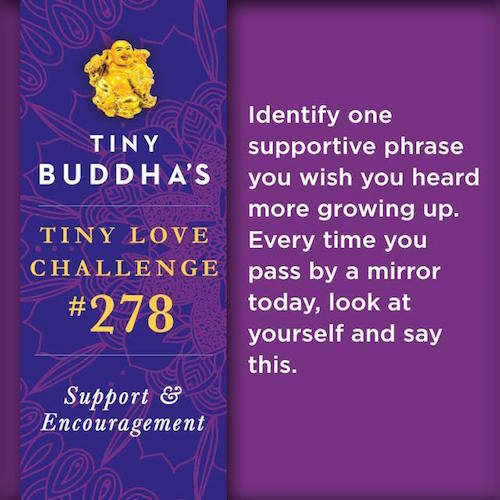
    “Identify one supportive phrase you wish you heard more growing up. Every time you pass by a mirror today, look at yourself and say that.” ~from Tiny Buddha’s 365 Tiny Love Challenges

    When I was a kid, an authority figure once told me, “If I was your age, I wouldn’t be your friend.”

    I tried to act like I didn’t care so I wouldn’t give that person the satisfaction of knowing how deeply they hurt me.

    But it hit me hard, and it stayed with me for years. Someone who was supposed to like me didn’t, so why would anyone else ever love me?

    There was something fundamentally wrong with me. And I wasn’t good enough at anything I did. Even when I did my best, I was never the best, so that meant I was a failure.

    These beliefs guided my childhood and adolescence. When I got to adulthood, I frequently sabotaged relationships thinking, “They won’t want to spend time with me. Why would they? I wouldn’t if I were them.”

    And I regularly overextended myself, only to beat myself up when I inevitably failed at juggling far more than any one person should have to carry.

    The voice in my head was callous and cruel. It took me years to realize it wasn’t even mine.

    Growing up, many of us heard more about what we were doing wrong than what we were doing right (from people who had the same experience growing up). And for a lot of us, there were more punishments than rewards, at home and in school.

    It makes sense, then, that so many of us grew into anxious, insecure adolescents, and then matured into fearful, self-doubting adults.

    But we’re not kids anymore, and we know better now than to believe everything we’re told.

    More importantly, we don’t have to continue hurting and criticizing ourselves. We don’t have to bully ourselves over our perceived shortcomings. We can stop the cycle.

    If you follow Tiny Buddha on Facebook, you’ve likely seen the “love challenge” graphics I’ve been sharing for the last month.

    Each one offers something simple you can do to improve your relationships, open yourself up to new ones, or nurture your relationship with yourself.

    And each one comes from my upcoming book, Tiny Buddha’s 365 Tiny Love Challenges.

    Recently, I posted the challenge below and asked Facebook followers to share what phrase they wished they heard more as kids.

    One Supportive Phrase

    Their responses reminded me that we all have the power, every day, to give ourselves the same kind of love and support we’d want from other people. In fact, it’s a prerequisite to getting love and support from others, because we’re only ever open to receiving what we believe we deserve.

    We all deserve to hear these things—from others and ourselves:

    1. I love you just the way you are.

    2. When you need something to believe in, start with yourself.

    3. I’ll always be here for you. I love you unconditionally.

    4. You deserve to be happy.

    5. You look beautiful.

    6. Don’t be afraid—you are good enough.

    7. I believe you are very capable of taking care of yourself, with or without someone else to take care of you.

    8. Anything you can imagine is possible. The only thing to fear is fear itself.

    9. Everything will be okay. Even if its not, it will be.

    10. You are enough as you are.

    11. You are an individual and are perfect the way you are now.

    12. You can do anything you set your mind to.

    13. It’s okay to make a mistake.

    14. I believe in you.

    15. You tried—that’s good enough.

    16. I’m proud of you.

    17. You don’t need permission from anyone to dream and explore your interests and passions.

    18. You have a beautiful soul.

    19. You are safe.

    20. You’re doing great.

    21. You can do anything.

    22. I want the best for you.

    23. You’re handling it beautifully.

    24. You are awesome, kid.

    25. I love and accept you no matter what.

    Imagine what the world would be like if we all told ourselves these things every day.

    Imagine a world full of people who believe in themselves, encourage themselves, and forgive themselves for their mistakes.

    Imagine a world full of people who speak to themselves kindly and look in the mirror and see nothing but love—and then take the positive, loving energy into their interactions with others.

    I’d like to be part of that world. And I know it starts with me—and you.

    Happy woman image via Shutterstock

  • When Someone Shows You Who They Are, Believe Them

    When Someone Shows You Who They Are, Believe Them

    Quarreling Couple

    “When someone shows you who they are, believe them the first time.” ~Maya Angelou

    I remember first hearing these words in my early twenties. I heard them. I just didn’t follow them. Hence, I brought myself a whole lot of painful lessons and needless suffering because I always wanted to give people a second chance, and a third, and a fourth … You get the picture.

    I was the girl who always saw the “potential” in people. The person they “could” be, with a little love and nurturing from yours truly. I considered myself to be one of the most loving, loyal, and big-hearted people out there. And besides, there were very few things I truly wanted that I went after and didn’t get.

    I suffered many disappointments and even more heartbreaks because of this, both in friendships and romantic relationships.

    I expected people to change just because I thought they should be or feel a certain way. But at that point in my spiritual journey, I hadn’t yet learned that everyone is on their own path, and sometimes their soul just isn’t in alignment with yours.

    When I fell for some guy and had it made up in my mind that he was “it,” I made a lot of excuses for his behavior, which was never in alignment with what I was looking for. Well-meaning friends would warn me in the beginning: “He doesn’t sound like a good match for you. His behavior seems a little sketchy.” Did I listen?

    No. My ego was way too big. Sure, I saw the behavior. I even saw the red flags. But I thought I was “different.” I was so special that I felt I could change that person… just by being wonderful, amazing me.

    NOTE TO SELF: When people show you who they are, believe them the first time!

    I married someone after seeing all the red flags in the very beginning. Behavior that didn’t add up to what I was being told, behavior in past relationships that was not filled with integrity. But there was so much about him that was good and pure, and the love and passion we had for each other was real and intense.

    I truly believed that people could change. And they can. But more importantly I believed I was different, and that behavior would never exist again now that he was with me.

    It should be no surprise that the marriage ended and was the most devastating and painful loss of my life. But that was the moment I started to live by Maya Angelou’s mantra.

    The dating world after divorce is a lot of things—exciting, fun, scary, sometimes horrible, but most of all, a test. How much have you learned from your previous relationships? And what are you going to do differently this time around?

    For me, I learned a lot, but I have blind spots. And comfort zones I fall into. I keep gravitating toward men that feel “like home,” except that home never made me feel good or secure in it and it was definitely a place I shouldn’t consider settling in long term.

    Some warning signs I’ve finally learned to look for and walk away from:

    • Lack of commitment to anything especially in relationships
    • Not a great communicator
    • Not being emotive with feelings
    • History of cheating in past relationships
    • Always looking for the “next best thing”

    These are my red flags. Someone else’s may be completely different. But they are things I know just won’t work for me and will eventually lead to heartbreak.

    What I tell friends when I see them falling into the same trap I often do is to ask themselves some key questions and to be rigorously honest:

    • Is this person someone who embodies all the things that are important to you, or are you convincing yourself that you can change them? You can never change someone. Walk away.
    • Are you attracting the same type of person you always do (the one who never works out for you and always leads to heartbreak)? If so, walk away.
    • Does this person have all of the things that are on your “Essentials” List? Those are the things that are your “must haves” and are non-negotiable. For me, those are trustworthy, spiritual, a great communicator, and someone who is affectionate, loving, and expressive with their emotions. If this person doesn’t have your essentials, walk away.

    The best advice I got just this week was from a friend who knows my journey well. He said, “You know what. Just recognize that you are finally learning what your heart truly wants and moving closer to that every day. You’re walking away from people who aren’t in alignment with your core values anymore.”

    So yes, I’m learning. And I still have a ways to go. But I trust that the right one, the one who steals my heart for good, will show me how amazing he is for me…. the first time.

    Quarreling couple image via Shutterstock
  • 10 Thinking Patterns That Can Fuel Depression

    10 Thinking Patterns That Can Fuel Depression

    Depressed

    “Nothing can harm you as much as your own thoughts unguarded.” ~Buddha

    You know the feeling …

    When out of the blue your mood switches.

    One moment you’re feeling upbeat and optimistic; next you’re feeling down in the dumps.

    You can’t think clearly and struggle to put things into perspective. The bright outlook on life of a moment ago has vanished, and in its place now resides an intense longing for its return.

    You feel disconnected, lost, and confused, and everything around you looks and feels dark and bleak. And even though you have no reason to feel this way, it feels all too real to you.

    And you know where that leads. You’ve been there many times before and don’t want to go back.

    I know the feeling too.

    Recovery is such an illusory term.

    It implies that once recovered, the depression is gone. But those who have recovered know this is false.

    Recovering from Depression Is Not the End of the Battle

    Having spent half of my life depressed, two years after recovery, I still find myself waging the battle of relapse. A battle that at times seems harder to fight than the recovery—just as you tasted the sweetness of the non-depressed life, you never again want to taste the bitterness of depression.

    On the surface, a mood swing looks like “having a bad day.” The kind everyone experiences and snaps out of quickly. But for those with depression, the consequences of mood swings can be severe and lasting.

    First, there’s the sudden change in mood, the one that is more than “feeling-down-soon-will-snap-out-of-it,” followed by a drastic change in outlook. One moment you’re looking at life through clean lenses, and now dirty ones blur your vision.

    Then the inevitable guests start showing up—low self-confidence, paralyzed will, self-loathing, and the most dreaded of all, inertia.

    Not getting completely trapped in the spell of this depressed mood is key in preventing relapse, which is not always easy to do.

    How to Keep Depression from Disrupting Your Life

    I used to believe depression was about “feelings,” so my focus was on understanding and managing my emotions. An approach that not always kept me from relapse—until I learned about the connection between thoughts-feelings-behaviors and about mastering one’s mood, which gave me a new perspective on depression.

    We think. We feel. We behave.

    “It is an obvious neurological fact that before you can experience any event, you must process it with your mind and give it meaning. You must understand what is happening to you before you feel it.” ~David D. Burns, M.D.

    So, how do you master your mood? Well, it’s not that hard. It involves the following:

    1. Detecting the mood change, its severity, and duration.

    For me, the most severe of mood changes, when I’m most vulnerable to relapse, is when it lasts more than a couple of days.

    2. Knowing the consequences of giving in to the depressed mood, as this is key in forcing you to take action.

    In my case, it always leads to the vicious cycle of procrastination, guilt, regret, and self-loathing. A cycle that, once started, is difficult to break.

    3. Taking action to keep the depressed mood from lasting too long.

    The longer it lasts, the more debilitating it becomes, and the harder it is to get back to normal.

    One of the things I used to do as soon as my mood changed was write about how I felt, a strategy that didn’t always keep me from relapse. But when I came across Feeling Good by Dr. David D. Burns and learned about the thinking patterns of depression, I found a new way to battle it.

    The 10 Thinking Patterns You Need to Recognize to Prevent Relapse

    A few weeks ago, I found myself close to relapse after having completed a major project—one I’d been working on for a while that needed to be done—which put all other work on hold. When it was done, I felt pretty good, but the feeling didn’t last long, and I soon found my mood changing.

    One moment I was feeling happy and proud of what I’d accomplished; next I was miserable and beating myself down.

    I had no reason for feeling the way I did, and this was confirmed when I put the thoughts behind the feelings to the test using the ten thinking patterns of depression to challenge them.

    1. All-or-nothing.

    At the core of perfectionism is the tendency to evaluate ourselves in terms of absolutes and nothing in between—good or bad, winner or loser, smart or dumb. In this situation, not being able to do both—complete my project and keep up with other work—pointed to not having achieved the “perfect situation.”

    2. Overgeneralization.

    Believing that if something bad happened once, it will happen over and over and over. “I did it again,” the thoughts that reinforced the belief it will always be this way—unable to manage and prioritize my work.

    3. Mental filter.

    The tendency to focus on one negative aspect of a situation while ignoring all other positive evidence. In spite of having completed the project, my focus was solely on “how behind I was.”

    4. Disqualifying the positive.

    More destructive than mind-filtering, this involves taking a positive experience and turning it into a completely negative one. With all the distorted thinking already stewing in my head, the sense of achievement from this moment was replaced by a sense of failure for not being able to keep up with everything else.

    5. Jumping to conclusions.

    Automatically jumping to negative conclusions without any basis for it. The immediate assumption here was that “I’ll never be able to catch up,” even though I always have in similar past circumstances.

    6. Magnification and minimization.

    The tendency to magnify our mistakes and weaknesses while minimizing our successes and strengths. The heightened sense of failure for not being able to keep up obscured my abilities and skills to overcome this and any other challenges.

    7. Emotional reasoning.

    Looking at life through painful eyes where everything looks bleak and dark. Once the wheels of distorted thinking were set in motion, everything I needed to do to get caught up appeared daunting and impossible.

    8. Should statements.

    The useless mind-noise resulting from being disappointed with ourselves and the world, reminding us of what we could’ve, should’ve, or would’ve done differently. “I should’ve tried harder to keep up.” “I must do all of this to catch up.” These were the thoughts that began popping into my head.

    9. Labeling and mislabeling.

    The constant labeling and mislabeling of ourselves in a self-deprecating manner. Once trapped in this way of thinking, the usual self-loathing terms to devalue myself showed up—loser, not smart enough, can’t do anything right.

    10. Personalization.

    Feeling responsible and guilty when there’s no reason for it. Even though I had a valid reason to do what I did (postpone other work), I blamed myself and felt horrible for finding myself in the situation I was in.

    Everyone thinks in this manner at one time or another.

    But for those with depression, it’s a way of life, with each distortion feeding and supporting the others, keeping us in a constant state of emotional turmoil.

    Transforming the Distorted Thinking of Depression

    Giving the insane thinking of the depressed mind a name, an identity, takes away its power to make us depressed. A power that lies in its obscure nature and that, once exposed, can be seen and defeated.

    This new way of understanding how the depressed mind thinks revealed how most (if not all) of the time when I’m depressed, it has nothing to do with what’s going on in my life but rather the result of distorted thinking.

    Today, armed with this knowledge, whenever I feel the depressed mood coming on, I immediately start jotting down the thoughts that pop into my head. I give them form by labeling them, and then I replace them with rational ones by questioning their validity.

    In this situation, the negative thoughtsI am so behind, and I’ll never catch up” kept me from acknowledging the positive aspects of having completed a major project. A form of mind-filtering, they persisted, making me feel overwhelmed, guilty, and anxious, all potentially leading to relapse.

    On the surface, “falling behind” was true. However, the underlying assumption—that I intentionally procrastinated—was wrong.

    When I realized this, the distorted thoughts lost their validity giving way to a more accurate and rational way of thinking: That this was a major project that needed to be completed and required all my attention. And that “putting everything else on hold” was a conscious choice made and not due to procrastination.

    Master Your Mood and Stop Being Victimized by Depression

    One by one, I challenged and transformed every distorted thought until there were none. As a result, my mood improved, and I went back to relishing the joy and pride the moment warranted for having completed the project.

    You can do it too.

    Master the mood of depression so it doesn’t take over your life.

    Learn to master it, and never again feel the fear of relapse.

    Break the chains of its prison by giving form to its formless thinking, and free yourself once and for all.

    And never allow depression to keep you from fully and uninterruptedly savoring the joy that life brings!

    *This post represents one woman’s unique experience of preventing a depression relapse. If you’re struggling with depression and nothing seems to help, you may want to contact a professional. 

    Depressed image via Shutterstock

  • How Accepting Anxiety Can Lead to Peace

    How Accepting Anxiety Can Lead to Peace

    “People have a hard time letting go of their suffering. Out of a fear of the unknown, they prefer suffering that is familiar.” ~Thich Nhat Hanh

    My unwillingness to accept my anxiety disorder (there, I said it, I have a disorder) results in panic.

    It results in waking up at night, heart racing, body tingling and trembling.

    It results in driving down the road in a thunderstorm thinking I am having a heart attack—but I just keep driving and talking to my beloved on the phone because “if I can just keep driving away from it, it will be okay.”

    Instead of accepting anxiety as a family member of sorts, I resist and resent her visits. She’s always forced into drastic measures to get my attention.

    When the panic and physical symptoms of anxiety start, I assign it to something else.

    My heart races and I must have a heart condition. I’m dizzy and I must have a neurological condition. If it’s not me I assign it to, it’s my children. My son has a horrible bruise; it must be Leukemia. Life is too good; something awful is going to happen to someone I love.

    It always happens just like this, I’ve realized recently.

    Anxiety shows up over and over the course of my lifetime, yet my expectation is that it won’t.

    Instead, I expect that I will always be happy, stress-free, compassionate toward others (but not myself), kind, thoughtful, smart, successful, fit, skinny, wrinkle-free—the list of things I “should” be goes on for miles. That word, “should,” is something that I need to eliminate from my vocabulary.

    I convince myself that anxiety can’t be the cause of these physical symptoms, because that would mean that I am something less than happy.

    Ah, there it is. Feelings other than happiness are bad, and I should (there’s that word again) be happy all the time; so therefore, if I’m not happy, I’m not perfect and I’m a failure. See how that works?

    Yeah, I see how irrational, uncompassionate, and unforgiving that is when it’s on paper, which is one reason I’m writing this. The other reason is because I realized I’m not being true to who I am without accepting this part of me.

    People who know me describe me as an open book. I would have described myself that way until recently.

    This is a part of me that I’ve hidden for years. I tuck anxiety away like that black sheep of the family and make sure no one, not even those closest to me, know her.

    I’ve been ashamed of my anxiety and I’ve realized that all along that black sheep family member just needed me to accept her.

    To sit with her and maybe give her a hug and say, “I see you. I know you’ve visited before. Feeling something other than ‘perfectly happy’ is a normal part of life and I should expect to feel anxious, worried, upset, or even sad sometimes. You’re here to help me figure out what feeling is really behind this anxiety and what actions I can take to feel better.”

    Recently, my children went out of state with their father for a week. This was the first time I had been that far away from them for that long.

    Every day I would wake with a jolt, heart beating fast, wondering why I felt so anxious. I finally realized that being away from my children and worrying about their safety was causing these feelings of panic.

    After recognizing this, I decided to focus on the fun things they were doing every day and how this trip would provide them great memories for many years to come instead of thinking about all of the “what ifs” associated with their trip.

    I see this recent epiphany as progress in my lifelong journey of self-acceptance.

    I am going to try hard to see anxiety as the gift she is, because every time she leaves, I’m a little more enlightened. I feel more capable of managing my anxiety and I realize that I am in control of my thoughts, not the other way around.

    I am able to be more compassionate to others when they are feeling less than “perfectly happy.” I’m able to dig a little deeper into what is causing my anxiety versus denying I have it at all.

    When I do that, I can develop a plan, which either addresses any legitimate concerns or dispels any irrational ones. It’s a lot easier than continuing along just being a victim of my own thoughts.

    The next time anxiety shows up, I’m going to try to embrace her visit so she doesn’t have to go to such drastic lengths to be seen and heard. I’ll simply say, “Oh, it’s you again. Come on in and sit a spell. We have work to do.”

    If you also have a family member named anxiety that’s visiting you more often than you would like, sit with her for a while. Think about why she’s there. What are your anxious thoughts?

    Write down any irrational, anxious, or self-defeating thoughts on one side of a piece of paper. On the opposite side, list any actual evidence that the thought is true.

    An example for me would be “I’m a weak person because I have anxiety.” To challenge that thought is easy—I can list 100 examples of how I am not weak, and have a hard time coming up with even one that proves my thought is true.

    Most of the time writing it down takes away the power of the thought and brings some clarity. If you do have a thought that’s true, figure out some steps you can take to address it. Put yourself back in control. Try it the next time anxiety visits and see if it shortens her stay.

  • Why Rejection IS Sometimes Personal (but Not About Your Worth)

    Why Rejection IS Sometimes Personal (but Not About Your Worth)

    “No one can make you feel inferior without your consent.” ~Eleanor Roosevelt

    It’s not about you. It’s about them. It’s their loss. Don’t take it personally. It doesn’t mean anything.

    Well-intentioned people have told me these things many times to soften the blow of rejection. And I wanted so badly to believe them, but how could I?

    When someone doesn’t want you, it’s hard not to take it personally. They don’t want you. It must mean something about you, right?

    When five college theater programs rejected me, when guy after guy ditched me, when countless potential friends avoided me, I thought for sure it meant I wasn’t talented or lovable.

    I beat myself up, put myself down, and wished I could be someone better, someone people wouldn’t so quickly write off.

    I tried to reframe it, to consider that it really had nothing to do with me. I knew this thought was supposed to comfort me, but something told me this wasn’t right—and it wasn’t my low self-esteem.

    Eventually, I was able to look beyond the simplicity of black-and-white thinking and recognize a beautiful grey area.

    That grey area was the key to bouncing back from rejection. It was the key to learning about myself. And it was the key to changing how I showed up in the world, and how I experienced it.

    In the grey area, rejection sometimes is about us, but not about our worth.

    In high school, I had tremendous potential as an actress and singer. I got cast in lead roles plenty of times, received abundant praise for both my dramatic chops and my comedic timing, and represented my school choir at a national competition.

    I had talent; I know this now. Still, with the benefit of hindsight, I also know that my college rejections did mean something about me.

    I didn’t take care of myself back then. My throat was constantly hoarse due to aggressive bulimia. And I was terrified of judgment, which made it difficult to be present and throw myself into my monologues.

    But none of those things meant I was untalented or unworthy. They meant I needed to be kinder to myself, to strengthen my confidence, and to grow as a person and performer.

    As a teen and in my early twenties, I had a lot to give in relationships. I was compassionate, good-hearted, and loyal to those I cared about.

    I was lovable; I know this now. Still, with the benefit of hindsight, I also know that my inability to sustain relationships and friendships did mean something about me.

    I frequently looked to others to fill gaps in my self-esteem. I obsessed about myself while blinding myself to their needs. And I was clingy, insecure, and unwilling to heal the pain that caused me to focus all my attention on winning their approval.

    But none of these things meant I was unworthy of love. They meant I’d experienced tremendous pain and I needed to heal and learn to love myself before I could truly love or be loved by others.

    Some rejections really weren’t about me—like when a casting director was looking for someone older.

    Most times, there was a lesson for me in the rejection, some area where I could learn and improve. But the lesson never had to do with my worth as a person—only about my potential for growth.

    This isn’t a mindset I adopted quickly or easily. 

    For years, I hated myself when I failed or it seemed people didn’t want me. Even the tiniest rejections would push me down to a dark, dirty place of “There’s something wrong with me.”

    And it was awfully tempting to stay there. In a way, it felt safe. It was a place where I could hang out without getting shut out.

    In accepting my inadequacy, I was free to shut down and avoid future rejections. What was the point of trying when I knew I was the problem, and there was nothing I could do about it?

    If I plain and simply wasn’t good enough—if I was intrinsically unworthy of all the things I wanted—then I could stop putting myself in a position to have this disheartening truth confirmed.

    Or, perhaps even more depressing, I could lower the bar on what I wanted so that it aligned with what I believed I deserved. I could seek out jobs that dissatisfied me, men who looked down on me, and friends who devalued me.

    Because that’s what happens when you conclude that you’re unworthy and undeserving—you find people and situations that confirm it.

    Like I did in my mid-twenties, when I casually dated a man who said I was lucky he spent time with me because I wasn’t really a great catch (while torturing myself by living in NYC but not auditioning because I thought I wasn’t good enough).

    I know now that I am good enough. I deserve so much more than I once settled for, despite all the rejections I received. And I have a light I can share with the world, if I choose to kindle it instead of stifling it.

    In a way, I’m grateful for those rejections. They enabled me to identify areas for growth, to develop confidence while making progress in those areas, and to tame the cruel, critical voice inside that hurts far more than anyone else’s rejection.

    We all have a voice like this, and it has a knack for getting louder right when we need compassion the most.

    When we’ve failed to achieve something we wanted, it likes to obsess over all the reasons we probably shouldn’t have put ourselves out there.

    Really, it’s trying to keep us safe by discouraging us from putting ourselves in a position to be hurt again. Just like our friends are trying to protect us from pain by telling us it really isn’t about us.

    But safe isn’t a place where we learn or grow. It’s not the key to feeling alive, engaged, challenged, or proud of the way we’re showing up in the world.

    To feel those things we have to first tell ourselves we’re worthy of those feelings—no matter how much room we have for growth.

    We have to tell ourselves that we can achieve more than we think, but we are so much more than what we achieve.

    We have to live in that grey area where failures and rejections provide information, but not confirmation that we’re not good enough.

    I’m not always open to that information. On days when I’m feeling down on myself, it’s tempting to interpret “no” as “no, you don’t matter.”

    Even those days are opportunities, because I get to practice telling myself, “Yes, you do. Now prove it. Keep learning. Keep growing. And keep showing up, because you have so much more to give.”

  • 19 Simple Daily Habits for a Happier Life

    19 Simple Daily Habits for a Happier Life

    “Hug harder. Laugh louder. Smile bigger. Love longer.” ~Unknown

    Did you ever have it all mixed up?

    Happiness, I mean. I once thought that a university degree and good grades would make me happy. I thought that traveling the world would leave me feeling fulfilled. I thought that moving abroad and getting that top-notch job would make me satisfied and content.

    They all did, but only for a while. They always came with an expiration date.

    Finally, I had to stop and ask myself, “If I’m not able to be truly happy now, will I ever be?” If I couldn’t appreciate everything I already had in my life, would more really be the answer?

    No.

    Then I thought, “If happiness is what I want, why not take a shortcut and go there directly?”

    So, I did. I stopped putting it on hold. I stopped allowing external circumstances to dictate how I felt. And I stopped relying on illusionary destinations of promised happiness and bliss.

    What I realized is that happiness doesn’t happen by chance–it happens by choice. It’s a skill that anyone can develop with the right habits.

    19 Happiness Habits That Could Change Your Life

    1. Appreciate more.

    This morning I woke up feeling appreciative of my bed, my incredible friends, and my mom for being the rock in my life. Appreciation feeds happiness. It highlights and gives value to what matters in our life. And the more you appreciate, the more you’ll find things to be appreciative of.

    When waking up and going to sleep, remind yourself of three things you currently appreciate in your life.

    2. Energize yourself every morning.

    Mornings set the tone for the rest of the day. A good morning routine leaves you feeling centered, energized, and ready to take on the world.

    Meditate, do yoga, write a list of everything you love, watch inspirational YouTube videos, or listen to your favorite song before leaving the house. Simply, set yourself up for a great day!

    3. Practice acceptance.

    Things don’t always go as planned. I used to get frustrated when plans changed or when the bus arrived late. But resisting never changed anything; instead, it just sent me into a downward spiral. When I started accepting whatever happened, I relieved myself from unnecessary suffering.

    Start practicing acceptance. Adjust to the new situation, without fueling it with negative emotions.

    4. Live in the present.

    This is where it all happens, the present moment. It’s the only place where you can experience happiness (or anything else for that matter). It’s the only place worth being. It might sound obvious, but realizing this was life changing for me. In the present I think better, feel better, and act better.

    Whenever you enter a new place, use your five senses—sound, sight, touch, smell and taste—to find more nowness.

    5. Listen attentively.

    Listen with focus and compassion. Give people the gift of your full attention. This is a powerful source of happiness, as it creates strong bonds between people and places you in the now.

    Whether it’s your colleague, partner, or a complete stranger on the street, decide to be more present in all your conversations.

    6. Save money to invest in memories.

    Material things might satisfy us short term, but experiences are what makes us happy long term. For the past year I’ve barely bought anything new. Instead, I’ve used that money to travel. Just thinking about the beach parties in the Caribbean, those sunny days in Central Park, and that festival in Ibiza puts a ridiculously big smile on my face.

    Buy only things you need or fall head-over-heels in love with. Then, use that extra money for experiences that will make you go “Aaah,” “Ohhh,” and “Wow” when you think back of them.

    7. Make new friends.

    Many of us stop making friends after the age of twenty. Make new friends and you’ll grow as a person, be exposed to new experiences, and have a rich social life.

    Have a friendly conversation with a stranger and maybe you make a new friend. Maybe it’s for five minutes, or maybe it’s for a lifetime.

    8. Dream big.

    Dreams are good; they propel us forward. They enliven our heart, awaken our mind, and give us reasons for living. Allow yourself to dream big and trust that it can become a reality for you.

    Dedicate at least five minutes every day to be swept into your dream life. Make it as real as possible: visualize and create the feelings of being, doing and having all that you want.

    9. Take steps toward your dream.

    Now, does your present look like the future you’re dreaming of? If not, put more time and energy on what you want to see grow.

    Take small steps every day to elevate you toward what you want. Tiny steps all add up.

    10. Develop a mindset of abundance, not scarcity.

    How we experience the world depends solely on our perception of it. When you live in lack, you protect and hoard. When you give away, you signal that you have more than enough for yourself.

    Don’t feel like you get enough love? Give love to someone else. Don’t feel like you make enough money? Give money to someone else in need.

    11. Take time to re-charge.

    Even though we live in a society that fosters us to do more, be more, give more, and have more, we need time to re-charge. We need to fuel ourselves with energy. Take short breaks, and why not a power nap?

    What doesn’t get planned usually doesn’t get done, so make sure to plan for downtime.

    12. Make time to play.

    Living isn’t a duty. You didn’t come here to fix something that’s broken or to complete a to-do list. You came for the fun of it, for the exhilaration and magic of being alive.

    Set aside at least fifteen minutes every day for fun-time and make that time non-negotiable.

    13. Be around happy people.

    Attitudes are contagious. If someone’s smiling at you, you’ll probably smile. If someone is rude, then you’ll probably be rude back. Only hang out with people whose attitude you want to catch.

    If happy people aren’t near, go online and watch videos with awesome-attitude people such as Marie Forleo, Tony Robbins and Regena Thomashauer (Mama Gena).

    14. Move slowly.

    Lao Tzu said, “Nature does not hurry, yet everything is accomplished.” Faster doesn’t mean better. Busier doesn’t mean exceeding. Don’t rush through life.

    Slow down. Put your heart and energy into what you’re doing and focus on that (and only that).

    15. Actively soothe yourself.

    What matters isn’t what happens in our lives, but how we choose to deal with it. To make better decisions, we need to become our own lifeguard and sooth ourselves from negative thoughts.

    When I feel bad I usually go running, meditate, or write a list of everything I love about my life. Practice different techniques until you find some that work for you.

    16. Let go.

    Letting go isn’t always easy, but it’s the only way new and better things can come along. When we let go of something, we come to a peace of mind. The struggle is over and new ideas and perspectives can begin to open up.

    Practice letting go of what doesn’t serve you, such as complaining, comparing yourself to others, negativity, and mistakes from the past or worries about the future.

    17. Forgive often.

    Maybe someone was late, maybe someone was rude, or maybe someone forgot to call you back. Forgiveness doesn’t excuse behavior; it frees you from it. It releases resentment and other negative emotions tied to a person or a situation.

    Make a habit of forgiving people, even for the smallest of things.

    18. Attend to the real world.

    Smartphones, tablets, and laptops are constantly screaming for our attention to the world of social media. The digital world is supposed to be a complement to our real life, not the other way around.

    So, take time to be present where you physically are (the Facebook status update can wait).

    19. Care for yourself.

    Our body, mind, and soul are connected. Make a change in one of them and you change the state of all three. Isn’t that nice to know?

    Do something every day to improve your overall state of well-being, such as preparing a good meal, exercising, or watching a good movie. And know that caring for yourself is caring for the world.

    Claim Your Happiness Once And For All

    Not being in charge of your happiness is frustrating. Relying on external events and circumstances to be in a certain way in order to feel good is a recipe for misery. Because, when life doesn’t go as planned or things fall apart, so does our happiness.

    Happiness isn’t about having all the pieces in place. It isn’t about having a problem-free life or reaching a certain goal or objective. Instead, it’s about being able to enjoy where you are, no matter what.

    Don’t leave your happiness to chance. Choose to claim it. Live the life you deserve to live.

  • Why Hard Work Might Not Pay Off (and What Will)

    Why Hard Work Might Not Pay Off (and What Will)

    Hard Working Business Man

    “Man is only truly great when he acts from his passions.” ~Benjamin Disraeli

    At a young age I was told, “Without hard work nothing grows but weeds.”

    I was also told, “With hard work it was possible to achieve the American Dream.”

    I was not sure what the American Dream was, but I did what everyone around me seemed to be doing. Working hard. I did well in school, helped my mother at home and my father at his place of business.

    The world looked incredible to me growing up, and I was so passionate about waking up every day and exploring. I wondered why my parents and the other adults around me didn’t seem to be passionately alive.

    Didn’t everyone see what an incredible world this was?

    There was a glimpse of this passion they once had in the boxes of photographs in our living room closet. I would look through them on Saturday afternoons while babysitting my siblings so my parents could take a nap and rest their weary, hard working bodies.

    In the photos, they were young and full of raw passion. My favorites were of my mother at around twenty years old, dressed up in a leopard velvet fitted suit, working at Oleg Cassini, a NYC fashion company. Smiling.

    My Dad’s photos were of him as a young twenty year old in full military uniform on a US Navy ship, somewhere far away, looking over the side rail in contemplative thought. Thinking. His favorite thing to do, an intellectual. Looking far off into the distance. Tall, slim, and handsome.

    “When did they let that go?” I used to wonder. “When and why did Mom stop dressing up and working, and Dad stop writing and thinking, taking quiet contemplative time for himself?”

    Mom resigned herself to working hard at home with lots of kids to raise on a dead end street in the suburbs, which she hated. Dad worked a series of jobs in the business world that he was completely unsuited for.

    Mom let us all know how miserable she was by her lethargy, and Dad’s anger and rage let us know just how discontent he was. I know they were doing their best to keep it all together.

    Yet passion was nowhere to be found.

    What did I do? I followed in their footsteps. I got engaged at eighteen and stayed in the suburbs, which bored me to tears. I worked a well-paying job in finance that I was ill suited for.

    I was living the American Dream they told me about, only it was more like the American Nightmare.

    I found myself crying on the way to work every day, with no joy to share with my child. I found myself longing to leave my marriage, which I’d entered to please my parents, and get to know myself and what would make me happy.

    No one had ever asked me what I was passionate about, and I’d never thought of asking myself.

    The realization of what former British Prime Minister Benjamin Disraeli said hit me. A great man or woman acts on their passion. I realized my greatness was in the one place no one told me about. In acting from my passion.

    For me that was writing. When I write I feel great. I feel passionate and alive. Just like a kid again. So that’s what I did. I moved to the city and studied writing as if my life depended on it, because it did.

    You may have some troublesome thoughts about the conflict of working hard vs. acting from passion. I know I did.

    If you’re not doing hard work, you may feel lazy or guilty. Or like it’s too good to be true. Following your passion seems like it’s easy, yet it can be hard work too. But it’s the kind of hard that’s fueled by pleasure and passion.

    Or maybe you want cold hard cash. You want stuff. You want to support yourself and your loved ones. So you take the work that you can get, or that makes the most money, or do what someone else wants you to do.

    Yet, what happens if you act from passion first? Get happy first? Before you decide on a career or take a job or get into a relationship. Or move to a city or countryside. What happens is that everything flows more easily from this place. Sure, you could work hard, just put passion first.

    How do you begin acting from your passions?

    Put passion first, even if it’s only in your thoughts at first.

    When you want to discover and act from your passion, you may have thoughts that challenge this new way of letting go of “hard” and gliding into joy and passion. So develop a mantra for yourself that you repeat, about giving yourself permission to put passion first.

    Hide from those that bring you down.

    Steer clear of the “hard work and little passion and play” people. Seek out those that understand how acting from passion first enhances your life and the life of everyone around you.

    Accept how hard your work and life really are and must be for now.

    Know that sometimes life is hard. And work is hard. World and life events and tragedies bring us down out of happiness and passion. Know that this is necessary so you can see the contrast of living from passion first to living from the work hard place.

    Remember, when you have passion about something you are more willing to take risks. Everyone can decide to work hard, but passion means something different to each person. Follow yours.

    You can have one leader that leads with hard work and another that leads with passion. Which one do you want to follow?

    Ask yourself some tough questions.

    What do you feel passionate about?

    If you have no idea, remember what you loved doing as a kid. What were your favorite toys and games?

    What activities do you partake in that, when you do them, you lose all sense of time?

    What do you really want to do but are afraid to say out loud?

    Close your eyes while contemplating this question. Feel the answers in your heart instead of thinking them with your head.

    Passion is not always strong and powerful. It can be calm and deep. Don’t worry about motivation. Once you feel the passion for something, the motivation comes with little effort.

    Queen Victoria invited Disraeli to become British Prime Minister, and they soon struck up a remarkable rapport thanks to Disraeli’s charm and skillful flattery.

    On finally achieving his long ambition, to become Britain’s Prime Minister, Disraeli declared, “I have climbed to the top of the greasy pole.”

    Find your own greasy pole, the one you are more than willing to climb, using passion as your inspiration and motivation. For whenever something great was accomplished in the world, it was done with passion.

    What are you doing to find yours?

    Hardworking man image via Shutterstock
  • Confessions and Lessons from a Former Approval Addict

    Confessions and Lessons from a Former Approval Addict

    “It’s not your job to like me. It’s mine.” ~Byron Katie

    I’m short. I’m stumpy. My nose looks like a pig’s. My inner thighs touch when I walk. My gums show too much when I talk. I have to change the way I look. Maybe then you’ll like me.

    I obsess. I overanalyze. I get caught up in my head. I dwell on things I should let go. I can never simply go with the flow. I have to learn to be laid back. Maybe then you’ll like me. 

    I’m shy. I’m anxious. I’m dependent on reassurance. I ask for advice way too much. I look for validation as a crutch. I have to be more confident. Maybe then you’ll like me.

    Day in, day out, plotting away—that’s how I spent my life. I didn’t like who I was, so I hoped you’d do it for me.

    If only you’d tell me I was okay. If only you’d confirm that I didn’t have to change. If only you’d give me permission to be myself. Maybe then I’d like me.

    It’s what led to more than a decade of self-torture.

    I’d cut myself to feel relief and create a physical representation of the pain I feared no one else could see.

    I’d stuff myself with food to the point of bursting, then hide myself away to purge it, up to thirteen times day.

    I’d curl up in my bed and cry for hours, hoping maybe my tears would wash away the most offensive parts of me.

    I remember once, when I was in a residential treatment center for bulimia, an art therapist asked me to draw a self-portrait.

    I drew a bag of vomit with me curled up inside. That was how I saw myself.

    I know why I grew into this needy, insecure person. I can trace the moments that, bit by bit, eroded my self-esteem and caused me to question my worth.

    But it doesn’t really matter why I learned to feel so small and insignificant. What matters is how I learned to tame the fears that once imprisoned me.

    Notice I wrote tame, not destroy. For some of us, the fearful thinking never fully goes away.

    I have never seen myself as a before and after picture, because it’s never felt black and white to me.

    There wasn’t a distinct turning point when my life went from painfully dark to light.

    It’s been a slow but steady process of cleaning layers of grime from the lens through which I view myself—and sometimes, just after chipping away a massive piece of dirt, I catch a splash of mud in the spot that was briefly pristine.

    I live, day in and day out, in a messy mind that, despite my best efforts, has never been fully polished.

    But it’s far clearer now than it once was, and I have the tools to clean it a little every day—and to accept the times when I simply must embrace that it’s still dirty.

    Perhaps you can relate to the lost, lonely younger me, desperately seeking approval. Or perhaps you’ve come a long way, but you still struggle with confidence every now and then.

    Maybe you sometimes feel like a fraud because you’re human and imperfect.

    Maybe you still want to fit in and belong—who doesn’t? We’re social creatures, and wired to seek community.

    But there’s a difference between looking for connection and looking for permission to be.

    There’s a difference between depending on people for support and depending on them for self-esteem.

    Here’s what’s helped me shift from seeking praise and approval to knowing I deserve love and support.

    Become aware of the layers of grime on your lens.

    You may see yourself as someone else once saw you, years ago when you were too young and impressionable to realize they weren’t viewing you clearly.

    Or perhaps your grime built up later in life, when people close to you projected their own issues onto you and convinced you that you were somehow lacking.

    Most likely, a combination of both led you to form a harsh, critical view of yourself, backed up by caked on beliefs, reinforced through consistent self-critical thoughts.

    Understand that, much like those other people, you are not seeing yourself clearly—or fairly.

    You may see small mistakes as evidence that you’re unworthy. You may interpret your challenges as proof that you’re incompetent. Neither of these things is true, and you don’t have to believe them.

    Learn how to clean your lens daily.

    While I wish I could say I know how to power wash that lens, I’ve yet to discover such a process. But I can tell you how I’ve slowly chipped away at the mud:

    Change your beliefs.

    Once you identify a limiting belief—such as I’m not lovable—you can start to change it by looking for evidence to support the opposite belief.

    Once upon a time I believed I was ugly. I truly believed my face was offensive when not covered in makeup, because I have light features.

    I know where this belief came from—when I was a kid, someone told me light-skinned blonds are homely. And because this person valued physical appearance, and I desperately wanted them to accept me, I started caking on layers of paint.

    Over the years I’ve met people with varied looks who I found to be incredibly beautiful, and it had nothing to do with the color of their skin, eyebrows, or eyes.

    It had to do with the light in their eyes and the joy behind their smile.

    I, too, possess the capacity to shine from within and exude joy. More importantly, I feel good about myself when I access my inner spark, and how I feel about myself matters far more than what I look like.

    Challenge your thoughts.

    While you can identify evidence to support a new belief, it’s likely you’ll get stuck in engrained thought patterns from time to time. It’s a process, not a one-time choice.

    My mind will occasionally formulate reasons I am not good enough.

    You aren’t where you should be professionally.
    You didn’t respond to that conflict wisely.
    You reacted too emotionally.  

    As often as I can, I catch these thoughts and challenge them with compassion:

    There’s nowhere you should be professionally—and you’ve done a lot more than you give yourself credit for.
    You could have responded better to that conflict, but that’s okay; this is an opportunity for growth.
    You reacted emotionally, but that’s okay too—you’re not a robot. And at least you’re self-aware enough to recognize when there’s room for improvement.

    You may not catch every self-critical thought, but over time you’ll catch more and more, and tiny bits of progress add up.

    Slow your thoughts. 

    It’s all well and good to challenge thoughts, but if they’re coming at you like baseballs from a pitching machine, you’ll probably end up feeling too overwhelmed to be effective.

    I’ve come up with a list of mindfulness practices that help me find relief from my loud, persistent inner monologue. These are the ones I’ve found most effective:

    • Five minutes of traditional meditation or deep breathing
    • A five to ten minute walk, focusing on my senses and the experience of being in nature
    • A yoga class or five to ten minutes of deep stretching, synced with my breath
    • Listening to music (on YouTube) with subliminal messages for confidence
    • A repetitive creative outlet, like crocheting
    • Anything that gets me into a state of flow, like dancing

    Take a little time every day to clear your thoughts, and it will be a lot easier to tame the fear-based voice that makes you feel bad about yourself.

    Change for the right reasons.

    With all this talk about accepting yourself and taming the voice that makes you feel unworthy and dependent on approval, you may assume you should never again strive to change.

    When I considered that possibility, I came up against a lot of internal resistance. But it wasn’t because I felt I needed to become someone else to be lovable. It was because I realized growth provides me with a sense of possibility and purpose.

    In much the same way I wouldn’t berate my child, if I had one, for having more to learn, I didn’t have to motivate change from a place of self-disgust; instead, I could encourage myself to continually grow into a stronger, wiser version of myself.

    I could regularly identify areas for improvement without concluding I needed to change because I was intrinsically flawed.

    If you’re not sure how to tell the difference between change rooted in shame and change rooted in self-love, ask yourself: Do I want to make this change because I know I deserve the results, or because I fear I’m not good enough unless I do this?

    Take power back from others.

    I still want you to like me. I do. I want you to think I’m witty, and funny, and wise, and interesting, and worthy of your attention.

    But these days I focus a little more on you and a little less on your approval. I think back to times when you were witty, and funny, and wise, and interesting, and I’m grateful that I get to give you my attention.

    And if you don’t feel the same about me, well, it can hurt. On days when I’m at my strongest, I’ll acknowledge the pain and let it run through me.

    Then I’ll remind myself that I can like me even if you don’t. Because that’s what happens when you learn to view yourself through a clearer, more compassionate lens: You start seeing how lovable and wonderful you really are.

    I am imperfect in so many ways. I’ve made more mistakes than I can remember or count. I have struggles that I sometimes think I should have completely overcome.

    But I’ve been through a lot. I’ve been beaten down. And I’ve risen up every time. I’ve kept playing my hand when it would have been easier to fold. I’ve learned and grown when it would have been easier to stagnate.

    I am no longer ashamed of where I’ve been; I’m proud of the journey through it.

    I am no longer ashamed of being imperfect; I’m proud that I’m brave enough to own it, and humble enough to continually grow.

    That shift in perception has helped me accept that you may or may not accept me.

    I’m going to show you who I am, in every moment when I find the strength and courage to be authentic. Maybe then you’ll like me. And if you don’t, it might hurt, but that’s okay. Because I’m going to love myself through it.

  • There’s More Right in the World Than You Might Think

    There’s More Right in the World Than You Might Think

    Good News

    “When you turn on the television … you run the risk of ingesting harmful things, such as violence, despair, or fear.” ~Thich Nhat Hanh

    I passed the rack of newspapers on my way into story time at the library, ignoring the latest headlines. Murder, mayhem, war, disaster—it all calls like a siren at sea. My pace picks up as I turn the other direction.

    My two-year old charge, whom I affectionately call Little Man P, is captivated by the animated librarian. She impresses me with her liveliness and ease in handling a room full of kiddos. It is clear she loves her work and those that come to story time.

    After everyone else left, she lingered to talk with me and Little Man P. He’s shy and bashful, but loves attention. Since he insists in going out in his superman outfit, he certainly gets noticed.

    I’ve enjoyed caregiving most for Little Man P because he has reminded me how to have fun and use my imagination.

    There’s hardly a moment he isn’t asking me to tell him a story. He’s more interested in elephants that can climb trees and fire hydrants that can talk than he is in anything else. I tell the librarian how my imagination has come alive since I’ve been babysitting him.

    With this comment, she seizes the opportunity to plug a special kids program coming up that weekend at the library. Unfortunately, I wasn’t going to be available to attend. I explained I would be spending a few nights staying with an elderly woman at risk of falling whose husband had to be out of town for a funeral.

    I shared with her what I consider to be the greatest downside to working with the older end of the age spectrum. Many, if not all, of my clients are really into the news. I can pretty much count on a newspaper at the table and the television turned on.

    Rather than participating in a fun and imaginative weekend program, Id be stuck listening to CNN running 24/7 in the background. I complained about this with my new librarian friend, commenting how difficult it is to hear all the bad news in the world.

    She shook her head sympathetically and muttered an agreement. I went on to express my frustration with the news media for mainly reporting what’s wrong in the world. I asked her, “Don’t you think there are just as many good things going on in the world?”

    She agreed, but then said: “Yes, but it seems things are getting worse every day.”

    I felt the familiar flare of passion rise up when a topic really pushes one of my buttons.

    I passionately exclaimed, “People only think that because that’s all they hear about on the news! Isn’t it just as likely there are an equal amount of miracles happening every day, or good Samaritans doing heroic deeds that we don’t hear about?”

    I think my enthusiasm must have turned her off, as she made a rapid exit after my outburst. Our conversation, however, reminded me of why I have such a ban against reading or watching the news. My desire to know what’s right in the world instead was ignited.

    Although not everyone agrees with the belief that we focus on is what we create, chances are if you’ve ever thought about buying a certain kind of car, you’ve experienced suddenly seeing that kind of car everywhere.

    This phenomena is referred to as frequency illusion. Our minds sift out all the other data we are receiving and starts to see more of something we have just noticed or learned. It is amazing how we will begin seeing things previously unnoticed based on where our thoughts and focus are directed.

    I’ll concede, simply watching or hearing about murder, terrorism, or the bad economy isn’t necessarily going to mean we see more of those things as we go about our day to day lives. However, it does increase the likelihood we start living a more fearful life.

    As such, we might notice the unusual looking man at the grocery store. Then, when he pulls out behind us in the parking lot, we worry he is following us. Or perhaps we become suspicious of the neighbors who just moved next door because of their race or religious orientation.

    Similar to “frequency illusion” is the experience of “selective attention.”

    Numerous studies demonstrate when our attention is occupied with one thing, we often fail to notice other things right before our eyes. In one study, few people noticed a woman with an umbrella cross the field while they were counting how many times a football got passed from one player to another.

    Likewise, if we are preoccupied with the strange looking man in aisle two of the grocery store, we might not notice the cashier pull money out of her own pocket to help the customer in front of us who didn’t have enough to pay for their groceries. Or see the young man help the elderly woman carry her groceries to the car.

    Constant bombardment of all the horrible things happening in our world can only lead to greater and greater distress and mistrust.

    What we need instead is more hope, faith, and love. In an information age where what happens on the other side of the world is known immediately everywhere, why does the media report mostly on what’s going wrong?

    Imagine a primary news channel devoted predominately to the announcement of miracles or to reporting various good deeds.

    What if we were constantly seeing pictures of people helping each other, babies being saved by the latest in modern medicine, or politicians shaking hands in agreement over important issues?

    What if we were to hear stories about the rising inner peace movement, or new and innovative programs to assist the elderly, sick or disabled?

    Is it possible we would all smile a bit broader and greet strangers with a warm hello?

    Perhaps we would feel encouraged to do our own generous act of kindness or join an existing worthy cause.

    Would not knowing about some of the things we hear about on the daily news make a huge difference to us in our day-to-day lives?

    How can we possibly know if things are getting better or worse when we aren’t given even a 50/50 accounting?

    Steven Pinker, in his 2011 book, The Better Angels of Our Nature: Why Violence Has Declined, argues things actually are getting better. He asserts violence has been in decline, despite the ceaseless news about war, crime, and terrorism.

    We just can’t see it because no one is focused on what’s right it the world.

    Since I’ve stopped watching the news and reading the paper, my life is happier and more fulfilling.

    If there is something really important happening in the world, I will hear about it elsewhere. If there is some action I can take to make things better, I will do it. But most the time, I’m quite content to live in my bubble, smiling at people and extending kindness to strangers.

    Good news image via Shutterstock

  • A Reason to Feel Less Anxious During Times of Transition

    A Reason to Feel Less Anxious During Times of Transition

    Woman with Butterfly

    “How ironic that the difficult times we fear might ruin us are the very ones that can break us open and help us blossom into who we were meant to be.” ~Elizabeth Lesser

    This past May I graduated from college, where I majored in Environmental Science. I chose this subject for one simple reason: I love learning how the world works.

    There are always strong connections to be made between humans and other species. Every time I hear a unique, astonishing fact about other animals, I feel more connected to the world around us rather than more separate.

    My latest bewildering discovery came from the radio.

    I was driving in my car, heading to the grocery store but mostly in need of some fresh air. I had spent the day inside, applying to jobs and pondering the next step of my life. Riding along, listening to the radio, provided a source of calm.

    The segment was on NPR’s RadioLab and the subject was “black boxes.”

    On NPR’s website, the hosts describe black boxes as: “those peculiar spaces where it’s clear what’s going in, we know what’s coming out, but what happens in-between is a mystery.”

    The hosts announced their first topic of discussion: a caterpillar’s transformation to butterfly.

    The black box, in this case, is the chrysalis within which the caterpillar’s body changes into a butterfly. We know the caterpillar and we know the butterfly, but many of us do not know what happens inside the cocoon.

    I was hooked. Sitting in my car, I had parked but couldn’t turn off the radio.

    I wanted to hear what exactly goes on in the chrysalis. What does it look like inside this hidden chamber? Is it what I’d imagine?

    I predicted that within the cocoon, caterpillar cells begin to replicate on either side of the body in a symmetrical pattern. Maybe the wings curl around the body as they grow.

    I was wrong.

    If you open a chrysalis about a week after its conception, there is no discernible caterpillar. Within the chrysalis, the caterpillar actually digests itself. The enzymes released by this process create a sort of goo in place of the caterpillar.

    The creep-factor of this for me was akin to watching Silence of the Lambs. The story was as perturbing as it was captivating.

    I believe what fascinates me most about the caterpillar’s transition into butterfly or moth is that the original wormy fellow neither stays fully intact nor completely disappears. The “goo” is actually a collection of cells that replicate where they need to.

    The butterfly’s organs, such as the antennae, the wings, and legs, all develop through the constant division and replication of cells that collect from caterpillar goo. Even more interesting, some species of moth have been shown to retain some memory of their caterpillar lives. The cells, therefore, hold qualities of their original character.

    The metamorphic process is evolutionary, and it is encoded in the caterpillar’s DNA.

    I do not believe that the small creature makes a conscious choice to turn himself into goo. Rather, he does so by default just as his ancestors have been doing for millions of years. I know this logically. And yet, there is something abstractly beautiful about the concept.

    I love that the caterpillar trusts it will become a butterfly. It is willing to break itself down for a short period of time, knowing that the result of its self-destruction will be as grand and sensational as a butterfly or moth.

    What fearlessness required, what self-confidence! The caterpillar eats and eats for days, plumping itself up for the process of its own obliteration. That takes some serious bravery and commitment.

    Last month, I put on a graduation cap and gown, and I, along with millions of other graduates, took a leap from the comfortable role of student to something as yet undefined.

    One moment, I could define myself by my courses, my friends, and my ability to navigate campus. The next moment, it became a lot harder to define myself, as my entire environment changed.

    I have been wondering a lot lately about where I’m headed next. Is there any clear-cut path or formula?

    Looking on Instagram and Facebook it seems that everyone is confident in their post-graduation choices, whatever they may be.

    I feel that I am somewhere in between, applying for jobs but still unaware of my first step, and uncertain of the specifics of my future.

    For example, where do I want to live? What types of people do I want to surround myself with? Where do I want to work? More specifically, what type of work will fulfill me?

    The questions are normal, even necessary. But hearing about caterpillars, I realized something important about how I’ve been navigating my transition.

    I, along with many of my friends, have been envisioning my life thus far as having two separate stages: one during college and one after.

    The first stage we view as preparation. We feed ourselves with the tools necessary to grow, just as the caterpillar does. After college, we expect to become a butterfly. On top of this, we expect the transition to occur rapidly and effortlessly.

    Before I graduated, I had a lot of anxiety about remaining active and engaged after graduation. Looking back, I realize I was desperately scared that I’d lose myself—that the transition would seize the “me” I knew and morph me into some worse version. But what if these fears ended up being more dangerous to my growth than the transition itself?

    When I view this period of time as my black box, instead of feeling anxious that I will lose myself, I feel excited by the opportunity to rebuild.

    I trust that whatever is contained within the black box, is still “me.” So what if it gets a little gooey? Times of transition are meant to be gooey; we are meant to settle into ambiguity before we are able to achieve clarity.

    This mentality has helped me to take positive action toward starting on my new path.

    This doesn’t mean it’s easy. My identity is undergoing a breakdown of boundaries. It can be scary.

    I do fear on some level that, like the caterpillar turning to goo, I will lose everything that defined me, other than DNA, of course. But however scary, it can be more fruitful to spend time in the black box than to rush the process of becoming a butterfly.

    During a time of transition, it’s important to give yourself space and time to break yourself down and settle into the uncertainty of the moment, to take a pause before stepping forward.

    Maybe the caterpillar has it right. Before becoming a butterfly, the caterpillar loses all structural integrity; he does not fight to keep his body as it was. Nor does he entirely disappear.

    Instead, he changes form, while maintaining essential parts of his former identity. In the end, he builds himself back up as a better version of himself, this time graced with a pair of wings, and poised for flight.

    I am confident that after time in the black box, I will emerge more capable, more mindful, and more me.

    If you are also in a black box, having just completed one phase while preparing for another, know that nature provides these spaces for a reason.

    These periods of transition, with all of their anxiety and ambiguity, are critical to our growth. There are times in our lives when the best place to be is inside the black box.

    Woman with butterfly image via Shutterstock
  • A Tiny Act of Kindness Can Help Someone in a Big Way

    A Tiny Act of Kindness Can Help Someone in a Big Way

    No Act of Kindness Is Wasted

    I started working in the food industry when I was just twelve years old.

    I couldn’t drive, stay out past 11:00pm, or do algebra, but I could easily fill a bag with bagels at a business owned by a close family friend. And so I did, every weekend.

    It was a simple job, working the dozen counter. I didn’t even have to ask people how many they wanted (thirteen, a baker’s dozen—that’s just good business!) I only had to ask what kind they wanted, then hand it to them, make change, and send them off with a “Have a nice day!”

    I tried, as often as I could, to stay neatly tucked behind the register, but every now and then someone asked me to help with something unrelated to my one responsibility.

    I knew it would reflect poorly on the business—and would erode my self-esteem—if I responded to those requests with, “I don’t know how to do that—I’m just a kid,” so I often tried to do things I’d never been trained to do. Like make coffee.

    Sounds easy, right? It should have been. Except I didn’t know the commercial coffee maker wouldn’t light up after I hit the “twelve cups” button, to register that it was, in fact, brewing. So I hit that button five times, flooding the coffee island in the middle of the restaurant.

    I remember the angry looks on customers’ faces, and I remember feeling both embarrassed and bad about myself. I’d failed at a simple job, and people weren’t happy with me.

    That kind of thing happened a lot, and not just when I worked at the bagel shop.

    A couple years later I worked with a few friends at a dinner theater fundraiser for my community theater group.

    We all wanted to raise money to do Grease, and we thought serving would be good practice for adulthood, when we’d likely wait tables between endless rejections (at least, that’s what I thought). So we were eager to work the event.

    Even though there wasn’t a coffee maker in sight (I didn’t have to go too deep into the kitchen) once again things went less than smoothly.

    Since the cooks were amateurs too, it took a while to get all the food prepared and plated. As table by table received their heaping piles of pasta, the patrons in my section appeared to get a little antsy. So I worried, once again, that they were annoyed and angry with me.

    When their food was finally ready, I loaded it all onto one massive tray so no one would have to wait a second longer for their saucy carbs, and then hoisted the tray above my head.

    I made it just a few feet shy of the table before it all came crashing down. On me.

    I’m not sure if it was the sight of me fighting back tears or the knowledge that I was only fourteen, but the patrons didn’t act annoyed. In fact, they got up and helped me clean the mess.

    I was amazed that they weren’t infuriated, especially knowing they’d have to wait even longer to eat. They were patient, kind, and giving, as I learned at the end of the night when a man slipped a twenty in my hand and said, “You did a good job—thanks!”

    He was lying, I knew, as I cleaned sauce out of my hair, but it didn’t matter. These people didn’t focus on what I’d done wrong. They saw how I’d struggled and they chose to respond with understanding and compassion.

    In doing so, they helped me show myself understanding and compassion—yet one more thing I haven’t always done well.

    I’ve reflected on this experience many times over the years when I’ve encountered servers or workers in other businesses who’ve done less than stellar jobs, and I’ve tried to show them the same kindness a group of strangers once showed me.

    They may not all be minors with tears in their eyes and spaghetti in their hair, but they are, no doubt, hard working people who are carrying a lot around—and I don’t just mean their trays.

    They all have struggles, and dreams, and goals, and responsibilities, and they too could benefit from someone showing them patience, kindness, and understanding if they’re a little slow or less than friendly.

    I’m not saying it’s not reasonable to expect good service, just that the world is a better place when we see people beyond their nametags, and visualize everyone as a kid who truly is doing their best.

    As you may have seen on the site or Tiny Buddha’s social media pages, I recently wrote a book titled Tiny Buddha’s 365 Tiny Love Challenges (on sale October 6th), with the help of seventy Tiny Buddha contributors, that shares numerous stories just like this.

    Reading through these stories reminded me how similar we all really are.

    We’re all a little scared and a little rough around the edges.

    We’re all looking for love, support, acceptance, and appreciation.

    And we can all get and give these things every day, one tiny act at a time.

    I’ve seen the power of tiny acts of kindness, forgiveness, and acceptance countless times in my own life, and as the title suggests, I’ve created 365 of these small acts that we can all do, including this one from the seventh month:

    Be patient and understanding with people who serve you, especially if they have a lot of customers to tend to.

    It may seem like a tiny thing, but sometimes the tiny things are the big things.

    Empathizing instead of criticizing is a big thing. Getting up to help instead of sitting back and judging is a big thing.

    And it’s big things like these that help us all feel seen, appreciated, and loved—and far happier for it.

    Kindness quote image via Shutterstock (attribution: Aesop)

  • Stop Waiting for Permission to Live the Life You Want to Live

    Stop Waiting for Permission to Live the Life You Want to Live

    “One day your life will flash before your eyes. Make sure it’s worth watching.” ~Unknown

    I know you.

    You’re smart. You’re driven. You’re a “good girl/boy.” You found out a long time ago that life goes more smoothly for people who follow the rules, so you learned the rulebook inside out.

    People expected things from you, and you made it your job to live up to those expectations—and probably beat yourself up inside when you fell short.

    But now you’re stuck, the way anyone who has spent their life making other people happier than they make themselves gets stuck.

    You wish you could go back to school to study what you really love doing, or maybe you want to start your own business, or buy a camper and drive cross-country, or move to a big city. Or quit your high-stress, high-paying job and instead do simpler work for less money that makes you look forward to getting out of bed every day.

    And every once in a while, when you’re not busy getting your to-do list checked off or giving your time to the people in your life who always seem to need you—when things get real quiet—you feel absolutely desperate.

    You hear the clock ticking, and it’s the ticking off of the moments of a life that’s passing you by.

    You see a whole string of days ahead of you. Out of bed. Off to work. Watch the clock. Count the hours ‘til the weekend. Rejoice on Friday evening. Lament on Sunday night. Repeat.

    Nothing new. Nothing real. Nothing joyful.

    You know, somewhere inside you, that there has to be more than this.

    I know you. I am you.

    I realized not long ago that I’ve spent my entire life waiting for permission. Because I’m a good girl, you see. In my twenties I felt the burning desire in my heart for something more than a go-nowhere nine-to-five office job and the bar on the weekends.

    I wanted a career as a singer. Travel. Excitement. Adventure. Heart-stopping moments of bliss.

    And I wanted somebody—anybody—to tell me that it was okay, that I should go ahead with it. I don’t mean Oprah or some random person speaking to the masses. I wanted somebody who knew me to give me the green light.

    Guess what? It never happened, and it never will. Why? Because nobody can give us permission but ourselves.

    Nobody outside ourselves knows what’s going on in our hearts, no matter how we try to explain.

    Have you ever found this to be true? You can try and try, but there’s a nuance, a depth of desire, that’s impossible to describe. It has to be felt, and nobody else can feel it but the person whose heart is burning.

    So we wait. We wait for permission. Many of us die waiting for it.

    I don’t want to die waiting for it. Do you?

    It’s time for us to come out of our shells and admit that we want more. Let’s be honest with each other and ourselves about what we want out of life. Let’s truly support each other and push each other and not take any excuses.

    And let’s stop taking guff from the rest of the world—the ones who are still too afraid to leave the status quo behind. If that’s really what they want, let’s bless them and then move the heck on, because life is too short to be wasted on wondering what somebody else thinks of us.

    We simply have to be the heroes of our own lives. I’m willing to dust off my cape and step into that role.

    Are you?

    Here are some bits of resistance that will probably come up for you once you decide to reclaim your hero status. (Because you were totally the hero of your own life when you were a kid; you just forgot. Don’t worry. It’s totally cool. Most of us forget!)

    This is too hard.

    No, it’s not easy. But what’s easier—living a beige life for endless (yet all-too-short) years, or accepting discomfort in the present in order to live the technicolor dream life we yearn for?

    There comes a time when we have to move through what’s hard in order to get to “What took me so long to get started?” This is growth, and growth can be uncomfortable, but it’s always worthwhile.

    I’m too old to get started.

    This logic makes absolutely no sense, yet I’m willing to bet there’s no one who hasn’t told themselves this at some point.

    Guess what? If school is going to take you four, five, or six years, you’ll just get that much older anyway, whether or not you go to school. Wouldn’t you rather be happier and feel more accomplished at that point, or would you rather just feel older?

    What will ______ think?

    Listen, nothing anybody does or thinks or says to or about us has anything to do with us. It’s all about their own hang-ups, insecurities, and jealousies.

    We all apply the filter of our own experiences to what we see other people doing with their lives, and chances are our interpretation of even the people closest to us is way off base.

    People won’t accept me.

    I can’t even be flippant about this because you’re probably right. There will likely be at least one person who can’t get on board with your authentic vision for your life. But you know what? For every one person who can’t understand you, there are fifty people who will—you just haven’t met them yet.

    This isn’t the right time.

    Fact: There will never be a right time. Waiting for the right time is just a form of procrastination that stems from fear. Now is the time to get moving. You’ll figure things out as you go.

    Am I crazy?

    No. You’re finally sane. It’s the version of you who believed life was meant to be a boring slog-fest that was crazy.

    Is this even worth it?

    Yes. A million times, yes.

    So, are you ready? Let’s do this. Let’s reclaim our dreams, and when we do, we’ll inspire others to do the same.

    Because life is too short to be spent waiting for permission to get started.

  • Forgiving Abusive Parents and Setting Ourselves Free

    Forgiving Abusive Parents and Setting Ourselves Free

    TRIGGER WARNING: This post deals with an account of physical abuse and may be triggering to some people. 

    “Forgiveness is not always easy. At times, it feels more painful than the wound we suffered, to forgive the one that inflicted it. And yet, there is no peace without forgiveness.” ~Marianne Williamson

    Growing up in the seventies and eighties with Italian immigrant parents definitely had its challenges. In a family of four girls, I was number three. That in itself was tough enough. Never as good as the first-born and not as loved and protected as the baby. Yes, it was challenging.

    On the outside, one would think that we were a picture perfect family. Our lives were as normal as normal could be.

    Both parents worked. We had a beautiful house in a nice, quiet neighborhood. We all went to good Catholic schools. Had fun family vacations in the summer. Our parents entertained a lot, so there was always a bustling of activity at the house. Picture perfect, indeed.

    Unfortunately, Mom and Dad lacked parenting skills. Sure, they provided food, shelter, and the necessities of life. Compassion, encouragement, and love? Not so much.

    Behind Closed Doors

    My mom was cold and mean to Dad, and often to us. My dad was cold and mean only to daughter number two and me. I never liked my dad. He didn’t get us. He was always angry with us. I’m pretty sure he didn’t even like me.

    And so began the misery.

    The beatings started when I was ten and continued until I finally fled at eighteen years old.

    I ran away several times throughout that period, always returning simply because, as bad as the beatings were, I had a nice roof over my head, food in the fridge and great meals, a nice bedroom, nice clothes, and all kinds of other luxuries.

    So in exchange for all these lovely things, I took the abuse.

    I never knew when I was going to get beaten either, which was the worst part for me. It wasn’t always like I knew I did something wrong, though I’ll admit, I wasn’t an angel.

    More often than not though, it was more like, if sister number two did something wrong and she wasn’t around to get beaten, they took it out on me. I was always on my toes. I never knew.

    There were many nights I would be in bed sleeping. Dad would come home late from work, bust through my bedroom door, tear off the blankets, and whip me til he thought I had learned my lesson. The problem was, I rarely knew which lesson I was supposed to have learned.

    I can recall one incident when my parents had company over for dinner, a lovely elderly couple, a minister and his wife. I loved them so much. They were the sweetest people you could ever meet.

    I came home from a friend’s house, Mom and Dad and John and Sally (not their real names) were sitting in the living room having coffee. I came running in, so very happy to see them, and Dad had that look on his face.

    I froze. Omg, you’re kidding me, right? He’s seriously not going to do this right here, right now, in front of these people, is he? Yup. He sure is. And he whipped me right there. He had an audience and no one stopped him. They just sat and watched. And once again, I had no idea what I had done.

    I hated my father and lived in fear of him throughout my teen years.  Constant fear of never knowing when the next beating was going to be.

    Forgive and Forget?

    As I grew older, I tried to have more of an appreciation for him, but failed.

    I tried to gain his respect and love as I grew into a beautiful, somewhat successful woman. That didn’t work much either. I gave him a grandson that carried the family name. That seemed to work a little. He respected me a little more then and actually even supported me more. Finally something.

    I spent most of my adult years trying to forgive him, like him, maybe even love him a little. The forgiving finally came. Liking and loving, not so much.

    It was clear in my thirties, forties, and into my fifties that I simply did not like my father. Not one bit. Because of that, I lived daily with this monkey on my back. This thorn in my side. Guilt in my soul.

    It ate away at me constantly. Why can’t I just let this go? Who knew that forgetting wasn’t going to be as easy as forgiving? I always thought that once you forgave something, you just naturally forgot about it. Nope. It was clear to me it just didn’t work like that. Not for me anyway.

    Step Up to The Plate

    Years later, Alzheimer’s had struck Mom and it was time to place her in a nursing home. Dad was eighty-four and home alone. This meant only one thing to me. It was my turn to look after dad.

    Daughter number one and I had a schedule worked out. She was retired; I worked full time, so my *duty days* with dad were limited to two to three days a week. That’s not so bad, right? Wrong! It was the hardest thing I’ve ever had to do, and I cringed every single time I pulled into the driveway.

    My job was to sit and have dinner with him and keep him company for an hour or two. I had nothing to say to him, ever. I could barely even look at him. I had no patience for him, and the only thing I felt was pity.

    He was a pitiful old man, sitting alone in a house waiting for people to come visit him, and all I could think was, “Good for you! You deserve this, you miserable old man.”

    I know, shame on me.

    Two years later, we finally placed him in a nursing home. My visits were few and far between. I was overcome with guilt. I should be visiting him more often, right? He’s coming into his last years now and all he wants is love and company.

    I just couldn’t do it. There was nothing left in me.

    I went about once a month, maybe every two months. Still cringing. My only thought was “Geezus, when is this old man going to die?”

    Pretty sad, eh? Here was the man that gave me shelter, food, clothes, money when I was broke, took me on nice family vacations every summer, and all I wanted was for him to get out of my life.

    Fake It Till You Make It

    I struggled with these emotions for a long time. How is it that I, Iva, the sunshine happy girl that sprinkles pixie love dust everywhere, could possibly be having and thinking these horrible thoughts?

    It took some time but I finally learned to rewire my brain. Think new thoughts. “Fake it til you make it if you have to” I kept telling myself.

    I realized it wasn’t going to kill me to show him some love. Some compassion. Show him something for goodness sake, Iva! So I did.

    I hugged him when I went to visit him and said, “I love you daddy” when I left. Maybe it was a lie, but he didn’t know that. That’s all he needed to hear. Someone to tell him they loved him. In his last lonely moments of his life, dad just needed love. And I gave it to him.

    I dug deep down as far as I could and gave him the love he longed for all his life. It meant little to me but everything to him. That’s all that mattered.

    Understand and Set Yourself Free

    When Dad died at eighty-eight years old, I cried tears of relief and closure. But it wasn’t his death that set me free—it was the choice to forgive and treat him with more kindness than he offered me. I knew then the pain hadn’t scarred me for life; I had taken that pain and turned it into strength and wisdom.

    I forgave him because I could finally see he raised me the only way he knew how. That’s all he knew—it was how he was raised—and I felt sad for him.

    Did it make it okay? No. Understanding doesn’t mean we condone it when someone hurts us. It means we understand. And understanding and compassion are the keys to forgiveness.

  • A Simple Yet Powerful Method for Making Big Changes

    A Simple Yet Powerful Method for Making Big Changes

    Time for Change

    “Whenever I go on a ride, Im always thinking of whats wrong with the thing and how it can be improved.” ~Walt Disney

    As a kid, I never realized how lucky I was to grow up less than an hour away from Disneyland.

    I was spoiled by how often I would visit the park and get the whole Disney. Unsurprisingly, I have been a fan of Walt Disney and Disneyland since I was young. He was even the subject of my first book report.

    When I was about seventeen years old I had an annual pass and spent countless hours in the park trying to absorb all the history and nerdy trivia I could.

    This was about ten years ago, which also happened to be the same summer of their fiftieth anniversary celebration. Even during all the commotion of the fiftieth, I couldn’t get enough Disney! I decided to go back and learn more about Walt and his life.

    Looking back, his accomplishments were both awe-inspiring and seemingly inevitable.

    It was his determination and ingenuity that led to his almost guaranteed success, despite his limited education and resources. Especially when he was just starting out, despite some setbacks, he was always moving forward. 

    There are many great stories, quotes, and anecdotes about Walt’s life that made an impression on me, but one in particular has always stuck with me.

    Walt knew that his business was risky and that the best way to stay successful was to constantly improve what he was creating. This led to a principle known to all Disney employees as “plussing.”

    It’s the idea that you start a project the best way you know how, even if it’s not perfect.

    Day by day you make small adjustments to your project. Your focus becomes all about improving the project as you build momentum toward your goal. Even if you start slow, momentum is always progress and anytime you can see progress, it gives you confidence to keep going.

    You don’t have to make movies or build theme parks to take advantage of this principle though. I have seen this play out and be extremely effective in my own life.

    In August of 2014 I moved from Las Vegas to Denver. I went from living on my own to a spare room in my mother’s house.

    I didn’t have a job when I made the move, but I quickly landed a part-time job in addition to the work I was doing on an online business I was building.

    At the time I weighed about 280 pounds and had way more debt than I was comfortable with. I didn’t really want to admit it at the time (who does), but it was obviously an extremely low point in my life. My “scorecard” was not looking great.

    Its not that I hadnt been trying to improve these situations; I had tried a lot of different solutions to my situation. The mistake I was making, which I can clearly see now, was that I was trying to pull off dramatic change overnight instead of working on steady progress. 

    I found a new diet that a lot of people had success with and I immediately ordered the supplies to give it a shot. After a few days of trying the diet and trying to stick with the dramatic change, I felt like I was failing, so I gave up.

    Sound familiar to anyone else out there?

    Trying to quit or stop something suddenly often doesn’t work out. If you haven’t created any momentum or new habits, it’s extremely difficult to make dramatic changes in short periods of time.

    Changing your life is no small thing and it takes time. It may start slow but once you build momentum you also pick up speed.

    Even if you set a simple goal of making your mornings less hectic and you don’t feel like you have a energy to make a change. That’s okay!

    Start with the smallest change possible; all that matters is that you start. If all you can do today is untie your shoes, great! Take that step today and see what else you can add in tomorrow. 

    This principle has been working for me since I moved to Colorado, even before I was aware of it.

    Instead of jumping into a drastic diet, I decided to go slow. I started wearing a Fitbit, which encouraged me to walk more and challenge friends to see who could walk more during the week. After a few months, that was my new habit, I started paying more attention to calories and how much I was over eating.

    Even though I ended up losing the majority of those competitions, I was losing weight, which is all I really cared about.

    In fact, as of a few days ago I am down to a little over 240 pounds. It’s not where I’m stopping, but it is drastically better than any progress I’ve made and without any of the guilt or struggle that I had experienced before.

    After living in Colorado for less than a month, I decided to scrap the website I had been working on. I was trying to build a community through this website, without first being involved in that community—rookie mistake. Things weren’t panning out like I had hoped (duh) and I realized I needed to go in a new direction.

    From this new direction I’ve continued to make constant but minor changes, and I can clearly see the progress I’ve made. The results are not immediate, but they continue to improve more and more over time.

    I am still living with my mother which is not where I want to live at twenty-seven years old, but I’ve definitely moved closer to my goals since arriving in Colorado. In fact, my car is even paid off, another first for me!

    The positive changes Ive experienced since that move and really throughout my entire life are because of small but constant adjustments. When you think about it, thats how all great things are achieved. One small improvement at a time.  

    It’s the principle behind the couch to 5k training program, it’s what led Edison to a working light bulb. It’s the principle that guided a relatively poor and uneducated farmers son from obscurity to being one of the most successful and iconic businessmen of the 20th century.

    I figure, if “plussing” worked to make Disneyland a success, it can probably help you make a positive change in your life.

    Actually, that’s my challenge to you. Wherever you are in life, whatever you are trying to achieve, take a minute to think about how this principle can help you reach your goal.

    What one action can you take today? It doesn’t matter how small it is; take that step. Even if that means that all you do is untie your shoes so it makes tomorrow morning a little less hectic.

    Start there and keep going, take tomorrow’s benefit and turn that into even more progress the following day. If you miss a day, it doesn’t mean progress is over or you’ve failed. It is only a delay, treat it as such and keep moving toward your goals.

     Time for change image via Shutterstock
  • 40 Ways To Live, Laugh, And Love Like A Child

    40 Ways To Live, Laugh, And Love Like A Child

    “Children see magic because they look for it.” ~Christopher Moore

    Adulthood? No thanks!

    All too often, being grown up is the pits.

    It can leave you drowning in responsibility, suffocating from anxiety, and sinking with doubts about your ability to be all that you should.

    Frazzled, you fall into bed to fortify yourself for tomorrow’s craziness. Then you lie awake fretting over your lack of action you regret, scary debt, and all the targets you haven’t met.

    Life’s supposed journey has left you dreading where you’re heading.

    What the hell happened?

    Somewhere between making daisy chains and making money, life’s magic became a disappointing sideshow. Somehow, your everyday blue sky turned a disconcerting gray.

    Rediscover Your Sunshine

    Children are sunshine, sunshine on little legs.

    Because sunshine is all they see.

    They have no concept of worrying about the future and living up to responsibilities or overwhelming to-do lists. They feel no embarrassment in falling over, getting it wrong, or showing anyone exactly how they feel.

    Every day brings discoveries, wonder, and excitement. Every day is new.

    They’re always way too caught up in the fun to even think about the consequences. They laugh with every inch of their bodies until they hurt, and they still keep laughing.

    There’s a word that sums up all of these characteristics …carefree.

    Ah! That’s an incredible state to be in.

    Imagine brimming with blissful expectation rather than a million worries. Being pleased with everything you’ve said and done instead of regretting forever. And swapping fear of what the day might bring to being too excited to wait and see.

    Oh boy, we can learn a huge lesson from our mini experts on life. I certainly have.

    Luckily, years ago my career path took a convoluted turn, and I ended up being surrounded by happy innocence while immersed in the whirlwind of teaching children.

    Right from the start, my wagon load of worries felt an extra heavy burden amid their light, lively atmosphere. All my long-standing hang-ups stood out as making life unbelievably difficult among their unrestricted actions. And my critical inner voice sounded super mean around their enthusiasm over the slightest achievement.

    But I desperately wanted to be one of their gang, so I resolved to emulate my young friends.

    I decided to rediscover my silly, consequence-free side, to unlock my optimism, to question everything and see responsibility as nothing more than fun tasks I’d chosen to accept.
    I worked with my little sunshines on legs nine to five every day, but it no longer felt like work.

    They made every task bright, fun, and interesting . . . and chaotic. Their infectious excitement and belief in good things pervaded my every working day. Their unconscious behavior and easy emotions filled my every weekday thought.

    I owe those little smiley faces a heck of a lot! Being surrounded by children for years made me feel years younger.
    You don’t need to be childish to be childlike. You can find happiness in everyday routine.

    I’d love for you to have carefree times too. To breathe. To dance. To laugh so hard that you physically shake.

    How can you take the first step toward feeling that free? With one small, child-like action at a time. Run with the ideas below that jump out at you. Skip into some more when you’re ready.

    Re-discover your sunshine…

    How to Live, Laugh and Love Like a Child

    1. Belly laugh at your own jokes.

    Give your happiness a double boost by delighting in your own unique sense of humor.

    2. Hop, skip, and run.

    Instantly halt worry with the enjoyable distraction of moving your body in fun ways.

    3. Believe you have super powers.

    Call on your amazing inner store of talent, knowledge, and intuition to feel superhero invincible and stay blissfully upbeat no matter what the day throws your way. “All the wonders you seek are within yourself.” ~Sir Thomas Browne
    4. Giggle with friends.

    Build heart-warming, life-long relationships and a treasure of great memories with fun, giggle-making get-togethers.

    5. Ride a chariot.

    Whiz along on a shopping cart or anything with wheels for a gleeful ride that will blow any earnest thoughts from your mind.

    6. Holler, “Me! Me! Me!”

    Trust good things will happen, and put your hand up for every opportunity that comes your way.

    7. Jump into the circle.

    Join in with any fabulous fun around you without waiting to be asked. You’re bound to form some great new relationships with like-minded good-timers.

    8. Demand, “Why not?”

    Argue back against any limiting thoughts regarding your chances of happily succeeding with any ideas or plans you have for the life you dream of.

    9. Radiate joy.

    Let your presence spread happiness to others by the infectious nature of your joy.

    10. Clown about.

    Brighten up your day by acting out any daft idea that strikes you—the sillier the better.

    11. Be impulsive sometimes.

    Follow your gut instead of overthinking. It’s a great way to find what truly motivates and inspires you.

    12. Jump up and down.

    Encourage feelings of excitement to bubble up more often by giving them glorious, physical free rein. Others will fall in love with this hugely appealing quality.

    13. Be a rebel.

    Question every wretched rule that hampers your precious happiness. Realize consequences are mostly imagined.

    14. Talk nonsense.

    “I like nonsense, it wakes up the brain cells.” ~Dr. Seuss

    15. Sing happy birthday.

    Give yourself the gorgeous gift of looking forward to birthdays (even the “big” ones!) by focusing on sharing, receiving, and celebrating all you’ve contributed in the past twelve months.

    16. Do a twirl.

    Pander to your creative flair for a brilliant mood-boost by wearing exactly what you fancy, unrestricted by any concerns for color matching or trends.

    17. Dress it up.

    Delve into your dressing up box to turn unavoidable chores into fun, let-me-at-‘em tasks by completing them while regaled in fantastically outrageous items that instantly lift your spirits.

    18. Boogie on down.

    “Kids: they dance before they learn there is anything that isn’t music.” ~William Stafford

    19. Eat jam from the jar.

    Bypass the rules every now and then if you see a happiness-boosting opportunity, and it won’t hurt anyone else.

    20. Splish splash through puddles.

    Take a break from meaningful activities to relax by being deliciously frivolous.

    21. Banish bedtime blues.

    Play late into the night if you’re having fun; you’ll sleep better for it and wake up feeling super positive.

    22. Hug your friends.

    Lavish love and affection on the people who make your world a great place to live.

    23. Burst into song.

    Sing lustily when a tune pops into your head to bring on feelings of pure joy.

    24. Chatter to yourself.

    Have upbeat conversations with yourself out loud to silence your inner critic. Kid’s don’t have an inner monolog and get things out in the open – much more healthy.

    25. Have a powwow.

    Don’t be self-conscious about asking for help from strangers. Discussing your problems in a positive way with someone else not only finds a solution faster but also can find a new friend as well.

    26. Splash in the bath.

    Get super playful with mundane events to make these supremely enjoyable.

    27. Camp out.

    Build an overnight den in the yard or even in the lounge for an exciting change of routine that will keep your thinking patterns fresh.

    28. Stamp your foot.

    Be strong over matters that are important to you. No one has the right to steal your, or a child’s, happiness.

    29. Blurt out, “I love you.”

    Love at face value. Don’t be shy about telling those you cherish just how much they mean to you.

    30. Say sorry.

    Be the first to quickly repair any relationship breakdowns for a lifetime of loving support and a million happy memories.

    31. Play with your food.

    Make meal times fun again by dining in playful settings and choosing menu options you associate with celebrations, holidays, and picnics.

    32. Trust a stranger.

    Rekindle unconscious, natural behaviors by talking to people you’ve never met. You’ll be amazed by how much you light up their day and what you learn along the way.

    33. Be boastful.

    Be proud of every little success each day, and give yourself a gorgeous reward that encourages you to keep going.

    34. Refuse to tidy your room.

    Leave tasks unfinished when you’ve had enough in favor of an activity that will give your happiness a super boost.

    35. Ask for the world.

    Be cheeky, and ask for something seemingly outrageous if it’s important to your joyful well-being.

    36. Point with awe.

    Re-discover how awesome the everyday world is around you.“There are no seven wonders of the world in the eyes of a child. There are seven million.” ~Walt Streightiff

    37. Create chaos.

    Get messy, big, and bright! Focus on fully enjoying any activity you choose so that you can encourage carefree thinking and let go of needing to control the result.

    38. Be queen (or king) of your kingdom.

    Rule your own imaginary world and let some of that feel-good fantasy rub off in the real world. “Logic will get you from A to B. Imagination will take you everywhere.” ~Albert Einstein

    39. Please yourself.

    Leave dull, unimportant tasks till later, and make time for the things that truly matter to you.

    40. Slay the dragon.

    Believe in fairy tale endings by casting yourself as the heroine or hero in your own true life story. Act this out for an incredible life of happiness. “If children ran the world, it would be a place of eternal bliss and cheer.” ~Peter David

    Forever stressing through all the pressures of adulthood is exhausting.

    The relentless demands on your time and physical and emotional wellbeing leave you feeling totally wrung out.

    Your natural energy and enthusiasm have totally lost their sparkle.

    But small, simple actions toward rediscovering your sunshine can help you burst with the joy of being a kid again.

    Consciously choosing a child-like approach brings incredibly carefree times that you can build on.

    Rekindle your natural inner child. Giggle, guff, snort, and chortle until pure joy runs out your nose. Live, love, and laugh like you never lost the magic.

    And wake up feeling as if every day is the first day or your childhood.

  • 3 Words That Can Change Your Perspective and Your Life

    3 Words That Can Change Your Perspective and Your Life

    “Sometimes a change of perspective is all it takes to see the light.” ~Dan Brown

    It was a cold January morning in California when a woman living on the streets uttered three words that forever altered my life.

    It started with my alarm blaring its wake-up call at 6:15AM. I had a Kundalini yoga class at 7:00, but I wanted nothing more than to hit the snooze button. I did. Four times.

    Lying in bed with drowsy eyes open, I silently whined, “Do I have to go? I don’t wanna… Why did I sign up for this?” I was in full resistance when I finally got up and forced myself out the door.

    Rushing to the yoga studio, with my mat under my arm and an unenthusiastic attitude in tow, I crossed the path of a woman on crutches.

    She had a missing leg and was clearly homeless; but rather than ask for money or food, she pointed a finger at me, smiled, and asked, “You going to yoga?”

    “Yes,” I replied.

    Her smile got bigger before she said, “Good for you. You’re lucky.” She continued on her way, but her words, so direct and honest, crippled me momentarily.

    In that moment, I realized something big. Something life-changing big.  I am lucky. I don’t have to go to yoga; I get to go. Those three words—I get to—completely changed how I experience life.

    It wasn’t a fell-swoop change. It took effort and time. It took me being aware of my perspective, even catching myself in the backslide. I learned that if we’ve chosen to do something, there’s a good reason why; there’s something we’ll gain from it, even if we can’t see what that is. Yet.

    After that day I saw how much I categorized things in my life. There was the “have to’s” and the “should’s.”

    And when I lived from that perspective—the one of obligation—it completely stripped me of the fulfillment of all the things, even those I disguised as should’s, that are actually extraordinary blessings. They are things I want to experience, do, and learn.

    Not only that, I was the one who chose to go to yoga in the first place. It’s crazy how all of a sudden my choice had become something that was being forced upon me.

    There are benefits in the choices and decisions we make. And in those moments of have-to’s and should’s, we can shift into an attitude of get-to, which will transform our experience of those moments to being one of choice and a blessing.

    Also seeing everything in life as a ‘get to’ has us focus on the positive benefits. You can apply those three powerful words—I get to—to any experience you feel resistant about. When you do, the resistance turn into liberation.

    Up until that life-altering day, I had been feeling like this beautiful privilege of practicing yoga was something that was being forced upon me like so many other things in life. But really, I was lucky to get to wake up in a warm bed, and lucky to get to walk myself into the yoga studio with two working legs and a healthy body to do my sacred practice.

    Often, we reserve luck to coincidences and random acts, like winning the lottery. But each of us is lucky, in our own right.

    We can apply this same shift of thinking even when there is something that can feel challenging, like working a double shift on a Saturday.

    That double shift doesn’t have to be the thing we grumble about; rather, it can be the thing we appreciate. That shift we get to do on a Saturday means we have a job and money to live.

    While those three words can often shift your attitude to one of gratitude, it can’t fix everything.

    There are some things in life we just have to endure—like being there for a loved one who’s fighting cancer—and that’s okay. We’re only human. Our experiences are never black or white but always a varying shade of alive.

    It’s been about a year since that encounter on the sidewalk, and my world has shifted. In the big-big way. In the way that matters.

    Living from a place of “I get to” and forgiving myself when I slip, which I’m happy to say has become pretty rare, has lessened my inner resistance and created deep fulfillment and possibilities I wouldn’t have seen before.

    I now wake up with more vibrancy and gratitude, reminding myself of all that I get to do, get to be, get to know. Lucky me.

  • Why It’s Essential to Find Humor During Your Darkest Hours

    Why It’s Essential to Find Humor During Your Darkest Hours

    Little Monks Laughing

    “A good laugh overcomes more difficulties and dissipates more dark clouds than any other one thing.” ~Laura Ingalls Wilder

    During my pregnancy with my second daughter, Grace, a routine scan showed that the baby had a rare and serious heart defect.

    From that moment onward, my husband and I started walking along the most challenging, heart-breaking, and grueling road either of us has ever traveled. The journey often saw us cry, but you may be surprised to hear that we laughed a lot too.

    On the day of the scan, the fetal cardiologist spent a long time scanning our baby’s heart. When she had finished, she sat us down to explain her findings. Up until that point, we knew that the problem was serious, but we didn’t know the exact diagnosis.

    She took out a pad of paper and began drawing a detailed diagram of a heart. She then looked up and asked, “How’s your biology?” My husband (who has one failed attempt at a biology GCSE under his belt) looked worried, as if he were fifteen again and she was about to test him.

    “Not good,” he said apologetically. Even in the midst of such a traumatic experience, I found this small part of it funny. So I laughed.

    There’s no point trying to be solemn for solemnity’s sake. Even in the darkest, most trying and difficult moments, I believe if something is funny, you have to laugh. Seize the opportunity to escape the situation, even if for a few seconds, and welcome the release.

    On the day of Grace’s funeral, as my husband and I sat together clutching each other’s hands, the choir began the first song.

    I had never properly heard my husband sing before, and it was the poorest display of tone-deaf screeching I have ever been subjected to. It was also extremely funny, and I couldn’t help bursting into fits of giggles (everyone else thought I was crying).

    You may think me heartless—how could I laugh at my own daughter’s funeral? Believe me, that day was the saddest and heaviest of my life. Minutes earlier, when my husband and I carried Grace’s tiny white coffin into the crematorium, the pain was so intense that I didn’t think I could make it.

    And then suddenly, my husband once again exercised his great ability to make me laugh. The laughter lightened me for a few moments.

    A minute of laughter allowed me to momentarily forget my sorrow, and the heavy burden was temporarily lifted.

    Grace only lived for one day. I will never know the person she would have become. But I do know that she would have loved me, and she would be happy that my laughter helped me endure the pain of losing her, even if it was just for a short period.

    My husband is a very funny man who has me in stitches every single day (so much so that sometimes I can’t even stand up).

    He hides this from the rest of the world, and I feel privileged to be one of the few people he shows this side to. When we were at the doctor’s office and Grace’s funeral, he wasn’t trying to be funny, and yet even during the most difficult of times, he still has the ability to make me laugh.

    When Grace died, many people told me that the burden of grief would probably cause our relationship to become strained and difficult.

    We were given lots of well-meaning advice, and yet our relationship didn’t suffer at all. Indeed, we became stronger and developed an even deeper bond. I think humor had a lot to do with this.

    The ability to laugh every single day, despite our grief, pulled us through our mourning together. I came to admire my husband even more for his strength, compassion, kindness, and (of course) his wonderful sense of humor.

    Laughter is a remarkable healing force, allowing you to forget yourself and bond with the person you are laughing with.

    I have witnessed friends who, when going through tough times, stop themselves from laughing at something (even though I know they would normally find it funny). We have a tendency to halt our laughter because it doesn’t seem right or appropriate, because we might feel guilty if we let it go.

    Laughter is always right and appropriate (as long as it’s not at someone else’s expense).

    In your darkest hours, if you find something funny, allow yourself to laugh. Many studies have shown that laughter and humor have a huge array of benefits, including strengthening the immune system, reducing pain and stress, and increasing energy.

    If you are going through a difficult experience or are generally feeling down, humor may accidentally find you. Embrace it.

    And if you don’t come across it by chance, track down a way you can lose yourself in some proper laughter. Watch a film that never fails to make you chuckle, speak to a humorous friend, or read a funny book. It’s not wrong to laugh when things are tough; on the contrary, I promise it will help.