Tag: politics

  • How Going Offline for 10 Days Healed My Anxiety

    How Going Offline for 10 Days Healed My Anxiety

    “Almost everything will work again if you unplug it for a while, including you.” ~Anne Lamott

    I wake up anxious a little past 4am. My heart is beating faster than usual, and I’m aware of an unsettled feeling, like life-crushing doom is imminent. For a moment, I wonder if I just felt the first waves of a massive earthquake. Or perhaps those were gunshots I just heard in the distance.

    But no, it’s just another night in my bedroom in the Bay Area, and everything is utterly fine. But somehow, my central nervous system isn’t so sure.

    The problem is the thick swirl of news media, social media, and talk among friends I carry with me every day. It’s a toxic milkshake of speculation, fear, and anger that I consume, and it has me deeply rattled. I absorb this stuff like crazy.

    I suspect I’m not alone.

    I know for a fact that my anxiety isn’t just some vague menopause symptom, but the result of my deep immersion in the current zeitgeist. I know this because recently I left the whole thing behind for ten glorious days. I went to Belize, and left my phone and my laptop sitting on my bureau at home.

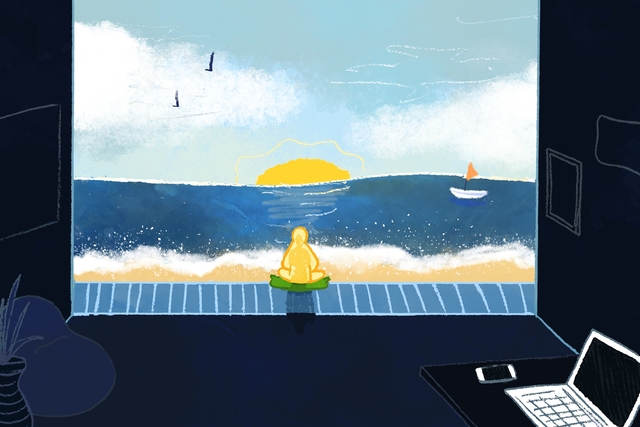
    For most of that time, my wife and I lived on a small island thirty miles out to sea with only a bit of generator electricity. We avoided the extremely spotty Wifi like the plague. Instead, we woke with the sunrise, and sat on the deck outside our grass hut, watching manta rays swim in the shallow water below us and pelicans perch nearby. The biggest thing that happened every morning was the osprey that left its nest and circled above us.

    It was life in slow-mo all the way. And it was transformative.

    For ten entire days I didn’t think about politics or how America is devolving into an angry, wild place where public figures regularly get death threats, and social media has become the equivalent of High Noon with guns drawn.

    The toxic interplay of who is right or wrong, or the future of our democracy ceased to exist as we sailed toward that island on our big, well-worn catamaran. In fact, by the time we reached our refuge, those tapes had disappeared altogether.

    Instead, we swam and we rested. We snorkeled. We read. We had some adventures involving caves and kayaks, and we hung out with the other guests. The two Belizian women who cooked for us observed us Americans with our expensive toys, and they took it all with a grain of salt. In their presence, I could suddenly see how silly and overwrought all this intensity has become.

    Ironically, when given the opportunity to present a gift to a school in one of Belize’s small seaside towns, I brought along a laptop and an iPad I no longer used. An elementary school teacher received the gifts with gratitude. Yet, as I gave them to her, I noticed I felt wary.

    I could swear she seemed wary as well.

    What new layer of complexity was I bringing onto these shores? And was it even necessary for life to go on happily and productively?

    When we returned to the so-called civilized world, here’s what I immediately noticed:

    1. I was now leery of all my previously trusted news sources.

    Suddenly I could clearly see the anguished bias all around me, going in all sorts of directions left and right. The newsfeeds I’d previously consumed with abandon now seemed more biased than I’d realized. I was left with one option—either drop out and start reading the classics for entertainment, or proceed with caution.

    2. I had more time to sit alone with nothing in particular to do.

    Before my media fast, that was a bad idea. Hey, I had social media to check and emails to catch up on. The day’s events were going by in a high-speed blur, and I had to keep up. But now life had slowed to the pace of my emotions. I could breathe again. And so, for a while at least, I enjoyed spacing out.

    3. My anxiety disappeared. For a while.

    So did my knockdown ambition, and my desire to overwork. Everything had just … chilled. Enormously. For a while I slept easily. I no longer drove myself to do the impossible, and my to-do list now seemed balanced and reasonable. In turn, I no longer woke up with my heart pounding, nor did I have qualms overcome me during the day. Instead, I got ideas. Inspiration landed on me, and I was energized enough to pursue it.

    4. Life became lighter and more fun.

    Now I found my day-to-day routine to be far more delightful. It simply was, and for no particular reason. I laughed more. I found myself singing while I did chores around the house. Since I wasn’t consuming the same fire hose of media, I now had time to have more fun.

    5. I complained less.

    Now that I was unplugged, I found that I didn’t have to share my opinion on every last political matter happening around me. Nor did I need to engage in fights on social media. In turn, I didn’t lie awake as much, gnashing my teeth.

    6. I thought about things I’d long forgotten.

    Like my childhood. I tapped into long buried feelings sitting in that glorious deck chair of mine, like how it felt to be a vulnerable kid at school, and what joy I found in standing in the water, letting the waves rush my legs. I rediscovered the great internal monologue I have going all the time. It had long been forgotten.

    7. I had more time just to hang with people.

    This was, perhaps, the greatest gift of all. To quietly sit at a table, chatting over empty coffee cups with relative strangers, or perhaps my wife. There we all were, on our island for days on end. So we might as well talk, right? I found people to be fascinating once again.

    In fact, I was discovering JOMO—the Joy of Missing Out. Turns out this is a thing. Those exact words were projected on the screen behind Sundar Pichai, CEO of Google, at a recent developer’s conference. Apparently even the tech people want to turn off their screens.

    So one must ask the question: did all of this good stuff last?

    In a word, no.

    It’s been several months since this experiment ended, and I am, of course, back online. The pull is simply too great to ignore and avoid. Since I actually make my living online, disappearing off the grid is not even an option. And yet, I’ve learned a lot.

    I no longer subscribe to certain reactionary newsfeeds. While I may be more out of touch, this is alarming material, guaranteed to not make me feel better. So no, I no longer read these emails. And I cherry pick what I read in my newsfeeds with care.

    I no longer reach for my phone as soon as I open my eyes every morning. I also try not to check my email on my phone at all, something I often did while waiting in the Bay Area’s many lines. In fact, I’ve learned to leave my phone at home when I go out.

    Instead, I chat with other people while waiting in the line, or I just look around. Or I zone out and enjoy what brain scientists call the “default mode,” the fertile, random, and enjoyable hopscotch the brain does while at rest. I realized now that I’d been missing that hopscotch. Instead, I enjoy the fertile luxury of a good daydream.

    My late daughter Teal would have understood my need to drop out perfectly. Even at age twenty-two, she refused to have a smart phone. She embraced the world, eyes forward and heart engaged, making friends wherever she went. And she did so until her sudden death from a medically unexplainable cardiac arrest in 2012.

    “Life is now,” she liked to say. Usually she reminded me of this as she headed out the door with her travel guitar and her backpack, on a spontaneous decision to busk her way across the other side of the world.

    At the time, I couldn’t begin to fathom what she was talking about. “Too simplistic” I thought, dismissively, as I wrote it off to my daughter’s relentless free spirit. But as it turns out, Teal was right. So now I am left with this very big lesson.

    Not only is life now, life is rich, random and filled with delight. The trick is to unplug long enough to actually experience it.

    Illustration by Kaitlin Roth
  • It’s Not Either/Or: The Power of Opening Your Mind and Seeing Both Sides

    It’s Not Either/Or: The Power of Opening Your Mind and Seeing Both Sides

    “Compassionate listening is to help the other side suffer less.” ~Thich Nhat Hanh

    In late 2017 my husband and I were both getting ready for work one morning when I casually said, “Hey, I think I’m going to start teaching yoga in the jail.”

    Without missing a beat my husband said, “Well, that’s a terrible idea. Why would you do that?”

    He gave this comment as a statement, flat and decisive. I had suspected I would get this type of response, so I tried to play it cool, like it didn’t bother me. But it still stung a bit, since I had hoped for his support.

    As a long-time yoga teacher, I was excited about the opportunity to serve those who could potentially receive the practice’s mind-body benefits and who also might not have access to or have experienced yoga before.

    I knew I wasn’t going to fix them with a single yoga class, but I hoped by connecting with someone who saw them as whole and unbroken, they’d know they don’t have to be defined by their current situation.  

    My husband, on the other hand, saw it through the eyes of a police detective who specializes in crimes against children. He has seen the worst in human behavior on levels you and I can’t even begin to imagine. Additionally, he had worked in the very jail I was going to. He knew much better than I, with my dialed-up altruism, what could go wrong.

    He is an outstanding human being, as is almost every single police officer I’ve met. His misgivings were based in a reality I had never experienced but one he had the first-hand experience of.

    I understood his concerns, but my pride and ego were still hurt because he didn’t support the work I wanted to do.

    I went ahead and pursued teaching with the support of the Prison Yoga Project and ended up teaching the female inmates at the county jail.

    In the early weeks, my husband and I continued our unofficial cold war and didn’t talk much about what I did. But that didn’t affect my enthusiasm.

    I love my work at the jail. My students are as diverse as an exclusive studio’s clientele. I’ve had pregnant women, a mother-daughter duo, young, old, and a few who’ve gotten out only to come back a few weeks later.

    I never ask what they’re in for, but their tattoos tell more about their lives than I could read in their record—the deep grief for all they’ve lost engraved in black and smeared faded colors on their skin.

    The most common tattoos are in memory of people who’ve died. I wonder if there is something temporarily soothing to literally feel the pain of grief being etched into their skin and buried under the surface. I only have to look at the tattoo on my own wrist in memory of my son to know the answer.

    In the months that followed that initial conversation, my husband and both began to soften our stance. I found him to be a good resource for some questions I had about legal procedures or other things that came up, and he was curious about the women and their yoga experience.

    Then one day a few months back he came home and shared that a long, emotionally difficult case he’d been working on had wrapped up. The woman was sentenced to one year in the jail where I was working.

    He admitted he felt a moment anger that she would be able to take yoga classes after what she’d done. But then, he took a breath, sighed, and said that he would rather see her have the chance to come out better than to hurt any other children. We both softened.

    Within a week I too had a moment of questioning my decision to work with inmates. In an altercation with a man who was strung out on drugs and unhinged with violence, one of my husband’s co-workers was injured so badly he needed to be hospitalized. The perpetrator was arrested and taken to the jail where I teach.

    It was my turn to be angry and imagine that this man (or someone like him) could’ve hurt or killed my husband. Did I really want to support someone who could threaten one of the most valuable things in my life?

    I felt so deeply conflicted. Then I wondered if my husband felt betrayed by me because I was teaching at the jail. Did he feel I was either with him or against him? And did I expect him to be with me in my altruism or else he was against me?

    Either/Or and Both/And Mindsets

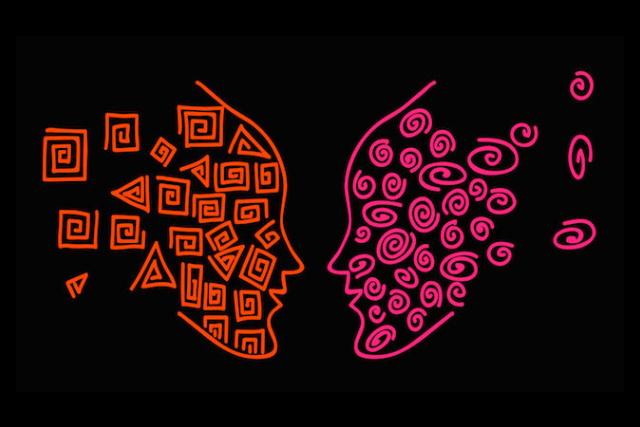
    Life is too often defined as either this or that. And, it seems, when we choose our side we must also choose all the things that are aligned with that side. For example, if I’m a woo-woo yoga teacher then I must be against the police. Our culture increasingly demands that we stake our claim, unwaveringly.

    When we fall into the trap of an either/or mindset we shut ourselves off from opportunities, connections, and relationships that could alleviate suffering for people on both sides of the issue.

    Either/or thinking is divisive at best. It places us firmly in our own silos, cloistering us in an imaginary us versus them utopia, whereas “both/and” thinking creates community and connection. It allows us to begin to build webs of supports that extend beyond our own ability to impact change.

    Perhaps you’ve found yourself in the either/or conflict when you discover that your favorite co-worker supports the opposite political party. You feel your stomach tighten and then extrapolate what else they must believe that you find offensive. These mental games likely result in feeling that you’re at war with this person, resulting in your work relationship suffering.

    A great place to start to transition to both/and thinking is to use the Zen Buddhist tenant of “not knowing.” When we open to the fact we don’t know everything about the situation it softens us.

    In the example of your coworker, perhaps they’ve been influenced by different life experiences that have shaped their beliefs and opinions about what’s best for our country and the people in it. And perhaps you even share similar values but hold different perspectives about the best approach to honoring them.

    When you consider that people who seem against you may also have good intentions, it’s easier to find common ground and work together instead of against each other.

    When my husband and I began to see our situation as both/and not either/or it was much easier to see how each of us could positively impact the individual systems we work in and, even in a small way, create healing for those involved.

    Recently in my Buddhist Chaplain studies, we looked at systems using Donella Meadows’ model. In her book, Thinking in Systems, she says, “You think that because you understand ‘one’ that you must, therefore, understand ‘two’ because one and one make two. But you forget that you must also understand ‘and.’”

    Seeing that my husband’s work is necessary and my work is necessary, even within the same situation, is a powerful force that creates change.

    It would be easy to put me in my woo-woo yogi silo and my husband in the cop silo. Instead, we agreed to focus on both our work and how the overlap can be an opportunity to dissolve the hard lines of either/or thinking and look for the places where “and” exists. Then we lean deeply into those places, because these are the tender places of real change.

    We need to learn to make our silos more permeable.

    One of the other things I’ve learned in my Buddhist Chaplain program is that when we consider the best way to positively impact how a system is functioning, we can start by focusing close in, then zooming out.

    If I am standing in the middle of a river I can feel the power of the flowing water, but when I stand on a mountaintop and look down at the same river it can look calm and peaceful. Both of those perceptions of the river are correct, but I’ve changed my vantage point.

    When we feel ourselves being asked to take an either/or position we can take a moment to zoom out and in to find balance in our perspective taking. We need to do both, get wet and get distance!

    Another negative outcome of the either/or mindset is that it forces us to find blame. When I assume the either/or mindset in a situation, then by default the person who is opposing me must be incorrect and therefore is also to blame when things go wrong. When we are looking for someone to blame it takes us out of accountability for our own actions and it removes us from being empathetic to another person.

    Without empathy, it is very hard to come from a place of compassion. And without compassion, we de-humanize the other person. The result of dehumanization is believing that the other person is less than us and therefore deserving of whatever bad things come their way.

    In the case of my husband and the woman he sent to jail, rather than dehumanize her with an either/or mindset, he saw her as both human and deserving of something good, while she took responsibility for her action.

    Each time we choose a both/and mindset over an either/or mindset we release ourselves from having to find someone to blame and we stay connected to our human experience without dehumanizing another person.

    A both/and mindset doesn’t mean we have to let go of being change-makers in the world. The world needs change-makers now more than ever. But there will never be peace and compassion in the world if we can’t do both—get in the river to feel the power and climb the mountain to see the calm. As one of my teachers at the Upaya Institute said, “A nudge of calm can shift a storm.” Be the nudge, not the storm.

  • What If We Listened and Opened Our Minds Instead of Shouting and Judging?

    What If We Listened and Opened Our Minds Instead of Shouting and Judging?

    “If you can laugh with somebody and relate to somebody, it becomes harder to dehumanize them. I think that most of what we are constantly bombarded with in terms of media leads you to a creation of ‘the Other’ and a dehumanization of ‘the Other,’ and it’s very much an us-versus-them conversation.” ~Jehane Noujaim

    People are really hard to hate up close.

    In today’s acrimonious political climate, whole groups of people seem to be pitted against one another based on various political, ideological, class, geographic and racial classifications. And yet, spend a day with “the other” and it’s difficult to resist the gravitational forces of our shared humanity that make those walls come a’ tumbling down.

    New York State, like many others, has a wonderful tradition of civilian run elections. Each polling precinct is manned by four election inspectors—two Democrats and two Republicans.

    From 5:30am to 9:00pm—other than the two thirty-minute breaks to which each inspector is entitled—these four individuals spend every moment together sharing responsibility over the most minute of tasks, from opening packets of ballots to recording the serial number of the dozen or so seals on various documents and pieces of equipment.

    Once the polls are closed, vote tallies recorded and everything securely stowed, usually round 9:30pm, everyone goes home. It’s a long day.

    For these sixteen hours of work, all inspectors are earn $225, or around $14 per hour—not bad, but well below the earning potential of most of the inspectors. Many of the inspectors are “old-timers” who have been doing this three or four times a year (in addition to the big November elections, there are primary elections and other local referendums) for many years.

    Last year, sort of in between jobs and living in the United States for the first time in many years, I decided to become an election inspector.

    Far removed from America’s increasingly bitter political divide, I was a little bit apprehensive about what to expect or how this was all going to work so harmoniously. After all, the America I left after graduating from college was one in which people from all segments of our political spectrum—which compared to other countries’ is surprisingly narrow—could have a discussion without being branded white supremacists, snowflakes, fascists, or traitors.

    Once upon a time in the quaint old days less than twenty years ago, political talk was sometimes pleasant and not always so insufferable and divisive.

    Like all others, my polling station had three other inspectors. One of the other inspectors turned out to be the father of a girl I’d grown up with from our Hebrew school days but had not seen in nearly twenty years, once a close family friend.

    Another was a retired school administrator, an Irish guy who had grown up in the Bronx and slowly migrated ten miles or so north to Westchester County over the course of his life.

    Finally, there was an African American lady who had been born, raised, and was still living in Mount Vernon, a nearby city perhaps most notable as the sometime home of Malcolm X.

    As the hours passed and different members of the team shared the various responsibilities and each took his or her break time, everyone found themselves getting to know the others one by one.

    With the one guy whose daughter I used to know, reconnecting was fun, and nothing seemed to have changed other than that we were all older.

    The Irish guy shared my love and knowledge of the local waterways (I’m a sailor and he’s a diver). He was a Republican who didn’t vote for and viscerally disliked President Trump; he was more of a John McCain or Nelson Rockefeller kind of guy who felt Trump was an abomination to his lifelong political affiliation.

    The African-American lady was a Democrat who, judging by her apparent age, may very well have remembered or even met Malcolm X during the tumultuous Civil Rights Era, didn’t like Trump either but also didn’t understand the current white supremacy scare. She remembered a lot worse racial tension and fear in her lifetime and thought that all the recent talk was based in reality but overblown.

    During the slow portions of those sixteen hours, even when politics came up, nobody raised their voices nor found anything to get angry about. Politics was sprinkled around more immediately pressing topics like family, local community developments, and lunch.

    And, where there were disagreements, after talking it all out with the copious amount of time that we had on our hands, it became clear that there was a strong foundation of shared values—respect for individual freedoms, belief in racial equality, etc.—on top of which the (relatively minor) disagreements were built. There was much more in common than there was different.

    You would never know it from reading the headlines, but this observation is actually reflective of society at large, as political science studies and public opinion polls over the years have consistently shown a clustering of public sentiment on most major issues toward the center.

    And yet, the loudest and most extreme voices seem to be the one that dominate the debate. Controversies erupt over smaller and smaller issues, such as symbols of past oppression as actual oppression becomes less prevalent.

    It’s not that today’s issues are trivial—you would certainly be concerned if you were a gender non-conforming person being forced into using a bathroom based on your biological sex or an African American who had to pass by a statue of Jefferson Davis every day on your way to work—but that the final 10% of every issue, namely the public policy prescription for how to “solve” it, is nowadays typically built on top of an agreement over 90% of the multiple facets and relevant fundamental questions involved.

    Only the most extreme fringe elements of society support institutionalized discrimination, secession from the nation, limitation of basic rights, etc. In most instances, the disagreement is over the “how to get there” as opposed to the “where we are going” or “who we are.”

    More importantly, whatever people’s political beliefs, it is exceedingly rare to find people today who are consciously bigoted. He might think men are men and women are women like in the good old days, but faced with an actual person—maybe his son or nephew—undergoing a struggle with gender, those fixed opinions usually soften.

    She might not get her sister-in-law’s “churchiness” but nevertheless appreciate the values it seems to instill.

    These prejudices are borne from ignorance and isolation, not hate.

    Moreover, even among people affiliated with bigoted or extreme views or organizations, it is my firm belief that what is at work is more an unfortunate facet of group psychology: it is easy to hate a distant group, a faceless enemy, or a caricature of a supposed threat.

    It is even easier when riled up by a group of like-minded people, an all-too-common phenomenon as America self-segregates by class, culture, and geography.

    And, to pour gasoline on top of this whole incendiary situation, it is still easier when these types of conflicts sell papers and generate clicks, especially within marginalized communities suffering economic or cultural dislocation.

    Not surprisingly, the most extreme and bigoted views are typically found in relatively homogenous and often economically distressed communities far away from many of the problems or “bad guys” they fear. When people get together, hate becomes difficult to maintain, and it is difficult not to relate with one another on some level.

    I wonder how fixed all of these angry opinions would be if we all at least once spent sixteen hours at a polling station or had to live and work in ideologically integrated communities or even share a meal with “the other.”

    I wonder how long it would take the narrative of this hopelessly divided nation to unravel before the truth that we all share so much more than what divides us.

    Perhaps there is a small duty we should take on each and every day from now on.

    If you’re reading this, you probably already accept the most basic spiritual truism that we are all part of something greater, and the goal of nirvana or heaven or whatever you choose to call it is the oneness without separation from all life.

    Why not endeavor to keep that in mind the next time you are in a heated political argument or shouting at the television? After all, the concept of oneness isn’t meant to be merely a comforting idea but a way to live, a view of a better earth.

    Even better, why not go out of your way to break down the daunting barriers that divide us? Reach out and engage or listen to someone outside of the type of person who would normally be inclined to agree with your point of view.

    And, your engagement need not be about politics. Maybe it would be even better to focus on something that’s shared. You’ll probably find the “daunting barrier” is more like a “thin veneer.”

    There is also gratitude, an indispensable daily practice in a spiritually oriented life. Once again, the issues involved in politics today are not trivial—injustice is alive and well in this world, and so much needs fixing. However, can we not each day take a moment and realize how far we have come?

    For example, white supremacists were able to muster a few hundred people to march on Charlottesville, VA in the largest such rally in decades. Have we forgotten that less than a century ago the majority of America—not a fringe group—shared most of their uglier points of view?

    Likewise, while poverty in America remains a stubborn problem, can we not be thankful that we are indisputably living in an age of unprecedented prosperity among humankind?

    The point of this gratitude is not to engender complacency. There is simply too much at stake. However, if we can find space for gratitude, perhaps even the most strident voice of the most passionate advocate of whatever policy could be softened. The angry activist could become the happy warrior.

    And that’s one of the major ironies of today’s politics, that with such an air of negativity, even the most just cause will repel fair-minded people. Gratitude can help us to stop shouting and start listening and speaking with one another with respect and love.

    This is how spirituality and consciousness, which are as a genre of writing or literary interest so often completely divorced from current affairs, can help heal our poisonous political atmosphere.

    After all, spirituality isn’t about escaping the world and self-soothing by occupying a peaceful place in the clouds; it’s about gaining the strength to thrive in a challenging world and even doing the hard work to make it better.

    As I found, after sitting in an overtly political setting for sixteen hours with three other apparently very different people who disagreed on a lot of topics, the work isn’t always so hard. It can even be fun.