Tag: persevere

  • How To Make Yourself Stronger When Facing Health Challenges

    How To Make Yourself Stronger When Facing Health Challenges

    “The beautiful thing about setbacks is they introduce us to our strengths.” ~Robin S. Sharma

    This has been the worst year of my life. Financial stress. Relationship problems. Being separated from my family because of the pandemic. Mentally I’m a mess. I thought I had hit rock bottom. But the worst was yet to come.

    I had been ignoring health issues for years and finally dragged myself in for an ultrasound. I already knew I had a fibroid and had booked the ultrasound to check on it. However, as the sonographer explained, I now had innumerable fibroids. They had taken over my uterus and ultimately my life.

    I remember starting to feel numb as she talked me through my scan. I knew there was no other option. I needed a hysterectomy, and I was terrified. I was scared about what this meant for my body and my future, but I also have extremely high anxiety about doctors and hospitals. You can imagine how I felt about surgery.

    One of my favorite motivational speakers, Eric Thomas, talks about how pressure creates diamonds. Just when you think you’ve had enough pressure and all you can bear, life turns up the heat. I felt like I was burning.

    I knew surgery was inevitable and I needed to get my mindset right. As much as positivity eluded me the past year, I had to be mentally and physically strong going into the surgery because I wanted to come out a diamond.

    The Japanese call this kensho, which means growth through pain or finding positivity in life’s challenges. If you want to become a diamond or a stronger version of yourself from whatever you are facing, here are some strategies that will help.

    1. Allow yourself to feel everything. It’s normal.

    When coping with health challenges, you’ll probably filter your feelings with shoulds:

    I shouldn’t feel anxious (angry, sad).

    I shouldn’t act so irrationally.

    I should think more positively.

    I should feel grateful it’s not worse.

    I should hold myself together for those around me.

    Truth is, though, you are going to feel all the emotions. You’re also going to feel your body’s symptoms. It’s easy to get stuck in the pain because, until it stops, it’s hard to see the good in life.

    Give yourself permission to feel everything. If life is continually knocking you down, of course you’ll feel angry. In fact, some anger is probably going to help. It’s the fuel you need to rise up and change things.

    When I started to cry in theatre before surgery, I felt guilty and embarrassed. The nurses kept telling me it’s perfectly normal. And, you know what? It is perfectly normal to feel scared before surgery. It would be weird if you weren’t.

    Allow yourself to feel every miserable thing without the guilt. It’s part of grieving and healing. You may need some time to grieve the loss of something physical or a way of life you imagined that now has to change. You may need to set aside some quiet time to check in with yourself and feel whatever you feel. Grieve what you need to let go.

    But the way you make sure it doesn’t consume you is by allowing yourself to feel the good too. And it’s the good that you want to blow up and make bigger in your mind.

    I bet there are so many little things you can appreciate about your life. You can take a moment to savor a healthy meal or feel the sun on your skin. I find a lot of happiness in my cat’s funny antics and cuddles, so I always make sure I am fully present around him.

    Small goods won’t fix your big problems. Believe me, I know how hard it is to find the positives when anxiety takes over. No amount of mindfulness is ever going to fix the misery of a health problem that confines you to bed or the house. Nor will it take away the physical pain that you have to endure daily.

    But the good can soften the bad and give you strength to keep going.

    2. Build your mental fortitude.

    You have a choice as to how you are going to face this health problem. You can let it take you down or you can use it as an opportunity to become a stronger version of yourself.

    Surgery was inevitable. Anxiety was inevitable. Pain was inevitable. Despite all this, I made a promise to myself that I would face it with strength and hope for a better future.

    Unfortunately, after a really difficult year, I knew I wasn’t in the right headspace for it. I had to start “training my brain” in the same way you might train your body for a big mountain climb or fitness event.

    You can train your brain in a variety of ways. You can get support from positive people in your life. You can get counseling. But you also need something you can do daily on your own.

    One of the best ways to train your brain is through selective use of social media and Google.

    If you Google your health problem, you’ll find positive stories, but you’ll also find a lot of negative and scary information. In my case surgery was inevitable and I knew the risks. Why needlessly worry about outcomes I couldn’t control?

    Instead, I ignored my inclination to over research everything, and in preparation for surgery I decided to read or watch one positive hysterectomy story each day. That’s all I allowed myself to look at. This was one of the best things I did for my mental health.

    I also trained my mind by going for a walk everyday and listening to a motivating video or podcast. This was a way to calm and connect with myself and to keep building my mental strength for surgery and recovery. I really felt the benefits of this practice the day of surgery.

    You have to find videos and speakers that speak to your soul, and everyone will be different. I prefer a tough love approach, and as I mentioned before, one of my favorite speakers is Eric Thomas.

    On the day of surgery, whenever I would feel a wave of anxiety, I would say to myself “pressure creates diamonds.” This idea gave me strength and reminded me that this surgery was a gift I was giving myself so I could have a better future.

    3. Put one foot in front of the other.

    There will be days it seems impossible to get out of bed. You will start to feel better and then you’ll feel worse. You will get overwhelmed and discouraged. No one is perfect, but you can be better day by day even with setbacks.

    In the gym you build strength through progressive overload. This means doing a bit more each time you train. When I coach my clients, I teach them that little steps lead to big results. It’s all about consistency and patience.

    When I was recovering from surgery, I had to apply the same principles. First, I had to learn to sit up. Then I was able to walk around my hospital room. A few days later I was walking around my yard and eventually I started walking down the road. Each day I literally walked a few more steps. I set my sights on being able to walk to a bridge down the road and two weeks post surgery I got there.

    Before surgery I was hitting personal bests in the gym with big deadlifts, squats, and presses. I know it will be a long time before I have that strength again, but I will get there. Step by step I will build myself up to be even stronger than before.

    Along the way I will be patient and kind with myself and give my body what it needs. Some days I have to give in and just sit in the sun with my cat because that’s all I can manage.

    I know how hard it can be to deal with health challenges. Sometimes you have to let yourself cry and feel angry—or whatever else you feel. In the face of setbacks always remember this is your opportunity to get stronger and healthier than ever before. Pressure creates diamonds, and you are on your way to becoming the most beautiful gem.

  • How I Find the Courage to Keep Jumping (Even Though the Net Never Catches Me)

    How I Find the Courage to Keep Jumping (Even Though the Net Never Catches Me)

    “The future never comes. Life is always now.” ~Eckhart Tolle

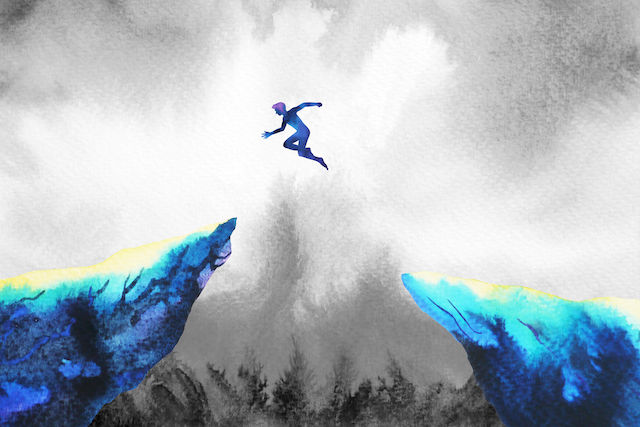
    “Jump, and the net will catch you.” “Leap, and the net will appear.”

    This piece of writing is to make a case for the following argument: there is NO net.

    Before I put forward my reasoning, please bear with me for a moment while my ego rattles off the times I have jumped (but the net never appeared).

    1. I quit my well-paid marketing role and traveled across the world to pursue a humanitarian dream job. I failed at the job interview and was jobless and in despair in a foreign land.
    2. I invested some of my savings into launching an online e-commerce site selling organic products but was diagnosed with blood cancer shortly after launch and had to give it up.
    3. I threw myself into the wellness industry in an attempt to heal my cancer. Nothing worked, and I ended up on the medication I was desperately trying to avoid.
    4. I poured my heart and soul into a memoir but have, so far, only received nice rejections from the publishing industry.

    Okay, I’m glad that is off my chest.

    Point number 4, my current life situation, has got me thinking about “the net.”

    The writing of my memoir felt different to points 1, 2 and 3. The writing process was one in which there was no outcome attached to it. I simply sat down to write the longings and yearnings and realizations that came from within. Four years of writing from that place flowed, quite naturally, into a book. There was no thought of a net. I just had to write.

    The net came later.

    The net came when I had finished my memoir, and people told me to publish it.

    The net came when I started researching the publishing industry and the how-tos and what-not-to-dos.

    My research began to form a perception. That perception started to develop a belief. A belief that said: to be signed by a literary agent and traditional publisher means you “have made it.” You are literary success. That belief grew stronger with every industry blog I read and podcast I listened to. The ropes of belief grew thicker and intertwined and formed what I perceived to be a net. A net in the form of a book deal from one of the top five publishers.

    My mind whirled and looped with the following thought: If I’m brave enough to share my story, if I jump, the net will catch me, I will get a book deal.

    I believed that thought. And I was brave. I put myself out there. I jumped.

    But, as I write, I have yet to be caught by any net.

    My ego looks back up at points 1 to 4 and screams, “FAILURE! The net never catches me. Stay small!”

    It is easy to get stuck in that stream of thought. That place is familiar. The is an almost comfort there. The ego blankets me with perceived safety—safety in the form of remaining small and quiet.

    But then I remember there is another aspect of myself. A place beyond the ego and beyond even thought. It is my core. My essence. The truest, most authentic part of me. When I carve out time for silence, I remember that place. I bring awareness into the present (without hanging on the past or projecting into the future) and get still. When I do that, the thought of a net dissipates.

    From this place, I see that the net was only a future concept. It was no more than a thought about something great that would happen in some distant time. The net was always only a thought about what success should look like: saving the world, a thriving business, healing from an incurable disease, and now a bestselling book.

    But freedom was found beyond the thoughts about how life should be. And every day, I come home to that place, home to myself. I get pulled into ego. I come back. I get pulled into thought. I remember.

    When my true nature aligns with the present moment, there is clarity in knowing what to do.

    Some moments my children want to play. And sometimes, I feel called to send a pitch off to a literary agent. There is a sense of surrendering to whatever is in front of me. When I’m flowing with life, there is no net. Or more, the net is no longer a result but rather a deep trust that everything will happen as it should.

    I have no idea how my book will be published. All I know is that if I keep coming back to the present moment, those seemingly minuscule steps pave the way for my soul to live out its true purpose: to bring awareness into the present and live life from that place.

    There is no net. There are only small awakened steps. Some steps are ordinary. Some ask us to be excruciatingly vulnerable. It is the latter that can feel like a leap of faith into the ether. But I no longer see those moments as a leap.

    Looking back, it was only ever one step, a simple stride on the path home to myself. Inch by vulnerable inch, moment by conscious moment, that is how I have come to feel whole. It is all perfect, even with a rejection letter to boot.

  • It’s Okay to Feel Scared: How to Stand Up to Fear by Standing Down

    It’s Okay to Feel Scared: How to Stand Up to Fear by Standing Down

    “It’s okay to be scared. Being scared means you’re about to do something really, really brave.” ~Mandy Hale

    When it comes to plane travel, I frequently quip: “I’m not a nervous flier, but my bladder is.”

    In a way, this is true. Aside from brief freak-out moments when there’s a patch of turbulence or when a flash from my catalog of gruesome “what-if” scenarios forces its way into my mind’s eye, I remain blissfully disconnected from my fear. Meanwhile, my bladder takes the brunt of it, with hourly pit-stops to the lavatory alongside a persistent, dull ache.

    While this is physically annoying, my strategy has its utility: it conveniently shifts the blame and shame for my irrational fear onto my bladder so that I don’t have to face up to it. (Otherwise known as somatizing my emotions, if you or my therapist want to get technical.)

    So, as you might imagine, when I recently boarded my first plane flight in two years amidst a still-very-present Covid pandemic, my bladder felt even twitchier than usual. Especially at the abrupt jolt of going from socializing at a distance to being packed like sardines into a confined space with a bunch of breathing, coughing, possibly infectious humans.

    At least, that is, until a little boy said something heart-stopping.

    A Cry for Help

    No more than six years old, the slender boy with a mop of golden-blonde hair had just clambered into the window seat of the empty row in front of me, trailing his white satin-trimmed fleece pillow and blanket.

    While the boy fiddled with his seat belt, I noticed that his mother and grandmother—each equally youngish-looking with lemony hair and tanned skin—were still lingering in the aisle, conversing in hushed tones. As I casually eavesdropped, I learned that they were debating which of them would sit with the boy versus with the rest of the family located several rows up.

    At first, I cursed my luck to be seated right behind a kid too young to be vaccinated or keep his mask up. Thanks a lot, universe, I grumbled internally.

    But as his mother began walking away to sit with her younger child (presumably expecting that her older son was in good hands with his grandmother), the boy wriggled upward in his seat, shoulders tensed, assessing the situation. Then, he called out quite loudly, without a hint of self-consciousness or shame: “Mom, I want you to sit here with me, because I’m scared and I need you.”

    Instantly, the radius of chatter around Row ten fell mute.

    Like a silent lightening strike, the boy’s words charged the atmosphere with an almost electric energy. For two long seconds, they hung there in the air above us, almost too sacred to desecrate with sound. During that time, I swear, you could practically feel our collective hearts opening. Then, a sincere chorus of “Awww”s and “Bless his heart”s rang out, cushioning the silence.

    A Permission Slip

    As I marveled at what had just transpired, I realized that, in one simple sentence, this young boy had done something remarkable: he’d given us permission to be human.

    After all, how many times had many of us felt just as fearful in life yet pretended we didn’t? How many times had we wanted to cry in the midst of overwhelm (if not wail like hell for our mommies), yet told ourselves to “buck up” or “be an adult”? And how many times had we rushed to the side of a friend in need yet readily denied ourselves this small grace?

    Perhaps the reason the little boy’s words stirred us so deeply, it struck me, was that he reminded us of what we already knew yet stubbornly denied: Of the power in vulnerability. Of the courage in asking for support. Of the importance of honoring our feelings, especially our fear—meeting it with acceptance, rather than my preferred method of hastily swatting it away like a poisonous wasp.

    Meeting Fear with Acceptance

    Fortunately, the boy’s mother was much more adept at dealing with fear than me.

    Making a beeline back to her son’s side, she enveloped him in a warm embrace, murmuring, “I’m so sorry, honey. It’s okay, I’m here for you,” (a relational repair that was powerful in itself).

    Spying through the narrow slat between our seats, I watched as the boy’s shoulders immediately unknotted. Seconds later, he began chattering to his mother about the character on his video game player—his fear a seemingly distant memory.

    It was then that I realized something even more remarkable: to the boy, the preceding moment was likely just an ordinary moment.

    Too young to be fully conditioned by our cultural garbage around fear or gender “norms,” he had no idea that he’d done anything profound, much less impacted a plane full of people much older and “wiser” than him. He was simply acknowledging his fear and taking care of himself.

    Okay, Lisa, I told myself. If that little boy can unabashedly proclaim for all to hear that he’s scared, then the least I can do is acknowledge my own fear to myself.

    Especially considering that, the very day before, a beloved teacher of mine had providentially reminded me about the power of acknowledgement. How, oftentimes, just acknowledging our feelings can considerably ease our unease. And sometimes, she claimed, it’s the only thing we need to do.

    Huh, I realized with a wink to the universe. You’re giving me an opportunity to practice this right now, aren’t you?

    And so, I did. Closing my eyes as the plane taxied down the runway, I felt into my fear and whispered: Okay, fear. I see you. I hear you. And it’s okay that you’re here. In fact, it would probably be abnormal not to feel you on my first post-pandemic plane ride after two years of semi-hermitude.

    From there, I stayed quiet and present in my body. I didn’t try to do anything with the fear, other than “stand down” so that its stifled energy could move through me.

    A minute or so later, wouldn’t you know it, the tight ball of yarn that was my bladder muscle magically slackened. Even my abdomen, I noted, no longer bloated out like I was carrying a small fetus. My entire body felt lighter too, as if I’d released a leaden weight I didn’t know I was carrying. Holy moly! I boggled, gazing down at my body in both awe and glee.

    “Alrighty, folks,” the captain’s disembodied voice announced over the PA system just then. “We’re about to head out, so sit back, relax, and enjoy the flight.”

    Grinning to myself, I silently replied in my head: You know what? I think I will.

    *A Magical Postscript*

    Incredibly, the story doesn’t end there.

    Toward the end of the flight, I tentatively caught the attention of the boy’s grandmother, whose name I’d soon learn was Beverly.

    “Um, pardon me,” I started, “but I’m a writer, and I was so inspired by what your grandson said before the flight that I actually just wrote an article about it!”

    “Oh, really?” Beverly replied in surprise, my unanticipated admission taking a few seconds to sink in. Then, her surprise gave way to delight, as her eyes crinkled into a smile above her mask and she added, “Wow, that’s so wonderful!”

    “I’m happy to email it to you if you like,” I continued, “but I really just wanted to thank your family. For providing such a powerful moment for me—as I’m sure it was for many others.”

    “Well, let me tell you something,” Beverly responded, leaning toward me with an unanticipated admission of her own. “That moment was a bigger deal than you know. You see, my grandson has autism, and for him it was a very big deal to express his feelings like that.”

    Straightaway, goosebumps traveled up and down my arms. Of course, the writer in me couldn’t help but be tickled by the added significance to the story. But the real eye-opener for me was the extent of my own ignorance. That I assumed the moment was important to everyone but the boy. That I assumed there was only one “giver” and one “receiver” in the equation. As if the universe ever worked that way.

    When the plane touched down soon after, tears sprang to my eyes as the full-circle nature of the experience hit me.

    Thank you, universe, I humbly mouthed—this time meaning it.