Tag: perfect

  • 5 Practices That Helped Me Stop Being a People-Pleaser

    5 Practices That Helped Me Stop Being a People-Pleaser

    “If you spend your life pleasing others, you spend your life.” ~Cheryl Richardson

    Looking back on my life, I came to realize that I spent quite a high amount of my precious time trying. Trying to be perfect. Trying to be appreciated and liked by everyone else around me. Trying to fit in with different groups of people so that I could feel accepted and approved of.

    I can recall many situations in my life when I did things I didn’t really want to do to comfort or please others. I was a master of people-pleasing and, to be honest, it wasn’t always because I wanted to make everyone happy.

    The truth is that I wanted people to like me. I expected them to give me the things I wasn’t giving myself: love, care, and attention.

    People-pleasing is an unhealthy behavior, a clear sign of low self-esteem. It is disempowering, inauthentic, and extremely time- and energy-consuming.

    Here are five simple practices that helped me stop being a people-pleaser.

    1. Allow myself to be me.

    I can recall I once told a guy I was dating that I wanted to join him for a football match when, in fact, I didn’t. I knew he loved football, so I thought he would see me as a right partner and like me more. Big mistake.

    If you’re also doing things you don’t want to do, hoping those things will strengthen your relationships, be careful with that. Be honest about what you like or dislike. Be real. Pretending and faking who you are and what you want will only work against you.

    Being myself got me married. The day I had the first dinner with my husband (as friends at that time), I had no expectations of getting involved in a romantic relationship. I didn’t care if he liked me, I didn’t try to please him in any way because, to me, he was just a friend, not “a marriage prospect.” No lies, no mask, no hidden agenda.

    He got to meet the honest, real me, and this was whom he eventually fell in love with. Authenticity is magnetic! Being genuine is a matter of choice, so I stopped explaining myself for what I want and for who I am.

    If you also feel like wearing a mask when among people, I want you to know it is okay to be you. Your perfect imperfections make you special and unique.

    Be your own kind of beauty. Stay true to your feelings, opinions, thoughts, and emotions. Live your own life, with no apologies and no regrets.

    “Authenticity is the daily practice of letting go of who we think we’re supposed to be and embracing who we are.” ~ Brene Brown

    2. Detach from other people’s opinion of me.

    Did you know that the fear of public speaking comes first among all kinds of fears? Even the fear of death comes second! Most people don’t feel brave enough to show up in their vulnerability in front of others because they’re focusing more on what people might think about them than on the message they want to convey. I was there in the past, and whenever I had to hold a speech at work, it felt like torture.

    Seeking validation from others turns us into their prisoners. In reality, we can’t control what other people feel or think, but we are in charge of our own actions, feelings, and thoughts.

    When I know that what other people think of me does not define me, I set myself free from any judgment. What they see in me is their opinion. Some might perceive me as smart, funny, and talented. Others might think I’m an average public speaker or even a lousy one. To some, I might look pretty. To others, I might not. It’s all about their standards of beauty or intelligence, and it has nothing to do with me.

    I do the best I know and the best I can every day. I love and approve of myself as I am, and other people’s opinion or validation of me is neither required nor needed.

    If this rings a bell with you, please know you cannot please everyone, no matter how much you might try. Other people’s opinions of you are nothing but perception, filtered through their own lenses, expectations, or system of belief. Know you are worthy and beautiful, not because others think so, but because you decide to believe it.

    When I seek your approval, I don’t approve of the me that’s seeking the approval.” ~ Byron Katie 

    3. Set healthy boundaries with the outer world.

    One of the most challenging things I had to learn was how to say no to things I didn’t really want to do, without feeling selfish, guilty, or overly worried that I might hurt or upset someone else. I struggled with this in my personal relationships (like when I saw a movie in town on a Sunday because a good friend had asked, even though my body only wanted to sleep and recharge), but not only in this area of my life.

    This was a challenge at work, as well, whether I was saying yes to tasks that were not part of my job profile or volunteering to take on new projects when I already had a lot on my plate. But one day, I decided to speak up for myself and see what happened. Surprisingly, everything was just fine when I started telling people what I needed.

    To me, setting healthy boundaries was a learned practice, and here’s where I am today:

    Saying no doesn’t mean I dislike or reject the other person. I say yes to the person and no to the task. In reality, I know I can’t disappoint anyone. People disappoint themselves with the expectations they set for whom they want me to be and what they expect me to do. It’s always their story. If they truly love me, they’ll understand.

    We teach people how to treat us by deciding what we will and won’t accept. I ceased letting anyone take advantage of me. I am not a doormat. It is not my responsibility to entertain other people and make them happy. Whenever I offer people time, I give them a piece of my life.

    Today, I spend my precious time with people who bring the best in me, who support me and accept me just the way I am. Relationships in which we need to pretend are toxic. If I don’t feel at ease with people, I don’t change myself; I change the people.

    Setting boundaries in a relationship might look selfish to the outer world. In reality, it is a form of self-respect, self-love, and self-care.

    “No one can make you feel inferior without your consent.” ~ Eleanor Roosevelt

    4. Assertive communication.

    Often cases, I found it extremely difficult to say no only because I didn’t know how to express myself with clarity and confidence, fearing I could sound aggressive or impolite. I learned to say no with grace, without offending anyone.

    Here are some simple formulas that always work well for me:

    • It doesn’t work for me right now.
    • I’m not able to make it this Sunday/this week/month/year.
    • I’ve got too much on my plate right now.
    • Thank you for thinking of me, I’m sorry I can’t at this time.
    • It’s too bad I’m busy, but please let me know how it turns out.
    • Perhaps another time, let me know what next week looks like for you.
    • No thank you, but it sounds lovely.

    “When you say Yes to others, make sure you are not saying No to yourself.” ~ Paulo Coelho

    5. Become my own best friend. 

    For my happiness, I’m in charge. I stopped expecting others to make me happy and to fulfill my needs and desires.

    I’ve made myself a priority in my own life. I engage in activities that bring me joy. I do more things for my heart and soul. This way, I create happiness from the inside out instead of chasing it through other people.

    It is not my husband’s responsibility to make me feel valued, cherished, loved, whole, and complete; it’s mine.

    Loving ourselves as a whole—mind, body, and soul—is not selfish; it is necessary. Being loved is a human need. However, being needy is something different. I came to understand that people who are taking good care of themselves are less dependent on the approval of others.

    I pay attention to my self-talk. I eliminated disempowering words or thoughts from my repertoire: “I am stupid,” “I am too fat,” “I’m a failure,” “I’m not good enough.”

    I treat myself with dignity and respect. I talk to myself kindly. I don’t call myself names and I acknowledge myself for my achievements, for my willingness to learn and grow. This way, my cup of self-love is always full, and external praise comes as a bonus.

    I practice the art of embracing praise. I take compliments gracefully instead of putting myself down, as if I’m unworthy of such a celebration. I enjoy when people compliment me but I am not dependent on them to feel good about myself.

    “It’s not your job to like me; it’s mine.” ~ Byron Katie

    Once I decided to embrace myself with love and compassion, being alone didn’t feel scary or hard, and I started to enjoy my own company.

    Just think from this perspective: Out of everyone you know in the world, the only person that is always present in your life, non-negotiable, day and night, is you. So if you don’t like being all by yourself, at least from time to time, you might need to work on the most important relationship you’ll ever get in life: the one with yourself.

    To some people, the need to be alone could also be a personality issue, as introverted persons want to charge their batteries from the inside out and don’t always need to be surrounded by people. Meanwhile, I have met very extroverted people who suddenly didn’t need to spend so much of their time with others and started focusing more on themselves.

    Being liked and included and feeling a sense of belonging to a community are basic human needs. As defined by Descartes, humans are “social animals.” However, many people use others as a diverting tool that helps them run from themselves.

    I’ve been there as well in the past—spending time with others to feel seen or included, or keeping the TV switched on all day long in my home, even if I wasn’t watching. In reality, I was using that noise to run from my own thoughts and emotions.

    When we have a harmonic relationship with ourselves, we no longer look to other people to fill holes in our self-esteem. We need people but we aren’t emotionally needy. There’s a big difference between the two.

    “You can never feel lonely when you like the person you’re alone with.“ ~Wayne Dyer

  • Quit Trying to Be Perfect (You Already Are)

    Quit Trying to Be Perfect (You Already Are)

    “Perfectionism doesn’t make you feel perfect. It makes you feel inadequate.” ~Maria Shriver
    Like many of us, I spent a big part of growing up feeling like I wasn’t enough. I was quite a studious kid, and this coupled with being terrible at sports and also quite chubby meant I was a bit of a target. Indeed, when your first and last names both rhyme with “fat” it’s pretty easy for bullies with even limited wordsmith skills to come up with insults.

    And it’s easy to say what words can’t hurt and that it says more about them than it did me. Yet, what it did mean for a long time was that I felt a lack of acceptance from my peers. And this does hurt. I don’t for a second think I’m alone with this either.

    No matter who you are there’s times growing up when you want nothing more than acceptance.

    Because here’s the thing: This need for acceptance, it’s a natural human tendency.

    As we grow we try to fit into the world as best we can. We yearn to be grounded in who we are, so we fall into the trap of defining ourselves by what others say about us. As a result, over time, we become conditioned to believe that the world outside us is somehow responsible for our happiness and well-being. We look at our jobs, our partners, what we believe other people think of us—and we decide that we are lacking.

    This was certainly true for me for a good number of years until I became a teenager, when I lost weight and started to feel stronger and happier about myself. Finally those feelings of not being enough were gone. Or so I thought.

    Because what I realize now is that they too had grown up. And what was once naïve insecurity had twisted and mutated into an adult need for perfection and control. As I’ve come to terms with this recently it’s opened up a whole range of emotions and new insights for me.

    It’s dawned on me how much I’ve been hiding and pretending these past few years, and I’m ready now to move past that.

    This was highlighted recently for me when I found a poem I wrote when I was younger titled: If I was David Bowie I wouldn’t have had my teeth done.

    And I really meant it too. Because the thing is, I’ve always liked things a little edgy, a little earthy and real. I grew up listening to Nirvana and Guns n Roses and The Stones. I spent my twenties obsessed with the Beats and Bukowski. So, the idea of being overly polished and shiny-teethed wasn’t something that ever really appealed to me.

    Yet, next month I finish off a two-year course of Invisalign, which has made my teeth all straight and nice, and ends in a treatment to make them all white too!

    You see, something changed a few years ago and it’s only now that I’m really seeing it fully. Somewhere along my journey I reverted back to acting from fear rather than love. I stopped enjoying my imperfections and had begun striving for an outward ideal of perfection.

    What I thought was me having it all figured out was actually just me getting a whole lot better at tricking myself.

    You see, despite having lots of interests and passions in my life—and being pretty motivated and focused for most of the time—there always came a point when I stopped enjoying what I was doing. The lightness and joy of creativity got overtaken by struggle and perfectionism.

    As I went forward with a vision, I began comparing myself to others; looking for acceptance externally, to the point where I ended up second-guessing myself and eventually giving in and moving on.

    This is something I’ve only recently realized. The pattern seems to go that whenever I’m operating from fear I revert to hiding behind a shield of faux-perfection. I feel I’m not enough, so I act out, trying to go the other way—to counter the feelings; to try and kid myself, as much as the world, that I’m flawless.

    And I think this is where a lot of us can struggle. We feel we have to be more than who we are.

    We want to fit in. So we bend to what we think others want us to be like. But I see now that trying to seek acceptance from outside of myself is a path to nowhere good.

    I believe now that this is one of the main issues that can hold us all back if we aren’t aware of it. Comparing ourselves to other people makes us fearful of being who we really are. But when we aren’t us, who are we? Who are we looking for when we try and be anything other than who we really are?

    When we put this barrier of desired perfection between us and the world, it stops deep connections being formed.

    It stops us from being as authentic and open and grounded as we could be. Yet when we accept ourselves whole-heartedly, with all our foibles and vulnerabilities, we give ourselves and others permission to grow and create without limitations.

    Because we’re not here to try for perfection. Doing so it implies there is a goal to reach, an ideal to master. But what if we knew that who we are is already perfect? What if we were all able to step back and see that striving for acceptance is only taking us further away from ourselves?

    In this surrender we are allowed the freedom to connect to a deeper, more pure perfection that is always there.

    It is beyond the intellect, the personality, and the mind. It’s an inner sense of knowing, which only comes once you’ve realized that who you really are exists before all your thoughts, beliefs, stories, and insecurities.

    And that person is always completely perfect.

    Because I know I’m intelligent, I know I’m empathetic, caring, a good listener, and I have really great imagination. I’m fantastic at lighting fires under others, helping them see how special they are and how things that might seem impossible are actually really achievable.

    But… I’m also clumsy, self-conscious, introverted, sarcastic, messy, and grumpy sometimes. I can procrastinate for days, I skip meditating some mornings to watch the cookery channel, I can be argumentative and downright silly when I want to be. I read a lot of pretty deep books but I watch quite a lot of lowbrow TV too, and I really enjoy it. But that’s okay. I don’t have to be a constructed ideal of ‘perfect.’ None of us do.

    Because the thing is, when we compare ourselves to others and seek external validation we exist in a perpetual state of need.

    But once you see yourself from an infinite perspective and don’t need to win people’s acceptance, you can be kinder and gentler toward yourself.

    There is only ever going to be one you. Ever. There is only one you that has ever existed in this entire universe. Right now you are absolutely perfect at being you. No one can think like you, create like you, love like you.

    That thing you do that you keep hidden? That’s perfectly you. That weird sneeze that you do that makes you feel a little silly? Embrace that like crazy. That’s perfectly you. No one does that but you.

    When you seek acceptance, when you try for perfection, when you aim for external validation, all you’re really doing is playing it safe. You’re fitting into someone else’s ideal. Or worse and more likely, you’re fitting into a societal average of what perfection is, watered down, anodyne, overly safe.

    So what would it take for you to throw off the need for acceptance and perfection and just be you—playful, silly, messy, lovable, perfect?

    Don’t you owe it to yourself to eschew external validation and only look for your validation within?

    Your experience of life is always created inside of you. Yet because of the way our minds work we often make ‘things’ out of our thoughts. Suddenly something someone said to us becomes a real ‘thing’ we feel we have to deal with and obsess over. But it was only ever a thing because you made it a thing. And just like that you can let it go too.

    You have ultimate power over what you create in the world.

    But the caveat is you can only wield this power if you are living in the real world. In a place where you have impact and where you can take action. Spending too long looking for made up perfection outside of yourself will stop you from being all you can be.

    I also know that just because I’ve had this insight doesn’t mean I’m any more sorted either. I’ll still get caught up in the outside-in misunderstanding on a regular basis. Just like we all will. I’ll still get envious and impatient and blame external things for my ‘lack.’ I’ll still seek acceptance from others.

    Yet I also know I’ll be able drop out of this habitual, insecure thinking a whole lot quicker and connect back with my innate creativity and resilience. I hope reading this will help you do the same.

    Because it’s all part of the game, all part of the dance. And I don’t regret any of it, least of all getting my teeth done. In fact, I love them. What I once described as a “row of wonky tic tacs” now looks pretty good.

    But really what I like about them most is I feel like I’m smiling a lot more now. And maybe it’s the teeth, but maybe also its because I’m enjoying myself again, maybe it’s because I feel I am allowing ‘me’ to show and I’m becoming more connected to who I really am, imperfections and all.

    So stop trying for perfection and relax in the knowledge that when you stop trying you’ll quickly connect back to who you really are. Someone who is already perfect at being you. And that will never change.

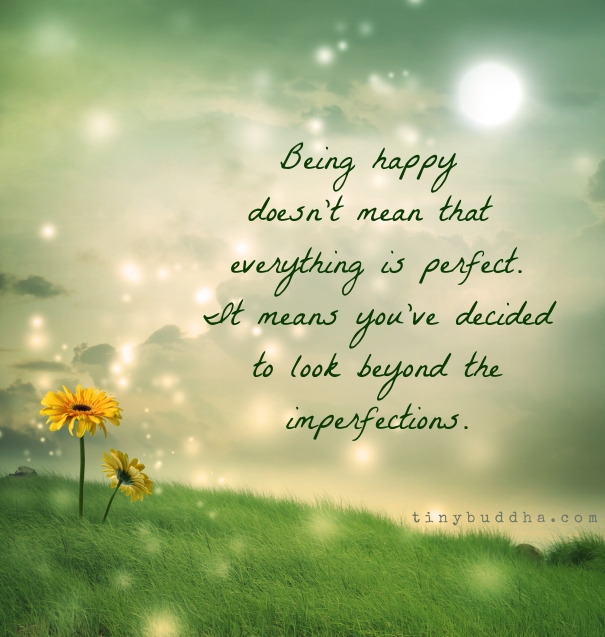
  • Being Happy Doesn’t Mean That Everything Is Perfect

    Being Happy Doesn’t Mean That Everything Is Perfect

    “Being happy doesn’t mean that everything is perfect. It means you’ve decided to look beyond the imperfections.” ~Unknown

    We are all on a mission to be the best we can be, to be happy, to have the perfect house, family, partner, and job. To complete our to-do list, to complete out bucket list, to make our parents proud, to get promoted, earn more money, and be successful.

    Life can often feel like a never-ending treadmill, going quickly in the wrong direction. As we run faster to try to progress down this path, the goal becomes more elusive.

    Are we setting ourselves up to fail in this quest for the perfect life? And will it even result in our one main aim: happiness?

    I’m beginning to think that our quest for success and happiness is, in fact, the main reason we are unhappy.

    We place such high expectations on ourselves—to progress at work and be successful, to meet the same pressure to be perfect at home—and we feel we have to conform to the media ideals we see every day in terms of our health, our looks, our weight.

    As if that’s not hard enough, we then look at everyone around us feeling like they’ve got it mastered and we’re falling short.

    We often don’t realize that what we see in others and the media is only the best side. It’s not a full picture, so it’s unrealistic to expect ourselves to achieve this. We’re setting ourselves up to fail.

    I spent years doing all of the above, climbing the corporate ladder, trying to conform in a bid to please people, and it made me unhappy and unfulfilled. The perfect life always seemed just out of reach, and yet my life on the outside might have looked ideal to everyone else.

    I thought there must be another way, so one day I gave it all up and set on a journey to rebuild my life around my passions and restore my happiness.

    I learned a lot about myself and learned, from others, how people become happy and how we can live an authentic, perfectly imperfect life. I’ve learned that:

    • Things won’t always go according to your plan
    • The to-do list will never be complete
    • You’re doing the best you can with what you’ve got, and that is as perfect as it can be
    • No one has a perfect life (despite what it may look like on Facebook or in a magazine)
    • Happiness is not a point you arrive at in the distant future when you resolve all your problems and achieve perfection.

    So often it’s our quest for perfection that stops us from being happy.

    We plan our weekend and then get upset when it rains, disrupting our plans. This prevents us from enjoying the fact that it’s the weekend, and we get to spend time with those we love, doing what we enjoy (even if it rains).

    We want our to-do list to be complete, and of course it never will be, because as fast as we cross things off, more stuff will appear on it. We never quite have the right amount of money saved, so we work harder to get there, that perfect point in the future, with enough money to be comfortable, which of course never exists because we always want more.

    We look for a partner with no faults, when being human means we’re always going to have some.

    We expect for things to turn out the way we’d like them to, but life isn’t like that. It’s full of ups and downs. Even for the happiest of people, the storms will always come.

    We search for the perfect job, one we will enjoy every day. Yet every job will have its highs and lows. Even the rich and famous, who get to play sports or music and make a living from their passion, complain about the travel, the schedule, the media, and the pressures of fame. Every silver lining has a cloud, and the reverse is also true, because true perfection is always imperfect.

    It’s because of our desire to achieve perfection that we worry about making the wrong choice. We come to a fork in the road and we want to make sure we go in the right direction, but how can we know, since we can never see the end of the path at the beginning?

    I regretted not having the courage to leave my corporate job when I was offered the chance of redundancy money. Instead, I hung on for another year in a job I didn’t enjoy and delayed my dreams.

    It took me a while to realize that there are no wrong choices; every choice has ups and downs, and there is no such thing as a perfect outcome.

    When we chase an unrealistic expectation of perfection for our life and expect happiness to follow, we’re missing the point. Happiness is available all along in those imperfect moments scattered throughout our everyday life.

    A recent party I threw springs to mind. It was supposed to be a barbecue, but the weather didn’t cooperate; my outfit got torn just before the guests arrived, so I had to change; and the recipes I’d planned were seeming harder to pull together than I thought. Then there was the fact that I’d woken up that morning with the start of a cold.

    As we sat inside drinking wine and laughing together with the few dishes I had managed to prepare, I realized that while it was far from the perfect evening I’d planned, it was still lovely. We were surrounded by friends, everyone was having fun, and it was perfectly imperfect.

    It’s all too easy in today’s society to get caught up in the cycle of always wanting more. Our house, car, and partner were once new, and we thought they were perfect, everything we wanted. Then the novelty wore off and it became apparent that this was not the case, so we began searching again, back on a quest for perfection.

    When I’d ticked off the things I thought I wanted, when I had it all—my corporate career and all the things I’d bought with it—I sat on the deck of my dream beach house and felt empty inside. I knew this wasn’t the recipe for happiness; after all, I had everything I’d ever wanted yet felt unfulfilled. I’d clearly been missing the point along the way.

    Happiness is about loving what we have rather than chasing down the things we think we want. If we can focus on what’s good in every imperfect moment, we’ll all feel a lot more fulfilled.

  • Why Striving For Perfection Is Actually Holding You Back

    Why Striving For Perfection Is Actually Holding You Back

    “The thing that is really hard, and really amazing, is giving up on being perfect and beginning the work of becoming yourself.” ~Anna Quindlen

    I used to strive for perfection in every aspect of my life. I thought perfection would make me “acceptable” to others.

    Deep down, I felt inadequate, insecure, and not enough. And subconsciously, I decided that if I could just achieve perfection with myself, my body, and my life, than I would finally feel the deep love and inner acceptance I longed for inside of myself.

    As a kid, I demanded a perfect report card: only straight A’s would suffice. I spent hours upon hours studying in high school and college, doing extra credit, attending office hours any chance I could get, all in a desperate attempt to maintain a 4.0 GPA.

    As a young adult, I agonized over what career path to pick, wanting to pick the perfect job that would be my dream career. I was desperate to be the best, wanting to be the perfect employee, and giving nothing less than 150% in every project I worked on and presentation I did.

    I was terrified to make a mistake and required excellence in every task. I was afraid of others judging me. I didn’t see it my mistakes as learning experiences; I saw them as a way of others seeing what I didn’t want them to see: that I was flawed, imperfect, and somehow not enough.

    I demanded perfection in every part of my life. But the area I struggled the most with was the desire for body perfection.

    As a teenager, I decided that 110 pounds was the “perfect” body. I spent years trying to whittle my body down with exercise, diets, and restriction in an attempt to get the figure I deemed flawless.

    The pressure I put on myself to be a size 2, to eat only 1200 calories a day, to spend at least 45 minutes at the gym daily was agonizing. I lived and breathed this obsession of needing and wanting to be perfect.

    Looking back, I can see how detrimental this drive was to living and enjoying my life. In my chase for perfection, I put unnecessary pressure on myself to be something I was not. I wasted hours and hours trying to be someone different and wishing I was somewhere other than where I currently was.

    But the biggest lesson of all was that in my quest for perfection, I wasn’t really living.

    The reality is that striving for perfection holds us back. We spend so much time doing, striving, achieving, in an endless quest to get it all “perfect,” and we end up missing out on what life is really about: being in each moment and experiencing life where we are, as we are.

    I vividly remember New Year’s Eve in 2007. One of the dear friends I had met living abroad in Thailand was in town and wanted to see me. She wanted to do dinner with a group of people, then head out dancing for the ball drop.

    I agonized over this decision to go or not. I remember wanting to meet up with her, but feeling so awful about my body not being “perfect” that I didn’t want to go out and have to “hide” my body in baggy clothes.

    It pains me to say that I didn’t go. I gave up a chance to catch up with this dear friend, to have fun with others, and to dance the night away because I was unhappy with my body. I stayed home that night and ran on the treadmill in my parents’ basement.

    It was the ultimate low in my quest for body perfection: I decided that I needed to burn off what I had eaten that day and work to “fix” myself into a smaller size.

    The anxiety I felt about eating more calories at a restaurant, when I already felt “fat” in my body, pushed me to stay home and run on the treadmill. It was a moment of life that I missed out on because I was desperately pursing a perfect body.

    When we’re caught up in the pursuit of achieving the perfect body, finding the perfect mate, landing the perfect job, or being the perfect person, it actually hinders us from seeing how beautifully our journey is unfolding right before our eyes.

    Perfection detracts you from the incredible life path you’re on and prevents you from seeing the gifts that are always in front of us. So the next time you get caught up in the endless pursuit of perfection, here are three things to remember:

    1. Perfection isn’t attainable.

    We try so hard to achieve an ideal in our lives that is next to impossible. There really is no perfect body, perfect job, or perfect life. It isn’t possible to have our lives be happy, joyous, and 100% problem free. Unexpected tragedies happen. Something doesn’t turn out as you hoped it would. Someone you love disappoints you.

    When you understand that perfection isn’t actually something you can achieve and maintain forever, you can let go of the never-ending quest for your job, your body, your parenting skills, or your relationship to be perfect.

    Letting go of this unattainable goal is a huge sigh of relief. We don’t have to try to be perfect, because it’s impossible anyway! Once we relax into the idea of letting go of perfection, life becomes easier, less stressful, and a lot more fun.

    Perfection leaves little room for error and joy, and while life can sometimes be messy, it’s during these times where we learn and grow (and have some adventure along the way).

    2. Perfection isn’t authentic.

    When you’re always striving to be perfect, you miss out on showing the world who you truly are. Years ago, when I was in the throes of dieting and restriction, trying to be “perfect” in my eating and my body, I wasn’t being true to myself. I was hiding from the world, desperately trying to conceal what I thought were imperfections.

    In the drive to be perfect, I never allowed myself to be vulnerable—to show up and let myself be seen. I thought when I’d reached perfection, I’d find approval and acceptance. But since the pursuit of perfection is an endless chase, the approval and acceptance never came.

    It was only when I had the courage to drop my unattainable goals and bring my true self to the world, imperfections and all, when I began to find the inner acceptance I had wanted all along.

    It was scary to show up as who I was without wearing a mask or pretending to be someone I was not. But I began making decisions for and from me.

    I quit my job and traveled for a year without an agenda (giving up a well-paying, secure job in the process). I ended a relationship that was no longer serving me (letting go of a man who was also my best friend). I took Spanish classes, wore a bikini to the beach without a cover up, told friends I wasn’t into partying anymore, and began to speak up for what I wanted and what I thought.

    It wasn’t easy or comfortable, but it was incredibly freeing. I felt vulnerable and naked, but as I began to express my honest opinion to others, voice what I needed or wanted, follow my own preferences instead of what was expected of me, and show more of who I was to the world without hiding, it got easier and easier.

    Your imperfect self is enough. Allow yourself to show up in the world as you are. When we’ve demanded perfection from ourselves for years, it can be scary to let go of our ideal and let the world see us as we are. But this is where your true, authentic beauty resides. Not in perfection, but in bringing all of who you are to the world.

    3. Perfection is stagnation.

    No one is meant to be perfect in any area of life, whether it’s your body, relationships, personal growth, habits, or your career, because in a “perfect” world, everything is stagnant. There is no growth and no evolution. It is only through mistakes, missteps, and experimentation that we learn and grow. 

    Looking back on my life, most of my decisions that seemed irrational or didn’t make sense in the traditional way ended up leading me to a path that was a perfect fit for what I needed and wanted. Life is funny that way.

    I quit a stable job, but had incredible adventures traveling South America for a year. I left my hometown to move cross county without a plan, but ended up starting a business that is my true passion. I mistakenly got thrown into a role that I didn’t want at a job, but learned so much about fundraising and development that I ended up enjoying it.

    These “mistakes” allowed me to see how perfection would have actually held me back. If I had followed the “perfect” path, the path without risk, without chance of failure, and the path that felt safe and easy, I never would have had these life-changing personal growth experiences.

    Many people who are striving for perfection in their life path, wanting to plan it all out and have it go exactly how they think it should, end up missing out on some of life’s best surprises and most meaningful moments.

    It is a refreshing way to view life. To allow ourselves to make mistakes is a relief, whether it’s messing up our food plan, getting into a fight with a family member, expressing emotions to a close friend and having it come out all wrong, or experimenting with a new hobby knowing you’ll likely mess up trying to master it. It’s these “mistakes” that allow us to incorporate feedback and chart a new course.

    If we’re constantly striving for perfection, we end up missing out on the lessons we most need to learn. In the pursuit of being flawless, our eyes are always looking three steps ahead of where we are. And as we’re consistently living a few steps ahead, we end up missing out on life’s most precious moment: now.

    Perfection isn’t something you can achieve because it doesn’t actually exist. So the next time you find yourself striving to be a more perfect version of yourself, remember that the imperfect, flawed, vulnerable you is perfectly enough.

  • Is Your Life Really as Perfect as It Looks on Facebook?

    Is Your Life Really as Perfect as It Looks on Facebook?

    Retro woman with phone

    “Most men would rather deny a hard truth than face it.” ~George R.R. Martin, A Game of Thrones

    So would most women.

    This is the way we have encountered life so far. Better to show the world just the socially acceptable and shove the rest under the rug. That’s where the hard truths go.

    But we all know the trouble with the rug. Stuff builds up under the rug and eventually you land on your face. Hard truths don’t go away.

    Social media is exacerbating the historical tendency to present only the pretty, so we’re justifiably, and understandably, really scared about putting the hard truth out there.

    Naturally, we don’t post that our relationship is in trouble, or that we’re going to lose our business, or that we have a physical illness, or some deep emotional stuff that we’re working through, or that we’ve been diagnosed with anxiety, or depression, or have an addiction.

    If we did, it might bring a whole slew of support, but it’s also a high-risk maneuver.

    I saw a meme the other day that read, “May your life be as amazing as you pretend it is on Facebook.”

    It made me laugh out loud. And I’m as guilty as anyone.

    I’m a big advocate of transparency and vulnerability. I’ve written publicly about my eating disorder, as well as depression and anxiety. Those were big.

    But you are unlikely to see me online yelling at my kids, crying after I’ve argued with my husband, or first thing in the morning, pre-caffeine and make-up.

    Recently, on Facebook, I posted a playhouse that I’d sanded it down and re-painted for my kids. I felt pretty damn pleased with myself.

    Here’s what I didn’t post.

    I actively encouraged my four-year-old to watch TV for a lot of the day while I painted.

    The next day my husband yelled at my six-year-old for turning on the electric sander without supervision. She cried. I was annoyed with him for watching rugby and not helping me, even though I didn’t really even want his help. I wanted to take credit for doing it all myself, and I did.

    This is hardly egregious behavior. It’s not super high on the shame scale. But still, I just posted the happy ending. My two girls standing by the white picket fence smiling.

    Actually, it’s a grey picket fence, and I think that’s a great metaphor. Because our lives are never black and white. A lot of life is grey.

    Having a crappy day (or week or month or year), getting the odd bit of road rage, feeling bitter and twisted toward our co-workers, worrying about our appearance, feeling overwhelmed and rushed, disliking the behavior of our children, getting sick—that’s grey.

    We’re ashamed of the grey because we think it is unacceptable.

    But the more unacceptable thing is to choose not to acknowledge it, and to pretend we’re not human. Because clearly we are.

    Part of being human is smiling kids, cute playhouses, and happy families. A big part. A beautiful part.

    But it’s not all of it.

    By ignoring what we perceive as not so beautiful, we do ourselves a disservice. We do our fellow humans a disservice. Because we are not telling the hard truth.

    But the reason we are not telling the hard truth is because it is hard. It feels way too vulnerable.

    We’ve all felt the pain of judgment, whether from ourselves, or from others. It’s a hard thing to recover from.

    It brings up shame, and nothing keeps you quiet like shame. Shame ensures we take the safe option. Picnics with our kids, holidays, sunshine, and happy faces.

    And you know what? This is okay. In the meantime.

    I don’t believe in feeling the fear and doing it anyway. Fear, like any other emotion, has something to tell us. Fear believes it is trying to protect us. So I believe in feeling my fear, acknowledging my fear, honoring my fear for what it’s trying to protect me from, and then letting it know that I’m doing it anyway.

    I wonder, can we honor our fear and allow it to help us be more vulnerable, and more real? To help us show up more? Little by little?

    Can we recognize our shame and our denial, too, and thank them for their role? Can we listen and learn so we can move on?

    Shame, denial, and fear are like misunderstood bad boys. They’ve put up a wall. They are trying to protect you from judgment, because they know how much it hurts.

    Shame will tell you that you can never let anyone know, because whatever it is doesn’t measure up.

    Denial will tell you that if you don’t engage with the hard truth, it can’t hurt you.

    Fear will tell you that courage is a lofty goal you probably can’t reach.

    Like with bad boys, you know in your heart that it’s not healthy to stay in the relationship. You’ve got to learn from the relationship and find a way to leave as gracefully as possible.

    When I experienced depression and anxiety, I had a close relationship with all of them.  

    I wanted to believe there was no problem. If there was a problem I could explain it away with something else.

    I wanted to believe that if I just tried harder, these symptoms would go away. And try I did.

    I wanted to be courageous, but I couldn’t.

    I wasn’t ready to leave denial, and this resulted in a very difficult few years—for me, for my husband, and for my babies.

    When I did leave, I found a way to sort through the grey. Shame and fear were still frequent visitors. They needed time to let go.

    We all needed time to integrate. And this was okay. Not at the time so much, but in hindsight.

    Here is some of what I’ve learned about shame, denial, fear, and courage that I hope will help you:

    1. There was actually nothing wrong with me.

    Shame, fear, and denial stepped in because I thought there was. But there wasn’t.

    2. What was wrong was that I was basing my perception of myself on society’s perception of me.

    I was caught up in people-pleasing and perfectionism and trying to be someone I wasn’t. I had no idea how to handle my emotions, and no idea how my thoughts about myself and my emotions corresponded. This resulted in a long trip down to the bottom of the barrel, and a steady climb back up.

    3. There is something wrong with society’s perception of mental health issues.

    We change that one by one, by individuals understanding that society’s perception is the problem, and allowing ourselves to be honest about that. That is the truth, but it’s still a vulnerable statement, and becoming vulnerable is a journey.

    4. There is something wrong with continuing to seek the white picket fence and ignoring the grey in life.

    It’s not serving us well. We change that too by working toward transparency. Transparency is also vulnerable, and for me has been a work in progress.

    5. When we recognize that everyone has some kind of issue (it’s not just you), we gain courage.

    And trust me on this. Everyone has issues. Kind of like everyone has a belly button. When you come into this world, you get both.

    Opening up and being transparent, whether to family or friends or online, is risking engaging with shame, denial, and fear. It’s risking deafening silence or unhelpful comments.

    It’s not always going to feel safe. It’s not always going to be safe. You should feel no pressure to do it if you haven’t had a chance to work through the stuff that you need to work through.

    But it is something to work toward, little by little. Because grey is a very pretty color, really. And the truth, although hard, is still the truth.

    And only the truth will bring us closer to love.

  • Overcoming Shame: Forgive Yourself and Let Go

    Overcoming Shame: Forgive Yourself and Let Go

    “Stop beating yourself up. You are a work in progress; which means you get there a little at a time, not all at once.” ~Unknown

    I haven’t always been the woman I am today.

    I used to be scared. Of everything. And everyone. Painfully shy and insecure, I saw myself as a victim of my circumstances and was always waiting, on guard, for the next rejection. I masked my insecurity in a blanket of perfectionism, and worked hard to put forth the image that I had everything together and had it all figured out.

    I did a good job looking the part. On the outside most people just saw an attractive, intelligent, successful woman, and had very little awareness or understanding of the pain and fear that was living inside.

    To further protect myself, I oftentimes took advantage of knowing that others believed my facade.

    I believed myself to be unworthy of love or loving, and there were times when the only way I knew to feel good about myself was to treat others harshly, often by knowing I could intimidate them just by being my “perfect” self.  

    I had split the world into people that I was either better than or less than.

    It’s been said that someone once asked the Buddha whether it was possible to be critical and judgmental of other people and not treat oneself the same way.

    He said that if one is critical and judgmental of others, it is impossible not to treat oneself the same. And that while at times it appears that people can be judgmental toward others, but seem completely satisfied themselves, this is just not possible.

    How we treat others is how we treat ourselves, and vice versa.

    I’ve spent the last four years working on finding compassion for myself and those who I blamed for my pain, embracing the concept of self-love so that I could find a sense of peace within. I’m proud of myself for how far I’ve come and the life that I lead today.

    However, it was recently brought to my attention that, despite the hard work I’ve done and the large shifts I’ve made, there are still some people who have a negative perception of me, and some hurtful words were used to describe my qualities and attributes.

    When this was shared with me, I immediately felt the stinging pain of rejection and my automatic response was to go to shame. I felt really bad about myself.

    Aside from the fact that I don’t think it ever feels good to hear that someone doesn’t like you, I’ve spent a long time working to heal these very wounded parts of myself, and in a moment they were all brought back to the surface in a very painful way.

    When memories arise of behaviors and situations we’re not proud of, it can be easy to turn to shame. However, shame has very little usefulness, as it oftentimes serves to shut us down, isolate, and close ourselves off from others and our own healing.

    Seeing this reaction in myself was an indication that there was work I needed to do, something within that I needed to address.

    This situation showed me that I have spent years turning my back on this former image of myself, striving to be better, but what was still lacking was compassion and forgiveness.

    Pema Chodron describes emotional upheaval, feelings of distress, embarrassment, or anger that we assume is a spiritual faux pas, as actually being the place where the warrior learns compassion.

    When we learn to stop struggling with ourselves and dwell in the places that scare us, we are able to see and accept ourselves and others exactly as we are, complete with imperfections.

    We all act unconsciously and without consideration for others at times. When we allow ourselves to be honest about these behaviors, without the judgment of shame, we are left with remorse, which is a quality we are actually quite fortunate exists.

    Remorse can help us refine our actions and to live a more authentic life. It does not mean that we are useless and unworthy or that we made some horrible mistake beyond repair. It simply means that we are human, and that like all humans, we are in a learning process.

    Remorse can be a sign that we are becoming more aware and that what was previously unconscious is coming into consciousness.

    However, if we move into shame and beating ourselves up, we stop ourselves in our tracks, get stuck and likely remain in the mistake, and deprive ourselves of a lesson learned and opportunity to do things differently moving forward.

    In order to keep moving forward in the face of remorse, we need to be able to find compassion and forgiveness for ourselves. We all know, however, that forgiveness cannot be forced. But if we can find the courage to open our hearts up to ourselves, forgiveness will slowly emerge.

    The simplest way I know how to do this is to, in the face of painful feelings, start by just forgiving myself for being human. This can be done with a simple breath practice.

    By bringing awareness to our experiences and acknowledging our feelings, we can then start to breathe these feelings into our hearts, allowing our breath to slowly open it up as wide as possible. And then from this place, with our breath, we can send ourselves forgiveness.

    And then, in the spirit of not dwelling, we let it go. Breathe it out and make a fresh start.

    This practice of acknowledge, forgive, and start anew doesn’t magically heal our wounds overnight and it’s not a linear process.

    I find that forgiveness is a state that we move in and out of, and will continue to revisit, oftentimes, for many years, oscillating between shame (or anger, resentment, fear, etc) and compassion. Ideally though, with practice and patience the time spent in shame will become fewer and farther between.

    If we practice this way, continuing to acknowledge, forgive, and let go, we will learn to make peace with the feelings of remorse and regret for having hurt ourselves and others. We will learn self-forgiveness and eventually, we will learn to forgive those who have harmed us too.

    Photo by Don 

  • Stop Trying to Fix Yourself and Start Enjoying Your Life

    Stop Trying to Fix Yourself and Start Enjoying Your Life

    Enjoy

    “You think that the goal is to be over there, and we say the goal is the journey over there; the goal is the fun you have along the way on your way to over there.” ~Abraham

    I have a clear memory of my mother looking at my bookshelves several years ago and commenting, “You’re always reading all these self-help books, and where has it gotten you?”

    I responded with a quip about how I’ll always be working to align my personality with my soul, to which she scoffed and said, “When will you grow up and realize you have a great life, a great job, and great friends—and just enjoy it?!”

    Of course, all I heard was “When are you going to grow up?” Her point, however, was a wise one: Just enjoy your life. She made a similar comment a couple of years later.

    I had just been told the place I was living was going to be turned into an art studio for my landlady. Thankfully, she gave me two months notice to find a new place. But man, I loved my cinder block house on the river and was crushed by the news.

    I called my mom in tears. I complained about how I’d never find someplace else so wonderful and how unhappy things were with my job. I talked about wanting to just sell everything I owned and take a walkabout.

    Mom didn’t say a lot at the time. However, when I got up the next morning I had a long email from her. My favorite paragraph is this one:

    Shannon, you should stop buying all that self-help crap and going off to retreats to find yourself. You are not perfect, never will be, and no one in the world is either. You make mistakes; we all do. Just live with it. You are a warm, intelligent woman—just live the best honest life you can.

    All of my self-help books and years of spiritual study, and my mom nailed it in one simple paragraph. Granted, her delivery could use some work, but the essence of what she wrote was right on. Again.

    I will, of course, continue to read personal development books and go on personal retreats. However, I no longer do those things because I think something was wrong with me. Now, I do them because I love myself.

    However, I think the best message here is to just live the best honest life we can and let that be enough.

    For the majority of my life, I’ve spent massive amounts of time beating up on myself. My inner critic is a loud and obnoxious voice that has seemed unstoppable. My biggest judgment of myself has been how I tend to “slumber” and “awaken” in my consciousness.

    For example, when I was on a personal retreat in the mountains this summer, I was really feeling inspired, in the flow, and motivated to become a successful writer and speaker. I was excited about this new life I am creating and about feeling fully conscious again. I was sure I was going to maintain my awareness.

    Then I came down off the mountain. Once back to the routine of my everyday life, I easily slipped back into distraction. I stopped meditating every day. I played computer games instead of writing. I vegged out to my favorite show on Netflix.

    Once again, my inner critic rose up and I started to get really down on myself. It’s ironic that what inspired me to get out of my funk was my own voice recording from when I had been on retreat. Listening to it, I was reminded that slumbering and awakening are just a part of life.

    I heard myself say, “When we do stumble, when we do fall, when we are capsized, we learn to have compassion and simply laugh at our humanness.”

    I’ve realized it’s so easy for me to get caught up in this idea that I need to be perfect. If I only drink enough green smoothies, go to yoga class, and chant an hour each day, then I can be happy. However, the minute I skip some part of this self-imposed regimen, I beat myself up and feel like a total failure.

    Life is about slumbering and awakening. It’s about falling off the wagon, the exercise routine, the diet, the spiritual practice. Anyone who appears to always be perfectly aligned is most likely not being fully authentic. We are human, and this is what being human means.

    My dear mother, at age eighty-three, has got this message without having read or studied any of the numerous discourses on this subject. She just enjoys her life.

    At the end of the day, what is most important is how we answer the question: Were we kind to one another? And, equally important, were we kind to ourselves?

    People jumping image via Shutterstock

  • Pushing Yourself to Try When You’re Afraid of Failing

    Pushing Yourself to Try When You’re Afraid of Failing

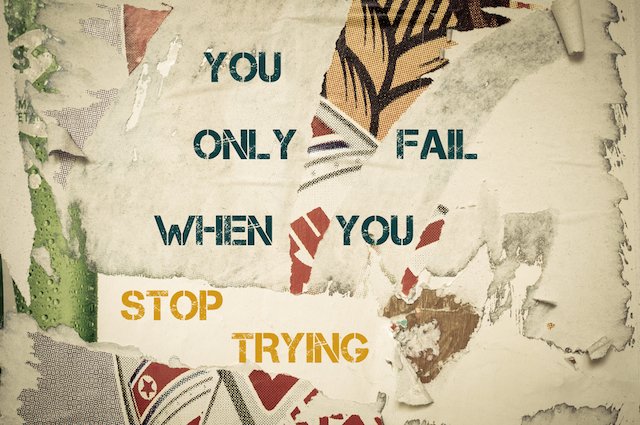
    You Only Fail When You Stop Trying

    “You may be disappointed if you fail, but you are doomed if you don’t try.” ~Beverly Sills

    Before I became a teenager, I developed a characteristic and a disease that went hand-in-hand: I was a perfectionist, and I had an eating disorder.

    While my perfectionism was helpful in succeeding at things such as school and sports, the same perfectionism helped to fuel a dangerous relationship with my own body.

    Fortunately, I received treatment in high school, and I learned to handle my issues related to anorexia and bulimia in healthy ways. This process was neither easy nor simple, but I felt cared for in the arms of recovery. It wasn’t until years later, when I was out of college, that the safety of recovery felt far away.

    Felt far away, I should emphasize. It was tantalizingly within reach, but I was reluctant to seek its grasp. This reluctance was based on my fear—not my fear of asking for help (I had done that before, after all), but my fear of failing at recovery.

    Since I relapsed into an eating disorder in my twenties, going back into treatment felt daunting—I let myself go too long in sickness and poor health, physically and emotionally, because of my trepidation.

    Certainly, one fear was based on living without a disease I had grown to depend upon, but another fear was my unwillingness to ‘fail’ at treatment—if I couldn’t be perfect at it, why bother?

    In the end, this fear kept me from receiving the help I desperately needed. I did not want to disappoint others (or myself) by entering recovery and failing. My disease affected not only me, but also my family and friends. Could I really subject them to the hope of my recovery, only to disappoint them?

    Eventually, I reached the point where I knew I was either going to die by this disease or live another way. As scary as recovery felt, I knew I had to try at life. And that meant trying again at treatment, even if it took several tries.

    Entering recovery—or rather, my long putting-off of entering recovery—was not an easy or perfect process.

    Like a normally calm person losing their temper, I finally had to abandon my pride (I don’t need help! I’m not that bad! Recovering means settling!), and accept the inevitable: I did need help, the disease was that bad, and recovering meant much needed (and deserved) health.

    Through the process I learned that I deserve a life of recovery, no matter how hard it can be, and I also learned how to find the success in moving past the fear of disappointment and into a mindset that strives to try.

    The end result is not guaranteed, and you may even fail, but we can find joy and resolve in the effort.

    Are there areas in your life you have felt the fear of disappointment? Perhaps a new job opportunity, or going back to school? Sometimes pursuing relationships or new passions and hobbies can create this anxiety.

    The process can seem overwhelming, and the fear of failure can loom large. But what if the fear of disappointment did not dictate what we tried to do and who we tried to be? How can we feel confident in trying?

    1. Think it through, but don’t over think.

    Any new undertaking involves discernment and time to think and weigh the options. But sometimes when we overthink, we may talk ourselves out of opportunity due to fear instead of into a worthwhile adventure.

    This doesn’t mean you should take a leap and then tune out your thoughts and feelings. There is something to be said about your instinct and what your gut is trying to tell you.

    When I finally reached out to a therapist that was recommended to me, I did not have a strong connection with her. But my time with her reinforced that healing was possible, and she led me to another therapist who was a better fit and has been instrumental in my recovery.

    2. Find value in the process.

    Some projects in life have definite finish lines, but other times we are called to continue growing. In both cases, the process itself is essential to the work being done. Once I settled into therapy, I was reminded that mental health does not operate on linear time—celebrating simple or little success helped me see the bigger picture.

    For those embarking on a new adventure or trying to undertake a new project, it isn’t too uncommon to worry oneself so far into the future that we struggle with the realities of the present. I know I began to fear how I would handle recovery in future situations, like while on vacation or out to eat with friends. But in each day of the process, I discovered more of my own strength that allowed me to continue on, even in the face of unknowable circumstances.

    Focus on each step of the journey and the outcome will take care of itself.

    3. Talk away the fears.

    Fear and disappointment can ring loudly inside your mind. Letting them out and bringing them to light can help diminish their power. When I sat the people in my life down and explained to them that I was seeking therapy once again, I saw the concern and love in their eyes, and that erased my fear of their disappointment.

    Having the right people in your life who can listen to your fears is a great gift. Allow yourself the freedom to recognize these people and the value they bring. If you struggle to know who to reach out to, consider the power of your word in journaling, poetry, or song writing (or even wordless body movements—dancing, painting, and sculpting, and so on!)

    You may not be able to completely let go of your fears, but expressing them may help you find the courage to act in spite of them.

    4. Find value in yourself, despite the imperfections.

    Since recovery—ten years in—I certainly have failed, by some standards for sure. I have not always made the best decisions. But what has made me successful is the resolve to absolutely never settle into how I used to think.

    My recovery was successful the moment I decided to try. Being patient with the process and gentle with myself even when I experienced setbacks allowed this success to continue.

    Give yourself credit for making an effort and you’ll find yourself motivated to continue.

    Ultimately, we may not be perfect, but we will not be doomed so long as we try.

    You only fail when you stop trying image via Shutterstock