Tag: people-pleasing

  • How to Stop Agreeing to Things That Aren’t Good for You

    How to Stop Agreeing to Things That Aren’t Good for You

    “Agreeing to things just to keep the peace is actually a trauma response. When you do this you’re disrespecting your boundaries.” ~DJ Love Light

    Two years ago, I moved from New England to the Pacific Northwest. It was time for a change, and though I was excited to begin a new chapter of my life, I was sorry to leave my old friends behind.

    The first year in my new home was hectic. I hopped from hostel to hostel on the hunt for an apartment to call my own. Eager to make friends, I spent my evenings attending meetups of all varieties. My business grew as I welcomed a new influx of clients. Atop these external pressures sat my anxiety, a presence whose intensity ebbed and flowed like an unpredictable tide.

    I struggled to maintain consistent contact with my New England friends during this time of transition. One day, I needed to reschedule a phone call with a friend because I felt utterly overwhelmed. I apologized and rescheduled for the following weekend, despite the fact that it would be my first free weekend in months, and I would need time to recuperate. “I’ll make it work,” I told myself.

    Lo and behold, when the next weekend arrived, I was anxious and exhausted from yet another stressful week. The thought of a phone call felt utterly overwhelming, and so I cancelled. Again.

    This time, my friend was rightfully upset with me. He viewed my persistent rescheduling as lack of investment in our friendship, and we slowly lost touch.

    Even now, months later, I feel deep shame for how I handled that interaction. It was a painful loss, one that taught me an incredibly valuable lesson: making promises you can’t keep is a surefire way to erode relationships⁠—relationships with others and your own relationship with yourself.

    Since then, I’ve learned how to break the overpromising pattern and trust myself again. Here’s how.

    Why Do We Overpromise and Under-Deliver?

    Generally, overpromising stems from our desire to be liked or accepted. We believe that we are most valuable to others when we give 110%, and so we overpromise —we make a commitment that is unrealistic given our present circumstances.

    Overpromising might look like:

    • Agreeing to complete a work project by an unrealistic deadline
    • Promising to call a friend even though your schedule is totally bonkers
    • Agreeing to attend multiple parties in one weekend even though you have social anxiety

    Overpromising is a specific form of people-pleasing, a phenomenon in which we act against our natural impulses in order to garner another’s approval, acceptance, or love.

    When we overpromise, we attempt to become an idealized version of ourselves—a version who does these things, effortlessly, on a certain timeline. By doing so, we deny our natural limitations and prioritize what we believe others want from us instead of what we need from ourselves.

    Somewhere along the way, most people-pleasers learned that their authentic selves were not lovable enough, so they believe —consciously or subconsciously⁠—that the only way to secure the love they crave is to be different. They may put great effort into seeming more sociable, more productive, more accommodating, or happier than they really are. In the case of overpromising, they put great effort into giving more than they comfortably can.

    As a result, those of us who overpromise either do the agreed-upon task—albeit resentfully⁠—or back out altogether. Either way, it causes serious damage because we learn that we cannot trust ourselves. We’re left with a nagging sense of shame and a conviction that we must do better next time, and so the cycle repeats itself.

    The secret to breaking this guilt-filled cycle is to communicate our needs, limitations, and desires from the outset with proactive boundaries.

    The Power of Proactive Boundaries

    When we think about boundaries, we generally think of what I refer to as retroactive boundaries: responding to someone else’s behavior with a clear assertion of what is, or is not, acceptable to us. We might feel threatened, angry, unsafe, overwhelmed, or triggered, and we respond accordingly. For example:

    On a first date, your companion puts his arm around your shoulders. You feel uncomfortable. You remove his hand and say, “I’m not ready for public displays of affection yet.”

    Your father asks you who you’re voting for in the election. You say, “Dad, I’d like to keep who I’m voting for private.”

    Your friend Barb asks if she can borrow $100. You reply, “I’m sorry Barb, but as a rule, I don’t lend money.”

    Retroactive boundaries are a form of verbal self-defense. They’re powerful and effective, but many find them horribly difficult to set. It can be challenging to speak up for ourselves when we already feel threatened, bullied, or pressured. If we were raised in an environment where we were harmed when we spoke up for ourselves, we may find the very idea of setting boundaries impossible.

    To circumvent the awkward process of setting retroactive boundaries, I have learned the art of proactive boundary-setting. Proactive boundaries require us to consider, in advance, what our needs, limitations, and desires will be. We then communicate those needs in the early phase of the relationship, effectively incorporating our needs into the relationship’s very foundation.

    A few examples:

    • You exchange numbers with someone you meet at an event. You’re hopeful that this could turn into a friendship. When she texts you the following day, you reply with enthusiasm and let her know that you tend to take a few hours or days to reply to texts.
    • You have a history of trauma. Before your romantic relationship gets physical, you tell your partner that you prefer to take physical intimacy slow. You explain that you wait to have sex until you feel safe and comfortable.
    • You’ve been offered a new job. You also have a toddler in childcare. You tell your new employer that, should your toddler get sick and need to be picked up from childcare, you will need to leave work early to do so.

    Setting proactive boundaries requires self-acceptance. We need to be able to acknowledge and accept our own needs in order to convey them to others. In doing so, we create an opportunity for others to be authentic and share their needs with us.

    Sometimes, both parties will be willing to meet the other’s needs or find a manageable compromise. Sometimes, after we share our proactive boundaries, we may learn that our needs are not compatible with the needs of our new partner, friend, or colleague. And that’s perfectly okay. Wouldn’t you rather learn that from the outset instead of six months—or six years—down the road?

    How to Set Proactive Boundaries

    Scenarios like this might make a good fit for proactive boundaries:

    • Negotiating how quickly you reply to texts, calls, and emails
    • Discussing the rate of intimacy in a physical relationship
    • Limiting how many extra responsibilities you take on in the office
    • Negotiating dating as a single parent
    • Determining how you will manage money when you move in with your partner

    Finding the right language can be the most challenging part of boundary-setting. In my experience, opening a two-way conversation where both parties can express their needs without judgment is the simplest way to create a healthy conversation. You might try the following:

    When setting proactive boundaries in new friendships or new romantic relationships:

    “I’m excited about this connection we’re building. I’d like to have a conversation with you about what we each want this relationship to look like. I’d love to hear a bit about your needs and share some of my own.”

    When setting proactive boundaries in existing relationships going through a transition:

    “I know we’re about to enter a new phase of our friendship/romantic relationship/working relationship. To make the transition easier for both of us, I’d like to have a conversation with you about what we each want this new phase to look like. I’d love to hear a bit about your needs and share some of my own.”

    When setting proactive boundaries at work:

    “I’m really looking forward to working with you. Before we get started, I’d love to schedule a conversation to discuss how I can best meet your needs, and vice versa.”

    Setting proactive boundaries doesn’t eliminate the possibility that your friends, colleagues, or loved ones will overstep your boundaries in the future. However, in those circumstances, it’s far easier to reference a previously agreed-upon boundary than to set a fresh boundary from scratch.

    Proactive Boundaries Have Changed My Life

    I used to carry a heavy burden of shame for the trail of broken promises I left behind me. Now, I understand that accepting my own needs is the key to keeping my word.

    I use proactive boundaries daily. My friends know that I am slow to respond to texts, emails, and Facebook messages. My partner knows that I have a trauma history and need to set the tone of our physical interactions. My clients know that I work four days a week, 10am – 5pm, and do not reply to emails outside of that time frame. My immediate family knows that I will not discuss politics at home.

    Setting these boundaries has allowed me to love myself. Before, I hated the fact that my anxiety prevented me from keeping in better touch. I hated the way my trauma surfaced at the least opportune moments. I felt guilty and lazy when I didn’t reply to my client’s emails on the weekends. Now, I accept that these are my needs, and I give others the opportunity to accept them, too.

    Those who know my boundaries and choose to connect with me anyway are a powerful reminder that my needs do not make me unworthy of other’s affections. They remind me that I am lovable and enough, just as I am.

  • 9 Powerful Lessons from People-Pleasers Around the World

    9 Powerful Lessons from People-Pleasers Around the World

    A woman struggles to tell her boss that no, she won’t work overtime for the third day this week.

    A man feels resentful in his relationship because he always gives, and his partner always takes.

    A woman wants to stop faking pleasure in the bedroom but doesn’t know how.

    Though their stories differ, these folks share a painful secret. They worry that if they are truly and authentically themselves, they will not be loved or accepted. They have spent their lives morphing into smaller, more “acceptable” versions of who they are, sacrificing their authenticity along the way.

    I, too, am a recovering people-pleaser. In my teens and early twenties, I listened in envy as my friends splattered their unfiltered truths across our conversations like fistfuls of finger paint. Meanwhile, every time I needed to turn down an invitation to a party, World War III raged in my chest as I was racked with nerves and guilt. The thought of disappointing others terrified me.

    I used to feel terribly alone in my predicament. Specifically, I was convinced that 1) I was the only one who struggled with this degree of people-pleasing, 2) there was something dreadfully wrong with me, and 3) I would be that way forever.

    In the years since, my work has led me to speak with recovering people-pleasers, recovering codependent folks, highly sensitive people, empaths, and chronic caregivers around the world. From Ireland to Yemen, India to Malaysia, France to South Africa and more, I’ve spoken with folks who are conquering the people-pleasing pattern, setting empowered boundaries, and mastering the art of speaking their truth.

    Their stories taught me that people-pleasing is a very common—and entirely breakable—pattern. From hundreds of conversations, here are the nine most valuable lessons I learned:

    1. If you don’t speak your truth, your truth will speak through you.

    At first, staying silent to keep the peace sounds like a good idea. Why speak our truth and deal with others’ negative reactions when we could stomach our own discomfort like champs? Those of us who played the role of peacekeeper in our families of origin will find this approach familiar, maybe even comfortable.

    But people-pleasers around the world agree: external peace does necessitate inner peace. When you stay silent, the folks around you might be blissfully ignorant, but you feel the repercussions emotionally and physically. Debilitating anxiety, depression, jaw tension, and stomach aches, for example, are common symptoms folks report when they stifle their voice over an extended period of time.

    Recovering people-pleasers around the world recommend: Recognize that speaking your truth isn’t some corny self-help mantra: it’s a necessary prescription for a psychologically and physically healthy life.

    2. If it’s hard for you to access your wants and needs, a great first step is to tune into your body’s simple physical desires.

    Even those of us who have long histories of people-pleasing can access the sacred whispers of our inner selves through our bodies. As Martha Graham famously wrote, “The body never lies.” We can begin living our truth by listening for our bodies’ cues for food, sleep, movement, sex, dance, and play.

    Recovering people-pleasers around the world recommend: Sleep when you’re tired. Don’t eat food you don’t like. Don’t have sex if you’re not in the mood. Dance when you want to dance. The more you practice listening for these simple wants, the more complex desires will arise.

    3. Expecting others to mind-read your needs is a recipe for resentment.

    In the past, I spent undue time and energy analyzing others for cues of their likes and dislikes. I was a bonafide chameleon, tailoring my colors in whatever way I believed would please others most.

    Given my hyper-vigilance to others’ preferences, I believed that if people really knew me and really loved me, they would predict my needs, too. Unfortunately, you can’t love your way into being a mind reader, and I was regularly disappointed when folks didn’t show me care in the way I wanted.

    When we assume that others should automatically know how to take care of us, we assume that we all share the same definition of being cared for. You might need your partner to say, “I love you,” but your partner might show her love by rewiring your toaster.

    Gary Chapman’s book The 5 Love Languages depicts five distinct ways folks show love, including words of affirmation, quality time, gifts, acts of service, or physical touch. Avoid the guessing game and explicitly communicate your needs often.

    Recovering people-pleasers around the world recommend: Explain your needs to loved ones to avoid mixed messages that could lead to painful miscommunications.

    4. Caregiving can be selfish when we don’t have a strong foundation of self-love.

    Many people-pleasers take care of others because it gives us a sense of value. We structure our identities around being reliable, generous, good listeners, and maybe even sacrificial. However, if we give care to others without taking care of ourselves—without developing our own interests—we may find that we need to be needed to feel a sense of purpose. This means that we may insist on caregiving even when our efforts are no longer required, requested, or welcome, which can violate someone else’s boundaries and autonomy.⠀

    Recovering people-pleasers around the world recommend: Give yourself the degree of love and care you’d regularly give to others. Pay your bills. Go to the doctor. Take quiet time. Treat yourself to a nice dinner. This way, when you do make the decision to take care of others, you can do so with no strings attached.

    5. Just because it feels awkward to state your needs and take up space doesn’t mean it’s wrong. It means it’s new.

    Many of the folks I spoke with remembered how scary it felt to state their needs and take up space at first. To them, it felt “impossible,” “terrifying,” and “overwhelming.” Can you relate?

    That discomfort is a natural growing pain. After all, breaking the people-pleasing pattern means rewriting the scripts you’ve followed since childhood. Maybe as a kid you were told that speaking your truth made you unlovable. Perhaps you were bullied in school for being different and made fierce efforts to blend in as a result. Regardless, you are breaking a years- or decades-long pattern of making yourself small. It will feel less challenging with practice.

    Recovering people-pleasers around the world recommend: Instead of interpreting anxiety as a sign that you’re doing something wrong, reframe it as an affirmation that you’re doing something new—and growing as a result.

    6. It’s totally normal to feel mean, guilty, or overwhelmed after setting a healthy boundary.

    If you grew up in an environment where you were punished or neglected when you expressed your true feelings, learning the art of honest expression is a radical act. The simple act of setting a boundary may feel like an enormous emotional upheaval. You are learning how to stand up for yourself, and like any new skill, it takes practice. 

    After setting a boundary, you might wonder if you’re a bad friend/mother/colleague/[insert role here]. You’re not, of course, but your nervous system needs to learn that with time.

    Recovering people-pleasers around the world recommend: Acknowledge that by setting a boundary, you’ve just done some serious emotional work. Hold yourself with compassion and give yourself permission to rest and recuperate.

    7. If you struggle to set boundaries, you might have a tendency to cut people out when resentments arise. Learning to set boundaries will help you maintain your relationships through moments of conflict.

    For much of my life, I was unable to maintain a single close friendship for more than a year. It seemed that every friendship eventually withered away—not with a bang, but a whimper.

    When I sat down and reflected on this pattern, I realized that when conflicts arose—and conflicts will naturally arise in all meaningful relationships—I had chosen to let the friendships fade instead of addressing, and resolving, my grievances.

    People-pleasers might cut folks out when we don’t have the tools to communicate how we really feel. When we break the people-pleasing habit, we develop the ability to have difficult conversations with friends and loved ones—which enables us to nurture and strengthen those relationships.

    Recovering people-pleasers around the world recommend: Contrary to popular belief, boundaries are an invitation to connect. Remember to consider the many ways that setting boundaries will benefit, instead of threatening, your relationships.

    8. Sometimes extroversion is just people-pleasing at a social scale. For some of us, breaking the people-pleasing pattern means learning to embrace our own introversion.

    As people-pleasers, we regularly act against our instincts to become a version of ourselves we believe is lovable. For many of us, the bubbly extrovert we present in social settings is really just an unconscious performance. In my conversations with many people-pleasers, I was shocked to hear gregarious, fast-talking folks share that all they wanted was permission to be quiet. “I want to trust that I’m worthy of love even when I’m not entertaining others,” they would say.

    As children, we may have received love only when we actively acted in an outgoing, cheerful manner. If our parents were addicts or suffered from mental illness, we may have acted as their de facto caretakers, providing sunshine, reassurance, and good spirits. As a result, we feel that in order to be loved, we must be constantly happy or outgoing—and we are exhausted by it. In adulthood, we’re tired of performing and we crave inner peace.

    Recovering people-pleasers around the world recommend: Practice giving yourself permission to not always be “on” around others.

    9. There is no “right” way to feel after leaving a toxic relationship.

    I had to leave a platonic relationship recently. It was a friendship that had many beautiful parts and many toxic parts, and my decision to leave was fraught with indecision.

    In the aftermath, I felt a hundred ways about it. I felt grief at the loss. I felt empowered for advocating for myself. I felt anger at the circumstances that led to our dissolution. I felt compassion for my friend’s limitations, as well as my own. I felt self-doubt and found myself second-guessing whether I handled the conflict properly. I felt hopeful for friendships yet to come. And I really missed my friend.

    There is no right way to feel after leaving a toxic relationship. Relationships are never one-dimensional, and so our emotions when they end will rarely be one-dimensional, either. You can simultaneously be certain you had to leave and miss the person terribly.

    Recovering people-pleasers around the world recommend: When you leave a toxic relationship, recognize that all of your feelings are legitimate. You don’t need to pick just one.

    ⁠—-

    Years and hundreds of conversations later, my initial understanding of people-pleasing has shifted entirely:

    The myth: “I am the only one who struggles with this degree of people-pleasing.”

    The truth: If you are a recovering people-pleaser, you are far from alone. Millions of folks worldwide are doing the challenging and rewarding work of learning to speak their truth. There are even Facebook support groups like this one designed specifically for folks who are working to conquer the people-pleasing pattern.

    The myth: “There is something dreadfully wrong with me.”

    The truth: As a kid, people-pleasing was likely how you secured love and affection from distant, neglectful, or self-centered caregivers. It was a survival strategy. Now, you can give yourself permission to let it go.

    The myth: “I will be this way forever.”

    The truth: People-pleasing is not a life sentence; it is a pattern that you can break with practice and intention. You can seek support from friends, therapists, and coaches as your practice the art of radical self-expression.

    As hundreds of folks around the world made clear: With time and intention, you can master the art of speaking your truth and find the strength, authenticity, and inner peace you’ve been waiting for.

  • How Yoga Gave Me the Courage to Stop People-Pleasing

    How Yoga Gave Me the Courage to Stop People-Pleasing

    “Yoga is the journey of the self, through the self, to the self.”  ~The Bhagavad Gita

    Growing up, I couldn’t have been further from my ‘self.’ Early childhood experiences taught me to focus all of my energy externally. To put everyone around me first and to be insatiably attentive to their needs. This kind of thinking instills you with an incredibly low sense of self-worth, disconnects you from your own feelings and desires, and ultimately leaves your happiness pinned to other people.

    When you have low self-worth, you mostly want to contract away from the world like a turtle. Hiding in your protective shell becomes a way of life because you fear that by revealing who you truly are people will leave, reject, or mock you.

    A common response from those around me was “Don’t worry! Just be yourself!” When you have low self-worth, “being yourself” isn’t just something that worries you, it’s not something that simply makes you feel uncomfortable. It is quite literally something your brain deciphers as high risk. The act of “being myself” was unbelievably terrifying. I had my guard up all the time and a face for every occasion.

    In my early twenties, I started to analyze my unhealthy thought patterns and tried three different therapists. Each one encouraged me to give a monologue about my life while they vacantly nodded and asked questions such as “How did that make you feel?”

    It did nothing for me. What I desperately needed was to cultivate a loving relationship with myself. I needed to get to know the girl I had been and the woman I was becoming. To be there for her, to soothe her, and to cheer her on.

    That’s where yoga came in.

    There was no single defining moment. My first yoga class didn’t change my life. Neither did the second, the third, or the fourth. Yet, little by little, as I went to more classes and read ancient scripture, I began hearing one important message reiterated over and over again—the importance of looking inward for validation, love, and support.

    Years of looking outside myself for these things had left my worth precariously hinged to other people, yet once on the mat, with only myself, I was challenged to connect with it all—my own fears, my own desires, and my own needs. Without this step, I couldn’t have moved forward in my life.

    My yoga practice went deeper when I found yin and restorative; branches of yoga which emphasize gentle support, nourishment, and mindful movement as opposed to any kind of striving or precision.

    Unlike the sweaty sequences of fast-paced flow classes, yin is a soft, intuitive practice that slowly guides you toward opening up, both physically and emotionally. Poses open your heart and your hips—places where those with low self-worth are often most closed off.

    Positions such as supported twist and swan can be held for over five minutes, encouraging a deep tissue release whereby tension dissolves out of your body and onto the mat. Meanwhile torso opening poses like butterfly and camel can make you feel totally vulnerable.

    As you sprawl out across the mat, the urge to close up can be powerful and it’s not unusual to feel emotional. It left me with no choice but to surrender, despite resistance from every cell in my body.   

    Many of the poses in yin yoga are named after animals and insects we associate with peacefulness. The gentle movement of a swan emits a blissful sense of inner peace. The slow-moving ways of a camel and the flutters of a butterfly convey the kind of quiet strength you feel when you finally reach a solid sense of self-worth. When you know you are enough, the need to prove yourself gradually begins to subside, being replaced by a lightness in both the body and the mind. It is this lightness which yoga instils.

    Similar to yin, restorative yoga aims to center you through both stillness and slow movement. It took all the energy I was relentlessly giving out to the world and brought it back to me. It felt like the first time I’d fully, and completely, focused on my own experience. It felt good.

    I went to restorative classes on Thursday evenings. I remember the first class I went to vividly because it felt so unnatural. Away from the pace of everyday life, where there are so many opportunities to numb out—with work, TV, socializing—this session involved just four restful poses each held for five to seven minutes.

    Poses included reclining hero, where you relax your entire body onto a supportive cushion, and bend your knees gently back, and Supta Baddha Konasana—lying with your legs open, feet together and arms left flat to the side. Whatever the pose, the purpose of it was comfort for the body, rest for the mind, and replenishment of the spirit.

    At the beginning I found this practise excruciating. My body was tense and my muscles were contracted. After years of avoiding myself, I simply couldn’t relax and let go because I was scared.

    The teacher noticed and he often came over to lightly press my back down onto the mat. Other times, he’d swap the hard cork block I’d picked to hold up my head for the softness of a folded blanket. As with many other yoga teachers, his non-judgemental support provided the safe, gentle push I needed to finally relax into my own body.

    These simple yet nourishing acts reflect the philosophy of yoga so well, in that the practice has little to do with who can stretch the furthest, the longest, or the most elegantly. Instead, one of the key tenants of yoga is union with yourself. If a pose feels painful, you adjust. If you’ve reached your edge, you pull back.

    This mantra has been repeated throughout every class I’ve been to, and it’s the most tangible evidence I have of the effect yoga has had on my life. If something feels painfully uncomfortable, out of line with my true nature, I now ask “Why am I doing this? Is it for me, or to please other people?”

    Chronic people pleasing, in order to gain a sense of self-worth, always felt excruciating to me. It put me at the whim of just about everyone I met. But it was only when I found the teachings of yoga that I realized why it felt so bad and found the courage to change.  

    When you’ve been so far away from yourself and finally connect to your inner being, it can feel overwhelming. The discovery that, I too, existed in the world, and not only that I had needs and feelings that deserved to be heard, but that who I was really, really mattered, was profound. In this way, yoga worked to highlight how prolifically I’d been neglecting myself in a way that talk therapy never even touched upon.

    I began to engage in radical self-care, I started a soothing inner dialogue, regularly asking myself if I was okay: how did I feel? (as opposed to how others felt). Albeit daunting and uncomfortable at first, I gradually stopped doing things to please others and started revealing every part of myself—the goofy side, the quiet side, the intelligent side. Why? Because my self-worth was inherent, it was within me rather than outside of me, and therefore, I had the safety to be exactly who I was.

    If you’ve ever struggled with low self-worth, you’ll know that the path to true acceptance is long, tedious, and never linear. It is a one step forward, two steps back process. One where you must wake up every single day and commit to building yourself up rather than down. One where you must silence your inner critic and instead begin to accept every part of yourself—even those which you find unpleasant.

    By practicing yoga and learning from the principles that underpin it, that path can be made easier, and a whole lot brighter, too.

  • How I Went From the Pain of People-Pleasing to the Freedom of Being Me

    How I Went From the Pain of People-Pleasing to the Freedom of Being Me

    “How hurtful it can be to deny one’s own true self and live a life of lies just to appease others.” ~June Ahern

    Growing up I felt lost, separate, and different from everyone else in my family. After all, everyone else was a fit; they pursued the same hobbies, had the same aspirations, and even thought in the same way (everything was very black and white with hardly any grey areas). I was interested, it seemed, in everything they were not interested in.

    I had a different way of looking at the world. Any task I was asked to do I did my way, which, of course, was wrong and not fast enough. No matter how hard I tried to please, to get attention, to be listened to, I failed.

    When my parents weren’t judging, criticizing, and shouting at me, I felt invisible to them. Because I believed everything they said to me and about me, and sensed that I was a disappointment to them, a part of me slowly started to give up. When my grandparents supported and encouraged me, especially when they realized I had an interest and talent for athletics, I felt great.

    As far as my dad was concerned, it didn’t matter whether I succeeded or failed. He managed to find something wrong with everything I did.

    Because I put so much importance and belief in what he said, instead of feeling proud of what I had achieved, I felt empty, not good enough, and like there was something wrong with me. To say I had low self-esteem would be an understatement.

    In my early twenties, I didn’t know what I wanted to do with my life, so, still trying desperately to fit in and please them, I ended up working in a bank. They thought this was a respectable job, but I hated it.

    Over time I realized I didn’t know myself or what I wanted anymore. I’d lost contact with how I truly felt. I tried to be someone that they would accept, until I realized that person didn’t exist and couldn’t be found.

    I sought fulfillment in external things, buying clothes I didn’t need and drinking too much at parties.

    I often became disappointed with friends, because I relied too heavily on their judgments and opinions to feel okay in the world. I put huge expectations on others to give me the love and acceptance I didn’t have for myself. My self-worth and confidence depended solely on what other people felt and said.

    I put too much pressure on myself to reach a perfection that didn’t exist. I often felt anxious, had panic attacks, or just felt a sort of paralysis when I tried to do things that I really wanted to do, and wanted to do well, because I feared I couldn’t get it right. In fact, I felt like this whenever the real me would try to sneak through and show up.

    But not taking action and always checking and worrying whether I had offended anyone or said or done the wrong thing just left me feeling sad. Somewhere deep inside of me I knew I could do something worthwhile, if only I could break this cycle.

    It took a long time, but eventually I realized that I couldn’t find what I needed from anyone or anything else until I found it within myself first.

    I realized that only I could fill the void and emptiness inside. Being a people pleaser in order to be liked just made me feel resentful. I had to stop blaming other people for things that happened and the way I felt, which, I admit, was not easy to do.

    Slowly, over time, I faced the fact that I am responsible for my own decisions—no one else can make me do anything I don’t want to do—and I don’t have to put so much weight on other people’s opinions or believe my own criticisms, judgments, and negative thoughts.

    I realized that thoughts are not facts but simply words we use to try to make sense of the world. And our choice of words can determine how we feel about a situation. I could choose my words, my thoughts, and thus my feelings.

    I knew I had to find ways to listen to myself, not everyone else, and deal with my anxiety. After all, at best, others’ opinions are just that—opinions, which are based on their thoughts, perceptions, and judgments rather than facts. Here’s what helped me do just that.

    Learning To Listen To Myself And Tapping Into My Inner Wisdom

    Whenever I felt anxiety about what other people think, instead of resisting it I allowed it to be present. I used my breath to ride the wave of emotion, by breathing deeply and slowly into my belly. I welcomed the emotion by really feeling it, noticing where it was in my body, and being curious.

    At the same time I started to become aware of any thoughts and judgments that came up. As I listened I brought my attention back to my breathing, so as to not indulge and engage with various thoughts. This prevented me from getting lost in specific thoughts and feelings.

    I found that, with practice, the feelings would subside and I’d feel calmer and better able to observe and be aware of how unsupportive most of these thoughts were. I practiced various forms of meditation, in particular a kundalini Yoga meditation called Kirtan Kriya – Sa Ta Na Ma Mirabai Ceiba. I found doing this meditation everyday for at least forty days very helpful.

    This meditation helped me feel balanced and neutral, neither very happy nor sad, nor any other emotion.

    From this neutral position I could observe and be a witness to what I was automatically thinking, formerly without conscious awareness. I quickly realized how crazy some of my thoughts were, and in the realizing I could let go of their hold on me.

    Being able to observe and be the witness to what was going on inside my mind, not engaging with unsupportive thoughts, and allowing the feelings to come and go, enabled me to feel calm and centered and to see things from different angles.

    This practice also started to give me the time and space to decide how I wanted to respond, rather than react instantly without awareness.

    Over time I learned a lot about myself. Most importantly I learned to like, love, respect, accept, and forgive myself. I was able to stop beating myself up, cease being my harshest judge and critic, and start allowing myself to take action.

    This helped me discover what I loved and didn’t love doing. I allowed myself to make mistakes and concentrate on what really interested me, by allowing myself to do more of what I wanted to do. As I got in touch with who I really am, I found I had more unconditional love and tolerance for others.

    I felt happier, clearer, more emotionally and mentally resilient, and more connected to myself and others. And I was less thrown by life’s challenges. I was able to trust myself and my intuition, which made making decisions easier. I can handle my family now, no matter how they choose to show up.

    Most of the time I am able to respond in the way I choose to, authentically, assertively, and with compassion, my self-respect and self-worth in tact. I am me, and that feels freeing.

    If you also give too much weight to other people’s opinions, worry about getting their approval, and beat yourself up in your head, perhaps meditation can help you too. Learning to sit with your feelings and observe your thoughts, instead of believing and acting on everything that pops through your head, is the key to making peace with yourself. And making peace with yourself it the key to living the life you want to live, regardless of what other people think.

  • Forget What Other People Expect and Do What’s Right for You

    Forget What Other People Expect and Do What’s Right for You

    “Your time is limited, so don’t waste it living someone else’s life.“ – Steve Jobs

    When we come to this world, we know nothing. We are all products of the societies that raised us and shaped our belief system with things labeled good or bad, right or wrong, normal or abnormal.

    I was raised in an Eastern European culture that led me to believe every single woman on Earth must tick off certain boxes.

    During the time I was single, especially once I turned thirty, many people started to wonder “what was wrong with me” and why I couldn’t find that illusionary person that was supposed to be “The One.” The prince on the white horse who was supposed to make me forever happy. I was perceived as smart, healthy, funny, and beautiful, so “why I was single?”

    I used to think about my biological clock ticking, and the societal pressure to marry felt high, as if a woman without a romantic partner were unlovable, miserable by default, or incomplete.

    I think asking single people when they are getting married is rude and unfair. No one asks married people when they are getting divorced.

    I met my husband four years ago, many years after I was expected to marry. At the time, we were two Romanians living and working in Asia, within the same company but in two different countries. I was in China; he was in South Korea.

    Our relationship started as a beautiful, genuine friendship. After three dinners in Shanghai and many long telephone conversations that felt like a deep, soulful connection, he proposed. I will never forget that day. It came like thunder. Totally unexpected. Surreal. A miracle of love.

    I was thirty-five and very clear on what I wanted from a romantic relationship. My wish was to feel loved, supported, cherished, and appreciated. I wanted a partner—a lover and a friend—not to complete me, because I was already feeling whole and complete. I wanted to spend my precious time with someone I could share new life experiences with while building a solid foundation together.

    Once we got married, some people started to ask me about pregnancy plans. Some ask this question without even thinking that some women can’t conceive, or just don’t want to have children. In fact, it’s nobody’s business.

    Motherhood is not for everyone, and every woman has the right to her own choices. Having children is not a game to play; it’s the most difficult job in the world, and it has to come as a conscious decision, not an obligation or another box to tick. Some people adopt, and some don’t. Some women make amazing aunts, friends, caregivers, or mentors. There are various ways to give, nurture, and be of service.

    I know women who’ve been advised to have a second child right after delivering their first baby, as if a mother should not act “selfish” and “only think of herself.” To some people, part of being a good mom is providing the first born with brothers or sisters.

    Why so much pressure? In our lives, who makes the rules?

    Someone recently suggested that I hurry up and have a child now, as I’m still young enough to conceive. “What if you end up alone when you’re old?” they asked. “Who’s going to take care of you if you get sick?”

    But here’s what I think: I would never decide to have a child out of fear. It’s not a child’s job to complete their parent or make them happy, just as it isn’t our partners’ job. Children are meant to come to life for themselves, not to fill a void or make us feel whole and complete. Happiness is a personal responsibility, with or without children. But not everyone sees it this way.

    So many people live their precious years ticking boxes or following norms imposed on them by others, trying to fulfill other people’s requirements and expectations. I find this heartbreaking. Some do not go for their dreams because they feel afraid or guilty. They wouldn’t want to disappoint anyone, especially their dear ones.

    In reality, we can’t disappoint anyone. People disappoint themselves with the expectations they set for whom they want us to be, or what they want us to do. People with no agenda cannot get disappointed, nor can they get involved in drama. They accept and love us unconditionally, as we are.

    I wouldn’t want anyone to enter co-dependent romantic relationships with someone out of pressure.

    I wouldn’t want anyone to do a job they dislike or even hate because that’s what someone in their family wanted for them. Or more precisely, their family member wanted that for themselves.

    Descartes was right: by nature, we are all “social animals.” No matter our gender, race, age, or social status, we all have a basic human need to feel seen, heard, liked, appreciated, and loved. Most of us need to belong to particular groups or communities of like-minded people and feel socially accepted. There’s nothing wrong with that.

    The problem occurs when we are not able to satisfy some of our human desires by ourselves, using others as a source of happiness, an instrument for validation, or a means to avoid ourselves.

    I’ve been there myself in the past. I can recall many situations when I did things I didn’t really want to do to please others, like going to a movie with someone on a Sunday when my body wanted to stay home and take a good nap.

    I was a master of people pleasing and, to be honest, it wasn’t always because I wanted to make everyone happy. The truth is that I wanted people to like and approve of me. I expected them to give me the things I wasn’t giving myself: love, time, care, and attention.

    Again, being loved is a human need. However, being needy for love is something different. When we have a harmonic relationship with ourselves, we don’t need to spend time with others to fill a void in ourselves, but rather to feel a sense of connection and belonging. And we don’t need to make choices just to get their approval. We’re able to do what’s right for us, and accept that may or may not approve, and that’s okay.

    You are the sum of your choices. Do whatever feels right for you. You don’t owe anyone any explanations for the way you choose to live your precious years, and with whom. Your time is your life, and it’s never coming back.

    Spend your life with people who bring the best in you, who support you and accept you just the way you are. Relationships in which you need to pretend are toxic. If you don’t feel at ease with people, don’t try to change yourself; change the people you surround yourself with.

    Mind your own journey and sing your own song. If it sounds like something you “should” do, don’t do it. Your needs matter. Don’t let anyone else write your story. Your life is about you, and you deserve to be happy. The world doesn’t need more counterfeit people. The world needs you to be you.

  • Feeling Anxious? People-Pleasing Could Be to Blame

    Feeling Anxious? People-Pleasing Could Be to Blame

    “Living with anxiety is like being followed by a voice. It knows all your insecurities and uses them against you. It gets to the point when it’s the loudest voice in the room. The only one you can hear.” ~Unknown

    White lights flutter before your eyes. Your chest tightens, as if under the weight of a hundred ten-pound bricks. You wonder if your next breath will be your last. Emotions rip through you: fear, glooming dread, hopelessness. Without warning or clear cause, these feelings consume you.

    You start to wonder if you’re going crazy. It’s like you no longer have control over your own body, your own thoughts.

    This is the experience of chronic anxiety. And if you’ve ever encountered it, you know that the presence of it—and the absence of answers or solutions—can make you feel like you’re losing it. It can make everything that was once enjoyable feel like a struggle.

    I know this feeling all too well.

    I used to suffer from periodic anxiety attacks in my early twenties. They left me perplexed and afraid. I felt like I was being possessed. I felt out of control and believed I was dying all the time, with no evidence of a real illness.

    Anxiety stole parts of my life from me, until I decided I wouldn’t let it take away my hope for a better future. One day, embarrassed after having to pull over onto the side of the road in order to breathe, I decided to get help for my anxiety attacks.

    I realized then that people pleasing was causing me anxiety in two ways.

    First, I felt anxiety about being imperfect, making mistakes, and making choices that others didn’t approve of, especially in my family relationships. Then I felt more anxiety because I thought I shouldn’t feel this way. I thought if people knew I was suffering from anxiety that they would reject me.

    Life can be messy, strange, and hard sometimes. And it gets even harder when the faith you once had in yourself is bulldozed by your inability to take a deep breath and calm yourself down.

    It’s hard not to blame yourself. It’s hard to avoid feeling inadequate, like your issues are all your fault. It’s especially hard when you’re a people-pleaser.

    Chronic people-pleasers want to look presentable all the time, like we have it all together and our lives are perfect. Anxiety doesn’t fit into the perfect lives we’ve established for ourselves. So when it hits, we become our harshest and cruelest critics.

    We fail to realize that when we don’t accept our symptoms, we only exacerbate them. We forget that judging things never makes them better. We can’t help but get angry with ourselves.

    Stop Playing Pretend

    Anxiety had its most crippling effects on me when I was in college. I believed I needed to get all A’s on my report card in order to be a good student. I also believed that if I had to study to get good grades, I was somehow intellectually inferior.

    I studied a lot for tests—more than what I thought should be necessary. But when I talked to other people, I pretended like I’d barely studied at all. And whenever I received the occasional B, I beat myself up pretty harshly.

    I didn’t want anyone to know that I didn’t have the best report card. Little did I know at the time it made me appear pretentious and stuck up.

    After graduation, I interned at a university clinic, where I started to see clients. With each client, I was assigned a therapy room. This one time, I accidently used a room that wasn’t assigned to me. When the therapy was over, the clinical supervisor was not very happy with me and did not have trouble showing it.

    Not knowing how to handle disappointing someone, I cried to her and ran off because I could feel a panic attack coming on. Later I felt like a baby, and couldn’t understand why I had such a strong reaction to making a mistake.

    Later I realized I was always anxiously trying to please people because it was difficult for me to deal with disappointing others. I thought somehow making a mistake devalued me as a person, and that made me anxious to think about.

    I would assess my worth on how much I could do right, instead of realizing I had intrinsic worth regardless. This experience helped me understand that my urge to please was based on anxiety and fear more than anything else.

    I spent that time of my life hiding who I was and putting a fake smile on my face.

    In trying to appear perfect, I became rigid and lost my edge and my humor. I resisted my outgoing personality because I thought I would interrupt people too much. I thought I should always let others take center stage while I didn’t ruffle any feathers in the background.

    I pretended everything was great, but it wasn’t. I was suffering from crippling anxiety, feeling disconnected, and often misunderstood. I was hiding my pain, and my frustration with people who were acting rude and selfish.

    I gave advice and ran to the rescue of anyone in despair, and partook in activities that I didn’t necessarily enjoy. I hid my true self by hiding behind other people’s problems. I convinced myself that there was no room for me.

    Through my own experience, I learned that the greatest changes begin when we look at our problems with interest and respect, instead of judgment and denial. When we allow our true thoughts and feelings into awareness, we have the opportunity to learn from them instead of unconsciously reacting to them without knowing why.

    We keep our negative feelings relaxed by not ignoring them, and we increase our awareness of reality by being willing to encounter our personal truths.

    After therapy, I learned that my panic attacks were a reminder that I was a human, not a perfect being. I needed to be acknowledged for who I was, instead of always putting others first or forcing myself to have it all together.

    I needed to know that my worth didn’t depend on what I did for others or what grades appeared on my report card.

    Our bodies have so much wisdom, and sometimes they know more than we realize. Sometimes our anxiety is merely a signal telling us to take a closer look within.

    Anxiety As A Symptom, Not The Disease

    When I first sought therapy for my panic attacks, I thought they were a sign of weakness that needed to be eliminated. What I came to understand is that we can choose to bury our unexpressed emotions and deep thoughts, but they’ll come back later, often in unpleasant ways.

    In my case, they came back as panic attacks. When aspects of ourselves are distanced, denied, or devalued, they’ll always try to make us listen by surfacing as unwanted symptoms.

    Think about what some aspects of your ignored self are trying to tell you. Maybe your symptoms are coming up as chronic anxiety, depression, muscle pain, headaches, feeling lost, etc.

    The analogy of the missing roommate, from Bill O’Hanlon and Bob Bertolino’s book Even from a Broken Web: Brief, Respectful Solution-Orientated Therapy for Sexual Abuse and Trauma, can help clarify the impact of ignoring our inner selves.

    The Missing Roommate

    Imagine that there are a bunch of people living together in a house, and they decide to kick out one of their roommate because they don’t like him. They lock him out and change the locks.

    He comes to the door and tries persistently to get back in, but the roommates tell each other to ignore him, thinking he will go away.

    After a while, he becomes exhausted and slumps against the door. They think he’s gone away and won’t cause any more trouble. For quite a while, it seems to have worked. But he’s really just sleeping outside the door.

    Eventually, something wakes him up, and he decides he wants to get back in the house. He pounds on the door again but gets no response and becomes tired again. Finally, he becomes desperate and crashes through the front window.

    That is what happens when parts of your true self are vanished, unexpectedly. The parts of you that went missing will want to show you who you’re meant to be. They’ll scream, “I want to come back! I am part of you! I will not be ignored!”

    This is how it happened for me. I got so caught up in trying to be who I thought I was supposed to be, I lost who I actually was.

    However, when we devalue parts of ourselves, they develop a mind of their own. They may go away for a while, at the expense of our wellbeing and relationships, but before long they’ll come crashing through the front window.

    We must realize that the experiences we have, even seemly negative ones, are here to teach us, challenge us, and allow us to grow.

    How you see yourself, your life, and your options is shaped by your mindset. If you live with the mindset of a people-pleaser, you’ll constantly feel pressure to fit in, make others happy, be liked, gain acceptance, and seem happy all the time. That’s a lot of pressure. No wonder you feel anxious!

    When I reached out for the help of a therapist, I thought there was something wrong with me because of how sick I’d gotten. I wasn’t able to see that even if I could benefit from making some changes, my anxiety wasn’t my fault. I needed to grow so I could learn to better manage my life and be okay with sometimes disappointing other people in order to take care of myself.

    It’s okay to make mistakes; it’s all right for people not to approve of all your choices; it’s fine to have the occasional issue. In fact, it’s through the pitfalls of life that you can learn and experience who you are.

    I’m thankful for my panic attacks. They allowed me to open my eyes and change my life. I started making myself a priority and embraced my imperfections with open arms.

    Editor’s note: Ilene has generously offered to give away two free copies of her latest book, When It’s Never About You: The People-Pleaser’s Guide to Reclaiming Your Health, Happiness and Personal FreedomTo enter to win one of two free copies, leave a comment below. You don’t have to write anything specific—”Count me in” is sufficient! You can enter until midnight PST on Sunday, December 24th.

    Update: The winners have been chosen. They are Stephen Chavez and Julie.

  • What to Do When Your Need to Please Is Ruining Your Life

    What to Do When Your Need to Please Is Ruining Your Life

    “We are captives of our own identities, living in prisons of our own creation.” ~Theodore Bagwell

    Have you ever thought you had to do what other people said or they wouldn’t love you?

    Have you felt selfish for wanting to put your needs first, or guilty for setting limits with the people you care about?

    Have you learned that even when you’ve complied with everyone’s wishes and whims they still weren’t happy, and you weren’t either?

    Welcome to the deception of people-pleasing. Welcome to the story of my life.

    There is no tragedy greater than being alive but not feeling it because you’re numb, aloof, and emotionless. For many years I lived that way, showing all the signs of being alive but never truly living. That’s because I felt a strong desire to give all of myself in order to pay back the world for everything I’d been given.

    You see, I had the American Dream. I was granted many blessings, and by all accounts, I should have been happy. But I didn’t feel a thing—especially not happiness.

    It took me a while to identify the missing piece that kept me from truly experiencing my life: I wasn’t living as the person I really wanted to be. I was living my life to please others, make them happy, and follow society’s rules.

    I thought I was doing the right thing; I truly believed, “Eventually, all this selfless work will bring me the happiness I deserve on a silver platter.” But it never really worked out that way. It seemed the more I did, the less fulfilled I felt.

    My early life experiences shaped me into a people-pleaser. Though I was grateful for everything I was given, I was also aware that I’d been born into difficult family circumstances. Pleasing others was my way of coping with it.

    Like most young children, all I wanted was to gain my parents’ attention and approval. But praise was a scarce resource in my household, and both of my parents readily doled out criticism. I quickly become aware of how my actions affected them, so I acted in approval-seeking ways and suppressed my feelings in order to avoid punishment.

    I didn’t want to be criticized or berated in front of others, so I became the child, teenager, and adult of my parents’ dreams. They still found fault at times—which crushed me—but I ultimately did everything I could to make it up to them.

    This trap I had fallen into got deeper when my parents divorced. I tried to appease both of them by sticking myself in the middle of their marital battle and protecting my siblings from having to bear the brunt of their anger. I became my parents’ mediator, and this form of communication spiraled me into a deep depression that no one knew about but me.

    I lost a lot of weight, my grades dropped in school, and I no longer found any pleasure in activities I once enjoyed. But with a brave face, I trudged along and dealt with it so that my siblings wouldn’t have to. I convinced myself that this was my way of fulfilling my duty as a daughter and avoiding criticism.

    Growing up in these circumstances led me to believe I was responsible for how others felt. I learned to shape my personality, behaviors, and reactions according to what other people wanted or needed from me instead of being authentic to how I truly felt.

    Because of my parents’ often extreme reactions to situations, I came to believe that I needed to change; but the truth is, their reactivity was their responsibility.

    You see, we tend to call people who display this pattern of behavior people-pleasers, doormats, or approval-seekers. We describe them as being selfless. People-pleasers rarely say no, are super responsible, spend most their time doing for others, and are viewed as the nicest kinds of people.

    On the surface, it can seem like being a people-pleaser is the right thing to do; but over time, this identity wears a person down, and all that pleasing turns into an unhealthy pattern of behavior that doesn’t actually end up pleasing anyone in the long run.

    Your Identity

    I used to identify myself as being a good, nice, and selfless person who was always accommodating others.

    When I self-identified as having certain personality attributes, it dictated my actions and led me to believe I needed to act in certain ways to match society’s standard of how a good and nice person behaves.

    Even when my actions weren’t aligned with how I truly wanted to live my life, I found myself complying anyway. I worked hard to avoid looking selfish, unaccommodating, or disagreeable, and I avoided confrontation at all costs.

    I stopped this pattern when I came to realize that being a good person is a lot more complex than just accommodating the needs of others all of the time.

    When I realized that constantly giving in wasn’t as loving as I thought it was, and that the way I was acting didn’t come from a loving place at all but from a place of guilt and inadequacy, that’s when I decided to go from people-pleasing to living life on my own terms.

    That’s when I started to evolve from selfless to self-full. That’s when I deconstructed my identity as a people-pleaser and restructured my life. That’s when I decided that living my own life was more important than my parents’ approval of me.

    If the need to please has been running your life, here are some ideas to support your shift from selfless to self-full.

    1. Understand that other people are responsible for themselves.

    Being a people-pleaser allowed me to overlook one important fact: other people are responsible for themselves and their own problems.

    Somewhere down the road I decided that other people’s problems were my problems. I believed it was my responsibility to make other people feel better. For as long as I can remember, I played the caretaker role in my life; but all it got me was a burdening sense of obligation and crippling anxiety.

    It’s important for you to remember that you aren’t responsible for how others feel or act. If you try to please people because you’re scared of their reactions, that’s a sign that you need to start making a change.

    You see, when you take on other people’s responsibilities, you’re allowing them to continue acting irresponsibly; you’re permitting and promoting their unhealthy patterns.

    The next time you’re inclined to take on someone else’s stuff, ask yourself, Does taking on this person’s responsibilities really make me a good person? Is it actually kind to keep people from taking ownership of their own lives?

    You’re likely to find that the answer is no, and then you can explore how to be supportive without taking over completely.

    2. Stop trying to keep the peace.

    I often used to wonder why I was surrounded by selfish people; from my perspective, everyone else was the problem. But on my journey to self-fullness I realized that they weren’t the problem; I was.

    By trying to keep the peace in my relationships, I was overlooking the ways in which other people were taking advantage of me. I ignored their twisted priorities because I thought I should play nice all the time.

    It’s important to keep in mind that sometimes the better, more loving choice is the more uncomfortable, anxiety provoking one. Truly loving behavior calls for limits, boundaries, and saying no every once in a while.

    Some people will get upset with you or throw a tantrum like a two-year-old, but the cost of ignoring your boundaries is much greater than that. So stop thinking that keeping the peace is better for your relationships. The truth is it’s much better to be honest and upfront.

    3. Know the consequences of seeking approval.

    Living your life through fear of criticism and rejection doesn’t allow you to truly live at all. Constantly censoring yourself doesn’t allow you to see the freedom of choice that you really have. When you’re seeking approval all the time, you aren’t really growing.

    My approval-seeking behavior stemmed from a belief that my mental health depended on my being liked; if people didn’t like me, I didn’t feel worthy. The consequence of this was that my value as a person was totally dependent on what other people thought of me. Any criticism made me feel terrible about myself, so I avoided it by acting in ways that would gain others’ approval.

    I finally broke this pattern by placing more value on seeking approval from myself. By figuring out who I was and what I valued, I was able to create a stronger sense of self. When you know who you are and accept yourself, other people’s criticism doesn’t bother you too much at all.

    4. Become self-full.

    If you’re caught up in the people-pleasing cycle, you probably think it’s selfish to consider your needs first. Once you shift your idea of what it means to be a good person, like I did, you’ll see it isn’t selfish—but rather self-full–to put yourself first.

    Much of my desire to change came from realizing that if I didn’t start valuing myself, my relationships would suffer. Although it might seem counterintuitive, prioritizing your needs and gaining a strong sense of self is actually better for other people, because it serves to strengthen the relationships you have with them.

    It’s for this reason that placing your needs first is self-full rather than selfish. It’s about seeing your value and knowing your worth as a person. When you do this, others can start seeing your value also, and your relationships can start to transform.

    Final Thoughts

    The journey to self-fullness is all about trial and error. It’s about making mistakes, changing your behaviors, and asserting your own decisions.

    I started to feel happy and truly alive when I started to get to know myself, learning when to say no and when to set limits in my relationships. It wasn’t easy. I had to get used to some criticism and disappointment; I had to grow a stronger backbone. However, I can say without hesitation that it was worth it. And I know it will be worth it for you, too.

    Your life should be lived the way you want to live it. No one should have the power over you to dictate how you need to live your life. The more you get to know who you are, and the more boldly you begin to live life on your terms, the better you’ll feel about yourself.

    I no longer make decisions out of fear or wind up washed over with resentment. Now I do things for people because I want to, not because I’ll feel guilty if I don’t. I no longer need other people to make me feel worthy; I give that sense of worthiness to myself by knowing and accepting who I am.

    It will serve you greatly to let go of the idea that people need saving and it’s your responsibility to do it. Somewhere down the road, you internalized the message that you have to be responsible for how others feel. But the truth is, you aren’t responsible for anyone else’s feelings but your own.

    You can’t live a healthy, happy life if you’re too busy managing your feelings and other people’s feelings at the same time. Remember, people can take care of themselves. That idea will leave room for you to take care of yourself, too.

  • A Powerful Guide for People-Pleasers (and a Giveaway!)

    A Powerful Guide for People-Pleasers (and a Giveaway!)

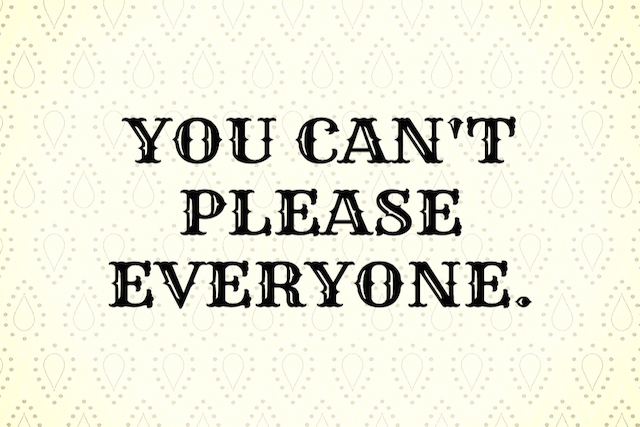
    You Can't Please Everyone

    Update: The winners for this giveaway are Galit Erez and Granny Nate.

    I’ve often wondered if I suppressed my tears when I was born, in fear of upsetting the doctor and my parents.

    I wouldn’t be surprised to learn this about myself, as many of my childhood memories involve a fear of causing trouble, and an even greater fear of the consequences.

    As I grew older, I began to shape-shift to please the people around me. It was exhausting, but I frequently tried to control their perception of me so I could feel confident I was likely to receive their approval.

    I was always hyper-vigilant in a group dynamic, monitoring the room for signs that someone may be angry, annoyed, or otherwise bothered by me.

    Since I was highly empathetic, and paranoid—and I couldn’t read people’s minds—I often recognized emotions in others and attributed them to something I said or did “wrong.”

    Thus began the draining dance of trying to win them over again. But because they were likely feeling something that had nothing to do with me, I’d ultimately feel even worse after trying to earn some type of validation and failing.

    Very few people knew the real me—and I wasn’t sure I did, either—which meant I felt incredibly alone.

    It’s taken me years to understand the roots of my people-pleasing instincts, and to challenge them so I can form authentic relationships based not on fear and need, but rather love and mutual respect.

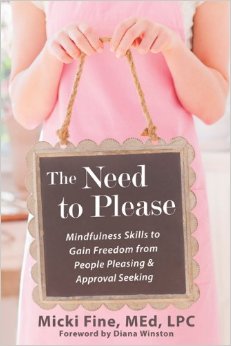
    Since I still struggle with this from time to time, I was eager to read Micki Fine’s book The Need to Please: Mindfulness Skills to Gain Freedom from People Pleasing and Approval Seeking.

    A certified mindfulness teacher, Micki Fine has written an insightful book that delves into the causes of people-pleasing, and offers tools to overcome it with non-judgment and self-compassion.

    If you’re tired of worrying about what people think of you, and beating yourself up when you fear you’ve lost their approval, The Need to Please could be life-changing for you.

    I’m grateful that Micki took the time to answer some questions about her book and people-pleasing, and that she’s offered two free copies to Tiny Buddha readers.

    The Need to Please

    The Giveaway

    To enter to win one of two free copies of The Need to Please:

    • Leave a comment below
    • For an extra entry, tweet: Enter the @tinybuddha giveaway to win a free copy of The Need to Please http://bit.ly/1CQUh66

    You can enter until midnight, PST, on Friday, July 24th. 

    The Interview

    1. Tell us a little bit about yourself and what inspired you to write this book.

    My childhood taught me in many ways to be a people pleaser, and I lived it unconsciously for a long time.

    In my mid-thirties a series of events helped me wake up a bit. As a result, I decided to follow my own path and went back to school to become a psychotherapist after being a CPA for many years. I also started meditating.

    In 1994, when I saw Jon Kabat-Zinn on the PBS series, Healing and the Mind, I had a deep sense of knowing that I wanted to teach mindfulness and eventually became a certified MBSR teacher.

    The idea for the book came during meditation. I ignored that idea for some time but at a certain point I simply had to pay attention.

    2. What causes some people to become people-pleasers and others to feel less dependent on external validation?

    When our parents reflect our goodness back to us appropriately and accept us as we are, we can grow to trust our own experience and feel worthwhile. The greater the love and acceptance, the less we feel the need to look outside ourselves.

    When love and acceptance is inadequately shown, our hearts are wounded. (We all share some level of this wounding.) Because of this treatment, we can grow up feeling insignificant, unworthy, and fearful and then look to others for the love and acceptance we didn’t get enough of as children.

    The experience of abuse, neglect, and abandonment are obvious indicators that we have not been treasured as children. Other experiences affect us too: having parents make all decisions for us as if we don’t matter, being told we need to be different than we are, and having love withheld if certain conditions are not met.

    3. How can mindfulness help us overcome the need to please?

    Mindfulness is the awareness that arises when you bring open-hearted, non-judgmental awareness to the present moment. Mindfulness helps you wake up to life.

    When you know you have only this moment to live, you might be moved to live life as if it matters. This helps you get off autopilot, like when you’re in the shower but thinking about someone’s opinion of you.

    If you decide to be present, you might catch your mind wandering to worry and intentionally decide to experience the pleasant sensations of the shower.

    Mindfulness can be practiced at any time, whether you set time aside from your daily activities to meditate or intentionally experience the present moment as it is.

    Through mindfulness practice we come home to ourselves after having our focus on others and what we think they want from us. We gain an intimacy with the body, our thoughts, and emotions instead of running away from ourselves.

    As we come to know ourselves better, mindfulness asks us to let go of judgment and allow things to be as they are, instead of struggling to make things different.

    This attitude helps us to relate to life and ourselves with kindness and compassion, making it possible to befriend our lives. We develop the capacity to relate to things in a radically different way: less reactivity and more lovingly.

    A wondrous thing that can happen through this allowing, kind-hearted, present-moment attention is that we come home to our inner loveliness through which we begin to trust ourselves instead of relying on others.

    Mindfulness and loving-kindness meditation can help us value ourselves after spending years thinking we are not okay. When we know our true nature of love we can truly feel at home.

    4. What do you think is the key difference between generosity and unhealthy self-sacrifice?

    I think a big difference is whether a caretaker behavior is motivated out of love or fear. Of course there can be a mix of motivations; our lives are complex. With mindfulness we can help discern more skillfully our feelings and motivations.

    I think it’s important to say that sometimes we do have to and want to make sacrifices for others. But, once again, is the behavior motivated out of love or fear?

    5. What are some of the most common people-pleasing behaviors, and how do these negatively impact our lives?

    The main behavior is doing whatever others want you to do even to the detriment of your well-being. In addition to the behavior, there is constant worry and hyper-vigilance to determine others’ imagined needs and what we should do.

    Another behavior is the inability to say no when you want or need to. A particularly sad behavior is not following your own path.

    The people pleasing cycle fuels feelings of anxiety, shame, and resentment. It is exhausting, as we focus almost completely outside ourselves, making it difficult to know our inner loveliness and wisdom, which in turn keeps us from valuing and trusting ourselves in order to act of our own volition. It is a self- perpetuating cycle.

    There are two important ideas here.

    One is that people pleasing is, at its core, an attempt to find love and to be free. To remind ourselves of that deep loving intention when we get caught up in people pleasing can help us to have compassion for ourselves and not be so self-critical.

    Another important thing is that our attempts to please others can never yield the experience of unconditional love precisely because our effort involves doing something to earn love. But since it is a self perpetuating cycle we keep trying in vain to earn love.

    6. I found the section on “the unspoken contract,” in Chapter 4, particularly eye-opening. Can you tell us a little about this and how people-pleasing creates an imbalance in relationships?

    One might think that being the partner on the receiving end of people pleasing would be great. You get everything done for you! However, the “unspoken contract” is that the receiver of all the caretaking is obliged to love the people pleaser unconditionally and never abandon him or her in return for all the caretaking.

    This is an impossible task because both partners have human hearts that are wounded and thus rarely capable of giving and receiving perfect love. Not only is this contract unspoken but it is unconscious and creates resentment, anger and disappointment for both partners due to the untenable expectations.

    7. In Chapter 6, there’s a heading that reads, “It’s not the thoughts that drive us crazy.” Can you expand on this?

    Two things come to mind. One is that a thought is simply an event in the mind (even the one that tells you it’s not). As we meditate we begin to find that thoughts simply come and go without our bidding and most of them are not true. The mind simply has a mind of its own. In other words, thoughts are not our fault.

    The other idea is that what we resist persists. We struggle with our thoughts, either trying to think “good” or “happy” thoughts or get rid of difficult thoughts. This can elicit a fair amount of discontent because the mind is like a two-year old who is having a tantrum.

    The harder you try to control the child having the tantrum, the more he or she kicks and screams.

    Taking our thoughts personally and struggling with them only serves to make the mind more agitated. So it is not the thought itself that makes us suffer, but how we relate to the thought.

    Through the active process of mindfulness, we practice kind, accepting observation of our thoughts so we can see thought as events in the mind that are not you.

    8. What’s one simple thing we can do to ground ourselves and get out of our head when we feel overwhelmed by people-pleasing thoughts?

    When you feel overwhelmed with thoughts, give yourself a chance to regroup by grounding your awareness in sensate experiences. Precisely notice your moment-to-moment physical experience.

    For example, if you’re taking a sip of water, notice your arm muscles moving as you reach for the glass, the feel of the glass as you touch it, the temperature of the glass on your lips, the feel of the water in your mouth, and the sensations of swallowing and the water flowing down your esophagus.

    Notice how you feel afterward. You may be more grounded and able to access a more independent perspective.

    9. In the chapter on befriending your emotions, you shared a helpful acronym, RAIN, from mindfulness teacher Michele McDonald. Can you share a little about this and how it can help us deal with difficult feelings?

    RAIN is a non-linear process of Recognizing, Allowing, Investigating, and Non-Identifying.

    To work skillfully with our emotions we first need to release ourselves from autopilot by taking a conscious breath and bringing awareness to the present-moment experience of the emotion.

    We recognize the emotion is present perhaps by silently saying “anxiety is here.” Allowing the emotion means that we let go of struggling with the emotion. Most of the time we try to make difficult emotions go away and hang on to the pleasant ones. Instead we cultivate a kind, friendly attitude toward the emotion.

    Then we investigate the emotion by dropping into the body to explore the sensations with compassionate curiosity. We non-identify when we remember that everyone suffers and that we are not alone. This can help us feel comforted because it helps us take the emotion less personally.

    Practiced together we can bring a friendlier attitude toward our emotions.

    It is important to practice RAIN with patience, kindness, and non-striving. For example, sometimes it is not possible to allow an emotion to be present, but we can allow the resistance. We need to be charitable with ourselves.

    10. What’s one thing we can do daily to develop self-compassion so we can give ourselves the approval we’ve so desperately sought from others?

    Offering ourselves compassion can be a beautiful thing. It can interrupt the harshness with which we treat ourselves and provide an opportunity to choose more wisely what comes next.

    For those of us experiencing people pleasing difficulties, it is important to do things that focus us inward, recognize perfectionism at work, and give kind understanding and compassion to our humanity.

    Here is one such practice. When you notice a people pleasing or other stressful moment, stop and take a breath. Then speak to yourself in a way that recognizes the moment as being difficult and also offers kind words toward you.

    Using a pet name that reminds you of your goodness can add a touch of kindness. Also, adding a physical gesture such has putting your hand on your heart or cheek can help foster gentleness.

    For example, with hand on heart, you could tell yourself “Dearest, this is really hard. How can I take care of you now?” My book has many suggestions about self-compassion.

    You can learn more about The Need to Please on Amazon here.

    FTC Disclosure: I receive complimentary books for reviews and interviews on tinybuddha.com, but I am not compensated for writing or obligated to write anything specific. I am an Amazon affiliate, meaning I earn a percentage of all books purchased through the links I provide on this site.