Tag: past
-
How to Make Peace with the Past and Stop Being a Victim

“Never allow yourself to be made a victim. Accept no one’s definition of your life; define yourself.” ~Harvey Fienstein
Do you usually feel as if everything bad that can happen will happen, and it will happen to you?
You must be the unluckiest person on the face of the planet. Opportunities never work out. Doors that should open close in your face. Friends let you down. Bosses don’t see your value. There seems to be a universal conspiracy to keep you stuck right where you are now.
You feel like your life is always going to be like this.
You feel like a failure as a person.
You worry that you’re never going to be happy.
You stress that you have no control to change any of it.
And it’s all so unfair, right? Why does this bad stuff always happen to you? How come other people get all the breaks, and you never do?
If this sounds familiar, you’re probably still affected by past events that left you feeling helpless, scared, or inadequate—and you’re going to keep re-experiencing these feelings until you do something to change them.
My Experience with Self-Sabotage
Why do I get how this works? It’s no big mystery. I’ve been there myself. In fact, at one time, I was the queen of self-sabotage.
I went from being a straight-A student to dropping out of school a year before my finals. From being a loved and spoiled child to losing touch with my family. From being confident and self-assured to needy and codependent.
What happened? I stopped thinking of myself in a positive way in response to events outside of my control. I’d always taken pride in myself, and I felt someone had taken that pride away from me.
All of these dramatic changes came from something very small—a change in my home circumstances that stopped me feeling like part of the family. Because someone in my life constantly criticized me, I lost confidence in my ability. Because I lost my security, I became chronically insecure.
Instead of feeling that I was a person of worth, with good prospects, I started thinking of myself as rejected, unwanted, and somehow less-than.
As a teenager, I was in no way equipped to deal with that. So I rebelled. And from there, my life went very rapidly downhill.
I sabotaged my jobs; I couldn’t stick anything beyond a few months. I sabotaged my first degree by dropping out. And as for relationships, I attracted every narcissistic guy around, all with the agenda of keeping myself a victim.
So What Changed—and How Do You Change It?
I hit rock bottom. My last bad relationship had come to a nasty end, I’d dropped out of University, and I had absolutely nothing in my life to keep me going.
When you hit rock bottom, you have two choices: You give up, or you say, “enough is enough.” And you start changing the way you’re thinking about things and do something to radically improve your life.
I took the second option, and my life turned around. From nothing, I went to a happy marriage, motherhood, a lovely home, and a fantastic career. And I promise you, if I can do it, from where I was at that time, so can you.
The following are some of the things that helped me overcome my negative programming and self-confidence issues. If you feel you were born to be a victim, and to live a life filled with anger and frustration, these steps could work for you too.
Why “Just Let Go” Is Not the Best Advice
I hear this advice all the time. People come to me saying they’ve been told to put the past behind them and start over, but they have real problems doing that. If only everything in life were that simple.
This stuff happened, and it happened to you. You’d need to be some sort of superhuman, or a machine, to think that it’s had no effect on who you are. And letting go, like it never happened, is denying its influence.
People who try to deny the effect of past experiences use a strategy called repressive coping, and these things have a nasty habit of coming back to bite you when you least expect it.
Accept what happened, understand how it’s affected you, but make sure you place it where it belongs—in the past. The fact that it’s there doesn’t mean you have to keep playing the same situations over in your life. You can make different choices, think in different ways, and keep moving forward.
Being Peaceful or Being Strong?
Of course we’d all like to be peaceful and calm, but sometimes that’s just not possible, especially when you’ve been through traumatic events. Lacking a magic wand, we can’t just make it all vanish. So following on from acknowledging it, we then move to what it gave us—and although it may be hard to see sometimes, it gave us strength.
There are people in the world who’ve never had to deal with the stuff that you’ve been through. You’ve dealt with things they can’t even imagine. That gives you reason to be proud of yourself, and a whole different perspective on what “tough” really is.
Losing my family and my identity may have been the cause of my initial problems, but it also provided me with the strength to overcome challenges I encountered in my life, and played a great part in giving me the confidence and ability to achieve my management career goals.
Accept Who You Are—But Who Are You?
So following on from the point above, who are you now and how do you see yourself?
You may have been a victim in the past, but you’re still here, in spite of everything that the world’s thrown at you. In my opinion, that makes you a survivor. You may not feel it, but you’re strong.
You can take the strength and be proud of the person who survived the challenges. You can choose how you see yourself. Do you want to see yourself as a helpless victim of circumstance, or as someone who is still standing, still fighting, still growing, still on a journey to make your life better and not give in?
Sure, the insecure stepdaughter is still somewhere inside me. And she’s now also the person who has achieved a really good life and has the security and success she always wanted.
As We Forgive Those…
Another piece of common advice that people are given: forgive what was done to you. Unfortunately, some things are harder to forgive than others, so the brain will fight that.
If someone has maliciously caused you harm and you have to live with the consequences, forgiving what’s unacceptable may seem to keep you in victim mode—as if, once again, you’ve just had to take it.
Of course, the truth is, by staying angry and bitter, you’re still hurting yourself. It’s irrelevant that they may deserve your bitterness. They aren’t suffering from it; you are.
So, I don’t advise you to force forgiveness. Instead, accept what happened, acknowledge how you feel about it, then put it behind you. You can’t change the past, but you can change the future, and dwelling and brooding on these feelings will not help you move forward.
Count Your (Amended) Blessings
However positively you can spin the past, your life has still been negatively affected. You may have a worse life than you would have done if this thing had never happened, and it’s hard to feel gratitude for something awful! So how can you be grateful for what you do have now?
Be glad for the person who has come through this—the survivor, even though you may not feel like one.
Be glad for what you’ve managed to achieve, in spite of everything that’s been done to stop you. You may feel like you haven’t achieved much, but as a person who is reading this and trying to change your life, you’ve achieved the power to make decisions and refuse to give up, which some people never do.
Be glad for the extra lessons you learned: the ones that made you tough, make new problems minimal compared to past challenges, and put you in a position to be able to help others who’ve been through the same things.
—
These are the things that are going to empower you to go out and change your world.
Playing with the cards stacked against you is just plain unfair. It’s time for you to even the odds.
Your past is always going to be something that happened to you, but that doesn’t mean it needs to define you, restrict you, and dictate your future life.
How would your life change if you were only taking what was positive from the past? If you could see yourself as someone who overcame it, who chose to reject the negative self-concepts that were forced on you, who was a survivor, and not a victim?
You can do this. You, and only you, have the power. And that’s why you’re not a victim. The only person who can control this is you.
Work through all of the points above. Find out where your blocks are. Deal with them. Move on. You’ve been through enough already. It’s time for things to get better.
You’ve got this.
-

How to Move On: What It Really Means to Let Go
“Don’t let the darkness from your past block the light of joy in your present. What happened is done. Stop giving time to things which no longer exist, when there is so much joy to be found here and now.” ~Karen Salmansohn
If you are lucky enough to spend time in mindful communities you will hear the phrase “letting go” used frequently. The practice of letting go is used to support our acceptance of the way things are, and I believe it’s a cornerstone of creating a happy, full life.
But what happens when you’re being asked to let go of something that is deeply emotionally charged or something that directly relates to how you identify yourself?
When we have a deep emotional attachment to an event or circumstance in our life and we’re being asked to let it go, it can often feel like we’re being asked to move on and forget about the past, person, or event that we’re deeply connected to.
In 2010 my oldest son passed away unexpectedly. At that time I had been a practicing yogi for almost ten years and had navigated what I thought were significant opportunities for practicing detachment and letting go.
For example, during my divorce from my son’s father I let go of my long held dream of having a happy marriage, white picket fence, kids, and a dog (though I did get the kids and the dog).
Following my divorce, when my middle son, at the young age of fourteen, had to be sent away to a drug treatment facility, I let go of the typical teenage dreams of homecomings, proms, varsity sports, and so on; after all, I wasn’t sure he would live to see those years. Not only did Daniel live through those years, he has since become a vibrant soul, who never needed all those typical experiences to thrive.
So when my oldest son passed away while home on leave from the army I felt I had a head start in the letting go department, and therefore, I would find my way to healing more quickly. Not true.
Some attachments are so deeply woven into the fiber of our beings they seem almost impossible to let go.
Fortunately (but not really), we live in a culture that allows 365 days to ‘let go’ of the death of a loved one.
After Brandon died everyone was patient, loving, kind, and willing to support me going through the first year. However, on day 366 our culture seems to think it’s time to get over it, let go, and move on.
Even with my prior experience of letting go, it took me almost three years to really figure out what it means to let go when what you’re letting go of is an essential piece of your heart, soul, and identity.
Below I have identified three action steps you can take to use your practice of letting go to deepen your personal growth and attract joy and happiness in your life.
1. Future thinking—believing you can’t be happy or you’ll be happy when…
As a bereaved parent I struggled for a long time with believing that I had ‘the right’ to be happy. I struggled with reconciling happy moments in my life (with friends or my other children) with the deep grief I felt for losing Brandon.
Once I learned that life isn’t making a choice between the two emotions, but rather learning to balance and integrate them both into each situation, I was able to let go of my belief that I couldn’t be happy and begin to hold both feelings.
Another way we set ourselves up for struggling with letting go is defining our happiness in terms of if-then.
If I get the raise at work, lose ten pounds, meet my soul mate, then I’ll be happy. Those events may change certain qualities about your life, but the achievement alone doesn’t bring happiness.
When you find yourself if-then thinking, bring your focus back to the present and appreciate what is already wonderful in your world.
2. Past thinking—attachment to how things should be
As we grow up we often become attached to how we think our life should be, and we create beliefs about universal truths.
Perhaps you believed you should get a college degree, get married, have two kids, and live in the burbs. But instead you are struggling to make ends meet, don’t have a significant other, and live in your parents’ basement.
Staying fixated on how you think your life should be focuses your attention of lack rather than abundance, and on wishful thinking instead of reality.
Recognizing should-be thinking is a powerful way to shift our thoughts toward appreciation for what we do have, enabling us to come from a place of gratitude. Gratitude is a key element to joyful living.
It’s harder to let go of should-be thinking when our thoughts involve universal truths. I believed, and it’s a commonly accepted truth, that children will outlive their parents. But no one ever guaranteed me that Brandon would outlive me. The universe did not break a sacred promise with me when Brandon died.
The reality is, and I know it’s hard to hear and harder to accept, how things should be are exactly how they are right now. (I know, I don’t always like it either)
3. Definitive thinking—believing there are some wounds you can never heal from
Do you remember how you felt when you were twelve and your first boy/girlfriend broke your heart? It felt like a wound that would never heal! But it did, and you learned so much about love, life, and your own capacity to be resilient.
Unfortunately, we often experience other events in our lives that feel much bigger than that and leave us with a void that feels insurmountable. Perhaps it’s abuse, or the abandonment by a parent. These types of events leave us with wounds that are carved deep into our souls and can be much more challenging to overcome than your seventh grade love.
The human spirit has the capacity to overcome almost anything. When we let go of the thought that we can’t heal from something that has deeply wounded us, we open ourselves up to the growth potential this event holds.
It might take a lot of time, help from professionals, and deep soulful work on our part. But healing from these types of wounds can be the most transformative and powerful things we do in our lives.
What Letting Go Is Not
Letting go of an ideal, thought, or experience is not some laisse-faire, woo-woo thing.
Letting go often takes work on our part and requires us to do some introspection about what’s true and what we’re actually attached to. Neither is letting go the same as moving on without doing the work or simply forgetting about an important life-changing event or experience.
Another important aspect to recognize about letting go is that it’s not the same as forgiving someone who has wronged you. Forgiveness is an important aspect of wholehearted living, and it’s separate from letting go of attachments that keep you from becoming the incredible individual the world needs you to be.
Letting Go Is a Work in Progress
Begin the practice of letting by noticing the small ways in which you let attachment create unhappiness in your life. For example, what do you do when you’re really looking forward to your morning cup of joe and realize you’re out of coffee? Or when a friend cancels a date that you’ve been looking forward to?
Learning to let go of the things that are not serving you will free up energy and resources and you will begin to reap the benefits of a grateful, joyful life.
Woman walking on the beach image via Shutterstock
-
You Don’t Need to Fix the Past in Order to Have a New Future
Note: The winners for this giveaway have been chosen! They are:
- Dianna
- Michael Maher
- Kathleen B
- Yusuf Stoptagginmeanyhow Sulei
- Aparna
“The future is completely open, and we are writing it moment to moment.” ~Pema Chodron
My family recently drove from Michigan to North Carolina—twenty hours roundtrip. To entertain themselves, my five-year-old daughter Willow taught my three-year-old son Miller to play rock-paper-scissors in the backseat.
Miller learned the hand signals and got the overall concept pretty quickly, but he had a hard time with the fast speed of the game. Willow narrated, “Rock-paper-scissors…go! Okay, next round!” But Miller wanted to linger.
When he chose paper and Willow chose scissors, he’d see her scissors and quickly try to change to rock so that he could win the round.
Or if he chose rock and she chose scissors, he’d want to stop and hang out in his win for a while. He’d celebrate, gloat, and become frustrated when she was already on to the next round.
My husband and I tried to explain to Miller that it was a quick game with no time to hold on to what was already done. There’s also no need to hold on—each round brings a brand new chance to win or lose.
While we tried to teach him that it made more sense to leave the past behind and look toward the next round, his let-it-go-and-move-on wasn’t up to par compared to his older sister’s.
Miller turned rock-paper-scissors into a slow, thought-heavy emotional roller coaster, where every move felt important and meaningful. What could have been a fun and easy game was not very fun for him.
It was clear to see how Miller was getting in his own way. And then it hit me that I—and most people I know—do the same thing in our adult lives. We innocently get in our own way as we focus on what we don’t like and try to make it better when it would be far easier to leave the past behind and look toward the “next round.”
Life is always moving through us—nothing is permanent. New thought and emotion flow through us constantly, creating our rotating and fluid experience of life.
Sometimes we stay out of the way and let our experience flow. Willow was staying out of the way as she played rock-paper-scissors (and she was having a great time, I might add). And sometimes we’re more like Miller, innocently blocking the easy flow of life with our opinions, judgments, and disapproval. We don’t pick up and move on as much as we focus on righting what is already over.
In hindsight, I can see how I’ve dammed up my own flow of experience at times in my life, especially when I was struggling with things I wanted to change.
When I was facing a confusing and uncontrollable binge eating habit, for example, I thought what I was supposed to do was to examine it, analyze it, talk about it, and focus on it with a whole lot of emotion and energy until I made it go away.
But more often than not, that created more suffering. It left me even more convinced that my habit was a serious problem that I needed to solve, and it left me feeling hopeless because I didn’t know how to solve it.
Of course, there’s a lot to be said for understanding ourselves and our experiences in a new way and taking action where action is needed. Those are absolutely necessary. But keeping our “problem” under a constant microscope, trying to use our intellect to solve it as if it’s a crossword puzzle, is not the way to freedom.
If new thought, emotion, and insight are always flowing through us like a river, doesn’t it make sense to look upstream at what’s coming next, especially when we’re experiencing something we don’t like? It’s just like we told Miller in rock-paper-scissors: if you don’t like what happened in this round, let it go and look toward the next round.
But we forget this when it comes to the big things in life, don’t we? It seems responsible, necessary, or adult-like to hold the problem tightly until we fix it.
If our moment-to-moment experience of life is like a river rushing through us, our “fix-it” attempts are the equivalent of standing in the middle of the river, filling a bucket with the water that has already flowed past and carrying that bucket with us everywhere we go.
We obstruct the momentum of the river and analyze that old, familiar “problem” water to death, not realizing that if we only turned and looked upstream we’d have an excellent chance of seeing something new and different.
Looking upstream we might see with fresh eyes—looking downstream, we’re just looking at more of what we already know.
With regard to my binge eating habit, I realized that my best chance for change would come from letting go of everything I thought I knew and being open to fresh, new insights and ideas. Not carrying around the past or analyzing the problem; instead, being open and unencumbered.
As I began to see my habit-related thoughts and behaviors as things flowing by me that I didn’t need to grab ahold of, they passed by more easily. Each and every day I found myself less in the way, realizing that I was very separate from those unwanted thoughts and urges.
When my habit-related experience looked more like leaves floating on the surface of the river than like gigantic boulders, life took on a new feeling of ease. I saw that I could gently dodge some of what was coming down the river rather than stop and fight with or fix it. The healthy “me” was more visible than ever.
Not staring at your problems is not ignoring or denying the issue any more than Willow was ignoring or denying the previous rock-paper-scissors round when she easily moved on. Take note of how your experience feels. When life—which really is very game-like—feels like a difficult, not fun, emotional rollercoaster, you’re holding on to something, innocently getting in your own way.
Maybe even the bigger issues in life really aren’t so different than rock-paper-scissors—you get what you get, but you don’t have to stay there and try to change the last round. Let life flow and as you do, the healthy, clear, peaceful version of yourself will be more visible than ever too.
NOTE: Amy has generously offered to give five copies of her new book, The Little Book of Big Change: The No-Willpower Approach to Breaking Any Habit. Leave a comment on the post for a chance to win! You can enter until midnight, PST, on Friday, February 5th.
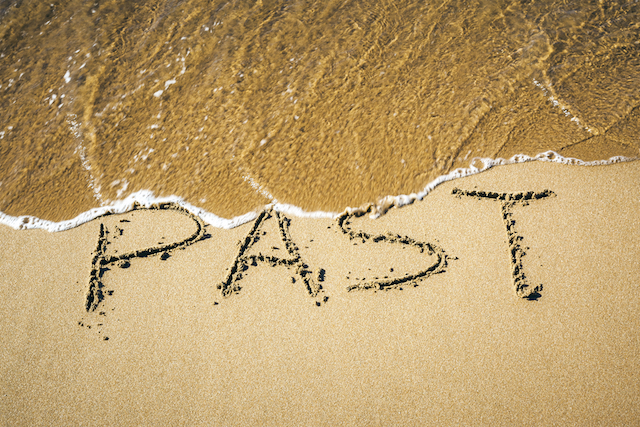
Past in the sand image via Shutterstock
-

You Have a Choice: Your Future Can Be Better Than Your Past
“Someone I loved once gave me a box full of darkness. It took me years to understand that this, too, was a gift.” ~Mary Oliver
On the January 17, 2000, I was in a car crash. I was living in France at the time. I don’t remember much about the crash. I know that we all walked out of the car relatively unscathed. Shocked, scared, and confused, yes. Injured, no.
I remember thinking that I should probably call my mum and dad back in England. Tell them what happened. What I didn’t know in that moment was that back in the UK, I didn’t have a mum to call anymore.
That same afternoon, on the 17th January 2000, was also the day my mum had decided to take her own life.
I found out about my mum’s death standing in the reception of the hotel we had walked into after the crash.
“Liz, she’s gone.”
That’s all I heard at the other end of the phone. It’s all I had to hear. I knew. It was my sister’s voice. She’d managed to track me down in the hotel.
It’s weird because I remember thinking in that moment, “Okay, my mum has just died and I now have to tell some people I don’t know that my mum has died, and I don’t want to put them out or get them all upset, so I’ll just be matter of fact and straight up and not cry.”
Matter of fact. Straight up. I won’t cry. And that’s how I chose to deal with the aftermath of my mum’s death.
While everyone fell apart around me, or grieved, I was the one who was totally okay. I was so together and dealing with it quietly, like I was totally fine.
I remember one day, standing at the checkout of a supermarket, I stood next to my dad as he fell apart while we were packing cans of baked beans into the carrier bag.
I looked at him, the giant pillar of a man I had always known—wracked with the most intense grief for his wife—and thought, “I am alone in this. I’ve got to be strong because no-one else will be.”
I returned to France three weeks after my mum’s death. I couldn’t wait. I spoke to no one of her death. People knew, of course, but death is weird, isn’t it? It shuts people down. Especially suicide.
“How did your mum die?”
“She killed herself.”
Oh. No more questions.
Back in France, I got drunk a lot. I was the first person at the party and the last one to leave. If there was something stupid to do, I was there, the life and soul, but if anyone got too close I’d push them away.
I was the master pretender. The chameleon. Always fun and happy and having the best time, yet on the inside it was ugly and dark and I was wracked with grief that was so painful, the only way I could cope with it was to numb it out. To not allow myself to feel anything.
I started developing strange behaviors about seven years after my mum died. The grief that had been locked in the box in my head for so long finally exploded, and it manifested itself not by crying and grieving, but in horrific anxiety and OCD and really weird thoughts that freaked me out.
I also started to wonder what it would be like to not be alive anymore. To not have to walk around and be the girl whose mum killed herself and deal with all the crap that came along with it.
I remember walking past a huge wall one day and wondering what it would be like to climb to the top and jump off it. I wondered whether the impact would kill me.
It was in that moment, staring up at that wall, that I actually felt something for the first time. And that feeling was relief. Relief that I had a choice. A choice of whether I lived or died. A choice in my future.
As numb and as twisted as I felt right there in that moment, I remember smiling. Because it was up to me what happened next. I chose to walk away from that wall. To start living again even if I didn’t know what that meant exactly at the time.
I decided to not let my mum’s death, which had dogged me for some many years, become a reason to end my life too.
And I don’t just mean end my life by suicide, but to end my life emotionally, to shut down, to numb out, to allow what happened to become my story—the story of someone who shirked away from her own life because her mum killed herself and the world now owed her something for taking her away.
But guess what? The world didn’t owe me anything, and the world doesn’t owe you anything either.
We are all victims of something that has happened in our lives. We ruminate and torture ourselves with things that were said or not said, and about what happened or didn’t happen or things that haven’t even happened yet.
We react to things like a tightly coiled spring, red raw from experiences and situations that lie well in the past. And yet most of us allow our past to build our future.
It’s the reason why you can’t commit to men, because your dad walked out when you were five, or you don’t make friends easily because of that one moment in the playground, aged eleven, when the popular girls made fun of your glasses.
It’s the reason you go to work to a job you hate every day, because you decided early on in life that you weren’t good enough and that you’d just settle for less than.
It’s the reason we make so much meaning out of things. You receive a text message and they don’t end it with a kiss, or someone signs off their email with “regards,” and your immediate thought is, “What did I do?”
You see your boss walking toward you in the corridor at work and you say hello to him, but he keeps his head down and doesn’t respond. “Oh my god, why did he not say hello? Maybe I’m one of the ones who’ll be made redundant?”
We attach so much meaning to everything, don’t we? And yet here’s the thing. There’s what happened and our story about what happened, and assuming the two things to be the same is the source of much pain and unnecessary self-suffering.
Some people just don’t like leaving kisses at the end of text messages, and your boss just found out his wife has cancer and didn’t notice you walking toward him in the corridor, and Barry in accounts doesn’t think that “regards” at the end of an email sounds rude because Barry is more interested in getting the email written and sent so he can leave at 5pm, and fifteen years ago my mum died.
You’re not five anymore. You’re not eleven and I am not the eighteen-year-old girl whose mum blew out the candle without saying goodbye.
You have a choice. Today, right here, right now, you have a choice in how you’re going to show up, not just while you’re reading this, but right here in your life.
You only have one life. And yet you always have lots of choices. About how you respond to what has happened to you in your life and what you do with it as a result.
We can become wrapped up in darkness and negativity, blaming everyone and everything, or we can take from what has happened and learn something about ourselves.
My favorite poet, Mary Oliver, wrote in her Thirst collection, “Someone I loved once gave me a box full of darkness. It took me years to understand that this, too, was a gift.”
And now, writing this, fifteen years after my mum’s death, I feel grateful, not that she died, but that amidst the heartache and the grief and the intense loss, I found out who I was.
And I did so because I made a choice. To show up. To live the life that I wanted to. To take responsibility. To rewrite my story. To not just be the girl whose mum killed herself. But to be the woman who chose to decide that my future is bigger and better than my past.
And I invite you to do the same.
Change image via Shutterstock
-

How To Change The Past By Changing Your Thinking
“The most positive action we can take about the past is to change our perception of it.” ~Deepak Chopra
Death didn’t happen quickly like in the movies.
A compassionate nurse set the tone and gently guided us through the ordeal. Mom, Dad, my other brother, and I spread out so that one of us held each of Chris’ hands and feet with a person at his head. Time passed in slow motion.
In horror, I watched for more than an hour as his breathing abated, with the pauses in between his raspy, strained breaths becoming longer and longer. I fervently sent him love and light and wished him peace as I watched the scene unfold through my tears.
Chris’ lips were chapped and cracked from breathing oxygen through a mask for weeks. A piece of skin on his upper lip fluttered with each breath, but in the prolonged pauses between breaths, it lay still. Each time the skin went inert, I thought, “This is it.”
But he would take another shallow breath one more time until the flap was frozen and his chest motionless forever. Putting a stethoscope over his heart, the nurse said, “It’s awfully quiet in there.”
It was New Year’s Eve 1995. After two years of rapidly declining health, Chris, my brother with the wicked sense of humor, flawless taste, and the ability to make me believe he was invincible, succumbed to AIDs at the age of thirty-three.
In the years following his death, I numbly went on with my life, like I was supposed to, like I had to. Being the mother of two beautiful, energetic young boys, there was plenty to be happy about and thankful for, but I only grew more depressed as the gruesome scenes of Chris’ sickness and death played on an endless loop in my head.
As time passed, Chris became a distant memory, like a book I knew I’d read once but couldn’t quite recall. I knew how the story ended, but the details were blurred behind a cloud of hurt.
Over the years, the highlights reel of the ugliness from my eighteen-year marriage and divorce got equal mental airtime along with the drama from a subsequent tumultuous three-year relationship.
Eleven years after that New Year’s Eve in the hospital, I found myself a depressed, divorced, single mother with no idea who I was or why I was here.
I couldn’t find anything resembling the strong, smart, feisty sister Chris had loved. In a pill-popping stunt, I tried to commit suicide, which only made things worse—much worse—resulting in a serious brain injury and losing custody of my boys.
While healing from the suicide attempt, I realized that I had been torturing myself with the painful memories. I was doing it to myself! While this point may be apparent to some, it was a huge “aha” for me, and I also realized that if I was doing it, I could stop it.
Yes, Chris died and went through a horrible illness. Yes, there were many messy times from my marriage, and hurts from the following relationship. All of it really did happen—no denying that—but I was the one keeping the pain alive and bringing it into the present.
It really boiled down to making the decision not to do this to myself anymore.
Because of neuroplasticity, the scientifically proven ability of our brains to change form and function based on repeated behaviors, emotions, and thoughts, the more I dwelled on the sad memories, the more I reinforced them.
“Neurons that fire together, wire together.” This saying, from the work of Donald Hebb, means that synapses, the connections between neurons, get more sensitive and new neurons grow when activated repeatedly together.
Our brains also add a subjective tint to our memories by subconsciously factoring in who you are and what you believe and feel at the time of the recollection. The act of remembering changes a memory. So, as I became more depressed and hopeless, the memories became darker.
But the good news is that the reverse is also true. Neural connections that are relatively inactive wither away, and a person can consciously influence the process in a positive, healthier way. I made the memories stronger and more painful, and I could make them weaker and more loving.
Through mindfulness and meditation, I learned to become aware of and take control of my thoughts and mind. By realizing my subconscious influences and consciously choosing which ones I allowed to have impact and intentionally inserting new ones, I changed my past.
Not literally, of course. But by pairing more positive thoughts and emotions with negative memories and feelings and modifying my perspective about past events, I changed their role in my present, which, in turn, altered my brain and life for the better.
The goal is not to resist painful memories or experiences and grasp at or try to force positive ones instead. That’s almost impossible and leads to its own kind of suffering.
In his book, Buddha’s Brain: The Practical Neuroscience of Happiness, Love, and Wisdom, Rick Hanson writes:
To gradually replace negative implicit memories with positive ones, just make the positive aspects prominent and relatively intense in the foreground of your awareness while simultaneously placing the negative material in the background….
Because of all the ways your brain changes its structure, your experience matters beyond its momentary, subjective impact. It makes enduring changes in the physical tissues of your brain which affect your well-being, functioning and relationships.
If your head is filled with painful memories of the past, I want you to know that you can change this! I did.
I certainly still remember Chris’ tragic illness and death, but I choose to focus on the times we laughed so hard that we got the “gigglesnorts.” I prefer to see him on the dance floor working up a sweat. I recall how much he loved me and that adored feeling I had when I was with him.
I even view his death differently now. Instead of feeling the horror and shock of that night, I can now feel the love and support for him and one another in that hospital room.
In any life, past and present, there’s always going to be pain, joy, and everything in between. Your experience of your life and your brain are shaped by what you choose to focus on. You can torture yourself with the past or choose better feeling thoughts and memories.
It really is that simple. Simple, but not easy.