Tag: parents

  • 5 Surefire Signs You Grew Up with an Emotionally Immature Parent

    5 Surefire Signs You Grew Up with an Emotionally Immature Parent

    “There’s no such thing as a ‘bad kid’—just angry, hurt, tired, scared, confused, impulsive ones expressing their feelings and needs the only way they know how. We owe it to every single one of them to always remember that.” ~Dr. Jessica Stephens 

    All children look up to their parents from the moment they enter this world. They have this beautiful, pure, unconditional love pouring out of them. Parents are on a pedestal. They are the ones who know what’s best! They are the grownups showing us how to do life!

    We don’t think for one moment that they could be showing us the wrong way.

    I, like many others, adored both my mum and dad. I could not see their flaws, their pains, or their trauma. I just loved them and wanted to spend time with them. If they shouted at me and told me I was wrong, I trusted that they were right, no question.

    When I had non-existent self-esteem, anxiety, and suicidal ideation because I believed I was not good enough, I blamed that 100% on myself. I had unconsciously recorded all those moments when their behavior had made me feel not good enough as my own fault for being ‘bad,’ not considering they could have had something going on themselves.

    When I struggled in romantic relationships, always chasing unavailable men, I held myself responsible and never for one minute thought that this pattern of behavior stemmed from my relationship with my parents. I believed what they had told me in different ways—that I was the problem!

    The reason I struggled in relationships, I later discovered, was that my parents were not actually okay when they were parenting me because of their own traumas and were emotionally immature.

    Here are five signs you had emotionally immature parents and how may it impact you.

    1. Their feelings and needs were more important than yours.

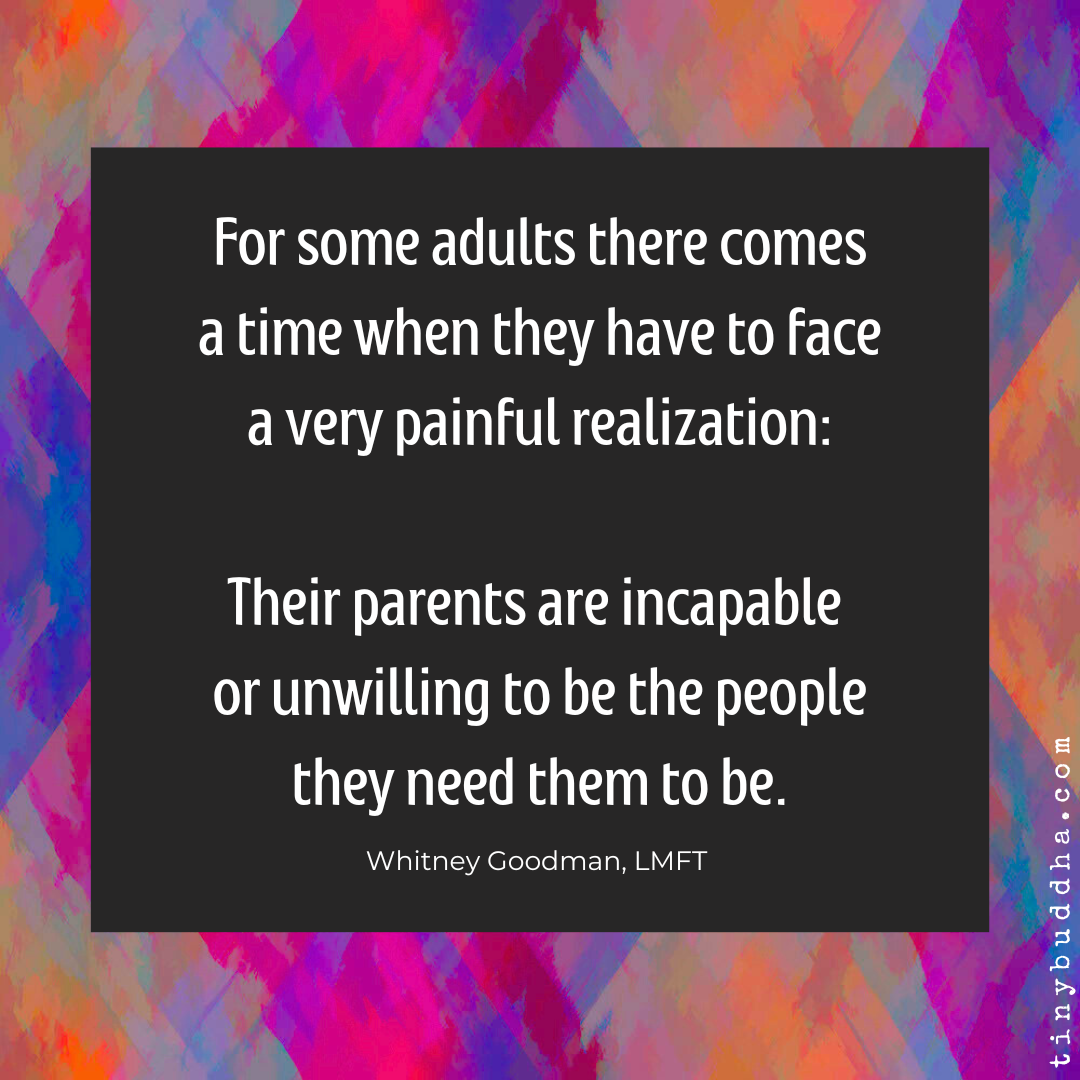
    Emotionally immature parents can be incredibly self-absorbed and distracted by their own feelings and emotions, and they want their child, you, to regulate them.

    For example, when my mum was upset, I would be affectionate toward her and soothe her. As I got older, she would be angry with me if I was not there to soothe her when she needed it, saying I was selfish and she had no one. I believed her.

    I was off playing with my friends and being a child, but this was not allowed if it meant I couldn’t meet her needs and calm her emotions. As a result, I learned it was not safe to choose my needs over hers, as she would withdraw her love from me, which felt so scary. My heart would race, and I would feel terror take over my body.

    As an adult, this meant I believed I was responsible for other people’s emotions, and if they were angry or upset, it was my fault. So I would always walk around on eggshells just in case someone might attack me for upsetting them. Because I believed everyone’s pain was my fault, I attracted more relationships like the one with my mum. These relationships made me feel powerless.

    2. Expressing your feelings or needs was not safe.

    When you expressed a feeling and it was met with a negative reaction from your parent, it created a world of panic inside your body. For example, sharing how you were struggling could have been met with a comment about how their lives were so much worse and you should stop being so dramatic.

    Expressing a need, like asking for a ride somewhere, could have launched an attack about how selfish you were—and didn’t you realize how hard your parents were working!

    So what happened? You stopped expressing your feelings and needs and buried them deep. (For me, I topped them with ice cream and sugar for comfort.) As an adult, you may now be so cut off from your own emotions and needs that you act as if you don’t have any.

    3. They did not take responsibility for their actions.

    They’d say or do something that really hurt you, but they wouldn’t acknowledge it, nor apologize. In fact, they may have just carried on as normal.

    Your relationship with them was not repaired as a result. You may have tried to resolve the situation, but you were the only one trying, and you may even have found yourself blamed for something you didn’t even do. The whole situation would leave you feeling crazy and like you didn’t know what’s true. You may even have started thinking it was your own fault.

    As an adult, you might repeat this dynamic in other relationships, feeling powerless to repair and resolve issues that arise. This leads to resentment and staying in unhappy relationships because you don’t know it can be any other way.

    4. They have no idea how to regulate their emotions.

    They walked around triggered by their emotions all day. They had no idea how to bring themselves back into balance. They’d come home exhausted from work, but rather than doing something to discharge from the day, they’d get stuck in their chores and then take out their emotions on others due to resentment over being so tired.

    They also might have had no idea what they were feeling. Maybe they were constantly angry because they lacked the self-awareness to recognize they were really feeling sad or anxious or overwhelmed. And because they didn’t know what they were feeling, they had no idea what they needed to do to feel better.

    5. You were forced to grow up before your time.

    It wasn’t okay for you to be a child. They found it way too stressful, so you were encouraged to be a little adult. Maybe even a little adult that parented them. It was also not safe for you to be a child. You couldn’t be loud or silly, as they could have lost their temper, so you walked around on high alert waiting for this. You may have learned to be the calm one because your parents weren’t.

    I found myself getting involved in their very grown-up arguments as a child just to try and keep the peace in the house. This is not the role of a child. If you had the same experience, you may find yourself attracting similarly codependent relationships as an adult.

    If this childhood sounds like yours, you are not alone. There are many of us. There is an inner child within you that missed out on so much love, nurturing, encouragement, and balance, which could be the reason you are struggling now as an adult.

    It is not because you are not good enough or because you are to blame for everything. It is because you were raised by emotionally immature parents. Effectively, you were raised by children in adult bodies.

    You could still be dealing with these patterns as an adult with your parents, as they could be children in even older bodies now!

    Learning how to be emotionally mature yourself so you don’t repeat the patterns with your own children is a wonderful gift to be able to give them, but also it means you can have healthy relationships and find peace within. Healing and reparenting your inner child means you will be able to express your emotions and have boundaries so others don’t think it is okay to do the same to you.

    I used to feel powerless when people treated me like this, not just with my parents but in other relationships too. I would try to be whatever they wanted me to be, but they would still react in the same ways no matter what I did. Stepping back from them and focusing on healing my inner child, understanding her feelings and needs, and holding space for her has changed my life. I was able to become the parent I always longed for.

    I understand now that my parents were emotionally immature, as they were raised by emotionally immature parents too. They were mature with money and jobs, but with emotions, they were out of their depth because no one showed them how to manage them, and unfortunately, they never learned.

    But we can be the generation that breaks this pattern by being the emotionally mature parent we needed. We can be the example of healthy relationship dynamics that we never had.

    **This post was originally published in 2022.
  • How to Calm Anxiety That’s Rooted in Childhood Wounds

    How to Calm Anxiety That’s Rooted in Childhood Wounds

    “Anxiety is a response to a nervous system that learned early on it had to protect itself.” ~Dr. Hilary Jacobs Hendel

    Anxiety shaped much of my life—how I showed up, how I held myself back, and how I connected with others. For years, I didn’t even know what it was. I just knew the pounding heart, the tight chest, the trembling hands. I knew the shame that followed every “failure,” big or small, and the fear I would never be enough.

    For a long time, I thought I was the problem. But anxiety isn’t a moral failing. It’s a part of me that learned to survive in environments where my emotional needs weren’t met, where fear and shame felt louder than safety.

    Where It Started

    The roots of my anxiety began in childhood.

    I was in first grade when I brought home my school report card and saw that I ranked seventh in my class. At that age, I didn’t know if that was good or bad. I was just excited to tell my dad.

    When he came to pick me up, I smiled and shared the news innocently. Instead of a hug or encouragement, his eyes glared at me. His sharp, aggressive tone cut through me as he shouted, “It’s bad!”

    Looking back, I can see his reaction came from fear—that my performance might limit my future and that shaming me would push me to improve. But as a child, I couldn’t see that. I felt shocked and humiliated. My small body trembled, and my younger brain concluded:

    “I’m only worthy of love if I perform better.”

    The next semester, I ranked third. My dad bragged about it to everyone, and I felt brief relief. But the fear returned quickly:

    “What if I can’t keep this up?”

    That was the beginning of a belief that no matter how much I achieved, I was never “enough.”

    This pattern followed me for decades, surfacing in unexpected places. As an adult, I would freeze with anxiety at gas stations, trembling as I pushed my motorbike forward even when no one was rushing me.

    Eventually, I connected it to another childhood memory: my dad shouting at me to move faster in line at a gas station, his glare and sharp tone burning into me again. When processing this as an adult, I realized he had a good intention—to move things along for the other people waiting. But before I began my healing process, my nervous system was wired to react to the present as if I were reliving the past.

    Even years later, the anxiety lived on in my body, and I didn’t know how to process it.

    The Breaking Point

    I carried this unprocessed anxiety into adulthood. When I was five weeks pregnant, my partner was in a tragic accident that left him in a coma for two weeks before he passed away. Suddenly, I was alone, grieving, and without money to survive.

    I didn’t have the privilege of avoidance anymore. Grief, financial instability, and the responsibility of carrying a child forced me to face emotions I had buried for years.

    This was when I learned the practices that helped me stop spiraling and regain my composure.

    10 Tips That Help Me Prevent and Manage Anxiety

    Important note: These tips are not a substitute for therapy, medication, or professional diagnosis. They are complementary practices to help restore balance and create a sense of safety in the body.

    1. The gratitude shift—turn anxiety into information.

    Instead of berating the intense sensations anxiety brings, I now try meeting it with gratitude. Anxiety is my body’s built-in alarm system.

    When I feel it rising, I say, “Hi, anxiety. I see you doing your job. Thank you for showing up.”

    Then I ask:

    What is this sensation trying to tell me?

    Where is this coming from in my history?

    What action can I take now to feel safer and more supported?

    This small act of acknowledgment makes space to feel more in control and invites curiosity instead of fear.

    2. Slow down and simplify your life.

    Too many distractions can block memories and emotions from surfacing. Simplifying my life gave me mental space for self-awareness.

    I released unnecessary obligations, overpacked schedules, and numbing habits like endless scrolling. When I slowed down, I could finally hear myself and recognize what was driving my anxiety.

    3. Trace the roots through quiet observation (and fasting).

    Closing my eyes and observing the first persistent memories that surface often reveals the root of anxiety.

    When I couldn’t afford therapy, I used intentional fasting to access clarity. (If you decide to give this a try, I recommend consulting with your doctor first. This is my personal spiritual practice, not a universal recommendation.) I started slowly with:

    • A twelve-hour fruit and vegetable fast, then
    • A twelve-hour water fast, then
    • A full-day fast (6 a.m. to 6 p.m.)

    Each time hunger arose, I named my intention out loud through prayer or journaling: “Please show me the root cause of this anxiety and how to release it.”

    Fasting, for me, was a deliberate way to quiet external noise so buried memories and insights could surface.

    4. Catch the first emotion—shock.

    My body often stores layers of pain, and shock is usually the first overwhelming emotion. If I can name it quickly, I can interrupt the spiral.

    For example, when I was feeling overwhelmed as a mother, I’d sometimes snap at my daughter. I’d get frustrated and angry with myself, but after fasting, the memory of my parents snapping at me came up quite vividly.

    Remembering this, I allowed myself to see, acknowledge, experience, and accept how painful and shocking it was for me to be treated that way.

    5. Write in detail what shocked you (and other emotions).

    After naming shock, I write the exact details of what triggered it: the sudden glare, the change in tone, the clenched jaw, the slammed door.

    Then I name the other emotions as honestly as possible: fear, humiliation, sadness, anger, or betrayal—whatever is true in that moment.

    Being radically honest in this process helps me release the experiences that I previously stored as trauma.

    6. Grieve the losses.

    Once I release the shock, I let myself grieve. I cry for the safety, compassion, and respect I needed but didn’t receive.

    Sometimes I use music to amplify the sadness so it can move through me. This isn’t weakness—it’s how the body processes pain instead of storing it.

    7. Name the unmet needs.

    Grief opens the door to understanding my needs.

    “When I was shouted at by my dad after making mistakes, I felt unsafe and ashamed. My need for emotional security was violated.”

    “When I was only praised for achievements, I felt unseen. My need for consistent acceptance was neglected.”

    Naming needs clarifies what’s important so I can ask for it clearly and assertively as an adult. It’s empowering to name the hurt and see how it helps me understand my emotional needs better.

    8. See the context—compassion for your parents’ limitations.

    Fasting and becoming a mother helped me understand the hardship my parents faced. Parenting a neurodivergent child with limited resources, little support, and financial stress is overwhelming.

    This doesn’t excuse the harm, but it helps me hold two truths:

    1. Their actions hurt me.
    2. They were also struggling humans who lacked the tools to parent better.

    This perspective softens resentment and breaks cycles.

    9. Write down the worst-case scenarios.

    While processing the past experiences that have contributed to my anxiety can help decrease anxious feelings in the present, it also helps to challenge how I think about the future.

    When I spiral, my brain floods me with worst-case scenarios. Positive thinking never helped—it only deepened my fear.

    Instead, I confront the fears by writing down every possible worst-case outcome, even the most extreme. I’ve lived through homelessness, earthquakes, and tragic losses. Pretending they couldn’t happen again didn’t work.

    By naming them, I strip them of their power.

    10. Prepare intuitive actions and identify help.

    After writing the worst cases, I ask:

    What is the first intuitive action I can take to prevent or reduce the impact?

    Who is the first person I can contact for help? Who else could I reach out to?

    Writing these down gives me agency. It tells my nervous system, “I’m not helpless. There are things I can do and people I can ask for help.”

    Anxiety is a part of me. Experiencing the spiral because I didn’t know how to name, process, and communicate it sucks.

    I’m still a work in progress when it comes to maintaining composure consistently, but I feel empowered knowing that I’m mastering emotional intelligence—skills I can pass down to my child.

    Healing is not linear, and some steps will feel harder than others. But with consistency, these practices can help you restore a sense of safety, reclaim your agency, and soften the belief that you must always be on high alert.

  • Healing Without Reconciling with My Mother and Learning to Love Myself

    Healing Without Reconciling with My Mother and Learning to Love Myself

    “Owning our story and loving ourselves through that process is the bravest thing that we’ll ever do.” ~Brené Brown

    Several years ago, I wrote a heartfelt letter to my estranged mother, articulating my deep feelings about her perceived lack of empathy and care. My intention in writing the letter wasn’t to ignite conflict; it was to sincerely share my perspective.

    Rather than lashing out with blame, I expressed my profound sadness about feeling parentless and the struggle of raising myself without parental love and guidance, something I desperately needed at times.

    I bared my soul, detailing the emotional turmoil our relationship has had on me as an adult, and expressed the longing for connection that always seemed just out of reach.

    After completing the letter, I did something I thought at the time was a bit reckless: I mailed it. Now looking back, I realize it was a courageous step toward advocating for my emotional health, confronting my truths head-on.

    I had no expectations and was prepared for any outcome, including silence, which often felt like our norm. However, mailing it felt like a cathartic release and was undeniably liberating.

    Months passed without a response. I had kept my expectations low but remained hopeful that perhaps she would reflect on what I had shared and gain some insight into our dynamic. Then, almost nine months later, I found myself at a family gathering out of state, and she was there. I had a vague notion that she might show up, but I hadn’t put too much thought into it.

    A rush of panic enveloped me, especially knowing my children didn’t even recognize her. My husband supported me, rubbing my back to help me through the initial shock of seeing her after so many years.

    As conversations swirled around me, I felt an odd sense of being at an event together yet acting like strangers. Though it wasn’t much different from before, I had openly shared a vulnerable part of myself in that letter, which she never acknowledged receiving.

    During the gathering, we barely spoke; our unresolved past loomed between us like an unbridgeable chasm. As the event was wrapping up, my family and I collected our jackets to leave, and then she walked over to me.

    With a sincere expression, she said, “You were right, and I’m sorry.” That was all that passed between us, and then I left. As I walked out the door, a wave of sadness crashed over me, not just from the validation but from the acknowledgment of our painful reality.

    In that moment, I recognized that while the deep understanding I’d once yearned for might never materialize, that exchange marked a significant turning point in my healing journey.

    Through this process, I learned invaluable lessons about boundaries—how to say no without guilt, to stop explaining myself, and to recognize when emotional distance is an act of self-respect rather than rejection. I discovered that safeguarding my emotional space was not just essential but necessary for my well-being.

    Although my connection with my mother remains the same, my inner transformation has been profound.

    I still grapple with sadness that my children will not know their grandmother, leaving me with a wound that is still healing. However, I have learned the art of giving and receiving love in healthier ways. I prioritize open communication with my children and partner, ensuring that their feelings are validated, something I wished for during my upbringing.

    Not everyone is fortunate enough to have their experiences acknowledged. Many of us carry the weight of unvalidated pain, silently wishing for recognition that our feelings matter. The journey of writing a letter reinforced the power of self-love as a transformative force, even in the absence of answers or sincere apologies.

    Self-love for me is about nurturing inner compassion for myself and understanding and recognizing the validity of my feelings, independent of external validation.

    The seeds of self-love began to flourish in my twenties with small acts of kindness toward myself, moments of self-forgiveness, and the courage to question the beliefs I’d carried since childhood.

    It was a crucial period when I started to challenge the idea that my worth depended on pleasing others, and I allowed myself to feel fully—to name and honor my emotions without shame or self-censorship.

    During this time, I began seeing a therapist, which offered me a safe space to examine how my sense of worth had been shaped by my mother’s unpredictable affection and the silence that shaped me when it was withheld.

    Books like Adult Children of Emotionally Immature Parents by Lindsay C. Gibson and The Gifts of Imperfection by Brené Brown helped me understand and reframe these patterns, guiding me toward self-compassion and a more stable sense of self-worth.

    With the support of a nurturing chosen family and the continued guidance of therapy, I’ve been able to unravel beliefs that no longer serve me—such as the idea that my worth depends on others’ approval, that my emotions should be contained to keep the peace, and that love must be earned through perfection or compliance. Letting go of these patterns has allowed me to reclaim my sense of self and to honor my feelings as both valid and necessary.

    As I contemplate this recent encounter with my mother, I see the evolution of my perspective since I began advocating for my emotional well-being. I’ve come to understand the delicate balance between expectations and reality—the longing for a different kind of relationship coexisting with the acceptance of what is. It’s a balance that asks me to hold compassion for her limitations while still protecting my own heart.

    Each lesson I’ve embraced about self-love has become foundational—learning to set boundaries without guilt, to speak my truth, and to treat myself with the same tenderness I once reserved for others.

    These shifts have reshaped not only my relationship with myself but also how I engage with the world around me. Now, I give and receive love in healthier, more meaningful ways, ensuring that my relationships are grounded in mutual respect and appreciation.

    This healing journey has profoundly shaped my approach to parenting. I aim to teach my children the significance of setting boundaries and advocating for their emotional well-being, rather than simply seeking to please others or maintain peace at all costs. They see a mother who is honest about her feelings and who takes care of herself instead of abandoning herself, which serves as a powerful lesson that goes beyond words.

    While my relationship with my mother may never be what I hoped for, it has guided me toward a fuller sense of self and a more authentic, balanced way of loving. And I’m committed to continuing on this healing journey. I’ve unearthed the strength within me to heal and evolve—strength that exists independent of external acknowledgment.

  • When the Body Freezes: On Love and Grief in Midlife

    When the Body Freezes: On Love and Grief in Midlife

    “I was constantly seeking a balance between mourning what’s already been lost, making space for the time and moments we still had left, and making sense of this complicated process that felt like my heart was split between two contrasting realities: hope and heartbreak.” ~Liz Newman

    There is a quiet heaviness that begins to settle into many of us in midlife.

    It doesn’t announce itself with drama. It slips in through unanswered emails from an aging parent, through half-slept nights spent wondering how we will ever afford live-in care, or whether that one fall they had was the beginning of the end.

    It’s not grief exactly. It’s the shadow of grief that lingers before the loss, that creeps in through ordinary moments and whispers that everything is slowly, quietly, but undeniably changing.

    My mother has Parkinson’s. She lives alone in the UK while I live abroad—untethered by design, a traveling healer by choice—except now that freedom feels like it comes at a cost I never calculated.

    She has started falling. Backwards. Her voice is nearly gone. I can barely understand her over the phone anymore, and every time she forgets a detail or struggles to find a word, my stomach knots.

    I wonder when the dementia will get worse and instead of only forgetting my birthday, she will also forget about me: her eldest daughter. I wonder how long she can live on her own. I wonder what happens when things really go south.

    And I panic.

    The truth is, I can’t just pack up and move to the UK. Not anymore. Not with Brexit and visa restrictions. These days, my visits are brief, limited to a few weeks or months at a time. Right now, I’m here for the summer, doing what I can while I can.

    Add to that the financial uncertainty of running a healing business and the lack of steady income to support full-time care. The weight of it all settles quietly. Like many of us, I carry it in silence and swallow the worry. I fold it into my body, into the slope of my shoulders. The right one, to be exact.

    Until one morning I wake up, and I can’t move my right arm the way I used to. Turning it inward sends a sharp pain up through my upper arm. At first, I think I must have slept weirdly. But when the pain lingers for days, my hypochondriac side takes over. I start googling symptoms. And frozen shoulder pops up.

    I pause. Then I type in “spiritual meaning of frozen shoulder.”

    And everything clicks.

    In spiritual traditions, the shoulder is where we carry burdens that were never ours. It’s where we hold onto responsibility, overcare, and all the invisible weight of things unsaid.

    When a shoulder freezes, it may be our body’s way of saying, “I can’t carry this anymore.”

    A frozen shoulder can also signify:

    • Suppressed grief or emotion, often near the heart
    • Over-responsibility and carrying others’ pain
    • Fear of moving forward, or feeling stuck
    • A lack of energetic boundaries
    • A subconscious attempt to halt motion when our lives demand change

    All of these mirror how I feel about my mother. The anticipatory grief. The helplessness. The guilt. The stuckness of being in-between countries, in-between decisions, and in-between who I was and who I need to become. Wanting to take care of her and to sign the power of attorney papers and equally not wanting to do any of it because it’s just so damn painful.

    The Midlife Guilt That Has No Language

    There is no manual for this phase of life. For the moment when your mother still lives but is slipping. When you are still someone’s child but also now the one silently parenting the parent. When love no longer feels light but edged with dread and uncertainty.

    And unlike childhood, this stage has no defined rite of passage. We often endure it quietly, bravely, invisibly. We plan around it. We work through it. We cry into our pillows about it.

    We don’t want to be seen as selfish. We don’t want to fail them. We don’t want to map a life of meaning only to feel like we missed the most important chapter back home. And then the body begins to speak.

    Reclaiming the Self While Loving the Mother

    Healing my shoulder may take time. Physically and emotionally. But it has also been an invitation to ask: Where am I over-caring? Where am I still trying to prove my worth through sacrifice? What if I let myself hold love and limits?

    Maybe I don’t need to force myself to stay for an entire summer out of guilt that I otherwise don’t live nearby.

    I don’t yet have all the answers about my mother’s care. But I know this:

    • I don’t need to disappear to honor her: I don’t need to dim my joy in front of her so she doesn’t feel the contrast of what she’s lost.
    • I don’t need to break to be a good daughter: I don’t need to say yes to every request out of fear that one day, she won’t be able to ask, nor do I need to say “I’m fine” when I’m anything but.
    • I don’t need to put my dreams on hold to make up for the years I wasn’t there, or carry the weight of what I couldn’t prevent.

    Maybe the most radical thing we can do, in a world where many of us live oceans away from aging parents, is to stop blending ourselves into the expectations of those who stayed behind. Our parents. Our siblings. The ancestral and societal chorus of “You owe them everything.”

    Because the truth is we can’t always return. Not like generations before. The village is gone, the visa expired, the life we’ve built stretches across time zones and cultures.

    Maybe we need to learn to soften the guilt without hardening our hearts. I wonder if we can learn how to grieve the distance without erasing ourselves. Can we find a new kind of middle path where love is not measured by geography but by presence, honesty, and the quiet ways we still show up?

    What if love is no longer a burden carved from duty but a bond held with tenderness and boundaries?

    If your shoulder aches too, or your chest feels heavy or your body is acting up in any way, pause. Because we were never meant to disappear into devotion and carry too much. We were meant to love with presence. To grieve with grace. And to remain visible, even while honoring those we come from.

    I have come up with a few journaling prompts I will journal through myself. If they are in any way helpful on your own journey, please feel free to do the same:

    Journaling Prompts for the Tender Weight We Carry

    1. Where in my body am I holding what feels too heavy to say aloud? What does this part of me wish I would finally hear or honor?

    2. What roles or responsibilities have I inherited culturally, ancestrally, or emotionally that no longer feel sustainable? Am I willing to release or reimagine them?

    3. When I think of caring for my aging parent, what emotions arise beneath the surface and beyond obligation? What fears, guilt, or grief live there?

    4. What does love look like without self-sacrifice? Can I write a version of devotion that includes my wholeness?

    5. If my body were writing me a letter right now about how I’ve been living, what would it say? What boundaries or changes might it ask me to consider?

    If you do, share in the comments what realizations came up for you.

  • I Lost My Father—and the Illusion of My Mother

    I Lost My Father—and the Illusion of My Mother

    “Sometimes letting things go is an act of far greater power than defending or hanging on.” ~Eckhart Tolle

    In July 2023, my father died in a tragic accident. We were devastated—my sisters, my mother, and I. Or so I thought.

    What followed in the months after his death forced me to confront the truth of my mother’s emotional disconnection, a truth I had sensed but never fully allowed myself to see. In losing my father, I also lost the illusion of the mother I thought I had.

    A Sudden Exit

    By September, just two months after my father’s death, my mother packed up and left the home we had just helped her settle into. She moved from Florida to Alabama to be with a man she had secretly loved for years—her high school crush. A man she had long referred to as her “co-author.” I will call him Roy.

    He had been a nightly fixture in her life for a while. She would stay on the phone with him late into the evening, even while my dad slept in the next room. She always claimed it didn’t bother my father. But looking back, I wonder if he just swallowed the discomfort, like so many other things.

    Let’s take a step back. In 2022, my sister and I bought a home for our parents to retire in comfortably. We thought we were giving them a safe and loving space to grow old together. But before my father even passed away, my mother had already planned her escape. The house we bought wasn’t her sanctuary. It was a stopover.

    She didn’t ask us for help moving. She didn’t even warn us. She bought new luggage, made quiet arrangements, and disappeared. We were suddenly bombarded with text messages filled with excitement: stories of her “new life,” her “adventures,” and her rediscovered love. She glowed with freedom while the rest of us were still gasping for air.

    A New Life, A New Name

    By January—six months after my father died—she was married to Roy. She changed her last name. She discarded decades of shared identity with my father like she was shedding an old coat. She left behind his ashes. She left the framed photos that we had prepared for his memorial. It was as if he had never existed.

    But it wasn’t just him she left behind. She also abandoned her daughters. Her grandchildren. Her great-grandchildren. A family many would cherish, tossed aside like clutter.

    Her new story was one of long-suffering redemption. She recast herself as the woman who had endured a marriage with a difficult man and had finally, after decades, found joy. The truth? She had slowly detached from the rest of us for years—investing more time in writing projects and Facebook groups aligned with Roy’s interests, and less in her own family.

    Her new husband had also just lost his spouse, only days after my dad died. The narrative practically wrote itself: two grieving souls who found each other through fate. But those of us watching from the outside knew the foundation had been laid long before the funerals.

    The Pain of Rewriting the Past

    Eventually, my sisters and I had to step away. We had asked for space to grieve our father—kindly, repeatedly. But every boundary was met with denial, deflection, or emotional manipulation. There was no recognition of our pain, only excitement about her “next chapter.”

    Sometimes I wrestle with the urge to correct her version of events. In her telling, she’s the eternal victim: a woman finally liberated, only to be judged by ungrateful daughters who refused to be happy for her. But I’ve learned that arguing with someone’s internal mythology rarely leads to healing. It only deepens the divide.

    So, I let go. Not of the truth, but of the need for her to see it.

    I grieved deeply—not only for my father, but for the mother I thought I had. I began to wonder: Had she ever wanted children? Had she ever truly been emotionally available? Was it all performative?

    Those are hard questions to ask. But once I allowed myself to see her clearly—not as the mother I hoped she was, but as the woman she actually is—I began to feel something surprising: relief. And eventually, acceptance. Accepting that a parent is incapable of giving you the love you needed is one of the hardest emotional tasks we face. But it’s also one of the most liberating.

    Breaking the Cycle

    There were red flags in childhood. My mom wasn’t nurturing. She often complained of pain, stayed stuck on the couch, irritable and disconnected from the rest of the family. I walked on eggshells around her. I can’t recall warm, playful memories. That emotional void quietly shaped me in ways I didn’t fully understand until recently.

    I developed an attachment style that drew me to avoidant relationships, repeating old patterns. I didn’t know how to ask for what I needed because I had never learned to recognize my needs in the first place.

    Through therapy, reflection, and support, I began to break the cycle. But it required giving up the fantasy. It required grieving not just the loss of my parents, but the loss of the childhood I wished I had. This is not a story of blaming parents, but rather one of gaining a deeper understanding of my mother to better understand myself.

    I want to be clear: I have compassion for my mother. She grew up with mental illness in her home. She wasn’t nurtured either. She didn’t learn how to attune, connect, or show up. She may have done the best she could with what she had.

    But compassion doesn’t mean ignoring harm. I can hold both truths: her pain was real, and so is the pain she inflicted.

    The Freedom of Letting Go

    I’ve stopped hoping for an apology. I’ve stopped trying to explain myself. And I’ve stopped trying to earn her love.

    Instead, I’m investing in the relationships that nourish me. I’m giving myself the emotional safety I never had. I’m allowing myself to feel it all—the grief, the clarity, the compassion, the peace. Letting go of a parent doesn’t make you cold-hearted. It means you’ve decided to stop betraying yourself.

    Because here’s the truth I’ve come to accept: we can love our parents and still recognize that the relationship isn’t healthy. We can give grace for their pain without sacrificing our own healing. And in some cases, we can—and must—walk away.

    There is freedom in seeing our parents as they really are—not as idealized figures, but as complex, flawed humans. When we hold onto illusions, we gaslight ourselves. We call ourselves too sensitive or too needy when in reality, we’re responding to unmet needs that have been there all along.

    To me, that doesn’t mean sitting in resentment about what you didn’t get from your parents; it means figuring out how to provide that for yourself as an adult. If we don’t examine those early wounds, we carry them forward. We struggle to trust. We tolerate toxic dynamics. We confuse love with emotional labor.

    Understanding where it all began leads to healthy change. We can choose different relationships. We can choose ourselves.

    And that, I’ve learned, is where healing begins.

  • Raised on Their Best Intentions—Healed on My Own Terms

    Raised on Their Best Intentions—Healed on My Own Terms

    “Out of suffering have emerged the strongest souls; the most massive characters are seared with scars.” ~Kahlil Gibran

    There are two versions of me.

    There’s the one I am now—the grounded, present woman who holds space for others, who guides people toward healing, who walks barefoot through the grass and whispers affirmations while sipping her coffee.

    And then there’s the other version. The one who barely made it. The one who used to stare into her fridge not out of hunger but as a distraction from the ache in her chest. The one who didn’t feel at home in her body. The one who was certain no one could ever understand the weight she carried, let alone help lift it.

    If you’ve ever felt pain that rewired your entire being, you know:

    Trauma doesn’t just live in the mind.

    It takes root in the bones, in the pauses between conversations, in the way you flinch when someone raises their voice—even slightly.

    For years, I was operating on autopilot. From the outside, I seemed fine. But internally, I was haunted by invisible wounds and unspoken memories.

    Then came the moment I will never forget—when I confronted the very people who gave me life.

    I was in my twenties. I’d been carrying years of resentment, confusion, and heartache. Every harsh word, every time I felt small—it all built up inside me.

    And I finally let it spill out during an emotionally charged conversation. I brought up a pattern that had deeply impacted me, hoping to be heard.

    I expected remorse, maybe even repair.

    But instead, I heard: “We did the best we could.” It was calm, maybe even resigned. It wasn’t unkind, but it felt like a door closing instead of opening. In that moment, I felt both understanding and a quiet ache, realizing we weren’t going to meet in the middle.

    Those six words didn’t offer relief. They didn’t soften the years of damage. Because understanding your parents’ limitations doesn’t erase your pain. But it does offer you a choice:

    To carry it forward. Or to finally put it down.

    That was the turning point.

    I realized I didn’t want to live stuck anymore—stuck in old stories, like believing I had to suppress my emotions to keep the peace, or that loyalty meant silence; stuck in shame and in patterns I didn’t choose. I wanted to heal. Not just for myself, but for every version of me that had felt unseen.

    So I started to write.

    Not for anyone else, but for me.

    When I couldn’t speak the truth out loud, I wrote it down. My journals became confessionals. My pen, a lifeline. My pain, my teacher.

    Eventually, I found tools that helped me dig even deeper—meditation, somatic work, subconscious reprogramming, hypnotherapy.

    I learned that the subconscious mind is like a computer. It stores everything you’ve ever believed about yourself—especially the painful parts. If you don’t update the programming, you’ll keep replaying the same loop:

    I’m not enough. It’s my fault. Love has to be earned. I must stay small to be safe.

    And when you realize that you can change that inner script? That’s when everything shifts.

    In 2020, I became a certified hypnotherapist. But truthfully, that was just the official title. My real training began the day I stopped running from myself.

    Through that work, I began to rewire old beliefs, release trauma stored in my body, and speak to my younger self with compassion instead of criticism.

    I finally started to feel free. Not perfect. Not enlightened. But freer.

    Free to cry and not apologize for it. Free to take up space. Free to stop fixing everyone else so I could finally tend to myself.

    Today, I help others do the same.

    Not because I have all the answers, but because I remember what it felt like to not even know which questions to ask.

    And if you’re reading this right now, I want to say something I wish someone had said to me: You are not broken. You are not behind. You are not unworthy. You are a soul who has walked through fire—and you’re still here.

    Healing is not linear.

    You will have days where you feel like you’ve regressed, where the sadness feels fresh, where you question everything. That’s okay.

    Progress isn’t perfection. It’s presence. And your presence—your willingness to look at your pain instead of running from it—is what will change your life.

    You don’t need to hustle your way to healing. You just need to return to yourself.

    So here’s what I’ve learned, in case it helps you:

    1. Triggers are teachers in disguise. They point to wounds that need tending. For me, being interrupted or talked over would trigger an intense emotional response—one rooted in earlier experiences where my voice didn’t feel valued. I also noticed that certain tones of voice, especially condescending ones, could instantly make me feel small.

    2. You are allowed to feel anger at those who hurt you and compassion for the fact they didn’t know better.

    3. The body holds trauma, but it also holds the key to release. Pay attention to your breath. Your posture. Your gut feelings.

    4. You can forgive and still hold boundaries, like saying no without over-explaining or stepping away from emotionally unsafe conversations. I’ve also created space by recognizing when it’s not my role to carry someone else’s emotional process—especially if it comes at the cost of my well-being.

    5. You can grieve and still grow.

    And most of all: You can rewrite your story at any time. Because you are not your past.  You are the author of your next chapter.

    So let it be one of reclamation.

    Let it be the moment you stop shrinking and start rising. Let it be the chapter where you stop surviving and start living.

    You are the light you’ve been looking for.

  • What I Know About Healing Now That I’ve Ended Contact with My Mom

    What I Know About Healing Now That I’ve Ended Contact with My Mom

    “Not all toxic people are cruel and uncaring. Some of them love us dearly. Many of them have good intentions. Most are toxic to our being simply because their needs and way of existing in the world force us to compromise ourselves and our happiness. They aren’t inherently bad people, but they aren’t the right people for us.” ~Daniell Koepke 

    If someone had asked me a year ago if I would ever cut contact with my mom, my answer would have been a definite no.

    After reconnecting with my dad in 2020 (we didn’t speak for over eleven years), I decided to handle this parent business differently.

    Part of me strongly believed that if I was healing and doing this inner work right, I would be able to find a way to coexist in a relationship with my parents, and that I had to do that at all costs.

    My mom and I were always very close. Although our relationship was toxic, we had a bond that I believed was unbreakable.

    She used to say that I was a rainbow baby since she lost my sister to a shooting accident before I was born. After my sister died, they told her she would never have more children. One year later, she got pregnant, and I was born. Everyone was saying that she was beside herself, and I believed it.

    Although there was a lot of abuse and violence happening in our household, I saw her as someone who was fighting for her life to move beyond the trauma of her past while losing it to a bottle of vodka to numb and escape.

    I believe this is why I always had this unsettling drive not to give up and be defined by the past while never shying away from addressing it. I saw the consequences we face when our souls are unhealed and how unaddressed trauma drives everything.

    The first time I clearly saw how toxic the relationship with my mom was and how it affected me was when I read the book Silently Seduced: When Parents Make Their Children Partners by Kenneth M. Adams, in 2020.

    It was the most difficult but revolutionary book that I had ever gotten my hands on. I remember times when I had to put the book down and take deep breaths to stomach the deeply confronting truth I saw myself in. Reading this book marked a breaking point for me when the dynamic between my mom and I started to change.

    As the years went on, her alcohol abuse became uncontrollable. I think she lost any desire to fight her addiction, which she always had before. Although we live on two different continents, I began to wake up to Facebook messages from her attacking me and calling me names while demanding I send her more money.

    Therefore, in December 2023, after pleading with her repeatedly to seek help and threatening her that I would stop talking to her if things continued the way they were, I decided to act on my word. I ended my contact with her for the first time. Since then, we haven’t been in touch. Here are four things this decision and reflecting on it periodically taught me about healing.

    1. Pain doesn’t always subside.

    Someone once told me that the pain that I feel regarding my mom will eventually subside. Although I am doing a much better job at dealing with this situation internally, I understand that pain of this sort doesn’t always subside. I must learn to carry it with grace.

    When we look at the person we love destroying themselves while not being able to do anything, how can we let go of the pain we feel? This pain comes from love, not from others doing us wrong. And those, to me, are two different types of pain. Although learning how to deal with our emotions is up to us, when we love, we also hurt.

    The two most empowering practices that have been helping me are accepting things I can’t change and allowing myself to release what I feel without stuffing it up. I don’t try to hold my emotions in or lie to myself that I don’t care when, in fact, I do. I choose not to shy away from the emotional discomfort and to take time to reflect on how I am progressing with this no-contact situation as I move through it.

    I also see my pain as a sign of the deep love I am capable of. Understanding that my capacity to feel pain reflects the capacity to feel love helps me ground myself and, in a way, befriend the pain instead of rejecting it.

    2. It’s important that we honor our healing.

    There is no right or wrong way to heal. It is one of the most complex and imperfect paths we will ever walk, and honoring every step of it is the only thing we “should” do.

    For all those years, I felt immense guilt that I couldn’t help my mom. I felt like a failure, working with women from all over the world to heal themselves while being powerless to help a woman who gave birth to me.

    Only those who have ever dealt with an addict close to them can understand the pain this brings. After some time, we realize that the only thing left to do is to sit back and watch the tragedy unfold, as if we are watching some heart-aching movie, while understanding that only an addict can help themselves.

    It took me many years to start accepting that I couldn’t fix this situation while paying attention to the pain I felt.

    Often, when a person struggles with alcohol or drug abuse, the focus is, understandably, on them. However, people around them are affected as well. For as long as I can remember, I battled with the desire to turn my back on my mom while shaming myself for wanting that.

    Eventually, I started to pay attention to the effect this had on me and stayed away from people who said things like, “But it’s your mom.” I was and am fully aware that this is my mom, whom I love deeply. I am also mindful that these remarks come from people who’ve probably never stood in my shoes.

    As Brené Brown said, “You share with people who’ve earned the right to hear your story.” This is especially true when it comes to our stories of shame. There were times when I thought about how easier my life would have been if my mom died and I didn’t have to deal with her alcohol. A few moments later, I felt paralyzed by shame, judging myself for having had these thoughts.

    Today, I choose to own my story of shame and work on forgiving myself. I understand that these thoughts come from desperation and a desire to escape her addiction, which, in a way, I did when I moved to the U.S.

    Recognizing the source of it while offering myself compassion and forgiveness helped me work through my unmet expectations of her recovery while becoming more resilient to face our dysfunctional relationship.

    3. Sometimes we have to love people from a distance. 

    One of the hardest lessons I learned on my healing journey was this: love doesn’t equal presence. Requiring presence to love is attachment.

    Eventually, I understood that I could love my mom while choosing not to be around her because it isn’t healthy for me. This, of course, came after a series of inner battles, and it certainly stretched me beyond my comfort.

    The biggest battle for a person who is in contact with an addict is to choose when to leave or when to keep fighting for them. This often comes with doubts because we don’t want to give up on them, and we constantly question whether we did everything we could to help.

    But when we choose to distance ourselves while keeping love in our hearts, we are honoring our mental health while still loving those who struggle. We understand that their paths are not ours and that our mental health, healing, and life matter as much as theirs.

    4. We heal better when we choose to understand. 

    One thing that helped me while healing my relationship with my mom was looking at her life from a place of curiosity and understanding.

    At first, I used this understanding to excuse her behavior while holding lots of anger and resentment toward her. Although I would call her every day and send her money every month, I resented her for the mother she was. As I progressed in my healing, I realized that I could only understand her actions and heal the pain from my past if I honored what was true for me. And that was to distance myself and go no contact.

    It helped me to look at her with more compassion while considering everything she had been through as a child and the fact that she had done no healing work (coming from the era where mental health was taboo). It also helped to recognize that she really tried. I know she did. And I think knowing that hurts the most.

    Reflecting on my mom’s life and understanding her while healing myself helps me to detach from her actions while knowing that whatever she did, it wasn’t about me. It wasn’t because she didn’t love me but because she didn’t know how to handle her own demons.

    It also shows me the importance of making healthy choices for myself. In a way, I am learning to hold her in my heart while, at the same time, holding my well-being there as well. It teaches me that there isn’t a right way to heal while navigating through our recovery.

    At the time of this writing, my mom and I haven’t spoken in seven months. As I am preparing to come home for Christmas, I am planning to reach out to her to meet and talk face-to-face.

    Although I have no idea how the conversation will go, I know that whatever will be true for me at that moment, whether to reconnect or keep things as they are, I will obey what my soul tells me.

    Because listening to what we truly feel and then honoring it, regardless of what it looks like on the outside, is the only thing that heals us and sets us free.

  • How to Break the Cycle of Painful, Dramatic Relationships

    How to Break the Cycle of Painful, Dramatic Relationships

    “No matter how far we come, our parents are always in us.” ~Brad Meltzer

    Had you asked me five years ago, before my healing and personal growth journey began, if my upbringing and childhood wounds were shaping the choices I was making in relationships, I would have scoffed at you and said, “No way. Are you kidding?”

    Somehow, I had normalized the dysfunction I grew up in: the absentee father, the mother with mental illness, the lack of stability and safety, the enmeshment and codependency, the attachment wounds that left me spending a lifetime searching for someone or something to fill the void.

    Somehow, I had overlooked the fact that I had chosen a partner who reflected back to me what had been familiar in my past: the power struggles, the imbalances, the passiveness and emotional disconnection, the unhealthy conflict resolution, the gaslighting and volatility.

    This is not to say that my former partner was all bad, because he wasn’t. No one is. It’s just that together, we became toxic and dysfunctional, unintentionally recreating the patterns we had both witnessed growing up.

    We were so entangled in our patterns and unconscious behaviors that we didn’t see how it was all playing out. I wrote off our unhealthy relationship dynamics as “normal,” something all marriages experience, because I had not yet spent any time diving into my childhood wounds to know any better. I lacked the awareness of what a healthy partnership looked like, because I had never known a healthy relationship—not with my mom, not with my dad, nor in observation of anyone in my extended family.

    Dysfunction in my family (and my former partner’s family), appeared to be the norm. Therefore, I convinced myself that what I was experiencing was normal. Little did I know that I would eventually be the one to break the mold, to become the reasonable and sane one in a sea of insanity.

    This is how I woke up:

    1. The level of dissatisfaction and dysfunction in my marriage reached a breaking point that inadvertently led me to fall for another man.

    2. This started me down a long road of healing, introspection, psychological work, and therapy.

    3. Therapy taught me that my spouse was reflecting back to me the characteristics of both my mother and my father.

    4. My relationship patterns were brought to my conscious awareness.

    5. The knowledge of where my patterns and behaviors originated allowed me to make the changes needed to heal.

    I remember the precise moment the light bulb turned on. It was like the heavens parted and a bolt of lightning came crashing down from the sky, illuminating what had previously been hidden in the dark. I was walking out of my therapist’s office one afternoon when I stopped abruptly in the middle of the parking lot and said aloud to myself, “Oh my God, April! You have married your mother and fallen in love with your father. How in the hell did this happen?”

    During that session, she had pointed out, or rather helped me see, how my partner’s anger issues and harsh disciplinary measures resembled those I had seen in my mother, while his passivity and lack of accountability resembled traits of my father.

    Unbeknownst to me, I had entered that relationship with a sort of subconscious recognition of both of my parents, even though some of these traits didn’t present themselves until later in our relationship. This realization in itself was enough to get me to wake up to the reality I had been living in and decide it was time to end the marriage.

    The knowing is what helped me break the cycle. The knowing is what liberated me.

    Through the painful and bitter process of uncoupling, I was finally able to free myself from the unhealthy and dysfunctional patterns that relationship was mirroring from my childhood. In a strange way, I was grateful for the unhappiness and dysfunction that partnership had created, because it provided me with the stark contrast I needed to experience in order to know what a healthy relationship is NOT.

    Looking back, I couldn’t have seen it coming any sooner. I couldn’t have known what I didn’t know, even though I beat myself up for months after the divorce thinking it was all my fault. Even though my former partner tried to do the same… blaming, shaming, and avoiding any responsibility for his part in the toxicity and dysfunction. Skirting the fact that he was the other factor in the equation.

    Then, I realized, “You know what? No. It takes two to tango.” Both parties need to clean up their side of the street, unpack their childhoods, and take accountability for their own wounding. Relationships are never a one-way street.

    For anyone who has suffered through these types of unhealthy romantic relationships (the ones full of pain, drama, and conflict), please allow what I have learned to save you a little time and a little heartbreak. I’ll cut right to the chase.

    1. We are all longing.

    Deep down, we all have the desire to be loved intensely and wholeheartedly. We desire someone to help us feel seen and adored and to wrap us up in a soft, comfy blanket of protection. We long for the parents we never had, for the love we wished we had received, and for the chance to be loved just once in the most breathtaking, unimaginable way. Sometimes, we are lucky enough to experience this. And other times, we think we have found it, only later to realize that it was just a memento of the past coming to pay us a visit.

    2. We unconsciously choose partners who remind us of our parents, usually the opposite-sex parent.

    This does not have to be tied to gender, but rather whoever embodies the masculine/feminine energy in the relationship.

    As much as we’d like to say that things with our partner “just didn’t work out” or that the problem was all on them, we must learn to admit to ourselves how our upbringing impacts our romantic lives. More often than not, the partners we choose have some obvious, and some not-so-obvious, things in common with our parent of the opposite sex.

    For example, if your dad was a workaholic and was rarely present for you as a child, you may tend to (unknowingly) seek male partners who are also career-driven and perhaps distant or detached. If you are a male, and you grew up with a mother who was meek and submissive and rarely stood up for herself, you may find yourself with female partners who are the same.

    3. We unconsciously seek partners who we think will give us what our parents could not.

    On another level, it can be that we are subconsciously trying to recreate scenarios from our childhood that didn’t meet our needs. We are attracted to people who show us what it could feel like to have the parent we wished we’d had.

    For example, we may seek a partner who is kind and nurturing, because we didn’t receive nurturing as a child. Or we might be enamored by a partner who makes us feel safe and protected, because we didn’t feel safe and protected as a child.

    If you go back to your childhood and think about what you were lacking, and then look closely at your last few relationships, or even situationships, you may come to discover that the person you were dating possessed certain qualities that filled a gap inside. What attracted you to them is that they filled a hole in your heart that was left by one of your parents.

    Keep in mind these dynamics usually play out on a subconscious level. You are often not consciously aware of your choices, because you have not yet done the work to reveal what it is that is driving your behavior and causing you to make these relationship choices.

    This is why it is so crucial to get to know yourself and to dive deep into your past, your wounding, and your patterns and behaviors. Until the underlying nuances are brought into your awareness, you will continue to repeat the same patterns, choosing similar kinds of partners who show up wearing different suits.

    If we truly want to free ourselves from the relationship patterns that we inherited from our caregivers, we must begin by focusing our attention inward. Rather than seeking love outside of ourselves, or looking to another to repair our wounds or mend our broken hearts, we must give ourselves the love we seek. This means healing our childhood wounds and traumas, re-parenting ourselves and our inner child, and cultivating a deeply compassionate self-concept.

    Some of the reparenting methods that helped me the most include:

    • Inner child healing and reprogramming exercises
    • Eye movement desensitization and reprocessing (EMDR)
    • Brainspotting
    • Journaling
    • Visualization

    Be patient with yourself during this process of healing, uncovering, and repairing. It can be difficult to come to new realizations about your past and some of the ways that you didn’t get what you needed as a child. It can stir up feelings of sadness, anger, or grief, so you must hold yourself gently and do the inner work as you feel ready and as you have the necessary support to guide you through it.

    Realizing that we made poor choices in relationships can cause enough shame. We need not strengthen the blow by beating up on ourselves further for something that we were not aware of at the time. However, being in a healthy relationship means that we are willing to own our side of the street, take accountability for our choices, and make the necessary changes to show up better the next time. As the saying goes, “Once you know better, do better.”

    Our parents did the best they could with the tools and awareness they had at the time, as did we. But now, it is time to pave a new path. You get to be the one to rewrite the script. You get to be the person in your family who, despite being surrounded with dysfunction and unhealthy relationship models, breaks the cycle for good. You get to prove to yourself, and to your future children someday, that just as dysfunction can be passed down through your lineage, so can healing.

    You… yes, you.

    Whoever gets to hold your heart will be infinitely blessed because of your courage. Love you. ♥

  • How I Stopped Being Everything I Hated About My Parents

    How I Stopped Being Everything I Hated About My Parents

    “The beautiful thing about life is that you always change, grow, and get better. You aren’t defined by your past. You aren’t your mistakes.” ~Unknown

    When I was an angsty fourteen-year-old, I remember screaming at my parents that I never (ever!) wanted to become like either of them. And I meant it.

    My dad was a workaholic who was never at home. When he was at home, he was emotionally unavailable, arguing with my mother, or he’d escape the stress of our house by going to the betting shop to gamble.

    My mother had erratic mood swings, did not allow me to have age-appropriate boundaries, and would talk to me about the lack of intimacy between her and my father. These were, unfortunately, not role models that inspired me.

    As I entered my twenties and experienced adult life for the first time, I continued to carry the ideation that my life would be different. I was determined not to become my parents. And for many years, I naively lived life proudly thinking I had not turned into them.

    Then, one day, I opened my mouth and heard my mother’s voice come out. I can’t even remember what I said, but I recall the feeling of utter despair. Despite all my thinking and wishing over the years, I had become my parents. This prompted me to reflect on my life so far, and I realized that I had repeated many of my parents’ patterns.

    I had become a workaholic to avoid feeling my emotions, was in an abusive relationship but didn’t realize this until well after it had ended, and I struggled to know how to develop healthy friendships due to difficulties setting boundaries.

    Shit. Damn. Bugger it.

    I’d accidentally become my parents! Why was all my thinking and wishing over the years not enough to stop this from happening? I thought that I had more control over my life than this.

    During my own self-discovery journey, I found that there are many reasons why we repeat the same family patterns. I also learned that we can change them.

    Humans learn from watching and copying other people’s behavior, and children are sponges that soak up everything in their environment.

    For example, when I was a child, I remember my dad ordering a meal at a restaurant, and the vegetables on his plate were stone cold. Instead of sending the meal back and asking for hot veggies, he complained about how terrible the restaurant was and ate the cold meal. When I became an adult, I struggled to assert myself in similar situations, which led to a lot of anger and resentment.

    Learned behavior is not just a one-time thing. It is passed down from generation to generation.

    For instance, my paternal grandparents lived through the Great Depression in the 1930s, before my dad was born.

    They taught my dad that food was a scarce resource, so he carried this belief with him into his adulthood, and subsequently passed this down to me through not being able to model assertive behaviors.

    This is called intergenerational trauma because the unhealthy family dynamics continue throughout new generations. Generally, intergenerational trauma is defined by events that affect people profoundly, such as child abuse, parental incarceration, poverty, war, natural disasters, etc.

    Sometimes, we aren’t even aware that our family dynamics are unhealthy, or we might be aware but are too scared to change. This is usually because humans have a strong desire to be accepted and belong. In fact, this is very important for our survival.

    For some people, repeating those family dynamics means that they continue to be a part of the family unit.

    From a young age, I was often labelled as the ‘black sheep’ of the family, because I voiced the unspoken, toxic family rules. It became easier for me to distance myself from my family rather than remain enmeshed in a family environment that was detrimental to my mental health and well-being.

    The good news is we can change our patterns so that we don’t become (or continue to be) our parents.

    The first step is to be aware of the unhelpful patterns that you’re carrying with you. Without awareness, we cannot change.

    I started by asking myself what emotions I experienced frequently and whether they ever seemed like they were out of context or disproportionate to the situation.

    One emotion I often struggled with was jealousy. Whenever a friend would share something positive about their life—if they got a new car, got a promotion at work, or won a competition—my go-to emotion was jealousy.

    This impacted my friendships, as I was constantly comparing my life to theirs and driving them away by trying to find ways to make sure my life was more successful. This led to perfectionism in everything that I did, and let me tell you, it was exhausting! I couldn’t maintain this lifestyle, and I felt like I was drowning.

    When I hit a low point after my relationship ended, I sought therapy. Through therapy, I learned that the reason I compared myself to other people so frequently was due to the beliefs I held about myself. I didn’t feel like I was good enough as I was. This made a lot of sense when we explored the relationship I had with my parents.

    They regularly compared me to other kids and were only proud of me when I performed better than anyone else. It made sense that, as an adult, I would experience strong feelings of jealousy toward other people. Jealousy meant that I was constantly trying to prove my worth to other people rather than living life on my own terms.

    I then looked at my beliefs about this situation/emotion and thought about where and when those beliefs developed. Identifying the patterns behind my behavior was a positive first step in my inner healing journey, because you can’t heal what you don’t know.

    Because I wasn’t taught what emotions were or how to understand my emotions as a kid, I needed to learn how to do this as an adult.

    My therapist helped me to better understand the motivations behind our emotions and develop new strategies to cope with these.

    For example, with my jealousy, I learned that this was a response from fear and insecurity. I was able to learn to identify my thoughts, and when I realized that I wasn’t actually unworthy but rather that was the story I had learned from my parents, I was able to choose different behaviors instead of continuing to follow the same old patterns as before.

    I recognized that perfectionism meant I worked too much, so I learnt how to slow down through mindfulness and yoga. Once I was able to recognize my emotions for what they were, rather than reacting to them without awareness, I was able to make better choices about how I wanted to respond to that emotion.

    Having that space to understand my emotions meant that I could move out of the comparing myself to other people situation, and I was able to step into the entrepreneurial space and create a business that I love. I wouldn’t have been able to do that if I hadn’t done the inner work to change and not become my parents.

    I learned this was why my wishful thinking didn’t work. I knew I didn’t want to be like my parents, but without additional support from a therapist, I didn’t know what to do instead! Therapy helped me learn how to deal with old patterns in new ways.

    From there, it was all about practice. These habits and patterns existed for many, many years. I knew they would not change overnight. However, with perseverance and practice, I was able to make meaningful changes in my life. I found it helpful to keep a journal to record my progress so that I didn’t forget how far I’d come.

    Finally, it was important for me to remember that my parents are human too. In addition to recognizing the unhelpful habits they taught me, I found it useful to remember some of the positive traits or experiences I’ve gained.

    Even though my dad was a workaholic, he instilled a strong work ethic in me, which has helped me when creating my own business. My mother loved to travel, and she has definitely passed that love to me as well.

    Reminding myself of these things allows me to acknowledge my parents’ humanness, especially in moments where I find it hard to offer them grace. For me, reminding myself of the positives is a way to honor my need to have compassion for myself.

  • My Second Mother: When Someone Steps Up Like Family Never Did

    My Second Mother: When Someone Steps Up Like Family Never Did

    We are all blessed with two birth parents, and if we are lucky one or two of those are positive role models and on board for at least some portion of our lives. If we are really lucky, we may have the good fortune to score another mom or dad figure, someone who appears virtually out of nowhere, as fate or serendipity might have it, and takes us under their propitious wing.

    Such a thing happened to me in the form of a bright, spunky, and emotionally generous woman named Joanie Arnesty, who helped me through the veil of darkness that infiltrated every corner of my being.

    As a child of a German-Jewish Holocaust survivor, my mother’s past of suffering and trauma filled my own life with perpetual sadness, which I found difficult to eviscerate.

    There was scant laughter in our house and constant retellings of what my maternal family had gone through in World War II and how many of them had perished in the Shoah. I yearned for the happy childhood I intuitively felt was my birthright but which evaded me because the spectre of war filled up our entire home.

    Although grateful for my parents, I felt the emotional burden of my mother’s scarred and tattered life to ultimately be too much, and I fled at age nineteen to a coastal California town to begin a college life. I was excited by the prospect of sand and sea at my doorstep and new stories and events that had nothing to do with the Holocaust, which had stolen so much from us.

    Throughout my adulthood I wondered why I had not been given a happy family and a childhood that was punctuated with cheery memories.

    In every photo that was taken of me by my Polish father—who had hoped to become a photographer but instead found himself bitterly working in low-paying factory jobs, never with anyone who appreciated his creative intelligence—I look depressed and off-kilter, as if the vagaries of life have already turned me to the dark side.

    My mother has piled my auburn-colored ringlets high atop my head, in some vague European-influenced do, and I am wearing clothes that are old beyond my years, somber and unflattering, out of step with the fashion of the day.

    In those pictures it looks as if I am always on the brink of tears, under the impress of her reminders that I should not be pouting, or acting “beleidig” (the German word for angry), and should be grateful for my very life when so many had died during World War II. 

    When I was finally able to leave the house of despair that was my family, I felt I had been given a second chance at life, although throwing off the yoke of depression would be a battle I’d fight my entire existence. It still pulls at me with its relentless and intractable force, not stayed or mitigated by a battery of allegedly efficacious anti-anxiety/anti-depressant meds in conjunction with weekly psychotherapy.

    When I look back the years often blur, although I seem to remember with some affection those when I lived in the world of academia.

    I made my way through undergraduate school, a year of graduate school, and finally three years of law school. Not in any of those venues did I ever meet anyone whose parents were Holocaust survivors or who seemed to live daily with the scourge of the remembrances attached to that horrific event.

    I had long ago learned to blend in, to shed the apparent manifestations of an inherited life where pain, not pleasure, always predominated. I chose as my companions those who laughed easily and often, who absorbed the impostor that I always felt I was without any real resistance.

    In my thirties, then settled in Berkeley, California, and working in the legal field, I met someone who would change the architectonics of my life and the notions of family, from the fragmented moorings of a biological one to a new definition of what benefits an intentional family might confer.  

    Joanie Arnesty entered my life, encountered at some now forgotten community event, and became the mother I had always hoped for, full of effusion and contagious laughter and shining hopes.

    The first time we met I recall her saying “Such a beautiful girl you are! That hair! People would die to have that glorious mane of hair. And a law degree? Beautiful and smart! Well, that’s the icing on the cake!”

    Compliments were not the tender my parents traded in, and I yearned inveterately to hear a good word thrown in my direction. With my own son, I have emphasized the importance of being around what I call “encouragers”—those who not only give you emotional support but do it with a fiery and unrelenting vengeance. These are the folks who throw fairy dust on any situation, and you emerge wiser and better.

    Joanie, who was my mom’s age, was the physical embodiment of the epiphany I needed and became the female parent who helped me navigate the sudden storms and vicissitudes of life and celebrate the good times. 

    The turbulences of her own life seemed to have borne no apparent adverse impacts upon her. The product of an out-of-wedlock pregnancy, she lost her own mother, a Jewish woman who worked as a nurse and got involved with a married Irish Catholic man named John Brown, around five years old.

    Raised by her mother’s sister, she inherited her father’s red hair and storied charm and wit but never met or even saw a photo of him.

    After high school, she married a man who, in quick succession, gave her three brilliant daughters, but there were black eyes and beatings, which finally caused her to run with just the clothes on her back and the three children in tow.

    When I think of Joanie, I remember the name of a film, The Unsinkable Molly Brown, which turned out to be a perfect descriptor of her. A single parent, she raised three girls, with never a male in the picture, all embodying her own unshakeable confidence and optimism.

    She watched them eventually attain professional identities, as an optometrist, pediatrician, and university professor. During their childhood she held numerous jobs and worked as a seamstress, baker, cook, and babysitter and lived a lean but happy life, never dwelling on her own misfortunes, which were incontrovertibly substantial.

    As our friendship grew from a chance meeting, I grew comfortable in sharing insecurities and what it meant to have never felt comfortable in the family I was born into.

    When I told my own mother one day that I wanted to be a writer, she yelled at me in German that this was “a stupid idea” and added “you have a lot of those.” I never forgave her for that outburst, and I still feel the sting of what it means to be deeply and disinterestedly misunderstood. 

    I shared my mother’s words one time with Joanie, and this woman, who admittedly was not book-smart and tutored, said energetically to me, “The meaning of life is to find your gift. The purpose of life is to give it away. Pablo Picasso said that. I saw it in a magazine and I cut the words out and put them on the refrigerator.”

    And there they were on her old General Electric fridge, with magnets on each end, their wisdom illuminated in the midst of Safeway coupons and doctors’ business cards.

    “You need to have faith in yourself and to follow your dream. You are a great writer, but you need to first and foremost believe that yourself.”

    I have many failings but do not number among them the inability to listen closely.

    The reality is that we may not have parents that are a good or appropriate match for us, but it is within our power to seek out those who can fulfill these roles. I consciously chose Joanie as a second mother, who encouraged me to feel that I was good and able enough and deserved the fruits of a celebratory life.

    In time she introduced me to my husband, saw me through a difficult pregnancy, and threw a large and amazing baby shower, replete with a ton of baked dishes and desserts, scratch-made by her.

    She seemed able to put her unique and affectionate brand on everything. She loved and worried over my son, who was born with congestive heart failure and an array of other medical conditions.

    She once said to me “you’re my fourth daughter,” and my eyes filled with tears. She was always at my side, bouncy and ebullient, helping to lift me emotionally when I so often foundered.

    My own mother, 800 miles away in Los Angeles, issued regular rebukes and continued her criticism, saying that I had ruined my life, remaining emotionally distant and mired in depression after my father’s passing.

    She could never see my life because hers was always in the way. It was as if she had no happiness to give anyone, including herself, and the role of a biological parent disappeared into the background.

    What I have taken from my own story is this: We don’t all have parents who can offer us the love and encouragement we need, but we can all search for a parent or a mentor to fill in the spaces where support is lacking. It’s not always easy to find a person who can fill that role, but there are lots of good people out there with love to give. We just need to open our eyes and hearts to find them.

    In my case, I required encouragement and someone who was willing to listen closely. I needed laughter because there seemed so little of it in my own familial background.

    I remember seeing another quote on Joanie’s refrigerator that stood out, remarkable because it really captured the essence of who she was. I wrote it down on a yellow post-it and have it to this day:

    “Nothing is worth more than laughter. It is a strength to laugh and to abandon oneself, to be light.”

    The author was Frida Kahlo, a Mexican artist who I was not familiar with at that time. Joanie taught me the importance of rising above what could be the oppressive weight of life, of laughing often and out loud, and embracing a path of positivity.

    The photo of my son and I on her desk shows us both smiling, seemingly recovered from our battles— mine of a life filled with emotional turbulence and his of a successful fight with a life-endangering condition.

    Years later, when I moved to central California, I wrote her a letter and told her that I was writing again, that I had returned to what I characterized as being a “wordsmith.” A week later I received a beautiful card and opened it to see the words imprinted in a careful and deliberate hand: “Always be yourself.  And be grateful for your gift and the ability to share it.”

    I do not know that I am a good writer or that any critical commentary will make such a determination.  But I do know that having a second mother, who stepped in time with me like some ineffable Mary Poppins character, made a difference. Her enthusiasm and encouragement restored to me the idea of what a family who embraces you really feels like.

    In the end it is not the biological bonds that necessarily provide succor and strength and understanding—there are other mothers and fathers to be found, intentionally or not, that can provide those qualities as well.   

    Here is to all the Joanie Arnestys in the world that have rescued the people whose families were emotionally missing in action and gave us the hope to soldier on and create new networks of families to lean into.

    Anf if you haven’t found your own Joanie yet, here’s to you for moving through this sometimes challenging life without the love and support you’ve always deserved.

  • Dear Parent of an Estranged Adult: What Might Repair Your Relationship

    Dear Parent of an Estranged Adult: What Might Repair Your Relationship

    Dear estranged parent,

    I know it’s not easy to feel cut off from your child when you still feel love and maybe even remorse. I know you might feel confused about why your adult child is so upset, and you might even feel angry and wrongly accused.
    Perhaps there’s some truth to that. I don’t know why your child cut ties with you, but I can share a little of my own experience and then offer some tips that might help, regardless of your unique situation.

    So why did your son or daughter cut you out of their life?

    I can’t speak to the specifics of your situation, but I can offer you some insights from my own experience and I can talk about common themes expressed by my community of estranged adults.

    Before I go any further, I need to remind you that everyone remembers and experiences the same events differently. For example, you might remember the fun family trip to Disneyland where everyone was together and had a good time, but your son or daughter might remember getting yelled at or you and your spouse fighting.

    I’m not trying to invalidate your feelings but simply to remind you to be open to the possibility that your child may remember or may have experienced events differently.

    I tried to have a relationship with my parents for many years before I made the hard decision to cut them out of my life. I would seek validation for my academic accomplishments, but all they would notice were the mistakes I’d made, and they would repeatedly highlight them.

    I’m not saying I was perfect, but a little love and affirmation would have gone a long way. Each rejection left me feeling hurt. I questioned my self-worth and became depressed. Still, I tried to maintain a relationship with them, despite the fact that it took a toll on my health.

    I showed an interest in my mother’s life, and every time I came back to visit, I did my best to be helpful around the house and attend to their needs in any way I could.

    My parents would criticize me repeatedly, even in front of friends and family members, and I was left feeling smeared and demeaned. All of my actions were met with judgmental negativity.

    If I tried something new, my father would list all the reasons why he thought I was going to fail, while my mother would take sadistic joy in my failures. My parents never wanted anyone to see the good in me or even to allow me to see the good or the potential within myself. I was always a failure in their eyes—a common theme among estranged adults.

    My parents also repeatedly failed to respect my boundaries and at times would list off reasons why I could not have the ones I had set. They often guilted me for having boundaries or even basic needs.

    My parents never admitted the hurt they caused me. They never admitted the years of abuse and neglect. It was always somehow my fault. They were also unwilling to listen or allow me to have a productive conversation about my feelings. Again, I’m not saying I’m perfect, but I didn’t deserve to be treated in the manner I was during my formative years.

    Each time I would invite them to come visit me or take an interest in my life they gave me a list of reasons why they couldn’t come or why I was not good enough for them to bother caring.

    Each interaction cut me deeper, causing me to get depressed and shut down.

    When I got engaged, my father listed all the reasons why he thought my relationship would fail, and my mother expressed frustration at the thought of having to help me plan a wedding. I couldn’t force them to care, and the tremendous emotional effort I was making was taking a toll on me. I felt I had no choice but to accept that the relationship I so desperately wanted would never be and let go.

    For me, this was the right decision because it freed me from the bondage of hope that one day I might be good enough and it allowed me to live a meaningful and happy life.

    I must reiterate that there is a reason your son and daughter has cut you out of their life because no one would make this decision lightly.

    If you care about rebuilding a healthy relationship with your estranged child, these are some steps that you can take.

    Realize that people remember events differently and be open to seeing their perspective.

    Sometimes we remember things so differently that we’re inclined to deny the other person’s reality. Please don’t do this, as it will only create walls and cause them to recoil and pull away.

    If your child says they did not like it that you pushed them into doing sports and only cared about them winning games, don’t shut the conversation down by saying “You were good at sports.” If your child says that you always criticized them about their weight, don’t tell them that you were trying to help them lead a healthier lifestyle.

    Listen and try to understand their point of view. Simply allowing them space to share how they experienced their childhood can help them feel heard and respected.

    If it helps, keep communications in writing to start.

    Oftentimes, it’s hard to really hear what someone is saying when you feel attacked, accused, and emotional. If conversations are upsetting both parties, try communicating by e-mail so that you can read and reread what they have to say in order to digest the message being communicated. Try your best to understand their experiences and empathize with them whenever you can, and odds are they’ll be more willing to do the same for you.

    Avoid being critical.

    You may not agree with your child’s lifestyle or their actions, but repeatedly criticizing and voicing your disapproval will only cause them to pull away. Don’t call them names or make reference to their past failures. Work on being supportive and providing them with validation whenever possible.

    This might be hard to do if you feel they’re being critical of you. Criticism tends to shut people down—on both sides. But replacing criticism with validation can help heal old wounds.

    Be self-reflective.

    It can be hard for anyone to take a critical look at themselves and examine their actions in order to admit that they’ve harmed someone. This can be a painful process that forces you to see yourself in a new light. Sometimes, as painful as it is, it has to be done.

    This doesn’t mean that you are inherently bad. Most people parent as they were parented and repeat harmful patterns without realizing it.

    It takes tremendous courage to examine yourself and admit that you caused pain. Remember you don’t need to do this alone. Seeing a trained counselor or psychologist can help you understand yourself better.

    Take responsibility for your actions.

    Many estranged adults, myself included, never felt we got the apology we longed for. If you have wronged your adult child, even if you feel you were a good parent on the whole, own up to your mistakes and apologize. This simple act will go a long way toward rebuilding the relationship.

    Respect boundaries.

    It can be tough to honor a firm boundary when you feel an urget need to talk things out. But you can’t force someone to hear you until they’re ready. If your son or daughter has said that they don’t want to see you for the next month, don’t show up at their door. This will only leave them feeling intimidated and disrespected and cause them to pull away.

    Be willing to change your behavior.

    If your son or daughter has described behaviors of yours that bother them, make a conscious effort to change. Show them that you are capable of taking their constructive criticism and applying it. Listing off ways that you think you have changed isn’t enough. Your actions need to speak for themselves.

    This is, of course, a two-way street. Adult children are also capable of doing things that upset their parents. And in a perfect world, they’d hear you and make changes too, if necessary. But you can’t control their behavior—only your own.

    Understand that distance isn’t always permanent.

    Sometimes we need to take a break from family and friends in order to heal from childhood trauma and focus on our own health and well-being. This is a natural part of the healing process. If you have been asked to give your son or daughter space, honor their request.

    Never use guilt.

    As harsh as this might sound, your adult child doesn’t owe you anything. By inflicting guilt on them—telling them they should have a relationship with you because you’ve done and sacrificed so much—you invalidate their feelings and exert power and control that could cause them to pull away even further. It’s far better to create a new relationship from a foundation of mutual understanding than try to force one on a foundation of guilt and shame.

    Don’t try to buy them back.

    If your child asks you not to send gifts or give them money, don’t. You might think the gifts are a way to repair the relationship, but this never works and only breeds resentment. Estranged children can also see gifts as a means of exerting power and controlling, forcing us to feel obligated to have a relationship we do not feel comfortable having. Relationships can never be bought.

    Offer to go to therapy.

    This can feel intimidating at times, but your willingness to go will send a strong message that you’re open to rebuilding a healthy relationship. Many times it can be easier to talk about sensitive subjects in front of a trained neutral third party that can help us work through our emotions and misunderstandings. If your child declines your invitation to go to therapy, see a therapist on your own.

    Allow for growth and change.

    Some of the healthiest relationships we will ever have grow and change as we do. Don’t expect your child to like the same things or act the same way as they did before; this is simply not realistic. You must adapt and grow as they do and be open to the fact that the relationship may change.

    If all else fails, work on accepting the situation.

    Not every story has a happy Hollywood ending. Sometimes all we can do is accept the choices other people have made, let go, learn from the experience, and move on with our lives. If your child insists that they cannot have a relationship with you, respect their choices, as painful as this may be. Don’t contact them repeatedly. Remember that nothing in life can be forced, not even relationships.

    I’m not saying that parents are solely responsible for healing broken relationships with their children. We have to do our part too, but often we’ve tried for years only to feel invalidated, disrespected, and rejected.

    Had my own parents done any of these things it might have been possible to reconcile with them and work together to heal.

  • Dear Everyone Who Tells Me I Should Reconcile with My Parents

    Dear Everyone Who Tells Me I Should Reconcile with My Parents

    “You are allowed to terminate your relationship with toxic family members. You are allowed to walk away from people who hurt you. You don’t owe anyone an explanation for taking care of yourself.” ~Unknown

    You might think I’m a monster because I don’t have a relationship with my parents. I don’t spend holidays with them; I don’t call them and reminisce; they don’t know pertinent details about my life, my friends, my family, my work, or even the person I have become. Do these facts shock you?

    It is possible that you have only known loving, supportive parents. Parents who were open to discussing and negotiating your relationship, respecting your boundaries, and truly being a part of your life. That’s probably why you can’t understand how I don’t feel the same way about my parents.

    When you learn that I don’t have a relationship with my parents your instinct is to deny my reality. You try to tell me that my parents love me unconditionally, that my mother still cares about me, and that my parents acted out of love for me. You assert that I should try and reconcile with my family, and tell me over and over that I will regret it if I don’t.

    I don’t agree that they love me unconditionally, that they still care about me, that their actions are based on good intentions, or that they abused me in order to make me a better person. I am sorry if this upsets you or challenges your understanding of what a family looks like.

    You become aggressive telling me that I should try harder, that I should adapt and be accommodating and compassionate toward my parents. You tell me that I should forgive them for the things I claim they have done to me and tell me over and over that forgiveness will lead to peace and healing.

    But you don’t get it; I have already healed by not having them in my life, by accepting my painful reality.

    You think that I should call my parents and have a reasonable conversation that would magically lead to a Hollywood ending filled with apologies, validation, love, and reconciliation. You believe that if I do this, I will have the family I have always wanted, and our relationship will be stronger, healthier, and more supportive.

    I need to stop you and be firm. Your lack of understanding about my situation is re-traumatizing me. I cannot contact my parents and reconcile with them. Do you think I didn’t try to have the conversations that you’re suggesting? Don’t you realize that I tried so hard to adapt, to do what they wanted, to apologize and accommodate my parents, yet nothing ever changed? I was never enough!

    Each interaction affirmed how much they despised me, how little they thought of me, and how reluctant they were to listen to me, get to know me more, or even to take the time to understand where I am coming from. Over and over, I tried harder and harder, my heart breaking each time. The picture of the perfect family shattering off the wall and the reality of my family becoming clearer and clearer.

    These were not parents who loved me unconditionally the way parents should love their child. These were parents that might love me if I was better at school, did more for them around the house, and accomplished something they could brag about to elevate their own social position.

    These were not parents who could be bothered to get to know the person I had become, because they believed they knew the flawed, evil monster they had conjured up in their minds. Yet I was not the evil monster; I was an adult child desperate to have a healthy relationship with my parents. I was a teenager who made a few mistakes, and finally I was an adult who saw and understood the family dynamics clearly and accurately.

    Cutting contact with my parents was one of the hardest choices I have ever had to make in my life. Contrary to what you may think, I did not wake up one morning and decide that I did not want to have a family anymore. Rather, I woke up one morning and realized that if I didn’t end the relationship, I would continue to get hurt by my parents for the rest of my life.

    Cutting contact with my parents, formally known as estrangement, allowed me to accept the reality of my situation and build a life that led to self-validation and healing.

    This path has been painful, and there are times when I question whether I did the right thing. However, there are also times when I realize how much better my life is without my parents’ lack of compassion, respect for my boundaries, or willingness to work with me to have a healthy relationship.

    Each time you cling to the Hollywood notion of reconciliation, you traumatize me. I know that I can’t have a relationship with my parents because this relationship will never be healthy. Yet each time you suggest I reconcile you cause me to question myself.

    Questioning myself is something I have grown good at over the years because society does not affirm my choice as socially acceptable, nor does it condone the reasons I chose to cut contact in the first place.

    Questioning myself and my own self-worth is something my parents helped me to become very good at over the years. You see, I couldn’t be doing what was best for me because to them, I was wrong, I was a bad person, and I never remembered situations and events accurately.

    Maybe you don’t mean to cause me to question myself, but each time you bring up reconciliation and the notion that the relationship with my family could be fixed it takes me back into that space. I’m forced to remind myself of all the reasons why I had to cut contact. I’m forced to relive the painful conversations and the intense, overwhelming longing for apologies, validation, and love I know I will never get from my parents.

    Before you tell me I need to see things differently and that most relationships can be fixed, I’m going to stop you. I’m going to remind you that it is hard for people to change. It is much easier for people to say that they have changed in order to save face or absolve themselves of any feelings of guilt and anguish.

    People don’t change for others; they change for themselves because they realize that there are benefits to adjusting their behavior. An uncaring, disconnected parent is not likely to change for a child they never really could love.

    I know that my choices make you feel uncomfortable. I took your family picture and I broke it into a million pieces, pieces that can never be put back together. I challenged your notions of the loving, supportive, forgiving family because that is not my reality, although for your sake, I am glad if that is yours.

    Don’t tell me that time can heal all wounds or that time fixes relationships. Time has taught me that I made the right choice.

    Incredible longing still washes over me when I see some of you interacting with your parents. You have support, love, and mentorship from your family that I will never know. Instead, I will look through the window at the seemingly perfect family, at your family, longing to know what it feels like to be loved and supported the way that you are.

    I will always feel the pain of not having that picture as my own. Part of me will always question why I was not worthy enough to have it in the first place. A piece of my heart will ache with pangs of longing, longing I have learned and accepted is a natural part of life when you don’t have parents who are loving and supportive.

    Don’t downplay my pain or deny my lived experiences. Don’t tell me that how I feel now will not be the same way I feel six months or six years from now. I don’t mean to be harsh, but you have not lived my life or walked in my shoes, and I am relieved for you.

    Don’t remind me that my siblings have a great relationship with my parents, so therefore, I might be able to improve my relationship with them.

    Let me remind you that in families like mine, not all children are treated the same way

    Some children are the golden children, showered with love and support, while others are the neglected children who are barely noticed yet continue to maintain contact in the hopes that one day the relationship will improve. Other children within the toxic family system are scapegoats. Scapegoats are not really loved, and are blamed for things beyond their control.

    In adulthood, some children in these families choose to deny the reality of the dysfunction because society teaches us that everyone needs a family. They choose to hang on and stay in touch with uncaring parents because the alternative choice is so stigmatizing and painful.

    Stop! Don’t remind me of the way my mother acted when you were over at my house growing up. Don’t tell me that she treated you well over the years and was very interested/invested in your life. Please don’t tell me she asks about me every time she sees you or that she has no idea why I cut contact with her.

    I don’t want to hear about how kind my father was. I don’t want to relive backyard barbecues where my parents acted kind and hospitable. You see, they acted.

    Toxic parents can often be kind, compassionate, and caring to everyone else except for their own children. Behind closed doors, when you and the rest of the world were not watching, they were very different people.

    You may have seen them treating me with kindness or pretending that they cared. This was all an act. I don’t want to show you who they really were behind closed doors because I doubt that you will believe me. I know this makes it harder to understand my perspective, but I don’t want to live in the pain of the past. I want to dwell in the present and look to the future with an open heart and an optimistic mind.

    Let me reiterate this: the choice not to have family is both stigmatizing and painful. The pain and stigma flow from not being understood. From assumptions that there must be something wrong with me for cutting contact, that I must be inherently bad or have done something catastrophic to deserve to be cast out of the family.

    Let me shatter that picture again. The only thing I did wrong is challenge your understanding of a loving supportive family.

    Let me ask you something: If your friend criticized and judged everything you did and did not accept you as a person, would you stay friends with that person?

    What if I told you that after interactions with that friend you were anxious, your entire body hurt, you felt like you did something wrong, you couldn’t sleep, and you questioned your judgment? You replayed the interaction over and over in your head each time, remembering more of the abusive comments, the judgmental actions, and the dismissive words you had endured during your visit.

    Could you really stay friends with that person? No, you couldn’t. So why are you encouraging me to reconcile and stay in contact with my parents given that this is how they make me feel? Is it so hard for you to grasp that an unhealthy relationship can occur between family members?

    Hold on tight to your family picture, but don’t ask me to repair mine. Instead, understand and accept my shattered picture.

    Don’t ask me to cut myself with the shards of glass through forgiveness, reconciliation, and false hopes of unconditional love and acceptance. I’m sorry if what I’ve said makes you feel uncomfortable. Society makes me feel uncomfortable each time I am asked to deny my reality, pick up a piece of glass, and expose my family wound that you could easily help me heal by accepting it.

  • Dear Estranged Adult: You Are Strong and Worthy of Love

    Dear Estranged Adult: You Are Strong and Worthy of Love

    Dear estranged adult,

    What I want you to remember is that it was never really about you, although it might have felt like it at the time and it might feel that way now.

    When your parents told you over and over you weren’t good enough, that you would never amount to anything, they were just projecting their own feeling about themselves on to you because deep down, they do not feel they are good enough and don’t believe they have amounted to anything.

    Maybe these feelings were passed down from their parents, or maybe your parents have regrets about their lives that they transfused on to you, but these reasons are not that important. Not as important as that fact that what was said to you, what was done to you, was never your fault. It was not about you.

    You were always good enough; you were always going to amount to something. and that might have threatened them. No one is born unlovable or unworthy of love, no one.

    Over the years I have learned that people’s words, actions, and beliefs have very little to do with me and are more about themselves.

    As people interact with others, they project how they think, what they believe, and how they feel on to others. In fact, we all do this, even you and I do it. But what sets us apart is the fact that we can reflect on how our actions and words impact others. We can see the world from our own perspective and can also understand how others might see it.

    If you grew up in an environment like mine, you were taught the incorrect belief that how others see things and how others see you is more important than how you see yourself. You were likely taught to put your own thoughts and feelings aside and instead engage your parents’ thoughts and feelings.

    In some cases, you might have mistaken their thoughts and feelings as your own. You might have heard their voices in your head over and over, and you might have found yourself saying their words.

    Over time, if you were at all like me, you began to experience dissonance with what your parents told you, and you began to connect with your own ideas, thoughts, and feelings.

    In some cases, you might have felt doubt about your ideas, and you might have tried to suppress them. In other cases, you might have found yourself on a teeter-totter between your thoughts and their paradigms of you on the other side. But either way, you found your truth, and even though it caused you pain you found your voice.

    As you found your voice you found yourself and started to speak your truth. As you started to speak your truth you were told over and over “But they are your parents, they love you, you can’t cut them out, you can’t let them go. They are getting older, they need you.”

    In your heart you know the truth, but because you were taught to listen to and believe the voices of others you questioned yourself and tried over and over to reconcile. With each attempt to fix a broken relationship, your heart ached until you knew you could not take it any longer. You had to listen to your own voice, or you would break.

    You likely wrestled with guilt and you might feel guilty now. If you are struggling with guilt over going no contact with your parents, let me ask you a few questions:

    How do you feel after you have interacted with your parents in any form? Be honest with yourself.

    Do your parents respect your boundaries?

    Is there healthy reciprocity in the relationship?

    Do you feel you can be who you are, and state your truth without judgment?

    Do you feel respect or love or acceptance from your parents?

    If the answers to these questions are painful, know in your heart you have made the correct choice for you. You have made the choice that is best for your health and well-being.

    Now here you are, an estranged adult child. You are navigating the world without connection to your family of origin. You might be stronger than you have ever been, in some cases happier, healthier, and more confident then you have ever been.

    Every day you confront the childhood trauma that brought you to this choice with clarity, resolution, and strength to work through it.

    You might have done things you did not know you were capable of doing; you might have built a supportive family of your own and/or helped others in the ways you needed help. You might be taking small steps every day to live as your best self. Take a moment to celebrate that!

    You have done something that no one should ever have to do, you have made one of the most painful choices you will ever have to make, and you have been misunderstood by so many—and yet you remain strong. You remain true to yourself and your story!

    Maybe you are desperate for people to understand your story, to validate your lived experience. You might long for your parents to say that they are sorry for the pain that they have caused you. I know because I have felt and longed for these things, but the truth is you don’t need these things.

    You might question why. Why will my parents not understand the pain they have caused me, say they are sorry, and love me the way I have needed to be loved all my life?

    I wish I had an answer that would satisfy these questions and somehow take away that pain. The best answer I can come up with for you and for myself is that some people are not ready to accept that they are the villains in your story, and they might never be. Rather than reflect on what you have asked, they lash out, desperate to protect their narrative as kind and loving parents.

    Parents often don’t want to experience any cognitive dissonance, or things that cause them to question who they believe they are as parents and as people. This may be why you do not get the validation you deserve. The truth is, you don’t need that apology you might never get, and begging and pleading with them to validate your truth is likely hurting you.

    Some people will never understand you; some people will hurt you in more ways than you can imagine, and they’ll walk away as if it was all your fault or as if nothing ever happened. This is about them; it’s not about you. You know your story and you are prepared to own it. You are living it despite adversity. and I am proud of you for that.

    Please try not to focus on those who don’t understand, don’t try and convince them to see it your way. You will be better off emotionally if you abandon those fruitless efforts. Sometimes people can only understand what they themselves have lived through.

    If your friends or extended family grew up with supportive parents, they might not even be able to picture what you went thought, and that is okay. Instead, try to surround yourself with people who do understand and do your best to validate your own lived experiences. Write or record notes about your experiences, and when you start to question yourself, look back at these and self-validate. This helped me when I questioned myself, and I still do this today. I know this is not easy.

    Take time to celebrate you, because you deserve it. You have discarded the story your parents tried to write for you, and you have started to write your own. You have walked away from abuse and adversity in a society that sees you as the problem, and you continue to stay strong every day.

    Tell your story, live your truth, and never be ashamed of the painful choice you had to make. The abuse and the way you were treated was never about you, it was about them. You have virtues, insights, and values. You are lovable and you deserve to be celebrated and loved for the person you are and the person you are becoming. You are not alone.

  • 7 Signs Your Parents’ Love Was (and Is) Conditional

    7 Signs Your Parents’ Love Was (and Is) Conditional

    “The beauty of the truth; whether it is good or bad, it is liberating.” ~Paulo Coelho

    It’s around the time of your mother or father’s birthday. You browse through the card aisles of your local store getting more and more frustrated because you cannot relate to any of the cards you read. You eventually pick out the most generic birthday card you can find and think, “Okay, I’m off the hook until the next holiday.”

    Celebrations often bring up a lot of unresolved issues in families, even in among the most well functioning ones. We are reminded that the relationships we have with loved ones are not only not the way we would like them to be, they are downright unfulfilling.

    Sure, you can accept that your relationship with your family is not what you want. In fact, that’s the healthiest way to look at it, but you still must interact with them, and that just leaves you feeling depleted.

    No one can say that they had a perfect childhood. If someone was to ask a room of people if they grew up in a dysfunctional family, I would be the first to raise my hand.

    Personalities clash from time to time; however, there’s a specific way that people feel when their parents loved them with conditions. There’s a nagging outlook that something was and is always missing, a deep emptiness.

    Unconditional love is when someone loves you without confines. They express their love to you whether you succeed or fail. They don’t hold it against you if you’re going through a tough time. Their love is constant.

    Conditional love is when someone expects perfection at all times, and if you fail, they’re extremely disappointed. They treat failure as a character flaw and have a hard time accepting mistakes. They don’t truly see you. They rarely build you up and instead tear you down.

    The emotions associated with inconsistent parental love are similar to the feelings one may experience during loss. Numbness, anger, sadness, and loneliness are common when you’re working toward acceptance, which is a vital phase of healing after an emotionally lonely childhood. In time you’ll come to the realization that you cannot change your parents and say goodbye to the relationship that will never be.

    Conditional love from a parent is one of the reasons why so many people feel that they will never be enough and have a deep longing for something more in life.

    Not sure if your parents love you conditionally? Here are some signs to look out for.

    1. You feel drained and beaten down after seeing your parent.

    No interaction is ideal from start to finish in any relationship, but if you feel consistently exhausted after seeing your parent, it’s worth looking deeper into your relationship with them. Feeling tired after each interaction with a parent is not the norm.

    2. You never felt like you were good enough as a child or even now as an adult.

    You are perfectly aware of all of your positive attributes in your personal life and career; however, you feel like you’re a failure. Nothing you do makes you feel like you’ve succeeded.

    3. Your parents rarely beamed with pride over your accomplishments.

    Your parent never really talked about you with pride, though you may have heard them boast about your brother, sister, or even acquaintances to others.

    4. They downplay your achievements.

    You accomplish a challenging personal goal. Someone asks you about it and before you can answer him or her, your parent talks over you denying or downplaying your achievement.

    5. They openly reject you in front of others.

    You show up at a family event, and even if you and your parent are seemingly on good terms, they avoid contact with you at all costs. It leaves you feeling deeply hurt and confused, wondering what you did to make them avoid you like the plague.

    6. You dread expressing yourself or talking openly with your parent.

    Your parent says something that may seem insensitive. You’re thrown off and would like to address it, but you’re afraid to express how you feel because you know it wouldn’t be worth the agony. You feel they might lash out, turn the tables on you, or deny your feelings.

    7. You feel they don’t see the adult version of you.

    No matter how much therapy you’ve been through, how many self-help books you’ve read,  how many successes you’ve achieved, or how many people you meet in your adult life that make you feel that you are loved and accepted for who you are, you still feel defensive and attacked in your parent’s presence. You logically know your positive attributes, but around your parent you feel like the child who was trapped in a dysfunctional home with little hope of escaping.

    You may be thinking that all this sounds strikingly similar to the relationship you have with your parent. If so, it’s going to be okay. You are not alone in this. Remember I raised my hand too when the topic of dysfunctional families came up earlier in the article?

    It takes self-awareness, support, self-care, and patience to heal. Just recognizing conditional love isn’t enough to ease the pain. But there is something you can do to create a little relief when you feel those familiar feelings bubbling up.

    First, take a moment to close your eyes and take some deep belly breaths, filling your stomach up with air. Feel the tension in your body. Where are you holding it most—your stomach, chest, jaw, or shoulders? Breathe and release it with each breath until your body feels completely relaxed.

    Next, picture yourself in a bright, beautiful forest or open meadow. You walk through the grass and come to an enchanted pond with a pinkish, golden light. You find a metal pitcher sitting on the edge of the pond and pick it up. You then dip the pitcher into the pond collecting the beautiful liquid.

    You hold it against your body and take another, deep belly breath. Then you hold the pitcher to your nose and smell it, and it smells like the scent that you love the most—like apples, peppermint, lavender, whatever it may be.

    Now allow your heart to slowly open up. This may take some time. Even if your heart doesn’t feel completely open, relax and pour this magnificent liquid downward into your chest area. Let it flow through your heart, your core. DEEP BREATH.

    Your chest opens even more as you sense the space you’re in. Allow yourself to focus on the presence of your surroundings. Now, just sit there for a moment. Take another deep breath and pull the presence back into your chest. Hold it in for a moment and let it flow to your feet. Hold it, then release it into the ground/Earth.

    Open your eyes once you’re ready and feel how this visualization has created space for peace, acceptance, and presence.

    You are and will be okay.

    Take comfort in the fact that, in time, with the help of solid friendships, partners, self-care habits, support groups, coaches, or therapists, you will recognize that your experience with your parents was less about you, and more about the lack of love they may have received when they were children.

    Their pain is not yours and it most definitely was and is not your fault. The best you can do is channel your experience into the changes you’re in control of. The thoughts you choose to believe, the people you select to be around, and the self-care rituals you want to have.

    Recognizing your pain is the beginning of healing. Many loving wishes.

  • I Refuse to Inherit My Parents’ Pain and Problems

    I Refuse to Inherit My Parents’ Pain and Problems

    “I wonder how much of what weighs me down is not mine to carry.” ~Aditi

    My dad once told me about his early experiences with my mother’s parents. He shared that he knew right from the start that there was something extremely off with them.

    They were an elderly couple who would constantly curse at one another, belittle and embarrass each in front of others, and yell hate-filled words such as “I hate you,” “I wish you were dead,” and “I’d be better off without you.” He said the fighting would get so aggressive, that sometimes the police had to be called to the house to intervene.

    When my dad finished his story, he sat back and sort of chuckled at the craziness of it all, while I sat there in silent shock and horror. Those were all the things my mother said to me.

    No one else could have known that, because I had never told anyone what really went on at my mother’s house.

    It was the first time I realized that emotional and verbal abuse could be handed down from generation to generation, without anyone ever realizing it.

    My Mother’s Mistakes

    My mother treated me my whole life as if my thoughts, feelings, and even physical condition were invisible, or at least weren’t important.

    She was cruel with her words and calculating with her actions. But the real damage she did couldn’t be seen on the surface, because it went straight to the core of my very existence. She made me believe that who I was and how I felt didn’t matter, and that it truly was a mistake for me to be here.

    I grew up with a vague sense that I was meant to be on the outside of life and love. Destined to always get close, but never able to grasp, or experience it for myself.  Her rage and neglect created a deep loneliness within me, and a longing to mean something to someone.

    My romantic relationships were deep, intense love affairs that were often one-sided. I found myself genuinely wrapped up in the emotion, attention, and affection of it all.

    When the relationship ended, I was borderline traumatized. I couldn’t understand why I couldn’t let go. I blamed myself for every possible mistake and went to humiliating lengths to get some of them back.

    And this type of behavior wasn’t only specific to my romantic relationships. I had a trail of broken friendships where my clingy tendencies also reared its ugly head. I was possessive, over-protective, emotionally needy, and easily prone to feeling left out.

    In my subconscious quest for self-acceptance and self-love, I couldn’t see that I was eroding all my relationships, romantic and friendly, from the inside out.

    My Father’s Faults

    What my mother lacked in love, my father made up for with aggressive behavior and shame.

    My father always wanted to be somebody and felt the best way to achieve a sense of self- importance and self-worth was through the workplace. He wanted everyone around him to see how smart he was, that he was natural born leader, and that he could get the job done and make the place all the better for it.

    This need caused him to constantly be in and out of work. Taking on highly powerful positions, only to be asked to leave within a few months due to his over-aggressive and in your face management style.

    He blamed us for his defeats, asserting that he was putting himself through this because “having kids wasn’t cheap, and neither was paying all that child support to your mother!”

    His failures became our faults, and I would spend my adult career trying to rectify them. Trying to find my own sense of importance and value through my career.

    At work, I was an over-achiever and aggressive power-player. It wasn’t even about the money. It was about the sense of self-importance, attention, and validation it gave me. All the things I didn’t have as a child and didn’t know I was searching for as an adult.

    I went from job to job, always leaving for the same reasons¾ “I was overworked and overlooked.” I blamed the industry, the people, the work culture, the office politics, but never myself. My failures were everyone else’s faults, and so the cycle continued until I was out of work, out of money and without a professional ally in the world.

    Repair and Rebuild

    I used to believe that when I turned eighteen and moved away from my parents the pain and abuse would all be over, but instead, it continued to live on in me, and through me, for many years.

    Although my parents had different problems, the result was still the same. Both parents left me struggling with a loss of identity, and a compulsory need for attention, love, and validation.

    Far from escaping my past, I found myself reliving and repeating its most painful parts in the two areas of my life that had ever given me any sense of meaning and purpose¾ my relationships and my career.

    Every bad emotion I had tried to avoid, everything I was trying to escape from as a child—the loneliness, the fear, the isolation—somehow became the foundation of my adult existence.

    My mother’s mistakes and my father’s faults became the core of my identity. Worst of all, I was completely unaware. I felt like I was acting according to my own desires and needs, but I was really just acting out, following a set of behaviors that I had learned as a child.

    I was driven by unseen emotional needs, and it would take many years for me to find a combination of therapeutic and self-help techniques to carve out a life for myself that was a reflection of my own thoughts, feelings, and hopes.

    Starting with acceptance and accountability, I began the long process of undoing my childhood emotional damage.

    I accepted that I had no control over my parents’ decisions, actions, and how they chose to treat me as a child.

    I embraced personal accountability, in that while it was not my fault what happened to me as a child, as an adult, my behavior and my actions were my choice.

    Once I took responsibility, I was able to separate what was mine to carry and what was mine to let go.

    In my mid-thirties, for the first time in my life, I began to discover who I really was, the things I did and didn’t like, who I could be, and more importantly, who I wanted to be.

    I had always sought out leadership roles in companies, not because I was a natural born leader, but because I had a deep-seated need for attention and admiration.

    I found that in both my romantic relationships and personal friendships, there were many times I didn’t agree, but I went along with it, because my need to be loved was much stronger than my need to be me.

    After my career was over, I took a small part-time job working on an assembly line. It wasn’t much, but it was everything to me. It was my chance to rebuild and repair my shattered sense of self.

    It gave a me chance to figure out what I really wanted.

    Did I really want this high-powered, all-consuming career? Did I really want these intense love-affairs that ended just as quickly as they began? Or, were their other avenues of finding personal and professional happiness out there?

    Our parents’ mistakes do not have to be ours.

    My mother was emotionally abused and neglected as a child, and she handed that legacy down by creating the same home in which she grew up for her own children.

    My father was overlooked, undermined, and overall cast aside as a child, and he too passed this on to his children.

    Painful legacies can repeat themselves if we are not careful to do the inner work necessary to stop the cycle.

    Parents can unwittingly imbue us with their faults and characteristics. We become the dumping ground for unresolved emotions, lost opportunities, and broken dreams. We unknowingly carry our parents’ problems, and even their abuses.

    Even now today I still struggle with these problems, but being constantly aware of them gives me hope that I will one day be able to live my life not as product of my past, but as the person I know I am capable of being.

  • Why My Abuse Is No Longer a Secret

    Why My Abuse Is No Longer a Secret

    “You own everything that happened to you. Tell your stories. If people wanted you to write warmly about them, they should have behaved better.” ~Anne Lamott

    To say I had a tough life would be a gross understatement. Growing up in a strict Catholic Italian family I endured my fair share of emotional and physical abuse. I was unloved and suffered great violence at the hands of both my parents, mostly my father.

    No one ever talked about this. On the outside, we were the ‘perfect’ family. Both my parents had decent full time jobs; Mom was heavily involved in the church and was the pillar of the community. Everyone respected and liked my parents.

    Growing Up Scared

    I spent most of my teenage years terrified of my parents. I hated them and wished I had a normal mom and dad like my friends did. I craved love, compassion, and affection. I so desperately wanted a normal life.

    I’ll admit, I wasn’t winning any “Teenager of the year” awards, but I’m sure my punishment never fit any crime I committed. Dad’s brutal force and mom’s lackadaisical attitude toward it all had me wishing I was dead. On many occasions.

    I have very clear memories of dad storming downstairs into my bedroom after an evening shift at work, ripping off my blankets, pulling me by my leg out of bed, and whipping me. He stopped when he was tired.

    I never knew when these random visits would happen. They just did.

    I feared coming home after school, I feared when they came home from work, I feared bedtime.

    Seeking Redemption

    Long after I moved out and had a child of my own, my mom became parent of the year. No one ever spoke of the abuse. It happened. It was their normal. And life went on.

    My mom finally became the mother I longed for. Dad wasn’t too far behind. Still unloving to me, he adored my child and with that, finally treated me somewhat like a human being. My parents would do anything for me and my son.

    I welcomed these new parents into my life. Loving, supportive, caring, and affectionate. Mom became my best friend. Dad became a father figure to my son. I appreciated this, as I’d separated from Julian’s father when he was just eighteen months old and we never saw him again.

    Through the Years

    As time went on I maintained a very close relationship with my parents. With my father it was mostly for my son; with my mom, it was simply because I let bygones be bygones. I forgave them both and we just moved on.

    I carried the trauma with me throughout my entire life. I spent a lot of time healing and growing. I needed to do that for me. I wasn’t the least bit interested in carrying all that heavy weight around. I had to learn to let it go. And I did.

    I let it go through writing, much to my family’s dismay.

    Finding My Voice

    I can’t pinpoint exactly when it happened, but I discovered blogging. At first I was blogging about fun Feng Shui stuff. Then I slowly slipped into personal development, and there I found my voice.

    I would share my stories and my readers would reply. They felt me. They totally got it. I wasn’t alone in my healing, and I realized that people desperately needed to hear my stories so they could heal too.

    At first I would share stories of healing from bad relationships (Lord knows I had enough of them), and then I started sharing stories on self-confidence and self-love. The more I wrote, the more impact I was having on others.

    I had found this voice that was helping people around the world, and I was more than happy to use it.

    And Then It Was Time

    I held back for the longest time on sharing my family trauma. I wasn’t sure. Should I or shouldn’t I? Will I hurt people? Will I help people? I struggled with this for years, until one day I finally put it out there.

    I wrote of the trauma, the pain, and the abuse. I poured my heart out about the lack of love and encouragement in my childhood—two things every kid deserves from their parents. I spoke of random beatings and being terrified.

    The replies and emails I received from people around the world shocked me. They thanked me for helping them forgive. They cried. They asked me how I did it and how they could let go and move forward.

    Finally, something good was coming from all this pain. I was not only healing myself, but helping others heal too. The more I wrote, the more we all healed together. And it was a beautiful thing.

    Not Everyone Shared My Enthusiasm

    I was sure, without a shadow of a doubt, that none of my family would ever read my stuff. Surely none of them were open minded enough to read self-help stuff, especially mine. They didn’t read blogs.

    They followed the news and immersed themselves in negativity and drama. They craved and hung on to misery and trauma. They’re not going to read anything from me ever. I was positive of this.

    I was wrong.

    Someone read a blog. I’m not sure who it was exactly, but I have my suspicions. A cousin perhaps. I’ll never know and at this point, it no longer matters. Someone read a blog and shared it with other members of the family.

    It was a good one. It was a Mother’s Day blog, and I went on about how my mom wasn’t always the mother of the year. How she beat me and let my dad do the same. I talked about how not all moms deserve to be honored on this special day.

    However, in my defense, I closed this piece with how my mom later became my best friend and the mom I had always longed for. No one read that part apparently.

    I didn’t become aware that my relatives had read my post until my mom’s funeral in February of 2019.

    My Final Goodbye

    Mom had been suffering with Alzheimer’s for the last fifteen years. We were waiting for her to die. We wanted her suffering to hurry up and end. (Dad had passed away five years earlier).

    I’ve been living in Guatemala for the last four years and hummed and hawed about whether or not I should return to Canada for her funeral. I had said goodbye to her when I left Canada.

    Somewhat reluctantly, I made the decision to return, be with my sisters and family, and say my final farewell to mom. And besides, I hadn’t seen most of my family in a long time. I was looking forward to catching up with them.

    That never happened.

    Being Shunned at My Mother’s Funeral

    I arrived in Canada and spent the first few days catching up with friends and two of my sisters. I was looking forward to seeing the rest of my family over the next two weeks. The day of mom’s funeral I knew I would see them all.

    Not the best place for a family reunion, but isn’t that usually the way? Weddings and funerals?

    I walked into the church and greeted a few people. Then my eldest sister walked in and brushed right past me, uttering a very brief and cold “oh, hello” as she continued to walk away. That’s odd, I thought. We’ve always been pretty close.

    Then another family member walked by without even a word. Hmmm. And then another one. I was numb. What was going on?

    We all congregated in the church for mom’s service, and the whole time I was confused and saddened by the fact that my family was shunning me. Why was this happening? Especially on this day?

    The Final Straw

    After the ceremony, we all headed to the basement of the church for fellowship. There, even more family members ignored me. I’d say hi, and they’d turn and walk away, leaving me standing with my heart broken and my jaw on the floor.

    I still didn’t know why I was being treated like this, though I had my suspicions—that someone had read a blog. And sure enough, two days later, I found out.

    My family members wanted to strangle me. They were disgusted with me. I embarrassed the family. I was a disgrace.

    This is How We Heal

    I spoke to no one after that aside from one sister. She understood.

    I found my voice and lost my family. I learned how to use my voice to help others heal, but not everyone understands this or is ready to heal. Keeping family secrets is sometimes more important.

    I long to have them back. But I realized this is also part of my healing, since it’s led me to release things and people that no longer serve me or my higher good.

    It breaks my heart into a million pieces to know that my family will choose losing a relative over healing. It frustrates me to think that people would rather stay broken, tormented, and in silence than repair what needs to be fixed.

    But I know I’ll never make them understand any of this, or grasp the concept that anger is toxic, negativity is poison, and only in love and forgiveness can we heal what hurts and move beyond the past.

    What’s Your Story?

    Too many of us keep our stories buried deep inside, afraid to share them with the world. Afraid of upsetting the apple cart. Embarrassing our families. We keep the trauma and the pain to ourselves, hiding behind secrets and drowning in shame.

    I did that for years, but when I finally released the truth I was set free.

    What’s your story? What family secrets and lies are you keeping buried deep inside that are tormenting your soul? It’s in talking about them and sharing our stories that we can heal from the pain.

    It is also in sharing our stories of pain and recovery that we can help others find healing and freedom too. Generational curses can end when we speak up and speak out.

    Always remember, the truth will set you free.

    My Final Goodbye

    My time with my family has come to an end. They are no longer part of my life (aside from a few). My heart is broken and I know without a doubt, this healing will take a bit longer, but it’s necessary.

    I know how hard it is to forgive. I also know that some people will never choose forgiveness and would much rather live with anger and hate.

    My wish and sincere hope is that one day, they will see that forgiveness will set them free.

  • When You Can’t Take Away Their Pain: Just Being There Is Enough

    When You Can’t Take Away Their Pain: Just Being There Is Enough

    “Just being there for someone can sometimes bring hope when all else feels hopeless.” ~Dave G. Llewellyn

    Parents, if I were to ask you what your worst nightmare is, what would you say?

    I daresay it probably falls somewhere under the category of “safety and health,” and the negative version thereof.

    Death. Illness. Suffering.

    It could largely summed up as “to watch or know my child is suffering,” an extension of that being “… and to not be able to do anything to help or take it away.”

    If you’re not a parent, I’m guessing you’re felt this same way about someone else you’ve loved, so a lot of this probably applies to you as well.

    Let’s focus for a minute on the illness angle, as that is where I have a personal frame of reference.

    Illness is a painful reality for millions of people around the world.

    It doesn’t matter whether that illness is something as seemingly innocuous as the common cold, or something far more sinister on the health scale; for a parent to watch their child get sick and suffer, it’s not a situation that anyone wants.

    They’re forced to put on a brave face and shove down the feelings that threaten to bubble over at any point: fear, sadness, guilt, anger, helplessness, frustration, and exhaustion, just to name a few. 

    Chronic illness has left its mark on my family; spun it’s web, drawn us in.

    I may not have been a child when my whole world changed—I was a young adult of twenty-four years old—but my parents had to stand by and watch it all unfold.

    I’ll be a child in their eyes—their child—always.

    They’ve not only had to witness the initial impact—that devastating moment when they were told to brace themselves, stand strong, for their child was so critically ill that her life was hanging in the balance—but they’ve also had to continue living with those ever-reaching threads for fourteen years.

    They’ve watched me overcome adversity and shine, time and time again.

    But then the coin flipped over and they had to face the underlying realities of my situation despite my vibrant smile: the ongoing chronic pain, neurological deficits, and life challenges.

    When a person is chronically ill, the whole family feels the pain.

    Healthy family members are often overworked, physically and mentally, particularly if they have assumed caregiver responsibilities, all of which is compounded by the helplessness they feel when they’re unable to provide relief to the family member in distress.

    I’ve always been aware of this impact. I’ve always known my parents would willingly take my illness and make it theirs, if that option existed.

    I know my parents often feel powerless; they don’t know what to say, how to act, or what they can do to help me.

    I’ve always understood and had empathy for this. But I’ve never fully comprehended the true extent of their experience and feelings.

    How could I possibly?

    Just like they can’t walk a mile in my shoes, I can’t walk a mile in theirs. Our shoes are unique. They fit only us.

    Life lesson coming up…

    Horus, my fur child, has had some health challenges over the past twelve months, seemingly one thing after another.

    His most recent ailment relates to a leg issue that thankfully is now on the mend, but it’s certainly been cause for worry.

    At one of his recent check-ups, his vet made mention that Horus is most likely experiencing a high degree of pain and discomfort, despite the perpetually happy exterior and perky disposition, and it suddenly struck me:

    My child, so like his Mumma, is in pain.

    Quite possibly a high degree of pain.

    I will never know for sure.

    And I can’t take it away for him.

    A blow to my heart. I’m his Mumma and I can’t take away his hurt and make it all better.

    It’s a blow that my parents, and in this example context, my mother, has no doubt felt, time and time again, with my situation. Only I know hers would be amplified tenfold. A hundredfold. And my father’s as well.

    Because parents love their children so deeply, they would make any sacrifice required to take their hurt away and make it all better.

    What happens when you really can’t take away their pain, despite all the wishing and heartfelt sentiments? 

    When you really can’t remove your child’s obstacles, in whatever form they may take?

    I can’t fathom the agony, anger, guilt, frustration, helplessness, powerless and the myriad of other emotions that my parents must have felt, and continue to feel, when they think about my challenges in life.

    And even though I am in an amazing new season of growth, opportunity, and health, the challenges are still real, albeit tapered down—thank goodness!—and I know they still struggle because I struggle.

    A parent is supposed to take away all of her child’s obstacles.

    Or are they?

    Truthfully, that is an unrealistic burden to place upon yourself.

    To any parents reading this—or to anyone who’s feeling the agony of being unable to heal their loved one’s pain—please do your upmost to release yourself from these mental shackles. 

    The mind is very cruel at times, if you allow it untethered freedom, and it will keep you stuck in a place of sadness that serves neither you nor your child. You can’t be there for them, or anyone else, if you’re lost in your head, beating yourself up for not being able to do more.

    You’re doing the best you can. Why compound your pain with unnecessary guilt?

    To my parents, please know this:

    You have equipped me with everything I need in this life.

    You can’t take away my pain, but you can be happy that you gave me the strength and the will to persevere.

    You can’t take away my obstacles, but you can be there, physically and emotionally, to guide me, to hold out a hand, to lift me up when I fall down, to be my biggest cheerleaders.

    Sometimes, all you can do is be there.

    But just being there might be enough.