Tag: parenting
-
When Positive Messages Feel Bad: Why I’m Changing How I Use Social Media
“How wonderful that we have met with a paradox. Now we have some hope of making progress.” ~Niels Bohr
Social media is indeed a paradox in that it has the power to be both good and evil simultaneously. Ironically, one of the most harmful things about social media is the abundance of “positive” messages.
You’re probably wondering how something that creates so much comparison, self-doubt, and anxiety can be “too positive.” What I mean is that social media messaging is starting to put a lot of pressure on us to be grateful and optimistic about our life no matter what we’re going through—also known as “toxic positivity.” This seems to especially be applied to mothers.
Optimism and happiness are of course wonderful when they’re authentic for you. However, if you try to pass over your uncomfortable emotions or ignore what you’re going through, it’s similar to spiritual bypassing, where you try to skip over being a human and struggling through life’s challenging times.
What feels like toxic positivity to one person can feel completely empowering to another. It depends on where you’re at in this moment and how a specific message lands with you.
There does seem to be an overall trend, however, of emphasizing how grateful and fulfilled we should be without the counter-messaging that sometimes life just sucks.
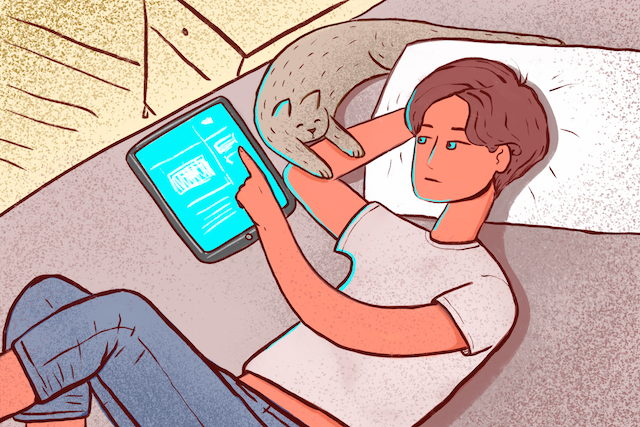
One of the hardest things about social media is staying in tune with ourselves. We go to our phone for comfort, distraction, and entertainment. Once we arrive, our brain gets hijacked by the content, and we have to buckle up for whatever ride the algorithm sends us on. Even with the best intentions going in, we can get turned around by one video or post and find ourselves feeling like we aren’t measuring up.
When I first became I mother I was obsessed with the idea of gentle parenting. I consumed everything I could find on this parenting style. I gave it my best go, but every day I felt like a complete and worthless failure.
I was bombarding myself with an idealized version of this parenting style that social media made look so easy. After reading any social post, I felt like I was an idiot for sucking at it.
How hard is it to just speak in a calm voice and not lose your patience with your one-year-old? He’s literally an innocent baby! One that hits the dog, bites you while breastfeeding, or turns and runs into the street with a mischievous smirk on his face.
In my frustration I would go straight to social media to flagellate myself with messaging that had a toxic effect on me. I pivoted against my husband who had a more relaxed attitude toward parenting and put more pressure on myself to be a “perfect” mom. This created tension in my marriage and physical and emotional burnout for me.
Don’t get me wrong here’; I don’t think there is anything inherently wrong with social media. The way it connects us with each other is truly wonderful. The current messaging to parents and mothers sounds so beautiful at first glance.
“Your babies grow up fast, so you should savor each moment.”
“Motherhood is the most challenging job, but so worthwhile.”
“Your house is a disaster, but you shouldn’t care about that when you have young children.”
My issue is that we are using social media as a weapon to inflict self-harm. Instead of taking these messages in the way they are intended—to inspire us—we criticize and judge ourselves against them.
We can start to feel bad that we actually care if our house is a giant mess or that we don’t enjoy every moment.
Or we might feel guilty for not feeling grateful. Or bad about feeling sad. Or frustrated because we can’t just “choose to be happy” when we’re feeling down.
My solution is not to delete all your social media apps (but go for it if that sounds amazing to you). What I recommend is to start actually noticing how each reel, TikTok, or post feels in your body. It doesn’t matter that it has beautiful music, photos, or a positive message.
If your brain is twisting that message to be used against you, it is not yours to absorb.
It is easier to spot the types of messages that we instantly don’t agree with. Any time I see a perfectly put-together mom with three kids in matching, neutral-toned outfits, I mentally reject it. It doesn’t matter what the content is; this is always a pass for me. What messaging bothers you or feels toxic is completely personal.
Our brain gets conflicted when something seems really positive, but doesn’t feel good to us. Since our brain doesn’t like being confused, we unknowingly spend mental energy trying to make sense of the discordance that we feel. Becoming aware of your emotional reactions helps you quickly accept or reject the messaging coming at you, so you aren’t as negatively affected by it.
We don’t need to villainize the content creators here either. I don’t think anyone (hopefully) is going out there intentionally using pretty messaging to turn us against ourselves. So much of the messaging we see is meant to be inspiring and helpful.
A lot of times I feel connected and motivated by the positivity I encounter on social media. Especially content that is less perfected and less filtered.
When you come across a “positive” message that makes you feel critical of yourself, I suggest you mentally “pass” on it and move on.
I like to compare social media messaging to a food sensitivity. Tomatoes are not inherently bad, but if your body doesn’t react well to them, then they aren’t for you right now. You may heal or grow out of some particular food sensitivities and be fine with them in the future.
Giving yourself the power to pass on or to accept every message that comes your way gives you complete control over your experience on social media, regardless of what you scroll through.
You get to decide what “positive” things feel good to absorb and what “positive” things aren’t for you right now. My wish for each of you reading this is that you update your relationship with social media to be one that fully empowers and supports you.
-
How I Healed My Mother Wound and My Daughters Are Healing Theirs

“Your children are not your children. They are the sons and daughters of Life’s longing for itself… You may give them your love but not your thoughts, for they have their own thoughts. You may house their bodies but not their souls, for their souls dwell in the house of tomorrow…” ~Kahlil Gibran
Now that my daughters are in therapy trying to heal their relationship with me, I have more compassion than ever for my mom. I haven’t felt angry at her in years. But when I was a teen, I earnestly desired to kill her more than once.
I was in my forties when my mom died. Afterward, I had frequent dreams about her chasing me around, telling me I wasn’t good enough. The dreams lasted nightly for about six months and occurred for a few more years when I felt stressed. The last one I remember, she was chasing me under the covers of the bed, screaming my worst fears—that I was unlovable and unworthy—reinforcing my wounded child.
About twelve years after she died, I was able to come to a place of comfort with her. While in deep meditation I saw a vision of her spirit bathed with light and love. Freed from her mental and physical sufferings, I saw her as I had seen her when I was a child—my universe.
Unfortunately, she couldn’t see herself as I did in those days. I knew that she was beautiful. I remember thinking about it as a young child, and when she was dying. How often I’d searched her face, looking for her to see me.
Like my dad, I have prominent facial features. I wished I had her cute small nose and her pretty lips that always looked beautiful in her Berry Berry Avon lipstick. She had blue eyes, which I rarely saw straight on. She was uncomfortable with her looks. I don’t remember any direct eye contact with her unless she was angry, though I realized there must have been.
She was born with a crossed eye. Her story was that her parents were accused of having a sexually transmitted disease that caused it, which brought great shame. My mom was also dyslexic. Sometimes at school, she had to wear a dunce cap and stand in the corner or hall because she couldn’t spell. These challenges shaped her self-worth from a young age.
I loved looking at pictures of her in her twenties with long dark wavy hair, stylish glasses, and a beautiful smile.
When she died, I didn’t cry. I proclaimed that her reign of terror had ended, and I held on to my anger for twelve more years. That day in meditation, when I was able to break through the veil of outrage that kept me in my darkness, I saw her as a bright light in my life.
I had known for years that some of my healing depended on letting go of the story of my time with my mom—one of mental health issues, abuse, and unhappiness. I needed to take time to process our relationship and see her beyond her earthly life. When I was finally able to, I felt better than I expected.
Through my experience and my work with other women, I’ve learned that the mother wound—our unresolved anger at the flawed woman who birthed or raised us—is two or threefold.
Our first challenge is processing the actual events that happened as we were growing up.
The second is letting go of our reluctance to be fully responsible for our mental and physical health as adults.
And, if we have children, the third is not wounding ourselves—realizing that there was never a scenario where we could be the perfect parent we had hoped to be, no matter how self-sacrificing we were.
Processing Our Childhood
Our work as adults is to make a conscious effort to process the hurt, anger, and betrayal that we endured from the female authority figure that raised us (or the figure who was our primary caregiver).
Even if we resolve that our mother did her best, we are still left to sort through our shame over not feeling loveable or good enough, and the feeling that we missed out on the experience we should have had growing up. Processing and healing could mean seeing a therapist, journaling, or even stopping all contact with our mother.
I moved far away from my mom, which minimized my contact and gave me space to process. But I kept the past alive in my thoughts. Now when I look back, I see that holding on to my anger well into adulthood added to the years of feeling like I was missing out on a normal life. In the end, I was responsible for my own healing, and it didn’t happen overnight.
Now, at this place in my life journey, I see the hard parts of my life as the foundation for my life’s purpose, and I don’t feel like I’m missing out.
I’ve met enough people to know that even those who had the perfect parents—like we all wanted—also have challenges as adults. My work to heal has led me to a deep understanding of the human condition and fueled my passion to love and to help uplift the suffering of all.
How Our Commitment to Self-Care Helps Heal Our Mother Wound
We looked to our mother to provide emotional and physical nourishment. Her inability to do this (or do it consistently) created our feeling that we were wronged by our mother. Now, as adults, we need to let go of thinking our mother will take care of us and do our own nurturing work for ourselves. That might seem like a harsh statement, but it enables us to move on.
The second part of healing my mother wound was letting go of the part of me that doesn’t take care of myself. That little voice in my head that apathetically whispers, “I don’t care” about little things that would improve my health, help me sleep better, or feel successful.
That little voice doesn’t have as much power over me anymore. So instead of overeating in the evening, which would affect my ability to sleep well, I can override it—most days. I’m also able to notice that when I don’t take care of myself, I open myself up to being the wounded child again.
We didn’t have a choice when we were young, but now the choice is ours. We need to decide when and how we take up the torch.
When Our Mother Wound Becomes a Mothering Wound
My mother wound turned into a mothering wound when I didn’t live up to my hopes of being a perfect parent. Of course, I had intended to be the loving, nurturing, protecting mother, who produced adults without any challenges, but alas, I was not. How could this happen? I tried so hard.
I was able to find alternatives to the punitive, violent punishments, shaming, and blaming tactics that my mother used, but as a young parent, I was still challenged with low self-worth issues and an eating disorder.
Although some of the things that occurred during the three marriages and two divorces that my daughters and I experienced together were horrific, we were luckily able to process a lot of them in real time with therapy and tears.
Now, with their adult awareness, my daughters are processing their childhood, including my addictions, insecurities, and mistakes. It is almost torture to watch them do that, even though I know they must. And they are so busy with their lives now—as they should be. I miss them.
To weather this time of my life and continue to grow, I need to employ my practices of understanding, compassion, and detachment, and take deep care of myself. Continuing to love my daughters deeply, to be on call whenever they need me, and at the same time be detached from needing them, has called me to deeper depths of my character.
We all deserve to be treated respectfully and kindly. As daughters and mothers, we can role model compassion—empathy in action—and boundaries with our mother and our children. We can strive to create relationships that mutually nourish loving-kindness.
We can focus on healing our past and taking care of our future. We all need to communicate this clearly to our mothers, partners, and children. And, although we can’t walk away from our underage children, we can set boundaries that facilitate healthy relationships now.
We can be clear—our children don’t need their lives or their mother to be perfect. They need to know that they are loved, and they need to see us love ourselves. Holding on to this love for them and for ourselves when our children are troubled, distant, or even estranged is one of our biggest tests as parents. My heart goes out to any mother dealing with these challenges, especially if you are dealing with them alone.
I never stopped wanting my mom to be happy. She is now at peace, maybe even joyful. I strive to let myself be at peace. I let myself live in this place of deep tenderness for her—and now for me. I understand that my experience is universal. I needn’t feel alone.
I realized that this confident and peaceful version of me is the best I can do for my daughters as they heal their mother wounds and take care of themselves, as I am doing for myself.
To heal our mother wound is to remember that it is ultimately a spiritual journey. Not only are we trying to figure out the depths of our own purpose, but we are bound to the journeys of our kin.
As with all spiritual journeys, there will be rough passages that tear our heart open and ask us to become more. The journey of the mother is the journey of love. We need to remember, no matter what rough journey is behind us, we are the designers of the path ahead.
-
The Relief of Letting Go and Living Fully Despite My Anxiety
“We only live once, Snoopy.” ~Charlie Brown
“Wrong. We only die once. We live every day.” ~Snoopy
I am an anxious person. I haven’t always been though. When I had my first child, fourteen years ago, it was the week after my father died. My son was born and went right to the NICU where he spent the first fourteen days of his life. In that moment, I changed. I’d already had one miscarriage. I couldn’t lose anyone else.
Man, life is fragile. I spent the next decade making sure he played on the swings at the park, but not too high since he could fall and break his neck. We always took him to the river or the lake, but no swimming. There are amoebas in the water. (Funny and crazy, I know.)
I now have two children who are fourteen and nine. Just a couple weeks ago, we went to the zoo. I had to talk about not leaning on the railings; you could fall in an enclosure. I am exhausted. The worry never ends.
I am a mom, a wife, a daughter, anxious, neurotic, controlling, and scared. I never meant to be that helicopter mom. I had great ideas about how I would parent my kids. My husband and I always talked about how we would raise teenagers and what their curfews would be, but being in the middle of it, I’m terrified. I live in a constant state of panic and fear.
I constantly worry I’m having a heart attack or a stroke. I worry my kids will die. I worry I will die.
During the early months of the Covid-19 lockdown, we completely shut off from the world. Guess what? We all got Covid-19, except my nine-year-old. My elderly mother (who lives with us) got it too. I even sanitized groceries. We have no clue how we got it. We are all fine. Thank goodness. I know not everyone is as lucky.
Every pain or sniffle is a worst-case scenario. Have you ever seen the movie My Girl? I am totally Veda Sultenfuss.
It took several years, trips to the emergency room, shaky relationships, and a whole lot of self-discovery to figure it out. My lack of confidence, yet another sad part of anxiety, made me think I wasn’t enough. It caused my divorce. Thankfully, we are remarried. He sees me, he sees the moments I am fun and carefree, and he helps me work through my anxiety. Old Bob Ross reruns help too.
So, what is the lesson here? I am not in control of a single thing. (Mind blown, I know.) Life is full of terrible things, wonderful things, heartache, tears, laughter, death of parents, even children. It’s all those moments in between that make life worth living.
If we hide because of fear, we miss out on those moments. We miss out on a chance to save a memory we could pull out of our little brain file when we’re seventy-three and watching the snowfall on Christmas morning when all our kids are grown up.
It’s really scary, letting go. It’s like walking on a tightrope. You see what could happen, but you just walk, because you know you’re not fully living if you sit out, and at the end of that walk, you realize how fast it went by. Either way, it will go by. It’s up to you how you spend that walk. Frank Sinatra says it best, that’s life.
-

Stay Safe or Risk Opening Your Heart?

“When you begin to touch your heart or let your heart be touched, you begin to discover that it’s bottomless.” ~Pema Chodron
As a child I learned boundaries. I learned what I wasn’t allowed to talk about outside of the family. I learned how far I could go with my parents before I faced their disapproval. I also learned that this boundary was unpredictable.
Because it was unpredictable, I honed the ability to sense when it seemed safe to do something, and when I couldn’t, based on the emotions of those around me. It kept me safe for the most part. And, I learned to always be on guard around certain people.
As a result of some of these experiences, I was reluctant to let people into my inner world for fear that I would get hurt.
I used this ability to read others throughout my life, especially in my career. I could walk into a room and read the mood of the group or individual to ensure that I understood how far I could go.
For a few people in my life, these boundaries were appropriate. But I used them almost all the time.
Setting these boundaries also cost me.
It cost me because I didn’t trust others.
It cost me because I learned not to expect things from others or I would end up disappointed.
It cost me because I thought I needed to only rely on and trust myself.
What I saw in other people was really a reflection of my own lack of trust in myself.
All the time that I held firm boundaries, I thought they were about respecting myself. But they were really about fear.
I was afraid of letting others in. I was afraid of letting myself in. And, I discovered that I was main person who didn’t treat myself with respect. This was a difficult lesson.
It is a lesson I am still learning.
On the one hand, the skills that I honed in childhood served me well. They kept me safe. They kept me in what little control I had over my life. I couldn’t control much, but I could control what I let others see about me. I could control whether or not I let people in. (more…)