Tag: parenting

  • The Unexpected Therapy I Found on My Phone

    The Unexpected Therapy I Found on My Phone

    “Sometimes you will never know the value of a moment until it becomes a memory.” ~Dr. Seuss

    The notification pops up on my phone: “Jason, we made a new memory reel for you.” I pause whatever I’m doing, probably something stressful involving deadlines or dishes, and feel that familiar flutter of excitement. What chapter of my life has Google decided to surprise me with today?

    I tap the notification, and suddenly I’m watching years of Father’s Day adventures unfold. It started accidentally—one Father’s Day trip to the Buffalo Zoo that somehow became our tradition. Instead of buying me something I didn’t really need, we chose experiences. Year after year, we’d visit a new aquarium or zoo.

    There’s my son at age three at the Erie Zoo, barely tall enough to see over the penguin exhibit barrier. The same kid at five at the Baltimore Aquarium, tentative but overjoyed as he touched a stingray for the first time. Then six at the Philadelphia Zoo, taking in the fact that there is a tube system where some of the big cats can walk overhead.

    Buffalo, Erie, Philadelphia, Baltimore, Charleston. We’d mapped Father’s Days across the Eastern Seaboard without ever planning it. So much time has passed since we started. My son has grown taller, lost teeth, found his voice. I’ve gotten balder, maybe a little softer around the edges. But there we are, year after year, choosing moments over things.

    We tell ourselves to create experiences instead of accumulating stuff, but just how important that choice is never really hits until you play it back. Here was the proof: a memory bank I didn’t even realize we were building, one Father’s Day adventure at a time.

    The emotions hit in waves. Pure joy at his excitement over feeding the stingrays, happy sadness watching his younger self discover jellyfish for the first time, overwhelming gratitude for every single trip we took. This ninety-second reel has become medicine for whatever current stress I’m carrying.

    And that’s when it hits me. My phone accidentally became my therapist.

    When Technology Gets It Right

    I never intended for Google Photos to become part of my self-care practice. Like most people, my wife and I take hundreds of photos without much thought, letting them pile up in digital storage. The idea of actually organizing or regularly looking through them feels overwhelming. Iƒt feels like thousands of images scattered across years of living.

    But then technology stepped in with an unexpected gift. These automated memory reels started appearing, curating my own life back to me in perfectly sized emotional portions. Not the entire overwhelming archive, just a gentle serving of “Remember this?”

    At first, I was skeptical. Another way for a tech company to keep me glued to my screen when I routinely looked for ways to escape. But as these memory notifications became part of my routine, I realized something profound was happening. Google’s algorithm had accidentally created something I never knew I needed: regular reminders of how blessed my life has been.

    The beauty is in the surprise element. I’m not seeking out specific photos when I’m feeling down. That can sometimes backfire, making me feel more nostalgic or sad. Instead, these curated moments arrive when I least expect them, like getting a text from an old friend who you haven’t heard from it a while.

    The Science of Digital Reminiscence

    Research shows that positive reminiscence (deliberately recalling happy memories) can significantly improve mood and reduce stress. When we engage with positive memories, our brains release dopamine and activate the same neural pathways associated with the original experience. We literally get to relive moments of joy.

    Visual memories are particularly powerful. Studies in cognitive psychology reveal that images trigger stronger emotional responses and more vivid recall than other types of memory cues. When we see a photo from a happy time, we don’t just remember the moment. We can almost feel ourselves back there.

    Nostalgia, once thought to be a purely melancholy emotion, is now understood to be a powerful mood regulator. Research from the University of Southampton shows that nostalgic reflection increases feelings of social connectedness, boosts self-esteem, and provides a sense of meaning and continuity in our lives.

    But what makes these digital memory reels especially effective is that they’re unexpected and brief. Unlike deliberately scrolling through old photos (which can sometimes lead to rumination or sadness), these automated highlights arrive as pleasant surprises and end before we get overwhelmed.

    The timing is often perfect too. These notifications tend to pop up during mundane moments, like waiting in line, taking a work break, sitting in traffic. Exactly when we need a little perspective on what really matters.

    The Emotional Range of Remembering

    Not every memory reel hits the same way. Some make me laugh out loud, like the diversity of my son’s increasingly elaborate Halloween costumes or the series of failed attempts to get a decent group photo at our destination wedding. Others bring that “happy sadness” I’ve come to appreciate… seeing my grandmother in photos from a few years back, her smile bright even when her health was declining.

    Then there are the reels that just make me feel deeply grateful. The random afternoon when we decided to try goat yoga. The collection of action shots over the years: chasing my son around the house in a homemade superhero costume, his skateboarding phase, catching up with friends we haven’t seen in some time. These aren’t momentous occasions, just evidence of a life filled with small adventures and genuine connection.

    What strikes me most is how these photos capture joy I might have forgotten. In the daily grind of parenting, working, and managing life, it’s easy to remember the stress and overlook the sweetness. But here’s photographic proof: we’ve actually had a lot of fun together.

    The reels remind me that while life hasn’t been all butterflies and rainbows, the good has consistently outweighed the tough times. The visual evidence is overwhelming. We’ve been blessed, again and again, in ways both big and small.

    Embracing Digital Self-Care

    I’ve learned to treat these memory notifications as legitimate self-care appointments. When that notification pops up, I pause whatever I’m doing and give it my full attention. No multitasking, no rushing through. I let myself feel whatever comes up. The giggles, the happy sadness, the overwhelming gratitude.

    Sometimes the timing feels almost magical. The day my social anxiety took over because I had to present during three different meetings, a reel appeared featuring peaceful moments from the trip my wife and I took to Newport, Rhode Island (mostly so I could try a lobster roll). When I was worried about whether I was doing enough as a parent, I was served a compilation of my son’s biggest smiles over the years.

    It’s become a form of mindfulness I never planned. These brief interruptions that pull me out of current anxiety and remind me of the bigger picture. They’re proof that I’ve been present for beautiful moments, that I’ve prioritized what matters, that love has been the consistent thread running through our ordinary days.

    The Memory Bank We Don’t Realize We’re Building

    Those Father’s Day zoo trips felt routine at the time. Just something we did because that’s what families do on special days. I wasn’t thinking about creating lasting memories or building traditions. I was just trying to make sure my son had a good day.

    But now I see what we were doing, and that was making deposits in a memory bank that would pay dividends years later. Every photo was evidence of intention, of showing up, of choosing joy even when life felt overwhelming.

    The beauty of these digital memory reels is that they reveal patterns we might not see in real time. They show us that we’ve been more intentional than we realized, more present than we felt, more blessed than our current mood might suggest.

    The Gift of Automated Gratitude

    In a world where technology often leaves us feeling more anxious and disconnected, these memory reels offer something different: automated gratitude practice. They’re gentle reminders to pause and appreciate not just where we are, but where we’ve been.

    They don’t require apps to download or habits to build. They just arrive, like grace, when we need them most.

    So, the next time you get one of those memory notifications, pause. Let yourself be surprised by your own joy. Look at the evidence of love in your life. The big moments and especially the small ones. Notice how much good has happened, even during life’s inevitable challenges.

    Your phone is holding more than photos. It’s holding proof of how blessed your life has been.

    And sometimes, that’s exactly the reminder we need to keep building that memory bank, one ordinary, beautiful day at a time.
  • Mindful Parenting: How to Calm Our Kids and Heal Ourselves

    Mindful Parenting: How to Calm Our Kids and Heal Ourselves

    “When we show up for our kids in moments when no one showed up for us, we’re not just healing them. We’re healing ourselves.” ~Dr. Becky Kenedy

    I wasn’t taught to pause and breathe when I was overwhelmed.

    I was taught to push through. To be a “good girl.” To smile when something inside me was begging to be seen.

    I was told to toughen up. Not to cry. Not to feel too much.

    But how can we grow into resilient humans when we’re taught to hide the very feelings that make us human?

    I thought I was learning strength. But what I was really learning was how to disconnect.

    And I carried that disconnection into adulthood… into motherhood… into my work… until it begged to be healed.

    Becoming a Mother and Seeing Myself Again

    When I became a mother, the past resurfaced in ways I couldn’t ignore.

    As a school psychologist, I had spent years working with children, guiding them through emotional regulation, supporting teachers and families, and creating safe spaces in classrooms and therapy rooms. But nothing prepared me for what would rise when my own child began to feel deeply.

    At the same time, my soul sister, Sondra, was walking through a similar reckoning.

    She had spent years creating spaces for children to express themselves through story and imagination, yet still carried parts of her own childhood she hadn’t been taught how to hold.

    We were doing meaningful work in the world, but our children cracked something open. Their meltdowns, their restlessness, their big emotions… all of it held up a mirror.

    And instead of just reacting, I saw something deeper: myself.

    Because even with all my tools and knowledge, I was still learning how to sit with my own feelings too.

    When I Teach My Child, I Re-Teach Myself

    That’s when I truly understood: When I teach my child mindfulness, I’m not just raising them. I’m re-raising myself.

    I’m learning to do something I was never taught: To feel. To breathe. To stay present in the discomfort. To hold space without fixing or fleeing.

    And through that process, I’m healing parts of myself that had been quietly waiting for years.

    I remember this moment clearly:

    My child was on the floor, overwhelmed by emotion. The kind of meltdown that pulls something primal out of you. Every instinct in me wanted to yell. To leave the room. To shut it down.

    But instead, I paused. I sat down. I took a breath. And then another. I whispered, “I’m here.”

    That moment wasn’t about control. It was about connection. And that’s what changed everything.

    What Mindfulness Looks Like in Real Life

    I used to think mindfulness had to look calm and quiet, but it’s not perfect.

    • It’s not silent yoga flows and lavender oils (though we love those, too).
    • It’s pausing before reacting.
    • It’s whispering affirmations under your breath when you want to scream.
    • It’s sitting beside my child, breathing together, without trying to make the feeling go away.
    • It’s placing a hand on your heart and remembering that you are safe now.
    • It’s letting your child see you regulate, repair, and return to love.
    • It’s letting a tantrum pass, not because I stopped it, but because I stayed.
    • It’s about building homes and classrooms where children don’t have to unlearn their feelings later.

    It’s not about perfection. It’s about presence. It’s about co-regulation, what children truly need to feel safe.

    Because kids don’t calm down by being told to. They calm down when their nervous system is met with ours. With softness. With breath. With safety.

    That’s mindfulness.

    That’s the real work.

    Healing Myself, Healing My Lineage

    The more I practiced this way of parenting, the more I realized I wasn’t just helping my child feel. I was healing emotional patterns that had lived in my family for generations.

    I lived in a loving family, but trauma was hard on them. They didn’t know how to regulate their emotions. They didn’t know how to sit with discomfort, how to process instead of project.

    So they yelled. They shut down. They pushed through, just like they were taught. And that became the blueprint I inherited, too.

    I am part of the first generation trying to raise emotionally attuned children while still learning how to feel safe in my own body.

    And it’s not easy. It’s sacred work. It’s spiritual work. It’s lineage work.

    Because every time I whisper “I’m here” to my child, I whisper it to the younger version of me who needed it too.

    There are moments, gentle, almost sacred, when I hear my child hum softly while striking a chime, eyes closed, saying,“This sound makes my heart feel better.”

    No one explained resonance. No one showed them how.

    And in that moment, I remember: our children come into this world with a knowing we spend years trying to reclaim.

    We believe we’re the teachers. But in their stillness, their play, their pure presence, they become the ones guiding us home.
    Planting Seeds of Calm

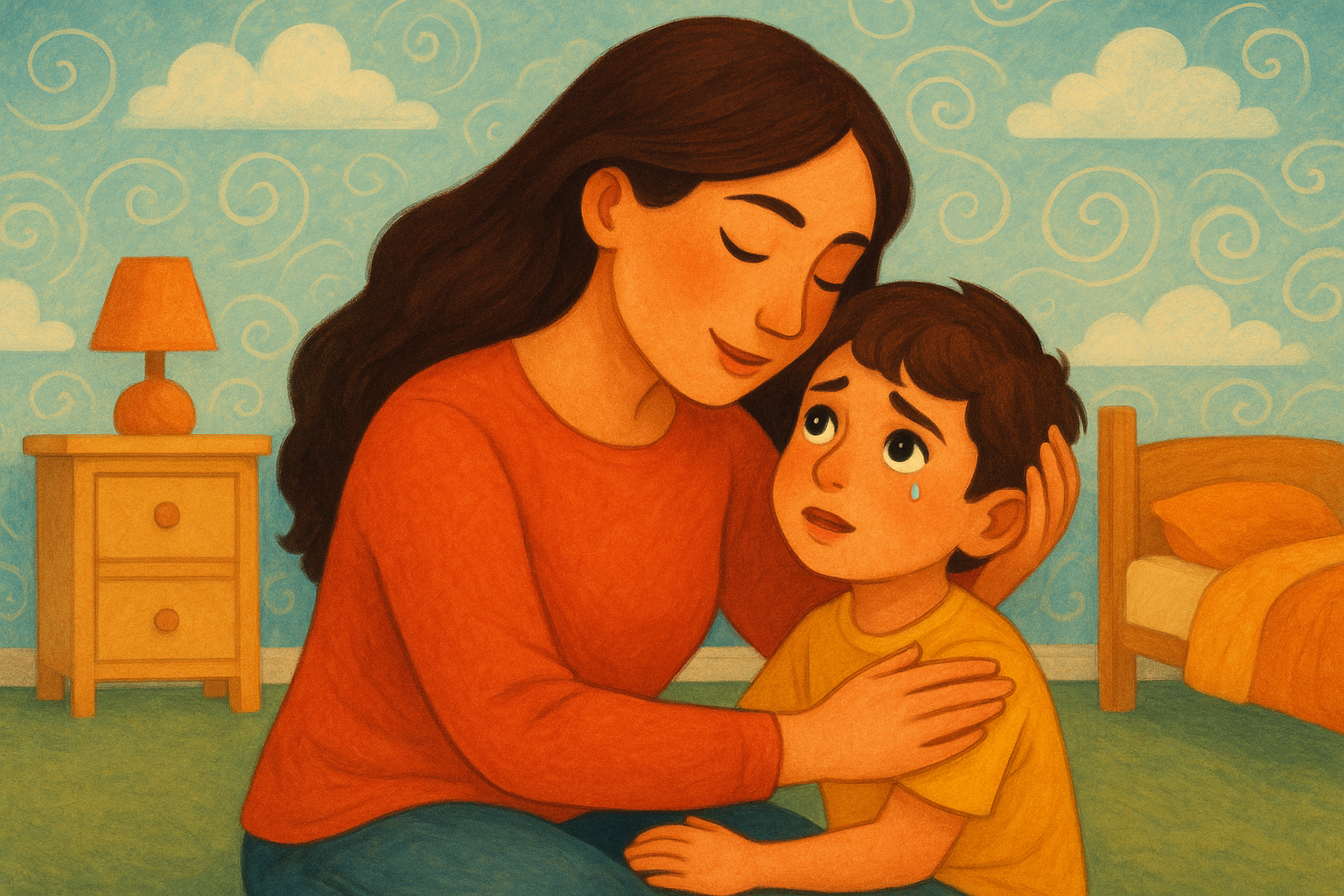
    One day, my son looked up at me with tearful eyes and said, “Mommy, I just need you to sit with me.”

    And in that moment, I realized: so did I.

    That moment changed everything. It was the beginning of a softer way. A new rhythm rooted in breath, presence, and remembering that we’re not just here to teach our children how to regulate; we’re here to learn how to stay with ourselves, too.

    I began to notice the magic in slowing down. To listen. To honor what was happening inside of me so I could meet what was happening inside of them. Not with control but with connection.

    Every time a parent sits on the floor and breathes with their child, something ancient is rewritten.

    Every time we name emotions instead of shutting them down, we break a pattern.

    We don’t just raise mindful children. We raise ourselves.

    Because the truth is: Every breath we teach our children to take is one we were never taught to take ourselves.

    And now, we get to learn together.

  • To the Parent Who’s Stressing About Being Imperfect

    To the Parent Who’s Stressing About Being Imperfect

    “Your greatest contribution to the universe may not be something you do, but someone you raise.” ~Unknown

    Have you ever heard the saying, “Mama knows best” or “If mama ain’t happy, nobody’s happy”? Honestly, who decided that moms should know everything and that the entire emotional balance of the home rests solely on their shoulders? Isn’t Mom a human too? A beautiful soul navigating this life, trying to figure things out just like everyone else? How is it fair that we pile all the pressure onto this one person—the keeper of the schedules, the task doer, the tender space for everyone to fall?

    It’s no wonder the pressure on moms today is sky-high. We carry expectations that are impossible to meet—being nurturing yet productive, selfless yet balanced. And let’s not forget about dads, who often get a bad rap for not doing things “as well as mom.”

    We need to take a step back. Both parents are human. They come into parenting with their own limiting beliefs, inner critics, and childhood wounds. Being a parent doesn’t mean you automatically know what you’re doing.

    I’ll never forget the drive home from the hospital with my first son. I was in the backseat, staring at this tiny human, thinking, “They’re really letting us take him home?”

    It hit me, sitting in that glider in his nursery a few weeks later, that I had no idea what I was doing. I tried reading all the books, hoping the answers were tucked in there somewhere. But even after reading the same chapter of Healthy Sleep Habits, Happy Child at least thirty times, I still felt lost.
    So, I did what felt natural—I called my mom. Surely, she had the answers. But all she said was, “This too shall pass.” At the time, her words made me angry. I didn’t have time for things to pass; I needed solutions. Yet, over the years, I’ve come to realize that she didn’t have all the answers either. None of us do.

    This journey of figuring it out—of reading books, blogs, and consulting my mom—lasted for many years. I wanted so badly to be a good mom. I was a good mom. I loved my kids deeply, left little notes in their lunch boxes, tucked them in at night, and kept them safe with helmets and seatbelts. But as he grew, so did the struggles, and often, so did my fear.

    When my son was in elementary school, he began struggling terribly. At first, I thought maybe he just needed a little extra encouragement. But when he would cry at homework or tear up on our way to school, I knew it was deeper. He would rush through his work just so he could turn in his tests at the same time as the other “smarter” kids. School was overwhelming for him, and it was crushing me to watch.

    Eventually, he was diagnosed with ADHD and dyslexia, and a wave of conflicting emotions washed over me. I was relieved to know he had support now, but the meetings, the individualized education programs, the tutoring—all of it weighed on me.

    Sitting in those meetings with teachers and specialists, I’d feel a tightness in my chest and tears spilling over. I wanted him to have an easier path, but I was realizing that I couldn’t just “fix” it. I was the mother, the one who was supposed to protect him, but I was helpless in the face of these challenges he would have to navigate on his own. My heart ached for him, and I often felt ashamed of my own emotional unraveling.

    Reflecting back, I see how much of those tears were for him—and for me. I was spread too thin. Work was overwhelming, my marriage was strained, and I had little left to give. My life felt like a juggling act, and each new challenge threatened to tip the balance. The layers of fear, responsibility, and love were always there, piling up, and I felt the weight of every single one.

    And then came the teenage years. Those years where the stakes felt higher, where choices carried more weight, and where my fear around his decisions—who he spent time with, the roads he might choose—grew even stronger.

    I remember one day, standing in the garage in an argument with him. The tension was thick, and we were both yelling—my fear bursting out as anger. I don’t even remember what we were arguing about; it’s a blur. But the shame and guilt afterward were so clear.

    The truth is, every stage of my son’s life brought forward a new version of myself—a woman, a mother, learning as she went, trying her best to balance it all. My own fear of failure, of not being enough, would surface in unexpected ways. But somewhere along the journey, I realized that my fears and my need for control were driving a wedge between us. And the more I tried to grip tightly, the more I lost sight of the tender love and wonder I wanted to bring into our relationship.

    So, I started working on myself. I went to therapy and hired a coach—not because I was broken, but because I knew I wasn’t showing up as the parent, or the person, I wanted to be.

    Through my healing journey, I learned that my desire to control was rooted in fear—a fear that if I didn’t do everything perfectly, he would somehow slip through the cracks. I feared for his future, that he’d face pain or hardship. But as I began to peel back those layers, I started to see that my fear wasn’t protecting him; it was keeping me from fully loving and trusting him.

    As I did this inner work, something shifted. My approach softened. I wasn’t as reactive or rigid. I found that I could set boundaries from a place of love instead of fear, listen without rushing to fix, and let him make his own choices.

    I became less focused on making sure everything was perfect and more focused on simply being there. I was less afraid, more open—and, truth be told, I began to enjoy life more. I found joy in the little things again, the mundane moments I used to take for granted. And he noticed.

    My children began to see me differently. They told me I was more patient, kinder, and even more fun. This loop of healing—me working on myself, allowing my own growth to ripple into how I showed up for them—created a connection that only grew stronger. The more I invested in myself, the more balanced I felt, and the deeper my love for them became.

    So, what about that old saying, “If mama ain’t happy, nobody’s happy”? Perhaps instead we should say, “No one is happy all the time, but if mom is struggling, she needs time and space to address her own issues, and everyone in the house will benefit.” The same goes for Dad. If he’s checked out, he needs to come back to this one life we’re given. Both parents need to heal, grow, and show up for themselves so they can be there fully for their kids.

    Just like the thermostat in your home, if things are too hot or too cold, you adjust it to find comfort. The same goes for parenting. When we take the time to work on ourselves, we create the right environment—not perfect, but balanced and loving—for our children to thrive.

    It’s never too late to start. Let’s embark on this healing journey together so we can show up as the best parents we can be—not because we have all the answers, but because we’re willing to do the work, grow, and love along the way.

  • The Beautiful Life I Didn’t Plan For: On Raising a Special Needs Child

    The Beautiful Life I Didn’t Plan For: On Raising a Special Needs Child

    “I’ve learned that you can keep going long after you think you can’t.” ~Unknown

    As far back as I can remember, I have always wanted to be a mom. I held onto the belief that my life wouldn’t feel truly “complete” until I had children.

    This dream finally came true in 2010 when I was twenty-seven years old, when my son, Logan Patrick Arnold, entered the world. The moment I laid eyes on him, I sensed something was different about him. And though it might not sound flattering, he looked more like a middle-aged man than a Gerber baby.

    Upon closer examination, the doctors discovered several abnormalities. Logan had upturned earlobes, and while some suggested it was due to his fetal positioning in my petite belly (I’m just 5’1″), deep down, I knew it wasn’t the case. Logan also exhibited an unusually pointed chin, a wide nose bridge, and eyes set farther apart than usual.

    People often speak of a mother’s intuition or maternal instinct, and mine kicked in at that moment. Something was wrong, and I knew it was serious. Although others may have shared similar thoughts, we all kept our concerns to ourselves, perhaps out of fear of the unknown.

    As the months passed, Logan failed to reach the typical infant milestones. His body remained rigid, and his tiny hands were perpetually clenched into fists. He couldn’t grasp toys or sit up on his own. Even as first-time parents, we understood that this wasn’t normal.

    Fast forward about nine months, and my husband was typing phrases like “upturned earlobes, wide nose-bridge, pointy chin” into a Google search. He exclaimed, “Jackie, you need to see this!”

    I had no idea what to expect on that screen, but I could never have imagined staring at a child who bore such a striking resemblance to Logan that they could have been siblings. It was an uncanny resemblance. I whispered, “That’s Logan.”

    My husband had stumbled upon a website displaying pictures of children with Mowat-Wilson Syndrome, a condition discovered by Dr. Mowat and Dr. Wilson in 1997, with only about 500 diagnosed cases worldwide.

    I clicked frantically to see more pictures. Every child could have been Logan’s sibling, sharing the same facial features and bone structures. We had found our answer.

    We searched for more information, which would change our lives forever. I distinctly recall reading the words “moderate to severe intellectual disability” and “non-verbal.”

    My heart sank. Did this mean my child would never speak, not even a simple “hello” or “I love you, Mama”? I was devastated.

    It’s often said that “life throws you curveballs,” but this was one I hadn’t expected and certainly wasn’t prepared for. The beautiful life I had envisioned for Logan was going to be nothing like the one I had planned.

    The years following Logan’s diagnosis were filled with doctor’s appointments, therapy sessions, school meetings, and anything else we could do to aid his progress and growth.

    Back then, we were merely trying to survive: eat, sleep (very little), work, and do everything we could for Logan, repeating the cycle endlessly. Looking back, I’m not sure how we made it through, but we did.

    And you know what? Our life is still beautiful.

    Logan is a thriving non-verbal thirteen-year-old who adores school and his sister Lucy and would cherish nothing more than cuddling on the couch while we read him books and watch The Wiggles on TV. Life is pretty good for Logan.

    And it’s pretty good for us too. No, this isn’t the life we had planned, but it’s our life, and now we couldn’t imagine it any other way. Logan’s disability opened us up to a whole new world of people and experiences we never would have known otherwise.

    He’s taught us about unconditional love and finding patience when you think you’ve exhausted it all. Logan does everything in his own time; he sat at fifteen months, crawled at two-and-a-half years, and walked at five. Those milestones, achieved through hard work and countless hours of therapy, were all the sweeter because of the effort.

    When our daughter Lucy was born and effortlessly reached those milestones, we were in awe of what a tiny human could do without being “taught.” It made us appreciate the little things in life even more.

    Reflecting on the past thirteen years evokes a whirlwind of emotions. The journey was messy, ugly, amazing, and joyful all at once. But it has shaped us into who we are today—better people and better parents.

    If I could travel back in time and offer some advice to that sleep-deprived twenty-seven-year-old mom, it would be this.

    1. It’s okay to grieve and be sad. Receiving a diagnosis like ours can feel like a death in many ways. Embrace your emotions; you don’t always have to be strong.

    2. Understand that this child will change your life and make you a better person. Seek out supportive friends who understand your journey.

    3. Let others help you. When someone offers assistance, accept it. You don’t have to carry the burden alone.

    4. Communicate with your partner. You will process your emotions differently, so be open and honest with each other.

    5. This isn’t a race or a competition. Take it one day at a time; you are doing enough, and you are enough.

    6. You will get through this. You are stronger and more resilient than you ever thought possible.

    Receiving a diagnosis of any kind is life changing. If you know someone going through this experience, reach out to them. Ask if they are okay, like really okay.

    And when they turn down your offer to help, step in and do it anyway…let them shower while you watch their child, bring them dinner, mow the grass. Just be there and show your support. These simple gestures will mean the world to them.