“There is no greater wealth in this world than peace of mind.” ~Unknown
A few years ago, I had what could safely be deemed a “bad year.” My live-in partner left me out of the blue, I became un(der)employed and racked with debt, I got in a car accident that totaled my car, and then…my dog died.
After the year that I’d had, the death of that dog, my most treasured friend, was the final straw. It was the final straw for believing that things might turn around soon, and it was the final straw for my mental health.
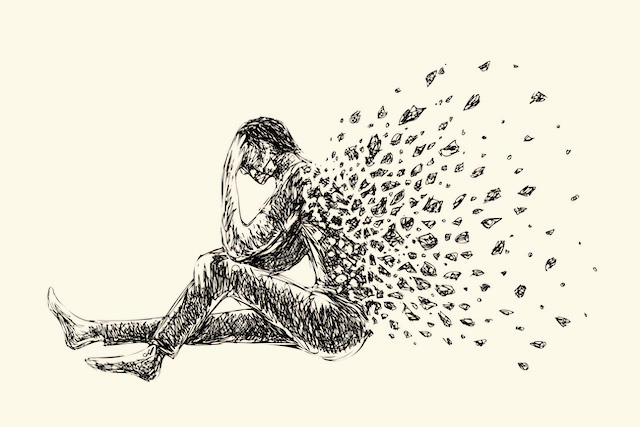
Shortly after her death, I started experiencing what I now know were dissociative panic attacks. At the time, however, I thought that I was going crazy, dying, and that my spirit was detached from my body. A feeling you can probably only understand if you, too, experience panic attacks and have felt derealization before.
For a long time, I suffered. And wallowed. And gave up. But after about six months of living in this nightmarish state of near-constant dissociation and depersonalization, I had a moment of clarity. I knew that I had to give it my all to get better, no matter how long it took, because the alternative was bad.
A panic attack is the ultimate manifestation of feeling a lack of control—feeling like you’re going to die, like you’re going crazy, like you’re disembodied… and there’s nothing you can do about it.
So I started my healing process by looking for ways to take back dribs and drabs of control in my life.
It didn’t happen overnight, but I am extremely grateful to say that it’s been over two years since I’ve had a panic attack. Something I never thought I’d be able to say when I was in the throes of the disorder. So how did I do it? I would love to share that with you here.
These are the three tools that I believe had the biggest impact on healing my dissociative panic disorder.
Adopting an Anti-Inflammation Diet
Inflammation is the response our bodies have to foods that irritate our digestive system, and the amount of inflammation in your body has a direct impact on brain-functioning. According to Psychology Today, there is an undeniable correlation between inflammation in the gut and mental health disorders like anxiety, bi-polar disorder, and depression.
I cut out gluten and alcohol completely (both notoriously inflammatory) and would have cut out dairy too except that I’d already done that a few years earlier for other reasons.
Looking back, I think adopting this new diet was effective in more than one way… Cutting out alcohol was not only helpful in soothing inflammation, but it also allowed me to become much more clear-headed right out of the gate. I was never a huge drinker, but eliminating the ten to twelve weekly drinks I did have was enough to notice an instant improvement in the evenness of my emotional state throughout the day.
Another surprise benefit was that making an intentional choice about the guidelines of my diet gave me back a sense of agency in my life because with every meal, I knew I was making an intentional choice about what would go in my body and why.
Progressive-Overload Weight Training
Unfortunately, weight training still seems to feel “off-limits” to many of us. There’s a rampant gym culture in our society, and it feels like either you’re in or you’re out. However, I learned during this journey to mental health that once you get “in,” it becomes clear that nothing and no one was ever really keeping you out!
But why did I decide it was important to find my way “in” in the first place? To be honest, this one was a happy accident. I knew that it was important to start moving my body again, but it was January 2021, which meant it was too cold to exercise outside, and group fitness was still not an option thanks to the pandemic. Going to the gym, however, wearing a mask, was.
What I discovered from my religious gym routine, and my dedication to learning how to weight train as a means to overcome feeling so awkward and uncomfortable during every workout, is that weight training has the powerful effect of connecting your mind to your body. Something I didn’t realize had been lacking for me.
It’s impossible to lift heavy weights without becoming deeply aware of the connection between your mental cues, your breath, and your muscles.
Dissociative panic disorder is a nasty feedback loop of feeling dissociated and disconnected, which is scary, and leads to our body trying to overcome that fear by dissociating and disconnecting. Developing a weightlifting routine created an interruption in that debilitating cycle and, over time, reminded me that I am firmly rooted in my body and that I have control over my physical reality.
Meditation
When I first started experiencing dissociation, depersonalization, and derealization, meditation was absolutely not the right answer for me. In fact, attempting to meditate only made me feel worse—like I was on the brink of leaving my physical body behind entirely.
However, once I regained a little bit of trust with my mind and body through other practices and knew that I would, in fact, not float away, I started using meditation to further the work I was doing in other places.
Since I had discovered through weightlifting the importance of strengthening my connection to my body, the first meditations I employed were for deepening that body-awareness (also called somatic awareness or interoceptive awareness.) My entire goal was to become more familiar and friendly with my body so that I could remain grounded in my physical self throughout the day.
Later, once I was feeling healthier and more optimistic about a panic attack-free future, I also began to employ meditations for future-visualization. I would tune into and sit with the feelings of connection, safety, and purpose as I allowed my mind to create pictures of my future life. In this way, I began to rewire my brain to understand, look for, and create positive emotions again.
Now, more than two years after I made the life-changing decision to do anything it took to heal my panic disorder, I still fall back on all three of these tools to keep me healthy. I avoid inflammatory foods, I hit the gym regularly (and move my body in other ways), and I try to meditate every single morning.
I know it can feel overwhelming to start a new routine, but none of these lifestyle changes will do anything but enhance your life. It’s worth it to try. I hope that a few months from now you, too, can look back at your panic attack days as just a difficult, but closed chapter in your life.