Tag: opportunity

  • 3 Questions to Ask Yourself Before Trying Something New

    3 Questions to Ask Yourself Before Trying Something New

    “New beginnings are often disguised as painful endings.” ~Lao Tzu

    During the Great Recession I lost my business. And I was devastated.

    My business partner and I built the company from an idea we were kicking around over wine into a thriving brand strategy agency. We had twenty employees. We had a cool studio office. We were winning creative awards competing against agencies many, many times our size. And then—slowly at first and then so, so fast—it was over.

    I remember when I called time of death. We had yet another client come in and say they couldn’t pay us anymore. Not because they were going to a competitor, but because they were in financial trouble themselves.

    We had already laid off all our employees except for our office manager. We had already reduced our own paychecks. We had one or two clients left, but it just wasn’t fun anymore. I couldn’t see the way forward. And I was exhausted.

    I told my business partner that I needed to stop, and that we needed to shut it down. I was beyond sad. I was numb.

    I would have looked for a job, but it was the Great Recession. No one was hiring. Luckily, my husband still had a job, so we were in better shape than many.

    I tried to focus on my health by taking up tennis and playing golf. But I wasn’t motivated.

    I tried getting more involved in the kid’s school. But I didn’t feel fulfilled.

    I felt like I had no identity. I was embarrassed and ashamed even though every other agency I knew about had either closed or was struggling. 

    I graduated from Duke University. I had an MBA. I was supposed to do great things. And yet, here I was with nothing to say when someone asked, “What do you do?”.

    We spent a few weeks in California with my in-laws. The change of scenery helped a little. (My mother-in-law did not.)

    I finally got around to taking the Meditation for Stress Relief program. That helped a little too.

    Finally, about nine long months later I was playing golf with a friend who was an executive-in-residence at a nearby university, and her phone rang. It was her department chair wanting to know if she knew anyone who could teach entrepreneurship. She handed the phone to me, and a few meetings later, the job was mine—if I wanted it.

    Now, I knew I knew lots about entrepreneurship. But teaching? Nada. Nothing.

    And that wasn’t the career I had planned.

    And, because it was an adjunct position, the pay wasn’t nearly enough to make it interesting.

    I went round and round. Do I do it? Do I not do it? It’s not in the right direction. It doesn’t pay enough. That doesn’t move me forward. What if I don’t like it…… 

    I was making my family and friends nuts with the indecision, and I had to work quickly because the new semester was only a month away.

    What should I do. What should I do.

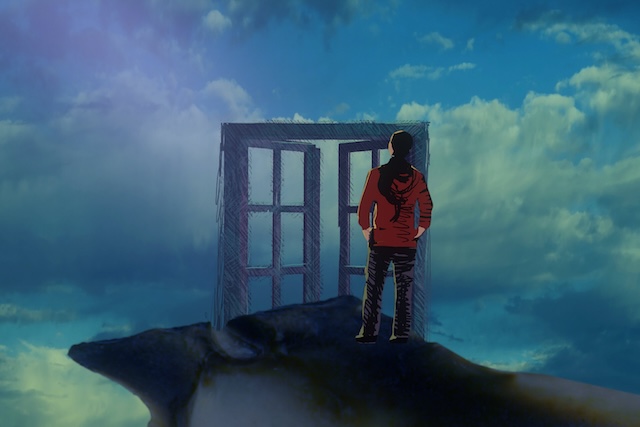
    But the universe (and my golf buddy) had opened a door for me. So I took a deep breath, gathered all my courage, put my money concerns aside, and walked through.

    Today I consider myself an educator first. Walking through that door connected me with my life’s purpose. I am a teacher.

    But before this all happened, the thought had never crossed my mind.

    Becoming a professor (they brought me on full time after one semester) and figuring out how to TEACH entrepreneurship completely reframed the way I think about business. I couldn’t just tell my students “that’s how it works because I did it and it worked for me.” I had to be able to explain WHY. And find examples of each step working for other people.

    Taking advantage of an opportunity I had never even considered opened up door after door and shaped the business I have today. Even though it initially looked like it was a complete detour from my career goals and the money in no way justified the decision.

    If you find yourself at a crossroads—a career crossroads, a relationship crossroads, a financial crossroads—look around and see if there are any doors that might be open that you’re ignoring. Laser focus on a singular outcome can be a powerful motivator, but it also drastically reduces your options and can obscure other routes to success. It can be useful to remember that career/relationship/financial growth is almost never a straight line.

    How will you know a door when you see one?

    Someone asking you if you know someone who can do X. Maybe that person is you?

    Maybe an organization you belong to is looking for workshop facilitators or volunteers? Maybe that person is you?

    Maybe you hear about an opportunity to do something that scares you a little bit—an open mic night, a writer’s retreat, a community gathering on a local initiative. Maybe you go and say hello to the person sitting next to you?

    And once you find that open door, here are a few things you might consider before you walk through:

    Does the opportunity appeal to you other than it’s not in line with your stated goals?

    In my case, I was absolutely intrigued about the opportunity to teach. It was scary because I wasn’t sure I’d be good at it. It was challenging because I hadn’t done it before. But I felt like it might be really fun. And fun counts.

    Will you learn something and connect with new people?

    As a lecturer in entrepreneurship, I would be developing an entirely new skill set. Additionally, I would have a chance to work with a large group of colleagues that would significantly expand my network.

    What is the next best alternative?

    For me, it was continuing to mope around and send resumes into the ether at a time when no one was hiring. Engaging in something, even if it wasn’t financially rewarding, gave me new energy and a much more positive perspective. And it led to the next opportunity to join the faculty full time and be compensated accordingly.

    Sometimes the most transformative opportunities come disguised as detours or distractions. But when there’s a door that’s sitting open, consider walking through it and seeing what’s on the other side. It’s rarely irreversible, you will always learn something, and it might be EXACTLY what you were looking for all along.
  • A Simple Plan to Overcome Self-Doubt and Do What You Want to Do

    A Simple Plan to Overcome Self-Doubt and Do What You Want to Do

    “Don’t let others tell you what you can’t do. Don’t let the limitations of others limit your vision. If you can remove your self-doubt and believe in yourself, you can achieve what you never thought possible.” ~Roy T. Bennett

    Ahh yes, self-doubt. Something that affects every single one of us at different times and at different magnitudes—even those that seem supremely confident.

    Why do so many of us experience self-doubt, and how can we overcome it?

    On a personal note, I can tell you my self-doubt comes any time I am trying something new. I’ve learned over the years where this stems from, and it may be similar for you. It comes from my parents.

    Although my parents were always encouraging, they’d also say things like, “Are you sure this is the right move?”, “Are you sure you want to do this?”, and “Be careful.” In fact, every time I left the house, that’s what my dad would say: “Be careful.” “Drive safe.” Not, “Have fun,” “Have a fantastic time,” or something along these lines.

    In my twenties I realized that it had been ingrained in me to always be cautious, which then led to me doubting myself in certain scenarios, though I’ve never been someone who shies away from challenges or holds myself back. Over the years, I learned to identify what contributes to my self-doubt and then push through it.

    Now, this isn’t the case for everyone. Other things that contribute to self-doubt are comparing ourselves to others; feeling a lack of means, intelligence, or other things we think we need to succeed; past experiences; possibly being criticized; and the natural fear that we feel when attempting something new.

    When we doubt our ability, we are allowing fear to settle in and hold us back from forging forward and taking a leap. Without trying, we are feeding the self-doubt, which means it will likely compound the feeling the next time we are faced with or offered a similar opportunity.

    So how can we detach from self-doubt and make sure we are not missing out on what could be an amazing opportunity or journey for ourselves?

    First, we need CLARITY.

    We need to first get clear on where this self-doubt is coming from.

    What is striking this feeling within you that makes you think you shouldn’t try it or you can’t make something happen? Is it the fear of the unknown, or is it the feeling of not having the ability, or something else you think you need to succeed? Are you comparing yourself to someone else in the process? Or do you think you couldn’t handle it if you failed?

    Second, we need to recognize the FACTS.

    What do you know to be true? For example, what do you know about yourself that can help prove that you can attempt or accomplish this? Have you had any similar experiences that prove you can do this?

    If you’re comparing yourself to someone else, what are the facts in this? Meaning, are you comparing yourself to someone who has already succeeded? Or are you comparing yourself to someone who is at the same stage you are? Nobody gets from A to B without experience, practice, and even failure. So, try not to compare yourself to others, as you may not know the complete story to their success.

    There was a time when I was contemplating which direction to take my business degree. I’d majored in marketing because it’s a creative field that allows for variety, which aligns with my values. But as I was working in my first couple of “corporate” jobs, I was enticed by sales.

    My father wanted to steer me away from sales. He said that it’s a hard career, it’s mostly male-driven, and it’s extremely stressful and unpredictable. But what I saw was the fun interaction sales teams had with their clients and prospects. How they were able to basically chat on the phone 80% of the time and attend fun events.

    It was a fact that sales is stressful, unpredictable, and male-dominated, but I knew myself. I knew I was different than my father. I knew I was up for a challenge and taking risks, whereas he was risk adverse. I knew if it didn’t work out, I always had marketing to step into or maybe other options, whereas my father was opposed to change.

    I had to recognize that he was from a different generation. That although what he expressed was true, there were other factors to consider. If I compared myself to the majority of people occupying these roles I likely wouldn’t have attempted it and enjoyed a fifteen-year-plus career in sales and business development.

    Finally, GO FOR IT!

    The best way to conquer self-doubt is to put yourself out there, take action, and see what happens. No success comes without failure. If it works out, you’ll be glad you did it, and if it fails you’ll learn and can progress.

    Without acting on it you will never know. At least if you push through the doubt and try you will understand yourself and your ability a lot more.

    There was a time when I was considering making a big move that I had dreamt of for so long. I loved my friends and family, but I didn’t love where I was living or the lifestyle I was caught up in. When the timing was right I decided to take the leap and move to the other side of the county alone, without a job.

    I heard things like: “Do you really want to go?” “It’s so expensive out there. How will you afford it?” And “It rains so much there, and people get depressed.”.

    If I had listened to others’ fear and angst about the move I would’ve likely lived in a miserable cycle. Instead, seventeen years later, I still feel this was the best thing I’ve ever done for myself, for my life, for my soul.

    The move brought me an even greater awareness of how resilient we are when faced with change.

    And if it hadn’t worked out, I would have had an adventure, and who knows where it may have taken me? Maybe it would have led me to something else I didn’t even know I wanted until I opened myself up to new possibilities. New possibilities I would never have known about had I limited myself based on other people’s fears.

    Don’t let others’ doubt or success deter you from going after what you want or trying something new. Recognize that you can either let your doubt leave you with regret or feel the satisfaction of taking action. Who knows, your action might actually inspire others to ditch their doubt and take a leap into a life they’ll love.

  • 5 Ways to Start Valuing Your Time and Making the Most of It

    5 Ways to Start Valuing Your Time and Making the Most of It

    “It is the time you have wasted for your rose that makes your rose so important.” ~Antoine de Saint-Exupéry, The Little Prince

    Oh, how I loved sleeping when I was a teenager. I would sleep for twelve hours, just as babies do.

    And guess what else?

    Another favorite activity of mine was taking selfies until I finally had a perfect one, editing it, posting it on social media, and waiting for likes. And scrolling through the feed.

    Wow. So unusual nowadays.

    I didn’t care what I was doing with my life. I chose a university degree just for fun and finished it just because I started it. I don’t even like what I chose. I had no goals, no ambitions. I was just drifting through life.

    But then adult life got in the way. Suddenly, I was married and had a child.

    What a turn.

    Now I don’t even have Instagram.

    Do you know why? Because I started valuing my time.

    And I am here to tell you that you need to do it too if you want to live a fulfilling life.

    Why should you value every second of your life?

    When I became a mom, I barely had time to brush my teeth. I didn’t have time to do anything that wasn’t related to my son.

    I started regretting all the time I’d wasted before.

    But let’s be clear: It’s not about productivity. It’s about living your life to the fullest.

    You see, when you value your time, you start valuing your life. You set your priorities straight and start doing things that matter to you. And that’s when life gets really good.

    Although my situation might be different from yours, time is one thing we have in common. And you’ve heard it a million times, but time is our most precious commodity.

    It is non-negotiable. You can’t buy more time, no matter how rich you are. And you can’t save time either. You can only spend it.

    Time waits for no one. So the sooner you start valuing your time, the better.

    Here are a few things that have helped me start valuing my time and life more that might help you too.

    1. Set your priorities straight.

    Oh, priorities. They are so important, yet we often forget about them.

    If you want to start valuing your time, you need to set your priorities straight. Ask yourself what is really important to you and start making time for those things.

    Ask yourself:

    • What do I want to do, achieve, and experience in life?
    • Who and what matter most to me?
    • What makes me happy?
    • Where do I see myself in five years?

    For me, the answer to these questions was simple: I want to value time with my son more. And I want to find a way to balance work and life.

    What I don’t want is to be glued to my phone while my son is next to me, or to watch movies instead of making small steps toward having my own business.

    Self-care is on my list of priorities too. I make sure to have enough time for myself. Even if it’s just ten minutes a day (to have a cup of coffee in silence), it makes all the difference.

    Self-care keeps me sane and happy. And when I am happy, I can give my best to my family.

    2. Realize the importance of limited time.

    We all have limited time on this earth, and we need to make the most of it.

    The idea of limited time gives so much magic to this life. It makes things more precious. And when you start realizing life is precious, time becomes more valuable to you.

    On top of that, it makes you more aware of your mortality. It might sound depressing, but it’s not. It’s actually very liberating. Just think about it: If you knew you’re going to die soon, what would you do differently?

    Do it now so you don’t end up with regrets about how you spent your time.

    I think about death every day. I accept it. And I thank the universe for being mortal.

    We never know when we are going to die, so the best thing we can do is to live each day as if it’s our last.

    3. Notice what your distractions are and eliminate (or at least minimize) them.

    We all have our own distractions. It can be social media, Netflix, video games, or anything else.

    Here is how I deal with my distractions.

    • My main distraction was Instagram. I deleted it.
    • Then, movies. I decided to watch only one movie per week. No TV series (all they did was make me escape my reality).
    • Internet surfing is another one. I decided to use the internet only for work and research. No more browsing without a purpose.
    • I open the app only if I want to relax for twenty minutes and watch something. Otherwise, it’s a huge time waster (I used to open the app and scroll through it for five minutes with no purpose).

    Once I did that, I noticed that sometimes I even got bored. And I love that feeling of not picking up my phone every time I have a free minute. I just enjoy it.

    4. Consciously choose to do one thing despite countless other activities you could be doing.

    You know those moments when you’re about to do something, but then you wonder, “Should I really be doing this? I could be doing something else.”

    This is a common feeling. We often have so many options that it’s hard to choose just one. But simply do that. Choose one activity and stick to it.

    It doesn’t matter if it’s the “right” choice or not. There’s no such thing as “right” when it comes to how you spend your time.

    I recently listened to a podcast by Oliver Burkeman. He said that we don’t want to make choices. We don’t want to decide. We want to let all the options remain available to us. This is also why we love dreaming about the future. Because all the options are open.

    But we need to make a choice. It is so liberating to make a choice. It gives you a sense of control over your life and your time and it keeps you moving forward instead of standing still.

    So, choose one thing and do it. You will feel so much more in focus because you know where you are going.

    For instance, I am writing this article. I could be doing a million other things, but I choose to do this. And it feels great. I am all in. And I am focused because I am not thinking about other things that I could do.

    5. Know that failure is a sign you’re using your time well.

    When we start a project or an activity, we want to do it perfectly. We need to be the best. Otherwise, we think it’s a waste of time.

    In reality, it is life itself. You can’t prevent failure. You will fail. A lot.

    And that’s a good thing. Failure is a sign that you’re trying something new; that you’re pushing your limits, learning, and growing.

    How can we make the most of our failures?

    • First, accept them. Don’t try to bury your failures or pretend they never happened. Acknowledge them and learn from them.
    • Second, put things in perspective. This one opportunity didn’t work out, but it’s not the last you’ll get.
    • Finally, focus on the successes in your failure. Odds are something good came from it, even if you can’t see it just yet.

    Oh, I failed so many times. I lost years of my life in failure. But I am grateful for every single one of them because they made me grow and become better, maybe even wiser.

    My biggest failure is probably my university degree. It’s three years of my life. I was so naive thinking that I can succeed no matter what bachelor’s I choose. And I chose the easiest one.

    Turns out, there is nothing I can do with my bachelor’s degree. It’s useless.

    I could have spent those three years better, but I am not regretting it. Because if I didn’t fail, I wouldn’t be so motivated today to start my own business and to create something that has meaning.

    As I said in the introduction, I was once horrible at valuing my time. But I am glad to say that I have changed. It certainly wasn’t easy. And I am not an expert at this. I still must remind myself to value my time. To cherish every moment.

    But my alarm doesn’t annoy me when it wakes me up in the morning anymore. It’s a reminder that I get to wake up and enjoy my time on this earth.

    I am grateful to still be alive.

    The time that you took reading this article is valuable. I hope it will make you value your time even more.

    Remember that time waits for no one.

    Remember that it’s non-negotiable.

    Remember that you can’t save it.

    You can only spend it wisely.

  • How Life’s Daily Challenges Can Actually Be Gifts in Disguise

    How Life’s Daily Challenges Can Actually Be Gifts in Disguise

    “Smile at your patterns.” ~Tsoknyi Rinpoche

    Partway through Eckhart Tolle’s Conscious Manifestation course, I furiously jotted down his teachings about challenges and obstacles to remind myself that they’re not only a normal part of the human experience but necessary for spiritual growth. “Yes!!!!” I wrote in agreement.

    When faced with difficulty, the human tendency is to react and resist, and when we do this, we add suffering to an already difficult situation. This tendency is reflexive within me, and my mindfulness practice has enabled me to either observe the cascading habit pattern as it unfolds, which disentangles me from its snare, or to gently accept what is happening and proceed with calm action and a quiet mind.

    When we can practice acceptance and equanimity, when we can say, “Okay, this is my present moment experience, and I can allow it because it’s already here,” we soften and open in the most tender way. And with this opening, we can receive a bounty of lessons and wisdom that our obstinance so often obscures.

    A few days after listening to Eckhart’s talk, I had to see several doctors and get lab work done to address symptoms I’d been experiencing. The entire week was pockmarked with small difficulties.

    First, the doctor’s office lost my lab sample, so I had to go back and give another one. Then the lab work process got delayed, and in an attempt to access my results, I spent two hours getting transferred between multiple staff members who ultimately said they couldn’t help me.

    At the end of the week, I confronted my last hurdle: I arrived for a follow-up appointment, only to be told that the automated system had canceled it and that the doctor was not available.

    After I explained my situation and expressed my discontent, the medical assistant managed to rebook me with another doctor. I softened, thanked her, and sat down, acutely aware that I’d lost my (spiritual) way.

    With each setback, I was upset and resistant. Like a snake releasing venom, I texted my husband flurries of frustrations, spoke exasperatingly to hospital staff, and felt my body tighten with stress.

    I realized that I only softened to the medical assistant because she told me what I wanted to hear, and within moments, this insight allowed me to look back on the entire series of events with a compassionate and non-judgmental eye. 

    I saw with clarity that in cloying for ease, I only created more difficulty. I saw that I had been behaving as if everything were a threat—like the healthcare system was out to get me—and that the real predator was my own mind. Immediately, I felt an internal release, like a nearly bursting balloon slowly deflating with the prick of a pin. I realized I could stop fighting. I realized that I could choose to surrender.

    After my appointment, I had to go to the lab, and I arrived at what felt like a crowded DMV: people everywhere, red ticket numbers glaring overhead, and a wait that seemed unending. I took a deep breath, pulled a number, and decided that I was going to use the wait—which I now perceived as an opportunity, not a threat—for mindfulness, presence, and spiritual practice.

    I looked around me at all the people. I watched as children caringly pushed their elderly parents in wheelchairs, as a pregnant woman patiently engaged her three children, and as a person laboringly limped to the ticket machine, burdened by a massive leg brace.

    I thought: Everyone is here because they are experiencing some difficulty; everyone has health scares; everyone is taking time out of their days to be here; everyone is waiting.

    I was so touched by the kindness and patience I witnessed. Suddenly, my story became enveloped in everyone’s story. I was them and they were me. I felt a deep kinship—a tenderness that made me feel enveloped in, rather than targeted by, the human experience. 

    As my awareness expanded further and further outside myself, I began connecting with those around me. I told the pregnant woman sitting beside me that I admired her patience, and when she shared that she was fasting for a half day of pregnancy-related lab work, I became even more aware that mindset is a choice.

    I made eye contact with a man whose gentleness I perceived underneath his masked face. We didn’t say anything, but we said everything.

    I kept scanning the room, and I noticed it had transformed from a chaotic, undesirable place, to somewhere I wanted to stay, somewhere I felt deep meaning and connection. Then I noticed that the space did not transform; I simply changed my relationship to it.

    When I left the lab, I was buoyant. I felt energized, connected, and light. I was overwhelmed with the experiential realization that the entire week was a skillfully designed lesson on challenges. I saw what happens when I fight to make them go away, and then I saw what happens when I invite them in, with an open heart and an open mind.

    “Challenges as gifts” left the theoretical world of quotes and concepts and burrowed into my lived experience. It stays there, and reminds me of itself, when I allow it to shine its light.

  • Afraid to Say No Because You Might Miss Out on a Big Opportunity?

    Afraid to Say No Because You Might Miss Out on a Big Opportunity?

    “What you do today is important because you are exchanging a day of your life for it.” ~Unknown

    Are you afraid of saying no in your professional life because you think you’ll miss out on a big opportunity? I’ve learned that a quick yes can sink a lot of ships. God only knows I’ve taken on too much at times because I feared I’d miss out on something life changing.

    We view opportunities as golden nuggets that are few and far between, so we snatch them up before someone else does, even if they don’t really excite us. But many of them are nothing more than fool’s gold—a superficial resemblance to what we actually want.

    It’s just so damn hard to pass on something that sounds promising like a new role at work, a chance to join an exciting new project, or an invitation to pitch your business idea (even if it’s hats for cats). And we’d be stupid to say anything but yes because it’s now or never, right?

    This is a sh*t storm brewing up a triple threat of overcommitted, overwhelmed, and overloaded, when all those exciting opportunities start feeling more like burdens.

    Grace Bonney is an author, blogger, and entrepreneur who knows a thing or two about this struggle. Bonney wrote The New York Times bestseller In the Company of Women, a book featuring more than 100 stories about women entrepreneurs who overcame adversity.

    Bonney had this to share on saying no:

    “The biggest fear most of us have with learning to say no is that we will miss an opportunity. An opportunity that would have catapulted us to success, or that will never come again. And most of the time, that simply isn’t true. I’ve found that the first part of learning to say no is learning to accept that offers and opportunities are merely an indication that you’re on the right path—not that you’ve arrived at a final destination you can never find again. If someone is choosing you, it means you’re doing something right. And that is the biggest opportunity you can receive—the chance to recognize that your hard work is paying off. And if you continue to do good work, those opportunities will continue—and improve—over time.”

    I know what she’s talking about because I used to put myself in this situation at least once a year. I would ignore this lesson and believe that this time would be different (and it never is).

    I remember one time I was sitting on the edge of my bed feeling like I had been kicked out of an airplane without a parachute. I could hear a violent whoosh sound in my ears as my boss picked up. “I don’t think I’m going to be able to come in today, I’m…”

    It was too late. I was already freefalling. I was experiencing my first panic attack. I couldn’t finish the sentence. The tears started coming as I blurted out, “I’m sorry, I’ve taken on too much and it’s hitting me all at once.”

    I was in a full-time job I loved, I had returned to school to become a certified coach, and I was attempting to start a business. As if all of that wasn’t enough, I’d also accepted an invitation to kick off a new innovation team because I thought it would look good on my resume and I was afraid I might never get an opportunity like that again.

    It’s sad to say, but my partner was left with a burned-out, easily agitated shadow of support. In an attempt to give us a better life, I had made life miserable.

    I sucked all the fun out of these exciting opportunities by pushing myself to a limit that clearly wasn’t sustainable.

    But then I did something magical. I started to say no.

    From then onward, I used three questions to help me filter possible opportunities in order to gain clarity.

    What does this opportunity mean to me?

    Why is this opportunity important to me?

    What does this opportunity give me?

    Answering these questions helped me see that I’d put zero thought into a lot of stuff I was saying yes to because I was trying to create a “successful” life.

    But I knew what I wanted my days to look like and what “success” actually meant to me. And more importantly, I understood that success without fulfillment is the ultimate failure.

    My north star of success is freedom. Having the freedom to invest my focus in the things that matter to me. Which means I need to do less so I can enjoy more.

    Now I’m not willing to accept an opportunity unless it truly excites me and I take something else off my plate. I’m unwilling to sacrifice my values. I trust that bigger and better opportunities will continue to come my way (if I keep improving and honing my craft).

    This gives me a measuring stick I can reference before I take on any new opportunities. Because a big part of saying no is the power it gives you to go all-in on something awesome when it comes across your plate (without being overcommitted, overloaded, and overwhelmed by sh*t you don’t care about).

    Bonney shifted my thinking of how I view opportunities. Rather than see an offer as a one-off that I need to jump on, it’s a sign that I’m on the right path. If someone wants to partner with me, it means I’m doing something right. As long as I continue to do what got me noticed in the first place, the opportunities will continue and improve in the future.

    Life is too damn short to be overcommitted, overloaded, and overwhelmed by a schedule of projects and people that bring you no joy. In the words of philosopher Ralph Waldo Emerson, “Nothing great was ever achieved without enthusiasm.”

    Don’t see saying no as letting people down. You’re actually letting people down when you say yes, but don’t have the capacity or the enthusiasm to knock it out of the park. If you won’t say no for yourself, say it for the rest of us, because the world is a better place when you’re working on things you love.

  • When You Reframe Your Breakup as an Opportunity, Everything Changes

    When You Reframe Your Breakup as an Opportunity, Everything Changes

    “Sometimes the most uncomfortable learning is the most powerful.” ~Brené Brown

    Seems impossible, doesn’t it?

    How can you look at your breakup as an opportunity when it feels like someone cut your right arm off and ripped out your heart?

    Breakups can be rough. When you open yourself up to another person, love them unconditionally, and compromise your own needs for the “betterment of the relationship,” you put yourself all-in. It’s no surprise that you feel lost, confused, and unwilling to move on when that connection is torn away from you. You gave everything to your relationship and now it’s gone. Forever.

    Breakups have taught me something that I never learned in school: I’ve learned that losing love is hard. Brutally hard. I experienced more pain after the toughest breakup of my life than completing an engineering degree, doing standup comedy for the first time, and walking 400 kilometers in two weeks with 50 pounds on my back. When I lost my soul mate, I didn’t know how I was going to move on.

    At first, I didn’t. I did everything I could do to escape, suppress, and avoid my feelings. I wasn’t nice to my body. I cried in the shower. I hid in the park close to my apartment since I was still living with my ex for a month after the breakup.

    It was my “grieving period.” We all need one after a breakup. But although we all need different lengths of time to grieve, it’s important to put a time limit on it. Since I knew I was going to be living with my ex until we got our arrangements sorted out, I decided that I was going to give myself that month to grieve. And grieve, I did! I was a drunk, unproductive puddle of sadness.

    Eventually I said goodbye to my ex, my cat, and my apartment. I cried on the metro on the way to my buddy’s condo. That first night away from the place I’d called home for years was brutal. But I knew my grieving period was over in the morning. And the next day, I got to work.

    The road to recovery wasn’t easy. There were many ups and downs. But I stayed focused on letting go and moving on in the healthiest way I could.

    That was two years ago, and I’m proud to say that I did let go and move on from the toughest breakup of my life. I’m a better version of myself today than I’ve ever been and I’m still a work in progress. We all are.

    When I was recovering from my breakup, I did a lot of “reframing.” I tried looking at things through new perspectives so I could develop more understanding and empathy, for my ex and for myself. Today, with the advantage of hindsight, I can put my finger on an idea, or reframe, that helped me start moving on faster:

    Breakups are an end, but they are also an opportunity for a fresh start.

    First, a breakup is the end. Accept it. If you’re reading this and thinking, “Maybe I can still get my ex back if I just do this…” then you’re reading the wrong article. Because if your mind is set on getting your ex back, this is not your new beginning. At best it’s a rerun of the same show that’s been playing for too long.

    Because guess what? When a breakup happens and people get back together, usually they break up again. And again. And again. The chances that you’ll get back with your ex and everything will improve and they’ll change into the perfect partner is as likely as me playing first base for the Yankees.

    But just because you accept this as the end of your relationship doesn’t make it a negative experience. Most things come to an end in our lives—jobs, friendships, lives, your favorite Netflix series, the tub of cookie dough ice cream in your freezer (okay, in my freezer).

    When one door closes another opens. You just have to have the guts to lock the old door behind you and walk through the new one.

    I realized that my breakup was my opportunity to:

    • Do things I’d wanted to do for a long time but hadn’t because I had a partner to consider in every decision I made.
    • Peel back the layers and look within myself to see where I was going wrong in my romantic relationships, and most importantly, how I could improve so that I would be better in my next relationship.
    • Reconnect with friends and family who had been relegated to the sidelines for five years because my relationship consumed a lot of time and energy.
    • Meet new people and get excited about a fresh chance at love.
    • Inspire other people to get over their breakups without the typical clichés and bad advice.

    Let’s face it, you’re here on Tiny Buddha because you’re interested in self-improvement and self-growth. You’re on a journey toward becoming a better version of yourself. That’s why if you’re struggling to let go and move on after a breakup, you need to reframe it right now so you can continue on your journey.

    You need to tell yourself this is your opportunity to become better. This is your chance to fix things that went wrong in your past relationship so next time you don’t end up with a partner who isn’t right for you.

    Remember, relationships end for a reason.

    You and your ex had your problems. Sure, you had love and a deep connection, but did you also have rock-solid communication, clear boundaries, and unwavering honesty? Did you share the same core values?

    I’ll say it again: relationships end for a reason. And when it happens, it’s okay. Your ex wasn’t the only person on the planet who is capable of loving you. On the contrary, if you use your breakup as an opportunity to improve things about yourself, you will attract a partner with whom you’ll find so much more love and connection that you’ll wonder how you lasted as long as you did in your past relationship.

    That’s what life is all about. None of us get things right on the first go. Finding a soul mate is no different than learning a new language or getting in shape. You have to practice. Look at your ex and breakup as a practice round. Because of that relationship, you’re stronger, smarter, and more prepared for the next one.

    This is your time. It’s your opportunity to sort through your past relationship issues and figure out how to be better.

    Because no matter what, we all play a role in our breakups. Even if you were lied to, cheated on, duped, or betrayed, you still played a role. That might be hard to hear, but it’s true. My mom always said, “It takes two to tango.” And my mom ain’t no fool.

    I had to get comfortable with my role in my breakup, too. I was no angel.

    I had to accept that I hadn’t been true to my core values. I wanted children, my ex didn’t. Still, I put that to the side because we were in love. I also realized I had a lingering fear of commitment. I was still battling with jealousy and insecurity issues even though I thought I’d left them behind in an earlier long-term relationship. It wasn’t easy accepting those things about myself, but when I did I knew exactly where the nuts and bolts needed to be tightened. And I got to work.

    For you, perhaps there were co-dependency issues or a need for validation. Maybe you stayed for the sake of the children, the dog, or the mortgage. Who knows. But I do know that you played a role and you need to accept that before you can move on.

    Looking in the mirror and accepting the not-so-good things about ourselves is difficult. People resist peeling back the layers of their personality because it means leaving themselves vulnerable and exposed.

    But you’re different. You understand the importance and power of vulnerability. And your breakup is the best chance you might ever have to rebuild yourself in the image that makes you feel like the confident champion you dream of being.

    I know your breakup sucks. I know you miss your ex and still have love for them. I know it’s hard looking to the future and wondering if you’ll ever meet your true soul mate.

    Remember: the greatest opportunities for growth in our lives come when we’re the most uncomfortable. And a tough breakup takes us way outside our comfort zones.

    That discomfort is your opportunity. Accept it, embrace it, and cherish it. Big breakups don’t come around often. This is an exciting time! You’ve proven to yourself that you’re brave enough to take a risk on love. Just because the relationship is over doesn’t take away that bravery. Now it’s time to be courageous in the face of adversity.

    And guess what? If you can shake off your breakup in a productive, healthy way, it’ll build new skills and resilience for the next time a difficult, unexpected life event happens. Jobs will be lost. Friends will drift away. People will die. Change is inevitable in your life. Now is your opportunity to prepare yourself for those times that will come whether you like it or not.

    A breakup is your opportunity to show everyone around you—friends, family, colleagues—how gritty you can be. It’s going to be hard work. It’s never easy coming to terms with our limiting beliefs, fears, and ghost in our closets.

    You have an important choice to make:

    You can choose to sit in your basement waiting for “time to heal” and hoping that by some miracle you’ll get better.

    Or you can choose to look at your breakup as an opportunity to improve the way you show up in your relationships so you can attract the right type of person into your life.

    You will let go and you will move on. But you have to start, today. The last thing you want is to look back on this moment and realize you waited too long to accept this as your opportunity. Time is too precious to waste feeling stuck.

  • Finding a Window of Opportunity When Life Closes a Door

    Finding a Window of Opportunity When Life Closes a Door

    Man Looking Out Window

    “Things work out best for those who make the best of how things work out.” ~John Wooden

    “Why don’t you just take up swimming?” the doctor asked.

    I was twenty years old, single-minded in my pursuit of a dance career, visiting yet another doctor about the vicious tendinitis that had forced me to give up my spot at the prestigious Juilliard School in New York City.

    What the doctor didn’t understand is that dance isn’t just a sporting activity; it’s a way of life, an identity.

    Telling a young dancer to “just take up swimming” is about as helpful as telling a woman receiving treatment for infertility to “just take up knitting.”

    Needless to say, I didn’t follow the doctor’s advice. Instead, I spent a good five years on the quest for the miracle cure, hopping from doctor to doctor, from treatment to treatment.

    Life went on, I graduated from college, I got a job, but in many ways I was stuck. I couldn’t really invest myself in anything else, because surely I might be able to start dancing again at any moment, and I refused to do anything that might jeopardize that possibility.

    As a result, I lived my life in a sort of painful limbo.

    I was unable to dance, but I was unable to move on either. Dance was like a bad lover who never truly cared for me, but kept me on a string, waiting in the wings, sighing my life away.

    Thankfully, I eventually did move on. It took about five years, but I finally accepted that a career as a dancer was not in the cards, and though I had to grieve this loss, once the fog of grief cleared, I found to my surprise that my chances for happiness had not died along with my dream of being a dancer.

    Perhaps it was my youthful naiveté that led me to believe that dance was my one and only passion. Perhaps I was influenced by the false, but sadly very prevalent, notion that we each have only one soul mate for all of time.

    Whatever the reason, I truly believed that I’d burned through my one shot at passion, and that I was destined to live the rest of my life in black and white.

    (This may sound overly dramatic, but remember, I was barely out of adolescence at the time, and young people do tend to be dramatic.)

    Just a few years after I decided to move on from dance, not long after getting married, I discovered a love of calligraphy and making things with my hands. Lo and behold, it turned out I wasn’t limited to one passion after all! I became just as passionate about art as I’d ever been about dance, and even started a business selling my art.

    Then my marriage fell apart. During the painful year of my divorce, now that my tendinitis had finally cleared up, I started going out salsa dancing for fun, and I discovered that lost things sometimes come back.

    Yes, I’d lost my dream of a dance career, but it felt like dance was being given back to me, in a new form.

    Now I had not one, but two passions: art and salsa dancing!

    The Universe has a wicked sense of humor, though, and a year into my salsa mania, a new foot injury flared up. I could barely walk, let alone go out salsa dancing. Once again, the thing I loved to do was barred from me.

    This time around, though, things were different. This time, I didn’t hang around in limbo.

    I still got to have my art, for one thing, but I didn’t settle for that alone. Some friends had taken me to see Teatro Zinzanni in San Francisco for my thirty-fourth birthday (imagine Cirque du Soleil plus a five-course meal) and I had been transfixed by the aerial artists.

    “I want to do that!” I thought. And instead of putting the idea on a shelf (as I had with so many other ideas in my life), I thought, “Heck, why not? If I can’t dance on the ground, I will dance in the air!”

    They say that when the Universe closes a door, it opens a window, and I leaped through that window! I found a circus school about an hour away, enrolled in an aerial arts class, and for the next year I did dance in the air.

    What a difference from the first time I lost dance!

    The first time, I refused to accept how things worked out. I admire my persistence, but I must say it didn’t lead to happiness.

    I don’t have any regrets about how things turned out, but I sometimes wonder how things might have been different if, instead of just doggedly aiming down a path that no longer existed, I had also kept my eyes open for an alternate path.

    What if, for example, I had discovered aerial arts at twenty instead of thirty-four? What if I had opened my mind to the possibility of a completely different passion?

    Of course, that’s exactly what happened eventually anyway.

    Eventually the crappy things that happened in my life fertilized some rich harvests; I just spent a lot of miserable years first.

    It’s not always easy to move on. It’s not always easy to see the windows that the Universe opens after closing a door. Processing a loss happens in its own time, and it cannot be rushed.

    What I’ve learned, though, is that I’ve been happier when I’ve made the best of how things work out. When I’ve made the best of what was in front of me, things have always rather miraculously worked out.

    With an open mind (and a liberal dose of patience and self-compassion), the worst things in my life have alchemized into unexpected gold.

    It can be hard to keep an open mind when things go terribly wrong, but the happiest people do just that. Challenging as it is, I know it has done me immeasurable good to let go of my attachment of how I think things “should” be.

    This, if you think about it, is the ultimate dance: dancing with the Universe. Whatever tempo or style of music it throws at you, our job is to make the best of it, say yes, and take a spin around the floor.

    Is there a place in your own life where things have worked out differently from how you wanted? How might you turn the crappy things in your own life into a rich harvest?

    Man at window image via Shutterstock

  • 3 Tiny Phrases That Can Help You Solve Big Problems

    3 Tiny Phrases That Can Help You Solve Big Problems

    Thinking

    “At any given moment, you have the power to say: This is not how the story is going to end.” ~Chris Mason Miller

    I was faced with an impossible problem, so like all the great thinkers throughout history, I shut myself in the bathroom and vowed not to come out until I had solved the problem.

    It had plagued me for two-and-a-half years, and for seven years—the length of time during I’d lost my voice for and had suffered from chronic tendonitis respectively.

    Such was the consequence of an obsessive guitar habit, one that saw me practicing up to fourteen hours in a single day as I worked my way through three years of my Bachelor of Jazz Performance Degree.

    I never made it to year four, the year I would have graduated. Year three had seen my pain increase to the point that I only played my instrument at performances and in classes requiring it.

    On my own, I practiced in my head, imagining both my instrument and the sounds it would produce.

    I developed a strong imagination alongside a strong case of tendonitis.

    But at the end of that year, my body quit. Shut down. It got so bad that I ended up unable to drive or hold a knife and fork. I even ended up having a friend push me around the Chicago Museum of Science in a wheelchair because the muscular dysfunction had become a whole-body issue.

    So there I was, several years later, with no voice and no use of my arms.

    I’d seen doctors, physiotherapists, massage therapists, and all manner of other people who poked and prodded and tried to figure out what was wrong with me. I’d tried all the treatments, taken all the advice, and done plenty of my own research.

    None of it had worked.

    So that sunny afternoon in June, I turned to the only resource I had left…

    How To Run Your Mind

    There are only two ways to change the quality of our lives: change the quality of the events, or change our perception of the events. Most of us opt for the former. I’d been doing this for the last seven years.

    Now, it was time to try out the other option. We can all change the way we perceive events by changing the words we use when we talk to ourselves. There were three phrases in particular that gave me my life back; they have untold power to have a positive impact in yours.

    1. I am here.

    This phrase saved my life. When we fight long and hard, trying to escape our pasts or reach our futures, we inhibit our ability to find joy, contentment, and inner peace in the present.

    And this is the only place where we can ever have it.

    When we ground ourselves in the here and now with a phrase like “I am here,” and put all our intent and focus into the words, we become accepting of where we are. We cease to judge ourselves as good or bad, as a success or failure. We are simply where we are. And that’s okay.

    The seriousness of what we’ve gone through and the gravity of whatever we’re trying to achieve diminishes, and we’re able to safely and securely assess our current situation and take one step in the direction we want. A step taken without fear, stress, or tension—without anything except the joy of taking that step and seeing what will come of it.

    2. I don’t know.

    We are conditioned from an early age to rationalize, justify, and explain things, whether we’re studying for a biology exam, writing an essay, or trying to get out of detention.

    This attitude can have serious consequences later in life as we become set in our patterns of thinking and behaving. We understand the world—we have the answers—so new information gets filtered out before it has any opportunity to impact us.

    By adopting the stance “I don’t know,” we open ourselves to the possibility that there are different ways of seeing the world. We give ourselves new opportunities to learn, grow, and evolve—to become okay with the uncertainty and humility of not always having the answer.

    3. Life is easy.

    When we suffer, and particularly if we’ve been suffering for a long time—whether that’s through health problems, workplace issues, relationship troubles, or anything else—it is easy to feel as if life is simply one prolonged struggle, and that getting by is the best we can hope for.

    But all this changes when we adopt the idea that life is easy!

    For instance, I had my laptop stolen when I was traveling in Malaysia. I lost several months of writing I had saved up, fairly significant for someone whose income relies upon his portfolio. Not only that, but with no computer I had no way of doing any freelancing work to help support myself.

    This was incredibly stressful until I decided to see this as an opportunity; with my old work gone, I had the chance to write something even better than I had created before.

    I had an interesting experience—a challenge and adventure—recovering from the setback that I could use in my future work. That was an amazing realization that made it simple to move on from the setback and enjoy the ride.

    When we turn obstacles and barriers into opportunities and adventures, stress and discomfort disappear, we need less motivation to act, procrastination affects us less, and the creative part of our minds responsible for lateral thinking and problem solving stay active.

    As a result, solutions start to appear as if from nowhere, simply because we put our minds in a position to find the answers. And life does become easier.

    These phrases, with enough time, were major reasons why I can talk and write today. They are the reasons I was able to solve the impossible problems that dumbfounded medical professionals, and they can be the reason that your life changes for the better in the coming weeks and months.

    Photo by Davide Restivo

  • Take a Chance:  Seize That Opportunity in 4 Steps

    Take a Chance: Seize That Opportunity in 4 Steps

    “It’s not who you are that holds you back, it’s who you think you’re not.” ~Unknown

    Have you ever paused at a podium, feeling your hands shake as you speak to the senators before you? Have you ever laced your skates, shuddering as you heard your name announced as the next skater to compete? Have you ever found out about an amazing opportunity (say, a chance to post on Tiny Buddha), only to realize that you’re terrified to try?

    I’ve been in all these risky scenarios, so I know how intimidating they can be. By definition, risk-taking doesn’t guarantee that you’ll attain your desired result. However, there are a few things you can do to optimize your chances of succeeding when an opportunity comes your way.

    1. Get yourself prepared (and keep your eyes open).

    Malcolm Gladwell said it in Outliers, and I’ll say it again:  It takes time to achieve expertise. To be precise, it takes about 10,000 hours of practice to become a true proficient. This is no small investment of your life energy.

    As such, it pays to spend time thinking about the kinds of opportunities you want to prepare yourself for.

    If you’re an advocate, what do you want to say to those senators? Start saying it now, even if you’re speaking to an empty room at first. If you’re a figure skater, what elements do you want in your Olympic program? Start practicing those elements every day.

    Once you have seriously invested yourself, and have discerned what kind of opportunity you’re looking for, keep your eyes open, because opportunity has a strange way of showing up once you’ve prepared. Said opportunity may be unexpected (the best ones are), but if you’ve put in the time beforehand, you can seize the opportunity when it arises.

    Nevertheless, it’s also essential to… (more…)