Tag: openness

  • Why I’d Rather Be Vulnerable with People Than Pretend I’m Perfect

    Why I’d Rather Be Vulnerable with People Than Pretend I’m Perfect

    “Give up being perfect, for being authentic. Give up the need to be perfect, for the opportunity to be authentic. Be who you are. Love who you are. Others will too.” ~Hal Elrod

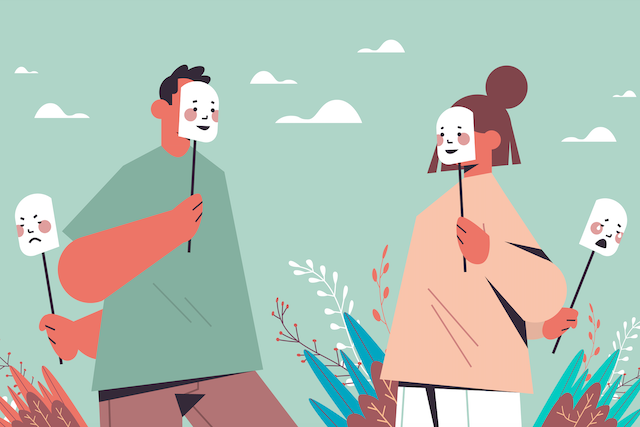
    I’m not perfect. Not that this would come as any kind of surprise to anyone who knows me. But I often feel pushed in the direction of trying to represent myself as someone who has it all together. Especially because of the nature of my work as a coach and facilitator. What about you? Do you ever feel like you’re putting on a show for others?

    The more I find myself trying to represent a perfectly put-together person, the less confident I feel in who I am because I know I am being inauthentic. It’s a big part of what took me off social media a few years ago.

    I don’t like that social media has the ability to mold what you think about yourself by way of comparison and encourage posturing. It’s a slippery slope, as we’re hardwired to yearn for love and connection as part of our survival. For me, it didn’t feel like the kinda place I wanted my love and connection to come from.

    Having the ability to talk about our flaws, what’s going wrong in our lives and where we’re getting stuck, is a huge part of human evolution that we often forget about. If we don’t have an environment to talk about our vulnerabilities, the wounds never get a chance to heal.

    Before getting into therapy, my life was a bloody mess because I pretended like these wounds didn’t exist.

    I don’t remember a period in my life without depression. Even as a teen it followed me around like a shadow.

    I believed the world would be better without me. I felt worthless—like I shouldn’t even have a seat at the table with other humans. I should have been in an alley eating scraps of food with sewer rats. No matter what I did or how hard I tried, the shadow mocked me for dreaming of a better future. My unwillingness to unpack those thoughts meant the infection spread to all areas of my life.

    I grew up in the nineties, when no one was talking about mental health. You struggled in silence.

    I battled demons in high school. I only lasted till eleventh grade before dropping out. I couldn’t stand the thought of spending another day being somewhere that made my life hell—but really, hell was inside me.

    The voice inside my head was (and still is at times) vicious. Every day it was like the Vikings raided and settled into my thoughts to destroy my existence. Those thoughts have left scars that would look like battle wounds of lobbed-off arms if you could see them.

    The voice inside my head was a reminder that I sure as hell would never do anything my parents would be proud of. It was easier to do nothing so that nothing was expected of me. I didn’t feel stupid if I didn’t try, so it made my reality an easier pill to swallow.

    I did graduate and made my way to university, but my life became increasingly dysfunctional. My love for being black-out drunk on Sailor Jerry rum became the perfect way to cope with a chaotic mind I didn’t understand.

    This comes back to not treating open wounds. Everything I resisted continue to persist.

    I had next to no insight into what I was going through because I wasn’t willing to share that I was struggling.

    At the time, my problems took on the weight of the world because I didn’t let people stand by my side to support me. I burned through relationships like a brushfire. I had no idea how to be in an open and communicative relationship because I barely had a relationship with myself.

    Once the wounds became visible through therapy, I could stop the infection from poisoning my ability to think and function. Vulnerability saved my life. I have no doubt that if I didn’t get that support, I would not be here today.

    We forget that our survival depends on being vulnerable. Author Brad Stulberg talks about this in his book, The Practice of Groundedness. He writes, “Our ancestors who survived weren’t those who were the strongest by traditional measures, but those who were most effectively able to share their weaknesses with one another and work together to overcome them.”

    If I didn’t share what I’ve been through, would you still be reading this? Probably not. It would be just another fluff piece on embracing your vulnerability.

    Without openness, there is no love and connection.

    Without openness, you and I wouldn’t be sharing this moment.

    Without openness, you and I can’t heal and grow together.

    The idea of being vulnerable scares the sh*t out of most of us. No one wants to be perceived as weak or admit they have flaws. We’re afraid that the lions of the world will sense our weaknesses and pick us off one by one.

    Except I’ve never actually been mauled by a wild animal when I’ve asked for help, or taken responsibility for a mistake. It’s actually had the opposite effect. Through my writing and vulnerability, I’ve connected with people on every continent of earth.

    It becomes impossible for me to pretend my vulnerabilities are mine alone if people from all over the world have said I’ve captured what they’re struggling with.

    This idea is backed up by research from The University of Mannheim, in Germany, that Stulberg references in his book.

    He writes, “They repeatedly found that the individual doing the sharing felt that their vulnerability would be perceived as weak, as a negative. But the person on the other end of the conversation, the listener, felt the exact opposite: the more vulnerable the sharer was, the more courageous they perceived him or her to be. The listener viewed vulnerability as an unambiguously positive trait.”

    And I think this is why a lot of us continue to feel stuck. We’re so damn wrapped up in worrying about what others will think of us when we open up that we miss the chance to connect.

    When we feel we need to be perfect, it becomes impossible to grow because we’re not being honest with ourselves about how we’re struggling and what would help. My life couldn’t move forward if I refused to see the reality that partying, substance abuse, and pleasure chasing was an attempt to escape depression.

    When you choose the illusion of perfection over vulnerability, you become a stunted version of who you’re capable of becoming.

    The first place you get to take the armor off is when you’re staring at the reflection you see in the mirror.

    Are you willing to be vulnerable with the person staring back at you?

    Are you willing to admit that life is not going the way you want it to?

    Are you willing to put aside judgment so you can get the help and support you need?

    We all want changes, but are we willing to make the choices that give us that change?

    These questions have the potential to shake the core of your foundation free from all the bullsh*t that accumulates over the years. It’s bloody liberating to let go of stories that no longer serve you—stories about who you need to be and what you need to do or have in order to be happy and loved.

    I didn’t need to achieve a promotion or drive a sports car to receive love from my parents. I didn’t have to do anything to show the world that I mattered. I needed to ground myself in vulnerability, rather than an image of perfection, so I could show up as my authentic self and make a difference for other people by being the real, imperfect me.

    Pretending to be somebody you’re not is exhausting work. Not to mention it does the complete opposite of what you want it to do. If vulnerability gives you the power to connect, lead, and grow, that means the inverse is also true. A lack of vulnerability means you end up feeling disconnected, a fraud, forever stuck with a fragile version of what you’re capable of because your ego is afraid of getting hurt.

    Putting a name to what you’re facing puts the power back in your hands. So recognize that you too may be pretending to be perfect to avoid admitting you’re struggling and feeling vulnerable. That single choice to embrace vulnerability could be the most important decision you ever make in your life. And it just may give you the confidence to know you can face anything and rise above it.
  • Feel Hurt in Your Relationship? How to Get Your Needs Met and Feel Closer

    Feel Hurt in Your Relationship? How to Get Your Needs Met and Feel Closer

    “The less you open your heart to others, the more your heart suffers.” ~Deepak Chopra

    I used to handle hurtful situations in relationships the same way. I’d get angry, shut down, get irritated, or just give my partner the silent treatment. This just led to more of what I didn’t want—separation, loneliness, and frustration.

    So one day I made up my mind. I was going to change my approach and try something different. Cause we’ve all heard that famous saying from Albert Einstein: “The definition of insanity is doing the same thing over and over again and expecting different results.”

    I was tired of not getting the level of intimacy in my relationships that I longed for. I was tired of feeling alone, frustrated, and separated from my partner, especially during the moments when I felt most hurt.

    It all turned around in one single moment.

    People think that change happens incrementally over time, but in my experience it’s often a defining moment in time where you make a new decision that changes everything.

    Turning Separation into Intimacy

    Let me take you back to this moment… I was upset, lying in bed next to my partner. Earlier that evening we had attended a birthday party, and my partner’s ex was there. Truth to be told, it made me jealous.

    Looking back, I had no real reason to be jealous, but that’s the innate nature of jealousy—it’s never rational, it’s emotional. On instinct, I handled the situation as I always did when I felt jealous, inferior, or threatened. I shut down, got irritated and cold, and gave him the silent treatment.

    “What’s the matter?” my boyfriend asked for probably the hundredth time that evening. (Have you ever been in a situation where your partner asks you the same question over and over again, and you repeat the same answer over and over again, secretly wishing that he’d read your mind?)

    “It’s nothing,” I replied with a cold tone, and turned my back on him. That’s where I started to ask myself what was really going on. What I realized was this: At the core, I was not really angry, upset, or irritated. I was hurt and afraid. I felt exposed and rejected.

    So I made a new choice there and then. I told him what the situation was really about: me not feeling pretty enough, not lovable enough, scared that he would choose someone else and leave me. And believe me, it was extremely scary to be vulnerable and expose myself in that way. I was way outside of my comfort zone, but it was truly worth it.

    When I dared to communicate honestly from my heart, I received what I needed: love, connection, and confirmation. This shift that I made during the conflict changed everything and made us, as a couple, closer than ever before. It opened up the door to a new level of communication and intimacy.

    Today, instead of pointing fingers at each other, we always try to take responsibility for our own thoughts, actions, and emotions. To stay honest and vulnerable, even when the stormy weather of negative emotions desperately tries to separate us and impose conflict.

    Assuming you’re in a healthy relationship with someone who would never intentionally hurt you, you too can turn conflict into deeper intimacy and not only feel closer to your partner, but also better meet your needs. Here’s the process that I follow to turn hurtful situations into intimacy:

    1. Stop and notice your emotions.

    The first step is to become aware of your emotions. Just stop and catch yourself when you feel hurt, angry, disappointed, jealous, irritated, lonely, etc. Don’t beat yourself up for having those emotions. To become aware of them is the first vital step in the process.

    For me, it was feelings of jealousy, irritation, anger, and separation that came over me.

    2. Ask yourself what story you’re telling yourself about the situation.

    What thoughts and beliefs do you have? It’s often very helpful to write down your story. The story in your head generates the emotions in your body, and it’s therefore crucial to become aware of your specific story.

    In my case, the story was the following: “My boyfriend still has feelings for his ex. He’s mean and doesn’t respect me. I don’t want to be close to him. I want to punish him and make him suffer. Also, I knew it; I can’t trust people, they always leave and hurt me.”

    3. Scrutinize your story.

    The stories that we play in our minds are often influenced by past memories and experiences. And they tend to trigger strong emotions, which makes us blindfolded; we aren’t capable of acting or thinking rationally.

    So, what we need to do is to scrutinize and question our story. Is this really true? Do I know for sure that this is the way it is? What are guesses, assumptions, and projections, and what are the actual facts?

    In my case, I had very few facts. My boyfriend had not left me, nor had he said or done anything that implied that he had feelings for his ex. When I scrutinized my negative and destructive story, I realized that there was little evidence to support it.

    4. Identify the root cause.

    Ask yourself what it’s really about. What are you not willing to see or feel that needs to be seen or felt?

    In my case, the root cause was me not feeling pretty enough, not lovable enough, and scared that he would choose someone else and leave me.

    This can be a tough one, but give yourself some love and credit for being brave enough to acknowledge your shadow. It’s key to be kind toward yourself, because this stage requires vulnerability. Trust me, the reward of doing so is immense!

    5. Reveal your true needs.

    When you know the root cause, ask yourself: “What is the underlying need that is not being met right now?” Is it to be loved? To feel connection? To feel special and significant? To feel safe? To tell what your heart is experiencing?

    Also, separate the needs that stem from fear and the needs that stem from love.

    Instinctively, I would have answered that I needed space and some time alone to think and reflect. That may sound rational and sound, but that was only my ego trying to avoid facing the real issue and pain. That only increased the distance and separation between me and my partner. To help you navigate this and to find the real, underlying need, ask yourself, “Is this need based on love or fear?”

    For me, the underlying needs were love and connection. I needed to feel my boyfriend’s love and presence. What I desperately longed for was a hug from him. A sincere hug that made me feel safe and seen. A loving hug that ultimately made me feel loved, significant. and special.

    6. Dare to be vulnerable with the other person.

    “Vulnerability is not winning or losing; it’s having the courage to show up and be seen when we have no control over the outcome. Vulnerability is not weakness; it’s our greatest measure of courage.” ~Brené Brown

    If this is a person that you truly want in your life, that you like a lot or love, then you have to take the risk of being vulnerable. You have to open up and tell the other person what you really feel. But really take time and contemplate this one. Not everyone deserves your vulnerable communication.

    I know that this can be very scary. The first time I did it, I stumbled on my words and I wasn’t able to look my partner in the eye. That’s how scared I was. But I did it anyway. And the reward was huge.

    So take a deep breath and speak your truth, tell the other person how you’re experiencing the situation right now, and dare to express your real underlying need(s).

    7. Take responsibility and own your thoughts and feelings.

    See the situation as an opportunity to acknowledge what you need to work on in life. See it as an opportunity to get closer to yourself and other people. Most importantly, don’t expect others to fix you.

    On my side, I realized that I have a hard time loving myself. But that was not my partner’s problem to fix. At the end of the day, I had to find a way to love myself, with or without his love.

    Next time you are in a situation where you feel hurt, stop and reflect. Use the steps outlined above to move from separation to intimacy with the people you love.

    And remember to be loving and kind to yourself while you do it. No one is perfect, and you show courage by even wanting to look at the situation from a new angle. So stay curious and compassionate toward yourself and others. You got this!

  • Learning to Receive: 5 Steps to Opening Up

    Learning to Receive: 5 Steps to Opening Up

    Arms Open

    “We must never forget that it is through our actions, words, and thoughts that we have a choice.” ~Sogyal Rinpoche

    I grew up deep in the “Bible Belt” in Texas, and along with that came the teaching that certain beliefs were never to be questioned. This kept life simple and reduced choices, but it also left me with the baggage of dogmas I no longer accept.

    One of the mainstay beliefs was “It is better to give than to receive.”

    Somehow, this one has held on in my head, in my heart, deep in my innermost belief system. Never mind that it makes no logical sense—to give requires someone to receive, so for someone, it must be better to receive. I just don’t know who that person is.

    All my life, I have practiced giving religiously, even while longing to receive. I even wound up with a career in the “Gift Industry”—talk about commitment!

    I could be counted on not only to give material and monetary gifts, but also to give my time, my support, and my skills. And then I would be angry for feeling depleted, all the while still giving.

    No one ever taught me how to receive. Not a compliment; I am a master at countering any comment with insight about all my faults. Not a gift; I immediately feel the need to give something in return, preferably bigger. Not a kindness; I wave people away from helping me in a grocery line, no matter that I am dropping bread as I speak.

    How could I have gone through so much life and have no experience with such a fundamental act as the ability to receive?

    As I begin to examine this, I realize for me receiving involves vulnerability. When I give, I feel in charge. When I receive, I feel less. (more…)