
Tag: okay

  • Acknowledging That We’re Not Okay is the Only Way to Make Things Better

    Acknowledging That We’re Not Okay is the Only Way to Make Things Better

    “Your pain is the breaking of the shell that encloses your own understanding.” ~Khalil Gibran

    There was a time in my life where I felt like everything needed to seem okay.

    I had trouble achieving emotional closeness in my relationships, I was unsatisfied in my career, and I struggled with at times severe anxiety and depression. But I was always “okay,” and actually went great lengths to hide any sign that I wasn’t.

    I kept myself busy to avoid seeming “lame” by having nothing to do, or perhaps to avoid the feelings that would come up if I had nothing to do. If I felt insecure or dissatisfied with something, I’d simply lie and try to cover it up rather than ever acknowledge there was a problem.

    Feeling alone and not heard in my friendships? Well, everyone else seems to be fine, so I’ll just pretend I’m fine too. Uncomfortable feelings? Push them down and ignore them, always. And if someone did something to hurt or offend me, I never said anything, because I wasn’t able to stand up for myself or set boundaries.

    I’m still trying to understand the origin of these feelings, but for me, it was dealing with generations of family trauma and hurt, as well as realizing that I’m bisexual. It was also receiving the message, implicitly and sometimes explicitly, that as a woman, it wasn’t okay for me to speak up and stand up for myself.

    Essentially, at some point, I came to believe that my real feelings weren’t acceptable.

    And the reality is, it was incredibly lonely. This perception left me unable to truly connect with anyone, because I felt as though they wouldn’t like the real me. But everyone else seemed like they were fine, so I pushed down who I was and my own personality to be who I thought I should be to fit in.

    I think we all struggle with this to some degree. Everyone has weird habits and secrets they keep to themselves. But for some of us, we feel like something is fundamentally wrong with us, as though if people saw our real selves, they wouldn’t like us. And so we hide it, and act in ways that we think we “should” act to seem like everyone else.

    The problem with this is that it makes life a lot more complicated when you have to suppress your own reaction or feelings, think about it, and then do what you assume other people would do in your situation.

    I always tried to hide and minimize any discomfort, pretend I felt more comfortable in my relationships than I did and was happier with my life than I was. Not that the people around me weren’t wonderful people, but I didn’t ever feel that I belonged or was known.

    In fact, in my early twenties, I had everything I could possibly want—a college degree, my own place, a relationship, great friends, and a job with a prestigious company. And I wasn’t happy. Or perhaps there was a part of me that was unfulfilled. Everything in my life was great, but I simply didn’t feel seen.

    The problem with always being “okay” is that at some point you just can’t do it anymore. And unsurprisingly, there came a point when my life fell apart.

    I experienced unemployment, a series of failed romantic relationships, and health issues, including disordered eating. In many ways, my life is still “apart.” Making changes has involved a lot of yoga, meditation, and emotional work, and even some solo traveling. It has been difficult and painful, and I have lost relationships.

    But the truth is that this previous “me” was like a house of cards, or perhaps a house with a cracked foundation. I pushed a lot of things down, I never stood up for myself or expressed my real feelings or needs, or even had any idea what those were—and that simply wasn’t a sustainable way to live.

    The most important step I took, and that I believe anyone can take, is finally stopping and recognizing when things are not okay. We can’t fix what we won’t acknowledge, and it is impossible to make changes if we refuse to admit something is wrong.

    Had life not presented me with the chaos it did, I would have continued to push my way along, shoving down any unwanted feelings and avoiding addressing them but also avoiding the growth, connection, and happiness that comes from actually facing my fears and emotions, and working through them with other people.

    Before, I had operated from the clearly faulty assumptions that any differences or unique qualities I had, such as my sensitivity and introverted, empathic nature—or, you know, things that make me a human being—were shameful and bad and must be covered up, that I was “too sensitive,” and that being assertive was definitely taboo. And above all, I must never admit it if I needed help. So I just went with what life gave me and tried my best to fit in.

    I’m learning to sit with difficult feelings and situations and trying to understand them instead of constantly running away from them.

    I am also working on communicating with people when they upset me. Sometimes they don’t have any idea, and promise to make sure it doesn’t happen again. But if they don’t care, that is something I need to know too. And instead of giving in to my insatiable need to fit in and be like everyone else, I’m trying to just be honest and be myself.

    Finally, instead of running, I’m trying to acknowledge when life isn’t good. Because acknowledging this, and understanding what uncomfortable feelings have to teach me, is the only way to actually make anything better.
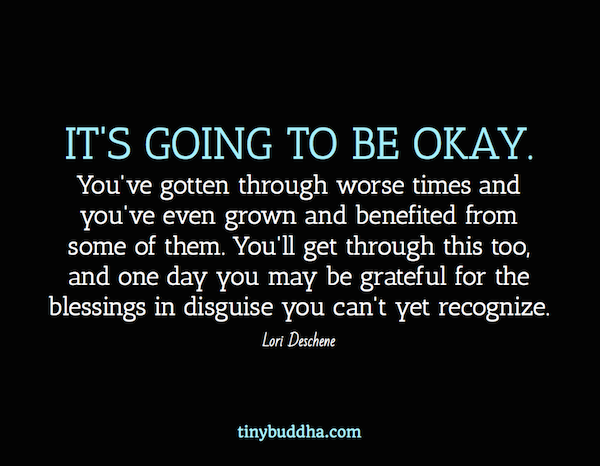
  • You’re Going to Be Okay

    You’re Going to Be Okay

    Man on a Bench

    “The mind is everything. What you think, you become.” ~Buddha

    “I will be okay,” I repeated to myself. “Deep breaths. You’re okay. Focus on the breath. I am going to be okay…”

    I was on a small plane flying over the Rocky Mountains of Colorado on a hot summer afternoon—a notoriously turbulent time to fly.

    I’m not afraid of flying. I do it a lot and it’s not something that makes me nervous, although the mantra could work perfectly well if I was. It does, for some reason, make me incredibly motion sick at times—scanning seatback pockets for white bags, sweaty forehead, trembling, white-faced…sick.

    I was flying alone, and thankfully there was no one in the other seat next to me. (The plane was only three seats wide, with the aisle offset in the middle.)

    I was glad to have personal space to sweat it out, bump by bump, mantra by mantra, coaching myself through, without having to tend to anyone else’s experience or reaction to my sickness.

    I knew I would be perfectly fine, ultimately. Like those times with a bad case of the stomach bug, the body’s reaction can be scary, or super uncomfortable at the very least. The severity feels primal, and one generally goes someplace deep inside and gets through.

    In this case, my mantra and the self-talk served as an anchor, a ray of hope, a deeply present champion who needed nothing from me. It was simply there, relaying meditative principles to my experience moment by moment.

    A few years later, I was going through the grieving process of saying goodbye to a relationship, riding waves of feeling sad, hurt, and alone, sometimes with gut wrenching strength. I wanted to reach out to him; I wanted to hear words I felt I needed to feel better, tell him how I wanted it to be, and then have that actually happen.

    I wanted control.

    It was done, and I hadn’t anticipated the ending script. My head and heart spun from hurt and unfulfilled dreams. So I began telling my story to friends and family, trying to help process the emotions, events, and logic.

    Sometimes it helped, others times it just hurt.

    As the emotions buffeted up and down like airplane turbulence, I always felt alone in the moments when the crescendo peaked then pressed me down into an unsteady whoosh.

    How was I happily engaged living life in the present one moment, then longing for connection, what had been, and feeling hurt, rejected, or confused the next?

    And how could I support myself better without just craving what had been or wanting another version of the story? I needed a mantra for those moments.

    A mantra is sometimes referred to as an “instrument for the mind.” The roots of man (mind) and tra (instrument) come from Sanskrit and can help us utilize the power of the mind to enter a place of healthy silence.

    In this space we can gain distance, perspective, and awareness from the stories that we tell ourselves about our lives and get wrapped up in.

    I think of mantras like yoga and church. (Go with me for a moment!)

    One can attend, soaking in the principles, morals, and lifestyle, and walk out the door not to return to that headspace until the next entrance to the building. Or, one can walk out the door taking the values into daily practice, and upon return, simply enrich the soul and fundamentals nourished from previous visits.

    I vote for integration and transference in all we do.

    On the plane, my mind would get caught up in a story such as, “How long is this going to last?!”and upon realization, I would come back to my mantra.

    Integrating mindfulness into more turbulent emotional times challenged my personal integration edge; after telling stories, feeling the emotions, and sometimes just trying to push them away, I walked back into the building.

    If I choose to stay attuned, present in my life, and committed to growth, I can honor the ups and downs and have the power to provide myself what I need.

    I am there. I can always be there—the constant, ever present voice in my life.

    It’s not that I don’t have good friends, loved ones, or a strong support system. I do. Most of the time they are probably best as the cherry on top, supplement, or supercharge to my own inner knowing.

    Imagine, what if you were always there for yourself, providing just what you needed, allowing your friends, family, and significant others to delightfully enrich your life?

    Coaching myself through living is more complicated than moments of seeing black spots, with sweat dripping off my face, sick as a dog on an airplane. But I believe I can—we can—learn and always become better supports for ourselves.

    At the very least we can be willing to search, learn, and try when we do not know.

    And in the end, for me, the mantra from the plane works, for heartache and quite a lot of other things. “I will be okay. Deep breaths. You’re okay. Focus on the breath. You are going to be okay.”

    Your mantra may sound different. My hope for you is to remember the instrument of your mind in times of smooth passage or turbulent flight, then sing, whisper, or chant yourself a perfect melody for the moment.

    Man on a bench image via Shutterstock