Tag: negativity
-

The Power of Reframing: 3 Ways to Feel Better About Life
“Some people could be given an entire field of roses and only see the thorns in it. Others could be given a single weed and only see the wildflower in it. Perception is a key component to gratitude. And gratitude a key component to joy.” ~Amy Weatherly
I grew up in a deeply negative environment. My parents separated acrimoniously when I was seven, and they were a grim example of how not to do divorce.
They brought out the worst in each other, and sadly, over time, they also brought out the worst in me. I was depressed as a teen, and had been conditioned to believe that my problems were an unfortunate family trait—one that I had simply to accept and live with.
And I did, for many years. But of course, I was not happy. And yet I didn’t know enough about the world to understand that my environment and upbringing were very largely to blame.
I now know that while genetics can account for up to around 40% of the happiness we experience, the rest is within our control.
I’m aware of this because studies have shown it to be the case. But I know it because I’ve also lived it.
Deciding to Change My Life
Over the last ten years, I’ve dramatically changed my life, and I’m the most at peace I’ve ever been.
When my eldest daughter was a baby, I finally had an important enough reason to want better. I was determined that she would grow up in a fun and positive home. And if I was going to make that a reality, I had to put in the work to make it happen.
Plus, it had become especially vital at that time since my daughter’s difficult delivery had been traumatic and left me with extreme postnatal anxiety. I was in a very bad place, and I needed to get out of it; I needed, in fact, to get out of my own head. And I didn’t want to rely on medication for that.
While my husband had already saved me in many ways, the rest was my responsibility—my state of mind, my outlook.
Desperate but determined, I began an activity that, over time, changed my life.
While I appreciate that sounds like an exaggeration, it’s really not. Because my life truly has changed. Although it also hasn’t. Allow me to explain…
The Power of Reframing
I inadvertently learned how to reframe, and it’s possibly the most profound skill there is for increasing happiness.
It’s so incredibly powerful because it can change your experience of life—without changing your actual circumstances.
Here are a few examples of how reframing helped me to feel more positive about my own life…
A few weeks ago my dad moved, and I planned to visit with my girls during half term to take him a plant.
We live in the UK, and while the weather is changeable, it’s usually fairly mild. But on the day it so happened to be spectacularly windy. I told my dad we’d make our way and I’d let him know if we couldn’t get there.
We made it! And after dropping off my dad’s plant, we drove a short way to a restaurant.
Before we’d even ordered drinks, the winds brought down a pylon and there was a power cut. The kitchen closed, and my young daughters ate crisps for lunch, and I still had to get us safely home.
But, instead of being mad that the entire day turned into a farce (we encountered fallen trees on the way home!), I was glad I’d made the effort. Most importantly, we were safe, but also it reinforced to my dad that we cared enough to get there despite the challenges.
Another example is that since Christmas we’ve had one illness after another in our home. First was COVID, and since then we’ve had viruses and two bouts of chicken pox.
When my eldest succumbed to COVID, I was worried about her, but also on a practical level how I’d get my youngest daughter to school (until my husband also tested positive, at which point I was able to leave the house). The fear that had been silently there for two years had finally caught up with us, and it had the potential to be an enormous source of stress.
But during the COVID episode—and later with chicken pox too—school mums stepped up without me even asking. I’d never really felt like I’d integrated with the school mum crowd, but as it turned out, I was wrong:
They totally had my back.
I felt and continue to feel so incredibly grateful not only for them, but also knowing that I have a support network I did not even realize was there.
These are just a couple of recent examples which spring to mind, of situations that previously I probably would have experienced negatively and complained about—but I’m now able to reframe to find the silver living.
So you see, my life is different in terms of how I experience the world, and yet it’s really the very same as it always was. But I feel vastly different.
I feel at peace.
And now I want to share my process so others can also learn how to do this for themselves, because it’s basically free therapy, available to everyone, that we can implement alone, and without guidance.
But how did I do it, without professional help—and without medication?
How to Tap Into the Benefits of Reframing
For me, there were really three steps to my journey, which happen to work together in perfect harmony.
1. Practicing gratitude
First, I began writing gratitude lists.
With no comprehension of their value—but with a deep desire to start appreciating the good things in my life, and a desperate hope it was a good starting point. Good enough to help me do better for my daughter.
I started writing a list of the positive things that had happened each week. Not realizing that this is actually an effective therapeutic exercise, I wasn’t expecting very much to happen.
But I knew that the fundamental change I wanted to see in my life was more positivity. So I figured the “fake it till you make it” approach might just be beneficial.
Incredibly, it didn’t just help—it was the turning point of my life to such a degree that it now feels like before and after.
Writing gratitude lists isn’t difficult. It can be as simple as jotting down three, or five, or ten things you’re thankful for. This can be done when you wake up, to start the day on a positive note, or at the end of each day if you prefer.
If you have a hectic schedule and can’t find time to do this daily, just be sure to do it regularly.
And if writing it down seems like too much effort at the end of the day, you could try saying your list of things for the day quietly and privately in your own mind.
It doesn’t need to a formal practice; it just needs to something you do practice. Because over time, something magical happens…
2. Positivity
As time goes by and you continue to acknowledge the good in your life, your default mindset will begin to switch over to a more positive one.
For me, it was like a spiritual awakening, and I like to use an analogy to describe my experience.
The idea of rose-tinted glasses is a familiar one for most people. But sometimes they’re actually a blessing. After spending several months practicing gratitude regularly, I felt like I’d removed the only pair of glasses I’d ever known, and the world suddenly looked brighter.
I also began to appreciate that positivity is often a self-fulfilling prophecy: the harder you look for it, the more you will find.
And your mood tends to be reflected back to you by others, too. Just as negativity is draining, positive people energize those around them!
I was recently waxing lyrical to somebody about the positive impacts of gratitude and reframing, but they insisted that offloading onto friends or family is necessary sometimes. I didn’t completely disagree, but I had something important to add:
By default, increased positivity leads to a decrease in negative experiences, which in turn leads to less often feeling a need to offload. And that’s the magic of this whole concept.
There’s one final step in my toolkit…
3. Journaling
Unfortunately, when you’ve grown up in a negative environment, it can be all too easy to slide back into ingrained behaviors—old habits die hard.
For that reason, even though I feel very mentally robust these days, I know that if I stop practicing these new skills, it’s almost inevitable that I’ll return to the mindset I developed as a child. (I’ve learned this the hard way.)
Journaling is my favorite way to stay on track and accountable, because it can easily incorporate each of the above ideas, plus so many more.
Depending on my mood, I love journaling for its mindfulness, or state of flow, or as a creative outlet. Or all of the above!
Essentially, these skills each feed into and reinforce one another. And together, they really are life-changing.
-

Hate Your Life? 4 Ways to Boost Your Happiness
“Hope is being able to see that there is light despite all of the darkness.” ~Desmond Tutu
I hate my life. Does this statement ring true to you at all? Do you feel like you’re at rock bottom? The good news is, it might not be as bad as you fear.
I spent a lot of time feeling afraid of everything.
I had an emotional collapse, and it made life suddenly seem terrifying. What had happened? Had the town I was living in changed? Had my country suddenly become different?
No, I had changed the filter through which I saw the world, from one of hope and joy to one of fear and hopelessness.
My biggest problem wasn’t that I was feeling terrible, but that I had unconsciously bought into the idea that the problem was ‘out there,’ or that perhaps I had lost my mind. It frightened me to experience that level of darkness, where everything looked gloomy and hopeless.
When We Believe Our Self-Talk and Perceptions of Our Terrible Life
What had really happened was that, after a series of bad experiences, I got very sad and then a whole lot sadder. I didn’t realize that, after the initial painful problems, I was continuing to create a lot of my upset with my thinking processes.
I was seeing—through my perception filter—only the darker parts of life. Everything felt greyer somehow. It got gradually worse and I became more and more entrenched in the grip of it.
Had the bad situations caused it? Perhaps, but the real problem was that they had caused me to change my filter to grey, and I was stuck there. The more I saw the world this way, the more I expected it. The more I unconsciously expected it, the more evidence my senses found for me to confirm my fears.
Therapists and books, in trying to help me get past my sense of pain and suffering, took me back to the time when the collapse happened, and even back to my childhood.
I established what the original problem was and ‘worked through it.’ I agree with the necessity to work through old wounds and baggage to a degree, and it is sometimes crucial for mental wellness. However, for me, it was re-traumatizing and mostly just dug up old things I’d already accepted. I found myself back at square one over and over again. Far from recovering, I was in a circle of regression.
What kept me going back over it was simple: The bad situations I had experienced were long over, and I had done the forgiveness and grieving, but I was still feeling bad. The only reason I could find was that I needed to do more healing work on the past. However, now that I look back, it seems what was really keeping it alive was my own belief that the problem was still there.
The Wake-Up Call
Here was a major truth bomb for me: While I’d certainly had experiences that were traumatizing when they happened, I was the one who was now perpetuating my pain. I had a habit of hating my life.
Did that mean it was my fault? No, I was just doing what we all do. I had practiced feeling terrible every day, and after a month or so it had become habit. I was a professional fearful person.
Yes, maybe the original upset or difficulties in my life were bad, but they were no longer happening. I kept them alive two ways: 1. Through learned habitual behavior and 2. By constantly picking over them to find out why I still felt bad.
Don’t Put a Happy Face Sticker Over It
There’s a lot of talk now of toxic positivity and concerns about putting a happy face sticker over problems. I do get that people sometimes do this. It is irresponsible to run away from a real-life problem, but I do not believe that most people who talk about toxic positivity are really warning about that.
I believe that many people who talk about toxic positivity are actually stuck with their filter on grey, and they are arguing for their own limitations.
There is an increased stigma around the idea of “love and light.” It’s become an almost contemptible topic. I agree that it’s ridiculous to think that “love and light” is the answer to everything. But if you feel stuck in old stuff and find that you feel less than happy about your life, I challenge you to give it a try before disregarding it as naïve or evasive.
Please remember that even some apparently very wise spiritual and transformational helpers or gurus are still themselves very much stuck in their egos. They still want to be the hero battling their pain and discussing their survival. Just because someone is well-known and well-loved does not make them any less human. Just because they claim to know better, does not mean that they do.
Positivity gets a bad rap in certain places on the internet, but please remember this idea that we don’t have to dwell in the difficulties is age old and has been supported by mystics and gurus since the beginning of time.
As the old Buddhist saying states, “Pain is inevitable; suffering is optional.” I get that there is a time and a place for facing pain—dealing with circumstances and processing grief is incredibly important. But we do not need to suffer beyond the original pain.
How to feel the Pain Without Getting Caught in Suffering
Yes, you’ll encounter difficulties, and sometimes they will be terrible, awful, and shocking. However, once you’ve done the initial processing and the grieving process is well under way, there is a lot to be said for introducing a happy face sticker! Not to go over the wound, but to go alongside it. We don’t need to dwell in toxic positivity or negativity.
What do I mean by initial processing of difficulties in life? It will be different for everyone and it depends on the circumstances, but what I really mean is this: Allow yourself a reasonable time to feel the feelings and then make efforts to move forward with your life!
No one would expect you to be happy the day after you witnessed some horrible crime or after the death of a loved one. This is ridiculous and what is really meant by toxic positivity—the notion that you should be happy all of the time regardless of your circumstances.
But there comes a time when we have to choose to shift our perspective and find reasons to smile, because it only happens if we make it happen.
Put a Happy Face Sticker Next to it and Start Hanging Out There
If you really hate your life, you may have gotten to the stage where you have started to believe it will never get better. Take it from someone who knows, this isn’t true. You are awake and breathing now, so there is still hope to turn everything around. I did. I am no more special than you, I have no special skills. If I can, so can you.
If you are clinically ill, get help, that is a given. If you are unsure, reach out to a medical professional and get assistance and their opinion. This is a must!
Once you are sure that you do not need medical intervention, be a risk taker and try the much maligned “positive thinking and action” methodology below.
What I suggest below is what I did, and it worked for me. It has worked for clients. Does this mean it will work for you? No, not necessarily, and perhaps you will do it slightly differently. But hopefully you will be able to understand the essence of what I’m suggesting and give it a try.
You have nothing to lose and everything to gain.
4 Ways to be Happier (The Not-So-Magic Formula)
Firstly, suspend the idea of not wanting to buy into “toxic positivity” and try this twenty-minute morning routine for a couple of weeks. I have never had anyone report that it made them feel worse.
Exercise as soon as you get out of bed.
Okay, go to the bathroom first! After that, take two to ten minutes to do some stretches, weights, or aerobic exercises. Put on some music and then get started.
I do fifteen minutes every morning with two little weights and a resistance band. I do five minutes on my legs with the resistance band, five minutes on my core on the floor or with the weights, and five minutes with the weights on my arms. My body looks better, and it gets my good-feeling chemicals pumping.
Make a few sheets of goals, quotes, or a vision board.
Put them up in the area where you will be doing your exercises, and read or look at them as you move to get into an empowered mindset. You can include pictures, quotes, or ideas.
I have thirteen sheets and a load of sticky notes. I don’t read everything perfectly every day, but I read most of it every day as I work on my arms. I have mainly quotes from my favorite transformational authors, as I’m not a massive fan of setting specific goals, but whatever you choose is up to you.
Gratitude journal.
Take one minute and list three things you are grateful for. This is a minimum requirement. If you have time, consider writing intentions for the day or listing the ways in which you feel the universe has helped you lately.
Even if you feel that there are twenty things that you could complain about, if there is one good thing, write about that.
A great addition to these exercises is to look back over previous days and notice how much you have to be grateful for or how many of your intentions you have met. If you think you haven’t met any of your intentions, remember that isn’t true! If you are writing your gratitude journal on more than one day, you are showing up for you and keeping it up somewhat. A huge number of people will not even get so far.
Be compassionate with yourself and grateful that you have shown some dedication to yourself, however small that effort may seem at first.
Listen to something motivational and upbeat every morning.
I do this while I am getting dressed or doing my to-do list. I watch something that talks about empowerment, what we can achieve, what is right with me and the world rather than what is wrong.
Is it to stick my head in the sand or deny that there’s anything wrong in the world? No, it’s so that I am pumped and empowered to actually take on the task of living life.
There is so much free content out there on social media that you can access. Do a social media search and start finding material that uplifts you and gets you thinking positively and with purpose every day.
No one gets excited about facing pain or the destruction stretched out in front of them. So, even when there are difficult things to face, it’s crucial that we can somewhat reframe it so that we can see it as a positive challenge rather than solely a painful experience.
When we do this, it is not to be irresponsible or to avoid the reality, but rather to give ourselves the best chance of being able to embrace what we need to do with enthusiasm and a good energy. This way we are more use to ourselves, the people around us, and the world
Takeaway: Summary of the Plan to Shift Out of the Pain
You don’t like your life… Okay, no need to panic.
Take a moment to check if you might need medical assistance. If you’re not sure, reach out to a health professional. Once you’ve done this and are sure you don’t have a clinical reason for feeling so bad about life, ask yourself if you are expecting yourself to feel better before you’ve had a reasonable time to grieve or recover from a recent event.
If something bad has happened, you will need time to feel it and process it. The world does seem to encourage us to always feel great, and this isn’t realistic. Our minds naturally want a simple solution and to get away from processing a painful experience, but it only prolongs it in the long run. Make sure you are not rushing a sensible grieving process.
Equally, if you hate your life today, check in with yourself and ask yourself if you are perhaps just having a bad couple of days. No one feels happy all of the time, and it is unhealthy to expect yourself to do so.
Once you’ve checked for a medical reason and that you don’t have a temporary and reasonable explanation for why you feel so bad, consider trying the ideas above and seeing what a positive start to your day might do for you.
Do it for a month and see what changes.
Perhaps starting your day with movement, motivation, and gratitude will not work, but I’d be surprised if it didn’t! Will it solve all of your problems? No, of course not. But hopefully, it will give you a boost of positivity and a sense of hope and show you that you can make changes that can help you to feel better about your life.
Once you see that small changes can make a big difference, you will get excited about all the other things you can change and improve in your life. It takes you out of reverse gear and into first. It may seem small, but it’s a start, and a very positive one at that!
-

5 Things I Let Go When I Was Tired of Playing the Victim
“Placing the blame or judgment on someone else leaves you powerless to change your experience; taking responsibility for your beliefs and judgment gives you the power to change them.” ~ Byron Katie
I will never forget the day a dear friend of mine told me I sounded like a victim. I can recall I was outraged with a guy who didn’t fulfill my needs and my expectations in love. In other words, he broke up with me, refusing to fill up my cup with the precious things I didn’t know how to give myself: appreciation, self-care, and self-respect.
“How could he do that to me?” “Why do I have to go through such a thing?” Here’s a small sample of my thought repertoire, full of anger, disappointment, guilt, shame, and blame.
While complaining, I was expecting my friend to be on my side. Shut up and listen. Accompany me in accusing that man of making me feel miserable and sad. Instead, she chose to be brutally honest:
“Dear, I can feel your pain. You might not realize this yet, but you sound like a victim.”
That wasn’t an easy thing to digest. I didn’t talk to her for months after that discussion, but today, I am profoundly grateful for that gift of honesty and genuine truth.
I took some quality time for reflection and journaling. I got myself temporarily closed for spiritual maintenance. Then I decided to press the reset button and take a deep, profound journey inside of me, to evaluate the only things I could ever control: my thoughts, my actions, and my emotions.
I wanted to declutter anything that didn’t add value to my life and make room for the things that mattered:
What did I no longer want to think?
Was I still hanging on to old beliefs from the past?
What did I no longer want to feel?
How did I no longer want to behave?
What kind of behaviors and relationships was I not willing to tolerate?That was a transformational exercise, and here’s what I decided to let go of as a result:
1. Self-neglect
I decided to love and approve of myself as I was and take good care of my wants and needs without feeling guilty or selfish. I committed to stop putting my life on hold until “The One” would show up and make me forever happy.
I started to exercise regularly, eat healthier, make time for my hobbies, go out with friends, travel and see the world. Instead of expecting for someone else to bring joy into my life, I offered that to myself, from the inside out.
“Don’t wait for someone to bring you flowers. Plant your own garden and decorate your own soul.” ~Mario Quintana
2. Self-criticism
I stopped calling myself names, putting myself down, and making myself small so that others would feel good about themselves—a powerful lesson of self-love and self-respect. I decided to eliminate toxic words like “stupid” or “failure” from my vocabulary. I learned to get mindful of my self-talk, as a form of self-care.
Whenever I find myself thinking disempowering thoughts about how I look or what I do, I stop for a moment and ask myself, “Would I say that to a friend? Would I call a good friend ‘idiot,’ ‘fat’ or ‘stupid’?” I know I wouldn’t, so why say that to myself?
I started to perceive myself as enough and worthy of love. Not because other people said so, but because I chose to believe it. Before that, I used to hate my body for years. Always on a diet, perceiving myself as too fat to be loved. Not smart enough; not beautiful enough. An “average kind of woman,” so “why would anyone want to be with me?”
I used to be desperate for a man’s love and approval. It took me months of deep inner work to make peace with my body and stop evaluating my worthiness through a man (or anyone else’s) opinions of me.
“You are what you believe.” ~Buddha
3. Negativity
I detached from toxic relationships, gossiping, and negative people whom I previously permitted to criticize me for being single in my thirties, as if something was wrong with me and I was broken.
Instead, I decided to surround myself with positive, non-judgmental people who helped me grow, people I could learn from.
Goodbye, people-pleasing! I stopped saying yes to things I didn’t really want to do, hoping I would be included, liked, and approved of. I set healthy boundaries and stopped seeing people who only called whenever they needed something from me.
I deleted old contacts from my phone. I had a look at my Facebook profile and unfriended people I wasn’t close to or who only complained and posted negative stuff. I removed myself from Facebook groups I no longer wanted to be part of.
“If you don’t feel at ease with people, don’t change yourself. Change the people.” ~Cheryl Richardson
4. Blaming
I stopped blaming people for the way they “made me” feel. Blaming others for taking our money, our time, and our love is unfair because we always choose how much we give and to whom.
Instead, I ask empowering questions, like:
- What could I have done differently?
- What am I taking with me from this experience?
- What do I know today that I didn’t before?
- What’s the gain in pain?
Such questions are empowering because they liberate us from the conditioning of a victim and the belief that things are imposed on us by other people and external circumstances. They shift our focus away from other people’s perceived shortcomings and toward the things we personally can control.
“No one can make you feel inferior without your consent.” ~Eleanor Roosevelt
5. Comparing
I stopped comparing myself with other women who seemed to have it all: the husband, the kids, the house, and the dog. I realized everyone was on their own journey and wished them well.
From previous romantic relationships that didn’t work out, I got clear on what I wanted from a romantic partner. I wanted a lover and a friend. My wish was to feel supported and cherished by someone warm-hearted, fun, intelligent, and kind.
I got the learning. I trusted the flow of life, and I am married to that wonderful man today. We’ve been married for six years now, and I gave birth to our baby girl last year, at age forty-one. I didn’t do it on anyone else’s timeline, but I have a life I love.
“A flower does not think of competing to the flower next to it; it just blooms.” ~Zen Shin
I’ve come to understand that the only person in charge of my happiness is me, and everything else is a bonus. I know this might sound selfish, but it’s not. Self-love is a necessity. Long-lasting happiness cannot come from someone else, but only from ourselves, from the inside out.
-
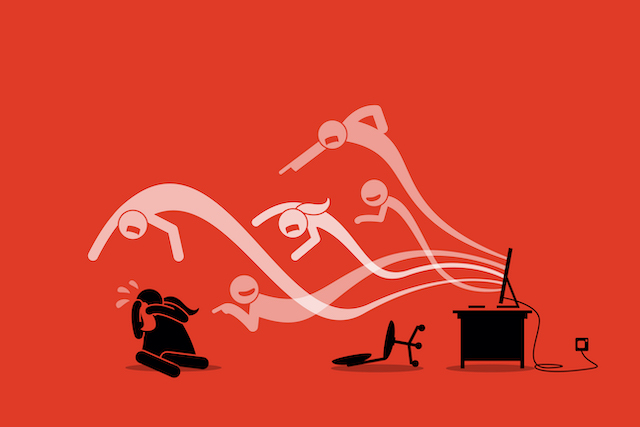
Dealing with Online Hate: What to Do When People Are Mean
“The less you respond to negative people, the more peaceful your life will become.” ~Unknown
I work for a website that creates videos on lifestyle, fashion, food, travel, fitness, and more.
Our channel has a massive following from all walks of life, and we receive a lot of love but also a bit of hate. Even though many people are involved in the production of a video (directors, videographers, editors), the comments, feedback, and of course the hate is usually directed at the face you see on camera, and that is the anchor—AKA me!
When I started out as an anchor, I had already been modelling for a couple of years and felt comfortable in front of a camera. When videos came along, I took it up as a challenge, as an opportunity to test myself and see what I could do.
Luckily for me, I really started to enjoy it. My initial videos garnered a huge response and some crossed hundreds of thousands of views. I was slightly intimidated but on a high as well because of how well they seemed to be doing.
But slowly, as I grew into my role as an anchor, I realized that there was a whole other side to being in the public eye that I never knew about.
For me, being on camera meant putting forth a good performance and getting appreciation or criticism on it. I believe that each one of us has the capability to deal with constructive criticism; we all want to grow, we all want to improve, don’t we? The problem starts when the criticism loses its perspective and becomes destructive and downright hurtful.
One fine day, after the release of my latest video, I sat at home scrolling through the comments section and came across a really mean comment. It stung me. And I couldn’t help myself. I went down the rabbit hole of reading all my videos’ comments and found tons of negative ones. It was one of the lowest moments of my life.
And oh, people are creative! The comments weren’t simply restricted to whether or not I was doing a good job as an anchor. They covered everything from shaming my body to even threats of physical harm. It close to shattered me to see all these mean things written about me by total strangers.
Now, I know that we don’t all have to face the same amount of hate that people in media do. But in today’s age of social media, each one of us has dealt with some negativity on our Instagram, Facebook, or Twitter. And as someone who has dealt with a lot of it, I feel strongly about this!
Below are a few things I did to deal with this trolling that really helped me out. I hope a few of these pointers can help you deal with hate when it comes at you!
1. Know your haters.
The kind of comments a person posts on social media speaks a lot about the person him/herself. What you need to realize is that a person who’s incessantly trolling you is probably at a very sad and unhappy place in their own life.
Would a person who’s living a fulfilled life hide behind the screen of anonymity and spend their time being mean to some random person on the internet?
Internet trollers are in most cases people who are leading unfulfilled, sad lives who want to vent out their frustration by blasting random strangers. Do you really need to take the opinions of such people seriously?
2. Distinguish between constructive and destructive criticism.
Let’s get real, no one likes criticism. But do we need it in some doses? Yes, we do! Not just on the internet but also in your personal life, taking criticism and working on your flaws is the best way to grow. The trick is to recognize whether the criticism is constructive or destructive.
For example, a comment telling me to work on my accent and pronunciation is constructive for me, because I know it will help me improve my diction.
On the other hand, a comment posted with the sole aim of body shaming me doesn’t need to be taken seriously. I can chalk it up to an unhappy person nit picking someone else to avoid acknowledging and addressing the things they don’t like about themselves and their own life.
3. Joke about it.
A trick that I learnt pretty soon into my breakdown was to stop taking things too seriously! I have a couple of close friends with whom I sit and read all the negative comments written about me and have a good laugh! (If you need a little help finding the funny in the mean, Google “celebrities read mean tweets.” When you don’t take the hate personally, you can’t help but laugh at some of it!)
4. Weed out negativity.
If at any point you feel that a person is getting too much for you to handle just weed them out. It’s very easy to do this on the internet, you simply block them from all possible platforms, and VOILA! Bye-bye negativity!
This might be slightly more difficult when dealing with people who are in your life on a day-to-day basis. But if a person regularly tries to pull you down, it’s not worth keeping them in your life anyway.
5. Open up.
Talk to your community and you’ll realize that everyone is dealing with hate in some form or other. What helped me the most is watching funny YouTube videos, where YouTubers answer back to hateful comments on their videos. Superwoman is one of my favorite YouTubers, and her video answering back to her haters was a savior for me.
Not only does this put a humorous spin on the situation, it reminds you that everyone is facing this in today’s world, which makes it easier to deal with, because you realize it truly isn’t personal, no matter how personal it seems.
Irrespective of how you choose to deal with the hate that is thrown your way, never be afraid to be absolutely and unabashedly yourself. Some will love it, some will hate it, but you don’t have to let their opinions get you down!
-

4 Simple Techniques to Erase Subconscious Negativity
“As you sow in your subconscious mind, so shall you reap in your body and environment.” ~Joseph Murphy
The subconscious mind is like a computer’s hard drive.
It saves whatever information you feed it, without any bias. It does not discriminate between useful information and trash information. It just saves everything!
The subconscious mind learns through repetition. So if it’s fed the same information multiple times, it keeps overwriting it until the information gets etched in.
As you would have guessed, such information is harder to erase.
For example, let’s say you write “I am not good enough” on a piece of paper. Now keep overwriting on top of this. The more you overwrite, the bolder the text becomes and the harder it gets to erase it later.
Let’s look at another example. When you first learned to ride a bicycle, you found it hard to balance. But you kept trying and could maintain balance for five seconds and then ten seconds and so on. Finally you could maintain balance for longer periods of time. Because of the repetitions, your subconscious mind picked up what it takes to maintain balance.
Once the subconscious mind learns, it falls back on this information whenever it is required.
So the next time you sit on a bicycle, the subconscious mind automatically switches on the default bicycle-riding program and without any effort, you start to ride your bike.
What is interesting is that if you learned to ride the bike in a faulty manner, you will keep riding the bike in a faulty manner.
For example, there are people who find it difficult to drive a car while wearing shoes. They can only drive the car barefoot! This is because when they were learning to drive, they did so barefoot. How do I know? Well, I am one of them!
For me, learning to drive a car while wearing shoes was like learning to drive the car all over again.
So what does this tell you?
Once the information is fed to the subconscious mind, and is repeated enough times, it simply gets etched in the mind and is hard to erase later.
Yes, it is erasable, but erasing it would require extra effort. This is exactly the reason why bad habits are so difficult to break. And this holds true for both physical habits and mental habits.
Physical habits equate to stuff that you do. Like your daily routines.
Mental habits are thought cycles like your self belief, your insecurities, your view of the world etc.
In a way, your mental habits fuel your physical habits and vise versa. It’s cyclic in nature.
Rewriting Negative Subconscious Programs
As mentioned earlier, your subconscious mind is like a computer’s hard drive. And just like we can erase and put new software into a hard drive, we very well can reprogram data into the subconscious mind.
Hypnotists have been doing this for ages.
But the technique we are going to look at is far stronger than hypnosis. Plus it is very simple to do. In fact, the technique is so simple, you might be forced to think, is that it?
So let’s see what this simple technique is.
The best and most effective technique to alter your negative subconscious mind patterns is awareness.
That’s right, you simply become aware of the subconscious patterns.
Once you become aware, the additional actions required to make the change follows automatically.
Becoming Aware of Subconscious Mind Patterns
Subconscious mind patterns are called subconscious for a reason. They are below (sub) your level of consciousness. In other words, you are not consciously aware of them.
For example, I used to have the habit of shaking my leg non-stop when sitting down, also known as restless leg syndrome. It would be many minutes, sometimes even hours before I would become aware that my leg was shaking and I would stop doing it. But moments later when my attention shifted to something else, my leg would start shaking again.
What helped me eliminate this issue was to develop body awareness. I started to become more and more aware of what my body was doing at any given point. So whenever my leg would start shaking, I would become aware of it within a few seconds as opposed to many minutes like before.
Over a period of time, the shaking stopped. I still do it occasionally but it is very rare. And each time I can catch myself quickly and stop doing it.
Body awareness not only helped me tackle this issue, it also helped me become aware of tense body parts so I could relax them more often.
For instance, I noticed that whenever I worked on my computer, the muscles around the base of my skull (known as the suboccipital muscles) would tense up badly. This would cause fatigue, headaches, and back pains. Body awareness helped me sense this and consciously relax my muscles whenever that happened.
This is just one very small example of how you can overcome a subconscious habit by becoming aware of it.
This habit is easy to catch as it is happening on a physical level. But there are many mental habits that happen on a mind level. You cannot see them; they just happen.
For example, just like me, you might have the habit of judging others. The strange thing is that the judging happens automatically. The problem with this habit is that you not only judge others, you judge yourself too. It always works both ways. Also, what you perceive of the other can be massively different from reality because you perceive from your own belief system.
The way to become free from this habit is, again, to become aware of your thinking patterns.
As you become more and more aware of your thinking patterns you will be able to catch your mind judging others. As you catch yourself judging, you do not blame yourself or force yourself to stop; you simply become aware of it—“Ah, here I go, I am judging again!”
As you continue to do this, slowly but surely, your judgments of other people will start to reduce.
Developing a Deeper Awareness
Awareness is a habit and the more you practice it, the more it becomes second nature. I find the following four techniques to be extremely useful in developing awareness of your physical and mental processes:
1. Consciously watching your thoughts
In our day-to-day life, we are lost in our thoughts for the most part. The goal is to detach from your thoughts for a few moments and watch them as a neutral observer.
This practice can help you become aware of negative thought patterns. You will find yourself questioning your beliefs and thereby weakening negative beliefs and consciously replacing them with positive ones.
Here’s what you can do:
Sit comfortably, take a few deep breaths, and calm yourself down. Start to become aware of your mind producing thoughts without engaging with them. If you find yourself getting engaged with the thought, take a moment to acknowledge that and return back to watching.
If certain thoughts produce strong emotions in you, feel the emotions instead of trying to suppress the thoughts. Divert your attention within your body and feel the energy behind these thoughts.
As you watch your thoughts, you will become aware of many negative thought patterns running in you. Simply becoming aware of these patterns is enough for them to start disintegrating.
2. Consciously feeling your emotions
Becoming aware of your emotions helps you understand the thought-emotion connection—in other words, what kind of thoughts produce what kind of emotional responses in your body.
This can help you weaken and release the hold of strong negative emotions.
What I find works best is to consciously recreate emotional responses when you are by yourself.
Let’s say certain situations cause strong anxiety in you.
For example, there were times when simple things like walking into a crowded restaurant made me feel anxious. There was this feeling that everyone is looking at me and judging me negatively, and that thought gave rise to a set of emotions that clouded my thinking and made me feel extremely anxious and unwelcomed.
When you are in such a situation, it is hard for the untrained mind to do anything. But there is a workaround. You can use this situation to train your mind when you get back home.
When you are back home, you can sit down in a calm place and recreate that exact scenario by running it in your mind. Doing so will evoke pretty much similar emotions. This time though, instead of being lost in your thoughts and overcome by the emotions, you have a choice to consciously feel your emotions. Feel them fully as they arise without becoming afraid of them. As you feel your emotions this way, they start to lose their power over you.
What you are doing here is becoming aware of thought patterns and the reactions they create in your body. This awareness slowly starts to dissolve existing thought patterns and their corresponding emotional responses.
Next time you visit the same restaurant, you will be aware when certain thoughts start getting generated and your body’s emotional response. But because you have already felt your emotions consciously and because you are aware of your thought patterns, you will find that they have significantly weaker reactions. Continue this and soon the reactions would die down completely.
3. Consciously feeling your body
Becoming aware of your body can help you learn how to relax your body and thereby aid healing.
For example, you might have body parts that tense up when you are engaged in work or some activity. For me, as I mentioned before, it was the back of my head and the suboccipital muscles (muscles near the base of the skull) that tensed up when I was engaged in work.
This would lead to extreme headaches and back pain and would cloud my thinking, leading to frustration. It was only after I started becoming aware of my body that I could feel these muscles all tensed up and relax them consciously. I had to relax them consciously many times over while working and after a few months they automatically started to stay relaxed.
A simple technique you can use to become aware of your body is to feel your body from within during a meditation practice. Simply feel the inside of your body starting from the soles of your feet to the tip of your skull. As you scan your body this way, find and relax various tension points along the way. If you find certain parts aching, spend some more time there and relax these parts.
Relaxing your body is key to healing. The more relaxed your body feels the more rejuvenated you will feel. This exercise is best done before going to sleep, so you feel fresh and rejuvenated when waking up. In-fact, you can do this lying down in bed.
Getting in touch with your body can also help you better feel and release your emotions.
4. Consciously focusing your attention
In any given point of time, our attention is divided between a myriad of things. Most of us don’t have any control over our attention. It just wanders like a wild beast anywhere it wants to go.
This method will help you gain control over your attention. The more control you have, the better you will be able to practice the above-mentioned methods.
For instance, you can feel your emotions for longer periods of time without getting pulled into thinking. Similarly, you can watch your thoughts longer without getting lost in the thoughts often. You can also stay mindful for longer periods of time.
There was a time I found it extremely difficult even to read a few paragraphs of an article. Within just the first few lines, my attention would drift away into my thoughts. I would be reading, but not understanding anything. I would then have to re-read the lines again. This is what happens when you don’t have mastery over your attention.
And the most effective way I found to gain mastery is focused meditation. All it involves is to divert your attention to your breath and keep it there for as long as possible. If your attention wanders, bring it back again. As you keep doing this practice, you will start to gain control over your attention and your ability to focus.
—
These four methods are the gateway to deeper awareness. They can be practiced together or separately, depending on what you find beneficial at the moment. I believe these techniques can help anyone become free from low self-worth, limiting beliefs, anxiety, depression, and all other types of issues related to the mind.
-

4 Steps to Let Go of Stress, Negativity, and Emotional Pain
“It’s not the bite of the snake that kills you, it’s the poison left behind.” ~Tom Callos
Have you ever taken it to heart when someone said or did something mean to you? The likely answer is yes; most people have experienced negativity from another person—and it hurts.
But why did you take it personally? Because, like all of us, you want love. And we often assume when someone is mean to us that it means that we are unlovable.
Now, when a person is mean to me, I choose not to accept what they are offering. Also, I recognize that they are doing it because they are hurting inside and don’t know how to express love.
This was the case for me as child. I was a very sensitive, and I received a fair amount of emotional bullying from my older brother. He repeatedly called me a loser and made fun of me.
I am not entirely sure why he did this, but I know he was hurting inside. He seemed to be unhappy a lot of the time. My mom believes this was due to her and my father expecting a lot from him, being the oldest child.
I looked up to my brother, but the mean things he did hurt me to my core, because I let the emotional poison build up and take me over. It got to the point where it became physically painful.
By age ten, I had put up emotional walls so I could block anyone from hurting me—or so I thought. This turned me into an unloving, uncompassionate, and judgmental person.
I would emotionally bully people, just like my brother had done to me. I would make fun of how certain people would dress, look, or speak. I wound pick apart other people’s insecurities to make myself feel better.
Shortly after that, I began noticing how insecure I was.
I was afraid of being judged by others and doing anything that made me stick out. The fear of judgment was so gut-wrenching that it stopped me from doing things I wanted to do, like join the high school basketball and rugby teams, and ask girls on dates.
In my late teens I realized that I needed to make some changes in my attitude, but I did not know where to start.
Shortly after putting out that intention, I felt drawn to Buddhism. I would read books here and there, but did not commit to making any real changes. I did feel a pull to go to a Buddhist monastery, but I thought to myself, “I don’t have time for that.”
By age twenty my spirit forced me to take action. One night after work, I was walking into the kitchen and dropped a glass. I tried to catch it as it fell, but it smashed and cut my left index finger down to the bone.
I was rushed to the hospital and bandaged up. The next day I had surgery on my finger to reattach the nerve.
Shortly after that, I began having visions of a Buddhist monastery. Now that I couldn’t work and I was on summer break from college, I could go.
I went to Birken Forest Monastery, and my life changed forever. By quieting my mind through seated and walking meditation, I discovered that I was actually creating and feeding all of the hell I was going through.
Compounding the pain, my mental torture created several health issues, because my body could not heal in such a stressed state.
I decided, right there and then, that I was going to let go of the issues that were disturbing me.
If you, too, are causing yourself a lot of pain and suffering by holding on to negative thoughts and feelings, the lessons I learned may help.
1. Don’t take anything personally.
If someone says something mean to you, it is because they are hurting inside and don’t know how to ask for love.
Now, if a person is being mean, I listen to them, look at them with compassion, and choose not to retaliate. This typically helps defuse that person’s pain.
2. Replace negative thoughts with positive action.
As a child I often had negative thoughts about myself and others, which would cause me to feel bad.
Many of my thoughts centered on the fact that I didn’t feel good enough. These thoughts caused me a lot fear and anger, and stopped me from doing things that I felt would bring me joy.
One thing that has helped me overcome this is telling myself, “I love being me,” and following through with the things that I feel guided to do.
For example, I received strong intuitive messages to go to college to become a Doctor of Traditional Chinese Medicine (TCM). Doing this was enriching and life changing for me. I also met the love of my life, my wife, at TCM college.
When you start thinking negative thoughts about yourself or others, tune in to your intuition about what would bring you fulfillment. When you devote your energy to things that bring you joy and satisfaction in life, there’s less energy to devote to negativity.
3. Love yourself unconditionally. Because if you don’t, who will?
Every day I reinforce how much I love myself. Why? Because it feels good, and who doesn’t like to feel good?
One simple way I do this is by telling myself, in my head, with a smile on my face, “I love myself unconditionally.” Then I sit in the feeling of love that arises.
Another thing I will do is ask myself the question, “What can I do today to deepen my self-love?”
My intuition will give me a response in the form of a feeling, thought, or image. For example, I may get a thought or an image of something to do, such as spend time in nature or with a friend.
4. Lastly, forgive.
If you don’t, you’re letting your past control and poison you, and you’re the one who ends up feeling bad.
I felt so bad in my adolescence as a result of having negative feelings toward people that I never want to feel that way again. The more anger I would feel toward someone, the more my life felt miserable and chaotic.
To forgive people, I needed to surrender to the things that had caused me stress. They were in the past, and they were only still bothering me because I was letting them.
As a result of letting them stress me out, similar issues would arise in other relationships until I acknowledged that I had to do something about it.
The way I see it now is, if I had rotting garbage in my home, I would not keep it because it stinks and it’s not good for my health. So why would I hold onto negative feelings that are causing me problems?
In order to let go and forgive, I first got into a calm mindset. I did this by focusing my attention on my breath, which brought me into the present moment.
Next, I thought about the person and said in my head, “I forgive (person’s name) for hurting me, and I release any anger and pain I feel about (person’s name). I send (person’s name) unconditional love.”
Doing this simple exercise helped me clear so much negativity from my life that I felt like a whole different person.
You may have to do this many times before you feel comfortable with it. It can take a while to fully surrender because we often hold a false sense that these negative feelings are serving us.
It helps to remember the first lesson—don’t take anything personally. The person who hurt you was also hurting. It doesn’t condone what they did, but it does make it easier to forgive.
My Future Is Bright
When I think back to how I was then and compare it to how I am now, I can see how far I have come, and I am grateful. Though, I do see that I have more to let go of. Letting go of stress, negativity, and emotional pain excites me because it allows me to focus on love and the things I do want in my life. The same is true for you.
-

How Complaining Rewires Your Brain for Negativity (And How to Stop)
“Spending today complaining about yesterday won’t make tomorrow any better.” ~Unknown
When I was about sixteen or so, one of my parent’s friends got into some trouble with the law. When we’d visit him he’d often shake his head from side to side and mumble, my life is in the toilet.
He said it many times, for many years, even when things seemed to have gotten better for him.
My life is in the toilet was his mantra.
At the time I thought it was funny, so I adopted it for myself, until one day I started to believe it. I’ve since dumped that charming phrase and gotten a new mantra.
Things haven’t magically become ideal for me since I did that. I mean, there’s this pinched nerve in my neck and those construction sounds across the street, and I could really use some more work, and…
Type of Drains
Everyone complains, at some point, at least a little, says Robin Kowalski, PhD, a professor of psychology at Clemson University.
There are different types of complainers, according to Kowalski, such as The Venter. The Venter is a “dissatisfied person who doesn’t want to hear solutions, however brilliant.”
Venting. We’re just letting off steam, right? Maybe not. I’ve personally found that the complain drain can be soul draining, not just for the complainer, but for all within earshot.
Other types you may have met along the way (or may be yourself) are the Sympathy Seekers, the I got it worse than you do, and the habitual everything sucks folks.
The Chronic Complainers, those living in a state of complaint, do something researchers call “ruminating.” This basically means thinking and complaining about a problem again and again. Instead of feeling a release after complaining, this sort of complaining can actually make things worse. It can cause even more worry and anxiety.
No one is suggesting you be a peachy-keen-Josephine and pretend all is swell when it isn’t. What I’ve learned in my mindfulness practice is to aim to do the opposite.
In mindfulness meditation, we try to experience fully the truth of the situation, in this exact moment, and allow it to just be. Easier said than done (but what isn’t?) Still, with practice, the need to express our dissatisfaction for things not being how we’d like them to be lessens.
Can’t We Just Call Roto-Rooter?
Running with this drain analogy…
Call Roto-Rooter, that’s the name and away go troubles down the drain!
When I was a kid I loved singing along to those Roto-Rooter commercials. Wouldn’t it be cool if we could “away go troubles down the drain?” Well, maybe we can.
Most of us may have been unintentionally reinforcing the nasty habit of complaining, by virtue of… complaining.
There’s something called “experience-dependent neuroplasticity,” which is the continuing creation and grouping of neuron connections in our brains that take place as a result of our life experiences.
Neuroscience teaches us that neurons that fire together, wire together. Donald Hebb, a Canadian neuropsychologist, coined that phrase back in 1949. What this means is that whenever we think a thought or have a feeling or physical sensation, thousands of neurons are triggered and they all get together to form a neural network.
With repetitive thinking, the brain learns to trigger the same neurons each time.
So, if you keep your mind looping on self-criticism, worries, and how nothing is working out for you, your mind will more easily find that part of your brain and will quickly assist you in thinking those same thoughts again.
This shapes your mind into greater reactivity, making you more vulnerable to anxiety.
Imagine a truck driving down a muddy road. The wheels create a groove in the mud, and each time that truck drives down that exact spot, the groove gets deeper and deeper.
The truck might even, eventually, get stuck in that mud rut. But it doesn’t have to. Instead of repeating the same negative complaints, we can drive our thoughts on a different road so we don’t get stuck in that negative mud rut.
Throughout our lives we are wiring our brains, based on our repetitive thinking. We get good at what we practice.
If we worry, creating more unease and anxiety, we become stellar worriers since our brain is responding, making it easier for us to worry each time we do it, thus creating our default mode living.
Default mode living is our habitual way of going about our lives. It’s our reacting minds as opposed to our responding minds.
Our reacting minds are often knee-jerk reactions to something. We often say or do things that we’ve said and done in the past, as if we were in that default mode living, on automatic pilot. But our responding minds come into play when we give ourselves a pause before responding to a situation.
We ask ourselves what’s really going on and what the next best step is. It’s a clearer response in the moment that’s not linked to past responses. So, how do we respond instead of react?
4 D.I.Y. Tips – Stop The Drain!
You’re stuck in traffic and not only are you complaining out loud to the cars that are in your way, you’re imagining getting home and complaining to tell your significant other all about it. You’re practicing this conversation in your head while in the car. Your heart races, your forehead tenses up. It’s all so very annoying! What to do?
1. Catch yourself.
During meditation we soon find out that our minds will wander. The moment when we notice it wandering and we bring it back to our focus, our breath, that moment is what one of my teachers calls “that magic moment.”
The catching yourself is the practice. Also, the not judging or berating yourself for having a mind that thinks thoughts. All minds think thoughts. That’s their job.
So to stop the drain:
- Catch yourself in a complaint.
- Stop complaining.
- Congratulate yourself—you’re aware!
2. Be grateful.
I’ve tried it; I simply can’t seem to complain and be grateful at the same time!
I’m stuck in traffic, but I’m grateful to have a car. I’m grateful for the song that’s playing on the radio and the sunny day.
It doesn’t matter what you’re grateful for; it can be the smallest thing, just notice. Complaining could very well be the evil twin of gratitude. Favor gratitude.
3. Practice wise effort.
In Buddhism, wise effort is letting go of that which is not helpful and cultivating that which is skillful.
In the book Awakening the Buddha Within, Lama Surya Das breaks down wise effort into four aspects, the first one being, restraint: “the effort to prevent unskillful thoughts and actions.”
Make the effort to pay attention and catch your complaining, negative thoughts before they become words.
Try it out and see how it feels. You might be surprised as to where you habitually have been putting your energy. Everything takes a certain amount of energy.
Next time you find yourself caught in a complaining loop, pause and regroup. Make the choice to put your energy elsewhere. The more you do this, the easier it gets.
4. Make a new groove.
Just the way our thoughts created that groove to make negative thoughts easier to replicate, we can create a brand new groove for pleasant feelings.
The more often we allow our minds to remember the good stuff, the easier that kind of thinking becomes.
Do you want to be the person who’s never satisfied and can always find fault in others, yourself, and the world at large? Or would you rather be someone who sees things as they are and finds a way to make peace with it? Let’s pretend it’s up to you. Oh, wait, it is up to you.
So, what do you say? You don’t need Roto Rooter to flush your troubles down the drain. Just make a new groove.
-

How to Keep Your Spirits Up When You’re Bombarded With Negativity All Day
“In essence, if we want to direct our lives, we must take control of our consistent actions. It’s not what we do once in a while that shapes our lives, but what we do consistently.” ~Tony Robbins
Do you ever have to deal with negative people?
Do you ever have days where everybody seems to want to bark at you all day long?
Under those circumstances, you struggle to keep your spirits up, don’t you?
Well, I know the feeling—all too well, unfortunately.
Years ago, I worked in a collection department for an insurance company collecting the unpaid debts of policyholders. Trying to obtain debt was like pulling teeth. But both the customer and I equally felt the pain for one undeniable reason …
People hate debt collectors, period.
Representing the company, I politely answered calls from those who questioned their outstanding balances. No matter how or what I said to appease the masses, they would retaliate. They’d yell my ear off and curse at me. And boy, did it take its toll on me.
By evening, I was mentally exhausted and drained and repeatedly asked myself, “How do I cope with the stress but more importantly the negativity?”
It was like clockwork; my mind was battered and bruised daily. I’d arrive home feeling the ill effects from the entire workweek. I didn’t go out or do anything on the weekends. Depression would engulf me, and I would hit a record low once Sunday afternoon arose.
Anticipating work was like approaching the apex of a roller coaster. You know there’s no going back and there’s only one way out … and it’s down this big drop whether I liked it or not.
Back then, my plan still was to move up the company’s career ladder, so as much as I loathed the job, leaving it to find something more fulfilling never even occurred to me. Instead, I tried to find ways to cope with all the negativity.
Eventually, I succeeded. I developed a safeguard. And even though the work experience wasn’t the best, it did have one positive effect.
I developed a shield against negativity, and to this day, I feel much better equipped to deal with negative people in my life without letting them get me down. Here’s how you can do the same:
1. Arm yourself with positives.
Prime yourself before walking out the door. Load up with whatever positives you can get before you tackle a new week. Watch inspirational or funny movies, laugh at jokes, read enriching and influential books, listen to uplifting music, or learn from motivational speakers and teachers.
Stock up as much positivity as you can, because everyday life can sap you of your precious energy. Your commute, job, unexpected challenges, personal problems, and friend and family issues can take their toll if you’re not prepared.
2. Choose not to mirror others.
Sometimes, others’ negative vibes subconsciously influence us. It’s not our fault we’re human. If someone is rude toward us, our defenses go up, and we’ll dish out the same in return. We’ll unknowingly become trapped and mirror their negative energy exactly.
If someone’s being negative toward you, and you realize it’s influencing you for the worst, make a conscious effort to get back in the driver’s seat and be in control.
Instead of mirroring their energy, try to help them mirror yours. Be glad that you’re in a more positive state, and reflect the desired positive outcome back at them.
If they raise their voice, you speak calmly. If they’re rude, you act politely. That’s the name of the game. Now it’s just a matter of who caves in first.
Maintain your energy, and stay the course no matter what. You’ll know you’ve got them when they start matching your tone.
3. Allow others to talk your ear off without ruffling your feathers.
Let me first preface this by saying it is not healthy to always listen to someone vent.
You’ll need to set boundaries and not let people treat you like a punching bag, but when you’re dealing with clients or customers, you can’t exactly ignore them. In those cases, just let them vent their frustrations without taking it personally.
Realize their problems are probably not with you specifically but with other issues that caused them torment.
Perhaps they need to vent their frustrations about the company you work for.
Whatever it is, taking it personally would be fruitless. Don’t stand in their way and take the brunt of the onslaught. Just step aside and let them attack the problem head-on to redirect the negativity away from you. That’s how you should visualize it in your head.
Remember, they’re not really attacking you. They’re attacking the problem. The problem itself is not a part of you; it’s a separate entity.
If they’re angry with you personally because you made an error, put your ego away, be honest about it, apologize, and move forward. Never hide anything. It’ll just make the situation and your feelings worse off than before.
Create the least amount of friction as possible by shifting the negativity away from you.
4. Kindly compliment others whom you dislike.
If you do find yourself disagreeing with someone, make the best of it by trying to find a point they thought of that you actually agree with. Then genuinely take the time to compliment them for their idea.
Doing so will subconsciously create a small bond. Believe it or not, this micro-connection is a tiny foundation that you can build upon for a better relationship in the future.
It’s always best to come out of a conversation on a good note rather than leave any potential seed of negativity.
5. Treat yourself when you feel the negativity getting to you.
A gift to yourself (it doesn’t necessarily have to be material) is the perfect distraction to help shift your mindset and lift your spirits when you’re down.
You should give yourself a reward, even a small one, at the end of the day or week. For example, it could be as simple as pre-ordering a book that’s piqued your curiosity or perhaps scheduling a dinner with someone you’ve wanted to be closer to.
Whatever it is, it gives you something mentally positive to hold onto and think about to make it through a tough day.
Your Positive Actions Make You Your Own Leader, Not a Follower
You’ll have to deal with a certain amount of negativity in your life. You can’t really change that. Negative people exist, and even the positive ones can succumb to negativity on a bad day.
But you can change how you deal with it … if you allow yourself to. You can change how you react. Is it easy? It can be. Is it challenging? It can be. The real answer is actually up to you. At its very core, negativity is how you perceive it.
You can choose to keep your spirits up no matter what negative people throw at you. And maybe you can even change their moods while you’re at it.
Is it worth the effort? Unequivocally yes. I gained this valuable life skill that I undoubtedly couldn’t get anywhere else, and I use this skill to this day.
Take control of your life, and lead it where we want to go. Don’t allow others to dictate how you should feel. That’s something you can do for yourself.
Negative and positive image via Shutterstock
-

Why Positive Thinking Didn’t Work for Me
“See the positive side, the potential, and make an effort.” ~Dalai Lama
I was a perfectionist growing up, always trying to bang my flawed round-shaped self into a perfect square hole that couldn’t possibly contain me.
In my early twenties, I decided to focus on personal development—a positive thing, I assumed.
I figured if I worked on improving a little every day and nurturing a positive mindset, I’d feel a lot better about myself than I did when I got down on myself for my flaws.
I didn’t take into consideration that I might become a perfectionist about positivity.
That I might catch negative thinking and feel guilty about it instead of letting it go and moving into a more positive space.
That I might muster every piece of my will to avoid negative feelings and end up over-thinking them instead of simply feeling them and letting them pass.
For most of my life, I’ve fought reality. I didn’t like the way people responded to me, so I tried to manipulate their perception. I didn’t like the world around me, so I tried to control it. I didn’t like the world within me, so I tried to escape it. (more…)
-
How to Stop Hurting When You Feel Like You’ve Been Wronged
“At any given moment, you have the power to say: This is not how the story is going to end.” ~Christine Mason Miller
Several months ago my partner’s father (we’ll call him D) verbally attacked me. A couple weeks later it happened again, except this time it was more aggressive and more personal.
When I calmly told him that his behavior was unacceptable, he became angry and spent the next several months using every tool in his vast arsenal to put space between my partner and me.
And for a while it worked.
Suddenly I found myself constantly obsessed over the confrontation, playing it back in my head like a bad movie that wouldn’t quit. I was sad all the time over the continued aggression, as well as the loss of the illusions I had unconsciously subscribed to. (“But we’re a family!” and “It’s supposed to be different than this!”)
Most importantly, though, I found myself removed from the happy, joyful person I was before. Instead, I was consumed by feeling angry, wronged, and resentful, seemingly unable to climb out of the hole of alienation and anger.
We all want to be accepted, seen, and loved, but it’s hard to feel any of those things when we’re too busy feeling victimized or picked on.
There’s no doubt that my partner’s father was out of line and that his behavior was disrespectful and hurtful, but there’s also no doubt that I allowed myself to be affected by it.
We’ve all heard that nothing ever goes away until it’s taught us what we need to know, and now that I’ve learned my lessons, I can tell you about some of the ways I was able to move past the anger and hurt:
1. Remember that people who seek to make others miserable are miserable themselves.
Most of us couldn’t imagine consciously attempting to tear down another human being through our words, and that’s because most of us are not in a place of such deeply rooted despair and self-loathing.
I had a very hard time understanding the hurtful things D said to me, and for many months I insisted on making it about my own inadequacy and wondering why I wasn’t good enough for him.
This went on until I came to understand that a person who is so accustomed to violence from within does not know how to function without creating external violence as well.
Understanding this does not excuse the action of the aggressor, but by recognizing the source of the aggression, we can choose to extend compassion and understanding rather than returned aggression and venom.
2. Just do right.
As D’s attacks continued to get more and more violent, my partner’s family began to push me to appease D in order to smooth things over. The thing about this approach, however, is that although smoothing things over would’ve been expedient, it wasn’t exactly right; and as such, I didn’t want to do it.
I wanted to hold out. I wanted to insist upon better treatment, yes, but mostly I felt the need to stay true to myself and to uphold my own moral standards. As author Maya Angelou has said, “Right may not be expedient, it may not be profitable, but it will satisfy your soul. It will give you the kind of protection that bodyguards cannot provide.” And, of course, she’s right.
Part of freeing ourselves from the anger and resentment that surrounds negativity is to not allow ourselves to be altered by negativity. We may experience great external pressure to “go along to get along,” but, at the end of the day, it’s more important to act in a way that you can look back upon proudly.
3. Set boundaries.
It may seem like an oxymoron, but it is possible to establish and maintain compassionate boundaries. I couldn’t completely walk away from D because of his proximity and relationship to my partner, but I could make it very clear that I would not accept such attacks in the future.
By making our mental, emotional, and physical space into a safe harbor, we can carefully control what is allowed to enter our hearts and minds.
We might not be able to transform the person trying to harm us, and indeed it is not our job to do so, but by insisting upon the creation of a safe space, we make the tiny spot of earth upon which we stand a better place and consequently, we render ourselves less available for hurtful attacks in the future.
4. Stay calm; stay true.
I had to fight to stay calm many times during the months following D’s attacks. Part of me wanted so badly to return venom, but looking back, I’m glad I never did.
As we all know, it’s easy to lose our heads when we are faced with an intensely emotional situation, especially one that feels like an assault on our dignity. But returning aggression for aggression ultimately does not serve us and, indeed, only serves to fuel the fire of the aggressor.
The best thing we can do when we feel overwhelmed with intense emotion is to transport ourselves mentally to a place five years down the road, look back at the situation, decide what type of action would make us proud in the future, and then act that way.
Getting angry might feel like a release in the moment, but that’s a false sense of righteousness. It’s better to state your truth quietly and calmly and remove yourself from the situation. By doing this, we refuse to allow ourselves to be transformed by the intensity of the emotions; instead, we act in a way that allows us to feel good about our actions, which is the first step to healing from the initial hurt.
5. Only do the work that is yours.
One of the toughest lessons I learned is that I couldn’t “fix” the situation, because the situation involved a lot more than just me. I wanted my partner to protect me. I wanted his family to respect me for standing my ground. I wanted a lot of things, and I made myself crazy trying to get them for months.
It was only after I realized that I was waiting for someone else to “fix it” that I was finally able to let go.
I realized, finally, that if I was going to feel safe and respected and loved, it had to come from within.
If the boundaries were going to be set, I had to be the one to set them. If the safe space was going to be created, I had to be the one to create it. If a demand for better behavior was going to be made, I had to be the one to make it. Furthermore, I had to be the one to behave better.
So, I started actively chasing the things that made me feel happy and safe: I invested myself fully in the beginning steps of a career that I love. I spent more time with friends and my family. I cooked huge meals for nobody but myself. I read ravenously. I went to therapy. I took long walks. And this is where the healing came from.
It’s inevitable that other people will hurt us. We can’t avoid it, and we don’t even need to understand it entirely; all we need to do is learn to take care of ourselves when it does happen. We cannot change the actions or perceptions of other people, but we can change how we respond to them.
We can choose not to harbor anger and resentment; we can choose to forgive and to walk away. We can focus on the things that make us feel safe and happy and devote ourselves to nurturing those relationships and hobbies.
We can use the negativity of others to become stronger, happier, and more complete. We can rewrite the ending.
-

16 Things to Let Go to Live a Truly Happy Life
“Happiness is not something you postpone for the future; it is something you design for the present.” ~Jim Rohn
Sometimes I feel like I’ve spent the better part of my life chasing after happiness. It always seemed like happiness stayed just a tad bit out of my grasp—somewhere in the future that I could always see, but not quite touch.
For instance, when I was a kid, I believed I’d be happy if I got an admission into a good college. In college, I believed that I’d be happy if I got a good job. When I got a job, I believed that I’d be happy if I got a promotion and a raise. And on and on it went.
Every time I reached a goal, it seemed like the next goal was where true happiness lay.
Sadly, this affected my personal life as well. I thought, “When I find a great guy, I’ll be happy. Wait, to be truly happy, we need to first get married. Being married is great, but we need to have kids to find real joy. Gosh, our baby needs to grow up a little so we can really enjoy being with her…” And so on.
For more than thirty-five years, I chased happiness on this path, not realizing what a futile chase it was.
And then, about two years back, I was abruptly jolted out of it.
One evening, on a day that had started out like any other, I found myself at the hospital with my three-year-old daughter in tow, waiting outside the emergency room that my husband lay in.
After a week at the hospital, my husband came out okay. However, it fundamentally changed the way I look at life.
For the first time I saw the futility of our chase. I still believe that goals are important and we should strive to achieve them. But now, I see them more as mile markers in life’s journey, not having much to do with happiness.
Happiness, it turns out, is not something we go after. It’s something already within us. We just need to clear up some clutter to find it.
The two years that followed have been an amazing journey of slowly letting go of some of that clutter in the quest to find the true happiness within. It’s still a work-in-progress, but here are the things I’ve been striving to let go.
1. Let go of trying to control everything.
The only thing that we can truly control is our own attitude and reactions. Once we accept that, we can find happiness right where we are, irrespective of how things turn out. This was perhaps the hardest but the most necessary part of the transformation for me.
2. Let go of trying to please everyone.
Every time we pretend to be someone, it takes us away from our true selves, and from our place of happiness. It was hard at first to stop trying to please others. Eventually I realized how liberating it was to dare to be myself!
3. Let go of the sense of entitlement.
I often found myself asking “Why me?” It was hard to replace that with “Why not?” After all, everyone gets their share of joys and sorrows; why should I somehow be above it and deserve only the joys?
4. Let go of resentment.
Unless we walk in the shoes of the other, we really don’t know the reason for their behavior. Carrying resentment only hurts us and delays any repair. I cannot tell you how amazing it’s been to let go of some of the resentment I didn’t even know I’d been carrying for years!
5. Let go of guilt.
On the flip side, if we are the ones who made a mistake, it is time to forgive ourselves and make amends. “I’m sorry. How can I fix it?” can go a long way in starting the healing process.
6. Let go of pride.
Neither apology nor forgiveness is possible without letting go of pride. Nor is there room for authentic connection where pride resides. Let it go.
7. Let go of perfectionism.
If I had a dime for every opportunity I squandered in the quest for perfection, I’d be rich! But no one can be perfect all the time. That’s what makes us humans. We are quirky. We have flaws. We are beautiful just the way we are.
8. Let go of negativity.
In any given situation we have a choice—look at what’s good and be grateful, or look at what’s wrong and complain. Deliberately adopting the attitude of gratitude literally changed the course of my life.
9. Let go of draining, unhealthy relationships.
We are the average of the people we hang out with, and if they are frequently negative, it becomes hard for us to maintain an attitude of gratitude. It’s been a tough call to distance myself from people in my life who were bringing me down, but it was necessary to move on.
10. Let go of the busyness.
Somewhere along the way, many of us have bought into the notion that the busier we are and the more we achieve, the happier we will be. After thirty-five years, I’ve come to realize that busyness does not equal happiness.
11. Let go of the attachment to money.
Money is definitely good to have, but once our basic needs and savings goals are met, it’s time to evaluate the tradeoff of earning more and more. Letting go of the need for money just for the sake of it has been a very hard but fulfilling experience for me.
12. Let go of the fear of failure.
Everybody who tries anything worthwhile fails at some point or the other. Failure does not mean we are broken. It simply means we are courageous to dare! Easier said than done, but I’m trying.
13. Let go of the fear of abandonment.
Fundamentally, we all crave for connection. But when fear of abandonment starts to rule our lives we make very irrational choices. I try to trust that what is meant to be will happen. And no matter how things turn out, we’ll come out of it okay.
14. Let go of comparison.
We usually only get to see the highlights reel of other’s lives. Comparing my behind-the-scenes to that has only made me unhappy in the past. It’s time for change.
15. Let go of expectations.
In the end, the core of all my issues was that I expected things to be a certain way. I expected what a good spouse or a friend ought to act like. I expected my daughter to behave a certain way. I expected how situations should turn out. Heck, I even had fixed expectations of what happiness was! Letting go of expectations has helped everything else start to fall in place.
16. Let go of yesterday and tomorrow.
And finally, how can we find true happiness if we are saddled down by the baggage of the past or fear of the future? Once I learned to let go of some of the above, I started to focus deliberately on today and now. Suddenly, music and beauty emerged from what was previously mundane. Is there a better way to find true happiness?
Letting go of something that is ingrained in our minds for years is hard. In my experience, even when I do manage to let go of something some of the time, at other times, it comes right back. In the end, it’s the journey that matters, right?
So, what will you let go of today?
-

How to Respond to Negative People Without Being Negative

“Don’t let the behavior of others destroy your inner peace.” ~Tenzin Gyatso, 14th Dalai Lama
A former coworker seemed to talk non-stop and loudly, interrupt incessantly, gossip about whomever wasn’t in the room, constantly complain, and live quite happily in martyrdom.
It seemed nothing and no one escaped her negative spin. She was good at it. She could twist the happiest moment of someone’s life into a horrendous mistake. She seemed to enjoy it, too.
At first, my judgmental mind thought her behavior was quite inappropriate. I simply didn’t approve of it. But after weeks of working with her, the thought of spending even one more moment in her presence sent me into, well, her world.
Her negativity was infectious. More and more, I found myself thinking about her negativity, talking with others about her negativity, and complaining about her constant negativity.
For a while, though, I listened to her whenever she followed me into the lunchroom or the ladies’ room. I didn’t know what to say, or do, or even think. I was held captive.
I’d excuse myself from the one-sided chit-chat as soon as possible, wanting to someday be honest enough to kindly tell her that I choose not to listen to gossip. Instead, I chose avoidance. I avoided eye contact, and any and all contact. Whenever I saw her coming, I’d get going and make for a quick getaway. I worked hard at it, too.
And it was exhausting because whether I listened to her or not, or even managed to momentarily escape her altogether, I was still held captive by her negativity.
I interacted with her only a handful of times a month, but her negative presence lingered in my life. And I didn’t like it. But what I didn’t like didn’t really matter—I wanted to look inside myself to come up with a way to escape, not just avoid, a way to just let go of the hold this negativity had on me.
When I did look within, I saw that I was the one exaggerating the negative.
I chose to keep negativity within me even when she wasn’t around. This negativity was mine. So, as with most unpleasant things in life, I decided to own up and step up, to take responsibility for my own negativity.
Instead of blaming, avoiding, and resisting the truth, I would accept it. And, somehow, I would ease up on exaggerating the negative.
I welcomed the situation as it was, opening up to the possibilities for change within me and around her.
I knew all about the current emotional fitness trends telling us to surround ourselves with only happy, positive people and to avoid negative people—the us versus them strategy for better emotional health. I saw this as disconnecting, though.
We all have times when we accentuate the positive and moments when we exaggerate the negative. We are all connected in this.
Instead of continuing to disconnect, to avoid being with negativity while denying my own, I wanted to reconnect, with compassion and kindness toward both of us.
She and I shared in this negativity together. And once I made the connection and saw our connection, a few simple and maybe a little more mindful thoughts began to enter my mind and my heart. This reconnection would be made possible through love.
And these simple little, love-induced thoughts spoke up something like this:
- Patience can sit with negativity without becoming negative, rushing off to escape, or desiring to disconnect from those who choose negativity. Patience calms me.
- While I’m calm, I can change the way I see the situation. I can see the truth. Instead of focusing on what I don’t like, I can see positive solutions. I can deal with it.
- I can try to see the situation from the other person’s perspective. Why might this woman choose or maybe need to speak with such negativity? I can be compassionate.
- Why does what this woman chooses or needs to say cause me to feel irritated, angry, or resentful? I have allowed her words to push my negativity buttons. I can’t blame her.
- She doesn’t even know my buttons exist. She’s only concerned with her own needs. I’ve never even told her how much her negativity bothers me. I see what truly is.
- I see that we are both unhappy with our shared negativity. People who complain and gossip and sacrifice themselves for others aren’t happy. I can help to free us both.
- I will only help. I will do no harm. I have compassion for us both. I will show kindness toward both of us. I will cultivate love for us, too. I choose to reconnect.
- I will start with me and then share love with others. May I be well and happy. May our family be well and happy. May she be well and happy. I choose love.
And whenever I saw her, I greeted her with a kind smile. I sometimes listened to her stories, excusing myself whenever her words became unkind, much the same as I had done before. But I noticed the negativity no longer lingered within me. It disappeared as soon as I began choosing love again. I was freed. And I was happier. Compassion, kindness, and love had made me so.
My desire was not to speak my mind in an attempt to change hers, to change her apparent need to choose negative words. I did hope she might free herself from negativity and liberate herself by choosing positivity instead. Our reconnection was complete, quite unlimited, too, and it gave me hope that happiness could be ours, shared through our connection.
I continue to cultivate this loving connection, being compassionate and kind whenever people, myself included, choose to speak negative words, for we all do from time to time. We are positively connected in this negativity thing, and everything else. And compassion, kindness, and love happily connect us all.
-

3 Ways to Deal with 3 Different Forms of Negativity in the World
“The world is full of a lot of fear and a lot of negativity, and a lot of judgment. I just think people need to start shifting into joy and happiness. As corny as it sounds, we need to make a shift.” ~Ellen DeGeneres
I’ve dealt with a lot of negativity in my life.
When I was only 20, my dad died of ALS, or Lou Gehrig’s disease. Before that I had to watch him suffer from it for a couple of years as his body slowly lost its functions.
Also, when I was young I was bullied a lot. Because I was taught to never fight back, I had a lot of pent up anger knowing that my wrongdoers “won” and got away with it.
To this day, sometimes I have trouble letting go of both big things and small things.
As such, I tend to develop a train of negative thoughts easily, subsequently affecting my mood.
Do any of you feel overwhelmed by negativity?
The Negativity in the World
The thing about negativity is that it’s rampant.
You’re bound to encounter people who disagree with you or people who seem out to bring you down.Then there’s the negative state of the world, where bad things happen to good people and innocent people suffer for no reason.
As such, the negative thoughts tend to enter your mind.
“Why is life so unfair?”
“What did I do to deserve this?”
“What if bad things happen to me?”
Sounds familiar? (more…)
-

The One New Year’s Resolution That Creates Lasting Change
“If you focus on results, you will never change. If you focus on change, you will get results.” ~Jack Dixon
I originally started to write a post offering tons of different New Year’s resolutions and tips to stick to them to create lasting change.
After all, that’s what we bloggers do around the end of the year: share our best practices for improving our lives as December rolls into January; compile well-researched suggestions to change, and do it consistently, despite knowing most people give up on resolutions within weeks of setting them.
Then I realized that didn’t feel authentic to me.
I don’t actually believe New Year’s Day is any different than any other day. I don’t believe a random point in the time measurement system we’ve created requires us to make a laundry list of things we need to change or improve.
New Year’s Eve is, in fact, just another day, and the next day is one, as well.
I don’t mean to minimize the excitement of the New Year, or any of the days we’ve chosen to celebrate for religious or honorary reasons. I love a big event as much as the next person; in fact, I sometimes bust out the champagne for parallel parking well or using a really big word in a sentence.
What I’m saying is that New Year’s resolutions often fail for a reason, and it’s only slightly related to intention or discipline.
Resolutions fail because they don’t emerge from true breakthroughs. They’re calendar-driven obligations. and they often address the symptoms, not the cause of our unhappiness.
Some resolutions are smart for our physical and emotional health and well-being. Quitting smoking, losing weight, managing stress better—these are all healthy things.
But if we don’t address what underlies our needs to light up, order double bacon cheeseburgers, and worry ourselves into frenzies, will it really help to vow on one arbitrary day to give up everything that helps us pretend we’re fine?
It’s almost like we set ourselves up for failure to avoid addressing the messy stuff.
Why We’re Really Unhappy
I can’t say this is true for everyone, but my experience has shown me that my unhappiness—and my need for coping mechanisms—come from several different places:
- I’m dwelling on the past or obsessing about the future.
- I’m comparing myself to everyone else—their accomplishments, the respect and the attention they garner, and their apparently perfect lives.
- I’m feeling dissatisfied with how I’m spending my time and the impact I’m making on the world.
- I’ve lost hope in my potential.
- I’m expecting and finding the worst in people.
- I’m turning myself into a victim or a martyr, blaming everyone else.
- I’m spiraling into negative thinking, seeing everything as a sign of doom and hopelessness
- I’m assuming there should be a point in time when none of the above happens anymore.
The last one, I believe, is the worst cause of unhappiness. All those other things I mentioned are human, whether we experience them persistently or occasionally.
We’ll do these things from time to time, and they’ll hurt. In the aftermath, we’ll want to do all those different things that every year we promise to give up.
We’ll want to eat, drink, or smoke away our feelings. Or we’ll want to work away our nagging sense of inadequacy. Or we’ll judge whether or not we’re really enjoying life enough, and in the very act of judging detract from that enjoyment.
So, perhaps the best resolution has nothing to do with giving up all those not-so-healthy things and everything to do with adopting a new mindset that will make it less tempting to turn to them.
An Alternative to Resolutions
Maybe instead of trying to trim away all the symptoms of our dissatisfaction, we can accept that what we really want is happiness—and that true happiness comes and goes. We can never trap it like a butterfly in a jar.
No amount of medication or meditation can change the fact that we will sometimes get caught up in thoughts and emotions.
What we can do is work to improve the ratio of happy-to-unhappy moments. We can learn to identify when we’re spiraling and pull ourselves back with the things we enjoy and want to do in this world.
Instead of scolding ourselves for all the things we’re doing wrong and making long to-do lists to stop doing them, we can focus on doing the things that feel right to us.
This may sound familiar if you’ve read about positive psychology.
I’m no posi-psy expert, and to my knowledge no one is since the industry is unregulated. But it doesn’t take an expert to know it feels a lot better to choose to nurture positive moments than it does to berate myself for things I’ve done that might seem negative—all while plotting to give them all up when the clock strikes tabula rasa.
4 Simple Steps to Increase Your Happiness Ratio
This is something I’ve been working on for years, so it comes from my personal experience. As I have worked to increase my levels of satisfaction, meaning, and happiness, I have given up a number of unhealthy habits, including smoking, overeating, and chronically dwelling and complaining.
That all required deliberate intention, but it was impossible until I addressed the underlying feelings. I still have some unhealthy habits, but I know releasing them starts with understanding why I turn to them. Starting today, and every day, regardless of the calendar:
1. Recognize the places where you feel helpless…
…the housing situation, the job, the relationship, that sense of meaningless. Then plan to do something small to change that starting right now. Acknowledge that you have the power to do at least one small thing to empower yourself.
Don’t commit to major outcomes just yet. Just find the confidence and courage to take one small step knowing that you’ll learn as you go where it’s heading. As you add up little successes, the bigger picture will become clearer. This isn’t major transformation over a night. It’s a small seed of change that can grow.
2. Identify the different events that lead to feelings that seem negative.
Like gossiping with your coworker, overextending yourself at work, not getting enough sleep, drinking too much.
Whatever it is that generally leaves you with unhappy feelings, note it down. Work to reduce these, making a conscious effort to do them on one fewer day per week, then two, and then three. The key isn’t to completely cut out these things, but rather to minimize their occurrence.
3. Identify the things that create positive feelings.
Like going to the park, painting, looking at photo albums, or singing. Whatever creates feel-good chemicals in your head, note them down and make a promise to yourself to integrate them into your day. As you feel your way through your joy, add to this. Learn the formula for your bliss.
Know that these moments of joy are a priority, and you deserve to receive them. When you’re fully immersed within a happy moment of your own choosing, you’re a lot less likely to get lost dwelling, obsessing, comparing, judging, and wishing you were better.
4. Stay mindful of the ratio.
If you’ve had an entire week that’s been overwhelming, dark, or negative, instead of getting down on yourself for falling that low, remind yourself that only your kindness can pull you out. Tell yourself that you deserve to restore a sense of balance—to maintain a healthy ratio.
Then give yourself what you need. Take a personal day at work and take a day trip. Go to the park to relax and reflect. Remind yourself only you can let go of what’s been and come back to what can be.
It’s not about perfection or a complete release from all the causes of unhappiness. It’s about accepting that being human involves a little unhappiness—but how often it consumes us is up to us.
This might not be a lengthy list of unhealthy behaviors you can give up, and how, or a long list of suggestions for adventure and excitement in the new year. But all those things mean nothing if you’re not in the right head space to release the bad and enjoy the good.
Resolve what you will this year, but know that happiness is the ultimate goal. It starts in daily choices, not lofty resolutions—on any day you decide to start.