Tag: needs

  • 10 Things You Need to Know to Maintain Strong Friendships

    10 Things You Need to Know to Maintain Strong Friendships

    “A friend is someone with whom you dare to be yourself.” ~Frank Crane

    Studies show that feeling connected to other people is a core human need. A sense of connection impacts not only on our mental health but also our physical well-being. It reduces our risk of disease and increases longevity.

    While the research is clear, statistics also suggest that our level of social connectedness is declining. Social media might help us be more widely connected, but it doesn’t usually replace the connection we experience in offline friendships.

    It seems that as adults we aren’t that good at friendships. People complain that it’s hard to make friends and maintain existing friendships after leaving school. It’s largely because we are busy with jobs and families, but I wonder whether there are other reasons outside of those external circumstances.

    Growing up I had a very specific ideal of what “true friendship” looked like, which I had primarily picked up from books, TV, and movies: You have a best friend who you share everything with, hang out with 24/7 and grow old with—through thick and thin and of course happily ever after.

    Only my reality looked different, which in itself made me feel that there was something wrong with me.

    I also struggled because I felt like an outsider. I am mixed race (half Chinese, half German), was born and raised in Germany, and grew up very conscious of looking different, which is something I simply cannot hide. My parents told me to be proud of being different, but I wanted nothing more than to blend in because I felt that my difference isolated me.

    I was a painfully shy kid. I always found it difficult to approach other kids and I began feeling invisible to the world.

    I wanted to belong so badly and would have done anything to fit in, but because I had convinced myself that I was too different, I eventually stopped trying. Instead, I pretended I didn’t care about not being part of the group. I didn’t want anyone to see that I was upset. On the outside I seemed self-confident and strong, but always faked it and never made it (until much later in life). In short, I was doing the opposite of being myself.

    The belief that nobody noticed me stuck with me into adulthood until I eventually realized that I hadn’t been invisible but rather I had been hiding. I had built a solid wall around me.

    As an adult I can see that I probably wasn’t all that different from the others. How many of us grow up thinking we need to pretend to be someone we are not in order to belong and to be loved? How many of us still do this now as adults? And how ironic is it that by wearing a mask we achieve the opposite of what we intend and basically make it impossible to experience true connection?

    Over the years, I’ve learned a lot about letting people in and creating meaningful connections. And I’ve come a long way from that insecure little girl who hid behind a wall and felt chronically isolated. If you’ve struggled to form and maintain friendships, perhaps my lessons may help.

    1. Not all friendships are created equal.

    Friendships are not a “one size fits all” kind of affair but rather come in different shapes and forms. A friend doesn’t have to cater to all your needs. It’s more natural to have friends for different areas of your life. That doesn’t make any one friend “less than,” but it feels much healthier than placing undue expectations on one person.

    For example, a lot of my close friends live far away and we no longer share our everyday lives with each other, but I know I can still rely on them. Then there are people I’ve just met. While sometimes I instantly click with people, with others it takes longer to connect deeply. I also have loose acquaintances, and while we might not discuss our deepest thoughts, it’s still fun to connect through experiences and mutual interests.

    Once we open our minds to what friendship can look like, we will gain access to connections that would have otherwise gone under our radar.

    2. Connection is a two-way street.

    The quality of connection is made up of what both of you are putting in. And the connection is likely to break apart if you expect what you are not prepared to give.

    This doesn’t just apply to what you are willing to do for the other person. Are you fully showing up as yourself? Are you allowing others to really see you? And are you prepared to really see the other person, too, including the more challenging things that can feel heavy and painful?

    3. People can only honor your needs and wishes if you communicate them.

    We often expect others not only to read our minds but also to be on the same page as us on all matters. Chances are that if you haven’t clearly communicated what you expect from your friend, they might have no idea.

    But also, remind yourself you have no “right” to others fulfilling your needs and wishes. Be prepared that others aren’t able or don’t want to give what you would like them to give you.

    You know that saying “In times of crisis, you find out who your real friends are”? Well, I don’t entirely agree with that. It assumes that there is an unwritten rule about how friends need to behave, but there can be multiple reasons why they might not be able to be there for you to the extent you expect them to.

    When my mum passed away, for example, my friends reacted in different ways. I totally understand that a lot of people find death highly uncomfortable and simply too terrifying to talk about, so, I accepted that I wasn’t able to talk about it with all of my friends.

    Fortunately, some friends were able to be there for me. This experience taught me to formulate my needs and ask for help. On some days, the support I needed was to be able to talk and cry and on other days, I wanted to be left alone. The only way for my friends to know was for me to tell them.

    4. You don’t need to agree on everything.

    Maybe this is just me, but I feel an urge to agree with my friends on everything. Disagreements on even the smallest of issues cause me a certain level of discomfort. Of course, this is where the cycle of not being myself begins: by not saying what I really want in order not to upset the other person. That’s what compromise is for though, right?

    I am therefore teaching myself to remember that it’s okay to disagree and to learn to accept that niggling feeling of discomfort that I still feel, even when I know this won’t affect the friendship overall.

    That being said, sometimes disagreement is a sign that someone isn’t a person I want to be friends with—there are certain no-gos, certain things that just aren’t okay with me. Get clarity on your no-gos and stop sweating about the rest.

    5. You don’t have to like each other all the time.

    This for sure is another remnant of my Hollywood friendship ideal. Do you like yourself all the time? I don’t. I can be moody or thoughtless. I have characteristics I don’t like and that I am working on changing.

    The same goes for every other person. And not only do we all have bad days and do stupid things sometimes; we might also have spleens or characteristics that are annoying to others. But they are likely outweighed by our loveliness . If so, maybe you can accept them in your friends and focus on all the rest instead of getting worked up over them or trying to change them.

    6. Friendships need appreciation to flourish.

    Don’t take friendships for granted, whether it’s the little or the big things: tell and show the other person that they are appreciated and loved, and express your gratitude. Especially when we have known somebody for a long time, we may expect them to just know how we feel. And chances are they do, but it’s always nice to hear it, too.

    7. Not everyone will give as much as you give.

    Just the way we set our own boundaries and decide what we are prepared to give, everyone else has the same right. And everyone’s boundaries are different.

    While solid friendships naturally involve give and take, it shouldn’t be about tit for tat. Don’t keep count and don’t expect reciprocity for everything you are giving into the friendship. Give because you want to, not because you feel obligated or because you want something in exchange.

    8. Grudges erode relationships.

    I am pretty good at holding a grudge. I also know that it’s my coping mechanism for trying to protect myself from getting hurt and disappointed again.

    Here’s a secret: It doesn’t work! Also, is it worth proving that you were “right”? Do you even know for sure that you were “right”? Put yourself in the other person’s shoes: Can you understand where they are coming from? Communicate when you are upset, clear the air, and move on. But remember:

    9. Strong friendships require strong boundaries.

    Boundaries are so important, and a lot of us are unfortunately not very good at a) identifying our boundaries b) ensuring they are honored, and c) walking away when they are not.

    Personally, I have two main areas where I am still learning to communicate my boundaries: First, I’m part introvert and as much as I enjoy socializing, it can also feel depleting. Saying no to an invite or leaving a gathering when my limit has been reached still doesn’t come easy but it’s getting easier. It’s a matter of taking my own needs seriously as well as explaining them to my friends.

    Secondly, people tend to find it easy to open up to me and often come to me for advice. As much as I want to help people and especially support my friends, I am still figuring out where my boundary is. I don’t want to take on a one-sided role of “counselor” in a friendship, since this inevitably leaves me feeling resentful. I am aware this is as much about me naturally putting myself in that role as it is about people’s expectations of me.

    10. People change.

    Are you the same person you were ten years ago? Even one year ago?

    We all change, and especially when we’ve known somebody for a while, it’s easy to assume that we know everything about them.

    I love this quote by George Bernard Shaw: “The only man I know who behaves sensibly is my tailor; he takes my measurements anew each time he sees me. The rest go on with their old measurements and expect me to fit them.”

    Are you still listening? Are you curious? Are you taking an interest?

    Sometimes we change so much that we drift apart, and that’s okay. The fact that we may grow so far apart that we no longer want to be friends doesn’t take away from all the joy and fun we had in the past.

    Though I have long since bid farewell to my warped idealistic friendship model, I do make a conscious decision about who I want to spend my time with. And the criteria for that can change over time and are for me to decide.

    My only advice is this: don’t be quick to discard relationships from a place of disappointment, hurt feelings, a bruised ego, or even a sense of revenge.

    If somebody means something to you, talk to them. Figure out a new way to be friends going forward—one that works for both of you. But also accept that people are not there to adhere to your expectations or to the image you built up of them in your head.

    And remember that connections in whatever form add immeasurably to the quality of our lives. Let’s open our hearts and minds to experience more of them!

  • How to Free Yourself from Your Spiritual Drama

    How to Free Yourself from Your Spiritual Drama

    “You have no friends. You have no enemies. You only have teachers.” ~Ancient Proverb

    My very wise aunt, a talented psychotherapist and one of my spiritual teachers, has told me many times that the people, places, and things that trigger us are just “props in our spiritual drama.”

    This phrase has stuck with me for years because it’s catchy and it rings so true to me. If we are struggling, it’s not a matter of the external force, it’s about what it provokes in us.

    We don’t heal by trying to change others. We heal through breaking cycles; through knowing and honoring ourselves by creating healthy boundaries, processing the past, and living presently to make different choices.

    We don’t grow by staying in the same circumstances and hoping they will be different, or by leaving one set of circumstances only to repeat the same patterns with new people and places. We grow by stepping out of our inner default programming and into discomfort, and by consciously shifting away from the patterns we know and choosing different environments and dynamics.

    The people, places, and things that come into our lives are there for our spiritual journey, learning, and evolution. We can use these ‘props’ for good, we can use them to stay stuck, or we can use them to spiral down. As adults, the choice is ours.

    The props in our spiritual drama are what trigger us the most. They may be people, situations, or even certain qualities we notice in strangers.  

    My most challenging relationship is with my father, and while I could get stuck in that hardship story, I believe that he was placed in that role to assist me in the lessons I needed to learn while growing up and into young adulthood.

    The guy that I just dated, who I fell hard and quick for, was a prop in my relationship practice and process in continuing to clearly define what I want in a partner and what healthy boundaries I need to set.

    When I feel pain in my heart and want to stand up for the child who is being yelled at by a stressed mother on the subway, it shows me my own emotional hurt and the ways I haven’t expressed my truth about how my young inner child was treated poorly.

    When I feel anger when confronted with economic inequality, inconsideration/lack of caring, and other injustices in this world, it teaches me that I am not doing enough to feel satisfied and proud of the ways in which I contribute positively to society.

    Anything that I have not made peace with, found forgiveness around, or worked out within me yet continues to be a prop that encourages my spiritual growth.

    As I’ve contemplated the props in my spiritual drama, I trust they are there to assist me on my path.

    Challenging people and situations can be very difficult to live with and through, but I believe they serve an important purpose. If we are conscious and choose to move toward growth, freedom, and love, we can take this adversity and turn it into empowerment so we are more capable of being our best selves.

    Two main points have stuck out to me as I try to evolve through my spiritual drama.

    1. Situations repeat themselves until we learn the lessons.

    The lesson is ours to be learned, so if we don’t learn it the first or the tenth time, the pattern will continue in a vicious cycle until we finally get the message and choose a different way.

    Sometimes if we examine where or by whom we are triggered, the lesson is clear right away. Other times we need some guidance because we recognize something doesn’t feel right, yet we can’t get out of our own way enough to see it clearly.

    Friends, mentors, and family members we have healthy relationships with can be great at helping us understand our cycles and patterns so we can break free. Other times, we need to go within.

    When confronted with a low point, we have the opportunity to acknowledge what isn’t working and figure out in what direction our gut wisdom is guiding us.

    Personally, I had a habit of choosing men who were very passionate about their career or a serious hobby, and they would prioritize this passion over me, which led me to feeling hurt and uncared about.

    When I held up the mirror to examine myself deeply, I was able to see that as long as I wasn’t prioritizing myself and showing up to fully love for myself, I would attract partners who would partially reject me in the same way.

    A second layer of this was that I was subconsciously living vicariously through my partners’ aliveness and passion because I was missing that in my own life. Once I developed my own passions and started doing work I love, the need to feel this joy vicariously faded away and I started desiring partners who are more balanced and can have multiple priorities.

    The change may be uncomfortable, but usually quite rewarding in the end. And the discomfort we feel moving into the unknown is better than the despair we feel when repeating the same pattern over and over and staying miserable in the ‘known.’

    2. Our triggers can help us discover unmet needs, and meet them.

    Oftentimes we feel triggered by certain people, qualities, or situations because they represent ways we feel consciously or subconsciously uncared for, attacked, neglected, and rejected.

    For example, let’s say your boss gives you some constructive feedback regarding your work, and you feel like it’s a personal attack or a criticism instead of feedback intended to support you to help you succeed.

    In this scenario, instead of feeling attacked or rejected by your boss, you could ask yourself why you’re feeling such intense emotion. Is it because you’re hypercritical of yourself? Or do you feel shamed for not getting praise or approval because that’s a pattern you were taught growing up? In this instance, the trigger might teach you that you need your own approval.

    The more we can meet our own needs and lovingly re-parent ourselves, the more these triggers will fall away. So the inquiry becomes the key to moving through this spiritual drama.

    We need to ask why to understand our triggers more deeply, shift the immediate emotional response to curiosity, and eventually release the trigger by clearing past baggage and learning the lesson to show up for ourselves differently.

    Whenever, I’m feeling particularly triggered by a person or behavior, I take a few minutes to sit quietly, go within, and ask myself what it’s about and what I need to do to take care of myself.

    Maybe my inner child needs some reassurance that she is safe and loved.

    Maybe my body needs some relaxation because my nervous system is over-stimulated or stressed.

    Maybe I need to play, dance, and move energy through my body because I’ve been too much in do/go/on mode.

    Once I take care of my own needs, I’m not focused on the other, the prop, the trigger anymore. I am peaceful and present.

    This realization has served as a helpful reminder as I’ve moved through my life and felt the range of emotions that have come up. It’s never all about the other person; on some level, it’s about me. It serves me well to keep the focus on myself, what’s going on for me when the triggers come up, and what I can learn and process so that those triggers no longer live inside my body, mind, and soul.

    As we own and clear what is within us, the props in our spiritual drama fall away and we become lighter and can live more peacefully.

    May this serve you and may you be free.

  • How to Listen to Your Body and Give It What It Needs

    How to Listen to Your Body and Give It What It Needs

    “And I said to my body softly, ‘I want to be your friend.’ It took a long breath and replied, ‘I’ve been waiting my whole life for this.’” ~Nayyirah Waheed

    For more than half my life, I took care of my body “by the numbers.” Every day, I walked a certain number of steps, no matter how sore, sick, or tired I was. I worked a certain number of hours, often going without sleep in order to finish my work and check off all the numbered items on my to-do list, no matter how my body begged for rest.

    For weeks I’d follow a strict diet, counting points or calories or carbs, ignoring hunger pains and my growling stomach. But when the diet was over, I’d stuff myself on sweets and junk food until I felt sick and ashamed. At the same time, I struggled to see a certain number on the scale and to fit into a certain dress size.

    Not only was I miserable physically, but when I didn’t meet these “number goals,” I felt like a failure and told myself there was something wrong with me.

    Maybe some of this sounds familiar to you. Maybe you’re exercising through pain, working beyond exhaustion, and eating in ways that leave you feeling tired, bloated, or sick.

    Maybe, like me, you’re blaming your body for not being strong enough, thin enough, tough enough, or just plain not good enough.

    But here’s the truth: None of this is your body’s fault.

    Whether you know it or not, your body is speaking to you all day long. It’s telling you on an ongoing basis what it needs to keep you healthy, comfortable, and happy.

    The trouble is that we’ve all been taught to ignore what our bodies are telling us in order to please the people around us. From our earliest days we were told when and what to eat. We’re told how we should look, act, and live in order to fit in. And, over the years, we’ve learned to judge ourselves and our lives “by the numbers.”

    But what if you decided to stop letting those numbers run your life and started listening to your body instead? What if you could trust that your body has a deep wisdom you can rely on to keep you healthy and strong?

    Here are some techniques you can use to connect with your body in a way that helps you feel, hear, and then honor its needs. Try them all and see what works for you.

    Listening to Your Body

    1. Respect it.

    Begin by thinking about and speaking to your body with love and respect. If you’re not sure how to do that, try repeating this.

    Dear Body:

    I love you exactly the way you are.
    I thank you for all the things you’ve done for me throughout my life.
    I respect you for all the things you do for me daily.
    I honor you for having the wisdom to know how to heal.
    I trust you to take care of me, and I will take care of you.
    I promise I will always listen to you and give you what you ask for to heal and thrive.
    My beloved body, I will speak to you with love and care for you as long as we’re together.

    Thank you.

    Commit to replacing any negative thoughts you have about your body with thoughts of gratitude for how well your body works and how many ways it serves you throughout your day. If you’d like, pick the body part you like best, and resolve to replace any negative thoughts about your body with a positive thought about what you like about your nose or your hands or your teeth.

    2. Connect body and mind.

    The easiest way to connect your body and mind is to use a combination of your breath and your sense of touch. Begin by putting your hand over your heart. Notice how your heart beats under your palm and how your chest rises and falls with each breath you take. Now close your eyes and draw a deep breath into your belly. Hold it a moment, then exhale slowly.

    As you continue to breathe deeply and rhythmically, bring your focus to the sound of your inhale and the sound of your exhale. Breathe in and breathe out as you continue to relax.

    Now, tune into your body and what it’s telling you.

    Is it tense? Relaxed? Tired? Hungry? Thirsty? Jittery? Notice if there’s a part that’s holding tension. Is that part tight or stiff? Does any part of you feel achy or anxious? Take a moment and really listen. You may be surprised at what you learn about what’s really going on inside you.

    3. Ask what your body needs in the moment.

    Now ask your body what it needs to feel better right away. When it answers, be ready to honor that need.

    • If your body is feeling anxious, try this breathing technique. Pull your shoulders all the way up to your ears, then exhale with a whoosh and repeat until you feel calmer.
    • If you’re hungry, grab a quick, healthy snack.
    • If you’re thirsty, drink some water.
    • If you’re restless, take a break and go for a short walk.
    • If you’re achy or stiff, stretch or try a few yoga poses.
    • If you’re tired, take a nap if you can. If not, try taking a two-minute vacation. Close your eyes and imagine yourself relaxing in a beautiful, peaceful place. Let your worries and exhaustion go for those two minutes while you soak up the feeling of calm relaxation.

    4. Ask what your body needs to stay healthy in the future.

    Next, take some time and ask your body what it needs on a long-term basis to heal and thrive in the future.

    • Do you need to go back to the gym?
    • Do you need to stop eating at night?
    • Do you need to replace your mattress to get a better night’s sleep?
    • Do you need to ask for help at work or at home?
    • Do you need to schedule a massage?
    • Do you need to forgive yourself or someone else?
    • Do you need to start speaking up for yourself?

    Pick the one thing you know your body needs right now to help it heal. Decide on one small step you could take right now to make long-term healthy changes. Commit to taking that step. Then commit to taking another small step tomorrow and the day after that until it becomes a healthy habit.

    5. Stop living “by the numbers.”

    Resolve to stop letting numbers run your life. Instead, commit to allowing your body to be your guide to good health and peace of mind. No more fear of failing, because you can’t get this wrong. Your body always knows what it needs.

    Remind yourself how important you are, not only to yourself but also to the people around you. What you think and feel matters. Your body matters. And when you honor that body by treating it with love and respect, it will respond in kind.

    As Jim Rohn says, “Take care of your body. It’s the only place you have to live.”

  • The Best Question for Self-Care: What Do You Really Need Today?

    The Best Question for Self-Care: What Do You Really Need Today?

    “Each day is a little life: every waking and rising a little birth, every fresh morning a little youth, every going to rest and sleep a little death.” ~Arthur Schopenhauer

    About a month ago I came back to my daily meditation practice after realizing I’d been pushing myself too hard, and I was amazed at how easy it was to sit, get into that groove, and just be. I expected to sit for ten minutes, but on this day, my body didn’t want to move. I was completely content in the stillness, in silence.

    I have been meditating and practicing yoga for many years, and different variations of different practices feel good at any given point in time. However, this was the first time in thirteen years that I sat down in meditation and didn’t fidget, or move a single millimeter, until the time was over.

    This continued for a few weeks, and I was elated. I felt like I had reached a new level of comfort in my body, of awareness of what is important, of connection to a magical inner peace.

    But life is a constant ebb and flow, and after that sweet three weeks, I was back to discomfort and fidgeting beyond about ten minutes. I felt a bit bummed, somewhat jokingly thinking that my Zen super powers were gone.

    But of course, fluctuations are normal. After not regularly meditating for a few months, my body was deeply craving the softness and stillness of sitting instead of pushing for five more minutes of intensity in Vinyasa flow or five more handstands. But after a few weeks, my needs shifted again. And that was okay.

    Every day, every week, every season of life brings different needs, desires, and requests. To truly care for ourselves, we need to pay attention to honor them.

    The How: Check In All of the Time—Regularly, Actively, and Consistently

    Ask yourself, what do I need right now? What do I desire? What’s true for me today? Only then can we address the shifts inside us and show them the respect they deserve.

    If you feel more tired than usual today, you may need to take a nap or at least take it easy. If you feel emotionally overwhelmed, you may need to carve out time for journaling. If you feel physically sore, you may need some gentle stretching. Or, if you feel disconnected from yourself, you may need a little meditation or some mirror work.

    There are no right or wrong answers when it comes to self-care—only what’s right for you in a given moment based on what you’re feeling and what you need. So, create a judgment-free space for yourself. Be kind, loving, and compassionate to yourself, and honor your varied needs.

    And remember: It’s not lazy to rest or switch an active practice for a gentle one if that’s what your body and mind are craving. In fact, this is the key energizing yourself.

    We are always changing, so what we need tomorrow, next week, and next month will be different. Whether the differences are subtle or obvious, it’s undeniably true. Believing that we are stagnant in life or permanently stuck in what is presenting today serves no value.

    The body, mind, and soul are constantly in flux, in growth, in evolution. When we don’t check in at least once a day about what is different and how our needs and wants have changed, we often do what we have done previously. We stick to our last best routine, and end up giving ourselves something that might have worked two weeks ago or two months ago, but doesn’t necessarily benefit us today.

    When I sat down and meditated so easily and effortlessly, I was finally answering some subconscious call. It made me curious to know for just how many weeks or months prior to starting meditations again my being had been requesting the practice.

    If I had been tuned in then and started meditating again when my body/mind/soul was asking for it, I could have given myself the medicine, the sweetness, that it was requesting and felt healthier and more aligned much sooner, instead of struggling through imbalance.

    For months, I had simply been going too fast and trying too hard to bring the next phase of my life to fruition. I didn’t like how it felt and my intuition gave me clues to stop, but instead of choosing to slow down, I told myself this was just an intense growth season in this chapter of my life and I should keep plowing forward.

    This helped me reach my external goals, but I felt burnt out, stressed, unhappy, and disconnected from myself. By the time I fully realized I needed to surrender and take the time to get still and silent, my being was begging for it. Once I honored that need, the imbalance began to recalibrate and harmony began to take its place.

    Now as a daily practice, upon waking, I ask myself:

    • What does my body need today?
    • What does my mind need today?
    • What does my soul need today?
    • What is my intention keyword for today?

    Finally, I write an empowering statement or affirmation to use as a mantra throughout the day.

    I write down whatever answers come and then figure out how I am going to fit those responses into my schedule.

    For example:

    Today my body wants nurturing and sweetness, which might mean a short morning self-message or a bath with essential oils in the evening.

    Today my mind wants relaxation, which could mean going to sleep thirty minutes earlier than usual, doing a yoga nidra practice, or watching something that makes me laugh.

    Today my soul wants peace and joy, which might mean calling a friend to laugh together or reading a spiritual book that makes me happy.

    My intention keyword today is peace. And, moving with the intention of peace throughout my day means being content with what I have, appreciating all the components of day that, continuing to come back to conscious breathing, and smiling.

    The Key: Follow-Through

    Follow-through is as important as tuning in and asking questions, because only when we give ourselves what we truly desire can we thrive and be the best version of ourselves.

    When we give ourselves exactly what we want and need, it’s surprising just how different our day is. We care for ourselves in a deeper way, we show up for other people and our work with more presence and with a better attitude and kinder heart, and we live on purpose in the truth of what is really important in life.

    Many years ago, my therapist told me “Every day is a little life.”

    I loved that phrase and put it on my mirror. Truthfully every day is a magnificent, magical, grand chance to create our life—a chance to give ourselves exactly what we crave; a chance to choose to be our genuine, raw, bold selves; a chance to be fully alive in our skin.

    Things will shift; change is the only constant. Check in every day. It’s the only way to know if you’re living each day with purpose, intuitive wisdom, and love. Give yourself what you need, what you desire, what you deeply crave. When we honor ourselves, life simply feels better.

  • Two Types of Boundaries That Can Help You Take Good Care of Yourself

    Two Types of Boundaries That Can Help You Take Good Care of Yourself

    “Daring to set boundaries is about having the courage to love ourselves, even when we risk disappointing others.” ~Brené Brown

    Do you have the courage to love yourself and set the boundaries you need?

    For years I didn’t, and wondered why my life didn’t work. I didn’t really understand what boundaries were or why I needed them.

    My severe lack of boundaries allowed me to give away my energy, time, power, and love to others, leaving virtually nothing for myself.

    For years I lived in a perpetual state of lack, feeling like I wasn’t enough. Looking back, it makes sense that I didn’t feel like I was enough; I was giving everything I had to everyone else.

    Unsurprisingly, things eventually reached a breaking point, and at the age of thirty-six it all came crashing down on me.

    Living without boundaries, overworking myself to the point of burnout, trying to please everyone, battling with money, having an emergency operation, and leaving a toxic relationship had left me almost broken. I finally surrendered and realized something had to give, before I did completely. My lack of boundaries was costing me too much.

    At the time I didn’t realize that an issue with boundaries was the root cause to the problems I was facing, but I could no longer deny, avoid, or ignore that something had to change. I had spent too long focused on how I could look after and help others, and simply wasn’t taking care of myself.

    Boundaries help us to recognize our own needs. They show us it is perfectly acceptable to have needs and to take care of them. Always.

    Not having healthy boundaries allows you to deny your needs through numbing behavior, such as: addiction, overworking, overspending, overdrinking, procrastination, people-pleasing, and unhealthy relationships. Whatever your personal preference, all of these behaviors allow you to disconnect from who you really are and how you really feel.

    The more you deny your needs, the louder they shout to try and get your attention, so you have to keep numbing away to quiet them down, and that’s no way to live.

    We must establish boundaries to promote and protect our self-care, self-worth, and self-love. It is only from that place that we can look after ourselves, which allows us to truly be there for others.

    Creating healthy boundaries means that you take responsibility for yourself, your time, your feelings, and your energy instead of allowing yourself to be buffeted around by everyone else’s.

    Boundaries allow you to take control rather than allowing others to control you, and conversely allow you to give more to others because you come from a place of abundance rather than lack.

    To create boundaries for yourself you have to tune in to your personal needs and your true feelings.

    In essence, it’s understanding what feels good for you, and what doesn’t. As you work on your boundaries, start to notice where you may be blocking your true feelings. If you are perpetually busy or distracted, leaving no time to connect to yourself and how you really feel, then you need to make time to reflect, recharge, and listen to what your body, mind, and soul are trying to tell you.

    There are two sets of boundaries you need to work on, which I refer to as your internal and external boundaries. Both require you to take notice of yourself, which may be a new experience if you’ve spent a long time focusing on others.

    You can see your internal boundaries as those that you have some control over. They dictate how you treat yourself. Do you sleep to fully recharge your system, eat a healthy diet, think and say kind things to yourself, and make time for the activities that light up your soul?

    During my twenties there were times when I hardly seemed to have slept at all. I was at University and worked in a credit control office, which I loathed, and also did bar shifts most nights. I’d spend the day studying, then go to the office and then straight to the bar, working until late. I had youth on my side and all the fire to keep going, but my energy wasn’t really channelled, I was exhausted a lot of the time, and I missed a lot of experiences because I was always working.

    I needed to set internal boundaries, even though my life was busy, as my choices were a recipe for burnout.

    Life will always get in the way, but do you consistently take care of yourself? If you listen to your heart you’ll know if you don’t. And odds are, you can feel if you don’t.

    If you consistently ignore your health and well-being, believe every negative thought you have about yourself, and treat yourself like you’re not a priority, you likely feel both physically and emotionally drained.

    Make looking after yourself a priority and notice how quickly you start to feel different. Notice how you feel when you allow yourself to sleep enough, eat well, support yourself, care about yourself, and ultimately, love yourself. All the time.

    Looking after your internal boundaries is the foundation for your external boundaries, how other people treat you, and how they and external situations affect you.

    The more you can understand your true feelings and attune to yourself, the easier it becomes to set and maintain your personal boundaries, in any situation,

    Boundaries are a work in progress; they cannot be a one-and-done exercise. Life and the people around you are constantly changing, so you will need to keep managing your boundaries as those changes happen.

    Look at any issue you are facing—perhaps you’re feeling anxious or overwhelmed, for example—and notice if there is a boundary that has fallen away or may have never even existed. Often when we feel overwhelmed it’s because we haven’t taken the time for self-care so we can be in the best place to find the answers we need.

    Once you’ve developed boundaries for yourself, it’s time to apply that philosophy to everything and everyone else. These are your external boundaries, protecting yourself from the outside forces that can potentially throw you off balance.

    I have found it useful to think of our boundaries with other people as energy exchanges. If there are people in your life who regularly leave you feeling drained, then it’s probably time to look at your boundaries with that person to see what might need to change.

    You don’t have to give your time to people who leave you feeling depleted. If they request more than you can reasonably give, you can say no. If they are vocally unsupportive of your choices, you can choose to speak about other topics when you’re with them. If you don’t like how they speak about other people, or they have values you don’t agree with, you can choose to spend less time with them, if any time at all.

    I found that working on my boundaries made me reassess a lot of friendships and who I trust and want to be in my inner circle.

    If there are people who drain your energy, and you feel worse for being around them, then it may be better for you to remove that person from your life.

    If that’s not possible, you can always alter how you interact with them. If face-to-face time becomes too challenging you can use another method, such as a short call, brief email, or social media.

    Ultimately it’s about finding what works for you and focusing on the people who protect your energy.

    If this is a new concept you can, like I did, feel that boundaries have to be big and solid, like a steel wall, so that nothing can ever get past them.

    When I left a very painful relationship my first thought was that trust was always going to be an issue for me, so it would be near impossible to have another relationship again. So I closed that avenue in my mind and focused elsewhere.

    Maintaining a steel wall like this is exhausting. It shuts out the good as well as the bad, and we risk becoming closed to life. It also means we don’t move forward in life either, as we’re busy using all of our energy to hold up the wall.

    Over time I realized that it was most important that I learned to trust myself again, and could start to build trust with other people at my own pace.

    As I continued to work on my boundaries I realized that I didn’t need to use so much energy to keep everything out. I just needed to focus on living my life, how I wanted, and to move away, in whatever way I needed to, from what didn’t serve me. Like water.

    For example, when a discussion became an argument that I could never win, going round and round in circles, I realized I could just remove myself from the debate. I didn’t have to prove my point to someone who didn’t want a resolution and was only looking to create drama, I could simply go and do something else.

    “Water is the softest thing, yet it can penetrate mountains and earth. This shows clearly the principle of softness overcoming hardness.” ~Lao Tzu

    My boundaries didn’t need to be fixed and rigid to work. They, and I, could be like water simply moving through life. Flowing with ease this way and that, toward what served me and away from anything that didn’t. No apology.

    This approach kept me open and moving instead of shut-off and stuck, able to adapt to all of life around me.

    Even when you are really attuned to yourself and have set healthy boundaries, they can still falter. You can still find yourself giving too much of your time, energy, and power, trying to please everyone else, and losing sight of what you need for yourself.

    If you find yourself falling back into old habits, recognize that it happened and start to take care of yourself to recover, in a way that works for you.

    When you’ve centered yourself, look for the lesson. There is no failing, only learning. Stay like water and choose to be light rather than becoming heavy and weighed down by the situation.

    Recognize your humanity and don’t forget your humility as well. Just as there is something to learn, there will be always be a reason to laugh, which helps you let go and move forward.

  • My Needs Matter Too: How I Started Speaking Up and Setting Boundaries

    My Needs Matter Too: How I Started Speaking Up and Setting Boundaries

    “Setting boundaries is a way of caring for myself. It doesn’t make me mean, selfish, or uncaring just because I don’t do things your way. I care about me, too.” ~Christine Morgan

    In my early twenties, I could shout into a megaphone at a political rally of thousands, but I couldn’t decline drinks from strangers at the bar. I could perform original music for an attentive audience, but I couldn’t tell my friends when I felt hurt by something they’d said. I could start a business, advocate for new laws at City Hall, and share deeply personal poetry on Facebook, but I simply couldn’t speak up for myself in moments of conflict.

    At the time, I had no idea that boundary setting and speaking up were systemic issues millions of people struggled with. I didn’t understand that my inability to set boundaries probably originated in my childhood as the cumulative result of my untended emotional needs.

    I just thought I wasn’t trying hard enough.

    I judged myself mercilessly for being unable set boundaries. I spent many mornings scribbling viciously in my journal, unpacking the previous day’s events. These are unedited excerpts:

    “She asked to reschedule our meeting, and even though I promised myself I’d never schedule an early-morning phone call again, I did—for 7:00am. Ugh. Why didn’t I just ask her to reschedule?”

    “I resent him so deeply for how he treated me, but when I saw him in the coffee shop yesterday, I acted like everything was peachy keen. What the hell? I’m so frustrated. How do I get better at standing up for myself??”

    Woven tightly around my self-judgment was a thick mesh of confusion. I was the type of person who looked forward to therapy, hoarded self-improvement books, and spent evenings with girlfriends unraveling the scrappy tangles of our psyches. I liked understanding myself. You can imagine, then, that I was totally and completely flummoxed by my inability to understand—never mind remedy—my people-pleasing habit.

    Most of the time, the thought of saying no—to friends, family, lovers, and colleagues—simply didn’t enter my mind space. No matter how uncomfortable or unsafe I felt, the only future that felt available to me was one in which I pleased the offending person and later felt victimized and resentful.

    Other times, when I felt brave enough to simply entertain the notion of saying no, I felt a heaviness in my chest and a closing in my throat. The words literally couldn’t escape my mouth.

    My friends who had no issues setting boundaries were wary of my explanations. To them, setting a boundary was like swatting an annoying gnat. But to me, it was like battling a saber-toothed tiger.

    I wish I’d known then what I know now: that boundary setting isn’t a simple box to check off of your self-care to-do list. It represents a complicated matrix of issues related to one’s family of origin, socialization, limiting beliefs, and, most importantly, one’s relationship with oneself. Setting boundaries is the final step on an extensive journey of self-reflection and diligent practice. Had I understood this years ago, I would have been able to reassure myself:

    You are not weak.

    You are not stupid.

    You are doing the best that you can.

    We set boundaries to protect ourselves. In order to protect ourselves effectively, we need to know what we’re protecting. Developing a rich understanding of our own needs, desires, values, and vision gives us the firm sense of identity we need to keep from wavering in our commitment to speak our truth.

    When I didn’t have a clear sense of who I was or what I wanted, it was easy to let others define me; wait for others to speak up for me; resent people who didn’t proactively predict or meet my needs; prioritize others’ needs over my own; and seek value from external sources, like whether others liked me or found me attractive. Combined, these tendencies were painfully disempowering. I often felt like a shadow of myself.

    I first began to build a solid sense of identity after I went through a devastating breakup with a long-term partner. My codependency had been a contributing factor to our separation, and I was finally beginning to understand that I couldn’t expect others—lovers, parents, friends, or colleagues—to be my purpose for living.

    I also couldn’t allow external measures of success—like climbing the career ladder, losing weight, or winning awards—to be the driving forces behind my behavior.

    I had to go deeper. Here’s how I did it.

    Step 1: Meet your fundamental needs.

    At first, I wasn’t sure where to begin. I mean, how do you build an identity?

    In that fragile state of post-breakup unknowing, questions like “Where do you see yourself five years from now?” or “What direction do you want to take your business in?” were enough to reduce me to tears. I didn’t know what direction I wanted my career to go in. I didn’t even know how I would get through the weekend.

    What I did know was that I wanted Kava tea before bed, and that I couldn’t sleep without lavender oil in my diffuser, and that going on long walks around the park with my best friend made my heart feel lighter.

    As I explain in my previous post about discovering what you want when you’re a people-pleaser, these mild, uncomplicated wants were sacred whispers from my innermost self. By pursuing these small desires, I learned to trust myself.

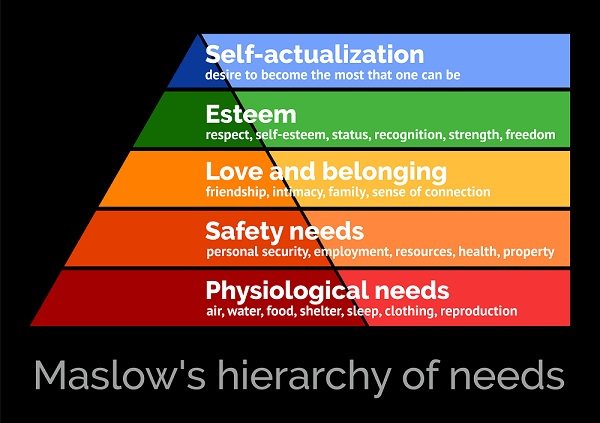
    Maslow’s hierarchy of needs gave me a helpful roadmap as I became more accustomed to taking care of myself.

    Recovering people-pleasers like me rarely meet our own needs and/or prioritize others’ needs instead. Oftentimes, we neglect even our most elementary needs at the bottom of the hierarchy.

    In the past, for example, I regularly cancelled dentist appointments and annual physicals, though I fiercely encouraged others in my life to take good care of themselves. I didn’t get enough sleep and postponed trips to the grocery store.

    Only when I began to meet these primary needs did other, more complex desires arise. We must meet our own fundamental needs on a regular basis in order to construct the firm foundation upon which our sense of identity will be built.

    Step 2: Uncover your core identity.

    Over months, I slowly climbed Maslow’s hierarchy, continuing with basic self-care as more vibrant desires surfaced. I began to crave rich social connections, meaningful bonds with family members, travel, and dancing. My natural curiosity, which I hadn’t felt connected to in years, awakened.

    Ultimately, I found myself considering how I could make the most of my life—how I could self-actualize and “become the most that one can be.” I considered the following questions during my morning journaling sessions:

    • Vision: What do I want my future to look like?
    • Identity: Who am I and what roles do I play?
    • Values: Which principles or morals most resonate with me?
    • Skills: What abilities do I possess?
    • Desires: What do I crave?

    Exploring my identity across multiple planes gave me the chance to learn how expansive I actually was.

    For starters, I possessed far more skills that I’d ever given myself credit for! I was uniquely empathic, a good listener, organized, and great at designing systems.
    I learned that I valued personal freedom, self-expression, financial responsibility, and playfulness.

    As someone who was recovering from a codependent romantic relationship, I was stunned to remember that I was sister, a daughter, a coach, a community leader, a best friend, and more.

    Wide-eyed, I realized that I was so much more than the shadow-self I’d felt like months before.

    I’d spent so much time defining myself by others that this simple exercise—putting my pen to paper and exploring myself for thirty minutes—was a milestone: not only because of what I discovered, but because I took the time for myself to do it at all.

    Take some time to explore your own roles, values, morals, abilities, and desires. It’s easier to set boundaries to protect the things that matter to you most when you’re clear on what those things are.

    Step 3: Bring your authentic self to your relationships.

    In retrospect, that early period of self-discovery was the most profound period of my life to date. It was characterized by the uncompromising commitment to prioritize my innermost self. Most importantly, those months provided me the firm foundation I needed to bring my authentic self to my relationships with others.

    Boundary setting is like working a muscle—difficult and exhausting at first, but eventually, second nature. With this new understanding in hand, I began to tentatively set firm and healthy boundaries in my relationships.

    At first, simply saying no to a party invitation was a challenge. But I did it.

    Not long after, I set non-negotiable work hours and withdrew from a few extracurricular commitments that no longer served me. It was hard, but also felt totally righteous.

    As I pocketed these small successes, setting harder boundaries felt less impossible. Eventually, I told best friends when their actions upset me; terminated romantic partnerships that weren’t meeting my needs; and unpacked old childhood hurts with my parents. I’d be lying if I said I didn’t dance around my kitchen once or twice—okay, definitely twice!—totally overjoyed that boundary setting was coming more easily to me.

    After each difficult conversation, rocky though it may have been, a weight lifted from my chest. In the absence of that weight, I could navigate the world more freely. I noticed that I was more present for my clients, more playful with my friends, and more authentic with my family. Relationships that had once been a source of resentment finally felt nourishing because I was bringing my full self to the table.

    Notice when you’re being inauthentic in your relationships so can you start creating this same freedom for yourself. Practice communicating what you think, want, and need and sharing how you honestly feel. Once you start working this muscle, it becomes much easier to set boundaries in all areas of your life.

    It’s A Lifelong Journey

    Putting my truth into action is a lifelong journey because my truth is always changing. My relationships grow, my needs shift, and my identity—the very bedrock of who I am and what I’m protecting—transforms.

    Years later, I still occasionally find myself challenged by moments of confrontation. In those moments, I always harken back to the fiercely empowering truth that I set these boundaries to protect the vibrant inner self that I’ve come to know and respect.

    I like to remember that this journey may not be linear.

    I like to remember the progress I’ve made so far.

    Most importantly, I like to remember to have patience and compassion for this inner self of mine. She has become so brave. She exposes herself to the elements, and risks being seen, known, and loved by herself and by others.

  • How to Avoid Petty Fights and Get What You Need in Your Relationship

    How to Avoid Petty Fights and Get What You Need in Your Relationship

    “It’s never overreacting to ask for what you want and need.” ~Amy Poehler

    It was yet another stupid argument that escalated from nothing to a hundred miles an hour in seconds. I’d been there so many times before, entrenched in warfare with us both preparing our defenses and priming our attacks.

    The intense emotions of the moment always took over, denying me the opportunity that hindsight would later afford me. Huge issues were, upon reflection, only minor disagreements about who had said what about the cooking, or where something had been left in the bathroom.

    On this occasion, once again we were both 100% committed to our side of the argument, when I stopped and thought:

    “This is crazy. What am I missing? There must be another way.”

    In that moment I had an insight that revolutionized my relationship and how I relate with my partner. But before I explain, let’s rewind a little.

    In the beginning, our relationship was pretty typical. Things started off great because we were really curious about each other. There wasn’t much judgment, as we always gave each other the benefit of the doubt, and with a lot of goodwill between us, we always knew we had each other’s best interests at heart.

    The adrenaline was pumping and the dopamine flowing, as we were in hormonal ecstasy with the excitement of exploring unchartered territory, something that made us so interesting to each other.

    After the honeymoon period, though, things started to become a bit routine. We started assuming things about each other, thinking we knew the other’s responses and desires because, after all, we’d been together a while now. I would always think, “I know you.” Only I didn’t know her anywhere near as well as I thought I did, and because of that assumption things started to go sour.

    This happened because we were not consciously aware of our own core needs, or each other’s. As a result, we couldn’t meet those needs for ourselves or communicate them in a way that empowered each other to meet them. So instead, we created unconscious strategies to get our needs met, like nagging and manipulation, which led to blurred boundaries and resentments.

    Eventually we became co-dependent, as we felt as if we each needed the other to keep us happy and satisfied. We knew we weren’t getting along as we once did, but we had no idea why. Now I know.

    We all have core needs, and they drive most of our behaviors, whether we realize it or not. By core needs I mean elements like safety, connection, autonomy, peace, meaning, and love.

    When we aren’t consciously aware of our core needs it’s often because we’ve become too distracted by other egoic needs, like the need for success, wealth, control, and dominance. Our core needs then become misunderstood and miscommunicated, which leads to us meeting our partner’s needs under duress or not at all.

    Here’s a simple example from my life to explain.

    Around a year ago my partner and I were having some minor ructions in our relationship. Nothing major, just some low-level tremors. I’m sure you know the type.

    I’d moved into her house a few months earlier, and we were still navigating the “how things are done around here” phase of the relationship, as I saw it. One of the areas of frustration for me was that she was always asking me to do things she could quite easily do herself, like taking out the trash.

    I’d do this, but kept thinking it would be easier if she did it herself whenever she noticed instead of always asking me. It triggered a lot of stuff in me, and I didn’t handle it well. I’d either fly off the handle and lash out, saying something I’d later regret, or I’d repress my emotions and go passive-aggressive, pretending everything was fine as my blood silently boiled.

    On this occasion, though, I stopped and slowed down. I became curious about why this was so important to her, and we had a conversation that changed everything for me.

    For my partner, I wasn’t just taking the trash out. I was meeting her need to feel safe and protected, and ultimately, loved. When she asked me to take out the trash, it wasn’t because she was being lazy. It was because, for one reason or another, this met those needs for her.

    The problem was, she’d never shared that this was about more than taking out the trash, so I interpreted her words through the lens of my life experiences and childhood memories, and it annoyed the hell out of me. But when I learned about the core need I was meeting for her, I totally understood it. Now I love putting the trash out, and I never thought I’d ever say that.

    When we continued to explore this I realized it went beyond the trash. I protect her and make her feel safe in many areas of our lives, which in turn makes her feel loved and cared for. Other things that met the same need for her were:

    • Securing the house before bed
    • Checking the car before long journeys
    • Standing on the outside of the path
    • Looking after our dog

    It’s worth noting here that we must also be able to meet our own needs. This isn’t about solely depending on someone else to make us feel how we want to feel.

    If we put the responsibility of meeting all our needs in someone else’s hands, we’ll never feel whole, strong, independent, or in control of our happiness and contentment. We’ll likely end up using unconscious strategies, like nagging or manipulation, to get our needs met, as my partner and I did. And we’ll also become increasingly needy and controlling.

    The key is to create a balance between honoring own needs and communicating with our partner when there’s a need they can meet, if they’re willing and able.

    We must also be aware that sometimes our needs might clash. For example, you and your partner might both have a need to feel safe and may look to each other to meet that need in the same exact way. In these situations it’s crucial that you become aware of this and discuss it together to find compromises that support you both.

    The important thing is that you understand what’s driving each of you so can set the stage for open communication and loving compromise instead of getting caught up in the same petty arguments over and over again.

    This can be harder than you may think. Oftentimes we don’t realize that our partner’s frustrating, demanding requests are actually badly communicated unmet needs, and we also don’t realize our own motivations.

    How can we dig a little deeper to get to the root of the issues? Here’s a simple exercise I learned from Harville Hendrix to help you and your partner understand, communicate, and meet each other’s needs:

    Step 1: Put aside some time and create a peaceful, intimate space for you and your partner.

    Turn off your cell phones, put the kids to bed, if you have any, and take a moment to create a safe and relaxing space between you both.

    Step 2: Get two pieces of paper so you can each write the answers to these three questions:

    • What do you need from your partner to help you feel loved and cared for that they currently do?
    • What do you need from your partner to help you feel loved and cared for that they’ve stopped doing?
    • What do you need from your partner to help you feel loved and cared for that they’ve never done before?

    Once you have completed writing out your list, highlight the ones that are most important to you.

    Step 3: Now swap your sheet with your partner.

    Take a look at their list and get curious about them. Ask questions to better understand the needs behind each one.

    For example, it may not seem particularly important to you to give each other a play-by-play of your day right after work. But this might meet your partner’s need to feel connected to you and express their emotions.

    Once you peel back the layers, you’ll be better able to create compromises if need be. So if you require space right after work to decompress, you could suggest discussing each other’s day over dinner, instead, so you both get your needs met.

    Step 4: Get clear on what you can and can’t do—and commit.

    Note on each other’s lists which things you are prepared to do for each other and which you are not. Then share this with each other and commit to doing one thing on each other’s list every day for two weeks.

    Step 5: Communicate throughout the process.

    Whenever your partner does one of your requests thank them for it and tell them how you feel as a result. This is important because you will both become more committed to this exercise when you understand the impact you are making for each other.

    I’ve done this exercise with my partner, and it was a simple and moving experience. You will find that your partner’s needs are not always what you think they are, and the simple things that might seem inconsequential to you are the ones that mean the most to them.

  • How Recovering People-Pleasers Can Discover What They Really Want

    How Recovering People-Pleasers Can Discover What They Really Want

    “When you say ‘yes’ to others, make sure you’re not saying ‘no’ to yourself.” ~Paulo Coelho

    People-pleasers regularly subvert their own needs for the needs of others. We spend years saying “yes” when we mean “no,” signing up for commitments we’d rather avoid, and occupying our minds with others’ desires.

    When we finally clear out the clutter to put ourselves first, we look around at the empty space, bewildered, with endless questions. What do we want? What does true happiness look like for us? What would a life lived on our own terms be like?

    For me, these questions once provoked anxiety. I’d spent a lifetime catering to my parents, friends, colleagues, and lovers—anyone but myself. By asking what I really wanted, I was looking my fear straight in the eye: my fear of being responsible for my own happiness. My fear of not getting what I wish for.

    These fears are both potent and entirely surmountable—if we’re brave enough to connect with our innermost desires.

    When we’re strongly connected to our dreams and desires, we begin to set boundaries with other people so we can reach them, and we slowly start finding the confidence to speak our truth. Our dreams and desires remind us how communicating authentically will change our lives, and the lives of our loved ones, for the better.

    For this reason, we recovering people-pleasers need to reclaim our familiarity with our inner voice and innermost needs. We cannot communicate authentically with others if we can’t communicate authentically with our inner selves.

    In my journey to overcome people pleasing, I’ve learned a few helpful tricks to connect with my innermost self and uncover what I really want in all areas of my life. Perhaps one (or more) of these methods may help you do the same.

    1. Label your feelings.

    As I mention in my post on setting boundaries, many of us have become so attuned to the feelings of others that our own feelings are elusive strangers, entirely unrecognizable to us.

    Our feelings are critical guideposts as we learn to prioritize our own needs—if we’re able to identify and own them. We can rebuild our connection to our feelings by noticing their presence in our bodies and hearts.

    First, we must learn to give ourselves permission to be excited, inspired, and desirous. I often notice these feelings when they appear as fluttering in my chest or tingling down my spine. These feelings signal that I’m moving toward something that excites me.

    If, like me, you’ve spent a lifetime motivated by guilt and anxiety, your positive emotions can starkly illuminate the activities and relationships that bring you pure joy.

    We can also learn from feelings that are challenging or unpleasant, once we’re able to identify them. Instead of glossing over anxiety, overwhelm, and anger, we can notice these feelings as pits in our stomachs, pressure in our chests, and tightness in our throats. Those feelings might be signals that something isn’t right for us, or that we need to set boundaries with others.

    2. Leave the system.

    Sometimes our deepest desires are buried under layers of fear, particularly the fear of seeming selfish or the fear of disappointing others. One way to dig beneath the fear is to mentally remove ourselves from the systems of which we’re a part.

    Begin by considering one of your social systems: your romantic relationship, your workplace, your church, your family. Then, ask yourself: “What would I do differently if I weren’t a part of this system?”

    Previously unacknowledged desires emerge when you extricate yourself from the pressures and influences of your system.

    Years ago, when I first did this exercise, I wrote in my journal, “What would I do differently if I weren’t in a relationship with my partner?” I was amazed as my hand flew across the page, scribbling: “Sign up for a dance class! Go out with friends more! Sleep in on Sundays!”

    My answers helped me realize that I was suffocating my own desires out of fear of my partner’s reactions. What I really wanted was right there on the page. Having this list enabled me to consider how I might carve out more space for my own desires within my relationship.

    3. Make a wish.

    The first time I saw a life coach, she began our session with the simplest of questions: “If you were granted three wishes, what would you wish for?”

    At first I thought her question was contrived, but when I answered, two of my responses were illuminating: I wished for a healthier relationship with my family, and I wished to become fully self-employed in the career of my dreams.

    Then she looked me in the eye: “You want these two things very much?”

    I nodded.

    “More than anything else in the world?”

    I nodded again.

    She grinned. “Then what have you been waiting for?”

    I was speechless. I’d never given myself permission to suspend reality, if only for a moment, to dream big. Making a wish allowed me to dive into my dreams without stopping myself with “What if?”s  “How?”s and “I could never do that.” Once I spoke my desires aloud, I could no longer ignore their truth. I begin strategizing how to get there.

    Practice suspending reality to discover what you crave. Imagine that you could make a wish that would be instantly granted, or imagine that you could walk through a door and your ideal life waited on the other side. What do you notice about these dreams? What desires do they demonstrate?

    4. Weave a web of impact.

    One of people-pleasers’ greatest challenges is the fear of being perceived as selfish or uncaring. I know this was true for me. Many of us believe that our worth comes from meeting others’ needs. Sometimes we forget that speaking our truth positively impacts other people.

    Take a moment to ask yourself the question: “If I spoke my truth and set firm boundaries, who else would benefit, and how?” Consider your partner, your friends, your colleagues, your children, passersby on the street. Consider who you might serve as a role model. Who might benefit from witnessing your strength and independence?

    You will quickly realize that speaking your truth has far-reaching benefits. Keep your list visible to remind yourself of the web of impact your new habits will have.

    5. Start small.

    If you’ve been in a habit of people-pleasing for a long time, it may be challenging to immediately identify your own big dreams. You may feel that you truly don’t know what you want right now, and that is totally normal. Living your truth and communicating authentically are muscles; when you exercise them regularly, they become stronger over time.

    Give yourself permission to start small. For example, you might not yet know what you want out of your career, but you do know you love strolling around the lake in the morning and winding down your nights with chamomile tea. You may not yet know which city you want to relocate to, but you do know you’d like to take a mid-afternoon power nap and buy thermal socks.

    These wants are sacred whispers from your innermost self. Give your innermost self time to surface. By pursuing these small desires, you learn to trust yourself. You begin to realize that you are fully capable of being your own advocate and building the life you want.

    Pay special attention to how it feels to meet your needs. Be patient. With the passage of time, bigger dreams make themselves known in your heart.

    Authentic communication is a two-way street; we must speak truthfully to ourselves before we can speak truthfully to others. Once we become familiar with what we really want, we can imagine a world where we replace old habits, like people-pleasing, with new visions for a brighter future.

  • Why I Focus on the Now Instead of What I Want for the Future

    Why I Focus on the Now Instead of What I Want for the Future

    “The next message you need is always right where you are.” ~Ram Dass

    I want you to go back to New Year’s Day 2009 with me for a second. I’d recently left a job and was embarking upon a new career, one in which I was self-employed.

    I pulled out all the stops and created a vision board that contained all of the things: how much money I wanted to earn, how I wanted to dress, where I wanted to vacation, how I wanted to eat, and everything else I could think of. I thought if I created this vision board, if I planned out exactly how things would go, somehow I’d find satisfaction and peace.

    I remember later that same year visiting my then-boyfriend (now husband) when he was working out of state. The area where he was working was gorgeous, and I kept writing down the future I wanted, what it would be like to live in a place like this, how it would feel if only we could afford a place here, near the ocean.

    I also remember being obsessive and miserable.

    None of the stuff I was clinging to so tightly worked out. Life unfolded, all was well, but all that planning wasn’t making my life better; it was making it more stressful.

    Every year, I’d come up with new goals, new dreams. Almost always they’d have something to do with controlling the way I ate, or how much money I made, or how to figure out the “right” career for me.

    Even last year I bought a big old notebook, divided it into sections for each month, and wrote down goals. Big goals for the year, smaller goals for each month, all things designed to bring me the happiness I was seeking.

    But this past year has changed me. I no longer try to plan far into a future I can’t predict, and I no longer expect outside circumstances to bring me internal pleasure.

    I’m not exactly sure what happened, but I know pushing myself to visualize the life I wanted, over and over again, and obsessing about writing down my goals finally got to me. I finally got to a point where the last thing I wanted to do was think about those things.

    I wanted something new. I wanted to meet each moment where it was and ask myself: What’s next? What should I do now?

    Recently I was letting my mind spin into high anxiety mode. I was freaking out about money and career and every other thing you can think of. Instead of my usual planning and searching and trying to come up with something to work toward, I sat down.

    I got out my notebook. I opened it, and I asked myself, “What can I do right now to feel better?” I don’t remember what the answer was, but I’m certain it was something along the lines of “take a deep breath” or “lie down” or “relax.”

    In fact, that’s often the answer I get when I stop and ask what to do in the moment. It may seem weird—I mean, shouldn’t we be planning for our retirement? Maybe sometimes, but more often than not I believe stopping and realizing this is it, this is the moment to stop and breathe, this is the moment to chill out, is a better way to live, at least for me.

    I feel happier and more settled this year, and I don’t have a resolution or goal in sight. Here’s how I’m approaching life nowadays: with the intention to stay in the moment and simply do the next right thing.

    I didn’t come up with any resolutions for this year. Okay, I guess I have one, but it’s an intention, not a resolution: to remind myself to check in with the present moment rather than letting my mind go in circles trying to figure out what the future holds. Because that makes me feel worse, not better.

    I committed to letting go of obsession. I’m still human—I still have things I hope to achieve, and I still have dreams for where my career might go, I still have lots of places in the world I want to visit. I’m not giving up; I’m just doing things differently.

    As soon as I feel my anxiety start to rise, as soon as I start to think the same thoughts (or worry the same worries) over and over again about what the future may bring, even if it’s something positive, I stop. I stop thinking, I stop planning, and I breathe into the moment.

    I remind myself every single day to ask myself what’s next right now. Not what I should do next year, not what my five year plan should be—what I should do in a minute or two from now.

    The way I do this is pretty simple: I either pause for a moment and see which thing seems like the most delightful thing to do next, or, if I’m in a stressed out place, I pause and write to myself.

    It’s journaling, really, but a type where I’m having an internal dialogue with what I think of as my heart. I’m looking inward, intending to hear what the deepest part of me would like to do next rather than letting my mind run away with the show and tell me all of the things I should be worried about.

    I sit still, breathe deeply, think about something that makes me feel calm and content (that usually involves imagining or petting one of my cats), and then write down a question. I ask what to do now. I ask what I can do to calm down. Then I just listen.

    Like I said, the answers I usually get have to do with lying down, or resting, or relaxing, or letting myself have fun. It’s all stuff that sounds really great, truly. It makes me feel better, not worse.

    I can hear the arguments now, though: You have to have a plan. You can’t always have fun!

    I’m not suggesting you empty your 401k or sleep all day, not at all. I’m suggesting that, at least for me, checking in with myself and listening for what to do next—not worrying and obsessing about how to achieve, achieve, achieve—is the key to a calmer, happier life.

    Yes, I have dreams and a vision for the trajectory of my career. Yes, I think about my health. Yes, I have plans to travel this summer. But I think about those things when it’s time to think about them, like in the exact moment I’m at my computer and can look at rentals on Airbnb. I don’t need to worry about it, stress about it, and think about it at other times when I can’t do anything to change it.

    The same goes for everything else in my life: I can’t become an overnight success; what I can do is find out, in each moment, what would serve me in moving toward the ideas I have for my career. Sometimes I truly think I’m being told to rest because that is what will serve me best—because I need a break.

    It’s simple though not always easy: Slow down and check in with yourself. See what the next right move is, the thing you should be doing in the next few minutes. I know it makes me feel calmer and more centered, and, so far, has never led me to feel anxious or worried.

    If you set a bunch of resolutions at the start of the year and are finding it hard to stick with them, maybe this is the perfect time to shift your focus from what you want in the future to what you need right now.

  • How I Overcame Childhood Emotional Neglect and Learned to Meet My Needs

    How I Overcame Childhood Emotional Neglect and Learned to Meet My Needs

    “In order to move on, you must understand why you felt what you did and why you no longer need to feel it.” ~Mitch Albom

    “Your feelings are valid,” said my life coach during one of our sessions, as we were working on an issue I had with my parents.

    I had to do a double take. My feelings are valid? She actually accepts them as they are?

    Eventually it started to dawn on me: My parents never validated my feelings. This sudden revelation earlier this year threw me into a dark period of my life.

    When I was growing up, my parents criticized me for being “overly emotional” and “too sensitive,” and I never felt they truly accepted me.

    My whole family shied away from expressing emotions, so I learned not to express or talk about my emotions either. I felt deeply disconnected in romantic relationships and often didn’t want to depend on others for help. Something felt completely off in my life, but I just couldn’t put my finger on what.

    It wasn’t until I did more research and came across the term “childhood emotional neglect,” coined by Dr. Jonice Webb, that I started to fully understand my situation.

    Childhood emotional neglect, or CEN, refers to a parent’s failure to respond to their child’s emotional needs.

    Dr. Jonice explains that CEN is an act of omission—or something that is silent, missing, and not visible—that goes on in the background of a child’s upbringing. In fact, most parents have good intentions and often provide for their child’s material needs but are emotionally unavailable because they were neglected themselves—thus, resulting in a cycle of not being able to express emotions or respond to their child’s feelings.

    So how do you know if you’ve experienced CEN? In Dr. Jonice’s CEN questionnaire, she asks questions like:

    • Do you sometimes feel like you don’t belong with your family and friends?
    • Do you have trouble knowing what you’re feeling?
    • Do you have trouble identifying your strengths and weaknesses?
    • Do you at times feel empty inside?
    • Do you have friends or family members who complain that you are aloof or distant?

    The more questions you answer “yes” to, the more likely you have been affected by CEN in those areas of your life.

    After taking the CEN questionnaire and reading more about it, I realized that it described my situation perfectly.

    Although I come from an Asian background that is generally known for not being expressive, I don’t want to live my life feeling wholly disconnected from myself and my emotions. But for a long time I wasn’t able to change this. It took me spiraling headfirst into anxiety and depression to find the courage to dig myself out of that proverbial black hole and fight back.

    I started going for counseling and received more validation that my feelings and emotions should be unconditionally accepted, and that it was okay to express them to others. I learned, through role-playing exercises, how to communicate my feelings properly, without feeling ashamed for having them.

    This continued to reinforce a new belief in me: that my feelings are valid and important, and so am I.

    As I went through this inner discovery, I learned a few other things that have helped me recover from the effects of CEN.

    1. I deserve self-forgiveness and self-compassion.

    Because children and adults affected by CEN are often shamed for their feelings, it is important for them to learn how to self-soothe and develop compassion for themselves.

    While I was going through my depression, I recognized that I was perpetuating the same behavior by shaming and guilting myself for my thoughts about my parents. I also blamed myself for causing my own pain all this time.

    It took much awareness to notice these negative thought patterns and consciously replace them with more positive ones. Now, I choose to be kind to myself when I’m struggling. I validate my own feelings in the way I wish my parents once did.

    2. My needs are important.

    In addition to accepting my emotional needs, I realized that all of my needs—physical, mental, and spiritual—are important. To ensure I could better honor them, I made a list of my varied needs and now use this as a guide on how to live my life consciously.

    I also learned how to communicate effectively when I need to stand up for myself instead of hiding from or running away from difficult situations. I learned that emotions are neither good nor bad; they’re just messages to inform me as I go about my daily life.

    For example, I don’t need to feel guilty about feeling angry. Anger is just a sign there’s something I need to address, like a boundary violation or perhaps a miscommunication.

    3. It’s okay to put my needs first.

    If your parents neglected your needs when you were younger, you may think that they are not a top priority. In my case, it took a lot of relearning, and I often had to stop and ask myself, in relationships or work situations, am I not putting myself first?

    I had to be careful to not martyr myself by agreeing to obligations, as this would lead to resentment and often, passive-aggressive behavior. I had to seriously consider whether I was actually saying yes to something because I wanted to or just agreeing because I wanted to please others.

    4. I need to regularly tune into my emotions.

    I use a simple body scan exercise every day that helps me recognize what I’m feeling. I listen to my body, and if any emotions or tension come up, I write this down, investigate what this really means, and see if I can find a way to meet my own emotional needs.

    For example, if I’m sad or angry, I ask myself: How can I tend to those emotions myself? What do I need to accept, change, or address? It’s like do-it-yourself parenting in a way.

    Slowly but surely, through the exercises above and counseling, I’ve become more conscious of my needs and emotions. I’ve started feeling more connected to myself, and I’ve opened up to other people. I now feel much freer and better able to accept myself and my emotions, and I find it easier to relate to others.

    Often, the biggest challenge for those who’ve been affected by childhood emotional neglect is recognizing they’ve been subjected to it, since many people don’t even recognize how their childhood affected them.

    When you have more awareness of your own situation, you can easily implement the above tips and get help from a professional to learn how to re-parent yourself, and also ensure you don’t perpetuate this unhealthy cycle with your own kids.

  • How to Honor Your Sensitivity (Because It’s Actually a Strength)

    How to Honor Your Sensitivity (Because It’s Actually a Strength)

    “The opposite of sensitive is not ‘tough.’ It’s insensitive. Sensitivity is a gift. Let’s nurture it, not squash it.” ~Glennon Doyle

    I would run no matter how much snow and ice there was, no matter how tired I was or how much my joints hurt. Even if I was hungover. It didn’t matter. Sometimes I would be in incredible pain, but I wouldn’t stop.

    I worked as a tree planter in the summers and got paid per tree. I would push as hard as possible, sometimes planting as many as 3,000 trees in one day. And, not surprisingly, I had my first back spasm at age twenty-one.

    That’s how I lived my whole life in my early twenties. Pushing. I barely had enough time to get everything done with college, volunteering, and a part time job. I would consistently end up exhausted.

    On top of this, bright lights and loud noises easily overwhelm me, but I pushed through that too. I didn’t really want to go to my friends’ loud parties, so would drink to the point that the loud noise didn’t bother me anymore.

    Years later I learned I was a highly sensitive person (HSP) and it all made sense. HSPs are sensitive to loud noises, bright lights, and other people’s emotions.

    And because HSPs only make up 15-20% of the population, it sometimes seems like the basic needs of quiet, space away from family members with big emotions, and soft lighting are self-indulgent or greedy. So HSPs often push through their sensitive nature.

    In my twenties, despite my sensitivities, I pushed through. I didn’t feel like my life was worth much unless I was highly productive, getting good grades, and pleasing my friends, family, professors, and pretty much anyone I met. I was determined to be perfect, and it was killing me.

    It finally came to a head during my first job after college. I was working hard to please my supervisors, co-workers, and the youth that were our clients. It was my dream job, but I ignored my own needs as a highly sensitive person to the point that I couldn’t do it anymore. I was exhausted and didn’t want to get out of bed in the mornings. I quit but I didn’t know what to do.

    Are You Highly Sensitive?

    Does any of this sound familiar? If you sometimes push through your own needs it could be a sign that you’re highly sensitive. Other signs you’re an HSP include:

    • You feel the tragedies reported on the news very deeply
    • You sometimes get overwhelmed by beauty—a breathtaking view or the kindness of a friend
    • You’re sensitive to bright lights and loud noises
    • You’re highly empathetic
    • If someone’s in a bad mood, you feel the energy in the room
    • Sometimes when a coffee date gets cancelled, you’re ecstatic that you get to stay hiding under the covers
    • You love creativity whether it’s music, dance, photography, writing, visual art or interior design

    And when an HSP tries to fit in, it takes a lot of energy. Ignoring your sensitivity will leave you drained. You’ll end up exhausted without much to give.

    What Happens When an HSP Ignores Their Sensitivity?

    HSPs often end up ignoring their sensitivities because they’re pressured to do so. Whether it’s a cubicle where you can hear 100 other people talking or your group of friends that want to meet in a noisy restaurant as an HSP, you’re constantly being asked to ignore your sensitivity.

    And so many HSPs end complying and pushing through. You don’t want to disappoint your friends or inconvenience your boss, so you say yes even though your nervous system is over stimulated. Or other times you want to save money, so you’ll share a hotel room with your noisy and emotional cousin even though it would be better to have your own room.

    The problem is, when your nervous system is constantly over stimulated, you end up exhausted. Your exhaustion might start out small, but if you continue to push, you may end up with a complete breakdown like mine. And because I’ve been through it, I really don’t want this to happen to you!

    The good news is that it’s possible to protect your sensitive nervous system. It takes time and practice, but step by step, you can start to take better care of yourself and not worry about other people’s expectations.

    How HSPs Can Heal After Years of Pushing

    1. Rest when you’re tired.

    The first and sometimes most difficult step is to get some rest. If you’re determined to fit in, you’re probably exhausted. You’ve been going and going and going and never stop to take a breath. You could:

    • Take a five-minute walk outside
    • Look out the window and breathe
    • Nap
    • Make time for meditation
    • Take a day completely off to recharge
    • Spend time in nature

    So start small and see if you can schedule even five minutes today to be quiet and rest.

    2. Learn about your sensitivity.

    The fact that you’re reading this article means you’re already on track to completing this step!! The more you learn about your sensitivity, the easier it will be to take time to rest, to say no to that overwhelming party invitation or to walk around downtown wearing giant headphones playing white noise to block out the sound.

    And it doesn’t matter whether it’s through reading or podcasts or watching videos. Whatever format you like best will get you on track. Some of my favourites include the Highly Sensitive Refuge website and the Introvert, Dear podcast which is hosted by an HSP.

    3. Honor your needs.

    I know this is difficult to do especially when there are other people involved, but as you begin to honor your needs, you’ll begin to get your energy back. You’ll feel calmer, more relaxed, and more excited about life.

    And so, even though it will involve some difficult conversations with your friends, your partner, you family and co-workers, I promise you it’ll be 100% worth it.

    When I was in a new relationship where my partner was definitely not an HSP we would have a lot of conversations that went something like this,

    Sweetie, you have to remember you’re dating someone sensitive.

    If my blood sugar crashes, I won’t be able to recover.

    OR

    I’m getting really overstimulated by that music.

    OR

    It would really help me if you just sat quietly with me for a minute.

    You can send your loved ones articles to teach them about highly sensitive people and what’s really happening for you. And sometimes, you just have to explain it to them step by step.

    Some common HSP needs include:

    • A slow pace of life
    • Beautiful spaces
    • Time in nature
    • Deep and meaningful relationships
    • Time to cry and feel your emotions
    • A good night’s sleep
    • Physical space after a conflict or challenging discussion
    • Nourishing food

    And yes, I get it; it’s hard to ask for. It’s taken me a decade but I’m learning to take better care of myself and now am able to share my supportive nature more fully with others. And you can too.

    The less you worry about fitting in and the more you can take care of your HSP needs, the more you’ll be able to bring your sensitive strengths forward to make the impact you were meant to make.

    Your Sensitivity is Your Strength

    As a highly sensitive person, you have the real gifts of empathy, creativity, attention to detail, and bringing quality into everything you create. Because of this HSPs like you make the world’s best writers, therapists, coaches, interior designers, actors, caretakers, and artists.

    According to an article by Jim Hallows, famous HSPs include Nicole Kidman, Edgar Allen Poe, Leonardo Di Vinci, Bob Dylan, Princess Diana, and Mother Teresa.

    You’re meant to protect and bring forward your sensitive strengths.

    By taking care of yourself you’re not being a diva. You’re not being selfish. You’re not being greedy and you’re not crazy. You’re being gentle with yourself so you can share your beautiful, powerful sensitive strengths with the world.

  • How I Stopped Feeling Guilty About Doing What’s Best for Me

    How I Stopped Feeling Guilty About Doing What’s Best for Me

    “A good rule of thumb is that any environment that consistently leaves you feeling bad about who you are is the wrong environment.” ~Laurie Helgoe

    Do you ever worry that if you fulfill your needs you will disappoint others? Do you ever feel guilty for doing what’s best for you?

    For years, I felt guilty about taking time for myself. I thought that being alone, away from the rest of the world, meant being selfish. This was especially true in one toxic relationship that kept dragging me down because I was afraid to make a change. As a peaceful, compassionate person who’s always been a good listener and a giver, I was drawn to his unstable and needy behavior, thinking that I could help him change for the better.

    But after two years of having to deal with constant putdowns from a possessive partner who thought I was selfish every time I craved alone time, I knew I was nearing my breaking point.

    I remember one night, after an exhausting day at work, I joyfully looked forward to a relaxing evening. As I drove home, all I could think of was taking a hot bath, brewing a fragrant herbal tea, and putting on my favorite fluffy pajamas. Under the dimmed light of my reading lamp, snug in a warm bed, I got lost in the world of mystery and imagination that made my soul come alive.

    Just a few minutes into my reading session, I received a text from him, demanding me to “get ready in ten because we’re going out, and you don’t have a choice.”

    At first, I ignored the message and went back to my reading, since he’d made plans earlier that week to see his friends. Then he called but I didn’t pick up. Finally, after several attempts to reach me, he came rushing to my apartment, banging on the front door.

    I pretended to be asleep and didn’t answer. The truth is that I was frightened and reluctant to open the door given his usual aggressive behavior.

    I didn’t want to confront him because I knew he wouldn’t understand. I felt mentally and physically drained for having to constantly explain myself and for letting him manipulate me yet again. I was fed up with having to come up with believable reasons why I needed time for myself, and I was sick and tired of constantly changing my plans for him.

    But as he left, I started to feel horrible. I felt guilty about avoiding the situation and for not being able to stand up to him. What made me feel even guiltier was that I’d finally done what I was afraid to do for so long. I’d listened to my inner guidance and done what was best for me.

    Still, instead of going back to reading and enjoying my evening ritual, I opened up a one-pound bar of chocolate and slowly devoured the massive amount of fat and sugar in a matter of minutes. Instantly, I got back into my “happy” mood, thinking life was good again. But then, as the guilt of eating so much sugar slowly sank in, I found myself back at square one, feeling even worse.

    This happened over a decade ago, when I struggled with a full-blown sugar addiction. To compensate for my inability to say no, being a perfectionist, and staying in a toxic relationship, I’d eat sugar. A lot of it. I was so drawn to sweets and chocolate that I couldn’t go a day without eating at least a whole bar. It was part of my daily routine and something I considered normal.

    Sugar was the answer to all my hardships. It was my biggest excuse for staying where I was and not doing anything about my life.

    Unsurprisingly, I struggled with self-blame, feeling that I was deeply flawed because I was an introvert. In childhood, I was ashamed of being regularly humiliated by my math teacher in front of the whole class and continuously bullied by some of my classmates and older students. Later on, the same guilt haunted me in similar ways, but as I grew older, it became a part of me, almost like a sickness.

    After that day, I decided to end the toxic relationship that made me doubt my worth and scarred me emotionally for years. I finally found the courage to confront the person who’d used blaming, shaming, and threatening to cover up all of his wrongdoings.

    Throughout our whole relationship, I apologized every time he hurt me because I felt guilty for making him feel bad. I tried so hard to be the perfect girl who never made mistakes, never spoke her mind, and never messed up. I found myself agreeing with everything while my conscience screamed the opposite. For so long, I tried to fix what was broken. I felt hurt, lonely, and betrayed.

    The truth is that I believed I was responsible for what he felt. For his actions. For how he saw me. I was afraid of being judged, so I diminished my value to make him feel comfortable. And I was slowly losing myself.

    I became an obsessive perfectionist, paralyzed by the fear of not being good enough. Everything I did had to be absolutely perfect. But no matter how hard I tried, it was never enough to meet his expectations.

    Now, I know that the guilt I felt that night was the reaction I’d gotten accustomed to, my place of comfort that told me I was safe. But no matter how guilty I felt for doing what I felt was right for me, I gained invaluable courage to start making a change.

    It took a great deal of work, patience, and understanding, as well as learning through growth and change, to know what I wanted out of a relationship and how I wanted to be treated.

    I started with forgiveness. I forgave myself for not listening to my intuition and for treating my body and mind badly. Knowing that I cannot change the past and that I do not actually want to go back there, I became mindful of the mistakes I’d made and learned invaluable lessons.

    When I became honest with myself about what I wanted, I began to take care of myself, preserving my health, nourishing my body, and nurturing my soul. I made my priorities clear and realized what was important to me. I started eating healthy and exercising regularly.

    Finding the courage to put an end to my unhealthy relationship inspired me to take action and do something about my serious sugar addiction, which was slowly but surely destroying my health. I signed up for a wellness course that I’d been telling myself I would enroll in for months. Just reaching this place was a huge success for me, at the time.

    I remember the moment I got there, I freaked out, unable to catch my breath. All I wanted to do was leave and never return. I thought I wasn’t ready to give up sugar, since it was keeping me safe and comfortable. All I could think of was getting one more bite of my favorite chocolate while promising myself, “I’m quitting tomorrow.”

    After days of crying in agony and successfully completing the workshop, I decided to continue without sugar for the whole month. I promised myself that I would let go of the one thing that was making me happy momentarily but holding me back in so many areas of my life.

    And that’s when something incredible happened. I noticed that the more I held off sugar, the more I pushed myself to pursue other things. I started waking up early and meditating. I began making better food choices and training for long-distance running. Postponing the immediate gratification and choosing not to eat what was actually hurting me, made me a much happier, more productive person.

    I became completely aware that my vice provided a powerful short-term relief, but in reality, it was forming a vicious cycle that was leaving me feeling vulnerable, empty, and regretful.

    After I’d forgiven myself, I forgave others. No matter how hard it was, I found the strength to forgive anyone who’d harmed me and asked for forgiveness of everyone I had unknowingly or deliberately wronged in the past.

    Forgiving someone means that you are letting go of bitterness and resentment toward that person. It doesn’t mean that you need to contact them or continue having them in your life. Not at all. They don’t even have to know, but in your heart, you know that you have no sourness left, only love and acceptance.

    And finally, I accepted myself for who I am and for having my own needs. I went back to reading daily and taking courses and certifications to better myself and improve my skills. I started trusting my innate needs and desires because I finally realized that it’s up to me to decide how I spend my time and how much alone time I need.

    As introverts, we feel guilty for not talking enough, for not going out as often as we think we should, and for avoiding social situations because we need time alone. We often end up in toxic relationships because we give, we love, we care about other people’s feelings, and we don’t want to hurt anyone.

    But our alone time is so vital to our well-being that if we don’t listen to our needs we end up feeling frustration, resentment, and the inevitable fatigue that goes with them.

    Living life according to your own needs doesn’t make you a selfish person. It’s perfectly okay to spend time away from others, to fulfill your need to read, write, create, and explore. It’s okay to want to be alone and to enjoy it. It’s okay to do whatever you need to do to feel fulfilled, balanced, and connected to yourself.

    Never feel guilty for doing what’s best for you or for prioritizing what you value in life. Never feel guilty for being honest about how you feel, and never apologize for being you.

  • Why People-Pleasers Don’t Get the Love and Respect They Desire

    Why People-Pleasers Don’t Get the Love and Respect They Desire

    “Niceness is the psychological armor of the people-pleaser.” ~Harriet B. Braiker

    I used to think that being kind, gentle, and agreeable was guaranteed to win me love and acceptance from others. I’d tiptoe around destructive people’s behaviors, no matter how uncomfortable I felt about it, believing to my core that if only I could be nice enough to them, they would one day lead a better life.

    I lived my life constantly avoiding anything that might make me look like a bad, imperfect, antagonistic, or unlikeable person. Because as every people-pleaser knows, being disliked or disapproved of feels worse than ignoring your own feelings—at least at first.

    Some people were easy to please; a kind gesture or smile was all it would take. Getting their approval so effortlessly made me happier than a kid at Disney World. But with other people, it seemed the more I tried to please them, the more likely they were to treat me like an old dish rag; and the more this happened, the less I liked myself.

    Eventually, my efforts to please others left me feeling disrespected, violated, and disconnected—from life, from other people, and from myself.

    For many years, I silently endured the ongoing, relentless invalidation of who I was based on how others treated me. When someone close to me was feeling unsatisfied, negative, or in search of someone to blame, there I was, ready to take it.

    But no matter how unhappy I was, I still wanted to make them feel better. I wanted to see them happy, even at my own expense.

    At the core of these one-sided relationships I maintained with some of the perpetually dissatisfied people in my life was an enduring belief that if only I could solve their problems and make them happy, I’d finally receive the love and acceptance I desired all my life.

    I never stopped to think, “But what about me? What will become of me if I keep trying to satisfy people with an unquenchable thirst?” I couldn’t see that no matter what I did, it would never be enough. In fact, it wasn’t about me at all. I didn’t realize that no matter how good I am at solving problems, or how perfectly I can handle things, if someone wants to find fault with me, they will.

    Instead of seeing other people’s dissatisfaction as an issue for them to resolve on their own, I internalized it and interpreted it to mean I wasn’t good enough.

    But one day, I finally started asking myself some important questions: “What will become of me and my self-worth if I keep basing it on unhappy people’s perceptions? Who will love and respect me if I’m not even taking a stand for myself?”

    My conception of who I needed to be in order to gain love and acceptance was slapping me in the face over and over again like a flat tire driving on uneven pavement. But still, I wondered why my formula wasn’t working. I truly believed that living selflessly was a surefire way to get love, appreciation, respect, and lots of hugs in return.

    It took me a while to realize that living this way was actually having the opposite effect. My constant selfless giving and kindness didn’t automatically earn me a pass on the eternal acceptance subway. It actually seemed to be an invitation for people to take advantage of my generosity, allowing them to feel less anxious about their own lives.

    I set myself up to be other people’s emotional dumpster, personal life fixer, and convenient source of blame for their misfortunes.

    What I came to learn the hard way is that pleasing others isn’t the way to win their love and respect. I finally realized that if I kept taking on other people’s anxiety as my own, they would never change. And why would they, after all? They got lots of relief from me stepping in and resolving things. But at what cost?

    All this pleasing had left me feeling inadequate and stressed out as I watched the recipients of my pleasing play out the same problems and drama, over and over again.

    Love At All Costs

    One night I had a dream that I was standing in a field with nothing but the clothes on my back. I felt weak and tired, like I needed someone to come lift me up and ask me how I was doing.

    Slowly, my family and friends started to join me in the field. But they weren’t there to rescue me; they were there to bring me their troubles.

    One by one, they started pulling me in different directions. They wanted me to solve their lives for them, even though I was alone, tired, defeated, and left with nothing.

    The dream was showing me the truth about how I was living. When my life and health started to collapse around me like a burning building, I had to take a hard look at my perspective and decisions. I started to question my beliefs about what it meant to be a truly good person, and what it took to receive the love and respect I so desired.

    That dream helped me understand that my people-pleasing behaviors weren’t getting me what I desired; they were getting me the very experiences I spent my life trying to avoid.

    Back then, it would have been easier for me to blame others for their ungratefulness and neediness; but deep down, I knew that blaming would have been another way to avoid taking a look at myself.

    I was sick of exhausting myself trying to help and change other people, only to find that it didn’t work. I knew I had to change myself and, as cheesy as it may sound, give myself the love and respect I so desired. Because the truth is, no one can give you what you should be giving yourself from within—especially not those people who need the pleasing you so easily offer.

    After much reflection, I came to see that my pleasing behaviors were a way for me to get the validation from others that I wasn’t giving myself. Of course my efforts backfired, because I alone was responsible for my happiness; other people’s happiness wasn’t my responsibility, and just because I was overly nice to someone didn’t mean they had to treat me the same way.

    I was trying to please other people so I could feel worthy of love. In reality, my kindness wasn’t coming from a place of vulnerability, honesty, or acceptance; it was rooted in anxiety and fear.

    In my attempts to make everyone else happy, I lost control of my own identity, and they lost their ability to solve their own problems. By changing myself to become who everyone wanted me to be, I made myself less desirable and implicitly invited people to take me for granted.

    Pleasing Yourself

    Do you find yourself people-pleasing and wonder how you can get the love and respect you desire? Well, the answer is pretty simple, but the actions it takes aren’t quite as simple. The first step involves changing your perceptions. Once that’s done, changing your behaviors will follow naturally. Here are some things to remember:

    1. You aren’t treating yourself with love and respect when you regularly do things for others that they’re avoiding doing for themselves.

    2. You aren’t treating yourself with love and respect when people violate your boundaries, and you don’t speak up about it.

    3. You aren’t treating yourself with love and respect when you say yes to something but really want to say no.

    4. You aren’t treating yourself with love and respect when you internalize others’ dissatisfaction and take it on as your own problem.

    5. You aren’t treating yourself with love and respect when you hurt yourself in order to make others happy.

    Over time, I came to understand that my efforts to make other people happy were like deposits made in a piggy bank with a giant hole at the bottom.

    If you’re stuck in a people-pleasing cycle, chances are you’re subconsciously attaching to people who need you to soothe their discomfort, because they can’t do it for themselves. Since they don’t know how to manage their own emotions, they’ll continue to reach out to you whenever they’re in crisis—and, on the occasions when your pleasing behaviors aren’t sufficient for them, they’ll blame you for their discomfort.

    If you want to make changes in your life, it’s time for you to see this pattern clearly and stop basing your sense of worthiness on other people’s approval of you.

    Change your perceptions, beliefs, and behaviors. Make contributions to a bank that pays interest. Receive the love and respect you so desire by celebrating your freedom from the longing to be accepted by others.

    Editor’s note: Ilene has generously offered to give away two free copies of her latest book, When It’s Never About You: The People-Pleaser’s Guide to Reclaiming Your Health, Happiness and Personal FreedomTo enter to win one of two free copies, leave a comment below. You don’t have to write anything specific—”Count me in” is sufficient! You can enter until midnight PST on Sunday, November 5th.

    UPDATE: The winners for this giveaway have already been chosen. They are Emma Andmark Shishkin and Mari Toni.

  • How I Prioritize and Take Care of Myself Without Feeling Selfish

    How I Prioritize and Take Care of Myself Without Feeling Selfish

    “I am worthy of the best things in life, and I now lovingly allow myself to accept it.” ~Louise Hay

    Looking back on my life, I see that for a long time I struggled to take care of my own wants and needs and didn’t make them a priority. I used to find that very uncomfortable, and sometimes even selfish. I was a master of giving, but I faced serious obstacles to receiving.

    By nature, I am a nurturer. I find tremendous joy and fulfillment in giving, so the old me used to offer plenty of time and energy to everyone else (my family, friends, and employers). I was always doing my best to please others and make them happy. I still believe there’s nothing wrong about that, and that my only mistake was treating myself as unimportant.

    Several years ago, while I was working for an international corporation in Shanghai, I was assigned to organize a major team-building event for the organization. I decided to go for a Chinese food cooking class. It all went beautifully, and everyone had much fun. People were cooking, laughing, and taking pictures, while I was supervising and making sure everything went impeccably.

    After the cooking class, it was time for dinner, time to eat that delicious food and enjoy a relaxing evening together. I had spent hours setting the tables, preparing different team games, and making sure this event was going to be a party to remember. And so it was, especially for me.

    I will never forget that day. It was transformational; a wake-up call that shook me to the bones. My colleagues asked where I was going to sit and have dinner, and I couldn’t answer. I had been so focused on making everything perfect for everyone else that I had completely forgotten about myself.

    Everyone had their seats and was ready to enjoy a nice meal, except for me. I was planning to grab some food at the end, if anything was left. I’d entertain everyone and play the master of ceremonies, even if no one had ever asked me to do that.

    I was the only one responsible for that unfortunate decision to please everyone but me.

    My first reaction was to blame myself. How could I have done such a thing? How could I have been so stupid? Deep inside, I felt angry with myself, and upset with my mother, as well.

    Since an early age, I watched her dedicate herself to us, her family, day and night: never tired (that’s what we thought), always available and willing to help. I watched her taking care of the household and working full time, including night shifts.

    I would have wanted her to teach me differently, to tell me about healthy boundaries and self-care. But that was the best she knew, and she did the best she could. Her mother had done the same thing, and so had her grandmother.

    Today, I feel thankful for that precious gift. My mother taught me how to serve, nourish, and nurture from the heart. However, there was one more thing for me to learn as a grown-up woman: that self-care was not selfish, but fair. Like everyone else, I am also a person, worthy of love, care, and attention.

    Today I know I needed that experience, to understand how old, inherited patterns of behavior didn’t serve me well. We can only change what we are aware of and accept to be true about ourselves, and staying in denial is a trap.

    So here’s what worked well for me and helped me take much better care of myself:

    1. Do more things for my heart and soul.

    If I can’t find time for myself in my busy agenda, I make it. We all have twenty-four hours a day, and my wants and needs are important.

    I have started to spend a higher number of hours all by myself. It doesn’t mean I’m not a social person or I don’t love the people around me. That’s how I reconnect with myself and get grounded, reflect, and recharge.

    I take breaks between working hours; I am not a robot. Sometimes, I go out for a nice walk in nature. I watch a good movie or read a good book. I listen to relaxing recordings, with my eyes closed. I sometimes treat myself to a massage. I use the beautiful bed sheets and the nice towels instead of saving them for the guests, because I’m worth it.

    2. Take good care of my body.

    I know my body is the temple of my soul, and the only one I’ve got, so I make sure I give it nutritious foods and plenty of water. I schedule those much-needed doctor appointments and yearly health checks. I take a nap when I need rest; put my phone on silent and disconnect from the outer world for a while. Surprisingly, the world does not collapse.

    3. Set healthy boundaries with the outer world.

    One of the most difficult things I had to learn was how to say no to things I didn’t really want to do, without feeling selfish, guilty, or overly worried that I might hurt or upset someone else.

    I struggled with this in my personal relationships (like when I saw a movie in town on a Sunday because a good friend had asked, even though my body only wanted to sleep and recharge), but not only in this area of my life.

    This was a challenge at work, as well, whether I was saying yes to tasks that were not part of my job profile or volunteering to take on new projects when I already had a lot on my plate.

    But one day, I decided to speak up for myself and see what happened. Surprisingly, everything was just fine when I started telling people what I needed.

    To me, setting healthy boundaries was a learned practice, and here’s where I am today:

    If it sounds like a “should,” I don’t do it. I have learned how to say no to things I don’t really want to do without fearing I might disappoint others.

    Saying no doesn’t mean I dislike or reject the other person. I know I can’t disappoint anyone. People disappoint themselves with the expectations they set for whom they want me to be and what they expect me to do. It’s always about them, and it has zero to do with me. If they truly love me, they would understand.

    It’s not my job to please others, and I don’t feel like I owe anyone any explanations or apologies for the way I am spending my precious time, and with whom. We always choose how much we give.

    Setting boundaries in a relationship might look selfish to the outer world. In reality, it is a form of self-respect, self-love, and self-care.

    4. Stop fighting for perfection.

    Years ago, I almost got burnt out at work. I was working ten hours a day as a rule, plus weekends. I couldn’t sleep well, and I generally spent my weekend time recovering from stress through overeating.

    One day, I collapsed. I often saw my colleagues leaving the office after the normal working hours, while I was doing overtime on a regular basis. I blamed myself for being less intelligent than my peers, thinking that my brain couldn’t handle my assignments at the same speed. In other words, I thought I was stupid.

    I had a chat with my manager about my workload, and that was transformational. I told him it felt too hard to handle. I will never forget that manager’s words:

    “Sara, I do appreciate your hard work, and I’m very pleased to have you on my team. However, I want you to know that I only expect you to run the daily business. I have never asked you for perfection, but for good enough.”

    That was mind blowing. For the first time ever, I came to understand that “good enough” had never been part of my repertoire. I couldn’t define what that was. I wanted things to do everything perfectly so no one could hurt me or blame anything on my performance. I was an overachiever, identifying my human worth through my professional results and achievements.

    I was raising the bar so high that my body couldn’t cope with the expectations I had set for myself any longer. Nobody else was responsible for my situation, but me.

    So here’s what I’ve learned from that experience: The need for perfection is energy consuming, and it can be exhausting for both body and soul. If this sounds familiar to you, please know that you will never get rid of perfectionism till you learn how to be okay with good enough.

    Today I do the best I know and be the best I can be in every situation, and I aim for progress instead of perfection. I have learned to embrace my mistakes as much-needed opportunities for growth. I know am not a Superwoman, and that we all have good and bad days.

    5. Let go of the “do it all” mentality.

    In a society that values human worth through how well we do things in life (based on individual results, goals, and achievements), most of us have forgotten just to be. Everyone is in a hurry, doing something or running somewhere. Many of us have even started to feel guilty for doing nothing.

    But here’s what I believe: Doing nothing doesn’t necessary mean I’m lazy. As long as it comes from an empowering place of choice—my own choosing—doing nothing is an action!

    6. Love and approve of myself, as I am.

    I’ll be brutally honest with this one: I often used to put other people’s needs above my own not because I genuinely wanted to help others. In many cases, I did it because I wanted people to like me. I wanted to be seen as someone who could handle everything in my private life and career so that people would perceive me as invincible, irreplaceable, and strong. Especially at work, I wanted to feel important, valuable, and needed.

    This came along with a very strong need for control, as I thought that would allow me to trust that I’d always be included in my group of friends, safe and never abandoned. According to Maslow’s pyramid of human needs, we all have a basic need to feel a sense of belonging to a group or community. However, if the cost is living behind a mask and having a hidden agenda, our relationships can become inauthentic, unhealthy, and even toxic.

    Looking back on my past, I realize that I often used others as an instrument of self-validation. I spent so much of my precious time trying to please others that I didn’t have any energy to focus on myself and what I truly wanted.

    I needed others to fill my void and help me avoid myself. Focusing on other people was a way for me to escape my own flaws and limitations. I used to associate this behavior with the extroverted side of my personality, but today I know that was a lie.

    Once I learned to approve of myself unconditionally and treat myself as if I were my own best friend, I didn’t need others to validate me. Though I still need to be loved and appreciated, I am not needy for approval any longer. And I no longer try to control how people perceive me, as I know they’ll always see me filtered through their own lenses.

    Once I began to take care of myself—body, mind, and soul—I started to feel happier and more balanced, energized, and alive. Investing in my self-care was the best decision I could ever make, and a life changing one.

    And now, I would like to hear from you. Have you ever felt like taking care of yourself and prioritizing your heart’s desires was selfish? Do you also tend to put other people’s wants and needs before your own? And why do you think that is?

  • Addicted to Helping: Why We Need to Stop Trying to Fix People

    Addicted to Helping: Why We Need to Stop Trying to Fix People

    Caregiver

    “Compassion is not a relationship between the healer and the wounded. It’s a relationship between equals.” ~Pema Chodron

    After college, I was hustling hard to get a work visa so that I could stay in the US.

    But then my mom got caught up in a political scandal, and without much reflection on how much this would alter my life’s plans, I dropped my dream of staying in America, drove 1,000 miles, and flew another 500 to be by her side.

    Would she have crumbled without me there? My mama is a tough chick, so I highly doubt it.

    But at the time, I (subconsciously) believed that when the ones we love are hurting, their pain trumps everything. Their pain gets top priority, and whatever goals and dreams we’ve been working toward now pale in comparison.

    At the time, I thought that love meant tending to the other person’s needs first, always.

    And this form of self-sacrifice came naturally to me (I’d behaved this way even as a young child), so I was lucky, right? Having inherent caregiver qualities is a beautiful gift, right?

    Yes. And maybe not.

    Are You a Natural Caregiver?

    You’ll know if you have this trait too, because people will often tell you their secrets mere minutes after meeting you.

    When someone has just been in a car accident or broken up with their boyfriend, you wrap your arms around them and for the first time that day, their body fully relaxes.

    People tell you they feel at home in your presence. Safe. Heard. Cared for.

    There’s so much beauty in having a trait like this. Without much effort, you nurture and care for those around you. It is a gift you give us all.

    But there’s another side to the caregiver coin.

    Helping other people can become addictive. It can begin to feel like the only way to show your love is to prostrate yourself at the needs of others.

    Oh, you’re hurting? Lemme swoop in and save the day.

    Oh, you’re broke? Lemme dump my savings into your bank account and all will be well.

    Oh, you’re single again? Lemme set you up with my neighbor’s son.

    Whatever your ailment, I’ve got a fix for you!

    And the gratitude from the people we’re supposedly ‘fixing’ tends to flow so steadily that we become convinced of the healthiness of our stance.

    We’re confident that healing every sore spot we see is not only natural and enjoyable, but it’s the main reason we were put on this planet.

    When you carry the Nurturer Gene, fixing other people can easily become a destructive self-identity. 

    You will martyr yourself over and over again in order to meet the invisible quota of Lives Helped that floats above your head.

    You will obsessively analyze how every choice you make might impact those around you.

    You will assess every meal, every dollar spent, every vacation taken (or not taken) based on how it will impact the people you feel a responsibility to care for.

    Because, in this unhealthy version of caregiving, our understanding of love has become warped. Love now looks like a relentless string of sacrifice.

    Your thoughts might go something like this:

    If I don’t love her with my constant presence, she will feel sad and lonely.

    If I don’t love him with my attentive eye observing everything, he’ll get sick again, or maybe even die.

    If I don’t love them with my efficiencies managing everything, someone will get hurt. Things will go very wrong if I’m not here to take care of them all.

    Sometimes, love calls on us to invest our energy and time in tending to someone else’s pain.

    But not 100% of the time. And not with the nurturing going down a one-way street, pouring out of the same person, over and over again.

    If you see this pattern in any of your relationships, consider what it would take to expand your definition of what it means to nurture, to love, to care for.

    A healthy caregiver not only nourishes the needs of others, but also nourishes her own.

    Holistic nourishment. Nourishment of the whole of us, for all of us—which includes you.

    Self-nourishment might look like hiring a babysitter so you can have a romantic getaway with your hubby.

    Self-care might mean taking the job on the other side of the country, even though it means you’ll only see your parents twice a year.

    Self-love might be quietly soaking in a bubble bath instead of probing everyone for a detailed account of their day.

    You are not responsible for the world’s pain.

    Share your talents and resources. Generously give your time and attention. But you cannot pour a magical tonic on the wounds of every person walking the planet. It’s not your job. And if it were, it’d be a sucky job because you’d fail at it every single day.

    Especially when we identify as being “spiritual,” we can lift up words like “compassion,” “generosity,” and “kindness” to such a degree that we forget that even “compassion” sometimes must say no.

    Even “generosity” has to allocate some of her resources for herself.

    And even “kindness” must muster the nerve to walk away sometimes.

    If you are the person in your relationship or family or company that defaults to caregiver and wound-tender, give thanks for the ease with which you dish out your love.

    But be careful about inhaling that caregiver role to such a degree that your identity becomes dependent on having someone nearby to nurture.

    Give your love. Freely and deeply.

    And trust that even if you’re not there to ‘fix’ them, everyone will be just fine.

    Photo by Valerie Everett

  • Your Anger is a Guide: Embrace It and Set Yourself Free

    Your Anger is a Guide: Embrace It and Set Yourself Free

    “Where there is anger there is always pain underneath.” ~Eckhart Tolle

    In the sixth year of marriage, my husband shocked me by telling me that he had decided on an open marriage. This would give him permission to do what he was already doing, having an affair.

    In one of my rare times of anger I argued and struggled with him. I can still see myself hitting him in the chest as he tried to put his arms around me to reassure me of his love.

    As he defended his position, he reminded me that I wasn’t being rational. I stopped protesting because that charge impacted me immediately. Logic and rationality were my guides.

    This surge of anger was new in my life. I had learned to bury my feelings, especially anger, growing up in my Japanese-American family where we hid most emotions.

    Adding to pushing down my feelings, I relied on intellect, my head, and dismissed my heart.

    When he attacked a vulnerable spot—to be rational—I became silent. It was the first of three betrayals I lived quietly through over the years.

    I swallowed two other screams of “No!” when, over the years, I learned about two other women, who intruded not only into my life, but also into my home.

    Why would any woman stand for this?

    Besides suppressing my emotions, I also learned from a young age to make the needs of the group, the others, more important than my own.

    Throughout my life, I let other people’s needs define my life.

    I disregarded my anger and I disregarded my needs.

    Why Burying Anger is a Recipe for Unhappiness

    When you bury anger, more than your anger is involved—you dampen all emotions, including joy.

    In my case, I was the model of a well-adjusted successful professional and, after I divorced my husband, a single mom.

    Inside a deep discontent lived undetected in my heart. It wasn’t until I slowed down in early retirement that I became aware of it.

    When you don’t have anger, you may think that there’s nothing wrong with your life.

    Why We Often Choose to Bury Our Anger

    You learn in childhood that adults don’t like you being angry. When you throw a temper tantrum, large or small, you get punished for it.

    This teaches you that being angry is bad and you should keep it to yourself.

    As an adult, when anger gets the best of you and you show it, people around you don’t respond well to it either.

    Some get frightened by anger. Others get defensive or angry in return. Exchanges full of anger often lead to regret and shame. They can even end a close friendship–a price you don’t want to pay.

    Embracing Your Anger Does Not Mean Throwing Tantrums

    When you express your anger, you think that you’re right and that the other person or situation needs to change. Or you say regretful, stupid things fueled by anger.

    In any case, you believe that someone or something outside you is the cause of your anger. This stance makes it easy to miss the early signal to go inside and investigate. 

    Embracing anger is turning inward to know your heart. It means spending time with your anger to learn what is under it—what’s really going on.

    Treat Every Inner Disturbance as a Clue

    Nothing changed in my life until I started to pay attention to all disturbances in peace I experienced, the little irritations, annoyances that were signs of anger. I began to appreciate whatever anger bubbled up because I saw it as a guide.

    Here’s an instance of a little annoyance I would have disregarded earlier in my life. I was talking with my partner on a walk through downtown about some insights I had about an important relationship. He interrupted me to point out how a new hotel construction was being completed, with details that could be barely seen at night.

    I felt disturbed, but instead of just burying that feeling like I normally would, I asked myself why I felt that way. I realized the annoyance pointed to anger about attention taken away from me. Needing attention from people who matter is a need I have. If I don’t get the attention, I feel like I don’t matter.

    I also recognized that my typical strategy would be to remain silent and let my partner go on. But instead of being silent, I stepped out of the pattern to speak up and stand with a new belief that I am important and deserving of attention.

    In this instance, once noticing the disturbance and realizing what it meant, I said, “What I’m saying is more important to me than what you’re pointing out that I can see another time.”

    My message was accepted with a small apology.

    Attuned to the energy of anger, I found it hidden in jealousy, envy, blame, frustration, disappointment, regret, withdrawal, stubbornness, and shame.

    I even found it in my lack of kindness in talking to my partner, my banging cupboard doors, my prolonged silence, and my criticism and judgment of others.

    When you follow each sign of anger you will find what is buried in your heart. You will discover what you need to resolve lifelong patterns that limited your growth.

    Through Your Anger You Discover Your Needs, Beliefs, and Strategies

    I began to know and honor the needs underlying my anger, such as my needs for acknowledgement and attention as I describe above.

    I also realized I had many limiting beliefs that stemmed back to my childhood, when my needs weren’t met. This is where my feeling of not mattering came from, but now I could recognize it and deal with it.

    Related to these beliefs I also saw the variety of limiting strategies I adopted trying to get these needs met. Some of these were being an over-achiever, a perfectionist, and overly self-reliant.

    To illustrate, I recently felt angry when I didn’t make the cut in auditioning for a voice ensemble. When I stayed with my anger, I found the pain of a wounded young-child who believed she wasn’t worthy, and saw clearly her strategies of people-pleasing and over-achieving that failed to get her what she wanted.

    Not only does your anger guide you to your needs but it helps you recognize the limiting beliefs and strategies that run your life. These were created and adopted early in childhood by a very young child and their limitations deserve examination.

    Deeply Exploring Your Anger Involves a Commitment

    Taking full advantage of honoring your anger involves taking the time to begin a process of discovery.

    This means remembering to remain the adult compassionate witness to what is there, and not identifying with or be taken over by the anger, and finally remaining with the anger long enough until you drop into what is beneath it.

    You may discover child-like vulnerability, fears, helplessness, and pain.

    When you integrate with lost parts of you, you deconstruct the patterns that run your life and free your original innocent heart to shine through.

    You are Richly Rewarded for Embracing Anger

    When you are one with your heart, you know not only your needs for safety, love, and community but your deep longings for meaning and purpose.

    You consciously make choices true to your heart.

    Then your heart opens—to love more and deeply; to reveal its wisdom; to see the world as an innocent child; to be present and accepting for all that shows up; and much more.

    Embracing anger may be counter-intuitive, but in doing so you become aware of old, unconscious reactive patterns. In becoming aware of these patterns you free yourself to choose from a place of power.

    Fully in your power you allow yourself to be fully present to experience life from the only moment you ever have—this present moment.

  • Why Loving Someone Isn’t Enough to Make It Work

    Why Loving Someone Isn’t Enough to Make It Work

    “We accept the love we think we deserve.” ~Stephen Chbosky

    Have you ever thought that you could love someone enough to make everything work?

    Have you been in a relationship where you knew you weren’t really happy, but you kept saying, “But I love him/her. Isn’t that enough?”

    I know how it feels to believe this. I have felt this more times than I care to admit. The worst was when I fell in love with my ex-husband. He was twelve years my junior, from another country (Greece), and barely spoke English.

    Our souls connected immediately, and I fell in love with him. What was I thinking? We had nothing in common. He was not ready financially or emotionally. We could not communicate. Our cultures were different. But I was in love, and shouldn’t that have been enough?

    It wasn’t only my ex-husband that I had this problem with. Every relationship I’ve had was fatally flawed. They weren’t flawed because I chose bad, evil men. They were flawed because I fell in love with character and not with our compatibility or their ability to contribute to my happiness.

    I fell in love with these men because of who they were, not how they made me feel. Yes, they were kind. Yes, they were ethical. Yes, they were attractive. But not one of them really listened to me. Not one of them treated me like I was the best thing since sliced bread.

    Still, I stayed. I kept trying and trying. I kept thinking that if I were enough they would care more. I kept thinking if I gave more they would understand I was doing everything to make them happy, and in return they would want to make me happy.

    I stayed hoping some miracle of all miracles would happen, because I loved them and shouldn’t love be enough?

    Unfortunately, it isn’t. It never will be. Just loving someone isn’t enough.

    So, whether you are in a relationship that you are unsure of right now or if you are just venturing into the dating world, ask yourself these things before you settle down.

    1. How do you feel about yourself when you’re around them?

    When you’re around them do you feel content and accepted, or do you feel anxious and misunderstood? Sometimes our relationships can be a reflection of how we feel about ourselves, so be careful not to push your judgment of yourself onto your partner.

    Determine whether these feelings arise out of their treatment of you, or whether they are insecurities you have no matter who you are with.

    Some people are just a better match for us than others. I’m someone who likes to talk and connect on a deep, emotional level. Unfortunately, I have a habit of choosing partners who don’t like to talk and don’t like to connect, so I always end up feeling alone and misunderstood. There was nothing wrong with them; we just weren’t a good match.

    2. Are my needs equal in importance to their own?

    When you tell your partner something is important to you, how do they react? If you tell your partner, “I really need to spend quality time with you because it makes me feel special,” and they don’t understand what that means and don’t want to know, then perhaps you are not right for each other.

    Relationships take two equal parts. If you make your partner’s needs important, then your partner has to do the same or you are in a lopsided relationship and you will never be fulfilled.

    I remember one time I came home from an extremely stressful week/month at work, and I really needed to vent. I started talking to my then husband. To this day I remember him saying to me, “Carrie. Carrie. I am not your girlfriend. If you want to talk, call Tracy.”

    What could I do with that? If my own husband doesn’t want to talk to me and doesn’t care about my day or that I’m stressed, where can we go? Yes, you can guess where we went. We went to divorce court.

    3. Are their core values in line with mine?

    We all have core principles and values that we live by. These are different for each of us. However, if your partner does not have the same values you have, then there is likely to be trouble in paradise as time marches on. Core values are things you must have in a partner.

    Core values include:

    • Religion
    • The desire to have children
    • How you deal with money
    • Integrity
    • Fidelity
    • Family
    • Health

    For example, I’m insanely ethical. I was born this way. I can’t explain it. No one wants a cheater or a liar, but many times people cheat and lie and explain it away or justify it. This is completely incompatible with my sense of self, and something I could never accept in a partner. I was drawn to my last boyfriend because of his ethical principles. He was highly actuated in this area and it made me extremely attracted to him because of it.

    Some of these things change over time, and sometimes not. Some people can become more religious or decide they want children. It is possible to change the way you view and handle money.

    Deeply ingrained core values are not likely to change. If the person you are with is not family-oriented and doesn’t want to be, and you have a huge conflict, you are setting yourself up for trouble. If you want children and s/he doesn’t and never will, then stop trying to make it something it isn’t just because you love him.

    4. Do they want to know me? The real me?

    I believe everyone has different comfort levels in regard to vulnerability. Some people crave intense emotional intimacy, and some do not.

    My parents were married for thirty-four years, and I often wonder how much they really knew each other. They were happy and content, but at times it seemed like a surface relationship because neither was willing to show the other their true self. I don’t judge them because that is what they were capable of. For me though, I want and need more.

    Are you capable of showing your partner who you really are on your darkest days? Do they want to know? Do you feel accepted and understood for all your quirkiness and irrationality or whatever your personality traits are?

    If not, then you may be left perpetually dissatisfied, and over time the relationship will probably erode itself away, or you will be drawn to someone else you think does want to know you and does accept you. Honestly, this is probably where most affairs start.

    5. Is my life better with them in it?

    Is your partner an asset or a hindrance? Do they support you or suck the life out of you? Do they want you to reach your goals and your dreams, or do they put you down and make you feel like you can’t or won’t accomplish anything?

    A partner should be your biggest supporter and cheerleader, and if they aren’t put them on the bench and find a new player. Life is too short to be with someone who doesn’t believe in you. Don’t take this to mean you should be able to do whatever you want and they should accept it. What it means is you should feel content and supported and loved with this person in your life.

    Days should not be filled with angst, fights, conflict, or division. If your days are not happy the majority of the time, then ask yourself why. What are you contributing to the unhappiness? Fix your side of the street and see if anything changes. If not, you may need to rethink why you are with them.

    What Do I Want?

    Don’t ask these questions just once. Ask them over and over. Ask them in one month. Ask them in six months. Ask them in six years. As much as you love them, and as much as you think they may love you, if they can’t meet your needs, and don’t want to meet them, then you are wasting your time and wasting precious moments of your life.

    There are many wonderful, kind people out there, but that doesn’t make them right for you. Just because you love them doesn’t mean you can be happy with them.

    Don’t waste years on someone because “you love them.” Every day is a choice. Choose your own happiness, and in doing so you will choose love rather than it choosing you.

  • It’s Okay to Cry

    It’s Okay to Cry

    Woman crying

    “We need never be ashamed of our tears.” ~Charles Dickens

    We have all cried, all of us, some more than others.

    But today I am not here to divide us by the liters of tears we have shed.

    Today I want to unite us because we are all the same.

    We all feel sad, stressed, overwhelmed, scared, and frustrated at times.

    Any stay-at-home parent would understand my frustration, my misery, and my overwhelmed days.

    It has eaten me up on the inside. I have been staying at home for the past seven years, looking after my kids, with no face-to-face interaction with adults like you and me.

    All I do is get three boys fed and cleaned (god knows, sometimes I skip the cleaning part). All I do is break up fights. All I do is clear the never-ending mess in the living room. All I do is everything for them, but nothing for me. 

    Some days I ask myself why I have decided to stay at home.

    Some days I ask myself why I have been given such a difficult task.

    Some days I feel that I’m not cut out to be a mother.

    Those are the days when I sit and curl up my knees, with my face in my hands, shoulders heaving, and my two-year-old by my side, wondering what’s wrong with Mama.

    And after the tears have run dry, I know I just have to get up and fight again.

    For I know that if I can’t handle it one more time, I have tears waiting to release me. And that’s okay.

    Today I want to let you know that it is not shameful to be in tears. That you are not a failure just because you couldn’t handle the situation.  That you had been doing so well, too well, that is why you’re now breaking. 

    My dear friend, I just want to let you know that it is okay to cry. Just let it all out, my dear.

    I do it all the time.

    It’s the only place I can go to, shedding those tears.

    It’s the only release I have, shedding those tears.

    It’s the only thing I could do, shedding those tears.

    My message today is that we shouldn’t be afraid to feel our feelings. More importantly, it’s only by feeling our feelings that we’re able to recognize the message they’re sending us and then make positive changes in our lives.

    For me, I discovered that I needed to pay more attention to my own needs, that I needed to find time to pursue my passion, that I needed to find time to mingle with my friends, that I’m not expected to be only a mother.

    I’ve learned that being a good mother doesn’t mean that I have to be around 24/7. Instead, a good mother is one that remembers to take time off for herself. No one is capable of being there for others (even if they are the people you love) without having some time for rejuvenation.

    I’ve learned that the hard way. Neglecting oneself can really make a person lose all sense of purpose, and when that happens, depression comes knocking on your door.

    I’ve learned that being a smart mother doesn’t mean you try to make it on your own. Being a smart mother means I ask for the help I need. Since I am currently residing in a country that is not my own, and neither my husband nor I have immediate family here, that’s meant hiring a babysitter.

    Other than that, we are also enrolling our littlest one into a half-day childcare program in a few days’ time. I can’t wait for the few hours of freedom every day! All of my three children will be in school, and I am determined to use this time to pursue my passion.

    It was only by feeling my feelings that I was able to recognize my needs and make these positive changes.

    Cry if you’re hurting, and realize you don’t have to accept your unfulfilling situation.

    The changes you need to make in your life don’t have to be on a grand scale. Simple changes to your routine may have a much larger impact on your happiness than you can imagine.

    You just have to listen carefully to what you want and need. You have to listen carefully to what’s holding you back. When you can identify these two things, you can make a positive change in your life. I know you can do it!

    Today I want to tell somebody, anybody, that if you see someone crying, please reach out to them.

    If you see someone crying, please don’t judge.

    If you see someone crying, being there could mean the world to them.

    If you’re a man, it is okay to cry too, because only strong people dare to show their feelings.

    You see, tears can come from all sorts of feelings.

    Tears come from stress. Tears come from sorrow. But they make your pain lessen, make you look to tomorrow

    Tears come from pain. Tears come from frustration. But you can get up again. You always have and you always will.

    It’s okay to cry. It’s okay for share your tears with others. And it’s okay to do whatever it is you need to do for you.

  • How to Confront Someone When You’re Afraid of Conflict

    How to Confront Someone When You’re Afraid of Conflict

    “Peace is not the absence of conflict, but the presence of creative alternatives for responding to conflict.” ~Dorothy Thompson

    I used to think that in order to live a completely peaceful existence, there could never be any conflict in my life, so I would do anything possible to avoid it.

    That included selling myself short, never sticking up for myself, and effectively compromising my value. That didn’t seem like the road to peace.

    The odd time I did say something, it still felt like a losing situation because I never felt I actually gained anything.

    Conflict scared me. It made me feel like I was a bad person or not spiritually evolved enough.

    About ten years ago, it became apparent that I simply couldn’t maintain a functional relationship with my in-laws, and I was devastated. The relationship became only about conflict, and it was simply too much for me.

    After saying goodbye to that dream of being part of one big happy family, I felt traumatized and fearful whenever I was faced with any sort of conflict.

    Despite always trying to do the right thing, I have had a falling out with a family member, an argument with a good friend, and a teeny, tiny disagreement with a colleague that became a much bigger drama than it should have.

    Each time I tried to learn from the previous situation and handle things differently; each time it didn’t work out for me. I was left wondering, what’s the best way to handle conflict?

    When someone does something to upset you, do you say how you feel? Do you ignore it and let it blow over? Is there another option?

    First, I decided to question my belief about conflict. Do I have to view conflict as a negative thing?

    It’s impossible to be perfectly aligned with everyone in our life so that no conflict ever arises. Expecting that is just going to result in disappointment, or, as in my case, feeling like I was lacking in some way when I couldn’t achieve that.

    Sometimes it doesn’t seem right to ignore things either.

    When someone is out of line, do we have a duty to make them aware of their impact on others? When someone is being unkind to you, isn’t it showing yourself kindness to put a stop to it? Is potential conflict your opportunity for growth?

    If you have a relationship in which you know that sharing your feelings is safe and the other person will respond positively, then you likely don’t even have to contemplate what you should do.

    It becomes difficult when you feel unsafe, so you start debating whether to ignore things or tell someone you’re hurt or angry.

    If we ignore it, we run the risk of the relationship with that person revolving around how we’re upset with them. We then look for any wrongdoings as evidence; that makes that story true and justified. Things can snowball, and then we can misinterpret everything they do or say in order to support what we believe.

    Telling people how we feel sometimes isn’t a good idea either. (Again, I should point out that I am talking about situations where conflict has the potential to increase—maybe with difficult family members, certain acquaintances, or challenging friends).

    If we tell people how we feel, there is an expectation for them to accept or at least acknowledge that we feel that way. That might not happen. The other person might not be capable of that, and things then escalate.

    Instead, they might go straight to defending themselves. Chances are, the other person did not intend to hurt you, and telling them will make them feel bad, intensifying the situation. This is not the foundation in which to resolve conflict.

    Fact and truth are different. Facts aren’t disputable. Truth is.

    There is your truth, and then there is what is true for the other person. Both truths are based on perception, which can be completely different.

    That doesn’t mean that one is right and the other is wrong. It means that truth can be different for everyone, because it’s influenced by one’s experiences, wisdom, and thoughts.

    We expect to feel better by telling someone how we feel and then can blame the other person if that doesn’t happen, making things worse.

    So, is there another option? Yes, yes there is. Instead, tell them what you need.

    Defining what you need requires a bit of self-reflection, and that allows you to work through what is your ‘stuff.’

    If you are angry with the other person and actually can’t whittle it down to being able to ask for something you need from them, then perhaps it is an internal conflict that the other person triggered, and you actually don’t need to involve them.

    Focusing on what you need removes “should” and “should not” from your internal dialogue –”they shouldn’t be so insensitive” or “they should be more respectful.” It isn’t true that they should or shouldn’t be a certain way; that’s just something you want.

    After determining how their behavior is affecting you, you can then discover what you need or would like to change.

    The intention of simply asking for what you need is not to elaborate, but if the other person seeks to understand the situation further, then they might ask questions that lead you to sharing your feelings.

    This becomes more of a conversation rather than a confrontation, because the person knows up front what is expected from them and they invited you to share your feelings; therefore, the dynamic in the discussion is different.

    Sometimes asking for what you need results in creating boundaries, which are useful and essential in life. (But remember that enforcing boundaries creates separation, which is kind of the point. But if you don’t seek to show your affection within those boundaries, the other person may just feel rejected.)

    There is no perfect approach to conflict; there is no surefire way that ensures both parties go through the process without being hurt or upset. And I certainly don’t think that we should never tell people how we feel.

    What I am suggesting is that sometimes, in some situations with certain people, it doesn’t help to voice our feelings (and it never accomplishes anything), so taking this approach to only ask for what you need might be more useful.

    Unfortunately for me, some of my conflict has resulted in me taking a major step back from certain people, which raises another important question: How do you know when enough is enough? What if there is continual conflict, or you don’t receive what you need?

    If grieving that relationship is a less painful option than having that person remain in your life, then that is something for you to consider, especially if it affects your self-worth.

    If I had asked my in-laws for what I needed, might things have turned out differently? Maybe.

    If I knew what they needed might it have changed things? Probably.

    If it didn’t conflict with my boundaries, then I would have accommodated their needs any way I could, had I known what they were.

    I know that things would have been very different with my family member if I had just said, “I need your support; I want us to be closer because you matter to me” instead of just feeling rejected, dismissed, and criticized.

    Or, if I had just said to my friend who would always cancel our plans at the last minute, “Can we only make arrangements if you are sure you won’t have to cancel, because I really want to see you.”

    Or, to my colleague, who I thought was being insensitive when a conflict of interest had arisen, “Maybe we should avoid talking about this topic until there is no conflict of interest, but I really enjoy talking to you, so let’s just focus on other things.”

    Asking for what you need, instead of focusing on the other person’s negative behavior and your feelings, is going to make it easier for them to respond to you, especially if you follow your request up with a positive statement.

    So, next time you are debating whether to ignore something or say when you have been upset, try asking yourself, “What do I need?”