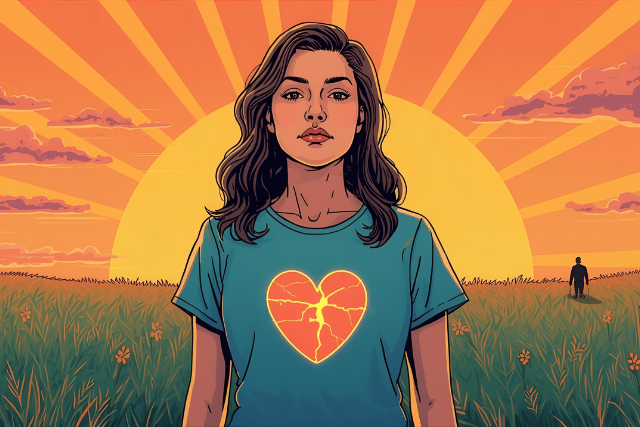
“When it hurts to move on, just remember the pain you felt hanging on.” ~Unknown
There was a time when I thought my heart would never heal.
I’d been lied to, betrayed, and broken by a man I thought I loved. A man who turned out to be nothing more than a beautifully packaged nightmare.
If you’ve ever been hurt by a narcissist, you know that the pain cuts deeper than most people can imagine. You know the way it seeps into your bones, the way it makes you question your worth and replay every moment, wondering if you could have stopped it.
I’ll never forget that night in Paris when I learned what love is not.
The Champs-Élysées was alive with golden lights strung high in the air. Shoppers moved slowly, bags swinging in their hands, laughter spilling out of nearby cafés. The smell of roasted chestnuts drifted through the crisp night. And in the middle of that beauty, my world shattered with one heavy punch to the stomach I did not deserve.
It happened on the balcony of a famous Paris hotel. I had overheard a phone call. His voice casual, almost bored. “I’ll be home in a few days.”
Home.
To. His. Wife.
My blood ran cold.
The words clung to my skin like ice. Betrayal swelled in my chest, my breath sharp and ragged. I demanded answers. My voice cracked, trembling between anger and disbelief.
The first slap was so fast I barely registered it. Then another. Then the kick. A sharp, merciless blow to my stomach that folded me in two and dropped me to the floor.
My lungs emptied. I gasped, but no air came.
I needed to scream. I wanted to claw, to fight, to make him hurt. But some part of me knew that to stay alive, I had to stay still. My body shook in silence, hot tears sliding down my cheeks, my ears ringing as his voice faded into a blur of meaningless words.
The carpet felt rough beneath my palms as I steadied myself. My ribs ached with each shallow breath.
When his rage finally burned out, I slipped away and stepped onto the balcony. The night air stung my face. Through the blur of tears, I saw the Eiffel Tower shimmering in the distance, each light flashing like a cruel reminder of where I was—the city I had dreamed of visiting. In love.
I gripped the railing, fighting the urge to collapse again. I wanted to disappear. I wanted to wash every trace of his hands from my skin. I wanted to go home, crawl into my bed, and erase Paris from my memory.
It took months to unravel what had happened that night. Months to understand why I had let a narcissist treat me like that. I wasn’t naive. I wasn’t unloved. I came from a loving family. I cared for people.
So why did I believe I deserved this?
Somewhere deep inside, I had confused love with proving my worth. I believed that if I could just give enough, forgive enough, understand enough, I could earn love that stayed.
That belief had been quietly living in me for years—from the little girl who learned to keep the peace by being “good” to the woman who equated over-giving with strength. I didn’t think I deserved cruelty, but I didn’t yet believe I was worthy of love that came without pain.
Looking back, all the signs were there. Endless red flags I chose not to see. The charm that drew me in, the constant need for attention, the way he twisted the truth until I doubted my own sanity. The anger when I questioned him, followed by the empty promises meant to keep me hooked.
The bruises faded in weeks. But the ache inside stayed.
For a long time, I hated Paris. I had been there with the wrong person. I had imagined us wandering hand in hand along the Seine, kissing on Pont Alexandre III as the city lit up around us. I had pictured mornings in Montmartre with coffee and croissants, sunlight spilling through tiny café windows.
Instead, I got a nightmare.
Deep down, I always knew real love was effortless. Not that it didn’t require work, but that it didn’t demand your dignity and your soul.
After months of healing, I wrote down exactly what I wanted in a partner, and I refused to settle for less.
Then, when I least expected it, he showed up. One email led to another, and soon we were talking across time zones, our words building a bridge neither of us had seen coming.
He wanted to meet right away. I stalled. Part of me still needed the safety of distance.
When we finally met in New York City, the moment felt like something written long before we were born. I had landed early that morning, wandering the city in the winter chill. When I called from a payphone near Bryant Park to confirm, I turned, and there he was, smiling at me like I was the only person in the crowd.
In the past, I would have rushed in and molded myself to fit his rhythm. But this time, I moved slowly. I asked questions I used to avoid, and I said what I needed without apology.
My healing had raised my standards, not for others but for how I treated myself in love. I was no longer searching for someone to fill a void, and because of that I could actually see him—not through the lens of fantasy or idealization but through truth.
His steadiness and confidence didn’t scare me. They grounded me. He met me where I was. I could simply receive his presence without fear it would disappear. And that was brand new to me—being loved without having to abandon myself to keep it.
Years later, we’re still together. We’ve faced storms, held the line when things got hard, and fiercely protected the magic we built. And we visited Paris together. This time, it was the city I had always wanted—champagne kisses, walks by the river, and a skyline wrapped in light.
For the first time, there’s safety. There’s no fear in being honest, no punishment for being human. We listen, we repair, and we hold each other accountable without shame. When one of us feels hurt, we talk instead of withdrawing. When one of us makes a mistake, we forgive and learn instead of blaming.
Love doesn’t take from us. It expands us. It’s steady, mutual, and kind. I can ask for what I need without guilt. I can express my fears without shrinking. We celebrate each other’s successes and hold each other through failure.
For me, this love feels like finally being able to breathe, like exhaling after years of holding my breath, and knowing I can rest in someone else’s presence without losing myself.
If you’ve been hurt by a narcissist, I see you. I know the nights you lie awake replaying everything. I know how heavy your chest feels, how loud the silence is.
You may need to close the chapter that destroyed you, then open a new one and write the story you’ve been longing to live.
Forgive yourself. Forgive them. Not for their sake, but because you deserve the peace it will give you.
One day, you’ll wake up and realize the darkness is gone. The fear, the self-doubt, the endless ache are no longer yours to carry. And in that moment, you’ll know the truth: you will never again return to what broke you.
It took months for my nervous system to finally feel safe around men again. For a long time, my body reacted before my mind could catch up, flinching at raised voices, shrinking from affection, bracing for betrayal even when love was right in front of me.
This is how I slowly found my way out of the grip of narcissistic abuse:
Belief work.
I had to meet the invisible story I’d been carrying for years—that love had to be earned. Rewriting it didn’t happen overnight, but each small reminder felt like a crack in the opening around my heart. I began telling myself, again and again, I am deeply worthy of love. I am enough, exactly as I am. When my mind drifted back to old patterns, I didn’t fight it. I simply offered a new story, one where I was already enough and worthy of calm, steady love.
Listening to my body.
I began to notice how my chest tightened or my stomach knotted when something felt off. Instead of ignoring those signals, I treated them as truth. My body knew what my mind wanted to deny.
Somatic healing.
Breathwork, sound therapy, gentle movement, and trauma-informed bodywork helped me release stored fear and regulate my nervous system.
I remember one session lying on my mat, my breath shallow, my chest heavy. As the sound bowls vibrated through the room, a trembling began to move through me. First it was rage, then a deep grief for all the ways I had abandoned myself, and finally a relief, like my body was releasing what it had carried for years.
Something softened inside me. Something I couldn’t name. But what that moment taught me is that healing isn’t about forgetting. It’s about allowing what was once trapped to move through you, until it no longer owns you.
Boundaries.
I practiced saying no. At first, it felt unnatural, even selfish. But every no became a small act of reclaiming myself.
I started small. I stopped saying yes to coffee dates I didn’t have the energy for or to men who mistook my kindness for an open door. Then it extended into every corner of my life.
I stopped overworking to prove my worth, stopped letting colleagues pile their tasks onto mine just because I was capable. I stopped replying to work messages late at night, stopped entertaining conversations that left me feeling small, but most of all, I stopped ignoring the quiet voice inside that whispered when something didn’t feel right. Each no created a little more space for truth, for me.
Choosing safe people.
I surrounded myself with friends and mentors who treated me with kindness, who showed me what respect actually looks like. Their presence slowly re-taught my body that love doesn’t always come with pain.
Clarity in love.
I wrote down exactly what I wanted in a partner, not just the surface traits, but how I wanted to feel with them: safe, cherished, seen. That clarity was my compass.
When we began talking, I noticed I didn’t feel anxious waiting for his reply. I didn’t need to edit myself to earn his affection. There was no chaos, only ease. That peace told me I was finally aligned with what I had written. He embodied nearly every quality I had put on that list—emotional awareness, consistency, integrity, and most importantly, a tenderness that made my nervous system begin to trust again.
Healing from narcissistic abuse isn’t linear. It’s a thousand tiny steps back to yourself. Some days you’ll stumble. Some days you’ll doubt. But little by little, the pieces come back together, and you realize you were never broken.
When the right one arrives, you won’t question it. You won’t shrink yourself to fit. You won’t beg to be seen. You will simply know, in the steady, quiet place inside you that this is real, this is love.
Rejection was never your ending. It was the redirection toward the life you were always meant to live.