Tag: more

  • The Beautiful Losses of a Childhood Moved to the Philippines

    The Beautiful Losses of a Childhood Moved to the Philippines

    “The only way to make sense out of change is to plunge into it, move with it, and join the dance.” ~Alan Watts

    I must admit, dear reader, that I wasn’t always a fan of change—not even a little. I wouldn’t say I entered this world naturally inclined toward new or unfamiliar things.

    Like many children, I found comfort in routine—the joy that comes from ordinary moments repeating themselves. Whether we realize it or not, repetition builds a mental framework that quietly defines our comfort zones.

    Maybe that’s where identity begins, slowly shaped over time. And perhaps that’s why, while others struggle to recall their earliest years, I remember mine so clearly—because the foundation of my childhood was disrupted early on by a dramatic shift.

    You see, my early years were divided between two drastically different parts of the world. One chapter unfolded in the familiar calm of the United States; the next, in the chaotic hum of a developing country.

    It’s not the most typical of childhood stories, but I was pulled from my life in San Francisco and thrown into the Philippines as a six-year-old girl. My story begins just before that life-changing move—in the heart of a city I called home.

    Simple Days

    My first memories of San Francisco are filled with pigeons on sidewalks, ice cream at Pier 39, sunshine in Yerba Buena Park, and seafood dinners with buckets of crab, shrimp, and fish. My parents ran a small corner store beneath our apartment while holding full-time jobs.

    That shop was the source of many joyful moments—snacking on candy, hotdogs, and whatever treats we could get. I can still remember the layout of our three-bedroom apartment, the party room where my grandfather handed out chips, and the rooftop playground where we rollerbladed and played tag.

    As a child, I was energetic and loud, especially in school. I often got in trouble—not for anything serious, but for being talkative, fidgety, or overly enthusiastic.

    That trait hasn’t gone away. I still get excited easily—so much so that people sometimes question whether my enthusiasm is real.

    But I never wanted to tone it down. Maybe I watched too many Robin Williams movies. Then again, it was the nineties.

    Those were the simple, happy days I’ve always cherished—before everything changed.

    Into Chaos

    Picture a six-year-old who had just started first grade, still talking about Disneyland, now sitting on a plane heading to the other side of the world. The irony wasn’t lost on me—traveling to my family’s country of origin and yet feeling like a stranger to it.

    All I had was the unknown ahead of me—and a handful of roasted peanuts to calm my nerves.

    But it didn’t take long for the new reality to hit. I was thrown into a completely different world—fast, loud, and all at once.

    Gone were the paved sidewalks. In their place: dusty roads with no curbs. The rivers I once knew were now polluted waterways, lined with trash and a lingering smell that hung in the air.

    Dust rose with every passing vehicle. The traffic moved like chaos—cars weaving, horns blaring, people changing “lanes” at will. Looking back, it felt like a game of MarioKart—motorcycles, jeepneys, trucks all racing without rules.

    And seatbelts? Nonexistent. People clung to the backs of buses, fingers gripping metal bars for balance. Honestly, even Mario Kart had more order.

    The hardest part, though, was adjusting to the humble conditions of our new home. There was no hot water, so my mother would boil it in a kettle and pour it into a basin every day.

    Power outages were common, and when it rained, the streets often flooded—sometimes with rodents or worse floating past as we walked home. Cockroaches flew through the air, and lizards skittered across the walls during breakfast.

    Sure enough, words like “disturbed,” “terrified,” or “confused” don’t quite capture how I felt.

    Homesick

    It’s only natural to feel overwhelmed in that kind of environment at such a young age. I remember the shock vividly and how much I missed the world I had left behind.

    If I’d been younger, maybe I wouldn’t have noticed. But I was already aware of the world and my place in it.

    I’d learned to observe, mimic, and ask questions. I was sensitive and curious—and all of that made the transition harder.

    I missed San Francisco—my school, my classmates, the little things that made life feel normal.

    And though I’m not proud of it, I saw myself as different from the people around me. That discomfort became my first lesson in how flawed ideas of “otherness” truly are—a lesson that would grow with me over time.

    But there was still so much more to learn.

    Slow Opening

    When you resist a situation, it becomes easy to judge everything around you. That judgment breeds negativity, and before long, it colors your entire experience. At some point, the only way forward is acceptance.

    Somehow, I found the strength to stop resisting and take things one step at a time. Because wherever you are in the world, the need for human connection never changes.

    So I went along with it. I showed up to school, even when I couldn’t understand my classmates’ language.

    I tried. Every day, I tried—slowly picking up words, watching how people spoke, doing my best to be open.

    Eventually, the language began to make sense. I started to come out of my shell.

    With my siblings, I explored the street food that showed up each week in our neighborhood—ice creams in local flavors served with magic chocolate, hot cheesy corn, sour mangoes with fermented fish paste, salty pork and beef barbecue skewers, fried fish balls with oyster sauce, and caramelized bananas. Strange at first, but so delicious.

    One unforgettable moment I can still recall was when our entire building lost power for several hours. These “brownouts,” as the locals called them, happened often and without warning.

    It was always inconvenient, but on that particular night, large groups of kids and parents came out of their homes during the outage. Despite the darkness, candles and battery-powered lights lined up the edges of the open spaces, imbuing the entire building with a warm glow.

    I can still remember enjoying the cozy atmosphere they made along with the background sounds of small talk and guitar music while meeting other neighbor kids for the first time. Little did I know that a few of them would become some of my closest friends and playmates for several years to come.

    That night changed something in me, and not just from the possibility of new friendships, but because it was the first time in my life that I saw how a begrudging inconvenience could be transformed into a beautiful moment of connection.

    Small World

    After that, my energy returned, though with more caution. After all, it was still life in a third-world country I was dealing with, and it was not very difficult to get hurt at random, like someone running your foot over with their car by accident.

    Still, before long, I was speaking fluently, playing after school, and venturing out to buy snacks in the neighborhood. It was common for families to hang signs of what they were selling outside their homes.

    With just a few coins, I could buy candy, pastries, or a soft drink tied in a plastic bag. It wasn’t the usual way to drink, but on hot days, it felt like a treat.

    There were plenty of local sights that stayed with me—boys climbing coconut trees, old men puzzled by Halloween. But there were also shared experiences: Gameboys, Nokia phones, WWE wrestling, karaoke, and pop music from Britney to Eminem. At this point, it was the 2000s.

    In many ways, I started to see how big and small the world can be all at once—how culture spreads and how much we share, no matter the distance.

    Lasting Lessons

    We spent four years in the Philippines. By the end, I felt at home in a lifestyle that once felt impossible.

    But eventually, we returned. And when I sat in a California fifth-grade classroom again, it felt surreal.

    There were well-dressed teachers, Costco cupcakes, and cubbies painted in bright colors. Everything looked polished—and yet, I felt like I had lived a secret life.

    It’s hard to describe. Maybe it’s something you can only understand if you’ve lived it. It felt like carrying two childhoods inside one life.

    My personality shifted. I became more grounded, more grateful—for electricity, hot water, and the simplest comforts.

    I learned to value what truly matters: connection, community, and confidence—not built on material things but earned through effort and heart. That’s the lesson that’s stayed with me, and I carried it into my teenage years, into teaching English in the Czech Republic, and into my current life here in Finland.

    I’ll be forever grateful for my childhood years in the Philippines. It taught me that abundance and scarcity can live side by side—and that sometimes, in embracing the art of less, you discover so much more.
  • When You’re Ready for More: How to Access Your Inner Wanderer

    When You’re Ready for More: How to Access Your Inner Wanderer

    “Not all who wander are lost.” ~J.R.R. Tolkien

    Sometimes as humans we lose sight of our profound inner resourcefulness—the wellspring of creativity and strength that has kept humanity reinventing itself over and over again.

    It happens to everyone. We get lost in comfortable routines, become discouraged from trying new things, and forget how to play.

    When life feels disappointingly status quo, it’s easy to keep floating downcurrent as you tell yourself, “Welp, I guess this is as good as it gets.”

    I don’t know about you, but I’ve definitely caught myself in a trap of wondering if the best is behind me.

    Thankfully, one of our instinctual superpowers is knowing how and when to start over or ask for more.

    Found deep in your psyche, you have an archetype known as the Wanderer who carries a wisdom on how to help you let go of misaligned, limiting, or outright unhealthy situations in pursuit of something better—whether it’s a job, relationship, or lifestyle.

    Archetypes are universal personality types and instinctual behavior patterns that we inherit from our ancestors that cut across all cultures. They’re inherent structures found deep in our psyches that offer us gifts and strengths that make us whole and well-rounded.

    Archetypes are especially useful as inner allies that help us grow through different phases or challenges in our lives. Becoming a parent, solving a unique problem in your industry, or rediscovering yourself in mid-life are all occasions where a certain archetype may emerge.

    The Wanderer is about leaving behind the familiar and entering the unknown. We see the Wanderer making an entrance when someone undergoes big transitions, such as getting a divorce, changing careers, or initiating a spiritual journey.

    The Wanderer is one of my favorite archetypes because it’s helped me stay in touch with my heart, mind, and body during tumultuous periods of my life. In particular, there’s one leap of faith that I couldn’t have taken without the aid of this powerful archetype.

    A few years ago, I was working a nine-to-five job in international education for university students, where I would send students across the world for a semester or summer. It was a deeply fulfilling and enormously fun job, but eight years into the field, I started struggling with the lack of flexibility of a forty-hour office job, and my body rebelled against the sedentary nature of desk work.

    I ended up on partial disability due to computer-driven repetitive stress injuries in both arms. For eight months I suffered from severe inflammation. It gradually got better, but my doctor told me I would likely never fully return to normal.

    No longer physically able to work at a desk full-time, I had to reimagine my future.

    As a highly sensitive person with a history of chronic pain, I was determined to find a new line of work that wouldn’t require me to sacrifice myself. With a plan in mind of building my own business, I decided to leave my desk job permanently.

    I didn’t need anyone’s permission.

    I wasn’t waiting for a sign.

    I just made up my mind with the hard-headed tenacity that’s typical of the Wanderer—it was time to go.

    I had a vision for how I wanted to shape my future. It felt like an uncontrollable itch I needed to scratch. Even though I loved the security of a salaried job with benefits, I couldn’t ignore the flashing warning lights coming from my body. Admittedly, my gut had also been nudging me to go work for myself long before I ended up on disability.

    I considered the next couple of steps to leave my career, but I didn’t have a detailed long-term plan. I felt a sense of inner trust and authority that I would land on my feet. I was ready and willing to make a humble living in the service industry as I built my business in my spare time. So, with a lot of courage and plenty of unknowns, I started over.

    I thank my inner Wanderer for making it possible.

    I can point to several other occasions in my life where I made a sudden change following a period of feeling lost or unmotivated. One of the hallmarks of the Wanderer is that it often becomes “activated” after you’ve endured a period of misalignment in your life that becomes intolerable.

    It often feels like a courageous awakening when you realize what you must do for yourself. Everyone needs a fire under their ass from time to time, and the Wanderer is precisely good for it.

    The hallmark quality of the Wanderer is that it takes responsibility for creating change.

    It doesn’t blame other people or circumstances for their predicament.

    It doesn’t mope or complain.

    It doesn’t flounder needlessly.

    The Wanderer is about taking risks.

    Whether you’re considering leaving an unhealthy relationship, a toxic job, or a lifestyle you’ve outgrown, you have to take risks. It might be an emotional risk, a financial risk, or a risk of vulnerability.

    I like to think that the Wanderer is here to remind me of who I’m becoming. When I start to think to myself, “I made it!” I’m always amazed to discover that I still have far to go. But I know I can count on my ingenious Wanderer to support me in taking the next necessary risk.

    If you’re teetering on the fence in a certain aspect of life, here are some tips on how to partner with your Wanderer to rediscover what’s possible.

    Tips for Partnering with Your Wanderer

    Start small and move slowly.

    I am not a proponent of rapid, overnight growth and change. Most people crash and burn when they rush into new experiences.

    The truth is that you can only move as fast as your body will allow you—physically, emotionally, and spiritually. There are no shortcuts. Start where you are. Use the skills and resources you have. Grow your capacity to do big, extraordinary things little by little.

    The easiest way to do this is by identifying the next smallest step one at a time. You don’t need to worry about what step ten is or how you’ll manage step twenty when you haven’t even taken the first step. Just focus on what you can do right now.

    Choose your mindset wisely.

    The Wanderer’s perspective is that there are no failures in life, only feedback and learning. Embodying this mindset will save you countless hours wasted on self-sabotage, pointless self-blame, and stewing in a victim cycle.

    The key is staying curious. When you try something new that feels risky and it doesn’t go the way you want, get curious. Self-loathing is cheap and easy, but practicing curiosity and self-kindness is the admirable, high road.

    If you feel yourself spiraling into thoughts and emotions that are abusive or critical, you won’t find a shred of useful wisdom that will help you pivot and move forward. Negative thoughts are neural pathways that become stronger the more you reinforce them. But you don’t have to forcibly plaster shiny, positive thoughts on top of them.

    Instead, focus on regulating your nervous system.

    A triggered nervous system sees the world through a lens of danger, disappointment, and hopelessness. If you arm yourself with a few tools to self-regulate, you’ll find it easier to return to the curiosity and kindness of the Wanderer mindset.

    The best self-regulating tools are simple and quick. Here is a favorite go-to of mine. Start by gently tapping around your collarbone with your fingertips. Then, bring in breath. Take in an inhale for a count of four and exhale out twice as long. Repeat at least twice more, or continue for as long as it feels good.

    When you’re done, take a break from what has triggered you and do something that feels kind and nurturing. Revisit the situation at hand when you’re feeling resourced and have access to a completely different perspective. The best insight and creativity come when you’re grounded and regulated.

    Nothing can guarantee you a soft landing into the next chapter of your life—which is to say, the road can get pretty bumpy and uncomfortable.

    In fact, you can pretty much count on it.

    But the mishaps and curveballs will make you sharper and lighter on your toes. You don’t need to nail every risk you take. Let yourself fall apart so you can put the pieces back together better next time.

    The Wanderer is ultimately about self-discovery. What do you find out about yourself when you re-enter the dating world after twenty years of marriage or when you pitch your creative writing to ten different publishers?

    You can’t possibly know what you want in life or what you’re capable of if you keep floating downstream passively.

    Life is an adventure, so keep asking yourself: What would the Wanderer do?

  • A Different Kind of More: The Beauty of Living with Less Stuff

    A Different Kind of More: The Beauty of Living with Less Stuff

    She was all that mattered. I was deeper in debt, legal fees, and uncertainty than ever before, but I held on tight to my vow to give her more.

    I would give her everything. I’d work harder, make more, buy her more, take her to see more, do more, and prove to her that everything would be okay. I had no idea that this new goal would be just as damaging, and just as hard on my heart.

    My desire to give my daughter more wasn’t wrong, just misguided. While I could never have articulated it then, I did want more for both of us, but not more stuff and money.

    What I wanted was more love, connection, laughter, and adventure, but that was too hard to measure. Instead, I made more money, worked more, spent more, and accumulated more. Living with less opened the door to a different kind of more: more space, more time, more light, more freedom, and yes . . . more love. It has always been about love.

    My mom showered me with love on our trips to Boston, and I went into debt loving my three-year-old with Christmas presents she could never appreciate. All of the more . . . it wasn’t just for Bailey. It was for me too because I didn’t just think more + more = more, I thought more + more = love.

    By letting go, I was able to see that love could stand alone. It didn’t have to come attached to presents, shopping trips, or big work bonuses or acknowledgments. I didn’t have to earn or prove love. When I got rid of the stuff, the debt, the busyness, and the distractions that were swallowing me, I was surrounded by love. It was everywhere.

    I had enough.
    I am enough.
    I don’t need more approval.
    I don’t need more money and stuff.
    I don’t need more anymore.

    When I discovered that I was enough without anything else, I saw that I was love. I am love. You are too. We’ve been the love we seek all along. It’s just been hiding beneath all of the layers of clutter, busyness, and show we use to protect ourselves from the pain.

    Diamonds Are Not This Girl’s Best Friend

    Diamonds are not my best friend but they used to be. It wasn’t just jewelry but all the things I bought to lift me up, prove my worth, and demonstrate my love. As I became more and more me and started experiencing the world from this new stuff-less place, I realized that diamonds are not this girl’s best friend.

    My best friend is a magical rooftop sunrise. My best friend is the ocean. My best friend is a hike in the mountains. My best friend is a peaceful afternoon. My best friend is a really good book. My best friend is laughter. My best friend is seeing the world. My best friend is time with people I love. Diamonds have nothing on my best friends.

    So yes, I want more, but not more stuff. I want more early mornings, more hiking and connecting with nature, more meaningful conversations and hand holding. More seeing the world. More creativity. More crazy ideas. More love. Always more love.

    With a soulful simplicity and living with less, my life has become more than I ever imagined. Instead of more money, more stuff, more busyness, and more stepping outside of myself to be who other people may need me to be, I’m enjoying a different kind of more.

    I am more myself and more connected to my heart. I am more available for people I love and projects I care about. I’m more present and focused. I have more space, time, and love in my life along with all of the other mores I craved for so long.

    I am always learning something new about how simplicity works on my heart, changes my relationships, and influences my work. At first my journey was focused on tasks like decluttering, paying off debt, and downsizing. The changes started on the outside while the real work was happening on the inside.

    With each thing, obligation, or assumption I let go of, I remembered who I was. I saw how far I had strayed and made it a priority to come back to myself. Forgetting who you are and living outside of your heart is painful. Do whatever it takes to come back and be more you. Give yourself all the space, time, and love you need to remember who you are.

    Excerpted from Soulful Simplicity: How Living with Less Can Lead to So Much More by Courtney Carver with the permission of TarcherPerigee, an imprint of Penguin Random House LLC. Copyright© 2017 by Courtney Carver

  • A Small Good Thing: A Documentary on Simple Sources of Happiness

    A Small Good Thing: A Documentary on Simple Sources of Happiness

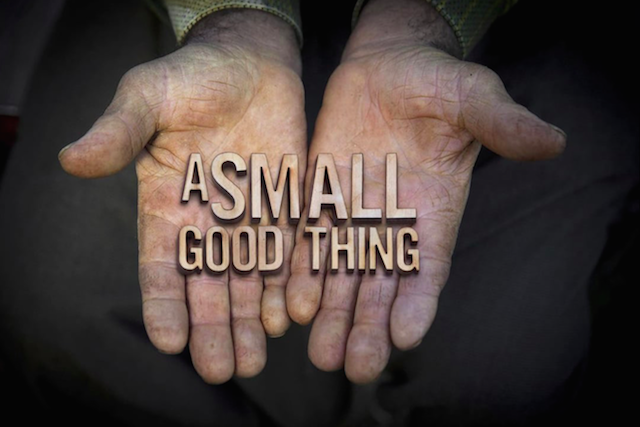
    A small good thing

    We live in a world that encourages the pursuit of happiness, which it seems we’ve collectively defined as “more.” We chase more money, more recognition, more stuff, more connections (and often, more followers and “likes”). If it’s quantifiable, and sometimes even when it isn’t, there’s no such thing as enough.

    Given that you’re here, visiting a website that promotes simplicity and appreciation for the little things, it’s possible you haven’t fallen into this trap. Or perhaps, like me, you have, and that’s why you now recognize that less is often more.

    Given my own experience chasing things that inevitably led to emptiness and disappointment, I was intrigued to learn about Pamela Tanner Boll’s new documentary A Small Good Thing.

    A Small Good Thing follows six people who’ve “recast their lives so they can find a sense of meaning.” If you’re disillusioned by the American Dream and fascinated by people who’ve found their own unique path to happiness, I highly recommend you check it out.

    I’ve never shared a documentary here before, but as you may remember, I’ve spent the better part of this year working on my first short film (which I’m excited to share here soon!) And I’m also planning to work on my first documentary, on a similar topic, next year.

    Given the synchronicity, I was thrilled to speak to Pamela about the motivation behind A Small Good Thing and what she learned in the process of making it.

    The Interview

    How did you choose the cast for A Small Good Thing? What’s the common thread?

    We were looking for individuals who were living in this new century in a better way. We wanted to find people who had made positive changes in their lives through mindful practices, through a closer connection to the natural world, and through a stronger connection to the greater good.

    Stephen Cope from Kripalu’s Institute for Extraordinary Living in Lenox, Massachusetts introduced us to Tim Durrin, who was working at Kripalu at the time, and through mindful practices (yoga, meditation, cycling) had been able to deal with his struggles with Post Traumatic Stress Disorder (PTSD) and addiction.

    I met Yoga and Breathing Instructor Mark Gerow at Canyon Ranch in Lenox and was very impressed with his story of how he used his yoga practice to overcome the personal struggles in his life and to learn how to share his story with others.

    We were introduced to Jen and Pete Salinetti from Woven Roots Farm and were fascinated with the fact that they were able to harvest twelve months out of the year in Western Massachusetts, as well as with the amount of food they were producing on a one and a half acre farm.

    Also, we learned about Sean Stanton who worked on both his family farm, North Plain Farm, as well as managed Blue Hill Farm for the Barber family. He was also giving back to his community as the Chair of the Selectman Board for the Town of Great Barrington.

    Finally, I heard about a woman in Pittsfield MA who was doing amazing community work with young adults who performed all over the state with the Youth Alive Step Team. I met Shirley Edgerton for coffee and found out that she was really guiding young people to a life of purpose.

    Why did you choose the Berkshires for the location of this film?

    The Berkshires has long been a place that attracted artists, visionaries, and change-seekers who value their creative expression and want to live closer to nature. It’s also one of those communities in the world that supports and encourages people who want to live in a different way. There seems to be less importance put on “keeping up with the Joneses” and more importance on “checking in with the Joneses.”

    While we focus on the Berkshires in the film, people who are practicing mindfulness, connecting to the natural world, and engaging in their communities can be found all around the world. Yoga studios, farmers markets, and community gardens and centers can be found all over New York and other urban settings.

    We also filmed in the Berkshires because it was closer to home for us. Our production company is located in Winchester, Massachusetts, right outside of Boston.

    How long did it take to make this film? And how did making this film influence the happiness in your life?

    We begin in 2011 researching the film for over a year focusing on the recent happiness studies and the science behind yoga and meditation. We also did a lot of research on how living in closer connection to the natural world also positively impacted our well-being.

    We began shooting in the Berkshires in 2012, and continued for over a year. The first edit, which took another year, was flat and disjointed. In December 2013, I made a decision to close down the production. I did not feel that the edit expressed my original vision.

    After four months, I found a new energy to complete the film in a new location with a new editor, T.C. Johnstone.

    In the making of this film, we all learned that living an authentic life is not easy. It’s hard to be vulnerable and to make mistakes. But this is the path to living a life that is meaningful and full of purpose. Like Shirley says in the film, “…the true success in life is you finding your purpose and your passion and you living it out.”

    How does watching these small stories about individuals transforming their lives help us to transform the world?

    Our culture is more invested in comfort than in truth. Our planet is suffering from our consumer-driven way of life. Although we have more connections through the Internet and social networking, we as a society have become more isolated and lonely. We have more material wealth, but we are not happy.

    These stories show individuals who are making small changes in their lives that have a big impact in the world. Jen and Pete Salinetti use only environmentally sustainable practices at Woven Roots Farm. Also, Sean Stanton feeds his livestock a natural diet; his cows are grass fed and his pigs and chickens are raised on pasture and eat all certified organic grain.

    Farms that use these types of regenerative agricultural practices can turn back the carbon clock, reducing atmospheric CO2 while also boosting soil productivity and increasing resilience to floods and drought. Also, the agronomists tell us now that you can produce more calories per acre on a small farm than a big one.

    Studies show that mindful practices such as yoga and meditation relieve our stress: blood pressure goes down, heart rates drop, negative emotions decrease, and positive ones increase. Tim Durrin and Mark Gerow have overcome the struggles in their lives by applying these mindful practices every day. And in doing so, have learned that by exposing their struggles to their community, they feel less isolated and more blessed.

    And finally, Shirley Edgerton is guiding her young adults to live a life of purpose. She is teaching them at a young age, “that if you leave yourself open that you move with the universe [and] that’s where you blessings coming in.” This is how we can live in a more engaged way, a way that helps us to develop empathy and compassion.

    Why did you make this film? What resources influenced your research?

    A few years back, everyone I talked to had the same complaints: People were running so hard to keep up with the pressures of life that they felt overwhelmed, isolated, exhausted, and unhappy. Even though our country had more material wealth, people were depressed.

    Given the additional worries about the growing income disparities, climate change, and the vanishing natural world, the question of what makes a good life became important to me. So, I did what I usually do—I read lots of books. These are just some of the books that informed the film:

    Earth and Deep Economy by Bill McKibben

    Born to Be Good: The Science of a Meaningful Life by Dacher Keltner

    The Empathic Civilization and The Third Industrial Revolution by Jeremy Rifkin

    The Wisdom of Yoga and Yoga and the Quest for the True Self by Stephen Cope

    Self-Compassion by Kristin Neff

    The How of Happiness by Sonja Lyubomirsky

    Being Happy by Tal Ben-Shahar

    Loving Kindness: The Revolutionary Art of Happiness by Sharon Salzburg

    Flow and Finding Flow by Mihaly Csikszentmihalyi

    The Art of Happiness by His Holiness the Dalai Lama

    The Wisdom of Tuscany by Ferenc Mate

    You can learn more about A Small Good Thing here.

  • Wanting More Time: Have You Lived Enough?

    Wanting More Time: Have You Lived Enough?

    Woman with hourglass

    “When you arise in the morning, think of what a precious privilege it is to be alive—to breathe, to think, to enjoy, to love.” ~Marcus Aurelius

    I remember attending a lecture by the Tibetan monk Sogyam Rimpoche, author of The Tibetan Book of Living and Dying, in which, smiling all the while, he confessed, “So many people, they say, ‘I’m not afraid of death.’I tell you, they’re lying! Death? Very scary. Me? I’m very scared of death.”

    And I thought to myself, “Phew, if he’s scared, then it’s certainly okay that I’m scared too.”

    For many years after that, I carried a question around with me. “Have I lived enough yet?Without hesitation my answer was always, “No way! Not by a long shot!”

    And then I’d follow this up with all the reasons why I wasn’t yet satisfied—I hadn’t left a mark on the world, wasn’t married yet, didn’t have children, didn’t know who was going to win this season of whatever reality TV show I was following.

    Even after I had built a decent career for myself, published a book that I know helps others, got married, had two adorable sons, and found out who won that season (and many others) of various TV shows and sports, the question and its familiar response still remained. Had I lived enough yet? No!

    It suddenly dawned on me that, if I continued to think this way, I would never experience fulfillment. I’d never arrive at that mythical destination I’d set out for myself where I’d finally cease yearning for more. Especially now that I had kids, this became abundantly clear.

    I’d always want to see what came next in their lives, to witness each step upon their journey into and throughout adulthood.

    Then if they had kids, I’d want to share as much of their lives as possible too. Feeling so much love in my heart, I knew I’d never reach a place where I’d had enough. I’d always want more.

    Realizing that I was chasing what could never be caught, I stopped to pose myself a new question.

    I asked, “What do I want my last thought in this world to be?” And my answer came back as something like, “I’d want to be thinking, Ahhhhh, that was good… that was nice… that was enough…”

    This new question might not have helped me much, if I didn’t remember something else, namely, that how we live this moment is the best predictor of how we will live in the future.

    So, it then occurred to me that, if I wanted to be thinking I have lived enough in the future, then the best way to get there would be to live with that exact same thought right now.

    Immediately, I started asserting this new notion that, already, I had actually lived enough. After all, there are many humans that are not blessed with the experience of even a second day of life on earth. How greedy was I willing to be? How selfish and ungrateful?

    The deeper this pronouncement that I had lived enough sunk into me, the greater the shroud of fear surrounding death lifted.

    Whether I initially had believed this or not, I slowly grew to the place where I knew, beyond any doubt, that I had lived enough. Yes! I had already lived enough! And, just like that, all my fears vanished and I finally felt free, overflowing with a sense of appreciation and contentment.

    Ever since, I’ve been discussing this concept of “enough” with others in the throes of grief and loss.

    What I explain is that “enough” is always a value judgment, rather than something that can be quantified or measured. It’s about perspective, a determination on our part to choose gratitude for what we’ve been granted over regret for what we have lost or fears about what we might lose.

    This can be tremendously powerful, though admittedly very hard at times. Is it possible to view the death of a young child and understand that he or she lived enough?

    Can a parent suffering through such a loss perceive their abbreviated time with their son or daughter as enough?

    When a friend or parent or anyone else we care about passes away, can we experience the time we had with them as enough?

    The answer is yes. It is possible, if and when we choose to exercise our right to invoke this perspective.

    We can view whatever time we’ve been given through the continually available lens of gratitude, appreciation, celebration, and love. We can understand each moment as a gift, as “enough.”

    To be a human is little short of a miracle. In the limitlessly vast universe of atoms and particles and stars and planets, gases and quarks and molecules, stones and trees and bugs and platypuses, of all the possible manifestations of life that are possible, we have been given the rarest of privileges of experiencing what it is like to be human. That’s cool!

    Just by being here, we’ve already beaten the odds, no matter how many more minutes of this miracle we get to experience.

    We know when we lived enough by knowing this right now, during this and all future moments, even while we crave to drink in as much as life continues to offer us. We appreciate that no more is needed.

    We’re thankful and, from the wisdom of this thankfulness, we smile, at ourselves and all around us. We’ve already lived enough—and that’s a beautiful thing.

    Woman with hourglass image via Shutterstock

  • Getting More Out of Life When You Have Less Money

    Getting More Out of Life When You Have Less Money

    Couple Walking

    “The real measure of your wealth is how much you’d be worth if you lost all your money.” ~Unknown

    When we find ourselves not having “enough,” times may be rough; however, this is only our first glance, our perceived perception.

    Not all who have little are poor. None who live simply fit into the status quo. And none of us deserves to be judged for what we do or do not own.

    Poverty lines are a general measure of separating the classes, but they fail to feel emotions, see our genuine qualities, or tell the stories of our lives.

    They quantify our income, encourage us to strive for more, but more of what? More money to engage in better opportunities? More cash to buy more stuff?

    Numbers have a tendency to lose their meaning when they don’t add up—a well-paying job with no time for family is no better or worse than barely scraping by without savings, yet having no debt.

    There are many lessons to be learned from being poor. If you have ever been on your last coin, or more than once, chances are good that you may have experienced an enlightened state of being.

    Voluntarily choosing to live with less is quite different than being born into poverty, yet the paths overlap and intersect on so many levels.

    Searching for the silver lining of a free fall into a greatly reduced income, of which my husband and I caught the winds of almost a decade ago, we discovered the concepts of minimalism and simplicity.

    At first I was terrified at the aspect of living off of so little money, coming from a consumer culture that defines worth in terms of income. However, rationality quickly stepped in after that initial panic, and feelings of being lost without monetary stability were replaced by a desire to live well within our means.

    There was no denying the change of mindset that was rapidly taking place.

    We made a tiny handful of money (way below poverty measures) that allowed us to go to the grocery store a couple of times a month for food; the rest we had to acquire for ourselves in other ways—learning to forage, trading, growing…

    Every coin we made went toward nourishing our bodies, because good health is the most important aspect of survival.

    When we couldn’t afford electricity for eight months, we lit the kitchen with a few beeswax candles. When they burnt out we went to bed early, only to wake up with the sun.

    Employment was nowhere to be found in the countryside. We had no Internet connection and it seemed that life was on standby. Months and years went by, and it was hard. We didn’t buy anything we couldn’t afford, we didn’t want what we couldn’t attain, and all the while we didn’t complain.

    The last part confused a lot of people. We didn’t complain because we accepted the situation we were in, and rather than fight it, we decided to learn from it.

    It is possible to live well, well below the poverty line. Much of it depends on your state of mind, part of it comes from where you enter the phase of living with less; but wherever life takes you, lessons are waiting to be found:

    1. You may already have enough.

    In our past we had acquired all the things we needed for survival, and then some. Clothes “out of fashion,” but definitely not out of use. Pots, pans, dishes, music, games. Though we didn’t have the ability to buy things anew, we certainly did not go without. 

    When you have little, you may still have more than you realize at first glance. Set possessions aside and focus on life that surrounds you. Friends, family, your health—foster those intangible, yet all important connections.

    Most importantly, make peace with patience. Slowly moves the world without flowing cash or access to the Internet, and it still remains a beautiful place to be.

    2. Less time with electronic gadgets leaves you more room for people.

    Physical relationships are the ones that foster real laughter, genuine love, and lasting memories. Conversations flourish in the absence of technology.

    We can relearn to have meaningful discussions without a cell phone on the table; they only serve as a distraction at the dinner table and attest to our shortening attention spans.

    3. Solitude gives you time to delve into your emotions.

    It gives you time to think about life. Inner reflection is hard to focus on when we are busy day and night, so get un-busy and make more time for dreaming, questioning, and contemplating. Find quiet activities to let your mind expand to new horizons; you have the time.

    4. Nature provides us with much beauty, energy, and inspiration.

    No money for a concert? Great! Go listen to the night song of crickets in summertime, listen to frogs bellow, listen to birds or running water. Hike, walk, bike—get out of your four corners and find freedom in the “wild.” 

    5. Self-reliance will foster an unending sense of independence.

    Spend time reading books; volunteer your time to learn and teach new skills, meeting new people and creating opportunities for advancement as you go about daily life. See the connections, and feel what is important for your personal growth.

    Rather than feel guilty that we couldn’t afford to eat out, we chose to develop our cooking skills and embrace the art of slow food. We grew vegetables in the garden to preserve for winter, we baked our own pies and pastries, we relished in our growing confidence of all matters related to providing for oneself.

    In eight years one can acquire immense knowledge, and our wealth grows with our ever-increasing set of useful skills (from knitting to felting to cobbing to shoe making) that we can apply over many aspects of life.

    6. Happiness cannot be bought.

    It can be grown, cultivated, tended, nurtured, but you won’t find it on a store shelf or a screen. Happiness comes when you are at peace with who you are, right in this moment—with your job or lack of it, with your salary or lack of it, with your friends or lack of them, with your wants fulfilled or lack of that.

    Struggles can bring out the worst or the best in us! Living with less money than “ideal” is certainly a challenge and if we haven’t been there ourselves, we certainly know someone who has been financially in need. You can be rich and poor or poor and rich, depending on where you place your values.

    Wanting less speaks volumes about your personality. It has nothing to do with charts and graphs that society creates, but it has everything to do with you—the way you treat yourself and the much-deserved attention you give to others around you.

    The next time you take a pay cut, voluntarily or not, remember the advantages of more time, more meaningful experiences, and a whole lot less stuff to store along the way. You are not defined by your past; you and your thoughts are the future. Learn, let go, and move on.

    You can live with much less than you ever thought possible and find many uplifting winds to carry you on your way.

    Photo by Tony Alter

  • The Hunger for More: What We Really Want and Need

    The Hunger for More: What We Really Want and Need

    Screen shot 2013-04-24 at 10.19.02 AM

    “Instead of complaining that the rose bush is full of thorns, be happy the thorn bush has roses.” ~Proverb

    As a child, I was obsessed with other worlds—reading about alien planets, writing fantasy stories, or just playing video games. As a teenager, I longed to know as much as possible— who we were, why we are here, the meaning of life.

    Later on, I started traveling. There was so much to see, so much to do, so many ways to look at the world. I wanted to see it all, touch it all, experience it all.

    This need for more has existed throughout my life in its many forms, and I can thank it for always driving me to do great, exciting things. But at the same time, it has never allowed me to stay still, to just enjoy myself the way so many people seem to.

    When I ignore this feeling, it starts gnawing away at me from the inside. It tells me that I am not doing enough, that I’m lazy, a time-waster. Some would call the feeling a feeling of becoming stir-crazy, cabin fever, ennui.

    I look at it as a hunger. When I ignore that hunger, when I stop traveling or learning or creating or just doing, the weight of the world piles up on me and life suddenly feels like a suffocating, restricting place.

    If I continue to ignore it, I tend to slip into depression or sadness; the smallest of stresses will bring me to tears.

    But what is that hunger? Do we all have it, to some degree? Without the human desire for knowledge and development, we might all still be living in caves.

    Without it, we wouldn’t have medical and technological developments, and we wouldn’t have art or poetry, perhaps. But on the other hand, we might not have war, hatred, and greed.

    That hunger takes different forms depending on how it is channelled.

    Given the right circumstances, we get creativity, ambition, and invention. Given the wrong ones, we get that dark, burning need to amass more and more money and power—that greed that can be seen in so many people throughout our history.

    We often try feeding that hunger with money, power, knowledge, creative output, food, sex, or drugs. We desperately try everything to fill that void, apart from what we really need.

    Four years ago, when I was on the verge of depression, a friend suggested that I try mindfulness. In short, the art of being in the here and now, of focusing on the senses instead of the thoughts, and of looking at thoughts objectively.

    It took a while, but what my most successful moments of mindfulness showed me is that it is possible to be still, to absorb a moment fully, without that restlessness, that hunger, starting to tap its foot and demand to know what on earth I think I’m doing.

    Quieting the nagging voice in my head has become an art of its own, now.

    The most powerful moments are found walking through nature, just listening to the variety of bird song, or feeling the ancient strength of a tree against my back.

    In those moments, another, older feeling comes to me. That feeling is of being one; one with myself, one with nature, one with everything. The flowers, the trees and the birds are just a part of it.

    In the heart of a forest I realize something so true, so powerful, that it brings tears to my eyes.

    We are animals. We are part of the earth, just as any animal or plant is. Somewhere along the line, we evolved to crave more, to be aware of our surroundings, and to think about ways to improve it. That craving brought us the modern comforts that we know now, but it also brought with it a world of suffering.

    In our haste to become more, to know and to create, we also felt that it was our destiny to conquer not only each other, but also nature. But this very act of cutting ourselves off from our roots has had disastrous consequences for many.

    Most of us crave companionship, whether we seek it by clinging to romantic partners or through a string of disconnected, drunken nights. We are addicted to social networking, perhaps not because of the technology itself but because it substitutes for that feeling of oneness, of connection, that we have lost.

    We, in the developing world, are starving ourselves. This fast-paced, technology-based life, focused only on the acquiring of money and status is a twisted manifestation of a hunger that exists deep down in every one of us.

    But what that hunger really is, what that calling inside us really is, is a call back to oneness, to our roots, which we ignore.

    One way to describe it is that we all have souls, and that our souls are connected to the earth and everything on it. Or, you could say, every atom in your body was once part of something else on this earth, and will be again.

    Without nature, we cannot eat or breathe, and yet we lock ourselves up in man-made cubicles and unquestioningly buy food from packets.

    We also need to connect to each other. We might seem to connect online, but it is at the cost of face-to-face interaction, which is far better for us.

    It worries me to see children glued to phones and games, ignoring the people around them. If we aren’t even teaching people to connect to each other and to their world, then there’s little wonder that so many people are unhappy.

    Ironically, people slave away unhappily so that, one day, they can relax in the countryside or on the beach. That retirement dream might be nothing more than recognition that we need to surround ourselves with a more natural environment, not in some distant future but right now.

    I’m not saying that we should abandon all human progress and go back to living in caves. Some inventions have saved lives and made it possible for us to live much longer and healthier lives. However, we need to look at the mental health problem we’re facing and consider all other possibilities before throwing drugs at people.

    Nature therapy and mindfulness are growing industries, and have been shown to treat everything from substance abuse to depression and anxiety.

    You can see the effects yourself; just sit in a park and close your eyes, listening to the birds or the running water. Turn off your phone and let yourself just BE.

    Recognize that you were created by nature; that you are part of it and it is part of you. I have been so much happier since I honoured this core part of myself, and I want to share it with everyone.

    I believe the hunger is a calling—a calling back to where we came from. We are each one tiny part of a massive picture, and when we disconnect ourselves from it we are denying ourselves the beautiful, meaningful feeling that comes from recognizing that we are all part of the same amazing world.

    Photo by notsogoodphotography

  • 3 Ways to Redesign Your Life by Shedding the Excess

    3 Ways to Redesign Your Life by Shedding the Excess

    “Don’t let your happiness depend on something you may lose.” ~C.S. Lewis

    For as long as I can remember, “more” has always been better, but the word “more” is no longer what it used to be.

    Five years ago, I started exercising for the first time in my life. At first, I counted down the minutes until my workout was over. As I got stronger, though, I started staying at the gym longer and longer.

    For a while, I burned more calories than I consumed during meals. It didn’t matter. I worked out as much as I could because I liked the effects it had on my body and mind. I felt healthy and vibrantly energetic.

    But I hardly had time for much more in my life.

    I was burnt out. Some of my other favorite activities—like reading or making plans with friends—took a backseat to putting in hours at the gym. But working out in less time scared me, as silly as that sounds now. Would less time in the gym slow down my health and energy level? Would I lose momentum?

    When my loved ones started complaining, I knew I had to make a change.

    I found I could do more with less at the gym. I found that my body appreciated the extra rest more than I ever expected. I found that, by finding a balance, my life felt more at ease.

    Over time, I discovered that in many areas of my life, less is more. Carrying the excess of my life felt like pulling around a parachute, making every step more strained.

    Focusing on the necessary, on the positive, on the essential may grant you the freedom you desire. Here are three areas in your life you can redesign:

    1. Your Relationships

    Growing up, my friends and I counted and compared how many toys we had, how many books we read, how many good grades we achieved. Only now, decades later, have I dropped that habit of thinking “more” is better.

    When I quit my job and started my own business, I never thought that my biggest obstacle would be the people I chose to accompany me on that path. Once I hit that roadblock, it took great courage to cut the ties that were holding me back.

    The people we come across and spend time with become a part of our lives. That doesn’t mean they necessarily should. It’s up to you to choose.

    Jim Rohn once said, “You are the average of the five people you spend the most time with.” If that is true, could your relationships serve you better? If you could choose, what kind of people would you surround yourself with?

    2. Your Material Goods

    Someone once told me, “The fastest way to get a pay raise is to spend less money.”

    Quitting my job last year meant watching how I spent money. This was a blessing in disguise.

    Every single time I browsed the web for a beautiful new handbag, I stopped myself, thinking: “What am I trying to find in this handbag? What am I looking to feel by buying this?”

    Over time, this spread to the material goods I already have, not just the ones I hoped to purchase. I gave away some things that would be more useful to people in need. Living in a third-world country made that process easier, giving me a chance to give back to the communities around me.

    The items we hold around us pile up over time, but the purpose of that is not always clear. What are you looking for within those items: happiness, status, or is it something else?

    If you are interested in living a life with less stress, try asking yourself why you hold dear the possessions around you.

    3. Your Expectations

    For much of my life, I gave in to my emotions. With a blindfold over my eyes, I stumbled through life at the whim of my mood swings.

    Very often, I spent my days feeling angry, jealous, or doubtful. I was unaware of the reason behind these emotions. I let them run free, untethered inside my heart and mind.

    Until someone introduced me to a book called Man’s Search For Meaning by Viktor E. Frankl.

    In his book, he writes:

    “A man’s suffering is similar to the behavior of gas. If a certain quantity of gas is pumped into an empty chamber, it will fill the chamber completely and evenly, no matter how big the chamber. Thus, suffering completely fills the human soul and conscious mind.”

    Whether the situation is big or small, every single person decides just how much to suffer for it. When faced with the same situation, each of us decides just how to frame and feel that situation.

    The biggest reason I let my emotions run wild was because I was not aware of my expectations. I imagined life to be a certain way, and I was torn when reality didn’t match up.

    Wiping my mind clean of how life should play out, I allow myself to accept each moment as it comes, for better or for worse. The calm I feel at shedding expectations is extraordinary.

    When I set out to redesign my life— quitting my job, starting my own mini-business, spending more time writing—I never thought I would also start a quest to shed many parts of my life.

    None of this is easy, but it is worth it. I grapple with it everyday, but that grappling makes all the difference.

    Are you looking to redesign your life? Share your stories in the comments.

    Photo by The Green Party

  • Need Less, Have More: Life Expands When We Eliminate the Excess

    Need Less, Have More: Life Expands When We Eliminate the Excess

    “Knowledge is learning something new every day.  Wisdom is letting go of something every day” ~Zen Saying

    Simplicity, at its heart, comes down to eliminating the excess in our lives.

    Excess needs, wants, possessions. The list goes on.

    Society tries to sell us on the idea that having more in our lives should be the goal and is the answer. But is more really improving the quality of our lives?

    Do more possessions beyond a certain point really add value to our lives?

    Do more commitments in our diaries really help us feel less stressed and rushed?

    Does always wanting the latest gadget really improve the quality of what we have now?

    Is more even feasible for many of us who are struggling just to make ends meet and pay basic bills in these challenging economic times? Many can barely afford enough, let alone more.

    Living in the Moment

    Having more in our lives or buying into the concept that more is better can mean we miss living in the moment. We’re constantly waiting for our lives to be complete with more and striving for a day that will never come.

    We’re in a state of deferred living. Always assuming what we have now is not enough. Always wanting more.

    My Journey to Simpler and Less

    My own path to wanting to live a simpler life is, I’m sure, fairly typical.

    Around four to five years ago my life was going pretty well with little to complain about in the grand scheme of things. I had great friends and family, a good job, a roof over my head, and certainly knew where my next meals were coming from.

    However, I had also started to accumulate more in my life. More material possessions, more commitments, more meetings, more financial responsibilities, more hassle. Alongside this I felt like less and less of my time was, well my time.

    The quality of my time was decreasing as more was added to it.

    I was busy and in motion a lot of the time but wasn’t really getting what I truly wanted out of life. I had bought into the concept of more and that more would be the answer. I had lost track of my own goals a little.

    A period of reflection followed. In this period of reflecting, I started to identify more of what I truly wanted in life. I also started to uncover those things in life I would rather be without.

    I started to seek out books on the subjects of simpler living and lifestyle redesign. I had the good fortune to come across the work of some truly great authors and thinkers (Leo Babauta, Chris Guillebeau, and Tim Ferriss, amongst a few). These books challenged my thinking but also encouraged me further into the rabbit hole I was starting to disappear down.

    I also started to take action.

    I started to peel back and eliminate what didn’t matter.

    I started extracting myself from commitments and meetings I really had no interest in being at or didn’t feel I could add value to.

    I learned the value and power of a polite “no thanks” when requests on my time (meetings, social gatherings) didn’t excite me, add value, or help my goals along in some way. Importantly, I started to feel less guilt about saying no in these cases.

    I started to see that conventional wisdom doesn’t always have to be followed.

    I started to remove distractions and excuses I was making to myself.

    I started to focus more on the things and people that were important to me.

    I realized I value freedom and flexibility over the ability to just earn more and started to try to seek out ways of living accordingly.

    I started to accumulate fewer material possessions but enjoyed my money more (holidays, events, great dinners, etc.).

    In short, the quality of my life has improved since I have sought to simplify things and intentionally live with less.

    Was Making the Change Easy?

    In short, no. This is very much a journey and not an overnight fix. However, in my own case the process of working toward a focus on less has already made some powerful changes in my life. It has meant:

    I have set up my own one-man consulting company rather than chasing the corporate dream that never seemed to fulfil me with each climb up the ladder. This gives me an increased sense of flexibility, empowerment, and freedom in my work.

    Because I’ve spent less on stuff, I have been able to travel more for fun in the past two years than at any other time in my life (and the more amazing places I travel to the more I want to travel).

    I have realized that life can be rich and full of small pleasures without having to spend lots or buy more. For example, I love taking early morning, long walks before dawn breaks and then coming back to a make some freshly brewed coffee.

    I feel like I have more time to do what I want to do and to spend with the people I want to spend time with. (In reality, I have the same amount of time available to me but have been more selective in how I fill my time and what I say yes to.)

    For you, the list will of course look very different depending on your own circumstances and goals. However, a commitment to banishing the “more is better” mindset will, I’m sure, improve the quality of your own life in equally significant ways.

    Eliminate the Excess

    Eliminating the excess means living a life that can be slightly unconventional by modern standards.

    Perhaps we don’t change to the latest smartphone every other week.

    Perhaps we don’t fill our homes with clutter.

    Perhaps we don’t check our email obsessively.

    Perhaps we focus on and are grateful for what we do have rather than on what we don’t.

    Perhaps we think more carefully about clothes we purchase going for quality over quantity (or indeed have a very simple wardrobe of a few clothes we enjoy).

    Perhaps we intentionally create space in our diaries and life so you can breathe a little and enjoy the moment.

    Making changes is not necessarily easy initially. We are so programmed to think a certain way that making changes can involve a significant shift in thinking. However, what we get back by eliminating these false wants and needs makes any initial effort more than worthwhile. It can literally transform our lives for the better. It can mean:

    • More free time to do what we want to do (hobbies, passions, etc.)
    • More quality time with those we care about
    • Less stress
    • Less spending
    • Ironically, more quality possessions that we truly enjoy and give us value
    • More savings (for holidays and other things you enjoy doing)
    • Less pressure to keep up with those around us

    Now ask yourself, what is stopping you trying to find your own path to less and forever banishing the more is better mindset?