Tag: mom

  • To the Parent Who’s Stressing About Being Imperfect

    To the Parent Who’s Stressing About Being Imperfect

    “Your greatest contribution to the universe may not be something you do, but someone you raise.” ~Unknown

    Have you ever heard the saying, “Mama knows best” or “If mama ain’t happy, nobody’s happy”? Honestly, who decided that moms should know everything and that the entire emotional balance of the home rests solely on their shoulders? Isn’t Mom a human too? A beautiful soul navigating this life, trying to figure things out just like everyone else? How is it fair that we pile all the pressure onto this one person—the keeper of the schedules, the task doer, the tender space for everyone to fall?

    It’s no wonder the pressure on moms today is sky-high. We carry expectations that are impossible to meet—being nurturing yet productive, selfless yet balanced. And let’s not forget about dads, who often get a bad rap for not doing things “as well as mom.”

    We need to take a step back. Both parents are human. They come into parenting with their own limiting beliefs, inner critics, and childhood wounds. Being a parent doesn’t mean you automatically know what you’re doing.

    I’ll never forget the drive home from the hospital with my first son. I was in the backseat, staring at this tiny human, thinking, “They’re really letting us take him home?”

    It hit me, sitting in that glider in his nursery a few weeks later, that I had no idea what I was doing. I tried reading all the books, hoping the answers were tucked in there somewhere. But even after reading the same chapter of Healthy Sleep Habits, Happy Child at least thirty times, I still felt lost.

    So, I did what felt natural—I called my mom. Surely, she had the answers. But all she said was, “This too shall pass.” At the time, her words made me angry. I didn’t have time for things to pass; I needed solutions. Yet, over the years, I’ve come to realize that she didn’t have all the answers either. None of us do.

    This journey of figuring it out—of reading books, blogs, and consulting my mom—lasted for many years. I wanted so badly to be a good mom. I was a good mom. I loved my kids deeply, left little notes in their lunch boxes, tucked them in at night, and kept them safe with helmets and seatbelts. But as he grew, so did the struggles, and often, so did my fear.

    When my son was in elementary school, he began struggling terribly. At first, I thought maybe he just needed a little extra encouragement. But when he would cry at homework or tear up on our way to school, I knew it was deeper. He would rush through his work just so he could turn in his tests at the same time as the other “smarter” kids. School was overwhelming for him, and it was crushing me to watch.

    Eventually, he was diagnosed with ADHD and dyslexia, and a wave of conflicting emotions washed over me. I was relieved to know he had support now, but the meetings, the individualized education programs, the tutoring—all of it weighed on me.

    Sitting in those meetings with teachers and specialists, I’d feel a tightness in my chest and tears spilling over. I wanted him to have an easier path, but I was realizing that I couldn’t just “fix” it. I was the mother, the one who was supposed to protect him, but I was helpless in the face of these challenges he would have to navigate on his own. My heart ached for him, and I often felt ashamed of my own emotional unraveling.

    Reflecting back, I see how much of those tears were for him—and for me. I was spread too thin. Work was overwhelming, my marriage was strained, and I had little left to give. My life felt like a juggling act, and each new challenge threatened to tip the balance. The layers of fear, responsibility, and love were always there, piling up, and I felt the weight of every single one.

    And then came the teenage years. Those years where the stakes felt higher, where choices carried more weight, and where my fear around his decisions—who he spent time with, the roads he might choose—grew even stronger.

    I remember one day, standing in the garage in an argument with him. The tension was thick, and we were both yelling—my fear bursting out as anger. I don’t even remember what we were arguing about; it’s a blur. But the shame and guilt afterward were so clear.

    The truth is, every stage of my son’s life brought forward a new version of myself—a woman, a mother, learning as she went, trying her best to balance it all. My own fear of failure, of not being enough, would surface in unexpected ways. But somewhere along the journey, I realized that my fears and my need for control were driving a wedge between us. And the more I tried to grip tightly, the more I lost sight of the tender love and wonder I wanted to bring into our relationship.

    So, I started working on myself. I went to therapy and hired a coach—not because I was broken, but because I knew I wasn’t showing up as the parent, or the person, I wanted to be.

    Through my healing journey, I learned that my desire to control was rooted in fear—a fear that if I didn’t do everything perfectly, he would somehow slip through the cracks. I feared for his future, that he’d face pain or hardship. But as I began to peel back those layers, I started to see that my fear wasn’t protecting him; it was keeping me from fully loving and trusting him.

    As I did this inner work, something shifted. My approach softened. I wasn’t as reactive or rigid. I found that I could set boundaries from a place of love instead of fear, listen without rushing to fix, and let him make his own choices.

    I became less focused on making sure everything was perfect and more focused on simply being there. I was less afraid, more open—and, truth be told, I began to enjoy life more. I found joy in the little things again, the mundane moments I used to take for granted. And he noticed.

    My children began to see me differently. They told me I was more patient, kinder, and even more fun. This loop of healing—me working on myself, allowing my own growth to ripple into how I showed up for them—created a connection that only grew stronger. The more I invested in myself, the more balanced I felt, and the deeper my love for them became.

    So, what about that old saying, “If mama ain’t happy, nobody’s happy”? Perhaps instead we should say, “No one is happy all the time, but if mom is struggling, she needs time and space to address her own issues, and everyone in the house will benefit.” The same goes for Dad. If he’s checked out, he needs to come back to this one life we’re given. Both parents need to heal, grow, and show up for themselves so they can be there fully for their kids.

    Just like the thermostat in your home, if things are too hot or too cold, you adjust it to find comfort. The same goes for parenting. When we take the time to work on ourselves, we create the right environment—not perfect, but balanced and loving—for our children to thrive.

    It’s never too late to start. Let’s embark on this healing journey together so we can show up as the best parents we can be—not because we have all the answers, but because we’re willing to do the work, grow, and love along the way.
  • The Beautiful Life I Didn’t Plan For: On Raising a Special Needs Child

    The Beautiful Life I Didn’t Plan For: On Raising a Special Needs Child

    “I’ve learned that you can keep going long after you think you can’t.” ~Unknown

    As far back as I can remember, I have always wanted to be a mom. I held onto the belief that my life wouldn’t feel truly “complete” until I had children.

    This dream finally came true in 2010 when I was twenty-seven years old, when my son, Logan Patrick Arnold, entered the world. The moment I laid eyes on him, I sensed something was different about him. And though it might not sound flattering, he looked more like a middle-aged man than a Gerber baby.

    Upon closer examination, the doctors discovered several abnormalities. Logan had upturned earlobes, and while some suggested it was due to his fetal positioning in my petite belly (I’m just 5’1″), deep down, I knew it wasn’t the case. Logan also exhibited an unusually pointed chin, a wide nose bridge, and eyes set farther apart than usual.

    People often speak of a mother’s intuition or maternal instinct, and mine kicked in at that moment. Something was wrong, and I knew it was serious. Although others may have shared similar thoughts, we all kept our concerns to ourselves, perhaps out of fear of the unknown.

    As the months passed, Logan failed to reach the typical infant milestones. His body remained rigid, and his tiny hands were perpetually clenched into fists. He couldn’t grasp toys or sit up on his own. Even as first-time parents, we understood that this wasn’t normal.

    Fast forward about nine months, and my husband was typing phrases like “upturned earlobes, wide nose-bridge, pointy chin” into a Google search. He exclaimed, “Jackie, you need to see this!”

    I had no idea what to expect on that screen, but I could never have imagined staring at a child who bore such a striking resemblance to Logan that they could have been siblings. It was an uncanny resemblance. I whispered, “That’s Logan.”

    My husband had stumbled upon a website displaying pictures of children with Mowat-Wilson Syndrome, a condition discovered by Dr. Mowat and Dr. Wilson in 1997, with only about 500 diagnosed cases worldwide.

    I clicked frantically to see more pictures. Every child could have been Logan’s sibling, sharing the same facial features and bone structures. We had found our answer.

    We searched for more information, which would change our lives forever. I distinctly recall reading the words “moderate to severe intellectual disability” and “non-verbal.”

    My heart sank. Did this mean my child would never speak, not even a simple “hello” or “I love you, Mama”? I was devastated.

    It’s often said that “life throws you curveballs,” but this was one I hadn’t expected and certainly wasn’t prepared for. The beautiful life I had envisioned for Logan was going to be nothing like the one I had planned.

    The years following Logan’s diagnosis were filled with doctor’s appointments, therapy sessions, school meetings, and anything else we could do to aid his progress and growth.

    Back then, we were merely trying to survive: eat, sleep (very little), work, and do everything we could for Logan, repeating the cycle endlessly. Looking back, I’m not sure how we made it through, but we did.

    And you know what? Our life is still beautiful.

    Logan is a thriving non-verbal thirteen-year-old who adores school and his sister Lucy and would cherish nothing more than cuddling on the couch while we read him books and watch The Wiggles on TV. Life is pretty good for Logan.

    And it’s pretty good for us too. No, this isn’t the life we had planned, but it’s our life, and now we couldn’t imagine it any other way. Logan’s disability opened us up to a whole new world of people and experiences we never would have known otherwise.

    He’s taught us about unconditional love and finding patience when you think you’ve exhausted it all. Logan does everything in his own time; he sat at fifteen months, crawled at two-and-a-half years, and walked at five. Those milestones, achieved through hard work and countless hours of therapy, were all the sweeter because of the effort.

    When our daughter Lucy was born and effortlessly reached those milestones, we were in awe of what a tiny human could do without being “taught.” It made us appreciate the little things in life even more.

    Reflecting on the past thirteen years evokes a whirlwind of emotions. The journey was messy, ugly, amazing, and joyful all at once. But it has shaped us into who we are today—better people and better parents.

    If I could travel back in time and offer some advice to that sleep-deprived twenty-seven-year-old mom, it would be this.

    1. It’s okay to grieve and be sad. Receiving a diagnosis like ours can feel like a death in many ways. Embrace your emotions; you don’t always have to be strong.

    2. Understand that this child will change your life and make you a better person. Seek out supportive friends who understand your journey.

    3. Let others help you. When someone offers assistance, accept it. You don’t have to carry the burden alone.

    4. Communicate with your partner. You will process your emotions differently, so be open and honest with each other.

    5. This isn’t a race or a competition. Take it one day at a time; you are doing enough, and you are enough.

    6. You will get through this. You are stronger and more resilient than you ever thought possible.

    Receiving a diagnosis of any kind is life changing. If you know someone going through this experience, reach out to them. Ask if they are okay, like really okay.

    And when they turn down your offer to help, step in and do it anyway…let them shower while you watch their child, bring them dinner, mow the grass. Just be there and show your support. These simple gestures will mean the world to them.

  • Book Review & Giveaway: You Cannot Be Serious (Tips for Balance)

    Book Review & Giveaway: You Cannot Be Serious (Tips for Balance)

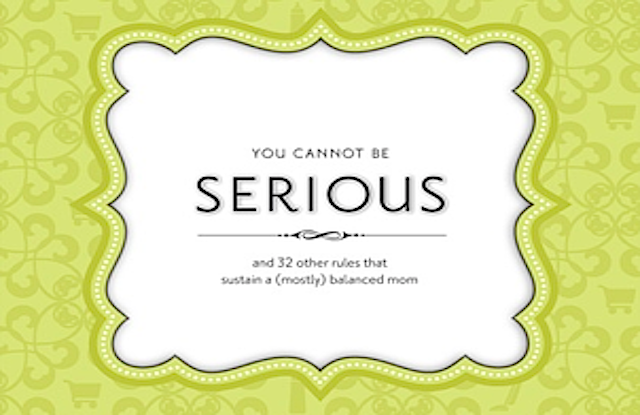
    You Cannot Be SeriousUpdate: The winners for this giveaway have already been chosen:

    • Laurie from Cuddle Hugs
    • Cyndi from So Much More Than a Mom

    I have the utmost respect for mothers.

    Their daily lives require an aptitude for all the qualities that make us good people: love, kindness, patience, generosity, and, perhaps most importantly, a sense of balance. If anyone knows chaos, it’s a mom.

    With this in mind, I was thrilled to read Elizabeth Lyons’ book You Cannot Be Serious and 32 Other Rules That Sustain a (Mostly) Balanced Mom.

    Make no mistake: I don’t have any children. Or friends with children. Or even access to children—there appear to be none in a fifteen-mile radius.

    What I do have is a need for balance in a world that is never predictable and rarely calm.

    Elizabeth’s book provides just the right anecdote, and it was so easy to relate to her reading it.

    She’s not the high-waisted jeans kind of mom who fills her days with baking and gardening (through she does both). She’s the mom who runs her own business, writes her own rules, and still manages to run a household without any hired help. (more…)