Tag: Mistakes
-
![How to Access Awakened Consciousness Through Meditation [Free eBook]](https://dev.tinybuddha.com/wp-content/uploads/2021/07/IMG_3042.jpg)
How to Access Awakened Consciousness Through Meditation [Free eBook]
If you’re anything like me, you’ve likely tried meditation, or even adopted a consistent habit, only to question if you’re doing something wrong. You show up and put in the time, but despite your best efforts, you’re not reaping the expected benefits, or at least not with the consistency you originally hoped to see.
Perhaps you initially turned to meditation for stress-relief, some way to defuse the constant sense of pressure and overwhelm that’s prevalent in our achievement-focused society.
Or maybe you first tried meditation to help you focus and be more present so that your days don’t go by in a blur while you’re busy rehashing the past and worrying about the future.
Both were true for me.
Before I found meditation, I lived my days shuffling through a number of damaging mental habits: dwelling on victim stories, beating myself up for all the ways I felt I’d failed, and pressuring myself to somehow achieve massive success in order to prove my worth.
I was missing out on my life while focusing on all the life I’d already missed and all the life I might miss if I didn’t somehow do better.
I hoped meditation would save me from myself, and in some ways it has. But I’ve also placed unrealistic expectations on my practice and found myself making, what I later learned, are common meditation “mistakes”—mistakes that prevent us from experiencing the greatest benefit of meditation: awakened consciousness.
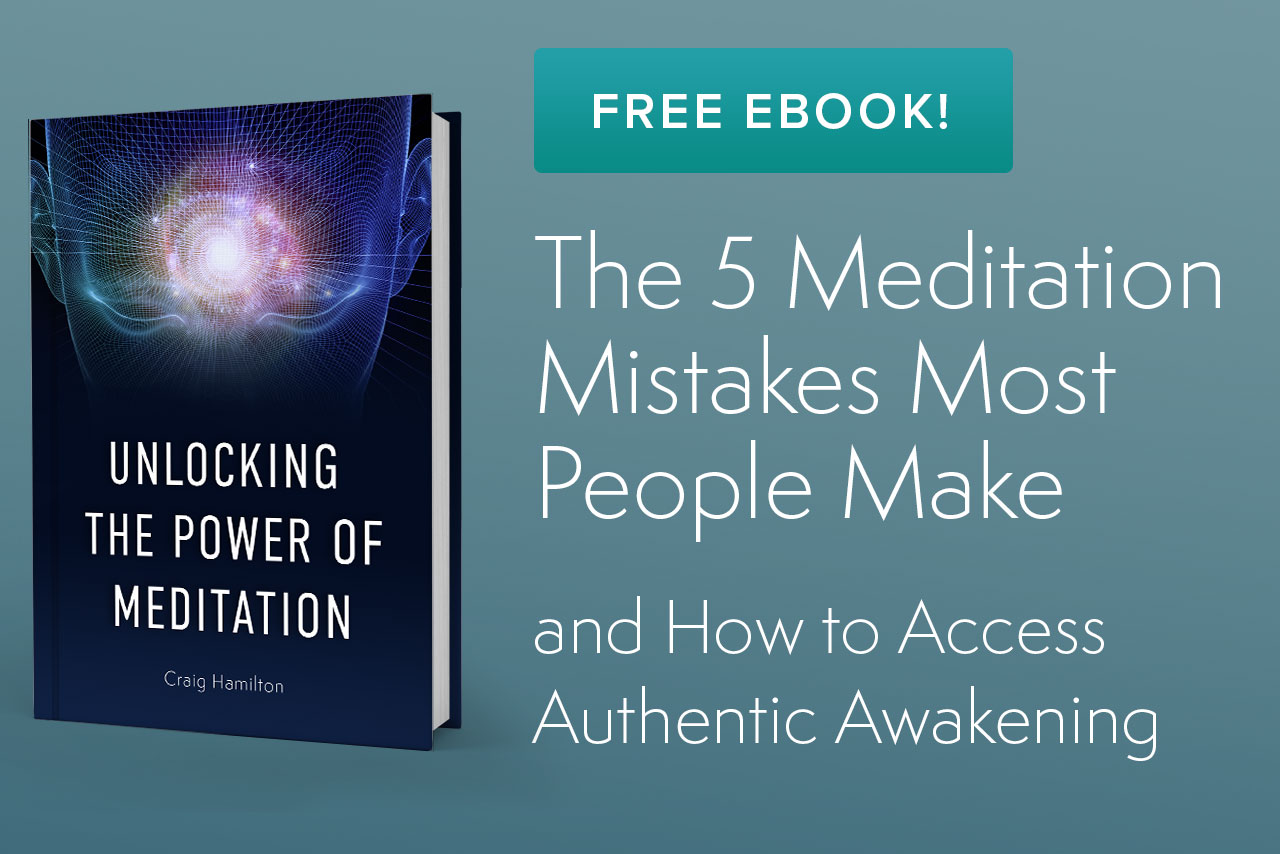
Spiritual luminary Craig Hamilton explores this thoroughly in Unlocking the Power of Meditation, a FREE eBook that I suspect you’ll find both eye-opening and life-changing.
In a nutshell, awakened consciousness is a sense of connection to our true nature, beyond our mind and ego. It’s the place where we can easily access our intuition, wisdom, creativity, confidence, inner strength, and resilience.
This is what I think we’re all after: not just reduced stress and greater focus in the moment, but access to an expansive, sacred part of ourselves that brings us an immense sense of freedom, flow, and connection to everyone and everything around us.
If you’ve struggled with meditation, as well—if you’ve found it difficult to maintain a regular practice and feel you haven’t experienced all the mental, emotional, and physical benefits you’ve read about—I highly recommend you check out Unlocking the Power of Meditation.
In this powerful resource based on groundbreaking research, Craig reveals the five surprising, yet pervasive mistakes most of us make that prevent us from accessing the true potential of meditation.
He also shares one powerful shift we can make to ignite our meditation practice and access awakened consciousness.
When you learn how to practice what Craig calls “direct awakening” you’ll discover how to:
-Access the miracle of awakened consciousness every time you meditate and allow its powerful energy to infuse every aspect of your life.
-Experience a deep inner freedom from the hypnotic spell of fear and desire, enabling you to meet life’s challenges with courage and grace, beyond reactivity or compulsion.
-Access a source of wisdom that arises spontaneously in response to the needs of the moment, bringing forth laser-like clarity faster than the speed of thought.
-Tap into a dynamic and seemingly limitless source of energy, enabling you to do whatever needs to be done in each moment without burning out or becoming drained.
-Access an inner well of creativity that brings forth a seemingly endless flow of unexpected new ideas, visions, and integrative solutions from a place beyond the mind.
-Become a conduit for an overflowing love and care that flows through you into the world from a place beyond your mind’s comprehension.
It’s a short eBook with a massive impact, and it ends with an invitation to a free ninety-minute workshop that can help you take your meditation practice to the next level.
If you’re ready to move beyond the most common mistakes meditators make and live a life filled with meaning, purpose, love, and inspiration, you can download the free eBook Unlocking the Power of Meditation here.
I hope you find it as helpful and illuminating as I did!
-

What No One Tells You About Setting Boundaries: The Good, Bad, and Ugly
“Yesterday I was clever, so I wanted to change the world. Today I am wise, so I am changing myself.” ~Rumi
Three years back was the first time I dared to set a boundary and be assertive in a friendship, and guess what? She blocked me on her phone, and we stopped being friends.
It came as a rude shock because I was quite invested in the friendship. Not only did we have good times together, but I had helped her search for and find a job and even babysat her kid for a long while free of charge. I felt betrayed and hurt. It made me feel like I was the one in the wrong, the bad person, and like I had no right to say what felt right to me.
I admit that I was early in my journey of being assertive and learning how to set boundaries, so my skill set wasn’t the best. But despite the mayhem and chaos it caused, it was a good thing for me.
We were similar in many ways, and I knew she was a lovely person. Still, I didn’t particularly appreciate that she always wanted to be in charge, acted as though she knew it all, only wanted her way, and behaved as though she had the world’s worst problems.
I empathized with her because she shared her struggles with me. But I didn’t share mine back partly because I wasn’t comfortable and partly because I felt there was no place for me; it was only about her. So, one day, when I’d had enough, I exploded and said what I had to say, rudely, and that ended the relationship.
Three years later, when the dust settled, we started talking. We are cordial, civilized, and respectful now. We share laughs and anecdotes, but it’ll never be the same because we’ve both changed, and our relationship has changed as well.
After taking this journey, I’ve concluded that being assertive and setting boundaries is not as easy as it sounds. But it’s the only way to regain your sense of self, sanity, and self-love.
What are the Benefits of Maintaining Boundaries?
Boundaries are limits between us and other people that enable us to honor our feelings, wants, and needs and take good care of ourselves. We need to set boundaries because:
- Boundaries offer protection against people who habitually do things that leave us feeling uncomfortable.
- Correcting troublesome behavior and letting other people know what’s acceptable or not, where we stand, and what we are willing to tolerate drastically improves our sense of self.
- Setting boundaries helps us trust ourselves and, in turn, trust others.
- It helps us treat ourselves and others as equal with respect and dignity.
- It teaches us what’s essential for us and gives us the courage to stand up for it.
- It builds our confidence as we work on our assertiveness muscle.
- Boundary-setting is generous to others because it allows them to grow and take responsibility for themselves, their actions, and their issues.
So, if boundary-setting is such a good thing, what’s the problem?
The problem is that it’s hard, especially for people who are not used to setting boundaries. It can make you question yourself and your intentions and turn your world topsy-turvy.
Why Is Boundary-Setting So Difficult?
Most people with weak boundaries:
- Are not aware of their needs, and this takes lots of time and practice.
- Are afraid to stand up for themselves.
- Don’t believe that they deserve to have their boundaries recognized and honored.
- Are afraid that people will think they are selfish.
- Think it is wrong to think about themselves because of various cultural or religious influences.
- Believe that what they want is unreasonable.
How Do You Start Setting Boundaries?
1. Take inventory.
Have you ever been in a situation where you felt like you were being taken advantage of, taken for granted, or treated disrespectfully? When you feel any of these things, you need to ask yourself:
- What are you feeling? Is it anger, hurt, betrayal?
- What brought about those feelings? What did the other person do? Did they disregard your feelings or act dismissive? Did they cross a line you’d rather no one cross?
- How did you react to the situation? Did you ignore it, make an excuse for them, or get angry and resentful but fake a smile?
- Why did you tolerate this behavior and respond this way? What were you afraid of?
So, the first step is being conscious of what happened and what you’re feeling.
This is essential because it helps you become aware of your needs, wants, and limits; notice when someone is neglecting or violating them; and reflect on how you usually respond—and why.
2. Be honest and courageous.
The second step is being honest about what you would like to do in the situation and reflecting so you can find the fairest and healthiest way to respond.
Then comes the hardest part: finding the courage to act even if it may displease, anger, or irritate the other person.
Everything inside you might scream that this is a mistake. You may feel scared, anxious, and even unsafe speaking up. But remember that ignoring the issue is not a solution because you will just end up feeling resentful if you continually avoid saying what you really want to say.
What No One Tells You About Setting Boundaries
1. You may feel guilty.
Somewhere down the line, you may have learned that your needs, feelings, and wants are less important than others’. When you start making changes, it may feel like you are embarking on a journey of selfishness and betraying the very core of your being.
2. You will likely make mistakes.
You are learning a new skill, and mistakes are bound to happen. You may overreact to minor issues or fail to communicate your feelings and needs accurately or clearly. There’s no right or wrong here, only a learning curve. You can always change your decision or apologize later if you realize that your decision wasn’t the best.
3. It sometimes feels like you are at war with yourself.
To some extent, that’s what this is. A war with what you once believed to be true but isn’t anymore, a war against your default responses.
4. It is not easy.
It will sometimes mean wrong turns, slip-ups, and lost relationships. But if you’re honest with yourself, you may realize that those relationships were already dead to begin with; you were trying to nurture doomed relationships because you were afraid to let them go.
5. It makes you confront demons you didn’t know you had.
Your insecurity, your feelings of low self-worth, your fear of being rejected or alone—all this and more bubbles to the surface when you get honest about why you’ve struggled with boundary-setting and start pushing past your blocks.
6. It takes all you have, tears you up, and breaks you down.
But when it’s all done and over, you build strength, wisdom, and trust in yourself. You learn to give your feelings more credence, knowing they’re an internal signal that something is off and you need to investigate them further so you can decide what’s really best for you.
So yes, boundaries can be life-changing, but the emotional upheaval that often accompanies them isn’t for the fainthearted. Changing yourself, getting out of your comfort zone, and doing what is right for you can trigger your reptilian brain, which craves safety, making you feel like you are doing something wrong. Arnold Bennett rightly says that all change, even for the better, is accompanied by discomfort.
Deepak Chopra said that “All great changes are preceded by chaos.” I believe the benefits of maintaining boundaries make the chaos worth it.
-

Where Our Strength Comes from and What It Means to Be Strong
“Strength doesn’t come from what you can do. It comes from overcoming the things you thought you couldn’t.” ~Rikki Rogers
A friend recently asked me: Andi, where does your strength come from?
It took me a while before I had a good enough answer for her. I sat contemplating the many roads I’ve traveled, through my own transformational journey and the inspirational journeys of all my clients who demonstrate incredible strength for me.
I moved to a different country, alone, at eighteen years old and have changed careers, battled a complex pain diagnosis with my child, and lost loved ones. I am now living through a global pandemic, like all of us, and most recently, I am recovering from a traumatic, unexpected surgery. Life has many surprises for us, indeed.
So where does strength really come from?
I wish I knew the precise answer to this question so that I could share the secret sauce with you right now, and you could have full access to all the strength you’ll ever need to achieve whatever it is that you really want. (Even the deeply challenging stuff and the tremendously scary stuff. All of it.)
I do know this:
Strength is a personal measurement for a truly unique, subjective experience. It’s entirely up to you to decide what strong means for you.
And I also know this…
Strength comes from doing hard things. It comes from showing up despite the pain or fear and going through the struggle, the endurance, and then building on that, to keep going forward and upward.
Strength comes from taking the time to notice and acknowledge what you have managed to do and accomplish until now. So much of the time we go through things without realizing what massive effort something took, and we minimize the entire experience because we only focus on the end result and not the process.
Strength comes from paying close attention to the small but significant steps and wins and incremental gains along the way. Strength comes from tracking progress and celebrating it one tiny bit at a time.
Strength comes from within—from moments of activating your highest faith and belief. Knowing why you do what you do, even when it’s not easy.
Strength comes from aligning with your core values and living with integrity even when no one is watching, and you aren’t in the mood. When we connect to what truly matters to us, we are stronger. When we believe there is a bigger plan and are hopeful about an outcome, we feel stronger. Even if we don’t know why.
Strength comes from without—by surrounding ourselves with people who lift us up and see our worth, even when we sometimes forget. It comes from choosing to envelop yourself with kindness, inspiration, motivation, and gratitude. It comes from selecting role models and learning from them. It comes from seeing ourselves through others’ eyes—especially those who see our greatness and light when all we see is our flaws, weaknesses, and shortcomings.
Strength comes from grabbing lessons and blessings, often dressed up as awful mistakes and painful failures.
Strength comes from collecting moments you are genuinely proud of and taking the time to truly recognize these events for what they are and what they enabled you to accomplish. Don’t overlook them. You get to use these strengths in countless ways and in other areas of your life as much as you want to.
Strength comes from knowing yourself. As you begin to discover and unmask more of you, you get to make choices that honor more of you, and you get to live your purpose and be more of who you really are. When we know better, we do better.
The strongest people I know have had insurmountable trials. They know what to say yes to and how to say no. They know how to be proud of themselves with humility and honesty. They know how to pick their circles wisely and accept help, compliments, and advice.
The strongest people I know cry a lot and feel everything.
The strongest people I know are the kindest.
The strongest people I know have wells of inner resources that are invisible to the naked eye.
The strongest people I know can say sorry and forgive others.
The strongest people I know can forgive themselves.
The strongest people I know fall down hard, and slowly, with every ounce of courage, bravery, and might, find a way to get back up again, battered, bruised, and aching.
The strongest people I know have incredible hearts that expand wider with each hurdle.
The strongest people I know have endured so much and yet still find their smile to light up the world for others.
The strongest people I know teach me every single day how to try and be just a little bit stronger myself.
-
How I Overcame the Stress of Perfectionism by Learning to Play Again
“What, then, is the right way of living? Life must be lived as play…” ~Plato
I am a recovering perfectionist, and learning to play again saved me.
Like many children, I remember playing a lot when I was younger and being filled with a sense of openness, curiosity, and joy toward life.
I was fortunate to grow up in Oregon with a large extended family with a lot of cousins with whom I got to play regularly. We spent hours, playing hide-and-seek, climbing trees, drawing, and building forts.
I also attended a wonderful public school that encouraged play. We had regular recess, and had all sorts of fun equipment like stilts, unicycles, monkey bars, and roller skates to play with. In class, our teachers did a lot of imaginative and artistic activities with us that connected academics with a sense of playfulness.
I viewed every day as an exciting opportunity and remember thinking, “You just never know what is going to happen.” My natural state was to be present with myself, enjoying the process of play
Unfortunately, my attitude began shifting from playfulness to perfectionism early on. Instead of being present and enjoying process, I started focusing on performance (mainly impressing people) and product (doing everything right). The more I did this, the less open, curious, and joyful I was.
Instead, I grew anxious, critical, and discouraged.
I first remember developing perfectionist tendencies when I was in elementary school and taking piano lessons. For some reason, I got the idea that I had to perform songs perfectly, or else I was a failure.
Eventually I became so anxious, I would freeze up while playing in recitals. I started hating piano, which I once had loved, and eventually quit.
My perfectionism spread into other areas of my life, too. In school, I pushed myself to get straight A’s, and if I earned anything less, I felt like a failure. I often missed out on the joy of learning because I was so worried about getting things right.
My perfectionism also negatively impacted my relationship with myself. I believed I had to look perfect all the time. As a result, I often hated the way I looked, rather than learning to appreciate my own unique appearance and beauty. I also remembering turning play into exercise at this time of my life and using it to pursue the “perfect” body.
Movement, which I loved when I was a child, began to feel exhausting and punishing.
Perfectionism also hurt my relationships with other people. I felt like I had to be smooth and put together and that I always had to put everyone else’s needs above my own. Not surprisingly, I often felt unconfident, anxious, and exhausted around other people.
At this time in my life, I believed that if I tried and worked hard enough, I could do everything right, look perfect, and make everyone happy.
My perfectionism increased in young adulthood until eventually it became unsustainable. In my early thirties, I became the principal of a small, private middle school where I had taught for eight years. I loved the school and was devoted to it.
In many ways, I was the ideal person to do the job. But I was also young and inexperienced, and I made some big mistakes early on. I also made some decisions that were good and reasonable decisions that, for various reasons, angered a lot of people.
To complicate matters, the year I became middle school principal, the school underwent a massive change in our school’s overall leadership, and we suffered a tragic death in the community. I worked as hard as I could to help my school through this difficult time, but things felt apart.
My school, which had largely been a happy and joyful place, suddenly became filled with fighting, suspicion, and stress. These events were largely beyond my control and were not the fault of any one person, but I blamed myself. For someone who had believed her whole life that if she worked hard enough, she could avoid making mistakes and could make people happy, my job stress felt devastating.
I felt like my life was spinning out of control and that all the rules that once worked no longer applied. I crashed emotionally, and I remember telling my husband at this time, “I will never be happy again.”
That was one of the darkest times of my life.
It took me several years to find happiness again. One of the major things that helped me to do so was recovering a sense of playfulness.
After my emotional crash, I decided I was done with perfectionism. I understood clearly that focusing so much on avoiding mistakes and pleasing-people was the source of much of my suffering.
I realized I needed a different way to approach life.
About this time, my friend Amy and I started taking fencing lessons together. I was quite bad at it, but it didn’t matter. Because I had given up perfectionism, I didn’t care anymore about impressing people at fencing class or performing perfect fencing moves.
Instead, I cared about being present with myself in the process and staying open and curious, and focusing on joy.
I had a blast. I felt free and alive, and something flickered to life inside me that had felt dormant for many years. I felt playful again. And I realized that I had been missing playfulness for many years, and that it was part of what had caused me to become so perfectionistic.
Playfulness is the attitude we take toward life when we focus on presence and process with attitudes of openness, curiosity, and joy. Perfectionism, on the other hand, makes us focus on performance and product and encourages anxiety, criticalness, and discouragement.
Fencing helped me rediscover play and leave perfectionism behind.
I fully embraced my newfound playful attitude. It touched every area of my life, and I hungered for new adventures. I began reconnecting with dreams I had put on hold for a while. Eventually I decided to leave my job as a middle school principal and return to graduate school to earn my PhD in philosophy, a goal I’d had since seventh grade.
Earning a PhD in philosophy may not seem like a very playful thing to do, but it was for me. For six years, I immersed myself in the ideas of great thinkers like Plato, Aristotle, Kant, Hegel, Rousseau, Herbert Marcuse, and Paulo Freire.
It felt like I was playing on a big, philosophical playground. But I also faced some significant challenges.
I was thirty-seven when I returned to grad school and was a good ten to fifteen years older than most of my colleagues. Most of them had a B.A. and even an M.A. in philosophy, while I had only taken one philosophy course in college. I had a lot of catching up to do, and I faced some major challenges.
One of the biggest challenges I faced early on was our program’s comprehensive exams. We had two major exams over thousands of pages of some of the hardest philosophical works ever written. The exams were so difficult that at one point, they had over a fifty percent fail rate. If students didn’t pass them by the third time, the graduate school kicked them out of the program.
I was determined to pass these comps and spent all my Christmas and summer breaks studying for them for the first several years of graduate school. But I still failed both exams the first time I took them, and I failed my second exam twice.
It isn’t surprising I failed them, given the high fail rate for the exams and the fact that I was still learning philosophy. But it was painful. I had worked so hard, and I was afraid of getting kicked out of the program.
I was tempted to revert to my old perfectionist habits because they had once given me a sense of control. But I knew that would lead me down a dead-end road. So, I began applying all the lessons I had learned about playfulness to the comprehensive exams.
Rather than focusing on performance and the product, I focused on presence and process. I also focused on practicing habits of openness, curiosity, and joy. Mentally, I compared the comps to shooting an arrow into the bull’s eye of a target. Every test, even if I failed it, was a chance to check my progress, readjust, and get closer to the bull’s eye.
This turned the comprehensive exams into a game, and it lessened the pain of failing them. It helped me accept failure as a normal part of the process and to congratulate myself every time I made progress, no matter how small it was. This attitude also helped me focus on proactive, constructive steps I could take to do better, like meeting with faculty members or getting tutoring in areas I found especially challenging. (Aristotle’s metaphysics, anyone?)
I also taught myself to juggle during this time. Juggling not only relieved stress, it was also a playful bodily reminder to me that progress takes time. Nobody juggles perfectly the first time they try. Juggling takes time and patience, and the more we focus on openness, curiosity, and the joy of juggling, the more juggling practice feels like a fun game.
I began thinking of passing my comps like juggling, and it helped me be more patient with the process. I eventually mastered the material and passed both my comps.
Studying for the comps taught me to bring playfulness into all my work in graduate school.
Whenever I felt stressed out in my program, I reminded myself that perfectionism was a dead-end road, and that playfulness was a much better approach. Doing this helped me relax, be kind to myself, accept failures as part of the learning process, and to take small consistent steps to improve.
This playful attitude kept me sane and helped me make it to the finish line.
Playfulness was so helpful for me in graduate school that I have tried to adopt this spirit of playfulness in all areas of my life, including the college classrooms in which I teach. I have noticed that whenever I help students switch from perfectionism to playfulness, they immediately relax, are kinder to themselves, and increase their ability to ask for help.
I am dedicated now to practicing playfulness every day of my life and to help others do the same. Playfulness isn’t something we must leave behind in childhood. It is an attitude we can bring with us our whole life. When we do so, life becomes an adventure, even during difficult times, and there is always something more to learn, explore, and savor.
-

7 Reasons I Was Scared to Take up Space and How I Boosted My Confidence
“You are allowed to take up space. Own who you are and what you want for yourself. Stop downplaying the things you care about, the hopes you have.” ~Bianca Sparacino
I deserve to take up more space. Plain and simple. By taking the space I deserve, I further build the confidence I need to live a rich life that resonates with who I truly am.
Over the past several years, I’ve had to navigate a new life after hard breakups, difficult career transitions, and moving back home. I’ve had to face the feeling that I’m not doing enough. That I am not enough. That I don’t deserve to take up space. To be seen, felt, and heard with all of the faults that scatter among all my strengths.
I know I owe it to myself to show up. I know I owe it to myself to be present as I am. I know I owe it to myself to finally come out from the back curtains and take center stage where my heart can shine.
I deserve to take more space in my presence around others and to be truly seen.
I deserve to take more space in my voice in a loud world and to be truly heard.
I deserve to take more space in my heart and take care of my needs first.
Because I know these things, I now try not to make my voice small when I want to speak so loudly that it hurts.
I try not to be apologetic for taking the time to express what I feel to others when the person I should be accommodating first is myself.
I try not to bottle up my emotions because the longer I do, the longer it will take to get past ignoring them.
After taking moments to pause and breathe, I gently remind myself again that I am enough. That I deserve to speak from the heart and to be heard. That my thoughts, opinions, and voice matter.
Over time, I’ve recognized the reasons why I lacked the confidence to take the space I deserved, and I’ve also identified what I need to do to change.
7 Reasons I Was Scared to Take up Space (And How I Changed)
1. I lacked confidence in my communication and overused apologetic terms, which minimized my opinions.
I used to say sorry a lot in my interactions, if I thought I’d made a mistake or I interrupted a conversation, for example.
Research shows that when you say sorry, people tend to think less of you. I may have thought that I was displaying myself as a nice and caring person, but I was actually sending the message that I lacked confidence.
“Sorry” isn’t the only word I needed to watch out for. These 25 limiting words diminished my statements. For example, with the word “just”—if I was “just wondering” or telling someone it will “just take me a minute.”
There’s no need to use minimizing words. My needs and opinions are as important as others’. I built more awareness and confidence by flipping the script and being firmer in my conversations. I started saying phrases like “Thanks for pointing that out” or “Here, let me get out of the way” or “It will be a minute.”
2. I thought it was unkind to say no, even if something didn’t align with my priorities.
By consciously saying no to one area, I am confidently saying yes to another more important one. I don’t want to give my space away without consideration of what the true cost is. I need to protect my time like it is my most valuable commodity.
Saying no is not a natural response for many of us, though. We often feel nervous about creating conflict with others and tend to value others’ needs more highly than our own.
At least for me, I have learned to please others by being kind and helping those who ask for it. I tend to say yes because I want to be seen as caring, selfless, and generous. I didn’t realize that the ability to say no is closely linked to self-esteem.
So how did I start to say no without feeling bad about it? I kept my responses simple and to the point. I learned how to strengthen my delivery and not over-apologize.
Sometimes, when I provide too many details, I get caught up in the why behind my decision to say no. I’ve learned that there’s no need to overanalyze, and that I have the right to say no as much as yes. I just need to remember that I’m not saying no to the person, I’m saying no to the request. Also, I’ve learned not to take someone else’s no personally. Sometimes their no means “no for now.”
3. I didn’t realize my thoughts can contribute to a richer conversation.
Sometimes, it’s been easier for me to keep quiet and listen to the entire conversation without saying a word. I’ve learned that I have a seat at the table, and with every word I speak, the more confidence I gain.
I know I have many valuable thoughts that could add a new perspective to the conversation at hand. Whether it’s in a work meeting or hanging out with friends, I consciously remind myself not to hold back my voice.
The world benefits when we all find our voice. Whether it’s to elevate good ideas or discuss alternatives to bad ones, speaking up is how we arrive at the best outcomes.
4. I struggled with being vulnerable because I worried about what people thought of me.
Vulnerability is consciously choosing not to hide your emotions and desires from others.
Being vulnerable with others is scary and uncomfortable for me because it’s letting go of what people think of me. When I’m not afraid of what other people think, that’s when true confidence begins to grow.
Vulnerability bridges connections and helps me build confidence in the relationships I am creating. Vulnerability frees me up to share personal stories that others can relate to. Vulnerability sparks conversations that allow me to move beyond fear to a place of shared experiences.
Connecting with others by being vulnerable—as opposed to overcompensating and trying to get everyone to like you—will result in some of the best interactions and relationships of your life.
5. I felt insecure about sharing my dreams and achievements along with my mistakes and failures.
I needed to let myself be excited and proud in order to build confidence in what I’ve accomplished. Sometimes I have to be my own cheerleader to keep the confidence going and be okay with that.
By sharing my successes, I hope to inspire others and kickstart them in a direction that helps them on their journey.
By sharing my failures, I accept the mistakes I’ve made along the way. I’ve built confidence by taking the lessons learned and continuing to strive toward my dreams.
6. I felt uncomfortable asking for help.
It’s hard to ask people for help. Like most people, I’ve been taught to carry all the weight on my own. To be independent. To be self-sufficient. When you ask for help, people may say no, but it doesn’t hurt to simply ask. Each ask will give you confidence for the next.
Most people like helping others by sharing their time, knowledge, and experiences. I realized I am in a village where others look to help me, which in turn helps the entire village.
Asking for help isn’t a sign of weakness, it’s a sign of strength. Asking for help is uncomfortable because it’s a behavior I wasn’t used to. But it gives me the confidence to know others are there along the way to support my dreams and goals.
7. I didn’t realize how much I have to offer.
There are times I thought I didn’t have much to offer to others, but I now know I do. I possess a wealth of experiences that can help others live a brighter, more confident life. Whether it’s sharing how I aced a job interview or how I created a fine-tuned budget, there are people out there seeking my help.
As I started to offer my knowledge to others, I was surprised by how many people I began to help. By being of service to others, I built confidence that I have more to give than I realized. I am a wealth of knowledge and experience that can help others build their own confidence.
—
I’ve learned that my thoughts and needs matter—that I matter. That I can speak up unapologetically, say no when I need to, share my successes and failures, ask for help when I need it, and make a real difference for other people. I just need to let myself take up space, knowing I deserve it, and the world is better off because of it.
-
My Secret to Overcoming the Painful Trap of Perfectionism
“A meaningful life is not being rich, being popular, or being perfect. It’s about being real, being humble, being able to share ourselves and touch the lives of others.” ~Unknown
Hello, I’m Kortney, and I’m a recovering perfectionist.
Like so many of us, I spent the greater part of my life believing that unless something was perfect, it wasn’t good at all. There was really no in-between. If it wasn’t perfect, it was a failure.
One of the problems with perfectionism is that it’s common to believe it’s a positive thing. In our society, people tend to value it. If you’re someone that aims for perfection, you must be accomplished. Driven. Smart.
Have you ever had a sense of pride over being called a perfectionist?
I have.
Have you ever thought about why?
Speaking for my own experience, when someone called me a perfectionist, I felt like even though I didn’t believe I was perfect, it meant that they were perceiving me as being perfect. They saw me as being one of the best, or as someone who was talented. It was validation that I was seen as someone who was good at things.
My rabid thirst for this sort of validation fed the perfectionist machine for years.
If you’re wondering what it means to be a perfectionist, here are a few traits:
- Perfectionists obsess over mistakes, even when it’s not likely that anyone else even noticed.
- Their self-confidence depends on being perfect.
- They think in black and white—things are either good or bad. Perfect or failure.
- They have unrealistic expectations and crazy-high standards for themselves and beat themselves up when they don’t meet them.
- They put up a front that everything is perfect, even when it’s not, because the thought of someone else seeing their imperfection is unbearable.
- Despite their quest for perfection, they don’t feel anywhere close to perfect.
- They can’t accept being second-best at something. That’s failure.
- They spend excessive time on projects because they’re always perfecting one last thing.
- They spend a lot of time searching for external approval.
- No matter what they do, they don’t feel good enough.
At one point in my life, all of those bullet points described me well. I wasted so much time worrying about approval and validation so that I could feel like I was awesome. But I never felt even close to awesome. I never felt good enough at anything.
Sure, there were times when I felt like I was good at something, but then I had to raise the bar. Just being good at something wasn’t enough. There was always another level to reach. The bar kept getting higher and higher, which isn’t necessarily a bad thing for people who are striving to make improvements in a healthy way, but for a perfectionist whose self-worth hinges on reaching the bar every time it’s raised, it’s not a positive.
It was exhausting.
After a lot of struggle in my life, I knew I needed to explore my perfectionist ways and find a way to be more compassionate toward myself. Perfectionism was holding me back from loving my life. And to be honest, I don’t think I intentionally set out to rid myself of the perfectionist mentality specifically. It came as a byproduct of a great deal of other personal work.
I began to realize that I had many beliefs that were etched into my brain that weren’t helpful. Beliefs that I never thought to question. These beliefs also severely hindered my ability to be happy and to live the life I wanted to live.
We all have belief systems that we don’t really think to question. We’ve grown up with them. We’ve learned them from the media, culture and society. But if we actually take a step back to notice that these thought patterns that inhibit our ability to grow and progress are there, we can start to question them.
Some common limiting beliefs that keep people stuck in perfectionism are:
- People reward me for having high standards. They are impressed and I gain approval.
- The only time I get positive attention is when I am striving for big things or achieving.
- If I make a mistake, I’m a failure.
- If only I can make so-and-so proud with my achievements, he/she will love me, and I’ll be happy.
- If I fail, I am worthless. Failing is not okay.
- If I don’t check over everything multiple times, I’ll miss something and look like an idiot.
- My accomplishments are worthless if they’re not perfect (i.e.: receiving a “B” instead of an “A” in a class is a failure),
- If others see my flaws, I won’t be accepted. They won’t like me.
The good news is that thoughts like these are examples of faulty thinking—faulty belief systems that keep you stuck in perfectionism. By identifying the specific thoughts and beliefs that keep you stuck in perfectionism, you can start to build new, more helpful thought patterns and belief systems.
I also stumbled upon another secret for overcoming perfectionism.
The secret is that I became okay with being average. I worked to embrace average.
If you’re a perfectionist, you know that being called average feels like the end of the world. It’s a terrible word to hear. My inner critic was not having it. “How dare you even think average is okay?” it hissed.
As a teenager, a twenty-something, and even a thirty-something, my world would have come to an end if I had accepted being average.
But sometimes life has a way of making you better.
Life has a way of putting things into your path and it presents opportunities for you to grow. Everyone has these opportunities at one point or another, but you have to notice them and choose to take advantage of them.
There was a time not too long ago when I went through a really difficult time and had to rebuild my life.
Looking back, I can see that the situation was an abrupt “lane-changer”—a push in a new direction to make a change. I was not living my best life and I wasn’t meant to stay stuck in that lane. I struggled with depression and anxiety, much of which was triggered by perfectionism.
By working on thoughts like the ones I listed above, and working to accept lowering my standards—the ones that told me that achievement and success were the only way I would be worth anything—I gradually learned to replace my old standards with this one:
Just be happy.
Learning to make this my standard led me to a place where I am okay with being average. Eek! I said it. Average.
Today, I can honestly say that I’m pretty happy with being average. Do I like to do well? Sure. But it doesn’t define my self-worth. While it’s created more space for me to fail, at the same time it’s created the space for me to succeed.
The difference is that my self-worth isn’t tied to whether I succeed or fail.
Here’s how I look at it:
I’m really good at some things, but I’m not very good at other things. You are really good at some things. And you aren’t very good at other things too. The good and the not-so-good all average out.
At the end of the day, we are all just average humans. We are all the same. We’re humans trying to live the best life we can. We are more similar than we are different.
Don’t you think that if we all ditched our quest to be perfect, or better than everyone else, we’d feel a little happier? Don’t you feel like we’d all be a little more connected?
If you struggle with perfectionism, I invite you to take a look at the list of limiting beliefs above and see what resonates for you. What evidence can you find that can disprove these limiting beliefs? What would you like to believe instead? Try on those new beliefs and build them up with new evidence to support them.
And along the way, work on accepting that you are enough, even if you’re average.
-
5 Meditation “Mistakes” That Increase Our Suffering
“If your mind is empty, it is always ready for anything, it is open to everything. In the beginner’s mind there are many possibilities, but in the expert’s mind there are few.” ~Shunryu Suzuki
So many of us come to meditation through our suffering. Nearly everyone who has come to walk the spiritual path can spin a tale of sorrow, frustration, and often devastation. Through our life struggles and difficulties, we become conditioned into habitual patternings of mind that seem to offer us no escape, and often turn to meditation to find relief.
I always say that anxiety was my first spiritual teacher and it began teaching me at a very young age.
I spent a great deal of time and effort attempting to control my experience in order to limit my suffering. I’ve now come to see that the illusion of control is the root of anxiety, as our stresses are exacerbated by our inability to accept “not knowing” what will happen in life.
In my early forties life handed me a situation that would eventually overpower my ability to control life. Over a seven-year span, my son Mark struggled mightily, suffered deeply, and fought gallantly to try to fend off addiction and mental illness.
Lost within my own mental struggles, I attempted to meet his difficulties through my habitual need to control life. Anyone who has ever had a loved one suffering with addiction knows that we’re never in control of the situation. Nevertheless, I foolishly pressed forward and selfishly tried to control Mark’s experience.
I can remember the day Mark was diagnosed with schizophrenia. My inner controller had an “I can’t do this anymore” moment and finally came to the stark realization that there was no way for me to control his situation.
Something shifted within me, and I felt the “controller” release its grasp on me. There was nothing to control. There was just life moving, and life was just meant to be lived as it comes.
Tragically Mark lost his fight against addiction in 2017. I’ve come to see that Mark was my spiritual guru the entire time, teaching me about compassion, how to love unconditionally, and how to let go of the need to control life.
Mark opened the doorway to meditation for me by teaching my how to let go. He opened up my heart to accepting what is, as it is and taught me how to start shedding my mind’s old habitual patterns of conditioning.
I’ve been formally “sitting” for about four years, and although I feel very good about my practice now, I’ve made my fair share of “mistakes” along the way.
One of the biggest errors I made was trying to use meditation as a means to an end. I wanted to feel better and thought if I sat “well” enough then I would find peace. I initially failed to realize that this mind that was trying so hard to find relief from suffering was the same mind that had created my suffering.
I spent a lot of time spinning my wheels trying to find the right formula to quiet my mind. I thought if I concentrated hard enough, if I focused on the breath the right way, if I limited external noises and distractions… then my mind would quiet down and I would find truth. The mind was the one constantly looking for the right formula, the right path, the right insight.
It took me nearly two years to finally realize that no matter what the mind decided, if the method came from the mind, it would actually prevent me from relaxing into the silence beyond the mind.
This was just one of the many mistakes I’ve made. Putting too much emphasis on how long I sat in meditation, trying to recreate blissful feelings, trying to determine if I was enlightened or not, all contributed to perpetuating my monkey mind.
If you’ve had similar frustrations with your practice, don’t be discouraged. Don’t stop. There’s no wrong way to meditate, because all “mistakes” only serve to exacerbate our suffering, and therefore increase our earnestness to come back to try meditation again. Life is very good at putting in fail-safes against our own ineptness.
If you’ve started meditation and stopped, started and stopped, let years go by, started again and stopped, you’re in good company. Everyone gets frustrated and quits a few times before developing a good practice. In actuality, one must stop “attempting” to meditate before one actually begins to awaken to what meditation is all about.
So let’s go into a bit more detail on these mistakes we want to avoid…
1. Trying to quiet the mind
As I touched on earlier, the number one reason we sit in meditation is we desperately want to silence the inane chatter within our mind. Our monkey mind is quite relentless. It’s like the Terminator: “It can’t be bargained with. It can’t be reasoned with. It doesn’t feel pity, or remorse, or fear. And it absolutely will not stop, ever, until you are…” spiritually awakened.
So why shouldn’t we try to quiet the mind?
The best way to answer this is to ask: Who is trying to silence the mind? Take your time and examine this. What you will find is that your mind is trying to quiet the mind. How could that which is the root cause of the problem also be the source of the solution? It can’t. It won’t listen to our desire to be freed. It’s only interested in furthering its continuity and increasing its own significance.
Our mind wanting to quiet our mind creates additional inner conflict. This inner conflict provides more fuel to the mind, and so our attempt to meditate and quiet the mind has only led to more struggles and frustration.
In order to circumvent this dilemma, we must “do nothing.” Just sit and observe whatever comes and goes. Patient, passive, non-reactive observation is your superpower. Whatever thoughts arise, let them come. Whatever thoughts go, let them go.
It might take a bit of time to settle into observer mode, but once we realize it’s possible to sit and observe the mind from a point of neutral awareness, the mind’s reign of terror is coming near to an end.
2. Sitting too long too soon
I think many of us sit down in meditation envisioning a transformation into a Zen Master on day one. We’ve heard that an hour of meditation is a really good meditation, so we decide to sit for an hour.
Within the first minute we’ve relived every embarrassing event in our life from preschool up until this current moment. We sit and wrestle with our thoughts like a chihuahua puppy tied to a firehose on full blast. We’re tossed around like a rag doll in this mental octagon by our own mind. Beaten to a bloody emotional pulp. Our will is broken…
We quit after five minutes and vow to never sit in meditation ever again.
Don’t do this to yourself. Start slow! Meditation is no different than lifting weights. If you try to do too much too soon, you will only end up hurting yourself.
Do one or two minutes for the first week or two. Add a minute or two every week after that and try to slowly work your way up to at least twenty minutes per day.
This is not a competition. You don’t get any awards for persevering through harsh conditions or adversity. Enjoy the journey. Take your time.
3. Quitting too soon
So we’ve worked our way up to twenty minutes a day. We’ve sat for twenty minutes for two days now and we feel… nothing. Everything feels the same. The mind is still wandering. The monkey mind is still in charge, still kicking us around, and we’re getting frustrated.
The mind is whispering that this is all a really big waste of time and you’ve fallen for it again! How long are you going to listen to that spiritual guru who is unemployed and has no money? Of course he is at peace. He doesn’t ever do anything…
Don’t give into the mind.
Meditation is like walking in fog. We don’t notice much of anything going on, and then we realize that we are soaking wet. If the mind begins to pressure us about sitting without seeing any results, then just observe those thoughts as well.
There is no set time frame for the mind to settle down, but if you are patient you will begin to experience “gaps” of silence in the mind. These small gaps are a good indication that the mind is getting tired of not getting a reaction out of us. So, be patient. Relax. Take up the attitude that you will sit until your last breath, and having no results is not going to deter you.
4. Trying to recreate meditative phenomena
The bliss! Give me some more of that bliss. Can never have enough bliss! Anyone who has come to experience the feeling of euphoric bliss in meditation has definitely tried to recreate it. If you say that you haven’t, you’re lying.
Anything that occurs within the meditation is phenomena. Bliss, lights, colors, auras, sounds, images, dreams, out-of-body experiences, clairvoyance, receiving messages, full-body orgasmic euphoria, alien contact, angels, numbers, time travel, space travel… It’s all just phenomena and it has no real significance in the grand scheme of awakening.
If you become infatuated with phenomena, this means that the mind has become infatuated with phenomena. The point of meditation is to relax into the awareness of life moving. Awareness of life moving includes awareness of mind moving. If we “fall into” the role of mind trying to recreate our meditative experience, then we’ve most likely fallen out of the neutral witness role.
A good rule to remember is to relax and allow whatever comes to come and allow whatever goes to go. Nothing needs to be created. Nothing needs to be removed. Just relax with what is.
5. Holding any expectations about your practice
It’s natural to begin a meditative practice because we want to feel better. Our mind is giving us trouble. Our relationships never work out. We are overworked, underpaid, and complete balls of stress. We are grieving over loss. We are tired. We sometimes just want to give up. It’s all too much.
Again, who wants to feel better? Who is holding this expectation that meditation is the cure all that we’ve been waiting for? The mind! The mind is interested in feeling better, so again, we are creating more inner conflict. The mind doesn’t like the way life is moving, it wants to make life better. We are playing tug of war with ourselves…
Any expectation of getting something out of meditation delays getting anything from meditation. If you don’t want anything, then you will get something. That something is peace of mind.
Peace of mind arises with the deepening of awareness of what is. When we sit in meditation without expectation, the mind’s inner conflict dissolves. There’s no fuel added to the mind when we don’t expect to get anything. Relaxation without expectation is how the mind begins to quiet down.
—
So, to summarize, even though we may make some or all of these five meditation mistakes, life will continue to use our suffering as a way to bring us back to our spiritual practice and back to meditation.
Don’t try to quiet your mind. Don’t try too much too soon. Don’t quit too soon. Don’t try to recreate a pleasurable meditation session. Don’t hold any expectations.
Just sit. Relax and be with what is.
-

What I Did to Survive: Not Proud but I Forgive Myself
“Forgive yourself for not knowing better at the time. Forgive yourself for giving away your power. Forgive yourself for past behaviors. Forgive yourself for the survival patterns and traits you picked up while enduring trauma. Forgive yourself for being who you needed to be.” ~Audrey Kitching
I used to suffer from survivor’s remorse.
What does this mean exactly? Well, I was ashamed of the things I did to survive.
As I reflected back on my life, I’d get filled with sadness, shame, and regret.
Sadness because I did things that were against my moral values when I knew right from wrong.
Shame because I did things that I never thought I would have to do, in order to survive.
Regret because I was involved in drugs, sex, and violence.
I had kids to feed, and they depended on me. As a single parent, I was willing to do whatever I had to do for them. I would sell tools and electronics for gas money. I would sell plates of food to buy diapers. I even chose to sell my body. I did whatever I needed to do to get by.
I hurt family and friends along the way and lost their trust with my broken promises. Promises that I would pay back money that I borrowed, knowing I wouldn’t be able to. I used people for my own personal gain. My pain caused other people pain.
I was risking my whole life, and I didn’t even realize it. I could have gone to jail and lost my kids, all because I was trying to provide for them.
How Did I Get Into a Life of Drugs, Sex, and Violence?
Well, I had a rough childhood; I dealt with physical, verbal, and sexual abuse as a child, and witnessed abusive relationships amongst relatives and family friends . I processed this into rejection, fear, and anger.
I struggled to feel love because I equated it with hurt. My family members said they loved me and then did things that caused me pain. I thought this must be love; this is normal behavior.
The hurt turned into anger, and then I started to resent people. This caused extreme paranoia.
Still, despite my relationship fears, through a twisted turn of events, I had a baby at fifteen years old. I told myself I would do anything to make sure my son didn’t have the same life I’d had.
Then at eighteen years old I was a homeless high school senior.
My Survival Tactics
I found myself on public assistance. I was in situations that evoked the exact feelings I’d experienced as a child, when I saw my mother depend on welfare and food stamps to get by. I felt impoverished, worthless, and dependent on a system to survive.
I found myself wrapped up in an abusive relationship, with three kids now, around drugs, around violence, and I saw no way out. This was my life. I wanted to leave, and I tried to many times, but he held me at gunpoint, locked me in a closet, and even choked me at times.
Domestic violence is a learned behavior. I witnessed it growing up and he witnessed it as well. This abuse was familiar. I didn’t know if I was prepared for the fight. I needed to be loved, so I accepted any love I could get even when it hurt.
I eventually chose to break the cycle and free myself from the lifestyle I was caught in, but it left me at ground zero. I had to fight for myself, for my kids, for our future. I had to get out of this abusive relationship before he killed me, or I killed him. I’d had enough!
But leaving was just the beginning of change, and not the end of my stress. My fight-or-flight response was constantly activated. I was always thinking, “I got to do something. My kids need shelter, food, and clothing.”
I needed food stamps, I needed public assistance, I needed section 8 housing. I needed everything I could get to survive.
I was doing things that I knew were wrong—lying and stealing what didn’t belong to me—but I felt like I had no choice. I couldn’t call anyone to come save me. I had already borrowed money from people. I couldn’t depend on help from my kids’ father. No one was coming to protect me. I had to save myself.
I felt helpless. At this point I had a high school diploma, little job experience, and no stability. I was in complete survival mode.
I did not possess the language to tell someone that I was hurting, that I was struggling and needed help. My fear (ego) told me that no one would listen, and no one would care.
I feel so ashamed for lying to my mother, for stealing, for degrading my body. I know this is not who I am, but looking back I can see these were my survival tactics.
I only wanted to survive, and guess what? I did.
But eventually I wanted more than that. I wanted freedom. The freedom to let go of the past. These secrets that I was ashamed to say out loud.
This was over fourteen years ago. I was still holding on to guilt.
My Accountability
I never wanted to talk about my past because it was painful. I wanted it to disappear.
I didn’t want to admit that I was broke with $2.29 in my bank account, with three kids.
I didn’t want to admit that I was on food stamps because I couldn’t afford food.
I didn’t want to admit that I’d taken other people’s property for my personal gain.
I didn’t want to admit I’d used my body for financial gain.
I didn’t want to admit that I was in pain from different traumas, and I was self-medicating with drugs.
Still, I had to stop and realize that I’d made it and could now focus on thriving—but I could only do that if I forgave myself. That required self-compassion. But I also realized I couldn’t blame anyone else; I had to take complete and total responsibility.
I had to take responsibility for my choices. I had to take responsibility for doing what I felt I had to do to survive.
Note to self: “Beating yourself up for your flaws and mistakes won’t make you perfect, and you don’t have to be. Learn, forgive yourself, and remember: We all struggle; it’s just part of being human.” ~Lori Deschene
My Forgiveness and Pride
I had to forgive myself for not understanding my power and for inheriting patterns from the trauma I’d experienced.
I also had to give myself credit for breaking the cycle.
I remember once, I was having a conversation with my three daughters, and I was telling them about a time when they were little, and I couldn’t afford to do certain things. One of my daughters said, “Aww, Mom. You used to be poor?”
In that very moment, I realized that I had survived. And I had created a better future for myself and my kids. Not only did I make it, I provided a lifestyle for my kids without drugs, sex, or violence.
I apologize if I was toxic energy in anyone’s life, including my own. My forgiveness doesn’t mean that the guilt never existed; it just means I’m letting go of the shame and pain that once controlled my life.
I used to feel a sense of strength because I’d endured a high amount of abuse, but deep down I was so fragile.
At this very moment in my life, I now choose to measure my strength by how quickly I release things that threaten my peace of mind.
I looked at my sadness, I looked at my regret, I looked at my shame straight in the mirror. I acknowledged them, accepted my past, and decided they would no longer control me. This was my first step toward my freedom.
I made mistakes. I was doing the best I could. I realized I was afraid of speaking my truth, but it’s my truth that’s setting me free.
Whatever you did in the past to survive, I’m sure you did the best you could too. You were hurting and you used the tools you had based on what you’d witnessed and learned.
But the past is behind you now. You don’t have to beat yourself up over who you’ve been. Accept your past. Learn from it. Forgive yourself for being who you thought you needed to be. And face your shame so you can let it go. You’ve been through enough. Why torture yourself even more?
Whatever you’ve been through, and whatever you’re going through now, may your truth set you free and may you heal from your pain.
-

How Failure Holds the Key to a Meaningful, Successful Life
“Perfectionism doesn’t believe in practice shots.” ~Julia Cameron
Within each of us lurks a perfectionist. And perfectionists set themselves up for a lot of pain in life.
How so? I’ll come to that.
First let me describe how our first child took her first step. She was less than ten months old. A very bright girl, who wanted nothing less than my approval at all times.
On one occasion, a few months previous to that, she was crawling on the carpet and picked up some small thing. As she started to put it in her mouth, I called out loudly “No!”
That was the first time she experienced any negative or critical words from me. Otherwise, I had been steadily adoring. What was her response?
She fell flat on the floor and remained perfectly still. It was as if she had been laid flat by a sledgehammer blow.
That’s how much she had come to rely on my approval.
So, what happened when one day she could finally stand up? I decided, as a very proud parent, to teach her how to walk right away.
Now, walking is easy for someone who’s already confident with standing up. It’s more challenging for someone who’s just learned how to stay on their feet unsupported. I was too young and foolish and overeager to think through all that.
In my excitement, I stood by her and urged, “You can walk. Just do this. Look at me. Just lift a foot like this and put it forward.”
In retrospect, I was too hasty and cruel. I’ve grown to recognize that everything happens in its own good time.
Anyhow, I was young and foolish then. So, allow me to tell you the rest of the story.
Our baby looked very doubtful. I demonstrated a step once again. She remained hesitant.
After some more cajoling from me, she decided to do something.
She took the oddest first step you can imagine.
Did she lift one foot as I kept urging? No.
She simply hopped forward, keeping both feet on the ground. Like a baby kangaroo. That was only minutes after she had first stood up without support.
Of course, not long after that she was walking very confidently, and then running, and has gone on to do amazing things with her life.
Imagine if we were all so afraid of failure that we always kept both feet on the ground for safety. How much would that interfere with a full and meaningful life? How would that affect our ability to do whatever we considered to be good and important?
We can see this quite clearly in babies. In order to be able to lift their head, they need to accept that they’ll sometimes flop.
In order to learn how to crawl, they need to accept that they’ll sometimes fall flat on their face.
In order to learn how to stand, they need to accept that they’ll sometimes fall in a heap.
In order to learn how to walk, they need to accept that they’ll sometimes tumble.
In order to learn how to cycle, they need to accept that they’ll sometimes fall off and get bruised.
In order to learn how to swim, they need to accept that they’ll sometimes need rescuing.
In order to learn how to read and write, they need to accept that they’ll get many things hilariously wrong.
In order to learn to love wholeheartedly, they need to accept that some people will betray their trust.
Whenever they want to do something that’s good and important in their lives, they need to accept the possibility of failure.
It’s easy to acknowledge such facts, but it’s more difficult to live by them.
Why is it that we often struggle with failure? Why do we so often consider it as a full stop rather than a necessary comma in our life story? Why does it seem more like a trap than a springboard?
It may have something to do with our need for approval.
Our daughter didn’t want to hear the word “No!” from her beloved parent. It crushed her the first time she encountered it from me.
Only after I picked her up and comforted her did she loosen up and smile again. She was learning that she could get things wrong and still remain completely lovable to me.
People can be good to us. They can build us up. They can teach us that it’s okay to fall and fail, because we’ll still be completely lovable.
However, we’re all human beings. We don’t always do what we set out to do. We don’t stick to doing what we know to be good and important.
As a result, we often wound others and are too often wounded by them.
That tends to suck us into the rat race. Not content with being intrinsically and unshakably lovable, we tend to look for reassurance. And too often we seek it by trying to be one up on others.
We sometimes pounce on the mistakes or flaws of others because it allows us to feel superior despite our own mistakes or shortcomings. We sometimes become overly reliant on praise because we’re terrified that criticism confirms how worthless we are under the surface.
All this tends to make life a bit like walking on thin ice. Even when it looks as if we’re winning, we’re on edge because we fear that the ice might give way at any moment. I know, because I’ve struggled with these things myself.
Imagine a different way of living. A calm and courageous way of reaching for whatever we consider to be good and important in our lives, with full acceptance of whatever failures come our way.
Paradoxically, the perfectionist is more likely to fail because they’re too afraid to bring out the best in themselves. They’re so hungry for approval, and so afraid of failure, that they often don’t do what they know to be good and important.
They keep the safety wheels on their bicycles even though it slows them down. That’s because they’re convinced that failure will confirm their worthlessness.
Imagine a different way. Imagine having a deep, unshakable anchor within yourself. An anchor of self-acceptance. No storms in life can then blow you out of the safe harbor of being intrinsically lovable.
The baby who’s uncertain of being lovable might be too afraid to attempt anything worthwhile. It’s the same with us adults.
Our perfectionism goes hand in hand with fear of failure. It’s like a prison. However, we have the key, or we can find it.
This may be the most important lesson life has taught me, and I’m going to share it.
You can get the key to calm, courageous living by letting others know that they are unshakably lovable despite their failures and mistakes and flaws.
When you give this gift to others, you begin to believe it yourself. Not as a sterile principle. But as a reality that you feel deep in your being.
Once you have this key, perfectionism loses its stranglehold over you. You recognize that you are intrinsically worthy and lovable, just like every other human being.
Life becomes really good and inviting, failure can no longer terrorize, and you get more good and important things done.
Once you’re prepared to fall flat on your face, life starts to sparkle.
-

This Weekend I Fell Apart, and That’s Okay
“Look for something positive each day, even if some days you have to look a little harder.” ~Unknown
This weekend I hurt more than I have in a very long time.
It all started on Friday, when my boyfriend and I headed out to spend the weekend with friends—two couples, both with babies in tow.
I’ve been trying, unsuccessfully, to get pregnant since the start of the year, yet I didn’t anticipate that it would be emotionally taxing for me to be around two little families. I was just excited to see our friends, who live in the Bay Area, hours away from our home near LA.
A little backstory: I’m less than three weeks away from my thirty-ninth birthday, which means I’m now in the category of “high-risk pregnancy,” if I’m even able to get pregnant at all.
My boyfriend and I first discussed having a baby five years ago, but we kept pushing it off because our families live on opposite coasts, and neither of us was able to agree to live on the other’s coast full-time for the long term.
We finally decided, at the beginning of this year, that I would be the one to visit my family—as often as I feel I need to, with our kid(s), for the foreseeable future—and we’d commit to staying in LA, which makes sense since we’re working toward a career in film.
But biology doesn’t just fall in line because you finally get over your fears and decide to make a compromise. We’re both open to the idea of adoption, but there are other personal issues—that my fiercely private boyfriend would not want disclosed—that have complicated matters.
So there I was on Friday with our friends and their adorable babies—one actually a toddler, since he recently turned two.
We toasted our get-together around 5:00 with our first glass of wine, and the wine continued flowing throughout dinner. After, we all moved to the deck to partake in an at-home wine tasting.
The ladies and I discussed my road to pregnancy, and though I was discouraged, for the most part I was fine—until I wasn’t.
Having lost track of the amount of wine I was drinking, I eventually hit that emotional place I remember from my younger years, when alcohol eventually led to histrionics and tears. It is literally a depressant, after all, and generally not great to imbibe when you’re already feeling fragile.
I don’t remember all the details of that night, but I know I cried about my fears about not being able to have a family (which, as I mentioned, is an issue complicated by many factors).
I woke up at 4:00 in the morning and picked a fight with my boyfriend about our relationship. Then I woke at 8:00 with two things: a hangover and a shame-over. I was absolutely mortified.
I’d gotten drunk, turned a fun night with friends into something heavy and emotional, and had caused my boyfriend a lot of pain and embarrassment. It gave me a little comfort to realize everyone had drunk too much. But I still felt deeply ashamed of having lost control.
Ironically, I received an email that morning that I’d been waiting on for almost a month. My film mentor had just read the second draft of my first feature screenplay, and she said she was blown away by the massive improvement from the first draft.
I had never in my life simultaneously felt immense pride and deep shame, but I did right then.
Fortunately, the friend I cried to was extremely kind and empathetic. And no one judged me or put me down, as good friends never do.
But that day was pretty rough for me, physically and emotionally. And the next day, it got worse.
That night I noticed that a few people had commented on a meme I’d shared on Friday, using clipart with a hyper-sexualized female silhouette. They mentioned that it was demeaning to women to use what essentially appeared to be Barbie to represent the female form. One person called it “offensive.”
Though there were only a few critical comments, juxtaposed against 12,000 shares, I immediately realized I agreed with them. As someone who once struggled with an eating disorder, I’d like to represent women as more than a busty, high-ponytailed caricature.
This didn’t fully or accurately represent my values or the message I’d like to convey. And I didn’t like the idea of young girls seeing it and concluding, as I may have as an adolescent, that this was what a woman is supposed to look like, even if some women actually look like this. So I decided to take it down.
With a mind still foggy I decided to write something on Facebook, as I wanted the community to know I felt I’d made an error in judgment. I didn’t want to just delete it. I want to make it clear I don’t agree with a society that puts pressure on women to be femme bots and suggests that our sexuality is our most valuable contribution.
I mentioned in my post that some people had pointed out that the image was offensive, and I agreed that it was triggering—and the backlash was swift and harsh.
In retrospect, I don’t think I accurately communicated why I decided to remove this image, since I didn’t address the cultural issue of how women are portrayed in the media and the fact that I’d like to be part of the solution, not the problem. But I’m not sure it would have mattered if I did, since I’d used the word “offensive.”
I forgot that people often get offended by other people getting offended.
Over the next day, hundreds of comments came in, many attacking me on a personal level.
People called me spineless for catering to “snowflakes.” People said they lost respect for me and questioned my aptitude for even doing the work I do, since I clearly have no sense of conviction or belief in my own decisions. Even more alarming, many people mocked the idea of being “triggered,” and essentially belittled anyone with emotional or mental health issues.
I felt misunderstood, judged, and condescended.
I hid or deleted many of the worst comments and resisted the urge to defend myself, deciding instead to leave one clarifying comment a couple hours in. But I’m not going to lie; this affected me deeply.
While on the one hand, I reminded myself that my power was in my response, and publicly, I only responded in one calm, clear comment, I also obsessively monitored the feed.
By this time my boyfriend and I were at his parents’ house in Nevada, where we planned to stay for a few days, and I wasn’t even close to present. I didn’t want to delete this new post, since I believed I’d done the right thing, but it pained me to see so much vitriol in a space that I hold sacred.
Then came another blow: I’d noticed a while back that since the start of the year, someone had been sharing every single challenge from my book Tiny Buddha’s 365 Tiny Love Challenges on Facebook. Though this person tagged my page, none of the posts included the book’s title or a link—and some people actually assumed she was writing these posts or getting them from my Facebook page.
I’d emailed my publisher a few weeks back to ask their thoughts on this, and they told me they could send an email asking her to stop. At the time, this seemed warranted.
Her Facebook friends didn’t see it that way. After she posted the letter from my publisher’s legal department, tagging my page, once again, the comments turned nasty.
F— you, Tiny Buddha.
You suck, Tiny Buddha.
More like “Greedy Buddha.”
Unbelievable! She should thank you for the free marketing!
For a while, I felt completely numb. And I knew I was doing the “wrong” things by obsessively monitoring my phone and letting these comments get to me.
I knew it wasn’t serving me to dwell in my self-righteousness and how wrong I believed it was for this woman, who enjoyed my work enough to share it, to like comments that attacked me on a personal level. But I did it anyways.
I was angry with the people who were angry. I was triggered by the people who were triggered.
And then something occurred to me: This whole weekend was an opportunity. It was a chance to practice some of the lessons that are much easier to practice when everything is going well.
This weekend was a chance to remember that:
I need compassion most when I think I deserve it the least.
Initially, I beat myself up over several things this weekend: drinking to excess, exploding emotionally, hurting my boyfriend, choosing clipart that I wished I hadn’t chosen, letting my publisher speak for me instead of reaching out to the woman personally, and obsessing over the various challenges I was facing instead of being present.
I told myself I shouldn’t have made any of those mistakes. I should have been beyond this. I was a fraud.
Then I realized something: I was being as mean to myself as the people online. And not a single blow of self-flagellation was helping me move on. In fact, each self-judgmental thought cemented me further into the hole. Because telling myself I was sucking at life made it awfully hard to find the strength to do better.
Every time I criticized myself, I weakened myself, and a weakened person is far less equipped to reframe difficult circumstances and respond wisely.
The only way out was to cut myself some slack. I needed to stop fighting with myself and let go, as if melting into a hug from someone who had finally forgiven me. I needed my own love and compassion.
So I drank too much and cried. I was hurting. It’s been a long journey toward starting a family, and it’s been hard. It’s okay to hurt.
So I made mistakes in my work—who hasn’t? I owned them and publicly admitted them. What matters isn’t the fact that I messed up but that I acknowledged it and committed to doing better.
I don’t have to be perfect. Sometimes I will make mistakes, some public, and sometimes I’ll make many that compound. The only way to stop the cycle is to stop obsessing about having done things wrong. The only way to move into the future is to fully accept the past. Once I did this, I felt freer and better able to be present.
The approval that matters most is my own.
It bothered me that people believed I removed the image because I needed approval from the “complainers,” as opposed to having made a decision based on my own beliefs and values.
But ironically, once the flood of negative comments came in, I did start feeling a need for approval. I wanted people to understand and honor my positive intentions.
It took me a day, but I was finally able to accept that some people were simply committed to judging me, and this wasn’t something to change; it was something to accept.
It didn’t matter if some people derided me or questioned me if I felt in my heart I’d done the right thing.
I eventually deleted the second post because I wanted to put an end to the negativity. There’s far too much of that on Facebook already. But I’m proud I waited and resisted the urge to remove all criticism immediately. For a recovering approval addict, allowing a public character assassination requires immense strength. And I give myself a lot of credit for that.
It’s rarely personal.
Intellectually, I knew this when people were insulting me in both places on Facebook.
I knew that the people who were angry with me for catering to “snowflakes” were really projecting their feelings about what they perceive to be an oversensitive culture. It wasn’t just about this one image. It was about every time someone’s ever said they were offended and their complex feelings about what that means to them.
I also knew that the people defending the woman who’d been sharing my book online were acting from a place of allegiance to their friend. They were more pro-her than anti-me. Many didn’t even have all the information—they didn’t realize she’d been sharing from a book. So really, I couldn’t take that personally either.
This wasn’t immediately comforting to me because the attacks were so public, but when I was able to fully absorb this, it did give me some peace.
Not everyone will see my side, and that’s okay.
I believe one of our deepest desires is to feel understood—to know that other people get where we’re coming from and that they may even have done the same thing if they were in our shoes.
I didn’t feel that way when people judged me personally based on the letter from my publisher’s legal department.
I left a few comments on that post, trying my best to respond from a place of calm, but I know there are some people who will forever think I am greedy and soulless because I didn’t want my book’s content republished online.
I’ve decided that this is okay. Not everyone has to get me, understand me, support me, be considerate of me, or treat me kindly—so long as I do those things for myself.
Pain can be useful if you share it to help someone else.
I decided to share this post for two reasons:
First, I thought it would be cathartic for me. I felt ashamed for a lot of this weekend, and I wanted to be able to reframe this experience in a way that felt empowering. As I said when I first launched this site, when we recycle our pain into something useful for others, we’re able to turn shame into pride.
And that brings me to the second reason: I thought it might be helpful for someone else to realize that even someone who runs a site like Tiny Buddha can fall into so many self-destructive traps.
If you’ve ever drank too much and fallen apart emotionally, know that you’re not alone.
If you’ve ever obsessed over comments online and allowed something as trivial as a Facebook feud to get the better of you, know that you’re not alone.
If you’ve ever failed to apply what you know and regressed to the least evolved version of yourself, know that you’re not alone.
And know that all of these things are okay. They don’t mean anything about you as a person. They don’t define you. And they certainly don’t have to dictate the future.
This is what I needed to hear this weekend when I was despondent and numb, so today it’s my gift to you. I hope someone benefits from something in my experience, but I suppose no matter what, someone has—me.
-
Everyone Has Struggles, So Don’t Stigmatize Yourself
“Shame corrodes the very part of us that believes we are capable of change.” ~Brené Brown
From a psychological point of view, my childhood sucked.
I didn’t have many friends, I rarely left the house, I was terribly shy, and I used to get bullied a lot, both physically and mentally.
My teenage years weren’t any different. The psychological issues I had as a child amplified further and created more profound problems.
When I started college, I didn’t magically become more confident or develop high self-esteem. I was almost the same person.
Now, I proudly (and humbly) can say that I’ve gotten over most of my childhood and teenage problems, including the ones related to my social life.
But I’m not here to tell you how I did that. That would probably take a book. And trust me, it’s not as glorious as I wish it were.
Instead, I want to tell you about one factor that made all the difference during my journey of change and development.
One factor that made my journey tolerable at times. Without it, I would have given up.
I’m Bad, Aren’t I?
When I was younger, I was shy, lonely, and depressed. My social skills were bad.
That, in and of itself, was hard enough.
Basically, I was witnessing my life falling apart in front of my eyes, socially and emotionally.
But do you know what was worse than seeing my life falling apart before my eyes?
It was feeling bad and ashamed of myself because my life was falling apart.
It was believing there must have been something wrong with me, and that was why I was suffering.
It was stigmatizing myself because of my problems.
I was developing harsh feelings of shame because I was shy, lonely, and depressed. And for a long time, I couldn’t ever feel good about who I was as a person.
In other words, I didn’t feel bad only because I wasn’t able to go out there and socialize. I also felt bad because I believed having these issues meant that I was worthless and inferior to other people. That I was unworthy of their attention or time.
When you stigmatize yourself, the feeling of shame very well may cripple you. You likely will not take action to solve your problems. You will think you are already a loser, so why bother?
Feelings of shame and stigma can never induce positive changes in your life. They will only induce fear, self-hatred, anxiety, and self-pity.
This was what I did for years and years. I solved nothing. I sat there pitying myself.
Am I Really Bad?
We all share the desire to connect with each other. Connection is essential for our well-being. No one can live alone; the “lone wolf persona” is just a myth.
And here’s where shame comes into play.
It’s when you feel that you are so flawed that you don’t deserve this connection. It’s when you believe you are too bad for anyone or anything.
It’s when you believe that, because you have certain problems or issues, you’ll never be as worthy as other people.
It’s when you stigmatize yourself because of your problems and issues.
It was only when I stopped doing this that I was able to get up and do something about my problems.
You know it’s hard when you work with someone who is judgmental about your every action. Someone who believes you are bad because you have issues. What if that person was yourself?
There’s a difference between guilt and shame. When you feel guilty, you’ll feel bad because of your actions, but you’ll likely do something to correct them. With shame, you’re more apt to do nothing but dwell in self-pity and self-destruction.
And in the case of stigmatizing yourself because of your problems, it’s shame and not guilt.
Own Your Problems, Flaws, and Mistakes
I remember one of the first times I started to adopt this mentality.
I was supposed to hold a microphone and talk in front of a lot of people. It wasn’t compulsory, but I was advised and expected to do it.
At that time, I was working on my self-confidence and my social skills.
But I chickened out. I escaped. I didn’t do it.
I remember sitting down to have a cup of coffee right afterward. My inner critic was torturing me. I felt like a fraud and a coward.
After all, I’d been working on my self-confidence, but I still couldn’t do it.
I started beating myself up. Feelings of shame started to develop. I started to hate myself because I couldn’t be as confident as I believed I should have been.
But then I stopped and noticed that I was stigmatizing myself because I’d chickened out and escaped. I was calling myself ugly names because I couldn’t overcome my low self-confidence.
That wasn’t a healthy response. A healthy response would have been to feel bad (and guilty) about the action but not about who I was as a person.
So, I stopped. And I told myself something like, “Hey, you have issues. But we all have issues because that’s life—everyone suffers somehow. The people around you have issues as well. Uncontrollable childhood events can screw up anyone. Work on a solution and do your best to improve. Feeling bad and inferior because you have problems is worse than the actual issues themselves!”
And man, did that save my self-esteem from collapsing.
Don’t Stigmatize; Do This Instead
This concept isn’t only about social skills or self-esteem.
It’s about any kind of problem or issue you are facing.
In fact, it’s not about the actual problems or issues. It’s about every situation that makes you feel ashamed of yourself because you feel like you lack something or something is wrong with you.
This feeling, the feeling that “something is wrong with me because I have X or Y,” is worse than the actual issues (the X and the Y).
Whether it’s depression, anxiety, failure, rejection, financial problems, family problems, or any kind of such (usually personal) issues, the concept is the same. Don’t stigmatize yourself because of your problems. Just don’t. It’s destructive. And, from the deepest point in my heart, I know you don’t deserve to feel stigmatized. No one does.
Instead, recognize that it’s not shameful to struggle, and it is possible to improve if you’re willing to accept responsibility for learning and growing.
The younger me, who was very afraid then, realized that there was hope when I did that presentation (and a couple more public speeches after). I wouldn’t have made that presentation if I hadn’t held myself responsible for solving my problems. And I wouldn’t have held myself responsible for improving if I had stigmatized myself.
It’s much easier is to make progress once you accept that having problems doesn’t necessarily mean you are a bad person or that the situation is helpless.
This lesson is easy in theory, but it takes a large amount of self-awareness, self-care, and self-love to be applied. But once applied, it can move mountains. Mountains of emotional and psychological problems that were beating the hell out of you. Choose, right now, to do that for yourself when you need it the most, no matter how hard or uncomfortable it might be.
-

We All Make Mistakes, So Let’s Try to Remember the Good
Julius Caesar has long been my favorite work of William Shakespeare. I am drawn to the political intrigue, the betrayal, the powerful words of Marc Antony.
One line from the play has always remained lodged in my mind:
“The evil that men do lives after them; the good is oft interred with their bones.”
The line often pops into my head when I feel unjustly persecuted or blamed. Shakespeare understood hundreds of years ago that human nature causes us to feel self-centered and unjustly targeted.
While I recognize I am not now nor was I ever a perfect mother, I do know I was not a terrible mother. I never missed a school event. I made the dioramas. I read with my kids every night. I helped them prepare for no fewer than three competitive spelling bees.
I ran school carnival booths. I made the calls to the principals and superintendents when unjust policies were implemented.
My house was the spot where my son’s friends always came to hang out.
I gave an epic Jackass themed birthday party when my son turned thirteen that remains legendary among his friends.
While my ex-husbandwouldn’t often get up early on Saturdays, I never missed one of my daughter’s soccer games. I made sure I stayed involved in tennis, soccer, and swimming.
I sharpened two pencils for my son every morning and set them out before he left for school. I put a sticky note of encouragement in my daughter’s lunch each day.
I fought for them against abstinence-only education, ministers eating lunch in school without parental permission, and any other unjust issue my kids needed me to fight against.
I worked on every college scholarship application with my daughter. I attended every college visit with her.
She and I have been to dozens of Broadway shows together.
I do not recount those events to receive accolades or praise. Millions of mothers do the same activities daily.
Those memories are just some of my strongest as a mother. That is the reason for my recounting those memories. I remember the good about motherhood. The carnivals, the laughter, the vacations.
No doubt my kids remember the bad more strongly. Because of my problems with alcohol, I remember a humiliating event where I chased my son trying to get him to try a drink in front of his cousin and friends. I know I got drunk the first day of my daughter’s freshman year and passed out that afternoon.
I am sure they have multiple other negative stories about me. I began drinking in a dysfunctional manner off and on at age twenty-eight. I take responsibility for it. I’ve stupidly driven drunk. I’ve experienced the ire of both of my children in response to my drinking. I’ve spent years sober and spent months in relapses.
Addiction appears in the DSM-V as a disease. I will fight it for the rest of my life, but I live in fear that the evil overtakes the good in the memories of those I love.
The evil I’ve done lives on; the good remains buried. I recognize that is probably my own shame and self-pity surfacing, but I continue to feel the good remains buried.
I experienced a similar childhood and understand now that I react to my mother in an equally unfair manner.
My mom was the “cool mom.” She was the first one who would stand up for me or any other underdog. She was funny, edgy… My friends all loved her.
Monetarily, I never wanted for anything. I grew up in suburban America. We went on vacations—nothing fancy: Tennessee, Arkansas, New Mexico. I had new school clothes and shoes every year. My mother never missed any event in which I participated.
I remember the silly songs my mother would sing to me. I sentimentally keep a list of them on my phone. I remember my mother’s laugh. I am remembering the good. I want the good to live on.
Like my own children, I will admit that it’s the “evil” I tend to remember more easily. I continue to fight that urge.
My mother too battled with alcohol. She would get off work at 5:00 p.m. and disappear. I memorized the phone number of every regular bar she visited, every jail, and every hospital in the area. I called so frequently looking for my mother that I knew every phone number by heart.
She drove drunk, picking up a friend and me from the movie theater, drunkenly yelling out the window. Meanwhile the grease she’d put on the stove to cook chicken at home had caught on fire.
She passed out half-naked in my room when I was thirteen and a friend was spending the night. We had to try to drag her to bed. This event occurred after a special night of her hurling pornographic obscenities at a Craig T. Nelson character and a Jim McMahon commercial while watching television with us.
She ran into a dumpster while driving home one night. She called us, but was so drunk she could not explain where she was.
I am now conscious of the fact that I am guilty of that same Julius Caesar line regarding my mother. The good that she has done remains interred. The evil tends to run unfairly on repeat in my mind.
My mother was a good mother. She was flawed, as I am, as we all are, but she was my biggest ally when I was a child.
I am going to make a commitment to remember the good. I do not want it interred with her bones. I owe her the same that I hope for myself. Let my kids remember the good. Let that be my legacy. I owe it to my mother for the good that she has done to be her legacy.
I cannot ever take back the hurt I’ve caused for my children, but I also know that I can strive to be better. That’s all any of us can do. We’re all only human. We all make mistakes. And we all have the choice to honor each other by remembering the best moments instead of focusing on the worst.
-

7 Misconceptions That Keep You from Achieving Peace of Mind
“There is no greater wealth in this world than peace of mind.” ~Unknown
Achieving (and keeping) peace of mind is high on my priority list, yet my choices didn’t always reflect this, particularly when it pertained to my work.
Over time, I realized that I needed to change to live a more peaceful life.
If you’re feeling stressed, overwhelmed, and frustrated, it may be time to bust a few misapprehensions. Here are a few of the main ones that compromised my peace of mind.
1. Money will make me happy.
I formerly considered money and material possessions to be the ultimate sources of happiness, and my life’s aim was to earn and acquire as much as I possibly could. Because of this, my professional commitments were constantly eating into my personal time with my loved ones, and vice versa.
There I was, trying to give my best at work while simultaneously catering to the needs of my family to the greatest extent possible. I was trying to excel at everything, but I wasn’t doing justice to either of my roles. And I wasn’t enjoying any aspect of my life.
There came a point when I realized my schedule was depleting me, and I could not serve from an empty vessel. Now, I’ve come to understand that money can buy you fancy things but not happiness.
There can be no happiness without peace of mind, and materialistic things can’t provide that. Indulging in a certain degree of hedonistic pleasure will do you good, but happiness comes from feeling at peace with who you are and how you spend your time.
Also, spending wisely can make a huge difference to your peace of mind. Today, investing in meaningful and memorable social interactions such as family vacations, sporting events with friends, and concerts with near and dear ones brings me more satisfaction than spending money on a pair of designer shoes ever did.
2. There’s no room for mistakes.
It’s hard to feel peaceful if you punish yourself for making mistakes. You may even end up avoiding risks and new experiences to escape the pain of your own self-judgment. Remember, trying new things not only opens up avenues for you, but also brings a sense of fulfillment in life.
The key is to perceive mistakes as lessons rather than failures. I could easily get down on myself for, consciously or unconsciously, choosing material gains over all-round prosperity. But, choosing to learn from experience worked wonders in speeding up my healing process.
Now, instead of focusing on my errors, I pay attention to the feedback received and the experience gained.
Instead of feeling bad for focusing too much on money and things, I focus on learning from my past, letting it go, and making my present better.
At the time, my near and dear ones told me that they missed my presence and attention. They also mentioned how they worried about me neglecting my needs while trying to double my earning capacity.
So, these things had to change for sure, and over time, I did find balance through conscious efforts. I feel so much more in control of my destiny now, which brings me inner peace. I didn’t think bouncing back from supposed failures would feel this empowering, but it does.
Think about it; if you learn from mistakes, you end up a much wiser and happier person, so really, mistakes are valuable.
3. Shunning negative emotions brings peace of mind.
When my mind was troubled, I often experienced bouts of anger, frustration, anxiety, and other negative emotions. And I tried hard to fight them.
There were times when I masked them under the guise of a fake smile, indulged in a lot of retail therapy, and even overate to make myself feel better. I wanted to get rid of my demons by any means possible.
After all, that’s what you’re expected to do, right—keep your real feelings to yourself and plaster a smile on your face to appear happy and successful? However, as Carl Jung said, “What you resist persists.”
Emotions don’t go away when we hide them. If anything, they control us even more; we just don’t realize it. Also, emotions are what make us human. Not feeling them means we’ve become robots.
Avoiding negative emotions can give you the feeling of being trapped in a prison, because when you can’t accept them, you can’t deal with them. You deny yourself the opportunity to resolve those feelings permanently and feel free.
I’ve found healthy ways to come to terms with my emotions with the help of mindfulness, meditation, and even by writing them down. Peace doesn’t come from suppressing your feelings; it comes from working through them.
4. Getting ahead in life is all that matters.
In our quest to stay ahead in the rat race, we forget that no amount of getting ahead will ever feel like enough. And more importantly, by pushing to get ahead in one part of our life, we “fall behind” in others.
When I was focusing on money and material pleasures, I missed family milestones and cancelled on friends’ get-togethers just so I could work more. This, in turn, made me stay late at office, even though I was well aware that my family awaited my return so we could spend some valuable time together.
I thought I’d make up for lost time later on. Little did I know that ignoring my needs would affect my relationships, physical health, and mental state. I’m glad I realized my true priorities sooner rather than later and that I made a conscious effort to create balance.
We often undermine the importance of balance. We cannot expect to find peace if we’re constantly chasing our dreams and neglecting ourselves and our relationships. A lot of people are under the impression that only achievement will bring them happiness and peace. However, this is far from the truth.
Sure, secure finances are crucial to our peace of mind, but we need to draw a line between what we need and what we want and focus more on the former. Only then will we know real peace.
5. I need to hold on to my past and think about the future.
No, you really don’t! We can experience peace of mind only in the here and in the now. I live in the present and this is where I find my peace. This is where the answers to all my pressing questions are.
If I keep going back to the choices I made in the past, I will never be able to move on. I believe that I made the kind of progress that I did because I chose to let go of my former decisions and lifestyle, and I stopped thinking about the money I was going to have in the future. I consciously became more concerned with what I was achieving in my present.
Holding on to your past will only allow it to control your present. Everyone has experienced a mix of happy and hard moments. While reminiscing about the good times once in a while is fine, you need to let go of memories and moments that hold you back or instill fear in you.
Thinking about the future, on the other hand, will lead you to daydream and imagine potential outcomes, which may be far worse than the reality. So pondering too much over what’s to come won’t help much either.
Life always happens in the present, and it’s only by truly experiencing it that we can find peace of mind.
6. To express my feelings is to be weak.
Being in the situation that I was in (and knowing that I’d brought it upon myself), I wanted to talk about how I was feeling and seek help for dealing with it. And it’s not like I didn’t have an audience. I knew I could always speak to my family and friends, and they’d offer me an ear and a kind shoulder to cry on. However, I was too afraid of being perceived as weak or vulnerable, which reinforced my silence. After all, I was supposed to be the pillar of strength to them, and not the other way around.
A lot of us feel uncomfortable expressing ourselves. This is especially true of people like me, who grew up in a family that didn’t encourage open expression of emotions.
I had a hard time opening up to my family about the hardships I was facing, but when I did, I experienced a catharsis of sorts. It was liberating to not have to carry the anxiety and frustration alone. You can experience this too.
We need to realize that expressing our emotions in a healthy manner is a sign of strength rather than weakness. It takes a brave person to be honest about his or her feelings. More often than not, the bravado is rewarded with peace of mind.
7. I need to be or feel a certain way.
There was a time when I thought I needed to be visibly successful to gain approval from those around me, but all that did was make me unhappy. I was always too preoccupied with trying to receive validation.
The truth is, you really don’t need to be anyone other than yourself or do anything you don’t want to do. We all have this image of our “ideal” selves and we try to live up to that as best as possible. But, this can sometimes mean setting ourselves up to be someone we’re not. How can that bring peace?
Accepting ourselves, on the other hand, can be immeasurably liberating. When we accept ourselves and our values and build our lives around what’s actually important to us, peace inevitably follows.
—
Achieving peace of mind is a gradual and a continuous process, and it’s not just about knowing what to do, but also understanding what not to do. Start with busting these misconceptions and you’ll be well on your way to peace, happiness, and contentment.