Tag: mirror

  • For People Who Look in the Mirror and Cringe

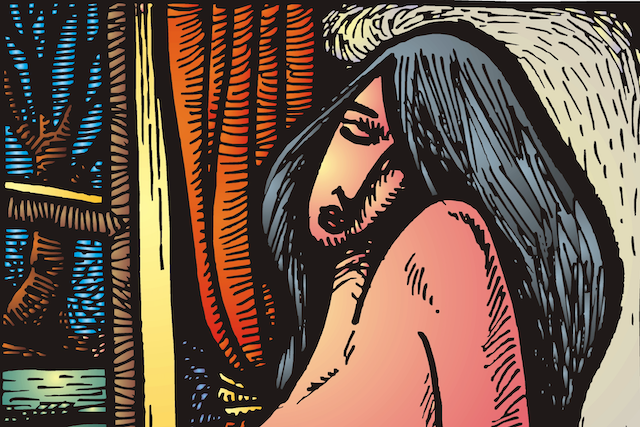
    For People Who Look in the Mirror and Cringe

    “Authenticity is the daily practice of letting go of who we think we’re supposed to be and embracing who we are.” ~Brené Brown

    When I was fourteen years old, I vividly remember the first time I put my fingers down my throat and made myself puke.

    I remember feeling fat, ugly, unworthy, and like I was not good enough. I felt as if I had no control and I was unable to effectively process the strong emotions I was feeling. Binging and purging allowed me to temporarily release these feelings, to numb them out, and created a fallacy of control in my life.

    From that day on, for the next twelve years of my life, I became consumed with food, weight, working out, and binging and purging.

    I measured my value based on the inches on the measuring tape, the letters on my clothes, and the numbers on the scale.

    I measured my self-worth on the severely skewed perceptions of beauty that I held.

    The way I viewed myself led me down a lifestyle of numbing my emotions with substances, putting myself in risky situations, and hurting the people I loved most.

    My self-hatred kept me blocked off, emotionally numb, and gave me a false sense of control in my life. I became adept at constantly wearing a façade of masks—smearing a smile on my face was second nature to hide the ugliness and shame that I felt in every pore of my body.

    And although over the years I have overcome my disordered eating, the battle with self-love continues. I sometimes wonder if I will ever be able to silence the constant push and pull from the internal thought patterns and dialogue that goes on in my head.

    The one thing that gives me some solace (and sadness) is knowing I am not alone.

    Because, no matter your age, gender, race, family make-up, or religion, the majority of us struggle with some sort of skewed self-image, negative self-talk, and self-limiting beliefs that keep us stuck in the perpetual cycle of questioning our worthiness.

    Although the stories we tell ourselves based on our personal life experiences, traumas, and joys are unique to us, they are collective to the human experience.

    This post is for anyone who looks in the mirror and cringes…

    Who cry as they measure their self-worth by the letters on their clothes, the numbers on the scale, or the amount of “likes” they get on social media…

    Who judge themselves for the jiggle of their bellies, the cellulite on their legs, or the wrinkles on their face…

    Who take out their perceived inadequacies on their bodies, harming it through their method of choice—substances, eating disorders, self-harm, risky behaviors.

    This post is for the women who are researching the next fad diet, fretting about the color of their roots, their wrinkles, or their weight as they contemplate spending their savings on cosmetic surgery trying to live up to society’s filtered expectations of how a woman “should” look.

    For the men who are measuring their masculinity based on the size of their penis, the look of their muscles, or the hair on their heads.

    For the transgendered and Cis community who feel trapped in a body that is not aligned with the essence of their true being.

    For the people who refuse to look in a mirror, fearful of what they may see.

    For the people who feel like they will never be good enough, strong enough, or worthy enough.

    I want you to know: You are beautiful enough. You are good enough. You are worthy enough.

    I know if you are reading this right now, you may be skimming over those words thinking “yeah, yeah.”

    But slow down and read them again.

    You. Are. Beautiful.

    You. Are. Good. Enough.

    You. Are. Worthy. Enough.

    No matter your age, size of your pants, number of dimples or pimples you have. No matter the size of your muscles, the hair on your head or the wrinkles in your skin.

    You matter.

    Your life matters.

    The world needs your essence. Your love. Your personality. Your spirit. Your uniqueness.

    In a world where we are inundated with an average of 6,000 to 10,000 advertisements a day telling us how we should look, how we should live our lives, and who we should be, in a world where social media is a filtered lens skewing reality, allowing only glimpses into the realities of others’ lives, it can be easy to add fuel to the fire of self-deprecating thoughts and feelings of unworthiness.

    What I learned from my personal struggle with body image, self-hate, and pure distain for every inch of my being, is that self-love is going to look different for everyone, and it is going to take time to undo the decades of self-deprecating self-talk.

    But it can be done.

    The rise of body-positivity and self-love movement is encouraging, yet it can also leave you feeling as if it is one more thing you are failing at because you just can’t bring yourself to fully embrace those lumps, bumps, tiger stripes, pimples, and dimples just yet.

    Through my experience I have found if you start small and give yourself grace and compassion you can start shifting your mindset around how you view yourself. Below are the steps I took in my journey that you may find helpful for your own journey.

    Do the deeper work.

    Begin to understand how your subconscious mind and self-imposed limiting beliefs from your personal experiences are keeping you stuck. Neuroscience shows us that we can reprogram our subconscious beliefs. Start being the scientist of your life and figure out where these feeling come from so you can start becoming aware of them. The first step in changing any habit/belief is awareness.

    Start small.

    Focus on the features you love about yourself. The first body part I started liking was my fingernails. Yes, my fingernails. But as I got used to saying I loved my fingernails I moved on to other body parts and kept the snowball going.

    View your body as your partner, not your enemy.

    This body does so much for you day in and day out. Shift into a perspective of gratitude for all the amazing things it does. Those thighs help you walk, that belly processes nutrients to fuel you, those wrinkles are proof of years of love, life, and wisdom. Start using the holistic healing powers of your breath. Begin partnering with your body on how you can help each other.

    Do an inventory of your strengths.

    If this is hard for you to do, then reach out to someone you love and ask them to tell you, in writing, what they love about you or see as your strengths. Seriously, this is scary. I get it because I did it. And I am so grateful I did. I reached out to three of my closest friends and family members and asked them what they saw in me. I did this over eight years ago and still have these letters taped in my journal so that I can read in times when I cannot see what they see.

    Consciously choose to focus on what gets you excited in life.

    It is so easy to waste our valuable time comparing our lives to others, focusing on what we hate about ourselves, or getting stuck in the perpetual cycle of negative self-talk. Instead, consciously choose to chase your curiosity.

    Have you ever set intentions for your year or your life? Setting intentions is one of the most powerful tips I adopted when I began my self-love journey, as it allowed me to focus on the bigger picture of who I wanted to be, how I wanted to show up each day, where I wanted my life to go, and what my definition of happiness truly looked like.

    Can you imagine how much passion, happiness, and love we would exude into the world if we were able to switch out the time we spend putting ourselves down into building ourselves up?

    We would change the world.

    You truly are so much more powerful that you know.
  • The People Who Hurt Us Are Vehicles for Our Growth

    The People Who Hurt Us Are Vehicles for Our Growth

    “You only see in others what you have in yourself.” ~Annette Noontil

    I now recognize, after observing painful patterns repeat many times, how things that trigger me are just lessons I need to learn that are often delivered through other people. The more painful the experience, the more I can see (in retrospect) I learned from it.

    Every now and then, when I find myself getting sucked into thoughts about the rightness or wrongness of a situation and how much pain it’s causing me, I take a step backward. I can see that people are just the mechanism to my growth, and painful experiences are just big Wrong Way signs redirecting me to my best life.

    In his book Scattered Minds, Dr. Gabor Maté wrote, “It is well recognized now that people will form relationships with others exactly at the same level of psychological development and self-acceptance as their own… What we might call the law of equal development holds true even if the people themselves buy into the mythology that one of them is more emotionally mature than the other.”

    I love this insight from Dr Maté, especially when he goes on to give a typical example of a married couple with one spouse that appears to be functioning in the world more successfully than the other. When the relationship is examined more closely it can usually be seen that both people have a lot of maturing to do in order to be able to function healthily as individuals rather than in a codependent state.

    It’s no coincidence that we form relationships with people who trigger us. We are drawn to people who are, in some way, a match to our own issues, and they both challenge us and help us heal and grow.

    As a homeopathic practitioner recently observed, about two differing constitutions often drawn to one another: “One is in their head and has to learn to connect from their heart, the other is in their heart and has to learn to connect from their head.”

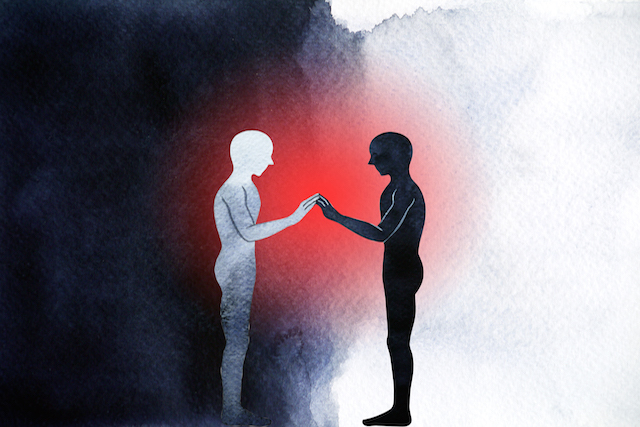
    But all this holds true whether it’s an intimate relationship or a more distant one; if someone triggers you (positively or negatively) they have something to teach. Michael Kerr puts it simply as “People gravitate toward their emotional mirror images.”

    “People tend to sort themselves out by levels of emotional development for many purposes, not just marriage, “ writes Stanley Greenspan, “because those functioning at different levels are practically speaking different languages…. People widely separated developmentally in fact have very little to talk about.”

    It can be tough to look at people I have, at one time, literally despised and consider that we were emotional mirror images—for example, a jealous colleague who went out of her way to discredit me on a number of occasions. This doesn’t mean that I am a bully because someone bullied me (although it could mean that for someone else); it means that we both had an equal emotional stake in the same interaction.

    In retrospect, I can see that my former colleague triggered pain from my childhood relationship with my mother.

    My colleague’s modus operandi was an unfiltered lashing out at anything that stood in her way. Her unprofessional conduct went unchecked and unmanaged because she had been promoted for the short-term results she’d achieved.

    Her behavior reflected the unfiltered (tongue) lashing I often received from my mum when she was feeling highly anxious.

    As a child, I learned to stay out of trouble by anticipating her emotions and striving for perfection in my behavior so that I received no criticism (which was usually unfounded and always delivered in a way that felt crushing and unfair).

    Not that I was ever passive, but when I wanted something I would go after it from a point of defense, justifying myself rationally rather than having healthy boundaries around my own needs and desires.

    To be criticized publicly by a colleague was, therefore, not something that felt safe to me. My attempts at repairing the relationship privately were unsuccessful, and it was not until I stood up in a meeting and told her pointedly that I would not allow her (nor anyone else) to bully me that I garnered her respect.

    This experience allowed me to see how much hurt I’d been harboring from my childhood, and to put energy into healing that old wound rather than perpetuating any more situations that echoed it.

    With the benefit of hindsight and my own years of parenting, I can now see I wasn’t responsible for my mum’s anxiety; rather it was an amplification of her own anxiety as a child in reaction to the culture and environment she grew up in, and the way her behavior was managed.

    While it’s easier for me these days to detach myself from issues that trigger me emotionally, note that I do still get triggered. That, I believe, will never change because there is no surer way to know what we do want without first experiencing what we don’t want. It is just best not to get stuck feeling sorry for ourselves.

    I’ll admit it’s sometimes hard to see a way through the emotions of the moment, especially when it relates to an ongoing situation. When I’m triggered, it’s still through other people whom I would dearly love to validate my view, just as they would no doubt love me to validate theirs, so there is a lot to work on.

    The beauty, though, is that I mostly choose to do it from a point of intrigue and willingness to learn and grow rather than feeling powerless and at the mercy of others.

    Again, note I said mostly. Old habits die hard, and there are still many times where I’ll find myself turning to confidants to rant about something. For this reason I choose to confide in people who gently prompt me back to the observer’s chair, and the broader view.

    And when similar situations keep arising, I know that life is presenting an important lesson for me. It’s not always immediately obvious what the real lesson is and how I can overcome my struggle, but experience has taught me that things become clear when they are ready to; my job is to cope as best as I can with my frustrations rather than make myself miserable.

    And since the lessons are most often delivered through others, I try not to vilify them for their part. I know that in the future I will be thanking them—even if only inwardly—for the role they played in my ongoing growth and journey through life.

    So what are you currently triggered by, and who is the focus of your frustrations? Think about past situations where you’ve felt similarly. When was the first time you can recall feeling this way? Try to see the pattern, and what it might be telling you.

    Rather than living through the pain as a helpless victim, try to see the lessons you’ve come to learn. In whatever way the lesson is being played out, the true lesson will be some version of learning to love yourself more; it always is.

    Can you imagine a world full of people who are seeking their power through self-love rather than trying to take from others? Now that is a world I’d like to live in.

  • What Do Strangers Think of You?

    We all hone in on our “imperfections.” Most of us are harsher toward ourselves than other people would ever be. But what if those imperfections are actually things others might find beautiful? And what if other people see us for so much more than just our skin and body type?

    BuzzFeed asked people to look in a mirror and describe what they saw. What they didn’t know was that there were strangers on the other side of the mirror, giving their first impressions.