Tag: mind
-

How to Relax in Meditation When You Have a Busy Mind
“The Tao is always at ease. It overcomes without competing, answers without speaking a word, arrives without being summoned, accomplishes without a plan.” ~Lao-Tsu
As a longtime meditator and participant in the awakening process I am constantly on the lookout for hints that illuminate the path. I am open to these hints regardless of their source, so many of my teachers have been young children.
We may have many differing reasons to practice mindfulness and meditation. Regardless of the specific motivation, all meditators experience distraction and mental rebellion from time to time, and it can be quite frustrating. Many new meditators never get past the frustration and ultimately give up before they see the fruits of their efforts.
Although I never had a formal meditation teacher, I became engrossed in my own meditation process at a fairly young age.
Fortunately for me, I learned a lesson from an unexpected teacher, fairly early in the process, who helped me to transcend distraction and mental rebellion during meditation and throughout daily life. I’d like to share this lesson with you in hopes that it helps you to get more out of your meditation and life.
My wife regularly visited a large park in Tokyo for weekend strolls, picnics, and to walk the dogs. One day at the park a young Japanese girl unwittingly became my teacher.
We had agreed to meet a friend, Yuuji, for a picnic one Sunday. Yuuji brought his wife and his eight-year-old daughter, Kotomi, and we brought our dogs.
One of our dogs, Leila, is a Chinese crested dog, which is a small breed. Kotomi really loved dogs and wanted to walk one of ours, so we let her take the lead for Leila.
Kotomi was so excited to walk a dog for the first time! It would also be Leila’s first walk with a stranger.
My wife taught Kotomi how to hold the leash, how to keep Leila next to her during the walk, and so on. Kotomi listened and nodded that she understood.
Our little Leila was always great on walks, but as my wife handed Kotomi the leash, Leila looked at me incredulously. Clearly this was going to be a battle of wills.
Leila totally ignored Kotomi’s lead and began sniffing here and there to her heart’s content. Kotomi, feeling Leila’s weight on the leash, pulled the leash over her shoulder and leaned into the walk, forgetting all technique.
Not wanting to submit to this stranger, Leila leaned back against the leash and bucked against the girl. Kotomi just kept moving forward as if Leila wasn’t even there.
I kind of felt bad for Leila, but she wasn’t experiencing any physical harm. She was testing her new walker, which is not uncommon for dogs that have never been walked by anyone other than their family members. Curiosity had me, and I wanted to see how this scenario would play out.
Leila put up a great fight, but it was all for naught because Kotomi seemed oblivious to it. She was just excited to be at the park. I wondered if she had forgotten that there was a dog on the other end of the leash.
The dog fought; Kotomi just moved forward.
After five minutes, I began to wonder how long Leila could keep up her fight. Ten minutes passed with Leila still locked in resistance mode, so I considered taking the leash myself. But then, like the flipping of a light switch, Leila joined the walk.
Just like that, she surrendered to Kotomi and began smiling as she walked next to her new friend. For the rest of the day she was the perfect dog. She sniffed, wagged her tail, and even let Kotomi pick her up, the first stranger ever to do so successfully.
Kotomi had won a fight that she never even took part in! She just moved forward mindlessly.
After this experience I began applying the “forward motion” principle to my meditations to astounding effect. I just gave up any expectation that my mind was going to cooperate and instead simply moved forward.
How does that principle play out in meditation?
You know how it can be in meditation: The mind gets distracted again and again. There may be some physical aches and pains that the mind clings to. Then the mental resistance starts with statements like, “I’m not doing this right,” or “I have too much mental noise,” or “I don’t feel like meditating today, I’ll do it tomorrow instead.”
But now is the only time that we ever have! Tomorrow never was and never will be. It’s a figment of the imagination. Either we are moving forward in the moment or we are not.
Admitting the reality of now, I decided to sit in meditation for the allotted time, regardless of how my mind felt about it. I was not going to let distraction or frustration have any power. I determined to let the mind fight the good fight, while I moved toward my goal of deeper relaxation and clarity.
My mind was worried about work-related issues, reminding me of things that I already knew. Here’s what happened.
“Did you check the tests for grammar errors?” I took a deep breath, tensed my entire body and released it, relaxing my body and expanding my awareness globally.
“Don’t forget to print the tests first thing tomorrow morning!” I tension-released again, going deeper still into relaxation, opening awareness again in every direction.
“Remember to ….” In midsentence I tension-released into spaciousness.
I began to notice that my mind would go into little frustrated narrations when a thought arose, “Jeez, another thought,” or “Ah, again,” or “When is this going to stop?” Then it occurred to me that my reactive opinions of thoughts are also thoughts, so I decided to relax and expand at each such occurrence.
After a few minutes of expansive releasing, secondary thought ceased, but there was still the feeling of frustration when primary thoughts arose. I then included feelings into my breath-releases.
In short order, thought felt far away. Although thought still occurred, there was no feeling that it was my thought.
The breath-release-expansion continued at each distant thought, and after a time overt thought and emotion ceased entirely.
What was left were just little blips of thought and emotion, unformed and out of context. They came up out of the unconscious like little ripples in the stream of awareness.
There was a sudden insight into how the mind worked. Thought begins with these tiny little blips that the mind reacts to habitually by stringing them together with memories, effectively creating narratives, stories, and images that pull awareness out of the present.
It was like seeing behind the curtain in The Wizard of Oz, only to find a weak-willed con man at the controls. A debilitating illusion was broken.
Silence.
The lesson of moving forward worked! Just like every little step that Kotomi had taken in the park, I moved forward, step by step, into a timeless clarity that was interrupted only by a beeping alarm. Thirty refreshing minutes had passed.
So, when you sit down to meditate, decide how long you are going to be there and be there for that allotted time, relaxing ever deeper into expansiveness. Accept that the mind will sniff here and there and rebel. Just keep moving forward through relaxed awareness into spaciousness.
Eventually something unexpected may happen. Before long the mind begins to follow your intent, silencing quickly.
When you stop fighting the mind, something else unexpected may happen. You may also cease to concern yourself over the mind’s assumptions, opinions, narrations, regrets, instant replays, and so forth.
Once there is insight into the mind through direct experience, there is no longer any need to fight or correct it. The dog will come along once it tires of the fight, and before you know it, you will have a new friend who supports your meditations—and your life.
-

Slow Down, Simplify, Clear Your Mind, and You’ll Get Better Results
“The real you, the inner you, is pure, very pure. It understands. It has patience. It will wait forever while your ego trots all over everywhere trying to figure life out.” ~Stuart Wilde
There’s a common myth I think we all fall prey to: If something is important, it has to be complicated.
Surely, if what we want is easy—be it a business venture or a happier life—then everyone would be going for it, wouldn’t they?
Well, yes, in a way. But I’ve found that while the road to success and happiness isn’t always smooth sailing, it’s usually us who overcomplicate matters.
When we learn to get out of our own way, we might actually get the results we want a whole lot faster.
Slowing Down to Speed Up
You see, I’ve been aware of this idea of creating space, slowing down, and simplifying for a long time, but it’s only recently that I’ve fully grasped what it’s all about from a deeper level of understanding.
Growing up I was quite a creative soul, and as I moved into my teenage years, I began to write songs. It was then that I was first introduced to this idea of simplicity of both form and message.
A teacher once told me that it wasn’t the notes you played that made the music special; it was the space between the notes. The beauty was in what you didn’t play.
At the time I kind of understood what he meant, but more on an intellectual level than insightfully.
I always felt I had to learn more, to put more notes and more ideas into the music I made. So I’d layer more guitars, buy new keyboards, put in whatever I could find to make it feel bigger, more accomplished.
What I now know, of course, is that all I was doing was muddying the waters. This perhaps was why my musical career never took off in the way I wanted. Similarly, a few years after, I turned to another passion of mine and started acting. Again, I did okay by and large. I got myself an agent, did some short films, a few plays, a tour.
But again, faced with fear, uncertainty, and doubt, I wobbled. I wrongly thought I needed more techniques—that, if I had more theory at my disposal, I’d never have to deal with the insecurity that came from exposing the real me.
I steadily found myself overcomplicating my craft. One more course, one more book on acting, and I’d become the actor I could be.
I trained and I read and I watched master classes until my head swam with so many different ideas that I eventually forgot the only real important part: to be present and connected with the other actor in front of me.
Releasing Control Doesn’t Mean You Don’t Try
In both these cases I found myself overcomplicating everything so much that it stopped being fun. I was trying to control something that never was meant to be controlled.
The worst part of all this was that, intellectually speaking at least, I knew this. I knew that simplicity was the key to creating anything good in the world.
When something is stripped down, pure and totally authentic, it cannot help but be rich with energy, spirit, and truth.
I knew this, but I think back then I only knew it in my head, not in my heart. I wasn’t confident enough to trust in it. In a way, complicating things felt safer because it tricked me into thinking I was being productive while taking the focus off my own insecurities and vulnerability,
And I think this is where a lot of us can struggle.
We overcomplicate things because doing so takes the attention away from the root of who we are.
We’re scared of sitting quietly with ourselves, so we do everything we can to keep the lights on and the dance floor full.
We worry that if we let go of our habitual, insecure thinking, we might not like what we find in those quiet moments.
Yet these quiet moments are actually the times when we can allow real progress to be made.
When our minds are clear and we’re connected with who we are—before all the thinking and stories and beliefs we’ve piled on top of ourselves since birth—we are more resourceful and resilient than we might ever give ourselves credit for.
We don’t ever need to think ourselves into getting better results; we just need to trust that our innate wisdom is always there if we slow down and connect with it.
As Lao Tzu wrote, we turn clay to make a vessel, but it is in the space where there is nothing that the usefulness of the vessel depends.
I think this is apparent more and more in this modern world, where we all willingly plug ourselves into the matrix.
If we never slow down and get off the hamster wheel, we can avoid the emptiness we expect is waiting for us.
Yet, this is an unfounded fear.
Sure, it might seem that simplifying our lives and our experiences will leave us devoid of fun.
It might appear that surrendering to the present moment will take us further away from the life we want.
We might believe that unless we keep latched on to our thinking, we can’t possibly get to where we’re going.
Yet, in reality, the space we allow to open up when we slow down and simplify actually fills up pretty quickly.
And, instead of that cold, unforgiving abyss, what actually comes flooding in is love and resilience. And with it, a clarity of mind that promotes insight and high performance.
In allowing ourselves this space, we access infinitely better results than if we stayed stuck in our heads, overcomplicating our lives with stressful thinking.
I’m not suggesting we all just tune out of life and bury our heads in the sand. I’m suggesting that when we ground ourselves in the realization that insecure thinking never gets us what we want, we can then move forward with a much stronger footing.
Overcomplicating matters never works well for us, whether writing music, acting, or figuring out what to do next in life.
When we drop out of our thinking and connect to ourselves and the present moment, the answer often shows itself to us. Why? Because we’ve given it the space to appear.
Without that space, all we have is the same old thoughts and ideas cluttering up our heads.
These ideas haven’t served us well in the past, so why do we think we’ll find the answers there now?
As Einstein wrote, the definition of insanity is doing the same thing over and over again and expecting different results.
I used to believe that if I wanted to achieve something, or if I had a problem I had to solve, the only way I’d get there was to go up in my head and think my way to a solution.
But this too was just a symptom of overcomplicating matters—a fear of surrendering to what is.
As I’ve traveled further on my journey of self-awareness, I’ve come to understand the true inside-out nature of how life works. I recognize more and more how the old way of being never helped me, and that when we give ourselves space and clarity of thought, we allow new ideas to form.
Whether we’re stressed, anxious, or trying to work out how best to achieve what we want, the less we have on our mind, the better life gets.
So if we are learning to move away from thinking our way to solutions, what do we do instead?
We slow down. We take away.
The beauty of these concepts is that we don’t have to learn lots of new techniques to get the results we want. It’s not about adding things but simply stripping away all the stuff that inhibits us.
Trust that going up into your head and doing loads of that really, really good thinking only really takes you out of the present moment.
Usually in these moments you’ll be imagining a past that you think is warning you of something or a future event that scares you from moving forward. But the operative word here is “imagining.” These experiences aren’t real. Yes, it’s very easy to think your feelings about them are telling you something. They never are. You are only ever feeling your thinking in the present moment.
When you become fully aware of this, you quickly reconnect with yourself and fall back into reality, where insights can happen and you can take action.
To better help with this understanding and create a space for insight to happen, I find it helps to get away from distractions strategically throughout the day. Go for a walk in nature, book some quiet time with yourself for reflection, and actively disconnect from your emails and phone for an hour or so.
Little acts like this create exponential results when you allow yourself the space and clarity to fully connect with yourself and the world.
When we’re calmer and more relaxed, everything comes a lot more easily. By creating a peaceful, quiet space around us, we allow our innate wisdom and well-being to come to the surface.
This is who you are before the world put all the thoughts and worries and stories on you.
This is you, uncomplicated, unencumbered.
Pure, elegant, resourceful.
Think about it; did you ever really get any great ideas or solve any major problems when you were stressed, stuck in your head, and anxious? Don’t you usually get your best ideas when you’re calm, clear-headed, and relaxed? Perhaps in the shower or when out walking?
Life was never meant to be a struggle.
If I’d known this earlier, maybe I’d have been a more successful songwriter or a better actor. Yet, I wouldn’t change anything about my journey, and with these new insights I have no desire to be anywhere else than where I am: here. In the moment. Connected.
The bottom line is simple: learn to trust that when your head is clear of thoughts, this isn’t you not trying; this is exactly the right condition to allow new insights and ideas to appear.
With this new understanding, you free yourself up to fully connect with who you really are.
You are free to play music, act, or do whatever you see fit, from a place of simplified ease. You surrender any ego-driven desire and enjoy your present reality.
Letting yourself go and really trusting in that stillness will take courage, but when you do, I think you’ll find that life suddenly feels a whole lot richer and less complicated in the best possible way.
-

21 Easy Ways to Create a Calm Mind (Without Meditating)
“Learn to calm down the winds of your mind, and you will enjoy great inner peace.” ~Remez Sasson
While juggling a full-time job and my writing, I found it easy to lose track of the days. Weekends ceased to exist, and my life ebbed and flowed between working and writing, the two constantly blurring into one another.
I dragged myself from day to day without a moment’s rest in between. When I did rest, I’d feel guilty for taking a break from working on my dreams, and it didn’t take long for the guilt to turn into frustration.
I wondered whether I’d ever reach my dream of writing full-time, if and when it would ever come.
I intended on using every free moment I had from my job to write, without realizing the true consequences of what I was doing. And by constantly pushing myself forward, I never gave my mind the space it needed to shape and form my thoughts; I never allowed myself to simply be, which resulted in all kinds of mental blocks and frustrations that met my writing progress head-on.
I was on my way to burnout, and fast, and I knew I needed to make a change. So I turned to meditation. It helped me become more mindful throughout the day and approach my writing from a new angle of clarity.
As I began to incorporate mindfulness into my daily routine, I found it easier to give myself permission to relax and unwind from the pressures of my day job, rather than simply filling every moment with something more to do.
Mindfulness Goes Beyond Meditation
While meditation can help you become more attuned with your mind, you already possess all the tools you need to reap the benefits of a quiet, calm mind.
By simply tuning into the small things in life, you can work your way towards a greater happiness and fulfillment in your own life. Here are twenty-one ways you can boost the quality of your mind without meditating.
1. Create a mindfulness mantra.
As Eckhart Tolle says, “Realize deeply that the present moment is all you have.” Every morning I remind myself that my new life starts today, which helps me step into the now and connect more deeply with the present moment and separate myself from the worries of my mind.
2. Remind yourself you’re not your thoughts.
Whenever a negative thought occurs in your mind, simply identify it as a “thought” or “feeling” and move on. You’re not scorn or regret, and you’re not self-doubt or anger. You’re separate from your thoughts, and they’re separate from you, so why dwell on them?
3. Accept that thoughts arise naturally.
And if you can’t change them, then why bother trying to replace them with different and “better” thoughts? Don’t beat yourself up over something you can’t control, but don’t ignore them either; simply move past them and choose not to identify with them, even as they cloud your mind.
4. Breathe.
Take a long breath through your nose and breathe it out through your mouth. This can help to calm you and remind you that your thoughts are a small part of the infinitely vast world around you.
5. Thank someone in any way you can.
Even the small act of saying “thanks” to a cashier can reconnect us with the present moment, and it can also prevent us from becoming stuck in our own thoughts, which block us from enjoying life as it comes.
6. Smile at a stranger.
Smiling helps focus our attention outward to the people around us, and by reconnecting with this gratitude for others, we can connect more deeply to the present moment and remind ourselves to simply be.
7. Go for a nature walk.
Go for a walk and fade into the environment around you, and listen for sounds you’d otherwise have missed.
8. Keep a daily gratitude habit.
Keeping a gratitude journal helps pull us away from the stress of the day. It also forces us to appreciate life as it comes and find the good in every day.
9. Leave your phone on silent all day.
You can also turn off your phone’s notifications, as these can be distracting and pull you away from the present moment. Your messages will still be waiting for you there later when you’re ready to go through them.
Turning your ringer off can also stop each disruption from clogging your mind and blocking you from the peace of mind you could be having throughout the day.
10. Eat slowly.
Focusing on the texture and the taste of what you eat can help remind you that while all feelings are temporary, it’s important to truly experience the moments as they come, rather than letting them pass you by.
11. Drink tea.
Tea can help calm your nerves and slow down your thoughts and connect you more to the present moment.
12. Take a bath.
Baths can help you relax by forcing you to take a step back from the bustle of the day, and they can be a great way to let your worries fall away as they fade into the heat of the water.
13. Listen to instrumental music.
It’s proven to boost your ability to focus, which can raise your quality of mind and help you relax when your thoughts won’t stop coming.
14. Tackle one of the most stressful things on your to-do list.
While it’s important to be mindful despite the demands of your day, don’t avoid completing a stressful task on your list if it’s giving you unneeded anxiety. If you need to finish your taxes, for example, but keep putting them off, then it might be useful to complete them to get rid of the stressful thoughts that come from procrastinating.
15. Have a deep conversation with somebody you know.
Fully focus on the other person and listen to what they have to say. By not simply waiting to say our piece, we can help pull ourselves out of our own heads and connect more deeply to the moment by showing appreciation to the people we talk with.
16. Watch your favorite show.
It’s important to take time out of our day to reward ourselves, and indulging in a simple pleasure like watching a show we like can help us step away from our worries and enjoy our free moments from the bustle of life.
17. Write a haiku or any restrictive poem.
This can challenge you to be creative in ways that free-form writing can’t do, and can help you recapture a moment in your life that was pleasant but fleeting.
18. Do a word puzzle.
Crosswords can help your mind be creative and can boost your intelligence, as well as the overall clarity of your thoughts. They can also provide a break from your daily routines, all while being fun to complete.
19. Do the dishes.
Doing the dishes can be a great way to take a break from life, and also be productive while you’re at it. Cleaning dishes can help you feel great, and it pulls you away from your current thoughts, which, in turn, can give your mind permission to relax and recharge from the stress of the day.
20. Stare at a piece of art you love.
Whether it’s the Mona Lisa, a poem you like, or a drawing that your spouse made, nothing is off the table here. Art is subjective, and it can help you feel and fully embody the moment by showing your appreciation for the work of others. (Just don’t think about why you like something, as that’s not important here).
21. Pet a dog or cat.
Feel the fur beneath your hands and the softness of their skin. Petting an animal can help release our tensions and connect us to the moment, and can pull us away from our thoughts.
Sometimes we’re so busy focusing on ourselves that we forget to enjoy the moments as they come. We become trapped in the confines of the day-to-day and the span of our own goals, and we forget to enjoy the beauty of life and the little things.
Being more mindful helped remind me that all good things come with time, and there’s no sense in working so hard if you don’t enjoy life as it comes. It helped me escape the pressures of my job and embrace my writing without allowing it to consume my life, and it helped remind me to enjoy life again by tapping into the power of the present moment.
We All Have Time To Be Mindful
Mindfulness doesn’t have to be time-consuming or all-encompassing. You can easily use any of these techniques throughout your day to calm your mind and keep yourself fixed in the present moment and free from your worries.
Just don’t forget to stop once in a while and breathe it all in.
-

Get Out of Your Head: The Life-Changing Power of Embodying Your Body
“The modern individual is committed to being successful, not to being a person. He belongs rightly to the ‘action generation’ whose motto is ‘do more but feel less.’” ~Alexander Lowen
I’ve always been a little bit scared of my body. And when you’re scared of something, you tend to avoid it at all costs. So that’s what I did for most of my childhood and teenage years.
I avoided it in lots of different ways, and most dangerously, I avoided it unconsciously.
I was bought up doing a lot of physical activity—gymnastics, dance, basketball, and horseback riding. Although this wasn’t bad, the perspective I developed was. I grew up seeing my body as a challenge to overcome—something to will into performing better.
Moving into my awkward pre-teen and teen years, surrounded by an image-obsessed culture where our bodies are displayed in a hierarchy of perfect to undesirable, I started to rank myself.
It was inevitable that I’d become even more isolated from my body. I stopped playing sports as much, feeling too insecure to lose myself in something I enjoyed, and started feeling embarrassed about my body altogether.
I had an idea of what I should have looked like, but it seemed impossible to mirror that image without feeling miserable.
It was as if my body didn’t belong to me anymore. Other people’s preferences determined the way it moved and how it looked.
I neglected the conversation my body was trying to have with me.
We are a head culture, and increasingly so. We spend a scarily large portion of our lives inside our minds. Whether it’s on Facebook, talking on the phone, listening to music through headphones, or staring at screens, our physical interaction with the world is limited.
It’s rare for us to use our bodies physically in any activity. Even when we exercise, we often have the ultimate ego goal of looking good in our minds, not feeling good.
I realized that my mind had become so loud, and with university coming up and more responsibility looming, it was just going to get louder.
One day, by chance, I came across bioenergetics.
Bioenergetics is a form of therapy that seeks to understand personality through the expression of our bodies. Its most fundamental principle is that what goes on in the body affects the mind, and vice versa.
Essentially, the mind and the body are the same thing.
This was groundbreaking to me, because I had always thought of myself as two separate entities—the mind in control and the body along for the ride.
Exploring bioenergetics further, I started to practice calming my busy mind through paying attention to the physical sensations in my body.
I would stretch every morning, not using any particular routine, just allowing myself to move, and in turn, relinquishing any sense of control over my body.
I learned to let myself breathe in a way that made me feel good. Not with the shallow breaths I was used to taking from years of sucking in my stomach, but deep, indulgent belly breaths. The satisfaction and happiness I felt from simply breathing deeply was phenomenal.
I learned that being exhausted doesn’t indicate a “good workout,” but that my body was telling me I had done too much.
I would go on these intense runs and not even be aware of myself until I was home, sweating, and bright red in the face. Why do we force our bodies to run that extra mile if they’re screaming at us to stop?
In a society that values power and progress, our bodies can sometimes take the role of subordinate, working beneath our minds.
We want to achieve more, so we repress feelings of tiredness in the name of getting more done. We ignore tough emotions, like sadness, because we think we have to put on a happy face to the world around us.
When you listen to your body, you get a greater sense of your emotions flowing within you. Allowing your emotions and feelings to surface and be expressed, as opposed to repressing them, is a recipe for happiness.
It takes courage to give in to how you feel, but when I started doing this, I wasted less energy trying to hide my real feelings.
Instead of runs, I tried going for walks, moving slowly and sensually, with purpose, being completely aware and engaged with myself and everything around me. It has proven to be a much more enjoyable experience.
And why not enjoy our bodies?
Our heads are a seductive place to live because inside them, we feel we have complete control. But through having complete control, are we really enjoying life more? The gaping void between a mind that can’t be quiet and a body that is a dozen steps behind causes us nothing but stress.
Sometimes we need to let go of our heads and follow our hearts. To truly experience life is to allow the thinking in our head to mute and the feelings and sensations in our bodies to amplify.
Next time you’re going somewhere, pay attention to everything you feel in your body as you walk. Try not to plan what you’re going to do when you arrive; just stay very present with your body in the moment you are.
Think of children playing, and how much excitement and joy they get from just moving and being in their bodies. There is no reason we can’t be like this again. We just need to trust in our bodies—in ourselves.
I turned against my body and the intricacies of its needs, all in the name of progress—in order to look better, run faster, perform more accurately. I now know that our bodies are our gateways to the world; and unless we are fully living in them, our presence will be limited and the world will pass us by.
-
Whose Mind Is It Anyway? Get Out of Your Head & Into Your Life (Giveaway!)
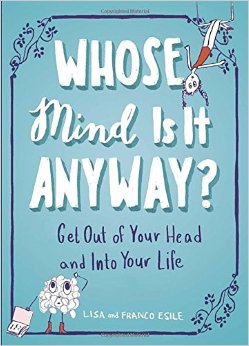 Note – This winners for this giveaway have been chosen. They are:
- Stephanie
- Kait Husmann
A few years back, Tiny Buddha contributor Lisa Esile wrote a post about negative thinking that was incredibly eye opening.
Titled 3 Reasons to Stop Worrying About Your Negative Thoughts, her post suggested that instead of trying to suppress negative thoughts or replace them with positive ones—as conventional wisdom suggests—we should observe them, choose not to believe them, and let them naturally pass.
Brilliant, I thought. Don’t feel bad about the thoughts that go through your head (which adds guilt on top of the stress that comes from constant judging, assuming, worrying, plotting, and controlling).
Instead, create space between you and your thoughts. Stop fighting your mind and start understanding it.
Stop struggling to let thoughts go and instead, let them be.
Ah, instant relief.
I know what you might be thinking: If we don’t listen to our thoughts, how will we know what to do? How will we solve problems? How will we figure out what we want and make a plan to get there?
Lisa tackles all of this, and more, in her quirky new illustrated book Whose Mind Is It Anyway? Get Out of Your Head and Get into Your Life.
Co-written by her husband, Franco Esile, Whose Mind Is It Anyway touches upon how our thoughts can drive us crazy, how our beliefs can sabotage us, and how easy it is to find calm—once we stop thinking our way through life.
It’s a quick read, but don’t let that fool you: Within seven short, fun chapters, Lisa and Franco have succinctly explained how we can not only find peace from our thoughts, but also be at peace with ourselves.
I’m a huge fan of Lisa’s work, and I couldn’t be more grateful that she sent me a copy of her book and offered two free copies for Tiny Buddha readers.
Whether you win a copy or choose to grab one today, I recommend keeping it somewhere you’ll see it often and flipping through the pages whenever you’re getting stuck in a web of thoughts.
Start paying attention to how your mind works and you’ll notice this happens a lot!
THE GIVEAWAY
To enter to win one of two free copies of Whose Mind Is It Anyway?:
- Leave a comment below. You don’t need to write anything lengthy—“count me in!” is more than enough!
- For en extra entry, share this post on one of your social media pages and include the link in your comment.
Good luck!
Want to grab a copy now? You can order Whose Mind Is It Anyway: Get Out of Your Head and Get into Your Life on Amazon here.
FTC Disclosure: I receive complimentary books for reviews and interviews on tinybuddha.com, but I am not compensated for writing or obligated to write anything specific. I am an Amazon affiliate, meaning I earn a percentage of all books purchased through the links I provide on this site.
-

Think You Can’t Do It? Don’t Let Your Mind Limit or Define You
“The limit is not in the sky. The limit is the mind.” ~Unknown
I was having a conversation with a friend. She was telling me how maybe I should quit my writing and focus on something that wasn’t so challenging for me; that I should accept my limits and work within those boundaries. Her words made me cringe.
You see, I am dyslexic and I struggled greatly to write this story down. I am probably going to read it twenty times and will still have many mistakes that need editing.
My job is a daily struggle, and sometimes I break down and cry because it takes me double the time than it would take a non-dyslexic person. But here’s the thing, I’m not quitting, no matter how many times I cry, no matter how many times the editor sends my story back, or how bad I have it with dyslexia. I won’t quit.
I’ve seen a man with no legs and no arms swimming in the ocean, Albert Einstein was dyslexic, The Beatles were told their music sucked, and I was told I would probably fail in university.
Am I a story of success? That depends on what you think success is.
In a world limited by people’s opinions, I was fortunate enough to have parents who pushed me beyond what I thought were the limits imposed by my circumstances.
I was born with a heavy form of dyslexia that saw me fail over and over again math and Spanish (my native language). Teachers preached to my parents about how I would struggle greatly if I ever decided to go to university.
I felt like a failure, unable to cope within this non-dyslexic world. My parents, on the other hand, pushed me for greatness, but in my own mind I felt I couldn’t go very far. I let my own fear of failure keep me from going to university after high school finished.
For three years I searched for forms of making a living that didn’t involved math or Spanish. I became a waitress, a maid, a bartender, and a dog walker, until I realized I didn’t want to live my life with jobs that weren’t personally fulfilling and that left me no sense of satisfaction. I wanted to write. But how could I if I have dyslexia?
In spite of the great fear I had for my dyslexic mind, I enrolled myself into university. Ironically I chose a career path focused on writing. Journalism.
I pushed myself beyond what I thought were my own limits. I worked harder than my fellow classmates, and if it took them two hours to do an essay it would take me twelve. But I wasn’t fighting against them; I was fighting against my own self. Pushing and working beyond the pain, frustration, and desperation.
I spent countless sleepless nights trying to get each essay perfect and flawless, re-writing every sentence to make it correct and still I had flaws, mistakes, errors that made me feel like a failure.
It came as a surprise to me (but not to my parents) that I actually managed to graduate top of my class and got a freelance writing job in English! Which is not even my native language.
No, I’m not rich, I haven’t written a bestselling book, and I don’t make much money. But I can tell you this: I love my job, I love writing, I cry when I get sent back stuff, and I get very frustrated, but I keep going beyond my limits only to discover that it is limitless on the other side.
I keep improving with every mistake I make, and I’ve been fortunate enough to find amazing editors that value the creativity in my writing more than my mistakes.
Our bodies may have limits. We can only stand certain temperatures; we can only go a limited amount of time without air. But our minds forge their own limits. Those with limited mindsets will work within their limits and stay within the comfort zones that allow them to feel contentment with a sense of conformity.
But pushing our minds beyond their own limits can give us an indescribable sense of joy by showing us how limitless we truly are. We are what we think we are.
If you think you can’t run a marathon, you’ll never push yourself to start training; you’ll limit your body by your minds perception.
If you think you can’t start a new career in a creative field, you’ll overlook opportunities to strengthen your craft and potentially earn from it.
Doing what you want to do starts with believing it’s possible, no matter how difficult it may be. Achieving what it’s beyond our pre-conceived limits is what strengthens not only our bodies, but also our own minds.
Muhammad Ali didn’t become the greatest boxer of all time by believing it was easy, but by pushing beyond the pain and frustration, by forging a mind that saw him go beyond what he thought were his limitations.
I can whine and quit because I have a learning disability, or I can accept I have a disability and work around it, through it, and over it. For many years I saw my self as a failure for having something I never wished I had, but the moment I took responsibility for myself, my life, and my mind, I found the courage and determination to not let it define me.
Don’t let your mind define you. You are so much greater than what you think you are.
-

How We Create Problems for Ourselves (And How to Stop)
“If you think you’re enlightened, go spend a week with your family.” ~Ram Dass
I just returned from a four-day trip with my family. It was my own family of four (my husband and two kids), plus my mom, my two sisters, and my brother-in-law.
It was great. We get along well and have fun together.
And, it was four days with family.
It’s a funny thing…although you grow up with your siblings, listening to and being influenced by your parents, you all end up so unique—different from each other and different from the adults who raised you.
Of course we’re all unique. But our differences seem to be a little harder to accept or dismiss when we’re talking about family. These are the people you care about most in the world, and that usually means they can get under your skin like no others.
We tend to have the most opinions about, and agendas for, the ones with whom we have the deepest emotional connection. Unconditional love and all of that good stuff aside, four days with family can be the perfect breeding ground for I-can’t-believe-she-said-that and I-must-be-adopted.
A Shift in Understanding
In the past, when I’d think about the frustration and annoyance that would come up around my family, it looked very real. It looked like it was definitely about—and caused by—them.
I would have described it something like this: “Being around my family stirs stuff up. That’s normal, right? I experience some frustration, but it’s relatively minor. We get along great for the most part, and whatever annoyance there is tends to fade as soon as we go our separate ways.”
Basically, it looked to me as if there was an actual issue with my family, but I was grateful that it was minor. I was good at seeing the bright side.
Bright side-looking isn’t all bad. That was the best way I could see our “issue” for a long time and it served me. It kept me showing up and it allowed me to mostly enjoy our time together.
But on this most recent trip, I was blessed with an insight that gave me a different understanding of the exact same circumstances.
What I saw is that there is no problem with my family. There never was.
We don’t have an actual issue. If you looked at us from the outside, you’d see eight people hanging out with each other. There is no problem.
The “issue” I was feeling and attributing to my family all these years was nothing more than my own thinking. It’s just where my mind tends to go.
My mind likes to tell stories and get quite overactive when it comes to my family. It’s been doing that for decades, actually.
When I’m around them, my mind tells predictable, old tales tinged with frustration and fear, full of why-do-they-do that, and they-don’t-ever, and what-about-me. On this particular night, my mind was full of stories of how we should feel around each other, how we should be on the same page, how people should listen to me more.
And those stories have nothing to do with my family. They have to do with my own unmet expectations and my own biased mind in the moment, not with my family at all.
What a relief! The moment I saw this, the tension was gone. This may sound like a strange reaction, but I found it hilarious, actually, to see that I’ve spent thirty-some years in a mental dialogue about something that was never about what it looked to be about.
The mental dialogue was the source of my angst all along.
The Same May Be True for You
The same may be true for you and your family, or whatever you think your outside “issue” is, as well.
Part of why my insight had such an impact on me is that it wasn’t just about me and my family. It showed up as I found myself lying in bed ruminating about what someone had said earlier that day. But the problem wasn’t what they had said.
It hit me like a ton of bricks that the rumination my mind happened to be doing was the only “problem” I had ever had.
Your opinionated, personal mind is either being quiet or loud. When it’s quiet, it looks like all is well in the world outside. Actually, all is well on the world inside—the peace you’re feeling is your own inner peace.
And when your mind is loud, it looks like all is chaotic in the world outside. Actually, it’s just a little chaotic internally, at the moment. It may have nothing to do with what it looks like it’s about. Or, as they say, it’s not what you think…it’s what you think.
This difference may sound insignificant, but it’s been really huge for me. I thought I was getting off good by putting a nice spin on our family “issues.”
To see that there are far fewer issues than I think—that often the main source of frustration is the show my mind is putting on in any moment—that’s freedom. When my mind gets tired or the show ends, it’s done. No issues to get over, just seeing thought as thought.
You might wonder: but what if there is something that needs to change? The beauty of seeing how your mind ruminates and replays and creates problems is that when it stops doing that so much, you know if there’s something to do and you do it, drama-free.
It’s like if you’re driving across the country with a filthy windshield. That’s kind of what an I-can’t-believe-she-said-that opinionated mind does—it muddies your inner windshield and taints everything you see.
So going on a road trip with globs of dirt and mud on your windshield, well, that’s going to affect your judgment, right? Things won’t look as clear. You’ll probably miss turns because you can barely read the signs. You might mistake a town as “dirty” or “blah” because you’re seeing the windshield more so than the city.
From a very busy mind that believes everything is a big issue to be solved, you’re not seeing clearly.
You’re might try to intervene on things that might naturally blow over; and fear, self-doubt, or resentment might have you staying quiet when there is a place to intervene. You’re seeing from a dirty windshield so you’re not getting an accurate view of things.
Seeing that your mind is constantly running what are essentially re-runs of this story about your family (or whatever your story happens to be about) lets you discount those stories. You naturally disconnect from them because you see the truth about them. That clears your windshield.
From that place, you handle any actual problems you might want to handle calmly and peacefully. It’s a night-and-day difference. From a clear mind, you simply know what to do and you go about doing it the best you can.
When you see that a gigantic proportion of your “issues” are caused by a dirty windshield, the windshield is wiped clear and anything that needs to actually be dealt with in the real world is dealt with. It’s as simple as that.
I can breathe deeper knowing that. I hope you can too.
Man lying on grass image via Shutterstock
-

When Your Mind Feels Like a Prison and You Zone Out to Escape
“All the suffering, stress, and addiction comes from not realizing you already are what you are looking for.” ~Jon Kabat-Zinn
I’m currently obsessed with Orange is the New Black. As a binge TV watcher, I find dramas at least three seasons long and watch them like a prisoner eating a box of contraband donuts. I’m glued to the iPad in every spare moment, while I cook, exercise, or eat.
Then it’s over. And all I have left are wasted hours and a tidal wave of guilt. I always make the same promise to myself—no more binge watching.
I punish myself. I cook and eat in silence, avoiding the TV. I put myself into the mental equivalent of solitary confinement, criticizing and shaming myself.
But always after the punishment, I’m overwhelmed with the most powerful desire to rebel. I inevitably find myself again lost in the beautiful bliss of screen time, obsessed with yet another show.
I watched the entire 144 episodes of Buffy the Vampire Slayer in a month and a half during one of my worst rebellions.
Whether it’s TV, alcohol, drugs, or food, most of us use something to escape. We take the edge off, relax, and zone out.
But at some point, all of this zoning out can start to become hazardous to our mental and physical health.
I’m addicted to zoning out. Zoning out has trapped me in my own personal mental prison.
And I want out.
My Iron Mind
We get addicted to escaping and zoning out because we create minds worth escaping from. My mental prison is a foggy and grey place.
The leader of my mind runs a very tight ship, full of strict and unrealistic rules. When I inevitably fail, I punish myself.
In my former life as a lawyer I remember not letting myself pee until I finished an email, in punishment for surfing the Internet and wasting 0.2 of a billable hour.
All of this constant punishment and self-criticism then puts me in such a bad place emotionally that the only way out is an escape route. I binge-watch TV, have too many glasses of wine, pot, or an entire German chocolate cake.
The War on Binge TV
The war on drugs tried to teach us that the drugs are the problem. We were told that drugs hijack our brain and force addiction.
But research now proves that it’s actually not the drug’s fault at all. Two different people exposed to the same drug don’t get addicted the same way.
In other words, your propensity to addiction to anything is directly related to the circumstances you are in—your life.
When you live in a mental prison full of punishment and internal criticism, for example, you escape to survive. You escape to not go crazy.
So if you want to stop escaping with food, drugs, alcohol, or OITNB, you must work to make your mind a happier place.
I must find a way to dissolve my internal prison.
Your Inner Bubble Wrap
Now I’m no expert here, obviously. But I have to think that if I created this mental prison, I can let myself out of it.
First, I have to stop doing what I’m doing—stop this never-ending pattern of punish-rebel-punish-rebel.
Whatever your pattern is, try this:
Stop engaging in it. Just accept what has already happened and then cover the whole thing in compassion.
So when I watch too much TV, for example, engaging with my pattern is to punish myself with a crap ton of guilt and shame, and then escape that criticism by watching more TV.
Another way to engage with your pattern is to fight with it. Like for me, arguing with my inner critic to plead my case actually gives it more power.
Inner criticism is particularly mean and tricky. Try too hard to stop criticizing yourself and you will start criticizing yourself for criticizing yourself.
Instead of fleeing or fighting, just accept what happened and accept yourself in spite of what happened. Like, if you drew a circle around all of the behavior that you accept for yourself, draw a bigger one.
I like to look right at my inner critic (in my head) and say, “Yea, so what? So what if I watched too much TV?”
This opens you up to self-compassion. When you accept yourself no matter what you did, you can start to dissolve even the most powerful mental prison-y pattern.
Next, you need to replace the negative pattern with a positive one. Plant a garden of positive feelings in your mind, like gratitude and joy.
I like a “grow” analogy because new thoughts and patterns are like little seeds. At first they may seem small, but if we continue to water them and feed them with our attention, they will grow.
So start finding ways to create a feeling of gratitude and joy.
Every time you can remember to do it, find something you love about your life and acknowledge it. Most of us think of gratitude as “I’m thankful for mommy and the dog.”
But gratitude is so much bigger and more powerful than that. Your mission is to cultivate the ability to find gratitude in any given situation.
Even if the only gratitude you can find is in your breath, find it. Gratitude is about the feeling state that it creates. Gratitude is inextricably tied to joy.
This process won’t necessarily free you overnight. But it will start to wrap you in mental bubble wrap, protecting you from the guilt, punishment, and shame that lead to your pattern.
Strive to become the softest place for you to land. Dream of becoming your own most supportive and accepting friend.
When you can let go of the way you think you must run your mind, you can embrace what is already a perfect system.
Mental prison image via Shutterstock
-

A Simple Technique to Quiet Your Mind and Be Present
“Get out of your head and get into your heart. Think less, feel more.” ~Osho
Meditating. It’s one of those things that we all know we’d be better off doing, but most of us struggle with it immensely.
It’s difficult. It’s hard to find the time. And it often doesn’t seem like it’s working.
For many years, I’ve tried to make meditation a regular habit. But rarely can I do it consistently. It’s almost always the first thing to go when I’m crunched for time or feeling stressed.
Of course, those are the times that meditation is best!
But, for someone like me who has difficulty paying attention in general, the standard “beginner’s meditation” is often insufficient. It’s quite challenging to do nothing but focus on your breath for five minutes, let alone twenty or more.
This has only gotten more challenging since moving from a university setting to a full-time job. Now my mind is often so crammed with technical details of troubleshooting health information systems that the idea of shutting off my mind for even a few minutes feels nearly impossible.
I know I’m not alone here. Many people struggle with this, and it is a nontrivial problem. I’m not an insomniac, but on numerous occasions I’ve been completely unable to go to sleep because I simply cannot shut my mind off long enough to pass out.
Sometimes I’m concerned with what someone said to me at work that day. Sometimes it’s missing my family and friends. Sometimes I beat myself up for not going to the gym that day. And sometimes it’s just a whole mess of thoughts that I can’t quite pin down.
As such, I’ve been in the market for a meditative technique that can be done any time, anywhere, for as long or short as I’d like, and without requiring the ability for sustained attention. I believe I’ve just found this technique.
Before going into it, I would like to acknowledge the fact that having the ability to sustain your attention for extended periods is invaluable, and absolutely worth working toward. The technique I will be discussing should be used to help build this capability, not to replace it entirely.
The Technique Sensory Awareness
Rather than directing your attention inward, say, toward your breath, what about directing it outward toward the world around you?
This is an approach that I first came across right here on Tiny Buddha, when Lori described “the noticing game.”
The idea is that you can expand your awareness by paying attention to the things around you, and trying to notice as much of your environment as possible. A great, common example of this would be “people watching.”
The noticing game has helped me tremendously as a meditative technique, but it does have its limitations.
For instance, I’ve found that it tends to cause a feeling of separateness—that I am in some sense isolated from whatever it is that I am observing. In addition, I have a tendency to search around more frenetically than I should, trying to notice the “coolest” thing in my environment.
Surely, this is not the intention behind the exercise, but I do feel as though it is a consequence of the simplification that comes from looking at it as a game. While the noticing game has benefited me greatly, I’ve recently been taking it to the next level with a slight modification of that approach.
A couple weeks ago, I came across a great method of expanding my awareness in a fascinating book about Kabbalah, or Jewish mysticism. You can think of it as a more generalized or holistic version of the noticing game.
The goal is to maximize the use of your sensory perception.
When we are not conscious of it, we filter out a huge quantity of sensory data that is not useful for whatever task we are trying to accomplish. This is a great evolutionary strategy, and it also gives us the opportunity to expand our awareness whenever we feel like it. Double win!
First, let your vision expand peripherally. No need to turn your head, look around, or change your body position at all. You can see (at least in my experience) about 50% more of your environment simply by being conscious of it. Try it out now!
Expanding your visual awareness like this makes you feel more alert and “in the moment.” In other words, it does much of what traditional meditation does, but without needing to focus on anything in particular.
But why stop at just visual perception? You can pay more attention to the sounds in your environment as well.
You need not focus on a particular sound; simply let the noises in your environment get consciously registered in your mind. Huge amounts of ambient noise gets filtered out, but you can easily remove that filter for short periods of time, thereby noticing much more of your environment.
Next, notice your body. Right now, I’m quite aware of an uncomfortable twinge in the center of my back. But until I started paying attention a moment ago, I couldn’t actually “feel” my butt in my seat, or the bottoms of my feet on the ground.
These feelings simply got filtered out, because they are bland and uninteresting from an evolutionary standpoint. But they’re actually quite interesting as I pay attention to them.
There’s really nothing new or revolutionary about this technique. In fact, one of its major advantages is the simplicity of the whole thing; there’s no need for any complicated maneuvers.
We all have much more awareness potential than we actually use in our daily lives. Instead of actively trying to notice specific things in your environment, you can let the environment come to you and soak it all up together.
Most of us, most of the time, are experiencing life on autopilot. But without a huge amount of effort, we can begin to spend more and more time in a state of calm awareness, where the trials and tribulations of the day become unimportant.
Our anxieties and concerns take on a fraction of the significance we normally attribute to them. And who wouldn’t want that?
-

The Power of Silence: How to Free Yourself from Painful Thoughts
“Within you there is a stillness and a sanctuary to which you can retreat at anytime and be yourself.” ~Hermann Hesse
As a child, I hated when someone told me to sit still and be quiet, and rightly so. I was young and full of energy; every minute of being still and silent was a minute of missing out on this magnificent life.
Then, as I grew older and entered into teenage and young adult years, it grew into a fear with a capital “F” of being still and silent; for as soon as I was quiet and still, the noise in my head got increasingly louder and more powerful.
If the chatters of my head were beautiful, joyful, and empowering, that would have been uplifting. But they were voices of judgment, negativity, and self-loathing, nothing else.
To me, those chatters, voices, and thoughts were me. My head would chatter day and night, even in my sleep. Noise, heaviness, thinking, and more thinking, sometimes my head felt like it was about to explode.
I wasn’t even aware I was thinking. I was just on autopilot. I would act and react and get triggered into waves of emotions and feelings, which churned into more turbulence, heaviness, and weariness.
Everything became dysfunctional because I couldn’t interact effectively with people or life. My whole reality, both inside and outside, was warped.
I was a paranoid, fearful, self-loathing, neurotic human being, so my life and world were full of fear, anger, and depression. Life was an endless battle, as everyone and everything was always against me.
I got to the point of total exhaustion. I eventually lost all coherence and overdosed on pharmaceutical codeine painkillers, just so I could have peace, silence, and rest. I was totally depleted, and I felt I had lost my battle with life.
Lying in the hospital, slipping in and out of consciousness, I deprived someone else who was probably critically injured and in need of the bed. But I had a moment of peace and silence because I left my body and head.
As I stood and looked at my weary body and still very heavy head, I was in the silence. At that moment, the question arose, “If I can see and look at the ‘me’ lying on the bed, then I must not be ‘me,’ so who am I?”
Of course, I never spoke about this or they would have said I was having hallucinations and sent me straight to the loony bin.
Amazingly, I survived and took off far away where I couldn’t be found, nor forced to take medication. It was inevitable; I had started on the quest. I had to find that silence again, for it was real.
What was that silence and stillness that I glimpsed? I knew from that day on there was something more. Over the course of the following years, I rediscovered and nourished that silence, and it grew to be my anchor, healer, and guide. Here’s what I learned.
Nature’s core is silence.
Make time for yourself every day to connect in some way with nature. Walk barefoot on the grass, swim in the ocean, watch the sunset, stroke an animal, or even weed the garden. Submerge yourself in nature, and you will experience silent, unconditional, utter bliss and peace from your core.
Every time I’m in nature, I find that time literally stops and thoughts quiet. All that’s left is the beautiful sounds of birds chirping, water trickling, winds howling, and all the gaps of nature’s silence in between.
Feed and grow that silence.
Reading spiritual books or articles, listening to enlightened masters, practicing yoga or qigong, listening to music that you resonate with, dancing and moving your body will feed and nourish your silent core within.
Meditation is the ultimate channel and food for inner silence. However, unlike nature, which is effortless silence, meditation may be slightly more challenging. Sitting or lying there unmoving and in quietude, the brain may seem anything but silent or still.
I used to find that whenever there was drama in my life, my brain would get louder. The thoughts were more controlling and dominating, the emotions more intense, and my energy zapped. It was almost like my thinking brain was sucking up all the energy from my entire body.
But I continued to feed and grow that silence by persisting and holding in quiet meditation, or nourishing it through active meditative activities that anchored it.
Trust the silence.
Even if the silence was minuscule, I always chose to stay in it. The less attention I paid to the thinking mind, the softer and dimmer the thoughts became, and the more the silence and stillness grew.
Instead of resisting or fearing your thoughts, simply be aware. Allow them to be, but don’t attach to them. You have a body that feels and a brain that thinks. They are a part of you, but they are not you.
In silence, you become aware that you have the freedom and power to choose the types of thoughts you wish to entertain and empower, and the thoughts you wish to ignore and diffuse.
Silence and stillness came hand in hand. Together, they were my best friends. I loved my early mornings and nights just before bed, for when I shut my lids in meditation I disappeared into the void of peace, stillness, and silence, my essence.
Silence and stillness are teachers.
In silence, my head was lighter and clarity emerged on its own accord. Unfathomable strength revealed itself, which helped me let go of my painful past, forgive those who had hurt me, release pent-up emotions, and unfold into compassion and my true nature of unconditional love. Through the healing, my silence is now infused with deep wisdom.
—
Sometimes, like myself, you may find yourself careless and allow this connection with your silence to lapse. Perhaps your excuse might be, “No time, too hard, later, tomorrow, next week, after I finish this project, after I solve that issue. Life’s too good right now, I’m fine so I don’t need it.” Then bang!
A big wave inevitably comes along, catches you off guard, and dumps you straight into the mouth of the controlling mind again. The silence may shrink and disappear. That’s only human.
Hold yourself in the space of compassion and return to the voice in the heart. That will lead you back into silence and stillness. The voice in my heart is the silent voice, no words, simply a knowing.
The more I listen and follow, the stronger it becomes. It has about it an air of strength, love, wisdom, and joy. It works magic, it leads me to meet people I am meant to meet, go to places I am meant to go, and do things I am meant to do.
With devotion and commitment, the work of maintaining and sustaining your silence will naturally become a joyful routine and not a chore.
There will also come a day when there is only silence and stillness, and that is all. All else arises out of that silence. And flow emerges. The result: Reverence, unconditional peace and love, and infinite possibilities.
What does this mean? You transcend your limited physical reality, know the true bigger picture, and now integrate your wisdom and truth into manifesting your soul purpose in life.
-

4 Simple Steps to Freedom
“I know but one freedom and that is the freedom of the mind.” ~Antoine de Saint-Exupery
Once upon a time my mind was filled with negative talk and self-doubt. Those thoughts were so loud I could not hear my authentic self shine through. On a deeper level I knew she existed, but I didn’t how to connect with her.
I believed I would have to work at it, change myself, somehow be good enough so I could be free to be myself. I believed the key to happiness was figuring out how to fix everything that was wrong with me (and oh, was there a lot to fix).
If I fixed myself, then I could enjoy life and be that free woman I always envisioned myself to be. Little did I know the key to this freedom wasn’t fixing myself at all, but realizing that the little voice coming up with all those things to fix was a big, fat liar!
The most profound and important realization I’ve ever had came from reading a little book called A New Earth by Eckhart Tolle. It was that I am not my thoughts, but the awareness behind them.
Wow. My true self is the awareness behind my thoughts, and she is always here! I have the power right now to choose from which place I act—what a magical concept! (more…)
-

How Gratitude Can Calm Your Nerves and Make You More Effective
“Gratitude is not only the greatest of virtues, but the parent of all others.” ~Cicero
Being grateful or practicing gratitude has many benefits, including improving our health, relationships, careers, sleep, and self-esteem, to name just a few.
In recent years, these benefits have been confirmed in scientific studies showing how the brain is “rewired” by continuous grateful thoughts.
However, I recently discovered (and experienced) another significant, and I believe mainly overlooked, benefit of being grateful—in the somewhat unusual setting of a major seniors championship tennis tournament I played in Palm Springs this past January. I learned that:
Practicing Gratitude Calms the Nerves and Mind
As an avid tennis player, I had struggled to play up to my ability in tournament match play. I was constantly over-thinking, too cautious, and too tight during matches.
Before playing in the tournament I read about a mental strategy recommended by sports psychologist Jeff Greenwald in his insightful book The Best Tennis of Your Life:
Play with gratitude.
Feeling there was nothing to lose, I decided to give it a try. Before my first match, I thought to myself how grateful I was that:
I was able to play without injuries.
I could play in such a magnificent setting at the historical Palm Springs Tennis Club.
I could afford to take time off from work and treat myself to so much fun.
I repeated these blessings throughout the match, was calm and focused, and won.
My next match was against a player that had soundly defeated me the year before. I repeated the above blessings and added one more:
I am grateful to have the opportunity to play the same person again to see if my game has improved.
I played the best tennis of my life and won in two sets—and again was calm and focused throughout.
Hmm, I’m now thinking there must be something to this “being grateful reduces-the nerves-and-calms-the-mind” thing. Next match: I played another (and seeded) player who also had soundly beat me the year before.
I again won in two sets.
I’m now in the semi-finals against the #1 seeded player, a former national champion. I’m not only grateful for this, but I have been playing at a whole new level and having the tennis time of my life.
I lost in two hard fought sets, but not because I was nervous or uptight. To the contrary, I played extremely well. I lost because I played a more highly skilled and experienced player who, incidentally, shared with me after the match that he was grateful that he could still play so well in his seventies! (I think he was more grateful than me!)
Upon reflection, it occurred to me that what applies to sports and performance, probably applies equally to most life arenas. Which is to say:
There is a powerful synergy between being grateful and calmness and serenity.
I soon had the opportunity to prove this to myself again, but in an entirely different setting—a courtroom. In April, I was in traffic court for a trial to fight a ticket that I felt I had wrongly received.
While waiting in court, I was nervous as heck as I repeatedly went over in my mind what I would say, what the officer would likely say, and how the judge might rule.
Then an amazing thing happened. I reminded myself to be grateful—yes, grateful. Specifically, I was grateful that I had the opportunity to be heard and present my case, something I was clearly unable to do at the time the officer issued the citation.
I was also grateful that I lived in a country where I could seek justice without a lot of constraints. With those thoughts, my nerves immediately subsided and I became very calm and grounded.
A short while later, my ticket was dismissed!
The Non-Science of Why Gratitude Leads to Greater Calmness and Serenity
I have no doubt that being grateful stimulates the brain’s neurons and in effect re-wires the brain to produce a more happier state of being. I believe, however, there are more basic reasons why gratitude bestows upon us a more calm and serene state of mind. For example, being grateful:
- Redirects our focus from what is troubling or worrying us to what lifts our spirit. We shift from negative to positive thinking, and energy.
- Provides us with a true perspective of what’s at stake (including “how important is it?”)
- Reduces our anxiety creating fears.
- Allows us to let go of the need to control, thereby creating space for greater calmness and serenity.
Test the Gratitude/Calmness Dynamic
I encourage you to see if the gratitude/calmness dynamic works for you as it does for me. For example, consider trying it when:
- You have to give an important talk or presentation
- You have a job interview
- You have to take an important test
- You have to perform or go on stage
- You have writer’s block
- You keep procrastinating in completing an important task
Bottom line, there is no shortage of opportunities where you can test this powerful dynamic!
Please write and let me and others know how it worked for you. Were you less tense? More grounded? What was the final outcome?
Photo by Giuseppe Chirico