Tag: meditate

  • Why I Don’t Want to Become Enlightened Anymore

    Why I Don’t Want to Become Enlightened Anymore

    “Being free isn’t actually that easy.” ~Unknown

    I’ve always been an achiever. I’ve worked hard to reach goals: I was good at school, then got a good job, and ended up making good money. My colleagues valued my clear view of the goal, my ability to break down the big task into parts that one can work on, casting it all as individual problems that one can solve. I was diligent, hard-working, and reliable. An employer’s dream employee.

    At the same time, I’ve always had a wish to be “free.” Not so much from outer constraints, but from inner ones—depressive episodes, difficult feelings, painful experiences. It sounds terribly naive when you put it like that, but I guess it was a wish to live “happily ever after” at some point in the future.

    And I was willing to work hard to achieve that, too.

    In hindsight, it all seems clear how that was bound to fail. But working hard was the one thing I knew how to do, so I applied it to everything, including the wish for happiness, the wish for inner freedom.

    I tried a range of different things and ended up connecting with Buddhism. I think what appealed to me was the clear outline of a path to achieving happiness, the methods, and the way the goal was described: enlightenment, awakening, the ultimate inner freedom. So I learned about the methods and began applying myself to them.

    With my scattered mind, I sat down trying to watch my breath. With aching knees, I sat for hours repeating mantras, counting how many repetitions I “got in,” making progress toward the numeric goal of 100,000 repetitions of various things. That took years.

    I think my wife noticed long before me that there was something unhealthy in my approach. She pointed out how I came down the stairs with a “forced smile” after a long meditation session. She tried to encourage me to “live.” It was no good; I wouldn’t listen.

    The harder I tried to work at it, the more frustrated I became. Since I didn’t see the progress I craved— like peace of mind, like mental calm—I thought the solution was clear: I had to try harder. Devote more time to it, reduce other activities more. Retracting from the world, rather than living in it, my wife called it.

    The big irony was that, in order to feel more alive, I cut myself off from life more and more. I tried to achieve inner freedom by applying the same habitual patterns that governed my life: striving hard, unrelentingly.

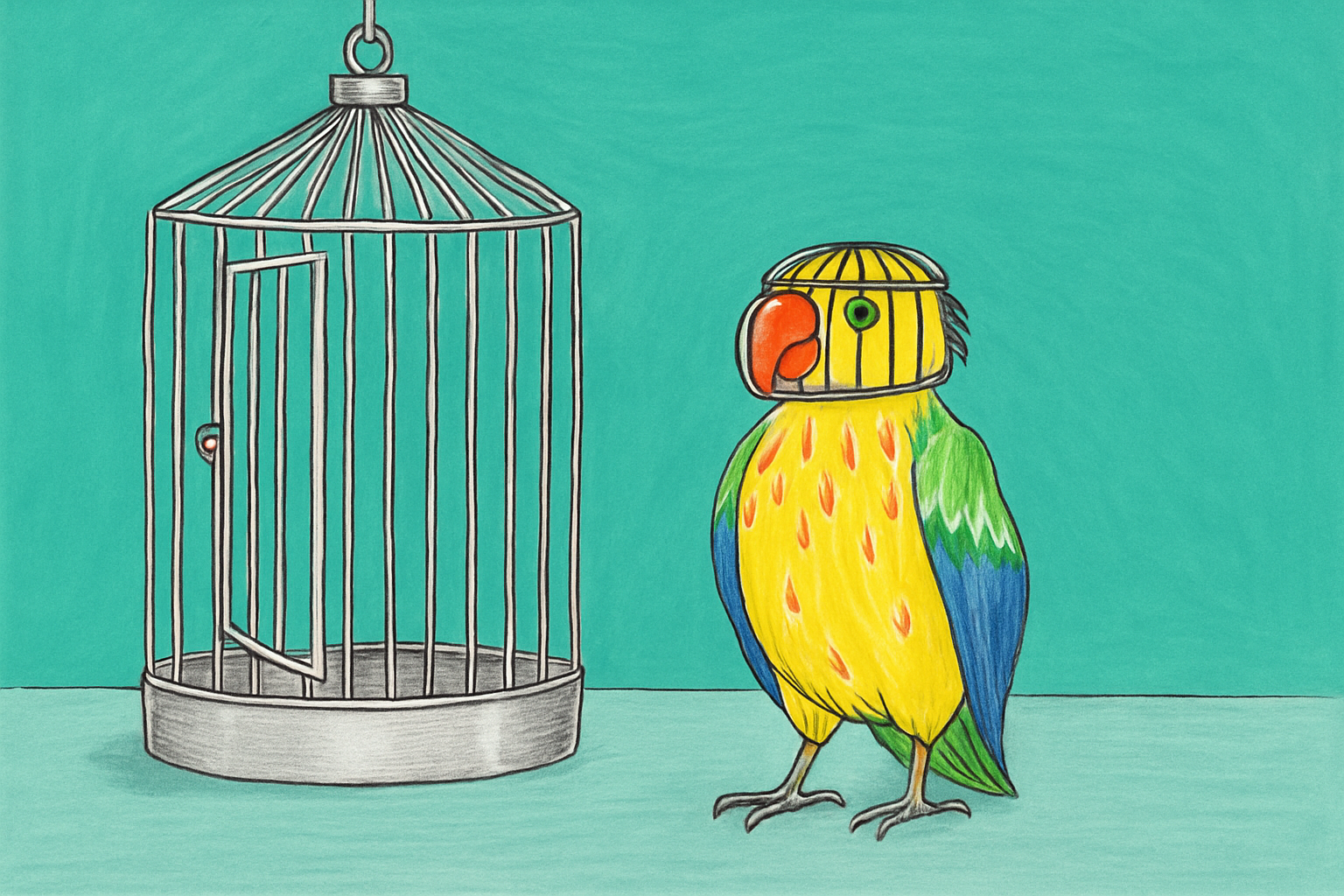
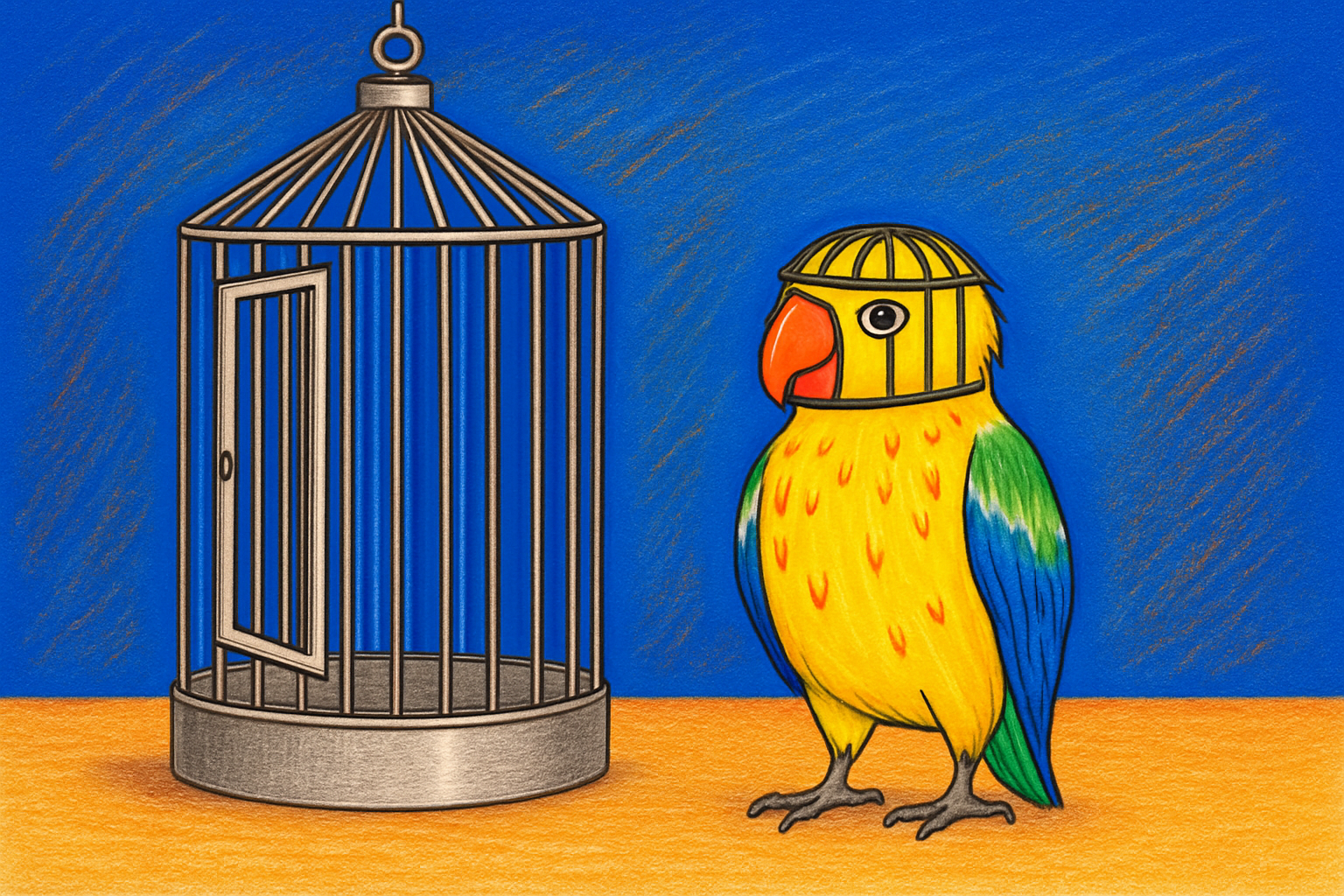
    I once saw a postcard with the drawing of a parrot walking out of its birdcage, while wearing a small birdcage like a helmet around its head. The words on the card said, “Being free isn’t actually that easy.” I think it summarizes very well how I was trapped trying to be free.

    When my tenacious striving ended up threatening my marriage, I sought help from a therapist, and that’s when things started to change.

    I became aware of the pattern I was caught in. The narrow-mindedness of feeling that I had to achieve something big. The unspoken wish that one day, someone would tap me on the shoulder and say, “Well done.” The rejection of life in the name of an abstract goal—ironically, in my case, the goal of wanting to be truly alive.

    I can’t say change happened overnight, although there was this one therapy session where I had a sense that I could feel that inner truth of just being, of awareness. That felt real and true—and much more than any external rules and descriptions of a path, it has been my compass, my guiding light ever since.

    What amazes me most is that for so many years, I just didn’t see the obvious: that I was applying my habitual patterns of ambition and goal-oriented striving to meditation, to the search for inner freedom. How on earth did I not see that?

    Frankly, I think it’s like with the fish and the water. The joke of the old fish meeting two young fish and asking them, “How’s the water today?” and the young fish responding, “What do you mean, water?” It’s so around you, so much an integral part of your lived experience, that you don’t even notice.

    After that recognition, I think the process has been gradual, and I would say it’s ongoing. The key thing is that I recognize striving as striving now. I’m in touch with the emotional tone that comes with it and have gradually learned to take it as a warning sign. Whenever I feel the narrowness of wanting to achieve, I now pause to check if I’m just digging myself into a hole again.

    As a result, there is now a sense of acceptance, of acknowledging that some things cannot be achieved by willpower. That feeling alive isn’t really something you can work at. In fact, today I’d say it’s the opposite: the way to feel alive is to relax into the reality of the moment, again and again. It’s admitting to myself what’s really there, in every situation, pleasant and unpleasant. It’s breathing with the pain, cherishing the pleasant moments. Valuing the people in my life.

    In short, I’ve given up on the “big goals.” I still meditate every day, but I do it differently now: I always try to work with what’s really there in that particular moment—sitting quietly with the breath on some days, working with emotions on others, maybe formulating wishes for well-being on the third day… There are so many options, and the key to making it a living practice, for me, has been to allow myself to start with what’s really there, every day anew.

    If any of this rings a bell, if you feel stuck trying to live a meaningful life, here are the lessons I’m drawing from my experience.

    1. Choose a direction, not a destination.

    To me, owning my life is a cornerstone. Grabbing the steering wheel, deciding on my own priorities rather than simply living according to a script that’s provided from the outside. So I totally stand by that original aim of wanting to live with inner freedom.

    In fact, if you don’t already have a clear sense of what you want your life to be, I strongly recommend taking some time to explore that question for yourself. There are great methods for this—reflective prompts or journal exercises that help you envision your ideal future.

    I’ve realized that what matters most is the direction I’m giving to my life—not so much a specific outcome, let alone a timeline for achieving it. Attainable goals have their place with respect to the outside world, such as working toward an education or a place to live, but with respect to inner processes, I’m now convinced that you cannot force things. At the same time, my orientation in the present situation matters deeply and makes all the difference.

    2. Be patient and gentle with yourself.

    This is the hard part for an achiever like me. My habitual disposition is wanting to measure progress. So after I realized the dead end I had maneuvered myself into with that goal-oriented approach to meditation, it’s been an ongoing challenge. The creature of habit in me continues to want to “be good at it,” to achieve.

    The process has been, and continues to be, getting to know that driven feeling and learning to actively soften it whenever I notice it. One helpful practice has been tuning into the tone of my inner voice—the one reminding me to let go of goals and relax. How friendly or harsh does it sound? And if it’s rather impatient, can I soften that too?

    Suddenly, rather than chasing some goal, I’m exploring what’s really there in myself, discovering and cultivating a friendly stance every day anew.

    3. Connect with your inner compass.

    I’m a rational person, and I often insist on spelling out the reasons for a decision. As far as things go in the world out there, I think that’s useful, even though I tend to overdo it sometimes.

    At the same time, I believe that I have an “inner compass,” which I discovered during my therapy sessions and that I find difficult to put into words. It’s a sense of whether something feels right that I can somehow feel in my body.

    I value this sense as extremely precious, even though I cannot describe it well. This inner compass is the most important guiding principle for me regarding “inner” topics, which cannot always be explained through logic or reason. It’s about whether something feels healthy, whether it seems to move you in the right direction.

    Tuning into this compass, even when I can’t explain it, helps me stay true to myself, no matter what situation I’m in.

    To me, the result of applying these principles has been great. I guess I won’t be enlightened any time soon, but the good thing is, I’m much happier with that now than I’ve ever been in my life.

  • Meditation: A Simple Way to Show Up Fully in Your Life

    Meditation: A Simple Way to Show Up Fully in Your Life

    “The real meditation is how you live your life.” ~Jon Kabat-Zinn

    I never saw myself as someone who would meditate. It wasn’t even on my radar until my wife suggested it while we were both working on our wellness. I chuckled. Like a lot of people, I assumed meditation meant sitting still, trying to clear my mind, whatever that even meant. It sounded impossible and, frankly, frustrating.

    I grew up in the rust belt, part of the baby boomer generation, and I’ve spent my life working hard, showing up, and taking care of my own. I love hard and play hard. I enjoy a good bourbon, an occasional cigar, and being a little stupid with my friends and family. That’s always been part of my life.

    That’s who I was when I started this practice, and that’s still who I am today. Meditation didn’t change me into someone different. It didn’t make me soft, overly serious, or turn me into some enlightened guru. It just made me more aware. The same things I’ve always loved, I still love. The same challenges I’ve always faced, I still face. The only difference is that now, I experience it all with a little more presence. Life didn’t change. I just stopped rushing through it.

    At the time, I dealt with stress the way a lot of people do—by staying busy. If I felt overwhelmed, my instinct was to distract myself. I would work harder, scroll through my phone, watch TV, or find something to keep my mind occupied. The idea of sitting in silence with nothing but my thoughts sounded like torture.

    At the same time, I couldn’t ignore the fact that I was constantly drained. Even when I wasn’t actively dealing with a problem, I carried this low-level tension everywhere I went. My mind was always racing, thinking about what needed to get done, replaying past conversations, and worrying about things that hadn’t even happened yet. It was exhausting.

    So, I gave meditation a shot. Not because I believed in it but because I figured I had nothing to lose. What I learned along the way completely changed my perspective, but not all at once.

    I think a lot of people expect some kind of breakthrough moment with meditation, like flipping on a light switch where suddenly everything feels calm and clear. That never happened to me. Instead, it was more like a dimmer switch—subtle, slow, and almost unnoticeable at first.

    The biggest misconception I had was that meditation was about emptying the mind. That’s not the point at all. And honestly, if that was the goal, I probably would have quit on day one.

    Meditation isn’t about forcing thoughts away. It’s about noticing them without getting caught up in them. It’s about observing what’s happening inside rather than constantly reacting to the outside world. Think of it like sitting on the side of a busy road, watching cars pass by. Cars are your thoughts. You don’t need to chase them or jump in. You just watch.

    Once I stopped trying to clear my mind and instead focused on simply noticing my thoughts, the practice became much easier. More than that, it started to make a difference in my daily life, but not in some dramatic, life-altering way. There was no single moment where I thought, “This is it. Meditation has changed everything.” It was far more gradual than that.

    I started noticing small shifts. I felt shorter bursts of calm in my day, even in stressful moments. Instead of immediately reacting when something frustrated me, I had a split second of space to breathe first. I became more present and less lost in overthinking.

    I realized I wasn’t spending as much time stuck in my head, replaying past mistakes or worrying about the future. And perhaps most importantly, stress didn’t grip me the way it used to. It still crept in, but I caught it earlier and let it go faster.

    That, I’ve come to understand, is what meditation really does. It doesn’t erase stress. It just helps you see it sooner so it doesn’t take over.

    One of the most unexpected benefits was that I became much better at recognizing when I was running on autopilot. Before, I would get lost in thought without realizing it. I would stress about everything, scroll through my phone, or half-listen to conversations while my brain was somewhere else. Meditation helped me break that habit. I started to realize how often I was going through the motions without truly being present. That awareness alone made a difference.

    At this point, meditation isn’t just something I “do.” It’s something that shows up in how I go about my day. And that, more than anything, has been the biggest shift. It’s easy to sit in a quiet room and meditate. The real challenge is remembering to breathe and stay aware in everyday moments. That’s where the practice really matters.

    I’ve also realized that even when I don’t feel like meditating, that, in itself, is a form of meditation. The fact that I check in with myself, notice whether I’m avoiding something or just not in the mood, and allow myself the freedom to choose—that’s awareness. And that’s the whole point. I don’t pressure myself to meditate at a specific time every day because I know awareness isn’t confined to a cushion or a set routine. I am free to be free.

    If you’re skeptical like I was, here’s what I’d recommend. Forget about clearing your mind. Trying to shut off your thoughts is like trying to stop the wind. It’s not going to happen. Instead, just notice your thoughts without getting carried away by them. You don’t have to control or judge them. Just observe.

    Keep it short. You don’t need to sit for thirty minutes. Start with two to five minutes. That’s it. You wouldn’t expect to lift heavy weights on your first day at the gym, right? Meditation is the same. It’s mental muscle that gets stronger over time.

    Make it easy. There’s no need to sit in a perfect cross-legged position or chant mantras unless you want to. Just sit comfortably, whether on a chair, couch, or even lying down, and focus on your breath. No need to overcomplicate it.

    Expect your mind to wander. That’s normal. Meditation isn’t about having a blank mind. It’s about noticing when your attention drifts and gently bringing it back. That is the practice. Stick with it. The benefits sneak up on you. You might not notice a difference at first, but over time, you’ll realize you feel a little calmer and a little more grounded. Give it time.

    Over time, I stopped thinking of meditation as something separate from the rest of my day. It became less about sitting in silence and more about paying attention. Noticing my breath when I felt unsettled. Feeling the weight of my body in my chair while working. Catching my mind when it started spiraling into stress. It all counts.

    At the end of the day, I’m still the same guy. I still work hard, love hard, and enjoy a good bourbon and laugh with my friends. Meditation didn’t make me a different person. It just helped me show up for my own life in a way I never had before. And for me, that’s been enough.

    What moments in your life are slipping by unnoticed? Where can you slow down, even for a breath, and truly be present? You don’t need to change who you are or chase some perfect version of mindfulness. Just notice. Just pay attention.

    As Jon Kabat-Zinn reminds us, “The real meditation is how you live your life.” It’s not about sitting still or doing things a certain way. It’s about showing up—fully—for the life you already have.

    So, take a deep breath, bring a little more awareness into your day, and let the rest take care of itself.

    Always remember to JUST BREATHE.

  • How 10 Days of Silence Brought Me Perspective and Peace

    How 10 Days of Silence Brought Me Perspective and Peace

    “Removing old conditionings from the mind and training the mind to be more equanimous with every experience is the first step toward enabling one to experience true happiness.” ~S.N. Goenka

    I just spent ten days sitting in absolute silence with about 100 strangers, time I previously thought I should’ve spent networking and applying for jobs as an unemployed twenty-something with little savings and no assets, living in a completely new country with no network or job prospects.

    There were no conversations, no eye contact, no listening to music, no exercise, no reading or writing—just silence, with twelve hours of meditation each day.

    I applied to the program on a whim, was accepted off the waitlist the day before it began, and bought my plane ticket impulsively the night before. With little time to prepare and even less certainty about what lay ahead, I couldn’t shake the feeling that perhaps this was exactly where I was meant to be, even if it wasn’t what I originally had planned.

    This retreat is a course on Vipassana meditation, a practice I discovered through Dhamma.org, taught by the spiritual guru S.N. Goenka. This ancient technique, deeply rooted in the teachings of Buddha, requires intense focus on the physical sensations of the body, observing them without attachment or aversion.

    The aim is to cultivate a deep sense of equanimity and insight, leading to a more balanced and peaceful state of mind. It’s a journey inward, stripping away the layers of noise and distraction to reveal the true nature of our existence.

    Of course, the website paints a serene and enlightening picture. While it truly is all those things, there were moments when I questioned my decision. At times, the retreat felt less like a sanctuary of peace and more like a self-imposed prison.

    This retreat was undoubtedly one of the hardest things I’ve ever done, but it was also one of the most transformative. It completely rewired my brain and changed my relationship with myself.

    After those ten days, I emerged as the most present and clear-headed I have ever been. Vipassana is often touted as a path to enlightenment, and it proved to be more than just a meditation technique. It is a rigorous self-confrontation, an unfiltered dialogue with the incessant chatter of one’s thoughts. In this space of relentless introspection, I came face to face with the raw, unedited version of myself.

    This experience came at a crucial time in my life, having recently quit my stable and glitzy job in entertainment to pursue a dream of living abroad, devoid of job security, a support network, or friends. The insights and clarity I gained through Vipassana meditation arrived at a moment when they were most needed, clearing a mental fog that seemed to have clouded my vision for years.

    And here I am to share the lessons and revelations from those transformative ten days.

    The Experience 

    The retreat took place in a hostel nestled in a remote village in Austria in late winter. When I arrived for the Vipassana meditation course, the cool and crisp air that was often shrouded in mist buzzed with anticipation.

    It was “day zero,” and we participants chatted lightly as we checked in, handed over our belongings, and met our roommates.

    As our vow of noble silence commenced after the 9 p.m. orientation, the sense of solitude set in. We knew that starting at 4 a.m. the next day, our routine would be drastically different.

    The first three days were dedicated to Anapana meditation, focusing on the sensations of the breath at the nostrils and upper lip. While the concept was straightforward, the challenge for me was substantial, especially due to the physical demands.

    Having just learned to ski the day before, I suffered from severe aches in my shoulders, neck, and back from repeated falls on hard snow, making it difficult to maintain a single sitting position for extended periods. The pain was a constant distraction, and looking around at the quiescent participants in the meditation hall, I felt acutely alone in my discomfort.

    Despite feeling isolated in my struggles, I soon noticed something uplifting. After each meditation session, relieved by the sweet sound of a gong, everyone would rush outside to stretch and shake off their stiffness. Some even sneaked in a few yoga poses or aerobic stretches behind trees (which is usually prohibited). Watching everyone stretch and move, I realized that even in our quiet, solitary struggles, we were all finding our own ways to ease the tension and feel a bit of relief.

    By the fourth day, we transitioned to the core practice of Vipassana meditation, which involved a more intricate mental process of scanning each part of the body with “unwavering equanimity” to feel sensations throughout.

    The early days of this practice felt like a mental battlefield. Repressed emotions and thoughts that I had long distracted myself from now screamed in my mind, creating a cacophony of emotions swirling in my mind.

    I thought I’d only struggle with wanting to leave when I felt negative emotions. However, I found that even positive emotions like inspiration, hope, and motivation were just as unsettling. These uplifting feelings made me want to run home and take action just as much as feelings of shame or sadness did.

    By midway through the fourth day, however, I experienced a significant breakthrough. My mental focus crystallized; the incessant chatter quieted, and for the first time, I managed to sit motionless for a full hour.

    This newfound calmness was soothing, and I was convinced it heralded a smoother path ahead. However, day six proved to have other plans. At 4 a.m., I was jolted awake by a panic attack, my heart racing and a nagging tightness in my chest, plunging my mind into turmoil and shattering the calm I had found. The serenity I had felt was replaced by a torrent of negative thoughts that felt inescapable.

    After this, I considered asking to leave during my next daily consultation with the assistant teacher. However, when the time for my consultation arrived, I reflected on my experiences and noticed a small but meaningful shift in my mental state. This glimmer of progress gave me the strength to persevere and stay committed to the process.

    The teacher, noticing my distress, offered reassurance that my intense emotional experience was a normal part of the process, advising me to face these emotions with equanimity rather than judgment.

    This pivotal conversation reminded me that experiencing a range of emotions is an inherent part of being human.

    The retreat, though intensely challenging, taught me valuable lessons about the transient nature of emotions and the strength found in communal endurance. By the end, I not only gained insights into my own psyche but also developed a deeper compassion for others, recognizing that despite our individual struggles, we share a common journey of growth and discovery.

    Insights and Reflections

    Emotions

    From that pivotal sixth day onward, my approach to my emotions and to meditation itself evolved profoundly. Rather than being overwhelmed by my feelings, I learned to observe them from a distance, recognizing their transient nature and gaining insights that I could apply to my life beyond the meditation cushion.

    Previously, I had a profound misunderstanding that I wasn’t just experiencing feelings—I was enshrining them as immutable truths, anchoring my identity and decisions to their fleeting presence. I had been using my emotions as a barometer for reality, attaching unwarranted significance to each emotional wave without recognizing their transient nature.

    For example, if I felt anxiety about a decision, I might interpret that anxiety as a sign that the decision was wrong rather than as a natural response to uncertainty. This led me to avoid potentially beneficial but challenging opportunities simply because of the discomfort they invoked. Similarly, if I experienced joy in a situation, I might overly commit to it without critical assessment, mistaking transient happiness for long-term fulfillment.

    However, through mindful observation, I began to understand the ephemeral nature of emotions—they come and go, often influenced by myriad external and internal factors that do not necessarily have a direct correlation with the objective reality of the situations that provoke them.

    This insight led me to a more nuanced understanding that while emotions are valid experiences, they are not definitive guides to action. They are, rather, one component of a broader decision-making process that should also involve rational analysis and reflection.

    Self-confidence 

    Moreover, I came to understand that seeking external validation for my decisions was unnecessary. The concept of a “best” decision is elusive; what truly matters is making choices that resonate with my personal beliefs and values.

    This profound period of self-reflection allowed me to become more comfortable with myself and to trust my own judgment. This shift was incredibly liberating, particularly at a pivotal moment in my life where I faced the daunting task of choosing between two vastly different paths, each enveloped in its own uncertainty.

    I realized how much of my past behavior was driven by a need for external validation. It wasn’t always about seeking approval, but rather looking for someone else to affirm my choices, to nod in agreement, or to give me the green light to proceed with my plans. Unbeknownst to me, I had been stifling my own instincts and insights, inadvertently relegating the authority over my life to others.

    Each choice I make, grounded in self-awareness and self-compassion, leads me down a path that contributes to my growth and learning, regardless of the outcome.

    This perspective shifts the focus from fear of making a “mistake” to an understanding that every step taken is part of a larger journey towards personal fulfillment and wisdom. By being present and committed to myself, I can navigate life’s uncertainties with confidence, knowing that all experiences are valuable and that my inner guidance is a reliable compass.

    Love

     Formerly, I saw love as a destination, a goal to be achieved, wrapped in expectations and specific outcomes. This perspective treated love as something to be received passively—a feeling handed down rather than actively cultivated. My approach was centered around control, trying to steer love toward a preconceived notion of what it should look like, often ignoring the dynamic and evolving nature of genuine connections.

    Love as an act, rather than just a feeling, transforms it from a passive state to an active engagement with life and the people in it. It’s about pouring into relationships freely and generously, not intending to receive something in return but to foster a genuine connection and mutual growth.

    This shift in perspective has taught me to appreciate love’s subtle presence in life—how it’s not just found in grand gestures or declarations, but in the quiet, everyday actions that bind lives together. Understanding love as a fluid, evolving force rather than a static goal has freed me from the burdens of expectation and control.

    True love is about being solid and sturdy with someone without needing to define every moment or cling too tightly. It’s about letting love for others—romantic, familial, friendly, even for strangers and animals—flow without possession.

    Contribution

    This evolved understanding of love profoundly influences how I approach my career and contributions to the world. Previously, I saw my career mainly as a way to chase personal fulfillment, driven by the often-cited advice to “follow your passions.” While this was empowering, it also kept me in a bubble of self-focus and entitlement, where I was more concerned with finding the perfect job that would maximize my happiness.

    However, as my concept of love matured, so did my view on my professional life. I began to see my work not just as a means for personal achievement but as a chance to contribute to something bigger than myself. This shift in thinking about love—as something you give without expecting a specific outcome—has mirrored in my career approach.

    Now, my career decisions hinge not only on what brings me joy or utilizes my skills but also on how I can use those skills to positively impact others. It’s about leveraging what I know and can do for the greater good, not just for my own success.

    Embracing this broader perspective has made me more conscious of the interconnectedness of our actions and our collective well-being. Just as love builds bridges in personal relationships, a career grounded in contribution and service can foster connections that lead to community growth and improvement. It’s changed how I set professional goals: instead of just aiming for personal milestones, I focus on creating value that uplifts others.

    Connectedness

    On day ten, we finally broke our vow of noble silence after breakfast. After speaking with the other participants, a profound realization emerged—although our individual narratives and life experiences were markedly different, the emotional outcomes and insights we arrived at were astonishingly similar. This fascinating contrast highlighted that, despite our unique paths, at our core, we feel the same fundamental human emotions.

    This commonality in our emotional responses underscores a deeper, universal truth about the human condition in that we are more interconnected than we might believe. The emotional threads that connect us do not vary greatly from one person to another; joy, sorrow, fear, and hope are universal experiences that transcend individual circumstances.

    Vipassana meditation, focused on observing one’s own mind and body, amplifies this realization by stripping away the superficial differences and revealing the underlying uniformity of our emotional nature.

    This realization served as somewhat of an ego death, where the sense of being profoundly unique or a special case diminished. It brought to light the collective human experience, suggesting that while our life stories add richness and variety to the human experience, the emotional landscape we navigate is shared. We are not isolated in our feelings; rather, we are part of a vast continuum of human emotion that binds us together.

    Embracing this understanding fostered a profound sense of empathy and solidarity. It diminishes the ego’s insistence on our separateness and highlights the shared journey of growth and understanding that we all undergo.

    The Return to the World

    The morning after day ten was another humbling moment. I got my phone back, and turning it on was overwhelming. In just ten days, life had moved on without me—friends got promotions, planned trips, made big career jumps, ended relationships, and began new ones.

    It was sad to miss out yet heartening to return to positive developments in their lives. This contrast served as a poignant reminder of the impermanence and relentless pace of the world around us and the importance of finding grounding in our inner selves.

    Upon returning to the real world, I felt a profound alignment between my mind and body that I hadn’t experienced before. I could see things as they were, not just as reflections of my internal dialogue. I wasn’t stuck in my head anymore; I could slow down, be with myself, and actually enjoy my own company—something that used to terrify me.

    It’s almost as though the experience altered my brain chemistry. For the first time, I felt normal in my own skin, a sensation that was entirely new to me. Growing up in the digital age, I rarely, if ever, had the opportunity—or the need—to sit with my thoughts for more than ten minutes. Allowing myself the space to sit, feel, and think deeply was not just valuable; it was a profound and rare experience that I believe many people deny themselves in our fast-paced, modern world.

    Overall Reflections

    Reflecting on my recent Vipassana retreat, it has become evident how such experiences are profoundly relevant in today’s fast-paced, often superficial world.

    During these ten days of deep introspection, I confronted layers of myself that were cluttered with unresolved emotions and unexamined thoughts.

    In a world where action is prized, stillness can be revolutionary. It’s not just about silencing the chatter of the outside world—including the instant feedback loop of social media that we rely on for our self-esteem and decisions—but more importantly, understanding the internal dialogue that shapes our perception of ourselves and our lives.

    Recalling my initial reservations about spending precious time in silence when I could have been networking or job hunting, I now see how misplaced those concerns were.

    My Vipassana experience did not magically solve all my challenges or answer all my questions. However, it profoundly reshaped how I view my journey through life. It wasn’t about finding a perfect job or even perfect peace, but rather about learning to navigate the inevitable ups and downs with a bit more grace and a lot more self-awareness.

    This deeper understanding has not only helped me appreciate the quiet moments of reflection but has also prepared me to engage more meaningfully with the bustling world around me.
  • How to Ease Pain and Anxiety Through Meditation

    How to Ease Pain and Anxiety Through Meditation

    “If nothing changes, nothing changes. If you keep doing what you’re doing, you’re going to keep getting what you’re getting. You want change, make some.” ~Courtney C. Stevens

    If someone looked at my life when I was younger, they would think that I had it all together. I went to college to obtain my bachelor’s in psychology and social work, followed by my master’s in social work. I have always had good friendships and family relationships. I traveled regularly. I was and still am young and living my life. Little would they know that so much was brewing inside…

    The perfect storm of overachieving, perfectionism, stress, and anxiety was brewing until I developed chronic pelvic pain in college.

    As an overachiever, I had all of my homework and essays done a week before they were due because if I waited until the last minute, my anxiety would be higher than it already was. I always wrote more pages for my assignments than I needed to. I studied more than I needed to. I always did the most.

    As a perfectionist, I bawled my eyes out when I got my first 88% in my child development class. I bawled my eyes out when I got a 20 on my ACT, thinking that I wouldn’t even get into college with that score.

    Anxiety. I was a tight ball of anxiety. Always worrying, anxious, and catastrophizing, with whole-body muscle tension, trouble sleeping, and intense restlessness.

    A perfect storm.

    After graduating from my master’s program, I started working in community mental health in order to obtain my 3,000 clinical hours for my clinical social worker license.

    This whole time I was going from doctor to doctor, trying to figure out what was going on with my body. I was looking for every solution under the sun. I finally found one after working at my first job for about a year. I was so burned out, anxious, and in pain that I took a sabbatical and went to California.

    There was a clinic in California that specialized in chronic pelvic pain and anxiety. I thought, “Finally, a place that can help me.”

    This is how my meditation journey started. A journey that I now can say changed my life. I do not know where I would be without this powerful practice.

    Let me paint the picture of what the clinic looked like for you. I was in a room of about eight to ten fellow anxiety and chronic pelvic pain sufferers lying down in what looked like sleeping bags, tucked in like caterpillars in cocoons.

    The psychologist at the clinic started to teach us how to meditate.

    He started doing a guided meditation without a script and told us to focus on the feeling of “sinking” when we exhaled, the “ahhhh” feeling. Can you imagine how hard that would be if your anxiety and pain were off the charts?

    After what felt like thirty seconds of this exercise, my first thought was, “WE ARE DONE, RIGHT??? That’s all for today. Time to go!!” Being someone who was a tight ball of anxiety, with a million thoughts running through my mind, and lying there in excruciating pain, it felt like torture. I thought I was going to explode.

    The worst part was that he kept going. I do not remember how long the meditation lasted. It felt like it lasted for twelve hours when in reality we may have done ten to twenty minutes. Throughout the rest of the clinic, we kept repeating this guided meditation, and it honestly kept feeling awful.

    Through dedication and practice, it took me a year and a half, twice a day every day, to be able to do that guided meditation for forty-five minutes. I can say now that the practice of meditation saved my life and dramatically calmed down my nervous system and anxiety.

    Here are the lessons that I learned throughout my meditation journey.

    1. Start small.

    When you want to start something new or create a new habit, start small. Starting big is overwhelming; starting small feels more manageable.

    When I first started to meditate, I began with a couple of minutes and worked my way up. After a couple of months, I was able to do ten minutes, then fifteen minutes, then twenty minutes, and so on, until I could meditate for forty-five minutes and it felt like only fifteen minutes went by.

    Be compassionate with yourself if it takes a while to be able to master those first couple of minutes. Meditation is difficult when you are first starting out, as is anything you are trying in the beginning. Give yourself the grace to be a beginner, knowing that you are engaging in a powerful practice, and that already is enough.

    After putting in the work for over a year and a half, I felt calmer and more present, more able to notice my thoughts without holding onto them, and better able to sit with the sensations in my body with ease.

    2. Long-lasting consistency is key for any change you want to make in life.

    Trust me, I struggled with consistency for a very long time. I would try out something new for three to four days, and after that time, I would say, “Oh, well, this doesn’t work” and stop doing the thing. I didn’t give the technique time for it to work.

    I realized that was the part of me that was impatient and wanted instant gratification and results. I would always tell clients that I worked with, “Trust me, if I had a magic pill that would take away all of your problems, I would give you one and then myself one. Then I would live on a private island and have my own personal dolphin to play with.” Wouldn’t that be cool if life worked that way?

    This was a cycle for me that lasted a very long time. It takes a little over two months to create a habit. Once I started to see the effects of meditation, I made sure to make it a daily lifestyle habit, something that I do for my physical and mental health.

    3. Change is uncomfortable. Meditation was and still is comfortable.

    Change sucks. Learning something new sucks. I also learned that in that moment, I could do something that was going to be hard and in the end be helpful, or I could stay stuck. I had a choice, and I knew that I could not stay stuck in super high levels of anxiety and chronic pain. I knew something needed to change despite feeling uncomfortable.

    “Life is the difference between what hurts and what hurts more.” ~Nicole Sachs, LCSW.

    Meditation was SO uncomfortable in the beginning. My brain felt like a game of ping pong with so many thoughts and sensations going on in my body. I had a really hard time focusing on the sinking feeling of my body during meditation because I became distracted with anxious thoughts and pain. Over time, it became easier until I was able to just focus on the sinking sensation or my breath. As with anything in life, practice makes progress.

    I do not meditate for forty-five minutes anymore. I use the Calm app and do the daily meditation for ten minutes. There are days that focusing on my breath is still challenging because of anxiety, pain, or the thoughts running through my mind.

    As with life, there are moments where days are harder and easier. What has helped me is to accept whatever is happening in the moment, which also takes practice. I have created compassion for myself when meditation feels harder for me. No judgment. I am human.

    4. You cannot run away from your mind and body.

    What I learned from my meditation practice is that you cannot run away from what is happening inside your mind and body. Your mind and body will keep giving you a thought or sensation until you are fully able to sit with it and accept it in the moment rather than sweeping it under the rug because it feels uncomfortable or scary.

    It is uncomfortable and scary. By running away from it, it’s also reinforcing the pattern and showing your brain and nervous system that the thought or sensation in your body is a threat.

    During my meditation practice, I had to sit with whatever was happening in my body: intense pain, tightness in my chest, queasiness in my stomach, “what if” thoughts in my mind, tightness in areas of my body—you name it. I had to feel all of it.

    At first, I hated it and it was terrible, but then it became easier. I had to learn to accept my body and its protection, because that is what it was doing. That acceptance turned into compassion, which turned into reduced symptoms.

    Your body and brain will keep giving you symptoms until you have processed them, accepted them, and turned off the danger signals.

    As with anything that you do, it will get easier with time and practice!

    I want to add a caveat that if you are having chronic pain, please consult a medical professional to rule out anything structurally happening with your body. I had every test and scan done under the sun, and my body was and still is normal, physically. Also, with anxiety, if you need support, there are many wonderful places to receive it, whether through therapy or online forums.

  • The Benefits of Vipassana Meditation and How to Start Your Practice

    The Benefits of Vipassana Meditation and How to Start Your Practice

    “Meditation is not a way of making your mind quiet. It’s a way of entering into the quiet that’s already there.” ~Deepak Chopra

    Have you ever felt overwhelmed by the chaos of daily life, longing for a sense of calm and clarity? That was me a year ago, trapped in a cycle of overwork and unhealthy habits. It wasn’t until I rediscovered meditation, particularly Vipassana, that I began to find true peace and transformation. Here’s my story and how Vipassana changed my life and how it could change yours too.

    My Personal Journey with Meditation

    I’ve always been drawn to self-improvement activities like meditation, exercise, and healthy eating. However, I often ignored my own advice and indulged in moderate-to-heavy drinking and overworking, embodying a “work hard, play hard” mentality. In college, I was introduced to meditation and yoga, but my practice was inconsistent, lacking the structure or commitment needed for lasting change.

    About a year ago, I became determined to transform my life. I was drinking more than I liked, eating poorly, overweight, and overstressed from my highly demanding job as an actuary. I committed to a daily practice of meditation, exercise, and healthy eating.

    After browsing for books on meditation, I discovered 10% Happier: How I Tamed the Voice in My Head, Reduced Stress Without Losing My Edge, and Found Self-Help That Actually WorksA True Story, by Dan Harris.

    The book’s simple approach—eyes closed, focusing on the breath—resonated with me. My OCD tendencies made mantra-based meditation daunting; I worried a mantra might exacerbate my symptoms.

    The Limits of Breath-Based Meditation

    After a few months, the commitments were paying off, but I wasn’t getting the mental calm and peace I’d read so much about with meditation.

    As I started listening to podcasts about meditation and sober living, I noticed a recurring theme: Many people, including myself, found it challenging to stay committed to focusing solely on the breath because it can become monotonous. This led me to question, “Is all I get just 10% happier? Why not aim for 100%?”

    Breath-based meditation has become incredibly popular and is often seen as the beginning and end of meditation practice; however, there’s a common perception that it is the ultimate form of meditation. While it is great for beginner meditators or for those comfortable with a more casual practice, it may be insufficient for those seeking more. Vipassana offers a deeper, more transformative experience.

    Discovering Vipassana Meditation

    During my exploration, I found The Art of Living: Vipassana Meditation as Taught by S. N. Goenka, by William Hart. Vipassana meditation is believed by some to be the actual method of meditation practice used and taught by the Buddha over 2,500 years ago. Vipassana takes meditation to the next level by addressing the deeper layers of the mind.

    According to The Art of Living, breath awareness is the foundation, but true progress comes from observing bodily sensations. It emphasizes maintaining equanimity, or mental calmness, while experiencing these sensations. Practitioners maintain a balanced mind in the face of physical and mental discomfort, heal past traumas, and foster mental resilience.

    The book is organized into ten chapters, in sync with the typical ten days of a Goenka-style meditation retreat, described more below. To put the importance of breath-focused meditation, or Anapana meditation, into perspective, seven chapters are dedicated to Anapana, while only three focus on Vipassana. Breath-based meditation’s importance is fundamental to a successful Vipassana practice.

    Vipassana in Practice

    My own experience with Vipassana has helped me tremendously. As one who has struggled with severe anxiety, panic attacks, and hypochondria, it has helped me break the cycle of interpreting daily aches and pains as life-threatening illnesses and to accept the bodily sensations with more equanimity.

    By observing sensations without reacting, I have trained myself to dissociate minor physical discomforts from anxious thoughts. As a result, the frequency and severity of my anxiety and panic attacks have been significantly reduced.

    Even on the days I do have stronger aches and pains, I focus on the pain itself and notice the physical sensations are constantly changing. They don’t feel as bad as what my brain tells me the pain should feel like.

    I continue meditating on the pain and let the physical sensations come and go. Eventually, the pain becomes more tolerable and often forgettable.

    Another benefit is that I feel more at peace with childhood traumas and that some of the experiences I’ve clung to for all these years aren’t as bad as I’ve made them out to be. When a memory of these bad experiences arises, I observe and feel my bodily sensations with equanimity. I permit the feelings to be with me until they subside.

    It isn’t always easy. Recently, there was a meditation session where I had a more profound realization that brought forth deep-rooted feelings of fear and terror.

    I began to struggle to breathe and started to hyperventilate. I was scared. Goenka teaches during these times to refocus back on the breath until the emotion and sensations subside and equanimity returns.

    I rode that wave and trusted the process, and my breath eventually calmed down. That session was one of the most profound experiences of my life and really helped me on my spiritual journey toward peace and calm.

    Mechanics and Technique of Vipassana Meditation

    For those interested, the technique of Vipassana meditation involves several steps:

    1. Preparation

    Sit comfortably with your back straight and eyes closed. Take a few moments to settle and focus.

    2. Anapana

    Start with Anapana meditation, focusing on your breath. Observe the natural flow of breath as it enters and leaves your nostrils without trying to control it. This helps calm the mind and prepares it for Vipassana.

    3. Body Scan

    After calming the mind, begin the Vipassana practice by systematically scanning your body from head to toe. Observe each part of the body in turn, noticing any sensations—tingling, heat, pressure, etc. Keep your attention moving without lingering too long on any one sensation.

    4. Equanimity

    As you observe sensations, maintain a sense of equanimity. Understand that sensations are transient and try not to react to them with craving or aversion. This helps in developing mental balance and insight.

    5. Focus

    When strong emotions and thoughts come, return the focus to the breath until they subside and equanimity can be regained, then go back to the body scan.

    6. Regular Practice

    Consistent daily practice is essential. Start with short sessions and gradually increase the duration as you become more comfortable with the technique. With repeated practice, some of the strong traumas begin to lessen and fade as you become more at peace with yourself.

    The Ten-Day Vipassana Retreat

    To deepen my practice, I hope to attend a ten-day Vipassana retreat. These retreats provide an immersive experience in Vipassana meditation with a structured schedule of meditation, instruction, and silence.

    The retreat offers a unique opportunity to disconnect from daily distractions and focus entirely on the practice. It is intense but promises profound insights and lasting benefits for those who complete it. It includes a strict schedule of meditation, instructions, and “noble silence,” providing a conducive environment for deep mental purification.

    The retreat is free of charge, funded by donations from previous participants. More information can be found on the dhamma.org website.

    My Progress to Date

    Since committing to meditation last year and strengthening my practice with Vipassana, I’ve seen significant improvements in my physical and mental health. I have weaned off all my prescription medications, lost twelve pounds, and gained a newfound energy I haven’t felt in years. I even went for a run the other day just for fun and to let off some extra energy, something I haven’t done in a long time.

    Even more dramatic, I realized my actuary job wasn’t worth the stress and long hours, and I quit. I bought an RV and have been traveling with my dog, exploring the country and having adventures. I’ve also started a blog dedicated to my passions in health and travel.

    Final Thoughts

    For me, maintaining a balanced sense of work and play where I can enjoy life’s rich pageant is what truly matters. Vipassana meditation is quickly establishing itself in my life as the doorway through which I am free to drop my past baggage at the door, step through, and live in the present moment like it was meant to be lived.

    I’m excited to see what the next year brings for me. If you’re curious about Vipassana, I encourage you to give it a try.

  • 9 Self-Guided Meditation Courses to Deepen Your Practice and Supercharge Your Spiritual Growth

    9 Self-Guided Meditation Courses to Deepen Your Practice and Supercharge Your Spiritual Growth

    In a culture that teaches us we need to prove our worth through achievements, it can be challenging to prioritize peace, well-being, and spiritual growth.

    We’re bombarded by marketing messages that tell us we’ll be enough, if only we “buy this—do this—look like this,” making it difficult to simply relax in who we are and feel a sense of contentment in our lives. But there is a way out of this cycle of discontent, anxiety, and constant striving.

    If you’re yearning to connect with life more deeply and feel a sense of greater peace and acceptance, I highly recommend developing a regular meditation practice.

    Before I began meditating, I was constantly agitated, anxious, and self-conscious, trapped in a mind that always found fault with myself—and everyone and everything around me.
    Meditation is the closest thing I’ve found to a magic bullet in life. It can replace stress with calm, confusion with clarity, ignorance with self-awareness, and bitterness with grace.

    There’s a lot we can’t control in life, including our thoughts and feelings—but we can control how we engage with them. And that’s how we can find a little sliver of peace in this complex, chaotic world. It all starts with mindfulness.

    Not sure where to start, or how to take your practice to the next level? Tiny Buddha sponsor Shambhala Online has you covered!

    The nine courses I’ve shared below will allow you to learn from anywhere, on any schedule, and to revisit the content whenever you’d like to be refreshed or re-inspired. They’re also great for when you feel your anxiety ramping up and need a de-stress tune-up, and something that reminds you that you are enough just as you are.

    All of the courses feature authentic and deeply experienced teachers from Shambhala’s global community, and offer teachings from their Tibetan Buddhist heritage in forms that are direct and relevant for Western students.

    As a special gift to Tiny Buddha readers, the Shambhala team has included a unique 10% off code for each course.

    I hope you find something below that speaks to you!

    To Start or Resume a Regular Meditation Practice

    Mindfulness meditation can change your life. It’s a transformative practice that offers relief from anxiety and stress, a more grounded life, better general health and wellness, stronger relationships and connections (with others, the world around us—and ourselves!), a more spacious and accommodating mind, and innumerable other benefits.

    If you’re looking to begin, or resume, a regular meditation practice, the course Learn to Meditate can help.

    Led by senior teacher, movement artist, and pioneer Arawana Hayashi, Learn to Meditate covers both sitting and walking meditation, equipping you with the tools necessary to integrate meditation into your daily life—bringing you greater well-being and connection with yourself and others.

    Use the code TBLEARN10 to receive 10% off Learn to Meditate.

    To Develop Self-Love

    Learn to Love Yourself with Sabine Rolf will help you discover warmth and kindness for yourself—a beautiful quality known as loving-kindness in Buddhism (maitri in Sanskrit).

    Through meditation, experiential exercises, and talks, you’ll learn to embrace and accept your authentic self; manage stress, anxiety, and difficult emotions, leading to a more balanced and resilient state of being; and develop self-confidence and trust in yourself.

    By investing in your own self-love and self-compassion, you’ll pave the way for personal growth, increased happiness, a more harmonious life, and stronger and healthier connections with others and the world around you.

    Use the code TBLOVE10 to receive 10% off Learn to Love Yourself.

    To Cultivate Compassion and Love

    If you want to explore the Mahayana Buddhist path of universal compassion, Melting the Ice and Getting Unstuck: Talks On The 37 Practices of a Bodhisattva is the perfect jumping-off point.

    This course uses as a reference a classic 14th-century Tibetan Buddhist text called The Thirty-Seven Practices of a Bodhisattva. A “bodhisattva” is any ordinary person who makes a commitment to live like the Buddha: to help others discover their fundamental goodness and be free from suffering. This course explores what it means to live on the bodhisattva’s path, and offers invaluable guidance for cultivating a strong heart and a compassionate approach to life’s challenges.

    Use the code TBUNSTUCK10 to receive 10% off The 37 Practices of a Bodhisattva.

    To Explore Buddhism and the Buddhist Path

    Shambhala’s yearlong Foundations for Freedom: The Hinayana offers an in-depth exploration of foundational Buddhist teachings, providing you with a clear understanding of the core principles and practices.

    Foundations for Freedom has five parts, each led by experienced teachers, and covers core Buddhist teachings, such as:

    • The nature of suffering,
    • The origin of suffering,
    • That freedom from suffering is possible, and
    • The path of Shila (discipline), Samadhi (meditation), and Prajna (wisdom).

    By engaging with these teachings, you’ll develop mindfulness, compassion, wisdom, a deeper connection to your spiritual journey, and a true understanding of foundational Buddhist teachings and the Buddhist path.

    Use the code TBFREEDOM10 to receive 10% off all Foundations of Freedom courses.

    To Discover a Spiritual Path in Everyday Life

    If you’d like to bring mindfulness into your daily life and discover the “ordinary magic” in your everyday- experiences, check out Meditation in Everyday Life and Contentment in Everyday Life.

    Meditation in Everyday Life

    Led by Janet Solyntjes, Meditation in Everyday Life is a five-week introduction to mindfulness meditation.

    You’ll learn about peaceful abiding meditation, receive guidance on establishing a meditation practice, and explore ways to improve your daily life through meditation. The course also offers meditation posture instruction, shamatha yoga instruction, and downloadable guided meditations.

    Through simple instructions and support, you’ll discover your mind’s innate stability, strength, and clarity.

    Use the code TBMEDITATION10 to receive 10% off Meditation in Everyday Life.


    Contentment in Everyday Life

    Contentment in Everyday Life invites us to explore the art of finding happiness within ourselves, regardless of our external circumstances. It helps us understand that even in the most difficult of circumstances in life, we are enough—just as we are.

    In this five-week course led by Eve Rosenthal, you will learn how to cultivate contentment through meditation and contemplation practices. You’ll also learn how to relax with yourself, appreciate simple human experiences, and face life’s challenges with gentleness and mindfulness.

    Use the code TBCONTENT10 to receive 10% off Contentment in Everyday Life.

    To Explore Human Goodness and How to Build a Good Society

    If you’re looking to connect with your own worthiness and contribute to a more compassionate, enlightened society, explore the Basic Goodness series. Together, these three courses delve into the principle of basic goodness as it applies at the level of the individual, society, and reality itself, offering a roadmap for personal and social transformation.

    Who Am I? The Basic Goodness of Being Human

    In Who Am I? The Basic Goodness of Being Human, you’ll embark on a journey of contemplative inquiry, exploring the timeless question “Who am I?”

    Through Buddhist teachings and meditation practice, you’ll learn how our sense of self arises moment by moment, and how to use meditation to contact and express the basic goodness that lies within you.

    Use the code TBHUMAN10 to receive 10% off Who Am I? The Basic Goodness of Being Human.

    How Can I Help? The Basic Goodness of Society

    In How Can I Help? The Basic Goodness of Society, you’ll explore your relationships with others, your aspirations to help the world, and specific aspects of social transformation.

    This six-session course delves into what an “enlightened society”—a society that is based on and nurtures the goodness of all—might look like. The teachings focus on transforming four aspects of society: family, professional life, entertainment, and economy.

    Use the code TBSOCIETY10 to receive 10% off How Can I Help? The Basic Goodness of Society.

    What is Real? The Basic Goodness of Reality

    In What is Real? The Basic Goodness of Reality, led by acclaimed teacher John Rockwell, you’ll delve into the magical nature of reality, learning the progressive stages of discovering non-dual perception of the elements and, consequently, the nature of the mind.

    This experiential course encourages you to engage with sense perceptions and the elements as your teachers, enabling you to see, hear, touch, taste, and smell reality anew. You will awaken your innate capacity to directly experience the basic goodness that is the essence of reality.

    Use the code TBREALITY10 to receive 10% off What is Real? The Basic Goodness of Reality.

    No matter what aspect of meditation and spirituality you wish to explore, Shambhala Online offers courses that cater to your unique needs and interests. As you engage with these teachings, you’ll not only deepen your personal practice, but you’ll also contribute to the creation of a more compassionate, enlightened society.

    Shambhala Online also offers a regular calendar of live online courses with personal interaction, from monthly and quarterly mini-retreats to programs with revered teachers from the Tibetan Buddhist tradition. To see their upcoming courses, view their course calendar.

    If you have any questions or requests, you can contact the Shambhala team at registrar@shambhalaonline.org.

  • 5 Meditation Retreat Practices to Try at Home for a More Mindful Life

    5 Meditation Retreat Practices to Try at Home for a More Mindful Life

    “Meditation is the ultimate mobile device; you can use it anywhere, anytime, unobtrusively.” ~Sharon Salzberg

    It was the fifth night of my first silent retreat, and 100 of us spilled out of the meditation hall into darkness, flashlights swinging as we made our way along the path to our dorms and sleep.

    Suddenly the wind picked up and quiet excitement rippled through the group as we looked up to see a bank of clouds move and reveal a full moon, beaming a bright white light from the night sky. We stopped and stood, some of us for hours, gazing upwards.

    This is a painfully obvious metaphor, I wanted to say to someone.

    Despite my natural cynicism, despite the sleepiness and agitated thinking that had haunted my meditation for days, as I looked up at the moon I thought: In a world this beautiful, how can I not pay attention?

    Days later, when my weeklong retreat ended and I came home, I was reminded that being on a retreat is a lot different from regular life.

    I can’t see the sky let alone the moon from my house, and my time is punctuated by the sound of email notifications instead of gongs. But is it possible to recapture some of the mindfulness you can cultivate on a meditation retreat? Here are five strategies I am trying, and you can try too.

    1. Enjoy a daily meditative meal (or snack).

    On the first day of our retreat one of the teachers gave an inspiring talk just before lunch. Every mealtime is an opportunity to practice, he said. Try smelling each spoonful of food before you put it in your mouth. Put your silverware down between each bite.

    Lunch that day was the longest meal I have ever experienced. We considered each bite of salad, noting the whiff of vinegar in the dressing and the crunch of the greens. I grew to know the subtle flavor of plain brown rice, and the multisensory experience of holding a mug of hot tea to my lips and inhaling the lightly scented steam before sipping.

    It was reinforcing to be in such a large group enjoying meals together so slowly and quietly, but everyday life presents multiple mindful eating opportunities as well.

    Post-retreat, I try for at least one meditative meal. Where I would once wolf down lunch while scrolling through Twitter, I create space to experience the flavor of the food and note the texture. It works for snacks too—you can really taste the salt on your lips from the first bite of a chip. An added bonus: All that chewing is great for digestion.

    2. Ground yourself by walking.

    Much of the retreat schedule can be summed up as “seated meditation followed by walking meditation.” The sitting-walking pattern helps break up the day and ideally prevents us from dozing off on the meditation cushion.

    Slow meditative walking, with its noting of the “lift, move, step” motions of our feet, felt like a close cousin of seated meditation. Normally paced walking in the hills of the retreat center was still more inspiring, as I tried to tune into each step connecting me to the earth.

    At home, where sitting at a desk dominates my awake time, I am incorporating periods of mindful walking—even if it is just down the hall. Between meetings or projects, I get up and feel the floor under my feet with each step, noting the swinging of my arms, and the way the fabric of my pants moves across my legs.

    Longer walks, taking in the sights of the neighborhood without a distracting podcast, is also part of my new routine. With or without the mental noting of “lift, move, step,” walking can effectively bring our minds back into our bodies.

    3. Befriend a tree.

    One retreat teacher encouraged us to select a tree from the surrounding forests and forge a connection with it. We each considered our tree’s solidity, the sap running through it, the wind in its branches bringing constant change, and the co-arising circumstances that led to its growth. It was common to round a path in the woods and come across someone standing looking up at a tree, seated at its roots, or even swaying in rhythm to its movements.

    Back in the city, I can simply sit on my front steps and contemplate the river birch in the yard without alarming my neighbors. I pay attention to the subtle grays and whites of its bark, the way its leaves almost shimmer in the breeze. I have lived with it for years, but this tree is now a brilliant object of meditation in my daily life. Cheesy as it sounds, the tree has become a friend I greet with a smile every morning.

    4. Embrace mindful chores.

    Just like the summer camp I attended as a kid, my retreat required us all to sign up for a job. My work meditation was to chop vegetables in the afternoon. It became a highlight of my day to carefully peel parsnips or work my way through a box of eggplants, guiding the knife into the flesh to create slices then cubes I would eventually see in the evening meal.

    In everyday life, chopping vegetables can feel like a boring imposition, something to rush through between more exciting activities. But when you have been meditating all day the subtle pleasures of chores become clearer.

    I try to invoke some of that mindfulness at home, feeling the weight of the knife in my hand as I chop, and taking the time to focus all my attention on removing the peel from a carrot. Using vegetables as my gateway I am now experimenting with mindful dishwashing. Soap bubbles can be a revelation if you really pay attention.

    5. Take a break from needing to “be” someone.

    When you are on silent retreat, you’re not just quiet, you’re existing anonymously within a large group of people. It was enormously relaxing not needing to “be” someone for a week—and eye-opening to recognize how much effort goes into conjuring up the ideal “me” to present in social situations.

    In not speaking to one another, or even looking each other in the eye, my fellow retreatants and I could co-exist, focusing on our experiences in the moment instead of mentally rehearsing what we would say at dinner.

    I admit to secretly pondering the backstories of my fellow retreatants, and I was certain that people were judging me whenever I forgot to take off my shoes inside or made other newbie mistakes. But overall, our shared silence created much more space to do what we were doing without extra mental labor.

    The relaxation of silent co-existence can be harder to achieve in the regular world, where our work and family lives can hinge on being visible and vocal.

    Taking “non-being” home for me has meant noticing the relaxing qualities of being alone, rather than looking for distractions, and recognizing the temptation to needlessly make an impression in passing interactions as I go about my day. That jokey comment to the barista might be less about being friendly and more about being noticed.

    I’ve also brought a new kind of attention to gathering places like the grocery store or library, asking myself: Can I navigate among people without comparing, judging, fixing, or asserting an ego that demands attention?”

    As Sharon Salzberg so wisely says, we can use meditation anywhere. I had the privilege of dropping out of the daily grind for a weeklong retreat, and literally saw the clouds part for a moment of insight. In the time since returning, however, I see that many of the retreat’s greatest gifts were the less flashy moments—the practices that provide tools for the other fifty-one weeks of the year.

  • Become a Certified Meditation Coach with Sura Flow (12-Week Online Program)

    Become a Certified Meditation Coach with Sura Flow (12-Week Online Program)

    Over the last thirteen years of running this site, I’ve read comments and emails from thousands of people with varied wants and struggles, but it seems to me it all boils down to the following two things:

    We all want to feel good and avoid feeling bad, and we all need to connect with other people on a meaningful level and feel that we make a difference.

    I can think of no better way to accomplish these goals than to meditate regularly and share the gift of meditation with others.

    Whether you practice cross-legged or through a movement practice, like yoga, odds are you’ve gotten at least a small taste of the blissful calm meditation can provide.

    There’s no better (or easier) way to create space in your busy mind and connect with yourself and the present moment.

    And there’s no better way to make a difference in someone’s life than to help them find peace, healing, and clarity.

    If you’ve ever considered becoming a meditation coach, I highly recommend you check out the LIBERATE 12-Week Meditation Coach Training Course from Sura Flow.

    Sura first discovered meditation while working a high-stress job on Wall St. Her practice was so profoundly healing for her that she eventually left New York to study in the countryside in Asia.

    She’s since taught thousands of students her signature approach to meditation: a three-step, heart-centered approach that cultivates energy flow, creativity, and inner guidance for self-actualization.

    She hosts the LIBERATE Meditation Coach Training Course twice annually, and the next starts next month, on March 15th.

    About the LIBERATE Meditation Coach Training Course

    Meditation coaching blends stress-relieving meditation practices with effective coaching techniques to help people cultivate emotional resilience, navigate periods of uncertainty and transition, and foster insight, clarity, and calm.

    This powerful combination allows practitioners to experience deep relaxation in their body and tap into their own inner wisdom to help them achieve their goals.

    Through this 12-week program you’ll learn to guide calming meditations for others, teach from your own personal experience, be “in the flow” and guide others intuitively, and help others develop a daily practice.

    You’ll learn different types of meditation, ways to practice, how to meditate consistently, and how to maintain your energy while seeing client after client.

    You’ll then have all the tools you need to become a professional meditation coach, which might mean offering meditation pro bono or earning over $200/hour.

    Who is This Training For?

    Meditation coaching is a useful skill for:

    • Professionals looking to expand their leadership skills
    • Health practitioners, teachers, and healers
    • Leaders in business and public service
    • High performers and teams
    • Educators and administrators
    • People who have high-stress jobs and lifestyles

    The Schedule and Curriculum

    You’ll need at least 8-10 hours per week to complete this program.

    This includes:

    • A live weekly training webinar on Tuesdays, from 6:00-8:00pm EST
    • A live Q&A with group coaching and practice sessions, on Thursdays, from 6:00-8:00pm EST
    • Weekly exercises/coaching assignments to integrate your learning experiences

    During the 12-week intensive, you’ll receive personal mentorship from a senior coach, with one monthly coaching session to review your homework and help keep you accountable, and you’ll have access to the LIBERATE community site for coaches and trainees for further support and encouragement.

    You’ll also receive six bonus sessions, including 60-90-minute training videos to help you develop your meditation skills, and a coaching business toolkit to help you take your training into the real world.

    Whether you want to teach at a studio, create your own courses, or expand your business with meditation, the Sura Flow Meditation Coach Training Course will give you all the tools and skills you need to make an income and make an impact.

    You can learn more about LIBERATE by signing up for the price investment kit here.

  • How Shifting Your Attention Can Be the Cure for Anxiety

    How Shifting Your Attention Can Be the Cure for Anxiety

    “Anxiety was born in the very same moment as mankind. And since we will never be able to master it, we will have to learn to live with it—just as we have learned to live with storms.” ~Paulo Coelho

    “Am I focusing too much on my anxiety?”

    This very question weighed heavily on my mind as I found myself in yet another bout of anxiety. I was playing professional baseball at the time, and I just couldn’t seem to free myself from the constant and unending worrisome thoughts racing through my head.

    A lot of these thoughts centered around how I would perform the next game. What my teammates were thinking of me, whether they saw me as a valuable part of the team. I often thought about why I was playing baseball and if I was wasting my time.

    All of these worries did nothing but lead to further thoughts, centering around much of the same, leading to a terrible cycle.

    This was not the first time I realized the presence of anxiety in my life. It has been something I’ve dealt with for as long as I can remember.

    In college, I even worked with a sport psychologist who taught me coping mechanisms to alleviate the anxiety I felt surrounding baseball.

    We addressed my self-talk, with him generating a routine I could use the night before games. He also focused heavily on process goals. As focusing on the process, rather than the outcome, is a major way to reduce anxious thinking.

    After completing a master’s in psychology and beginning work as a mental performance coach, I felt as though I had a solid understanding of how to cope with anxiety. Why was it then that I once again found myself in its grasp?

    Well, the truth is, no matter how strong you build your mind and how much work you put in, anxiety will still find its way into your life. Some time or another, those pesky worrisome thoughts will enter your head.

    What matters is how long you allow those thoughts to stick around. And what’s interesting is, sometimes the more we try to rid ourselves of anxiety, the more we invite it to stay.

    That is the mistake I made, and why, after all my years of work and learning, I found myself faced with great difficulty.

    Energy Flows Where Attention Goes

    Have you ever heard this saying before?

    I’ve heard different interpretations of its meaning, but one I really resonate with is, wherever we place our attention will be amplified.

    This means the more we focus on our anxiety, the greater the strength we give it.

    So if we want to not feel anxious, one of the worst things we can do is try to not feel anxious.

    When I recognized I was giving my anxiety too much attention, I realized what needed to happen instead. The decision I made involved the same techniques I’m going to show you later in the article.

    For now, I want to address just a little bit about why we focus so much on anxiety in the first place.

    Can’t I Just Will It Away?

    I’m the first to admit to having fallen into this type of thinking in the past.

    Whenever I would grow overly anxious before a game or experience anxiety in my daily life (which was all too often), my natural response was to try and force the anxiety out.

    But that only worsened the problem. I remember feeling the anxiety actually grow within the more I tried to get it out.

    So why do we continue to believe we can rid ourselves of anxiety through focusing on it?

    The main reason is due to the fact we are anxious people in the first place. Do you know how hard it is to stop thinking about something? Especially when that which has captured your attention is as powerful an emotion as anxiety.

    So, one, the easiest option is to grow anxious over the anxiety, thus focusing on trying to will it away. Two, anxiety is a scary feeling. Having uncontrollable thoughts that lead to a dizzying feeling of dread is not fun.

    As a result, we try to get rid of it as quickly as we can. Removing our attention from the anxiety and trusting in some other technique does not feel as safe as simply focusing on how terribly we feel and hoping the anxiety will go away.

    But as I already said, giving too much attention to our anxiety only makes it worse. So, what can we do instead? The answer lies in attention, the shifting of attention that is.

    The Power of Shifting Your Attention

    Since we know where we place our attention is where our energy will be directed, a shift in focus can drastically improve our mental state.

    When I questioned whether I was focusing too much on my anxiety, it became clear to me that I was obsessing over why I experienced it, where it came from, and how I could get rid of it.

    So, I decided to make a switch and instead, give my attention to how I wanted to feel. This meant focusing on ways to feel confident, relaxed, and so on.

    Do you see the major difference? Understanding that everything is heightened based on how much attention we give it, you realize it’s only hurting you further to focus on what you don’t want.

    Once you accept the anxiety you feel, it’s now time to turn your attention onto how you wish to feel instead. Always focus on things in the affirmative rather than the negative. Pay attention to how you want to feel, not how you don’t want to feel.

    To become more relaxed and confident I employed the use of meditation and visualization.

    Using Meditation and Visualization to Train Focus

    I sit for mindfulness meditation twice a day and just relish in the moment.

    I have found the practice so powerful in training my mind to focus on the present moment. Not only has it taught me to give attention to feeling relaxed and calm, but the more present I am, the less anxiety I feel.

    That’s because anxiety, by definition, is a child of the future. To feel anxious means you are worried about what may happen or something not happening the way you wish.

    To practice mindfulness meditation, simply follow these steps:

    1. Get into a comfortable position with your back straight. I prefer sitting on my knees, but feel free to sit in a chair if that’s more comfortable.

    2. Set your timer. You do not want to be wondering if you’ve meditated long enough. Give yourself five to ten minutes if you’re a beginner. Choose a calming alarm, as you don’t want to be startled out of your mindful state.

    3. Close your eyes and begin breathing deeply and rhythmically. Focus on your breath and as your mind wanders, simply return your focus, without judgment. Thoughts will keep coming. The goal isn’t to stop them. It’s to allow and observe them, then let them pass.

    I also use mindfulness is during the day. Whenever I feel anxious, I’ll pause and take a few breaths to center myself in the present.

    I usually add some count breathing into this—breathing in for a count of five and out for ten.

    Visualization has been an equally powerful tool in training my mind to manage worrisome thoughts.

    After my meditation is complete and I’m relaxed, I visualize myself full of confidence, calm, and relaxed in different scenarios where I typically feel anxious.

    Once again, I am not seeing myself as not anxious, but rather as the way I wish to be.

    Usually, I’ll decide on one situation each day and visualize it in detail—what’s going on in my environment, who’s around me, what they’re doing. This allows me to mentally practice facing these situations with ease.

    Throughout the day, whenever I feel anxious, I bring this image back into my mind, reminding myself to operate off my ideal vision of myself rather than my past conditioning.

    These techniques have been tremendously helpful in shifting my attention off anxiety. And the less attention I give to feeling anxious, the less hold anxiety has on my life.

    If you are struggling with anxiety, I encourage you to ask yourself the same question I did, “Am I focusing too much on my anxiety?” You might be surprised by how your anxiety eases when you stop giving it so much attention.

  • How 10 Minutes of Daily Meditation Can Calm Your Mind and Relax Your Body

    How 10 Minutes of Daily Meditation Can Calm Your Mind and Relax Your Body

    “Peace. It does not mean to be in a place where there is no noise, trouble or hard work. It means to be in the midst of these things and still be calm in your heart.” ~Unknown

    I began the morning with a meditation. After taking my dog out and brewing the coffee, I sat in my sunny living room, my little dog Frankie nestled beside me. I perched cross-legged, a blue pillow on my lap for warmth. I closed my eyes and began to focus on my breath.

    When ten minutes passed, I raised my hands in appreciation. “Thank you for this day. Thank you for my family and for our health. Give me strength, wisdom, and love.” Then I extended my hands forward, “So that I may give strength, wisdom, and love.” Finally, I stretched both arms out sideways, wiggling my fingers in my peripheral vision, a reminder to be fully aware. This is how I start every day.

    It wasn’t always this way. My older brother Marc tried to get me to meditate when I was fourteen. Although he was a patient teacher, I didn’t understand the point of the exercise.

    “Let’s sit together. Close your eyes and concentrate on your breath.”

    “Why do I have to do this?

    “Just sit, Lise. It’s good for you to learn. We will do it together.”

    “OK, but why?”

    Marc tried, but I resisted. I stopped meditating as soon as he went back to college.

    Years later, as part of my psychology training, I took classes which touted meditation as a stress-reducing technique. During the classes, there were demonstrations which I always enjoyed. I sat back, breathed deeply, and felt a deep flow of relaxation inside me. But, back home, I had no follow-through. Once the classes were over, so was my meditation.

    My breakthrough into daily meditation happened in 2020, one of the few good things that arose from that dreadful year. I was home, virtually every minute of my life. I didn’t have to dash from of the house, brave traffic, and arrive at the office by 9:00. Mornings stretched more languidly. It was easier to find those ten minutes to breathe every morning.

    Now I sit every day. I scan through my body, noting points of tension, areas of pain and pressure. Simple awareness of the tension shifts any pain, and my body settles.

    My mind, free from my constant to-do lists, drifts along, as if floating on the waves of a gentle sea. I hear the sounds of the house around me, the heater outside, working mightily to warm our home; Frankie the dog beside me, sighing. My stomach muscles unclench. I notice thoughts drifting in. I don’t attend to them. The thoughts fade away. Peace.

    Of course, that’s when meditation goes well. Sometimes every minute slogs on. My scalps itches. “I forgot to return that phone call,” I think, and my body tenses into high alert. “Oh no, I have to write that woman back!” My throat tightens. “What if that editor doesn’t like my submission?” My stomach jams into a knot. I cannot let these thoughts go. “I suck at meditation. Why can’t I just breathe? When will these ten minutes be over?”

    Sometimes meditation goes like this. It isn’t always peaceful, and it doesn’t always feel good. The key, I’m told, is to keep at it. Like any skill, the more we practice, the better we get at it. It is no accident that we say one “practices meditation.” I didn’t get decent at writing in one year either.

    If you are like the fourteen-year-old me, you might be asking, why meditate at all? There are so many benefits I don’t even know where to begin; here is a partial list. Meditation…

    • Soothes anxiety: When you learn to focus the mind, your thoughts don’t spin off into anxious “what-ifs,” spiraling into anxious ruminations.
    • Calms anger: Focusing on breathing calms the mind, stopping our internal tirades over people who have wronged us.
    • Improves the immune system: The body is not designed to be in a constant “fight or flight” mode. When we are tense, our immune system works poorly. When we relax, our immune system resumes its work.
    • Lowers blood pressure: Meditation is a proven technique for improving hypertension.
    • Manages emotional reactivity: This is a big one. It is easy for me, sensitive soul that I am, to feel hurt and wounded by other people. Meditation allows me to detach from the provocations of the moment, and to tap into inner peace. Once I have calmed myself, I find freedom from reacting emotionally. I can bring more thoughtfulness and wisdom to my relationships.

    Happily, the benefits of meditation extend past the ten minutes into the whole day.

    Now that I practice regularly, I notice when my shoulders leap to attention. With mindfulness, I can lower those shoulders down.

    I notice when my stomach tenses up, and I can breathe that tension away.

    I notice when my mind anxiously swirls around my to-do list and I can tell my mind to relax.

    The awareness that comes from a regular ten-minute mediation follows me throughout my day, helping me stay calmer and more serene.

    A while ago, I was getting ready for a radio interview, as part of my recent book promotion. I had an hour to spare, and I thought I’d make a quick phone call to an insurance company.

    This “quick” phone call dragged into an infuriating forty minutes. I was on hold, listening to inane music, on some incessant torture loop. Finally, the customer service rep came on, but we had with a terrible connection. I could barely hear her, as she was undoubtedly on another continent, and I couldn’t understand her either.

    After a brief exchange, which I barely fathomed, she declared she couldn’t help me. I got off the phone in disgust.

    “I’m so aggravated! I just wasted an hour on the phone with this stupid company and now I have an interview in fifteen minutes. What a colossal waste of time! I have this radio interview and I am so upset I can barely think!”

    My husband gazed at me. “Why don’t you do your meditation thing?”

    I glared at him. I really just wanted to righteously complain. But my husband was right; I was a wreck.

    I sat in my bedroom and closed my eyes, focusing on my breath. Immediately I sensed my body’s distress. My heart rate was elevated. I breathed rapidly. My shoulders were raised and my stomach was in spasm.

    “My god,” I thought. “My body is completely dysregulated, all from one stupid phone call.”

    Quietly, I focused. I felt my muscles relaxing and my heart rate slowing. I ended the meditation, feeling like a different woman, and started the interview with a smile on my face.

    That is the power of a regular ten-minute meditation practice.

    Let’s be clear. Everyone, no matter how busy, has ten minutes to spare. You can do this, and build yourself a calmer, more peaceful life, in a healthier body.

    One final tip: it is best to find a regular time of day for your meditation practice. Do your breathing every morning, or every bedtime, or every evening after work. Otherwise, you will keep putting it off until later. If you are like me, you might even put it off for forty years.

  • 5 Things You Need to Know If You’re Interested in Meditation

    5 Things You Need to Know If You’re Interested in Meditation

    “The fruit of meditation is not the absence of thoughts, but the fact that thoughts cease to harm us.” ~Bokar Rinpoche

    My inspiration to start meditating came from one of the most unlikely sources—a Star Wars movie.

    When I saw the wise Jedi Master Yoda meditating, I thought that there had to be something more to this than merely sitting silently with your eyes closed.

    Eventually, my curiosity got the better of me, and I decided to find out for myself.

    That was over six years ago. Since then, my life has changed for the better in both subtle and profound ways.

    It has considerably improved my mental clarity and focus and made me feel grounded in my life. The number of unhelpful thoughts in my mind has significantly reduced, and it’s helped me to become more present in my daily life and less on autopilot.

    The relationship with my family members has vastly improved, as I had the habit of being particularly reactive around them. Now that I’ve built the habit of recognizing thoughts and letting them pass, I’m better able to stop myself from unconsciously reacting. Which means I’m more likely to respond from a rational place and less likely to do and say things I regret.

    It’s also made it easier for me to deal with cravings and urges, and I’ve developed a kind of will power and self-control that I have never had before.

    However, it hasn’t always been easy. And in some ways, I made it harder on myself.

    Here are some things I’ve learned over the years of practicing meditation that I wish I knew when I first started out.

    1. Be easy on yourself.

    When it came to meditation, this was something I had trouble with.

    On far too many occasions, I would find myself lost in my thoughts or drifting in and out of sleep while meditating, and I’d then become frustrated.

    It took me years of meditating before I finally realized that being frustrated or hard on yourself for not being able to meditate doesn’t make anything better.

    One of the main reasons why we find meditation difficult is because we enter it with a goal-oriented mindset, expecting our minds to calm down within a very limited timeframe.

    It’s the failure to meet our own expectations that can make meditation frustrating.

    Instead, be willing to be extra patient and easy on yourself and let go of all expectations. This will not only make your meditation sessions a lot easier but also make them more effective.

    Always remember to be kind to yourself. If you struggle, accept it and let it go. After all, there is always tomorrow or the next meditation session.

    2. Take deep breaths.

    Many of us meditate to find some peace from our thoughts, but our thoughts can be loud and overwhelming. Taking a few deep breaths can make it easier to calm the chatter in your head before you sit down to meditate.

    Deep breathing activates our parasympathetic nervous system, which helps to promote a state of calm and relaxation in our body.

    A simple breathing exercise you can use is the 4-7-8 technique.

    • Inhale slowly through your nose, to a mental count of four.
    • Hold your breath, for a count of seven.
    • Exhale completely through your mouth, making a whoosh sound, to a count of eight.
    • This completes one cycle. Repeat it for ten times or more according to your preference.

    3. You have to put in the work.

    If you want to progress in meditation and have a calmer mind, you have to put in the work.

    Having a sense of discipline and routine goes a long way. If you decide to meditate for fifteen minutes each day, stick to it no matter how distracted your mind is when you sit down to meditate.

    Many times I would cut my meditation short or sometimes skip it all together when it seemed difficult to sit down and be still. But skipping one or two days can make it much harder to meditate the next time around and can make you prone to skip many more.

    Ever since I began exercising (physical workout) daily, I’ve understood some days you are not going to feel like doing it, but once you do it you will always feel better, and the same applies for meditation.

    Make it a point to show up every day, no matter what mental state you are in, because you always feel better by the end of it.

    4. Stop chasing experiences.

    As you meditate daily, after a while, you may start to have different kinds of experiences such as seeing different colors and visuals, experiencing your whole body vibrating, and even feeling intense energy in your chakras (energy centres).

    During some meditations I would feel so happy and at peace, and I would start craving these kinds of experiences.

    The problem is that the more you meditate with that kind of mindset, the more distracted you will be during meditation, then the inner chatter gets even noisier.

    While meditating, it’s always best not to chase any experiences, since you will most likely be disappointed if that’s what you are after.

    5. You are not your thoughts.

    The first time I read The Power of Now, by Eckhart Tolle, I didn’t really understand what the book was all about.

    However, after reading it for the second time a couple of years later, the main message hit me and has since had a life-changing impact on me—the fact that you are not your thoughts.

    Here is how Eckhart Tolle puts it:

    The most decisive event in your life is when you discover you are not your thoughts or emotions. Instead, you can be present as the awareness behind the thoughts and emotions.”

    Understanding that the thoughts that pop into my head during meditation are not mine, I realize that I’m under no obligation to follow them while meditating. I can simply observe them and let them pass. And that’s where I find peace.

    Practicing meditation has allowed me to slow down and savor life without the urge to be always doing something or require constant stimulation.

    If you’ve never meditated, you may find it hard to see yourself as someone who meditates and may feel that it’s not your thing.

    Try it for yourself and find out. Who knows, you just might get hooked.

  • How to Meditate Like a Buddhist: Book Giveaway

    How to Meditate Like a Buddhist: Book Giveaway

    The winners have been chosen! If you see your name below, please send your address to email@tinybuddha.com so I can get a copy out to you!

    I’ve often wished I found meditation much earlier in life.

    Like in high school, where I once burst a stress ball from excessive squeezing, shooting little beans or beads or whatever filled the ball in every direction around my overloaded desk. Or in college when the triad of my depression, anxiety, and bulimia began to feel like the foundation of my identity.

    I wish I knew when I was young that meditation could heal me both physically and psychologically and help me find a space inside my mind that wasn’t so loud and painful—not to mention the effects it would have on my relationships.

    It’s almost impossible to be available to the people around you when you’re constantly on edge, quick to react emotionally, and slow to let things go.

    Just like meditation creates space in our minds, it creates space in our relationships; it’s strips away our insecurities and judgments and grudges and enables us to meet each other, fully and authentically, in the present moment.

    Though I wish I found meditation years ago, I likely wouldn’t have believed you if you told me, back then, just how profoundly it would change my life.

    I now believe meditation is the most powerful tool for personal transformation, and I’m passionate about sharing the practice and its benefits—which is why I’m thrilled to introduce you to How to Meditate Like a Buddhist, the latest book from bestselling author and certified meditation instructor Cynthia Kane.

    Before discovering meditation, Cynthia often felt anxious, disconnected, and overwhelmed by her daily to-do list. No matter what changes she made to her external world, her internal world remained in chaos, and she eventually concluded she was fundamentally broken.

    Peace, presence, and purpose eluded her, until she had no choice but to address her feelings in the aftermath of a tragic loss. Self-destructing and deteriorating both mentally and physically, Cynthia needed to heal her mind, body, and spirit. That’s when she found meditation. And like me, she was blown away by its effects.

    “If you had told me eight years ago that I would find peace in my life, form deep connections with others, see beauty in the world, stop judging and evaluating myself constantly, and change my relationship to fear, death, stress, and anxiety, I would never have believed you. Yet here I sit, writing this book to let you know this is exactly what happened and that beginning a meditation practice was the cornerstone to this way of life.” ~Cynthia Kane

    And thus begins How to Meditate Like a Buddhist, a book that teaches basic meditation practices and their benefits from a Buddhist perspective. By the time you reach the end of the book, you will know:

    • What meditation is and what it isn’t
    • The simple tools you need to practice
    • The many types of meditation you can choose from
    • Some of the obstacles you’ll encounter when practicing
    • How to incorporate meditation into your life with a meditative outlook

    Each chapter begins with a Buddhist story or teaching and ends with hands-on practices to help you bring the benefits of meditation into your everyday life.

    The book even includes structured programs for a 10-Day Meditation Challenge, a 30-Day Meditation Challenge, and a 1-Day Home Meditation Retreat.

    Comprehensive yet easily digestible, How to Meditate Like a Buddhist outlines everything you need to know to start a meditation practice and create mental freedom.

    We can’t change the past or control the future, but we can always come back to the present moment, releasing our worries about what’s behind us and our fears about what’s coming. It’s not easy, and we’ll likely still struggle at times. But that’s why it’s called a practice. And the beautiful thing is once we learn how to meditate, we can always come back to it, no matter how much time has passed.

    The Giveaway

    To enter to win one of five free copies of How to Meditate Like a Buddhist, leave a comment below sharing one reason you’d like to form a meditation practice (or if you already have one, what inspired you to start). You don’t need to write anything specific, and your comment can be as short or as long as you’d like.

    You can enter until midnight PST on Wednesday, June 17th. I will list the winners’ names on the top of this post some time on the 18th. Please note you will need to check back then to see if your name has been chosen so you can then email me your address.

    **Click here to read an excerpt from How to Meditate Like a Buddhist and to sign up for a special live video workshop, taking place on June 22nd, available to anyone who purchases the book, in any format!

  • What You Need to Know Before You Start or Quit Meditating

    What You Need to Know Before You Start or Quit Meditating

    “Many paths lead from the foot of the mountain, but at the peak we all gaze at the single bright moon.” ~Ikkyu

    I was the kid who didn’t like to sleep. In nursery school, I would pretend to be asleep at nap time, while the other kids were sleeping. I’ve always thought life was full of exciting things to explore and learn, and I didn’t want to sleep through it.

    So, it shouldn’t surprise you that traditional meditation didn’t sit well with me (pun intended). I remember my Buddhist grandmother chanting and meditating twice a day. Yet I never had any interest in mantra meditation until I was in my forties. I thought it was boring, and I didn’t have the patience to sit still.

    Meditation helps to lower stress, improve concentration, and increase emotional intelligence. It helps to connect you with your subconscious—also referred to as higher self, intuition, or inner self. There are two concepts to understand before you embark (or disembark) on your journey:

    1. There are many ways to meditate.

    Just as there isn’t one correct religion for everyone, there isn’t one correct way to meditate. There are hundreds of ways to reach a meditative state.

    As a teenager, I experienced an altered state sometimes when I played the piano. Even though piano playing isn’t recognized as a meditation, I knew I was in a meditative state. It felt like my brain was producing more alpha waves, which is what happens with some types of meditation.

    My fingers felt nimble. I released my emotions into my playing. Everything seemed to flow. I wasn’t thinking—it was as if my higher self or intuition commanded my fingers.

    When doing repetitive chores such as washing the dishes, sometimes I would zone out. It seemed contradictory to zone out while zooming in to focus on the act of washing the dishes. This was my first exposure to mindfulness.

    In my twenties, I started learning tai chi and yoga. Iyengar yoga bored me. I enjoyed Ashtanga yoga, also known as Power yoga, but didn’t feel meditative doing it. It felt like an intense stretching class for me.

    Likewise, with tai chi, which made me feel like I was doing choreography in slow-mo, but I didn’t feel an altered state. In fact, I studied tai chi for about three years and never felt chi energy. Yet in my first reiki class, I felt the chi. Go figure.

    Meanwhile, I was a Polynesian (mostly Tahitian and Hawaiian) dancer. Unlike with tai chi and yoga, I experienced a variety of meditative states when dancing.

    High energy dancing to live Tahitian drumming felt like a shamanic meditation of primal energy. Dancing to traditional hula chants felt like a spiritual combination of mantra and moving meditations.

    Modern hula songs are usually about love or nature. Dancing about love was an emotion-releasing meditation. Dancing about nature felt like a spiritual nature meditation without being outdoors.

    After ten years of Polynesian solo dances, I switched to Latin partner dances such as salsa and Argentine tango.

    Improvised, non-choreographed social dancing is enormously fun! It makes me completely focused on the present moment. I get into a meditative state and feel creative and playful.

    Dance leaders can’t be as completely in the moment as I can as a follower. They have to think a few microseconds ahead. After all, they’re “driving.”

    My favorite partners create with me and give me the space to express myself. They don’t dictate all the moves and try to control me like a puppet.

    I imagine that musicians feel a similar flow when they’re jamming spontaneously. In fact, when I dance to live music, the musicians and I often feed off of each other.

    They play music that inspires me to dance a certain way. In turn, the energy I give off inspires them. It’s a win-win feedback loop!

    When I dance Brazilian samba, even dancing to recorded music can make me feel high. Likewise, African drumming has a shamanic trance energy. I was doing ecstatic dance meditation before I knew there was a name for it.

    Going back to mainstream forms of meditation, I’ve taught mindfulness in health education classes. As a communication coach, I’ve taught breathing meditation to help clients relieve public speaking anxiety. I’ve even taught meditation to help develop assertiveness in my ESL (English as a Second Language) students.

    In short, there are many ways to get into a meditative state. Don’t let anyone convince you that their method is the only correct way. You may find more than one way that works for you.

    2. Don’t judge yourself.

    Meditation helps you pay attention to your subconscious and intuition. Yet, paying attention isn’t enough. Your inner self also has to feel comfortable enough to share its thoughts with you.

    Your subconscious voice has probably been suppressed for years. As if you were earning the trust of a shy child or a skittish animal, you have to be gentle and kind with yourself.

    Don’t judge your thoughts or feelings. Acknowledge and accept them without judgment. They are what they are.

    Being critical of yourself counteracts the benefits of meditation. Don’t agonize over how you look when you’re doing yoga. Don’t beat yourself up if you lose track of the number of repetitions you’ve chanted.

    Don’t focus on playing the right notes or dancing the right moves. When you relax, you will be more likely to enter a state of meditative flow.

    Most importantly, don’t ever feel that you’re doing a meditation wrong. Or feel that a meditative activity isn’t a “real” meditation because it hasn’t been codified and practiced for thousands of years. If grooming your cat or brushing your dog with a flea comb puts both of you into a meditative state, it’s legit.

    Listen to your inner self for guidance on what kind of meditation you feel like doing and when you want to do it. Trust that your inner self knows what’s best for you.

  • How to Reap the Benefits of Meditation Without Meditating

    How to Reap the Benefits of Meditation Without Meditating

    “Absorb what is useful, discard what is useless and add what is specifically your own.” ~Bruce Lee

    The benefits of meditation are far reaching and have been well known for centuries. However, the idea of formal meditation doesn’t sit well with some of us.

    The idea of sitting cross-legged for extended periods and delving inward puts many of us off before we’ve even got started. Even the word “meditation” can be a very real barrier to entry for some. What a shame, as the many benefits of meditation can be good for us all.

    Those benefits can include:

    • A reduction in the stress we feel
    • A deeper sense of calm and relaxation in our lives
    • Reduced feelings of anxiety
    • A better understanding of what we truly think/feel/want
    • Less feelings of anger, hurt, or disquiet
    • Being more present
    • Being more content
    • A better understanding of who we really are

    This little list is just starting to scratch the surface. Meditating can be that powerful.

    If meditating in a more traditional way for extended periods feels right for you, all power to you— please continue with your journey. If that isn’t you, don’t worry, I’m here to tell you it doesn’t have to be.

    If you recoil a little when meditation is mentioned but still want to reap some of the rewards, I hope to offer several ideas that might work for you. But first, a bit of personal reflection.

    I Confess I Do Not Have a Formal Meditation Practice

    As someone that writes books and a blog all under the broad umbrella of simplicity and that can often be found leafing through books and words by Thich Nhat Hanh, Bruce Lee, Sun Tzu, and Lao Tzu, it may surprise you to know I do not consider myself to have a formal meditation practice.

    Perhaps somewhat out of step with the trend of our time, my morning routine (if I even have one) does not have time carved out for sitting cross-legged in a quiet room, reflecting on the universe at large.

    Don’t get me wrong, I admire that others do this, but it never really felt like a fit for me. I’ve tried to make it a habit, at a few points in my life, but it just hasn’t stuck.

    If I’m honest, I think the word “meditation” itself intimidates many of us. We perceive it to mean we need some special point of entry, or skillset, to reap the rewards.

    All this said, perhaps paradoxically, I am also totally sold on the benefits of meditation and I want them to be a part of my life. I just happen to believe you can get those benefits in other ways. Your formal practice doesn’t have to be formal, and you don’t even have to call it a “practice.”

    This is where the art of meditating without meditation comes in.

    Meditation without Meditating in Action: My Top 6

    Here are some of my favorite ways to achieve some of meditation’s powerful benefits without actually feeling like I am meditating.

    1. Walking

    Walking is my ultimate reset. It blows away the mental cobwebs that can accumulate. It provides new stimulus and re-energises a tired mind. Complex problems I’ve been struggling with can suddenly feel like they fall into place on a good, long walk. A fresh perspective can somewhat magically drift into view.

    I like to walk early, before the rush and before the noise of human traffic drowns out the birds singing. Depending on where I am, I like to walk as close to nature as possible (a nice park, a beach, a hike over rolling hills). This is as close as I consider I get to a formal meditative practice.

    2. Being at one with the outdoors and nature

    The natural world is a passion for me. Something that breathes life and color into any day, if I just make time to stop and notice what is going on around me. I find it grounding and uplifting all at once.
    Nature presents us with a constant wonderland. It’s easy to take this for granted. We can fix this by spending some time just being at one with nature and reconnecting with the great outdoors, and we’ll feel so much better for it.

    Be amazed by that spider’s web glistening with the morning’s dew.

    Take in the sun rising and setting.

    Make time to watch the clouds moving overhead, soak up the inspiration that comes from the view.

    Be endlessly in awe at nature’s ability to evolve, adapt, and deal with challenges.

    Enjoy the offerings of new life and renewal each and every spring, by making deliberate time to stop and notice.

    3. Losing myself in music (art)

    Some would say this is cheating, as you are using outside stimulus to get a response; I say call it what you will. The benefits that people claim to get from meditation, I have and feel from losing myself in music.

    Music is transformative. It can lift our mood on our darkest days, it can ease anxiety when we feel on edge about something, it can shift our mindset.

    We can leverage different music at different times to support our state of well-being. Music is one of life’s true pleasures for me, one of the very last things I would want to give up.

    However, if music isn’t quite as powerful a force in your own life, perhaps there is something else that is. Literature can, and does, serve the same end. Or a beautiful painting or sculpture that really moves us, or even a really great movie. All of the above can be transformative, life-affirming, and even life-changing ways we can apply ourselves.

    4. Seeking stillness

    Seeking stillness may sound like a total contrast to the earlier suggestion to listen to music; maybe it is or isn’t, but this time is necessary for me. This is time to let my mind just drift without expecting too much of anything from it. Letting it wander where it wanders. In a results-orientated culture, we can spend too little time here.

    Cut to the core, this is actually what meditation is all about. For me, all it really means is taking the time to get in touch with our own thoughts and finding a point of reflection. It’s cutting out the external world for a while and tuning into frequency us. It’s about reconnecting with the signal, amongst the noise.

    This is time to turn off the phone, unplug from the internet, and make space for some calm in our day.

    Disconnecting a little from the busy world around us, to reconnect with ourselves.

    No special cushion necessary, unless you want one, no special seating position necessary unless it helps trigger the state. Just make a commitment to be mindful and find some stillness in your own way.

    5. Creating

    For me this means writing and playing guitar.

    Writing, in particular, is something I spend much time on. I feel better on days and weeks that I have made time to write creatively. Ideas flow freely and come out on the page. I make sense of thoughts and words and try to communicate as effectively as I can, then I refine (edit). When I am truly in a writing flow, this creative process can definitely feel meditative.

    6. Exercise (calisthenics, yoga, and breathwork)

    I am a fan and practitioner of calisthenics (working with one’s bodyweight as the weight). I find this form of training both physically demanding and endlessly interesting. I enjoy the raw simplicity.

    Learning new moves or practicing well-worn moves, trying to perfect them, also has a meditative effect. I’m totally in the practice, and often have to be if the move in question is getting hard or has a balancing element. Trying to create whole body tension for some moves also means I need to be aware of where my breath is (am I holding it somewhere or letting it flow?).

    Yoga is relatively new to me and I have been slow to embrace it, perhaps somewhat surprisingly as my wife is a yoga practitioner and teacher and has encouraged me to give it a proper go for years.  Knucklehead that I am, I finally took note and I’ve come to really enjoy this time. I now make time for working on the mat through my week, amongst other exercise I do.

    As I am new to the yoga poses themselves, and how different teachers teach, I find I have to be totally present for yoga. No time to think about what comes after or what has just happened; to keep up with the class I have to listen. This has a calming effect on body and soul on the best days.

    The breathwork, and constant queues to focus on breath, have also made me aware of where I tend to keep tension (physically and mentally).

    Reframing Meditation

    What’s great about this list is that you can use these practices interchangeably, and they can happily co-exist at the same time.

    I think the “meditation” label puts as many off as it attracts. In busy and distracted times, this is a missed opportunity for us all to feel the benefits.

    When we forget the labels, all we’re doing with the practices above is resetting a little. The art of meditating without meditating if you like.

    Give it a go. String these resets together on a regular basis and feel the benefits for yourself. Who knows, maybe you’ll even be open to further experiments in formal meditative practice after doing so. If not, just find your own way. Keep what works for you, discard what doesn’t, and call it what you want, or call it nothing at all.

  • How to Ease Your Suffering and Confusion by Deciphering Your Emotions

    How to Ease Your Suffering and Confusion by Deciphering Your Emotions

    “The symphony of bodily feeling, mental thoughts, and images is emotion. It is the symphony on which people must learn to focus, to understand their inner stirrings and to harness its message.” ~Dr. Leslie Greenberg

    Like most people in our Western culture, I didn’t learn to read the language of emotions growing up. I had no clue that our emotions are purposeful information about ourselves, our relationships, and our experience in the world around us. They actually carry messages about what to do—what actions to take to meet our needs for safety, balance, and contentment.

    Like all people, my parents were a product of their generation and their family dynamics. Both of their childhoods consisted of emotional deprivation and trauma.

    Like all humans, they did their best to survive.

    Their intolerance to deal with the transgenerational trauma they carried led them to numb themselves through partying and drinking every weekend to avoid their pain. In the eighties this resulted in relying on pretty much any kid from the neighborhood to babysit me and my brother. One of those babysitters sexually assaulted me when I was seven.

    I had no skills to deal with all of my feelings from this and other life experiences. Like all kids, I adapted quite automatically and unconsciously to my environment.

    Like many victims of abuse, I tried to numb out and not feel. I started experimenting with drugs at age fourteen, not having any insight that I was drawn to teens doing the same because we were all trying to self-medicate—to cope. When I didn’t have drugs to help me zone out, I ate. And ate and ate and hated myself for it.

    Of course, the uncomfortable feelings would be only temporarily anesthetized, inevitably reappearing with equal or more intensity. I felt like an open funnel where any soothing, satisfaction, or peace I experienced siphoned through, leaving me again faced with my vulnerability, like a dark cloud I couldn’t shake that brought with it more anguish than I could bear.

    The illusion of love and care from boyfriends became another way to detract from the shadow within and distract myself from negative feelings.

    A history of ignoring and trying to avoid my feelings meant that I also couldn’t hear their messages telling me “This relationship isn’t good!” I heard the whispering inner voice that said “leave this jerk,” but I stayed far too long, not trusting or believing my feelings mattered.

    The earlier abuse and unresolved trauma I carried had eroded my sense of self-worth. Without knowing how to read the cues of my emotions that told me otherwise, the internalized belief that I didn’t matter, that I wasn’t worth protecting, was the one I acted from.

    Although I was desperate to just feel better, the choices I made because of these unconscious beliefs and disconnection from my emotions left me feeling worse and worse, running from a dark shadow that followed me always with mere momentary lapses of relief.

    Like for many people, it took a level of pain and despair that was no longer tolerable for me to change the course of my life.

    The means I used to numb myself lost their effectiveness to numb the pain. The emotional abuse I endured by my boyfriend put me in a trance of darkness so far from myself that “brainwashed” is the closest descriptor that comes to mind.

    It took the depth of this darkness before I finally listened to the inner whisper—the voice of something or someone inside me that said “Enough.” I woke up out of what seemed like a trance and left the dysfunctional community I was in. But still a dark cloud followed me.

    I made many steady positive changes towards being healthy. I cut out the toxins—both substances and relationships. I went back to school and exercised regularly (to feel better, not just to look better).

    I learned about mindfulness and began meditating daily. I ate healthier food and slowly and steadily started to treat myself like my own close friend. Though smaller, and with breaks of light, the dark cloud continued to follow me.

    I was accepted into graduate school to become a therapist and I met my soul mate, but I still didn’t understand my emotions.

    The aha moment came while sitting in a training course to learn about emotion-focused therapy from its developer, Dr. Leslie Greenberg. The missing piece of the puzzle that had eluded me finally landed.

    Dr. Greenberg taught that emotions are actually purposeful, important, and meaningful information. Like data, when understood and translated, emotions can help us connect with our needs and values. They are the clues to the path to find meaning and happiness in our life.

    I had spent my life avoiding, pushing down, and viewing feelings as the greatest nuisance—something to try to shut down and get rid of. It rocked my world to learn that they are actually purposeful, natural, and wise—they are there for a reason!

    “How is everyone not freaking out right now?” I wondered.

    How is this knowledge not everywhere, in every school, so we can all learn the skills to deal with our emotions and not suffer so much? Why is knowledge about emotions so esoteric?

    After that epiphany, I became a devout emotion-focused therapist, training as a clinician and finding true healing working with Dr. Greenberg as his student and client. I finally rid myself of the hanging cloud by learning how to process my deeply suppressed emotions and resolve my unfinished businesses of the past.

    Transforming my relationship to my emotions was the missing piece that allowed me to fully heal. Learning to be with my emotions, investigate them, and process them was like letting go of 100-pound chains shackled around my body all these years.

    I felt free and empowered, knowing I no longer had to run from myself. I could decipher the inner sensations of my emotions and actually use them to get out of life what I want and need for peace and happiness.

    For the past decade, I have taught hundreds of people how they too can ease their suffering and confusion by relating to their emotions differently, with mindfulness and compassion, and by processing the unresolved emotions that have been stored as their own personal shadows.

    Here is a brief synopsis of my knowledge about emotions, as well as some practices that can help you transform your relationship to—and experiences with—them.

    The Different Types of Emotions

    All emotions are not equal. There are different types of emotions—some are healthy and helpful, while others, linked with social conditioning and internalized from negative experiences are less healthy. To complicate things, emotional expression can also be used as a tool to try and get our needs met.

    Understanding the different types of emotions is a great first step in being able to read what type of emotion we might be feeling.

    1. Core Emotions

    Core emotions are a source of intelligence, hard-wired into us and available from two months old. These emotions tell us about what to get more of, what to avoid, and about the state of our relationship with others in the world.

    For instance, core anger informs us when we are being violated or our boundary is being crossed. Sadness is a core emotion we feel with any loss, and fear is a hardwired survival emotion to let us know when there is a threat to our safety.

    Core emotions tell us what action to take (e.g., core anger wants assertive empowered action, sadness typically wants acceptance and comfort, whereas fear will tell us to flee for safety).

    If they are responded to well (considered valid, without added judgment or resistance), they leave the body fairly quickly.

    But if core emotions are not responded to well by others in childhood, and especially if there is trauma, the emotions can be imprinted in a skewed and negative way.

    This is where people tend to feel stuck in painful emotions, which can last long after the situation that caused them—sometimes for years (e.g., feelings of shame, destructive rage, and unresolved grief).

    For me, feelings of shame and unworthiness were imprinted as a result of abuse. These core emotions (that include thoughts and beliefs) needed to be experienced and activated in order to access the adaptive and healthy emotions to help heal, such as core anger and self-compassion.

    2. Secondary Emotions

    Secondary emotions mask the core emotions. They are influenced by our judgment about emotion. They include internalized messages from culture about what is permissible (e.g., “boys don’t cry”). They can also be a form of self-protection or as a defensive mode (e.g., afraid of one’s anger or ashamed of one’s fear).

    These are the feelings that are created from thoughts. For example, if you have a negative thought about yourself, this will trigger a negative feeling, which in turn triggers another negative thought and there you are, caught in a negative ruminative loop.

    3. Instrumental Emotions

    This is a type of emotion that small children try on to see if they can get their wants met by expressing emotion, like the toddler who cries when Mommy says “No” to a second cookie (i.e. “Crocodile tears”).

    If Mommy gives in and gives the child the second cookie, the child learns that by using certain expressions of emotion, one can get what one wants. This reinforces the use of instrumental emotion, which is basically expressing certain emotions to manipulate others to get one’s wants/needs met.

    Anger, for example, can also be instrumental, like when people walk on eggshells around a family member and give into their demands in order to avoid the consequences of their anger. Here, anger is not primary, but is instrumental and as you can imagine, a big problem for all involved.

    Practices that Help You Get Better at Feeling

    While it may take some time, following these steps is a good start to change your relationship with your emotions and help you feel better by become emotionally literate.

    1. Meditate

    Practice mindfulness meditation or yoga to help build your capacity to stay present in your body. Mindfulness meditation has been proven to help expand your “window of tolerance,” which refers to the capacity to be with all of your sensory experiences, including uncomfortable emotions.

    2. Mindset

    Bringing an attitude of curiosity and care to your inner emotional world will help you start to connect with your emotions. Investigate and challenge any internalized myths/beliefs that emotions (i.e. tears) are weakness. Understand that your emotions are not who you are—they are energy, sensation, and experiences all humans are hardwired to have. They do not define you.

     3. Self-reflection

    Learning to pause and go inward to investigate your emotions is essential to see what type of emotion(s) you’re experiencing.

    Ask yourself: What am I feeling? Can I stay with it long enough to see if there’s something underneath? See if you can name what you might be feeling. It’s okay to guess if you’re not sure. (“Is this sadness? Fear? Anger?”)

    If you feel a negative emotion, like shame, question the truth of the thoughts that accompany it to help get underneath to the core emotion. For example, if the thought is “I suck at everything,” you might ask yourself, “Is that true?” Then ask, “Where did I learn that I’m not good enough?”

    Write down the messages you were taught and from whom. You might be able to see that you learned this from somewhere.

    Remember, just because it feels real, doesn’t mean it’s true. It is most likely one of those skewed, negative, unhealthy emotions that came with painful learning in childhood or from negative or traumatic experiences in your life.

    Recognizing our use of instrumental emotions is important to check ourselves. If you are using emotional expression to get another person to respond in a certain way, choose to be truer in your emotions. Investigate what it is you really want and speak directly with the person in your life about what you really feel and what you need.

    The practice of mindfully witnessing and reflecting on my emotions allowed me to know myself, understand my feelings and needs, and ultimately see that I am not my emotions. They are important information, but they do not stay stuck and they do not define me. This felt incredibly helpful and freeing.
    4. Express your emotions

    Journal/write/paint/create to begin to connect with and express your inner feelings in some way.

     5. Self-compassion

    Sometimes staying with our emotions is hard. Sometimes we close off or shut down from our emotions, which, particularly in cases of trauma, can be adaptive. Bringing an attitude of care and friendliness to our difficult emotions is essential.
    Not knowing what we’re feeling, or feeling something other than happy, needs to be held without judgment.

    As we work to learn the language of our emotions and relate to ourselves with understanding, it helps to approach our experiences with kindness, patience, and compassion. We are all feeling beings, and we all suffer at times in our lives. Reminding ourselves of this is paramount to healing and being better at feeling.

    You will find that practicing these steps will transform your experience of feeling. Over time, you will come to see that many emotions, when they arise and are not judged, dissolve naturally without activating stories of the mind or creating drama or painful narratives.

    When we investigate the stronger emotions that have deeper meaning for us and relate to issues of importance, we can close in on them with curiosity and openness, able to identify their inherent messages and heed their call to connect with our inner most needs and desires. We can connect with our true self.

    Getting better at feeling completely transformed my life. Thinking back to the times when I couldn’t bear to be with any of my feelings, drowning myself in anything I could to not feel, it’s like I was a completely different person. Eons away from my true self.

    Of course, I was still me. The difference is, I learned that my emotions are an importance source of intelligence in life. I learned how to read the messages of my emotions and to use them to connect with myself, which ultimately led me to pursue my dreams and my purpose. Which I realized is to help others do the same.

  • Living with Depression and Anxiety: How to Lessen the Pain

    Living with Depression and Anxiety: How to Lessen the Pain

    “I am bent, but not broken. I am scarred, but not disfigured. I am sad, but not hopeless. I am tired, but not powerless. I am angry, but not bitter. I am depressed, but not giving up.” ~Unknown

    Depression and anxiety. Two words we hear often, but unless we have actually lived with them, we cannot come close to understanding the tremendous impact they can have on one’s quality of life.

    Depression and anxiety can make people feel as if they are worthless and better off dead. What a horrible plague. But it is 100% possible to tame these two demons and live a happy, optimistic life that is full of wonder, gratitude, and contentment.

    I have lived with the twin tornado for as long as I can remember (since around the start of secondary school), and it’s been a battle of trying to find things to help me to live a good life—one in which I don’t constantly feel a knot in my stomach and a numbness toward living.

    When you tell your doctor you’re struggling with depression and/or anxiety, they usually suggest taking medication. This approach can work for many people and is a viable temporary option; however, what happens when the medications don’t work? What happens if the medication turns you into a walking zombie—numb, passive, and cold?

    That was my experience. Fortunately, I had enough self-awareness to realize that I wasn’t living; I was just surviving.

    There has to be another way, right? That is the question I asked myself night after night. Luckily, my interest in self-development and self-help led me to a few alternative options for healing, many of which sounded promising and were very effective.

    I stumbled across the work of Anthony Robbins, which really blew my mind. Many of his NLP ideas were great, ideas such as reframing the way one perceives a problem, creating a radical change in one’s physiology (posture, breathing rate, facial expressions, etc.), and changing the images in our head as well as the story we tell ourselves when we get depressed or anxious.

    I found this new information exciting and put it into practice straight away. Sure enough, I started to become more socially confident and began feeling more comfortable in myself.

    Much of the change in my life came about because now I had tools that I knew could take the edge off my depression and anxiety whenever they cropped up.

    These psychological tools continued to work time and time again; plus, I knew just how effective they were, so my self-belief improved.

    Before long I started training in martial arts and kickboxing, began attending public speaking classes, and also landed myself a girlfriend. These were feats that had seemed daunting, intimidating, and impossible back when I didn’t have a handle on my depression and anxiety.

    I want you to know that if you are suffering right now, things can and will get better.

    Many of you are likely reading this article to get the ‘answers’ for defeating anxiety and depression in order to help yourself escape a dark place. Many of you are reading this in order to help a friend or loved one do the same. Some of you might be reading out of curiosity.

    For those of you who are struggling right now, you might feel pessimistic about my advice, and that’s totally understandable. I ask that you dedicate a week to trying some of my suggestions and make a point of noting your mood throughout the day; you’ll see how these things will help you, again and again.

    For those of you reading this who aren’t struggling too much but are looking for suggestions to promote happiness and well-being, or simply to fight off a bad mood when one arises, I also urge you to keep reading, as well as to take on any of my suggestions that may suit you.

    Before I share the main things that have helped me manage my depression and anxiety, I want to let you know that I still have bad moods (I am human), I still get nervous (I am still human), and that life is not a fairy tale.

    This being said, I have made tremendous leaps forward and feel in control of my depression and anxiety. These two demons are still in my life, but now I control them and not the other way around.

    Okay, so let’s take a look at some of the things that helped me—things that can help you too.

    Practical Steps for Managing Depression and Anxiety

    Meditate.

    This is easily the most overlooked and simple practice that can make a world of difference in improving the quality of your life.

    It is so frustrating to see people who know all of the vast benefits meditation has to offer and yet do not meditate. Due to the fact that it seems too simple to be truly helpful, many people never start a practice. (Rant over!) I lovingly suggest you make it a daily habit, as it can help you train your brain to respond differently to negative thoughts and stressful situations.

    There are many different forms of meditation (including walking meditation, so “having no time” cannot be an excuse). I suggest you experiment and find one that suits you.

    If you’re suffering with depression and/or anxiety, I recommend Loving Kindness Meditation. (Google it—you’ll find lots of articles explaining how it’s done).

    Start with a short practice to ensure that you build the habit of practicing daily. If you can only manage three minutes a day, then perform three minutes of meditation per day. If you feel as if you can do more, then go right ahead. The goal is to eventually practice twenty minutes a day.

    Ask better quality questions.

    Thinking is nothing more than the process of asking and answering questions in our heads. We need to develop the habit of asking ourselves more empowering questions whenever we fall into a downward spiral.

    If we ask a question such as “Why do I always fail?” or, if we make statements to ourselves like “Life is pointless,” we can’t be surprised that we feel bad. Imagine somebody following you around all day pointing out the negatives in you and in life; your self-talk can have the same damaging impact on you and your emotions.

    Whenever I felt as if the cycle of depression was coming on strong, I would take the time to answer the following questions in as logical as manner as possible. Why logical? Because logical thinking negates irrational thinking and helps stop the spiral of depression (or anxiety) from getting worse.

    It’s easier said than done to be purely logical in our thinking when we’re depressed or anxious; it’s still worth a shot, though, because it can help.

    • What is the issue that is upsetting me? (Be factual here—what do you know for sure?)
    • What can I learn from this problem/situation?
    • What is one good thing about this? How can this be an opportunity?
    • What is great about this situation?
    • What action can I take right now to better the situation or how I feel?
    • What is the worst-case scenario here? How can I handle this should it become a reality?
    • What am I grateful for in my life right now?
    • What am I excited about or looking forward to right now?
    • Who do I love and who loves me?

    These questions can get us to acknowledge all of the good in our lives and helps us to get away from a downward negative spiral of emotions when we encounter situations that might otherwise trigger depression and anxiety.

    Practice acceptance.

    Many people have different ideas of how we can truly accept the obstacles and struggles that life throws us; they all involve non-resistance to the present moment (how things are in your life right now).

    I practice acceptance by stepping into the body, becoming present, and identifying how depression and anxiety feel. This does not mean how we think our depression and anxiety feel but how it actually feels.

    Is it a tension, a tingling, a pulsing? It usually feels like a knot in my stomach. I often feel my heart beating stronger and stronger, while I also experience a slight tingling or even shaking in my legs.

    Where do all of these sensations reside? Are they in your chest, stomach, or throat? How about all three?

    I have found that depression usually occurs in the mind first—our thinking is what gets us depressed. Accepting how your body feels in the moment takes your attention out of your head, giving you a much-needed break from the relentless thoughts that depression and anxiety bring forth.

    Try not to get roped back in to wrestling with your thoughts. Simply acknowledge them and let them drift in and out, or even dissipate. This kind of acceptance is likened to a mindfulness approach—again, very simple but extremely effective.

    Side note: Another great way to get outside of your head is to help somebody else. Spend some time helping somebody feel better, sleep better, live better, and notice how this makes you feel.

    Tell people how you feel.

    Sometimes it can feel as if those around us, whether family, friends, or colleagues, don’t truly understand how we feel. You might think people can sympathize but cannot empathize, but more people struggle with anxiety and depression than you may realize.

    When we tell people how we truly feel it’s as if a weight has been lifted off of our shoulders, and also, we are more likely to receive their support and understanding, which makes our lives a little bit easier.

    I understand how difficult it can be to let people know that you suffer with depression and anxiety, especially since we have been taught to ‘soldier on’ and put on a happy front to the outside world. But believe me, there is nothing embarrassing about admitting that we struggle. In fact, quite the opposite is true; it’s admirable because it takes a huge amount of courage to do so.

    Try telling somebody close to you how you feel and ask for their support and understanding. If you are really struggling and even battling suicidal thoughts then this is an even more important action step for you; I know it is extremely difficult but I promise you will not regret it.

    Give yourself time to be happy each day.

    This may seem too simple and perhaps even patronizing, but stay with me while I explain what I mean. Actually, I mean two things:

    First of all, we must be kind to ourselves and allow time for relaxation and enjoyment. Seems obvious, but many people (including myself) find ourselves feeling guilty or lost in thought during times in which we ought to be relaxing and having fun.

    Take an hour each day to do something you truly enjoy, something that makes you lose track of time and feel joyful and vibrant.

    One element of depression is a lack of enjoyment in activities, so you may need to think hard about what you can do each day that will bring a smile to your face; but I’m certain there is something!

    You could go for a walk in nature, read a book, watch your favorite television program, talk to a friend—the options are truly limitless.

    Now, if you struggle with both depression and anxiety (like myself), you may find that many activities you truly enjoy involve being alone. This is perfectly fine, but I urge you to push yourself at least once a week to spend time with close friends or loved ones; you will likely see an improvement in your mood and increase in your energy once you do so.

    The other element of giving yourself time to be happy is slightly different from what you may have heard before. Sometimes we forget that being happy can actually require work! In fact, most of the time we need to exert self-discipline in order to do those things that we know are good for us, such as eating a healthy, balanced meal and taking part in regular exercise or meditation.

    Set aside ten to twenty minutes a day to write in a journal. This is a great way to vent your thoughts, feelings, frustrations, fears, and dreams. A journal can give you more clarity and objectivity so you get out of your own head and escape your sometimes-malicious thoughts.

    I personally like to journal for five to ten minutes each morning and then again every evening. I noticed a world of difference to my mood once I became consistent, especially with regards to my anxiety.

    If you don’t know what to write or how to structure your journaling sessions, then start with the basics: how you feel, what you have been doing, anything on your mind, anything you are worrying about, etc.

    Try and write at least one thing each session that you are grateful for or looking forward to, as this will likely lift your mood. Remember that this will be your journal; you are free to do with it what you will. Give it a go yourself and see how you get on.

    A quick word before I leave you: You might not experience any benefits immediately after you begin implementing these practices, so it’s important to be patient and to keep moving forward.

    As I already mentioned, applying some of what you may have learned here will require discipline, but I know that you can do it.

    Also, remember to be kind to yourself. Don’t beat yourself up for feeling down or anxious or uncomfortable. We all have bad days, especially when we are dealing with the twin terrors of depression and anxiety. Be kind to yourself. Be kind to others.

    I wish you all the best, and I sincerely hope that this article has been of benefit to you.

    *This post represents one person’s personal experience and advice. If you’re struggling with depression and nothing seems to help, you may want to contact a professional. 

  • 4 Ways to Boost Your Happiness and Overcome Hedonic Adaptation

    4 Ways to Boost Your Happiness and Overcome Hedonic Adaptation

    “Happiness is not something ready made. It comes from your own actions.” ~Dalai Lama

    One of the biggest challenges in life seems to be the attainment of happiness. Everyone wants to be happy (or so they say). But what does happiness truly mean, and how do we not only find it, but embrace and maintain it?

    Researchers have come to the conclusion that happiness has three separate elements. First, there’s the amount of happiness you are genetically predisposed to have, which accounts for about 50%.

    Studies were done on identical twins who were raised together and on some who were raised apart. The researchers discovered that their happiness levels were extremely similar despite complete differences in rearing and environment.

    In her book, The How of Happiness, Author Sonya Lyubomirsky calls this the “happiness set point.”

    The second element of happiness is life circumstance, which makes up about 10%. These are the things that occur that you cannot control, including such things as gender, age, where you grew up, ethnicity, relationship status, occupation, neighborhood, and health.

    Studies have shown that life circumstance only accounts for 10% of our happiness, which means whether you are a garbage man or a millionaire developer, it won’t really impact your happiness level all that much.

    In fact, you would probably be surprised to hear that many African societies that live in extreme poverty are some of the happiest. They’re happier because they have a sense of community, and a sense of community is not tied to material wealth, status, or possessions.

    The third element of happiness is what we do and how we think. This element accounts for 40% of our happiness, and is really the only element we have control over. What this means is that our intentional activities and strategies we take to achieve our goals can seriously influence our happiness.

    The biggest problem we face with intentional activity and thought is a little thing called hedonic adaptation. Humans are fickle, and unfortunately, when wonderful, amazing things happen to us, the newness of it slowly wears off and we become immune to whatever it was that brought us that new form of happiness.

    For example, if you buy a new home with stunning views of the ocean, and every morning you wake up and sit on your patio having a cappuccino or watching the dolphins frolic in the water, slowly the scene won’t appear as beautiful. You will become accustomed to the sites and sounds, and sitting outside every morning won’t bring the same pleasure.

    We can’t change our set point any more than we can change the color of our eyes or hair (not withstanding contacts or hair dye!), and life circumstances will usually be dependent on our upbringing, so it can take time to change them.

    However, we can fight hedonic adaptation and increase our happiness levels by making proactive choices for joy every day.

    If you don’t wake up and choose to remind yourself that you are lucky to have spectacular views, then the joy you get from that activity will fade. On the other hand, if you choose to wake up every day and think, “Wow, I’m lucky” it creates a positive reinforcement in your mind and will help increase or maintain your happiness levels.

    Everyone is different and there are a number of things you can do to increase your happiness. Here are four that seem to work for me.

    1. Stop worrying; focus on the now.

    Eckhart Tolle believes that one of the main causes for unhappiness is the fact that we live in or obsess about the future or the past. He says:

    “Realize deeply that the present moment is all you ever have.”

    “It is through gratitude for the present moment that the spiritual dimension of life opens up.”

    “The power for creating a better future is contained in the present moment: You create a good future by creating a good present.”

    How many days and weeks and hours have you spent ruminating about what could have been or what might be, all the things you need to do, or all the things you should have done? If you’re at all like me I’m sure that answer is way too many.

    This is wasted time, wasted life, and wasted energy. The only moment that matters is right now.

    When I left my job and started working on my own business I began obsessing about the outcome. Would I get clients? Would I be any good at this? What if I suck? What if no one cares what I have to say? What if I run out of money?

    Luckily, I had a life coach who helped keep me on track, and eventually I realized I was wasting my thoughts on things that may or may not happen, but that did not influence me in the present. The only thing I could control was what I was doing at the moment. If I am moving toward my goal and taking little steps forward, then I needed to stop worrying and let it be enough.

    2. Meditate.

    Nearly everyone extols the benefits of meditation, and I have to agree. Meditation can help you stay in the present and calm your mind, even if only for a few minutes a day.

    Meditation is renowned for reducing stress, improving concentration, slowing aging, encouraging a healthy lifestyle, and increasing self-awareness. Meditation is a very centering practice. It allows you to focus on the core of who you are and what you believe without all the conflicting, self-effacing thoughts that can run through the mind.

    If you have problems with concentration, try guided meditations. There is no right or wrong way to meditate. Take it slowly and do what works for you. What is most important is making it a part of your daily life as much as you can.

    3. Develop strategies for coping.

    We live in a stressful time in so many ways: politically, economically, and emotionally. We are connected and disconnected at the same time. If you focus on all the bad that is going on, you certainly are going to be a bit stressed and depressed.

    Start off by focusing on what you can control and let go of those things you can’t.

    As we speak they are demolishing the building across from me, which requires eight hours of jackhammering and bulldozing, six days a week.

    It is extremely stressful, noisy, and discomforting, but they are huge developers and there’s really nothing I can do unless I want to pay a massive amount of money to get out of my lease. So, I have to find ways to cope with the stress of this activity rather than just become frustrated all the time.

    One of the ways I cope with stress is to write. Writing is a huge source of stress relief. Some people like to garden. Some enjoy working out or reading or hiking, or social activities like playing pool or even just taking a bath and relaxing in a hot tub.

    Everyone is different. Think of something that will take you away from the stress and strains of your day and will help you cope. If you are unhappy with your job it won’t do any good to keep complaining about it. What will help is creating an exit plan and starting to research and apply for new jobs, or maybe considering going back to school

    Focus on those things you can change and what you can do to make your day, your life, and your existence less stressful. Can you carpool instead of commuting? Can you ask your husband to take the kids for one night so you can have girl time? Do you need a “guy weekend”? There is nothing wrong with asking to get your needs met.

    4. Invest in real-time connections.

    As I mentioned earlier, some of the happiest places in the world are those that live and exist within a community. Each is a member of a whole and they seek to help one another. I believe having connections with other human beings is one of the main reasons we exist and is a huge factor in the derivation of happiness.

    Researcher Brené Brown says, “I define connection as the energy that exists between people when they feel seen, heard, and valued; when they can give and receive without judgment; and when they derive sustenance and strength from the relationship.”

    Brené has spent her life studying vulnerability and connection, and she believes that in order to gain a deeper purpose and more meaningful life, we need to become vulnerable with others. I tend to agree with her.

    In order to be vulnerable you have to connect, and I don’t mean trading pithy comments on Facebook; I mean truly connect. True connection means to understand, accept, and hear someone and to allow yourself to be understood and heard and accepted.

    How can you do this? Start with people who are already in your life that you think you can forge a deeper bond with, or join a new social group that revolves around an activity that you like. Take up bowling or attend meditation classes. Seek out those who are interested in similar pursuits and it will be easier to form an initial connection. What you do from there is up to you. The world is open.

    These may sound like generic answers to a really big problem, and maybe they are, but they’re a good start.

    Take out a pen and paper or start typing. Make a list of a few things you can do every day to apply this advice—what might help you stop worrying, when you can make time to meditate, which strategies help you cope with stress, and how you can invest in real-time connections. Then do what you’ve written.

    Try these four things for thirty days and see if you feel any differently. If you don’t, try another thirty days or move on to a new strategy. What matters isn’t whether you win or lose or succeed or fail but that you showed up every day and you did your best. Life is a journey, not a race to the end.

  • Mindful in May: Get More Present and Help Fight Global Poverty

    Mindful in May: Get More Present and Help Fight Global Poverty

    It’s that time of year again! I’m excited to share that Mindful in May, the world’s largest online mindfulness fundraising campaign, has launched.

    Join thousands of people across the globe and learn from the world’s leading teachers and well-being experts in this comprehensive one-month program.

    For a limited time you can get a free taste of the program by accessing an exclusive video interview with Joseph Goldstein, one of the world’s leading mindfulness teachers, and also download two free guided meditations.

    Get free access to this teaching and learn more about Mindful in May here.

    The Mindful in May program includes:

    • Access to a world-class online mindfulness program delivered to your inbox, starting on May 1st
    • Downloadable guided meditations
    • Exclusive video interviews with world leaders in the field including Joseph Goldstein, Sharon Salzberg, Daniel Goleman, Tara Brach, James Doty, Mark Nepo, Sara Lazar, and many more
    • Daily emails to support you in making meditation a habit
    • Access to a private online community to keep you accountable and support your daily practice
    • An opportunity to help make a positive difference in the world by transforming the lives of those in need of clean water

    Whether you’re new to meditation or looking to reboot your practice, Mindful in May will help you create greater ease, calm, and well-being in your life—and through your involvement, you’ll help transform the lives of those in need of clean, safe drinking water.

    One in ten people on the planet struggle to survive without access to clean water, with one child dying every ninety seconds from a water-related illness.

    When you register to Mindful in May, you’ll be invited to make an optional donation or get sponsored and dedicate your month of meditation to transforming the lives of those in need.

    Register for Mindful in May today ($39 for early enrollment) and meditate to make a difference.