Tag: learning

  • The Weight of Regrets and the Choice to Live Better

    The Weight of Regrets and the Choice to Live Better

    “It is very important for every human being to forgive herself or himself because if you live, you will make mistakes—it is inevitable. But once you do and you see the mistake, then you forgive yourself and say, ‘Well, if I’d known better I’d have done better.’” ~Maya Angelou

    I’ve lived long enough to know the difference between a mistake and a tragedy. Some of what I carry falls in between—moments I wish I could redo, things I said or didn’t say, relationships I mishandled, and opportunities I let slip through my fingers. They don’t scream at me every day, but they visit me quietly. The memory of my mistakes is like a second shadow—one that doesn’t leave when the light changes.

    I’ve done a lot of good in my life. I’ve built meaningful work, taught students with heart, and showed up for people when it counted. I’ve loved deeply, even if clumsily. I’ve also failed—sometimes badly. And it’s the memory of those failures, more than the wins, that lingers.

    The Woman on the Highway, and Others I Left Behind

    I remember the woman on the side of a Mexican highway after our car ran off the road. She touched my forehead and looked into me with a deep compassion and mystical kindness—wordlessly holding space for what had just happened. I never thanked her. I left without saying goodbye, and I still think about her. I wonder if she knew how much that moment meant. I wish I could tell her now.

    That moment wasn’t an isolated one. There have been many like her—friends, lovers, colleagues—people I walked away from too soon or too late. Some I hurt with silence. Others I lost because I couldn’t admit I was wrong. I see now that my pride got in the way. So did fear. So did the misguided belief that being clever or bold or accomplished could make up for emotional messiness.

    It didn’t.

    What I Thought Living Fully Meant

    I used to chase experience and pleasure the way Zorba the Greek did—believing that living fully meant taking what life offered, especially when love or passion knocked. Zorba said the worst sin is to reject a woman when she wants you, because you’ll never stop wondering what could’ve been. There’s a strange truth in that, even if it doesn’t fit with modern ideas of love and consent and mutuality.

    But I also know now: not every yes leads to peace. Sometimes you dive in and still end up alone, or ashamed, or with someone else’s pain on your hands.

    And here’s the truth—I even failed at being a Zorba purist.

    I missed a lot of messages and opportunities, not just because of bad timing or external circumstances, but because of my own blindness. Fear, shyness, and a deep lack of self-confidence got in the way more times than I can count. In that sense, yes, it’s a kind of failure. I didn’t always seize the moment. I didn’t always say yes. Sometimes I watched the boat leave without me.

    But here’s what I’ve learned: sometimes not getting what you wished for is the blessing. I missed out on things that might have done more harm than good. And while I’ll never know for sure, I’ve come to trust the ambiguity.

    My appetite for imagined memories—for playing out what might have been—can still guide me in unhealthy ways. It’s easy to get lost in nostalgia for possibilities that never were. But that too has become a teacher. I’m learning not to be burdened by those alternate timelines. I’m learning to live here, now, in this life—the real one.

    I Will Not Be a Victim

    These days, people talk a lot about not being a victim—and that’s become something of a mantra for me. Not in a tough, self-righteous way, but as a quiet practice. I don’t want to turn my past into a story where I’m the hero or the helpless. I want to see it clearly.

    I’ve struggled in so many ways—emotionally, financially, spiritually. I’ve suffered through losses I couldn’t control and some I helped create. But I have to constantly stay mindful of my point of view. How I frame my life matters. Am I seeing it through the lens of powerlessness? Or am I recognizing my part, owning it, and doing what I can from here?

    Finding that balance isn’t easy. I fall out of it regularly. But I return to it again and again: I will not be a victim. I have the power to respond—not perfectly, but consciously.

    Learning to Live With, Not Against, My Mistakes

    I carry those memories not because I want to but because I’ve learned that regret has something to teach me. It’s not just a burden. It’s a mirror. And if I look at it with clear eyes, it shows me who I’ve become.

    I’ve also learned that some mistakes don’t go away. They live in your bones. People say, “Let go of the past,” and I believe that’s a worthy aim. It’s consistent with the Four Noble Truths in Buddhism: suffering comes from clinging, and peace comes from release. But maybe some memories are meant to be carried—not as punishment, but as reminders.

    Despite my tendency toward impostor syndrome—the whisper that I’m not wise enough, not healed enough, not even worthy of writing this—I know this much: I am learning to live with my mistakes rather than against them.

    I no longer believe healing means erasing the past. I think it means letting it breathe. Letting it soften. Letting it speak—not to shame you, but to show you where the heart finally opened.

    Sometimes I wonder—how could I have missed so much?

    I don’t mean that I lacked intelligence. I mean I was often distracted. Caught up in my own ego, my longings, my fears. Sometimes I look back and shake my head, wondering how I didn’t see what was right in front of me. Not just once, but again and again.

    There’s that old saying: Youth is wasted on the young. Maybe there’s a sharper version of that—Youth is wasted on the non-mindful. I see now how many years I spent reacting instead of reflecting, chasing instead of listening, trying to prove something instead of just being present.

    And yet, maybe this is how it works. Maybe it’s necessary to go through the valley of mistakes before we can rise into any meaningful self-awareness. Maybe the errors—the cringeworthy ones, the silent ones, the ones we’ll never fully explain—are the curriculum.

    Still, I have doubts.

    Is mindful growth real? Or are we always just half-blind and half-deaf, hoping we’ve finally gotten it, only to be proven wrong again later?

    Sometimes I think I’ve evolved. Other times I realize I’m repeating the same old pattern, just in more subtle ways. And yet… there’s something different now. A deeper pause. A longer breath. A willingness to admit I don’t know, and to stay in the discomfort.

    Maybe that’s what growth really looks like—not certainty, but humility.

    No, I wasn’t stupid. I was learning. I still am.

    When the Weight Is Too Much

    And then, just when I think I’ve made peace with the past, something happens that shakes me again.

    This morning, I learned that someone I’ve known since high school—an artist and surfer, quiet and soulful—jumped off a cliff to his death.

    It was the same spot where he first learned to surf, first fell in love with the sea, maybe even first became himself. A place filled with memory. And maybe, pain. Maybe too much.

    We weren’t especially close, but I respected him. His art. His quiet way of being in the world. And now he’s gone.

    I don’t pretend to know what he was carrying. But I do know this: memory is powerful. Returning to it can heal us, or it can crush us. Sometimes both.

    So I write this with no judgment. Only sadness. And the reminder that what we carry matters. That being kind—to others and to ourselves—is no small thing. That sometimes the strongest thing we can do is stay.

    What I Know Now

    So what have I learned?

    I’ve learned that tenderness outlasts thrill. That presence matters more than persuasion. That a goodbye spoken with kindness is better than a door closed in silence. I’ve learned that some apologies come too late for anyone else to hear—but that doesn’t mean you shouldn’t say them.

    I’ve learned that showing up—however imperfectly—is always better than disappearing.

    And I’ve learned that even now, even at this point in life, I can still choose how I respond. I can meet the past with compassion. I can meet this moment with clarity.

    To the ones I left too soon… to the people I failed to thank, or hear, or stand beside… to the ones I loved imperfectly but truly… here is what I can say:

    I see it now. I wish I’d done better. I’m sorry. I’m still learning.

    And I’m still here—still trying, still growing, still becoming the person I hope to be.

    And if you’re reading this, carrying your own memories, your own regrets, know this: you’re not alone. You don’t have to be perfect. You just have to keep showing up. That’s what I’m trying to do, too.

  • 5 Ways to Explore the World and Feel Excited About Life

    5 Ways to Explore the World and Feel Excited About Life

    “Twenty years from now you will be more disappointed by the things you didn’t do than by the ones you did do. So, throw off the bowlines. Sail away from the safe harbor. Catch the trade winds in your sails. Explore. Dream. Discover.”  ~Mark Twain

    In 2022, I wanted to quit my job and didn’t know why. I was about to embark on a six-week trip to a country I’d always wanted to visit—New Zealand—to work in sports TV production. I loved the people I worked with, the company I worked for, and the buzz I got from live TV. Still, it wasn’t enough. I needed to explore these feelings further.

    That word “exploration” was the key. It took me back to 2004, when I was in a hostel in Laguna Beach, an eighteen-year-old girl travelling alone. When I was growing up, I didn’t want to follow the traditional route of going to university just to find a corporate job, climb the career ladder, and retire with a good pension. The perfect path for many was not an option that excited me.

    I was travelling around the U.S. West Coast, hoping to find adventure and opportunities, but I knew I’d need to start seriously thinking about my future and next steps when I returned to London.

    I sat on Huntington Beach and spent some time thinking about what I wanted my life to look like. I wanted to work for a reputable company that could offer me travel opportunities. I couldn’t identify what I wanted to do with any precision, but I knew that was a good starting place.

    A few days later, on July 7, I was awakened in the early morning by a fellow Brit who informed me that terrorists had just attacked London. For the rest of the day, I was glued to the BBC, watching the tragedy unfold. In between the journalism, adverts depicted BBC correspondents working all over the world, and that’s when I thought the BBC might be the company for me.

    Several months later, I returned to London and applied to be a production team assistant for a BBC sister company. To my astonishment, I got the job. I was so excited! A new job, new people, and new opportunities.

    During my first week, I overheard my boss speaking on the phone with a friend in the BBC Sport division. She was preparing to travel to Germany to spend six weeks working on the FIFA World Cup. My mind exploded. That was the job I yearned for. I wanted to work in sports and travel to the most spectacular events on earth.

    I asked my boss if she could find out whom I could contact to get a foot in the door in that department. It wasn’t straightforward, but after several attempts and emails to their senior production manager, I was asked to come in for a coffee and informal chat.

    Fast forward eighteen years. I’ve travelled the globe to work on the biggest sporting events, from World Cups in South Africa and Brazil to the London Olympics, Euros in Poland and Ukraine, umpteen Formula 1 and Formula E races on five continents, sailing regattas off the coasts of Australia and the US, cricket in the Caribbean and New Zealand. And that’s just a partial list.

    Travel has shaped my life in so many ways. It has impacted my outlook on life, perspectives, relationships, and goals. It has taken me out of my comfort zone time and time again and allowed me to be inspired by new things.

    I have loved my job and still do, mostly, to this day. So it was a surprise to me when I felt the urge to hand in my notice.

    Truth be told, throughout my career, I’ve always been restless. I have consistently sought out new opportunities within the framework of my role. I’ve moved between companies, permanent contracts, temporary contracts, and freelancing. I’ve trained to become a teacher, left TV to work on sports documentaries, returned to TV, become a tutor as a side job, and set up my own business.

    It wasn’t that I was unhappy in TV production. I just love exploring and presenting myself with new learning environments. That eighteen-year-old in me who never wanted to follow the common path society can push us down still lives within me. And I wouldn’t change her for the world. If I’d never explored different paths, I never would have had the courage to create a lifestyle around my passions, purpose, and skills.

    Exploration is one of the greatest purposes of humankind. Everything we know about the world comes from those who explored before us. Discoveries in medicine, science, technology, religion, geography, space, and philosophy have changed the world for the better. They have led to greater equality of race and gender, alleviation of poverty, advances in health and education, tolerance and peace, and preservation of the environment.

    The world is constantly changing and developing because of our need to explore and continue learning, growing, creating, building, making, connecting, debating, and trying new things.

    So, if you’re feeling stuck and want more fulfilment in your day-to-day, it might be helpful to remember there’s a whole world out there to discover. Our time on Earth is finite. Life should be lived, explored, and enjoyed. Through exploration, you might just stumble across that sweet spot that lights you up and creates a new path for your future.

    Here are three reasons why I believe exploring and discovering new opportunities could be the recipe for a more fulfilled life:

    1. Exploration is a natural requirement for humanity.

    It is as necessary as warmth, love, food, and shelter. Exploration has been the driving force behind humankind since the dawn of time because it is at the centre of everything we do. We explore everything we do from the moment we are born through play, travel, work, speaking, writing, experimenting, singing, and interacting with each other. Let alone the preciousness of exploring the world through the eyes of our children.

    From religion to literature, politics to science, and design to philosophy, we are constantly asking questions and searching for new ways to develop our minds and abilities. There is no end to exploration. It is the driving force behind our survival as a race.

    2. Exploration creates more self-awareness, which I believe is a critical aspect of meaningful living.

    It allows people to understand their strengths, weaknesses, and areas for growth. By becoming more self-aware, you can gain a deeper understanding of your passions, values, and goals, and can make more intentional choices about how you live your life.

    3. Exploration inspires us and gives us hope for a better future.

    There is a vast world outside waiting to be explored. It offers adventures to be experienced, endless possibilities, stories to be created, and dreams waiting to come true.

    Having a curious and hungry mind allows you to discover goals and options that will bring you more fulfilment and happiness. You can chase your dreams with the comfort of knowing that it’s possible to understand almost anything. By constantly learning, you see what’s possible for yourself and others and alter your perspective of the world.

    Exploration doesn’t have to involve big steps such as quitting your job, moving countries, or travelling the world seeking adventure. Instead, we can seek exploration in our every day, and the good news is there are plenty of opportunities to explore and seek purpose wherever you are in life.

    Here are five ways you can implement exploration into your everyday lifestyle immediately.

    1. Look at your passions and interests and find a way to get more involved in them.

    Whatever interests you—art, animals, baking, singing, decorating, driving, teaching, embroidery, music, or sports to name a few—find a way to go and explore how to implement this into your daily or weekly routine.

    This could be interning, volunteering your time, picking up a book, subscribing to a podcast, emailing someone who is successful in that field, or taking a class. Getting involved in this area will open up your creative channels. The key is to allow yourself permission and time to experiment.

    2. Be spontaneous and get out of the humdrum routine and predictability of your daily life.

    Play a different radio station on your way to work, choose a brand new restaurant or cuisine on the weekend, walk a different route around your park, order something completely different off the menu, or choose a different vegetable to cook with each week. There are always surprises and fascinations in store for us if we are open to exploring new ways; we never know what we will discover.

    3. Connect with new like-minded people.

    You never know what conversation might spark a new thought or perspective. You can find inspiration from one word, a smile, or an interaction that can change your outlook on a situation. For example, buying from a local business instead of a corporate chain allows you to get to know the owner and the story behind their product. Their story might just inspire your exploration journey.

    4. Even if you can’t pack a suitcase and fly to far-off destinations, that doesn’t mean you can’t transport your mind to them.

    Movies, documentaries, TV shows, and books can all transport you into new worlds and cultures. Next time you settle down with a good book or in front of the TV, why not choose a new genre and be open to learning new things?

    5. Your clothes are one way to show the world what you stand for and who you are.

    Fashion has a huge impact on your mindset, mood, and confidence. Experiment with different clothing, mix and match what you already have, and play around with what makes you feel most confident so you’ll want to get out in the world and explore.

    We can open the door to exploration in everyday life. After all, the reason for your exploration is not to discover your life’s purpose. The purpose of your life is to live it!

    Exploration is a continuous journey toward self-improvement and personal growth that allows you to live a life that is fulfilling and meaningful to you. Don’t give up on exploring what you want and pursuing your dreams. Your life is what you make it, and it’s worth trying to make it what you want it to be. So go! Explore and discover. Embrace the journey and enjoy the ride!

  • The Surprising Lesson I Learned About Why People Leave Us

    The Surprising Lesson I Learned About Why People Leave Us

    “When the student is ready, the teacher will appear.” ~Lao Tzu

    While this Lao Tzu quote may sound familiar, I recently learned there is a second portion of that quote that often gets omitted.

    “When the student is truly ready…the teacher will disappear.”

    The first part of this quote was a healing anchor for me as I went through what I call a thirteen, or a divine storm.

    In one year’s time, I went through a devastating divorce, was robbed, got in two car accidents, and lost a dear friend to a heart attack. I felt like I was watching everything in my life burn to ash, including my deepest desire of having a family, and found myself on my knees doing something I had never done before: asking for help.

    I realized the way I had been living my life wasn’t working anymore and I needed to learn, so I became the student and opened my palms to the sky asking for guidance.

    So many teachers came. I found a therapist who helped me heal from my divorce, I found spiritual guidance after being lost, I met other divorcees, and found meditation, which was a loving balm to my broken heart. I was ready, so the teachers appeared.

    Each teacher that came forward instilled in me the importance and effectiveness of the right support, and as I faced all the challenges of building a new life, I continued to seek help. What I learned allowed me to find my life partner, one who desired creating a family as much as I did.

    As my life transformed and I opened my heart to love again, I thought the first part of this quote was the full lesson.

    Until recently, when I encountered the second part on a quote website.

    Staring at the words on my screen, my whole body stopped. Tears fell down my face as I realized all these years I’ve spoken about the teachers that arrived in the face of my divorce, but hadn’t really spoken about the teachers that left.

    Specifically, the biggest teacher, my ex. For the purpose of this post, we will call him Jon.

    When Jon dropped the bomb on Thanksgiving Day of 2012, and said he didn’t love me anymore, I honestly thought I could stop it. I thought I could save the marriage. But nothing worked. Not couple’s counseling, not locking myself in the bedroom and refusing to eat, or crawling under the hide-a-bed he was sleeping on in the living room, pleading for him to stay.

    Jon’s refusal to work on the marriage left me with something I hadn’t spent real time with in my thirty-seven years. His refusal left me with myself.

    And the truth was, I had been lying to everyone around me for years. I had been in an on and off again affair and swayed violently between immense shame for my actions and complete confusion as to why I kept going back to a man I didn’t really love.

    I didn’t understand what I was doing or why.

    I would cover up the shame and confusion with overdrinking, lots of TV, and listening to constant music. I would cry in the shower, so afraid I would be found out. I was convinced my friends and family would all stop loving me.

    But something had been alive for a long time. In fact, it was alive when Jon and I were engaged in college.

    I was a musical theater major, and in my last year of school, when I was planning my wedding, I threw myself at two men I was in shows with. Nothing happened with the first guy, but with the second, we kissed, and I immediately felt ashamed and appalled. What was I doing?

    So I told Jon, and he asked me a powerful question, “Do you want to postpone the wedding?” I told him no. I told him I loved him. I apologized and promised this would never happen again.

    So the wedding went forward, except a week before I walked down the aisle, I felt scared again and asked my mom if this was a good idea. She thought it was just nerves and talked me back into getting married.

    Our first year of marriage was both exciting and tumultuous. We were both actors, and very passionate, and many times would have escalating fights filling our small Queens apartment with our voices. My parents came to visit, and my mother pulled me aside, concerned about how we were speaking to each other.

    I told her this was what actual communication was like, not just staying silent like she did with my father.

    So the yelling continued, as did all the excitement of our careers, and we spent a lot of time apart as we worked at different theaters. Even though I thought we were on the same page about having a family eventually, the years went on and on.

    Until my thirty-sixth birthday, when I finally got off the pill. I was terrified. I never thought I would wait this long to have a family, and as the months went on and my period continued to come, I heard again and again how scared Jon was too. Nothing I said would make any difference, and the fights were getting uglier and uglier.

    I felt so alone.

    And a panic was rising in me. A panic that he didn’t want to have a family. That I was married to a man who didn’t want to be a father.

    Then he kneeled in front of me a year later and confirmed my panic. Turns out, everything I felt was actually true.

    “When the student is truly ready…the teacher disappears.”

    Jon was my teacher for nineteen years. I met him when I was eighteen, wide eyed and madly in love. But now it was time. Time for me to learn what it looked and felt like to be with a partner who shared my deepest desire.

    Time to learn what a healthy relationship is, and what healthy and loving communication sounds like.

    Time to learn how to honor my instincts and process strong emotions, and especially my anger at being in my late thirties with no children.

    He didn’t need to be there anymore, because I was finally waking up and ready to learn the lesson he was in my life to teach me.

    He could leave, and actually had to leave in order for me to grow.

    Lao Tzu was speaking to one of the most profound teachings we have, that change is constant. People come in and out of our lives for different purposes, and our deepest suffering arises when we try to control every outcome. We try to control our relationships, our friendships, and the people we believe have to always be there.

    But what if each teacher is here for the time needed, and when they leave, it’s actually a reflection of what you are ready for?

    What if people leaving, relationships ending, is actually a reflection of your readiness for transformation?

    What if your heartbreak of any kind, romantic or personal, is a moment of sacred alchemy?

    Take a moment today to honor the teachers who have left. Perhaps write in your journal around this question: What did you learn when they were gone?

    For me, I sat down on the floor and cried. I felt a great wave of relief recognizing Jon left because I was ready.

    And I would not have known otherwise.

    You are so much stronger than you know, and your greatest learning comes when you claim the wisdom of those teachers who have left.

  • Feeling Weighed Down by Regret? What Helps Me Let Go

    Feeling Weighed Down by Regret? What Helps Me Let Go

    “Be kind to past versions of yourself that didn’t know the things you know now.” ~Unknown

    When I taught yoga classes in jails in Colorado and New Jersey, I would end class with the Metta Meditation:

    May we all feel forgiveness.

    May we all feel happiness.

    May we all feel loved.

    May all our sufferings be healed.

    May we feel at peace.

    The women, all clothed in light gray sweatpants, would be in a relaxed yoga posture, usually lying on their yoga mat with their legs up the wall. The fluorescent lights would be full blast, as they always are in a jail or prison. Some women would feel comfortable closing their eyes. Some wouldn’t.

    With quiet meditative music playing, I led the meditation with the gentlest voice that I could, taking into consideration that the noise outside the room would be loud. Often, we could hear the incessant dribbling of basketballs in the men’s gym. Someone in the complex might be yelling, and we all would have to work past it.

    As I spoke that first line, “May I feel forgiveness,” their tears would start, steady streams rolling down their faces. When we would talk afterward, they said that the most challenging part of the practice was forgiving themselves.

    If these inmates had been allowed to dress as they wanted, they would have seemed like any other group of yoga students.

    I couldn’t tell who had murdered someone—because their life felt so desperate; or who had too many DWIs—because their addictions (the ones that they used to cover up abuse and trauma) were out of control; or who got a restraining order against an abuser, and then violated it herself—because she was sure he would be loving this time.

    Now that they were incarcerated, their parents and children were also suffering the consequences.

    Choices That Become Regrets

    We can all understand that our personal choices have sometimes created challenges for others. Some of us were just lucky that we weren’t incarcerated for our decisions.

    We have all made decisions that we wish we could reverse. We have said things that we want to take back. We neglected something important, sacred, and cherished, and there were consequences. We might have been too naive or too absorbed in principle or perfection, and there were emotional casualties.

    These regrets lurk in the backs of our minds. They are like dark shadows stalking our heart space, with ropes binding our self-acceptance, keeping us from flying high. We might still be feeling the repercussions of choices made twenty, thirty, forty years ago. And even today, the shame and guilt impact our decision-making.

    The mistakes I made that affected my children are the most challenging to process. The abuse in my second marriage was harmful to my children, my community, and me. The fallout took years to unwind.

    When life seemed back to normal, I had time to see my part in the trauma—mainly the red flags that I ignored when I was dating him. Ignoring what went on in his first marriage and the comments that he said, that made me feel uncomfortable, but I didn’t respond to, are my hindsight, my ball and chain, dragging on my self-worth. Time was healing, but I could also be triggered by even little mistakes. Even if I said something wrong in a conversation, like we all do, I could be pulled down the slippery slope to a pile of unresolved remorse.

    I have come to enough resolve not to think about those stories most of the time. I’m not sure that I will ever find total peace with some of them. I know that they still have the power to sabotage my peace of mind.

    I know that it is worth the effort to come to some resolution of our regrets, even if we have to keep chipping away at them over time.

    Processing Regrets Consciously

    One way that I have processed regret is to write out the story. Dump it all out of my head—including the hard stuff. If possible, I write out what I would do or say differently the next time. I find that there is healing in knowing that I have learned from my past mistakes.

    Writing the story out can also give me a clear picture of what amends I need to make.

    Is there someone to say I’m sorry to? Do I need to muster the courage to have a heartfelt dialogue with the other player in the story? Or if I have already said I’m sorry, do I need to forgive myself? Do I need to consciously let the story go now? Do I need to remind myself that it doesn’t do me any good to dwell on the story?

    I also take my regrets to my meditation practice.

    One of my most potent times of processing regret happened when I was sitting on the garden roof of our stone home, early one morning in the spring. I was feeling heavy. The weight of the abuse in my second marriage, and the resulting divorce, was pulling me down once again.

    Listening to the birds singing to each other, I felt a sudden inspiration to recite the Metta Meditation—the one that had brought tears to the inmates’ eyes in those faraway jails.

    “May we all feel forgiveness,” I began. This time, the wonderment of my surroundings combined with the ancient familiar words to give me a feeling of release and freedom I hadn’t felt before. The sound of birdsong let me know that I could let go of another piece of my remorse over what I could have done differently. My tears welled up. My heart relaxed.

    Accepting that I might not see complete harmony with my regrets is, itself, part of letting them go. I have heard this from other clients.

    A common challenge for women in the second half of life is not feeling close to their children. Marcia, the mother of five adult children, regrets how hard she was on her oldest daughter. Her attempts to repair the relationship haven’t had the results she wanted. Accepting that this estrangement might or might not be temporary is challenging. She has assured her daughter that she wishes to be closer, and that is the peace that she can find each day.

    We also might need to find a resolution with someone who has already passed. I came to peace with my mother, twelve years after she died, using the Metta Meditation. That completely surprised me and freed up my heart more than I ever thought possible.

    Becoming Whole

    Every regret, memory of shame, and overwhelming guilt are part of who we are. When we are driven by them, we might make choices that aren’t in our best interest. We might believe that we don’t merit good things or that we deserve to be relentlessly punished. If we fuel our regrets by reiterating them, we reinforce our shame and increase the emotional charge. Our spirit will continue to be fragmented, tethered to the past, and we will feel incomplete.

    If we can process our regrets with tenderness and compassion, we can use these hard memories as a part of our wisdom bank.

    Wholehearted living is accepting ourselves with all the mistakes that we have made. Wholehearted living is compassion for all the times in our life when we made mistakes. It is understanding that we are not alone—every single adult has regrets. When we live wholeheartedly, we can have healthier relationships and make wiser decisions in all our endeavors.

  • Remember This Before Judging Someone Who Annoys You

    Remember This Before Judging Someone Who Annoys You

    Judgment

    “We judge ourselves by our intentions and others by their behavior.” ~Stephen Covey

    It happened again! A different place, a different person. But again, I was outraged! How could I let it go this time?

    I was driving home from work, excited about the weekend. As I looked in the rear-view mirror, a bulky four-wheel drive gradually came closer. Next minute, it was right behind me. Another tailgater!

    I sped up to shake it off. It stayed with me. I tapped the brake to tell the driver to back off. He came closer!

    I was beginning to fume. As I was considering my next move, the car turned off. It was gone. I was left angry, fuming, and worked up.

    This happened quite often. But would I ever learn to let it go?

    Have you learned to let it go?

    Many of us are doing our best to learn to be a better person—be kinder, more accepting, and more mindful, for instance. But when it comes to being less judgmental, it seems that we have a knee-jerk reaction that takes place on its own accord.

    It’s true that a certain part of it is due to conditioning and triggers. But if we begin to understand exactly why we judge, we can make space for acceptance and peace with others.

    When we are annoyed or upset with someone, it can be explained by the fundamental attribution error. Attribution is when we try to understand the causes of behavior. The problem is that we make errors when we try to make sense of people’s behavior.

    Simply put, when we see someone doing something wrong, we think it relates to their personality instead of the situation that the person is in.

    “What a jerk!”

    “How rude!”

    “That is so inconsiderate!”

    So how can we let it go? If we acknowledge our attribution errors that are judging personality alone, we can contemplate the situation. In my driving incident, perhaps this driver never tailgates. Maybe he had just been sacked at work, or had an emergency at home.

    Wouldn’t you be more understanding then? I should have been, but I never put this idea into practice in my life.

    But one day, I was driving to work when up ahead I saw a car slowing down for no apparent reason.

    “Okay, what’s going on here?”

    I was ready to place my attributions: “What a turkey…. How selfish… You are just a… a….”   … I stopped. It was an L plater. A learner. Oops.

    I swallowed my outrage. I shut my mouth. I stayed calm and understanding.

    And then it hit me. Aren’t we all L platers—in life?

    I knew that the person in front of me was an L plater learning to drive. The only difference with everybody else in the world is that we don’t know what they are learning.

    What was the tailgater learning about when he was on my tail? What were the teenagers learning about when they egged my car on Halloween? What was I learning about when I reacted?

    We all have struggles. We all have a past. We all have a reason for who we are today. It just can’t be seen like an L plate can.

    When people hurt you or do wrong, they are simply making mistakes and learning in their own way to get through life—the best way they have learned to do so with the life they have been given.

    As I drove away from the L plate driver, I decided to respond to people differently. Whenever I felt like judging, I would imagine they were wearing a shirt with a big L printed on it.

    Learner. Learning life. Making mistakes. Taking wrong turns. Getting lost. Moving forward. Getting stuck in jams. Even writing the darn thing off at times!

    It seemed that I had figured it out. I finally began to understand things a little bit better.

    I encourage you to give it a try in your own life and see how it helps overcome the need to judge others. You too will begin to realize that L platers are everywhere.

    As I drive home from work a few weeks later, I reflected on the fundamental attribution error.

    But then…

    It happened again!

    A different place, a different person.

    And this time…

    I let it go.

    Woman with scales image via Shutterstock

  • A Simple Shift in Perspective That Can Improve Your Relationships

    A Simple Shift in Perspective That Can Improve Your Relationships

    Friends Holding Hands

    “I would rather have a mind opened by wonder than one closed by belief.” ~Gary Spence

    Right after college, I joined AmeriCorps. Not really knowing what I wanted to do with my life, I decided to apply for a program teaching classes on HIV/AIDS. I knew a little about the subject, but I have family members affected by the disease.

    A couple of cities hosted the program, and I was accepted into the Chicago one. I’m from a small town in Colorado and, to me, Chicago was a huge city. Well, it is the third largest city in the US, but as people will tell you, it’s no New York City.

    After receiving extensive training and settling in, I was assigned to a drug and alcohol rehabilitation center mostly serving low-income minorities. I was a part of the health education unit.

    One of my first classes was to teach a group of incarcerated men transitioning back into society. I was going to teach them about HIV/AIDS and sexually transmitted diseases.

    Admittedly, I was nervous. Why would any of these guys pay attention to me? Are they even going to like me? These thoughts were racing through my head. 

    I remember walking into the classroom for the first time. It’s one of those moments you can vividly remember every detail of. Imagine a young white kid, plaid shirt tucked in, walking into a room of mostly African American men from poor Chicago neighborhoods.

    As I awkwardly walked into the room, everyone went silent. Perhaps it was my perception of that moment, but I have a distinct memory of the room falling silent and heads turning toward me. As a quiet guy, it was not something I reveled in.

    I can only imagine who they thought this nerdy looking guy was and what he was doing there. In that moment, I asked myself the same question. I was scared.

    As I made some small talk and introduced myself individually to them, the class started. Talking to people I didn’t know was hard enough, so this was a huge step for me.

    As I took a deep breath and tried to fully immerse myself in that moment, I said something that, looking back, would set the tone for the entire duration of the class.

    I said something like this: “As you now know, I’m going to be teaching you all about your health. But, it’s not about me teaching you. You all know a lot more than I do, and I want to let you know that I’m also here to learn from you.”

    The room fell silent for a couple of seconds. Then, one of the guys in the back of the room yelled, “Shawn, that’s not a problem. After I get out, I’ll give you a tour of the South Side. You’ll learn a lot real quick!”

    Other guys starting chiming in and laughing. I didn’t know if they were laughing at me or with me. But then, another guy reassured me and said, “Shawn, you’re going to do just fine. You’ll fit right in.” They welcomed me in and I felt at ease, like a weight was lifted off.

    Through this experience, I learned an important lesson about the human condition and personal relationships.

    I could have taught them all the facts in the world about HIV/AIDS and what they should and should not be doing. Anyone can do that. But to connect on a deeper level, to truly understand them, I had to remove my own biases.

    It was the first time I actually had to put myself in someone else’s shoes. I had to see things from their perspective before I could teach them anything. I had to truly understand where they were coming from. I had to understand their struggles, triumphs, and wisdom.

    There is a great story about a professor visiting a Japanese Zen Master. The professor wants to learn about Zen. He arrives and the Master begins pouring him a cup of tea.

    As the cup fills up, the Master continues to pour until the cup is overflowing. Astonished, the professor exclaims, “The tea cup is full. Why do you keep pouring?!”

    The Zen Master says, “You are full of knowledge. But before you learn Zen, you must first empty your tea cup.”

    For many years, I didn’t truly understand this lesson. Intellectually, I thought I understood the concept. But in that moment in Chicago, I experienced it. Looking back, I didn’t connect the lesson to that moment. It just felt like the right thing to do.

    To connect with people on a deeper level, you have to empty your own tea cup. Whether you are a son, daughter, mother, father, partner, spouse, teacher, student, mentor, coach, or supervisor, you have to be open to the wisdom of other people rather than intellectually try to figure them out.

    Over the next couple of months, we all grew closer together and they taught me more than I could have ever taught them.

    They had the experiential knowledge and the real world experience. They were open to learning the intellectual knowledge, but if I hadn’t let them know I was open to them, it could have easily become one-sided.

    I could have talked at them instead of with them.

    On the last day of class, we had some fun and talked about what we all learned in the class.

    At the end of class, the same guy on the first day of class spoke up again. “Shawn, don’t forget about our tour of the South Side.”

    We all laughed. We wished each other well and parted ways.

    Some of those guys I would see again in the building, and I often stopped by to say hello. I hoped the best for them, even though many of them (as they informed me) would end up back in the system.

    I never did see the man who offered me a tour. I frequently wonder if he ever made it. I may have taken him up on his offer.

    Those guys probably don’t remember me now, but I will never forget that experience and the wisdom they shared.

    We all connected on a deeper level, and a room full of strangers became some of my greatest teachers.

    Friends holding hands image via Shutterstock

  • Why Accepting That You’re Not the Best Is the Key to Getting Better

    Why Accepting That You’re Not the Best Is the Key to Getting Better

    Medal

    “In fear, we expect; with love, we accept.” ~Kenny Werner

    It’s easy to let our ego and fear get in the way of our own success. I’m not talking about the aspects of ego that create a desire to “win” over others, which plague some more than others; I’m talking about the more inherent aspects of our inward facing ego that plague us all.

    When I was in high school I played a lot of piano. For Christmas one year, my dad (a professional musician) gave me a book called Effortless Mastery.

    It was a book that, among other things, taught one how to practice. The author spoke about the importance of learning how to practice in order to improve one’s skill. Sounds like common sense, right? Well, sort of.

    You see, most people don’t really like to practice much of anything.

    When I was a kid I learned a few really impressive songs on piano. My favorite was “Swanee River” in a boogie-woogie style. I practiced it and practiced it until my fingers could dance around like little people on the keys.

    Once I had learned that song, I played it over and over and over again. I used to tell myself I was “practicing,” but really I just enjoyed sounding good, so I would play it repeatedly, never really improving. I had been playing piano for over ten years, but I had never really learned to practice.

    Practicing is intentionally sounding bad in order to get better, and what I was doing was performing for myself. Quite a bit of life can be spent performing for oneself, which can act as a real barrier to knowledge, the kind of knowledge that requires vulnerability to acquire.

    If all you ever do is perform, then you’re not really learning and growing. If you’re afraid of practicing because you might sound bad or fail, then you will never really master anything.

    If you’re not willing to accept being anything but the best, then you will never gain knowledge and develop the skills that come from learning from others who are better than you.

    I’ve spent over ten years thinking about that book and reflecting on it in different ways, and I’ve finally learned how to put my thirst for knowledge ahead of fears.

    My interests and hobbies have come a long way from when I was a kid. Back then, I took up anything and everything that I was good at. It’s not to say that I didn’t genuinely love the activities I was doing, because I really did, but I wanted to do things that offered me the opportunity to be the best.

    My first foray into the realm of activities that I wasn’t naturally gifted in was triathlon. After high school I took up the sport. I had been running all my life. While swimming came very naturally to me, cycling did not.

    I began to sort of thrive in the zone of discomfort that I lived in throughout my years cycling. I would ride with people who were so much better than me and they would push me harder and harder every week.

    I remember at one point, I had a game going with my cycling buddies where when we reached a hill, they would keep cycling to the top and then back down again, repeating this until I reached the top.

    I began to grow a little less uncomfortable knowing that I wasn’t the best at this sport. So much so that I was able to laugh at myself as one by one competitors would pass me on the bike leg of the race, after I had come out on top in the swim.

    If you were to look at my life today, you would find a person who participates in a range of activities (in my personal life, my career, and academically), from ones where I excel to those at which I am less than mediocre.

    My husband has helped me along on this journey, because he doesn’t have a competitive bone in his body, so I’ve learned to derive enjoyment from things other than winning and to be less afraid of losing.

    I’ve taken up things like crafting. I love it and I’m really quite terrible at it. I mean, I can do simple projects, but give me a glue gun and materials and watch out, because I’m bound to mess something up.

    I really love rock climbing. I’m middle of the road (and that might be a stretch) within the group of people I climb with. And I recently finished a research project for a degree I was working on and I took up interpretive research, a paradigm that I was completely lost in.

    I have learned to take absolute pride in not being the best. As much as I love being a mentor, I’ve discovered that I really love being a student too! I love the vulnerability that is present and how real it feels when I openly acknowledge my weaknesses and areas for improvement.

    I’m perfectly okay knowing that I’m not the best, and I’m even more okay knowing that in certain activities, I never will be.

    In activities where performing counts (like my career), I’ve learned that it’s okay (even desirable) to make mistakes.

    I declare freely when there’s something that I don’t know. Ask me at an interview what my greatest weakness or area for improvement is, and you won’t get a cliché answer that I’m too attached to my work—you’ll get the real deal.

    In this territory of discomfort, failure, and ‘sounding bad,’ I have found what it really means to have a willingness to learn.

    I accept what I don’t know and learn what I can. I practice many things every day (from communication in my relationships to skills in my career), and as a result, I learn and grow every day.

    Here’s how you too can overcome your fears, embrace failure, and learn every day:

    1. Try something new that interests you but doesn’t come naturally to you.

    I think most people have at least one activity that they might like to try but don’t out of fear of being bad at it.

    Maybe it’s singing, maybe it’s drawing, maybe it’s public speaking. Pick an activity that you’re not good at and try it out for a while. Embrace the discomfort and insecurity that you’ll experience being less than the best, and have fun with it!

    2. Ask more questions.

    When you ask questions, you display vulnerability; you’re acknowledging that there is something that you don’t know that others do.

    Asking questions doesn’t always come easily for people who derive their confidence from a sense of success. Don’t be afraid to ask questions, and ask lots of them. People appreciate sincere questions and the opportunity to teach.

    3. Lift others up.

    Take some time to tell those around you how great they are, and celebrate in their successes.

    Have a friend that you run with who runs faster? Tell them. Have a coworker who has organizational skills that you could learn from? Tell them. Have a significant other who communicates better than you do? Tell them.

    Communication is the gateway to learning. When you tell someone about a skill or trait of theirs that you appreciate and could learn from, it empowers them and gives them the confidence to own that skill/trait. The more they own it, the more you can learn from them.

    4. Don’t beat yourself up.

    When you’re used to being good at everything you do, it’s going to feel very awkward to be less than the best. Don’t allow negative self-talk.

    I often catch myself jokingly saying, “I just suck at this” during my weekly rock climbing sessions, but all that’s doing is re-focusing on a win/lose attitude. Instead, speak kindly to yourself, and focus on how much your improving and what you can do rather than what you can’t.

    5. Think about the fun you’re having.

    Reflect on things that you do in your life and why you enjoy them. Acknowledge the aspects of your life where you derive pleasure out of perfectionism and those where you derive pleasure from other sources.

    Those other sources will be the key to finding more enjoyment out of new experiences and activities that don’t involve your ego.

    6. Be enthusiastic about failure.

    Don’t just accept failure as part of life; welcome it in with open arms! Sometimes the only way to learn is through complete and utter failure. It’s what you do with the failure that counts.

    Next time you’re working on something in your life (maybe a work project, maybe a relationship), acknowledge when what you’re doing goes belly up and think objectively about what went wrong. Don’t look at failure as an extension of you; see it as the only journey that leads to true success.

    As the great Winston Churchill once said, “Success is the ability to jump from one failure to the next with enthusiasm.”

    Medal image via Shutterstock

  • How Painful Relationships Can Be The Best Teachers

    How Painful Relationships Can Be The Best Teachers

    “Sometimes the wrong choices bring us to the right places.” ~Unknown

    “This is it,” I thought. I finally found the man I had been waiting for.

    Of course, it had taken me thirty-nine years and a painful divorce from my husband of ten years. But that was all worth it, I told myself, because it had led me to the man who seemed to see, understand, and love me the way I had always hoped someone would.

    Things were blissful in beginning. We made breakfasts together, took romantic vacations to exotic locations, we fantasized about buying vacation houses. Our developing story read like a fairy tale.

    But this fairy tale did not have a happy ending. The once-sweet Prince Charming eventually became cold, distant, and abusive—a man in constant pursuit of new “shiny objects” to distract him from the remnants of his troubled past.

    I was that shiny object…until I wasn’t shiny anymore.

    The clock struck midnight, and I was left with a broken heart.

    There was a firestorm of mixed emotions after the breakup: betrayal, rage, sadness, and disappointment. I wanted someone to wake me up and tell me it was all just a bad dream. I wanted Prince Charming to return so I could feel those loving feelings again!

    I spent countless hours mentally rehashing the details of the story, torturing myself, trying to see precisely why things went wrong.

    This fruitless nonsense only made me angrier and sadder. Then, one day, amidst the noise of the fruitless nonsense, I heard a gentler voice inside me whisper, “Be patient. The most painful relationships can be the best teachers.”

    After I heard that voice, I began to let myself consider that, just maybe, this heinous experience was serving a benevolent purpose I had yet to discover. And that’s when the learning began.

    I recognized that I had been so willing to make someone else the focal point of my life because, deep down, outside of a romantic relationship, I had no idea who I was, let alone how to love myself.

    I had spent so much time after the breakup focusing on my ex-boyfriend’s shortcomings because I was not ready to see that, in some ways, I was just like him.

    I spent the majority of my adult life bouncing from one relationship to another because I told myself that “happiness” was just around the corner; all I needed was the right partner.

    The pursuit of Mr. Right kept me at a safe distance from pain I spent a lifetime avoiding: the acrimonious divorce of my parents at age thirteen and subsequent abandonment by a mother, who left an emotionally unavailable father to raise my sister and me.

    It turns out that betrayal, rage, sadness, and disappointment were actually remnants of my own past; feelings I thought romantic love would magically erase.

    The harder we work to escape unwanted parts of ourselves, the greater the likelihood we will choose relationships that help us find these unwanted parts.

    I thought a relationship with Prince Charming meant I would never have to feel the pain of grief, but what I really needed was to learn how to welcome grief. The feelings associated with grief are our body’s way of inviting us to honor and grow from loss.

    When I decided to stop running away from my feelings, it didn’t take long to discover that avoiding psychic pain is like running in front of an avalanche: When we stop running, all of the once-forbidden feelings cascade over us with such a great force, it can feel as if we will be crushed by their weight.

    At first, it felt like I was dying. I cried with such intensity and regularity that I began to refer to these daily crying spells as “taking out the trash.” The only problem was, there was so much trash that I feared this chore would never be finished.

    I attended weekly therapy sessions, furiously wrote in my journal, and confided in trustworthy friends.

    Through this, I slowly (and I mean slowly) started to see that the life I once thought of as empty was actually quite full. I had my health, two healthy children, a successful therapy practice, the ability to play and sing music, and a village of supportive friends.

    I was so busy searching for happiness outside of myself that I couldn’t see that the makings of happiness were already there, waiting for my own recognition.

    Looking back, what initially felt like a death was actually a rebirth. All of my feelings, even the ones I feared were too destructive, deserve to be acknowledged and felt.

    When we welcome our feelings into awareness, we are taking the first brave step toward accepting all of who we are. This acceptance is the beginning of unconditional self-love.

    Working through grief eventually yielded a life of creativity and abundance that my once fearful heart never knew was possible!

    Bonds with old friends became stronger, I started writing more, and I began to discover activities and interests, both new and old, that brought me joy. Eighteen months after the breakup, I noticed I wasn’t just surviving each day any more; I was actually living a pretty decent life—by myself.

    None of this would have been possible had it not been for the blistering heartache of betrayal and loss.

    So, if you are in the shadowy aftermath of loss and it feels as if you are dying, perhaps you are really in the process of being reborn. It is your own inner wisdom that has led you to where you are, so trust it.

    Though you may feel awful now, remember this is how you feel, it is not who you are. Feelings are temporary energy states that, when given permission to exist, like the weather, move in and out of our conscious field.

    There is no point in fighting your feelings because they will only scream louder until you hear them. Why make them work that hard?

    As you progress through your own journey, gently remind yourself that everything you seek, you already have. You may feel broken right now, and that’s okay. It is important to remember that all of the pieces are there, waiting to be put back together in the form of a stronger, wiser you.

    You might stumble along the path, and that is also okay. Life isn’t like the Olympics—we don’t have to perfect the routine or stick the landing—we just have to keep showing up, trying our best every day to travel our own path at our own pace.

    So, I invite you to ask yourself, “How could this pain be an invitation to grow?” If you are patient and listen closely, the answer will find you. It might be slow and subtle at first, but it will come.

  • Realizing You’re Enough Instead of Trying to Fix Yourself

    Realizing You’re Enough Instead of Trying to Fix Yourself

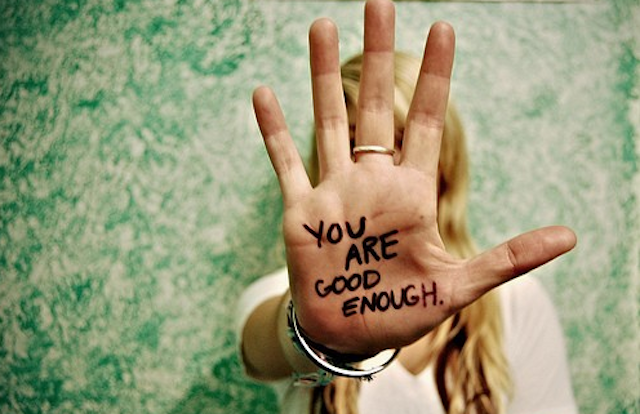
    You Are Good Enough

    “If you concentrate on what you don’t have, you will never, ever have enough.” ~Oprah Winfrey

    Seven years ago I discovered a world of healing, energy, and spirituality. It came at a particularly hard time in my life. Everything that could go wrong seemed to have.

    First, I picked up a bug while travelling, which left me unable to hold down food for over eight weeks, and doctors told me there was nothing more they could do.

    Then, there were secondary infections, which I learned I might have to live with for life.

    I was being bullied at work and then walked away from my friends. Both of these experiences were extremely stressful and a great source of pain. Then, two weeks after moving to a new country to start afresh, one of my best friends died suddenly.

    The first twenty-five carefree years of my life exploded in my face, and confusion set in.

    In a desperate quest to find answers, happiness, and peace again I went searching, and what an awesome world I found!

    It started with discovering kinesiology and developed into a learning of healing foods, chakras, and energy healing. Yoga and meditation followed, along with personal development seminars and stacks of self-development books.

    And all for a good reason—each of these disciplines was quite literally changing my life.

    One by one, they helped me unravel subconscious layers from the past and release old stagnant energy, emotions, and beliefs that were no longer needed.

    For example, if I felt angry and frustrated from work, I would pop in for a kinesiology session and walk away upbeat and happy. If I got upset after an argument with my husband, I’d run off to heal the part of me that was causing this to arise, and skip home loving and free.

    To say these quick fixes became addictive would be an understatement.

    Then, over the last year I kept getting the same lines repeated to me over and over again. Healers telling me my work with them “was done,” my kinesiologist telling me I’d “got it” a while ago now, and friends reflecting left, right, and center that “I’m there.”

    The problem was that I could not see it. Surely there is no final destination, and besides, there were still so many things to fix. I didn’t feel “there.”

    My addiction to fixing myself had kicked in. Even though I know we are all human and will never be perfect, I felt the need to keep on clearing as much of the imperfect away until I got “there.”

    But “there” was not coming, at least not in my eyes, and frustration started building. I believe this addiction formed due to a deeply hidden belief that I was not fundamentally good enough.

    I thought that if I healed enough, sooner or later I would be “fixed.” I would be good enough—but I was missing the truth, the truth that we are always good enough exactly as we are.

    We will all encounter lessons as we walk through life and, of course, healing can help us move through these, but fundamentally, we are always already good enough. This part I was slow to grasp.

    Along this journey I had walked away from a career in advertising to follow my passion for nutrition, leveraging all I had learned to become a coach. What I didn’t see coming was the second cousin to “healing” and the old pattern formed under the guise of “business development.”

    All of a sudden I would never be a success unless I had mastered a zillion courses on marketing, sales, coaching, webinars, and list building.

    No matter what I did I couldn’t hold on to the money I was making—so I looped back into the healing world looking for answers to my money blocks.

    Then came the clincher: My income dramatically increased—and, you guessed it, I still spent every cent each month on the next skill I needed to learn or block I needed to clear.

    At the same time I noticed I was getting angry with healers and “experts,” as they repeatedly told me what I already knew.

    Something wasn’t adding up any longer. Luckily, the person I turned to for advice supported me to process the most amazing realization for myself:

    I discovered that I had been through an intense period of learning, that over the last seven years I had been absorbing “universe lessons.”

    It was time to step out of the Universe-ity classroom and start truly living all that I had learned. And with so much knowledge under my belt, it was also time to pass it on to others.

    It’s not that we will ever stop learning—it’s just that we have to start using the tools in our everyday lives, as opposed to conducting an ongoing search to fix ourselves.

    Through my journey, I have learned that it is common for us to get these lessons in the spiritual realm, but not bring them to life in the physical world.

    At some stage along the path I had started focusing on what was still “broken” instead of how amazing things had become.

    I was so blinded by this thought pattern that I was unable to receive the joy and pleasure already surrounding me.

    By shifting from the energy of “not enough yet” to realizing I already am, I’ve found the peace to step forward and apply all that I’ve learned, and inspire others to do the same.

    I now know that I am already so much more than “enough,” and it’s now time to graduate from Universe-ity!

    So I invite you to check in on your own motive for healing. Are you desperately trying to fix a part of you that you deem wrong, shameful, or bad? Or, can you accept that you are already perfect exactly as you are now, shadow and all, even if you still have room to grow?

    Are you ready to relax and let your journey unfold exactly as it is supposed to?

    Photo here

  • Stop Being Hard on Yourself: 5 Tips for Learning Life Lessons

    Stop Being Hard on Yourself: 5 Tips for Learning Life Lessons

    women sunset landscapes

    “When we can no longer change a situation, we are challenged to change ourselves.” ~Viktor Frankl

    I learned a big lesson this week. It’s been a lingering challenge that has popped up in many ways recently. Mostly it’s presented itself in other people, or rather, in the qualities of other people.

    Over the last few months, I’ve been introduced to quite a few new acquaintances, and I’ve continuously come up against traits that I considered ugly, like arrogance, materialism, insecurity, and ignorance.

    It really riled me up to the point that I felt a physical change in myself.

    I interpreted their taste for expensive things as a sign that they were hiding behind material objects. I interpreted their obvious mask to the world as another hiding mechanism. And what I perceived as stupid life choices I thought were a form of escaping their real selves.

    In essence, I felt that all of these traits were an attempt to cover up their own insecurities, for fear of not being accepted completely for who they are, who they really are.

    Why were these people so…unaware?

    It infuriated me.

    Each time I was triggered by a person with these traits I would think to myself “Not this again. When will I finally be rid of this uncomfortable feeling?”

    Then it hit me. Several times.

    I realized that the traits I noticed in others were just a reflection of myself. The traits that really peeved me off were traits I did not accept within myself.

    I also like to buy nice, expensive things sometimes. There are moments in my life where I wear a mask to not reveal all of myself. And in the past, I made some decisions to avoid what I was really feeling within.

    This was shocking to me because it meant I was passing judgment, not just on the other person but also on myself. It meant that I was not accepting myself fully, completely, wholly.

    And trust me, just accepting that fact was a lot to take in.

    I’ve always thought myself to be a person with confidence and a great belief in myself. But apparently, there were a few more things that I needed to learn about loving and accepting myself.

    No one is perfect. And we need to accept ourselves as we are, flaws and all.

    As we go through life, challenges arise to help us keep growing. We’re human and we have layers. Just when we think we’ve learned something, life comes along and shows us there’s more.

    Here are some tips that have helped me accept and grow with my most recent life lesson.

    1. Don’t beat yourself up.

    No matter how easy it is to say to yourself, “Why can’t you just get over this?” allow yourself the time to learn the lesson at your own pace. Challenges can hit a raw nerve within us. Sometimes we need to take it step by step and nurture ourselves in the process. Be nice and gentle to yourself!

    2. Observe your thoughts and emotions.

    Awareness is the first step in acknowledging any life challenge. How are you responding to a particular event, circumstance, or person? What are your initial feelings? And why are you feeling this way?

    Asking yourself some important questions can help you understand why you are having such a profound response to something. Don’t censor yourself to sound like a good person. Be truthful. It’s the only way to find out what’s really beneath it all.

    3. Shift the focus back to you.

    Our outer world is a reflection of what’s going on within us because we project our own thoughts and feelings onto other people and events. We give it our own meaning.

    Remember, we can’t change other people, the past, or circumstances out of our control. All we can change is ourselves. Shift your focus back onto yourself and realize that you have the power to change your life.

    4. Accept what you cannot change.

    I know it’s easy to resist your circumstances, and blame other people and events. Sometimes we just have to accept it, breathe through it, and know that this is happening because it’s time for us to grow.

    5. Celebrate your growth.

    When you’ve learned the life lesson, celebrate! After all, you’ve just taken another step in evolving as a human being. Rejoice in the fact that you can handle whatever life throws at you and become a better person because of it.

    Life is pretty amazing. We all hit a few road bumps along the way, but eventually the road gets smooth again. As long as we’re learning lessons as we go, there’s no reason we can’t sit back and enjoy.

    Photo here

  • Why We Don’t Always Get What We Want

    Why We Don’t Always Get What We Want

    Lonely Man

    “Remember that sometimes not getting what you want is a wonderful stroke of luck.” ~Dalai Lama

    It’s probably happened to you. In all likelihood, it has happened multiple times in your life thus far.

    You don’t understand why it happens. And when it does, it can throw you into the deepest valleys of despair.

    Perhaps you cry out to a higher power to make things better. Maybe you just stare into the cosmos, wondering what the meaning of life is and why things get tough.

    I’ve been there. Many times. For all sorts of reasons.

    Breakups, career problems, dealing with a death, financial issues, there are a million things that can put you into this frame of mind.

    You know what you want more than anything, but no matter what you do, the universe just doesn’t seem to give it to you. Why? Why can’t things just be easier, simpler? Why can’t things get better?

    Why can’t we get what we want?

    A few years ago I was going through an extremely difficult time in my life. My fiancé of four years had broken up with me. Over the phone.

    No visit. No long talk about how we could maybe work it out. She just told me she couldn’t do it anymore.

    And just like that, I was thrown into that valley.

    I spent the next few months searching for answers. I read through different religious texts, self-help sites, and scientific books. I prayed, I meditated, and I even tried to visualize the thing that I wanted the most. 

    I just wanted my fiancé back.

    My work suffered at my job, though I didn’t notice. It took an old friend, one of my bosses, calling me into his office and having an honest conversation for me to realize that I was basically coasting through the weeks.

    In the evenings, I was plagued by dreams of my ex. In them, we were happy and together. Everything had worked out.

    Of course, I always woke up in the middle of the night, sweating and crying. Yeah, I woke up crying.

    I was raised to believe in a higher power. But during those nights of torture, I found myself pounding my pillow and begging him/her to make everything better.

    Nothing ever got better, though.

    Talks with friends yielded no good counsel. As a student of the psychological sciences, and a counselor myself, their cliché words only served to frustrate me.

    “There’s a reason for everything.” “If it’s meant to be.” “Time heals all wounds.” The more I heard their fortune cookie advice, the angrier I became. 

    And the whole time, I continued to beg the higher power to fix everything.

    One day at my job, I was talking to one of the teachers I worked with. She was a huge fan of Native American history and had an interesting perspective on my predicament.

    She suggested that I go on a vision quest.

    I’d done one of these when I was in graduate school as part of an assignment. We had studied the ancient technique the natives used when they were searching for answers, so I was pretty familiar with the process.

    If you don’t know what a vision quest is, you go out to a place where all you can do is observe the world around you and focus intensely on the thoughts that come as a result.

    This time, though, the stakes were much higher than on my previous quest.

    I decided to do it on a weekend and woke up the following Saturday morning with one mission in mind: to find answers. 

    The former capital of the Cherokee nation was only twenty minutes from my house, now set aside as a state park. I figured what better place to do a vision quest than where the Native Americans used to live?

    It was a chilly morning, and the forests surrounding the historical site were thick with fog as I began my walk.

    I stopped at various points along the way to meditate and pray. There was one spot next to a gentle brook where I watched the birds and squirrels scurrying about their day, mirroring the many thoughts and feelings rushing around in my head.

    While nature was peaceful around me, a storm still raged in my heart centering around a single question: Why can’t I have what I want?

    I continued the walk, writing down every thought and emotion that came to my mind. Minutes turned into hours and, as I neared the fourth hour of my quest, I decided it was getting close to time for me to leave. Empty handed.

    I neared the top of a ridge at the edge of the sacred land and looked up into the leafy canopy of the forest. Poplar, oak, and maple leaves hung silently above me.

    “I just want to know why you won’t fix this for me,” I said out loud, bitterly.

    Suddenly, my mind was whisked back to the school where I work to a point a few weeks before and a conversation I’d had with one of my students. I’d walked into the computer classroom to see what everyone was working on that day and he’d gotten my attention.

    “Hey, can you fix my grade in this class so I can pass?”

    The question caught me off guard and I laughed. “Yeah, I can do that,” I surprised him with my answer. As a school counselor, I have access to that kind of stuff.

    His face became hopeful. “You can?”

    I went on to explain to him that I could do that, but I wouldn’t.

    He asked why.

    I told him it was because if I fixed everything for him like that, he would never learn anything.

    My brain zipped back to the moment, standing on the forest trail. The realization punched me in the face like Mike Tyson in his prime.

    A smile crept onto my face. Then I began to laugh and looked back up into the treetops.  A robust breeze rolled in, waving the high branches around dramatically.

    I continued to smile as I spun around staring dizzily into the rustling leaves.

    That was it. If someone or something always fixed everything for me all the time, I would never learn anything. More than that, I would never be able to do anything for myself in life. I would always be dependent on someone or something else to make things better for me. 

    I would never be able to learn another language, live in a foreign environment, try new foods or activities, or grow as a person in any way.

    Sometimes in life things happen that can be difficult, and often they can be extremely painful. We must push through those moments where all seems lost. When we do, we can find a new us on the other side that is wiser and more beautiful than we ever imagined.

    By working through these difficult changes in life, we grow into something new, better, stronger.

    To paraphrase what the Rolling Stones said: You can’t always get what you want. But you get what you need.

    Photo by Zigg-E

  • The Wisdom of Learning What’s Right and True for You

    The Wisdom of Learning What’s Right and True for You

    “Knowing others is intelligence; knowing yourself is true wisdom.” ~Lao-tzu

    There seems to be a common perception in our culture that knowledge equals wisdom; however, I don’t believe this is true.

    I would say that wisdom is what knowledge becomes when we have brought it into our hearts and experienced it as true.

    Wisdom cannot be gained by passively accepting what we read or by believing what another person tells us. We must take an idea or thought and test it, truly investigate it, before it can become wisdom.

    Wisdom requires awareness and a willingness to ask ourselves—and experience firsthand—what is true for each of us.

    We’ve all read a book, or heard someone speak, and learned ideas and theories that sounded really great; but this information cannot be wisdom until it has been tested in our own experiences.

    In other words, wisdom comes from walking the walk, not just talking the talk.

    According to Buddha, we cannot believe something just because it is written in a book, or because the person who said it is well-known, or a teacher, or an elder. He said to only believe something after you have tested it in your own heart and found it to be true.

    He states, “Those who recite many scriptures but fail to practice their teachings are like a cowherd counting another’s cows.”

    In my early years as a therapist I felt as though I needed to be the “expert.” I would offer my clients, and friends, and family, and people I barely knew, what I thought were wise phrases hoping to impress and impact them with my “wisdom.”

    I thought that I could gain the assurance I was looking for by demonstrating how smart I was, relying purely on my education and the knowledge I had attained from teachers and supervisors.

    However, the harder I tried to prove myself, the less confident and effective I felt. I would stumble over my words, trying to recite some theory that would end up just coming out like advice-giving, leaving the other person feeling confused and uncertain.  

    I thought wisdom meant knowing all the answers all the time. I had been in my own therapy for years and had a high level of insight and awareness of myself; however, I had not yet really begun practicing the principles I was preaching of compassion and self-acceptance. As a result, I felt a bit like a fraud.

    What I’ve since realized is that wisdom does not mean “knowing” all of the answers.

    Wisdom is a state of mind, specifically, an openness of mind, that has explored and experienced truth.  Wisdom requires action.

    Wisdom does not have set answers for everything, but instead has a willingness to learn. Rather than trying to resist or hide my not-knowing, I have learned to embrace it with compassion and use it as an opportunity to consider a new way of understanding something. (more…)

  • Peace Is Learning the Lesson

    Peace Is Learning the Lesson

    “No matter how hard the past, you can always begin again.” ~Buddha

    It’s strange to feel peace while a part of your heart is being chipped away.

    I’m in the middle of a heart chipping, but the longer it goes on, the more I’m realizing that it needs to be removed before it hardens the rest of the organ. Maybe the chipping is kind of like pruning a diseased tree so the remainder grows stronger and more resilient.

    The cuts hurt like hell though.

    The last few months have been some of the most difficult of my life. I’ve been trying to stand firm while my girlfriend determines whether she will stay in our three-year relationship or return to her former life.

    Like it or not, and I really don’t, my own personal pruning must occur. I keep telling myself it will be worth it. I try to keep my highest prayer in mind, which is love, always love.

    The pruning hurts like hell.

    I’ve come to believe that love sometimes wraps itself around a process of letting go.

    I don’t let go easily or often, but love helps me loosen my grip so that when I’m finally prepared, my knuckles are not quite so white from hanging on for dear life.

    The pruning process of letting go releases the insanity in my life.

    For me, the pockets where insanity lies—where I can’t tell the difference between what’s working for me and what’s not—nearly always involves a relationship of some kind.

    Let me be clear: The process of releasing doesn’t necessarily mean letting go of the person. Sometimes, the pruning is about trimming back feelings.

    The trimming hurts like hell.

    Right now, I am totally messed up because the relationship with my girlfriend is the most significant in my life. We’re each highly invested and more than a little enmeshed. There’s certainly a lot of insanity mixed in with all the love!   (more…)

  • 10 Journaling Tips to Help You Heal, Grow and Thrive

    10 Journaling Tips to Help You Heal, Grow and Thrive

    “The more light you allow within you, the brighter the world you live in will be.” ~Shakti Gawain

    Keeping a journal has many positive benefits. Journaling can help with personal growth and development. By regularly recording your thoughts you will gain insight into your behaviors and moods.

    Journaling can be used for problem-solving and stress reduction. It’s been proven to improve mental and physical health. It can lead to increased self-esteem.

    Dr. John Grohol, CEO of Psych Central, estimates that one in three people suffer from a mental illness.  Anxiety disorders, mood disorders and substance abuse can be treated with a combination of medication and counseling.

    In addition, writing in a journal is an effective tool for use in the healing process.

    I started keeping a diary at age 8. As I grew up, I wrote the normal kinds of teen angst entries but eventually I turned journaling into a more sophisticated practice. In my 20’s I read all of Anais Nin’s Diaries.

    I studied Ira Progoff’s At a Journal Workshop and implemented his methods—an elaborate design for generating the energy for change. Using his methods I was able to sort through turbulent emotions during the divorce from my first husband and discover hidden lessons from the experience.

    To this day I continue to use some of his techniques as well as others I’ve learned. Recently I’ve discovered a new creative world in art journaling. Using mixed media has helped me express myself in refreshing and unusual ways.

    There is a lot of power in the written word but occasionally words are hard to find. By drawing or making a collage I have been able to create a representation of how I feel that moves beyond my analytical writing.

    Writing has helped me to process not only failed relationships but also to recover from grief and loss. 

    Reading back through my journals has helped me reflect on where I used to be and where I am now in my life. It’s a method of allowing the light of understanding and compassion to shine on my past.

    In The Artist’s Way Julia Cameron suggests writing three handwritten pages or 750 words every morning.  At first there is a lot of “dumping” but eventually little jewels of wisdom and direction emerge.  I found myself creatively energized when I participated with a group for 12 weeks using her book as a guide.

    If you want to improve your perspective on life and clarify issues, start writing in a journal. 

    You can’t know where you’re going if you don’t know where you are. Be sure your journal will remain private or write online so that you are writing for your eyes only.

    Here are 10 tips to get started: (more…)

  • When You Keep Learning Instead of Taking Action

    When You Keep Learning Instead of Taking Action

    “Begin, be bold, and venture to be wise.” ~Horace 

    It was day five without food, meditating in a cave in the Sahara desert.

    In 2009, I skipped out on two weeks of my senior year of college to go to the desert.

    Ever since I was a young I had been into exploring the boundaries of the self. I had always wanted a period of time when I could totally be alone for days—not a word spoken to me, where I could go deeper into my mind than ever before until I simply evaporated.

    So there I was.

    Just the desert sands, the sky, and me.

    And I was bored.

    The mind-bending impenetrable boredom was the first thing that hit me. Hard.

    And I’m not one of those people who is constantly multitasking. You can put me in a room for 3 hours and tell me to do something quietly and I’ll come out fine, sanity-intact.

    However, there was something so stubborn about this boredom. I was wondering if perhaps I should’ve just gone back to my daily meditation routine instead of flying all the way into the Sahara desert.

    The days eventually passed, the sun rose and set like it should, and every once in a while I had little visitors stop by.

    A dragonfly.

    I thought that was a little weird, since I knew dragonflies don’t go far from water.

    Two dragonflies. Hmm.

    Five dragonflies.

    A cloud of dragonflies flying in formation. That was pretty bizarre, I thought.

    As the days wore on, I started experiencing the subtle effects of hunger. Pain and nausea wore off after day 1—and afterwards I just experienced weakness from the lack of food. (more…)

  • You Can Control What You Do Today

    You Can Control What You Do Today

    “What you leave behind is not what is engraved in stone monuments, but what is woven into the lives of others.” ~Pericles

    Life is full of challenges. These obstacles are the greatest teachers we can have.

    As I’m sure is true for all of us, I have struggled with many things throughout my life. I used to feel a sense of “woe is me,” but I’ve learned to leverage these experiences to make positive changes in life.

    Don’t let your history dominate your life. We have a choice. You can let your past be the ruler of your life—or, you can make a choice to change your attitude and perspective. 

    I grew up in a dysfunctional family. My parents showed little in the way of affection, and I dare say they stayed together “for the kids.” This was a recipe for disaster. Water boils at 212 degrees, and our family was moving closer to that boiling point on a daily basis.

    The inevitable collapse came to fruition during the summer of my freshman year of college, in 1995.  After an intense argument, I had to separate my parents from a potentially disastrous physical altercation.

    A call to the police was made, and my dad was taken to jail for the night. Twenty-six years of marriage gone in an instant. That was it. My dad moved out the next day.

    I felt extreme guilt. I was faced with unending questions about what I could’ve done to save my parents’ marriage. I didn’t allow myself to grieve. I felt the grief my parents were feeling was enough for all of us.

    I buried these feelings and numbed myself. My negativity and destructive thinking overwhelmed me. I was never the same as a college athlete, as I let my personal challenges affect my confidence. My relationship was never the same with my girlfriend. It eventually went up in smoke.

    My biggest mistake was never talking to anyone about what I was going through. I turned to drugs and alcohol to ease the pain. This only caused more problems.  (more…)

  • Learning and Unlearning: A Journey of Self-Acceptance

    Learning and Unlearning: A Journey of Self-Acceptance

    Sitting by the Water

    “What you are is what you have been. What you’ll be is what you do now.” ~Buddha

    A teacher of mine once said, “Don’t show up as the person you think you are. Show up as the person you want to be.”

    A powerful statement, but I didn’t know who I wanted to be. Even if I did, I wasn’t sure if I could pull it off.

    I knew who I didn’t want to be: self-critical, self-conscious, and always focusing on my shortcomings. I wanted to learn how to get out of my own way.

    For a long time, I thought improving my external situation by becoming richer, thinner, and smarter meant that I was learning. Not to say that accomplishing those things isn’t learning. However, in that cycle I wasn’t learning, but repeating the same story.

    I kept trying to get from A to Z by pushing myself and always expected my results to meet my expectations. And the vicious cycle continued. I thought I’m not good enough; I’m pathetic and I’ll never get it right.

    Ironically, my desire to learn continued to work against me. (more…)