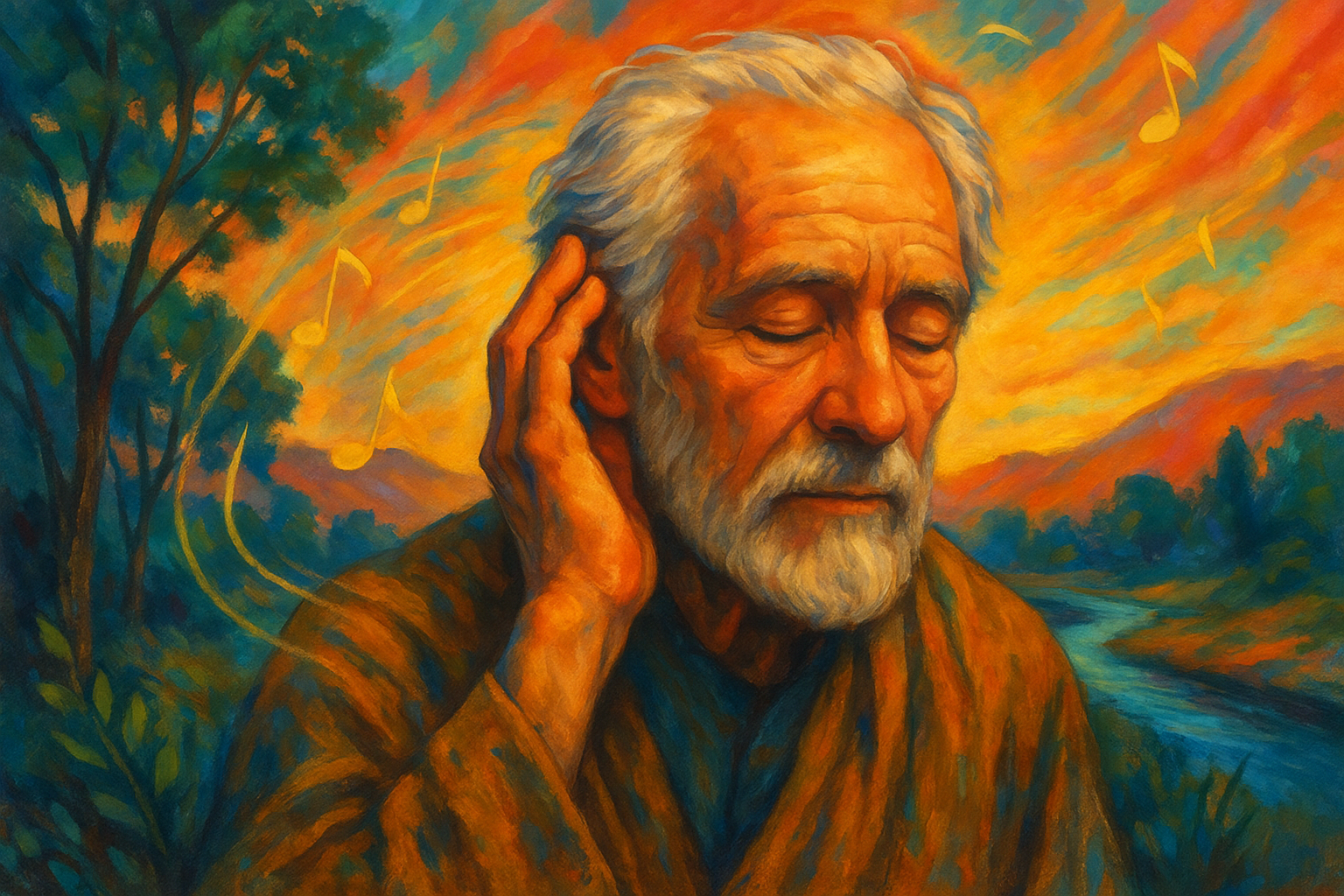
“The silence between the notes is as important as the notes themselves.” ~Wolfgang Amadeus Mozart
When I was younger, I thought knowledge was something you could capture—something you could write down, measure, and prove. I believed that to understand something, I had to explain it. And for a long time, I tried.
But then, life—through film, through music, through long conversations with people whose wisdom couldn’t be found in books—taught me something else: the most powerful truths don’t always come in words. They exist in the space between them.
I learned this lesson in the mountains, where the sky stretches wide, and silence is not empty but full of presence. I had traveled there to document a group of elders who carried the history of their people in their voices, in their stories, in the songs they sang to the younger generations.
One elder, in particular, stood out. He didn’t speak much, but when he did, the others listened. Alongside his fellow elders, he would chant in a rhythmic, sing-song cadence, weaving the origins of the universe into the fabric of their small mountain community. But what struck me most wasn’t his voice—it was his silence.
As the camera rolled, he sat in stillness. The wind whispered through the trees. The river murmured its eternal song. In that quiet, there was something deeper than speech, something that pulsed with meaning.
Later, when I played the footage for a colleague, they asked, “But what is he saying?”
I wanted to answer, Everything.
Listening Beyond Words
If you’ve ever felt like the world moves too fast, like people are speaking over each other instead of really hearing, then you already know how rare true listening is. We live in a time when everyone wants to be heard, but few know how to listen.
Listening—real listening—isn’t just about hearing words. It’s about feeling presence. It’s about noticing what isn’t being said. It’s about sensing the weight behind someone’s silence, the emotion in their breath before they speak.
I didn’t always know how to listen this way. In my early years as a filmmaker, I focused on what was visible—the shot, the framing, the dialogue. But over time, I realized that the most powerful moments weren’t always what was said aloud. It was the glance between two people who had known each other forever. It was the way someone’s hands trembled before telling a difficult story. It was the pause between sentences, where something unspoken begged to be understood.
This kind of listening—deep listening—is a skill, just like any other. And like any skill, it can be practiced. It requires patience. It requires presence. And it requires a willingness to be quiet yourself, to let go of the need to respond, explain, or control the conversation.
The Silence That Speaks
There is an old teaching in Nada Yoga, the yoga of sound, that says silence is not an absence, but a vibration. It is a resonance that allows meaning to unfold.
I have felt this in the editing room, cutting together scenes, realizing that what moves people is not the dialogue but the spaces between it—the quiet before the revelation, the moment of stillness before the truth lands. I have felt it in music, when a musician allows a note to fade just long enough for it to sink into the listener’s bones.
And I have felt it in life, in conversations where someone shares something so raw, so deeply personal, that all you can do is sit with them in silence.
That silence is not empty. It is full of acknowledgment, of understanding, of respect.
The Power of Presence
One of the greatest challenges I faced in my work was convincing people that this kind of knowledge—this ability to sit with silence, to notice, to be present—is just as valuable as facts and figures, as theories and analysis.
Academia, where I spent much of my life, doesn’t always recognize the kind of knowledge that is felt more than written. The kind of scholarship that comes through film, through sound, through experience. There, knowledge is measured in citations, in publications, in things that can be counted. But how do you count a pause? How do you measure the impact of a shared silence?
I have spent years trying to advocate for a broader understanding of what it means to know something. To understand that presence—the ability to be fully here, fully aware—is its own kind of intelligence.
And here’s what I want you to know: You don’t have to be a filmmaker or a scholar to develop this skill. You don’t have to travel to distant mountains or sit in long hours of meditation. You just have to start paying attention.
How to Listen Deeply
If you want to learn to listen—to truly listen—try this:
1. Pause before responding.
Next time someone speaks to you, don’t rush to fill the space. Let their words settle. Notice what else is there—their body language, their expression, what they aren’t saying.
2. Listen without planning your reply.
Too often, we only half-listen because we’re already thinking about what we’ll say next. Instead, try just absorbing what’s being said. Let the response come naturally.
3. Pay attention to the silences.
In music, the rests are just as important as the notes. In conversation, the pauses carry meaning. Notice what happens in those spaces.
4. Be comfortable with not knowing.
Some of the most profound moments in life don’t come with clear answers. Be open to sitting with uncertainty.
5. Practice with sound.
Spend time listening to the world around you—really listening. Close your eyes. Notice how many layers of sound exist at once. The wind. The hum of a distant car. The rhythm of your own breathing.
The more you develop your ability to listen, the more you will understand—not just about others, but about yourself.
A Different Kind of Knowing
I write this now, not as a call to arms, but as an invitation.
To the artists, the thinkers, the ones who feel deeply but don’t always have the words—know that there is a place for you. There is value in the way you experience the world.
You don’t have to explain everything. You don’t have to put it all into words.
Sometimes, the most powerful things we know—the things that change us—exist in the space between words.
And if you ever find yourself doubting whether your way of seeing, of listening, of feeling has a place in this world, remember this:
Some of the greatest wisdom isn’t spoken.
Some of the most powerful messages are never written.
And sometimes, the best way to understand is to simply be present.