Tag: judgment

  • How to Motivate Yourself with Kindness Instead of Criticism

    How to Motivate Yourself with Kindness Instead of Criticism

    I don’t always make the best choices, but today I choose compassion over intolerance, sympathy over hatred, and love over fear.” ~LJ Vanier

    It’s crazy to me now, to look back and realize how freaking hard I was on myself for decades.

    Had I ever talked to anyone else the way I talked to myself, it would surely have left me friendless and jobless, and I definitely would have been kicked out of school.

    Basically, I was a bully. Just to myself.

    If I said something awkward, I called myself an idiot.

    When I couldn’t find the motivation to clean my house, I called myself a lazy slob.

    If I wasn’t invited to a party, I told myself it’s because no one liked me.

    When work projects were hard, and I had to make it up as I went, I told myself that I was going to get fired as soon as my boss figured out that I had no idea what I was doing.

    My parents set high expectations of me. A’s were rewarded and B’s were questioned: “Why didn’t you get an A?”

    They are successful, intelligent people (who somehow also are able to keep a clean house, like all the time), so if I did anything that didn’t meet what I assumed were their expectations, I told myself, “I’m not good enough, I’ll never be good enough.”

    At a certain point, I realized this “strategy” wasn’t working out for me.

    It wasn’t making me any smarter or more successful.

    It wasn’t making people like me more.

    It wasn’t getting my house any cleaner.

    What it was doing was making me feel like crap. Every day. And it got old.

    Looking back, I realize now my catalyst for change was when I finally pushed past my social anxiety and found the courage to take classes at the gym.

    I found that I performed better when in a group because of the positive energy of people cheering me on.

    After a while I noticed I didn’t cheer people on quite as much as they cheered me on, and since it felt good for me to hear it, I busted through my fears and started cheering on everyone else in the class.

    It felt really good.

    It felt even better when it dawned on me that I could talk to myself that way too.

    And that is what self-compassion really is.

    What is Self-Compassion, Anyway?

    Self-compassion is speaking to yourself as kindly and empathetically as you would a friend.

    It involves consciously directing kindness inward.

    Self-compassionate people recognize that being imperfect, failing, and experiencing challenges are all inevitable parts of life, so they’re gentle with themselves when confronted with painful experiences rather than getting angry when life falls short of their expectations.

    Therefore, they speak in kind words—intentionally—to themselves.

    It is recognizing the shared humanity in our suffering and difficult experiences.

    When we’re being compassionate toward someone who is going through a hard time or has made a mistake, we say things like:

    • “You’re not alone.”
    • “Everyone makes mistakes.”
    • “You’re only human.”
    • “I’ve been there too.”

    Because there is comfort in recognizing that pain and making mistakes is part of life, it’s part of the process, it’s how we grow, and we all do it—literally every human.

    When we don’t take the time to say that to ourselves when we misstep, we feel isolated, and isolation breeds shame and separation and makes us feel worthless.

    Why We Are So Darn Hard on Ourselves

    We live in a success-driven, “no pain no gain,” “win at all costs,” “if you have time to lean you have time to clean,” “failure isn’t an option” kind of culture.

    There is nothing wrong with pushing ourselves and driving success.

    The problem is, we are a mimicking species, and when all we see are examples of people being hard on themselves and few or no examples of people being kind to themselves, we don’t know what that looks like.

    So the idea of self-compassion is foreign to most people. As such, we have these misconceptions that keep us from being self-compassionate.

    Myth #1: I need high self-esteem to feel good about myself.

    One of the biggest misconceptions about self-compassion is that it is the same as self-esteem.

    We grow up believing that high self-esteem is the key to feeling good about ourselves.

    The problem is, in our culture, to have high self-esteem, we have to be above average or special in some way.

    It’s almost an insult to be considered “average.” If someone were to say, “There’s nothing special about her” that would make a person feel especially bad.

    So, by this measure, self-esteem is conditional to everyone else’s status in comparison to ours. Our self-esteem (and therefore self-worth) go up and down as those around us go up and down.

    That’s why there are so many bullies in our society—because putting others down is one way to make your self-esteem go up.

    (There are literally studies showing an increase in bullies and narcissism in our society in the past several years, and many psychologists point to the “self-esteem” movement as a big factor.)

    Myth #2: I need to be hard on myself, or I’ll let myself get away with anything.

    A lot of people have the misconception that self-compassion is self-indulgence.

    They worry that they could be too self-compassionate and too soft on themselves, that they need to be hard on themselves in order to keep on track.

    But self-compassion enhances motivation, it doesn’t hinder it.

    Let’s say your friend is upset that she texted someone, and they haven’t texted her back.

    Do you say to her, “That’s probably because you did something wrong. I bet she doesn’t like you anymore, or maybe she never really did. You should apologize even though you don’t know what you did wrong, since she is most likely mad at you for something.”

    Absolutely not!

    Not only is it a mean thing to say, you know objectively that this is almost certainly not true.

    You would likely say, “I know that feeling too. I get disappointed when I don’t get a response from someone. But she likely forgot or is busy, just like a lot of people. Her not replying isn’t a reflection of you, it’s an inaction by her. Don’t worry, she still might message you back, or you can message her again later!”

    Which one of those feels more motivating? Which one feels more stressful?

    Which way do you talk to yourself when you slip up?

    The motivational power of your inner bully comes from fear, whereas the motivational power of self-compassion comes from love.

    How to Practice Self-Compassion

    1. Mindfully recognize when you hear your inner critic talking.

    We get so used to using negative self-talk that we don’t even notice it. We just run with the critical stories we’re telling ourselves.

    But you can’t change anything unless you recognize when you’re doing it by mindfully bringing attention to your thoughts, without judgment.

    First, notice how you feel. Because self-criticism feels crappy. That’s your sign that you need to do a little mindful digging.

    Now, the best tool you can use when you get that sign is to ask, “What is the story I’m telling myself?”

    • The story I’m telling myself is that people at work think I’m a fraud because I’m making everything up as I go, and I’m not giving myself any credit for all that I do know and have achieved.
    • The story I’m telling myself is that I’m not a good mom because I let my house get messy, and I’m not thinking about how happy and healthy my kids actually are.
    • The story I’m telling myself is that I’ll never lose weight because I ate those cookies, and I’m not giving myself permission to make a mistake.

    What is the story you’re telling yourself, and what language are you using to tell it?

    2. Understand the positive intent behind your negative self-talk.

    This is going to help you reframe your negative self-talk into self-compassion.

    Let’s say you’ve been wanting to lose weight, but you look down and realize you just ate an entire box of cookies.

    And now your harsh inner critic is saying, “You’re disgusting, you’ll never be able to lose weight, you have no self-control, this is why you’re so fat.”

    Again, words we would never say to someone else.

    What is the positive intent, what is that self-critic voice trying to achieve?

    • It wants me to be more conscious of when I’m eating and what I’m eating.
    • It wants me to be a little stronger when I have these cravings so I can lose weight.
    • It wants me to make a better choice in the future.

    Right? It’s not trying to beat you up for the sake of beating you up. That voice has a purpose, it’s just using the wrong words.

    3. Reframe that positive intent with self-compassion.

    Restate what your self-critic is saying with the voice of self-compassion by talking to yourself as you would a friend or loved one, recognizing the shared humanity in the experience, and consoling in the fact that this too shall pass.

    Can you look inward and say, “I see what you’re doing here. Thanks, subconscious, for the reminder, I know you’re just looking out for me. Now that we’ve heard what you have to say through the self-critic voice, let’s hear what the self-compassion voice has to say…”

    What would that sound like?

    “I get it, I’ve had a stressful day, I skipped lunch, and I’m tired, so I just fell back on an old habit—I made a mistake. Now that I know why I ate all those cookies, I can make a better decision tomorrow. All is not lost.”

    Which one of these feels better? Which one would motivate you to do better tomorrow?

    4. If you think you can’t be self-compassionate…

    If and when during this growth process, you find yourself thinking, “I just can’t stop talking to myself in that negative way, it doesn’t feel natural to speak positively to myself,” I want you to understand two things…

    First, self-compassion is a habit.

    That negative self-talk you’ve been doing for years has simply become a habit.

    It’s become your habitual reaction to stress, adversity, and failure. And that’s what we’re doing here: breaking old habits and creating new ones.

    It will be a challenge at first, as are all new habits. But with some practice, this is going to get easier and easier. It’s making self-compassion your new default mode.

    It will feel weird and unnatural at first. Don’t let that make you think it isn’t working. The more you practice this, the more you are training your brain to focus on compassionate self-talk instead of criticism, meaning you’ll spend less and less time with that critical language and more time with the compassionate language. In time, this will become your new, natural response.

    Eventually, you’ll reach a point where you say, “Hm, if I did that a year ago, I would have beat myself up for days. Good for me!”

    Second, you have a natural negativity bias that is working hard right now.

    When you feel like you can’t be self-compassionate, understand our natural negativity bias.

    We all have a negativity bias. It’s there with the intention to keep us safe. Your ancestors who were on the lookout for mountain lions lived longer than those who sniffed flowers all day.

    But we are centuries beyond the point in our evolution where we need to be on guard in order to keep safe at all times. When you’re living with chronic stress and anxiety, your negativity bias is sticking in the on position.

    Meaning, all you can see are threats. What could go wrong. What is wrong. What might be wrong. If you get a ninety on a test, you look at that ten that you missed and not the ninety that you achieved.

    Know that you have blinders on to positivity, that your negativity bias is making you focus solely on challenges instead of achievements.

    It’s what I call wearing poop-colored glasses instead of rose-colored glasses. Mindfully notice when you’re wearing them. Then take the glasses off! (They smell and they aren’t helping anything, anyway!)
  • My Secret to Overcoming the Painful Trap of Perfectionism

    My Secret to Overcoming the Painful Trap of Perfectionism

    “A meaningful life is not being rich, being popular, or being perfect. It’s about being real, being humble, being able to share ourselves and touch the lives of others.” ~Unknown

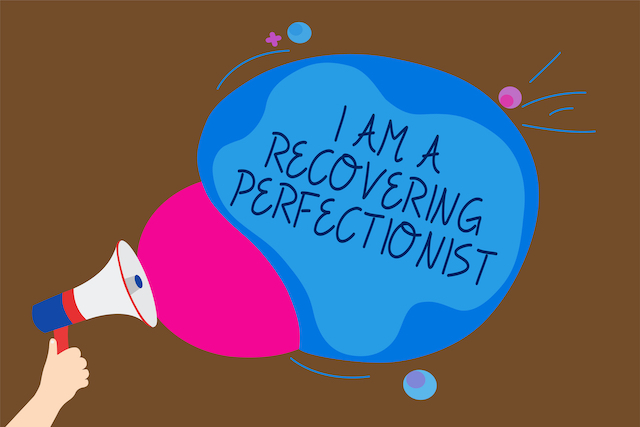
    Hello, I’m Kortney, and I’m a recovering perfectionist.

    Like so many of us, I spent the greater part of my life believing that unless something was perfect, it wasn’t good at all. There was really no in-between. If it wasn’t perfect, it was a failure.

    One of the problems with perfectionism is that it’s common to believe it’s a positive thing. In our society, people tend to value it. If you’re someone that aims for perfection, you must be accomplished. Driven. Smart.

    Have you ever had a sense of pride over being called a perfectionist?

    I have.

    Have you ever thought about why?

    Speaking for my own experience, when someone called me a perfectionist, I felt like even though I didn’t believe I was perfect, it meant that they were perceiving me as being perfect. They saw me as being one of the best, or as someone who was talented. It was validation that I was seen as someone who was good at things.

    My rabid thirst for this sort of validation fed the perfectionist machine for years.

    If you’re wondering what it means to be a perfectionist, here are a few traits:

    • Perfectionists obsess over mistakes, even when it’s not likely that anyone else even noticed.
    • Their self-confidence depends on being perfect.
    • They think in black and white—things are either good or bad. Perfect or failure.
    • They have unrealistic expectations and crazy-high standards for themselves and beat themselves up when they don’t meet them.
    • They put up a front that everything is perfect, even when it’s not, because the thought of someone else seeing their imperfection is unbearable.
    • Despite their quest for perfection, they don’t feel anywhere close to perfect.
    • They can’t accept being second-best at something. That’s failure.
    • They spend excessive time on projects because they’re always perfecting one last thing.
    • They spend a lot of time searching for external approval.
    • No matter what they do, they don’t feel good enough.

    At one point in my life, all of those bullet points described me well. I wasted so much time worrying about approval and validation so that I could feel like I was awesome. But I never felt even close to awesome. I never felt good enough at anything.

    Sure, there were times when I felt like I was good at something, but then I had to raise the bar. Just being good at something wasn’t enough. There was always another level to reach. The bar kept getting higher and higher, which isn’t necessarily a bad thing for people who are striving to make improvements in a healthy way, but for a perfectionist whose self-worth hinges on reaching the bar every time it’s raised, it’s not a positive.

    It was exhausting.

    After a lot of struggle in my life, I knew I needed to explore my perfectionist ways and find a way to be more compassionate toward myself. Perfectionism was holding me back from loving my life. And to be honest, I don’t think I intentionally set out to rid myself of the perfectionist mentality specifically. It came as a byproduct of a great deal of other personal work.

    I began to realize that I had many beliefs that were etched into my brain that weren’t helpful. Beliefs that I never thought to question. These beliefs also severely hindered my ability to be happy and to live the life I wanted to live.

    We all have belief systems that we don’t really think to question. We’ve grown up with them. We’ve learned them from the media, culture and society. But if we actually take a step back to notice that these thought patterns that inhibit our ability to grow and progress are there, we can start to question them.

    Some common limiting beliefs that keep people stuck in perfectionism are:

    • People reward me for having high standards. They are impressed and I gain approval.
    • The only time I get positive attention is when I am striving for big things or achieving.
    • If I make a mistake, I’m a failure.
    • If only I can make so-and-so proud with my achievements, he/she will love me, and I’ll be happy.
    • If I fail, I am worthless. Failing is not okay.
    • If I don’t check over everything multiple times, I’ll miss something and look like an idiot.
    • My accomplishments are worthless if they’re not perfect (i.e.: receiving a “B” instead of an “A” in a class is a failure),
    • If others see my flaws, I won’t be accepted. They won’t like me.

    The good news is that thoughts like these are examples of faulty thinking—faulty belief systems that keep you stuck in perfectionism. By identifying the specific thoughts and beliefs that keep you stuck in perfectionism, you can start to build new, more helpful thought patterns and belief systems.

    I also stumbled upon another secret for overcoming perfectionism.

    The secret is that I became okay with being average. I worked to embrace average.

    If you’re a perfectionist, you know that being called average feels like the end of the world. It’s a terrible word to hear. My inner critic was not having it. “How dare you even think average is okay?” it hissed.

    As a teenager, a twenty-something, and even a thirty-something, my world would have come to an end if I had accepted being average.

    But sometimes life has a way of making you better.

    Life has a way of putting things into your path and it presents opportunities for you to grow. Everyone has these opportunities at one point or another, but you have to notice them and choose to take advantage of them.

    There was a time not too long ago when I went through a really difficult time and had to rebuild my life.

    Looking back, I can see that the situation was an abrupt “lane-changer”—a push in a new direction to make a change. I was not living my best life and I wasn’t meant to stay stuck in that lane. I struggled with depression and anxiety, much of which was triggered by perfectionism.

    By working on thoughts like the ones I listed above, and working to accept lowering my standards—the ones that told me that achievement and success were the only way I would be worth anything—I gradually learned to replace my old standards with this one:

    Just be happy.

    Learning to make this my standard led me to a place where I am okay with being average. Eek! I said it. Average.

    Today, I can honestly say that I’m pretty happy with being average. Do I like to do well? Sure. But it doesn’t define my self-worth. While it’s created more space for me to fail, at the same time it’s created the space for me to succeed.

    The difference is that my self-worth isn’t tied to whether I succeed or fail.

    Here’s how I look at it:

    I’m really good at some things, but I’m not very good at other things. You are really good at some things.  And you aren’t very good at other things too. The good and the not-so-good all average out.

    At the end of the day, we are all just average humans. We are all the same. We’re humans trying to live the best life we can. We are more similar than we are different.

    Don’t you think that if we all ditched our quest to be perfect, or better than everyone else, we’d feel a little happier? Don’t you feel like we’d all be a little more connected?

    If you struggle with perfectionism, I invite you to take a look at the list of limiting beliefs above and see what resonates for you. What evidence can you find that can disprove these limiting beliefs? What would you like to believe instead? Try on those new beliefs and build them up with new evidence to support them.

    And along the way, work on accepting that you are enough, even if you’re average.

  • Why I Now Believe Everyone Is Doing the Best They Can

    Why I Now Believe Everyone Is Doing the Best They Can

    “You just never know what someone is dealing with behind closed doors. No matter how happy someone looks, how loud their laugh is, how big their smile is, there can still be a level of hurt that is indescribable. So be kind. Even when others are not, choose to be kind.” ~Andrea Russett 

    Everyone is doing the best they can. When they can do better, they will.

    “I disagree,” you say. “I see people who are not doing their best all the time!”

    Before the year 2006, I had a ton of complaints about the world and the people around me, including my parents, friends, and coworkers. I felt no one cared. Or at least didn’t care enough to try to do better. People seemed to do the bare minimum to get by or only what benefitted them directly. They didn’t care about how they affected others. They certainly didn’t care about me.

    I had issues with my family I couldn’t make sense of, such as how my parents treated me, the way they communicated or lack thereof, and how they were never there for me. Everything I experienced in my family seemed like the direct opposite of how parents love their children was publicized.

    Outside of my own family dynamics, I saw others with a variety of their own family issues. From financial struggles, household duties, to resentment and neglect, even abuse.

    My view of mankind and my hopes to find happiness were dark and pessimistic.

    I went to therapy, attended workshops, tried support groups, but nothing really answered the burning question I had in my mind: “Why do people continue to behave the way they do when they can change? WHY?”

    Then in 2006, I attended a three-day workshop hosted by the late Dr. Lee Gibson. It changed my perspective forever.

    Lee, as we all lovingly called him, was a brilliant behavioral psychologist who taught from a spiritual and energetic foundation. It was my first experience seeing everything from a holistic point of view, and I was hungry for more. I still practice all of his teachings today.

    Among all the Leeisms he shared, it was the insight, “Everyone is doing the best they can. When they can do better, they will” that sparked a lightbulb in my head. It would free me from an emotional trap I had created for myself.

    I will admit, it took me some time to fully grasp and embrace that perspective. I was not going to let everyone off the hook that easily. Every moment I was hurt, ignored, and betrayed flashed before me. What about my uncaring parents, my condescending boss, or my selfish boyfriend? Why should I give them the benefit of the doubt?

    Then it occurred to me that I was, in fact, doing my best at the very moment but still felt sad, angry, not good enough in many areas of my life. Not because I wasn’t trying, or didn’t want to be better, but because I didn’t always know the exact right things to say or do every step of the way. I was filled with confusion and uncertainty a lot of time, bombarded by my own emotional past. And as far as I knew, I had never chosen a lesser option if I knew there was a better way. Turned out I was the first person I needed to give that benefit of the doubt.

    If others are going through similar struggles, bound by emotional pains and egotistical voices, then I can surely believe they are as helpless as I was in breaking free of those patterns until they are aware and have the right tools to do so.

    Life events are arbitrary, and most of us don’t get to practice each scenario over and over again until we get it right (like in the movie Groundhog Day). We are often put in a position to respond to whatever is thrown at us unexpectedly. All we have to go by is what we learned at a young age from our guardians or mentors. Even if we suspect they were not the best ways, we are still unsure what the best ways are.

    It was as if a weight was lifted off my body. My mind felt more open, and I began a sort of social experiment by slowing down, observing the way people react in different situations from an outsider’s point of view, and freeing myself from taking anything personally.

    What I discovered was when I positioned myself at a place of compassion and objectivity, I became less reactive to others’ reactions. The knowledge of everyone is doing the best they can but can’t help themselves gave me a sense of power—a power to disengage from their personal struggles and maintain focus on my own powers.

    Shortly after that shift of perspective, my relationship dynamics began to shift as well. The people around me gradually put down their weapons and began to relax and open up about their internal struggles. They even started to take an interest in how I felt and expressed remorse in how they behaved in situations. It was unbelievable!

    I won’t lie in saying all my relationships have flourished. A few of them remained the same or faded away, while others were brought closer than ever because of my newfound perspective.

    For me, the greatest outcome was knowing that the few relationships that could not progress was not because of my rigid condemning stance of “Why wouldn’t you try to be better?” And that was a new level of emotional freedom.

  • When You Struggle with Being Yourself, Remember This

    When You Struggle with Being Yourself, Remember This

    “Make the most of yourself… for that is all there is of you.” ~Ralph Waldo Emerson

    Every day, it was more or less the same. I presented an edited version of myself to the world. I felt a deep level of discomfort with the idea of letting myself go. Could I? Should I? The answer was “no” every time, even if it wasn’t always a conscious decision.

    It felt wrong to be myself in a society where we’re conditioned to believe that we have to look and be a certain way to fit in. I believed that no one would accept me as I was. That it would result in my personality being mocked or criticized.

    After all, how can anyone understand someone who’s both quiet and bubbly? The two aren’t said to go together. If you’re bubbly, it means you’re outgoing, fun, lively. On the other hand, a quiet person is likely to be just that—quiet, all the time. At least, that’s what most people think.

    And if you’re both, then there’s something about you that isn’t quite right because you can’t be put into one box.

    As for the side of me that likes to laugh, be silly, and squeal in delight at rainbows, how childish. I need to grow up. I should be more mature like everyone else; play less and get serious about life because that’s how it is as an adult. Less fun, more… boring.

    Those thoughts held me back for years. The “shoulds” I imposed on myself were endless, and they rarely worked in my favor, so parts of me remained hidden like some shameful secret that could never be revealed. It felt like the biggest annoyance to not be able to show all sides of myself.

    As time passed, I started to notice some things about the way I interacted with people. I noticed that on some occasions, I would feel completely relaxed in a person’s presence. Talking to them felt like talking to someone I had known for years.

    There was no tension, no paranoia about what they might be thinking of me, and no unnecessary mind chatter trying to convince me that I looked stupid or weird.

    The second form of interaction was the kind of encounter where I felt judged with every breath I took.

    The vibe was off, a total mismatch, and the conversation was strained. Was it me, and was I the cause of this disconnect? Perhaps, at times, my obvious feelings of awkwardness or self-consciousness left the other person with a feeling of discomfort. Maybe they gave up after hitting the invisible wall I’d built around myself.

    And then, there was and still is the third type of interaction. The kind where I’m happy to talk to someone, but I make a conscious decision to not show all of who I am. It’s not necessarily because I don’t like the person or that I have anything against them. It’s often because I don’t feel a connection with them where I would want to show other sides of myself.

    Sometimes, but not always, I see myself as a prize. The more we get on, the more of me you win. The deeper connection I feel, the more of the prize you get to see, which may come across as pompous to a certain degree. But this isn’t about thinking that I’m better than anyone else or getting to choose someone’s level of deservability.

    It’s the level of connection that matters the most. In my mind, it’s not necessary to show everything to everyone all the time just for the sake of it, and perhaps that’s the introvert in me speaking. But that’s what has helped me to feel more okay with being myself.

    No pressure, no forcing. Just doing it my way and understanding that I get to choose: In interactions, I either reveal more of myself or I don’t. And if my holding back results in my missing out on establishing a deeper connection with someone because they took off due to seeing me as “hard work,” then that’s both of our loss. A loss, however, that won’t break us, unless we let it.

    So, when you struggle to be yourself, remember, you too have a choice. Always. And you don’t need to feel guilty or bad about not being your true self around others, especially when you don’t even want to. Sometimes, it may not even be appropriate.

    Showing up as your full-blown glorious self can feel terrifying, and that’s okay because you’re human. So obvious but so easy to forget.

    As humans, we ride the waves of life every day. Some of the waves are far too tumultuous for us to bear, and we’re left feeling battered, bruised, and shaken.

    We believe that what we’ve experienced is an unshared experience—no one will ever understand; we think that what we’ve done shouldn’t be revealed—people will think ill of us; we presume that what we’ve not done is going to be held against us. That may be the case in some instances, but the rest of the time, we’re safer than we realize.

    Being yourself is important, but forcing yourself to make it happen isn’t. You’re allowed to practice. You’re allowed to take two steps forward and five steps back. You’re allowed to trip up multiple times. You’re allowed to be human.

    So, be patient with yourself and focus on embracing your humanness because that, more than anything, is what we all share. And when we embrace it, we make it easier for ourselves to accept what, who, and how we are.

    It’s the remembering that we’re human and the compassion that we have for ourselves that steer us closer to being ourselves. Trying to be yourself while ignoring your human tendencies and being hard on yourself only leads to more trying.

    It’s time to stop trying, especially if you’ve been trying for years. Instead, spend more time noticing just how human you’re being today. Spend time noticing just how human others are being too. You may not always like what you see, but there’s no getting away from the fact that it all comes back to us being human. Multifaceted humans.

  • 8 Ways to Stop Worrying About What Other People Think of You

    8 Ways to Stop Worrying About What Other People Think of You

    “You can’t force anyone to value, respect, understand, or support you, but you can choose to spend your time around people who do.” ~Lori Deschene

    It can be paralyzing.

    The worry about what other people think about you, I mean. That worry can hinder you from pursuing your dreams. It can stop you from expressing your true nature and stand in the way of the life you so badly want to create.

    This worry can easily get your mind wandering to dark places and trigger feelings of insecurity, anxiety, and self-doubt. When it has a grip on you, you do anything to avoid rejection, ridicule, and potential embarrassment. Better to be unseen than negatively judged, right?

    You know that you shouldn’t worry about what others think of you. But that’s just easier said than done.

    For a long time, I felt stuck because I was afraid of other people’s opinions. Due to this fear, I was terrified of pursuing a new career path. Eventually, I reached a point where I couldn’t take it anymore.

    I knew I had to deal with the fear and worry of other people’s judgment, or I wouldn’t be able to live the life I wanted. And I was not willing to compromise on that—neither should you.

    To help you move past the fear of other people’s opinions, I’ve put together a list of ideas that have helped me. Use this list as your go-to whenever your worries about what other people’s opinions get the best of you.

    1. Know that you’re not a mind reader.

    I used to assume that I knew what other people thought of me. But assumptions often lead to bad conclusions.

    When I left my corporate job to travel and pursue my own entrepreneurial endeavor, I was afraid of ex-colleagues judging my decision. I thought they would see me as naive, reckless, or foolish for making that decision.

    Turned out I couldn’t have been more wrong. During the following months and years, many of them became my greatest supporters! Some said I was brave for walking my own path, others opened up about their desires to do something similar. The takeaway here is: You never know what people think about you unless you give them a chance to speak.

    2. Understand that it’s never about you.

    This has been a game-changer for me! Hear this: Another person’s judgment about you is never about you—it’s about them. It’s a reflection of their fears, limitations, and perceptions.

    One of the closest people in my life told me that I was making a mistake by quitting my corporate job to start my own business.

    First, I felt that he judged me and didn’t support my decision. Later on, I realized that his reaction was a mirror of his beliefs, fears, and view on the world. For him, staying at a corporate job meant security, safety, and a good life.

    When I realized that he always had my best interest at heart, I felt nothing but compassion and love for him. To make sure you navigate your choices right, ask yourself: What do I want? What is the right thing for me to do?

    3. Stop judging yourself.

    Many times, we’re so aware of what we find awkward about ourselves that we look for others to confirm our beliefs. So, the judgment we fear from others is really a reflection of what we judge ourselves for. Sneaky, right?

    Be honest with yourself, what do you judge yourself for? It can be related to your health, career, relationship status, living situation, or looks. Then ask yourself why you judge yourself for this. What beliefs are driving the judgments? Do you believe it’s wrong to prioritize career over family? Do you believe it’s bad to be the center of attention?

    Once you challenge these beliefs and stop judging yourself, you’ll be able to make peace with who you are and the choices you’ve made, good and bad. Once you’ve reached acceptance, you won’t fear the judgment of others because you stand behind yourself.

    4. Stop judging others.

    The more we judge others, the more we tend to believe that they judge us. It’s a vicious cycle. So, instead of judging others for their choices, character, religious views, ways to dress, or something else, choose to be curious about the differences and diversity.

    Ask yourself what you can learn from this person? Why this person is in a certain way? Maybe there are reasons for it. As Wayne Dyer said, “When you judge another, you do not define them, you define yourself.”

    5. Use your worry as guidance.

    What is it that you worry other people will judge you for? Perhaps it’s your job position, living situation, relationship status, insecurities, looks, or intelligence. That worry tells you there’s either something you need to accept and make peace with or something you need to change.

    For example, maybe you can start pursuing a new career path that feels more aligned with your values. Or maybe you can choose to view your situation today as a stepping stone to something better. When you approve of yourself and your life, other people’s opinions won’t matter as much.

    6. Expect reactions from others.

    Instead of trying to avoid getting reactions from others, expect them! If you try a new plant-based diet, change career paths, or decide to go all-in on that geeky hobby of yours, expect people to say something about it. And take it as a good sign because it means you’re doing what’s right for you, even though people will have opinions about it.

    As Aristotle said, “There is only one way to avoid criticism: do nothing, say nothing, and be nothing.” And that’s not you, right? You are here to live to the fullest, follow what excites you, and be the incredible person that you are.

    7. Focus on long-term happiness.

    Judgment and criticism from others can hurt. But it will never hurt as much as regret. Do you know what most people regret on their deathbed? This: “I wish I’d had the courage to live a life true to myself, not the life others expected of me.

    Be willing to take judgment and criticism in the short term, in exchange for what will serve you long term. Focus on living life true to yourself and not on the life others expect of you.

    8. Approve of yourself.

    Acceptance of yourself is what it all comes down to, right? Once you approve of yourself, you stop worrying about other people’s opinions. You have the one approval that matters most: your own.

    Look at your imperfections, flaws, and the choices you wish you had made differently and accept it all. Know that you are enough. Know that you’ve done the best you can, from where you once were. We all want you to be the person you are meant to be—including the quirks, flaws, and imperfections.

    Living with the worry that other people will judge you is hard. It can keep you stuck, paralyzed, and separated from the life you want to live.

    It’s time to take your power back. Use this list, choose one or two points that resonate, and practice them. Then, once you’re ready, come back to the list and choose another point.

    Stop living in accordance with other people’s expectations and start living life true to yourself.

    Now, go out and show the world what you’re made of. We are waiting eagerly.

  • If You Expect a Lot and You’re Tired of Being Disappointed

    If You Expect a Lot and You’re Tired of Being Disappointed

    “Letting go gives us freedom, and freedom is the only condition for happiness. If, in our heart, we still cling to anything—anger, anxiety, or possessions—we cannot be free.” ~Thich Nhat Hanh

    Almost universally, many of the problems we face in life are tied to our own expectations.  Expectations of ourselves. Expectations of others. Expectations of situations. Expectations of the world at large.

    We may expect ourselves to be perfect and successful in all our pursuits. We may expect to feel constantly happy with our lives. We may expect others to think and react like we do. We may expect life to always go to plan, and the world to be uncompromisingly fair.

    To be clear, some expectations are perfectly healthy and reasonable. For example, it’s reasonable to expect that the people we love will not intentionally hurt us, or that they’ll care when we share our feelings. On the flipside, it might not be reasonable to expect they will show their care in a specific way, since we are all different.

    Holding onto expectations can cause us much harm internally.

    It can eat us up, from inside out. It can lead us to frustration, anger, and resentment. We may blame others and ourselves for the way things are. Or perhaps we feel so hurt that we retreat into a shell to try to protect ourselves, withdrawing from those that care about us and the world at large.

    We can then become indifferent to all that life has to offer. Flat, uninspired, and deeply unhappy. At their worst, these festering emotions can lead us to some very dark places.

    To avoid falling into depression and improve our quality of life, we have to look for ways to let go of our unreasonably high expectations.

    This isn’t easy to do, old habits die hard. Letting go of anything can be tough. We grow attached to objects, habits, people, behavior, and everything in between. But it is possible if we practice self-awareness, continually work at letting go, and have patience with ourselves when it’s hard.

    Personal Experiences: Expectations of Others That Have Only Hurt Me

    Over the years, my expectations of others have brought me much frustration, and some degree of hurt. I’ve left myself open to disappointment when others haven’t seemed to give something that’s important to me equal priority, as I perceive it. As I type this, I realize how trite it sounds. I understand this is entirely about my perspective and expectations, but it’s also something I have had to fight hard against at times.

    This outlook has not been reserved purely for those closest to me, either. A former manager (and something of a mentor in a work setting) once said to me, “Carl, you know your problem is you expect too much out of people.”

    And in that succinct sentence is a very large element of truth. Something I have had to wrestle with.

    I’ve recognized that I hold expectations of others in various circumstances, and it always leads to disappointment. It could be frustration with a good friend for pulling out of plans last minute (even if they had a good reason). It could be a work colleague missing a deadline, that I believe they should have taken more seriously. It could even be related to a stranger not acknowledging the fact that I just held the door open for them.

    Any disappointment I feel in any of these cases is entirely about my own expectations. What I expect others to do, or how I expect them to react. Nevertheless, emotions don’t always make perfect sense, so I’ve had to be mindful of when I’m falling into this harmful pattern.

    Bizarrely, I can also get frustrated at my own frustration—because I expect myself to be better. I’m someone who values calm in my life and sees himself as being pretty rational and reasonably emotionally intelligent. When I let any perceived ‘infringements’ shake this calm, I inevitably reflect on how far I still have to come.

    Self-Examination Without Judgment

    Experiences like these, and how I react to them, have made me confront myself.

    Why did I feel slighted or hurt? Is it all ego, or is something deeper at play? If there is something deeper, what can I do to address the bigger issue instead of stewing in my feelings?

    What good did it do me to carry this energy for any length of time? What good would it do my relationships if I voiced my frustrations?

    Was I guilty of not walking my talk and acting in an adult fashion? Is this the person I want to be? Can I do better?

    Do I expect so much of other people because I expect so much of myself? Would cutting myself some slack enable me to do the same for others?

    This self-inventory is an important step for all of us if we wish to develop ourselves in any way.

    We all have our strengths, and we all have areas that need attention. Without beating ourselves up, we need to ask some tough questions of ourselves at times. If we want to avoid negative reactions in the future and get better at handling expectations and emotions, we also need to have an understanding of them.

    In my case, I’ve realized what a waste of precious life it is to hold onto negative energy. I don’t want to be the person that holds a grudge. I don’t want to carry any anger or resentment with me. I don’t want to be the person that becomes bitter. So now I learn a lesson, if there is one to learn, but then release the negative energy so it doesn’t weight me down.

    I’ve realized that some of my frustrations indicate areas of my life that may need attention.

    If it’s related to a friend who keeps breaking promises, maybe we just need to broach the subject directly, have an open chat, and clear the air. Or maybe, that’s just not the friend for me. We can grow in and out of relationships, as much as we may attach ourselves to them.

    I’ve also realized my ego is often at play in these scenarios. I feel slighted because I take things personally—that someone is cancelling on me, or not honoring something important to me, and therefore, they must not value our time as much as I do. But often, when people disappoint me it has little to do with me and everything to do with their own life circumstances.

    This is something I need to watch and work on. I’m far from perfect, but I am getting better, and now less of my behavior is ego-led.

    I have also made peace with the fact that I may not always be as Zen as I’d like to be, but that’s okay.  My journey is my journey. The important thing is for me to recognize what I am and work on being the best version of me I can be.

    Besides, I’m sure even the Zenist of monks are not immune to the odd expectation and frustration, creeping into their day.

    I have also tried to develop a practice and habit of gratitude in my life to offset the pain of unmet expectations.

    When we feel gratitude, true appreciation and joy for something, it’s hard to stay in a negative space.

    Gratitude enables us to celebrate others for who they are instead of vilifying them for not being who we want them to be. We can embrace the fact that we are all different, we are all fallible. We all have our own little weird and wonderful ways. This is what it is to be human. We can choose to judge less. We can choose to accept and move on.

    We can choose to let go.

    Letting Go Is a Journey

    Expectations are a natural part of life. Not all are necessarily negative, but they often need balancing. If our expectations are causing us pain or making us a person we do not wish to be, we must learn to let them go.

    It doesn’t happen overnight. It’s a journey. It means taking the time to ingrain new habits—like self-reflection, ego-challenging, and gratitude—that will support new ways

    And paradoxically, sometimes our unmet expectations signal something else we need to let go—like friendships that are consistently draining or a career path that is persistently unfulfilling. This means we need to check in with ourselves occasionally to make sure we’re on the right path for us. And we need to be brutally honest with ourselves about what it is we truly hold dear in our lives.

    Letting go not only means confronting ourselves and making challenging choices, it also involves facing down some of our biggest internal fears and perceptions. What we thought we needed may not be what we actually need to nourish ourselves fully. For example, we may realize we need to validate ourselves instead of looking to other people for validation and interpreting every perceived slight as proof of our own unworthiness.

    Learning to let go of our expectations is hard, no doubt, but it’s also necessary to maintain our relationships, our peace, and our sanity and become the best versions of ourselves.

    Are you ready to let go?

  • What If Your “Overthinking” Is Actually Good for You?

    What If Your “Overthinking” Is Actually Good for You?

    “The happiness of your life depends upon the quality of your thoughts.” ~Marcus Aurelius

    Overthinking is common. And everyone is asking us to stop it. Articles like these are abundant:

    “7 Signs You Are an Overthinker”

    “13 Strategies to Stop Overthinking”

    “9 Tips to Overcome Overthinking”

    The overthinker in me is starting to question the effectiveness of all this well-meaning advice. If it were that easy to stop, there can’t be so much of it still.

    I can’t help but wonder if we are looking at overthinking too negatively. Could overthinking be a part of human nature that actually has benefits? Otherwise, wouldn’t evolution have weeded out this useless trait by now?

    Surely, the universe has not made a mistake by giving human beings a brain so prone to overthinking. Surely, the overthinkers amongst us are not mistakes?

    Yes, many a times I feel like a mistake when being told “you think too much” and “don’t overthink it.” Is there something wrong with me?

    Years of Thinking Before a Life Decision

    For as long as I’ve known, I’ve thought a lot. This served me well in school and at work, as I was recognized for my analytical abilities and rigor of thinking.

    However, when it comes to personal matters like family, relationships, or career problems, this deep thinking power of mine becomes seen as overthinking.

    Several years back, I was dealing with a failing marriage and a challenging new job posting at the same time. Amidst the stresses and unhappiness, I found my brain constantly thinking about what was happening and what I could do.

    As I thought and thought, the situation appeared rather hopeless. I wanted to leave the marriage—but what about our child, our financial commitments, our religion, our closely-knit families? I wanted to leave the job—what if I could not find a better job because of my age, specialized experience, poor job market, people factors?

    When I tried to share all these thoughts with friends, I often attracted a “you are overthinking” comment.

    Initially, I thought the problem was really me. I wished I wasn’t such an overthinker.

    But was I really overthinking? These were important factors, shouldn’t we be thinking about them thoroughly before making any decisions?

    It hurt when people seemed dismissive of the fears and concerns that arose as I thought deeply about the issues. Since they were not going to try to understand, I guess I just had to stop telling them.

    I can now confidently say, had it not been for the rigor of my thoughts back then, I would not have had a relatively smooth divorce and a change of jobs within the same period of time. They did not come about from luck—they came about from careful, thorough thinking that allowed me to take actions to mitigate possible fallouts.

    I planned and executed my divorce and job switch as I would a multimillion-dollar deal. To others, it might have been overthinking. To me, it was necessary thinking.

    The Definition of Overthinking—Inherently Negative

    Overthinking in itself is already negatively defined. According to Cambridge Dictionary, overthinking is “the action of thinking about something too much, in a way that is not useful.”

    Let me zoom in on the two descriptors in the definition.

    Firstly, “too much” is a very subjective term. It necessitates that there must be a “just right” level as a basis of comparison. Isn’t it a fine line between “thinking too much” and “thinking just right”? Where you draw that line is most likely different from where I draw it.

    And just as there is the possibility of “too much,” there is also the possibility of “too little.” Not giving sufficient thought to issues can be just as, if not more, harmful.

    Secondly, “not useful” is also a very subjective term. Let me give a simple example:

    A young girl goes to a supermarket to buy capsicum for her mother. Her mother had forgotten to specify the color of capsicum she had wanted. The young girl stands looking at the variety of capsicum in the supermarket, thinking for an extended time which color she should buy.

    If you had stood by the girl and watched her, you might think “why is she taking so long to make a decision? She must be overthinking, just pick any color!” To you, thinking about the color of capsicum to buy is definitely not useful.

    But the girl knows different. Her mother has a temper that few can tolerate. The last time she brought home normal carrots instead of baby carrots, her mother had gone into a violent fit, screaming at the top of her voice and lambasting her on her stupidity. Thinking carefully which color of capsicum to buy is definitely useful for the girl to avoid the same punishment.

    Although her mother did not specify the color, the girl carefully recalls what dish her mother might be preparing and whether her mother had used a specific color before. It takes more time than usual but she makes a calculated guess.

    What is useful to her may not be useful to you or me. Do we have sufficient information to judge?

    Incidentally, that little girl was me.

    Why is Useful Thinking So Often Mistaken as Overthinking Then?

    People generally have no time or patience to listen. And we are not particularly effective at articulating and summarizing our thoughts well.

    Without sufficient information and understanding about one another’s lives, the judgment that many of us are overthinking can easily arise.

    Think about it, how many people in your life have truly spent time to understand your problems and thought processes? One or two good friends? And perhaps therapists and counselors who are paid to do so.

    Many a times, after hearing our issues in depth, these friends and therapists understand where we are coming from and help us achieve greater clarity about our issues.

    When we think a lot about an issue, we are likely to dissect an issue to great depths—we see all angles, the positives and the negatives. The problem is that we tend to talk more about the negative aspects of an issue and give the impression that we are only thinking negatively (= not useful, therefore overthinking).

    Speaking for myself, I tend to assume that the positive parts of an issue are obvious and need not be discussed at length. It is the negative parts that warrant focus because they need to be mitigated or resolved.

    So How Do We Engage in Useful Thinking?

    Thinking is a human superpower. Considering how complex the human brain is, should we even be surprised that we are capable of thinking a lot?

    This Scientific American article estimates that the brain’s memory storage capacity is around 2.5 petabytes (or a million gigabytes), with more than a trillion connections between one billion neurons. This roughly translates to storage of three million hours of TV shows (or running the TV continuously for more than 300 years).

    If that is our brain’s storage capacity, what about its processing capacity. The human brain is known to be much more efficient at processing than computers. What might take a computer a few million steps to calculate can be achieved by a few hundred neuron transmissions in the human brain (see “The Human Brain vs Supercomputers… Which One Wins”). In addition, humans are capable of advanced planning and decision-making, humor and morality (BBC Science Focus).

    This superior cognitive capacity sets us apart from other animals. The same brainpower, it seems, also makes us prone to overthinking.

    What we can do to harness this tremendous brainpower is to ensure that most, if not all, of our thinking is useful thinking? Here are four quick principles to keep in mind:

    1. When thinking, consciously push for greater clarity of the issues, with the goal to reach a decision or a plan of action within a certain timeframe. (Kinda like what we do in our jobs.)

    Note: Deciding not to do anything at the moment about a problem (e.g. failing marriage) because there are too many constraints (e.g. children’s welfare) is also a decision. Thinking thoroughly about it allows us to better understand the situation and either choose to accept it or do something to change things.

    2. Recognize when the thinking gets stuck and leads to confusion or anxiety. This is when talking it out with someone can be useful.

    3. It is okay to be selective about who to talk to. Some people will not have the patience or sincerity to hear out our issues and will likely judge us as overthinking.

    4. When talking out issues with someone, it is good to touch on both the positives and negatives. This helps people understand that we have thought through the issue from many angles before zooming in on specific parts that need addressing.

    Differentiating Between Useful Thinking and Overthinking

    Perhaps generally, we can say that the thinking is not useful if it results in extended periods of confusion, anxiety, or inability to make a decision.

    Conversely, if thinking a lot about something eventually leads to greater clarity, careful plans, and robust decisions, then the thinking can be considered very useful.

    The only people who can truly differentiate between useful thinking and overthinking are ourselves and the people who understand us well.

    As the saying goes, nobody has walked in our shoes. Our childhood, upbringing, and decades of life experiences set the context of our thinking patterns.

    Let’s not be so quick to judge that we ourselves or other people are overthinking. Have we truly listened and tried to understand?

    I’m not dismissing the fact that there may be medical reasons if we are frequently engaged in thinking that is not useful. There has been a lot written about overthinking as a symptom of or giving rise to anxiety and depression.

    But we should also refrain from passing judgment or assigning a medical condition so quickly to an action that many of us engage in, at least sometimes if not often.

    I am sure philosophers and sages across centuries (like Seneca, Confucius, and Gandhi) may have been seen as overthinkers in their time. But how useful their thoughts have been to benefit and inspire generations.

    While analysis paralysis is a real problem, when it comes to significant life decisions, I would rather err on the side of caution by thinking too much than thinking too little.

  • What to Do When You Can’t Seem to Love Yourself

    What to Do When You Can’t Seem to Love Yourself

    “You’ll be amazed at what you attract when you start believing in what you deserve.” ~Unknown

    You just need to love yourself more.

    I’ve heard that advice so many times when I’ve felt rejected, inadequate, and not enough. And instead of that advice helping me, it has just made me feel even more rejected, inadequate, and not enough.

    Don’t get me wrong, I wasn’t angry at the person giving me the advice—I was angry with myself for not being able to love myself unconditionally.

    It’s easier to feel love for yourself when things are going well. When you succeed at something, feel appreciated by someone, or when you feel good about yourself and your life. That’s not when the rubber hits the road. Instead, that happens when things don’t go well. When you fail, mess up, or find yourself with a heart smashed into a thousand pieces.

    It’s in those moments of darkness that love and appreciation for myself have been replaced by judgment, self-loathing, and criticism. That’s when I ‘should’ all over myself.

    It’s in those moments when I’ve been in the company of shame, rejection, and inadequacy that I’ve been told to love myself more. And that’s frankly, much easier said than done.

    Building solid self-esteem is crucial, no doubt about that. But there are different ways to build it. If you also fall into the category of people who struggle with your self-esteem, here’s another approach that truly helped me.

    You Can’t Jump from Inadequacy to Self-Love in an Instant

    In a tough period of my life, I spoke to a therapist. She told me, like so many before her had, to focus on loving myself in those dark moments. When I asked her if she herself was capable of this brilliant advice, her reply was “Oh, I know, it’s actually really hard.

    Something can sound good in theory, but if it’s not doable to put into practice it won’t make any difference. I needed some more concrete advice I could actually use in my daily life.

    For years, I was under the impression that self-love meant loving yourself in all circumstances, no matter what. In times of happiness, success, satisfaction, gratitude, and joy—as well as in moments of darkness, failure, misery, hurt, and feelings of unworthiness.

    Later on, I realized that the step I was asked to take in those moments was too high. I understood that you can’t go from feeling angry, hurt, or inadequate to loving yourself in an instant. That’s like asking someone to walk a long staircase in one giant step. It’s pretty much impossible.

    In my experience, trying to jump too far too fast means setting yourself up for failure. And what does this lead to? Yep, even more frustration, anger, and feelings of inadequacy.

    Don’t get me wrong, it’s great to practice self-love and to tell ourselves “I love you.” But this may only resonate when you are in a somewhat good-feeling place.

    When I’ve tried to fetch too far on the love scale in moments of stress, despair, and frustration it’s made my mind go: “What the h*ck are you talking about?!” Instead of letting those words sink in, my mind has given me a long list of reasons I don’t love myself at that moment.

    And you know what? I’ve realized that’s perfectly okay. Because it’s hard to think thoughts beyond what we feel in a given moment when that emotion is overpowering. If you’re angry, you access angry thoughts. If you’re feeling insecure, you reach thoughts related to insecurity. If you’re feeling hopeful, you have thoughts connected to hopefulness.

    My point is this: We need to go step by step. We can’t expect ourselves to feel self-love, self-appreciation, and self-respect when we’re not even close to feeling these things. Instead, we need to take the next logical step that will help us feel better about ourselves. Then from that place, we can take another step in the right direction.

    Replace Love with Acceptance

    For me, everything changed when I stumbled upon these words: “I’m enough.” According to Marisa Peer, a world-renowned speaker and pioneering hypnotherapist trainer, these three words will actually change your life.

    “In my three decades as a therapist […], I’ve discovered that the root of so many modern problems— smoking, excessive drinking, compulsive shopping, depression, and overeating—come right back to a need to fill the inner emptiness of not feeling enough’ with external things.”

    Although loving ourselves under all conditions would be ideal, it’s not easy. Maybe it’s not even realistic. And what I’ve realized is that we don’t necessarily need to feel love for ourselves at all times. Instead, what we need to reach in those dark moments is a place of acceptance.

    All of our insecurities and, at times, dislike of ourselves, come from a place of not feeling enough. That time I was standing in front of a crowd, sweating and shaking, I didn’t feel competent enough. Those times I’ve questioned myself in meetings and have kept my mouth shut as a result, I haven’t felt smart enough. Those moments when I’ve looked at other people’s pictures and compared myself, I haven’t felt pretty enough.

    When we feel low on self-esteem we don’t feel enough, simple as that.

    And it’s no wonder that many of us don’t feel enough. That’s what the media and advertising keep telling us over and over again. “You need to weigh this much to be sexy.” “You need this jacket to prove that you’re in style.” “You need this car to show people that you’ve made it.” All in all, they take advantage of our insecurities.

    Self-esteem is about your overall sense of self-worth or personal value. And to truly know and feel that you are worthy, you need to feel that you are enough.

    So, to boost your self-esteem, you need to tell yourself these simple but powerful words: “I’m enough.” To remind yourself over and over and over again (because this is how adults learn: by repetition) that you are enough, no matter the circumstances.

    Realizing this was a huge relief to me. There was nothing wrong with me. There was nothing major that needed to “be fixed.” There was no need to dig into my past to figure out where my self-esteem got bruised. Instead, it’s about repeating and telling yourself that you’re enough.

    If you fail at a project and mess up, remind yourself that you are enough.

    If you come late to a meeting and feel bad for making everyone wait for you, tell yourself that, no matter the situation, you are enough.

    If you get rejected, stood up, or are left with a bruised heart, keep reminding yourself that you are enough, that you’ve always been enough, and that you always will be enough.

    Feeling enough is the baseline to strive for when you feel bad. To remind yourself that, no matter what is going on in your life, you are enough. You are smart enough, pretty enough, valuable enough, kind enough, and intelligent enough. You are enough and that is enough.

    Focus on Your Bounce-Back Rate

    What makes us often fail? That’s right, when we set the bar too high. So even if we’ve put it on a reasonable level by going from loving ourselves to knowing that we are enough, we still can’t expect that we’ll feel enough 24/7 (let’s be realistic here).

    So here’s another piece of advice that has helped me come back faster and quicker than before: When you dip into a dark hole, focus not on why you are lacking self-esteem, but on your bounce-back rate.

    How quickly can you go from feeling insecure, inadequate, and shameful to coming back to feeling enough?

    Take count, not on how many times you fall down, but instead on how quickly you manage to come back. When you fall back into negative thoughts and patterns, use it as your signal to shift and to remind yourself that you are enough.

    Remind Yourself of the Three Little Words

    Developing and nurturing your self-esteem and sense of value is crucial in life. It’s the key to giving and receiving love. It’s the doorway to self-love, self-respect, and self-compassion. And it starts with feeling enough, just the way you are.

    So, use the words “I am enough” as your foundation. Keep reminding yourself of this over and over again, until your mind starts believing you. Put up reminders on your phone, notes in your drawers, and write “I’m enough” on your bathroom mirror.

    Simply, set yourself up for success and solid self-esteem by constantly telling your mind that, no matter what is going on in your life, you are enough. “I’m enough” is the small, but very powerful sentence that will boost your self-esteem.

    Whenever you fall back into a dark hole, remind yourself that it’s not about the number of times you fall down, but about your bounce-back rate.

  • How to Stop Obsessing Over What Other People Think of You

    How to Stop Obsessing Over What Other People Think of You

    “You wouldn’t worry so much about what others think of you if you realized how seldom they do.” ~Eleanor Roosevelt

    I spent way too much of my life worrying about what other people were thinking of me.

    I couldn’t walk down the street without sucking in my gut for fear a stranger might have thought I looked fat (mind you, I did this even when I weighed 120 pounds!!)

    Going to any social gathering—a Halloween party, networking event, craft fair, even a holiday family meal—was so stressful it felt like I had a bees’ nest in my chest.

    I had a successful thirteen-year marketing career, was one of the founding employees of a startup company turned publicly traded international corporation, but I still worried someone was going to figure out that I didn’t know what I was doing—because there was no way I was smart enough to be there, regardless of any accolades I received.

    It trickled into even the seemingly smallest tasks in my life—calling someone on the phone, going to the grocery store, going to the gym. If there were other people involved, I could find a way to believe they were going to judge me, and harshly.

    At a certain point I said, “Enough is enough. I need to stop this because I’m miserable.”

    I was sick of living in other people’s heads, imagining the horrible things they could be thinking of me, and never feeling like I could be my authentic self because I didn’t feel good enough for anyone.

    I’ve come a long way since then. I’ve done the work (and keep on doing it!) to recognize when I’m sinking into my negative thinking habit, to accept instead of resisting what I’m experiencing, challenge my inner bully, change my perspective, and best of all, let it go.

    The change in me was so drastic that I look at my life as the old me and the new me.

    The old me would never be able to strike up a conversation with a stranger, eat at a restaurant alone, never mind be on a podcast or do live videos on Facebook.

    The old me most definitely couldn’t handle making a mistake, failing at something, or putting my foot in my mouth without relentlessly beating myself up for hours, days, or months.

    So why do we worry so much about what other people think?

    For one thing, there’s a bit of a survival instinct going on. We’re a communal species and understand that there is strength in numbers and security being part of a group. And if anything (real or perceived) threatens our place in the community, it triggers our fear response—our fight-or-flight instinct.

    But remember when I wrote “perceived threats?” That’s really what we’re talking about here.

    Because what is really happening when we’re worried about what other people think, we’re taking judgments we hold against ourselves, and we’re projecting them onto others, assuming they believe the same things that we believe about ourselves.

    We hold these limiting beliefs about ourselves, so we are constantly on the lookout to “prove” them to be true.

     So let me walk you through, step by step, how to break this habit of worrying about what other people think.

    Step 1: Mindfully recognize when it happens.

    You can’t change unless you know where you are starting from and when you are there. Mindfulness is the ultimate empowerment tool and crucial first step to taking back control over your thoughts, emotions, and actions.

    Mindfulness is paying attention, on purpose, to the present moment, without judgment. It’s recognizing what is really going on right now in your mind and in your body.

    So let’s say whenever you go to the gym or yoga you spend the whole time worrying about what people think about how you look.

    You can’t break this habit until you catch yourself doing it. What usually ends up happening is we just run with these worries, get caught up in the stories, and before we know it, we’ve spent the whole hour stuck in worry. Then we carry it into the locker room and on the drive home like we’re stuck on a broken record and dancing to the beat.

    Mindfulness is noticing the feeling. Usually we feel it in our bodies first. Where does this feeling of worry show up physically? Knots in the stomach or tightness in the chest?

    It’s noticing what thoughts we’re having, without judgment. Ask yourself, what story I’m I telling myself about this?

    Mindfulness is noticing “Ohh, look, I’m doing that thing again where I’m worrying that other people think I look fat.”

    From there, label what you are feeling. “I’m feeling anxiety and self-judgment.”

    Do you see how taking a step back to be objective and curious about what is happening inside our own heads is like taking the needle off that broken record? It stops us from mindlessly running with this worry, and gives us pause to examine it, and the space to choose how we want to respond. But before that, let’s go to step 2 because it’s important not to skip.

    Step 2: Practice radical acceptance and self-compassion.

    Normally when we feel these uncomfortable feelings, we want to run from them, ignore them, numb them (with wine, pot a Netflix binge, whatever your vice is). We don’t like how it feels, so we hide from it, which means we don’t fully process it.

    Emotions are energy in motion. Ignoring them does not make them go away. Allowing them to exist, accepting that this is an emotion I’m experiencing right now, is a step toward letting it run its course.

    In step 1 we recognized and labeled this feeling. From here, you can look it square in the eye and say, “Oh, hello self-judgment. Welcome to the party.”

    I personally find it really helpful to minimize the feeling by almost belittling it. I know that sounds harsh, but bear with me.

    I’ll say, “Oh, hello self-judgment, don’t you look adorable this evening.” And I picture myself opening the door, allowing her in, and letting her find her way to the bar. And I picture myself not joining her.

    That’s how I allow her to be, to exist, to show up in my life, but I don’t need to go swap stories with her over a glass of wine.

    This is a much more self-compassionate approach than denying the real emotion that arose in that moment because I’m not judging or beating myself up for having had this thought, nor am I indulging in the negative emotion.

    Step 3: Challenge your core beliefs.

    But let’s dig into that thought with Step 3—challenging core beliefs.

    Going back to the gym example, the thought that was causing the feeling of anxiety and self-judgment was “other people are looking at me and they think I look fat, unattractive, that I don’t belong here.”

    To get to the core belief driving this thought, think, “If that were true, what would it mean about me?”

    Does it mean you think you are not likable, not worthy, not good enough?

    This is how you identify the limiting core belief that is driving you to judge yourself and imagine other people are judging you.

    When it comes to beliefs, our minds are always on the lookout for anything to prove that belief to be true, with the exclusion of all the evidence to the contrary. We have blinders on to anything that proves that belief to be false.

    So let’s stop that. Once you identify your limiting core belief, I want you to list out all of the reasons this belief is not true, or at least not completely true.

    You may be thinking, “But I am actually overweight, how do I come up with a list?”

    Don’t forget, the limiting belief is found by asking, “What do I think this means about me?” Which might be that you think you are not lovable. So list off all the evidence to the contrary.

    Use this list when you’re feeling down about yourself. Remember, when we have these limiting beliefs, we have blinders on blocking us from the truth, from the positive qualities about ourselves and our accomplishments.

    Step 4: Reframe the situation.

    Ok, now we’re really getting into the good stuff.

    Here is where we are going to reframe the situation and give ourselves a new perspective. The situation in our example is that you are at the gym or yoga, there are other people there, and they can see you and you find yourself thinking, “People think I look fat.”

    Our emotional response to that thought is anxiety, depression, sadness, etc…

    Those emotions then influence our behavior: We ruminate, obsess over this thought, maybe we leave the gym early, maybe we don’t go use the machines on the other side of the room because there are more people there.

    Without changing the situation, what is another way we can think about what is going on?

    Here some ways to reframe this:

    People are not thinking about me, they are thinking about themselves.

    This one is really quite true. People are not thinking about you as much as you think they are. They are thinking about themselves. See, you aren’t thinking about them really—you are thinking about yourself and how you look in their eyes and worrying about what they think of you.

    If they are thinking about you, maybe they think they are proud of you.

    They may have been just as out of shape as you just a few months ago and are rooting you on in their heads. I do this all the time! I’ve gone through some great physical journeys myself, and I love feeling proud watching others on theirs.

    Maybe the guy across the room actually thinks you are cute.

    Maybe the lady in downward dog thinks you kind of look like her sister.

    Maybe someone else is wondering where you got your top.

    The goal is to come up with a new thought. One to replace the automatic thought that came to mind due to your limiting belief.

    With that new thought comes a new emotion. With that new emotion comes a new behavior. And that is now changing your relationship with your thoughts literally changes your life.

    Step 5: Let go.

    You’ve recognized what’s going on, allowed yourself to feel, gave yourself a moment of self-compassion, challenged your core beliefs, looked at the situation from another perspective, and now it’s time to let it go.

    I want you to ask yourself, “Is holding onto this thought serving me in any positive way?” If the answer is no, give yourself permission to let it go.

    You do that by bringing your focus back to the present. You can take some mindful breaths and focus on that.

    If you’re at the gym, bring your full attention to your feet hitting the treadmill. The feel of your sweat on your skin. The sound of the music playing. When you notice your mind has gone back to those negative thoughts, just notice it, say, “Oh yeah, I decided to let that go,” and come back to the present task at hand.

    It will happen again, your mind will go back to the thought—just gently guide your attention back to the present.

    This is meditation in action. This is how a meditation practice translates into real world change.

    Notice, acknowledge, and come back. Rinse and repeat.

    You are working on cultivating a new habit. One that allows you to let go of all that is no longer serving you.

  • Why I Want to Stop Judging and How This Opens My Heart

    Why I Want to Stop Judging and How This Opens My Heart

    “The quicker you are in attaching verbal or mental labels to things, people, or situations, the more shallow and lifeless your reality becomes, and the more deadened you become to reality.” ~Eckhart Tolle

    Things are hard right now, aren’t they? When I first started writing this article about my goal to drop labels so I could live without judgment, I was thinking I didn’t want to judge people at the gym based on what their T-shirts said.

    Now I’m trying not to judge people in my local community and around the country for taking actions that make me feel afraid for my safety and the safety of my family. It’s quite a different kettle of fish, let me tell you.

    In some ways, though, this experience has clarified something for me: We are all human and we are all doing our best. And judging someone else’s best, someone else’s beliefs, does nothing but harm us.

    I’ve spent a long time trying to become aware, trying to become more conscious, trying to practice gratitude and compassion.

    But this pandemic, it’s testing me.

    When I read a news article about people in my town caravanning down Main Street, protesting the stay-at-home orders, I admit my mind immediately jumped in with negative labels and assumptions.

    And I bet those same people caravanning would judge me in an unflattering way, as well.

    That’s the thing with judgment—it cuts both ways and there is no final answer. There’s no way to know who is “right.” Likely because we all have glimmers of truth in our belief systems.

    I also find myself listening to the news and calling people names, both out loud to my husband and inside my own head, which is just another way of labeling and judging them. It makes my insides feel awful, but I’ve noticed my fear makes it hard for me to stop.

    Since I don’t want to spend my entire existence during this crazy time wrapped up in a ball of nerves, worries, and anger, though, I’m realizing it’s more important now than ever to try to let go of labels.

    But how?? How can I let go when I think that guy over there is doing something stupid, something that might literally kill me?

    There’s one thing I’m certain of, and it’s that I feel better, calmer, and more present when I stop listening to and believing the chatter of my mind. When I go outside and take a walk, when my mind is busy admiring the flowers rather than tearing down the politicians, I’m at peace.

    I want more of that. Fewer labels. More compassion. So here’s how I’m currently encouraging myself to let go of judgments.

    I’m reminding myself that labeling helps nothing. Nothing at all. Whether you’re labeling people who want everything to stay closed for a long time as ridiculous snowflakes or judging the leader of a city who wants everything re-opened right now as a right-wing nut, you’re not helping.

    Judging other people won’t make you feel better, not really. It may temporarily make your ego feel self-important, or smart, or special, but if you’re in touch with yourself and your real feelings, it will just leave you feeling empty.

    When I judge, I get angry. When I get angry, I’m not compassionate or kind. I’m not calm and available with my kid. And all of this negative energy would be significantly lessened if I simply accepted people for what and who they are.

    Accepting our differences and other people’s opinions doesn’t mean taking no action, though. It just means taking action from a place of peace rather reacting from anger or fear. It means putting yourself in their shoes for a moment.

    Instead of commenting on someone’s Facebook post during a fit of rage (which will help nothing), take some deep breaths, then assess what the actual problem is.

    Can you do anything about it? Can you organize a petition or take other actions to protect yourself and your own family? If you can, go ahead and do it from a level-headed place.

    Judging someone from your home computer and getting riled up doesn’t help anything or anyone. Remember, these are people, too.

    I’m realizing that labeling is judging, plain and simple.

    You label someone as with you or against you, as old or young, as sick or healthy, as pretty or ugly. You label yourself as too wrinkly or too saggy, too nervous or too loud.

    They are all just words. Look at yourself and let your mind be still. Look at that person with the offensive (to you!) opinion and let it wash over you rather than tearing that person down in your mind.

    See that your mind is busy, busy, busy giving out comments and justifying why they’re necessary, when in reality it’s not helping anyone.

    I’m observing without the labels.

    I’m also noticing my judgments without labeling them.

    I would be embellishing the truth considerably if I told you I’m already really good at looking at things, especially other people with differing opinions about the way this pandemic should be handled, without labeling them.

    However, as part of this process I’m giving myself compassion. When I notice that I’m labeling someone or something, (She’s trying to do what!? Why he is saying that, it’s so dangerous! How did we get in this horrible position??), I simply stop.

    I take the time to notice that I’m making judgments without labeling myself as “not good at this” or “never going to change.” A huge shift like this takes time, and getting down on myself certainly will not make the process more enjoyable.

    I’m consciously inviting myself to notice the present moment.

    When I start judging others, it takes me out of enjoying what’s happening around me.

    Instead of relishing the smell of baked ziti in the oven, I’m grousing about what I just read online. Instead of appreciating the brightness of my daughter’s laugh, I’m mentally worrying about her smearing jelly all over her shirt. Instead of feeling the warmth of my husband’s hug, I’m inwardly grimacing at the smell of the paint on his t-shirt.

    I’m simply not there when I’m in my mind, labeling every little thing. And current life events have made that even more noticeable.

    Instead of getting sad about living so much of my life in judgment, though (which is just another label!), I’m going to feel appreciative that I’ve arrived at this point.

    I’m going to take a deep breath and come back to right now. I’m going to spend as much time as I can simply being in the present moment.

    Being in the present moment also makes these circumstances easier to deal with. Instead of worrying when it will be over, or what tomorrow will be like, I can simply live in the now, my mind clear, my heart open.

  • 10 Things I’ve Let Go and How This Has Set Me Free

    10 Things I’ve Let Go and How This Has Set Me Free

    “I do not fix problems. I fix my thinking. Then problems fix themselves.” ~ Louise Hay

    Looking back on my life, I came to understand that perfection was my worst enemy. I was raised in an environment of high expectation, and every day in school felt like I was competing with others and fighting to be the best in class.

    At the age of ten I believed I was stupid just because my brain couldn’t work out physics and math. I was good with literature, arts, and foreign languages, but that wasn’t a sign of brilliance in the Eastern-European culture that shaped me.

    Much later, as a grown-up woman, I didn’t see myself as good enough, beautiful enough, smart enough, or successful enough. I felt unworthy of being loved by a wonderful man, unworthy of getting a good paycheck to reflect my skills and talents, too unworthy to apply for a tempting position at work.

    My life looks completely different today, and I embrace the new me with much gratitude and joy. I love myself as I am. I am happily married and doing what I was born to do in the world.

    So how did this shift happen?

    I can recall myself feeling overwhelmed after a long meeting at work, and looking for some inspiration to help me release the stress and feel better. As I was searching for The Secret movie on the YouTube, I “accidentally” opened another video that went straight into my heart: You Can Heal Your Life, by Louise Hay.

    Today, I know that was no accident. The teacher shows up when the student is ready—so true! I was so touched and absorbed by that movie, I couldn’t stop watching. Listening to Louise was pure magic; every single word went straight into my heart. I finally felt home, in a space where it was perfectly okay to be me: “I love and approve myself as I am. I am whole and complete and life loves me.”

    Over the next year, I discovered the work of other enlightened souls—Wayne Dyer, Byron Katie, and Don Miguel Ruiz—inviting me to precious moments of self-reflection and deep learning. Their teaching helped me to let go of old thinking patterns and cultural limiting beliefs that didn’t serve me well.

    After much trial and error applying their wisdom to my life, I have found a new sense of freedom. Here’s how:

    1. I’ve let go of the need to be perfect.

    I am perfectly beautiful and beautifully imperfect, and this is what allows me to be me.

    Perfection is an illusion—it doesn’t exist. I stopped stressing myself out trying to be perfect and now I am always aiming for “good enough.” I have learned to embrace my mistakes as much needed opportunities for growth, blessings in disguise that make me wiser. If I fail at anything, it doesn’t mean I’m a failure, because I am not what I do. Sometimes we win, sometimes we learn. We never lose.

    “Your best is going to change from moment to moment: it will be different when you are healthy as opposed to sick. Under any circumstance, simply do your best, and you will avoid self-judgment, self-abuse and regret.” ~Don Miguel Ruiz 

    2. I’ve let go of the need to be busy all the time. 

    Being in a rush isn’t a sign of virtue. I have learned to listen to my body, and I no longer feel guilty for doing nothing. I know I sometimes need to recharge the batteries of my body and soul, and I don’t feel like I owe anyone any explanation for doing that.

    If I don’t have time for myself, I make it. Watching a good movie, listening to relaxing music, reading a good book, singing, taking a walk to connect with nature—I do whatever makes my heart sing.

    “I am a human being, not a human doing. Don’t equate your self-worth with how well you do things in life. You aren’t what you do. If you are what you do, then when you don’t…you aren’t.” ~Dr. Wayne Dyer 

    3. I’ve let go of self-criticism.

    I pay attention to my inner talk; I don’t call myself names, and I treat myself with dignity and respect. I stopped telling myself things I would never tell a good friend. I am enough, whole, and complete.

    I have come to understand that in life, we don’t get what we want. We get what we think we deserve. That’s why it’s necessary to believe in ourselves and see ourselves as enough and worthy of the best things life has to offer.

    “You’ve been criticizing yourself for years and it hasn’t worked. Try approving of yourself and see what happens.” ~Louise Hay

    4. I’ve let go of blaming.

    I now know that each time I blame someone else, I am making myself a victim. Blaming others for taking my time, my money, or my love is unfair, because I always choose how much I give and to whom. No one can hurt me or upset me without my conscious (and often unconscious) consent.

    Instead, I now take responsibility for the way I feel, act, and think. I am in charge of my actions, and I know my future is the result of my current choices. I am what I believe and whatever I choose to be.

    “All blame is a waste of time. No matter how much fault you find with another, it will not change you. You may succeed in making another feel guilty about something by blaming, but you won’t succeed in changing whatever it is about you that is making you unhappy.” ~Wayne Dyer

    5. I’ve let go of judging.

    I know that everyone is on their own journey, and my job is to focus on my own. I also know that each time I am judgmental with people, I’m reacting to something that bothers me about myself. If I believe you are mean, it means I can also be mean; how could I see that in you, otherwise?

    “Placing the blame or judgment on someone else leaves you powerless to change your experience; taking responsibility for your beliefs and judgment gives you the power to change them.” ~Byron Katie

    6. I’ve let go of making assumptions about what other people feel, want, or think.

    I am not them, so there’s no way to know what they’re feeling and thinking.

    I stopped making up imaginary scenarios and letting my mind play with me. Each time I find myself disturbed by what people do or say, I know it’s time for a reality check.

    From “The Work” of Byron Katie, I’ve learned to examine the thoughts that trouble me and ask myself: “Is that true?” Many of my assumptions likely aren’t. For example, I might assume someone doesn’t like me, when really she’s just having a bad day. Or maybe she’s just shy. Not everyone is the same.

    The moment I realize I can’t know what this person thinks, simply because I am not her, my mind gets clear and I am able to meet her with an open heart.

    “I found that my unquestioned assumptions were the cause of all war and all peace in my world.” ~Byron Katie 

    7. I’ve let go of competing with others.

    I now know that my need to fight is nothing but my ego’s scream for self-validation. I don’t need anyone to lose any game so that I can feel good about myself. I love harmony, collaboration, and win-wins.

    I’ve stopped comparing myself to others. I choose to connect with people from a place of love instead of fear, and I believe in abundance. I choose to believe that we live in a supportive universe, where there is enough of everything and for everyone, including myself.

    “Love is cooperation rather than competition.” ~Dr. Wayne Dyer

    8. I’ve let go of chasing happiness.

    I no longer project my happiness into an imaginary future, hoping that someday, when I have that job, that house, that car, that success, I will be happy. I have learned to find happiness in the small pleasures of life, and I embrace the only reality that is, the present moment, with gratitude and much joy.

    I stopped waiting for the weekends to feel like living because each day is a gift and every single moment is precious and equally important.

    The day I shifted my focus from stressed to blessed, everything changed. I am thankful for everything I am and for everything I have: a healthy body and mind; a loving family; a few genuine, long-lasting friendships I’ve made over time; and a job I love and believe in.

    “I have noticed that the universe loves gratitude. The more grateful you are, the more goodies you get.” ~Louise Hay

    9. I’ve let go of worrying about the future.

    I accept that there are things in life that I cannot control, no matter how hard I might try. Each time I find myself worrying, I keep telling myself “Time will tell.”

    I might not always get what I want, but I know I always get what I need. I trust the flow of life, and choose to believe we live in an intelligent universe, where everything unfolds perfectly. Sometimes in life, even the time needs time.

    “Life is simple. Everything happens for you, not to you. Everything happens at exactly the right moment, neither too soon nor too late. You don’t have to like it…it’s just easier if you do.” ~Byron Katie

    10. I’ve let go of pleasing others.

    I no longer seek external validation so that I can feel liked or accepted. Worrying about what others think is a waste of time. Other people’s opinion of me is all about them and what they see in me, filtered through their lenses; it has zero to do with me.

    I’ve stopped expecting others to give me what I wasn’t giving myself: love, care, and attention. Loving myself as a whole—body, mind, and soul—is not selfish. I keep my cup full of self-love, and I take good care of my needs and my heart’s desires.

    I have learned how to make powerful choices for my highest good without worrying about disappointing people. People disappoint themselves by setting expectations for who they want me to be or what they want me to do.

    Saying no to things we don’t want to do is a learned practice and a sign of self-care. If it sounds like a “should,” I don’t do it. I go for the things that feel like a want. My wants come from myself, instead of being imposed on me by others. I always choose how I am spending my precious time and with whom. I know my time is my life, and it’s never coming back.

    My life is about me and I have the right to make my own choices. Life is to be lived, not existed, and I choose to live it authentically, with no apologies and no regrets.

    “Nothing others do is because of you. What others say and do is a projection of their own reality, their own dream. When you are immune to the opinions and actions of others, you won’t be the victim of needless suffering.” ~Don Miguel Ruiz

    My self-transformation into the mindful person I am today didn’t happen overnight. It’s been an ongoing process that required continuous inner work.

    Today, I am still a student at School of Life, and every day is a great opportunity for new learning. I know that I have the power to create my own reality, by the way I think. So I make sure I nourish my mind with healthy thoughts, knowing my mind has power.

    And now, I would like to hear from you. Are you holding on to any of these things? What’s preventing you from letting them go?

  • Why I’m in Therapy Again, and Not Ashamed to Share It

    Why I’m in Therapy Again, and Not Ashamed to Share It

    “Emotional pain cannot kill you, but running from it can. Allow. Embrace. Let yourself feel. Let yourself heal.” ~Vironika Tugaleva

    Ah, therapy, my old friend. We meet again.

    I thought I’d released you from my life. I thought I no longer needed you to maintain my sanity.

    I was wrong.

    Third time’s a charm, as they say.

    The First Time I Went to Therapy

    I was eighteen when I had my first encounter with therapy. My parents had just divorced under pretty devastating circumstances, and my first serious relationship had crumbled at my feet.

    It was a double betrayal.

    My parents had hidden their divorce from me. I found out on our “family holiday” that we weren’t actually a family anymore. Plus, my partner had secretly been seeing another woman. He started dating her publicly less than a week after our five-year relationship ended.

    I was young, impressionable, and distraught. My whole life felt like a lie.

    I spent weeks wrapped up in the safety of my bed, emerging only to find comfort in food. I dropped out of university. My partner had isolated me from my friends due to his controlling and coercive behavior, which left me feeling totally alone. Everything felt pointless. I had no idea what to do with myself, and my thoughts were starting to scare me. So I sought help.

    Finding a therapist was easy. A quick Google search was all it took.

    But it took a long time to build up the courage to make an appointment, fill out the pre-session questionnaire, and actually walk into the building.

    I remember feeling so much shame. I thought I was weak and ridiculous for not being able to handle my emotions or deal with what was happening—but I also knew that my mental health was on seriously shaky ground.

    So I went.

    I walked into the therapy room, shaking like a leaf. My heart (and my mouth) were melded shut for the first few sessions. My therapist had to carefully wrench it open to encourage me to open up.

    Finally, I did. And when I unburdened myself of all that had been weighing me down, I saw it on her face.

    Judgment.

    At the end of the session, I walked out of that room and never went back. My worst fear—that someone would see the truth about what was alive inside me and judge me because of it—had been realized. I cursed myself for thinking therapy was a good idea.

    And so I tried to forget about my wounds as I unconsciously carried them into the next phase of my life.

    The Second Time I Went to Therapy

    Six years later, I started having debilitating panic attacks on a daily basis. The problem was I felt more than a little resistance to the idea of going to therapy again.

    By this time, my anxiety had steadily increased to the point that it became a normal part of my everyday life.

    I expected to be unable to sleep, constantly feel exhausted, and be plagued by fearful, intrusive thoughts. I got used to the fact that I couldn’t relax, always felt irritable, and lashed out at the people I loved—despite desperately craving their support—because I was in so much emotional pain.

    And honestly, I thought my anxiety was my edge.

    I was completing my master’s degree, and I thought intense stress made me work harder. It felt like a sign I was on the right track. I worked day and night, utterly consumed by my projects. In my head, I was achieving top grades because of my worrying.

    So I put the idea of therapy out of my head until eventually, I hit my breaking point.

    I had a terrifying panic attack while driving at top speed. Unable to breathe, I pulled over to the side of the road to keep myself (and other drivers) safe. It was my third panic attack that day. I’d finally had enough and knew I couldn’t live like this anymore.

    I needed help.

    I was still nervous about going back to therapy. But I was also ready to dig—to excavate all the junk I’d been hauling around and declutter my mind.

    Instead of going with the first therapist who popped up on Google, I did more research this time. I interviewed different people until I found a therapist I vibed with. And because I wanted to be the ‘perfect’ client, I went above and beyond in my therapy work (a big part of which was working on my perfectionism and my need for external validation. Go figure).

    I had a breakthrough. I found a deep sense of inner peace for the first time in my adult life.

    My therapist introduced me to mindfulness, meditation, and yoga—healing tools I’m still learning, practicing, and teaching to this day. For that, I’ll be forever grateful.

    The Third Time I’m Going to Therapy

    These days, I’m in a very different place.

    I’m in tune with myself. I listen to my body. I take time to be still. I do everything therapists tell you to do to stay well. I’ve traversed the territory of my suffering, including childhood trauma.

    And yet, I’m still human. I struggle.

    Specifically, I notice a dynamic playing out in my relationships. I feel intense anxiety about not being enough for my partners and not being worthy of love.

    I worry that they’ll find somebody better and want to leave me. I convince myself that they hide things from me and must be secretly planning their escape. I mourn the loss of love before it’s even happened. No matter how much my partners tell me otherwise, it’s still an issue.

    After much reflection, I know why—I still don’t feel like I’m enough.

    Although I can now recognize it, I need to work on changing that pattern. That’s where therapy comes in.

    The difference is that this time, I know where to go for help. I know what type of help to ask for. And, crucially, I feel zero embarrassment about saying I need that help.

    The first two times I went to therapy, I stayed quiet and stewed in shame. Here are three reasons I’m telling people about it this time around.

    1. Suffering is a universal human experience.

    To be human is to suffer.

    It’s almost impossible for us to live a gorgeously rich, fulfilling life and emerge from it completely unscathed.

    If we open our hearts, we suffer. If we live our truth, we suffer. If we stand up for what’s right—guess what—we suffer.

    Our experiences might not look the same. My story isn’t your story. But the core emotions underneath are what we can relate to.

    You might not have had a nervous breakdown at university, for example, but you might have had one at work. You might have had one after having a child. You might even have just realized you’re heading toward one.

    Maybe you’ve had a panic attack and you know how that feels. Or maybe you can’t stop yourself from worrying, no matter how hard you try.

    Our universal experiences connect us to each other.

    When I reveal the depth of my suffering, people open up and show me theirs. We dance in our shared humanity and release our burdens together.

    Remember this mantra: It’s okay not to be okay. It’s okay to admit I need help and support. We all suffer. Admitting I need help isn’t weak; it’s a brave act of reclaiming my mental well-being.

    2. Hearing others’ stories normalizes our struggle.

    Listening to other people’s stories—on their blogs, podcasts, or books—helped me to accept, and seek help for, my own suffering.

    All too often, I wish I’d heard those stories sooner.

    When I was twenty-two and running my own business (after reading The Four Hour Work Week), what if I’d known that the book’s author had planned to end his life and still suffers from depression? Would I have put so much pressure on myself to be successful?

    Would I have continued to measure myself against him, thinking I wasn’t doing enough? Or would I have seen him as a fellow imperfect human being and perhaps been more vigilant in managing my mental health?

    It’s impossible to know, of course. What I do know is that when people share their stories, it helps others who are going through something similar. Instead of judging them, we feel seen and understood. We feel less alone.

    It normalizes suffering. And it normalizes talking about, and getting help for, that suffering.

    Remember this mantra: There are plenty of people out there who are experiencing (or have experienced) what I’m going through. If they got through it, so can I. There’s hope for me.

    3. There’s nothing to be ashamed of.

    The third and most important reason I’m sharing my journey into therapy is simply that I’m not ashamed of it.

    I’m no longer concerned with being perfect, masking my truth, or only showing a polished facade.

    What’s far more important to me is to show my humanity. To acknowledge my imperfections. To love my flaws. To let my clients and students know that I’m a work-in-progress.

    We live in a superficial culture that values appearances above all else. But if all we care about is how our lives look on the outside, we never get to actually live them. We end up spending more time worrying about how many ‘likes’ we get on our Instagram pictures than we do being present in the moment we take them.

    In my experience, the road to freedom is letting go of worrying about what others think.

    So much of my anxiety was caused by perpetual imposter syndrome. I wanted to be seen as someone who was bulletproof. Someone who navigated the world with ease and confidence. Someone who was wildly successful (without really trying) and looked good doing it.

    I worried about being “found out.” I thought if people knew how much I struggled with anxiety and depression, I’d be seen as a fraud and would be exposed as a failure.

    But the people who love and appreciate us for who we really are? Who see our vulnerability and accept us anyway? Those are the people we want in our world.

    Remember this: There’s no shame in suffering. The people who love me will support me when I need it. It’s safe to be who I truly am and let people see the real me.

  • 3 Negative Inner Voices and How to Challenge Them

    3 Negative Inner Voices and How to Challenge Them

    “Beautify your inner dialogue. Beautify your inner world with love light and compassion. Life will be beautiful.” ~Amit Ray

    There is no better way to feel good about yourself than changing your internal dialogue. Yes, you have the power to change your inner voice. You can choose to speak to yourself in a positive way or a negative way.

    Stop all activity for a moment.

    Be still. Notice what your inner voice is saying. Do you hear anything? If not, ask your inner voice this question: How does it feel to be still?

    Listen.

    Is your inner voice declaring that you are too busy to be chillin’? Or is it supporting you, happy to be playing this hanging-out-and-noticing game?

    Get to know your inner voice.

    Over the next few days stop and listen to your inner dialogue. Especially notice what your inner voice says as you are about to make a decision. Does it say, “I think, I can, I think I can” or does it say, “There is no way, I can’t do that, I can’t do that.”

    Powerful Lessons from a Little Children’s Book

    I hung out with a two-and-a-half-year-old the other day. He wanted to read a book and brought me The Little Engine that Could, by Watty Piper.

    This book was read to me as a child, and I heard the voice in my head chant, “I think I can, I think I can” as I opened the book’s cover. The part I didn’t remember was the lessons of the trains.

    As I read this little children’s book written way back in the 1930’s I felt the power of the lessons and how they apply to my own self-speak today.

    The Little Engine That Could

    The story is about a little train who wants to bring presents over the mountain to children who are patiently and excitedly awaiting their gifts.

    However, on the way to the town, the little engine breaks down. The toys are very upset, and one of them, a funny little clown, sets off to find another train to help them.

    Lessons on Self-Talk from Four Trains

    1. The first train has a Shiny New Engine.

    The Shiny New Engine didn’t want to help the little toy train because he was too special, too proud. He looked down on the little train and said a resounding “NO.”

    I thought of my shiny arrogance that I’d polished for years. I’d told myself I was too special, too important to waste my time and attention on certain tasks and people.

    Even though I’ve worked on this character defect, I know I have some of this self-speak going on inside of me. I noticed it the other night when I went out to dinner with a friend who brought along a friend of hers.

    The woman appeared to be in her sixties with huge fake boobs. She dressed in a tight, sparkly sundress that emphasized her boobs and wore high heels with gold doodads pasted on. She talked about how her love life was filled with younger men who were her “F–k buddies.”

    The moment she said this, I felt superior and stopped listening to what she shared. The next two hours I spent wishing I was at home watching Netflix. My inner voice said she was desperate.

    What did I miss out on? She could have been a kindhearted, fascinating person, even if she dressed provocatively and made choices I wouldn’t make. Where was my compassion or at least my curiosity?

    2. Next comes a Big Engine.

    The Big Engine says he is too important and won’t “pull the likes of you.”

    That got me thinking of my judgments. How do I judge others? Have I missed out on opportunities and connections because my over-inflated ego tells me that I’m too important to get involved with that person or situation?

    My lesson on this came from an Alanon meeting. Well, actually, two separate meetings.

    I rushed into my regular Alanon meeting a bit late and sat down in the only open chair. Once I arranged myself I noticed the man I was sitting next to had a scraggly beard, his clothes looked like they’d been slept in, and he smelled a bit. I scooted as far as I could from him in my chair and held my nose in the air.

    When he shared in the meeting I chose not to listen. My inner voice said, “He has nothing to share that could be of value.” I knew that at the end of the meeting I’d have to hold his hand. My inner voice said, “No way.” So I slipped out right before the closing of the meeting.

    A week later I arrived at my Alanon meeting on time and sat beside a good-looking man in a neat business suit. He piqued my interest. I’d never seen him at a meeting before, and I always appreciated a good-looking, well-groomed man.

    When this good-looking man shared, I listened intently and nodded my head in agreement with much of what he said. My inner voice said “yes” to holding this man’s hand at the end of the meeting. As we grabbed hands, I gave his an extra firm squeeze as my way of saying, “I’m glad you are here.”

    As we released our handhold, I turned to the nice-looking man and said, “My name is Michelle, welcome.” I’ll never forget how he looked at me with his deep blue eyes and asked, “You don’t remember me, do you?” I nodded my head “no,” thinking to myself I’d surely remember him if we’d met before.

    He said, “I was here last week, a bit disheveled, as my best friend who suffered from alcoholism had killed himself. This Alanon meeting was recommended by my therapist to get help and support. I was so distraught I wasn’t eating, sleeping, or taking care of myself. I noticed you wanted nothing to do with me.”

    It dawned on me as he spoke that he was the homeless-looking man from the week before. I turned bright red, mumbled an apology, and ran out of the room.

    I never saw the man again, but I do think of him often and consider him an angel sent to stop me from my “I’m better than” inner voice.

    3. The Rusty Old Engine comes next.

    The Rusty Old Engine sighed and said he could not. He was too tired and weary.

    I personally am not familiar with this inner voice. My inner voice tells me I can do anything and handle most things that come my way, to a fault. But I’ve watched others run this internal narrative. One of them is Jean.

    Jean was a vibrant, gorgeous woman who owned a successful advertising company. When the advertising business began to shift away from print toward the Internet, I watched as she became defeated. She told me she was too old to make the changes she needed to make.

    Her business began to fail, and as it did Jean failed as well. She stopped doing her movement practices, gained weight, and subsequently had two hip replacements. Her financial picture grew dim, and Jean was forced to sell her beautiful condo. She gave up on the life she’d so artfully created for herself over decades.

    I saw Jean a couple of years ago. She was a shell of her former self and shared she felt old and tired.

    4. Lastly comes the Little Blue Engine.

    Chugging merrily along. The dolls and toys didn’t have to ask this train for help. She asks them, “What’s wrong?” As she hears of their plight, she tells them she isn’t very big and has never been over the mountain.

    She thought of what the kids would be missing if this little train didn’t bring the gifts to the boys and girls on the other side. So she said, “I think I can, I think I can.” It was a supreme effort, but she hooked up to the train, began chugging along, and kept going all the way over the mountain by saying to herself over and over again, “I think I can.”

    I know this voice.

    I recently changed my business model from brick and mortar, which I knew I could do, to an online business, which required a supreme effort. I’ve gotten up every morning for over a year chanting, “I think I can.” I’ve put my head down and chugged through twelve-hour days, and you know what? I did it. I made it over that mountain. My online business is going strong.

    Inner Voice Lessons from The Little Engine That Could:

    1. Listen for your arrogant inner voice that tells you that you are better than anyone else. Tell yourself to remain curious and compassionate.
    2. Listen for your inner judgments. Say to yourself, “I’m grateful for the people that I meet; they might teach me something.”
    3. Listen to your inner voice of defeat that tells you that you are too tired. Change that voice to “I’m not handed anything I can’t handle.”
    4. Take the next adventure you encounter and say to yourself, “I think I can. I think I can.”
  • Our Shame Does Not Have to Silence Us Unless We Let It

    Our Shame Does Not Have to Silence Us Unless We Let It

    “Empathy’s the antidote to shame. The two most powerful words when we’re in struggle: me too.” ~ Brené Brown

    There is so much power in giving yourself a voice, in choosing to use that voice for truth, in giving life to the secrets, judgment, and shame you keep hidden away. “Me too” can change someone’s life.

    I learned this firsthand almost a decade ago. It changed my life, and it’s changed countless others around me.

    I gave my shame a voice, and she was loud, strong, and bold. She brought light to a secret others would have preferred I kept. She brought comfort in my struggle. She brought wisdom in my pain. She began what would be a lifetime of courage, speaking up, and going first. She started it all.

    My Secret Shame

    Let’s go back to what started this story of shame to begin with. Rewind nine years. I was sixteen at the time, and there I was, standing in only lingerie and a pair of incredibly high and uncomfortable heels, applying makeup to make me look older…braces and all.

    Nine years ago I was a prostitute. I was legally allowed to have sex, yet I was illegally standing in a high-end brothel hours from home, trying my best to pretend I knew what I was doing—read as: I had NO idea.

    Why on earth was I there, you may ask? I made a choice. A misguided choice, but still a choice. A choice my mother supported because we’d both gotten caught up in the glamorized story her friend, also an escort, had created and manipulated us into seeing.

    “I just see men as money,” she told me, which sounded appealing given that we had little at the time. I was stronger than my mum, and we both knew it. So I chose; it would be me.

    At an age where I was supposed to be exploring what being in my body felt like for me, I was being passed around like an object so others could explore my body.

    Night after night I would go numb. I would silence the inner voice screaming to leave with Valium, alcohol (because I was nineteen, according to my forged birth certificate), and sleep deprivation. I was in all-out survival mode, and I was experiencing guilt, shame, and invasion again and again. The longer I stayed silent, the stronger it all became.

    I was a good little girl and kept my mouth shut, doing what I thought I had to do to survive. Be quiet. Say nothing. Just oblige. Don’t rock the boat.

    So I didn’t.

    I stayed a few weeks and spent many hours, sleepless days, and countless showers trying to wash away the shame I was carrying. Until I couldn’t keep it quiet anymore. I couldn’t not speak. I couldn’t not vocalize how I felt. I couldn’t not say no anymore.

    So I said no and began taking my life back.

    Many people will blame my mum. Some always will. Many can’t understand how I let the blame go. But I spent many years condemning her, and the world of victimhood sucked me in deep. In order to heal and move on, I needed to accept the decision we had both made. And I needed to accept that, like all humans, she did the best she could with what she had at the time.

    Please know there was anger there, and at times there still is. Sometimes I feel hurt, let down, and all the rest. But I choose to rise above it, and I choose a new future for myself by letting go of the need to be a victim in any of this. Because I never was, and never will be.

    Owning my past and releasing my shame is the most empowering decision I’ve ever made for myself. It all started with empathy. I had to stop believing that I was ultimately flawed because I had been a prostitute. I had to recognize that I too was doing the best I could at the time.

    I could not be living the life I am now, in the relationship I’m in with myself right now, without seeing the sixteen-year-old me with utter love and compassion, dissipating all judgment.

    I need you to know that speaking up about my shame was scary. I was outing a secret that impacted many more than just me. Yet I never hesitated in doing it. Why? Because I had a deep desire to let others know that they are never alone, and I knew there was a deeper meaning to all of this. There had to be; it’s what got me through.

    I couldn’t let my shame silence me. I never will again.

    The Gift of Voicing My Shame

    It was through experiencing shame and sharing it that I learned the power and freedom voicing our shame brings. And the understanding of what binds so many of us. How many people are walking through life silenced by shame? Unable to find their voice for fear of judgment? As a result, what kind of life are they living? In stuffing down their pain, they end up blocking themselves from joy.

    How fortunate was I to be able to experience shame and then release it? Yes, fortunate.

    I now appreciate that I was able to learn something early in life, at an age many others wouldn’t, that freed me from the chains that bound so tightly and weighed me down so deeply.

    Sharing my shame created a beautiful opportunity for me to look at my life so far through a totally new lens. I came to appreciate that my most painful experiences had gifted me the insight and heightened awareness I now have.

    What unfolded from me speaking was a declaration to myself, and to the world, that we do not need to stay silent with our shame. I publicly shared my experiences, as well as the self-harm and self-destruction that followed, and a sea of “me too’s” flooded in.

    People reached out thanking me for letting them know they aren’t alone.

    People reached out acknowledging me for being inspiring and giving them the courage to do the same.

    One woman even contacted me, saying she left the sex trade after my story went public, because… “me too.”

    All of this came from the courage to speak up.

    Lives were changed, and mine was never the same.

    Our shame does not have to silence us. Unless we let it.

    To anyone experiencing their own secret shame, this is what I want you to know.

    Whether you’ve experienced something traumatic or feel shame about not having it all together, speak up. Shame cannot exist if you have empathy, a voice, and acceptance.

    We all experience shame, for different reasons, at different times. It’s okay.

    There is no shame in being you. Please reread that again and again. You are not your worst decisions. No matter what you’ve done, you deserve love, empathy, and understanding. And you are never alone.

  • How to Move Let Go of the Fear of Judgment and Break the Silence of Shame

    How to Move Let Go of the Fear of Judgment and Break the Silence of Shame

    “If we can share our story with someone who responds with empathy and understanding, shame can’t survive.” ~Brené Brown

    Every time I think I’ve unloaded most of the pain from my past, something surfaces that tells me I have more work to do.

    A couple of weeks ago, my boyfriend and I were cuddling one morning. I’m not sure what the trigger was, but out of nowhere, my thoughts rolled down a hill and into a painful memory that I must have blocked out.

    Tears rolled down my cheeks as my whole body curled up into the fetal position. He asked me what was wrong and I slowly told him about a sexual trauma I had experienced.

    We are radically honest with one another. Sharing the not so beautiful has deepened our connection. I thought I had shared my darkest secrets that carry shame.

    I was wrong.

    I had minimized and buried this story. Maybe subconsciously, I was afraid he would see this situation as my fault. He absolutely didn’t, and sharing my experience with him made me feel like a heavy burden was lifted.

    This last part rang especially true the following week when the #metoo hashtag went viral. It was during that week of teasing through my feelings and thoughts that I realized just how much confusion shame can create.

    The word shame can evoke such discomfort that we often don’t see how it shows up in our lives.

    If there’s one emotion I see as most prevalent and most hidden in the work I do, it’s shame. Every time I lead a workshop or retreat, there’s a common theme that I witness in nearly everyone. As humans, we all tend to feel in some way that we’re unworthy.

    Yet, the last thing we want to do is acknowledge our shame and vulnerability.

    But if left buried, shame inevitably causes harm to ourselves and our relationships. In my experience, I’ve seen firsthand how understanding and shedding light on shame can hold the key to healing.

    Shame is the emotion that says, “I am bad. I am unworthy.”

    It’s not that we did something bad and feel remorseful. That’s guilt. Guilt says, “I did something bad.” But shame is the internalization of “I am bad.”

    Most of us, even if we had kind, loving parents, grew up feeling a bit like we had to censor our true feelings and experiences. We may have done this to avoid dismay, protect others, or keep the peace in our families.

    We’re conditioned from a young age to feel shame when we learn who we shouldn’t be in the world. But as we get older, we don’t need others to make us feel shame. Shame becomes easily internalized and lives in that voice that says, “It’s dangerous to let others hear my story,” or, “They won’t love me if I share this secret.”

    Who we are becomes fragmented so that we hide the parts of ourselves we want no one to see. We unconsciously employ defense mechanisms. While those defense mechanisms might help us to survive, they’re bound to stand in the way of having healthy relationships and growing a sense of self-love.

    When we’re afraid to share our vulnerable side because we believe it would render us flawed, dirty, weak, and so forth, we’re carrying shame.

    Shame is carried silently and secretly for fear of judgment; yet, it is the self-judgment that grows the longer we conceal our vulnerability.

    I refuse to keep painful secrets festering inside of me, as I know that will only keep me repressed and disempowered in the long run.

    All humans experience shame, and it presents in many ways. Here are a few examples I’ve noticed within myself that maybe you can relate to:

    • Being too sensitive and emotional
    • Not doing enough to “save” my mother from her death
    • Being too selfish to fully want to be a mother myself
    • Feeling I’m not ambitious or smart enough to live up to my potential
    • Struggling to communicate clearly when I have too much in my head
    • Feeling too “needy” with my partner at times
    • Believing I was somehow at fault for the sexual abuses I have experienced

    My personal list could go on… But what I noticed when writing this list is that while many of the original sources of shame might be specific people or society as a whole, the critic is still me.

    When we keep shame locked away inside, we get stuck in feelings of inadequacy. Shame may cause us to feel mentally or physically ill. Feelings of inadequacy can be accompanied by emotions such as anxiety, anger, and loneliness. And when we feel inadequate, we sometimes develop destructive ways of relating to others: avoidance, lying, blaming others, attempts to control others, and so forth.

    So how can we deal with this lurking self-critic that wants to keep our stories in the dark?

    1. Speak kindly to yourself.

    Most likely, at some point you’ve heard the phrase, “Shame on you,” or, “You should be ashamed.” It can easily become habit to talk similarly to ourselves and challenging to learn to speak kindly.

    A simple framework for healing I teach comes from an ancient Hawaiian tradition called H’oponopono. H’oponopono means “to make right,” and it’s rooted in the essence of reconciliation and compassion.

    H’oponopono consists of four phrases: I’m sorry. I forgive you. Thank you. I love you. You can use these phrases speaking to another person. And you can use them with yourself. Here’s a personal example of the latter:

    Melissa, I’m sorry for making you feel the trauma you experienced was your fault.

    Melissa, I forgive you for placing blame on yourself and carrying shame all these years.

    Melissa, thank you for your courage to shine light on your vulnerability and resilience.

    Melissa, I love you and I commit to treating you with lovingkindness.

    2. Self-soothe with movement and massage.

    Think about what happens to your body when you recall a memory that carries shame. Often our bodies slump sinking our heart into the back body. Our gaze drops and our brows furrow.

    Emotions, including shame, reside in the body. Much of what I practice and teach relates to physical ways to release stuck emotion for this reason.

    If we want to reduce the unworthy and unlovable feelings we carry, it can help to self-soothe your body through dynamic movement practices like yoga and dance. Self-massage, tapping, and comforting touch while speaking kindly to yourself can help to release shame.

    3. Share your story.

    The most uncomfortable, but perhaps most effective method I can offer you is to share.

    You don’t have to share your vulnerability with the whole world. Many of my friends shared courageous, deeply personal stories on Facebook in response to #metoo. For a moment, I thought I had to share this way as well, but then I did some reflection.

    There are times I share my vulnerability through my blog or when I hold space for a group. But I don’t always want to share everything with strangers. In those cases, my partner is my greatest witness because of his ability to hold space for me.

    Whether you share in a twelve-step program, with a loved one, or therapist, or in an article for the world to see, there’s immense healing power in this process. When our voices are heard and we’re seen just as we are, we open up the door to growing a new sense of self-love and self-worth.

  • How to Make Anxiety A Lot Less Painful

    How to Make Anxiety A Lot Less Painful

    “You are not a mess. You are a feeling person in a messy world.” ~Glennon Doyle Melton

    Anxiety can be hardwired and genetic. It can be passed down from generation to generation. It can be a result of trauma and high-stress scenarios, including divorce, moving, and death. These things are out of our control, and can be really challenging to work through.

    But, anxiety can also come as a result of certain behaviors, lifestyle choices, and beliefs that you have about yourself and the world. And that, my friend, is always within your control.

    I want to challenge the way you’re thinking about anxiety. Take a moment to ask yourself the following questions:

    What thoughts, beliefs, and behaviors are leading to my anxiety? How can I address these behaviors and change the beliefs, thoughts, or emotions that create the anxiety to begin with?

    I used to have really extreme experiences with anxiety. I would wake up feeling this pit in my stomach, like something really terrible was about to happen at any moment. Except… everything was fine.

    I had a good job, I was making a decent amount of money, I had a nice apartment, I was in a seemingly good relationship, and it seemed like everything was working out in my favor.

    On the outside, I seemed fine, but on the inside, I was dreading getting out of bed in the morning. Sometimes I literally couldn’t get out of bed in the morning. I would call my manager and tell her I was having a rough start to the day (again) and would be in as soon as I was “back to normal.”

    My breath would become choppy. My heart would race. My palms would sweat. My hands would shake. My thoughts would bounce between “What the heck’s wrong with you?” to “Why can’t you just suck it up and go to work?” and from “Am I going to have a heart attack?” to “Do I need to go back to the doctor again today?”

    I had anxiety, and I felt so pathetic about it. I felt guilty for not being more appreciative of all the things that were going right in my life. I hated myself for feeling anxious. I hated myself because I thought there was something really wrong with me that would never get better.

    It wasn’t until I realized that I had the whole situation backward that I was able to start making changes.

    I realized that it wasn’t the anxiety itself that was causing me to suffer—it was the way I was thinking about and engaging with the anxiety that was the issue. 

    Here’s the thing: Anxiety is a normal human emotion that serves an evolutionary purpose. It’s a feeling that we get when something is threatening us. Anxiety is an emotion that serves as a trigger to activate our fight-or-flight response in response to a dangerous situation. So it’s normal to feel anxiety, and just because you may feel anxious doesn’t mean there is anything wrong with you.

    How we think about our anxiety is what will create our relationship to the emotion itself. 

    If every time you feel anxious you think negative thoughts about yourself, then you send yourself into a downward spiral of guilt, shame, anger, depression, and even more anxiety. You feel more anxious just because you’re anxious.

    But if you can reframe your thoughts to come from a place of positivity and love, everything changes. Instead of feeling like you’re broken or there’s something that needs to be fixed, you start to recognize that it’s natural to have an emotion like anxiety, and that you don’t need to engage with it in a negative, self-hating way.

    You can simply acknowledge its presence, try to notice what caused it, and non-judgmentally let it go. 

    Once we become conscious of our limiting beliefs and fears around anxiety, we can choose to see things differently.

    We can train our brains to know that anxiety is a part of life, and that it doesn’t dictate our worth as a human being.

    We can choose to reframe our beliefs to become more positive, accepting, and loving, in order to go easier on ourselves when we do experience anxiety.

    And we can take action steps toward living a life that is in more balance, with less anxiety and stress, and more happiness every day.

    By becoming aware of our thoughts and beliefs around anxiety and fear, we can consciously choose which beliefs are empowering and get to stay, and which are blocking our growth so that we can release them. Because here’s the bitter truth:

    Your thoughts about anxiety can cause you to suffer more than experiencing the anxiety itself.

    A while back, I got really interested in anxiety and my mindset overall. I started working with a coach who helped me understand on a more practical level the lessons I had learned from all the books I’d read: that your thoughts create your reality, and you are always in control of your thoughts.

    I started to reframe my thoughts about anxiety and shifted the lens through which I see the world from one of lack/fear to one of abundance/love.

    My life hasn’t been the same since.

    I still experience anxiety and fear—OMG, I experience so much fear! Running my own business feels approximately like: 50% singing in my shower and dancing around my apartment to Katy Perry and 50% wanting to hide in a cave for the rest of my life and never emerge again. But my relationship to anxiety and fear has changed, because my mindset has changed. I no longer see my anxiety as a crippling force in my life that I desperately want to get rid of.

    I now see anxiety as a gift, as a sign from the Universe that something is off balance in my life, and I feel grateful for having all of the tools I need to get back into balance. It is now my mission to help you do the same.

    So when you feel anxiety, check in with yourself on what your thoughts and beliefs around anxiety are. Do you talk down to yourself for feeling anxious? Do you judge yourself or criticize yourself? Can you be more compassionate instead? Do you believe you are an anxious person? Can you be willing to see yourself as something different?

    By becoming aware of the stories we tell ourselves about how we are and how the world is, we can consciously choose which stories serve us, and which need to be rewritten. You have the power to rewrite your anxiety story. The question is: will you do it?

  • 3 Ways to Decide Whose Opinion of You Matters

    3 Ways to Decide Whose Opinion of You Matters

    “The most courageous act is still to think for yourself. Aloud.” ~Coco Chanel

    “You know, Joui, I really like how you look tonight. I always thought your style before was… just a little wacky,” smiled Harry, a man I’d met during a forced networking meeting. He then smirked knowingly, like he was doing me a great favor.

    Inside I screamed.

    As a stylist one of the biggest fears my clients mention when we discuss any big change is feedback, judgment, and shame from their peers. And they are right to be fearful.

    People will have commentary, trust me. But while everyone has an opinion, not everyone has a clue.

    So we must be extremely careful who we let give us feedback.

    I have made this mistake many times in the past. I let another person’s opinion cloud my own vision without first asking myself whether I even respect that opinion.

    Like Harry, somehow just because they are a person with eyes I allow their remark to dig deep into my psyche and contort my energetic field. It feels like watching too many moving images at once.

    Yes, I am sensitive. One unchecked opinion can cause me to feel ungrounded and unable to think clearly for myself.

    But ultimately, this is my life. I’m the only one living behind my eyes, so I am the only one who can and should take ownership of my decisions.

    So in cleansing my life recently I decided to create a set of requisites to better decide whose opinions I will let in.

    I first came upon the idea in Brené Brown’s book Daring Greatly. She says that the work that scares us makes us most alive. But the more public and vocal you get, the more vulnerable you can become to outside input.

    And so she created criteria for her own feedback “force field,” so to speak. Brown says “If you are not in the arena and also getting your arse kicked, I am not interested in your feedback.”

    Let’s get back to Harry, for example. He made this comment during the annual BNI (Business Networking International) holiday party.

    I was dropping by the BNI holiday party about a year after I ended my membership, mainly for old times sake. It was during a period of my style where I was intentionally letting go of originality and flamboyance to explore different ways of expressing my identity.

    The night of the party I was in full-blown “mainstream sexy,” a pair of fitted black leggings, a classic pair of black heels, a white sweater, simple earrings. It was part identity experiment and part research project to understand women who enjoy looking this way so I could better support a broader range of style choices.

    Now it was Harry’s turn to tell me how the flat-ironed, mainstream version of me was so much better than the wacky side he’d seen a year before. And let me just say, from one angle he was right.

    I looked great. But sometimes looking “great” isn’t the point.

    In a world of endless options, it’s more important to look like me.

    This is why getting your criteria straight for whose input you let in is vital. Otherwise, it is very easy to find yourself waking up one day and not recognizing yourself because you fell into other people’s ideas of who you are instead of your own.

    If you are going to allow someone to be a competent mirror for you, here are a few factors I suggest considering.

    1. Is this person someone whose life’s work you admire? Is this someone with a promising, positive vision of themselves in the world? Essentially, do you love what they are up to?

    2. Do you love the way this individual sees you and who you aspire to be? Are they someone who supports you and inspires you to rise to every opportunity for personal growth?

    3. If this person is commenting on style, image, or branding do they have good taste? Do they have taste you admire? Have they mastered aesthetics? According to Brené Brown, are they “in the arena”?

    Most importantly, trust most those people that hold you in a warm, accepting light, and have your best interests at heart.

    So let’s take a moment to reflect on Harry and his opinion of my look.

    1. Was Harry the epitome of style? Answer: No.

    2. Was Harry the type of person I respected in work, career, life? Answer: No.

    3. Was Harry the kind of person I wanted more of in my world? Answer: Once again no.

    So how did I interpret Harry’s comment? Well, it did influence me in so far as I had been looking for a moment to stop experimenting in this style. His response to “Mainstream Joui” reminded me I was off.

    I needed more flair. I needed to bring back a little Wacky Joui, and fast. I guess this is an example of a reverse influence.

    You must carefully and consciously select the people who you actively allow to influence you, and whose judgments you take to heart.

    And remember, if you are a creative, empath, artist, or any type of deeply sensitive being, be on high alert. You may be extremely vulnerable to molding yourself to those around you and what they need.

    Choosing who you hang around with has the power to make or break you. You are the company you keep.

    You are the opinion of those closest to you.

    Chose wisely.

  • Watch Me Dance: Why I Stopped Playing Small and Hiding from Life

    Watch Me Dance: Why I Stopped Playing Small and Hiding from Life

    “There is no passion to be found in playing small—in settling for a life that is less than the one you are capable of living.” ~Nelson Mandela

    When I was a kid I’d get up early on Saturday mornings to start my routine, which ended with a few hours in front of the television watching my favorite shows. After the cartoons came dance shows featuring the popular musical acts of the time. I’m in love with music and I have been all of my life, so these shows in particular excited me and made me feel like dancing with joy—and I did!

    I always had a great deal of energy. I loved riding my bicycle, playing hide-and-go-seek with my friends, and dancing. Despite always being overweight (since weighing in at eleven pounds at birth), I still managed to keep up rather well with my smaller, super active peers.

    Warm weather meant lots of outdoor activities, and I even looked forward to physical education class, particularly when we could exercise outside.

    School provided a new, tougher atmosphere for me, though. There were always “those other kids” who would remind me of my weight in the midst of my fun times on the slide or running around the school yard.

    I thought they were mean and hurtful just because they didn’t know me. If they knew how I loved to laugh and sing and dance and play, they’d surely be my friends too, right? Maybe not.

    I remember the first time words from one of “those other kids“ changed how I felt inside. It was the first time I knew the power of words—unfortunately, at the time, being used for harm.

    The feeling confused me at that age and was the first crack in my inner mirror. Being teased back then changed my energy and altered the bliss that I felt when I was ignorant about how much someone’s words could hurt. “Those other kids” wanted me to feel bad and I didn’t understand that. Even worse, I changed how I viewed myself.

    That crack remained as I absorbed those words and brought them home with me. It became a full break when some of those words hit home for me there.

    On this particular Saturday, I was watching my shows and I proceeded to dance as if I was in the studio with the others. I turned up the volume and shimmied and shook as if the camera was headed my way next.

    My oldest sister came in and said a few things that I wasn’t paying much attention to because I was focused on my performance. Then she blurted out, “…and sit down! You’re too big to be dancing around like that!”

    Her words tore through me like a knife. I loved my big sister. She was mean sometimes and I didn’t like when she didn’t want me around, of course, but when she was nice, she was really nice, and when I could be around her I loved it. But now she sounded like “those other kids.” And she knew me. She was my friend already.

    I remember slowly finishing my dance and then turning off the television.

    I haven’t danced so freely in the forty years since.

    That message remained as I grew but took on a different voice—mine. I would quietly analyze all of the experiences that I felt I was “too big for” and find clever ways to avoid fully engaging and participating.

    In junior high, I was a girls’ basketball team manager who filled water bottles and recorded stats instead of trying out to play for the team.

    I was in my high school band, but learned to play a different instrument when competition became too stiff in my section.

    At work, I was always the one who worked harder, faster, better, but remained passive when I wasn’t promoted or considered for salary increases.

    Even socially, I usually sought the company of those with larger, louder personalities that were easier to hide behind. Many opportunities to step on life’s stage culminated in paralyzing stage fright fueled by negative self-talk and overall feelings of inadequacy.

    I minimized the rest of myself because my body wasn’t minimal.

    Many years had passed before I realized that repeating negative messages to myself drastically lessened my effect. My own cruel inner voice did much more damage than anyone else’s words ever could.

    As an adult, my weight struggles continue. But I now have a greater understanding of the life-altering power of words heard from others, and also those I speak to myself. There is no other voice as important as my own. I had to go back to the basics to get that, though, and on that journey found even more.

    Along with “doing unto others as I’d have them do unto me,” I also strive to do and speak unto myself what I want done and spoken by others. I know now that the “selfs”—self-esteem, self-confidence, and self-worth, along with self-acceptance—truly are inside jobs. Cracked or broken mirrors still show you a beautiful reflection when you stand in the right position of self-awareness.

    Self-awareness came to me through a great deal of self-assessment. I’d mistakenly taken on the opinions of others as my own, but as I matured emotionally and spiritually, I knew I didn’t need to see myself through their lens. And I knew I didn’t want to, because in hiding to avoid showcasing my flaws, I ended up concealing my gifts.

    I also realized we’re all quite similar. We all have things we’d rather hide, and we’ve all been on the receiving end of unfair judgment at some point in time, if not for our bodies, for something else.

    I no longer compared myself to others when I realized that each one of us is human, fallible, and flawed. With that realization, I stopped punishing myself for my imperfections and mistakes and decided not to hold myself back because of them. Maintaining perspective helped me stop being overly affected by condemnation or praise from others and highly critical of myself.

    I found it most important that I spoke well of and felt good about who I was becoming.

    Though quite simplistic, the full grasp of this awareness allowed me to see myself and others differently. It began my path to self-acceptance and “those others” became people in need of acceptance, as well.

    I’d spent decades spackling and caulking my ego after being hurt both intentionally and not, by others and myself. It has been a steady chore to find just the spot that enables me to see clearly my own image, but, through acceptance, I finally do.

    I’m excited about who stares back at me now with the same simple joys as that free-spirited girl on a Saturday morning.

    Now, I make sure having great energy is my goal. I try to put it in my words to live harmoniously with myself and others.

    I take steps to speak from love and remain aware of my intention.

    I’m a devoted relative, thoughtful friend, and compassionate, respectful person. I love hard, smile continually in gratitude, and have joy in my spirit so my very soul tends to dance. It’s too big not to.

  • There’s No Such Thing as Normal (and Other Lessons from Living Abroad)

    There’s No Such Thing as Normal (and Other Lessons from Living Abroad)

    “If you judge people, you have no time to love them.” ~Mother Theresa

    By passport and birth, I am Romanian. By soul, I am a citizen of the world.

    I’ve always been fascinated by cultures, traditions, mentalities, and different ways of doing things and perceiving the world. So when I got my first working contract in Sweden seven years ago, I embraced it with tremendous joy.

    Four years later I took one of the biggest steps in my life and moved to Shanghai. I was an Eastern-European woman leading a Chinese team, in an entirely new environment, so different from anything I had experienced before.

    Today, I am sharing these insights from my current home in South Korea, knowing that I will start a new, very exciting chapter of my life in Mexico in a few months.

    Looking back on my life, I’ve come to realize I was very judgmental of others. I expected others to behave in certain predefined ways, and I stereotyped people based on their country of origin. For example, I assumed that all Italians would speak a lot and loudly. All Swedish would be blond and shy. All Greeks would be cheese lovers, and all Chinese were supposed to eat dog meat.

    The truth is, I was putting labels on people and seeing the world in black and white. As if I was the only one holding the absolute truth and the “right” way of perceiving the world, and anything else was either strange or abnormal.

    Cognitive distortions like labeling or stereotyping separate us and shut us down. When I was meeting the world with a “my way or no way” approach, I was stuck on my ego. My mind was too busy judging, so it had no time to listen or understand other points of view, and everything outside my comfort zone scared me.

    The real shift happened the day I decided to meet new people with the eyes of a child, with curiosity and a genuine interest to know them and connect with them, from the heart.

    I started to ask questions, like: “What makes you say this?” “What makes you do that?” or “I’m not sure I understand. Can you tell me more about that?”

    New insights and new perspectives came to life that I’d like to share with you today.

    1. We judge what we don’t understand.

    During my first year in China, I was outraged to see people spitting in public spaces. I saw this behavior in the middle of the day, right on the streets, and at work, in the ladies room. I found it extremely rude and disgusting.

    Later, my colleagues explained that this is how people clean their throats from extreme pollution. I didn’t have to like it, but understanding the reason helped me become less judgmental.

    All behaviors are attempts to meet needs. We might not condone the action, but we can usually relate to the need a person is trying to meet, whether it’s self-protection or something else.

    When you find yourself in a blaming or judging mode, act as an observer. Get curious and ask questions. Look at the situation from this perspective: “I don’t have to agree with this, but I know where this comes from. I understand.” See the difference and how much lighter you feel.

    2. Normalcy is an illusion.

    As babies, we know nothing about the world. We’re all shaped by the societies we grow up in (family, religion, and schooling system), and everything we know to be true comes from the environment that raised us.

    In reality, things are as they are. Not good or bad, normal or strange, ugly or beautiful, stupid or smart. “Normal” is relative to each individual because we all filter the world through our own lenses and system of belief.

    To me, knowing this was such a relief! I’ve stopped trying to impose my views and convictions on others. I’ve also stopped judging silly little things that seemed odd to me—like how the Chinese eat tomatoes with sugar because, to them, the cherry tomato is not a vegetable, but a fruit.

    3. Beauty is subjective.

    They say beauty is in the eye of the beholder, and I believe this is true. Knowing this helped me stop judging the Chinese, South Korean, or Japanese for hiding themselves under big umbrellas during summer.

    As an Eastern-European woman, I was raised to believe “summer beauty” was all about getting a nice, sexy chocolate-like complexion. However, during my stay in Asia, I was always complimented on my “gorgeous white skin” because here beautiful often means “white.” So if you visit this part of the world, don’t get surprised to see lots of whitening products in beauty shops.

    Each time you think you’re not beautiful enough, your nose is too long, or your hips are too big, remember that beauty is a norm, shaped by societies and cultures. Spend your precious time by finding your own kind of beauty. You are what you believe. Decide you are gorgeous and see what happens.

    4. Feedback is just an opinion.

    If you are concerned with what other people think about you, know this and set yourself free: If they find you intelligent, stupid, ugly, or average, that has nothing to do with you. It’s all about them and what they see in you after they evaluate you through their personal standards and expectations.

    Take my example: a Swedish colleague once told me I was “scary”—“too emotional, too talkative, and too intense.” I wanted to know more about myself, so I asked colleagues from Romania what they thought about that feedback. They found it funny: “What? You, scary? You, intense? Who told you that? You must be kidding!”

    To them, I was normal. Showing vulnerability and expressing emotions at work was not common in Sweden, but it was normal to me.

    That’s where the differences came from. It wasn’t right or wrong; it was just different. Every time people tell you that you are “too little of this” or “too much of that,” know that it has nothing to do with you. It’s about how they’re reacting to you, so don’t take it personally.

    5. We’re all influenced by our culture’s values.

    Every culture holds a set of primary values that influence the way we act and think. In Sweden, for example, I learned the word “lagom” (meaning “not too much”), which is an expression of humbleness.

    In other words, one should not stick out and be too much out of anything, or believe they are “some kind of special.” On the opposite side, if you were raised in a country that puts a high focus on acknowledging and praising your individuality, acting and thinking “lagom” about yourself might be hard.

    Countries such as China or South Korea value harmony: let us all agree and collaborate, so it’s a win-win for everybody and no one has to lose. Kind of “me happy, you happy.” So don’t get surprised if people tell you they agree with you when, in fact, they don’t. It’s all about avoiding conflict and “keeping face,” for the sake of the collective harmony.

    Knowing the cultural values in a given country is another way to understand why people behave differently.

    We all have our own historical, social background, but diversity doesn’t have to be scary. Imagine how boring life would be if everyone thought the same: no learning from each other, no brainstorming of new ideas, no evolution and growth.

    It’s essential that we embrace our differences with compassion and accept diversity as a reality of the world we all live in. Souls don’t hold a passport. In spirit, there’s no separation, no nationality or religion. Those have been assigned to each of us at birth. Hurting you is hurting myself. Loving you is loving myself. We are all one.