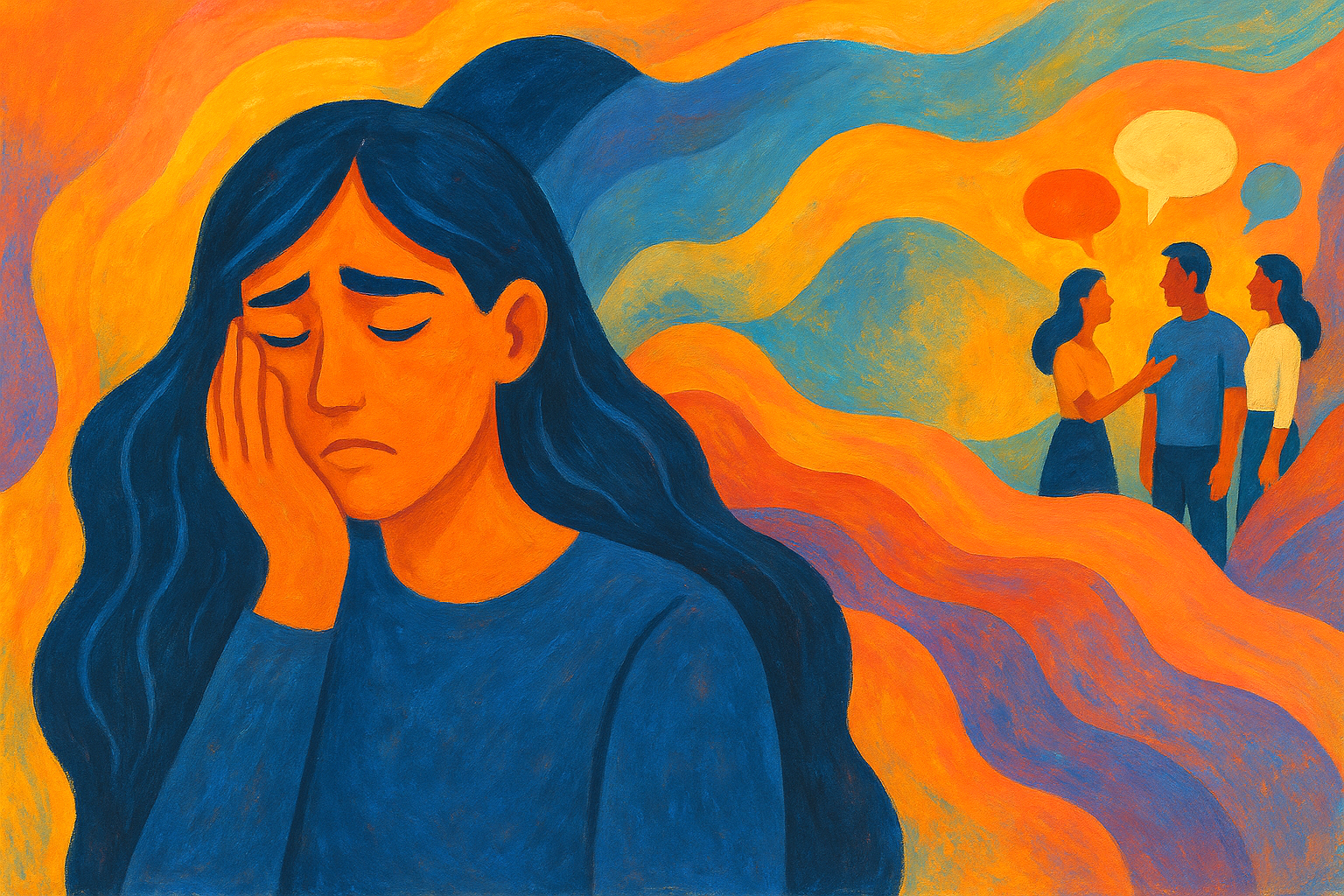
Tag: judgment

  • The Hidden Link Between Self-Rejection and Social Anxiety

    The Hidden Link Between Self-Rejection and Social Anxiety

    “True belonging only happens when we present our authentic, imperfect selves to the world. Our sense of belonging can never be greater than our level of self-acceptance.” ~Brené Brown

    Last year over lunch, my friend, Jess, confessed something to me that hit me right in my gut because I’d been there too—that exact same lie, that exact same fear.

    Out of nowhere, she blurted out, “I need to cancel.”

    “Cancel what?” I asked.

    She burst into tears. “I RSVPed yes to Jen’s wedding months ago, but it’s this weekend, and I just… I can’t do it.”

    As she sobbed, she confessed she’d already crafted a text message claiming food poisoning. The wedding was for her best friend since college, and she was bailing—not because of an emergency, but because she was terrified of being judged by the other guests.

    My stomach dropped. Not because I was shocked, but because I saw myself in her confession.

    Back in 2012, I’d done exactly the same thing. My cousin, who I’d grown up with—shared a bedroom with during family vacations, passed notes with during boring family dinners—was getting married. And I…just couldn’t make myself go.

    I still get a sick feeling remembering it. Me, twenty-nine years old, sitting fully dressed on my bed at 3:42 p.m., staring at the invitation that had been on my fridge for months. The wedding started at 4:30. It was a twenty-five-minute drive. And I was frozen, literally nauseous with anxiety.

    What if the small talk was unbearable? What if my ex was there with his new girlfriend? What if people noticed I’d put on weight since Christmas? What if, what if, what if…

    I texted my cousin claiming a 102-degree fever. Then I ordered pizza, watched Netflix, and tried to ignore the hollow feeling in my chest.

    Yeah. Easier to stay home where it felt “safe.”

    The Painful Paradox

    Working through my own social anxiety mess, plus helping others with the same struggle over the years, has taught me something that blew my mind when I first realized it:

    We reject ourselves BEFORE anyone else gets the chance.

    Let me explain.

    We think our social anxiety comes from being afraid of other people’s judgment. But that’s not quite it. We’re actually afraid they’ll confirm the crappy things we already think about ourselves.

    When I bailed on that wedding, I wasn’t really worried about what my family would think. I was worried they’d see the “truth” I already believed: that I wasn’t interesting enough, put-together enough, or worthy enough to belong there.

    So instead of risking that pain, I chose a different pain—isolation. I projected my own harsh self-judgment onto everyone else, assuming they’d see me the same way.

    Talk about a messed-up strategy! By “protecting” myself from potential rejection, I guaranteed rejection by rejecting myself first. And worse, I created real-world “evidence” that I didn’t belong, which only fed my insecurities.

    My friend was caught in the same trap. She didn’t actually know she’d be judged at the wedding. But she was so convinced of her own unworthiness that she assumed everyone else would see it too.

    The Lightbulb Moment That Changed Everything

    For most of my life, I brushed off my social anxiety as “just being an introvert.” Convenient label, right? Helped me avoid admitting I was actually terrified.

    Then my friend Kayla—who has zero filter—called me out over coffee.

    “Sandy,” she said, eyeing me over her mug, “you realize you spend like 90% of your energy imagining what people think about you and maybe 10% actually finding out?”

    I almost choked on my latte. Ouch.

    That night, I grabbed an old journal and started tracking my thoughts before social events. Holy crap. I was spending HOURS in mental gymnastics:

    • Rehearsing conversations that might never happen
    • Coming up with witty responses to imagined criticisms
    • Planning defenses to judgments nobody had actually made
    • Obsessing over outfit choices to avoid potential comments

    I’d exhausted myself before even leaving the house! And the worst part? I was playing both roles in these imaginary scenarios—both the harsh judge AND the person being judged.

    Talk about a rigged game.

    So I decided to try something radical. My neighbor was having a dinner party that weekend. Instead of my usual mental prep work, I made myself a promise: just show up as-is. Not as the “entertaining Sandy” or the “impressive Sandy” or any other version. Just… me.

    I won’t lie—I almost bailed three times that day. But I went. And without all the usual self-judgment noise in my head, something weird happened. I actually listened when people talked instead of planning my next clever comment. Conversations felt easier. I laughed more.

    Afterward, my neighbor texted, “Thanks for coming! Loved our talk about your trip to Maine—we should grab coffee sometime.”

    Wait, what? I hadn’t rehearsed the Maine story. That was just me rambling about something I loved. And she… liked it?

    This tiny experience punched a hole in my belief system. Maybe, just maybe, people could like the actual me—not some carefully curated version I thought I needed to be.

    Getting to Know the Real You

    So here’s what I’ve figured out: the way through social anxiety isn’t becoming better at small talk or forcing yourself into uncomfortable situations. It’s about getting to know yourself—the real you under all that fear and protective armor.

    When you actually know and like yourself, other people’s opinions just don’t matter as much. You develop a kind of internal anchor that keeps you steady even when social waters get choppy.

    This journey toward knowing yourself isn’t always Instagram-worthy. It’s messy. But here’s what’s worked for me.

    1. Catch yourself in self-rejection mode.

    Start noticing when you back out of things because you’re afraid of judgment. Ask yourself, “Am I rejecting myself before even giving others a chance to accept me?”

    Last month, I almost skipped a reunion with friends from high school because “no one would remember me anyway.” Classic self-rejection! Naming it helped me pause and reconsider.

    2. Question your core beliefs.

    Where did you get the idea that you’re not enough? Most of us are carrying around beliefs we formed as awkward thirteen-year-olds! Some of mine were:

    • “I’m boring unless I’m entertaining people.”
    • “People only like me when I help them with something.”
    • “If I show my real feelings, people will think I’m too much.”

    Once you identify these beliefs, you can start collecting evidence that challenges them. My friend who missed the wedding realized her core belief was “I don’t belong in celebrations.” We traced it back to an eighth-grade birthday party disaster!

    3. Talk to yourself like you’re not a jerk.

    I used to have a running commentary in my head that I would NEVER say to another human being. “You’re so awkward. Why did you say that? Everyone’s just tolerating you.”

    Learning to speak to myself with basic decency was life-changing. When I feel anxious now, I’ll literally put my hand on my heart and say, “This is hard. Lots of people feel this way. How can I support myself right now?”

    Cheesy? Maybe. But it works.

    4. Baby steps, not cliff jumps.

    Recovery doesn’t mean immediately diving into your scariest social situation. That’s like trying to run a marathon when you’ve never jogged around the block.

    Start small. Maybe it’s:

    • Coffee with one friend instead of a group
    • A thirty-minute appearance at a party with permission to leave
    • A class where the focus isn’t on socializing but on a shared interest

    Each small win builds evidence against your “I don’t belong” belief system.

    5. Create a self-connection practice.

    You need regular check-ins with yourself to quiet the noise of imagined expectations and reconnect with who you really are.

    For me, it’s morning journaling with coffee before anyone else is awake. For my friend, it’s painting terrible watercolors that no one will ever see. Find what helps you hear your own voice clearly.

    Even four minutes of intentional self-connection can begin rebuilding your relationship with yourself. (Trust me, I’ve timed it!)

    My Cousin’s Do-Over

    Life can be weirdly generous sometimes. Three years after I missed my cousin’s first wedding, she got remarried (to the same guy—they’d eloped after family drama with the first ceremony, then decided to have a proper celebration later).

    When the invitation arrived, my palms instantly got sweaty. Here was my chance to do things differently, but the old fear came roaring back.

    This time though, I had new tools. Instead of spiraling into “what-ifs,” I asked myself, “What if I just showed up as myself? What’s the worst that could happen? What’s the best?”

    I felt the fear—it didn’t magically disappear—but I didn’t let it make my decision. I focused on how much I loved my cousin and how I’d regretted missing her first celebration.

    Was the wedding perfect? Nope. I spilled red wine on my dress within the first hour. I got stuck in an awkward conversation about politics with my uncle. I still felt twinges of “I don’t belong here” at times.

    But I stayed. I danced badly to the Cha-Cha Slide. I ate cake.

    And at one point, my cousin grabbed my hands and said, “I’m so glad you made it this time, Sandy.” The genuine joy in her eyes hit me harder than any anxiety ever could.

    Sometimes showing up is enough.

    The Gift of Just Being You

    For most of my life, I thought social anxiety was just “how I was wired”—some unchangeable part of my personality. But turns out, it wasn’t about who I am. It was about how I’d learned to treat myself.

    When I began treating myself with a fraction of the kindness I’d show to a friend, things shifted. Not overnight. Not perfectly. But genuinely.

    The less I needed external validation, the more comfortable I became in my own skin. And weirdly, the more authentic connections I started making.

    Look, I still get nervous before big social events. I still sometimes catch myself falling into the old mental prep work. But now I can laugh at it and gently redirect.

    If you’re someone who tends to hide rather than show up, please hear this:

    • The judgment you’re so afraid of is often coming from YOU first.
    • By rejecting yourself, you deny others the chance to know the real you (and trust me, the real you is actually pretty great).
    • The more you practice showing up authentically, the easier it gets.

    Your presence—your real, unfiltered, sometimes-awkward presence—is worth sharing. Don’t let your harsh inner critic rob the world of your unique perspective and energy.

    Maybe the greatest plot twist in this whole story is this: When I stopped trying so hard to be someone I thought others would accept and started accepting myself instead, I finally found the belonging I’d been searching for all along.

    Funny how that works.

  • 5 Powerful Mindset Shifts to Stop Worrying About What Other People Think

    5 Powerful Mindset Shifts to Stop Worrying About What Other People Think

    “Care about what other people think and you will always be their prisoner.” ~Lao Tzu

    We carefully pick out what we wear to the gym to make sure we look good in the eyes of the other gymgoers.

    We beat ourselves up after meetings, running through everything we said (or didn’t say), worried that coworkers will think we aren’t smart or talented enough.

    We post only the best picture out of the twenty-seven selfies we took and add a flattering filter to get the most likes to prove to ourselves that we are pretty and likable.

    We live in other people’s heads.

    And all it does is make us judge ourselves more harshly. It makes us uncomfortable in our bodies. It makes us feel apologetic for being ourselves. It makes us live according to our perception of other people’s standards.

    It makes us feel inauthentic. Anxious. Judgmental. Not good enough. Not likable enough. Not smart enough. Not pretty enough.

    F that sh*t.

    The truth is, other people’s opinions of us are none of our business. Their opinions have nothing to do with us and everything to do with them, their past, their judgments, their expectations, their likes, and their dislikes.

    I could stand in front of twenty strangers and speak on any topic. Some of them will hate what I’m wearing, some will love it. Some will think I’m a fool, and others will love what I have to say. Some will forget me as soon as they leave, others will remember me for years.

    Some will hate me because I remind them of their annoying sister-in-law. Others will feel compassionate toward me because I remind them of their daughter. Some will completely understand what I have to say, and others will misinterpret my words.

    Each of them will get the exact same me. I will do my best and be the best I can be in that moment. But their opinions of me will vary. And that has nothing to do with me and everything to do with them.

    No matter what I do, some people will never like me. No matter what I do, some people will always like me. Either way, it has nothing to do with me. And it’s none of my business.

    Ok, “that’s all well and good,” you may be thinking. “But how do I stop caring what other people think of me?”

    1. Know your values.

    Knowing your top core values is like having a brighter flashlight to get you through the woods. A duller light may still get you where you need to go, but you’ll stumble more or be led astray.

    With a brighter light, the decisions you make—left or right, up or down, yes or no—become clearer and easier to make.

    For years I had no idea what I truly valued, and I felt lost in life as a result. I never felt confident in my decisions, and I questioned everything I said and did.

    Doing core values work on myself has made a huge impact on my life. I came to realize that “compassion” is my top core value. Now when I find myself questioning my career decisions because I’m worried about disappointing my parents (a huge trigger for me), I remind myself that “compassion” also means “self-compassion,” and I’m able to cut myself some slack.

    If you value courage and perseverance and you show up at the gym even though you are nervous and have “lame” gym clothes, you don’t have to dwell on what the other gymgoers think about you.

    If you value inner peace and you need to say “no” to someone who is asking for your time, and your plate is already full to the max, you can do so without feeling like they will judge you for being a selfish person.

    If you value authenticity and you share your opinion in a crowd, you can do so with confidence knowing that you are living your values and being yourself.

    Know your core values and which ones you value the most. Your flashlight will be brighter for it.

    2. Know to stay in your own business.

    Another way to stop caring about what other people think is to understand that there are three types of business in the world. This is a lesson I learned from Byron Katie, and I love it.

    The first is God’s business. If the word “God” isn’t to your liking, you can use another word here that works for you, like the universe or nature. I think I like nature better, so I’ll use that.

    The weather is nature’s business. Who dies and who is born is nature’s business. The body and genes you were given are nature’s business. You have no place in nature’s business. You can’t control it.

    The second type of business is other people’s business. What they do is their business. What your neighbor thinks of you is his business. What time your coworker comes into work is her business. If the driver in the other car doesn’t go when the light turns green, it’s their business.

    The third type of business is your business.

    If you get angry with the other driver because you now have to wait at another red light, that’s your business.

    If you get irritated because your coworker is late again, that’s your business.

    If you are worried about what your neighbor thinks of you, that’s your business.

    What they think is their business. What you think (and in turn, feel) is your business.

    Whose business are you in when you’re worried about what you’re wearing? Whose business are you in when you dwell on how your joke was received at the party?

    You only have one business to concern yourself with—yours. What you think and what you do are the only things you can control in life. That’s it.

    3. Know that you have full ownership over your feelings.

    When we base our feelings on other people’s opinions, we are allowing them to control our lives. We’re basically allowing them to be our puppet master, and when they pull the strings just right, we either feel good or bad.

    If someone ignores you, you feel bad. You may think, “She made me feel this way by ignoring me.” But the truth is, she has no control over how you feel.

    She ignored you, and you assigned meaning to that action. To you, that meant that you were not worth her time, or you were not likable enough, smart enough, or cool enough.

    Then you felt sad or mad because of the meaning you applied. You had an emotional reaction to your own thought.

    When we give ownership of our feelings over to others, we give up control over our emotions. The fact of the matter is, the only person that can hurt your feelings is you.

    To change how other people’s actions make you feel, you only need to change a thought. This step sometimes takes a bit of work because our thoughts are usually automatic or even on the unconscious level, so it may take some digging to figure out what thought is causing your emotion.

    But once you do, challenge it, question it, or accept it. Your emotions will follow.

    4. Know that you are doing your best.

    One of the annoying things my mom would say growing up (and she still says) is “You did the best you could with what you had at the time.”

    I hated that saying.

    I had high standards of myself, and I always thought that I could have done better. So when I didn’t meet those expectations, my inner bully would come out and beat the crap out of me.

    How much of your life have you spent kicking yourself because you thought you said something dumb? Or because you showed up late? Or that you looked weird?

    Every time, you did the best you could. Every. Single. Time.

    That’s because everything we do has a positive intent. It may not be obvious, but it’s there.

    Literally as I’m writing this post sitting in a tea shop in Portland, Maine, another patron went to the counter and asked what types of tea he could blend with his smoky Lapsang Souchong tea (a favorite of mine as well).

    He hadn’t asked me, but I chimed in that maybe chaga mushroom would go well because of its earthy flavor. He seemed unimpressed with the unsolicited advice and turned back to the counter.

    The old me would have taken that response to heart and felt terrible the rest of the afternoon, thinking how this guy must think I’m a dope and annoying for jumping into the conversation uninvited.

    But let’s take a look at what I had in that moment:

    • I had an urge to try to be helpful and a core value of kindness and compassion.
    • I had an interest in the conversation.
    • I had an impression that my feedback might be well received.
    • I had a desire to connect with a new person on a shared interest.

    I did the best I could with what I had.

    Because I know that, I have no regrets. I also know that his opinion of me is none of my business, and I was living in tune with my values, trying to be helpful!

    Though, I could also see how, from another perspective, forcing my way into a conversation and pushing my ideas on someone who did not ask may have been perceived as rude. And rudeness goes against my core value of compassion.

    That leads me to the next lesson.

    5. Know that everyone makes mistakes.

    We live in a culture where we don’t often talk about how we feel. It turns out we all experience the same feelings, and we all make mistakes. Go figure!

    Even if you are living in tune with your values, even if you are staying in your own business, even if you are doing your best, you will make mistakes. Without question.

    So what? We all do. We all have. Having compassion for yourself comes easier when you understand that everyone has felt that way. Everyone has gone through it.

    The only productive thing you can do with your mistakes is to learn from them. Once you figure out the lesson you can take from the experience, rumination is not at all necessary, and it’s time to move on.

    In the case of the tea patron-interjection debacle, I could have done a better job of reading his body language and noticed that he wanted to connect with the tea sommelier and not a random stranger.

    Lesson learned. No self-bullying required.

    At my last company I accidentally caused a company-wide upset. A friend and coworker of mine, who had been at the company for a few years, had been asking to get a better parking spot. One became available as someone left the company, but he still was passed over.

    He’s such a nice guy, and as my department was full of sarcastics, I thought it would be funny to create a pun-filled petition for him to get the better spot.

    I had no idea that it was going to be taken so poorly by some people. It went up the chain of command, and it looked like our department was full of unappreciative, needy whiners.

    And our boss thought it looked like I used my position to coerce people into signing it. He brought the whole department together and painfully and uncomfortably called out the whole terrible situation and demanded it never happen again.

    I. Was. MORTIFIED.

    He hadn’t named me, but most people knew I created it. I was so embarrassed and ashamed.

    But here’s what I did:

    1. I reminded myself of my values. I value compassion and humor. I thought I was doing a kind but funny act for a friend.
    2. When I found myself worrying about what other people must now think of me, I told myself that if they thought poorly of me (of which I had no evidence), all I could do was to continue to be my best me.
    3. When flashbacks of that awful meeting came back to mind, flushing my face full of heat and shame, I remembered to take ownership over how I felt and not let the memory of the event or what other people think dictate how I feel now.
    4. I reminded myself that I did the best I could with what I had at the time. I had a desire to help a friend and an idea I thought was funny and assumed would go over well.
    5. I realized that I made a mistake. The lesson I learned was to be more considerate of how others may receive my sense of humor. Not everyone finds me as funny as my husband does. I can make better decisions now because of it.

    And after a short time, the whole incident was forgotten.

    Stop worrying about what other people think. It will change your life.

  • Shadow Parts: How to Recognize and Release Them

    Shadow Parts: How to Recognize and Release Them

    “When we are aware of our weaknesses or negative tendencies, we open the opportunity to work on them.” ~Allan Looks

    Last year, I took my then-six-year-old son to a kite festival. He was ecstatic about flying his kites, and we spent a lot of time doing just that!

    At one point, his kite string got tangled with another lady’s kite string. Both kites crashed to the ground, and the lady and I started working to untangle the strings.

    In his excitement, my little one repeatedly asked if we were done yet and if he could fly his kite again. I reassured him, saying I understood his excitement and that his kite would be ready soon.

    However, the lady, visibly annoyed, gave him judgmental looks and eventually told him he was being impatient and needed to stop asking.

    Calmly, I explained to her that he was just excited to fly his kite and reminded her that he was only six years old.

    This incident made me observe her shadow of impatience. She was essentially impatiently telling a young, excited child to be patient without recognizing her own impatience. This is what we call a shadow.

    Recognizing our own shadows can be challenging because they are hidden within us, much like how a computer operates with its set of programs without being aware of them. Our shadows are ingrained from early childhood, making it difficult for us to see them clearly.

    Here are some common examples of shadows I’ve witnessed in clients, family, friends, and even myself:

    • A parent yelling at their child to stop yelling.
    • A parent (or anyone) being impatient with their child’s impatience.
    • Someone badmouthing another person while complaining about that person’s meanness, not realizing that badmouthing is unkind.
    • Someone desiring more benevolence from others but gossiping behind their backs.

    • I often feel unsure if someone wants me in their life or business, but the truth is, I am the one who is indecisive.

    Shadows make us judgmental and inhibit our capacity for love, compassion, joy, presence, and understanding. They limit our experience of life. This is why I believe shadow work is crucial for living a joyful and connected life.

    So, how can we shine a light on and release our own shadows? Here are a few steps:

    1. Bring Awareness: Notice your triggers—when you feel frustrated, impatient, annoyed, or judgmental towards someone else.

    2. Acknowledge the Emotion: Allow yourself to feel the emotion fully, without judgment or resistance.

    3, Be Curious: Curiosity transcends judgment. Ask yourself: What is it about this person that makes me feel this way?

    4. Identify the Shadow: Recognize that the part of yourself you have denied or repressed is being projected onto others. Ask yourself why you are judging them.
    5. Observe Honestly: Be radically honest and observe this shadow part of you. Acknowledge it by saying, “I see you.”

    6. Understand the Cause: Ask yourself why this shadow is showing up. Often, a younger, wounded part of yourself needs healing and love.

    7. Nurture the Wounded Part: Identify who you are protecting—perhaps a little girl who was scolded or punished. Hold this part of yourself with love, acceptance, and compassion.

    8. Heal with Love: Send love, patience, and kindness to this part of yourself. Give her what she needed at the time.

    9. Apply this Love Now: Extend this love to your current self and observe how it changes your feelings toward the situation or person.

    10. Practice Regularly: Repeat these steps until it becomes easier. As you nurture these parts of yourself, they will trust you more, and you will feel more grounded and loving.

    By shining a light on our shadows, we can transform judgment into understanding and impatience into patience, and ultimately live a more joyful and connected life.

  • How to Prevent Your Ego from Running Your Life

    How to Prevent Your Ego from Running Your Life

    “The ego is not master in its own house.” ~Sigmund Freud

    What does that mean? If the ego is not in charge, who is?

    Before diving deeper, let me tell you this story.

    That Little Voice Again

    My jaw tightened, and I couldn’t sit still. Anyone could see that the conversation was heading south. As I was fiddling with my car keys, a little distracted, a very distinct, persistent little voice pushed me to interrupt my sister.

    Go ahead. Say it! Make her stop talking!

    Like a broken cassette, the words you are wrong kept looping in my head. Honestly, I wasn’t even listening to her anymore. Her ideas were absurd, and I just wanted her to stop talking.

    Unable to bite my tongue any longer, I slapped my hand on the table and said, “You are wrong!”

    Moments later, we were at each other’s throats, and the inevitable He Said, She Said happened.

    Little did I know that that was my ego talking.

    In today’s spiritual circles, many wars have been waged against the ego. Any problem you have, they tell you to blame it on the ego and destroy it.

    The monster under the bed. The stuff of nightmares. Right?

    But what is the ego? Is it really the evil it’s made out to be? Was Freud right?

    The Ego is the House of the Self

    I like to think of the ego as the House of the Self, much like the distinct Houses of Stark, Lannister, and Targaryen in Game of Thrones.

    And the self is your identity, or all the things you identify with.

    From thoughts to things, it’s basically anything you’ve labeled me, my, and mine.

    As the distinguished spiritual teacher Eckhart Tolle put it:

    “Ego is no more than this: identification with form, which primarily means thought forms.”

    When you identify with any thought, for example, “my name,” “my things,” “my feelings,” or “my ideas,” you give birth to the ego.

    Why Does the Ego Exist?

    Without the ego or a sense of self, you cannot survive.

    If you can’t tell “what’s you” and “what’s not you,” everything blends together like one big mess. You wouldn’t be able to separate yourself from a tree, a car, another person, or a gun.

    Without a sense of self, you can easily walk into traffic, run into a knife, get chased by an animal, touch a live wire, or find yourself in all kinds of danger.

    So, yeah, the ego has one job—to keep you alive.

    It will always protect you from what it perceives as a threat, just as a scorpion will always sting when provoked. You could say that the ego is doing you a service by preserving the individual ‘you’ at all costs.

    Like a dragon guarding its treasure, it will always defend what you identify with and reject anything that threatens your identity.

    Why do you think my ego kept nudging me to interrupt my sister during our chat?

    Same reason.

    Hence the expressions I am right or you are wrong.

    Why Does the Ego Have a Bad Reputation?

    Like everything else, the ego is a neutral tool. It becomes “good” or “bad” based on how it is used.

    There are two possible reasons for its not-so-bright reputation.

    The first reason is duality.

    In the words of author and New Thought leader Teal Swan:

    “The ego wants to distinguish itself. It wants to be things like good, right, better, superior, and more. There is nothing inherently wrong with this drive.”

    By distinguishing “you” from “not you,” you create duality or separation.

    Separation between spirit and matter, seen and unseen, man and fellow man.

    This is not a bad thing. But staying in duality without seeing the bigger picture (of oneness and interconnectedness) can lead to judgment, fear, and suffering.

    For example, when you look at life through the lenses of “good/bad,” “right/wrong,” “acceptable/unacceptable,” “clean/dirty,” etc., you experience separation and cut yourself off from the vast oneness of life.

    Or when you judge people as “bad,” “wrong,” “sinful,” or “evil,” you let the ego take the upper hand and control you. This is literally the root cause of all division in the world—separations based on color, economic status, race, and religion.

    Even when you judge parts of yourself as “bad,” “ugly,” “wrong,” or “sinful,” you reject big chunks of yourself. In fact, you disconnect from your shadow self and become more and more dysfunctional as a person.

    The second reason is attachment.

    The Buddha nailed the hammer on the head when he said that attachment is the root of all suffering. This piece of wisdom goes back thousands of years and is the heart of the hydra.

    This is what happens.

    When you cling too tightly to your identity without chipping away at the parts that no longer serve you or without sculpting the pieces that need adjustment, you experience suffering.

    When you stay in your comfort zone and refuse to engage in this (spiritual or psychological) never-ending cycle of death and rebirth, you experience suffering.

    Or when you get attached to your thoughts and resist being open to change, again, you experience suffering.

    In other words, as long as you identify with any of the contents of the House of Ego to the point where they drive you, you will experience needless suffering.

    How Can You Work with the Ego?

    This line of thinking has worked for me. It may help you too.

    I am not the clothes I wear.

    If something happens to them, say my boots get worn out or I no longer want them, I won’t have a problem discarding them and getting new ones because I am not my boots.

    I found that the key is not to tear down or ‘transcend’ my ego, but to be detached from it.

    Had I identified with the boots, I would’ve held onto them out of attachment, rejecting the idea of change, which would have caused me suffering in the long run.

    But from this detached point of awareness, I gave myself the freedom to transform what needed transforming and experience positive change.

    To be even more honest with you, I used to think that detachment meant carelessness or a lack of commitment to something or someone. Now I see it as acceptance in its highest form—acceptance of all things foreign, different, or unfamiliar.

    So, when you detach from your identity, you become more accepting of things. This allows you to act from a place of empathy and create space for you, me, and everybody else to exist harmoniously.

    Final Thoughts

    You are not the ego. You have one. Everybody does.

    Whatever you put in the House of Ego, from thoughts to things, shapes you as an individual and contributes to the development of the self. This is what makes up your human experience.

    The best part is that the real you—the consciousness, or the immortal being that is really you—houses the ego, not the other way around.

    So yes, Freud was right. The ego is not master in its own house. You are. And you can always keep the House of Ego in order by living a judgment-free life.

    The more you welcome change from a place of loving awareness and recognize how everything is connected, the friendlier your relationship with the ego gets.

    But hey, as the saying goes, your house, your rules.

  • Trust Restored: Why I’m Letting Go of Preconceived Ideas About People

    Trust Restored: Why I’m Letting Go of Preconceived Ideas About People

    “The problems around us are only compounding. We will need to rediscover our trust in other people, to restore some of our lost faith—all that’s been shaken out of us in recent years. None of it gets done alone. Little of it will happen if we isolate inside our pockets of sameness, communing only with others who share our exact views, talking more than we listen.” ~Michelle Obama

    I’m up at the American River, one of my favorite summertime spots. I have a ritual of floating down it, then hiking back up the hill to my clothes. I love how the swift current knows exactly where it’s going, making any paddling unnecessary. I love how you can just lie back and let it take you as you look up at the cloudless blue sky.

    As I float, the sun beats down on my skin, but the river’s coolness counteracts its scorch. Small groups of Canadian geese speckle the shore. The air is still, its quiet punctured only by the occasional train sounding in the distance.

    Once I’ve reached the bottom, I set out back towards my towel—walking along a series of dirt paths consisting of small hills. They’re quick and steep like bunny slopes, coated with golden dust that glints beneath the sunlight.

    While walking them I notice two men picking fruit from a tree in the distance. Feeling exposed in my half-clothed state, I immediately tense up. I realize that having no shoes means I’ll be unable to walk quickly past.

    Bracing myself for discomfort, I continue walking. As the distance between us narrows, I wait for them to whistle, or to jokingly ask  if I need help finding my clothes—or create discomfort in whatever other way, be it through words or stares (as I’d become accustomed to men doing).

    I walk past, armor on, shield up—raising it a little more when one of the men begins to speak.

    His words are, “Hello,” followed by,  “You’ve got some tough feet!”

    They contain no sexualizing, nor any subtle attempt at intimidation. And in response to this comment— the kind one human would make to another, his equal—I find myself reacting with human thoughts in return:

    Yes—this terrain IS pretty rugged. I guess my feet ARE pretty strong. Thank you, Sir.

    **

    I think about how, in Whistling Vivaldi, a black man whistles classical music when crossing paths with white strangers on the street. He does this in hopes of quelling their fear and discomfort that are born from prejudice. Implying benevolent intentions and sophistication, his whistling preemptively wards off prejudicial treatment.

    Perhaps this man’s comment was the (gender) equivalent to this example—an attempt at polite conversation to keep from coming across as threatening.

    Or maybe he’d briefly entertained the same thoughts that often precede the sorts of comments I’d anticipated. Maybe in the past he would have converted those thoughts into unwitting weapon words, then launched them my way. Maybe, though, because our society is growing and learning and its people are evolving, he decided that day not to.

    Either way, I felt relief that the men did not behave in the way I’d predicted.

    It got me thinking about preconceived ideas. How we often develop templates, then apply them to the individuals we regularly interact with. How few encounters encourage us to challenge or expand these templates, because much of our lives are structured around familiarity. And how it’s easy to take one look at a person and file them away into a specified bin inside our minds, perhaps unaware we’re even doing it.

    How often do we go into an encounter with our mind already made up—both about the person and about what they could possibly have to say? Their words pass through a filter in our head, confirming what we already know or believe to be true.

    Sometimes our expectations turn out to be accurate. Other times they do primarily because we expect this of them, therefore never open our minds to the possibility that we might be proven wrong.

    People act in ways that contradict our initial views of them, but we don’t see it when we’re not looking for it.

    When I was a Lyft driver, I drove many passengers I was sure I’d have nothing in common with. One was a seemingly straight-laced white man who worked for a tech company. I thought we’d have little to talk about, but an hour later we were eating In ‘N Out and discussing everything from our country’s quick fix approach to handling emotions to how his brother’s coming out changed their relationship to finding a balance between impactful work and a job that pays the bills.

    So often we decide a person is a certain way. Our mind closes. Thereafter we do, indeed, fail to connect. But not on account of differences, but the fact that no connection is possible when the heart and mind are closed.

    **

    No shift in thinking takes place in a single instance. The fact that those two men at the river pleasantly surprised me, for instance, doesn’t erase the overall pattern. Many more such encounters would be necessary for a true paradigm shift.

    But it’s a start. And from now on when I have the bandwidth, I want to give people the opportunity to act in ways that contradict my preconceived notions of them.

    I don’t want to get to that point anymore where I stop seeing others as individuals. Where I’m blinded to what we have in common because I’m seeing only what they represent; the harm done by the larger group they belong to; the political implications of their behavior.

    For instance, several years ago a young man had approached me while I was reading at a bar—and I completely ignored him. At that time I was so fed up with men, so annoyed with their repeated intrusions on my dates with women, and so frustrated that it was them who approached me in public (never women), that I just kept staring down at my book. I didn’t say anything back. In the moment it felt empowering.

    When I thought about the incident years later, though, I regretted my behavior. The guy hadn’t even been aggressive in the way he’d approached me. He’d been earnest, apprehensive, even shy—the way I imagine I can also be at times when I approach women. He didn’t represent All Men; he was his own person, doing something in that moment that might have made him nervous, or pushed him out of his comfort zone.

    I’m not saying it was my job to ease those feelings, or that I owed him this. It’s more that I realized that now I would have genuinely wanted to. Wanted to have at least said hi. Wanted to have at least politely told him I wasn’t up for conversation. Wanted to, maybe not have smiled, but at least treated him more like a human than an implied enemy.

    I want to take my frustrations with patriarchy and heteronormativity up with the concepts themselves—and with individual humans only when they are truly practicing it.

    I’d like to believe that polarized positions aren’t set in stone. That they can evolve and expand with time. That we won’t be doomed to perpetual gripping of shields while walking this planet.

    This isn’t our climate right now—but I hope and wonder if one day we’ll at least start inching closer.

  • If You’re Feeling Judged: One Thing You Need to Understand

    If You’re Feeling Judged: One Thing You Need to Understand

    “Peace cannot be kept by force; it can only be achieved by understanding.” ~Albert Einstein

    Most of us feel judged at times. We might feel judged for the way we look, the things we do (or don’t do), the things we say (and the way we say them), or for the things we believe.

    We might respond to feeling judged by retreating inside ourselves, hiding, and silencing our voice, or we might react in defense or retaliation as if we’re being attacked.

    It doesn’t feel good to feel judged. It can hurt, make us feel like we’re not good enough, and drain our energy.

    But if we want to be free of the heavy burden of feeling judged, there’s something very important we need to understand.

    Feeling judged and being judged are not the same thing!

    This is such an important distinction. And understanding it can make the difference between feeling insecure or stable.

    It’s the difference between hiding and shining.

    Feeling Judged vs. Being Judged

    When we feel judged, it’s something we experience inside ourselves.

    It’s a feeling, not necessarily a fact.

    It’s important to understand that how we feel and react to others is up to us. It’s a result of our conditioning, traumas, fears, emotions, insecurities, attitudes, and the things we believe (whether they’re actually true or not), but it’s ours.

    It may be triggered by what someone says, but the feeling is still ours.

    Being judged is something else. It’s something people outside of us do. Whether someone passes judgment on us through their words, actions, a certain look, or a sneering sound under their breath, it’s an external thing… and we can react to it, or not.

    I’m not suggesting it’s easy to not react or take it personally, but understanding the distinction is important.

    Taking Things Personally

    If someone questions something we’ve said or done or why we believe something, we might take it personally and feel like that person is judging us.

    Have you ever felt judged because someone asked you a question?

    Be honest!

    We might act defensively or angrily when someone questions something we believe, but that person may genuinely want to understand us better.

    If we’re insecure about who we are, or if our sense of self is deeply attached to our beliefs, then any question can feel like an attack or judgment.

    But that doesn’t mean it was a judgment.

    I’m a very curious person. I’ve always been curious to understand myself, my mind and emotions. I know this comes through self-inquiry—meaning to question myself and my beliefs—and sometimes that is uncomfortable.

    But it’s more than just understanding myself, it’s a curiosity to understand the human experience. This also means understanding others. This curiosity to understand is also the desire to connect on a deep, authentic level.

    As Thich Nhat Hanh said: “Understanding is love’s other name. If you don’t understand, you can’t love.”

    Because of who I am and what I do, I often ask people questions about who they are and why they believe what they believe.

    Most of the time I’ve found people are quite open with me; however, occasionally people take my questions personally. Now, I know I had no sense of judgment in my questions, only my curiosity to understand and connect, yet there are times when the people I’m talking to become defensive.

    Even though I understand, when this happens, I can sometimes still feel a sense of being judged. Judged for something I didn’t do. But this is my reaction. I perceive their reaction as a judgment for my perceived judgment.

    I know, it sounds a little complicated, but that’s what happens sometimes. If I catch myself and feel what’s happening inside, I’m able to move through it and let it go.

    But it starts with recognizing and being mindful of my reaction.

    We Have a Choice

    In times when we feel judged, we can react, defend, and justify our emotions by trying to blame someone else, or we can use it as an opportunity to be curious about ourselves—to understand so we can learn and grow.

    Choosing to grow does not mean we don’t feel our emotions. We do. We feel them, and it can be uncomfortable at times. But choosing to grow means we feel our emotions consciously and recognize our reactions so we can take responsibility for them. Because we understand our emotions and reactions are ours.

    As long as we try to blame others for how we feel, we will always be the victim, because it will feel like we don’t have a choice.

    By learning to own our emotions by being present with them, we have the power to transform our relationship to them. We can then learn to navigate the landscapes of our mind.

    Let Go by Being Curious

    If you’re feeling judged—assuming someone is thinking badly of you and feeling bad about yourself in response—engage your curiosity.

    Follow your emotions mindfully. Just feel them. Be present with them (to the degree that you are able). Let them take you deeper into yourself.

    Ask yourself:

    Why do I feel judged?

    What beliefs am I holding onto?

    What do I not want to see about myself?

    What do I not want to admit?

    Am I judging myself? If so, for what?

    Why does it matter what someone else thinks?

    Don’t underestimate the power of our curiosity. It’s a superpower!

    It really can shift us from a closed and reactive state of mind into an open and receptive state of mind. Open and receptive is the place where we can break our self-imposed limits, connect to our heart, and grow.

    It’s also the place where understanding becomes love. Both within ourselves and within our relationships and interactions. It’s the place where we can heal our collective separation and bring back a sense of unity.

    Curiosity is the magic that can facilitate it.

    Journaling is a great assistant to curiosity. It helps us connect more deeply to what’s happening inside us. Any time you feel judged, take some time to sit quietly and reflect on your emotions, thoughts, and feelings. Writing them down can help to make it more tangible.

    Do this enough and you’ll start to see familiar patterns emerging.

    Find Your Strength

    It’s likely that people will judge you at some point. But remember, that doesn’t mean you have to take it personally or feel bad about yourself.

    Whenever you’re feeling judged, whether someone else is judging you or not, remember, it’s just a feeling. Use these times as opportunities to deconstruct your limits and insecurities.

    By doing this you connect with your true self and allow the strength of your heart to emerge.

    And the world needs your heart to shine!

  • 10 Highly Sensitive People Share What Helps Them Take the Sting Out of Criticism

    10 Highly Sensitive People Share What Helps Them Take the Sting Out of Criticism

    Criticism can be especially hard for highly sensitive people because we try so hard and we care so much. It’s really fascinating how much it can affect HSPs in particular.

    I want to share that because it normalizes our experience, to know we’re not alone in how we experience things. I certainly have developed some tools to help with criticism but can still be impacted at times.

    On an anonymous survey I posted, someone wrote that they find my voice so shrill that they could not stand listening to me. I felt the sting.

    But it’s important to realize criticisms are opinions that vary from person to person, and therefore, we have to be careful about what we take in and what we believe. To provide an example of that, many others have shared my voice is soothing, calm, and nurturing. Notice how opposite those opinions are?

    So the next time you receive criticism, I want you to remember this example and know that criticism has nothing to do with us personally and usually comes from a painful place inside another. People are going to have many different types of opinions. What’s important is that we don’t soak them in.

    It’s helped a lot to do my own personal growth work and build my self-esteem. When my self-esteem was low, criticisms knocked me down hard, and for a long time. When I had no personal value, I believed the criticism.

    It took time to build up my sense of self, and it will take time to build yours if that’s an issue for you too.

    When you feel the sting, acknowledge it and give yourself some compassion. Remind yourself of your value and your intentions. Also, focus on some positives about you so that negativity bias of the brain doesn’t take over. Remember, it takes eight positives to neutralize one negative.

    Not everyone is going to like us, and that’s okay. What’s important is that we learn to love and support our sensitive hearts and know our intentions come from good places.

    I don’t think anyone is completely immune to the impacts of criticism. Case in point, here’s what some HSPs in my Sensitive Empowerment Community commented after reading some of my thoughts on criticism:

    1. The power of self-compassion

    “I remember when I would be hurt when I was a kid my mom would tell me to ‘get over it.’ I remember that being invalidating, unhelpful, and actually hurt me more. I think it would be powerful to teach our sensitive children the art of self-compassion. Can you imagine a whole generation of sensitive children raised with self-compassion? I have found that skill to be one of the best things that I’ve developed. It helps me with everything now. I think that it’s probably a tool that we can constantly sharpen.”

    2. The importance of self-care

    “Criticism is still extremely hard on me to the point where it will put me out of commission for a minute (or days even). I’m working on not letting others’ criticism flatten me. I just know, when my rest and my health are in order, it’s much easier to shake it off. When I feel criticized, I’m starting to immediately make a list of people who support me and think differently than people who criticize me and speak unkindly.”

    3. It’s more about them than us

    “I find criticism extremely difficult. For me, there is a family wound around criticism, so I can have a deep, painful reaction. Self-compassion has really helped me work through those reactions. I heard something once that often comes to my mind these days—what someone says about us tells us more about them and how they see the world than it is information about us. I find this really helpful because I used to take every single thing someone said about me as truth, but seeing that people are seeing us through the lens of all their wounds and experiences takes the sting away a bit.”

    4. Perfectionism vs. our innate drive for excellence

    “What you said resonated so much with me (and a big yes to the knife in the heart analogy!)— especially that the desire to avoid criticism is what has caused or contributed to your perfectionism. I feel exactly the same way. Now I work really hard on trying to figure out when something is just my innate drive for excellence or when it’s more a perfectionism driven by fear/avoidance.”

    5. How it helps to build our self-esteem

    “I used to hold onto criticism much more when I was younger, and it hurt terribly. Working on myself and building up my self-esteem was integral to healing. I used to work with a boss who was critical of everything I did, and I dreaded going to work every day. One day I decided to begin therapy, and soon I built up enough energies to apply to graduate school. Once I got in, I put n my two-weeks notice. Going back to school was an investment in myself.”

    6. Other people’s opinions are none of our business

    “This is still something I’m working on for myself, although I’ve had huge growth in this area. I once read somewhere or heard someone say that ‘what other people think of you is none of your business,’ and I try to remember that if I get that sting.”

    7. People who criticize often lack courage

    “Criticism can indeed be hurtful. It can be good to remember that people who criticize are often either unaware of how much work you put into doing that which they are criticizing, or they are taking out their own frustration on you. For many people, it’s more ‘comfortable’ to criticize others who have the courage to do something than to actually do something themselves.”

    8. Criticism isn’t always true

    “I’ve come a long way working with the deep sting of criticism and feeling the knife in my heart. There are moments I still feel the deep sting, but it doesn’t ‘take me out’ in the way it used to. Often, I ask myself ‘is this really true what they said?’ That helps me to come back to myself, along with breathing. I am soothed when I see the criticism is simply not about me! A work in progress going forward.”

    9. Hurt people hurt people

    “Criticism is so hard, especially because everybody wants to be accepted and respected for who they are, and the judgments of others can be hard to bear. Depending on our mindset and self-acceptance/self-confidence, it can make us see ourselves as less than if we do not have the right tools in place. I always try to remember the simple truth that ‘hurt people hurt people.’”

    10. When criticism gets to you, it’s because you care

    “I found it quite emotional reading all the posts and having my intense and long-lasting reaction to criticism normalized. I have struggled with this for a long time. I had a similar thing to you, Julie, with a comment in a survey. It was a really mean, unthoughtful commentf about a presentation I gave, and coming from someone well respected in my field of work, it was hard to take and still gets to me years later. It is helping so much to reframe it as an issue they have rather than a failing of mine! It’s a very empowering feeling. I am also trying to celebrate the fact I find criticism hard knowing that it’s because I care so deeply about doing things well and with care.”

    What about you? What helps you take the sting off criticism?

    **Some of the community comments have been edited for clarity and grammar.

  • I Cheated on Him with My Higher Self (and We’re Still Going Strong)

    I Cheated on Him with My Higher Self (and We’re Still Going Strong)

    “It’s okay to let go of those who couldn’t love you. Those who didn’t know how to. Those who failed to even try. It’s okay to outgrow them, because that means you filled the empty space in you with self-love instead. You’re outgrowing them because you’re growing into you. And that’s more than okay, that’s something to celebrate.” ~Angelica Moone

    “How could you do this to me? It’s obvious you’re with someone else.”

    That was the third and final message I received from my partner of nearly three years, several weeks after we had finally decided to break up. I say “we” because initially it seemed that the decision was mutual, although it would later be revealed that it was me who wanted out.

    He was right, by the way. I had left him for someone else.

    No, not the lover that he had conjured up for me in his own mind. In fact, what had pulled me away was much more powerful and seductive than that. I had cheated on him with my higher self. And she had been trying to win me over for quite some time.

    My higher self: AKA my intuition, AKA my inner badass that will never be ignored. Yep, she’s the one I had left him for.

    Much like when I was nearing the end of my marriage, she had started off with a gentle nudge, a tap on the shoulder every now and again. I’ve noticed throughout my life that if I don’t stop what I’m doing, these attempts to get my attention will become more consistent, until what was once a whisper finally becomes a roar.

    Such was the case three years ago when she decided that I should shave my head. At that point, I had invested a lot of money turning my naturally dark brown hair into a platinum blond mane. This was before the pandemic, when I couldn’t imagine anything coming between me and my monthly visits to the salon.

    As with most suggestions that come from my higher self, my ego was not impressed.

    If the two of them had been sitting across from one another, the conversation would have gone something like . .

    “You want to do whaaaat??”

    “Shave it.”

    “Excuse me?”

    “Take it all off.”

    “All of it?”

    “All. Of. It.”

    So I attempted a compromise by shaving a bit off the side. I knew I was kidding myself when I thought that would be the end, but at least it was a start. Over the course of the next twelve months, I felt equal parts admiration and jealousy whenever I caught a glimpse of someone with a shaved head. This peculiar mix was familiar to me, and it signaled what was destined to happen next.

    When I had finally made the decision, it was a random Tuesday morning, and it made absolutely no sense to my logical mind. Unlike the ego that thrives on being booked and busy, the higher self loves white space. When we give ourselves the opportunity to tune out and tune in, our deepest desires have a funny way of being revealed.

    That fateful day I had decided to take an extra long walk with my dog through one of the parks here in Barcelona. There’s nothing like nature, movement, and a bit of solitude to help you cut through the noise and get to the heart of what you really want. Instead of returning to my apartment, we headed to the salon.

    As I took a seat at my hairdresser’s station and looked at myself in the mirror, my ego had a full-blown tantrum while my higher self popped open the proverbial champagne.

    In those moments of feeling the clippers pass over my scalp, watching my shoulder-length hair fall to the floor, I finally felt free. Whether it’s our hair, our jobs, or a relationship we’ve long outgrown, the higher self seeks our liberation, no matter what the cost.

    That day when I told my then partner what I had done, the conversation didn’t go as I had hoped but exactly like I had imagined.

    “You’re bald.”

    While this was indeed a fact, the tone made it feel like a personal attack. He asked me why someone so beautiful would intentionally make herself so ugly. For once in my life, being “pretty” hadn’t been the deciding factor. I wasn’t so concerned with how I wanted to look but rather how I wanted to feel. As I’ve come to learn since, life really changes when this perspective starts to shift.

    If his thoughts and feelings were any indication, I was no longer much to look at when it came to the male gaze. Ironically, all he could see was “a weirdo” while the person I saw with my own eyes was a queen. 

    While my ex couldn’t get past my shaved head, I couldn’t get over the luminosity and the brilliance that could fully shine through. As he continued to fixate on what I had lost, I knew the truth of what I had gained: freedom, courage, and beauty on my own terms.

    Perhaps I always knew that he would leave me over a haircut. No one likes to think that the future of their relationship comes down to the length of their hair, but he had told me from the beginning that shaving my head was the one thing I should never do. Funny the rules we’ll follow in an attempt to belong to other people while we strategically abandon ourselves.

    I had spent nearly four decades of my life searching for safety in the fulfillment of everyone’s expectations. I used to be an expert at figuring out what they wanted and becoming exactly that. Until one cold, cloudy morning in February 2021, when I decided I was done. Done with the pretending. Done with the pleasing. Done with the denial of what I knew to be true.

    I was finally ready for a different kind of love. And this time it was all my own.

    You could say that I cheated on my ex with my higher self, or maybe she was the one I was meant for all along. Either way, I’ve chosen to be faithful to my inner wisdom. And from what I can tell, we’re still going strong.

  • The One Thought That Killed My Crippling Fear of Other People’s Opinions

    The One Thought That Killed My Crippling Fear of Other People’s Opinions

    “Don’t worry if someone does not like you. Most people are struggling to like themselves.” ~Unknown

    For as long as I can remember, I have been deathly afraid of what other people thought of me.

    I remember looking at all the other girls in third grade and wondering why I didn’t have a flat stomach like them. I was ashamed of my body and didn’t want other people to look at me. This is not a thought that a ten-year-old girl should have, but unfortunately, it’s all too common.

    Every single woman I know has voiced this same struggle. That other people’s opinions have too much weight in their lives and are something to be feared. For most of us women, there is nothing worse than someone else judging our appearance.

    After that fear first came to me in third grade, I carried it with me every day throughout high school, college, and into my twenties. This led me to trying every diet imaginable and going through cycles of restricting and binging. I just wanted to lose those pesky fifteen pounds so I could finally feel better about myself and not be scared of attention.

    There was no better feeling than getting a new diet book in the mail and vowing that I would start the next day. Following every rule perfectly and never straying from the list of acceptable foods. I stopped going to restaurants and having meals with friends because I wouldn’t know the exact calorie count.

    All this chasing new diets and strict workouts was because of one simple thought that I carried for years. I just assumed everyone was judging my body and would like me more if I lost weight. I was constantly comparing my body to every other woman around me.

    This fear of what other people thought also led me to have a complicated relationship with alcohol in my late teens and early twenties. At my core I am naturally sensitive, observant, even-keeled, and sometimes quiet. But I didn’t like this about me; I wanted to be the outgoing party girl that was the center of attention.

    The first time I got drunk in high school I realized that this could be my one-way ticket to achieve my desired personality. With alcohol I was carefree, funny, and spontaneous, and I loved that I could get endless attention. I was finally the life of the party, and no one could take it away from me.

    I wanted everyone to think that party-girl me was the real me, not the sensitive and loving person that I was desperately trying to hide. Classmates were actually quite shocked if they saw me at a party because I was so different than how I appeared in school. It was exciting to unveil this persona to every new person I met.

    But the thing with diets and alcohol was that this feeling of freedom was only temporary. When the alcohol wore off or the new-diet excitement faded, I was back to the same feelings. In fact, I found that I was even more concerned about what people thought of me if the diet didn’t work or the alcohol wasn’t as strong. I feared that they would discover the real me.

    The irony was that whenever I drank, I felt worse about myself after the alcohol left my system. I felt physically and emotionally ill from the poison I was putting into my body. I would often be embarrassed about not remembering the night before or fearing that I said something I shouldn’t have. It was a nightmare of a rollercoaster that I no longer wanted to be a part of.

    I decided in my mid-twenties that alcohol would no longer have power over me. That I wouldn’t rely on it to feel confident and instead work on loving the real me. I decided to break up with alcohol and put it on the back burner. I was moving to a new city where I didn’t know anyone, so I figured this would be a good time to start fresh.

    Once I moved and started my new life, those same familiar fears and pangs of shame started to show up again. If I wasn’t the loud party girl, who would I be? What would people think of me if I wanted to stay in and read instead of partying? I wasn’t confident in my authentic self yet, and I was desperately looking for a new personality to adopt. That’s when I turned back to a familiar friend for help: dieting.

    In the span of five years, I tried every major diet out there: paleo, keto, vegetarian, vegan, counting macros and calories, you name it. I dedicated all my free time to absorbing all the information I could so I could perfect my diet even more. At one point I was eating chicken, broccoli, and sweet potatoes for every single meal. My body was screaming at me for nutrients, but I continued to ignore it.

    Then one day I hit that illustrious number on the scale and finally felt happy. Well, I assumed I would feel happy, but I was far from it. I felt like absolute crap. My hair was falling out, I had trouble sleeping for the first time in my life, my digestion was ruined, and I had crippling fatigue. I finally lost the fifteen pounds, but my health was the worst it had ever been.

    I felt betrayed. The scale was where I wanted it, but I wasn’t happy. I was more self-conscious of my body than ever before. I didn’t want people to look at me and notice my weight loss. That little girl that cared about what people thought was still ruling my life. I had to make a change, and I had to start loving the girl in the mirror no matter what I looked like. My life depended on it.

    It was during one of those nights where I felt so confused and lost that I stumbled into the world of self-development. I bought my very first journal and the first sentence I wrote was: “Self-love, what does it mean and how do I find it?” I vowed to myself that I would turn inward and get to know the real me for the first time in my life. 

    This new journey felt uncomfortable and scary and pushed me completely outside my comfort zone. I couldn’t just hide behind external sources anymore like I did with alcohol and strict diets. I had to get to know authentic Annie and show the world who she was.

    It was in this journey that I found my love of writing and inspiring people. I decided to follow my dreams and get certified as a life coach and finally make my writing public. But when I went to hit publish on my first post, that same fear reared its ugly head.

    This time I was deathly afraid of what my coworkers and friends would think. They would see the real me, the sensitive soul that had deep feelings and wanted to inspire other people. This fear caused me to deny who I was for far too long, again.

    I hesitated for years to share my writing because this fear stopped me. But this time I wasn’t going to let it have control over me anymore. One day this thought popped into my head and stopped me dead in my tracks. It was an enormous epiphany and one I couldn’t ignore. The thought was:

    When I am eighty years old and looking back on my life, what do I want to remember? That I followed the same path as everyone else or I followed my heart?

    As soon as that thought came to me it was like I was hit over the head. For the first time in my life, I understood it. I realized that if I kept living my life in fear of other people’s opinions, I wasn’t really living my own life.

    Every human is here to be unique and serve out their own purpose, not to just follow the crowds blindly. I couldn’t live out my purpose if I wanted to hide away.

    Self-acceptance and self-love come from knowing and respecting all parts of myself. It comes from acknowledging my shadow sides and still putting myself out there regardless of opinions. It comes from going after big and scary goals and having fun along the way. Because the absolute truth is this: other people’s opinions are not going to matter in one year. They won’t even matter five minutes from now.

    So now I want you to ask yourself the same question: What do you want to remember most about your life when you are at the end of it?

  • Why I Had to Stop Judging Myself to Start Healing from Childhood Trauma

    Why I Had to Stop Judging Myself to Start Healing from Childhood Trauma

    “I now see how owning our story and loving ourselves through that process is the bravest thing that we will ever do.” ~Brené Brown

    A few years ago, when I began recovering from childhood trauma, the first thing I learned was that I needed to master the skill of self-awareness.

    However, becoming aware came with some pretty hard truths about who I was, what I did, and how I acted because of what had happened to me.

    Although I eventually found the courage to face some challenging experiences from my past, I wasn’t ready to forgive and accept myself.

    When I acknowledged the impact of my past trauma and abuse on my current life, I immediately started blaming myself. It was difficult to accept that I pleased people to gain validation and stayed in toxic relationships since I didn’t feel worthy or lovable. Therefore, I went straight for what I knew and was accustomed to—judgment, guilt, and shame.

    As Bessel van der Kolk explained in his book The Body Keeps the Score:

    “While we all want to move beyond trauma, the part of our brain that is devoted to ensuring our survival (deep below our rational brain) is not very good at denial. Long after a traumatic experience is over, it may be reactivated at the slightest hint of danger and mobilize disturbed brain circuits and secrete massive amounts of stress hormones. This precipitates unpleasant emotions, intense physical sensations, and impulsive and aggressive actions. These posttraumatic reactions feel incomprehensible and overwhelming. Feeling out of control, survivors of trauma often begin to fear that they are damaged to the core and beyond redemption.”

    Although self-awareness is the first step toward nurturing change in our lives, many of us reach for judgment when faced with uncomfortable truths about ourselves and our past experiences. Ironically, the lack of self-acceptance blocks us from healing and moving past what happened to us.

    Is it possible we sabotage our healing by being overly hard on ourselves?

    For example, victims of sexual assault are often held hostage by the shame they carry around. Since speaking about the assault is terrifying, they remain silent while secretly taking responsibility for the abuse.

    If guilt and shame are predominating emotions we carry inside, how can we move toward successful recovery and accept our wounded inner child?

    We do it by letting go of judgment for what happened to us and, instead of taking responsibility for the harm we experienced, we become responsible for our recovery.

    I remember when I was about seven years old, my father got angry because my brother and I were playing around the house and making noise. He slammed our bedroom door so hard that the glass shattered. As he was moving toward me with his face red and furious, I urinated.

    Any time I looked back at this experience, I felt an overwhelming sense of shame and promised myself that I would never get weak and scared of anyone.

    As I got older, I adopted a survival mechanism of being a toughie. I would put on the mask of a strong woman while suffocating on the inside since I felt fragile, weak, easily offended, and anxious.

    However, I couldn’t stand facing my weaknesses.

    Anytime I felt sad, vulnerable, or emotional, I would judge myself harshly. In a sense, I became my biggest internal abuser.

    After I got divorced, I was haunted by self-judgment and felt worthless because of what I allowed while being married. Disrespect, pain, neglect, and lies. How can a worthy person allow such things? I couldn’t stop judging myself.

    Eventually, I began working on my guilt through writing and daily forgiveness meditations. Although I started to understand the importance of acceptance and forgiveness in my healing and recovery, I was only scratching the surface.

    The real challenge arose when I confronted who I was because of what happened to me. My focus started to shift from blame to self-responsibility. Although it was a healthy step forward, it was a long and intimidating process. Since I was deeply absorbed in my victim mentality and filled with shame and judgment, accepting myself seemed like a dream I would never reach.

    It was difficult to admit that I had stayed in a toxic relationship by choice, manipulated people with my tears, and created chaos and drama in my closest relationships to gain attention and feel loved. However, the discomfort I felt was a sign that I was on the right track. If I was willing to keep my ego at bay, I could achieve progress.

    Here’s how I overcame self-judgment and began healing my childhood wounds.

    1. I began to open up and speak the truth.

    At first, I had to face how disgusted I felt with myself. Once I began talking about what happened to me while finding the space of refuge with my therapist, coach, and close friends, judgment began subsiding and acceptance took over.

    My favorite piece of advice from Brené Brown is to share our story with people who deserve to hear it. Whether you speak to a therapist, a coach, a support group, or a very close friend or a family member, make sure this person has earned the right to hear your deepest and most vulnerable feelings and memories.

    Speaking our truth in the space of acceptance is one of the most beautiful ways to heal and process traumatic memories and experiences. A safe space and deep connections are fundamental when healing ourselves, especially if we get hurt within interpersonal relationships.

    2. I acknowledged what happened to me.

    The breakthrough during my recovery happened after I read a book by Oprah Winfrey and Dr. Bruce Perry titled What Happened to You? Suddenly, so much of my behavior started to make sense.

    I wasn’t the sick, disgusting, heartless human being I considered myself to be. I was a wounded adult who didn’t address her traumatic experiences from her childhood while acting from a place of survival and fear.

    When we begin healing ourselves and find the causes behind our (often) unconscious and self-sabotaging behaviors, we become more understanding of who we are and move away from judgment. There is a power in asking, “What happened to me?” instead of “What is wrong with me?”

    Understanding yourself from an open and compassionate place allows you to reach for the love and acceptance your inner child craves. I don’t believe that we are broken or need to be fixed. We are worthy and whole souls whose purpose is to find our way back to ourselves and reconnect with who we are at our core.

    3. I learned to silence my inner critic.

    Learning to recognize the little mean voice inside my head was challenging. My thoughts of judgment were so subtle that they passed by me without awareness.

    The easiest time to spot critical thoughts was when I was meditating. Even during meditation, I judged myself: “Sit up, make sure you focus on your breath. Oh, come on, Silvia, do it better. You aren’t good at meditating. Your mind just wandered again!”

    Since we have about 60 000 thoughts in a day, I decided to focus on my feelings. By observing my emotional state, I became better at identifying what I was thinking and was able to step in to change it .

    I remember one particular night when I was feeling very depressed and hopeless. I asked myself, “What am I thinking that’s making me feel this way?” The answer I observed was, “No one will ever truly love you.” It was the first time I decided not to believe these thoughts. I sat down and made a list of people who showed me love, care, and compassion.

    If you often judge yourself, you may need some practice  and loving patience. However, if you are working on your healing, understanding and accepting yourself is a way of telling your inner child, “I love you, I am here for you, and there is nothing wrong with you.”

    Once I discovered the positive effects of self-acceptance on my recovery, I realized that being overly hard on myself had nothing to do with healing but everything to do with the trauma I’d experienced.

    Today I understand that the little voice inside my head giving me all the reasons to stay stuck in survival mode is my inner child screaming, “Someone please love me.” And I am ready to do just that.

  • Freedom Is the Space Between Each Judgmental or Righteous Thought

    Freedom Is the Space Between Each Judgmental or Righteous Thought

    “It is inner stillness that will save and transform the world.” ~Eckhart Tolle

    Life is hard. Impenetrable at times. How can we use our spirituality to navigate through the density of life?

    That question inspired this piece of writing. And my navigation tool is almost effortless; I feel compelled to share it.

    When my mind is churning and burning with thoughts and fears and worries, I take myself off to a quiet place, get still, and watch my mind. I wait for the tiny gap between each thought. Bingo.

    That space, that little gap, is freedom in its truest, purest form. It is the birthplace of peace. And every time I enter that space, I am no longer at war with anything. Despite what madness may surround me, that place always remains untouched. It is like an infinite reservoir of strength and love—one that feels like, well, freedom.

    How I came to find that reservoir is a long and nuanced story (that’s why I wrote a whole book about it), but I’ll try and give you the nutshell version.

    Essentially, to even find it, I had to first get to the point where I was so disillusioned—with my cancer, with people, with the system, with the greed, with the house chores, with the destruction of the planet, with war, and with life full stop.

    Little did I know it then, but that disillusionment was freedom’s gateway.

    For so long, I looked to ‘the other’ as the source of my disillusionment.

    Sometimes ‘the other’ was a person, sometimes it was a situation—my cancer, the pandemic, the person who I believed had wronged me, the political party; anything or anyone that caused a disturbance to my happiness fell into this bucket.

    Of course, it felt good to blame cancer, that person, or the pandemic for my woes, at least on the surface. Yet the blaming was also the root of my suffering. The biggest wars I’ve had in my own life were when I was trying to get ‘the other’ to yield / change / admit they have it wrong so I could live in peace.

    But the true source of my disillusionment was never with them. When I stopped waiting for the situation to change and shifted my attention to my mind, I observed something that floored me at first: my own righteousness.

    Staring back in the mirror were my tendencies to be correct, envy, judge, complain, and win. That mirror revealed one simple truth: I was adding to the war I desperately wanted to end. I had arrived at the place where I was simply fed up—no longer fed up with life but rather fed up with the suffering caused by my very own mind.

    The challenges and hindrances of life may have taken you to a similar point—the point where you’ve had enough. Before freedom is even possible, this stage is necessary, essential even.

    The world is unsatisfying. So, now what? This is freedom’s front door. It is the opening to the very core of your being. When we have had enough of looking outside for contentment, only then do we look inward. This is where the rubber meets the road.

    But we have to go deeper—beyond the mind, beyond our thoughts about what is right vs. wrong, left vs. right—to our essential oneness.

    And, as a collective, I think we get there by asking ourselves one simple question: Do I want peace or war?

    If it is peace, we must start with the peace in our minds. In all the frenzy, it is possible to simply stop and enter into the space between every thought. Rest there for a few scared moments. Feel the ease wash over every cell of our being. Come home to that again and again. Life doesn’t need to be any different to enter that space.

    That space is freedom. And true freedom is not bound in any person or situation. Freedom is what sits underneath the war. It is found in the tiny gap between every righteous and non-righteous thought; it occurs through stillness.

    From this stillness, I’ve learned (yes, the hard way) that we can speak our truth, but now we speak it without the need to control any outcome.

    For example, rather than trying to force my husband to read a spiritual book instead of opting for Netflix—as if I know what’s right and best for him—I can respect him for where he is at in his inner journey. I still act. I still suggest books. But my happiness is not dependent on his choice.

    Instead of being angry at a friend who hurt me, I can step out of my righteousness and cultivate empathy for where she is at in her life. I still reach out. I still attempt resolution. But my peace is not dependent on her response.

    I throw my seeds of truth, dug up from the depths of my heart, out into my family and the world. Sometimes they land in the fertile soil of ‘the other,’ and sometimes they don’t. So be it. It is action without criticism, judgment, blame or control—without the war. I had found a place within where I could look at ‘the other’ and feel compassion and even love instead of anger and annoyance.

    Eckhart Tolle says, “It is inner stillness that will save and transform the world.”

    I couldn’t agree more. Because from that place, from the silent stillness within, war is not escalated but instead averted.

    So, to anyone feeling disenchanted, I want to honor you and say one thing: The freedom your soul is aching for is within arm’s reach. It is as close as your breath, as close as the space between each of your thoughts.

  • Why Judging People Is Really About You (Not Them)

    Why Judging People Is Really About You (Not Them)

    “It’s easy to judge. It’s more difficult to understand. Understanding requires compassion, patience, and a willingness to believe that good hearts sometimes choose poor methods. Through judging, we separate. Through understanding, we grow.” ~Doe Zantamata

    Why doesn’t he say something?

    I was sitting at the dinner table with my partner and friends. Everyone was interacting and talking to each other, except my partner. He was just sitting there quietly. I had to admit, this situation made me very uncomfortable.

    Why was he so quiet? We had been dating for over six months and normally, when it was just the two of us, he was very talkative, we had vivid discussions, he knew his opinions and was not afraid to speak his mind. But now, at a dinner with friends, he was a shadow of his normal self.

    To be honest, I felt a bit embarrassed. What would my friends think? Did they quietly judge him too? Did they think he was boring and uninteresting?

    When we got back home, I was irritated and annoyed. Have you ever had that feeling, when all you really want is to be brutally honest with someone? To explain exactly what they did wrong and explain how they should behave instead? I wanted to lecture him. To tell him this: “It’s rude not to interact at social gatherings. It’s weird. Can’t you behave? It’s sloppy! What’s wrong with you? What’s your problem?” 

    I didn’t say those things to him. Instead, I allowed what had happened to sit with me for a few days. Slowly, I started turning that finger I was pointing at him toward myself. Maybe this wasn’t all about him, maybe it had something to do with me?

    That’s when it struck me. He wasn’t having a problem. I was!

    I realized that my upbringing had given me certain values and “truths” about relationships and social interactions. This is how you behave: You actively participate during conversations, anything else is considered rude. You ask people questions and share stories during social gatherings; otherwise, people will think that you’re uninterested. That’s what I learned growing up.

    Because my partner wasn’t acting in accordance with what I had been taught, I judged him. Instead of asking myself why he was behaving the way he was, I put labels on him. When we came back home, I had, in my mind, labeled him as rude, boring, self-conscious, and not living up to the standards I wanted in a boyfriend.

    Now, eight years later, I know that my husband was quiet during that dinner because he needs more time with new people before he’s fully comfortable. He didn’t do it because he was rude. On the contrary, I know he cared deeply about me and my friends, he was just showing it in a different way.

    When I understood this, I knew that my judgment really had nothing to do with him—it was all about me. In judging my partner, I realized that I most of all judged myself. My judgment was never about him—it was about me.

    This insight did not only bring me more compassion, less judgment, and more closeness in our relationship, it brought me a new perspective and new values that made my life better.

    Below you’ll find the steps that I followed:

    1. Identify: What judgment do you make about someone?

    The first step is to be aware of the judgment(s) you make about other people. In my case, it was thoughts like “He’s rude and awkward,” “I’m better than him at interacting socially,” and “Maybe we’re not a good match? I need someone who can interact socially.” Often judgments include a feeling of you being superior, that you know or behave better than other people.

    Just become aware of the judgments you’re making (without judging yourself for having them). This is the first step in transforming the judgment.

    2. Ask yourself: How should this person be instead?

    In the specific situation, ask yourself how you think the other person should be or act instead. According to you, what’s the best behavior in the situation? Be honest with yourself and write exactly what comes to mind, don’t hold yourself back here.

    In my case, I wanted my partner to be fully involved in the conversations. I wanted him to be talkative, interested, and curious about my friends.

    3. Go deeper: Why is it important to be this way?

    Be curious and ask yourself, why is it important to be or act in the way that you prefer? If a person doesn’t act that way, what does it signal about the person? What is the consequence of not being or acting in the way you desire?

    For me, social skills translate into good manners and that you can behave appropriately. I used to think that people that weren’t behaving in the “right” way, according to my viewpoint at the time, weren’t taught well by their parents. I labeled them as uninteresting and not contributing to the group. (Now, I know better, but more on that soon).

    4. Spot: What underlying value is your judgment coming from?

    Ask yourself what underlying values and beliefs that are fueling your judgments. What’s the story you’re telling yourself about the specific situation? Be brutally honest here.

    In my case it was the following: Being unsocial is negative and equals weakness. Not being socially skilled is awkward and weird. It means that you are less—less capable, less skilled, less smart/intelligent, and ultimately less worthy. (Just to clarify, this was my judgment and insecurity speaking, and it’s obviously not the truth).

    From my upbringing I had learned that social skills are highly valued. I was taught to be talkative, to engage in social interactions, and to articulate well. If you didn’t live up to these expectations, you felt inferior and less worthy.

    5. Make a choice: Keep or replace your values?

    When you have defined your underlying values and beliefs, you have to make a choice: Either you keep or replace them. And the crucial questions are: Are your values and beliefs serving you or not? Are they in line with your moral standard and aspirations?

    I chose to replace my values. Instead of valuing people based on social skills, I chose to replace that value with acceptance, respect, curiosity, and equality. As much as I didn’t want to judge someone for their skin color, gender, or ethnicity, I didn’t want to judge someone based on how they behave socially.

    Instead, I made a conscious choice to accept and respect all individuals for who they are. And to be curious and kind, because in my experience, every person you meet can teach you something.

    Transforming Judgment to Your Benefit

    Looking back at that dinner with my partner, I was so close to falling into the trap. To get into a fight where I would hurt my partner badly and create a separation between us. It took courage to turn the finger of judgment I was pointing towards him and to turn it towards me instead.

    I realized that my underlying values and beliefs had consequences, not only for the people close to me, but also for myself. They implied that if someone has a bad day and doesn’t feel like interacting, that this is not okay. That others and I are not allowed to be ourselves and to show up just as we are (talkative or not).

    I realized that the values that my judgment stem from did not only make me judge my partner, they also made me judge myself. I was not allowed to just show up. I realized that my upbringing had given me a sense of insecurity and uncertainty. Sure, I had learned how to interact and be the center of attention. But the underlying painful feeling was there. I had to be an entertainer. I had to always be smiling and in a good mood. I had to be curious and ask other people questions.

    If not, I’d be excluded. I felt that I was only accepted when I was happy, outgoing, and enthusiastic. That was stressful and it didn’t make me feel safe.

    Also, to my surprise, once I stopped judging my partner, he became more social and talkative at social gatherings. Why? Because previously he’d probably felt my judgmental look, and that made him even more uncomfortable and introverted. When I stopped judging he felt acceptance and respect. And that, in turn, made it easier for him to be himself, even at social gatherings.

    The bottom line is this: When you judge someone it always comes back to you. What I discovered was that because I judged others, I was also very hard on myself. The more I have worked on this process, the more forgiving, accepting, and loving towards myself I have become.

    Next time you find yourself judging someone else, stop and reflect. Follow the five steps and remember: it’s key to be honest, vulnerable, and curious.

    Free yourself from the chains of judgment and allow acceptance, compassion, and liberation to enter—both for yourself and others. You got this!

  • How Not Setting Boundaries Serves Our Primal Need for Acceptance

    How Not Setting Boundaries Serves Our Primal Need for Acceptance

    “When we fail to set boundaries and hold people accountable, we feel used and mistreated.” ~Brené Brown

    I used to believe that others didn’t have healthy boundaries. They didn’t know where to draw the line, and I was the victim of overbearing people. People that would always cross the invisible line.

    When people crossed that line, it left me feeling uncomfortable, exhausted, and resentful. It felt wrong in my gut, but I never knew how to communicate it or change it until later in life. Lack of boundaries seeped into every part of my life, personal, professional, and everything in between.

    For example, an ex-boyfriend assumed it was okay to borrow my car. I wanted to be nice and easygoing, so I let it slide until I found myself walking home in the middle of the day from a long work shift. The same ex-boyfriend also moved in with me during a difficult life transition for him, and I thought being supportive meant letting him stay.

    I struggled with staying up late to talk a friend through her troubles night after night, even though I knew I needed to rest and felt depleted. In many cases, she wasn’t listening and was unaware of how long we had been speaking. I wanted to be helpful and caring and thought that it was the right thing to do.

    I also felt afraid to speak up with friends on subjects I was passionate about and would keep quiet when a friend said something that I didn’t agree with because I didn’t want to rock the boat or receive her judgment of my different opinion.

    In work situations, not setting boundaries meant I made myself overly available and overly responsible.

    I had a boss that would call me during off hours to complete a task he wasn’t able to do during the day. My instinct was to ignore, yet the people-pleaser in me wanted to be a “good” employee. I also went above and beyond finding my own replacements when I left jobs so that the transition would be smooth, and my co-workers wouldn’t have to bear any extra weight with my leaving.

    I’d continuously find myself offering and accepting situations that left me stressed out and resentful and would wonder why other people didn’t notice.

    I blamed others until I realized that it wasn’t anyone else’s job to guess what I was thinking or feeling. It wasn’t their responsibility to change to suit me; it was my responsibility to change to suit myself—my truest self, the part of me that felt confident enough to be honest, communicate, and trust that it was okay to do what was best for me.

    My problem with boundaries wasn’t that other people kept crossing the invisible line. It was that the line was invisible. I needed to start setting boundaries with myself. That meant recognizing that I struggled with setting boundaries because I felt safe and secure when I over-gave. I felt loved and worthy.

    After realizing why I struggled with boundaries and empowering myself to learn more about my unhealthy pattern of people-pleasing, setting boundaries became about facing my fears around others’ approval or disapproval.

    Being able to say no to people I loved or jobs I cared about might come at a cost to me. Would they ultimately love and accept me even if I didn’t meet their needs, or would they abandon me?

    In most cases, the communication or conversation wasn’t so dire; however, the fear I felt was big. After years of habitually putting others first and pleasing, I had to have the courage to disappoint others and even lose relationships that no longer fit.

    Thankfully, when I faced my fear of speaking up and potentially being abandoned, I was mostly met with unconditional love and support. In fact, most of the judgment came from myself and not from others. The pain I felt wasn’t about them, it was about me.

    To overcome my fear, I spent time journaling and listening to my heart. I spent time getting to know myself and accepting myself. I realized it was safe to be myself and that the relationship that mattered most was the relationship with myself. When I started to love and accept myself, I no longer searched for love acceptance through approval of others.

    I had to reach a point when honesty with myself and honoring my deepest desires became non-negotiable. Continuously going above and beyond for others left me angry and lonely. I wasn’t able to be authentic, so even if I was accepted by others, it was impossible for me to feel good.

    If you struggle with setting boundaries, speaking up for yourself, or saying no, begin by asking yourself why. What part of you desires to put others first? What are you truly afraid of? And are you willing to face your fears in order to meet your needs and create more reciprocal relationships?

    In order to communicate our needs to others we need to be clear with what they are first. That means taking the time to understand what is most important to you and what helps you feel your best.

    If, like me, you’re afraid of being abandoned, you can overcome your fear of rejection by understanding where it stems from and taking the time to nurture and soothe it. Then taking initiative and getting clear with what you want (and don’t want) won’t be a problem any longer.

  • Don’t Wait to Open Your Heart: There Is Only Time For Love

    Don’t Wait to Open Your Heart: There Is Only Time For Love

    “Be soft. Do not let the world make you hard. Do not let the pain make you hate. Do not let the bitterness steal your sweetness.” ~Iain Thomas

    Looking back, my most cherished childhood memories can be traced back to my rosy mother.

    Intricate forts in the backyard with Spice Girls playing in the background. Sleepovers using Limited Too’s finest sparkly lotion, eyeshadow, and lip gloss. Rainy afternoons filled with friendship bracelets and Lisa Frank activity sheets. Children and teachers showing off their wild side at my mothers’ signature talent shows at the local theatre. Arts and crafts in a room surrounded by floral couches and mauve wallpaper. Flea market field trips to select the perfect charm bracelet. And, loads of buttery birthday cakes with the words Be With Your Dreams written all over them.

    Sadly, we grew apart during middle school when she abruptly uprooted our sunlit lives in exchange for a nomadic lifestyle. After traveling with her to two states, I grew tired of the “new kid” title and moved in with my father.

    With each of her subsequent moves, my resentment morphed into a towering boulder that blocked her love to seep through. Our tug-of-war relationship continued for six years into early adulthood.

    I still remember the day that everything changed.

    I was at a work conference when I received an unexpected call from her. I grudgingly called her back in a crowded hallway.

    What?!” I said in a pompous tone.

    She whispered, “I’m so sorry to hound you but I need to tell you something. I have cancer.

    What do you mean?” I said as my throat sealed.

    “I’ve been diagnosed with ovarian cancer—I am so sorry.”

    A few days later, I visited her home in Key West, Florida. I can still picture her galloping towards me as I exited the puddle-jumper. She had a mop of loose curls, a wide smile, torn army green cargo pants, and a swollen belly that resembled pregnancy.

    For the first time in years, we bonded without the heaviness of the future.

    We became giggly movie critics. We strolled the shoreline in search of magical conch shells. We frequented our favorite Cuban restaurant and oohed and aahed over zesty soup. We bought vintage aqua blue tea sets for future tea parties. We swapped stories that were once forgotten.

    Instead of cowering in embarrassment, I encouraged her roaring laugh in public. I embraced her hippy lifestyle as we basked in the sun, with Key Lime Pie sticks in hand. I co-directed one of her renowned talent shows featuring local YMCA kids. Her trailer became a treasure trove filled with wispy white pillows, the aroma of velvety hazelnut coffee, and new beginnings.

    With each day that passed, the towering boulder of resentment I once had dissipated into raw love.

    She didn’t have standard health insurance, but she saved black pilot whales in her free time. She didn’t have a steady job, but she made others smile as she sold handmade bottlecap jewelry at Mallory Square. You see—if you’re fixated on expectations of who someone should be according to your standards, you can’t love them for who they really are.

    My mother once wrote me:

    “Those stressful days are gone, and I don’t think I’ll ever see them again. I don’t have the meetings and high-powered days like I used to. I drift to work somehow gazing at the blazing sun, aqua blue ocean, hibiscus blossoms, and the marshmallow clouds. I wear island dresses in the endless cool breezes with my hair in a wet bun. Most of the time, I hide my bathing suit underneath it all so I can hit the beach right after.  I’m dreaming of my toes in the sand, laughing, giggling, and snoozing while listening to music and chirping birds. Remember, life is beautiful. You need to find your happy – promise?!

    My mother appreciated every moment, even if the highlight of her day was glancing through a window in a sterile hallway. She described the hospital’s cuisine as divine. Although she could barely walk, she somehow dragged her flimsy wheelchair through sand, just to inhale a whiff of the salty ocean air. And at every opportunity, she looked up at the clouds in awe of being alive.

    As her soft body turned into brittle bones, I learned the importance of her famous motto, Be With Your Dreams. She taught me how to live an idyllic life filled with nature, wonderment, and positivity. She proved that having a raw, openhearted approach to life was superior than any cookie-cutter mold I once envisioned for her.

    In my mother’s last days, she shared tenderly, “Britt, I think of how I left you behind sometimes. I know I wasn’t a perfect mother, but I’ve always loved you so much, baby girl.”

    I waited for that moment for fifteen years. And in that moment, I felt nothing. Zilch. Nada.

    Time was the only thing I longed for. As tears streamed down my face, I wondered how many more memories we would’ve had, had I learned to appreciate her for who she was years ago.

    Most of us wait to resolve our conflicts “later.” The unfortunate part is that minutes and days turn into months and years. There’s a good chance we’re missing out on a relationship right now that could change our entire lives. So…

    Open the door to your heart and choose love. Be kind instead of right. Remember the good times. Let go of pain disguised as indifference. Take responsibility for your part. Stop the judgment. Be the bigger person. Forgive the small things.

    For goodness sakes, say or do something! Pick up the phone. Write an apology letter. Drive to their house. Plan a trip. Text a nostalgic memory.

    Don’t you see… there’s only time for love. And, who knows—if you’re lucky enough, they might just show you how to Be With Your Dreams.

  • When Positive Messages Feel Bad: Why I’m Changing How I Use Social Media

    When Positive Messages Feel Bad: Why I’m Changing How I Use Social Media

    “How wonderful that we have met with a paradox. Now we have some hope of making progress.” ~Niels Bohr

    Social media is indeed a paradox in that it has the power to be both good and evil simultaneously. Ironically, one of the most harmful things about social media is the abundance of “positive” messages.

    You’re probably wondering how something that creates so much comparison, self-doubt, and anxiety can be “too positive.” What I mean is that social media messaging is starting to put a lot of pressure on us to be grateful and optimistic about our life no matter what we’re going through—also known as “toxic positivity.” This seems to especially be applied to mothers.

    Optimism and happiness are of course wonderful when they’re authentic for you. However, if you try to pass over your uncomfortable emotions or ignore what you’re going through, it’s similar to spiritual bypassing, where you try to skip over being a human and struggling through life’s challenging times.

    What feels like toxic positivity to one person can feel completely empowering to another. It depends on where you’re at in this moment and how a specific message lands with you.

    There does seem to be an overall trend, however, of emphasizing how grateful and fulfilled we should be without the counter-messaging that sometimes life just sucks.

    One of the hardest things about social media is staying in tune with ourselves. We go to our phone for comfort, distraction, and entertainment. Once we arrive, our brain gets hijacked by the content, and we have to buckle up for whatever ride the algorithm sends us on. Even with the best intentions going in, we can get turned around by one video or post and find ourselves feeling like we aren’t measuring up.

    When I first became I mother I was obsessed with the idea of gentle parenting. I consumed everything I could find on this parenting style. I gave it my best go, but every day I felt like a complete and worthless failure.

    I was bombarding myself with an idealized version of this parenting style that social media made look so easy. After reading any social post, I felt like I was an idiot for sucking at it.

    How hard is it to just speak in a calm voice and not lose your patience with your one-year-old? He’s literally an innocent baby! One that hits the dog, bites you while breastfeeding, or turns and runs into the street with a mischievous smirk on his face.

    In my frustration I would go straight to social media to flagellate myself with messaging that had a toxic effect on me. I pivoted against my husband who had a more relaxed attitude toward parenting and put more pressure on myself to be a “perfect” mom. This created tension in my marriage and physical and emotional burnout for me.

    Don’t get me wrong here’; I don’t think there is anything inherently wrong with social media. The way it connects us with each other is truly wonderful. The current messaging to parents and mothers sounds so beautiful at first glance.

    “Your babies grow up fast, so you should savor each moment.”

    Motherhood is the most challenging job, but so worthwhile.”

    “Your house is a disaster, but you shouldn’t care about that when you have young children.”

    My issue is that we are using social media as a weapon to inflict self-harm. Instead of taking these messages in the way they are intended—to inspire us—we criticize and judge ourselves against them. 

    We can start to feel bad that we actually care if our house is a giant mess or that we don’t enjoy every moment.

    Or we might feel guilty for not feeling grateful. Or bad about feeling sad. Or frustrated because we can’t just “choose to be happy” when we’re feeling down.

    My solution is not to delete all your social media apps (but go for it if that sounds amazing to you). What I recommend is to start actually noticing how each reel, TikTok, or post feels in your body. It doesn’t matter that it has beautiful music, photos, or a positive message.

    If your brain is twisting that message to be used against you, it is not yours to absorb.

    It is easier to spot the types of messages that we instantly don’t agree with. Any time I see a perfectly put-together mom with three kids in matching, neutral-toned outfits, I mentally reject it. It doesn’t matter what the content is; this is always a pass for me. What messaging bothers you or feels toxic is completely personal.

    Our brain gets conflicted when something seems really positive, but doesn’t feel good to us. Since our brain doesn’t like being confused, we unknowingly spend mental energy trying to make sense of the discordance that we feel. Becoming aware of your emotional reactions helps you quickly accept or reject the messaging coming at you, so you aren’t as negatively affected by it.

    We don’t need to villainize the content creators here either. I don’t think anyone (hopefully) is going out there intentionally using pretty messaging to turn us against ourselves. So much of the messaging we see is meant to be inspiring and helpful.

    A lot of times I feel connected and motivated by the positivity I encounter on social media.  Especially content that is less perfected and less filtered.

    When you come across a “positive” message that makes you feel critical of yourself, I suggest you mentally “pass” on it and move on. 

    I like to compare social media messaging to a food sensitivity. Tomatoes are not inherently bad, but if your body doesn’t react well to them, then they aren’t for you right now. You may heal or grow out of some particular food sensitivities and be fine with them in the future.

    Giving yourself the power to pass on or to accept every message that comes your way gives you complete control over your experience on social media, regardless of what you scroll through.

    You get to decide what “positive” things feel good to absorb and what “positive” things aren’t for you right now. My wish for each of you reading this is that you update your relationship with social media to be one that fully empowers and supports you.

  • We Are Allowed to Age: Why I Don’t Care That I Look Old

    We Are Allowed to Age: Why I Don’t Care That I Look Old

    “When there is no enemy within, the enemies outside cannot hurt you.” ~African Proverb

    It is just past ten in the morning on a Tuesday.

    My wet boardshorts and blue tank top are drying at lightning speed in the sweltering South Indian sun.

    I am feeling alive and exhilarated after my surf session in the surreal blue, bathtub-warm Arabian Sea.

    Surfing waves consistently has been my goal for the past two years, and I’m doing it. Which is pretty awesome considering that I never thought I would surf again.

    The trauma and fear from a surfing accident ten years ago, that nearly knocked my teeth out, was still lodged in my body for years, and my life’s focus had shifted from sports to yoga.

    When I landed in Kerala, India, my intention was to do an intensive period of study with my Ashtanga yoga teacher for ten weeks and then return to Rishikesh in Northern India, where I had been basing myself.

    A chance invitation brought me to the coastal town I have been living in for the past two-plus years because of the pandemic.

    And it just so happens there is good surf here.

    My reentry into surfing has been slow and steady.

    For my fiftieth birthday present I gave myself ten surf lessons.

    I decided I needed to start off as a beginner and took basic lessons to ease myself back into things and get comfortable back on a surfboard.

    An Indian man in his mid-thirties who was in my surf class asked, “How old are you?”

    “Fifty,” I replied.

    “I hope I am still surfing at your age,” he said back.

    I think he maybe meant this as a compliment, but I took it self-consciously and wondered why it mattered what my age was.

    It is now two years later.

    I have slowly gone from a beginner to an intermediate surfer.

    As I sipped a hot chai out of a dixie cup on the side of a busy fishing village road, after my morning surf, an older Indian gentleman with grey hair asked me, “What is your age?”

    “Fifty-two,” I replied.

    His jaw dropped and he said, “I thought you were seventy. You have really bad skin.”

    Yes, this really happened.

    And it has happened more than once.

    Every time it’s happened, I have allowed it to knock the wind out of my sails.

    Wow, I think, how is it even possible that I look seventy years old when I feel better than when I was twenty-one?

    In all honesty, good skin genetics are not in my favor. Coupled with my love of the sun and spending most of my life outside, it has left me with the skin of an alligator.

    I lied about my age up until my mid-forties.

    On my forty-sixth birthday, I told a woman who asked about my age that I was forty. She laughed and asked if I was sixty.

    But this chai-guy encounter sparked me to lie in the other direction.

    What if I start telling these men I am eighty-five? I thought to myself as I drove my Mahindra scooter away from the chai shop. This idea made me smile, and I immediately felt more empowered.

    Instead of feeling ashamed of my skin, I decided to hand it right back to them.

    I no longer care what they or you think about how I look, and I put zero energy into my appearance.

    It doesn’t matter to me because inside I feel amazing.

    I practice the whole of Ashtanga yoga’s challenging intermediate series six days a week, which is something I never in my wildest dreams thought would be possible in my forties, and I surf every day.

    The young twenty-something Indian surf guys are now giving me fist pumps and saying, “You are really surfing and catching some big waves now!”

    And they have stopped asking about my age.

    I felt called to share this story because it made me wonder: Why are we not allowed to age?

    Why is it an embarrassment to have old-looking skin?

    Why can’t I have wrinkles and grey hair and own it?

    This is what the body does.

    It ages.

    So then why are we not meant to look our age? Or in my case even older!

    I have decided to take a stand and turn the tides.

    I am claiming my age and my place in the surf line and voicing my truth.

    We are allowed to age.

  • How I Turned My Disability into Desirability with a Simple Perspective Change

    How I Turned My Disability into Desirability with a Simple Perspective Change

    “Stop thinking in terms of limitations and start thinking in terms of possibilities.” ~Terry Josephson 

    I was affected by the deadly poliovirus when I was six months old. Most people infected with it die. Even today, there is no cure for it. I miraculously survived, but lost my ability to walk.

    During the first twenty years of my life, I evolved through crawling on the floor, lifting my leg with my hands, wearing prosthetics, using canes, and finally learning to walk, painfully, with crutches. As I grew up, I experienced post-polio syndrome, which weakened the other parts of my body.

    Some forty-five years ago, there were no educational or medical facilities in the remote area of India where I lived. That slimmed my chances of getting any education. When I reached the age to go to school, the only way possible was to wear prosthetic braces weighing forty-five pounds on my leg, which was more than my weight. It was incredibly painful to walk while wearing them. In those braces, I could barely take one baby step at a time.

    Experiencing Victim Mode

    The result was me being bullied, left behind, and teased by my classmates all the time. There were times when I had to drag my iron-casted leg back home alone for over a mile using the strength of my stomach muscles. It used to take me two hours, which felt like a lifetime. That cycle repeated for many years, and my emotional pain grew more and more.

    Every time, I asked, “Why me?” The more I asked, the more unpleasant the answers got in my mind.

    Stepping into Fighter Mode

    That misery got me into a fighter mode. I remember that many of the motivational books I read stressed one thing: “Break the walls.” So I secretly subjected myself to the harshest physical exercises, torturing myself, hoping someday I would get better at my disability. But the more I tried, the more my emotional and physical problems escalated—to the point of a breakdown. Charged with much willpower, I did not realize that perhaps I was fighting against the wrong wall. I failed.

    As I see it now, the actual wall that was limiting me was less my physical disability and more my self-limiting beliefs. I had made up unreal, perceived walls in my mind, thinking that I wouldn’t be accepted unless I walked like ordinary people.

    These made-up walls were the ones that were actually stopping me. I was doubly disabled—externally and internally.

    Spotting the Windows

    Every time I was left behind, I made a pact with myself: If I couldn’t walk with my legs, I would walk faster with something else. But the big question was: with what? But then, a simple perspective shift I call “windows through the wallschanged my life and put me on the path of personal transformation to achieve excellence.

    I gradually realized that my disability gave me some gifts I did not recognize earlier. I had no social interruptions, no spoiler friends, and not much mobility. Because of those three things, I had plenty of distraction-free time at my disposal, which was a gifted environment. What could I do with this unique leverage?

    Reading books was the best thing I could do while being contained in a chair. I remember the first book I read, by Dale Carnegie, was much ahead of my age. Soon I mastered poetry, physics, palmistry, psychology, and philosophy while reading any book I could afford to buy or borrow.

    By rigorous reading and learning through science books, I became an engineer at the age of twenty-one, and a year later, I became a technology scientist. It stunned the people who never believed I could do so. The hunger to learn faster led me to earn two doctorates, more than 100 international credentials, and some of the world’s highest certifications.

    “I couldn’t walk with legs—now I teach people how to walk faster in what they do.”

    My lack of speed made me obsessed with gaining it in another area. That became the unique expertise that took me places. I became a performance scientist, helping people speed up their learning and performance skills.

    Not only this, I leveraged my ability to learn and started sharing my learnings with others. My social isolation did not persist, and soon I had one of the largest friendship circles around.

    With my circumstances, I could engage in daydreams that developed my vivid imagination. Soon, a writer inside me woke up. I wrote dramas, stories, poetry, articles, and many things at a very young age. While I could not afford to buy one book then, I have authored twenty books now.

    While glued to that chair, I had similar leverage as other kids—that is, my hands. I developed my skills in painting, drawing, and sketching and received an international award for my art from back then.

    As I reflect back on it, my disability hardly ever got in my way while achieving these things. Rather, it helped me go faster. When I saw my crisis, my disability, my limitations, I did not see them as walls that I should break. Instead, I chose to spot windows among them—windows of opportunities, leverages, and advantages. I’ve leveraged everything my limitations ever offered me.

    Two Important Lessons

    I learned two important lessons in my journey.

    First, not all the walls that seem to be limiting us are real. We need to find the wall that indeed is limiting us and then break it.

    Second, we don’t always need to break every wall because some have windows. No matter the circumstances, we all should focus on spotting the windows.

    Once we change our perspective, we will be surprised at the number of advantages we find in our adversities, desirability in our disabilities, and leverages in our limitations.

    Are We Enough?

    When we experience a loss, we may feel less than others. That’s okay. Sometimes, the crutch I use as an aid for walking reminds me of what I lack. But that’s okay because I wouldn’t be where I am today if it was not for my disability. I think my loss, my disability, defines who I was yesterday, who I am today, and who I am going to be tomorrow.

    However, some of us have been groomed to chant motivational mantras like “I am enough.” It is like convincing our minds that the glass is full, so our minds might stop looking for possibilities.

    But when we realize our glass is half-empty, we become hungry to find windows of leverages in our misfortunes or limitations to fill it up somehow. That’s when we create new possibilities for ourselves.

    Leverage Your Losses

    Think about the losses that you have experienced due to your adversities, failures, or misfortunes. How could you leverage these losses to go from feeling less than others to being a lesson for others?

  • Dear Everyone Who Tells Me I Should Reconcile with My Parents

    Dear Everyone Who Tells Me I Should Reconcile with My Parents

    “You are allowed to terminate your relationship with toxic family members. You are allowed to walk away from people who hurt you. You don’t owe anyone an explanation for taking care of yourself.” ~Unknown

    You might think I’m a monster because I don’t have a relationship with my parents. I don’t spend holidays with them; I don’t call them and reminisce; they don’t know pertinent details about my life, my friends, my family, my work, or even the person I have become. Do these facts shock you?

    It is possible that you have only known loving, supportive parents. Parents who were open to discussing and negotiating your relationship, respecting your boundaries, and truly being a part of your life. That’s probably why you can’t understand how I don’t feel the same way about my parents.

    When you learn that I don’t have a relationship with my parents your instinct is to deny my reality. You try to tell me that my parents love me unconditionally, that my mother still cares about me, and that my parents acted out of love for me. You assert that I should try and reconcile with my family, and tell me over and over that I will regret it if I don’t.

    I don’t agree that they love me unconditionally, that they still care about me, that their actions are based on good intentions, or that they abused me in order to make me a better person. I am sorry if this upsets you or challenges your understanding of what a family looks like.

    You become aggressive telling me that I should try harder, that I should adapt and be accommodating and compassionate toward my parents. You tell me that I should forgive them for the things I claim they have done to me and tell me over and over that forgiveness will lead to peace and healing.

    But you don’t get it; I have already healed by not having them in my life, by accepting my painful reality.

    You think that I should call my parents and have a reasonable conversation that would magically lead to a Hollywood ending filled with apologies, validation, love, and reconciliation. You believe that if I do this, I will have the family I have always wanted, and our relationship will be stronger, healthier, and more supportive.

    I need to stop you and be firm. Your lack of understanding about my situation is re-traumatizing me. I cannot contact my parents and reconcile with them. Do you think I didn’t try to have the conversations that you’re suggesting? Don’t you realize that I tried so hard to adapt, to do what they wanted, to apologize and accommodate my parents, yet nothing ever changed? I was never enough!

    Each interaction affirmed how much they despised me, how little they thought of me, and how reluctant they were to listen to me, get to know me more, or even to take the time to understand where I am coming from. Over and over, I tried harder and harder, my heart breaking each time. The picture of the perfect family shattering off the wall and the reality of my family becoming clearer and clearer.

    These were not parents who loved me unconditionally the way parents should love their child. These were parents that might love me if I was better at school, did more for them around the house, and accomplished something they could brag about to elevate their own social position.

    These were not parents who could be bothered to get to know the person I had become, because they believed they knew the flawed, evil monster they had conjured up in their minds. Yet I was not the evil monster; I was an adult child desperate to have a healthy relationship with my parents. I was a teenager who made a few mistakes, and finally I was an adult who saw and understood the family dynamics clearly and accurately.

    Cutting contact with my parents was one of the hardest choices I have ever had to make in my life. Contrary to what you may think, I did not wake up one morning and decide that I did not want to have a family anymore. Rather, I woke up one morning and realized that if I didn’t end the relationship, I would continue to get hurt by my parents for the rest of my life.

    Cutting contact with my parents, formally known as estrangement, allowed me to accept the reality of my situation and build a life that led to self-validation and healing.

    This path has been painful, and there are times when I question whether I did the right thing. However, there are also times when I realize how much better my life is without my parents’ lack of compassion, respect for my boundaries, or willingness to work with me to have a healthy relationship.

    Each time you cling to the Hollywood notion of reconciliation, you traumatize me. I know that I can’t have a relationship with my parents because this relationship will never be healthy. Yet each time you suggest I reconcile you cause me to question myself.

    Questioning myself is something I have grown good at over the years because society does not affirm my choice as socially acceptable, nor does it condone the reasons I chose to cut contact in the first place.

    Questioning myself and my own self-worth is something my parents helped me to become very good at over the years. You see, I couldn’t be doing what was best for me because to them, I was wrong, I was a bad person, and I never remembered situations and events accurately.

    Maybe you don’t mean to cause me to question myself, but each time you bring up reconciliation and the notion that the relationship with my family could be fixed it takes me back into that space. I’m forced to remind myself of all the reasons why I had to cut contact. I’m forced to relive the painful conversations and the intense, overwhelming longing for apologies, validation, and love I know I will never get from my parents.

    Before you tell me I need to see things differently and that most relationships can be fixed, I’m going to stop you. I’m going to remind you that it is hard for people to change. It is much easier for people to say that they have changed in order to save face or absolve themselves of any feelings of guilt and anguish.

    People don’t change for others; they change for themselves because they realize that there are benefits to adjusting their behavior. An uncaring, disconnected parent is not likely to change for a child they never really could love.

    I know that my choices make you feel uncomfortable. I took your family picture and I broke it into a million pieces, pieces that can never be put back together. I challenged your notions of the loving, supportive, forgiving family because that is not my reality, although for your sake, I am glad if that is yours.

    Don’t tell me that time can heal all wounds or that time fixes relationships. Time has taught me that I made the right choice.

    Incredible longing still washes over me when I see some of you interacting with your parents. You have support, love, and mentorship from your family that I will never know. Instead, I will look through the window at the seemingly perfect family, at your family, longing to know what it feels like to be loved and supported the way that you are.

    I will always feel the pain of not having that picture as my own. Part of me will always question why I was not worthy enough to have it in the first place. A piece of my heart will ache with pangs of longing, longing I have learned and accepted is a natural part of life when you don’t have parents who are loving and supportive.

    Don’t downplay my pain or deny my lived experiences. Don’t tell me that how I feel now will not be the same way I feel six months or six years from now. I don’t mean to be harsh, but you have not lived my life or walked in my shoes, and I am relieved for you.

    Don’t remind me that my siblings have a great relationship with my parents, so therefore, I might be able to improve my relationship with them.

    Let me remind you that in families like mine, not all children are treated the same way

    Some children are the golden children, showered with love and support, while others are the neglected children who are barely noticed yet continue to maintain contact in the hopes that one day the relationship will improve. Other children within the toxic family system are scapegoats. Scapegoats are not really loved, and are blamed for things beyond their control.

    In adulthood, some children in these families choose to deny the reality of the dysfunction because society teaches us that everyone needs a family. They choose to hang on and stay in touch with uncaring parents because the alternative choice is so stigmatizing and painful.

    Stop! Don’t remind me of the way my mother acted when you were over at my house growing up. Don’t tell me that she treated you well over the years and was very interested/invested in your life. Please don’t tell me she asks about me every time she sees you or that she has no idea why I cut contact with her.

    I don’t want to hear about how kind my father was. I don’t want to relive backyard barbecues where my parents acted kind and hospitable. You see, they acted.

    Toxic parents can often be kind, compassionate, and caring to everyone else except for their own children. Behind closed doors, when you and the rest of the world were not watching, they were very different people.

    You may have seen them treating me with kindness or pretending that they cared. This was all an act. I don’t want to show you who they really were behind closed doors because I doubt that you will believe me. I know this makes it harder to understand my perspective, but I don’t want to live in the pain of the past. I want to dwell in the present and look to the future with an open heart and an optimistic mind.

    Let me reiterate this: the choice not to have family is both stigmatizing and painful. The pain and stigma flow from not being understood. From assumptions that there must be something wrong with me for cutting contact, that I must be inherently bad or have done something catastrophic to deserve to be cast out of the family.

    Let me shatter that picture again. The only thing I did wrong is challenge your understanding of a loving supportive family.

    Let me ask you something: If your friend criticized and judged everything you did and did not accept you as a person, would you stay friends with that person?

    What if I told you that after interactions with that friend you were anxious, your entire body hurt, you felt like you did something wrong, you couldn’t sleep, and you questioned your judgment? You replayed the interaction over and over in your head each time, remembering more of the abusive comments, the judgmental actions, and the dismissive words you had endured during your visit.

    Could you really stay friends with that person? No, you couldn’t. So why are you encouraging me to reconcile and stay in contact with my parents given that this is how they make me feel? Is it so hard for you to grasp that an unhealthy relationship can occur between family members?

    Hold on tight to your family picture, but don’t ask me to repair mine. Instead, understand and accept my shattered picture.

    Don’t ask me to cut myself with the shards of glass through forgiveness, reconciliation, and false hopes of unconditional love and acceptance. I’m sorry if what I’ve said makes you feel uncomfortable. Society makes me feel uncomfortable each time I am asked to deny my reality, pick up a piece of glass, and expose my family wound that you could easily help me heal by accepting it.

  • The Lies We Tell Ourselves About Our Worth and How I’ve Let Them Go

    The Lies We Tell Ourselves About Our Worth and How I’ve Let Them Go

    “You either walk inside your story and own it or you stand outside and hustle for your worthiness.” Brene Brown

    I was shaking and sweating with fear as I stood in front of my graduate professor for the final test of the semester. I was twenty-two years old at the time and felt like a fish out of water in my graduate program. I dreamed of being a professor, studying, and writing, but deep down I thought, “I’m not smart enough. I don’t fit in here.  No one likes me.”

    When my religion professor announced that the final wasn’t a sit-down, bubble-in quiz, but a one-on-one translation, and I’d need to answer questions aloud, I knew I’d fail it epically, and I did. To add oil to the fire, I ran out of the room in tears.

    I failed it before I even started because my fear was so great. My hands were shaking, and soon my teacher would know the truth: I didn’t belong there.

    My professor was incredibly intelligent, and I was intimidated from our first meeting. The way I thought he spoke down to others, probably because his tone, diction, and vocabulary were academic (whether intentional or not), triggered a deep wound.

    Since childhood I had developed a limiting belief: “I am not intelligent.” This followed me wherever I went.

    In school, at work, and in relationships, I constantly trusted others to make decisions and discounted my own opinion. I looked to others for the answers and then compared myself to them. This left me feeling insecure and dependent on others. Not at all the leader I envisioned for myself.

    It was the root of the shame I felt, and I allowed it to mean that I was stupid, I wasn’t worthy, and I would never succeed. My inner critic was loud and eager to prove to me why I was less-than.

    There are a few memories I have from childhood that I can recognize as the start of this limiting belief.

    I remember my first-grade teacher passing back a math worksheet. I received a zero at the top in red letters. I still remember that red marker, the questions, and feeling unworthy. I didn’t understand the questions or why my classmates got ten out of ten, and I was too shy to ask or listen to the answer.

    This happened throughout my schooling. It took me more time than my classmates to understand concepts. I wanted to ask questions but was afraid I would look stupid or that I still wouldn’t understand, so I just avoided traditional learning all together.

    I always looked around and thought, “If they understand it, so should I.” In other words, there is something wrong with me.

    Growing up in the nineties, I was teased for being blonde and ditzy. I was friendly, silly, and loved to laugh, so I was labeled as a stereotype blonde airhead. It hurt my feelings more than I ever let on.

    Even when the teasing was lighthearted and done by friends who loved me, it reinforced my belief that I wasn’t smart or good enough. This belief made me feel small and kept me locked in a cage because no matter what I achieved and how much love I received, I still felt like a failure.

    This limiting belief even made its way into my friendships because I held this insecurity about myself and felt that I could not be my truest self in front of others. I wanted to please my friends by listening, supporting, and championing their dreams rather than risk showing my leadership abilities and the intellectual pursuits I yearned for deep within me.

    Looking back now, I see that I was capable of excelling at school and in relationships, but due to my misconceptions about my worth, it felt safer not to stand out. Drawing attention to myself was too dangerous for my nervous system, which was always in survival mode.

    I preferred to fly under the radar and pass classes without anyone noticing me. I preferred to focus on my friends’ problems and dreams because it felt safer than vulnerably sharing my own.

    I never attended my graduate school graduation, nor did I complete all my finals. I still passed, but I didn’t celebrate my accomplishment.

    In fact, I wanted to write a thesis, but my guidance counselor (a different professor) discouraged me. She told me how much work it would be and that it wasn’t necessary to pass instead of motivating me to challenge myself. Since writing was always important to me, I actually wanted to do it but never spoke up or believed in myself enough to tell her.

    I have heard from many people like me and know that I am one of many sensitive souls that have been discouraged by a teacher. I mistakenly thought my differences made me less capable than others, but I am happy to say that none of these experiences stopped me from moving forward.

    With time and building awareness I took steps to heal these wounds and to change my limiting beliefs about myself.

    Learning about shame is the biggest step you can take to change this for yourself. Whether the shame you carry is from childhood, a traumatic event, struggles with addiction, coming out with your sexuality, or anything else, there is healing to be done here, and you are not alone.

    At the present moment, I don’t allow this feeling of shame to run my life. I am aware of it when it arises and no longer value its protection. I have done the inner work to heal.

    The first step I took was talking to someone about it. Letting it out. Shining a light down upon it. If we want to heal or change anything in our lives, we have to be honest about what we want and what we’re afraid of.

    Once I did that I realized many other people had the same fear and that it wasn’t true.

    It wasn’t true that I wasn’t smart enough. I had evidence that proved this. I’d been accepted to programs; I’d passed classes; I understood challenging ideas. I liked research and writing and was open to feedback in order to improve. I even had a graduate degree.

    I was able to learn new skills in environments that felt safe and supportive to me and my sensitive nervous system. I realized I did better in small groups and with one-on-one support.

    Knowing that didn’t mean the wound was no longer triggered, but it meant that I had the awareness to soothe myself when it was.

    It meant that it hurt, but I didn’t allow it to stop me from moving forward. Instead, I let myself feel the pain while supporting myself and reminding myself of the truth: that I am unlimited and worthy of love, acceptance, and approval.

    Whenever we believe a lie about ourselves it creates major internal pain for us. That pain is an invitation to dig deeper, expose the lie, challenge it, and adopt a new belief that makes us feel proud instead of ashamed.

    The person that I most longed for approval from was myself. I had to be the one that finally accepted my differences without labeling myself as unworthy. I had to love myself even if I felt unsafe or unsure. Once I did that, it was reflected back to me tenfold.

    We all have fears and limiting beliefs and carry the burden of shame within us. These are human qualities, meaning this is a natural challenge shared by all healthy people.

    Instead of hiding them, numbing them, and burying them deep within, share them in a safe space, shine a light on them so the truth can emerge, and take your power back by feeling the emotions while knowing the truth: No matter what lies you’ve told yourself, you are good enough and worthy of love.