Tag: judge

  • The Hidden Link Between Self-Rejection and Social Anxiety

    The Hidden Link Between Self-Rejection and Social Anxiety

    “True belonging only happens when we present our authentic, imperfect selves to the world. Our sense of belonging can never be greater than our level of self-acceptance.” ~Brené Brown

    Last year over lunch, my friend, Jess, confessed something to me that hit me right in my gut because I’d been there too—that exact same lie, that exact same fear.

    Out of nowhere, she blurted out, “I need to cancel.”

    “Cancel what?” I asked.

    She burst into tears. “I RSVPed yes to Jen’s wedding months ago, but it’s this weekend, and I just… I can’t do it.”

    As she sobbed, she confessed she’d already crafted a text message claiming food poisoning. The wedding was for her best friend since college, and she was bailing—not because of an emergency, but because she was terrified of being judged by the other guests.

    My stomach dropped. Not because I was shocked, but because I saw myself in her confession.

    Back in 2012, I’d done exactly the same thing. My cousin, who I’d grown up with—shared a bedroom with during family vacations, passed notes with during boring family dinners—was getting married. And I…just couldn’t make myself go.

    I still get a sick feeling remembering it. Me, twenty-nine years old, sitting fully dressed on my bed at 3:42 p.m., staring at the invitation that had been on my fridge for months. The wedding started at 4:30. It was a twenty-five-minute drive. And I was frozen, literally nauseous with anxiety.

    What if the small talk was unbearable? What if my ex was there with his new girlfriend? What if people noticed I’d put on weight since Christmas? What if, what if, what if…

    I texted my cousin claiming a 102-degree fever. Then I ordered pizza, watched Netflix, and tried to ignore the hollow feeling in my chest.

    Yeah. Easier to stay home where it felt “safe.”

    The Painful Paradox

    Working through my own social anxiety mess, plus helping others with the same struggle over the years, has taught me something that blew my mind when I first realized it:

    We reject ourselves BEFORE anyone else gets the chance.

    Let me explain.

    We think our social anxiety comes from being afraid of other people’s judgment. But that’s not quite it. We’re actually afraid they’ll confirm the crappy things we already think about ourselves.

    When I bailed on that wedding, I wasn’t really worried about what my family would think. I was worried they’d see the “truth” I already believed: that I wasn’t interesting enough, put-together enough, or worthy enough to belong there.

    So instead of risking that pain, I chose a different pain—isolation. I projected my own harsh self-judgment onto everyone else, assuming they’d see me the same way.

    Talk about a messed-up strategy! By “protecting” myself from potential rejection, I guaranteed rejection by rejecting myself first. And worse, I created real-world “evidence” that I didn’t belong, which only fed my insecurities.

    My friend was caught in the same trap. She didn’t actually know she’d be judged at the wedding. But she was so convinced of her own unworthiness that she assumed everyone else would see it too.

    The Lightbulb Moment That Changed Everything

    For most of my life, I brushed off my social anxiety as “just being an introvert.” Convenient label, right? Helped me avoid admitting I was actually terrified.

    Then my friend Kayla—who has zero filter—called me out over coffee.

    “Sandy,” she said, eyeing me over her mug, “you realize you spend like 90% of your energy imagining what people think about you and maybe 10% actually finding out?”

    I almost choked on my latte. Ouch.

    That night, I grabbed an old journal and started tracking my thoughts before social events. Holy crap. I was spending HOURS in mental gymnastics:

    • Rehearsing conversations that might never happen
    • Coming up with witty responses to imagined criticisms
    • Planning defenses to judgments nobody had actually made
    • Obsessing over outfit choices to avoid potential comments

    I’d exhausted myself before even leaving the house! And the worst part? I was playing both roles in these imaginary scenarios—both the harsh judge AND the person being judged.

    Talk about a rigged game.

    So I decided to try something radical. My neighbor was having a dinner party that weekend. Instead of my usual mental prep work, I made myself a promise: just show up as-is. Not as the “entertaining Sandy” or the “impressive Sandy” or any other version. Just… me.

    I won’t lie—I almost bailed three times that day. But I went. And without all the usual self-judgment noise in my head, something weird happened. I actually listened when people talked instead of planning my next clever comment. Conversations felt easier. I laughed more.

    Afterward, my neighbor texted, “Thanks for coming! Loved our talk about your trip to Maine—we should grab coffee sometime.”

    Wait, what? I hadn’t rehearsed the Maine story. That was just me rambling about something I loved. And she… liked it?

    This tiny experience punched a hole in my belief system. Maybe, just maybe, people could like the actual me—not some carefully curated version I thought I needed to be.

    Getting to Know the Real You

    So here’s what I’ve figured out: the way through social anxiety isn’t becoming better at small talk or forcing yourself into uncomfortable situations. It’s about getting to know yourself—the real you under all that fear and protective armor.

    When you actually know and like yourself, other people’s opinions just don’t matter as much. You develop a kind of internal anchor that keeps you steady even when social waters get choppy.

    This journey toward knowing yourself isn’t always Instagram-worthy. It’s messy. But here’s what’s worked for me.

    1. Catch yourself in self-rejection mode.

    Start noticing when you back out of things because you’re afraid of judgment. Ask yourself, “Am I rejecting myself before even giving others a chance to accept me?”

    Last month, I almost skipped a reunion with friends from high school because “no one would remember me anyway.” Classic self-rejection! Naming it helped me pause and reconsider.

    2. Question your core beliefs.

    Where did you get the idea that you’re not enough? Most of us are carrying around beliefs we formed as awkward thirteen-year-olds! Some of mine were:

    • “I’m boring unless I’m entertaining people.”
    • “People only like me when I help them with something.”
    • “If I show my real feelings, people will think I’m too much.”

    Once you identify these beliefs, you can start collecting evidence that challenges them. My friend who missed the wedding realized her core belief was “I don’t belong in celebrations.” We traced it back to an eighth-grade birthday party disaster!

    3. Talk to yourself like you’re not a jerk.

    I used to have a running commentary in my head that I would NEVER say to another human being. “You’re so awkward. Why did you say that? Everyone’s just tolerating you.”

    Learning to speak to myself with basic decency was life-changing. When I feel anxious now, I’ll literally put my hand on my heart and say, “This is hard. Lots of people feel this way. How can I support myself right now?”

    Cheesy? Maybe. But it works.

    4. Baby steps, not cliff jumps.

    Recovery doesn’t mean immediately diving into your scariest social situation. That’s like trying to run a marathon when you’ve never jogged around the block.

    Start small. Maybe it’s:

    • Coffee with one friend instead of a group
    • A thirty-minute appearance at a party with permission to leave
    • A class where the focus isn’t on socializing but on a shared interest

    Each small win builds evidence against your “I don’t belong” belief system.

    5. Create a self-connection practice.

    You need regular check-ins with yourself to quiet the noise of imagined expectations and reconnect with who you really are.

    For me, it’s morning journaling with coffee before anyone else is awake. For my friend, it’s painting terrible watercolors that no one will ever see. Find what helps you hear your own voice clearly.

    Even four minutes of intentional self-connection can begin rebuilding your relationship with yourself. (Trust me, I’ve timed it!)

    My Cousin’s Do-Over

    Life can be weirdly generous sometimes. Three years after I missed my cousin’s first wedding, she got remarried (to the same guy—they’d eloped after family drama with the first ceremony, then decided to have a proper celebration later).

    When the invitation arrived, my palms instantly got sweaty. Here was my chance to do things differently, but the old fear came roaring back.

    This time though, I had new tools. Instead of spiraling into “what-ifs,” I asked myself, “What if I just showed up as myself? What’s the worst that could happen? What’s the best?”

    I felt the fear—it didn’t magically disappear—but I didn’t let it make my decision. I focused on how much I loved my cousin and how I’d regretted missing her first celebration.

    Was the wedding perfect? Nope. I spilled red wine on my dress within the first hour. I got stuck in an awkward conversation about politics with my uncle. I still felt twinges of “I don’t belong here” at times.

    But I stayed. I danced badly to the Cha-Cha Slide. I ate cake.

    And at one point, my cousin grabbed my hands and said, “I’m so glad you made it this time, Sandy.” The genuine joy in her eyes hit me harder than any anxiety ever could.

    Sometimes showing up is enough.

    The Gift of Just Being You

    For most of my life, I thought social anxiety was just “how I was wired”—some unchangeable part of my personality. But turns out, it wasn’t about who I am. It was about how I’d learned to treat myself.

    When I began treating myself with a fraction of the kindness I’d show to a friend, things shifted. Not overnight. Not perfectly. But genuinely.

    The less I needed external validation, the more comfortable I became in my own skin. And weirdly, the more authentic connections I started making.

    Look, I still get nervous before big social events. I still sometimes catch myself falling into the old mental prep work. But now I can laugh at it and gently redirect.

    If you’re someone who tends to hide rather than show up, please hear this:

    • The judgment you’re so afraid of is often coming from YOU first.
    • By rejecting yourself, you deny others the chance to know the real you (and trust me, the real you is actually pretty great).
    • The more you practice showing up authentically, the easier it gets.

    Your presence—your real, unfiltered, sometimes-awkward presence—is worth sharing. Don’t let your harsh inner critic rob the world of your unique perspective and energy.

    Maybe the greatest plot twist in this whole story is this: When I stopped trying so hard to be someone I thought others would accept and started accepting myself instead, I finally found the belonging I’d been searching for all along.

    Funny how that works.

  • The Mean Instinct: Why We Exclude Others and How to Stop

    The Mean Instinct: Why We Exclude Others and How to Stop

    “In a world where you can be anything, be kind.” ~Unknown

    “Girls are mean!” I nodded knowingly as my boss struggled to explain the difference between raising boys and girls. I couldn’t speak to raising boys, but I remembered all too well what it was like when my daughters were growing up.

    Girls traveled in packs, always with a leader at the helm. And almost every week, one of the lesser-ranked members was cast out, ostracized from the group. More often than not, it was one of my daughters. I distinctly recall their heartbreak—the kind of deep, inconsolable sorrow that only a child can feel when their world is upended.

    Then, just as suddenly as they had been exiled, the social winds would shift. They’d be welcomed back into the fold, all smiles and laughter, as if the agony of rejection had never happened. And just like that, it was another poor girl’s turn to bear the brunt of exclusion. My daughters, now safely back in favor, never hesitated to play along, inflicting the same pain they had so recently endured—all in an effort to stay in the leader’s good graces.

    It’s easy to think of this as just ‘girl drama,’ but is it really? I found myself wondering: is meanness learned, or is it wired into us? And oddly enough, my horse helped me answer that question.

    From Outcast to Enforcer

    A few years ago, I moved her to a new home, where she had to integrate into an unfamiliar herd. The top mare wasted no time making it clear—she didn’t like my mare. For two weeks, every time I arrived, I’d find her standing alone on the outskirts, gazing longingly at the hay she wasn’t allowed near. And every time, she would run to me, silently pleading for help.

    It reminded me so much of my daughters. It broke my heart.

    But then, something shifted. Slowly, she earned her place. She ingratiated herself with the top mare. They became inseparable—best friends. And soon enough, it was my mare turning on the others, asserting her own dominance.

    Watching my mare transform from the outcast to the enforcer unsettled me. I realized—this wasn’t cruelty. It was instinct. The unspoken rules of survival. And the more I thought about it, the more I saw those same rules playing out in my own life.

    Sure, we may not bite or chase each other away from the hay, but we have our own ways of keeping the social hierarchy in check. The whispers. The inside jokes are at someone else’s expense. The subtle shifts in who gets included and who doesn’t.

    Had I been any different? Had I, too, learned to play the game—shifting, adapting, and excluding, not out of cruelty but out of the same deep, instinctual need to belong?

    Were We the Mean Girls?

    I don’t really remember the “mean girls” when I was in school. But looking back… that probably means I was one.

    I never thought of myself as particularly cruel, but I do remember moments that make me wince now. One in particular stands out.

    There was a girl in my class—let’s call her Claire. She was bright and talented, and she attended speech and drama classes. One day, in a rare moment of vulnerability, she opened up to us. She admitted that when she was younger, her parents had sent her to those classes because she had a speech impediment. She had worked hard to overcome it, and in that moment, she was trusting us with a piece of her story.

    And how did we respond?

    We laughed. And worse—we turned it into a joke. Every time she was in earshot, we’d start singing “Words Don’t Come Easy.” It was meant to be funny, just harmless teasing. At least, that’s what I told myself at the time. But now, I cringe at the memory.

    She had been brave enough to share something real, and instead of honoring that courage, we used it against her.

    At the time, I didn’t think of myself as mean. I wasn’t the ringleader, just someone going along with the joke. But does that really make it any better? Looking back, I realize that staying silent—or worse, laughing along—makes you just as much a part of the problem.

    If anyone I went to school with happens to read this—especially Claire—I’m sorry.

    Do We Grow Out of It?

    I’d like to believe that kind of behavior is just a phase—something we grow out of as we mature, as our empathy deepens, as we learn to control our baser instincts. After all, kids can be cruel, but their brains aren’t fully developed. They act on impulse, driven more by the need to belong than by a true desire to hurt anyone.

    Surely, then, adulthood brings wisdom. Surely, we learn to be better.

    Sadly, that’s not always the case.

    We like to think we’ve evolved beyond schoolyard cliques, but the truth is, meanness just becomes more subtle. Instead of playground exclusions, it’s office gossip. Instead of outright teasing, it’s backhanded compliments and judgmental whispers. The tactics change, but the instinct remains.

    How to Break the Cycle and Choose Kindness

    The instinct to exclude, judge, or tear others down may be wired into us, but unlike my mare, we have something powerful: awareness and choice. We don’t have to follow our instincts—we can rise above them. Here’s how.

    1. Recognize the pattern.

    The first step to change is awareness. Meanness doesn’t always look like outright bullying—it can be as subtle as rolling your eyes at someone’s success or staying silent when a friend is being excluded. Start paying attention to the moments when judgment, gossip, or exclusion creep in. Ask yourself:

    • Why am I doing this?
    • What am I gaining?
    • How would I feel if I were on the receiving end?

    2. Challenge the scarcity mindset.

    Much of our instinctive meanness comes from a deep-seated belief that success, beauty, or belonging is limited—that if another woman shines, it somehow dims our light. But that’s simply not true. There is enough success, happiness, and love to go around. Lifting others up doesn’t take anything away from you—it strengthens everyone.

    3. Replace gossip with encouragement.

    Gossip is a social bonding tool—we do it to feel connected. But there’s a better way. Next time you’re tempted to tear someone down in conversation, flip the script.

    Instead of:

    “Did you see what she was wearing?”

    Say:

    “I love how confident she is to wear that!”

    Compliments—especially when given freely, without expectation—have a way of shifting the energy in a room.

    4. Make kindness a habit.

    Kindness isn’t just about grand gestures—it’s in the small, daily choices.

    • Smile at a stranger.
    • Invite the quiet colleague to lunch.
    • Defend the person being talked about behind their back.
    • Support your friends’ successes without comparison.

    The more you practice, the more natural it becomes.

    5. Teach the next generation.

    If you have children, especially daughters, talk to them about social dynamics. Share your own experiences. Show them what healthy friendships look like.

    When they come home upset because they were left out—or because they left someone else out—help them navigate those feelings with empathy and self-awareness.

    6. Be the one who makes room at the table.

    In every social group, workplace, or community, there are people on the outskirts—just like my mare once was. You have the power to invite them in. Inclusion is a choice. So, the next time you see someone being left out, be the person who makes space for them.

    Final Reflection: Who Do You Want to Be?

    Every day, we have a choice. Not just in grand, dramatic moments—but in the quiet, ordinary ones.

    The choice to include.

    The choice to uplift.

    The choice to be better.

    So today, ask yourself: Who needs a seat at your table? And will you make room?

  • 5 Hidden Fears That May Be Secretly Sabotaging Your Life

    5 Hidden Fears That May Be Secretly Sabotaging Your Life

    “Sometimes what you’re most afraid of doing is the very thing that will set you free.” ~Robert Tew

    I like to say I don’t regret much in life, because I know I’ve always done the best I could and have learned from every experience. But I’d be lying if I said I haven’t considered what my life might be like now if I’d overcome certain fears sooner.

    For years I shut people out because I feared I might ruin relationships if I opened myself up to them. And there was a good reason for that—I’d damaged many relationships in the past by acting in response to my trauma.

    I’d driven people away, sometimes with unnecessary drama that stemmed from insecurity and other times with dangerous behavior, like binge drinking, that required them to take care of me.

    The binge drinking was particularly terrifying to me because I couldn’t seem to stop once I started, and I often blacked out, which meant I didn’t trust myself.

    I didn’t trust myself to drink responsibly. I didn’t trust myself not to humiliate myself when alcohol lowered my inhibitions and opened the floodgates to my deepest pains. But most importantly, I didn’t trust myself not to confirm what I suspected everyone thought of me: that I was a mess. Unlovable. And not worth having around.

    I remember a time when I was working on a marketing tour, when I was twenty-three, taking a mobile appliance showroom from state to state. My boss and I would often get drunk together at bars, along with my one female coworker, after we powered down the showroom for the night.

    A few shots in and I’d be all over him on the dance floor, with him all too happy to accept the attention.

    At one stop, my coworker, who was also my hotel roommate, met a guy who stayed in our room for several nights. This meant I moved to my boss’s room, where we finally took things to the next level.

    In hindsight I see it had “bad idea” written all over it—and not just because it was clearly a crossed boundary, but also because I was an emotional mess back then. But that’s exactly why I didn’t see it at the time.

    I convinced myself that he loved me and I’d finally found “the one.” Something I feared would never happen after my college boyfriend left me, after three years of my self-destruction. Which made it all the more devastating when he told me we had to keep things professional once we hit the next city.

    On the final night of the tour, in NYC, where it had originated, we met up at a bar with several people who were going to be my boss’s new coworkers. I got black-out drunk and—as I’ve been told—cried hysterically in front of all of them, screaming at him, “You used me!”

    I don’t think I’ve ever felt shame like I did in the days that followed, and I’ve felt some pretty deep shame in my life. It wasn’t just that I’d lost control and humiliated myself, though that obviously stung. And it wasn’t because I’d hurt someone I claimed to care about, though, once again, realizing this was brutal.

    It was also that I’d revealed my darkness and my damage to people who I assumed were better than me, much like I had as a bullied kid. I had publicly exposed the most fragile, broken parts of myself.

    This wasn’t the first time, but it was the first time “relationships” and “work” overlapped in the Venn diagram of my fears. And that terrified me. Because now I wasn’t just afraid that I’d mess up my relationships with my emotional issues but my professional life as well.

    We don’t always talk about these kinds of things because no one wants to broadcast the experiences and fears that make them feel most ashamed and vulnerable.

    But when we don’t process these kinds of experiences, they fester inside us, growing into toxic blocks that prevent us from pursuing the things that would bring us love, joy, and fulfillment.

    They keep us hiding, playing small, depriving ourselves of the connections and experiences we deeply want to embrace—if only we weren’t so scared.

    Scared of what we can’t do. Scared of what we might do. Scared of what people will see. Scared of what they might think.

    We barricade ourselves into a corner of our minds, somewhere down the hall from all our fantasies about the life we really want—filled with people and passion and pleasure.

    Because it feels safer there. Because less can hurt us if we don’t put ourselves out there.

    But life is out there. Love is out there. Passion and purpose and contribution—all the things that make life worth living—are out there. Beyond the fears that many of us don’t even realize we’re holding.

    Not sure what fears are holding you back? Maybe one of these will sound familiar.

    5 Hidden Fears That May Be Secretly Sabotaging Your Life

    1. If I get into a good situation, I might mess it up.

    Maybe, like my former self, you fear ruining relationships. Or perhaps for you, this fear pertains to your work and taking on more responsibility. Maybe you’ve cracked in pressure-filled situations before and worry you will again. Or maybe you fear having kids because you’re afraid you’ll mess them up, even if you try your best to be a cycle-breaker (a fear I know all too well).

    I believe this a three-pronged fear, born from equal parts shame, mistrust, and perfectionism.

    We’re ashamed of things we feel we’ve ruined in the past, and we don’t want to relive that pain. We don’t trust that we can do better than we’ve done, or that we can handle it if the past repeats itself. But most importantly, we don’t realize that the goal isn’t to never again make mistakes but to know that we can repair and bounce back when we do.

    I’ve often felt I’ve messed up as a parent to young kids because I’ve had moments when I’ve failed to meet my high standards of calmness and gentleness. And maybe this is why I waited until thirty-nine to have my first son.

    But in those moments when I disappoint myself, I remind myself that what matters most is how I respond to my mistakes—because my sons are human and fallible too. Even if I could do everything perfectly, which I obviously can’t, it’s far more valuable for me to show them how to repair, learn, and grow when I inevitably fall short.

    When I look back, I recognize that every I’ve time I’ve messed something up—in parenting or other parts of life—I’ve learned something that’s helped me do better going forward. Which has enabled me to slowly become more confident in my relationships and my work.

    The key to overcoming this fear, I’ve realized, is diving in, accepting that the worst might happen, and knowing that getting through your worst moments is the key to getting closer to your best.

    2. If I put myself out there, people might find out I’m a fraud.

    If, like me, you’ve struggled with low self-worth, you might find it challenging to overcome the fear of being seen as inferior, incompetent, inadequate, unworthy, or somehow less than others. And this might compel you to sabotage opportunities to make a difference in the world.

    It feels a lot safer in a shadow than a spotlight because people can’t criticize what they don’t see. And you don’t have to worry about being exposed as a fraud if you’re never in a position to be scrutinized.

    But I’ve come to believe that most of us feel like we’re really just winging it. Most of us worry that someday people will find out we have no idea what we’re doing. That despite the degrees and credentials and filters and followers, we’re all just wounded kids underneath it all, trying to outgrow the limitations that our trauma and other people have imposed on us.

    This is partly why authentic sharing has been so compelling to me. When I put my cards on the table, no one can question if maybe I’m bluffing. Because here you go, I’m showing you! I don’t have the best hand. But I’m playing it the best I know how. We all are. And there’s something empowering about letting that be enough.

    3. If I don’t push myself, I might never prove my worth.

    This is the other side of the last fear, but instead of creating a sense of paralysis, it keeps us in a perpetual state of busyness—depriving ourselves of rest, connection, and fun so we can hurry up and matter.

    It’s the fear that tells us to keep working. Or networking. Trying to build the right thing or meet the right person so we can finally make a name for ourselves. And make the kind of difference that proves we’re valuable.

    It’s the ticking time bomb of pressure and productivity that eventually explodes in a breakdown or burnout, ironically pausing all our efforts to do something big and significant.

    When we’re driven by the fear of dying unimportant, we’re never truly able to devote ourselves to the things that are important to us. Both because we’re too busy to find the time for them and because our minds are too busy when we finally do.

    And what a shame that is—because the people we’re most important to don’t care what we do or what we earn. They just want us. Our presence. Our attention. But we can only offer those things if we fully accept that they’re just as valuable as anything we could accomplish or create.

    4. If I’m honest and authentic, people might judge, reject, or abandon me.

    Maybe you’re afraid to set boundaries or speak up about your needs. Or perhaps you’re afraid of sharing your trauma because you worry that people might look down on you, or worse, doubt or blame you.

    When we suppress our needs and deepest truths, we not only withhold our authentic selves in our relationships but also reinforce to ourselves that we need to hide. That what we have to say is wrong or shameful.

    This means we simultaneously sabotage our relationships with others while fracturing our relationships with ourselves.

    Looking back, I now realize my binge drinking was partly my authenticity trying to survive. It was the liquid courage that enabled me to release my social anxiety and say the things I wanted to say.

    But the irony was that lots of people rejected me when I was a sloppy, emotional drunk.

    It took me years to recognize that my binge drinking wasn’t just rooted in the fear of rejection. I drank to excess in social situations because I wanted to numb the voice in my head that told me it might happen. And that maybe I deserved it because I was fundamentally flawed.

    So really, the key to overcoming the fear of being rejected was to stop rejecting myself. To recognize that it was okay if some people didn’t like me, and it didn’t have to mean anything about me. It didn’t have to mean there was something wrong with me—just that we were wrong for each other.

    5. If I don’t settle for what’s right in front of me, I might end up with nothing.

    Every fear on this list stems from low confidence in ourselves and our worth, and this is a sad but common belief many of us with low self-esteem subconsciously hold—that we probably can’t get anything better than what we have right now.

    So we settle for unfulfilling jobs and dysfunctional relationships that leave us feeling drained and empty.

    We hold onto people and things that hurt us, thinking it’s better than having nothing at all.

    And we do it because we believe we need those people and things to feel happy and whole—without realizing they’re actually keeping us stuck in feelings of unhappiness and brokenness.

    They probably didn’t cause those feelings, though. Or at least they’re not the root cause. They’re just the most recent iteration of familiar dissatisfaction—a new level in a pattern we’ve been repeating for years because we don’t realize we’re playing out the past over and over, recreating the initial pain that led to our low self-worth.

    No one is born believing they deserve the bare minimum. We learn it when that’s when we’re given.

    Then many of us go through life without ever questioning why we accept so little, from others and ourselves. We hurt but don’t know why, and try to drink it away, smoke it away, eat it away, or love it away—all to avoid facing ourselves and our deepest wounds and fears.

    We may even convince ourselves those fears are just parts of our personality. I’m just quiet. I’m an overachiever. I’m a cautious person.

    But that’s not the real truth, or not the whole truth. The truth is that we’re living behind a wall of our fears, yearning for life on the other side while taking comfort in the perceived safety of not exploring it.

    And I get it. I really do. I want to feel safe. Safe with other people and, most importantly, safe with myself. I now know that starts with trusting myself.

    Trusting that I can do hard things—and bounce back if I fail.

    Trusting that I can put myself out there—and handle it if someone doesn’t like me.

    Trusting that I can face the pain that comes with a life unnumbed—and grow through every uncomfortable moment.

    And maybe that’s it—trust. Maybe that’s the antidote to fear.

    I’m not sure if it’s the result of boosting our self-worth or the path to doing it. But I know that trust is the reward for trying. Because we can never guarantee that we’ll do everything perfectly or that other people won’t judge or reject us. But we can trust that with every step we take in spite of our fears, we are growing a little further beyond them. And that the more we grow, the less our fears can limit us.

  • If You’re Feeling Judged: One Thing You Need to Understand

    If You’re Feeling Judged: One Thing You Need to Understand

    “Peace cannot be kept by force; it can only be achieved by understanding.” ~Albert Einstein

    Most of us feel judged at times. We might feel judged for the way we look, the things we do (or don’t do), the things we say (and the way we say them), or for the things we believe.

    We might respond to feeling judged by retreating inside ourselves, hiding, and silencing our voice, or we might react in defense or retaliation as if we’re being attacked.

    It doesn’t feel good to feel judged. It can hurt, make us feel like we’re not good enough, and drain our energy.

    But if we want to be free of the heavy burden of feeling judged, there’s something very important we need to understand.

    Feeling judged and being judged are not the same thing!

    This is such an important distinction. And understanding it can make the difference between feeling insecure or stable.

    It’s the difference between hiding and shining.

    Feeling Judged vs. Being Judged

    When we feel judged, it’s something we experience inside ourselves.

    It’s a feeling, not necessarily a fact.

    It’s important to understand that how we feel and react to others is up to us. It’s a result of our conditioning, traumas, fears, emotions, insecurities, attitudes, and the things we believe (whether they’re actually true or not), but it’s ours.

    It may be triggered by what someone says, but the feeling is still ours.

    Being judged is something else. It’s something people outside of us do. Whether someone passes judgment on us through their words, actions, a certain look, or a sneering sound under their breath, it’s an external thing… and we can react to it, or not.

    I’m not suggesting it’s easy to not react or take it personally, but understanding the distinction is important.

    Taking Things Personally

    If someone questions something we’ve said or done or why we believe something, we might take it personally and feel like that person is judging us.

    Have you ever felt judged because someone asked you a question?

    Be honest!

    We might act defensively or angrily when someone questions something we believe, but that person may genuinely want to understand us better.

    If we’re insecure about who we are, or if our sense of self is deeply attached to our beliefs, then any question can feel like an attack or judgment.

    But that doesn’t mean it was a judgment.

    I’m a very curious person. I’ve always been curious to understand myself, my mind and emotions. I know this comes through self-inquiry—meaning to question myself and my beliefs—and sometimes that is uncomfortable.

    But it’s more than just understanding myself, it’s a curiosity to understand the human experience. This also means understanding others. This curiosity to understand is also the desire to connect on a deep, authentic level.

    As Thich Nhat Hanh said: “Understanding is love’s other name. If you don’t understand, you can’t love.”

    Because of who I am and what I do, I often ask people questions about who they are and why they believe what they believe.

    Most of the time I’ve found people are quite open with me; however, occasionally people take my questions personally. Now, I know I had no sense of judgment in my questions, only my curiosity to understand and connect, yet there are times when the people I’m talking to become defensive.

    Even though I understand, when this happens, I can sometimes still feel a sense of being judged. Judged for something I didn’t do. But this is my reaction. I perceive their reaction as a judgment for my perceived judgment.

    I know, it sounds a little complicated, but that’s what happens sometimes. If I catch myself and feel what’s happening inside, I’m able to move through it and let it go.

    But it starts with recognizing and being mindful of my reaction.

    We Have a Choice

    In times when we feel judged, we can react, defend, and justify our emotions by trying to blame someone else, or we can use it as an opportunity to be curious about ourselves—to understand so we can learn and grow.

    Choosing to grow does not mean we don’t feel our emotions. We do. We feel them, and it can be uncomfortable at times. But choosing to grow means we feel our emotions consciously and recognize our reactions so we can take responsibility for them. Because we understand our emotions and reactions are ours.

    As long as we try to blame others for how we feel, we will always be the victim, because it will feel like we don’t have a choice.

    By learning to own our emotions by being present with them, we have the power to transform our relationship to them. We can then learn to navigate the landscapes of our mind.

    Let Go by Being Curious

    If you’re feeling judged—assuming someone is thinking badly of you and feeling bad about yourself in response—engage your curiosity.

    Follow your emotions mindfully. Just feel them. Be present with them (to the degree that you are able). Let them take you deeper into yourself.

    Ask yourself:

    Why do I feel judged?

    What beliefs am I holding onto?

    What do I not want to see about myself?

    What do I not want to admit?

    Am I judging myself? If so, for what?

    Why does it matter what someone else thinks?

    Don’t underestimate the power of our curiosity. It’s a superpower!

    It really can shift us from a closed and reactive state of mind into an open and receptive state of mind. Open and receptive is the place where we can break our self-imposed limits, connect to our heart, and grow.

    It’s also the place where understanding becomes love. Both within ourselves and within our relationships and interactions. It’s the place where we can heal our collective separation and bring back a sense of unity.

    Curiosity is the magic that can facilitate it.

    Journaling is a great assistant to curiosity. It helps us connect more deeply to what’s happening inside us. Any time you feel judged, take some time to sit quietly and reflect on your emotions, thoughts, and feelings. Writing them down can help to make it more tangible.

    Do this enough and you’ll start to see familiar patterns emerging.

    Find Your Strength

    It’s likely that people will judge you at some point. But remember, that doesn’t mean you have to take it personally or feel bad about yourself.

    Whenever you’re feeling judged, whether someone else is judging you or not, remember, it’s just a feeling. Use these times as opportunities to deconstruct your limits and insecurities.

    By doing this you connect with your true self and allow the strength of your heart to emerge.

    And the world needs your heart to shine!

  • Freedom Is the Space Between Each Judgmental or Righteous Thought

    Freedom Is the Space Between Each Judgmental or Righteous Thought

    “It is inner stillness that will save and transform the world.” ~Eckhart Tolle

    Life is hard. Impenetrable at times. How can we use our spirituality to navigate through the density of life?

    That question inspired this piece of writing. And my navigation tool is almost effortless; I feel compelled to share it.

    When my mind is churning and burning with thoughts and fears and worries, I take myself off to a quiet place, get still, and watch my mind. I wait for the tiny gap between each thought. Bingo.

    That space, that little gap, is freedom in its truest, purest form. It is the birthplace of peace. And every time I enter that space, I am no longer at war with anything. Despite what madness may surround me, that place always remains untouched. It is like an infinite reservoir of strength and love—one that feels like, well, freedom.

    How I came to find that reservoir is a long and nuanced story (that’s why I wrote a whole book about it), but I’ll try and give you the nutshell version.

    Essentially, to even find it, I had to first get to the point where I was so disillusioned—with my cancer, with people, with the system, with the greed, with the house chores, with the destruction of the planet, with war, and with life full stop.

    Little did I know it then, but that disillusionment was freedom’s gateway.

    For so long, I looked to ‘the other’ as the source of my disillusionment.

    Sometimes ‘the other’ was a person, sometimes it was a situation—my cancer, the pandemic, the person who I believed had wronged me, the political party; anything or anyone that caused a disturbance to my happiness fell into this bucket.

    Of course, it felt good to blame cancer, that person, or the pandemic for my woes, at least on the surface. Yet the blaming was also the root of my suffering. The biggest wars I’ve had in my own life were when I was trying to get ‘the other’ to yield / change / admit they have it wrong so I could live in peace.

    But the true source of my disillusionment was never with them. When I stopped waiting for the situation to change and shifted my attention to my mind, I observed something that floored me at first: my own righteousness.

    Staring back in the mirror were my tendencies to be correct, envy, judge, complain, and win. That mirror revealed one simple truth: I was adding to the war I desperately wanted to end. I had arrived at the place where I was simply fed up—no longer fed up with life but rather fed up with the suffering caused by my very own mind.

    The challenges and hindrances of life may have taken you to a similar point—the point where you’ve had enough. Before freedom is even possible, this stage is necessary, essential even.

    The world is unsatisfying. So, now what? This is freedom’s front door. It is the opening to the very core of your being. When we have had enough of looking outside for contentment, only then do we look inward. This is where the rubber meets the road.

    But we have to go deeper—beyond the mind, beyond our thoughts about what is right vs. wrong, left vs. right—to our essential oneness.

    And, as a collective, I think we get there by asking ourselves one simple question: Do I want peace or war?

    If it is peace, we must start with the peace in our minds. In all the frenzy, it is possible to simply stop and enter into the space between every thought. Rest there for a few scared moments. Feel the ease wash over every cell of our being. Come home to that again and again. Life doesn’t need to be any different to enter that space.

    That space is freedom. And true freedom is not bound in any person or situation. Freedom is what sits underneath the war. It is found in the tiny gap between every righteous and non-righteous thought; it occurs through stillness.

    From this stillness, I’ve learned (yes, the hard way) that we can speak our truth, but now we speak it without the need to control any outcome.

    For example, rather than trying to force my husband to read a spiritual book instead of opting for Netflix—as if I know what’s right and best for him—I can respect him for where he is at in his inner journey. I still act. I still suggest books. But my happiness is not dependent on his choice.

    Instead of being angry at a friend who hurt me, I can step out of my righteousness and cultivate empathy for where she is at in her life. I still reach out. I still attempt resolution. But my peace is not dependent on her response.

    I throw my seeds of truth, dug up from the depths of my heart, out into my family and the world. Sometimes they land in the fertile soil of ‘the other,’ and sometimes they don’t. So be it. It is action without criticism, judgment, blame or control—without the war. I had found a place within where I could look at ‘the other’ and feel compassion and even love instead of anger and annoyance.

    Eckhart Tolle says, “It is inner stillness that will save and transform the world.”

    I couldn’t agree more. Because from that place, from the silent stillness within, war is not escalated but instead averted.

    So, to anyone feeling disenchanted, I want to honor you and say one thing: The freedom your soul is aching for is within arm’s reach. It is as close as your breath, as close as the space between each of your thoughts.
  • Why Judging People Is Really About You (Not Them)

    Why Judging People Is Really About You (Not Them)

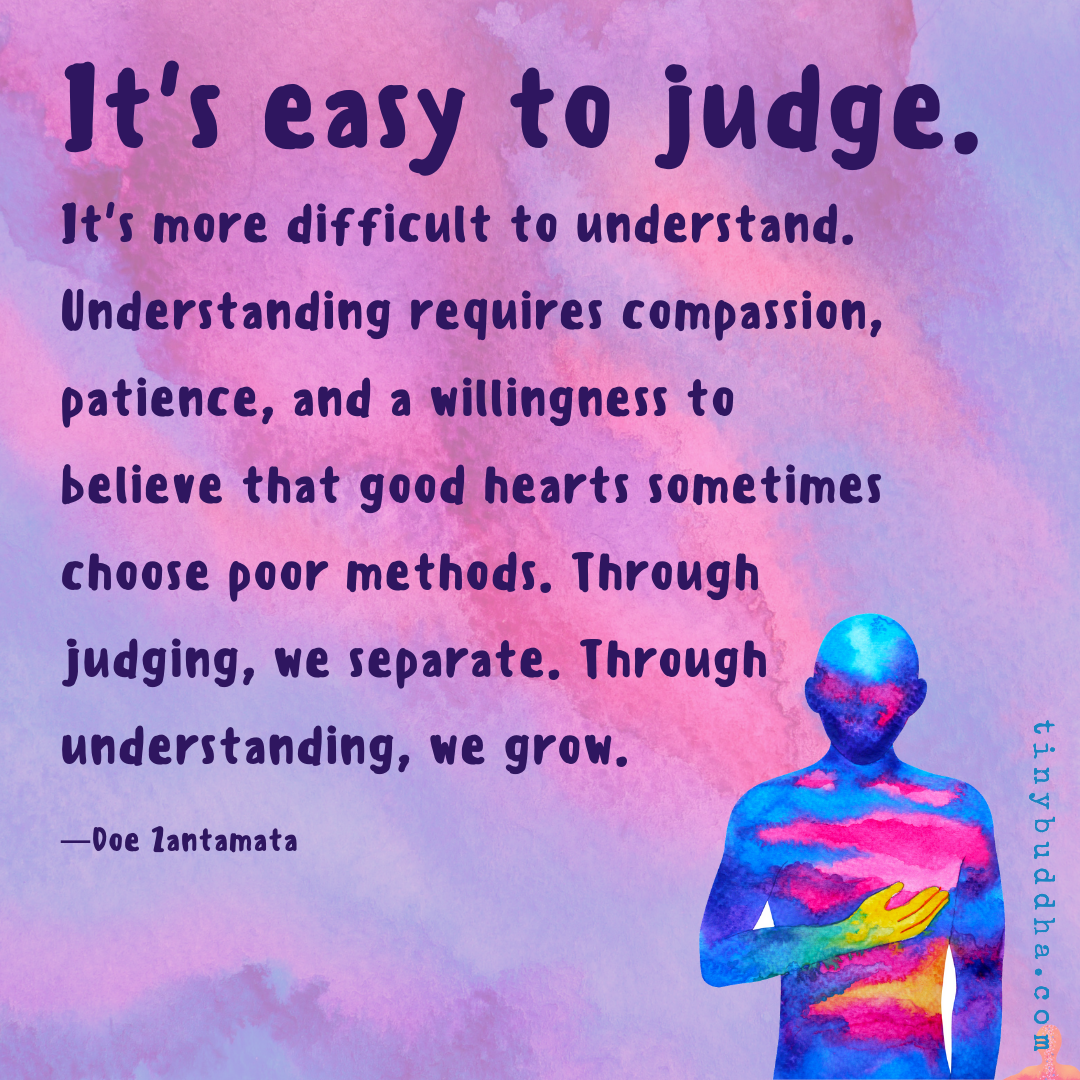
    “It’s easy to judge. It’s more difficult to understand. Understanding requires compassion, patience, and a willingness to believe that good hearts sometimes choose poor methods. Through judging, we separate. Through understanding, we grow.” ~Doe Zantamata

    Why doesn’t he say something?

    I was sitting at the dinner table with my partner and friends. Everyone was interacting and talking to each other, except my partner. He was just sitting there quietly. I had to admit, this situation made me very uncomfortable.

    Why was he so quiet? We had been dating for over six months and normally, when it was just the two of us, he was very talkative, we had vivid discussions, he knew his opinions and was not afraid to speak his mind. But now, at a dinner with friends, he was a shadow of his normal self.

    To be honest, I felt a bit embarrassed. What would my friends think? Did they quietly judge him too? Did they think he was boring and uninteresting?

    When we got back home, I was irritated and annoyed. Have you ever had that feeling, when all you really want is to be brutally honest with someone? To explain exactly what they did wrong and explain how they should behave instead? I wanted to lecture him. To tell him this: “It’s rude not to interact at social gatherings. It’s weird. Can’t you behave? It’s sloppy! What’s wrong with you? What’s your problem?” 

    I didn’t say those things to him. Instead, I allowed what had happened to sit with me for a few days. Slowly, I started turning that finger I was pointing at him toward myself. Maybe this wasn’t all about him, maybe it had something to do with me?

    That’s when it struck me. He wasn’t having a problem. I was!

    I realized that my upbringing had given me certain values and “truths” about relationships and social interactions. This is how you behave: You actively participate during conversations, anything else is considered rude. You ask people questions and share stories during social gatherings; otherwise, people will think that you’re uninterested. That’s what I learned growing up.

    Because my partner wasn’t acting in accordance with what I had been taught, I judged him. Instead of asking myself why he was behaving the way he was, I put labels on him. When we came back home, I had, in my mind, labeled him as rude, boring, self-conscious, and not living up to the standards I wanted in a boyfriend.

    Now, eight years later, I know that my husband was quiet during that dinner because he needs more time with new people before he’s fully comfortable. He didn’t do it because he was rude. On the contrary, I know he cared deeply about me and my friends, he was just showing it in a different way.

    When I understood this, I knew that my judgment really had nothing to do with him—it was all about me. In judging my partner, I realized that I most of all judged myself. My judgment was never about him—it was about me.

    This insight did not only bring me more compassion, less judgment, and more closeness in our relationship, it brought me a new perspective and new values that made my life better.

    Below you’ll find the steps that I followed:

    1. Identify: What judgment do you make about someone?

    The first step is to be aware of the judgment(s) you make about other people. In my case, it was thoughts like “He’s rude and awkward,” “I’m better than him at interacting socially,” and “Maybe we’re not a good match? I need someone who can interact socially.” Often judgments include a feeling of you being superior, that you know or behave better than other people.

    Just become aware of the judgments you’re making (without judging yourself for having them). This is the first step in transforming the judgment.

    2. Ask yourself: How should this person be instead?

    In the specific situation, ask yourself how you think the other person should be or act instead. According to you, what’s the best behavior in the situation? Be honest with yourself and write exactly what comes to mind, don’t hold yourself back here.

    In my case, I wanted my partner to be fully involved in the conversations. I wanted him to be talkative, interested, and curious about my friends.

    3. Go deeper: Why is it important to be this way?

    Be curious and ask yourself, why is it important to be or act in the way that you prefer? If a person doesn’t act that way, what does it signal about the person? What is the consequence of not being or acting in the way you desire?

    For me, social skills translate into good manners and that you can behave appropriately. I used to think that people that weren’t behaving in the “right” way, according to my viewpoint at the time, weren’t taught well by their parents. I labeled them as uninteresting and not contributing to the group. (Now, I know better, but more on that soon).

    4. Spot: What underlying value is your judgment coming from?

    Ask yourself what underlying values and beliefs that are fueling your judgments. What’s the story you’re telling yourself about the specific situation? Be brutally honest here.

    In my case it was the following: Being unsocial is negative and equals weakness. Not being socially skilled is awkward and weird. It means that you are less—less capable, less skilled, less smart/intelligent, and ultimately less worthy. (Just to clarify, this was my judgment and insecurity speaking, and it’s obviously not the truth).

    From my upbringing I had learned that social skills are highly valued. I was taught to be talkative, to engage in social interactions, and to articulate well. If you didn’t live up to these expectations, you felt inferior and less worthy.

    5. Make a choice: Keep or replace your values?

    When you have defined your underlying values and beliefs, you have to make a choice: Either you keep or replace them. And the crucial questions are: Are your values and beliefs serving you or not? Are they in line with your moral standard and aspirations?

    I chose to replace my values. Instead of valuing people based on social skills, I chose to replace that value with acceptance, respect, curiosity, and equality. As much as I didn’t want to judge someone for their skin color, gender, or ethnicity, I didn’t want to judge someone based on how they behave socially.

    Instead, I made a conscious choice to accept and respect all individuals for who they are. And to be curious and kind, because in my experience, every person you meet can teach you something.

    Transforming Judgment to Your Benefit

    Looking back at that dinner with my partner, I was so close to falling into the trap. To get into a fight where I would hurt my partner badly and create a separation between us. It took courage to turn the finger of judgment I was pointing towards him and to turn it towards me instead.

    I realized that my underlying values and beliefs had consequences, not only for the people close to me, but also for myself. They implied that if someone has a bad day and doesn’t feel like interacting, that this is not okay. That others and I are not allowed to be ourselves and to show up just as we are (talkative or not).

    I realized that the values that my judgment stem from did not only make me judge my partner, they also made me judge myself. I was not allowed to just show up. I realized that my upbringing had given me a sense of insecurity and uncertainty. Sure, I had learned how to interact and be the center of attention. But the underlying painful feeling was there. I had to be an entertainer. I had to always be smiling and in a good mood. I had to be curious and ask other people questions.

    If not, I’d be excluded. I felt that I was only accepted when I was happy, outgoing, and enthusiastic. That was stressful and it didn’t make me feel safe.

    Also, to my surprise, once I stopped judging my partner, he became more social and talkative at social gatherings. Why? Because previously he’d probably felt my judgmental look, and that made him even more uncomfortable and introverted. When I stopped judging he felt acceptance and respect. And that, in turn, made it easier for him to be himself, even at social gatherings.

    The bottom line is this: When you judge someone it always comes back to you. What I discovered was that because I judged others, I was also very hard on myself. The more I have worked on this process, the more forgiving, accepting, and loving towards myself I have become.

    Next time you find yourself judging someone else, stop and reflect. Follow the five steps and remember: it’s key to be honest, vulnerable, and curious.

    Free yourself from the chains of judgment and allow acceptance, compassion, and liberation to enter—both for yourself and others. You got this!

  • Don’t Wait to Open Your Heart: There Is Only Time For Love

    Don’t Wait to Open Your Heart: There Is Only Time For Love

    “Be soft. Do not let the world make you hard. Do not let the pain make you hate. Do not let the bitterness steal your sweetness.” ~Iain Thomas

    Looking back, my most cherished childhood memories can be traced back to my rosy mother.

    Intricate forts in the backyard with Spice Girls playing in the background. Sleepovers using Limited Too’s finest sparkly lotion, eyeshadow, and lip gloss. Rainy afternoons filled with friendship bracelets and Lisa Frank activity sheets. Children and teachers showing off their wild side at my mothers’ signature talent shows at the local theatre. Arts and crafts in a room surrounded by floral couches and mauve wallpaper. Flea market field trips to select the perfect charm bracelet. And, loads of buttery birthday cakes with the words Be With Your Dreams written all over them.

    Sadly, we grew apart during middle school when she abruptly uprooted our sunlit lives in exchange for a nomadic lifestyle. After traveling with her to two states, I grew tired of the “new kid” title and moved in with my father.

    With each of her subsequent moves, my resentment morphed into a towering boulder that blocked her love to seep through. Our tug-of-war relationship continued for six years into early adulthood.

    I still remember the day that everything changed.

    I was at a work conference when I received an unexpected call from her. I grudgingly called her back in a crowded hallway.

    What?!” I said in a pompous tone.

    She whispered, “I’m so sorry to hound you but I need to tell you something. I have cancer.

    What do you mean?” I said as my throat sealed.

    “I’ve been diagnosed with ovarian cancer—I am so sorry.”

    A few days later, I visited her home in Key West, Florida. I can still picture her galloping towards me as I exited the puddle-jumper. She had a mop of loose curls, a wide smile, torn army green cargo pants, and a swollen belly that resembled pregnancy.

    For the first time in years, we bonded without the heaviness of the future.

    We became giggly movie critics. We strolled the shoreline in search of magical conch shells. We frequented our favorite Cuban restaurant and oohed and aahed over zesty soup. We bought vintage aqua blue tea sets for future tea parties. We swapped stories that were once forgotten.

    Instead of cowering in embarrassment, I encouraged her roaring laugh in public. I embraced her hippy lifestyle as we basked in the sun, with Key Lime Pie sticks in hand. I co-directed one of her renowned talent shows featuring local YMCA kids. Her trailer became a treasure trove filled with wispy white pillows, the aroma of velvety hazelnut coffee, and new beginnings.

    With each day that passed, the towering boulder of resentment I once had dissipated into raw love.

    She didn’t have standard health insurance, but she saved black pilot whales in her free time. She didn’t have a steady job, but she made others smile as she sold handmade bottlecap jewelry at Mallory Square. You see—if you’re fixated on expectations of who someone should be according to your standards, you can’t love them for who they really are.

    My mother once wrote me:

    “Those stressful days are gone, and I don’t think I’ll ever see them again. I don’t have the meetings and high-powered days like I used to. I drift to work somehow gazing at the blazing sun, aqua blue ocean, hibiscus blossoms, and the marshmallow clouds. I wear island dresses in the endless cool breezes with my hair in a wet bun. Most of the time, I hide my bathing suit underneath it all so I can hit the beach right after.  I’m dreaming of my toes in the sand, laughing, giggling, and snoozing while listening to music and chirping birds. Remember, life is beautiful. You need to find your happy – promise?!

    My mother appreciated every moment, even if the highlight of her day was glancing through a window in a sterile hallway. She described the hospital’s cuisine as divine. Although she could barely walk, she somehow dragged her flimsy wheelchair through sand, just to inhale a whiff of the salty ocean air. And at every opportunity, she looked up at the clouds in awe of being alive.

    As her soft body turned into brittle bones, I learned the importance of her famous motto, Be With Your Dreams. She taught me how to live an idyllic life filled with nature, wonderment, and positivity. She proved that having a raw, openhearted approach to life was superior than any cookie-cutter mold I once envisioned for her.

    In my mother’s last days, she shared tenderly, “Britt, I think of how I left you behind sometimes. I know I wasn’t a perfect mother, but I’ve always loved you so much, baby girl.”

    I waited for that moment for fifteen years. And in that moment, I felt nothing. Zilch. Nada.

    Time was the only thing I longed for. As tears streamed down my face, I wondered how many more memories we would’ve had, had I learned to appreciate her for who she was years ago.

    Most of us wait to resolve our conflicts “later.” The unfortunate part is that minutes and days turn into months and years. There’s a good chance we’re missing out on a relationship right now that could change our entire lives. So…

    Open the door to your heart and choose love. Be kind instead of right. Remember the good times. Let go of pain disguised as indifference. Take responsibility for your part. Stop the judgment. Be the bigger person. Forgive the small things.

    For goodness sakes, say or do something! Pick up the phone. Write an apology letter. Drive to their house. Plan a trip. Text a nostalgic memory.

    Don’t you see… there’s only time for love. And, who knows—if you’re lucky enough, they might just show you how to Be With Your Dreams.

  • Why Judging People Hurt Me and 5 Things That Helped Me Stop

    Why Judging People Hurt Me and 5 Things That Helped Me Stop

    “It’s very easy to judge. It’s much more difficult to understand. Understanding requires compassion, patience and a willingness to believe that good hearts sometimes choose poor methods.” ~Doe Zantamata

    In the past, judgments kept me safe. They reassured me that I had worth. That I was right. That I was good. I believed I knew the “right” way to live.

    I felt I could clearly see the truth of matters. I didn’t understand why others weren’t always able to grasp the truth that I saw. However, the real truth was that my inner world was full of turmoil.

    Since adolescence, I went about my day with a certain level of tension in my chest. It was almost imperceptible, but always there. I felt I was constantly fighting the world, the universe. I tried to control it, to mold it to the way I saw things. I judged anyone who didn’t follow my vision of right and wrong.

    I spent a lot of time arguing and judging. Politics, religion, even school board meetings—they all elicited strong judgments from me. Judging others felt OH SO GOOD for a minute. That’s the kicker. Inevitably, though, the negative energy of the judgments left me feeling irritated or angry.

    Why was I judging so much? Because I believed that missteps should be punished. My judgments were just that. I thought punishments were critical to learning. To growing.

    The reality was that the person I was judging was mostly unaware of my judgy thoughts. My judgments weren’t resulting in positive change. When I sat down and actually thought about what punishments accomplish, I realized that no one needs to be punished in order to change. I saw that I was operating from a false “truth.”

    What I hadn’t understood was that the only person I was punishing when I judged was myself. I was poisoning my body, my mind, even my soul, with anger.

    What is clear to me now is that when I judge, I create division. When I judge someone, I am saying “I’m here and you’re over there.” I’m thinking, “I’m right and you’re wrong.” The problem is—they are thinking the same thing!

    I experienced the wisdom of the introductory quote in what turned out to be a pivotal moment in my spiritual journey.

    I was a witness to an unpleasant argument about vaccines between two friends. I started to feel the tension in my chest increase. I began to judge and felt the need to jump in and share my “right view” with them.

    Then I centered. I became still. And I saw two moms who were scared. Two moms who loved their children. Two moms who were just trying to do their best. The tension fell away. I stopped judging and felt compassion for my two friends instead.

    My inner world changed. The tension was replaced with expansion. I felt peaceful. I felt love.

    There is a concept in Buddhism called “the right view.” The “right view” is often described as the perspective that doesn’t cause suffering. I’ve also heard it described as “all views, or none at all.”

    I’ve learned that we filter all external information through our own personal experiences, knowledge, and traumas before coming to a conclusion. Our inner world and patterns determine our reactions. This is why we can all receive the same information and still come to different conclusions. None are right, and none are wrong. They are just different paths.

    In the past, I would have tried to convince you that my path was right. I wouldn’t allow you to be who you were. I wanted you to be who I wished you to be. I would have judged you.

    I don’t know about you, but when someone judges or shames me, I don’t change. I dig my feet in. It’s not a very effective communication technique.

    Instead of judging, if we try to understand each other and allow each other to be who we are, we foster acceptance rather than division. We have compassion rather than judgment and our inner world changes. We feel an inner peace within.

    It’s important to note that not judging someone doesn’t mean you condone what they’re doing. It also doesn’t change the consequences of their actions. It just allows you to keep your inner world peaceful.

    So, how did I get here?

    First, I learned to meditate and find that place of stillness within me.

    Second, I learned how to find that place of stillness with my eyes open. These first two steps allowed me to create a space between an event and my emotions. This moment (or space) allowed me to respond rather than react. In this moment, the truth will often become clear.

    Third, I practiced catching myself judging. I would take a moment and hold the person in compassion instead. I would try to understand them. I would allow them to be who they are rather than who I wished.

    Fourth, I saw that punishments don’t work. Judging others or ourselves doesn’t facilitate growth. It creates tension and division.

    Finally, I discovered that judging ties you to the past. To past patterns, reactions, and impressions. I’m judging based on my personal past experiences. I learned to let go and to forgive things in my past. I knew if I didn’t, nothing would change.

    The result was inner peace. My chest doesn’t feel tight anymore. In fact, it feels like there is an open, shiny jewel in place of the tension. Love flows through me daily. I see the bliss of the present moment. I spend less and less time in the past.

    When someone says something hurtful to me now, I try to pause and center. I bless them. I know when people are suffering that suffering often spills out onto others. I hold them in compassion. I understand that they are doing the best they can.

    I’m also not perfect. I do still catch myself judging. I am also doing the best that I can.

    I challenge you to try leading with compassion. First, compassion for yourself. We are all learning and growing. Then compassion for each other. See what happens to your inner world.

    It is easy to judge; it’s much harder to try and understand.

  • 5 Simple Ways to Overcome Your Mind’s Constant Judgments

    5 Simple Ways to Overcome Your Mind’s Constant Judgments

    “It’s easy to judge. It’s more difficult to understand. Understanding requires compassion, patience, and a willingness to believe that good hearts sometimes choose poor methods. Through judging, we separate. Through understanding, we grow.” ~Doe Zantamata

    If you don’t live in a cave, you have probably noticed two things. First, there are a lot of annoying, incompetent, stupid, and very difficult folks living in this world. Second, assuming you agree with my previous sentence, you have a very judgmental mind.

    For better or worse, you’re not alone. A hundred thousand years ago, the ability to judge people quickly helped our species survive. If we saw an unknown caveman and thought they “looked friendly,” we could die if they actually ended up being a killer. Thus, our minds learned to judge people quickly, and if in doubt, with great suspicion. After all, judging and being afraid of strangers could save your life.

    Yet nowadays, the tendency of our minds to judge most everyone as annoying, different than us, or just plain difficult simply leads to stress and unhappiness.

    Fortunately, there are five simple phrases you can use to overcome your mind’s constant judgments, and instead feel open hearted, compassionate, and at ease with others’ behavior.

    Your mission, should you decide to accept it, is to find the simple phrase or phrases that work best for you. Once you find a phrase that works for you, you can maintain a peaceful and loving attitude toward people—even when they’re committed to being super annoying.

    It Must Be Hard Being Them

    The first phrase I’ve used to quickly let go of judgment is, “It must be hard being them.” This sentence is meant to evoke compassion, not superiority. If you think this phrase and feel superior to whoever you’re judging, you’re not using it the way it’s intended. However, if you think this phrase from your heart, and feel compassion for a person for being burdened by their difficult behavior, then you’re using it well.

    Recently, I talked to a very rude airline reservation clerk over the phone. She was curt, unhelpful, and incompetent (in my judgmental opinion).

    Anyway, she was either a very wounded and angry person, or she was having a particularly bad day. Yet, when I thought in my mind, “It must be hard being her,” I immediately felt more compassion for her. After all, someone as angry and unhelpful as she must create a lot of havoc in her life.

    She probably feels very lonely, frustrated with her job, and angry that she gets a lot of resistance to her difficult personality.

    Strangely, as soon as I felt more compassion for her, her behavior became less troubling. It often goes that way.

    How is That Like Me?

    I used to live in a spiritual community. I liked some of the members of this community, while others I found particularly irritating. When annoyed, in this community we were encouraged to use a phrase that helped us to immediately let go of our self-righteousness and annoyance. The phrase was, “How’s that like me?”

    So, if Joe was complaining about how it was too hot to work outside when it was eighty degrees, I’d ask myself, “How’s that like me? Do I ever complain like Joe is doing?” The answer was an inevitable “yes.” In fact, I’d try to pinpoint exactly how I sometimes behaved like Joe’s current annoying behavior. For example, I might remember that my complaining about being out of potato chips was similar to Joe being upset about working in less than perfect weather.

    When I would see how I sometimes acted in ways that were similar to whatever I found annoying or difficult in another, two things would happen. First, I would let go of my self-righteousness and feel humbled. Second, I would feel more compassionate toward whoever I had been judging.

    After all, we all do annoying and even stupid things at times. We’re human. The phrase, “How’s that like me?” has helped remind me of our shared humanity and assisted me in seeing that I, too, am not perfect.

    Don’t Know Mind

    A third approach to overcoming our mind’s judgmental tendencies is to think a phrase such as, “I don’t really know the whole story.” In the Zen tradition, they call this “don’t know mind.”

    Our mind always wants to attach a story to whatever is happening in our lives. Even when we have almost no information, we create a story in our head as to what things mean and what’s really going on. Most of these stories that we create make us look pretty good and make others look pretty bad. Yet, if and when we get a fuller picture of reality, we see that there’s no such thing as one person being “all good,” and another being “all bad.”

    People are complex, and they often have very good reasons for their behavior—even if we can’t see it at the time or know what it is.

    As a psychotherapist, I get to see “behind the curtain” of why people behave the way they do.  Several years back, I had a client who was required by a court to see me due to his having repeatedly hit his wife and kids.

    I had never seen such a person in my office, and my initial reaction to him was one of judgement and disgust. However, I soon learned that his father had not only beaten him, but sexually abused him as a child. As I learned about his life, I understood why he had turned out the way he did. I felt deep compassion for this wounded man, and as therapy progressed, I let go of my judgments and he let go of his violent tendencies.

    Had I held on to my initial judgment that he was a bad person, neither of us would have been healed. Not believing your mind’s initial judgments can be a path to greater freedom for both you and others.

     They Are a Perfect Them

    In most spiritual traditions, there is the idea that behind our personality and behaviors, we all share a common awareness, soul, or divine nature. This divine nature may be hidden under many layers of ego and problematic behavior, but it’s there somewhere.

    If you can quiet your mind and open your heart, you can sometimes tune into this soul or divine aspect in others—even if they’re being annoying.

    A phrase I’ve used to help me along this path is, “They are a perfect them.”  When I say this sentence from my heart, it reminds me that everyone is simply doing the best they can, and that a perfect soul is hidden underneath all their wounding.

    In movies, there’s always a “bad guy” or gal who we root against. Even if that character’s behavior is abhorrent, we may still marvel at the acting abilities of the person portraying the antagonist.

    In a similar way, when I see someone doing something I find offensive, I can still admire how well they’re playing their role. They might be a world class jerk, but at least they are playing that role perfectly. And behind the role they are playing, they are a wounded, vulnerable human being—just like me.

    In short, they are a “perfect them,” and as I allow them to be who they are, it gives me the chance to let go of my judgment and feel compassion and peace.

    A fifth and final way to conquer your (and my) judging mind is to use a phrase that Jesus used: “Forgive them, Father, for they know not what they do.”

    People don’t consciously do stupid or self-destructive things. After all, people never put their hand on a hot stove if they know it’s hot. If we see someone acting in an upsetting or self-destructive manner, it inevitably means they’re too unaware—or too compelled—to do anything else.

    Because we assume babies are not very aware and have little or no free will, we tend to not judge them when they do things we don’t like—such as cry. In a similar manner, we can see that many adults also are so unaware or so compelled by their past conditioning that they’re really like a little baby. From our understanding that they “know not what they do,” it’s easier to let go of our judging and being annoyed at them.

    Ultimately, we all want to love and be loved. Unfortunately, our Neanderthal-like judgmental minds get in the way of what we truly crave deep down inside. By trying out the four phrases I’ve discussed, you may find a quick way to sidestep how your mind creates separation and annoyance. Once you find a simple way to elude judging others, you can instantly enjoy more peace, compassion, and love.

  • How I’m Winning Over My Inner Critic by Letting It Exist

    How I’m Winning Over My Inner Critic by Letting It Exist

    “Winning the war of words inside your soul means learning to defy your inner critic.” ~Steven Furtick

    We all have that voice in our head, the voice that’s always negative about ourselves. Our inner voice.  Our inner critic.

    The one that tells us we’re not good enough, not smart enough, not attractive enough. That voice that continuously compares us to other people, so we come up lacking and feeling less than.

    Sometimes that voice is our own. Other times, and for some people, maybe those of us who have felt unloved or disliked by a significant person in our lives, that voice belongs to them.

    Then there are times when that inner critic will take on the voice of multiple people. A parent, a past lover who jilted us, and an abusive boss, for example. It can be quite the party in our heads, and not always a good one!

    For a while, the voice in my head belonged to my mom.

    It became a lot more frequent after she passed away. And a lot more persistent. Her best times to chat with me were always during my morning and evening routines. 

    Why? I haven’t quite figured that out yet. Maybe it was because, during those times, especially with my morning ritual, I was prepping to present my best self to my world, doing my makeup and fixing up my hair. What better time to be critical, right?

    In the mornings as I prepared for the day, I heard how my skin care routine didn’t matter, I was going to get old anyway, and look old. The makeup I applied didn’t make me look any better. The affirmations I wrote on the bathroom mirror were stupid and useless.

    Anything I did to make myself better and healthier didn’t matter. I could never change, and I could never improve myself. Regardless of how much I tried, or how much effort I put in, I would never be good enough. Never enough period.

    At times, I think there was an undercurrent of jealousy. Maybe because I wanted to improve my life, that I wanted so much more from life. More than what she wanted for herself and for me.

    When she was alive, I definitely felt this was why she found so many faults with me and pointed out all my shortcomings. It would make sense, then, that any critical thoughts I had about myself could so easily be transferred to her image, and in her voice.

    I can understand those feelings and see why her feelings came out the way they did. Fears held her back from becoming more, from wanting more. And just possibly, those were my fears too, but now being heard via her voice. Fears of never really becoming who I want to be, of never being enough.

    Sometimes it’s easier to deal with our negative thoughts if we can make someone else responsible for them. Have someone else own them. It takes the burden off of me to change my thinking if I can tell myself these negative thoughts are coming from my mom.

    For a long time, during those morning and evening chats, I argued back. I got very defensive. And I felt like everything I was doing was useless and worthless. During those times it felt like she was right. That my inner critic was spot-on.

    Then one day I got quiet. Maybe I was exhausted with this daily dialogue. I don’t know. But I got quiet. I decided to just let her talk without reacting to what she said. No more arguing. I just smiled, a gentle unconcerned smile, and continued with my routine.

    I let everything that was being said just sit in the space around us. I heard it but didn’t take it in.

    My intention now was to observe. I wasn’t belittling her feelings by ignoring her, I just simply observed and let her talk, giving her voice the space to speak and to be heard. Periodically, I responded with something like, “Yeah, I can see why you think that.”

    For a while this became the style of our regular chats. The new dialogue that the voice in my head was speaking. The negative remarks, the catty remarks, and the put-downs, all drawing a quiet and unconcerned smile, with no negative response from me.

    Before long it changed again. My mom-in-my-head, instead of chastising me for wasting my efforts, became inquisitive. The voice started making positive remarks about the products I used and the affirmations I wrote on the mirror. She became curious. That voice started asking positive questions, empowering questions. Questions that were now on my side—with me, not against me.

    It’s very possible that the reason my inner voice, my inner critic, has taken on the voice of my mom is that I still very much want the approval from her that I felt I never received while she was alive. I will never actually get it now that she is gone, and that’s something I have to accept. But this may be another way that I can maybe feel like I get it, even just a little.

    Perhaps it’s how I can get the approval from myself that I’m seeking too. The belief that I am indeed becoming the person I want to be. That I am indeed enough.

    I’m reminded of this saying, “We can’t control how other people act; we can only control our own reaction.”

    Sure, this inner voice is mine, maybe sounding like someone I know. And one would think we can control our inner voices. But if it were only as easy as that, no one would ever struggle with self-doubt, and at times self-loathing.

    Learning to control that inner voice is like controlling a temper-tantrum-filled two-year-old. Eventually do-able, but it takes herculean effort!

    The method that’s currently working for me is to let that voice speak. Meeting it with a gentle smile and letting it flow around me, without landing on me. Being observant but unconcerned. 

    Over and over, as long as it takes. Because soon that inner voice will be curious about what’s happening with me, what’s working for me, what it is that is bringing me such peace.

    Perhaps the same is true for you. Maybe instead of trying to make your inner critic go away, you just need to let it exist. When you observe your self-critical thoughts without fighting or attaching to them, you take a little of their power away. And maybe as you take your power back your inner voice will slowly transform into something softer, gentler, and on your side, because it can finally see it’s a good place to be.

  • Surviving a Dysfunctional Relationship: What I Wish I Knew and Did Sooner

    Surviving a Dysfunctional Relationship: What I Wish I Knew and Did Sooner

    “No person is your friend who demands your silence or denies your right to grow.” ~Alice Walker

    When I was a child and in my early teenage years, I was a free bird. I laughed easily, loved life, never worried, and dreamed big. I thought the best of others, the glass was always full. I never dreamed others would hurt me, and I had a joyful and playful attitude toward life.

    That was a long time ago.

    My breakdown started gradually and slowly with judgments from a very close and trusted family member I dare not name. This person, though probably well-intentioned, thought that you make someone stronger by criticizing them. They believed in knocking me down, throwing verbal punches to make me “resilient.”

    They believed in “hard love.” They watched while I faltered and sometimes suffered. They stood back and watched from the cheap seats, then critiqued my performance. Their assessment of me was rarely, if ever, encouraging and was full of arrogance and judgment.

    Well into my adult life, this trusted person threatened me after an ugly incident where they made a terrible judgment call. Instead of admitting their error, they threatened me and made it my fault by saying, “If you ever tell anyone about this, I will disown you.”

    Shuddering under the weight of those words, I decided to sever ties with this person once and for all.

    Those words, “If you ever tell anyone about this, I will disown you…” said so much about this person who I have struggled to understand my entire life.

    For me, it was about as close to the admittance of wrongdoing I would ever get from them. And as always, there was the signature and ever-present judgmental spin. “I will disown you” because, after all, this is your fault, and you deserve punishment.

    I try to come to terms with the aftermath of the ugly side effects that this person has brought to my life.  Someone so blatantly flawed showed me my own weaknesses because I allowed them to erode my confidence and well-being.

    I regret not cutting ties sooner—like twenty years ago.

    As I sat in the aftermath of this situation, I wondered what good can possibly come from such a disappointing relationship? A lifetime of misunderstanding, jarring actions, harmful words, and hurt feelings—all from a person so close to me—someone I should trust, love and respect.

    Perhaps the answer lies in the decisive way I ended it after so many years of abuse. The final decision for me to end this relationship was my first real stand to protect myself. The first time I valued myself more than another person.

    The dysfunction of this relationship would not have come this far if I knew how to establish healthy boundaries early on and knew how to deal appropriately with a difficult person. I am nearly sixty years old and have learned my lessons the hard way.

    I like to share with you some easy strategies you can employ if you are struggling with a dysfunctional person in your life.

    1. Nothing you say or do will ever change them.

    Save yourself a lot of time and energy and come to terms with this reality. The only person you can change is yourself, which is the best place to focus your energy. You can control your reactions to this person, your opinions, and how you deal with them, but you can’t control them.

    They have to accept you for who you are, and likewise, you have to accept them for who they are.

    If you don’t like them or their behavior, you have to decide how you will deal with it. Maybe you only visit once a year or not at all. Perhaps you only call on the phone. Explore all the options that you feel will work for you and keep you safe, and try not to feel guilty about your decision.

    2. Set healthy personal boundaries.

    Healthy boundaries are essential not only for you in this relationship but within all relationships. Setting healthy boundaries with friends, your boss, your wife or husband, your children, with anyone is key to having healthy and fulfilling relationships.

    When you set healthy boundaries, you also allow the other people in your life to know what you expect and what you will or will not tolerate.  They will appreciate you for that.

    Setting healthy boundaries starts with knowing what irritates you, what pushes your buttons, what compromises you might make, if any.  Healthy boundaries have a lot to do with knowing your core values. Start with a shortlist of core values important to you. Know them and stick by them, and when someone challenges those values, be ready to protect them because they are there to protect you.

    Also, choose your words carefully when setting clear boundaries. For example, saying, “You insulted me, so I am out of here,” is not as effective as saying, “Your words (specify the words you find insulting) are insulting to me, and if you continue to talk to me like that I will have to leave.”

    Everyone deserves a chance to change their behavior for the better. However, act decisively and immediately if your boundary is crossed.

    3. Whether it is a friend or family member, people who constantly cross your boundaries and challenge your values don’t deserve your energy.

    Being decisive like this is called standing up for yourself. You can walk away and come back another day—or not.

    If you don’t stand up for yourself early, people will chip away at your inner confidence and make you resentful and even potentially volatile. Don’t let things get that bad.

    Make yourself strong from the inside out, rely on your judgments. Don’t listen to other people who persuade you to ignore your guidance. Only you can know whether someone is violating your inner self.

    4. You are not a bad person for deciding to step back or even end the relationship.

    Tell yourself that you are not a bad daughter, son, wife, husband, mother, whatever. You are not bad for deciding to end a volatile relationship that has left you drained, eroded, and empty.

    Maybe you could have done things differently or better or sooner, but you didn’t and couldn’t, and you did your best. You had good reasons to step away or even leave the relationship; accept that and don’t beat yourself up over it. Self-preservation will always make you a better person in a relationship, and indeed, it will make you a better person out of it as well.

    There is a great deal of wisdom that can be learned from years of perseverance and working your way through challenging lessons. It was my choice to stay in a dysfunctional relationship, perhaps too long, in a place that clipped my wings.

    I now know the true value of standing strong in who I am, and not basing my self-acceptance on the way others treat or view me.  That wisdom is profoundly liberating and once again I can be free, like a bird with newly feathered wings.

  • A Life-Changing Insight: You Are Not a Problem to Be Fixed

    A Life-Changing Insight: You Are Not a Problem to Be Fixed

    “I decided that the single most subversive, revolutionary thing I could do was to show up for my life and not be ashamed.” ~Anne Lamott

    I remember one particular clear, cold winter morning as I returned home from a walk. I suddenly realized that I had missed the whole experience.

    The blue, clear sky.

    The lake opening up before me.

    The whisper of the trees that I love so much.

    I was there in body but not embodied. I was totally, completely wrapped up in the thoughts running rampant in my mind. The worries about others, work, the future; about everything I thought I should be doing better and wanted to change about myself… it was exhausting.

    Alive, but not present to my life. Breathing, but my life force was suffocated.

    This was not new. In fact, up until that point I had mostly approached life as something to figure out, tackle, and wrestle to the ground. This included my body, my career, and the people around me. 

    My tentacles of control, far-reaching in pursuit of a better place, said loudly, “What is here now is not acceptable. You are not acceptable.”

    “You can improve. You can figure it out. You can always make it better.”

    But this time, rather than indulging in the content of this particular struggle, I observed the process I was in and realized profoundly that even though the issues of the day changed regularly, the experience of struggle never did.

    And I would continue struggling until I stopped resisting and judging everything and started accepting myself and my life.

    This wasn’t the first time I’d had thoughts like these, but this time there was no “but I still need to change this…” or “I can accept everything except for this thing.” I knew it was 100% or nothing.

    I knew then I only had two choices:

    I could continue to resist reality, which now seemed impossible and exhausting (because it was). Or I could accept myself and the moment and make the best of it.

    “What if there is actually nothing to struggle against? What if I let go of the tug-of-war that I called my life?”

    The choice was before me. The one that comes to people when they have suffered enough and are tired: to put down the arms.

    This doesn’t have to mean accepting unhealthy relationships or situations. It just means we stop living in a constant state of needing things to change in order to accept ourselves and our lives. It means we learn to let things be—and even harder, to let ourselves be.

    Whenever I have a conversation with people who are struggling, I’ve recognized that they have this innate feeling of I should be doing better than this. Or, I should not be feeling like this.

    It might seem obvious that “shoulds” keep us in a contracted position of never-being-enough.

    But I have found that letting them go is not as simple as a quick change of thought.

    It seems like denying ourselves has become the generally accepted and encouraged modus operandi of our culture.

    Denying our feelings.

    Minimizing our pain.

    Hating our body parts.

    This leads to disconnection from the life that is here, the life that is us.

    Self-loathing has become the biggest dis-ease of our time.

    When we are disconnected from who we are in this moment, there is a tension between right here and the idealized self/state.

    This disconnection or gap is a rupture in our life force that presents itself as a physical contraction, a shortness of breath, an inner critic that lashes out harshly and creates a war within. This war contributes to pain, illness, and I’d guess 80% of visits to a medical doctor.

    Even some of the best self-help books promote this gap…

    Don’t think those thoughts.

    Don’t feel those negative feelings.

    Don’t just sit there—you should be doing something to improve yourself and your life

    All of the statements above might seem like wise advice. But we’ve missed the biggest step of all—mending the gap between who we are and who we think we should be so that we don’t feel so disconnected from ourselves.

    Disconnection is the shame that tells you that you’ve got it wrong, that it is not okay to feel or think the way you do in this moment. That you have to beat yourself up so you can improve, be more than you are now, be better.

    That you are a problem to fix.  

    This is the catch-22 of self-help when taken too much like boot camp. Self-help can be helpful, but it can create an antagonistic relationship with our true selves if it doesn’t include a full acceptance of who we are in this moment.

    The belief of “not-enoughness” is at the root of so much physical and emotional pain, and I, for one, have had enough of it.

    What if we allowed ourselves to be, or do, in the knowing that we are okay, that we are doing the best we can, given what we know at this point in time?

    Do you feel the fear-gremlins coming out that tell you that you will lie down on the couch and never get up again? Or perhaps you will never amount to anything or be good enough?

    This is the biggest secret of all: It’s all a lie to keep the consumer culture alive. 

    People who are scared and in scarcity need to consume something outside of themselves to gain fulfillment. But it never really comes because there’s always something new to change or attain.

    It can be so difficult for us humans to accept not only ourselves, but that everything just might be okay in this moment.

    That this feeling is just right. Even if it hurts.

    It’s okay to be right here, right now. Pain is here, and I don’t have to fight it.

    Our relationship with ourselves is the most important relationship we will ever have.

    Because we are truly sacred, no matter how we feel.

    Maybe the only question to ask today is not “What do I need to do to change?” but “How can I love myself, just as I am?”

    Maybe the act of loving ourselves is as simple as taking a breath to regulate our nervous system and come back to the present moment.

    Maybe healing involves not so much changing ourselves but allowing ourselves to be who we are.

    Which is exactly what I did that day when I realized I had missed my whole walk because I was caught up in my mind, worrying about everything I wanted to change. I shifted my focus from the thoughts I was thinking to the feelings in my body. I realized that I was enough in this step, in this breath, and that’s all there is.

    I promise the results of moving into acceptance will feel far better than the shame, disconnection, and cruelty that come from the constant pursuit of self-improvement.

    The truth is…

    You are not a problem to fix.

    You are a human to be held.

    To be held in your own arms and loved into wholeness.

    Take care of your human.

  • The Surprising Strategy I Used to Stop Bingeing (and Why It Worked)

    The Surprising Strategy I Used to Stop Bingeing (and Why It Worked)

    “Sometimes the thing you’re most afraid of doing, is the very thing that will set you free.” ~Robert Tew

    I recovered from binge eating and bulimia by giving myself permission to binge. Sounds crazy, doesn’t it?

    My decades-long weight and food war started in my teens, immediately after reading my first diet book, about Atkins, to be exact. I spent the following two decades trying to lose weight (only to keep gaining) and struggling with food.

    By my early thirties, I’d finally managed to lose weight, but it hadn’t end the war, it had just started a new one. The war to try to keep the weight off and transform my body even further.

    Thus began the decade of my “fitness journey.” I became an award-winning personal trainer and nutrition wellness coach and even a nationally qualified, champion figure athlete.

    The weight and food war continued through it all.

    I was introduced to clean eating by a trainer I hired before I became one myself. Four days into my first attempt at clean eating, I was bulimic—bingeing out of control then starving myself and over-exercising to try to compensate. Within eight months, I was officially diagnosed.

    Bingeing to the point of feeling like I may die in my sleep became common, and I realized I had two choices: potentially eat myself to death or heal. I chose the latter.

    I sensed that understanding what was driving those behaviors was the key to learning to change it all, so I decided to get busy learning just that.

    And I recognized that meant I had to stop obsessing over (and hating myself for) my food choices. They were not the problem; they were the symptom of whatever was going on in me that was driving those behaviors.

    So I gave myself full permission to eat whatever I wanted, whenever I wanted.

    I even gave myself permission to binge as much as I wanted.

    And I slowly started bingeing less and less. Now it’s been years since I have—the drive is just completely gone.

    I know permission to binge sounds crazy, but has trying to force yourself not to binge or eat “bad things” been working? Is trying to judge, control, criticize, restrict, and shame your way to “eating right” and/or health and happiness working?

    If so, carry on. But if what you’ve been doing hasn’t been working, stay with me while I explain two reasons why permission is so vital, and the helpful versus unhelpful way to practice it.

    Why Is Permission So Vital?

    Permission to eat whatever we want helps reverse two of the biggest reasons we eat self-destructively: restrictions and self-punishment.

    Food restriction (the rules around what we think we should or shouldn’t be eating) caused my cravings, overeating, and even bingeing.

    Science has shown that food scarcity/restriction activates a millennia’s old survival instinct in our brains that triggers cravings, compulsions, and even food obsessions until we “cave.”

    Self-punishment contributes to bingeing because we treat ourselves how we believe we deserve to be treated.

    We’ve been taught that certain foods are good and create “good” bodies, and that certain foods are bad and create “bad” ones. We’re taught that we are what we eat, and to judge weight gain or eating “bad” things as failure, that we are good or bad depending on what we eat and what size we are.

    We punish ourselves by trying to restrict even more, or we go in the other direction and overeat the things we keep telling ourselves we’re not supposed to have, which fuels the cycle.

    How can you want to make nurturing or nourishing choices for yourself when you’re hating, judging, shaming, and criticizing yourself? You can’t.

    That thought, “Oh well, you already screwed up, you may as well eat the rest and start again tomorrow”—that all or nothing thinking, the bingeing, the self-sabotaging—it’s being driven in large part by those two things: restriction and self-punishment.

    Full permission, even to binge, helps start to shift both.

    It stops the feelings of scarcity around certain foods (so they lose their allure), and it helps improve the relationship you have with yourself (so you’re no longer judging and berating yourself for eating “bad things”).

    Now, you may be thinking, but Roni, eating whatever I want got me into this mess. I can’t be trusted to just eat whatever I want.

    Here’s where the biggest lie of all has steered us in such a toxic direction: the idea that our natural compulsion is to “be bad” and eat all that bad stuff is bull.

    We’re not born into bodies that naturally want to eat in ways that make them feel like garbage. We’re not even born into bodies that are “too lazy to exercise.” I call bull on all that too.

    We’re born into bodies that know how to eat and naturally want to move. We’re born into bodies that want to feel good and are actively working to try to keep us healthy 24/7.

    But we’re actively taught to ignore or disconnect from them, and we get so good at ignoring and disconnecting from our bodies’ natural cues that we can’t even hear them anymore.

    We learn patterns of thinking and behaving that get programmed into our brains and end up driving our choices, rather than the natural instincts we were born with.

    It’s not your natural instinct to chow down on a whole bag of potato chips just because they’re there. Nor is it your natural instinct to ignore your body’s cry for some movement. Those are learned behaviors.

    By the time we get to adulthood, the ways we eat, think, and live just become learned patterns of behavior—that can be changed when you stop trying to follow other people’s rules and start understanding how you got where you are.

    When you spend your life stuck in that “on track” versus “off track” cycle you’re completely disconnected from yourself, your body, and what you actually want and need.

    The two things that are driving you and your choices when you live in that place are either:

    1) learned patterns of thoughts and behaviors from old programming (when you’re “off track”)

    or

    2) fear and other people’s rules about what you think you should be doing (when you’re “on track”)

    Neither have anything to do with you—with what you, at your core, actually need or want.

    By giving yourself full permission to eat what you want, when you want (yes, even permission to binge) you’re given space to reconnect with yourself and what’s best for you.

    What You Think Permission Is Vs. What It Actually Is

    There are two ways to do this whole permission thing: the way you think you’re doing it when you’re “off track” and the helpful way.

    Typically, when we “fall off track” or binge, we start “allowing ourselves” all the foods we can’t have when we’re on track, but the whole time we keep telling ourselves it’s okay because when we get back on track, we won’t have it anymore. Then we feel bad and guilty the whole time.

    That’s not permission, it’s a clear example of the food restriction/self-punishment cycle that fuels feeling out of control around food/overeating or bingeing.

    How? It’s restrictive and punishing. We know at some point we won’t be “allowed” to have it anymore—ya know, when we start “being good”—and since we’re already “being bad” we may as well just eat all of it, then we end up not feeling great.

    That’s a food restriction/punishment fueled diet mindset that perpetuates those old patterns.

    True permission means losing all the food rules and judgments. I know it sounds scary and wrong, but it really is key to learning to want to eat in ways that serve you and hearing your body when it tells you what makes you feel your best.

    Begin noticing the things you’re saying to yourself around your food choices and start noticing how the foods you’re eating make you feel after you eat them.

    Do you feel energetic and good when you eat that thing, or do you feel bloaty, lethargic, and sick? How do you want to feel?

    If you’re eating lots of things that are making you feel the latter, just notice that, get curious about why, and most importantly, extend yourself compassion and kindness.

    The next time you’re about to eat something that you know makes you feel terrible, remember how it made you feel last time and ask yourself, do you really want to feel that way right now?

    If you think, I don’t care, ask why? Why do you not care about treating yourself and your body well? Don’t you want to feel good? If you keep hearing, I don’t care, that’s a sign more digging is likely required, but permission is still where you start.

    Notice how often through the day you judge yourself for eating something you think you shouldn’t. How does that judgment affect the choices you make next?

    Remind yourself that what you eat doesn’t determine your worth, and you’re an adult. You’re allowed to eat whatever you want.

    Giving myself permission to eat whatever I wanted, even to binge, was the first step toward a binge-free life because it helped me learn to change the biggest reasons I was bingeing in the first place: destructive thoughts, habits, and behaviors that were caused by food restriction and self-punishment.

    It’s how you start learning to end the food war, to trust yourself and your body, to stop feeling out of control around food, and to start making choices that make you feel your best, because you deserve to feel your best.

  • How to Motivate Yourself with Kindness Instead of Criticism

    How to Motivate Yourself with Kindness Instead of Criticism

    I don’t always make the best choices, but today I choose compassion over intolerance, sympathy over hatred, and love over fear.” ~LJ Vanier

    It’s crazy to me now, to look back and realize how freaking hard I was on myself for decades.

    Had I ever talked to anyone else the way I talked to myself, it would surely have left me friendless and jobless, and I definitely would have been kicked out of school.

    Basically, I was a bully. Just to myself.

    If I said something awkward, I called myself an idiot.

    When I couldn’t find the motivation to clean my house, I called myself a lazy slob.

    If I wasn’t invited to a party, I told myself it’s because no one liked me.

    When work projects were hard, and I had to make it up as I went, I told myself that I was going to get fired as soon as my boss figured out that I had no idea what I was doing.

    My parents set high expectations of me. A’s were rewarded and B’s were questioned: “Why didn’t you get an A?”

    They are successful, intelligent people (who somehow also are able to keep a clean house, like all the time), so if I did anything that didn’t meet what I assumed were their expectations, I told myself, “I’m not good enough, I’ll never be good enough.”

    At a certain point, I realized this “strategy” wasn’t working out for me.

    It wasn’t making me any smarter or more successful.

    It wasn’t making people like me more.

    It wasn’t getting my house any cleaner.

    What it was doing was making me feel like crap. Every day. And it got old.

    Looking back, I realize now my catalyst for change was when I finally pushed past my social anxiety and found the courage to take classes at the gym.

    I found that I performed better when in a group because of the positive energy of people cheering me on.

    After a while I noticed I didn’t cheer people on quite as much as they cheered me on, and since it felt good for me to hear it, I busted through my fears and started cheering on everyone else in the class.

    It felt really good.

    It felt even better when it dawned on me that I could talk to myself that way too.

    And that is what self-compassion really is.

    What is Self-Compassion, Anyway?

    Self-compassion is speaking to yourself as kindly and empathetically as you would a friend.

    It involves consciously directing kindness inward.

    Self-compassionate people recognize that being imperfect, failing, and experiencing challenges are all inevitable parts of life, so they’re gentle with themselves when confronted with painful experiences rather than getting angry when life falls short of their expectations.

    Therefore, they speak in kind words—intentionally—to themselves.

    It is recognizing the shared humanity in our suffering and difficult experiences.

    When we’re being compassionate toward someone who is going through a hard time or has made a mistake, we say things like:

    • “You’re not alone.”
    • “Everyone makes mistakes.”
    • “You’re only human.”
    • “I’ve been there too.”

    Because there is comfort in recognizing that pain and making mistakes is part of life, it’s part of the process, it’s how we grow, and we all do it—literally every human.

    When we don’t take the time to say that to ourselves when we misstep, we feel isolated, and isolation breeds shame and separation and makes us feel worthless.

    Why We Are So Darn Hard on Ourselves

    We live in a success-driven, “no pain no gain,” “win at all costs,” “if you have time to lean you have time to clean,” “failure isn’t an option” kind of culture.

    There is nothing wrong with pushing ourselves and driving success.

    The problem is, we are a mimicking species, and when all we see are examples of people being hard on themselves and few or no examples of people being kind to themselves, we don’t know what that looks like.

    So the idea of self-compassion is foreign to most people. As such, we have these misconceptions that keep us from being self-compassionate.

    Myth #1: I need high self-esteem to feel good about myself.

    One of the biggest misconceptions about self-compassion is that it is the same as self-esteem.

    We grow up believing that high self-esteem is the key to feeling good about ourselves.

    The problem is, in our culture, to have high self-esteem, we have to be above average or special in some way.

    It’s almost an insult to be considered “average.” If someone were to say, “There’s nothing special about her” that would make a person feel especially bad.

    So, by this measure, self-esteem is conditional to everyone else’s status in comparison to ours. Our self-esteem (and therefore self-worth) go up and down as those around us go up and down.

    That’s why there are so many bullies in our society—because putting others down is one way to make your self-esteem go up.

    (There are literally studies showing an increase in bullies and narcissism in our society in the past several years, and many psychologists point to the “self-esteem” movement as a big factor.)

    Myth #2: I need to be hard on myself, or I’ll let myself get away with anything.

    A lot of people have the misconception that self-compassion is self-indulgence.

    They worry that they could be too self-compassionate and too soft on themselves, that they need to be hard on themselves in order to keep on track.

    But self-compassion enhances motivation, it doesn’t hinder it.

    Let’s say your friend is upset that she texted someone, and they haven’t texted her back.

    Do you say to her, “That’s probably because you did something wrong. I bet she doesn’t like you anymore, or maybe she never really did. You should apologize even though you don’t know what you did wrong, since she is most likely mad at you for something.”

    Absolutely not!

    Not only is it a mean thing to say, you know objectively that this is almost certainly not true.

    You would likely say, “I know that feeling too. I get disappointed when I don’t get a response from someone. But she likely forgot or is busy, just like a lot of people. Her not replying isn’t a reflection of you, it’s an inaction by her. Don’t worry, she still might message you back, or you can message her again later!”

    Which one of those feels more motivating? Which one feels more stressful?

    Which way do you talk to yourself when you slip up?

    The motivational power of your inner bully comes from fear, whereas the motivational power of self-compassion comes from love.

    How to Practice Self-Compassion

    1. Mindfully recognize when you hear your inner critic talking.

    We get so used to using negative self-talk that we don’t even notice it. We just run with the critical stories we’re telling ourselves.

    But you can’t change anything unless you recognize when you’re doing it by mindfully bringing attention to your thoughts, without judgment.

    First, notice how you feel. Because self-criticism feels crappy. That’s your sign that you need to do a little mindful digging.

    Now, the best tool you can use when you get that sign is to ask, “What is the story I’m telling myself?”

    • The story I’m telling myself is that people at work think I’m a fraud because I’m making everything up as I go, and I’m not giving myself any credit for all that I do know and have achieved.
    • The story I’m telling myself is that I’m not a good mom because I let my house get messy, and I’m not thinking about how happy and healthy my kids actually are.
    • The story I’m telling myself is that I’ll never lose weight because I ate those cookies, and I’m not giving myself permission to make a mistake.

    What is the story you’re telling yourself, and what language are you using to tell it?

    2. Understand the positive intent behind your negative self-talk.

    This is going to help you reframe your negative self-talk into self-compassion.

    Let’s say you’ve been wanting to lose weight, but you look down and realize you just ate an entire box of cookies.

    And now your harsh inner critic is saying, “You’re disgusting, you’ll never be able to lose weight, you have no self-control, this is why you’re so fat.”

    Again, words we would never say to someone else.

    What is the positive intent, what is that self-critic voice trying to achieve?

    • It wants me to be more conscious of when I’m eating and what I’m eating.
    • It wants me to be a little stronger when I have these cravings so I can lose weight.
    • It wants me to make a better choice in the future.

    Right? It’s not trying to beat you up for the sake of beating you up. That voice has a purpose, it’s just using the wrong words.

    3. Reframe that positive intent with self-compassion.

    Restate what your self-critic is saying with the voice of self-compassion by talking to yourself as you would a friend or loved one, recognizing the shared humanity in the experience, and consoling in the fact that this too shall pass.

    Can you look inward and say, “I see what you’re doing here. Thanks, subconscious, for the reminder, I know you’re just looking out for me. Now that we’ve heard what you have to say through the self-critic voice, let’s hear what the self-compassion voice has to say…”

    What would that sound like?

    “I get it, I’ve had a stressful day, I skipped lunch, and I’m tired, so I just fell back on an old habit—I made a mistake. Now that I know why I ate all those cookies, I can make a better decision tomorrow. All is not lost.”

    Which one of these feels better? Which one would motivate you to do better tomorrow?

    4. If you think you can’t be self-compassionate…

    If and when during this growth process, you find yourself thinking, “I just can’t stop talking to myself in that negative way, it doesn’t feel natural to speak positively to myself,” I want you to understand two things…

    First, self-compassion is a habit.

    That negative self-talk you’ve been doing for years has simply become a habit.

    It’s become your habitual reaction to stress, adversity, and failure. And that’s what we’re doing here: breaking old habits and creating new ones.

    It will be a challenge at first, as are all new habits. But with some practice, this is going to get easier and easier. It’s making self-compassion your new default mode.

    It will feel weird and unnatural at first. Don’t let that make you think it isn’t working. The more you practice this, the more you are training your brain to focus on compassionate self-talk instead of criticism, meaning you’ll spend less and less time with that critical language and more time with the compassionate language. In time, this will become your new, natural response.

    Eventually, you’ll reach a point where you say, “Hm, if I did that a year ago, I would have beat myself up for days. Good for me!”

    Second, you have a natural negativity bias that is working hard right now.

    When you feel like you can’t be self-compassionate, understand our natural negativity bias.

    We all have a negativity bias. It’s there with the intention to keep us safe. Your ancestors who were on the lookout for mountain lions lived longer than those who sniffed flowers all day.

    But we are centuries beyond the point in our evolution where we need to be on guard in order to keep safe at all times. When you’re living with chronic stress and anxiety, your negativity bias is sticking in the on position.

    Meaning, all you can see are threats. What could go wrong. What is wrong. What might be wrong. If you get a ninety on a test, you look at that ten that you missed and not the ninety that you achieved.

    Know that you have blinders on to positivity, that your negativity bias is making you focus solely on challenges instead of achievements.

    It’s what I call wearing poop-colored glasses instead of rose-colored glasses. Mindfully notice when you’re wearing them. Then take the glasses off! (They smell and they aren’t helping anything, anyway!)

  • How to Stop Obsessing Over What Other People Think of You

    How to Stop Obsessing Over What Other People Think of You

    “You wouldn’t worry so much about what others think of you if you realized how seldom they do.” ~Eleanor Roosevelt

    I spent way too much of my life worrying about what other people were thinking of me.

    I couldn’t walk down the street without sucking in my gut for fear a stranger might have thought I looked fat (mind you, I did this even when I weighed 120 pounds!!)

    Going to any social gathering—a Halloween party, networking event, craft fair, even a holiday family meal—was so stressful it felt like I had a bees’ nest in my chest.

    I had a successful thirteen-year marketing career, was one of the founding employees of a startup company turned publicly traded international corporation, but I still worried someone was going to figure out that I didn’t know what I was doing—because there was no way I was smart enough to be there, regardless of any accolades I received.

    It trickled into even the seemingly smallest tasks in my life—calling someone on the phone, going to the grocery store, going to the gym. If there were other people involved, I could find a way to believe they were going to judge me, and harshly.

    At a certain point I said, “Enough is enough. I need to stop this because I’m miserable.”

    I was sick of living in other people’s heads, imagining the horrible things they could be thinking of me, and never feeling like I could be my authentic self because I didn’t feel good enough for anyone.

    I’ve come a long way since then. I’ve done the work (and keep on doing it!) to recognize when I’m sinking into my negative thinking habit, to accept instead of resisting what I’m experiencing, challenge my inner bully, change my perspective, and best of all, let it go.

    The change in me was so drastic that I look at my life as the old me and the new me.

    The old me would never be able to strike up a conversation with a stranger, eat at a restaurant alone, never mind be on a podcast or do live videos on Facebook.

    The old me most definitely couldn’t handle making a mistake, failing at something, or putting my foot in my mouth without relentlessly beating myself up for hours, days, or months.

    So why do we worry so much about what other people think?

    For one thing, there’s a bit of a survival instinct going on. We’re a communal species and understand that there is strength in numbers and security being part of a group. And if anything (real or perceived) threatens our place in the community, it triggers our fear response—our fight-or-flight instinct.

    But remember when I wrote “perceived threats?” That’s really what we’re talking about here.

    Because what is really happening when we’re worried about what other people think, we’re taking judgments we hold against ourselves, and we’re projecting them onto others, assuming they believe the same things that we believe about ourselves.

    We hold these limiting beliefs about ourselves, so we are constantly on the lookout to “prove” them to be true.

     So let me walk you through, step by step, how to break this habit of worrying about what other people think.

    Step 1: Mindfully recognize when it happens.

    You can’t change unless you know where you are starting from and when you are there. Mindfulness is the ultimate empowerment tool and crucial first step to taking back control over your thoughts, emotions, and actions.

    Mindfulness is paying attention, on purpose, to the present moment, without judgment. It’s recognizing what is really going on right now in your mind and in your body.

    So let’s say whenever you go to the gym or yoga you spend the whole time worrying about what people think about how you look.

    You can’t break this habit until you catch yourself doing it. What usually ends up happening is we just run with these worries, get caught up in the stories, and before we know it, we’ve spent the whole hour stuck in worry. Then we carry it into the locker room and on the drive home like we’re stuck on a broken record and dancing to the beat.

    Mindfulness is noticing the feeling. Usually we feel it in our bodies first. Where does this feeling of worry show up physically? Knots in the stomach or tightness in the chest?

    It’s noticing what thoughts we’re having, without judgment. Ask yourself, what story I’m I telling myself about this?

    Mindfulness is noticing “Ohh, look, I’m doing that thing again where I’m worrying that other people think I look fat.”

    From there, label what you are feeling. “I’m feeling anxiety and self-judgment.”

    Do you see how taking a step back to be objective and curious about what is happening inside our own heads is like taking the needle off that broken record? It stops us from mindlessly running with this worry, and gives us pause to examine it, and the space to choose how we want to respond. But before that, let’s go to step 2 because it’s important not to skip.

    Step 2: Practice radical acceptance and self-compassion.

    Normally when we feel these uncomfortable feelings, we want to run from them, ignore them, numb them (with wine, pot a Netflix binge, whatever your vice is). We don’t like how it feels, so we hide from it, which means we don’t fully process it.

    Emotions are energy in motion. Ignoring them does not make them go away. Allowing them to exist, accepting that this is an emotion I’m experiencing right now, is a step toward letting it run its course.

    In step 1 we recognized and labeled this feeling. From here, you can look it square in the eye and say, “Oh, hello self-judgment. Welcome to the party.”

    I personally find it really helpful to minimize the feeling by almost belittling it. I know that sounds harsh, but bear with me.

    I’ll say, “Oh, hello self-judgment, don’t you look adorable this evening.” And I picture myself opening the door, allowing her in, and letting her find her way to the bar. And I picture myself not joining her.

    That’s how I allow her to be, to exist, to show up in my life, but I don’t need to go swap stories with her over a glass of wine.

    This is a much more self-compassionate approach than denying the real emotion that arose in that moment because I’m not judging or beating myself up for having had this thought, nor am I indulging in the negative emotion.

    Step 3: Challenge your core beliefs.

    But let’s dig into that thought with Step 3—challenging core beliefs.

    Going back to the gym example, the thought that was causing the feeling of anxiety and self-judgment was “other people are looking at me and they think I look fat, unattractive, that I don’t belong here.”

    To get to the core belief driving this thought, think, “If that were true, what would it mean about me?”

    Does it mean you think you are not likable, not worthy, not good enough?

    This is how you identify the limiting core belief that is driving you to judge yourself and imagine other people are judging you.

    When it comes to beliefs, our minds are always on the lookout for anything to prove that belief to be true, with the exclusion of all the evidence to the contrary. We have blinders on to anything that proves that belief to be false.

    So let’s stop that. Once you identify your limiting core belief, I want you to list out all of the reasons this belief is not true, or at least not completely true.

    You may be thinking, “But I am actually overweight, how do I come up with a list?”

    Don’t forget, the limiting belief is found by asking, “What do I think this means about me?” Which might be that you think you are not lovable. So list off all the evidence to the contrary.

    Use this list when you’re feeling down about yourself. Remember, when we have these limiting beliefs, we have blinders on blocking us from the truth, from the positive qualities about ourselves and our accomplishments.

    Step 4: Reframe the situation.

    Ok, now we’re really getting into the good stuff.

    Here is where we are going to reframe the situation and give ourselves a new perspective. The situation in our example is that you are at the gym or yoga, there are other people there, and they can see you and you find yourself thinking, “People think I look fat.”

    Our emotional response to that thought is anxiety, depression, sadness, etc…

    Those emotions then influence our behavior: We ruminate, obsess over this thought, maybe we leave the gym early, maybe we don’t go use the machines on the other side of the room because there are more people there.

    Without changing the situation, what is another way we can think about what is going on?

    Here some ways to reframe this:

    People are not thinking about me, they are thinking about themselves.

    This one is really quite true. People are not thinking about you as much as you think they are. They are thinking about themselves. See, you aren’t thinking about them really—you are thinking about yourself and how you look in their eyes and worrying about what they think of you.

    If they are thinking about you, maybe they think they are proud of you.

    They may have been just as out of shape as you just a few months ago and are rooting you on in their heads. I do this all the time! I’ve gone through some great physical journeys myself, and I love feeling proud watching others on theirs.

    Maybe the guy across the room actually thinks you are cute.

    Maybe the lady in downward dog thinks you kind of look like her sister.

    Maybe someone else is wondering where you got your top.

    The goal is to come up with a new thought. One to replace the automatic thought that came to mind due to your limiting belief.

    With that new thought comes a new emotion. With that new emotion comes a new behavior. And that is now changing your relationship with your thoughts literally changes your life.

    Step 5: Let go.

    You’ve recognized what’s going on, allowed yourself to feel, gave yourself a moment of self-compassion, challenged your core beliefs, looked at the situation from another perspective, and now it’s time to let it go.

    I want you to ask yourself, “Is holding onto this thought serving me in any positive way?” If the answer is no, give yourself permission to let it go.

    You do that by bringing your focus back to the present. You can take some mindful breaths and focus on that.

    If you’re at the gym, bring your full attention to your feet hitting the treadmill. The feel of your sweat on your skin. The sound of the music playing. When you notice your mind has gone back to those negative thoughts, just notice it, say, “Oh yeah, I decided to let that go,” and come back to the present task at hand.

    It will happen again, your mind will go back to the thought—just gently guide your attention back to the present.

    This is meditation in action. This is how a meditation practice translates into real world change.

    Notice, acknowledge, and come back. Rinse and repeat.

    You are working on cultivating a new habit. One that allows you to let go of all that is no longer serving you.

  • Why I Want to Stop Judging and How This Opens My Heart

    Why I Want to Stop Judging and How This Opens My Heart

    “The quicker you are in attaching verbal or mental labels to things, people, or situations, the more shallow and lifeless your reality becomes, and the more deadened you become to reality.” ~Eckhart Tolle

    Things are hard right now, aren’t they? When I first started writing this article about my goal to drop labels so I could live without judgment, I was thinking I didn’t want to judge people at the gym based on what their T-shirts said.

    Now I’m trying not to judge people in my local community and around the country for taking actions that make me feel afraid for my safety and the safety of my family. It’s quite a different kettle of fish, let me tell you.

    In some ways, though, this experience has clarified something for me: We are all human and we are all doing our best. And judging someone else’s best, someone else’s beliefs, does nothing but harm us.

    I’ve spent a long time trying to become aware, trying to become more conscious, trying to practice gratitude and compassion.

    But this pandemic, it’s testing me.

    When I read a news article about people in my town caravanning down Main Street, protesting the stay-at-home orders, I admit my mind immediately jumped in with negative labels and assumptions.

    And I bet those same people caravanning would judge me in an unflattering way, as well.

    That’s the thing with judgment—it cuts both ways and there is no final answer. There’s no way to know who is “right.” Likely because we all have glimmers of truth in our belief systems.

    I also find myself listening to the news and calling people names, both out loud to my husband and inside my own head, which is just another way of labeling and judging them. It makes my insides feel awful, but I’ve noticed my fear makes it hard for me to stop.

    Since I don’t want to spend my entire existence during this crazy time wrapped up in a ball of nerves, worries, and anger, though, I’m realizing it’s more important now than ever to try to let go of labels.

    But how?? How can I let go when I think that guy over there is doing something stupid, something that might literally kill me?

    There’s one thing I’m certain of, and it’s that I feel better, calmer, and more present when I stop listening to and believing the chatter of my mind. When I go outside and take a walk, when my mind is busy admiring the flowers rather than tearing down the politicians, I’m at peace.

    I want more of that. Fewer labels. More compassion. So here’s how I’m currently encouraging myself to let go of judgments.

    I’m reminding myself that labeling helps nothing. Nothing at all. Whether you’re labeling people who want everything to stay closed for a long time as ridiculous snowflakes or judging the leader of a city who wants everything re-opened right now as a right-wing nut, you’re not helping.

    Judging other people won’t make you feel better, not really. It may temporarily make your ego feel self-important, or smart, or special, but if you’re in touch with yourself and your real feelings, it will just leave you feeling empty.

    When I judge, I get angry. When I get angry, I’m not compassionate or kind. I’m not calm and available with my kid. And all of this negative energy would be significantly lessened if I simply accepted people for what and who they are.

    Accepting our differences and other people’s opinions doesn’t mean taking no action, though. It just means taking action from a place of peace rather reacting from anger or fear. It means putting yourself in their shoes for a moment.

    Instead of commenting on someone’s Facebook post during a fit of rage (which will help nothing), take some deep breaths, then assess what the actual problem is.

    Can you do anything about it? Can you organize a petition or take other actions to protect yourself and your own family? If you can, go ahead and do it from a level-headed place.

    Judging someone from your home computer and getting riled up doesn’t help anything or anyone. Remember, these are people, too.

    I’m realizing that labeling is judging, plain and simple.

    You label someone as with you or against you, as old or young, as sick or healthy, as pretty or ugly. You label yourself as too wrinkly or too saggy, too nervous or too loud.

    They are all just words. Look at yourself and let your mind be still. Look at that person with the offensive (to you!) opinion and let it wash over you rather than tearing that person down in your mind.

    See that your mind is busy, busy, busy giving out comments and justifying why they’re necessary, when in reality it’s not helping anyone.

    I’m observing without the labels.

    I’m also noticing my judgments without labeling them.

    I would be embellishing the truth considerably if I told you I’m already really good at looking at things, especially other people with differing opinions about the way this pandemic should be handled, without labeling them.

    However, as part of this process I’m giving myself compassion. When I notice that I’m labeling someone or something, (She’s trying to do what!? Why he is saying that, it’s so dangerous! How did we get in this horrible position??), I simply stop.

    I take the time to notice that I’m making judgments without labeling myself as “not good at this” or “never going to change.” A huge shift like this takes time, and getting down on myself certainly will not make the process more enjoyable.

    I’m consciously inviting myself to notice the present moment.

    When I start judging others, it takes me out of enjoying what’s happening around me.

    Instead of relishing the smell of baked ziti in the oven, I’m grousing about what I just read online. Instead of appreciating the brightness of my daughter’s laugh, I’m mentally worrying about her smearing jelly all over her shirt. Instead of feeling the warmth of my husband’s hug, I’m inwardly grimacing at the smell of the paint on his t-shirt.

    I’m simply not there when I’m in my mind, labeling every little thing. And current life events have made that even more noticeable.

    Instead of getting sad about living so much of my life in judgment, though (which is just another label!), I’m going to feel appreciative that I’ve arrived at this point.

    I’m going to take a deep breath and come back to right now. I’m going to spend as much time as I can simply being in the present moment.

    Being in the present moment also makes these circumstances easier to deal with. Instead of worrying when it will be over, or what tomorrow will be like, I can simply live in the now, my mind clear, my heart open.

  • Maybe It’s Not All Good or All Bad

    Maybe It’s Not All Good or All Bad

    “You are the sky. Everything else—it’s just the weather.” ~Pema Chödrön

    A farmer has a horse for many years; it helps him earn his livelihood and raise his son. One day, the horse runs away. His neighbor says sympathetically, “Such bad luck.”

    The farmer replies, “Maybe. Who knows?”

    The next day, the horse makes its way back home bringing with it another horse. The neighbor says with a smile, “Such good luck.”

    The farmer replies, “Maybe. Who knows?”

    The following day, the farmer’s son rides the new horse and seeks to tame it. In the process, he breaks his leg. The neighbor says sympathetically, “Such bad luck.”

    The farmer replies, “Maybe. Who knows?”

    The last day of the story, the military comes to the village to draft all able-bodied young men to fight in a war. The son is exempt from the draft due to his broken leg. You can guess what the neighbor said, and how the farmer replied.

    This Zen Buddhist parable illustrates that we never really know exactly why things are unfolding the way that they are, and that labeling them as “good” or “bad” is useless. It only gets us wrapped up in the ups and downs.

    Riding the car of this dichotomy only takes us on a roller coaster ride while our emotions are following whatever storyline is in front of us.

    Because I’m a human, I do this all of the time. I think that something fits neatly into either category, and I place it there then try to not look back. Usually that ends with those contents spilling out all over the place. Like when I try to make certain foods “good” or “bad.” Food has no morality, and categorizing it in this way just brings me shame.

    David Allen explained that the Taoists have their own way of interpreting the complication: the yin and yang symbol. “Good” flows into “bad” and the two are even contained in one another. They can’t really be separated.

    How I’ve Found the “Good” in the “Bad”

    Not too far out of college I had a cushy tech job that I absolutely adored. I relished in the fact that I was doing what I loved, and that I had been promoted to that position after working really hard.

    The perks were great. We had flexible hours, leaving room for naps on my work-from-home days. My favorite perk was a giant snack room, full of all kinds of goodies. We were swimming in startup benefits, and by all measures, I was happy. However, I didn’t realize I was overworking myself until I collapsed.

    The long hours had taken a toll on me, emotionally and physically. My romantic relationships had also gotten me down. I’d been causing myself a lot of pain by continuously going after emotionally unavailable people. I had also been neglecting self-care, sleeping much less than my body required. My mental health deteriorated to the point where I no longer felt safe in my own skin.

    I’d struggled with my mental health throughout my life, but I thought I’d gotten to a good place. Turns out I was wrong. My mind had been slowly building up to a bipolar explosion that mixed mania and depression.

    My mania manifested itself in staying up too late, having impulsive sex, and taking on way too many responsibilities at once. My depression took the form of feeling worthless and losing interest in things I loved, and my hunger was either through the roof or absent. Suicidal ideation was a big part of the mix. This was the scariest part—the fact that I’d lost the will to live.

    As a result of all of this, I had a breakdown. I could often be found writhing in emotional pain, my brain wanting me dead. How quickly this “good” turned to “bad.” 

    Because I was deemed unsafe, I was taken by ambulance to a locked ward. Turns out when you show up to the hospital telling them you’re suicidal, they cart you away to a locked facility of some sort.

    Everyday things like my laptop cord and makeup mirrors were taken from me, lest I harm myself. I slept in a hallway of sixteen girls, and a nurse opened our doors every fifteen minutes at night to check to see if we were still breathing. The food was subpar at best.

    I wanted to die. I had a total mental health collapse and realized I had been running myself ragged at this job. I had to quit it because I knew that this hospital stay wasn’t going to be a quick fix. I had seven more hospitalizations that year, and I thought that my life was over.

    While reflecting on what had brought me to this point, I realized that not only was the job overly demanding on my time, the office had terrible boundaries, with lots of people dating one another (including myself at one point). Most harmful, though, was the unlimited stash of anytime booze. I’m a recovering alcoholic, and though I was able to stay sober, this wasn’t a healthy environment for me.

    Later, reflecting on the time I spent hospitalized, I realized my experiences weren’t all “bad.” 

    My time in and out of psych wards has reminded me how strong I am—the strength it took to get help instead of killing myself was something I didn’t know I had. I thought I’d stay on the path to destruction for much longer, but my will to live came through.

    Also, I was shown, despite my skepticism, that I’m indeed never alone; my loved ones showered me with support. People regularly visited me in the hospital, and their presence helped me heal.

    My friends showed up without judgment, holding space for all of my big feelings. They brought nothing but love (and some snacks). It was vulnerable to be seen in the condition I was in, but my friends proved they could be trusted to be with me in this state. Many of them had been in my shoes before, so they held compassion for what I was going through.

    Most of the friends that visited were AA companions. They were people trying to stay sober, just like me, and we were living many of the same values like acceptance and taking life one day at a time. With their support, I continued on the path of healing both inside and outside of the hospital.

    I’ve even managed to find the “good” in alcoholism. In fact, I now believe it’s one of the best things that’s ever happened to me. My recovery has brought me beautiful friendships, immense personal growth, and ridiculous amounts of resilience. I’ve learned to be there for another person without constantly putting myself first, and I’ve grown to be a better partner.

    It took eighteen months of rest before I was ready to go back to work. I struggled with feeling inadequate and useless during this time. I was so accustomed to working like a maniac that rest felt foreign to me. But I’m now finally well enough to work, though I’ve gotten a job that pays much less than my last one and it isn’t even close to as prestigious. I’m calling it my “get-well job.”

    I’m still working through some shame around it, wanting to call this “bad,” even though I know it’s a mix of things. Instead of calling it “bad,” I do my best to return to “maybe” with a shrug.

    I’m not saying that I’m able to be perfectly non-judgmental and unattached, living without worry at my job and feeling perfectly confident when talking about it. But some days I can just let things be what they are. I can notice that voice inside that’s yelling at me and I can soothe it. I can create a new script and I can practice radical acceptance by not fighting against what’s going on in my mind.

    Looking back, I called my job “good” and the psych wards “bad,” though there were no clear categories. Good is great, but it doesn’t last forever. Bad can hurt, but it doesn’t last forever either. There was a bit of a mix of everything. Much of life is this way.

    I don’t know why things happen the way that they do, and I never know what’s going to happen next. Perhaps this job will benefit my life in ways I could never predict. Maybe it’ll keep me where I’m at, or make things worse; I just don’t know.

    The thing is, though, once I start to move past outcomes I can be more present to and flexible with what’s happening.

    I can just enjoy learning to use the espresso machine at my new job rather than worrying about what people think of my new job choice. I can practice gentleness around my mental health, remaining non-judgmental when I have a difficult day. I can do this instead of thrashing against what is, letting my mind carry me to dreams of what could be and feeling angry about how things are.

    I can work with whatever emotions come up, knowing that it’s all the path. I can’t prevent life from happening and I can’t always force what I want to happen. What I do have control of is l how I react to everything, and today I’m trying to have a “maybe” attitude.

    No matter what happens, I know I can handle it. Being knocked down by my job and mental health reminded me that the human spirit is wildly resilient. I got back up; I did it very slowly, but I did it.