Tag: journaling

  • Does It All Feel Too Hard? Tiny Buddha’s Inner Strength Journal Can Help

    Does It All Feel Too Hard? Tiny Buddha’s Inner Strength Journal Can Help

    Do you ever feel like calling into the day? And I don’t just mean work. I mean everything. I mean turning it all off for a while. Freezing the full gamut of this messy human experience—the regrets, the fears, the adulting, the drama. The constant onslaught of anxiety-inducing news and personal problems to face.

    When everyone needs you and everything worries you and nothing helps you feel better, it’s tempting to disconnect. To numb out, shut down, or give up.

    But we can’t, at least not for long. And really, that’s not what we want. Or at least, that’s not what I want when I’m overwhelmed by it all. I don’t really want life to stop.

    When my relationships are triggering, my workload is mounting, and my kids’ needs feel hard to meet, I don’t really want to escape it all. I want to rise above it all. I want to respond wisely and make best of what’s in front of me instead of reacting impulsively and only making things worse.

    I don’t want to disconnect; I want to reconnect—with the still voice inside me that reminds me, if I listen, to breathe, take a step back, and take care of my needs so I can handle whatever life throws at me.

    Because I know I can. After all I’ve overcome, I know I’m strong, and I know you are too. I know, like me, you have stories of trauma, tragedy, and terror. But I also know we all have the capacity to not only handle life’s stressors and challenges but also learn from them and be better for it.

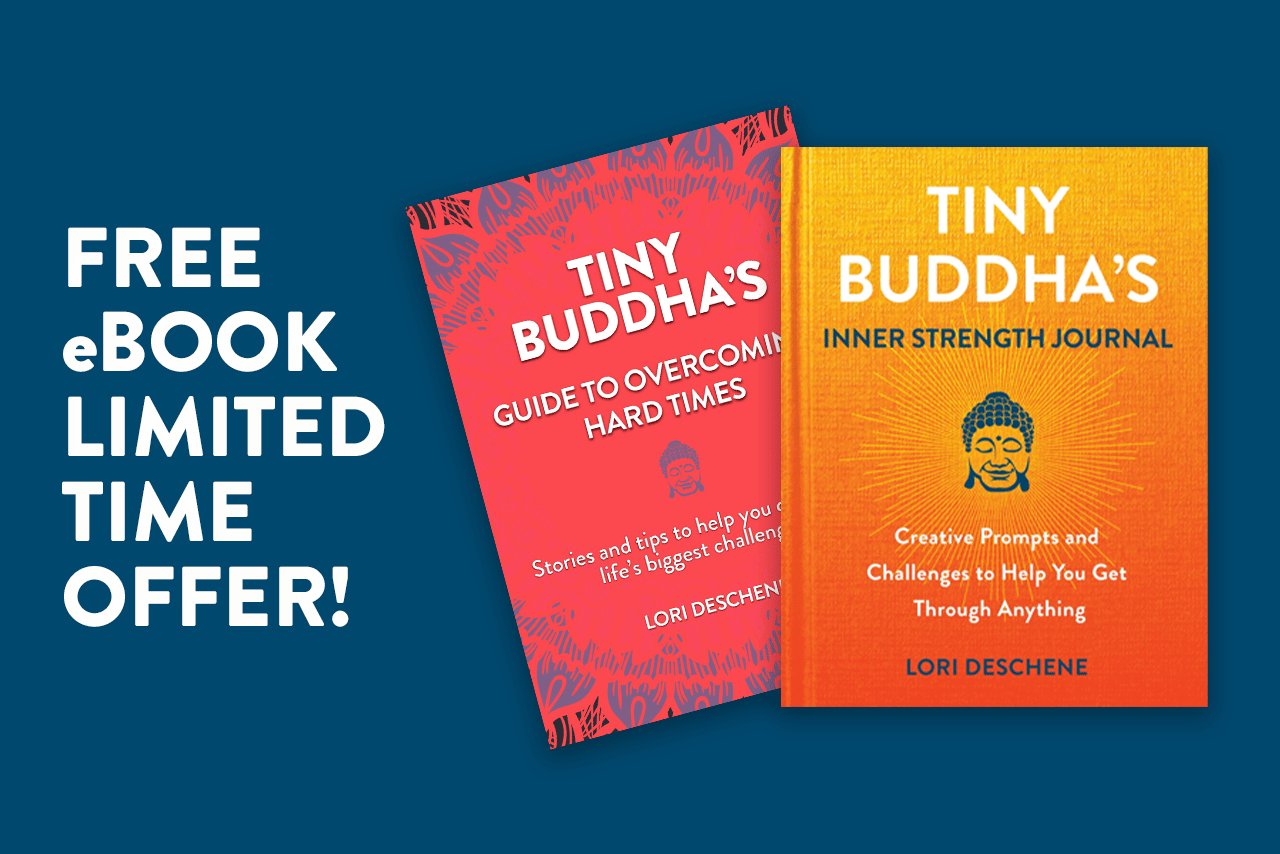
    That’s why I created Tiny Buddha’s Inner Strength Journal: Creative Prompts and Challenges to Help You Get Through Anything.

    I started working on this journal during the height of the pandemic, when I was exhausted from nights with a poor-sleeping toddler, drained from a high-risk, “geriatric” pregnancy, and overwhelmed by a new work project that ultimately failed in the end. And that’s not to mention all the Covid-related concerns and challenges we all had to face.

    I also knew from emails and comments that many of you were grappling with intense challenges and feelings of your own and struggling to get through each day.

    Since working things through on paper has always helped me feel less stressed, more confident, and more in control—all well-known benefits of journaling—I focused on prompts and questions that can help us access our personal power. Exercises that can help us protect our energy, manage our emotions, and take good care of ourselves so we feel our best—and feel prepared for the worst.

    I also put together a companion eBook—a free gift when you pre-order, for a limited time only—with forty of the site’s most helpful posts on overcoming hard times.

    The process of creating this journal was deeply healing to me, as I did each exercise as I went, and I have a feeling it can help you too. This isn’t a book of answers; it’s a framework to help you create your own personal roadmap to resilience so you can not only get through anything but also get the most out of life.

    As a mother to two young children, I’ve often wished I could prevent them from struggling. I’ve spent hours thinking about how I can insulate them from pain and ensure they never hurt as I have.

    But I realized a while back that if I protected them from pain, I’d also prevent them from gaining the wisdom and growth that accompany it. They’d live a flat, one-dimensional life, without the pride and confidence that come from doing hard things; and they’d never feel the sense of purpose we often find when we overcome something that once felt insurmountable and feel a burning need to help others do the same.

    What I really want for my sons, and for anyone I love—including myself—is the strength to handle life’s greatest challenges and the capacity to recycle their pain into something beautiful. Something meaningful. Something that makes all the darkness in life feel like a pathway to the light.

    I believe we all have that strength inside us, even if sometimes it all feels too hard. Even if sometimes we need to shut down for a while. We just need to learn how to access it.

    Whether you’re hurting, healing, or somewhere in between, I believe Tiny Buddha’s Inner Strength Journal can help you do just that. Click here to pre-order and get instant access to Tiny Buddha’s Guide to Overcoming Hard Times: Stories and Tips to Help You Cope with Life’s Biggest Challenges.

  • The Benefits of Solitude and How to Get the Most from Your Alone Time

    The Benefits of Solitude and How to Get the Most from Your Alone Time

    “Understand that healing and growing can distance you from people who you once had a bond with, and it can also bring you closer to those who will heal and grow with you. The time in between can be difficult, but there is so much to learn in solitude.” ~ @themoontarot

    There have been many occasions in my life where I’ve felt lonely. Some of these times I remember as incredibly painful; other times, I’ve relished in my solitude.

    During some periods, I’ve even forced myself into seclusion, which comes easily to me as an introvert.

    One thing all of these solo experiences have taught me is that it’s okay to be alone. In fact, with solitude, there’s a lot of self-growth to be had.

    In today’s day and age, we’re expected to be social creatures. With the rise of instant messaging and social media, it’s easy (and addicting) to stay connected all the time.

    This doesn’t mean it’s healthy, though. In fact, I’ve come to realize that solitude can be incredibly rewarding in a vast number of ways.

    The Benefits of Solitude

    Many nights of solitude have brought me epiphany moments. Ones where I have figured out what I actually want to do with my life. Ones where I’ve realized my spiritual path, and ones that have fueled new, exciting creative ideas.

    Many authors, artists, musicians, and philosophers have attributed their best work to time spent in solitude. As Aldous Huxley once said, “The more powerful and original a mind, the more it will incline towards the religion of solitude.”

    We need time alone because…

    1. We can gain a deeper sense of self-knowledge when we are alone and can see what is important for us as well as what we need.
    2. We are better able to acknowledge our feelings and deep desires when nothing external, such as other people’s thoughts, perceptions, or expectations, stands in our way.
    3. We get space to quietly reflect and reassess, asking ourselves the questions that truly matter.
    4. We recuperate and recharge (especially necessary for introverts) when alone, which allows us to be more present with others when socializing.
    5. We can tap into our intuition and learn to trust ourselves and our decision-making.

    By no means am I encouraging isolation. It’s not healthy to spend all our time alone.

    However, I do want to challenge those feelings of discomfort that often arise when thinking of solitude.

    Why Are So Many People Fearful of Solitude?

    There’s no denying that for some, the idea of spending a day alone, without interaction, isn’t appealing whatsoever. Why is this?

    Being busy, out and about with others, is a good distraction technique. When we’re surrounded by people, engaged in activity, we don’t face to face ourselves or our feelings.

    Are you the type of person who has to be on the phone with others when walking to the store? Or, perhaps you feel a strong sense of disconnection after a few hours of no in-person interaction. Either way, you’re not alone.

    Many people fear solitude because it’s unfamiliar. We don’t know what will happen when we finally face ourselves and are left alone with our thoughts and feelings, so we avoid it. But when we avoid being alone, we miss out on all the growth, healing, and creative inspiration that solitude can facilitate.

    So, how do we move away from a place of fear when thinking about solitude to embracing its possibilities?

    My Own Experience of Solitude

    As a child, I was often content spending time alone drawing, writing, reading, and exploring the great outdoors.

    During my school years I leaned into spending time with others, growing neglectful of my time with myself. The pressures of friendship groups, being sociable, and even ‘normal’ all took over my love for being alone.

    By the time I’d graduated from university and stepped into the working world, I was so accustomed to spending time surrounded by people, I barely knew who I was anymore.

    Coupled with confusion surrounding my career, a few failed relationships, and trauma from my childhood, I found myself in my mid-twenties reaching a pit of despair.

    Following a messy breakup after a toxic relationship, living back at my parents’ house with no money, no job, and no self-love, I was forced into solitude.

    I found myself alone in one of the darkest periods of my life, and it led to what I believed at the time to be an inescapable depression.

    Each morning I’d wake up and lock myself away in my parents’ spare bedroom. I had few friends in town since I’d previously moved away to London, and I didn’t reach out to those I was still connected with because I was afraid they’d judge me.

    It was just me and my cat spending hours alone in a small, dark bedroom. I cried a lot and I continually isolated myself. I hated the feeling of being alone, but in hindsight I needed solitude.

    I was about to discover something magical—my inner strength and an infinite love of the universe.

    What Solitude Brought into My Life

    My story of the most profound period of solitude in my life isn’t a necessarily pleasant one, but I now recognize it as a turning point in my life.

    When my depression hit rock bottom and I was feeling suicidal, I was overwhelmed with this inner strength that seemed to come from nowhere. It urged me to listen to what solitude was trying to teach me and helped me reconnect with my true self.

    I had a new determination to pull myself out of my current state of despair and step into new territory. Unbeknown to me, I was about to enhance my spiritual journey and discover peace.

    It was during a meditation session one night that I felt a warmth and deep love within me. I knew that there was a way out of my sadness, that being alone had the potential to teach me more than any book could.

    In the days following my realization and connection with a power I still can’t describe to this day, I gained the courage to step outside the house.

    I started noticing things around me on my solo walks like the vividness of nature’s colors, the soothing sounds of the river, and the tangible beauty everywhere around me.

    I also noticed for the first time that everything is connected. All that is in the universe, is the universe itself.

    How to Embrace Solitude

    Even if you live with family, a partner, or roommates, there is always an opportunity to implement some intentional alone time.

    For the most experienced spiritual folk, silence and solitude go hand in hand. However, for the sake of accustoming yourself to the intentional practice of solitude, you can start with the basics.

    Here are three practices that can heighten your alone time:

    1. Meditation

    Meditating in solitude can be an extraordinary experience. It enhances your ability to be present as you focus on just being.

    Sitting in silence and stillness can also decrease your stress, boost your mental health, increase your self-awareness, help you foster self-acceptance, and deepen your self-compassion.

    For me, meditation has been an ongoing practice, though not always consistent, that has brought about a deeper connection with myself and the universe.

    2. Journaling

    Daily writing is a wonderful practice to enhance your solitude. Writing leads to self-awareness and personal insight and facilitates creativity because inspiration often arises during quiet moments of reflection.

    Writing allows you to listen to the quiet voice inside your head, and it encourages you to ask yourself questions about what you truly want.

    Journaling continues to be one of the biggest tools I use in my moments of solitude. I gain creative insights and feel attuned to my emotions thanks to penning my journal each day.

    3. Connect with nature

    Taking a meditative walk in nature is soothing for the soul and a guaranteed way to perk up our mood.

    It may also lead to a greater sense of spiritual connection as you consider the larger, powerful natural force behind everything within the universe.

    A lot of my inner happiness is dependent on the time I spend outdoors alone. I find I’m at my most peaceful when walking in the woods or by the sea.

    However you choose to practice solitude, I encourage you to do the following.

    1. Get rid of distractions

    When you choose to spend time alone, really commit to your solitude. It’s tempting to grab your phone and mindlessly scroll social media or watch a YouTube video, but be disciplined and keep distractions at bay.

    Your time in solitude won’t be valuable if you’re just distracting yourself. Instead, lean into spending time on your own and what the space can teach you.

    2. Make it a priority.

    Everyone has the time to dedicate to themselves. Even if it feels uncomfortable, or you feel strange rejecting a social invitation, don’t make excuses to avoid being with yourself.

    The more comfortable you get with spending time alone doing things you love and reconnecting with yourself, the more connected you’ll feel to others. Self-love comes from solitude and with this love, you can give more to those you want to share it with.

    I Challenge You to Spend Time Alone Intentionally

    It probably won’t feel great the first time, and you’re likely to look for a way out of it, but spending time alone is one of the greatest gifts you can give yourself.

    There is so much self-growth to be had when you spend time nourishing the relationship you have with yourself.

    I’m sending you the warmest wishes and all the good vibes as you embark upon spending (and loving) your time in solitude.
  • Making Big Decisions: How to Discern the Whispers of Your Soul

    Making Big Decisions: How to Discern the Whispers of Your Soul

    “Intuition is the whisper of the soul.” ~Jiddu Krishnamurti

    “I can’t believe they are taking her side over mine. I gave this job so many years, and she decides to walk in and mess it all up for me,” I said to my husband.

    A few years back, when I was working full time at my corporate job, I got into a disagreement with a team member. It spiraled out of control to the point where my boss then had to have a sit-down with us. I was so humiliated and angry that he could not see my side.

    They will realize when they lose you, whispered my ego.

    That was when I decided to leave. I started to look for new jobs and got offers.

    Now here is the thing—I did have a great job, I had a great team, no long hours, and I liked what I did. But at that moment, due to that disagreement, I made a decision to leave it all from a place of anger.

    Tony Robbins often says It is in your moments of decisions that your destiny is shaped. I wish I knew this back then. I took the new job, but the moment I accepted the offer, I realized the colossal mistake I had made. I remember going to my farewell party and feeling like I might throw up. I remember trying to hide my tears.

    Your intuition often speaks to you through your body, and my body was clearly saying no. Unfortunately, the voice of my ego was stronger. It was too late to turn back. That wrong decision cost me two years of my life that I could have used toward my personal goals and business.

    Instead, I was stuck at the wrong job, working long hours, in misery, and hating every minute of it.

    There are many times when we feel the need to react, and the need to feel validated. The untrained mind often reacts the way I did, from fear and from anger. This is where the process of discernment comes in—discernment between whether you are making a decision to sate your ego or to truly evolve and expand yourself.

    The primitive, reactionary mind is not the best for making decisions because we are in a downward spiral and are tackling multiple negative thoughts in our heads. Nothing good can come out of this space—we are neither neutral nor can we listen to our intuition.

    In the grand scheme of things, when we ignore our intuition, we introduce complexities to our path. The reality is that in order to get to the next level, we must get out of victim mode and learn to take
    responsibility for our actions. There is always a choice in any decision that you make. That choice is between fear and love, between blame-shifting and personal responsibility.

    The easiest way to listen to your intuition is to ask yourself if you are making the decision out of fear or out of love. While this experience was unfortunate, it also taught me a very important life lesson. I rarely make big decisions in my life without “consulting” with my inner guidance or when I am not in the right headspace.

    The tool that I use for this is meditation. Over years, I have learned to use the art of meditation to hear the whispers of my soul. Anytime I get into a conflict or my life spirals out of control, I turn to my
    meditation pillow.

    Before I get into the meditation, I ask myself: Why is this happening to me? What is the lesson that I need to learn from this? Help me see the way. I am willing to do what it takes to feel and do better.

    And then I go into silence and complete surrender, without expectations that any insights or solutions will come through. The answer usually comes quite unexpectedly when the world around me is reduced to a silent hum. It is usually not the answer I was hoping for, but the answer I need at that moment.

    I often get asked what to do if the answer does not come. This just means that you are not detached enough and that you are still expecting an answer to come. This is fear itself.

    “Why is the answer not coming?”

    “Am I not doing this right?”

    “Maybe my intuition is broken?”

    Intuition comes when you are in a place of faith rather than fear.

    If this happens, try working out or watching or movie, anything that helps you not think about your problem. Then go back into meditation again with zero expectations, and you will be surprised at how soon the answer comes to you.

    It will be a quiet whisper, an inner knowing. It will happen in complete silence or when you are thinking about something completely different.

    It is akin to that little whisper that tells you that it may be a good idea to take the umbrella before you leave the house. But then you choose to ignore that whisper, and you later wish you hadn’t because it
    rained so much.

    One of the biggest benefits of meditation aside from intuition is that it helps you silence your mind. This helps you take bigger and bolder actions because there is no silent critic in your head judging and second-guessing your every move. Meditation helps you become more mindful and present. What others say or do does not affect your as much.

    Over time, you start experiencing the “observer effect,” where you feel as if you are directly experiencing life as a series of moments rather than evaluating and analyzing it.

    If you cannot meditate, journaling can help with this process too. Put on trance music in the background and free write. The trick to journaling is to let your pen flow without thinking.  You will notice that twenty to thirty minutes into it, your handwriting will start changing and your words will start looking different. The message will become more loving and compassionate. This is when you know that you are tapping into your intuition.

    Intuition is a powerful gift, but one that you can experience and learn how to recognize only in silence.

  • Why We Often Fail When We Set Big Goals and What Actually Works

    Why We Often Fail When We Set Big Goals and What Actually Works

    “You do not rise to the level of your goals, you fall to the level of your systems.” ~James Clear

    If you pull up any popular motivational video today, you’ll probably hear things like “Set big goals!” and “Aim high and don’t stop until you get there!”

    After watching a video like this, you may get inspired and start mapping out your plan to leave the 99% in the dust.

    And typically, because you’re riding a wave of motivation, you’ll write out these monstrous, Mount-Everest-like goals. These goals paint a picture of your life that is so exciting that you can’t wait to wake up and get to work the next morning. But when you roll out of bed and take a look at the goals you set the day before, reality hits you like a truck.

    Instead of being motivated to take action, you feel a massive wall of internal resistance. You want to take action. You know you need to take action. But for some reason you just can’t force yourself to muster up the discipline necessary to make progress.

    So instead, you choose the path of least resistance. You retreat to the comfortable and the familiar, and then decide that you’re going to wait “just one more day.” One day turns into two, two days turn into weeks, and weeks turn into months.

    But luckily, time heals all wounds, and six months later you get another surge of motivation and try it all over again. This is where most people find themselves in life—stuck on the self-improvement hamster wheel.

    How do you stop this vicious cycle? What’s the best way to facilitate lifestyle changes that you actually stick to?

    How Big Goals Ruined My Life

    When I was a sophomore in high school, I had ambitions to become an NBA basketball player. Despite the fact that I was 5 feet 6 inches tall, had below average quickness, and could barely jump over a stack of books, I was determined to prove everyone wrong.

    At this point, I didn’t have my driver’s license yet, so my wonderful mother would get up at 4:30 a.m. and drive me to my school gym early enough to get up shots before class. To make a long story short, I was cut from the team a few months into my sophomore year, and my NBA aspirations died right then and there.

    When I was a freshman in college, my focus had shifted to day trading the stock market. Once again, I had complete confidence that I was going to turn day trading into a full-time income. And once again, I was wrong. The $1,000 I had deposited into my Robinhood account disappeared in about two months, leaving me with no financial flexibility to invest into my dream of becoming a full-time day trader.

    During my sophomore year of college, I made the biggest decision I had ever made in my life up to that point. Despite having good grades, I decided to drop out of school and start my own marketing agency. Let me tell you, that phone call with my parents is undoubtedly the most emotional conversation I’ve ever had in my life.

    I even distinctly remember my own cousin telling me, “I think that you’re going to regret this decision for the rest of your life.” Still, I was unbothered, because I knew in my heart that I needed to give this a shot. A month after telling my parents I wanted to drop out of school, I was on a flight back home to California.

    Yet again, I found myself in a familiar spot—just a kid following his heart with some colossal goals.

    Filled with passion and drive, I set myself a goal to build the agency to $50,000/month in revenue by the following year. To reach that goal, I committed to at least two hours per day of prospecting, and another two hours of educating myself on the real estate marketing industry.

    By now, I think you can see where this is going. For fifteen months, I worked at trying to achieve my goals, but the highest monthly revenue target I was able to achieve was a measly $6,000/month. Despite desperately wanting to taste wealth and success, I had failed yet again.

    It was at this point in my life where I really took a step back and engaged in deep reflection. After all, I had just been following the wisdom that successful people had been preaching for decades—set big goals and don’t stop working until you accomplish them.

    Was it me that was a failure or was it my system? Why is it that so many people including me continually set big goals that they never accomplish? Pondering these questions drove me to explore the world of self-development.

    The Power of Identity

    I had always been passionate about self-improvement, but I had never really delved into the science and research behind what actually facilitates true behavior change. My research eventually led me to reach two life-changing conclusions:

    • Setting big goals does more harm than good for people who want to change their lives.
    • True behavior change occurs when you commit to small, seemingly insignificant shifts in your daily behavior.

    After spending hundreds of hours combing through research on habits, behavior change, and neuroscience, I finally had the “aha” moment that shifted my entire perspective on life. The fatal problem with setting big goals is that they focus on the outcomes we want to achieve as opposed to the type of person we want to become.

    The most powerful force in the human body is the desire to be consistent with who we’ve been in the past. Behavior that is incongruent with the self will not last, which is why big goals are often so hard to accomplish.

    You may have a goal to build a million-dollar business, but if your identity is that of someone who procrastinates on important work, it’s unlikely you’re ever going to hit that goal. You may have a goal to lose weight, but if your identity is consistent with someone who eats fast food regularly and lives a sedentary lifestyle, you’ll continue to be pulled toward actions that sabotage your weight-loss goals.

    You may have some new goals, but you still haven’t changed who you are. I wanted to build a marketing agency even though I was the type of person who procrastinated and refused to get out of my comfort zone. It was the inability to change those underlying beliefs that ultimately led to my failure.

    How to Achieve Your Biggest Goals by Thinking Small

    If big goals aren’t the answer, then what is? The key is to focus on who you want to be as opposed to the outcomes you want to achieve. You need to become the type of person who can reach the standards you have set for yourself.

    Your identity emerges out of your daily habits. You don’t come out of the womb with a preset identity. Whoever you are right now is a direct result of the daily habits that you’ve developed up to this point.

    In order to start forming new beliefs about yourself, you need to start building new habits. The formula for changing your identity is a simple two-step process:

    • Figure out the type of person that you want to become
    • Commit to small changes that align with your ideal self

    First off, you have to decide what kind of person you want to be. When setting goals, most people are guided by the question “What do I want to achieve?” Instead, try asking yourself, “Who is the type of person that can get the kind of outcomes I want?”

    Instead of setting a goal to lose fifty pounds, ask yourself, “Who is the type of person that can lose fifty pounds?” Instead of setting a goal to build a million-dollar business, ask yourself, “Who is the type of person that can build a million-dollar business?”

    The beauty of focusing on identity change is that your success is no longer tied to arbitrary targets. Let’s say that you set a goal to lose fifty pounds in six months. As you pursue this goal, you start walking every day and improve your diet. At the end of six months, you step on the scale and you’ve lost thirty-seven pounds.

    Did you achieve your goal? Nope, you’re thirteen pounds short. However, what if your goal was simply to become a healthy individual? Did you achieve that goal? Absolutely!

    Once you’ve figured out what kind of person you want to become, the next step is to commit to small shifts in your daily behavior. Too often we convince ourselves that massive success requires massive action. This is the principle that guided my life for nineteen years.

    Through constant trial and error, I’ve realized that true behavior change is the product of small, incremental changes compounded over time. We tend to dismiss the effectiveness of small actions because they don’t make an immediate impact.

    If you walk for two minutes per day for a week, you’re not going to see the number on the scale move much. If you meditate for sixty seconds for a few days in a row, you’re not going to turn into the Dalai Lama. However, what you will do is to give your brain concrete evidence that you’re a different person.

    James Clear puts this beautifully when he says, “Every action you take is a vote for the type of person you want to become. No single instance will transform your beliefs, but as the votes build up, so does evidence of your new identity.”

    Once you’ve nailed down your desired identity, come up with a daily habit that you can perform no matter how you feel. When you set big goals, your brain tricks you into thinking that the present level of motivation you feel will carry over to when it’s time to take action. By focusing on shrinking your daily targets, you’re taking motivation and willpower out of the equation.

    Here’s a few practical examples of this concept in action:

    • Meditating for ten minutes per day becomes meditating for sixty seconds per day
    • Walking for thirty minutes per day becomes walking for two minutes per day
    • Reading for thirty minutes per day becomes reading one page
    • Journaling for fifteen minutes every night becomes writing one sentence
    • Writing 1,000 words per day becomes writing fifty words per day

    It really doesn’t matter how successful you are right now, all that matters is that you’re on the right path. Once these small habits are solidified into your daily life, you’ll have mastered the art of showing up and acting in alignment with your desired identity.

    Since your brain now has some new evidence, you’ll be able to stretch yourself and gradually aim higher. That’s the true power of small habits. The same way that money multiplies through compound interest, the positive effects of your habits multiply as they become a part of who you are.

    So, the next time you get motivated to change your life, forget setting huge goals. If you do this, the power of your identity will loom large over you and prevent you from taking action. Harness the power of small, incremental change.

    Have the courage to set the bar low enough and aim at targets that you can actually hit on a daily basis. Solidify this small habit into your life, and then do the same thing with another habit. And then another. And then another.

    Soon enough, you’ll become someone unrecognizable.

  • 20 Journaling Prompts to Help You Love Yourself

    20 Journaling Prompts to Help You Love Yourself

    “Time spent in self-reflection is never wasted—it is an intimate date with yourself.” ~Paul TP Wong

    I’ve found journaling is a polarizing activity. People love it or hate it. (If you are in the latter group, don’t worry, you’ll still get a lot out of this!) Personally, I’ve hit both ends of the spectrum at different points in my life.

    I spent many years in a place of self-loathing. I truly believed I was just not blessed with being born a likable person. And this belief fueled decades of social anxiety, avoiding parties, coming up with lame excuses to leave early, and even being too anxious to call a customer service number to dispute a phone bill!

    I didn’t have the tools at the time to dig into what was really going on inside my head. Like a lot of people, even though I knew the benefits and evidence of journaling, I had plenty of reasons why I never did.

    I told myself I didn’t have the time, that I was too lazy, I was afraid of what I might uncover, and I just didn’t know where to start.

    I didn’t understand what journaling really was.

    Journaling is a self-awareness tool. It’s one of many tools you can use to uncover what you’re really thinking and feeling, or what you really want.

    But you don’t necessarily have to write down the answers. Just like to get healthier, you don’t have to go to the gym three times per week. Sure, it can help get you in shape faster, but you can also park farther away, take the stairs more often, or do a few squats waiting for the microwave to beep.

    There are different paths for different people.

    So don’t fret if you think you need to dedicate an hour a day to writing down your deepest, darkest thoughts and feelings.

    And if you want to do that, more power to you!!

    Why Journaling Helps

    Our swirls of strong emotions tend to consume us. They cloud our vision. They make us behave in ways not in tune with our values. And let’s face it, sometimes they just make us feel like crap.

    Our emotions are the physical and energetic manifestation of our thoughts. They are how we physically experience the thoughts in our heads.

    When the emotion is strong and so loud, it can be hard to hear what thoughts are really driving them. Journaling, especially with prompts, helps to clear through the strong emotions to dig up the stories we’re telling ourselves.

    It helps take all the busyness out of our brains and put them on paper so we don’t have to keep getting exhausted managing the swirl. (Fun fact, thinking literally takes energy and burns calories!)

    And very often, the thoughts that are causing us anxiety, stress, and depression, and leading us to be so hard on ourselves, are mulling around in our subconscious, just below the surface. When they are down there, there isn’t much we can do with them. We need to bring them to the surface in order to see them, question them, challenge them, or change them.

    What Held Me Back the Most from Journaling

    Honestly, the biggest reason I didn’t journal was because I didn’t feel like it. Writing felt like more work than I really wanted to put in.

    The times that I did sit down and write were truly powerful and cathartic. By doing some digging, I was able to uncover the beliefs I held about myself that kept me feeling small. When I put them on paper, looked them in the face, and saw in black and white some of the things I was thinking, sometimes I couldn’t help but laugh.

    But even still, the writing part turned me off most of the time. So I personally switched to doing “mental journaling” more often than not.

    A few weeks ago, a former coworker of mine posted something on Facebook that was similar to something I’d posted. Our former boss (whom I respect very much) “liked” her post and not mine. I went spiraling down a hole thinking “does he like her more than me?”

    By stopping and doing some mental journaling, I was able to realize that I thought I was less “worthy” than my coworker because he “liked” her post. Seriously, I laughed out loud.

    I proceeded to remind myself that my worth is not determined by a Facebook like. But I couldn’t have gotten there if I didn’t stop and do the work.

    If you don’t like writing, you can still gain so much from these prompts.

    That’s what I want you to take away from this: You don’t have to write pen to paper or fingers to keyboard to benefit.

    You can use these prompts to write, or you can use these prompts to think. Sure, you might get more out of it if you dump it all onto paper. But you don’t need to do it that way. Try just thinking about these prompts first if writing isn’t your bag.

    Maybe someday you’ll start writing, but it doesn’t have to be today if you don’t want it to be.

    Three Styles of Journaling Prompts to Help You Love Yourself

    #1 Lists:

    1. Three things you did right this week.

    2. Two flaws you can forgive yourself for.

    3. Five things you are good at.

    4. Three times I was courageous.

    5. Picture someone who you feel judged by and what you feel that person has judged about you. Then write down all the reasons that opinion of you is wrong.

    6. What are two things you need to let go of? (Then picture how you will feel when you let go.)

    7. What are five things your past self would love about your current self?

    #2 Open ended questions and prompts:

    8. Write yourself a permission slip to be imperfect.

    9. Write down something you think you failed at, and what you learned from it.

    10. Write down something your inner critic has said to you and ask, “What is the positive intent behind this?”

    11. What is one thing you want to stop doing, and what is one thing you can do to take a step in that direction?

    12. What is something you are procrastinating on, and how would you motivate yourself if you were a cheerleader?

    13. What is one way you’re being mean to or unfair to yourself, and what would you say to motivate and support yourself with kindness instead?

    14. What is a compliment you received and brushed off because you didn’t feel you deserved it? Now practice fully accepting and appreciating the compliment.

    #3 Fill in the blank “Even though” statements:

    15. Even though I feel ______, I choose to keep working toward feeling ______ by ______.

    16. Even though (person’s name) was ______ to me, I choose to love and accept myself and can show it in action by ______.

    17. Even though ______ seems hard or scary, I know I can do hard things. For example, I’ve ______.

    18. Even though I don’t like ______ about myself, I appreciate how I ______.

    19. Even though I have a hard time accepting ______, I choose to keep working toward acceptance by ______.

    20. Even though I didn’t do ______ perfectly, I choose to learn and grow from the experience. I’ve learned that ______.

    Self-inquiry can be challenging. But whether you put pen to paper, fingers to keyboard or spend some time deep in thought, the journey will bring you closer to the real you. It’s a journey to self-love which is so worth the ride.

  • Why Journaling is the Best Thing to Do During a Crisis

    Why Journaling is the Best Thing to Do During a Crisis

    EDITOR’S NOTE: You can find a number of helpful coronavirus resources and all related Tiny Buddha articles here.

    “The difference between despair and hope is just a different way of telling stories from the same set of facts.” ~Alain de Botton

    When I was told that the man I loved had a terminal illness, I instinctively reached for my journal. When I was asked to evacuate my home ahead of a category-5 cyclone three short weeks after his funeral, the first thing I threw into the back of my car was a large box with my journals.

    That was nearly a decade ago.

    Last month, when I stood in front of the empty shelves at my local supermarket, I was surprised to be instantly back in the grip of the fear and panic I felt during the crisis I had braved almost a decade ago. So I did the most logical thing. I took a deep breath, located the stationary aisle—which thankfully was still fully-stocked—and I bought myself a large new notebook.

    The next day, as the world prepared to go into lock-down, I missed the chance to return to my partner and my home in Vietnam.

    Depression and anxiety promptly came to visit, threatening to turn my self-isolation into another painful chapter of my life. But I know that I am more resilient than I think I am, and I instantly turned to my number one coping strategy. I opened my new notebook and started writing my Covid-19 journal.

    This is a challenging time for all of us, and we are all affected in different ways by this global pandemic. I don’t know how my partner and I will cope with the challenge of having to conduct our relationship across closed borders, via Zoom and Messenger, with no certainty when we might see each other again.

    But I know that writing will be there for me, as it has been during every crisis I have been through. Regular journaling has trained me to be my own therapist. Writing things down is an act of self-care. It’s like opening the door to my heart to see what’s in there and allowing myself to sit with all of it.

    Writing through the grief of my husband’s death and the aftermath of a natural disaster, I learned that we can cultivate resilience by allowing ourselves to experience our feelings, both good and bad.

    As I learned the hard way, writing builds resilience because it allows us to process, release, and make meaning of challenging events and complex emotions.

    Writing things down during a crisis is not only helpful as a way of processing and releasing our emotions—it is also a way to document what is happening as it unfolds.

    This strange and unprecedented moment in time sometimes feels like the world is collectively writing a new chapter. There is the official narrative, there is an abundance of alternative narratives floating around the internet, and then there are our personal narratives and the ways we as individuals cope with this crisis.

    Our memories will fade —though we’ll probably always remember that toilet paper was the first thing that ran out during a pandemic—but by keeping a diary and writing things down as they happen, we create a record of this unique historical moment.

    Writing is also a way to enter the creative flow, which is a great antidote to feelings of stress and anxiety. When we become absorbed in the process of writing, we momentarily step out of the chaos and the grief around us and into a safe zone of calm and flow.

    For many of us, self-isolation brings loneliness. Writing can be a great companion in times of loneliness. My diary has always been my best friend during difficult times. Writing can also be a safe place to retreat to for those of us who are assailed by a sense of cabin fever as members of a household suddenly have to live in close proximity with each other 24/7.

    It’s easy for conflict and irritation to arise in confined living environments. I think of my diary as my sacred space where I can say things I don’t dare to say out loud, where I can vent, rage and reflect and most importantly, where I enter into a dialogue with myself.

    Here are some suggestions for starting your own Covid-19 journal:

    1. Write about how you feel right now.

    Allow yourself to give voice to feelings that you might be holding back for the sake of protecting others or because you feel ashamed.

    Write about what feels particularly hard about this crisis. Begin by brainstorming words that describe your emotional state right now. Think of it as making an inventory of the feelings in your heart. You might even find that you feel stronger and calmer than you thought you did.

    2. Write about a time when you overcame a crisis.

    Remembering a time when you were resilient and got through a difficult emotional turning point will help you to believe in your own strength.

    Bring to mind a significant difficult emotional experience. Make sure it’s something in the past that you can safely write about.

    Begin to write about the experience in the first person. Bring the experience alive by giving concrete sensory detail, i.e. what smells, sounds and tastes do you remember? Maybe you want to make reference to the weather or the color of the car you drove. Use word pictures to get back in touch with the feelings you had during that time.

    3. Write a diary.

    Writing a diary about the current pandemic can be as simple as writing about your day. You may write about the things you did and did not do, the people you interacted with, the things you ate, the words you read, the news you watched, the things you did to care for yourself or the ways you allowed the news to affect your anxiety levels…

    Write about anything you’d like to capture about this day. This could be a simple brain dump. Or you could focus on the quirky things that happened today. The things that only a month ago, you couldn’t have imagined doing right now – things like having virtual sundowner drinks or virtual cups of tea via Zoom with your best friends.

    If you’re writing first thing in the morning, you might write about your dreams, the quality of your sleep, or about the day before.

    Be sure to include sensory detail to bring your world alive, i.e. write about the flowers that are in bloom right now, the smells during your daily walk, the noises that you can hear through the thin walls of your apartment etc.

    You never know, your Covid-19 diary may become the foundation of a memoir or something to leave behind for the grandkids.

    4. Write to practice self-compassion.

    In times of crisis, when we experience suffering, fear, or anxiety, it is important to give our hearts shelter. Self-compassion can help us feel less vulnerable and disconnected during this time of self-isolation. It’s also a great way to silence the voice of the inner critic who will be quick to tell you that you are poor at home-schooling or that you are a bad partner.

    Think of self-compassion as being like a warm embrace. Or as expert Dr Kristin Neff says, like speaking to yourself with the same care and kindness you would use towards a good friend.

    Write for ten to fifteen minutes about what you need from yourself right now to feel less vulnerable, less cranky, less anxious… or whatever you may be feeling right now. Another great way to use writing as a self-compassion practice is to write a letter to yourself from the perspective of a good friend, assuring you that whatever happens you’re loved and cared for.

    5. Write a gratitude journal.

    Gratitude is a secret superpower that helps to build resilience and happiness. Too often we focus on what we lack—and right now we lack a lot of things that we used to take for granted only a short while ago. Gratitude is a way of looking at what is abundant and good in our lives, despite the current crisis.

    Writing a gratitude journal can be as simple as listing five things you are grateful for at the end of every day: your warm bed at night, access to drinking water, having a shelter etc.

    Try to be more specific than just saying “I am grateful for my bed.” Tell your diary why you are grateful for having a bed, why you are grateful for the job that sometimes overwhelms you, or the kids that drive you mad during this pandemic.

    A good way to get started with a daily writing practice is to do a short meditation to settle your mind and to get into stillness. Then set the timer on your phone for ten to fifteen minutes and simply write without stopping to think or edit, trusting the pen to lead the way.

    I’ve kept a journal from the age of eleven, which makes me a seasoned diarist, yet during the current global crisis I am often feeling unfocussed and unmotivated.

    I tell myself that that’s okay, it’s part of the process of adapting to our new normal. But I always try to capture my new normal, even if I only write a quick list of things that stood out for me on a given day. It’s a way to stay connected to my inner voice and to write this new chapter one page and one breath at a time.

  • How to Journal Away Your Disappointment in Yourself

    How to Journal Away Your Disappointment in Yourself

    “Forgive yourself for not knowing better at the time. Forgive yourself for giving away your power. Forgive yourself for past behaviors. Forgive yourself for the survival patterns and traits you picked up while enduring trauma. Forgive yourself for being who you needed to be.” ~Audrey Kitching

    “I can’t do this.”

    “Why do I look so fat? I’m disgusting!”

    “I haven’t done enough today. I am so useless.”

    “I shouldn’t have said that. I shouldn’t have said that. I shouldn’t have said that.

    “Oh my god, why did this happen to me? What am I going to do now?”

    Since I was a teenager, there has always been a voice inside my head telling me that things are not going to be okay because I am not enough.

    At school, it told me I wasn’t popular or cool enough. At Arts university, that my work wasn’t original or deep enough. At my first job (which I disliked), that I wasn’t happy enough. In my current work (which I love), that I am never productive enough. And as the cherry on top throughout all these years, guess what—I’ve never been thin enough, talkative enough, or proactive enough.

    This voice has become so present and loud that it has led to severe anxiety attacks.

    One day, the feeling of self-loathing and despair was so strong that my usual journaling affirmations and gratitude practice were not enough. My soul, wounded by all the negative self-talk, needed something stronger. More than being fixed, it needed to be held in a tight, comforting hug.

    So that’s what I did: I knew that journaling was still the way, I just had to find a way to hug myself with it.

    Without thinking, I started writing to myself what a wise mother or a loving mentor would tell me in this situation.

    “My dear, I know you are feeling anxious about not having completed all your tasks for today. I know it makes you doubt if you will ever be able to achieve your goals. I know it makes you fear that you will end up out of money, out of friends, out of love. But here’s the truth: it doesn’t matter that you had a bad day. I know you’re trying hard. I know you’re giving your best. You deserve a rest. You are amazing, and you’re going to make it.”

    The effects were immediate: like with nothing else I had ever tried before, I felt a deep sense of comfort and relief.

    I had just discovered my new soul-medicine.

    How This Exercise Works

    The reason why so many of us constantly push ourselves to be more and do more (and blame ourselves when we fail) is because we’re trying to get from others the approval we have never learned how to give ourselves.

    This exercise teaches us to do just that: to give ourselves the appreciation we crave so much.

    But there’s one more reason why it is so powerful: it’s because it’s written in the second person.

    We are used to valuing more the compliments we hear from others than the ones we give ourselves. Therefore, it’s like having your adult self give your inner child the love and validation it has always wanted and needed, and that’s why it’s so healing.

    On top of that, writing it on paper instead of just thinking it in your head keeps your mind focused, and your heart fully immersed in the process. And it’s also quite relaxing!

    How To Do This Exercise

    1. Whenever your negative self-talk or your anxiety kicks in, grab your journal and a pen.

    2. Observe the thoughts and feelings that are happening right now. Don’t look away. Dive in.

    3. Now, imagine that the person thinking those thoughts and feeling those feelings is your inner child. Try to feel compassion and empathy towards their pain.

    4. Then, ask yourself: “Who is someone I look up to and what words would I like to hear from them in this situation?” This can be a higher power, a parent, a teacher, or whoever gives you comfort and guidance.

    5. Now, try to put yourself in that person/entity’s shoes, and start writing those words to yourself—to your inner child. Here are some examples:

    “I can see that you feel lost. You don’t know where to go next, and you doubt that you will ever know. But you will. I can assure you that you will. And when you know it, you can pursue it. You’ve made it so far, haven’t you? You have more in you than you think you do. You are kind to others, you are taking care of yourself the best way you can, you are doing everything at your reach. You always have. Just keep holding on, my love. This, too, shall pass.”

    “It’s okay to feel angry. Your anger is valid. I love you no matter what. You know what? You can scream. Scream, my beautiful creature. You are stunning when you scream. You are full of power, raw energy, and the time will come to use it well. You are simply taking your time. It doesn’t matter that things didn’t go well this time; but they will, when they have to. You are doing great.”

    As you write it down, let the words flow freely. Get fully immersed in the exercise. It might be helpful to imagine that you are hugging your inner child, and definitely focus on giving love, nurturing, caring.

    At points, the words you’re writing might feel like huge clichés, but it doesn’t matter: all that matters is that you feel them—that’s how you know it’s working.

    All You Need Is Love

    It’s easy to get trapped in a negativity loop: you feel bad because you failed to meet your own expectations; then you feel anxious because you’re feeling bad, and so afraid to get trapped into a negativity spiral that you don’t even notice you’re already in it.

    You can’t fight negativity with negativity. To break the loop, you need love.

    You have been hard enough on yourself. Give yourself the words and love you have been longing to hear. Do it from a different perspective—I guarantee, this will rock your world.

  • How Journaling Helped Me Heal from Grief and How It Can Help You Too

    How Journaling Helped Me Heal from Grief and How It Can Help You Too

    “No one ever told me that grief felt so like fear.” ~C.S. Lewis, A Grief Observed

    The day I was told that the man I loved was going to die from cancer, I did two things: I made a pact with myself never to have more than one bottle of wine in the house. I knew the risks of numbing pain and I knew that it didn’t work. Then I went to a stationery shop and bought a supply of fine moleskin journals.

    My journey through grief started the day the pea-sized lump behind my husband’s ear was given a name. Metastatic melanoma. Over the course of two years it spread to his lungs, then his brain. A brain tumor the size of a golf ball is what killed him.

    Four weeks after his death, a tightly sealed plastic box containing a dozen diaries was the first thing I grabbed when I had to evacuate my home ahead of a monster cyclone. Seven years after those events, the plastic container, which by now contains several dozen moleskins, is still the first thing I’ll grab at the next cyclone warning.

    Why? Because those journals were my lifesaver at a time when no therapist could help me. Grieving is a very long and lonely journey, and those journals were my most intimate, trusted friends during the most difficult time in my life.

    Grief comes in many forms. Divorce, being made redundant, a stillborn child, the list is long. We all have access to the world’s oldest and cheapest self-help tool.

    Here is how it helped me.

    1. Your journal is your best friend during the lonely process of grief.

    Grief turned me into a depressed mess, which made me feel like an outsider. It’s a common experience. As anybody who has been there will know, one of the most surprising things about grief is how alone it makes you feel. Only those who have grieved will be able to understand what you are going through.

    Your friends and loved ones will offer as much comfort as they can give, but they’ve got their own lives to live and nobody wants to hear your sad story over and over again.

    Writing provided comfort and relief at a time when nothing else did. I lived remotely and didn’t have access to a therapist. My journal became my lifesaver and my best friend. It was the only place where I could speak my truth and where I could safely express all of my emotions.

    My journal was always there for me to listen to the same story, over and over again, without judgment, until I was finally ready to let it go.

    2. Journaling allowed me to tell the story nobody wanted to hear.

    We live in a culture that is averse to grief. In the absence of proper grief rituals, people struggle for words and end up offering platitudes that diminish your grief. Before my bereavement, I too was ignorant about what to say to a grieving person.

    How many times did well-meaning friends, lost for words, offer meaningless platitudes? “He’ll be okay,” some would say, when it was clear that he was never going to be okay again.

    “You’ll be okay,” was just as hurtful. Of course I would be okay. I hadn’t died, even if it felt like part of me had. But I needed people to acknowledge my grief, not diminish it. Writing was a way of giving voice to the story nobody wanted to hear.

    I needed to say the things that I couldn’t say, that even the doctors wouldn’t say, as we desperately clung to hope.

    It was only in the pages of my journal that I could safely and without judgment write this messy story in the raw voice of pain. It helped me understand it and slowly craft a new narrative.

    I knew instinctively that my writing would lead me there, not my well-meaning friends who assumed to know what the appropriate timeframe for grief might be.

    3. Writing allowed me to hold on to memories.

    Journaling was also an effective way to hold on to the memory of him. I recorded the story as it was unfolding. The way he reacted to radiation treatment. The words he said when the word palliative care entered our conversation. The way he looked before and after each operation. The words he whispered into my ear, holding on to my hand as his strength faded during his last days.

    4. Journaling helped me find redemption after loss.

    For several years after my bereavement, the story I told about myself focused on the events that had burnt my life down. It was what defined me at that moment and I didn’t want it taken away from me.

    Writing about my pain allowed me to eventually gain a new perspective. Reading over my words, I became a detached witness of my story and I was able to see how my story is related to the universal narrative pattern of what Joseph Campbell calls “the hero’s journey.”

    Today I am able to tell my story as a narrative of redemption. I stumbled into the dark woods of grief and I came out of it transformed, stronger, and more aware of the preciousness of life. It’s a story I share with those who accept grief as an opportunity for deep transformation.

    5. Journal writing gave me the courage to venture into creative writing, which was healing in unexpected ways.

    Two years after my husband’s death, for my fiftieth birthday, I gave myself the gift of a year-long online creative writing course. I’d planned to write up my story as a memoir. But revisiting my pain in the pages of my journals felt like peeling the scab off a wound. It was still too raw.

    Writing creative fiction on the other hand, turned out to be incredibly liberating. I no longer had to write the story of how my life had exploded. I was free to write anything I wanted. I could create characters with red hair and freckles, I could make them Olympic swimmers or war correspondents. But deep down, the emotions I wrote into my characters were my own.

    By sorting the core of my personal grief story into a narrative arch, I could see how personal growth results from conflict and suffering. I could see how this is fundamental to the character’s journey and I could finally see redemption and envision a new ending for my story.

    I don’t know how I would have coped without my writing, it’s what guided me through my pain and showed me the way forward.

    Here are five suggestions on how to use journal writing during times of grief:

    1. Have your journal always with you.

    I found it incredibly comforting to have my journal always by my side. Sadness catches up with you in the back of a taxi or in the hospital waiting room. Being able to scribble in my journal provided relief.

    2. Do a brain and pain dump.

    On most days I’d do a simple brain and pain dump. I’d free write without editing or worrying about grammar for as long as it took to feel better. I found it helpful to record what was happening in detail and to name my emotions and reactions.

    By writing everything down, I felt like I was sharing my pain. It was liberating, even if it didn’t make the pain go away. It allowed me to see patterns in my thinking and to focus on the positive.

    3. Write a gratitude list.

    A gratitude list is a powerful way to focus on what is positive during a time when it seems that you will never find happiness again. By listing the things I was grateful for, I was able to momentarily reverse the feeling of overwhelming negativity.

    There was the bad test result, sure, but there was also the friend who brought a casserole around. It was always surprising and refreshing to acknowledge the things that made me feel grateful. It put my pain into perspective.

    4. Do timed writing exercises.

    If you are not naturally inclined to writing, you might find it useful to make journaling part of a routine and to set a timer. Timed writing exercises are surprisingly effective. Start small. Ten minutes of free writing every morning is a good start.

    5. Use writing prompts,

    Journal therapists will often use writing prompts. I personally feel too restricted by prompts, since my writing will naturally lead me towards the story that needs to be told. But when I am stuck, I find it helpful to pause and write “How I really feel is …” or “What I really want to say is …”.

    I also found great relief in writing unsent letters to my husband, both during his illness and after his death.

    Here are some writing prompts for you to try:

    I remember when …

    The first time we …

    My happiest memory of you is …

    What was good about today is …

    What I treasure is this …

    Today my grief feels like …

    Back when I went through my grief, I didn’t know that expressive writing and journal therapy are recognized modalities for healing, widely used by psychologists and therapists, especially with trauma victims.

    I’ve always used reflective and personal writing as a way to make sense of the world and my place in it. Faced with my husband’s progressive illness, I’d instinctively reached for my journal to process what was happening. By naming the emotions I felt, I could make sense of what seemed ungraspable and find healing.

    Journal writing really is the cheapest form of self-care there is. I hope you’ll try it, using some of the suggestions above. Or maybe you already have a journal writing practice and have your own favorite prompts. Feel free to share in the comments.

  • 5 Ways Journaling Can Help You Get Through the Hard Stuff

    5 Ways Journaling Can Help You Get Through the Hard Stuff

    “In the journal I do not just express myself more openly than I could to any person; I create myself. The journal is a vehicle for my sense of selfhood. It represents me as emotionally and spiritually independent. Therefore (alas) it does not simply record my actual, daily life but rather—in many cases—offers an alternative to it.” ~Susan Sontag

    My first journal was born into existence when I was twelve. I remember carefully choosing my favorite comics, pictures from magazines, and the odd scribble I’d drawn. Tongue stuck out in concentration, gluing them strategically on an unused exercise book. Wrangling with the clear sticky contact mum used to cover my schoolbooks, I encased the precious creation in it, preserving it forevermore: Nicole’s Diary.

    Needless to say it’s an extremely embarrassing collection of teenage angst, weird bits and pieces like lists of potential names for a child I didn’t and still don’t want; pages of dialogue between myself and other people with in-depth analysis of these conversations beyond anything reasonable; and daydreaming about the life I wished I had or complaining about the life I did have.

    Whenever I happen upon this old journal, It takes strength not to throw it away, just in case some invisible person were ever to discover it and think this was actually me.

    The journals since then have gone through phases. Phases where I wrote every day, or just once every few months. Where I was obsessed with recording quotes or where I collected everything from movie tickets to foreign sweet wrappers. There are endless lists, ways to improve myself, deep sadness, furious anger, joyful enthusiasm, unbridled hope, and ponderings on love during many a loving or loveless encounter.

    Historically journaling has been extremely popular, and if you think about the mountains of YouTubers and bloggers, it still is.

    They used to be more of a private affair, but consider the way we write when we really let the pen go. We’ve derived important pieces of the past from people’s journals. Are they genuine portraits of the time, or just endless, worrisome chatter from a mind trying to figure stuff out?

    These days it’s popular to have a gratitude journal, and I can see why—the idea being to cultivate gratitude as part of our being, and not give so much weight to the negative and the worrying. Remembering what we are grateful for is supposed to give us perspective on the hard stuff.

    But I don’t know. Writing about the hard stuff is actually what helps me get through it. It’s what makes journaling so incredibly powerful.

    Here are five reasons why:

    1. Journaling is the act of processing the past (and sometimes the future) in the here and now.

    For many of us, talking and writing isn’t about performance or the telling of something—it’s actually the processing. Getting it outside of yourself can give it a new shape.

    It’s like opening the clothes dryer mid-cycle. You interrupt the cyclic thinking and the jumble of ideas fall out, allowing each one to be tossed around and thought about on it’s own. The amount of times solutions have begun to appear while I was actually writing is astounding.

    2. Writing is and of itself cathartic.

    Try this: Set the timer on your phone for ten minutes, grab a pen, and write about your day until the alarm goes. Give yourself permission to burn it if you find yourself getting held back by the worries of who is going to read it (or delete it if you typed).

    Even if nothing at all has happened, you will most certainly have thoughts in your head that are dying to get out. Offloading conscious and subconscious stuff helps the mind become clearer and you calmer.

    3. Feelings and experiences become less overwhelming.

    A while ago I wrote a blog post about my partner’s beautiful little old dog being killed in a car accident. When I was writing the piece, I found myself crying almost the whole time.

    As I described the accident, moved onto what she meant to him, as I remembered my own times with her, it became an incredibly meaningful process. I spent some time looking for photos and wanted to honor her and the humans she had touched in her life.

    Writing about the grief helped me immensely. It slowed it down as well as enriched her life. I stopped simply wanting to escape the awful feeling and instead was able to wade through it and just feel. Even if no one read it, I felt like I’d created a full-bodied process—a eulogy—that honored her and helped me hold her light after she’d passed.

    4. Reading back helps reveal patterns.

    Sure, it can be frustrating to look back at a journal from three years ago and see that you are writing about the same thing in the same ways again, but that can also be empowering. It’s a researcher’s dream: go back and investigate and then spend some time reflecting on what keeps you stuck if you notice patterns.

    Similarly, you can celebrate any little (or big) changes you have made. “Wow, I used to worry about what people thought of me so much… it seems now I’m more concerned with what I think of myself and if I’m being a good person. What does that tell me about my journey so far? What do I want to take with me moving forward?”

    5. You can use creative journaling to change your story.

    We tend to tell our stories in the same way over and over, emphasizing the same points in the same ways, and even adding to a narrative by noticing everything that fits in with the story and ignoring everything that doesn’t.

    If that narrative is overwhelmingly negative (e.g.: I’m a people pleaser; I’m a doormat; I’m hopeless; I’m a victim; I’m unlovable; I’m always anxious; I can’t do anything about this; Only jerks like me etc.) then it can lead to a full-on negative identity conclusion based on one pretty shaky theme.

    Try injecting some freshness into a tired story. Journal prompts easily found via Google can help you do that, inviting you to answer questions you wouldn’t normally think of in the context of any given experience.

    Writing requires you to dig a little deeper into stories, where you may find that the ‘full’ conclusion isn’t based on much: you’ve dated a few jerks and have decided that you only ever attract terrible people. But if you are prompted to consider all the facts, there was a decent person who you just weren’t attracted to, so is there a more truthful nuanced conclusion to be considered in this narrative?

    What becomes available when you widen your perspective?

    I can think of a bunch more reasons why journaling deserves a comeback, but I hope these five have injected some enthusiasm in you as a great starting ground. Just last month I began my own personal project of writing almost daily again, as well as launching a little Facebook group to discuss journal prompts.

    Sharing some of your writing has an added benefit of being seen—becoming visible in the ways you want and feel safe to. To acknowledge your struggles as well as find humor in them, and be able to see beauty in who you are no matter what, is more than worthy of the little effort it takes to pick up a pen (or use a voice machine) and pour ourselves onto the page.

  • Letting Go of the Guilt That Keeps You Chained to the Past

    Letting Go of the Guilt That Keeps You Chained to the Past

    “Letting go gives us freedom, and freedom is the only condition for happiness. If, in our heart, we still cling to anything—anger, guilt, or possessions—we cannot be free.”  ~Thich Nhat Hanh

    One night after my nine-year-old son had just gone to bed, he asked me if I would lay with him, as he was scared. I was getting ready for a busy week and was tired, so I replied, “No, you’re fine. Go to sleep.”

    When he died the following afternoon after being hit by a car, I remembered what he’d asked me. The guilt that followed me from that day on was overwhelming.

    Guilt is an emotion that we have all experienced. It can come in many forms, from simply cheating on a diet or from making a dreadful choice that affects our lives forever.

    The guilt I felt after my son died burdened me for several years. Every anniversary, I would go over and over what I hadn’t done during those last few days before his death.

    I would remember every conversation, every request. The guilt beat me up, it made me replay my mistakes, and it wasted enormous amounts of my energy, re-enacting how I could have done something differently. It made me feel bad even when I didn’t feel bad!

    I think one of the reasons it was so hard to give up and let go of my guilt was because I felt the need to punish myself after his death for all the things I hadn’t done in his life.

    I would pretend that if I had made different choices, I could have changed that day.

    People would remind me of all the things I had done for my son and the wonderful life and love he was given, but it wasn’t enough for me. I constantly questioned why I hadn’t done more.

    After a few years, I realized that guilt was consuming me and in order for me to move on, I needed to find a way to let go and forgive myself.

    I was weighed down because I was living a life consumed by the past. Guilt did not allow me to be fully present with my family, or to see all the good that I had in my life then and now.

    I had to face that I was never going to change the past, but I could change the way I remembered my precious time with my son. Once I did, I could free myself from being the victim of my story.

    Guilt was a pointless burden on top of my grief. I needed to accept the decisions that I had made and let go.

    With guidance from a reiki practitioner, I learned how to become still, empty my mind of my negative thoughts, and finally give myself permission to stop carrying this burden.

    Here are some of the ways I learned to let go of my guilt and forgive myself. If you’re also clinging to guilt and living in the past, these may help you, too.

    Stillness

    In our busy world it can be difficult to find time for stillness, and sometimes it’s easier to avoid it, since it can bring up painful emotions. But it’s only in facing the emotions that we can work through them and let them go.

    Through practicing meditation and yoga, I found that breathing deeply and slowly helped me release the stress in my body and mind.

    It allowed me observe, accept, and release my guilt, and it also helped me focus and create new, positive beliefs and thoughts.

    Over time, stillness can help us learn to identify the beliefs and thoughts that lead to guilt so we can let them go to feel lighter and less attached to stories about the past.

    Journaling

    Not long after our son died, I began to write in a journal. It really helped me to express my feelings and understand why I felt how I did.

    Start by writing down your overwhelming thoughts and feelings. Allow yourself to express everything. Be still and take time to read it back.

    Now ask yourself some questions, like: Do I need to hold onto to these thoughts and feelings anymore? How would changing these thoughts or feelings make a difference in my life? How is guilt holding me back?

    Answer honestly and begin to see where you can change the thoughts and beliefs you have about your situation.

    Then start writing down some new goals, affirmations, and thoughts you can have instead, and make time each day to practice them. Our journals can help us release, learn, and keep track of our progress and our goals for the future.

    Visualization/Forgiveness

    Sitting in a calm, quiet place, visualize the person you feel guilty about and ask them for forgiveness. Now, see them forgiving you, see yourself and the other person covered in light, and see yourself no longer burdened by your guilt.

    For a long time I didn’t believe I deserved forgiveness, and you may feel the same.

    Forgiveness means letting go and releasing the heaviness and the old story we have told ourselves. Forgiveness allows us see the truth and release the past.

    It’s hard to forgive yourself and accept that you deserve it, but holding onto your guilt only creates pain. Seek help from a trained practitioner if you feel you cannot do it on your own.

    Time and practice will always be your healer, so be patient and never give up.

    Realize that no one is perfect—and also that our guilt often has more to do with ourselves than those who we feel we have harmed. Guilt is often a self-created reminder of all the things we wish we had done differently for ourselves.

    In realizing that it’s in large part about us, it’s a lot easier to let it go.

    I no longer allow guilt to have power in my life, and in doing so, I can experience the fullness of life and the precious time I have with everyone I love. No matter what you feel guilty about, you deserve that too.

  • 10 Journaling Tips to Help You Heal, Grow and Thrive

    10 Journaling Tips to Help You Heal, Grow and Thrive

    “The more light you allow within you, the brighter the world you live in will be.” ~Shakti Gawain

    Keeping a journal has many positive benefits. Journaling can help with personal growth and development. By regularly recording your thoughts you will gain insight into your behaviors and moods.

    Journaling can be used for problem-solving and stress reduction. It’s been proven to improve mental and physical health. It can lead to increased self-esteem.

    Dr. John Grohol, CEO of Psych Central, estimates that one in three people suffer from a mental illness.  Anxiety disorders, mood disorders and substance abuse can be treated with a combination of medication and counseling.

    In addition, writing in a journal is an effective tool for use in the healing process.

    I started keeping a diary at age 8. As I grew up, I wrote the normal kinds of teen angst entries but eventually I turned journaling into a more sophisticated practice. In my 20’s I read all of Anais Nin’s Diaries.

    I studied Ira Progoff’s At a Journal Workshop and implemented his methods—an elaborate design for generating the energy for change. Using his methods I was able to sort through turbulent emotions during the divorce from my first husband and discover hidden lessons from the experience.

    To this day I continue to use some of his techniques as well as others I’ve learned. Recently I’ve discovered a new creative world in art journaling. Using mixed media has helped me express myself in refreshing and unusual ways.

    There is a lot of power in the written word but occasionally words are hard to find. By drawing or making a collage I have been able to create a representation of how I feel that moves beyond my analytical writing.

    Writing has helped me to process not only failed relationships but also to recover from grief and loss. 

    Reading back through my journals has helped me reflect on where I used to be and where I am now in my life. It’s a method of allowing the light of understanding and compassion to shine on my past.

    In The Artist’s Way Julia Cameron suggests writing three handwritten pages or 750 words every morning.  At first there is a lot of “dumping” but eventually little jewels of wisdom and direction emerge.  I found myself creatively energized when I participated with a group for 12 weeks using her book as a guide.

    If you want to improve your perspective on life and clarify issues, start writing in a journal. 

    You can’t know where you’re going if you don’t know where you are. Be sure your journal will remain private or write online so that you are writing for your eyes only.

    Here are 10 tips to get started: (more…)

  • Writing Your Way to What You Want

    Writing Your Way to What You Want

    Writing

    “All the arts we practice are apprenticeship. The big art is our life.” ~M. C. Richards

    There is an art to living, to creating your life on your terms based on your desires, talents, values, and dreams. In a culture where we must attend thirteen years of school, we’re rarely taught to look within and name what it is we want from life.

    We’re rarely taught that we have the power within to live the lives we want, not what other people expect of us.

    While we can’t control what happens to us, we can control how we respond to what happens based on what we want.

    Five years ago I resigned from teaching in the public schools after giving birth to my son. A year and a half later, awaiting the birth of my daughter, I struggled. I missed teaching. I missed connecting with kids in a classroom.

    I missed having something in my life that was my own. While I felt blessed and lucky to be home, I also wanted to teach. But I didn’t know how to join these two desires that felt mutually exclusive.

    Having written in a journal throughout my twenties and into my thirties, I understood the power of pinning down thoughts into words. So within the swell of this profound transformation into motherhood, I began to write about the things I knew I wanted: (more…)