Tag: iphone

  • What Happened When I Went Off the Social Media Grid

    What Happened When I Went Off the Social Media Grid

    “Remember, being happy doesn’t mean you have it all. It simply means you’re thankful for all you have.” ~Unknown

    It was 3 a.m. when I realized I was the only person not in St. Barts. At least that’s what it felt like on Instagram, even though I know it wasn’t true. I wasn’t the only person not dancing on tables to a saxophone in the Caribbean. My fiancé was asleep right next to me.

    For the next three hours, I continued down the rabbit hole.

    Three hostages were released. Trump did more things to avoid bringing up at dinner parties, even in Texas, where I found myself living by accepting a marriage proposal from a Houstonian after a lifetime spent proudly between New York and L.A.

    I was served (and purchased!) an acrylic purse organizer for my closet that makes them stand just so, as if the algorithm had been privy to my frustration when they all fell limp sideways just yesterday. Some friends were pregnant. Even more got skinny—Ozempic. Shockingly, aside from procreators, on Instagram, no one ever gets fat. Which was how I was feeling then, now that I think about it. The fetal position is unbecoming for a midsection.

    By 6 a.m., my eyes were bloodshot from the screen’s glow, and I official felt like the heaviest, least pregnant, most geopolitically confused loser, not in St Barts, with a messy closet—who lived in Texas.

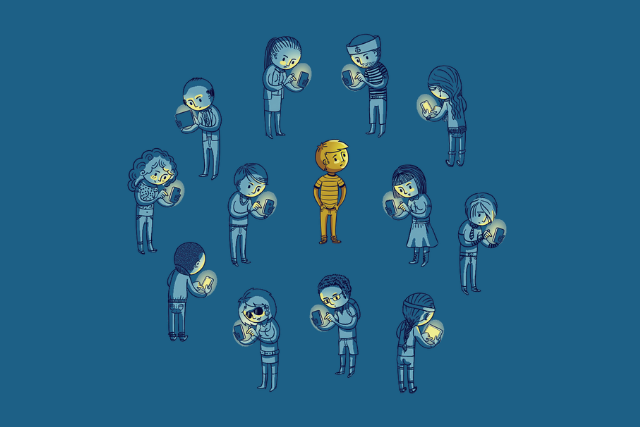
    It went on like this for weeks. Really only since I got to the Lone Star State and became a lone star with no friends, in a place I had considered visiting only if there were engine trouble. Devoid of an actual social life in a new city, I had begun to live vicariously through my old friends by staying in touch with them on Instagram. I’d never been more ‘connected’ or felt more isolated and alone. Still, I scrolled. And if I didn’t stop, I would never again get to sleep.

    I was going cold turkey. Wasser: 1. Zuckerberg: 0.

    When the time came, even my phone was skeptical. “Delete Instagram?” came the pop-up. I knew what I had to do. And so, with a swift ‘click-hold-delete,’ the Instagram app icon shimmied out of existence on my home screen. The joke was on me, though; getting back to bed was not in the cards. I couldn’t wait for my friends to wake up—on both coasts—so I could gloat.

    “Just FYI—if I don’t get back to you on Insta, … I’ve deleted it from my phone,” I’d say with a cool, casual air of someone who’s escaped the matrix of social media, like I was better, completely leaving out the part where I’d become an addicted insomniac crackhead.

    My L.A. friends called me “brave.” My New York friends were nonplussed if not annoyed: “So what? I’m supposed to call you now?”

    While not exactly a Nobel laureate reception, here’s what happened when I had nowhere to hide and forced myself to live IRL. My sleep got better. Packages from China stopped coming as I stopped spending frivolously on clothing that couldn’t make it through a wash. But these were obvious upsides.

    My screen time went down 42%, which, according to the Mayo Clinic, can improve your physical health, derail obesity, and boost your mood. Then, I did the math. By removing Instagram from my phone, I had taken back nearly two weeks of my life—every year.

    I was markedly happier… With my dog and the way she takes over my pillow now that I wasn’t exhausted in the morning. With my fiancé, who is much more fun to be around now that we’re both paying more attention to phone-zombie behavior (mostly when I remind him). Even Texas isn’t that bad.

    When I started looking up versus down at my screen, life in the present got prettier (even with Houston’s lack of zoning laws that puts fine dining establishments next to an AutoZone.)

    And then it hit me. The hardest part of growing up is coming to terms with who you are and, moreover, all of the versions of yourself you’ll never be. As an older millennial, I have had social media tracking my life since I was eighteen. I am now thirty-seven. I have been so many people.

    I’ve had multiple attempts at careers until I found one. I have had dreams I’ve let go of. Dreams that haven’t died. Loves I’ve lost. Men who still looked at my story even though I never wanted to speak to them again. They still bring me right back to being nineteen/twenty-two/twenty-seven every time I see their name.

    Social media connects all my ‘eras.’ Every success, failure, false start, and hair color that comes with adulthood and the people, places, and things that accompanied them. All my past timelines living amongst my present, right in my pocket. No wonder I found it so hard to let any of them go. And even less shocking, I couldn’t make new friends. My dance card—albeit virtual—was full.

    Within weeks without Instagram, I found myself with time on my hands. I was exercising more. The dog and I found walks we like in the neighborhood. I went out and actively looked for community outside my phone screen. It existed. Turns out the adage is true—you are where you put your attention.

    By making eye contact and staying present when out at restaurants, or getting coffee, or at the gym, I’d even made friends. New friends I hosted for dinner. A dinner so large I had to rent a table because there were more coming than my six-person dining table could seat. A table I did have to source online, but not on Instagram—an app I only regretted not having when I wanted to give my friends at home major FOMO and show them what I was up to.

  • The Simple Changes That Reduced My Phone-Induced Anxiety

    The Simple Changes That Reduced My Phone-Induced Anxiety

    “Simple living doesn’t solve all my problems, it just removes distractions.” ~Melissa Camara Wilkins

    At times it’s felt like my phone was my only access to the outside world. A place to connect in the middle of the night. The means to stay in touch with friends and family on the other side of the globe. It was a lifeline.

    Until it wasn’t.

    Improved sleep, reduced stress, and a mindful relationship with technology—they were high on my wellness “should have achieved by now” list.

    I’m not sure which was bothering me more, the actual stress of not having a mindful relationship with technology or the fact that I had not been able to achieve a mindful relationship with my smartphone.

    It was a cycle in my mind I just couldn’t stop. And I was struggling. All the tips and current trends to “digital detox” were not making my life easier. In fact, they were making it much harder.

    Being unable to successfully follow advice for my health made me feel like a failure, especially as it was connected to my mental health. Did that mean I didn’t care about my well-being? Was I a fraud?

    My phone was disrupting my sleep and worsening my anxiety. But all it took was one small change to break my bad habits and create a new, more mindful relationship with technology.

    Where It All Began

    Growing up I was a self-proclaimed night owl. As a child and young adult, I stayed up late reading. In university I would study late into the night.

    As I got older, falling asleep was always a struggle. I decided I was a night person and would use that time to get ahead of my to-do list for the next day. I figured the more I got done the night before, the easier the next day would be.

    When my first child was born, I was introduced to the late-night social media scroll. I was up feeding the baby in the middle of the night, trying not to fall asleep in my chair. And it turned out there was something that would keep me awake and entertained, but not disrupt my son: the blue screen of my phone. I knew it wasn’t ideal, but the thing is, it worked.

    Even after the late-night feedings ended, the screen still kept me awake. I would go to bed with the intention of reading a downloaded book or an article on my phone. It was so convenient to have all in one place!

    But inevitably a notification would distract me. An email. Or an update on social media. A message from my parents.

    To this day I’m a bit ashamed to admit I was guilty of not turning off my work email notifications, even though I was on maternity leave!

    What’s funny in hindsight is that at the time, those notifications annoyed me. It bothered me that I was still getting work emails. But I didn’t turn them off.

    I wondered who would send me a message in the middle of the night. I would check, knowing it was likely from someone in a different time zone, not expecting me to check my messages until the morning. But I looked anyway.

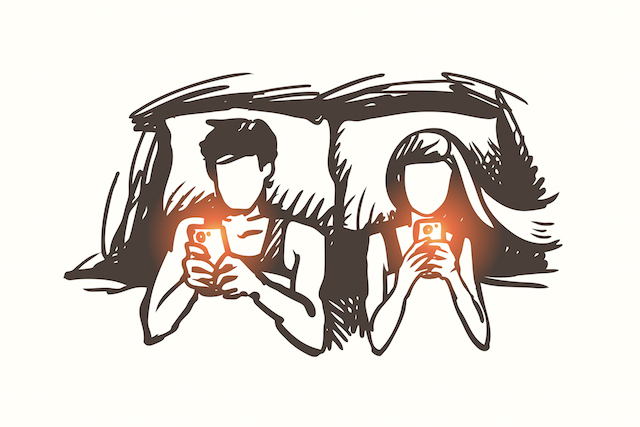
    I found myself often unable to sleep. Remembering the advice I’d received to “get up and do something different” if sleep didn’t come, I figured I’d found a solution: I could take a break from trying to sleep without leaving my bed, by using the endless options available on my phone. Located conveniently next to my bed, charging.

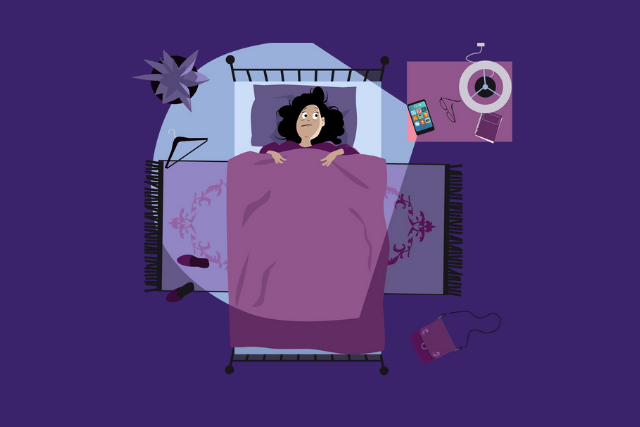
    And there I would be, hours later. Still awake, exhausted, and unable to fall asleep.

    I Needed to Make a Change

    I knew I needed to make a change. The demands of working and having young children were starting to make an impact on my health. I was tired, and not getting the sleep I needed.

    I decided that if my phone was keeping me up, and I was pretty sure it was, then I’d remove it from my room. That’s what the influencers and thought leaders were recommending! Or so it appeared as I researched the topic on my phone, late at night, in bed!

    The irony is not lost on me.

    My Mistake Was Following Influencer Advice

    On the very first night I failed. My son woke up, and I scrambled to find what time it was, but my phone wasn’t next to my bed. I crashed into several things trying to get to his room in the dark because my flashlight was an app on my phone. While this was happening, my son woke up my daughter.

    Insert several curse words that my children probably didn’t need to hear.

    By the time I got them both back to sleep, I was very much awake, alert, and a bit annoyed. Mostly at myself. What was I thinking? Why was I trying to follow this ridiculous Internet advice?

    And then I turned on myself.

    Why couldn’t I follow this ridiculous Internet advice? If it was working for everyone else, why couldn’t I do it? Was I just generally failing at adulting?

    Heading back to bed, the annoyance shifted into worry.

    Would I wake up with my phone alarm in the other room? What if I didn’t wake up to get everyone where they needed to go on time in the morning? Would I hear my alarm from the other room? Wait, the alarm won’t work, the phone’s off!

    Logically, I knew I was being a bit silly. I would get used to having my phone in another room.

    But I was tired. And time poor. And so frustrated. I wanted simplicity, and this was making my life more complicated.

    Why Did I Have So Much Resistance?

    Reading this, you might be thinking, “You could have just…” And yes, you’re right. I could have done several things differently. I could have made it work, having my phone overnight in another room.

    But here’s the thing: For changes to stick, I needed to start by making my situation easier, not harder. Sustainable change was what I was looking for.

    So, the first step couldn’t be too big or too hard. I was making the common mistake of trying to jump from one extreme to another. If I’m already tired, and my goal is to be less tired, then the first step has got to help with that.

    If the barriers are too many, if it’s just too hard, then there will be too much resistance. Then I’m probably not going to stick to it.

    There was a second reason I was not comfortable with having my phone off and in another room at night: We don’t have a landline, which is pretty common here in Australia. My family lives overseas. I want them to be able to reach me. At crazy hours if necessary.

    A solution that involves them not being able to do so will not help me sleep. Not at all.

    At the same time, I agree with the arguments for having digital devices out of the bedroom. And I did feel the phone was impacting my ability to fall and stay asleep. Was there an alternative?

    Sometimes being “best practice” doesn’t mean it’s going to fit into every person’s lifestyle. Nor should it. A healthy lifestyle is about finding the right fit and sticking to it.

    I needed to find an alternative. And I did.

    Focus on the Desired Outcome, Not the Popular Steps to Get There

    Instead of focusing on the rule, or the advice, I decided I needed to be realistic. Forget what the influencers were saying!

    What really was my problem? It wasn’t about the phone. What was I trying to achieve? Less stress and more energy, which meant I needed better sleep. And fewer distractions and interference from digital devices. Including my phone.

    Keeping that in mind, the rules didn’t matter as much. Rules that put me into a success v. failure mindset.

    Focusing on the outcome, or the goal, I didn’t have to engage with rules. Like where specifically the phone needed to be. Instead, I could address the changes I needed to get me where I wanted to be.

    To get there, I needed to change my habits and how I interacted with my phone at night. To get better sleep.

    Once I started thinking about it that way, everything became a lot simpler.

    The Change That Worked Was the One I Could Commit To

    Instead of turning off my phone or putting it in another room, I did something else. I turned it back into a phone, every night. A phone with no Internet access! And a blue light filter set to a timer, which now comes built into many mobile devices.

    Every night at 8:00pm, regardless of where I was or what I was doing, my screen changed to night mode to lessen the blue light interference.

    I considered putting my phone into flight mode. And if this is a possibility for others, I highly recommend it. Flight mode allows access to many frequently used features.

    But it does create the potential issue of completely barring communication. That didn’t work for me, so I made an adjustment. Instead of flight mode, I turned off the WiFi and data instead. A two-click solution.

    And it worked.

    For me, I find the best solutions when I’m realistic about where I’m at. If the barriers are too great, even if they’re perceived barriers, change probably isn’t going to happen. And even if it does, it’s probably not going to stick.

    What can I do instead? Focus on the goal. Create a series of low barrier changes guiding toward that goal. For me, this is the answer to sustainable lifestyle changes.

    The First Step Improved My Sleep, the Second Was for My Mental Health

    Every morning I wait an hour from when I wake up before I reconnect my digital devices. I don’t turn back on WiFi or data for at least an hour. Every morning.

    When I implemented my original habit I found that some days, I forgot to turn the data and WiFi back on. Those mornings were wonderful! I was more present with my children, and I was significantly less stressed about what I had on my to-do list.

    And when I did reconnect, it was my choice. The notifications started rolling in, and it didn’t bother me. Emails didn’t get me feeling overwhelmed. I stopped falling victim to “compareitis” while scrolling social media. My phone stopped impacting my mood.

    At first, I didn’t understand the connection.

    But on the days when I woke up and immediately reconnected, it was the opposite. I was inundated with notifications. And, I usually checked them. It was overwhelming, and I was only barely awake. It made me stressed before I even got out of bed, and it set the tone for my entire day.

    It was hard for me to accept, but my mood was influenced by notifications and what I saw social media. This bothered me because I felt like I should be better than that. As if just by knowing that it could be a negative influence, I should have been able to rise above it.

    Why Does My Morning Habit Matter?

    First thing in the morning I’m a lot less resilient. I’m more likely to react emotionally to what I see, hear, and read. And my early morning choices can set my mindset and mood for the rest of the day.

    So basically, my mood was being set by whatever popped up first on my social media feed. Or whatever was at the top of my inbox. By doing turning to technology immediately, I was handing control of my mood over to my phone.

    By delaying my digital start to the day, I found I was more mindful. And completely in control—of what I did first, what I saw, and how I reacted. I had taken control back of my mindset and how I would approach the day. I stopped allowing my mood to be dictated by whatever happened to pop up first on my mobile phone.

    The Lesson I Learned Was Simple but Powerful

    There are three key actions that help me be more mindful of my relationship with my phone and digital technology.

    My reality is that I don’t want to simply discard my smartphone. It makes my life simpler and allows me to spend more time doing things that matter. But only if I keep my relationship with it balanced in a way that suits me and my lifestyle.

    While I might not always be able to do them all, these are still my goals. In addition to improving my sleep, this strategy had improved my mood and mindset.

    My Top Three Tips for a More Mindful Relationship with Your Phone

    1. Disconnect your phone from the Internet at night, using flight mode or turning off the WiFi and data.
    2. Keep your phone disconnected from the Internet for at least an hour in the morning.
    3. Disconnect periodically during the day when you want to be present and mindfully engaged in an activity.

    The biggest thing I learned is to worry less about the tools and rules, and more about what works for me. The best changes are the ones you can stick to because they’re the only ones that will become habits. Once something becomes a habit, it doesn’t require much thought to keep doing it. There are many different paths to reach the same outcome. Find yours and follow it.
  • The Invisible Effects of Social Media: When It’s Time to Stop Scrolling

    The Invisible Effects of Social Media: When It’s Time to Stop Scrolling

    What you do today is important because you are exchanging a day of your life for it.” ~Unknown

    Is there a more precious commodity than time? It’s the currency of life; the most basic finite resource, and we have a responsibility to spend it wisely. It’s up to us each individually to figure out what that means to us. For me, that means being mindful of the people, activities, and thoughts to which I give my time and energy.

    I am an obsessive reader, and at any one time I have at least fifteen books checked out of the library. I tell myself that I won’t check out any more books until I’ve finished reading the ones I’ve already borrowed, but I never listen and I’m glad for it, because reading is one of the wisest and most enjoyable ways I can spend my time.

    I try to be cognizant of what grows my spirit and what shrinks it, and I aim to use my time accordingly.

    But this is hardly an easy task, especially with the constant lure of technology and smartphones. Unlike with books, the escape these devices offer can quickly lead me down a rabbit hole of anxiety where I feel my inspiration leaking away and self-doubt taking its place.

    Whether this is because I’m feeling guilty for wasting so much time, tired from staring at an electronic screen so long, or because I’m negatively comparing myself to other people, I know that my time can be put to better use.

    I often end these technology binges with a nagging sense of emptiness and, despite the vast array of connection offered by technology, a vague feeling of disconnection as well. I don’t want to scroll my day away, yet sometimes feel compelled to do it.

    We all have a basic need to belong, and social media’s popularity can be boiled down to its ability to tap into that need. However, it’s important to keep in mind that the complexities and imperfections of real life are often glossed over or edited out entirely. To compare your real life to someone else’s crafted digital persona is unfair and unrealistic, and it sets you up for disappointment.

    Social media can also taunt us by bombarding us with the adventures of people better left in our past.

    I didn’t fully appreciate this hurtful effect until my social media usage worsened a recent experience of heartbreak. Like a bullet in the back, my screen suddenly and completely filled with him. And not just him, but his new girlfriend too.

    It wasn’t long before the photo left the confines of the screen and filled my room and my mind; my entire world became consumed with memories of when he held me that way and the accompanying feelings of sorrow, loss, anger, and jealousy.

    I thought strength meant I shouldn’t be affected by something as silly and trivial as Facebook or Instagram, but no matter how much I don’t want to be affected, the truth is that I am. And the effect social media can have on our feelings of self-worth is not trivial.

    Only when I accepted this did I begin to move toward easing the pain of heartbreak. The first step was using my time not for social media obsession, but for reflective writing and poetry, which are activities that provide me with real, sustainable healing.

    When I do use social media, I make sure my feed is filled with posts that I enjoy seeing and that help me grow rather than make me feel smaller. And I share posts that are an expression of my inner feelings or at least can make someone laugh.

    I have also made a commitment to be present with myself and my emotions, without judgment, instead of using social media to distract myself from my feelings. This mindful practice, though difficult, is worth the effort because it allows me to strengthen my ability to treat emotions as valid but fleeting, rather than being in resistance or letting them consume me.

    Heartbreak and pain are part of the human experience. It helps to remind myself that I am not alone and to reach out to loved ones—offline—and let myself be vulnerable enough to express what I’m going through. For me, too much social media actually dampens my sense of connection to others because I tend to retreat when I start believing my life is not as exciting or meaningful as other people’s.

    I’ve learned to limit the time I spend fueling insecurity with social media and to fill that time either with mindful scrolling or something else entirely. I keep in mind that this technology is the new terrain on the landscape of communications, and it can be a fantastic and fun tool if I navigate and utilize it responsibly.

    This article is most likely reaching you via a social media channel, and I’m thankful for the opportunity this provides for sharing work that elevates our awareness and consciousness. Because of social media, I’ve increased my exposure to websites and channels that facilitate personal growth, such as Tiny Buddha, but I’ve had to learn to become more mindful of when it’s okay to unwind online and when it’s harmful.

    Sometimes I need a break, and watching a video of cats that are afraid of cucumbers or hopping from one newsfeed to the next can be a good stress reliever. I also find that pausing occasionally during creative activities gives ideas the necessary time to simmer below the surface until they are ready to come to light, and social media can be a good way to give my mind a break.

    I know I need to stop scrolling when I feel a shift in my emotions; when the lighthearted fun of connecting virtually and the joy of sharing my creative work with people all over the world becomes a self-imposed prison of mindlessness. I don’t want to allow my precious time to tick away in a stream of posts and updates. When I feel this shift, I know it is best to turn off my device, take a few deep breaths, and turn my attention and time to something more enriching.

    I also realize now that it’s more beneficial to be present with my surroundings rather than tuning out into a digital world during every available moment. On walks, commutes, and at the dinner table I enjoy being fully present with the people and things around me, as well as my own sensations and feelings.

    These small moments of togetherness and solitude are fertile with opportunity for self-reflection, presence, and connection, but only if I resist the temptation to compulsively check my smartphone.

    The key here is to become aware of how often we reach for our phones so we can examine how we spend our time and whether we can put some of that time to better use.

    I’ve caught myself multiple times at the beginning of an unproductive scrolling session and made the intention to put my phone down after ten minutes so I don’t get too lost in a cycle of posts and updates. And on other days I could use a good cat vs. cucumber video, and that’s okay too; it’s all about balance and awareness.

    Social media can be a good thing when we use it responsibly. Whether we are scrolling, sipping a cup of tea, or having a conversation, cultivating mindful presence can only enrich our experiences. This, I believe, is how we can wisely utilize the small amount of time we are afforded.

    When I dip into moments of deep, full presence, the only response that springs forth is gratitude, and I can think of no better way to spend my time than in a state of appreciation.

  • New Tiny Buddha Shirts and iPhone Cases, Just in Time for the Holidays!

    New Tiny Buddha Shirts and iPhone Cases, Just in Time for the Holidays!

    Hi friends! I’m excited to share that I’ve recently launched a new selection of shirts and iPhone cases on Tiny Buddha, with five new designs—meaning nine in total—just in time for the holiday season!

    I’m also happy to share that the new store offers much better shipping times than I was able to offer in the past.

    The new designs are based on some of the most popular memes I’ve shared on social media. My personal favorite is the “Peace Love Music” one.

    Each design is available in multiple shirt styles: tee, v-neck, tank, sweatshirt, and hoodie, with a range of colors and sizes, including kids shirts. For simplicity, I’ve include just the tee style below:

    You can grab a shirt or iPhone case for yourself or someone you love, or one of the five Tiny Buddha books (including Tiny Buddha’s Gratitude Journal and Tiny Buddha’s Worry Journal) by clicking the button below. Happy holidays everyone!


    **Please note that this a busy time of year for shipping companies, and shipping times vary based on which option you choose. I recommend ordering before the 7th if you’re purchasing items for holiday gifts.

  • Why We All Need Time Unplugged

    Why We All Need Time Unplugged

    “Life is what happens while we’re busy worrying about everything we need to change or accomplish. Slow down, get mindful, and try to enjoy the moment. This moment is your life.” ~Lori Deschene

    Technology is everywhere today, integrated into our lives from the moment we wake up and check our email to the twenty minutes we spend checking our Twitter feed before falling asleep.

    From smartphones and tablets to Fitbits and multi-display work computers, it’s hard to use technology mindfully, and most of us spend a great deal of time throughout the day looking at screens.

    Choosing to unplug, disconnect, and put down our devices is a deliberate decision. For me, the decision to unplug came as I was preparing to set off for a year and a half of traveling around New Zealand.

    The Problem

    I had just left a job where I spent most of my day emailing, updating social media, and scouring the Internet for websites that would be useful contacts for my company. I would get home from the office and eat something while simultaneously scrolling through my personal Facebook, Instagram, Twitter, and email accounts. The barrage of information was endless. I would often end the day red-eyed and battling a headache.

    I realized I didn’t actually know how to relax and unplug, and I also realized I didn’t know what a huge toll the excessive screen time was taking on me until I stopped the flow. It took a few weeks, but slowly the constant need to check feeds and update statuses faded, and I spent a great deal more time actually, well, doing things in the world—without posting about it.

    Deciding to Unplug

    Since I was embarking on a new chapter in my life, it seemed like a good time to try something new and try to not let technology take over my life. I was afraid of missing out on the experiences I would have while traveling because I was too busy trying to take the perfect photo or craft the perfect post instead of just being there and enjoying the moment.

    I sold my smartphone, cancelled my cell phone service, deleted my social media accounts, and asked all my friends and family for their mailing addresses so I could send postcards and letters instead of emails and tweets. I went cold turkey and all-in.

    While resistant at first, most people close to me were supportive of this change in the long run, although I did get the occasional, “How will I ever contact you if you’re not on Facebook?!” I figured the people who mattered would find a way to stay in touch, Facebook or no Facebook.

    My partner and I decided that while traveling, we would share one iPad mini we’d use to post monthly blog posts about our travels, and all other devices would stay at home. No phones, no nothing.

    Technology’s Impact on Behavior

    The effects of technology on our thought patterns and behaviors aren’t great. The presence of technology seems to give us a free pass to be rude and unmindful in group situations (i.e. texting during dinner), or to flake out on our friends. It also changes the way we interact with others, including our children, when doing an activity together, like reading.

    “Electronic readers seem to change the types of conversations that parents and children have over a story,” according to KinderCare Learning Centers. “With e-readers, we adults tend to be more prescriptive when talking—push this, swipe that—and less conversational…”

    For all the talk about technology connecting people around the world, it certainly does its share of creating disconnection, too. I strongly believe we would all be happier if we spent more time face-to-face and less time face-to-screen.

    Together but Apart

    I recently moved into a new house, and it took a few weeks for my Internet to get hooked up. There was a very noticeable shift in my behavior and that of my roommates once we were online.

    Before the Internet, we all interacted with each other when we were in common spaces, playing games and talking about our days. With the Internet, we were more likely to be in our own rooms, procrastinating and wasting time.

    Of course we still interacted and still have frequent game nights together, but often the presence of a smartphone or laptop changes the entire vibe of an evening. I long for the days when we were unplugged and connecting more deeply.

    Physical Reasons to Unplug

    In addition to emotional and behavioral patterns, the physical costs of excessive screen time are great. Vision and eye problems like dry eye syndrome can be exacerbated by too much screen time, while headaches and back problems are common among people who sit in front of computers all day. Lack of exercise due to too much sitting in front of computers directly leads to obesity and other health issues.

    Somehow, these ailments don’t seem to stop us. We’d rather end up at rehab camps for tech addicts than set down our devices. Do we really want to be chained to the Internet and at the beck and call of each notification that lights up our smartphone?

    A Different Way

    It’s unrealistic to banish technology from our lives completely. But we can take steps to unplug from certain networks or devices, or to designate a no-tech period in the day that’s screen-free. For me, finding that balance is key.

    Once I returned home from my travels, I found myself wanting to connect to all the social media networks I had abandoned. I wanted to share travel photos and stories and see what friends had been doing while I was gone. I felt torn between this urge to scroll and post and the desire to stick to my commitment of trying to be a more mindful user of technology.

    So I made some compromises. I waited a year before getting back on Facebook (and have since found it significantly less interesting) and I use a flip phone (I know, I know—living in the Stone Age) instead of a smartphone. I know I have to make it easy for myself to not get sucked into the social media/internet vortex.

    One technique I also like to use is list-making. Have you ever gotten online to do one simple thing and then found yourself staring blankly at your computer an hour later, having no idea what you set out to do in the first place? I like to make a specific list of what I need to accomplish online and stick it in front of my laptop where I can see it. That way I’m reminded of my goal and purpose for opening my computer.

    Finding individual solutions is the key to success, whether you need to get outside and completely away from technology, or you simply need some productivity tools to keep you on task so you can be done with your work sooner. Either way, everyone can benefit from unplugging from time to time. Our health depends on it.

  • Look Around (Not at Your Phone) and Be Present in Your Life

    Look Around (Not at Your Phone) and Be Present in Your Life

    Friends on Cell Phones

    “Enjoy the little things because one day you may look back and realize they were the big things.” ~Robert Brault

    Ten years ago I moved from the urban metropolis of London, where I grew up and spent the early part of my adult life, to the rural Mediterranean idyll of the coast of the Costa Brava in Northern Spain, in my quest to find the ultimate “quality of life.”

    I was able to make this move largely because I could be digitally connected to the rest of the world from anywhere.

    For me, digital technology in its early form provided a whole new series of life choices.

    Although it was during the pre-smartphone and WiFi era, I was able to be digitally connected via an ADSL cable that magically appeared from a field and connected to my studio, enabling me to work from there, nestled on a remote hill top location, surrounded by languid hilltops and lingering forests, underscored by a sea that merged with the sky like a pair of faded jeans.

    Perfect live/work balance achieved, or so I thought.

    But that was before. That was before something that is five inches tall and a quarter inch thick transformed every aspect of the way we live. The smartphone.

    The advent of the smartphone changed my life, but not in the way that you might think. It actually took me away from life, because it took over my life.

    Suddenly I didn’t need to be in my studio on my laptop to be connected, or to get my emails or to send projects through to clients, as I could do that from anywhere. I was free, no longer desk or studio bound.

    I could access information wherever I was. It was a revelation and totally life changing. However, although it was an incredible, life-enhancing tool in many ways, I think I was slow to realize that having access to the world in the palm of my hand also means the world had access to me.

    As my euphoria at being able to be connected anywhere and at any time began to wear off, it was replaced by the debilitating dependence of needing to be connected anywhere and everywhere, at all times.

    The more I became digitally connected, ironically I began to feel more and more personally disconnected from my surroundings, as my virtual life was not giving me any real nourishment.

    It provided a lot of ‘noise’ but I could no longer find the inherent ‘melody’ and rhythm of my daily life.

    Given that I was living in the sort of surroundings that are viewed as the ultimate off grid environment (the sort of place actually where weekend digital detoxes take place), I realized that the problem could not only be viewed as relating to a purely urban demographic.

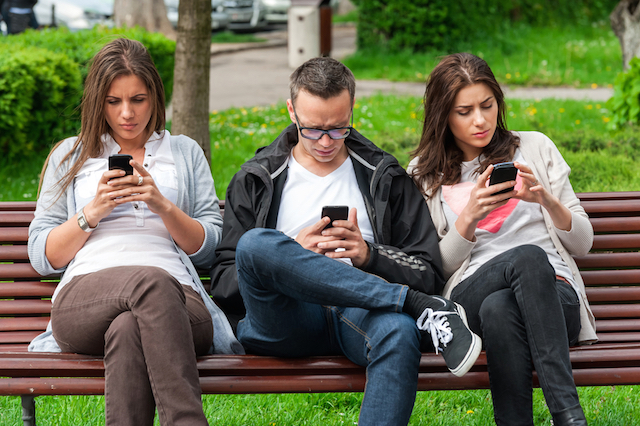
    I looked around me, at my friends and colleagues, and realized that we would get together for lunch on a beach or at someone’s house and we would all have our heads buried in our smartphones, oblivious to each other or the breathtaking beauty that surrounded us.

    It was a problem that was wide spread. I realized that what had at first been my life line had little by little started to strangle me.

    My digital dependence had become a habit filled with avoidance techniques, providing constant distraction to avoid being with myself. I found that, without realizing it, my reliance on my digital devices had gone from expanding my life to disabling it.

    When we created the smartphone it was designed to be a tool, albeit a very useful tool, but I was using it for everything it wasn’t designed to do:

    • Distraction
    • Taking me away from awkward situations
    • Making me feel busy
    • Make me feel important
    • Not making me feel alone
    • Anything in fact to avoid spending time with myself

    I took a hard look at myself and found that, despite living in an exquisite natural landscape, I was actually living a digitally reductive, hands-free, edited life, where nothing was messy, chaotic, or emotive.

    My epiphany came on a Saturday morning in my local market, where I had gone to get some vegetables for a dinner I was giving that evening. I arrived at the market, which was a bustling, vibrant gathering of the whole neighboring town, the meeting place for everyone to get together once a week.

    Walking amongst the throngs of people looking at the kaleidoscope of recently picked, sun ripened fruits and vegetables, was a heady, textural experience.

    The air was filled with the aromas of basil, ripe fruits, locally made honey, and soft goats cheeses, but I was oblivious to that, as I was on a mission to get some tomatoes to roast with some fresh fish for the dinner I was making that evening.

    I joined the endlessly long line at the fruit and vegetable stall I usually get my produce from and was checking my emails while I waited, and waited, and waited.

    The line didn’t seem to be moving. The only thing that seemed to be moving were the numbers on the digital clock of my smartphone showing me that I had been standing in line for twenty minutes.

    I was getting more and more stressed thinking, How long can it take to buy a pound of misshapen tomatoes?

    I stepped outside of the line to try and find out what was going on. Looking to the front of the line I saw an elderly lady, with her dog, chatting with the woman who ran the stall.

    They were discussing the stew she had made last week from the marrow she had bought from there, the plight of her neighbor who had had a fall, and the wedding cake she had made for her niece’s wedding.

    They were talking, communicating face to face, sharing the stories that made up their daily lives.

    As I looked along the line I noticed that actually everyone was talking to each other, animated, interested and alive. 

    That was the tipping point for me when I realized that I was physically there but was not present. I was missing in action from my life and missing all the little things.

    For me really being present meant giving myself times to disconnect from digital technology and instead taking time to connect with the seasons, learn the names of the different winds, recognize the cycles of the moon, and read the ever changing personality of the sea.

    Ultimately I learned how to be from going to local farmers’ markets. There, I learned to appreciate the beauty of imperfection. The splendor of a misshapen tomato, appreciating the real meaning of “slow.”

    I had to learn a new rhythm, one without a preset time limit for every thing. Where queuing for twenty minutes to buy some fruit was just how it was, and was something to be savored and appreciated, because every one in the line spoke to each other and wanted to share their stories.

    It was there, waiting to buy my imperfectly shaped, local, seasonal produce, that I began to really connect with where I was and learned to appreciate all the moments and experiences that really matter—those unique fleeting moments that bring us joy.

    If you are finding you are missing in action from your life, try adopting some of the practices that were game changers for me.

    Remember to take some time out every day to put your smartphone away, pause, breathe, look up, and embrace the art of slow by living in the now.

    Scheduling in fifteen minutes of mindfulness meditation practice every morning will set you up for a day of centered calmness, and will encourage a reconnection with yourself and your natural surroundings.

    In order to be more engaged in your life, try to do things more mindfully by concentrating on being present and in the moment.

    These small changes to your daily practices are manageable and meaningful, and will shift your focus from “faster, bigger, better” to an appreciation of the micro moments, the little things that punctuate our daily lives, which ultimately, in the words of Robert Brault, “we realize are the big things.”

    Friends on phones image via Shutterstock