Tag: introspection

  • Why I Didn’t Trust Myself to Make Decisions (and What If It’s All Okay?)

    Why I Didn’t Trust Myself to Make Decisions (and What If It’s All Okay?)

    “Tell me, what is it you plan to do with your one wild and precious life?” ~Mary Oliver

    Lately, I’ve been taking time to think about what I actually want. Not what I “should” want or what other people want for me.

    One thing I have learned is that mistakes happen when you choose not to follow your inner guidance system. The problem is that, for many years, I chose not to listen to mine.

    Whenever it screamed and pulled at me, desperate to get my attention (“Don’t purchase a car from that shady car dealership! Don’t go out with that person who makes you feel very uneasy! Don’t spend thousands of dollars on a degree that doesn’t make you happy!”), I would simply override it. I would tune out everything my gut was telling me, and instead, justify in my head why doing xyz would be a perfectly fine idea.

    After enough of these experiences piled up, rather than arriving at the realization that I willfully chose to ignore my intuition and that’s what got me into trouble… I arrived at a somewhat different conclusion. I decided that I simply wasn’t good at making decisions.

    So I stopped trusting myself. Before making an important decision about anything, I’d always have another person “validate” it. You know, just in case. My justification was, if I end up making a totally messed up decision, well, I don’t need to feel too badly about it since it was backed by another human being. Evading personal responsibility at its best.

    Now, short term, this sort of worked.

    The people offering guidance and helping me with my decisions were sound-of-mind individuals who cared about me. In fact, some of their guidance was largely beneficial to me, and I’m glad I listened.

    The thing is, while listening to others can be very helpful, it should not be used as a crutch. If someone gently encourages you to make a decision that you know, deep down, is good for you, that is perfectly fine. However, if you are relying solely on input from others because you’re afraid to make the “wrong decision,” that needs to be examined.

    Three problems started to slowly arise for me.

    One, I started to lose my own voice. I started to forget my own taste and what I liked, disliked, agreed with, or disagreed with. I convinced myself that I honestly didn’t know. But oh, I knew. I just was terrified of admitting it to others, much less myself.

    Two, there were occasionally moments where someone’s advice did not resonate with what I wanted. Wait, disagreeing with someone?! Feeling like I might have a separate, completely valid opinion that is different than another human’s?? TOO MUCH TO HANDLE.

    And three, chaos ensued when multiple people had multiple opinions about how I should live my life. And every single person expected me to honor their advice and guidance. And oh my god, what do I even do now?

    After years of dealing with the anxiety caused by trying to do everything everyone wanted, as well as the deep depression that arose as I realized I had become a former shell of who I was, unsure of who I was or what I wanted, I knew that something needed to change. I was lost and slipping away.

    I started making small decisions. It felt terrifying.

    I would like to buy this shirt. I would like to eat sushi for lunch. I would like to stay in this evening, rather than go out.

    Little wins for self-advocacy!

    Then I started making bigger decisions.

    I would like a new job. I would like to stop “hustling” during my non-work hours and just do things that make me happy. I’d like to take more abstract, nature photos than cookie-cutter family photos.

    With each little decision I made, I also made sure to pay close attention to how I was feeling.

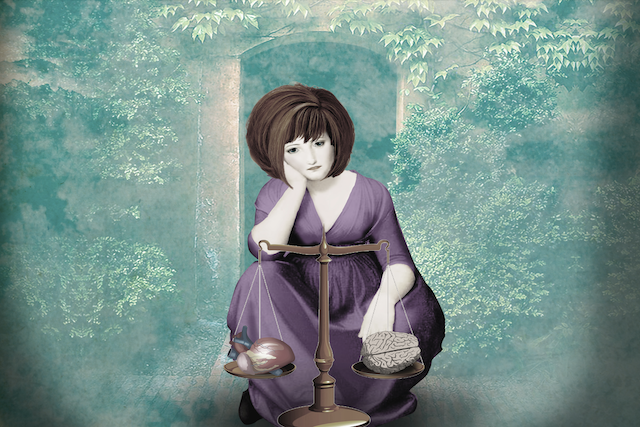
    If I felt a tightness in my chest and a feeling of uneasiness, I would pay attention to that. I’d think to myself, “You know what, brain… I know you might object to this for various reasons, but the heart is telling me to steer clear of this decision.”

    I slowly started becoming much more aware of everything my body was feeling at any given moment.

    I also started to realize something else. Maybe there truly are no “shoulds.”

    No matter what decision you make, there will be someone who is all for it and someone who disagrees completely. There are thousands of choices that a person can make in a day. It’s impossible to guarantee that everyone will like or approve of all of these little choices. From the decision to order a cinnamon dulce latte at Starbucks (yes, I see all you Dunkin’ Donuts diehards out there cringing), to the decision to dye your hair purple.

    What about the even bigger decisions? Such as the choice to work a certain job, have a family or not have a family, follow a certain political party, etc.

    What if the whole point is to simply live in accordance with our values, and honor other peoples’ desire to do the same?

    What if it is literally all okay?

    To plant down roots. To fly with wings.

    To be financially abundant and have more than you could need. To have just enough to live happily and comfortably.

    To be tall, short, skinny, fat, lean, muscular, and everything in between.

    To live on your own or to live with others. To be in a relationship or to be single. To work sixty hours a week or five hours a week. To have a job you adore or a job that pays the bills.

    To be a work in progress. To be sure. To be unsure.

    To still be learning. To still be searching. To be saved. To not believe. To be straight, gay, bi, or none of the above. To love men. To love women. To love animals. To simply love.

    What if it is okay to have hard ambition and dreams that are larger than life?

    What if it is okay to have soft ambition and dreams that are just right, which make us happy and honor our capacity?

    What if it is okay to not have any “ambitions,” per se, and to simply focus on cultivating habits rather than reaching goals?

    To experience satisfaction on our own terms without needing to prove anything to anyone, ever.

    What if being enough isn’t about trying to be everything to everyone? Rather, it is about being who you want to be, unstoppably, and nothing more?
  • All the Ways I Tried to Numb My Loneliness and What Actually Helped

    All the Ways I Tried to Numb My Loneliness and What Actually Helped

    “A season of loneliness and isolation is when the caterpillar gets its wings.” ~Mandy Hale

    I feel so alone right now. Like, crawling out of my skin, I’ll do anything I can do to not feel this way alone.

    I haven’t felt this way in a long time. Thank goodness I have tools to take care of myself. Let me explain.

    My earliest childhood memory is my mother’s empty bed. The sheets are white, untucked, and messy.  The duvet cover is loose and hanging halfway on the floor. The room is quiet, there’s no sign of mom, and I am all alone.

    That’s when I met loneliness for the first time. When I was three-and-a-half years old and my mom had just passed away.

    Loneliness came upon me before I could understand what was going on. It came upon me when I was unprotected and exposed, when I was vulnerable and needy, and it pierced me to my core.

    As I got older, loneliness made me feel unworthy and different—as if I was the only person in the world that felt that way. It made me feel flawed and defective, and it liked to catch me off guard.

    Being in this headspace was so intense and overwhelming, I would do anything I could to make it go away. I would binge watch television, emotionally eat, play video games, and watch pornography (yes, I just admitted that).

    I didn’t have the emotional tools to ride out the discomfort of feeling alone, so I made myself feel better the only way I knew how—by numbing out.

    If I had a tough day at work, I’d come home and “escape” my feelings with television. If a girl I was interested in didn’t show interest in me, I’d watch porn so I didn’t have to deal with my fear of abandonment and loneliness.

    Upon first look, the solution seemed simple: learn to be comfortable in solitude. Ha! That’s like telling someone who wants to lose weight “Just eat less and move more.”

    If letting go of our patterns were that easy, none of us would suffer. This is why healing and self-intimacy aren’t for the faint of heart.

    It’s called inner work for a reason. I digress.

    What I discovered was that my “pattern” of escaping was actually a coping mechanism. I was trying to help myself, albeit in a not-so-healthy way.

    My fear of being alone felt too big to meet, so instead, I used television, food, video games, and porn to help manage it. To squelch the inner anxiety going on inside of me.

    And it wasn’t even conscious. I didn’t wake up each day thinking, “I’ll watch porn today to escape my feeling of loneliness.”

    In fact, it was the opposite. I would go to bed each night saying I was done with this type of behavior only to repeat the pattern the next day.

    It was default programming that was running on its own—until I slowed down to be with what was running it. As soon as I courageously did this, my patterns shifted.

    With the help of a mentor, I’ve developed a practice where I connect with loneliness rather than run away from it. After all, loneliness is part of the cast of characters that live inside each and every one of us.

    Any time I feel this way, I come up with a list of five to ten questions, like: Why are you here? What are you here to teach me? Will I be okay if I just sit in the discomfort of what’s coming up for me? I then invite loneliness to pull up a chair next to me and I interview my greatest fear. I work on the relationship rather than running away from it.

    When I sit with my loneliness I remember I am whole and complete, just the way I am. I often think about my mom during this time and have gone back to that place as a little boy to let him know that he is okay and remind him that his mother loves him very much.

    In the beginning I shed many tears, but after a while I was no longer plagued by a constant sense of longing. In fact, I began to enjoy being alone. Go figure!

    This got me thinking—what if our patterns of binge watching TV, checking out on social media, watching pornography, etc. are well-intentioned? What if they are here for us?

    We humans play this game all the time. We try to manage our feelings through acts of busyness, distraction, overwhelm, food, alcohol, pornography, work, and more. We use something outside of us in order for us to feel better on the inside.

    What I’ve realized is that management is a defense—a protector trying to help. It’s innocent and wonderful in its own way. Yet, real help only comes when we go within and meet what’s going on inside of us.

    Loneliness doesn’t go away. It’s a part of who we are.

    It’s a normal human emotion and can teach us a lot about ourselves. It can teach us patience and the importance of self-love.

    Building a relationship with this part of you takes time. It’s a process.

    So the next time you feel the twinge of loneliness creeping in, don’t try and run from it. Rather, lean into it and see how your life changes for the better.

    Loneliness created the urge to numb my emotions. Learning to be comfortable in solitude strengthened my esteem.

    It’s your choice. Self-pity or self-love.

    Today I intentionally shift this relationship. Take the beginning of this article for example.

    My wife is away on a work trip for the next twelve days, and I’m feeling isolated and alone. Rather than binge watch television or escape via porn, I’m going to reconnect with loneliness by simply sitting with it and see what it has to teach me.

    Where are you managing your fears and feelings? And how can you meet them instead?

  • The Benefits of Solitude and How to Get the Most from Your Alone Time

    The Benefits of Solitude and How to Get the Most from Your Alone Time

    “Understand that healing and growing can distance you from people who you once had a bond with, and it can also bring you closer to those who will heal and grow with you. The time in between can be difficult, but there is so much to learn in solitude.” ~ @themoontarot

    There have been many occasions in my life where I’ve felt lonely. Some of these times I remember as incredibly painful; other times, I’ve relished in my solitude.

    During some periods, I’ve even forced myself into seclusion, which comes easily to me as an introvert.

    One thing all of these solo experiences have taught me is that it’s okay to be alone. In fact, with solitude, there’s a lot of self-growth to be had.

    In today’s day and age, we’re expected to be social creatures. With the rise of instant messaging and social media, it’s easy (and addicting) to stay connected all the time.

    This doesn’t mean it’s healthy, though. In fact, I’ve come to realize that solitude can be incredibly rewarding in a vast number of ways.

    The Benefits of Solitude

    Many nights of solitude have brought me epiphany moments. Ones where I have figured out what I actually want to do with my life. Ones where I’ve realized my spiritual path, and ones that have fueled new, exciting creative ideas.

    Many authors, artists, musicians, and philosophers have attributed their best work to time spent in solitude. As Aldous Huxley once said, “The more powerful and original a mind, the more it will incline towards the religion of solitude.”

    We need time alone because…

    1. We can gain a deeper sense of self-knowledge when we are alone and can see what is important for us as well as what we need.
    2. We are better able to acknowledge our feelings and deep desires when nothing external, such as other people’s thoughts, perceptions, or expectations, stands in our way.
    3. We get space to quietly reflect and reassess, asking ourselves the questions that truly matter.
    4. We recuperate and recharge (especially necessary for introverts) when alone, which allows us to be more present with others when socializing.
    5. We can tap into our intuition and learn to trust ourselves and our decision-making.

    By no means am I encouraging isolation. It’s not healthy to spend all our time alone.

    However, I do want to challenge those feelings of discomfort that often arise when thinking of solitude.

    Why Are So Many People Fearful of Solitude?

    There’s no denying that for some, the idea of spending a day alone, without interaction, isn’t appealing whatsoever. Why is this?

    Being busy, out and about with others, is a good distraction technique. When we’re surrounded by people, engaged in activity, we don’t face to face ourselves or our feelings.

    Are you the type of person who has to be on the phone with others when walking to the store? Or, perhaps you feel a strong sense of disconnection after a few hours of no in-person interaction. Either way, you’re not alone.

    Many people fear solitude because it’s unfamiliar. We don’t know what will happen when we finally face ourselves and are left alone with our thoughts and feelings, so we avoid it. But when we avoid being alone, we miss out on all the growth, healing, and creative inspiration that solitude can facilitate.

    So, how do we move away from a place of fear when thinking about solitude to embracing its possibilities?

    My Own Experience of Solitude

    As a child, I was often content spending time alone drawing, writing, reading, and exploring the great outdoors.

    During my school years I leaned into spending time with others, growing neglectful of my time with myself. The pressures of friendship groups, being sociable, and even ‘normal’ all took over my love for being alone.

    By the time I’d graduated from university and stepped into the working world, I was so accustomed to spending time surrounded by people, I barely knew who I was anymore.

    Coupled with confusion surrounding my career, a few failed relationships, and trauma from my childhood, I found myself in my mid-twenties reaching a pit of despair.

    Following a messy breakup after a toxic relationship, living back at my parents’ house with no money, no job, and no self-love, I was forced into solitude.

    I found myself alone in one of the darkest periods of my life, and it led to what I believed at the time to be an inescapable depression.

    Each morning I’d wake up and lock myself away in my parents’ spare bedroom. I had few friends in town since I’d previously moved away to London, and I didn’t reach out to those I was still connected with because I was afraid they’d judge me.

    It was just me and my cat spending hours alone in a small, dark bedroom. I cried a lot and I continually isolated myself. I hated the feeling of being alone, but in hindsight I needed solitude.

    I was about to discover something magical—my inner strength and an infinite love of the universe.

    What Solitude Brought into My Life

    My story of the most profound period of solitude in my life isn’t a necessarily pleasant one, but I now recognize it as a turning point in my life.

    When my depression hit rock bottom and I was feeling suicidal, I was overwhelmed with this inner strength that seemed to come from nowhere. It urged me to listen to what solitude was trying to teach me and helped me reconnect with my true self.

    I had a new determination to pull myself out of my current state of despair and step into new territory. Unbeknown to me, I was about to enhance my spiritual journey and discover peace.

    It was during a meditation session one night that I felt a warmth and deep love within me. I knew that there was a way out of my sadness, that being alone had the potential to teach me more than any book could.

    In the days following my realization and connection with a power I still can’t describe to this day, I gained the courage to step outside the house.

    I started noticing things around me on my solo walks like the vividness of nature’s colors, the soothing sounds of the river, and the tangible beauty everywhere around me.

    I also noticed for the first time that everything is connected. All that is in the universe, is the universe itself.

    How to Embrace Solitude

    Even if you live with family, a partner, or roommates, there is always an opportunity to implement some intentional alone time.

    For the most experienced spiritual folk, silence and solitude go hand in hand. However, for the sake of accustoming yourself to the intentional practice of solitude, you can start with the basics.

    Here are three practices that can heighten your alone time:

    1. Meditation

    Meditating in solitude can be an extraordinary experience. It enhances your ability to be present as you focus on just being.

    Sitting in silence and stillness can also decrease your stress, boost your mental health, increase your self-awareness, help you foster self-acceptance, and deepen your self-compassion.

    For me, meditation has been an ongoing practice, though not always consistent, that has brought about a deeper connection with myself and the universe.

    2. Journaling

    Daily writing is a wonderful practice to enhance your solitude. Writing leads to self-awareness and personal insight and facilitates creativity because inspiration often arises during quiet moments of reflection.

    Writing allows you to listen to the quiet voice inside your head, and it encourages you to ask yourself questions about what you truly want.

    Journaling continues to be one of the biggest tools I use in my moments of solitude. I gain creative insights and feel attuned to my emotions thanks to penning my journal each day.

    3. Connect with nature

    Taking a meditative walk in nature is soothing for the soul and a guaranteed way to perk up our mood.

    It may also lead to a greater sense of spiritual connection as you consider the larger, powerful natural force behind everything within the universe.

    A lot of my inner happiness is dependent on the time I spend outdoors alone. I find I’m at my most peaceful when walking in the woods or by the sea.

    However you choose to practice solitude, I encourage you to do the following.

    1. Get rid of distractions

    When you choose to spend time alone, really commit to your solitude. It’s tempting to grab your phone and mindlessly scroll social media or watch a YouTube video, but be disciplined and keep distractions at bay.

    Your time in solitude won’t be valuable if you’re just distracting yourself. Instead, lean into spending time on your own and what the space can teach you.

    2. Make it a priority.

    Everyone has the time to dedicate to themselves. Even if it feels uncomfortable, or you feel strange rejecting a social invitation, don’t make excuses to avoid being with yourself.

    The more comfortable you get with spending time alone doing things you love and reconnecting with yourself, the more connected you’ll feel to others. Self-love comes from solitude and with this love, you can give more to those you want to share it with.

    I Challenge You to Spend Time Alone Intentionally

    It probably won’t feel great the first time, and you’re likely to look for a way out of it, but spending time alone is one of the greatest gifts you can give yourself.

    There is so much self-growth to be had when you spend time nourishing the relationship you have with yourself.

    I’m sending you the warmest wishes and all the good vibes as you embark upon spending (and loving) your time in solitude.

  • Making Big Decisions: How to Discern the Whispers of Your Soul

    Making Big Decisions: How to Discern the Whispers of Your Soul

    “Intuition is the whisper of the soul.” ~Jiddu Krishnamurti

    “I can’t believe they are taking her side over mine. I gave this job so many years, and she decides to walk in and mess it all up for me,” I said to my husband.

    A few years back, when I was working full time at my corporate job, I got into a disagreement with a team member. It spiraled out of control to the point where my boss then had to have a sit-down with us. I was so humiliated and angry that he could not see my side.

    They will realize when they lose you, whispered my ego.

    That was when I decided to leave. I started to look for new jobs and got offers.

    Now here is the thing—I did have a great job, I had a great team, no long hours, and I liked what I did. But at that moment, due to that disagreement, I made a decision to leave it all from a place of anger.

    Tony Robbins often says It is in your moments of decisions that your destiny is shaped. I wish I knew this back then. I took the new job, but the moment I accepted the offer, I realized the colossal mistake I had made. I remember going to my farewell party and feeling like I might throw up. I remember trying to hide my tears.

    Your intuition often speaks to you through your body, and my body was clearly saying no. Unfortunately, the voice of my ego was stronger. It was too late to turn back. That wrong decision cost me two years of my life that I could have used toward my personal goals and business.

    Instead, I was stuck at the wrong job, working long hours, in misery, and hating every minute of it.

    There are many times when we feel the need to react, and the need to feel validated. The untrained mind often reacts the way I did, from fear and from anger. This is where the process of discernment comes in—discernment between whether you are making a decision to sate your ego or to truly evolve and expand yourself.

    The primitive, reactionary mind is not the best for making decisions because we are in a downward spiral and are tackling multiple negative thoughts in our heads. Nothing good can come out of this space—we are neither neutral nor can we listen to our intuition.

    In the grand scheme of things, when we ignore our intuition, we introduce complexities to our path. The reality is that in order to get to the next level, we must get out of victim mode and learn to take
    responsibility for our actions. There is always a choice in any decision that you make. That choice is between fear and love, between blame-shifting and personal responsibility.

    The easiest way to listen to your intuition is to ask yourself if you are making the decision out of fear or out of love. While this experience was unfortunate, it also taught me a very important life lesson. I rarely make big decisions in my life without “consulting” with my inner guidance or when I am not in the right headspace.

    The tool that I use for this is meditation. Over years, I have learned to use the art of meditation to hear the whispers of my soul. Anytime I get into a conflict or my life spirals out of control, I turn to my
    meditation pillow.

    Before I get into the meditation, I ask myself: Why is this happening to me? What is the lesson that I need to learn from this? Help me see the way. I am willing to do what it takes to feel and do better.

    And then I go into silence and complete surrender, without expectations that any insights or solutions will come through. The answer usually comes quite unexpectedly when the world around me is reduced to a silent hum. It is usually not the answer I was hoping for, but the answer I need at that moment.

    I often get asked what to do if the answer does not come. This just means that you are not detached enough and that you are still expecting an answer to come. This is fear itself.

    “Why is the answer not coming?”

    “Am I not doing this right?”

    “Maybe my intuition is broken?”

    Intuition comes when you are in a place of faith rather than fear.

    If this happens, try working out or watching or movie, anything that helps you not think about your problem. Then go back into meditation again with zero expectations, and you will be surprised at how soon the answer comes to you.

    It will be a quiet whisper, an inner knowing. It will happen in complete silence or when you are thinking about something completely different.

    It is akin to that little whisper that tells you that it may be a good idea to take the umbrella before you leave the house. But then you choose to ignore that whisper, and you later wish you hadn’t because it
    rained so much.

    One of the biggest benefits of meditation aside from intuition is that it helps you silence your mind. This helps you take bigger and bolder actions because there is no silent critic in your head judging and second-guessing your every move. Meditation helps you become more mindful and present. What others say or do does not affect your as much.

    Over time, you start experiencing the “observer effect,” where you feel as if you are directly experiencing life as a series of moments rather than evaluating and analyzing it.

    If you cannot meditate, journaling can help with this process too. Put on trance music in the background and free write. The trick to journaling is to let your pen flow without thinking.  You will notice that twenty to thirty minutes into it, your handwriting will start changing and your words will start looking different. The message will become more loving and compassionate. This is when you know that you are tapping into your intuition.

    Intuition is a powerful gift, but one that you can experience and learn how to recognize only in silence.