Tag: insignificant

  • No One Was Coming to Save Me: The Insignificance I Felt as a Kid

    No One Was Coming to Save Me: The Insignificance I Felt as a Kid

    Never make the mistake of thinking you are alone—or inconsequential.” ~ Rebecca McKinsey

    I can still remember it as vividly as if it happened yesterday.

    Our kitchen was small. Only enough room for a few people, and there were four of us kids scrounging to get our hands on the rest of the leftovers. It wasn’t a fight, but I can say with certainty that there was an underlying assumption that whoever got their hands on it first was able to claim it, so there was competition.

    I grabbed my spoon first and then went to the fridge to get my food when my dad grabbed the spoon out of hand.

    “Dad! Give it back!” I said in my most rude teenage voice.

    Not a second passed and his hand met my cheek with a blow that knocked me to the floor. There must have been a loud noise as I flopped to the floor, hitting the dishwasher, because my mom, who was doing laundry, came running inside to see what was going on.

    I lay there helpless on the floor, not struggling but also not fighting.

    I looked up at my mom, who looked back at me, then at my dad. She gave a sigh of disapproval, turned the corner, and walked away.

    Still on the floor, I looked up at my brother who was eating at the bar that faced where I was lying. He looked at me chewing his food, continued to eat, and said nothing.

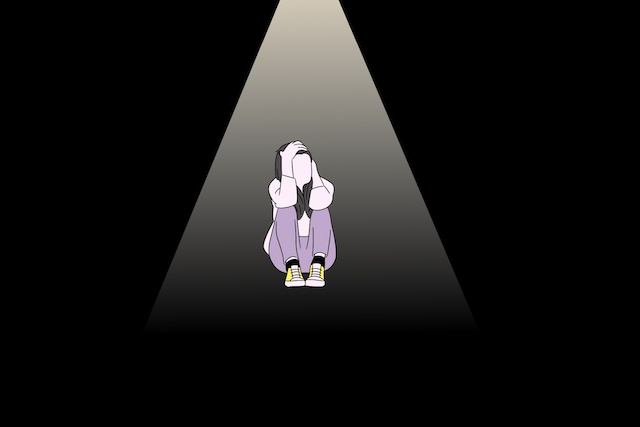
    This was the first time I remember feeling alone. It was a reminder that hit me like a ton of bricks that nobody was coming to save me… nobody. 

    Of course, this reality check didn’t come without consequences. It most certainly left a hole in my heart and closed off parts of me that later became nearly impossible to break. But I survived. I just learned to survive without the parts of me that were open to love and compassion.

    While the trauma of getting hit by a parent has repercussions, I believe it was the ignoring of suffering that had more catastrophic consequences for me.

    Having both parents fail me at the same moment and then looking up to see my brother carrying on with his life as if nothing was out of the ordinary was complete devastation for me.

    In that moment, it was a reminder of my worth, and it was a reminder of my insignificance within my family. 

    And that became my voice for a large part of my life.

    It’s funny, though, because I never remember feeling alone as a kid, and it’s probably just because I never understood what that even looked like. It took years of trying hard to sit with my feelings to understand that what I was feeling was insignificance. Years.

    Not having the vocabulary around my feelings made normalizing them so difficult. Now I can look at what I was feeling with confidence and not give it more weight than it deserves. I can label it, feel it, look at it objectively, and move on without taking it personally.

    Today I realize that feeling lonely, unseen, and insignificant was simply a product of emotionally immature parents, not a reflection of who I was. But as a kid, I internalized it as a problem with myself because I couldn’t properly label it and assign meaning to it. Instead, I made what I was feeling a part of my character, and thus I subconsciously became a magnet for all the things that would validate that “character flaw” in myself.

    I dated people who treated me like crap and sought out mean guys. I had friends who were hurtful. And all the while I felt like I had a problem that made me unlovable.

    And I’m not gonna lie, I’m a lot of “too-much-ness” for a lot of people, but emotionally mature people cannot just handle me, they can love me too. Because while I am a lot, I’m also full of a lot of love too.

    I tell this story because I realized that naming our feelings is foundational to learning to communicate without projecting blame onto others. This isn’t just true for children going through a difficult time. This is true for many of us adults who just never learned the vocabulary around what certain feelings even look like.

    When we own our feelings, we’re less likely to blame other people for causing them because we understand where they originated and know it’s our responsibility to work through them.

    My feelings of insignificance will probably never go away when it comes to my relationship with my family. Mother’s Day was difficult for me this year because it brought back those same feelings of loneliness (and a bit of sadness), but they no longer hold the same weight. I now can see my feelings at face value without judging myself and my character as a result.

    Instead, I know that…

    I am not insignificant, and I am worthy of love. And that is why I have created a life full of love and meaning in my own family.

    My “too-much-ness” is only “too much” for those that don’t have the ability to see the beauty in me. And that is why I surround myself with only those who see me through a lens of love.

    There is value in learning what our feelings are, defining them, recognizing what they look like, and realizing how they can run us ragged if left unchecked. If you do one thing this year, learn about your feelings so they no longer can control you.

  • 6 Things to Do When You Feel Small and Insignificant

    6 Things to Do When You Feel Small and Insignificant

    Big Sky

    “Tough times never last, but tough people do.” ~Robert Schuller

    On nights when the stars shine bright in the Arizona desert, I remember to tell myself to pay attention to the universe’s handiwork. From space, the Earth is a mere speck in the galaxy. I am humbled by this knowing, by my smallness. I call it my Ratatouille moment.

    Ratatouille is an animated movie that tells a story of a dreamer, a remarkable rat named Remy, who aspires to be a chef. Emerging from the sewers one day, Remy was shown a different vantage point of the city.

    To his great surprise, Remy discovers that he’s been living in one of the most celebrated cuisine capital of the world, Paris.

    Like Remy, I was lifted from my version of the gutters, a refugee camp, and exposed to a world of richer possibilities. 

    Americans know something of the Vietnam War, only if by name, as a thing that happened in a distant past, in a distant continent. The ones who fought in it knew firsthand the cost of going and the cost of returning home. They returned to a country that failed to appreciate their sacrifices; they defended an idealism no one understood. But they survived.

    There was another group of survivor. What you may not know is that there was a third country involved. Laos. The US dropped more than two million tons of bombs on Vietnam’s neighboring country in an effort to thwart its enemy from moving food and weapons to strategic locations.

    After the war was declared over, many Lao citizens were left homeless and took refuge in the neighboring country of Thailand. My family was among them. 

    And much like Remy’s world, inside a refugee camp, the only thought that existed on anyone’s mind was, how am I going to survive today?

    Refugees are forced to live in the moment because they can’t fathom a future beyond tomorrow.

    Food, when available, came in the form of a packet of dry protein handed out by missionaries. Most times, you are left scampering for meals that others throw away, buying meat that was left sitting too long in the sun, and making do with what kindhearted merchants were willing to give away.

    But like Remy, I saw my life taking shape beyond my family’s makeshift, one-room thatched hut. Something planted itself in my heart.

    I knew I didn’t belong here, and that where I belong was a world beyond the barbed wire fences that kept my family in.

    The hope that was in me was due in part to my courageous mother. She taught herself English by using a tattered Thai-English dictionary. Then she taught me, her little daughter, all that she learned.

    When others accepted that this was their lot, my mother had the audacity to see beyond her circumstances.

    I’m grateful for this remembrance and for my Ratatouille moments.

    We need a dose of humility from time to time. And if our humility serves to bring appreciation and a broader perspective of our place in the universe, feeling small once in a while is healthy.

    But then there are times when I feel small in an unhealthy way. It’s that crashing wave of emotion that comes at you like a tsunami, leaving you with a dignity crushing, self-reducing kind of insignificance.

    While it’s happening, I feel completely blindsided by it. But after it passes, I can usually spot some triggers. All of them points to change.

    Though I make light of them, see if you recognize any of these scenarios.

    Career Change

    Your boss did not appreciate your contribution. You salvaged the last shred of dignity and quit. You took the leap of faith, followed your passion, and birthed that passion project. The world ignores your talent.

    Value and Lifestyle Change

    Discovering your true value in life, you rid yourself of the fancy cars and the fancy home. Your spouse, however, does not share your fervor for the minimalist lifestyle and served you divorce papers.

    Lost of Support System

    Furthermore, since you no longer pick up the tab, your old pals stopped calling. Your hygiene suffers. Then you become too depressed to leave the house and make new friends. Without family, friends, and your material possessions, like a TV to fill up your time, you are left to contemplate life.

    You feel lost.

    But you are not.

    The only thing you lost is the hand-me-down values. The most important person in the world found you. You.

    Don’t feel it in this moment? It’s okay. Sit with it. Change feels like death because your old self is dying. But with every winter, there follows a spring. Allow yourself to have the bad feeling.

    But don’t let yourself linger there too long.

    Recognize this set of numbers? 000. It’s a reset position. You are starting at zero. An unhealthy mind will see this as a place of failure. An undefeatable spirit will see this as a blank canvas with wondrous possibilities.

    Believe me when I say your mind will go into complete panic, paranoia, or pity party mode. If it shifts into any of these modes, you will sink into the quick sand of despair. Cut it off. Here are six things that can help.

    6 Things That May Help When You Feel Small

    1. Get out of the house.

    Just the fact that you are out in the sun and breathing fresh air will lift your spirits.

    2. Stand tall.

    Just changing your posture changes your mood. Throw that shoulder back, chin up, smile. Smiling will trick your mind into thinking it’s happy even when you are not.

    3. Have a car karaoke.

    Simon Cowell’s not there to judge, so belt out your favorite tunes. For me, when Joan Jett is singing, “I Love Rock ‘n Roll,” my inner rocker chick cannot be denied. Drum on that dashboard. Strum the air guitar. But don’t take your eyes off the road.

    4. Volunteer in your community.

    It will give you a sense of purpose. You are needed. You have something to offer: your time. That’s rich.

    5. Donate something to Goodwill.

    You will feel rich instantly. You have things of value that you can afford to give away.

    6. Pay a checkout clerk or any service person you come in contact with a lavish praise.

    See how you have the power to make their day? You just made them feel big.

    What helps you when you feel small?

    Photo by Ryan Hyde