Tag: inner voice

  • Where Our Inner Critic Comes from and How to Tame It

    Where Our Inner Critic Comes from and How to Tame It

    “Your inner critic is simply a part of you that needs more self-love.” ~Amy Leigh Mercee

    We all have that critical and judgmental inner voice that tells us we’re not good enough, smart enough, pretty enough, etc.

    It tells us we don’t do anything right. It calls us stupid. It compares us to other people and speaks harshly about ourselves and our bodies. It tells us all the things we did or said “wrong” after communicating or connecting with someone.

    Sometimes it projects criticism outward onto others so we can feel better about ourselves. Other times we try to suppress our inner critic through overachieving, being busy, and accumulating more and more things.

    Sometimes it’s a protective mechanism that’s trying to keep us focused on our self-judgments so we won’t be authentic, because, if we are, we may be rejected and not get the love and acceptance we want.

    But, by doing this, we’re creating even more pain and suffering because we’re disconnecting from and rejecting our own essence.

    Just ignoring the critical voice doesn’t always make it go away. It may initially, but soon enough it will resurface if we haven’t healed/embraced our hurts, traumas, and wounds and shifted our internal patterning, which is where it comes from. 

    Have you ever heard the expression “What we resist persists?” Have you ever told an angry person to “just calm down” or a screaming child to stop crying? Does it work? Not when our energy is in a heightened state.

    Why is someone angry? Why is a child screaming and crying? Because there’s something going on internally that’s creating how they’re behaving. There’s often an unmet need or pain that’s asking for attention.

    Thinking a more positive thought to compensate can sometimes work, but sometimes it just creates an inner debate and mistrust in ourselves because deep inside we don’t believe what we’re saying.

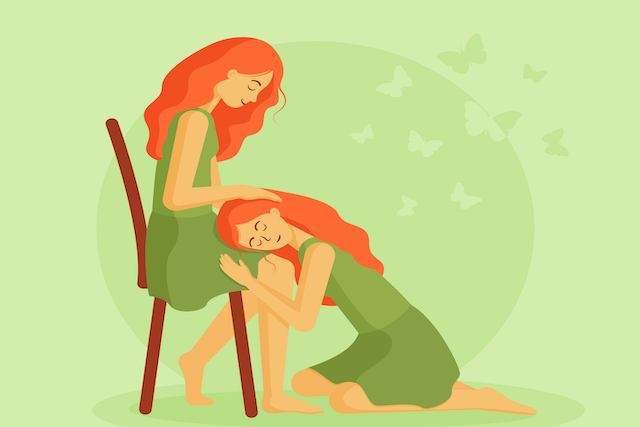
    As children, many of us were taught to suppress those “bad” feelings because if we expressed them, we may have been or were punished. Welcome to the beginning of the critical voice; it’s often a frightened part of us that’s wounded and asking for attention. It wants to be seen, heard, and understood.

    My dad used to get really frustrated with me and constantly told me, “Damn it, Deb, you never do anything right.” Hearing that many times left an imprint in my subconscious. I started living with that interpretation of myself, and the critical voice kept me “in check” with being this way.

    For me, the critical voice was my dad’s voice as well as the deep shame I was feeling for making mistakes and not doing things the “right way.”

    I was holding in suppressed anger, sadness, guilt, unforgiveness, resentment, traumas, and pain that I tried to keep hidden with a smile on my face, but eventually it turned into a shame-based identity.

    My inner voice criticized me whenever I fell short or wasn’t perfect according to society or my family’s expectations.

    Just like when we’re triggered by another person, our critical voice is asking for our attention and guiding us to what needs healing, resolving, forgiving, understanding, compassion, and unconditional love.

    When it comes to the surface, we’re experiencing an automatic regression; it’s a part of us that’s frozen in time. It’s a reflection of our unhealed wounds, which created ideas of not being enough or that something’s wrong with us. Basically, it’s a trance of unworthiness.

    When we’re in a trance of unworthiness, we try to soothe ourselves with addictive behaviors. It’s hard to relax because we think we need to do something to be better and prove ourselves, so not doing anything, resting, isn’t safe.

    When we’re in a trance of unworthiness, it’s hard to be intimate with others. Deep inside we think there’s something wrong with us, so we don’t get close because they may find out and leave. This keeps us from being authentic because we don’t feel okay with who we are.

    Deep down I felt unworthy, unlovable, and undeserving, and the critical voice showed me what I was feeling and believing. I didn’t feel safe in life or in my body. How could I? I was living with so much hurt, pain, and shame inside.

    The critical voice is often stronger for those of us with unhealed wounds and who are hard on ourselves, and it tries to get us with shame and guilt. We’re always looking at ourselves as the “good self” or “bad self,” and if we’re identified with a “bad self,” we’ll act in accordance with that in all areas of our life.

    If we’ve become identified with the critical voice, it’s who we think we are; it just seems normal. And when we start to be more kind and loving, it doesn’t seem right because our identity becomes threatened and our system registers that as danger.

    That happened for me. Eventually I became identified with being a “bad girl” who’s critical and hard on herself, and, even when I started being a little kinder, more compassionate, and more loving, I felt an angst in my body. It wasn’t familiar, and even deeper, it wasn’t okay for me to be this way. My survival was at stake, so I would automatically go back to self-criticizing and judging, without conscious awareness.

    The critical voice didn’t only speak to me harshly; it also told me to do self-abusive things like cutting my wrists and face, starving my body or eating lots of sweets, and exercising for hours like a mad woman to get rid of the food I ate, whether it was a carrot or sweets, because I felt guilty. 

    Even after twenty-three years of going in and out of hospitals and treatment centers, taking medication, and doing traditional therapy, nothing ever changed; the critical voice had a hold on me.

    It was a powerful force, and when I tried to stop it, it would get louder. It thought it was protecting me in a backwards sort of way; if it hurt me first, no one else would be able to do so.

    When people used to say to me, “Debra, you just need to love yourself,” I looked at them like they were crazy. I had no concept of what that even meant because I had no experience of it.

    What I’ve come to see with myself and those I assist in their healing is that the more we keep our deep hurts, traumas, anger, guilt, shame, and pain hidden, the more the critical voice chimes in.

    And, for some, like me, it seems overpowering, so we try to find relief through smoking, drinking, eating, or being busy, and/or we experience severe depression, anxiety, or self-harming.

    When we’re consumed by the critical voice, we’re disconnected from our true essence, and when we’re disconnected from our true essence, the love within, we feel a sense of separation; we don’t feel safe with ourselves or others, and we don’t feel lovable for who we are, as we are.

    This is why many people can change, be happy for a day, but then go back to their critical and/or judgmental ways. Our automatic programming, stemming from our core beliefs, kicks in. It’s just like an addiction, and in a sense it is.

    We can try meditating, deep breathing, and positive thinking, but, unless we address the underlying cause, we’re likely to keep thinking the thoughts our internal patterning dictates. They come from a part of us that doesn’t feel loved or safe.

    So, what do we do when the critical voice comes to visit?

    What do we do when it’s what we’re used to, and it just happens automatically?

    What do we do when we don’t know how to be with ourselves and how we’re feeling in a kind and compassionate way?

    What do we do when we have no concept of what it even means to experience self-love or ease in our bodies?

    First off, please don’t blame yourself for how you’re being. Awareness isn’t about judgment; it’s about kindness, compassion, and love.

    Working with and healing our traumas, where the critical voice was formed, is key in shifting our internal energy patterning. Many people call this inner child healing and/or shadow working. 

    This is a soft and gentle process of moving through the layers of trauma with compassion and love and making peace with our protector parts.

    Through inner child healing, we can shift and transform that “negative” patterning and how the energy is flowing in our body. We can help that part of us that’s frightened, hurting, and maybe feeling separate have a new and true understanding so we can feel loved and safe in our bodies.

    When we pause and take a deep breath when we first hear or sense the critical voice, it allows our nervous systems to reset and helps us come back to the present moment; this allows space for compassion, healing, and investigation.

    Why do I believe that?

    Where did I learn that?

    Is it true?

    How does my higher self see this and me?

    Does the critical voice totally go away? No, it may still chime in; it’s part of being human. But once we realize where it’s coming from and heal/shift that energy pattern, more love can flow through, and we can experience our truth. When we learn how to be our own loving parent and meet the needs our caregivers didn’t meet when we were children, the critical voice often softens.

    Remember, the critical voice is just a scared part of us who really wants attention, love, and a way to feel safe. When we no longer take it personally, when we’re no longer attached to it as our identity, we can offer ourselves compassion, understanding, love, truth, and whatever else we’re needing.

    Life can be messy, and our thoughts can be too. This isn’t about perfection; this is about experiencing a deeper connection with our loving essence.

    There’s a sweet and tender spirit that lives within you. This spirit is your deepest truth. This spirit is the essence of you. You’re naturally lovable, valuable, and worthy. You’re a gift to humanity. So please be kind, gentle, loving, and caring with yourself.

  • How to Access Your Intuition by Listening to Your Favorite Music

    How to Access Your Intuition by Listening to Your Favorite Music

    “Sometimes music is the only thing that takes your mind off everything else.” ~Unknown

    All major art forms can be a way to experience a deeper part of ourselves, but there is something unique about music. Perhaps it’s because music is a frequency with no physical form, so it can easily become a pathway to the formless realms of intuition and our higher selves or soul. We may never know for sure, but it is clear that music has a powerful effect.

    I have had experiences of feeling whole, connected, and complete when listening to music. However, I was not consciously aware of these experiences for a long time.

    I can remember driving my car, listening to my favorite songs, and being “transported” someplace. It was an experience of complete euphoria and wholeness. At the time, these were mainly subconscious experiences, and all I was aware of while listening was that I felt good.

    As I started to develop and use my intuitive abilities, I began to have many conscious experiences of my higher self. Only with this reference point did I become aware of how many times I connected with my higher self while listening to music. It was the same experience!

    Not all music will feel like a spiritual experience, and the pieces that do will be specific to the person listening, as we’re all unique. You may have said, without thinking much about it, that a particular song “speaks to your soul.” It does, and you will want to listen for its helpful guidance.

    Have you ever heard a song and then put it on repeat for the whole day or even a week? I sure have, many times. It seems like each time I play a favorite tune, it opens my heart a bit more to reveal hidden emotions and desires. These are the types of moments and songs you will want to observe to see what your inner wisdom is showing you.

    Over the past four months, I have been atypically listening to some of my favorite music from the 1980s; “Time After Time” by Cyndi Lauper, “Hazy Shade of Winter” by The Bangles, “Cherish” by Madonna, to name a few. Even current songs with an ’80’s feel find themselves first on my playlists.

    I began to internally investigate why the sudden ’80s music craze in my life when I received a knowing from my higher self that I was homesick and needed to talk more with family. I then started to recall childhood scenes of me playing with the family and neighborhood friends.

    I was in my formative years during this decade, and my siblings were still living at home. The ’80s was the only decade my entire family lived in the house before my older siblings moved away. It was a fun and joyful time in my life.

    My whole family now lives all over the country, and I live in Hawaii. We usually travel several times a year to see each other, but not this year because of the pandemic. I have been suppressing sadness about not being able to travel easily and safely to see my loved ones for many months without realizing it.

    The ’80s binge I’ve been experiencing these past few months was a way for me to emote this sadness and experience the childhood nostalgia associated with this music genre. Once my higher self revealed the deeper feelings around my recent propensity towards ’80 music, I began to reach out to my family more, which has helped with my feelings of isolation.

    Next time while listening to this music, take some time to reflect internally on what is happening and if any high levels of intuitive information are coming through. What I mean by high levels is direct guidance coming from your higher self or soul.

    There are ways to tell if you are getting intuitive guidance from your higher self while listening to music. You can observe specific characteristics right away that indicate you are receiving soul-level information.

    For example, intuitive information from your higher self is always accepting and loving. This loving feeling is inclusive and leaves none of you feeling left out or unworthy. Soul-level guidance will not come with harsh judgments and guilt trips.

    Another characteristic of soul-level information is that it will often come in very quietly. You may have heard phrases like “whispers of the soul” or “the still inner voice.” This is often the case when your soul is speaking. Music naturally stills your mind, which creates a quieter internal environment for higher guidance to come through.

    Guidance from your higher self is enveloped in peace. I notice that this peace is often present when listening to music I love. Even if a song’s message is heartbreaking, it still rides on a wave of peace if it’s speaking to my soul.

    Being in motion while listening to music, like on a bike ride or dancing, can heighten this experience of connecting to soul-level intuitive information. Movement helps “loosen” your spiritual body so you can become more open and receptive. Intuitive information will often become conscious when the physical body moves, especially if you are relaxed.

    If you’ve ever had an epiphany with your earbuds in, on a jog or an elliptical—with your mind clear, blood pumping, and heart open—you know what I mean.

    A relaxed nervous system is vital for hearing high levels of intuitive information. If the nervous system is on high alert, your internal environment will be very noisy. Information coming from the higher self is gentle and quiet, so having a relaxed nervous system will foster a space within you to hear your soul’s guidance.

    Listening to music while exercising outdoors is a great combo for hearing your intuition. We are intimately connected to the natural environment, and exercising outside in beautiful areas will naturally quiet and relax your body’s nervous system.

    I’m guessing you may have already experienced this as well. You’re at the beach, or in a park, your earbuds creating a perfect soundtrack to the beautiful, peaceful scenery, and suddenly life becomes clearer.

    If you don’t live in a place with a lot of natural outdoor beauty, put on some relaxing or heart-opening music in headphones and go for a walk. Do what you can to create a peaceful inner environment as you move around.

    Additionally, if moving around is something you can’t do, try taking a long bath or sit next to a body of water. Make the environment pleasant by lighting a candle or putting on your favorite soothing music. Water is a strong current for intuitive information. You may be surprised how much intuitive guidance will come through in these therapeutic settings.

    I have had many revelations in the tub or after a dip in the ocean. I often will get into a body of water when I’m feeling scattered, anxious, or confused. After soaking for a while, my nerves and mind will relax, and the next step I am looking for will appear.

    Whether you listen to music while exercising, at a concert, or just lounging around the house, I encourage you to think about the kinds of intuitive messages you get while listening. Is your higher self calling you to hold a different perspective, forgive, or acknowledge your true feelings about something?

    If you love lyrics, pay attention to words you’re drawn to and note what is happening in your life at that moment. Do the two relate? I tend to gravitate toward listening to instrumental songs. I feel they give me a blank canvas to interpret soul-level guidance more clearly. You may find that too.

    You will want to write down the soul-level information you receive while listening to music, apply it to your life, and then see if it has value for you. You can measure value by whether something is uplifting, useful, and helps you grow in character.

    Remember that if you closely observe your internal environment while listening to your favorite songs, you can intuitively reveal what your soul is saying to you. And then you can act on it and change your life.

  • 3 Negative Inner Voices and How to Challenge Them

    3 Negative Inner Voices and How to Challenge Them

    “Beautify your inner dialogue. Beautify your inner world with love light and compassion. Life will be beautiful.” ~Amit Ray

    There is no better way to feel good about yourself than changing your internal dialogue. Yes, you have the power to change your inner voice. You can choose to speak to yourself in a positive way or a negative way.

    Stop all activity for a moment.

    Be still. Notice what your inner voice is saying. Do you hear anything? If not, ask your inner voice this question: How does it feel to be still?

    Listen.

    Is your inner voice declaring that you are too busy to be chillin’? Or is it supporting you, happy to be playing this hanging-out-and-noticing game?

    Get to know your inner voice.

    Over the next few days stop and listen to your inner dialogue. Especially notice what your inner voice says as you are about to make a decision. Does it say, “I think, I can, I think I can” or does it say, “There is no way, I can’t do that, I can’t do that.”

    Powerful Lessons from a Little Children’s Book

    I hung out with a two-and-a-half-year-old the other day. He wanted to read a book and brought me The Little Engine that Could, by Watty Piper.

    This book was read to me as a child, and I heard the voice in my head chant, “I think I can, I think I can” as I opened the book’s cover. The part I didn’t remember was the lessons of the trains.

    As I read this little children’s book written way back in the 1930’s I felt the power of the lessons and how they apply to my own self-speak today.

    The Little Engine That Could

    The story is about a little train who wants to bring presents over the mountain to children who are patiently and excitedly awaiting their gifts.

    However, on the way to the town, the little engine breaks down. The toys are very upset, and one of them, a funny little clown, sets off to find another train to help them.

    Lessons on Self-Talk from Four Trains

    1. The first train has a Shiny New Engine.

    The Shiny New Engine didn’t want to help the little toy train because he was too special, too proud. He looked down on the little train and said a resounding “NO.”

    I thought of my shiny arrogance that I’d polished for years. I’d told myself I was too special, too important to waste my time and attention on certain tasks and people.

    Even though I’ve worked on this character defect, I know I have some of this self-speak going on inside of me. I noticed it the other night when I went out to dinner with a friend who brought along a friend of hers.

    The woman appeared to be in her sixties with huge fake boobs. She dressed in a tight, sparkly sundress that emphasized her boobs and wore high heels with gold doodads pasted on. She talked about how her love life was filled with younger men who were her “F–k buddies.”

    The moment she said this, I felt superior and stopped listening to what she shared. The next two hours I spent wishing I was at home watching Netflix. My inner voice said she was desperate.

    What did I miss out on? She could have been a kindhearted, fascinating person, even if she dressed provocatively and made choices I wouldn’t make. Where was my compassion or at least my curiosity?

    2. Next comes a Big Engine.

    The Big Engine says he is too important and won’t “pull the likes of you.”

    That got me thinking of my judgments. How do I judge others? Have I missed out on opportunities and connections because my over-inflated ego tells me that I’m too important to get involved with that person or situation?

    My lesson on this came from an Alanon meeting. Well, actually, two separate meetings.

    I rushed into my regular Alanon meeting a bit late and sat down in the only open chair. Once I arranged myself I noticed the man I was sitting next to had a scraggly beard, his clothes looked like they’d been slept in, and he smelled a bit. I scooted as far as I could from him in my chair and held my nose in the air.

    When he shared in the meeting I chose not to listen. My inner voice said, “He has nothing to share that could be of value.” I knew that at the end of the meeting I’d have to hold his hand. My inner voice said, “No way.” So I slipped out right before the closing of the meeting.

    A week later I arrived at my Alanon meeting on time and sat beside a good-looking man in a neat business suit. He piqued my interest. I’d never seen him at a meeting before, and I always appreciated a good-looking, well-groomed man.

    When this good-looking man shared, I listened intently and nodded my head in agreement with much of what he said. My inner voice said “yes” to holding this man’s hand at the end of the meeting. As we grabbed hands, I gave his an extra firm squeeze as my way of saying, “I’m glad you are here.”

    As we released our handhold, I turned to the nice-looking man and said, “My name is Michelle, welcome.” I’ll never forget how he looked at me with his deep blue eyes and asked, “You don’t remember me, do you?” I nodded my head “no,” thinking to myself I’d surely remember him if we’d met before.

    He said, “I was here last week, a bit disheveled, as my best friend who suffered from alcoholism had killed himself. This Alanon meeting was recommended by my therapist to get help and support. I was so distraught I wasn’t eating, sleeping, or taking care of myself. I noticed you wanted nothing to do with me.”

    It dawned on me as he spoke that he was the homeless-looking man from the week before. I turned bright red, mumbled an apology, and ran out of the room.

    I never saw the man again, but I do think of him often and consider him an angel sent to stop me from my “I’m better than” inner voice.

    3. The Rusty Old Engine comes next.

    The Rusty Old Engine sighed and said he could not. He was too tired and weary.

    I personally am not familiar with this inner voice. My inner voice tells me I can do anything and handle most things that come my way, to a fault. But I’ve watched others run this internal narrative. One of them is Jean.

    Jean was a vibrant, gorgeous woman who owned a successful advertising company. When the advertising business began to shift away from print toward the Internet, I watched as she became defeated. She told me she was too old to make the changes she needed to make.

    Her business began to fail, and as it did Jean failed as well. She stopped doing her movement practices, gained weight, and subsequently had two hip replacements. Her financial picture grew dim, and Jean was forced to sell her beautiful condo. She gave up on the life she’d so artfully created for herself over decades.

    I saw Jean a couple of years ago. She was a shell of her former self and shared she felt old and tired.

    4. Lastly comes the Little Blue Engine.

    Chugging merrily along. The dolls and toys didn’t have to ask this train for help. She asks them, “What’s wrong?” As she hears of their plight, she tells them she isn’t very big and has never been over the mountain.

    She thought of what the kids would be missing if this little train didn’t bring the gifts to the boys and girls on the other side. So she said, “I think I can, I think I can.” It was a supreme effort, but she hooked up to the train, began chugging along, and kept going all the way over the mountain by saying to herself over and over again, “I think I can.”

    I know this voice.

    I recently changed my business model from brick and mortar, which I knew I could do, to an online business, which required a supreme effort. I’ve gotten up every morning for over a year chanting, “I think I can.” I’ve put my head down and chugged through twelve-hour days, and you know what? I did it. I made it over that mountain. My online business is going strong.

    Inner Voice Lessons from The Little Engine That Could:

    1. Listen for your arrogant inner voice that tells you that you are better than anyone else. Tell yourself to remain curious and compassionate.
    2. Listen for your inner judgments. Say to yourself, “I’m grateful for the people that I meet; they might teach me something.”
    3. Listen to your inner voice of defeat that tells you that you are too tired. Change that voice to “I’m not handed anything I can’t handle.”
    4. Take the next adventure you encounter and say to yourself, “I think I can. I think I can.”
  • How to Hear Your Inner Wisdom When Making Tough Choices

    How to Hear Your Inner Wisdom When Making Tough Choices

    “Everyone who wills can hear their inner voice. It is within everyone.” ~Mahatma Gandhi

    Do you struggle with listening to your inner voice? Do you doubt yourself and every inner signal you get? You’re not alone.

    A decade ago, I didn’t know that I could follow my heart. I’d never heard of the concept of inner wisdom or inner voice.

    I started following my interests and doing what made me feel good, and this is the essence of doing what you love and listening to that subtle voice inside of you.

    The problems start when we listen too much to outside sources.

    We start to think that we’re doing it wrong. I went through one of these periods myself. Looking back, I see that while it was a period of struggle, it also helped me go deeper into what worked for me.

    What is Inner Wisdom, Anyway?

    You may get nudges from your soul by getting inspirational thoughts. It may be an unexplainable feeling that gets you into action. Or you may see an image in your mind.

    My inner wisdom is a blend of all of the above. But more often than not, it communicates through feeling.

    I like to say that it’s like I have cat whiskers all over my body. I feel my way through life.

    I still misinterpret the messages I get. Sometimes I follow fear. Sometimes I give in to resistance. I’ve learned to be okay with that.

    This doesn’t have to be serious. You can play and experiment; see what messages you get.

    How to Listen to Your Inner Wisdom

    With that said, let’s look at how to connect to your inner wisdom.

    1. Calm down.

    When my mind is calm, the connection to my inner wisdom is the strongest.

    When my mind is in turmoil, I try not to make any decisions because I don’t have access to my cat whiskers.

    If I’m in a negative state, I might go for a walk, wash the dishes, or meditate. I don’t necessarily try to get rid of the negativity, but I simply stop what I’m doing and take a break.

    When you take a time out, gradually your calm will return along with the connection to your wisdom.

    2. Stop trying so hard.

    I’m good at bullying life into place. I want to figure it all out. I want to force results, and I want to have achieved my goals last year.

    But I’ve noticed that the more I try to push, the more slowly things go. It’s like getting stuck in quicksand. If I try to dig my way out, I only sink in deeper. Instead, I have to let myself be pulled out.

    This doesn’t mean I become complacent. It means I notice what I have control over and what I don’t.

    And it goes back to calming down. When you’re worried about what might go wrong in life and you’re trying to fix an imaginary problem, the connection to your heart is severed.

    But once you let go and become aware that you don’t know where life is going, you can relax and peace can return.

    3. Be patient.

    My inner wisdom shines through when I’m patient. When my partner and I were looking for a house, we knew approximately what we wanted, but we didn’t try to push it.

    We were patient. We looked at different options and listened to our hearts. I let days pass because I noticed that the more distance I got, the clearer the signal from my inner wisdom.

    The realtor would try to pressure us, but we took our time. We weren’t going to rush into a big decision like buying a house.

    One day, we saw a house come on the market. It didn’t look impressive online. We almost dismissed it. Then we went to have a look, and the moment I stepped in the door, my inner voice said yes.

    We still didn’t jump on it. We waited a few days to see if the feeling would change. It didn’t. We ended up buying the house, and I’m sitting in a room right now writing this article.

    So when you want to get feedback from your inner wisdom, get the feedback over a couple of days or more. Don’t put pressure on yourself to get an answer right now, right here.

    Mistake to Avoid

    The biggest pitfall I fall into over and over is stressing about whether or not I’m on the right path.

    I still worry, but less than before. I’ve come to accept that life will take me where I need to go. I can only do my best with what I have.

    I don’t have to force myself to do anything. All I can do is listen to the quiet voice within me and see where it takes me.

    I don’t know if the struggles I’m going through today are what will help me get to where I need to be.

    When you’re honest with yourself, truly honest, you realize that you don’t know what’s going on in life. You don’t have control over it. All you can do is live life to the best of your ability.

    What You Need to Remember

    When I started reading about living a heart-based life, I thought that if I could just tap into my inner wisdom, my life would be filled with euphoria.

    But I’ve since realized that life is filled with life, which means both ups and downs. We see individual events as bad because we isolate them.

    However, we don’t know where we’re going or what our path looks like.

    I’ve discovered that the more fun I have in life, the smoother the ride goes. I don’t take life too seriously. Meaning, I don’t have to panic when something happens.

    In the end, your inner wisdom is always there, just like the sun is behind the clouds on a rainy day, waiting for you to relax.

    All you have to do is calm down and pay attention.

    Don’t be in a rush. Don’t try too hard.

    But have fun, and notice how your inner voice works.