Tag: independence

  • The Gift of Being Single (More Joy, Less Fear)

    The Gift of Being Single (More Joy, Less Fear)

    “The greatest thing in the world is to know how to belong to oneself.” ~Michel de Montaigne

    Some people fear spiders. Some fear public speaking.

    My biggest fear? That my plus-one will always be my own reflection.

    More and more people are finding themselves in the single life—not because they joyfully signed up for it, but because they’ve quietly resigned themselves to it. Being alone forever is one of the worst things most people can imagine. And yet, nobody’s talking about it.

    I have no interest in bashing men—I love them. And I’m not here to shame relationships—I’d still love to experience conscious partnership or marriage one day. But what I am here for is giving a voice to the other side: the reality of singlehood. A reality that has been shamed, underrepresented, and spoken over for lifetimes.

    Yes, humans of all kinds fear being single. I happen to live it in the skin of a woman, but the fear itself is cultural, primal, and deeply conditioned.

    Not a Witch, Not a Spinster, Not a Divorcee

    The stigma of singlehood is sticky and insidious. It convinces people to stay in relationships they’ve outgrown because it’s “better than the alternative.” It whispers that you’re not enough without a partner. And the biggest problem? We have so few role models of people living single, fulfilled lives.

    I’m not a witch. I’m not a spinster. And I’m not divorced.

    Funny story—when I was once applying for a work visa abroad, the form asked me to declare my relationship status. The options? Married. Divorced. Spinster. That was it. Guess which box I had to begrudgingly tick? I still laugh about it, but it says everything: if you’re not partnered, you must be a problem to categorize.

    It’s in Our Bones

    The roots of this run deep. For most of history, women’s survival was directly tied to men—financially, socially, legally. That dependency shaped generations of cultural messaging we all still carry in our bones, regardless of gender. We’ve been taught that wholeness comes from someone else.

    For anyone who has spent long stretches of life single, there’s a peculiar kind of grief that shadows us, not for something lost, but for something never felt. We grieve the idea of intimacy we were promised, the mythical “other half” we were told to need. It’s less about absence and more about a haunting—mourning the story we’ve been handed rather than our own lived truth.

    Maybe Disney messed us up. Maybe it was Jerry Maguire’s iconic “you complete me.” But the truth is, our obsession with relationships is far older than pop culture. It’s centuries old. And it’s led so many of us on a quest for “another” long before we’ve gone on the quest for ourselves.

    And now? The dating industry has taken that centuries-old conditioning and turned it into a multi-million-dollar business model.

    It shows up in quiet moments, like the friend fresh out of a twenty-year relationship who whispers, “What if I never find someone else?” as if that’s the worst fate imaginable.

    Legacy, Good Girl, and the Seventh-Grade Soothsayer

    We may have moved beyond needing a partner for a bank account or a roof over our heads, but inside many of us lives a whole cast of characters who haven’t gotten the memo.

    In my case, they look like this:

    • The legacy-burdened one—the part that still believes worth is sealed only once I’m chosen.
    • The good girl, who doesn’t want to disappoint the family, who smiles politely when someone says, “You’ll find someone soon.”
    • The people pleaser who wonders if they should tone themselves down to be “more dateable.”
    • And the inner child who still remembers the sting of being told in seventh grade, “You’ll never have a boyfriend” and worries, even now, that maybe it was a prophecy.

    Different faces. Same message: You’re not enough on your own.

    Swiping Right on Your Insecurities

    The modern dating industry has taken this centuries-old programming and turned it into a goldmine. Apps, relationship coaches, matchmaking services, and self-help books all thrive on making your relationship status yet another problem to be solved.

    Not long ago, I was on a twenty-four-hour road trip listening to yet another relationship self-help book. This one at least was about “becoming the one,” but even then, the end goal was still to get the partner. Where are the books about deepening your relationship with yourself, not as a prelude to love, but simply to live your damn best life?

    And can we please stop acting like every contrived meeting arranged on an app is a “date”? We used to meet organically in coffee shops or elevators; now we swipe because we’re too afraid to make eye contact in real life.

    The funniest part? Friends in relationships often get more excited about my first meets than I do—as if I’m finally about to be rescued from the great tragedy of my singlehood.

    Love, Yes; Panic, No

    Biology matters. We are wired for connection. We crave intimacy and belonging. This is not about pretending otherwise.

    What I’m talking about here is the fear of being single—the panic that drives bad decisions, keeps us in misaligned relationships, and has an entire industry profiting off our insecurities.

    Rather than pouring all that longing into loving and being loved by one person, we could simply be… loving. Period. Creating a more compassionate relationship with ourselves. Spreading kindness. Offering to everyone the kind of love that heals the world. Because when we’re busy running from the fear that something is inherently wrong with us, we miss our greatest capacity—to love, in every direction.

    The Gift of Being Unpartnered

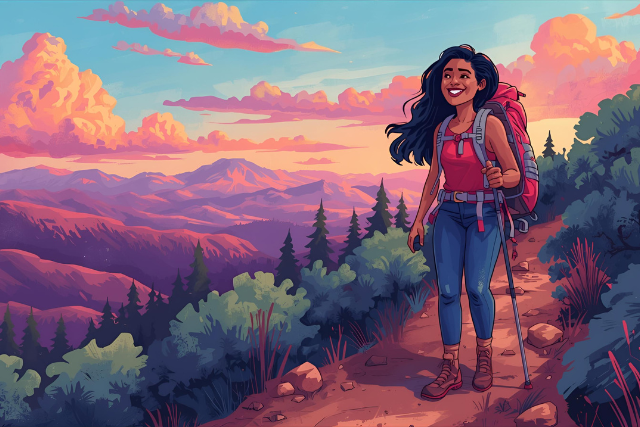
    Here’s the thing nobody tells you: I can literally do anything I want.

    If there are socks on the floor, they’re mine.

    If the yogurt is gone, I ate it.

    I can book a trip on a whim, sleep diagonally, and never negotiate over the thermostat. Netflix isn’t infiltrated with someone else’s questionable taste, and no one wakes me up in my sleep—except my dog.

    If I’m honest, my unfiltered fear about being single forever isn’t loneliness. It’s choking on a piece of toast and no one finding me. Or never experiencing the kind of deep intimacy and vulnerability I still hope for.

    But here’s the freedom side: I’ve gotten to know myself in a way I never could have if I’d always been in a relationship. I’ve formed an identity that’s mine—unshaped by a partner’s wants or habits. And I want anyone living single to know this is not a consolation prize. This is one valid, powerful way to live. You haven’t failed. Your worth is not measured in anniversaries.

    For me, soulmates show up in friendship as much as romance. My best friend and I joke we’ll probably live side by side when we’re old. Deep connection isn’t confined to coupledom, and that truth is liberating.

    Single By Trust, Not Default

    Seeing singlehood as a radical act of self-trust in a culture obsessed with coupling is… well, radical. And honestly, it’s 2025. We’ve accepted gender fluidity. Sexuality can be expressed on any spectrum you choose. So why are we still categorizing people by relationship status? Why is this still the metric we use to size up someone’s life?

    And this isn’t about some performative empowerment—people determined to prove they’re so strong, so independent, so “I don’t need anyone.” That’s still a posture that defines itself in relation to others. What I’m talking about is living fully for yourself, without apology, without your relationship status being a headline of your life.

    So maybe the real question isn’t “Will I end up alone?” but “Who can I be if I’m not waiting to be chosen?”

    And if you need me, I’ll be training for my next big adventure: walking the Camino trail in Portugal next summer—a pilgrimage powered entirely by my own two feet, my own heart, and absolutely no plus-one required.
  • I Cheated on Him with My Higher Self (and We’re Still Going Strong)

    I Cheated on Him with My Higher Self (and We’re Still Going Strong)

    “It’s okay to let go of those who couldn’t love you. Those who didn’t know how to. Those who failed to even try. It’s okay to outgrow them, because that means you filled the empty space in you with self-love instead. You’re outgrowing them because you’re growing into you. And that’s more than okay, that’s something to celebrate.” ~Angelica Moone

    “How could you do this to me? It’s obvious you’re with someone else.”

    That was the third and final message I received from my partner of nearly three years, several weeks after we had finally decided to break up. I say “we” because initially it seemed that the decision was mutual, although it would later be revealed that it was me who wanted out.

    He was right, by the way. I had left him for someone else.

    No, not the lover that he had conjured up for me in his own mind. In fact, what had pulled me away was much more powerful and seductive than that. I had cheated on him with my higher self. And she had been trying to win me over for quite some time.

    My higher self: AKA my intuition, AKA my inner badass that will never be ignored. Yep, she’s the one I had left him for.

    Much like when I was nearing the end of my marriage, she had started off with a gentle nudge, a tap on the shoulder every now and again. I’ve noticed throughout my life that if I don’t stop what I’m doing, these attempts to get my attention will become more consistent, until what was once a whisper finally becomes a roar.

    Such was the case three years ago when she decided that I should shave my head. At that point, I had invested a lot of money turning my naturally dark brown hair into a platinum blond mane. This was before the pandemic, when I couldn’t imagine anything coming between me and my monthly visits to the salon.

    As with most suggestions that come from my higher self, my ego was not impressed.

    If the two of them had been sitting across from one another, the conversation would have gone something like . .

    “You want to do whaaaat??”

    “Shave it.”

    “Excuse me?”

    “Take it all off.”

    “All of it?”

    “All. Of. It.”

    So I attempted a compromise by shaving a bit off the side. I knew I was kidding myself when I thought that would be the end, but at least it was a start. Over the course of the next twelve months, I felt equal parts admiration and jealousy whenever I caught a glimpse of someone with a shaved head. This peculiar mix was familiar to me, and it signaled what was destined to happen next.

    When I had finally made the decision, it was a random Tuesday morning, and it made absolutely no sense to my logical mind. Unlike the ego that thrives on being booked and busy, the higher self loves white space. When we give ourselves the opportunity to tune out and tune in, our deepest desires have a funny way of being revealed.

    That fateful day I had decided to take an extra long walk with my dog through one of the parks here in Barcelona. There’s nothing like nature, movement, and a bit of solitude to help you cut through the noise and get to the heart of what you really want. Instead of returning to my apartment, we headed to the salon.

    As I took a seat at my hairdresser’s station and looked at myself in the mirror, my ego had a full-blown tantrum while my higher self popped open the proverbial champagne.

    In those moments of feeling the clippers pass over my scalp, watching my shoulder-length hair fall to the floor, I finally felt free. Whether it’s our hair, our jobs, or a relationship we’ve long outgrown, the higher self seeks our liberation, no matter what the cost.

    That day when I told my then partner what I had done, the conversation didn’t go as I had hoped but exactly like I had imagined.

    “You’re bald.”

    While this was indeed a fact, the tone made it feel like a personal attack. He asked me why someone so beautiful would intentionally make herself so ugly. For once in my life, being “pretty” hadn’t been the deciding factor. I wasn’t so concerned with how I wanted to look but rather how I wanted to feel. As I’ve come to learn since, life really changes when this perspective starts to shift.

    If his thoughts and feelings were any indication, I was no longer much to look at when it came to the male gaze. Ironically, all he could see was “a weirdo” while the person I saw with my own eyes was a queen. 

    While my ex couldn’t get past my shaved head, I couldn’t get over the luminosity and the brilliance that could fully shine through. As he continued to fixate on what I had lost, I knew the truth of what I had gained: freedom, courage, and beauty on my own terms.

    Perhaps I always knew that he would leave me over a haircut. No one likes to think that the future of their relationship comes down to the length of their hair, but he had told me from the beginning that shaving my head was the one thing I should never do. Funny the rules we’ll follow in an attempt to belong to other people while we strategically abandon ourselves.

    I had spent nearly four decades of my life searching for safety in the fulfillment of everyone’s expectations. I used to be an expert at figuring out what they wanted and becoming exactly that. Until one cold, cloudy morning in February 2021, when I decided I was done. Done with the pretending. Done with the pleasing. Done with the denial of what I knew to be true.

    I was finally ready for a different kind of love. And this time it was all my own.

    You could say that I cheated on my ex with my higher self, or maybe she was the one I was meant for all along. Either way, I’ve chosen to be faithful to my inner wisdom. And from what I can tell, we’re still going strong.

  • Why I Never Let Anyone Support Me Until the Day I Almost Died

    Why I Never Let Anyone Support Me Until the Day I Almost Died

    “Why don’t you get up and make the coffee, while I stay in my sleeping bag and plan our ascent route?” I half-heartedly ask my climbing partner Hank.

    He just looks at me with that unassuming, “give-me-a-break Val Jon” look of his. It’s three o’clock in the morning, cold, dark, and damp, and neither of us wants to leave the comfort of our tent. But we’re committed to this climb, so we don our parkas and gloves and confront the bitter cold.

    In silence, Hank and I gather up our gear and join the rest of our climb team assembled at base camp, which is located at eleven thousand feet.

    Thirty-three climbers in all have come together for this extraordinary ice climb to the summit of Mount Shasta in Northern California. During our team meeting, we decide to make our ascent via “Avalanche Gulch,” a treacherous glacier route up a steep icy slope. This particular route is shorter than others, but it’s also notorious for its deep crevasses and unstable blue fractures, so one wrong move could mean sudden death.

    Ice climbing requires crampons for the boots and ice axes for leverage and braking. Ropes, carabiners, and belays are reserved for near-vertical climbs, which we may or may not need for this particular ascent route.

    For those unfamiliar with ice climbing, braking is used when a climber loses their footing on steep slopes. It’s done by grabbing the ax with both hands, flipping onto one’s side, and plunging the sharp metal tong into the ice.

    A firmly planted ax serves as an anchor and stabilizes the fallen climber’s position until they can regain their footing. Everyone on the team has practiced the braking procedure many times over along with other vital safety and life-saving protocols.

    As the full moon casts a bluish glow over the ice, we begin our ascent to the summit. At about twelve thousand feet, we come upon a massive fissure running horizontally across the steep glacier face. We traverse around its left edge and cross back about thirty feet above it. Climbing to the slope’s center, we zig-zag our way up to gain altitude and distance from the crevasse.

    Traversing around crevasses is a treacherous activity. If one climber slips, the entire group could be pulled into the abyss. For this reason, we are untethered and climbing independently. We are, however, organized into small teams of six to provide each other support if needed.

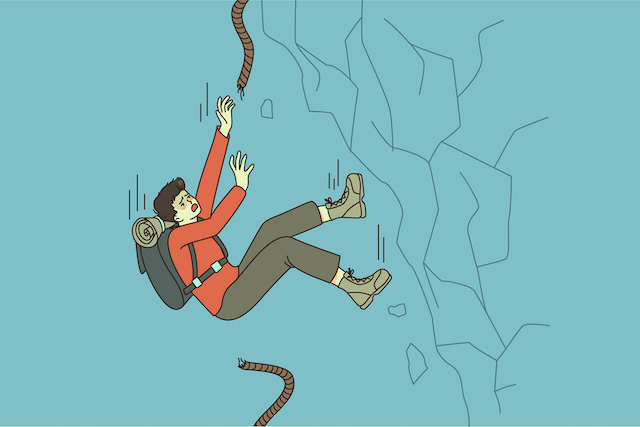
    All goes well as we gain altitude above the crevasse, until one fateful moment when the crampon on my left boot suddenly pops loose and I lose my footing.

    Tumbling headfirst downhill, I instinctively grab my ice ax with both hands and prepare to stop. Landing hard on my back, however, my ax bounces loose from my hands and I slide uncontrollably down the steep slope towards the crevasse.

    In a moment of frozen terror, my life flashes before my eyes and I am going to die! Then suddenly my flailing body slams into something solid, knocking the wind out of me.

    Stunned and disoriented on my back with my head pointed downhill, I’m unable to get a bearing on how close to the edge I’ve come and how close to death I am.

    Looking up, I see a blur of movement and shifting dark images. Clearing the snow and ice off my glacier glasses, I realize Hank and my fellow climbers have formed a human net, catching me just a few yards before I careened over the edge of the crevasse!

    I’m in shock, numb, and completely speechless. I’m also totally embarrassed and feeling extremely vulnerable. I’ve spent years being a strong and independent man, priding myself on not needing the help of anyone. Needing help always seemed like a sign of weakness to me, so this emergency situation is deeply disturbing.

    “We’ve got you, VJ! Hold on buddy, we’re not gonna let you fall!” I fidget around trying to stand myself up and respond, “Thanks guys, I can take it from here.” “Lay still, you’re pushing us back towards the edge!” Hank barks at me. “No, really, I’m okay guys, I’ve got this.” There was no way I was going to be the weakest link in this chain! This time, however, a number of my team members replied, “No you don’t have it VJ, you need to stop right now or you’re going to kill us all!”

    That message got in. The reality of killing my fellow climbers so I can stay in control is just too much for me to bear. The humbling realization shatters my macho control mechanism and I suddenly relax into letting them help me.

    As they reattach my gear, stand me up and reassure me with pats on the back, I realize it’s nearly impossible for anyone to support me. Experiencing them caring for me this way is both wonderful and wrenching.

    My chest tightens and tears come to my eyes as I realize how many times in my life I’ve not let others help or support me. I would always say, “No problem, I can do it myself.” I didn’t want to burden anyone or put anyone out.

    The deeper truth, however, is that if I let someone support me, I would be obligated to them in the future. The result might be that they could then somehow control me the way my father controlled me as a child.

    Looking into the caring faces of my fellow climbers, I suddenly see superimposed images of my mother, sister, and little brother, my friends, and exes who I’ve shunned and alienated with my stubborn macho independence

    I reflect on the pain and frustration that not being able to help me must have caused all these people in my life. So many opportunities I have had to accept the support of those who love and care for me, but no, I have to be strong and independent.

    How selfish and arrogant of me to rob them of the opportunity to contribute to my life! And how easy it would be for me to slide into humiliation over this display of narcissism.

    Standing here among those who just risked their lives to save mine, I realize I have a choice; I can dramatize my humiliation and hide behind my rugged individualism, or I can humbly open myself to their care and support.

    I choose to set humiliation aside and open with humility, and as I do, a wave of emotion fills me. For the first time in my life, as far back as I can remember, I’m able to see that accepting help from others is not a sign of weakness, it’s an act of humility.

    I also realize that rather than being a burden to people when I’m in need, it allows them to feel useful and to make a difference by offering their support and care. There’s no doubt that my fellow climbers are ecstatic about having just saved my life; I can see the joy and exhilaration on their faces.

    Still surrounded by a human net of care, I thank each member of my team for saving my life, and I apologize for placing them in additional danger. Each one of them nods in recognition, and nearly everyone assures me that having the chance to help save my life was far more important to them than blaming me for being a bit heedless.

    As I allow myself to be vulnerable and let their care in, my defensive armor melts, then drops away. We resume our ascent, and tears fill my glacier glasses as I reflect on the experience of my life being saved by this remarkable group of friends.

    How strange and new this is for me. I don’t need to see out of my glasses because I have the full support of those behind me as well as those in front to help me along if I need it.

    I’ve always been the one to give support to others, but now I can receive support as well. I breathe into this new awareness and suddenly have a profound realization that has remained with me for years.

    As I exhale, it’s synonymous with the movement of giving support, and as I inhale, it’s synonymous with the movement of receiving support. Engaging in both inhaling and exhaling doesn’t mean I’m weak, it means I’m human.

    Without further incident, we all ascend to the 14,179-foot summit of Mt. Shasta where a crystalline blue sky embraces the curve of the earth. The summit perch looks like a small crater and is no more than about twenty feet in diameter. Its outer rim is composed of a ring of rocky crags with one high point that signifies the very pinnacle of the mountain.

    Shining, sunburned faces grinning from ear to ear sit together in a blissful exchange of laughter and tears.

    After celebrating our joint accomplishment, we begin the ritual of reading and signing the register book stowed atop most climbable mountains in the world. The one at the summit of Mt. Shasta is contained inside a green metal canister under the Western crag.

    Each member of the team, like those before us, takes the opportunity with the book. After finishing, Hank hands it to me. As the last to see the register, I flip through its yellowed pages and my eyes fall on a passage written by a climber on October 23rd, 1972. I’ll never forget the inscription:

    “Father, I dedicate this climb to you. I’m standing at the top of Mount Shasta today because of the love, support, and encouragement you gave me as I was growing up. It’s because of your commitment and love that I was able to make it to the summit today. And although you lost your legs in the Korean War and have never been able to stand beside me. Father, I want you to know that today I stand on the top of this mountain for both of us. I love you with all my heart and all my soul, your son John.”

    How beautiful this dedication is! I take in the grandeur of the Earth’s curve from this high summit, close the book, and clutch it firmly to my chest. A wave of inspiration fills me, and I feel deep abiding compassion for all the world’s fathers, sons, mothers, and daughters . . . and I am challenged to act upon the humility that was moving so deeply within me.

    You see, up until this very moment I’ve coveted a deep wound in my psyche. As a boy, I was violently abused by my father, and as a result, I cut myself off from him in my early twenties vowing to never speak with him again.

    But now I am faced with a choice . . . should I maintain my position and continue to empower all the reasons why I should not reach out to him? Or should I humble myself and take a chance by reconnecting after all these years? It is here, within these deeply challenging life choices, that we both test the authenticity of our inspirations and discover what we are truly devoted to.

    I made my choice, and not only did I resurrect my relationship with my father, I affirmed that there is nothing more important to me than living with an open heart and honoring the humility I was gifted with high atop the summit of humility.

  • When a Mother Fails to Love: What’s Helped Me Move On

    When a Mother Fails to Love: What’s Helped Me Move On

    “You keep meeting the same person in different bodies until you learn the lesson.” ~Brandon Tarot

    Like most girls in junior high school, I tried out for all the cheerleading squads every time tryouts came around—basketball, football, even wrestling. And like 95% of the girls, I never made the squad.

    My kicks weren’t high enough, my splits weren’t split enough, my arms weren’t board-straight enough, I couldn’t jump high enough—and, let’s be real here: I wasn’t pretty enough and I wasn’t popular enough. After all, we are talking about junior high school.

    But eventually, the one tryout came around that I had half a chance at: the pom-pom squad. Even at thirteen years old, I knew I could dance. Pom pom was the group of ten to twelve girls that performed choreographed routines to music at half-time during basketball games, and rarely during the period breaks at hockey games, on ice (I grew up in North Dakota, where hockey was a big deal).

    To try out for pom pom, you usually got together with two or three of your best girlfriends who also wanted to make the team, picked a song you all liked, and tried to choreograph a dance routine to that song.

    Picking the right song was crucial: it had to be a popular song that everyone would immediately recognize (Top 40, currently getting radio play time was best!), and it had to have the right rock-and-roll beat that was not too slow so that it would be boring to dance to, yet not too fast so that we would have a hard time making spins, kicks, or coordinated moves in time with the beat.

    So it came to pass: Eighth grade, tryout date was announced, and teams signed up to compete. It turned out to be myself and my friends Diane and Becky who agreed we were going to go for it that year.

    We had no experience whatsoever in coming up with a dance routine; all we had ever done was watch the previous year’s dance team do their thing, and we figured we might be able to copy a few moves from them. This was 1970, and I believe we chose an Elton John song that was getting a lot of airtime that year.

    We pulled my bright orange record player out to my back concrete patio and set it up, where we played that song over and over as we practiced sequences of turns, kicks, fancy footwork, arm movements, and hip action.

    This patio was right off the back door leading from our kitchen, and in retrospect I’m sure hearing that song play endlessly must have driven my mother insane, because even after my friends left for the day, I continued to practice, practice, practice.

    Finally, the day of tryouts arrived! It was long and nerve-wracking, as we had to watch everyone else’s performance until our turn came around.

    We watched as their nerves got the better of them—as the plastered smiles froze and then faded completely, their eyes widening like deer in the headlights. We saw them forget their steps; turn in opposite directions; one girl ran off before her routine was even over. A few routines went smoothly, and you could hear the collective sigh of relief from those of us still waiting, but the disastrous ones unnerved us completely.

    I actually have no memory whatsoever of how our routine went. I remember our names being called, scampering up onto the gym floor, hearing the scratching of the needle on the record, and shaking like a leaf until the music started. Then I remember sitting down and the polite applause afterward. That’s it.

    We watched as the final teams competed, and waited for the judges to make their picks. This was the worst part of all. The gym was full of girls who all wanted a shot, and they would hear in front of everyone whether they would get that shot or not.

    It was already getting late and the judges seemed to be taking a long time. This event had taken place on a school night, so by now it was past 9:30 p.m.

    One by one, they started to call the girls’ names who had made it onto the dance team. When they eventually said “Gail …” and hesitated on the last name, I knew it was me they were referring to! (I had a Polish last name that always seemed to get massacred.)

    I leapt to my feet and ran out onto the gym floor in complete shock—OH MY GOD OH MY GOD!! My girlfriends pounded me on the back on my way out to the floor and shrieked and clapped for me. Finally, the ONE thing I knew I was good at, and I got my chance to be a part of this group. I was over-the-top euphoric!

    I lived a little more than a mile from my junior high school and had to walk back home that night. Well, I practically ran all the way home; I was so excited and couldn’t wait to tell my mom that I had made the pom pom team! I burst into the back door about 10:30 p.m.

    I yelled out, “Mom!”

    She stormed through the living room and into the kitchen, furious and screaming at me, “Where the HELL have you been??”

    Taken aback, I said, “You know I was at pom pom tryouts. I made it!”

    She said, “I don’t give a damn. You know your curfew is 10 o’clock. What the hell have you been doing this whole time?”

    Dumbfounded, I tried again. “Ma, you know where I was. It went late. It wasn’t my fault. Ma, didn’t you hear me? I made the squad.”

    “I don’t care about that. Next time you call if you’re going to be late.” Then she turned around and went to bed.

    I was stunned. If she had slapped me in the face, it wouldn’t have hurt worse. Literally the only thing I’d ever competed for, and they had said “Yes, Gail, you have talent, and we want you on our team,” and my own mother didn’t give a damn.

    If I ever needed a message that in her mind, my accomplishments meant nothing, she delivered it loud and clear that night. Unfortunately, it left a scar so deep that it remained with me for rest of my life, as the same message continued to be delivered, over and over.

    That night I could not get to sleep. Waves of excitement kept washing over me as I couldn’t believe my good fortune in being picked for this elite team. I remember literal chills going through my body; I simply could not relax. Then I would remember my mom’s reaction and a feeling of incredulity would take over.

    How could someone do that to their own daughter? How could someone do that to anyone who had such great news to tell—be such a horrible wet blanket?

    I never forgave her for how she treated me that night. At the end of that school year, the teacher/advisor who was the head of the pom pom squad thought it would be nice to host a mother-daughter night. The girls would choreograph a special routine, showing the mothers what they had learned all year long, and the teachers would prepare a special buffet for the mothers. This would take place after school one night. I didn’t even tell my mom about it.

    The day arrived, and I just told my mom I had a performance after school and would be home late. When I got home several hours later, she tore into me, furious. One of the other mothers had called her up, offering her a ride to the mother-daughter night. Of course this caught my mom off-guard because she didn’t know anything about it, and it embarrassed her as well. She declined the ride, seeing as she wasn’t ready to go out.

    Obviously, I got yelled at again because of the embarrassing phone call. But this time I didn’t care. I just tossed my head and said, “I didn’t tell you about it because I knew you wouldn’t want to go anyway.” And I walked away.

    The following year, as I was transitioning into high school, I tried out again for the high school pom pom squad. That year, I was the only one from my entire junior high school who made the team. For all three years of high school, I continued to try out and make the team. My senior year, I was the only senior on the squad.

    All this is to say that I was good at what I did. And for the four years I was performing with these girls, my mother never came once to watch me dance.

    I think her ugly dismissal of my winning a spot on the team, and my response by keeping her away from the mother-daughter night, created a gulf between us that never got repaired. The battle lines between us were already drawn, but that incident firmly entrenched them for many decades to come.

    When the most important people in my life essentially told me that I didn’t matter, that my accomplishments didn’t matter, two things resulted: I stopped “putting my pearls before swine,” and I started to seek validation from the wrong people and in the wrong places.

    By pearls before swine, I mean this: I protected my heart by not including her in the big celebratory events of my life. I felt that because of her lack of support, she didn’t deserve to be there and wouldn’t really appreciate what I’d accomplished anyway.

    We started to live a tit-for-tat existence. One day I came home from high school to find out that she’d given away my dog—she left a note for me on the kitchen table. The explosive fight we had when she came home that evening was epic, as was the silent treatment around the house that lasted for weeks afterward.

    She tried to prevent me from attending college, telling me I’d only be wasting money and was only going there to “chase boys” anyway. Four years later when I earned my B.S. degree, I purposely didn’t walk the graduation ceremony to spite her, thus robbing her of her day in the sun. “Why should she get any credit for that,” I thought? Several years later when I earned my M.S. degree, I didn’t invite her to that ceremony either, which I did participate in.

    The most far-reaching decision I made, as early as high school, was that I would never have children. I was the youngest of seven in my family and the only one who never had kids. I was so afraid I would turn out to be a mother just like her, and I didn’t want to inflict that kind of misery on any child.

    Where was my father in all of this? When I was in junior high school, my father had an operation for a brain tumor and its removal was successful. But a few days later he had a stroke that left him paralyzed on his right side and unable to speak. He remained in this state, wheelchair-bound, for the rest of his life.

    This was our alcoholic father who was unfaithful to my mother and physically abusive to her and to his seven children. Our mother, being the righteous Catholic martyr that she was, insisted it was her duty to now care for him at home. I am convinced it was this intensive caregiving for a man she did not love and who had been horrible to her that turned her into the bitter woman who was doing battle with me.

    It took decades of hindsight and therapy for me to see and understand this, but in the thick of our day-to-day dogfights, all I saw was a woman who would do everything in her power to hold me back. If she couldn’t be happy, no one was going to be happy.

    I’ve had three failed marriages, the final one lasting only nine months. My therapist helped me to see that I chose the same personality type each time: three overachievers, three brilliant and talented individuals, three bright and shiny objects. And by doing that, I was seeking my own validation—they reflected well on me, and surely they must see the same qualities in me.

    What I didn’t realize was that in these types of partnerships with high-achieving individuals, there is only room for one successful person, and that person would not be me. Megalomaniacs do not share the spotlight.

    Finally, in my sixties now, I understand that aloneness does not mean loneliness. I am more content and fulfilled than I’ve ever been in my life, as I pursue as many passions and dreams as the remaining years will allow. To finally achieve self-acceptance and self-esteem through rigorous study and therapy has been the greatest gift imaginable.

    It all started with understanding that my mother’s mistreatment had nothing to do with me. She let her pain shape her life. I won’t do the same. And I won’t spend my time seeking validation from anyone else, as I once did with my mother and three husbands. It’s natural to want approval from other people, but all that really matters is that we approve of ourselves.

  • How to Overcome Ultra-Independence and Receive Love and Support

    How to Overcome Ultra-Independence and Receive Love and Support

    “Ultra independence is a coping mechanism we develop when we’ve learned it’s not safe to trust love or when we are terrified to lose ourselves in another. We aren’t meant to go it alone. We are wounded in relationship and we heal in relationship.” ~Rising Woman

    Do you feel like you have to do everything on your own?

    Is it difficult for you to ask for and receive help in fear of being let down?

    Have you ever heard the expression “Ultra-independence may be a trauma response”?

    If this is you, I get it; that was me too.

    Please know there isn’t anything wrong with you. I lived most of my life this way. This way of being was a survival strategy that kept me safe, but it was also very lonely. I lived in a constant state of anxiety, and it wore me out physically because I thought I had to do everything myself.

    We often become ultra-independent because we don’t trust others and/or we may not feel worthy of being loved and supported. Or, we may believe that by denying support from others and doing things ourselves we’ll gain love and acceptance, because we’re not being a burden.

    Maintaining connections and receiving support from others are basic human needs. If we’re saying we don’t need anybody, that’s often coming from a part of ourselves that wants to protect us from hurt, abuse, criticism, disappointment, or rejection.

    If we even consider the possibility of wanting, needing, and/or receiving support from other people, something in us may say, “No way, it’s not safe,” so we keep these thoughts at bay.

    We may think that if we ask for anything then we’re weak or being too needy, and that’s codependency. But we’re not meant to do everything on our own; there is such a thing as healthy codependency.

    Ultra-independence may also be an extreme unspoken boundary, so, what may be important is to learn how to set healthy boundaries so we can feel safe in situations where we thought we’d lose ourselves.

    Sometimes we feel the need to be ultra-independent because we don’t feel safe being vulnerable and letting people in, because if we do, they may see our flaws and insecurities, or they may trigger our unresolved traumas and wounds.

    We may be carrying deep shame, and we don’t want to feel it or have others see it, so we stay away from connecting with and receiving support from other human beings.

    One of the hardest things to fathom is that, although we’ve been hurt in relationships, in supportive relationships we can experience healing and a sense of safety. 

    That didn’t make sense to me, because in my relationships I often experienced criticism, hurt, rejection, and being screamed at for having natural human feelings and needs.

    A part of me wanted support and connections, but another part of me was afraid, because as a child it made my father angry when I asked  for anything. It was hard living in a world where I felt all alone, believing I had to do everything on my own while watching everyone else receive support and connect with their family and friends.

    For me, being ultra-independent eventually led to denying and suppressing my needs and feelings because it got too overwhelming to try to do everything on my own, especially at such a young age.

    At age fifteen I became anorexic, and I struggled with depression, anxiety, and self-harm for over twenty-three years.

    In the midst of that, at age twenty, I let my guard down and got a boyfriend, who I thought loved me because he bought me anything I wanted, but there were strings attached. If I didn’t do what he wanted he would take back the gifts. He became obsessed with me, waited outside of my house when I wouldn’t talk to him, and would draw me in again with gifts and words of seduction.

    This left me confused. “Do I only receive support and things when I’m a slave to somebody?” I wondered. After I finally broke up with him, I made a vow to myself that I would never receive anything from anyone again. 

    I got the opportunity to heal that vow later in my life when I went to Palm Springs with a friend. We were playing the slot machines and he put in $20. I told him “It’s your money if we win.” We won $200 on the first spin, and he told me, “Cash out, you won.”

    When I cashed out, I chased him around the casino, trying to put the money in his pocket. I didn’t want to receive from him because I thought, “Then I owe him, and he owns me.”

    Thankfully, he’s someone I can share anything with, and we talked about it. He told me he knew my struggle, that he didn’t want anything in return, and that it makes him happy to give to his friends and family. This experience helped me see things differently.

    My healing journey really began at age forty when I started learning how to reconnect with myself, my needs, and my feelings and started healing the trauma I was carrying. I also learned how to ask for support, which wasn’t easy at the beginning; some people got mad at me, and some people were happy to fulfill my requests and needs.

    Instead of blaming and shaming myself for believing I had to do everything on my own, I made peace with the part of me that felt it didn’t need anybody. By listening to its fears I started understanding why it thought I needed protecting.

    It revealed to me the pain it felt of being rejected, hurt, and screamed at for having human feelings and needs, and that it didn’t want to experience that pain again.

    As I listened to this part of myself with compassion, I acknowledged and validated the fear and pain it experienced, thanked it for doing what it was doing, and let it know it was now loved and safe.

    I asked it what it really wanted, and it said, “I want to have true connections. I want to feel safe with and receive support from others, but I’m afraid.”

    This younger part of me was stuck in perspective from my childhood wounding and the experience with the guy I was dating. By giving this part of me a chance to speak and tell me its intentions, I was able to help it/me have a new understanding and feel loved and safe.

    I also began to have a more realistic view of who is and who isn’t safe, instead of seeing no one as safe based on outdated neuro programming stemming from my past traumas, hurts, and pains.

    Being ultra-independent did help me heal from all those years of struggling with anorexia, depression, and anxiety. Even after twenty-three years of going in and out of hospitals and treatment centers and doing traditional therapy and nothing working, I finally took my healing into my own hands, and yes, I did most of it on my own.

    However, even doing it on my own, I found it was also helpful to be in a loving and supportive environment with people who didn’t try to fix, control, or save me.

    We’re not meant to be or do life alone, but being alone can be comforting if we fear being hurt by others. 

    This doesn’t mean we should force ourselves to ask for and receive support from others, especially if we’re afraid; it means we need to create a loving and caring relationship with ourselves and understand where the need to be ultra-independent is coming from as a first step toward letting people in.

    A great question to ask yourself is “Why is it not okay for me to receive support?” Be with that part of you, allow it to show you what it believes, and take time to listen with compassion. Then ask it what it really wants and needs.

    Receiving support isn’t about being totally dependent on others, that’s just a setup for frustration and disappointment; it’s also important to learn how to be independent and meet our needs. This isn’t either/or, it’s both.

    Learning how to connect with our feelings and needs and how to communicate them and make requests is also important.

    For instance, if you’re going through a challenge and you would like support from someone, you can say, “I’m having a hard time right now, and I would really like someone who I can talk to, someone who will just listen without trying to change me or my situation. Is that something you would be willing to do?”

    If this feels impossible for you, it might help to repeat some affirmations related to letting people in and receiving support. If some of these don’t resonate yet, instead of using “I am” start with “I like the idea of…”

    I am worthy of being supported and loved.

    I am worthy of having heartfelt connections.

    It’s safe for me to have this experience.

    I am worthy of being seen, heard, and accepted,

    I am worthy of being loved and cared for by myself and others.

    I am worthy of shining authentically,

    I am worthy of receiving help and support.

    There isn’t anything you need to earn or prove. You are worthy because you are beautiful and amazing you.

    If you’re shutting people out because of your past traumas, as I once did, know that you don’t need to do everything on your own just because you were hurt in the past. Some people may let you down, but there are plenty of good people out there who want to love and support you—you just have to let them in.

  • How I Stopped Making Men My Everything and Losing Myself in Love

    How I Stopped Making Men My Everything and Losing Myself in Love

    “Yes, love is all about sacrifice and compromise, but it’s important also to establish a limit. You shouldn’t have to throw your whole life away to make a relationship work. If you have to lose yourself to please your partner, you’re with the wrong person.” ~Beau Taplin

    When I was twenty, I fell in love with a man who became my everything. My close friends watched me becoming someone else because I found myself trying to ceaselessly knead myself into someone who would perfectly fit into this man’s world, even if it meant betraying myself in the process.

    I changed my worldviews to fit in with his. I changed my dreams and ambitions to better align with his. I gave up friendships I valued that he wasn’t comfortable with me having. There was nothing I wouldn’t have sacrificed for this relationship and its survival.

    The relationship was only ten months long, but in that very short space of time, it became the center of my universe. When the relationship ended, to me, it almost signaled the end of my life. I did not see any life beyond that man or the relationship I had with him.

    At the end of that relationship I was forced to go into the hard journey of self-discovery. By the time I turned twenty-two, I realized that I would be in grave danger if I continued defining myself and centering my life on men and romantic relationships.

    The end of that relationship and the devastation that came with it made me vividly aware of my tendency toward engulfment. I found myself being someone who allowed romantic relationships to over consume her and take up her whole life.

    And now, eight years later, my idea of what a loving partnership looks like is so different and much more freeing. These are the truths that I had to learn the hard way that have allowed me to love my partners without losing important parts of myself in them.

    1. A relationship or partner will never meet all your needs, so stop expecting them to.

    My relationship broke because I placed a heavy burden on it to be my everything.

    Many of us give our partners a god-like status and expect them to satisfy our every whim and need.

    I looked to my partner to be for me what I had never learned to be for myself, thus putting on to him a responsibility that was always mine to carry.

    I now firmly believe that whatever our partners give us should merely be a drop into what we are already overflowing with because we did the work of nourishing our lives first before looking to a partner to do that for us.

    One is bound to lose themselves in partners that give them things that they don’t know how to give to themselves—like love, validation, and confirmation of their worth.

    2. Controlling your partner is a sure-fire way to lose the love you fear losing.

    I feared abandonment so much that there’s nothing about my partner I didn’t try to control. I wanted his obsession with the relationship to match mine. That was my twisted way of trying to put on a leash his love and affection for me.

    The downside of losing ourselves in love is that when our partners don’t lose themselves in the relationship like we do, we quickly equate it to lack of love, rather than having healthy boundaries necessary for the thriving of any healthy relationship.

    In retrospect, I cannot imagine how suffocated my then-partner felt about my misplaced efforts. The thing I feared most ended up happening because he could no longer take the extreme lengths I would go to in order to have his love.

    3. A healthy relationship will not change you, but encourage you to be more of who you are.

    It’s hard to maintain a strong sense of self in relationships when you don’t know who that self is. If you don’t know who you are, people can easily scrunch you up into versions of who they desire you to be. It’s so much easier to resist a relationship changing you into someone you know you are not when you have a clear sense of yourself.

    I still believe that love should always be transformational. But if love changes us, it should always be for the benefit of ourselves and our life purpose, not to please our partners or to meet their idealistic fantasies of what a perfect partner looks like. Love can only do its work in us when we allow ourselves to be fully seen, loved, and accepted for who we are.

    4. You should never neglect other areas of your life because of a relationship.

    There is nothing as thrilling as meeting a possible soulmate. It’s tempting to lose yourself in the new relationship and change your regular routine so that you can focus on this exciting new part of your life. This never turned out well for me.

    By the end of my relationship, I had enmeshed myself so deeply in this man’s world that I did not have my own world to go back to. My relationship became the most important thing, and I lost sight of every other beautiful thing I had going for me before I had him.

    A healthy relationship should never alienate us from our own lives but should be able to peacefully co-exist with all other parts of our lives.

    5. Your individuality should never be a threat in a relationship.

    I know we romanticize the idea of becoming one with our partners. We know the poems about becoming so intertwined with our lovers that we don’t know where we end and they begin. But love should never mean losing sense of who you are as an individual.

    We don’t have to be spitting images of our partners for love to mean something. When your partner first met you, they fell in love with your individuality, and it would cease to be love if you had to change the very things that drew them to you.

    Sacrificing ourselves for relationships will always be an act of self-betrayal. Loss of self is a cost of love I have sworn to never again pay. A healthy relationship is one where we can find a balance between being independent and interdependent.

    6. Be okay with loving in small doses.

    Love does not have to be all-consuming to be real.

    I struggled a lot with loving at a slow pace; I wanted everything, and I wanted it right now. I gave too much too soon hoping to get my partner hooked on to me. But now I understand that love takes time and it matures with time. It’s okay to keep certain parts of your love to enjoy and share later with your partner once the relationship has solidified and become more grounded.

    We want to stuff ourselves with love and affection and get shocked when we lose our balance in relationships. Love is much more satisfying when we savor it bit by bit, a day at a time.

    For me, surviving a relationship that was my everything, first and foremost, meant learning to develop my sense of self-worth (outside of my romantic relationships).

    It’s easy to lose yourself in a relationship. When you feel unlovable, you subconsciously believe that you need to give yourself up to avoid rejection. You can also find yourself obsessing over this one connection because, “Wow, someone finally loves me,” and you will do anything and everything to try and keep that connection.

    Life had to take me on a journey of learning that happiness can be found anywhere and not only through romantic relationships. When I discovered the idea of “multiple streams of happiness” centering myself, my life, and my joy on a romantic partner became close to impossible. Because now, in my late twenties, I have many beautiful things about my life that bring me great happiness, and should I fall in love again, it would merely be one of the many different streams that fill my life with joy.

    Now, on the other side of engulfment…

    I want my future relationships to be filled with freedom.

    I want a love where we can be apart while being beautifully together.

    I want my partner to have many other beautiful things about their life outside of me without feeling like I am not enough for them.

    I no longer want a love that I drown in but a love that will always let me come up for air; a love that puts me on steady ground, and never a love that I feel lost in.

    I want a love that reminds me that before we belong to each other, we will always first belong to ourselves.

  • How to Create Happiness Outside of a Relationship and Enjoy More of Your Life

    How to Create Happiness Outside of a Relationship and Enjoy More of Your Life

    “Remember, being happy doesn’t mean you have it all. It simply means you’re thankful for all you have.” ~Unknown

    For many years I was single. But I wasn’t just a regular single, I was a miserable one.

    Rather than enjoying a time in my life when I didn’t have to care about anyone else but myself and using it to devote my full attention to my purpose and passions, I chose to ride the “woe is me” train.

    I would complain about being single daily and covet other women’s “luck” in dating. I would blame every guy I dated for “just not being ready,” or somehow else at fault.

    I didn’t realize I was the common denominator in all my failed relationship attempts.

    I was the one who chose to spend time with these men and ignore the big red flags that would crystalize themselves early on.

    Instead of taking time to patiently vet and reject men that were not good for me, I allowed my desperation to entertain any man that would show interest.

    My inability to find happiness outside of a relationship was ultimately what kept me single.

    The saying you attract what you are” was true in my case. I was miserable single, so I kept attracting miserable relationships. 

    I continued down the same path until I decided that something needed to change.

    I realized that I had outsourced the job of making me happy to the many men that I dated.

    Their presence, their commitment, and their interest in me would determine how happy I was. Unfortunately, due to my questionable taste in romantic partners, that would often mean not so happy. So, I decided it was time to change that.

    That is when things started to shift, and I called in the life and love that I wanted. Here is what I did to find happiness outside of a relationship:

    Dealing with the Absence of a Relationship

    One thing I have learned is that in the absence of a romantic relationship I had to find fulfilling activities that made me happy.

    When you are single you have a lot of time. Time to think about everything you feel is missing.

    I would spend my evenings watching romantic movies on Hallmark wishing my life were like the plotline of the movie.

    And more often than not, all it did was make me more miserable. So, I decided to utilize that free time in the evening in a better way.

    I came up with a beautiful nighttime routine that included coloring, listening to music, and reading a book on spirituality or personal growth.

    I would fill the void with activities that filled me up.

    Same for the morning times. Instead of lying in bed and scrolling through Instagram until all I saw were couples and babies, I started running.

    Not only did I get into the best shape of my life because of it, but I also discovered a new passion for running and working out that quickly turned into a hobby I’m now passionate about.

    By dealing with the absence of a relationship head-on I found activities that made me happy.

    Dealing with the Sadness of Singleness

    The second thing I did to find happiness outside of a relationship was learn to deal with the sadness that singleness often brings with it.

    It’s no secret that being single can suck.

    No matter how often single people are made to believe that being single is a blessing, it can be hard to see it when that blessing seems to last forever.

    What I have learned is that rather than avoiding, suppressing, and denying the sadness, I had to learn to embrace it.

    I needed to allow the ebbs and flows to pan out accordingly. By deeply feeling the sadness and despair, I also enabled myself to feel the joy and excitement that followed after.

    Reminding yourself that no emotion lasts forever, and that you will eventually overcome it, is the light at the end of the tunnel that keeps you going.

    Therefore, you must make it a habit to tune into your inner well-being daily. Here are three ways I do it:

    1. Start your mornings with a meditation practice that centers you and puts you in tune with how you are really feeling.

    2. Start journaling your thoughts to better understand your fears and worries. You can commit a few minutes in the morning or evening to it.

    3. Commit to a daily gratitude exercise. Multiple times throughout the day, stop what you are doing and simply list three to five things you are grateful for. They can be as simple things as your home, furniture, or the body parts that serve you well.

    There are many different habits that you can choose from. The only thing that matters is that you create a safe space and routine that allows you to feel your emotions without judging them.

    This will help you deal with the sadness of singleness.

    Dealing with the Uncertainty of Dating

    The last thing I had to learn in order to find happiness outside of a relationship was how to navigate through the dating space without feeling burned out or discouraged.

    Dating nowadays feels like you are entering the twilight zone. With many different terms and stages describing the act of dating, many people are not sure what they are doing anymore.

    Are you dating, hanging out, hooking up, or maybe just “chilling”?

    If you don’t know, chances are you are stressed by the uncertainty. And that feeling of anxiety sucks.

    It’s a constant ride on a roller coaster of emotions controlled by the other person.

    So, how can you learn to deal with the uncertainty that dating oftentimes brings with it?

    The first step is to increase your self-esteem and remind yourself that your relationship status does not determine your worth.

    When a romantic relationship does not progress the way you want, you may feel discouraged and disappointed. These feelings are valid and should be honored; however, you have to remember that they are only feelings. That means they will pass.

    Instead, use affirmations to build yourself up daily and celebrate all your minor successes, the positive impact you have on the people around you, and how far you’ve come as a person. This will help you remember all the great qualities you bring to a relationship and will be a blessing to the person you are with in the future.

    The second step is to focus on the fun.

    In a world of billions of people, it may take some time to find the one person you would like to spend the rest of your life with, who happens to want the same.

    Uncertainty is part of the dating process. Rather than shying away from it, try to focus on the fun of dating. Meet people without any expectations and instead decide to just have a good time and enjoy their company.

    By doing that, you will naturally feel less anxious, because you are not trying to control your date’s experience, only your own.

    Because of today’s societal pressure to be boo’d up by a certain age, it can often feel depressing when you are not in a committed relationship. Which then leads to unhappiness.

    However, by taking matters into your own hands and deciding to create happiness for yourself, you allow yourself to experience life and live in the present moment.

  • Ending Codependency in Relationships: Find Who You Really Are

    Ending Codependency in Relationships: Find Who You Really Are

    “Be yourself; everyone else is already taken.”  ~Oscar Wilde

    I remember clearly and will never forget the golden moment when I revealed my truth. Out through the locked up, suppressed little voice hidden deep down within, I allowed myself to say, “I always feel as if I need to give people what they want.”

    It was almost as if lighting struck and the clouds parted at the same time. I sat there comfortably in the chair of my therapist’s office, and with a deep breath I knew that “it” was over. I did not know what “it” was, or the amount of work and change that would follow, but I knew that I was ready and willing.

    I grew up codependent. From the influence of an alcoholic, narcissistic father to the string of narcissistic relationships formed afterward, my identity evolved through who I was to others and what I had given to them.

    A relationship with a narcissist defines your existence as not your own, but as a part of theirs. Others saw me as shy and nice, but I didn’t realize that I was lost and without balance.

    I wanted others to be their authentic selves, truthful and free, but I could not do that for myself, so I continued giving up and giving in. Not all was bad—life is beautiful in each form—but I knew I would need to learn something different, as I always struggled with fear and anxiety.

    So I have learned something different. It’s taken a long time, but things have been getting better. If you’ve also realized that you are codependent, these ideas may help you dig down and reveal your true, authentic, beautiful self.

    Create a relationship with yourself.

    Remember the scene in Runaway Bride where Julia Robert’s character decides she will choose what kind of eggs she likes instead of choosing the kinds that her former partners liked? This simple act is where it can all begin. I make an effort to just ask myself honestly, “How are you doing?”

    Take time to focus on your preferences, likes, dislikes, and so on, learning more about the things that make you happy and unhappy, and healthy ways to deal and cope with the latter. It’s important to always stay centered. (more…)

  • Standing on Your Own Two Feet and Facing Uncertainty

    Standing on Your Own Two Feet and Facing Uncertainty

    “Uncertainty is the only certainty there is, and knowing how to live with insecurity is the only security.” ~John Allen Paulos

    A year ago I was finishing my degree in the UK. And I feel in love.

    I was confused about my life. What was I supposed to do after my degree? Go back home? Do a masters degree, and in what area? Stay and get a job in the UK? If yes, then what job? The questions in my mind were endless.

    It was the feeling of distress and confusion you experience when you’re in a transitional phase in your life. Everyone has felt it at least a couple of times.

    For me, it was probably the most confused period of my life, and then it got worse. My father let me know that he wanted me to end my relationship. He thought that because of his appearance and attitude he would be a bad influence.

    He told me to choose between the two of them, but I just I couldn’t.

    How could you choose between two people that are important to you?

    My father decided cut me off and didn’t want to have anything to do with me anymore.

    I felt disappointed with my father’s behaviour and confused because I would not be able to continue my studies without emotional and financial support; and of course I felt alone.

    You always have the suspicion that some people might betray, disappoint, or hurt you, but for many of us, it never crosses our minds that our parents could be those people. My father, the person I thought would always be there for me, didn’t want to see me anymore—and for such a stupid reason.

    I was firm in my decision to keep seeing my boyfriend. What if this happened again in the future; would I always need to choose who to spend time with based on my father’s approval? Was I willing to put each person that enters in my life through my father’s test? I certainly wasn’t!

    I felt angry. I couldn’t sleep well for almost six months. I cried almost every day. I was suffering as if my father had died, since he wasn’t in my life. (more…)