Tag: in-between

  • The Great Horned Owl That Kicked Me Out of Burnout

    The Great Horned Owl That Kicked Me Out of Burnout

    “When I let go of what I am, I become what I might be.” ~Lao Tzu

    I’d known for months that I was burned out.

    The kind of burnout that creeps in quietly—behind your eyes, in your spine, in your calendar. I was volunteering in raptor rescue, monitoring eagle nests as the busy season ramped up, juggling consulting work, supporting adoption placements, writing, creating. I was showing up fully in every space except the one I lived in: my body.

    And yet I refused to let go. I told myself it was just a busy season. That if I could push through, things would calm down. That my exhaustion was noble, temporary, necessary.

    That’s the trap when you build identity around usefulness. You stop listening for limits.

    Raptor rescue had become more than a commitment—it was part of who I was. I loved it. I was invested. I was finally making progress in catching and handling, and every shift brought new confidence. Even after everything I’d learned about rest, boundaries, and overfunctioning, I still couldn’t walk away.

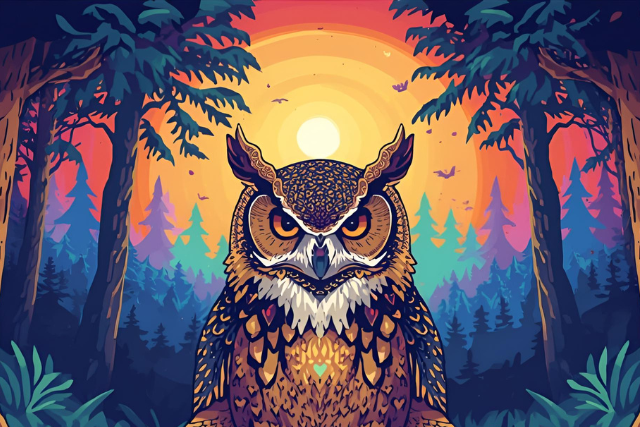
    It took getting kicked in the face by a great horned owl to wake me up. And I mean that literally.

    The Moment It Broke Open

    It was one of my regular volunteer shifts. I’d worked with this particular great horned owl before—had caught her successfully more than once. It felt like business as usual: enter the enclosure, take a breath, begin the catch.

    Except this time, it wasn’t usual. And I wasn’t ready.

    I took my eyes off her for a split second. That’s all it took.

    She flared, leapt, and with perfect precision, delivered a full-force kick to my face before escaping.

    Pain blurred into shock. And then into shame.

    Wounded pride doesn’t begin to describe it. My confidence evaporated. I had spent months building trust, practicing skill, stepping into this work fully. And yet, in one moment, it all felt like it had unraveled.

    I looked at my reflection in the mirror—face aching, spirit heavy—and the truth landed with brutal clarity:

    I’m not on top of my game. And I’m making rookie mistakes. Because I’m too tired to see straight.

    The Grief of Letting Go

    People talk a lot about burnout. But they rarely talk about how hard it is to walk away from something that feels meaningful.

    I wasn’t just physically drained—I was emotionally split. My time in raptor land had changed my life. It gave me resilience I didn’t know I had. It helped me feel grounded during periods of personal chaos. It reminded me that healing is messy and wild and worth it.

    The idea of letting go wasn’t just sad. It felt unbearable.

    And yet, I knew I had to. Not out of failure. Not even out of fear. But because continuing at the pace I was going—without rest, without recalibration—wasn’t sustainable. I was breaking. Slowly. Quietly. And now, visibly.

    Letting go wasn’t graceful. It was layered and raw.

    I cried. I wrestled. I tried to bargain with the truth.

    And when I finally stepped back, I didn’t feel immediate relief. I felt lost.

    The In-Between Is a Sacred Space

    People don’t talk enough about the in-between.

    That space where you’ve left something but haven’t landed in something new. Where you know what isn’t right anymore but aren’t sure what will be right next.

    It’s disorienting. It’s vulnerable. It’s uncomfortable.

    I wasn’t who I used to be—the eager, confident raptor catcher with fresh adrenaline in her chest. But I wasn’t yet someone with clarity about where to go next. My body needed rest. My spirit needed stillness. My heart needed time.

    But my mind? My mind wanted control. It wanted answers. It wanted speed.

    The in-between demanded something softer.

    It didn’t want me to leap. It wanted me to linger. To listen. To relearn what strength looks like when it’s gentle, not forceful.

    It’s the space where grief becomes teacher. Where identity sheds its armor. Where you realize you don’t just miss what you did—you miss who you believed you were when you did it.

    What That Owl Really Taught Me

    Yes, the kick hurt. It disrupted my rhythm. But more than anything, it delivered a message that I had been resisting:

    Even the things that change your life aren’t always meant to stay forever.

    There’s a difference between honoring a season and clinging to it. I wasn’t just volunteering—I was gripping. I was folding myself around an identity that made me feel capable, valuable, essential. I didn’t want to lose it, so I ignored the signs. I numbed out the signals. I kept showing up while my body whispered, “Not this.”

    And then it stopped whispering. It got loud.

    That owl didn’t punish me. She mirrored me.

    And once I heard what she mirrored back—once I stopped resisting the truth—I began to ask what my grip had been keeping me from.

    What Letting Go Made Room For

    Letting go didn’t mean losing everything I loved. It meant loosening my grip long enough for something gentler—and more lasting—to find me.

    I didn’t leave raptors behind. I shifted toward a deeper kind of care—one rooted in conservation, long-term observation, and relational presence. Nest monitoring, habitat awareness, quiet stewardship that still creates impact, but from a place of balance.

    It wasn’t about giving up my place in raptorland. It was about learning to show up differently—without the urgency, without the exhaustion.

    I’m rediscovering who I am in this space now. Someone who listens more. Who stays longer. Who works with the rhythm of the wild, instead of rushing through it.

    Change doesn’t always mean departure. Sometimes it just means choosing a slower path, a softer landing, and a future built on sustainability—in nature and in self.

    If You’re in the In-Between

    If you’re standing in that strange, sacred middle—between what was and what’s next—I see you.

    It’s not weakness to feel unsure. It’s not failure to step back. It’s not quitting to admit you need rest. The in-between is tender. It’s transitional. And it’s necessary.

    Whether it arrives through heartbreak or a literal kick in the face by an owl, change will always come to escort you out of what no longer serves—even when you swear it still does.

    You don’t have to leap before you’re ready. You just have to be willing to pause. To ask:

    What am I gripping that’s already trying to release me?

    What would it mean to let go gently, instead of waiting to be torn?

    Can I honor the season I loved without dragging it forward?

    Your next chapter doesn’t need to arrive with fanfare. It may enter quietly, through silence, through softness, through surrender. But it will arrive.

    And until it does, the pause is not empty. It’s everything.
  • When You Outgrow Where You Live but Can’t Yet Leave

    When You Outgrow Where You Live but Can’t Yet Leave

    “Living in the moment is learning how to live between the big moments. It is learning how to make the most of the in-betweens and having the audacity to make those moments just as exciting.” ~Morgan Harper Nichols

    There’s a peculiar grief that doesn’t often get named. It lives in the moments when you’re neither here nor there. When you’re packing in your mind but still waking up to the same kitchen.

    When your soul says go, but your bank account or relationship or circumstance says not yet.

    It’s the grief of the in-between, an ache I’ve been swimming in for weeks now, maybe longer.

    My partner might be offered a job soon, or he might not. We might move to Geneva and finally have a place of our own again: furniture, friends, rhythm.

    You see, we’ve been nomadic for five years now. In 2020, we packed up all our stuff and put it into storage just when the pandemic hit and when we moved to Porto in Portugal. Italy, France, Sweden, and the UK followed. My partner now needs more stability again, and I’m not sure what I need yet.

    I might take a leap, board a plane to Chile or China, and follow the whisper that says something there might change everything. I can’t plan anything yet. Not really. And it’s eating me alive.

    I’m not new to longing. I’m half German, and there’s a word we hold close in our language: Fernweh.

    It doesn’t have a perfect English translation, but it lives somewhere between wanderlust and homesickness—not for home, but for somewhere else. For a life not yet lived. For a distant landscape that feels like it’s calling your name, even if you’ve never been.

    Historically, Fernweh has roots in the Romantic period, when writers and artists felt the pull of faraway lands, not to conquer them, but to feel alive inside them. It’s the ache of the horizon. The hunger for distance.

    A soulful discomfort with too much sameness.

    German Romanticism gave rise to this ache. Writers like Johann Wolfgang von Goethe, Heinrich Heine, and later Hermann Hesse lived and wrote from this place of longing.

    As the writer Goethe reflected during his Italian Journey, “Architecture is frozen music,” and he confessed that “the spirit of distant lands was what I needed to restore myself.”

    I feel it now in every cell of my being.

    And even when I’ve answered its call—wandering through Egypt alone last year, losing myself in Istanbul for a month, and living in Bali for two months—I’ve met Fernweh’s twin: homesickness. The longing for my dog, my partner, my kitchen table and shared meals, the known.

    So I always find myself in that strange space between Fernweh and a desire to live a more rooted life. Between craving freedom and craving familiarity. Between the desire to disappear into a new culture, a new version of myself, and the desire to stay close to what grounds me.

    But this time, something’s different.

    I’m not craving the high of escape. I’m craving the quiet of returning to myself. Not in a performance way. Not in a spiritual branding way.

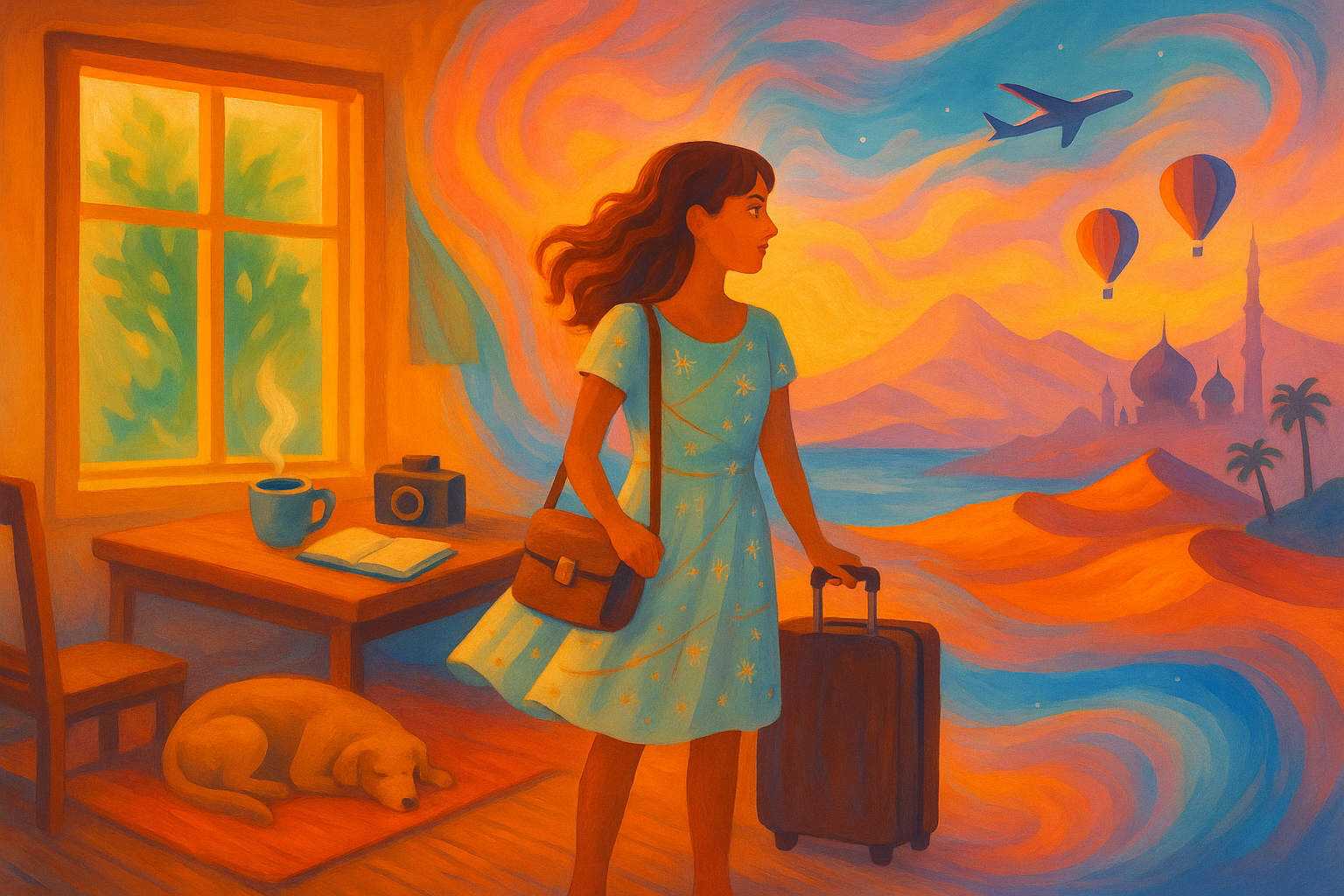
    Just me. A woman with a suitcase. A woman with a camera. A woman with grief in one pocket and curiosity in the other.

    And I’m learning to name this ache not as a failure but as a truth.

    This is the grief of the in-between. The ache of belonging to no one place, because your soul is too wide for borders.

    I used to think I had to choose. Be the grounded woman in a relationship, in a city, building something. Or be the nomad—alone, rootless, following the next passport stamp.

    Then I met my partner, with whom I could be both for the last five years. Now that he wants to settle somewhere long-term again, I wonder what I should choose.

    Or rather, I wonder if the real work is in the not choosing. But allowing both to live inside me. To let myself miss what I’ve left whenever I roam this world alone without him. And to let myself love what I’ve built whenever I live a settled life with him.

    Because the truth is, sometimes, I want to light incense in a place that’s mine. Sometimes, I want to wander through Shanghai with a notebook and no one waiting for me at home. Sometimes, I want both on the same day.

    And I know I’m not alone.

    There are so many of us soul-wanderers, soft-seekers, sitting in limbo. Waiting for clarity. For visas. For a sign. Wondering if we’re selfish. Wondering if we’re just lost. Wondering what the f*ck we’re doing with our lives while others seem so clear.

    If that’s you, I just want to say: you’re not failing.

    Your ache is evidence of your depth. Your longing means you’re alive. Your uncertainty is sacred. And your desire to hold both freedom and rootedness is not a contradiction. It’s a gift.

    So here I am, still waiting to know what’s next. Maybe Geneva. Maybe China or Chile. Maybe somewhere I haven’t dreamed up yet.

    I don’t have answers. But I have language now. And language has always been my bridge back to self.

    I used to think the ache meant something was wrong. That I had to pick a lane: freedom or stability. But now I know: the ache is a compass, not a curse.

    The real lesson? Maybe we don’t need to fix the ache. Maybe we just need to learn how to live with it. To stop asking ourselves “Where should I be?” and start asking “Who am I becoming?”

    Maybe that’s all we need in the in-between. Not a plan. Not a flight. But a sentence that lets us breathe. And for me, today, it is this:

    My task is not to end the ache but to build a life that lets me hold both: the longing to go and the ache to stay.

  • The Growth That Happens When You’re in Between Chapters

    The Growth That Happens When You’re in Between Chapters

    “The most powerful thing you can do right now is be patient while things are unfolding for you.” ~Idil Ahmed

    When one door closes, another one opens, or so the saying goes. From experience, I know that the new door doesn’t always open right away. Often you spend some time in the hallway, the state in between what has been and what will be.

    About two years ago I decided to quit my job. While I was in the process of making big decisions, I decided to give up my apartment and go abroad for a period. I didn’t have a super thought-out new plan, but I just felt like it was time to move on.

    When my loved ones expressed their doubts about my plans, I waved them away, certain I would figure it out. And to be honest, I kind of expected the new plan to just happen to me as soon as I made the decision.

    For most of my life, the phases between jobs, relationships, and living spaces followed each other neatly. I fully expected this time to be no different.

    You can imagine my surprise when this time the new phase didn’t start immediately. Answers, opportunities, and big synchronicities didn’t just fall at my feet. What I got instead was a lot of confusion and self-doubt.

    In the middle of all this, my long-term relationship ended, which added another element of uncertainty to my life. I was in the hallway, and it felt like I was waiting for the door to appear.

    One way or another, most of us spend time in the hallway during our lifetime. The hallway is that phase between two chapters of life when nothing seems to happen. This in-between phase can take many shapes and forms.

    Sometimes you end up there by choice, like when you take a sabbatical or choose to spend some time focused on yourself. Other times the decision is made for you: perhaps your physical or mental health forces you to take a pause. Maybe you are let go from your job, your business closes, or your partner chooses to end your relationship.

    There is also the space between where we think of something we want to bring into our lives—anything from a business to parenthood—and where it comes into fruition. That period can also feel like an in-between phase, where we are not yet where we want to be, but we are very focused on getting there.

    We want to be there and forget to enjoy that we are now here. Rather than enjoying the journey and all the little steps along the way, we focus on where we feel like we should be.

    Most of us don’t want to spend time in the in-between. It can be a highly uncomfortable time, as there is a lot of uncertainty involved.

    It can feel like being stranded in the middle of the desert: Everything looks the same, and nothing orients us in any direction. We don’t know how long the period will be or where we will go next. It can make us doubt everything we thought we knew and believed in, and that can be unsettling.

    There are different strategies to take in the in-between phase. I know, because I have tried all of them, with mixed results.

    You may choose to frantically knock on all doors until one of them opens. The problem with this strategy is that, while understandable, this is a fear-based approach. Rather than deciding from a deep sense of trust in yourself and life, you become attached to the door that opens.

    There’s also the option of lying on the floor and waiting for the door to present itself. While that works at times, it is not the most empowering strategy. It is also a slippery slope into a bit of a victim mentality when things take longer than you expect.

    And then there’s the option to see this period as an opportunity. A chance to get to know yourself better and become familiar with your own fears and doubts, hopes, and longings. If you let it, this phase can bring you closer to yourself and allow you to move forward in a more authentic, aligned way.

    It took me a little longer than I care to admit to move from strategy one and two into the third, but when I finally did, these were some of the lessons I learned.

    1. When you lose something that feels essential to your self-worth, you learn who you are without that part.

    Most of us feel quite attached to certain parts of our identity, whether it is our job, relationship, or an idea we have about ourselves. The more we attach our self-worth to a door that has been closed, the more uncomfortable this phase will feel. And the more we probably need this time.

    The in-between phase gives you a chance to see who you are without all the things you thought you were. In that process, you are invited to recognize that your worth is so much more than those identities.

    I had always seen myself as someone who followed her intuition and was courageous enough to follow her own path. In my relationships, I had taken on the role of encouraging others to do the same. When I felt neither certain nor courageous, I learned that I was still a caring friend and family member. Opening up about my feelings made other people feel safe about sharing their deeper feelings as well.

    No one is meant to take on one role; we are all multifaceted beings, and all of our parts are valuable.

    2. A period of uncertainty gives you the chance to become more resilient to fear.

    At times, your biggest fears come true in this in-between phase. And that is truly frightening. But it’s also a great opportunity. When what you deeply fear is happening, you have a chance to integrate that fear so that you are no longer so controlled by it in your day-to-day life.

    It gives you a chance to process it rather than just simply hoping it never happens. And with that, it can give you great freedom. If this happens, and you can handle it, then perhaps you are capable of more than you thought.

    When I was in limbo, I realized I had this deep fear that my life wouldn’t really go anywhere, and that I would never be able to live up to my potential. It made me feel deeply afraid of failure and rejection, as I felt that these experiences would confirm my core fear.

    In the process of creating a new path, I faced my share of failure and rejection. Initially, the feelings that came up would overwhelm me, and I would want to give up trying. But gradually, as I learned to process these feelings, I found a deeper sense of safety within.

    As uncomfortable emotions come up, learn to feel them in your body. Become familiar with the sensations and just breathe. Implement tools to calm your nervous system—like deep breathing or listening to calming music—so that you can regulate yourself back to safety.

    The more comfortable you become with uncomfortable emotions, the more resilient you become to them. You then no longer have to avoid the things you fear, which could potentially bring you great happiness.

    3. An in-between period is a chance to move forward in a different way.

    There is usually a paved path in relationships, career paths, and life in general, with a logical next step to take. So often in life we take that next logical step, rather than reflect on whether that aligns with our deepest longings.

    It is challenging to go off that paved path and into the wilderness, but it is greatly rewarding as well. An in-between period forces you to make a conscious choice: Do you want to keep going as you did before, or are there changes you would like to make moving forward?

    As you learn to find safety in the uncertainty and let go of your attachments to things that weren’t quite right for you, you open space to move forward differently. With a newfound trust in your resilience and a deeper knowledge of yourself, it becomes much easier to make decisions that are deeply aligned with you.

    4. Change is often gradual and can only be seen clearly in hindsight.

    There are moments that propel you into a new stage of life from one moment to the next. But often, there is not one big earth-shattering moment that changes everything. The hit-by-lightning breakthrough moment where you suddenly know exactly what to do does not always come.

    Rather, change is often a gradual process that you can only fully see when you look back on it. It is a combination of lots of little steps and lessons and a gradual integration of the emotions that the change brings up. When you fully embrace that, it is powerful.

    It means that you don’t have to dig for answers or figure everything out at once but learn to trust that the things you do every day matter. Life has natural rhythms and seasons, just like nature does. Some seasons are big and exciting, while others are slower paced.

    Looking back now, I can see that I learned to gradually replace my fear-based choices with options that felt more aligned. It started with seemingly small things, like my morning routine and the recipes I cooked, and evolved into starting my own business and deciding to move closer to the ocean. In the stillness, I learned to sit with my feelings and take tiny steps towards sustainable change.

    And so perhaps, as we move toward the door that will inevitably show up at some point, we notice that the hallway isn’t just a space between the two doors. It is a room all by itself, a necessary and fruitful phase of life. We learn that we are never in-between, as we are always growing, evolving, and simply living.