Tag: imperfection

  • Where Our Inner Critic Comes from and How to Tame It

    Where Our Inner Critic Comes from and How to Tame It

    “Your inner critic is simply a part of you that needs more self-love.” ~Amy Leigh Mercee

    We all have that critical and judgmental inner voice that tells us we’re not good enough, smart enough, pretty enough, etc.

    It tells us we don’t do anything right. It calls us stupid. It compares us to other people and speaks harshly about ourselves and our bodies. It tells us all the things we did or said “wrong” after communicating or connecting with someone.

    Sometimes it projects criticism outward onto others so we can feel better about ourselves. Other times we try to suppress our inner critic through overachieving, being busy, and accumulating more and more things.

    Sometimes it’s a protective mechanism that’s trying to keep us focused on our self-judgments so we won’t be authentic, because, if we are, we may be rejected and not get the love and acceptance we want.

    But, by doing this, we’re creating even more pain and suffering because we’re disconnecting from and rejecting our own essence.

    Just ignoring the critical voice doesn’t always make it go away. It may initially, but soon enough it will resurface if we haven’t healed/embraced our hurts, traumas, and wounds and shifted our internal patterning, which is where it comes from. 

    Have you ever heard the expression “What we resist persists?” Have you ever told an angry person to “just calm down” or a screaming child to stop crying? Does it work? Not when our energy is in a heightened state.

    Why is someone angry? Why is a child screaming and crying? Because there’s something going on internally that’s creating how they’re behaving. There’s often an unmet need or pain that’s asking for attention.

    Thinking a more positive thought to compensate can sometimes work, but sometimes it just creates an inner debate and mistrust in ourselves because deep inside we don’t believe what we’re saying.

    As children, many of us were taught to suppress those “bad” feelings because if we expressed them, we may have been or were punished. Welcome to the beginning of the critical voice; it’s often a frightened part of us that’s wounded and asking for attention. It wants to be seen, heard, and understood.

    My dad used to get really frustrated with me and constantly told me, “Damn it, Deb, you never do anything right.” Hearing that many times left an imprint in my subconscious. I started living with that interpretation of myself, and the critical voice kept me “in check” with being this way.

    For me, the critical voice was my dad’s voice as well as the deep shame I was feeling for making mistakes and not doing things the “right way.”

    I was holding in suppressed anger, sadness, guilt, unforgiveness, resentment, traumas, and pain that I tried to keep hidden with a smile on my face, but eventually it turned into a shame-based identity.

    My inner voice criticized me whenever I fell short or wasn’t perfect according to society or my family’s expectations.

    Just like when we’re triggered by another person, our critical voice is asking for our attention and guiding us to what needs healing, resolving, forgiving, understanding, compassion, and unconditional love.

    When it comes to the surface, we’re experiencing an automatic regression; it’s a part of us that’s frozen in time. It’s a reflection of our unhealed wounds, which created ideas of not being enough or that something’s wrong with us. Basically, it’s a trance of unworthiness.

    When we’re in a trance of unworthiness, we try to soothe ourselves with addictive behaviors. It’s hard to relax because we think we need to do something to be better and prove ourselves, so not doing anything, resting, isn’t safe.

    When we’re in a trance of unworthiness, it’s hard to be intimate with others. Deep inside we think there’s something wrong with us, so we don’t get close because they may find out and leave. This keeps us from being authentic because we don’t feel okay with who we are.

    Deep down I felt unworthy, unlovable, and undeserving, and the critical voice showed me what I was feeling and believing. I didn’t feel safe in life or in my body. How could I? I was living with so much hurt, pain, and shame inside.

    The critical voice is often stronger for those of us with unhealed wounds and who are hard on ourselves, and it tries to get us with shame and guilt. We’re always looking at ourselves as the “good self” or “bad self,” and if we’re identified with a “bad self,” we’ll act in accordance with that in all areas of our life.

    If we’ve become identified with the critical voice, it’s who we think we are; it just seems normal. And when we start to be more kind and loving, it doesn’t seem right because our identity becomes threatened and our system registers that as danger.

    That happened for me. Eventually I became identified with being a “bad girl” who’s critical and hard on herself, and, even when I started being a little kinder, more compassionate, and more loving, I felt an angst in my body. It wasn’t familiar, and even deeper, it wasn’t okay for me to be this way. My survival was at stake, so I would automatically go back to self-criticizing and judging, without conscious awareness.

    The critical voice didn’t only speak to me harshly; it also told me to do self-abusive things like cutting my wrists and face, starving my body or eating lots of sweets, and exercising for hours like a mad woman to get rid of the food I ate, whether it was a carrot or sweets, because I felt guilty. 

    Even after twenty-three years of going in and out of hospitals and treatment centers, taking medication, and doing traditional therapy, nothing ever changed; the critical voice had a hold on me.

    It was a powerful force, and when I tried to stop it, it would get louder. It thought it was protecting me in a backwards sort of way; if it hurt me first, no one else would be able to do so.

    When people used to say to me, “Debra, you just need to love yourself,” I looked at them like they were crazy. I had no concept of what that even meant because I had no experience of it.

    What I’ve come to see with myself and those I assist in their healing is that the more we keep our deep hurts, traumas, anger, guilt, shame, and pain hidden, the more the critical voice chimes in.

    And, for some, like me, it seems overpowering, so we try to find relief through smoking, drinking, eating, or being busy, and/or we experience severe depression, anxiety, or self-harming.

    When we’re consumed by the critical voice, we’re disconnected from our true essence, and when we’re disconnected from our true essence, the love within, we feel a sense of separation; we don’t feel safe with ourselves or others, and we don’t feel lovable for who we are, as we are.

    This is why many people can change, be happy for a day, but then go back to their critical and/or judgmental ways. Our automatic programming, stemming from our core beliefs, kicks in. It’s just like an addiction, and in a sense it is.

    We can try meditating, deep breathing, and positive thinking, but, unless we address the underlying cause, we’re likely to keep thinking the thoughts our internal patterning dictates. They come from a part of us that doesn’t feel loved or safe.

    So, what do we do when the critical voice comes to visit?

    What do we do when it’s what we’re used to, and it just happens automatically?

    What do we do when we don’t know how to be with ourselves and how we’re feeling in a kind and compassionate way?

    What do we do when we have no concept of what it even means to experience self-love or ease in our bodies?

    First off, please don’t blame yourself for how you’re being. Awareness isn’t about judgment; it’s about kindness, compassion, and love.

    Working with and healing our traumas, where the critical voice was formed, is key in shifting our internal energy patterning. Many people call this inner child healing and/or shadow working. 

    This is a soft and gentle process of moving through the layers of trauma with compassion and love and making peace with our protector parts.

    Through inner child healing, we can shift and transform that “negative” patterning and how the energy is flowing in our body. We can help that part of us that’s frightened, hurting, and maybe feeling separate have a new and true understanding so we can feel loved and safe in our bodies.

    When we pause and take a deep breath when we first hear or sense the critical voice, it allows our nervous systems to reset and helps us come back to the present moment; this allows space for compassion, healing, and investigation.

    Why do I believe that?

    Where did I learn that?

    Is it true?

    How does my higher self see this and me?

    Does the critical voice totally go away? No, it may still chime in; it’s part of being human. But once we realize where it’s coming from and heal/shift that energy pattern, more love can flow through, and we can experience our truth. When we learn how to be our own loving parent and meet the needs our caregivers didn’t meet when we were children, the critical voice often softens.

    Remember, the critical voice is just a scared part of us who really wants attention, love, and a way to feel safe. When we no longer take it personally, when we’re no longer attached to it as our identity, we can offer ourselves compassion, understanding, love, truth, and whatever else we’re needing.

    Life can be messy, and our thoughts can be too. This isn’t about perfection; this is about experiencing a deeper connection with our loving essence.

    There’s a sweet and tender spirit that lives within you. This spirit is your deepest truth. This spirit is the essence of you. You’re naturally lovable, valuable, and worthy. You’re a gift to humanity. So please be kind, gentle, loving, and caring with yourself.

  • If You’re Trapped Under a Pile of “Should” and Tired of Feeling Unhappy

    If You’re Trapped Under a Pile of “Should” and Tired of Feeling Unhappy

    “Stop shoulding on yourself.” ~Albert Ellis

    I was buried under a pile of shoulds for the first thirty-two years of my life. Some of those shoulds were put on me by the adults in my life, some were heaped on because I am a middle child, but most were self-imposed thanks to cultural and peer influence.

    “You should get straight A’s, Jill.”

    “You shouldn’t worry so much, Jill.”

    “You should be married by now, Jill.”

    “You should get your Master’s degree.”

    I could go on forever. The pile was high, and I was slowly suffocating from the crushing weight on my soul.

    What’s so significant about age thirty-two? It’s when I decided to divorce my husband of eighteen months (after a big ole Catholic wedding) and ask my parents for money to pay the attorney’s retainer. This is a gal with a great childhood, MBA, and a darned good catch for a husband.

    From the outside, our life looked charmed and full of potential. We’d just purchased our first home, were trying to start a family (despite suffering two miscarriages) and were building our careers. What no one else saw was the debilitating mountain of consumer debt, manipulative behavior, and my intuition’s activated alarm system… sounding off in reaction to the life I’d built and was, for all intents and purposes, stuck in.

    My intuition was done with the low-level warnings. She was sick and tired of being ignored, so she sounded the big one—an alarm that demanded action instead of lip service. I still tried challenging her; what she had presented me with was asinine.

    “But I can’t divorce him. We just got married. What will everyone think? I’m so embarrassed. I should have made better choices. How did I end up here? I did everything right, right? I should suck it up and stick it out; that’s what good Catholics do. This is kind of what life is, I guess… kinda sad, but it seems to work for most everyone else. Ugh, I wanted this… now I’m, what, changing my mind?”

    The alarm was not going to shut off until I sat long enough with those notions to yield honest answers. That was some tough sh*t to sit in. And even tougher to plod through. But it was better than being buried under it.

    This was my first lesson in “There’s only one way out of this mess.” There’s no express lane, no backroad, no direct flight. This ride resembled the covered wagon kind. Bumpy, hot, dirty, and uncomfortable as hell.

    I relented, listened, and tapped into the hidden reserve of courage I didn’t know existed within me.

    The time had come to quit living according to the “should standard” everyone else around me had subscribed to. The time had come to accept this curated life was not the one that would yield happiness for me. The time had come to turn up the volume on this newfound voice and assert to myself (and everyone else) that I was cutting my losses and trusting my inner compass.  

    The time had come to stop shoulding myself.

    Shoulds were my grocery list, my roadmap for life. How was I going to do this adult thing without my instructions???

    I’d already managed to clear a huge should—hello, divorce—and after that, with every should I challenged, another paradigm crumbled. I began to notice shoulds all over the place. After that, my awareness of intention got keener, and I could sniff out the subtle shoulds like a bloodhound.

    SHOULD: When are you having kids?

    CHOICE:  I do not want to have children. (Remember I miscarried twice with my first husband. I was checking boxes on my adulting grocery list. Honesty yielded clarity.)

    SHOULD: He’s too old for you and he has four boys of his own.

    CHOICE:  He is my person. His sons deserve to see their father in a healthy, happy relationship. I can show them love in a new, different way.

    SHOULD: You’re making great money in your job. Why walk away from your amazing 401(k) and great benefits to risk starting your own business?

    CHOICE:  I want to build a life I’m not desperate to take a vacation from. I want to live, serve others, and know when I’m at the end of my life that I chose it and made the most of it.

    Deleting the word “should” is a big first leap in taking ownership of your life. By altering your vocabulary in a simple way, you naturally become mindful of the words you put in its place. Instead of “I should….” substitute with “I choose to….” Instead of “You should…” try “Have you considered…?”

    Keep track of every time you say or hear “should” in a day. Then spend time with each one and get toddler with yourself. Ask why. Ask it again.

    Who says you have to get married or have kids or work a job you hate that looks good on paper? Who says you have to look a certain way or do certain things with your free time that don’t appeal to you? Why are you restless in your life? What idea keeps popping up, begging for your attention? Are you living your truth? What’s in the way? What pile of shoulds are you buried under?

    I get it. We’ve been programmed by our culture and our family traditions to follow the path, stay on course, climb the ladder to success! It’s the only way to be happy, they say. It’s the only way we’ll be proud of you, they insinuate.

    We’ve been indoctrinated with this thought pattern and belief system, and it seems impossible that we have the power to choose otherwise. We have the opportunity, the autonomy, the choice to rewire our iOS and make it what is ideal for ourselves.

    Overwhelm is natural; the antidote is to start small. Find one piece of low-hanging fruit, take a bite, and taste how sweet it is. For example, say no to an invite if you’d rather spend your time doing something else. Allow yourself to do nothing instead of telling yourself you should be doing something productive. Or let yourself feel whatever you feel instead of telling yourself you should be positive.

    Feel how nourishing it is to choose yourself. Experience satiety in your soul. Release restlessness and replace it with intention guided by your intuition.

    Do that and you’ll never should again. Or maybe you will—who says you should be perfect? At the very least you’ll think twice before letting should control you, and you’ll be a lot happier as a result!

  • I Was a Bulimic Nutritionist, but I’m No Longer Ashamed or Hiding

    I Was a Bulimic Nutritionist, but I’m No Longer Ashamed or Hiding

    “Shame derives its power from being unspeakable.” ~ Brené Brown

    I felt like a hypocrite. I would tell my nutrition clients to eat a salad with vegetables, then I’d go home and scarf down an entire pizza. After guilt and shame set in, I would purge and throw it up.

    I think I became a nutritionist partly so I could better control my relationship with food. If I learned the secrets behind eating I could biohack my way to putting the fork down, losing weight, and finally being happy. This was back when I thought thinness equaled happiness.

    It’s taken me over ten years to recover from an eating disorder. Years filled with perfectionism, shame, and isolation as I untangled that my worth is not tied to my weight. I share my story in hopes that it sparks a deeper dive into your own relationship with food.

    Growing up I was an over-achieving, people-pleasing perfectionist. Which by itself may have been fine but, paired with a sexual trauma I experienced in early University, it was the perfect storm for developing an eating disorder.

    I used food as a coping mechanism for the trauma I’d endured. It was a way to dissociate from having to feel the shame of being assaulted. I assumed it was my fault this terrible thing happened, and while eating as much and as fast as possible, I could numb out from strong emotions.

    For a short period of time, I was worry-free.

    But then inevitably came the guilt and shame—ironic, since I was trying to numb the shame of my assault with food.

    Why did I have to eat so much? Now I’ll gain weight, and if I gain weight no one will like me. Why don’t I have the discipline to control my food? To control myself? I am truly worthless.

    Somehow my brain had built the association between looking a certain way and being accepted, worthy, and even safe. Having a sense of control over what I ate and how I looked made me feel powerful in a way. And maybe subconsciously it gave me a sense that I could also control what happened to me.

    I knew I needed help in University when after purging for the third time one day I had a sharp pain in my chest. Bent over the toilet, clutching my heart, I realized things had gotten out of control.

    Luckily, before I lost my nerve, I set up an appointment with a counselor. And there began my long and twisty road to recovery from bulimia. A word I would rarely utter in the coming years, instead referring to it as my “food issues,” downplaying the severity of my illness. Bulimia was something only celebrities developed, not something a straight-A student like me could encounter.

    Wow, was I ever wrong! Along this journey I’ve met many others like me, and I discovered we had more similarities than differences. We put immense pressure on ourselves to be perfect, had an insane need to control everything, and we all felt deep shame about our behavior. Many others I met had also experienced trauma and used food to soothe.

    In 2008, when I first sought treatment, I worked in secret on my recovery, only talking with a counselor and a doctor. I needed weekly blood tests to ensure my electrolytes were balanced. Turns out purging is very hard on the body, something my lack of tooth enamel will attest to.

    It was years until I told friends and family, and even now many will be shocked reading this article. It was easy to hide from roommates, as I would binge alone in my room and come up with creative reasons to use the bathroom when needed. Sometimes even purging into bags in my room then disposing of it later.

    In 2013, after a few weeks of some particularly painful binging sessions, a doctor told me I had lesions in my throat. I could barely swallow, having to sip smoothies through a straw. And my first thought was:

    Yay, now I’ll definitely lose weight.

    Thankfully, it was followed by a second thought.

    This is dumb. I’m putting my health at serious risk here… to be thin? That makes no sense.

    That’s when I knew I needed to kick my recovery into high gear. I started out-patient treatment in Toronto and attended support groups with others like me. I learned to sort through complicated emotions and release my need for everything to be perfect. In short, I was on a great track.

    But here’s the thing no one tells you about recovery—it’s not linear. I was settling into my career as a nutritionist, my binging episodes reduced, then someone would make an off-hand comment…

    Wow, you cleaned your plate, you must’ve been hungry!

    And boom, I would spiral out and feel compelled to rid myself of the extra calories. Secretly hunched over the toilet once again, knowing I had failed.

    I didn’t think people would trust my nutritional advice if I gained weight. I was also a yoga instructor at this point and convinced students wouldn’t return to my classes if I didn’t have a lean svelte yoga body.

    I continued the ups and downs of recovery for years. Having to choose recovery every single day was exhausting. Over time, the periods between binges got longer.

    For me, there was no silver bullet cure. It was a combination of using mindfulness to sit with difficult emotions and getting a whole lot of therapy to address the trauma. I never thought I’d get to this place, but eventually I learned to see myself as a worthy person—no matter my past, no matter my size.

    I used to think having an eating disorder was a shameful secret. Now I see that struggle as the source of my strength. It takes an incredible amount of courage to address trauma, and working tirelessly on recovery has taught me how to bounce back over and over again.

    I went through the ringer for many years, having to hide many of my behaviors, and thinking my weight was the most interesting part of me. I share my experience as part of the healing process, to take away the shame that hides in the shadows. I hope it encourages you to examine your relationship with food and your body—and how you might also be using food or another substance to avoid dealing with your own traumas.

    We tend to judge what we’re eating and think of food as something to be controlled, but eating disorders aren’t just about food. They’re a reflection of how we judge ourselves and our need to regain control when we feel we’ve had none.

    If we can come out of the shadows and face our pain and shame, we can start to heal, but it might not happen overnight. It might be two steps forward and one step back, sometimes one step forward and two steps back—and that’s okay. People who struggle with eating disorders are often perfectionists, but we need to accept that we can’t be perfect at healing. It’s a process, and as long as we stick with it, we will see progress over time.

    Now that I’ve worked through the pain of my past, I can finally see that food is something to be enjoyed and celebrated, and I too deserve celebrating, no matter my size. I don’t need to be perfect to be worthy. And neither do you.

  • How I Stopped Feeling Unworthy of Love (And Finally Learned to Receive It)

    How I Stopped Feeling Unworthy of Love (And Finally Learned to Receive It)

    “I hope you find love, but more importantly, I hope you’re strong enough to walk away from what love isn’t.” ~Tiffany Tomiko

    When I was in my early thirties, I briefly dated someone right after my divorce.

    It was one of those fast and furious things that had no label and left me wondering if I made most of it up in my head.

    It wasn’t the first time and it wouldn’t be the last. How many times had I ended up feeling rejected and abandoned? I was trying so hard to impress a partner, but no matter what I did, I only seemed to push them away.

    Tearfully, I shared my pain with a spiritual advisor and psychic and asked for her guidance.

    She suggested I consider the joy that might come out of pleasurable and easeful partnerships. She asked me, “Briana, why don’t you shift your energy and focus to that aim?”

    But it wasn’t so easy. I was attached and hung up on this guy. Why didn’t he love me like I loved him?

    Another thought popped into my head, which I hadn’t realized was there before.

    Before I could voice it out loud, she said, “Oooohhhh, Briana. I can hear you already. You think if you’re not in pain, then your art and other creative works won’t be any good.”

    I burst out into another round of sobs.

    Because it was true. I did think that way.

    I thought I performed at my best when I was at my most miserable, and if you took away my misery, I would not only be common, but worse yet… mediocre. I would truly be the bad artist I always thought I was.

    Every aspect of creative expression would become cliched, trite, and uninteresting. There wouldn’t be anything special about me.

    And so I would become unlovable.

    The drama proved my worth, one way or the other; the drama of performing well enough to earn love. 

    It wasn’t until four years after that conversation that I finally stopped clinging to my pain.

    Because I realized that pain didn’t make something (love) more authentic—it just made it more difficult.

    Maybe you know where I’m coming from. Maybe you feel that you, too, need to “chase” a relationship and suffer for it to really matter. For you to really matter.

    That’s just not true. There is a far better way to build relationships, and that’s what I would previously have called “boring” and “too easy,” but actually is about respecting your own, authentic self and opening up to love.

    Here’s what I’ve learned about letting go of feeling unworthy of love and finally learning how to receive it.

    1. Take off your mask.

    Like me, you might believe that to attract a lover and be worthy of love, you have to pretend to be a perfect partner, through things like making them feel wanted and desired, looking beautiful, and being funny, witty, smart, and interesting all the time.

    All of these tactics might very well appeal to a potential partner. Certainly, it might make them interested enough to get to know you better, and maybe even date you for a while.

    But none of that means it will soften their heart and make them fall into a soul-shaking relationship with you.

    In fact, while I used to think that I needed to pretend that I was something I wasn’t so that I’d be worthy of love, I just kept deterring the other person.

    Why?

    Because while the glitz and glamour are appealing, it also, on a deeper level, left me completely unavailable.

    In the same way, you are pushing away a partner by performing all the time.

    You see, your partner is going to feel as if they have to perform just as well, and while that may be exciting in the beginning, unless the mask comes off, it also gets exhausting very quickly.

    A loving partner will be less concerned about how many degrees you hold or how much you make at your job and more concerned that you’re passionate about what you’re doing.

    A loving partner doesn’t care how many facts you can recite. They may enjoy your company if you’re a great conversationalist, but that won’t necessarily make them feel something for you.

    The way to a partner’s heart is to make them feel safe enough to explore and experience their own authentic self.

    You do that by feeling safe enough to express yourself—without someone else’s permission.

    Because if you don’t communicate that you’re comfortable in your own skin, this partner won’t feel comfortable or safe opening up to you, either.

    And if a person can’t open up to you, warts and all, they can’t fall in love with you. It’s as simple as that.

    When you put on a performance instead of taking off your mask, you unconsciously communicate a fantasy of reality, because that feels safer than vulnerability. And then you energetically and non-verbally tell your partner that you can’t handle their vulnerability, either.

    And isn’t it freeing? You, in all your vulnerability, are the person they want and need in order to be their own, true self.

    2. Get in touch with your own feelings.

    What many of us do when we feel unworthy of love is numb our emotions and pretend we feel something other than we actually do.

    But a loving partner wants to know you’re angry when you’re angry and why you’re angry.

    Guess what happens if you’re acting one way, while feeling something else? That’s right, drama.

    If they think you’re angry, but they are not sure, because you’re trying hard to plaster a smile on your face, say, “I’m fine,” and stuff it down, you’re not really fooling anyone, just confusing them.

    Your energy and your verbal expressions are going to contradict one another, and that is the seed of dramatic conflict.

    And this type of drama is so annoying because you are effectively keeping a partner at bay, and refusing to connect with them, for fear that they wouldn’t like the “real” you.

    But because they can’t access “the real” you, there’s no real glue holding them there, and they wind up leaving you anyway.

    So show them what you feel, while letting go of the fear that they will reject you for doing so. By reconnecting with your emotions, you show up as your authentic self and make it safe for them to love you.

    3. Be open to meeting someone with the same level of consciousness.

    Around the end of August last year, I started dating someone. He wasn’t originally what I would have imagined for myself, but he turned out to be exactly what I need.

    Right from the get-go, things went really well; we talked for hours on end, and I felt an instant connection.

    There were butterflies, yes, but not the kind of gut-twisting, obsessive sensations I have had in the past, which usually means I should run.

    This was more like, “Ah, you fit nicely… and kinda feel like home. What took you so long?”

    He shows up with fresh flowers, texts me “good morning,” and sees the humor in situations like that time my cat got jealous and bit him when he tried to kiss me.

    While before, I would have instantly dismissed this type of relationship as being too easy (and the lack of drama would have shown me that it wasn’t real love), I now see it for what it is:

    A relationship in which partners join together from a place of inspiration, as opposed to a fear-based need to be filled up with the other.

    This is a partner who already has a higher level of consciousness and is looking for purposeful building. There’s no drama, there’s no chasing, and there are no games or acts.

    This is the key to feeling worthy of and receiving love—finding a partner who is open to the same. The criterion for attracting such a partner, however, is that you are ready to meet them.

    I wasn’t ready four years ago. It took me that long to go from believing that relationships had to be a rollercoaster of emotions to opening up to a loving partnership.

    Ultimately, it’s about you finding your authentic self and realizing that this version of you (the real version) is so worthy of love and should be loved. That’s the premise for a relationship that, instead of being soul-sucking and anxiety-ridden, is the perfect space for self-growth and joy.

  • A Life-Changing Insight: You Are Not a Problem to Be Fixed

    A Life-Changing Insight: You Are Not a Problem to Be Fixed

    “I decided that the single most subversive, revolutionary thing I could do was to show up for my life and not be ashamed.” ~Anne Lamott

    I remember one particular clear, cold winter morning as I returned home from a walk. I suddenly realized that I had missed the whole experience.

    The blue, clear sky.

    The lake opening up before me.

    The whisper of the trees that I love so much.

    I was there in body but not embodied. I was totally, completely wrapped up in the thoughts running rampant in my mind. The worries about others, work, the future; about everything I thought I should be doing better and wanted to change about myself… it was exhausting.

    Alive, but not present to my life. Breathing, but my life force was suffocated.

    This was not new. In fact, up until that point I had mostly approached life as something to figure out, tackle, and wrestle to the ground. This included my body, my career, and the people around me. 

    My tentacles of control, far-reaching in pursuit of a better place, said loudly, “What is here now is not acceptable. You are not acceptable.”

    “You can improve. You can figure it out. You can always make it better.”

    But this time, rather than indulging in the content of this particular struggle, I observed the process I was in and realized profoundly that even though the issues of the day changed regularly, the experience of struggle never did.

    And I would continue struggling until I stopped resisting and judging everything and started accepting myself and my life.

    This wasn’t the first time I’d had thoughts like these, but this time there was no “but I still need to change this…” or “I can accept everything except for this thing.” I knew it was 100% or nothing.

    I knew then I only had two choices:

    I could continue to resist reality, which now seemed impossible and exhausting (because it was). Or I could accept myself and the moment and make the best of it.

    “What if there is actually nothing to struggle against? What if I let go of the tug-of-war that I called my life?”

    The choice was before me. The one that comes to people when they have suffered enough and are tired: to put down the arms.

    This doesn’t have to mean accepting unhealthy relationships or situations. It just means we stop living in a constant state of needing things to change in order to accept ourselves and our lives. It means we learn to let things be—and even harder, to let ourselves be.

    Whenever I have a conversation with people who are struggling, I’ve recognized that they have this innate feeling of I should be doing better than this. Or, I should not be feeling like this.

    It might seem obvious that “shoulds” keep us in a contracted position of never-being-enough.

    But I have found that letting them go is not as simple as a quick change of thought.

    It seems like denying ourselves has become the generally accepted and encouraged modus operandi of our culture.

    Denying our feelings.

    Minimizing our pain.

    Hating our body parts.

    This leads to disconnection from the life that is here, the life that is us.

    Self-loathing has become the biggest dis-ease of our time.

    When we are disconnected from who we are in this moment, there is a tension between right here and the idealized self/state.

    This disconnection or gap is a rupture in our life force that presents itself as a physical contraction, a shortness of breath, an inner critic that lashes out harshly and creates a war within. This war contributes to pain, illness, and I’d guess 80% of visits to a medical doctor.

    Even some of the best self-help books promote this gap…

    Don’t think those thoughts.

    Don’t feel those negative feelings.

    Don’t just sit there—you should be doing something to improve yourself and your life

    All of the statements above might seem like wise advice. But we’ve missed the biggest step of all—mending the gap between who we are and who we think we should be so that we don’t feel so disconnected from ourselves.

    Disconnection is the shame that tells you that you’ve got it wrong, that it is not okay to feel or think the way you do in this moment. That you have to beat yourself up so you can improve, be more than you are now, be better.

    That you are a problem to fix.  

    This is the catch-22 of self-help when taken too much like boot camp. Self-help can be helpful, but it can create an antagonistic relationship with our true selves if it doesn’t include a full acceptance of who we are in this moment.

    The belief of “not-enoughness” is at the root of so much physical and emotional pain, and I, for one, have had enough of it.

    What if we allowed ourselves to be, or do, in the knowing that we are okay, that we are doing the best we can, given what we know at this point in time?

    Do you feel the fear-gremlins coming out that tell you that you will lie down on the couch and never get up again? Or perhaps you will never amount to anything or be good enough?

    This is the biggest secret of all: It’s all a lie to keep the consumer culture alive. 

    People who are scared and in scarcity need to consume something outside of themselves to gain fulfillment. But it never really comes because there’s always something new to change or attain.

    It can be so difficult for us humans to accept not only ourselves, but that everything just might be okay in this moment.

    That this feeling is just right. Even if it hurts.

    It’s okay to be right here, right now. Pain is here, and I don’t have to fight it.

    Our relationship with ourselves is the most important relationship we will ever have.

    Because we are truly sacred, no matter how we feel.

    Maybe the only question to ask today is not “What do I need to do to change?” but “How can I love myself, just as I am?”

    Maybe the act of loving ourselves is as simple as taking a breath to regulate our nervous system and come back to the present moment.

    Maybe healing involves not so much changing ourselves but allowing ourselves to be who we are.

    Which is exactly what I did that day when I realized I had missed my whole walk because I was caught up in my mind, worrying about everything I wanted to change. I shifted my focus from the thoughts I was thinking to the feelings in my body. I realized that I was enough in this step, in this breath, and that’s all there is.

    I promise the results of moving into acceptance will feel far better than the shame, disconnection, and cruelty that come from the constant pursuit of self-improvement.

    The truth is…

    You are not a problem to fix.

    You are a human to be held.

    To be held in your own arms and loved into wholeness.

    Take care of your human.

  • How to Motivate Yourself with Kindness Instead of Criticism

    How to Motivate Yourself with Kindness Instead of Criticism

    I don’t always make the best choices, but today I choose compassion over intolerance, sympathy over hatred, and love over fear.” ~LJ Vanier

    It’s crazy to me now, to look back and realize how freaking hard I was on myself for decades.

    Had I ever talked to anyone else the way I talked to myself, it would surely have left me friendless and jobless, and I definitely would have been kicked out of school.

    Basically, I was a bully. Just to myself.

    If I said something awkward, I called myself an idiot.

    When I couldn’t find the motivation to clean my house, I called myself a lazy slob.

    If I wasn’t invited to a party, I told myself it’s because no one liked me.

    When work projects were hard, and I had to make it up as I went, I told myself that I was going to get fired as soon as my boss figured out that I had no idea what I was doing.

    My parents set high expectations of me. A’s were rewarded and B’s were questioned: “Why didn’t you get an A?”

    They are successful, intelligent people (who somehow also are able to keep a clean house, like all the time), so if I did anything that didn’t meet what I assumed were their expectations, I told myself, “I’m not good enough, I’ll never be good enough.”

    At a certain point, I realized this “strategy” wasn’t working out for me.

    It wasn’t making me any smarter or more successful.

    It wasn’t making people like me more.

    It wasn’t getting my house any cleaner.

    What it was doing was making me feel like crap. Every day. And it got old.

    Looking back, I realize now my catalyst for change was when I finally pushed past my social anxiety and found the courage to take classes at the gym.

    I found that I performed better when in a group because of the positive energy of people cheering me on.

    After a while I noticed I didn’t cheer people on quite as much as they cheered me on, and since it felt good for me to hear it, I busted through my fears and started cheering on everyone else in the class.

    It felt really good.

    It felt even better when it dawned on me that I could talk to myself that way too.

    And that is what self-compassion really is.

    What is Self-Compassion, Anyway?

    Self-compassion is speaking to yourself as kindly and empathetically as you would a friend.

    It involves consciously directing kindness inward.

    Self-compassionate people recognize that being imperfect, failing, and experiencing challenges are all inevitable parts of life, so they’re gentle with themselves when confronted with painful experiences rather than getting angry when life falls short of their expectations.

    Therefore, they speak in kind words—intentionally—to themselves.

    It is recognizing the shared humanity in our suffering and difficult experiences.

    When we’re being compassionate toward someone who is going through a hard time or has made a mistake, we say things like:

    • “You’re not alone.”
    • “Everyone makes mistakes.”
    • “You’re only human.”
    • “I’ve been there too.”

    Because there is comfort in recognizing that pain and making mistakes is part of life, it’s part of the process, it’s how we grow, and we all do it—literally every human.

    When we don’t take the time to say that to ourselves when we misstep, we feel isolated, and isolation breeds shame and separation and makes us feel worthless.

    Why We Are So Darn Hard on Ourselves

    We live in a success-driven, “no pain no gain,” “win at all costs,” “if you have time to lean you have time to clean,” “failure isn’t an option” kind of culture.

    There is nothing wrong with pushing ourselves and driving success.

    The problem is, we are a mimicking species, and when all we see are examples of people being hard on themselves and few or no examples of people being kind to themselves, we don’t know what that looks like.

    So the idea of self-compassion is foreign to most people. As such, we have these misconceptions that keep us from being self-compassionate.

    Myth #1: I need high self-esteem to feel good about myself.

    One of the biggest misconceptions about self-compassion is that it is the same as self-esteem.

    We grow up believing that high self-esteem is the key to feeling good about ourselves.

    The problem is, in our culture, to have high self-esteem, we have to be above average or special in some way.

    It’s almost an insult to be considered “average.” If someone were to say, “There’s nothing special about her” that would make a person feel especially bad.

    So, by this measure, self-esteem is conditional to everyone else’s status in comparison to ours. Our self-esteem (and therefore self-worth) go up and down as those around us go up and down.

    That’s why there are so many bullies in our society—because putting others down is one way to make your self-esteem go up.

    (There are literally studies showing an increase in bullies and narcissism in our society in the past several years, and many psychologists point to the “self-esteem” movement as a big factor.)

    Myth #2: I need to be hard on myself, or I’ll let myself get away with anything.

    A lot of people have the misconception that self-compassion is self-indulgence.

    They worry that they could be too self-compassionate and too soft on themselves, that they need to be hard on themselves in order to keep on track.

    But self-compassion enhances motivation, it doesn’t hinder it.

    Let’s say your friend is upset that she texted someone, and they haven’t texted her back.

    Do you say to her, “That’s probably because you did something wrong. I bet she doesn’t like you anymore, or maybe she never really did. You should apologize even though you don’t know what you did wrong, since she is most likely mad at you for something.”

    Absolutely not!

    Not only is it a mean thing to say, you know objectively that this is almost certainly not true.

    You would likely say, “I know that feeling too. I get disappointed when I don’t get a response from someone. But she likely forgot or is busy, just like a lot of people. Her not replying isn’t a reflection of you, it’s an inaction by her. Don’t worry, she still might message you back, or you can message her again later!”

    Which one of those feels more motivating? Which one feels more stressful?

    Which way do you talk to yourself when you slip up?

    The motivational power of your inner bully comes from fear, whereas the motivational power of self-compassion comes from love.

    How to Practice Self-Compassion

    1. Mindfully recognize when you hear your inner critic talking.

    We get so used to using negative self-talk that we don’t even notice it. We just run with the critical stories we’re telling ourselves.

    But you can’t change anything unless you recognize when you’re doing it by mindfully bringing attention to your thoughts, without judgment.

    First, notice how you feel. Because self-criticism feels crappy. That’s your sign that you need to do a little mindful digging.

    Now, the best tool you can use when you get that sign is to ask, “What is the story I’m telling myself?”

    • The story I’m telling myself is that people at work think I’m a fraud because I’m making everything up as I go, and I’m not giving myself any credit for all that I do know and have achieved.
    • The story I’m telling myself is that I’m not a good mom because I let my house get messy, and I’m not thinking about how happy and healthy my kids actually are.
    • The story I’m telling myself is that I’ll never lose weight because I ate those cookies, and I’m not giving myself permission to make a mistake.

    What is the story you’re telling yourself, and what language are you using to tell it?

    2. Understand the positive intent behind your negative self-talk.

    This is going to help you reframe your negative self-talk into self-compassion.

    Let’s say you’ve been wanting to lose weight, but you look down and realize you just ate an entire box of cookies.

    And now your harsh inner critic is saying, “You’re disgusting, you’ll never be able to lose weight, you have no self-control, this is why you’re so fat.”

    Again, words we would never say to someone else.

    What is the positive intent, what is that self-critic voice trying to achieve?

    • It wants me to be more conscious of when I’m eating and what I’m eating.
    • It wants me to be a little stronger when I have these cravings so I can lose weight.
    • It wants me to make a better choice in the future.

    Right? It’s not trying to beat you up for the sake of beating you up. That voice has a purpose, it’s just using the wrong words.

    3. Reframe that positive intent with self-compassion.

    Restate what your self-critic is saying with the voice of self-compassion by talking to yourself as you would a friend or loved one, recognizing the shared humanity in the experience, and consoling in the fact that this too shall pass.

    Can you look inward and say, “I see what you’re doing here. Thanks, subconscious, for the reminder, I know you’re just looking out for me. Now that we’ve heard what you have to say through the self-critic voice, let’s hear what the self-compassion voice has to say…”

    What would that sound like?

    “I get it, I’ve had a stressful day, I skipped lunch, and I’m tired, so I just fell back on an old habit—I made a mistake. Now that I know why I ate all those cookies, I can make a better decision tomorrow. All is not lost.”

    Which one of these feels better? Which one would motivate you to do better tomorrow?

    4. If you think you can’t be self-compassionate…

    If and when during this growth process, you find yourself thinking, “I just can’t stop talking to myself in that negative way, it doesn’t feel natural to speak positively to myself,” I want you to understand two things…

    First, self-compassion is a habit.

    That negative self-talk you’ve been doing for years has simply become a habit.

    It’s become your habitual reaction to stress, adversity, and failure. And that’s what we’re doing here: breaking old habits and creating new ones.

    It will be a challenge at first, as are all new habits. But with some practice, this is going to get easier and easier. It’s making self-compassion your new default mode.

    It will feel weird and unnatural at first. Don’t let that make you think it isn’t working. The more you practice this, the more you are training your brain to focus on compassionate self-talk instead of criticism, meaning you’ll spend less and less time with that critical language and more time with the compassionate language. In time, this will become your new, natural response.

    Eventually, you’ll reach a point where you say, “Hm, if I did that a year ago, I would have beat myself up for days. Good for me!”

    Second, you have a natural negativity bias that is working hard right now.

    When you feel like you can’t be self-compassionate, understand our natural negativity bias.

    We all have a negativity bias. It’s there with the intention to keep us safe. Your ancestors who were on the lookout for mountain lions lived longer than those who sniffed flowers all day.

    But we are centuries beyond the point in our evolution where we need to be on guard in order to keep safe at all times. When you’re living with chronic stress and anxiety, your negativity bias is sticking in the on position.

    Meaning, all you can see are threats. What could go wrong. What is wrong. What might be wrong. If you get a ninety on a test, you look at that ten that you missed and not the ninety that you achieved.

    Know that you have blinders on to positivity, that your negativity bias is making you focus solely on challenges instead of achievements.

    It’s what I call wearing poop-colored glasses instead of rose-colored glasses. Mindfully notice when you’re wearing them. Then take the glasses off! (They smell and they aren’t helping anything, anyway!)

  • My Secret to Overcoming the Painful Trap of Perfectionism

    My Secret to Overcoming the Painful Trap of Perfectionism

    “A meaningful life is not being rich, being popular, or being perfect. It’s about being real, being humble, being able to share ourselves and touch the lives of others.” ~Unknown

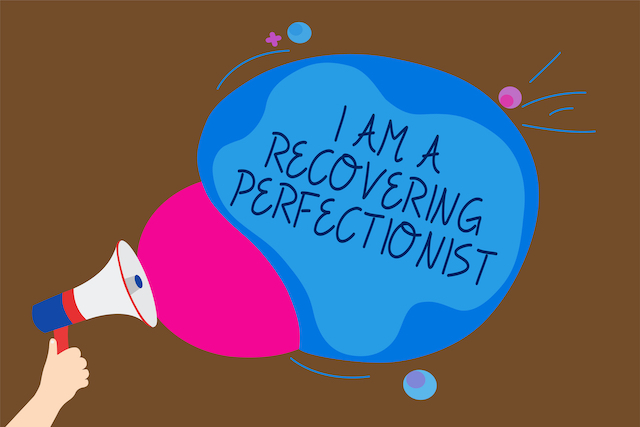
    Hello, I’m Kortney, and I’m a recovering perfectionist.

    Like so many of us, I spent the greater part of my life believing that unless something was perfect, it wasn’t good at all. There was really no in-between. If it wasn’t perfect, it was a failure.

    One of the problems with perfectionism is that it’s common to believe it’s a positive thing. In our society, people tend to value it. If you’re someone that aims for perfection, you must be accomplished. Driven. Smart.

    Have you ever had a sense of pride over being called a perfectionist?

    I have.

    Have you ever thought about why?

    Speaking for my own experience, when someone called me a perfectionist, I felt like even though I didn’t believe I was perfect, it meant that they were perceiving me as being perfect. They saw me as being one of the best, or as someone who was talented. It was validation that I was seen as someone who was good at things.

    My rabid thirst for this sort of validation fed the perfectionist machine for years.

    If you’re wondering what it means to be a perfectionist, here are a few traits:

    • Perfectionists obsess over mistakes, even when it’s not likely that anyone else even noticed.
    • Their self-confidence depends on being perfect.
    • They think in black and white—things are either good or bad. Perfect or failure.
    • They have unrealistic expectations and crazy-high standards for themselves and beat themselves up when they don’t meet them.
    • They put up a front that everything is perfect, even when it’s not, because the thought of someone else seeing their imperfection is unbearable.
    • Despite their quest for perfection, they don’t feel anywhere close to perfect.
    • They can’t accept being second-best at something. That’s failure.
    • They spend excessive time on projects because they’re always perfecting one last thing.
    • They spend a lot of time searching for external approval.
    • No matter what they do, they don’t feel good enough.

    At one point in my life, all of those bullet points described me well. I wasted so much time worrying about approval and validation so that I could feel like I was awesome. But I never felt even close to awesome. I never felt good enough at anything.

    Sure, there were times when I felt like I was good at something, but then I had to raise the bar. Just being good at something wasn’t enough. There was always another level to reach. The bar kept getting higher and higher, which isn’t necessarily a bad thing for people who are striving to make improvements in a healthy way, but for a perfectionist whose self-worth hinges on reaching the bar every time it’s raised, it’s not a positive.

    It was exhausting.

    After a lot of struggle in my life, I knew I needed to explore my perfectionist ways and find a way to be more compassionate toward myself. Perfectionism was holding me back from loving my life. And to be honest, I don’t think I intentionally set out to rid myself of the perfectionist mentality specifically. It came as a byproduct of a great deal of other personal work.

    I began to realize that I had many beliefs that were etched into my brain that weren’t helpful. Beliefs that I never thought to question. These beliefs also severely hindered my ability to be happy and to live the life I wanted to live.

    We all have belief systems that we don’t really think to question. We’ve grown up with them. We’ve learned them from the media, culture and society. But if we actually take a step back to notice that these thought patterns that inhibit our ability to grow and progress are there, we can start to question them.

    Some common limiting beliefs that keep people stuck in perfectionism are:

    • People reward me for having high standards. They are impressed and I gain approval.
    • The only time I get positive attention is when I am striving for big things or achieving.
    • If I make a mistake, I’m a failure.
    • If only I can make so-and-so proud with my achievements, he/she will love me, and I’ll be happy.
    • If I fail, I am worthless. Failing is not okay.
    • If I don’t check over everything multiple times, I’ll miss something and look like an idiot.
    • My accomplishments are worthless if they’re not perfect (i.e.: receiving a “B” instead of an “A” in a class is a failure),
    • If others see my flaws, I won’t be accepted. They won’t like me.

    The good news is that thoughts like these are examples of faulty thinking—faulty belief systems that keep you stuck in perfectionism. By identifying the specific thoughts and beliefs that keep you stuck in perfectionism, you can start to build new, more helpful thought patterns and belief systems.

    I also stumbled upon another secret for overcoming perfectionism.

    The secret is that I became okay with being average. I worked to embrace average.

    If you’re a perfectionist, you know that being called average feels like the end of the world. It’s a terrible word to hear. My inner critic was not having it. “How dare you even think average is okay?” it hissed.

    As a teenager, a twenty-something, and even a thirty-something, my world would have come to an end if I had accepted being average.

    But sometimes life has a way of making you better.

    Life has a way of putting things into your path and it presents opportunities for you to grow. Everyone has these opportunities at one point or another, but you have to notice them and choose to take advantage of them.

    There was a time not too long ago when I went through a really difficult time and had to rebuild my life.

    Looking back, I can see that the situation was an abrupt “lane-changer”—a push in a new direction to make a change. I was not living my best life and I wasn’t meant to stay stuck in that lane. I struggled with depression and anxiety, much of which was triggered by perfectionism.

    By working on thoughts like the ones I listed above, and working to accept lowering my standards—the ones that told me that achievement and success were the only way I would be worth anything—I gradually learned to replace my old standards with this one:

    Just be happy.

    Learning to make this my standard led me to a place where I am okay with being average. Eek! I said it. Average.

    Today, I can honestly say that I’m pretty happy with being average. Do I like to do well? Sure. But it doesn’t define my self-worth. While it’s created more space for me to fail, at the same time it’s created the space for me to succeed.

    The difference is that my self-worth isn’t tied to whether I succeed or fail.

    Here’s how I look at it:

    I’m really good at some things, but I’m not very good at other things. You are really good at some things.  And you aren’t very good at other things too. The good and the not-so-good all average out.

    At the end of the day, we are all just average humans. We are all the same. We’re humans trying to live the best life we can. We are more similar than we are different.

    Don’t you think that if we all ditched our quest to be perfect, or better than everyone else, we’d feel a little happier? Don’t you feel like we’d all be a little more connected?

    If you struggle with perfectionism, I invite you to take a look at the list of limiting beliefs above and see what resonates for you. What evidence can you find that can disprove these limiting beliefs? What would you like to believe instead? Try on those new beliefs and build them up with new evidence to support them.

    And along the way, work on accepting that you are enough, even if you’re average.

  • How to Stop Procrastinating When Things Feel Hard or Scary

    How to Stop Procrastinating When Things Feel Hard or Scary

    “You’ve been criticizing yourself for years and it hasn’t worked. Try approving of yourself and see what happens.” ~Louise L. Hay

    I dreamed of starting my own business for years. Ten years, exactly.

    While there are a few reasons it took so long to take the plunge, procrastination is at the top of the list.

    It’s hard work to change careers, uncomfortable to leave a steady paycheck, and nerve-wracking to think of failure.

    Even after spending months and years learning, studying, and getting certified, when it was no longer a matter of having the skills, the uncertainty of success was enough for me to keep kicking the can down the road to start marketing myself.

    I was afraid of failing. I was afraid of not being perfect. I was afraid that people would think I was a joke. And I was afraid that I wasn’t going to be capable of all the work it entailed.

    So I dragged my feet and kept passing my work off to “Future Me.”

    I did this for everything, though.

    “Tomorrow Sandy” can do the dishes. She’ll take care of scheduling that doctor’s appointment. Oh, and sign her up for that tough conversation I need to have with my mom too.

    At one point I recognized that I often procrastinated because I needed everything to be perfect.

    • I wouldn’t work on a craft project or cook a new recipe unless I knew it would come out flawless.
    • Or I would keep tweaking projects at work up to the last second and beyond, at the sacrifice of getting more work done.
    • Or I would agonize over every text and email I sent, often opting not to send any message unless I knew exactly what to say.

    But, as you can see, I’ve come a long way from that version of me.

    I’ve since started my own business (and I’m loving it!), and I’ve pulled my best tools together on paper for how to stop procrastinating—even though I actually procrastinated on writing this post (ironic, I know!).

    Today, I didn’t let my fear of “good enough” hold me back from sharing actual, helpful advice and mindset shifts to get moving and stop staying stuck.

    Because when we’re stuck, we start telling ourselves stories. So that’s where we’ll start, with this story we tell ourselves about why we procrastinate.

    What We Think Procrastination Is

    We have this misconception that procrastination is laziness.

    But procrastination is an active process. You choose to do something else instead of the task that you know you should be doing.

    In contrast, laziness is not caring. It’s apathy, inactivity, and an unwillingness to act. It’s an “I could, I just don’t wanna” kind of attitude.

    But when you’re procrastinating, you feel even more stressed because you do care about getting the task done. You’re just avoiding stress and having difficulty with motivation.

    Because that is why we procrastinate.

    What Procrastination Really Is and Why We Do It

    Procrastination is a stress-avoidance technique. It is an active process to temporarily avoid discomfort.

    We subconsciously are saying, “Present Me is not willing to experience this discomfort, so I will pass it on to Future Me.”

    (We do this as though we’re asking a stranger to do the work for us. Researchers have seen on fMRI that when we think about our future selves, it lights up the same part of the brain as when we think about strangers.)

    The really cool news is that by working toward overcoming your procrastination habit, you’re building your overall resilience to distress.

    That is how I define resilience: a willingness to experience discomfort.

    Examples of Procrastination

    Procrastination is tricky. Sometimes it’s obvious that we’re doing it. Sometimes we don’t quite realize it (like when I had to water the plants right then and there instead of writing this blog post).

    So here are some examples:

    • Scrolling through Instagram instead of getting started on important tasks
    • Putting off work assignments until the last minute
    • Wanting to start a new positive habit (dieting, exercising, or saving money), but repeatedly delaying it while telling yourself that “I’ll start soon
    • Wanting to start a business but wasting time in “research mode” instead of taking action
    • Doing an easy, less important task that “needs to be done” before getting started
    • Waiting until you’re “in the mood” to do the task

    5 Steps to Stop Procrastinating

    Now that we know what it is and why we do it, let’s look at how to stop.

    1. Motivate yourself with kindness instead of criticism.

    What really holds us back from moving forward is the language we use when talking to ourselves.

    Thoughts like:

    • I don’t want to.
    • It will be hard.
    • I don’t know how to do it.
    • It might not come out as good as I want it to.
    • I’ll probably fail.
    • This will be so boring.

    This is what we think that drives us to procrastinate. I mean, really, when you read those thoughts, they just feel so demotivating, right?

    This negative self-talk has a good intent. It is trying to save us from discomfort.

    Unfortunately, it’s achieving the opposite because it adds to the stress by making us feel bad.

    If you speak to yourself with kindness, just as you would a friend, it will feel so much more motivating.

    So think about what you would say to that friend. It might sound like:

    • I get it, it will be uncomfortable, but you’ll be done soon and then you can relax.
    • Once you get started, it will be easier.
    • You can do it!!
    • If it doesn’t come out perfect, at least you’ll have practiced more.
    • If you fail, you’ll have learned so much.

    2. Create a pattern interrupter.

    That negative self-talk has simply become part of your procrastination habit.

    Because that is what procrastination becomes—a habit—and habits are comprised of a cue, a routine, and a reward.

    • The cue is thinking about a task that needs to be done.
    • The routine is to speak that negative self-talk that leads to procrastination.
    • The reward is less stress. (Not no stress, because avoiding the task is still somewhat stressful because we know it eventually needs to be done.)

    In order to break the habit and create a new one, you need to introduce a pattern interrupter.

    Mel Robbins has a great one she calls the 5 Second Rule. When you think “I should do this,” before the negative self-talk starts in, count backwards, “5-4-3-2-1-GO” and move.

    I find this helpful when I’m having a hard time getting out of bed in the morning.

    If I’m having trouble getting motivated to do something difficult like write a post about procrastination, my pattern interrupter is “I can do hard things.” Not only am I interrupting the pattern, I’m motivating myself positively as well.

    If I’m having trouble doing a boring and tedious task like my taxes, I use something like “I’m willing to be uncomfortable now so that Future Me can be at peace.”

    3. Break down the task.

    One of the big drivers of procrastination is overwhelm. Overwhelm happens when we’re looking at a project in full scope, either not knowing where to start or feeling like all the work involved will be too much.

    If the next task at hand is too big, or if you don’t know where to start, your first task really is to either 1) make a list, or 2) figure out the smallest thing you can do first.

    The whole house is a mess? I bet you know where that one sock goes!

    Another example, I had social anxiety and going to the gym was overwhelming to me.

    So I broke it down into:

    • I just need to put gym clothes in my car, that’s it.
    • I just need to drive to the gym. I can turn around if I want once I get there.
    • I just need to walk in the door. I can always leave.
    • I just need to get changed in the locker room I can do that.

    Honestly, I never turned around and went home. Because once I’d taken the small, easy step, the next small easy step was doable.

    Which leads me to the next step…

    4. Just commit to five minutes.

    Studies show that if we commit to five minutes only, 80% of us are likely to continue with the task.

    Five minutes is nothing. You can do anything for five minutes.

    There is an 80% chance you’ll continue working once you put in those five minutes, but even if you don’t, you’re still five minutes closer to your goal.

    And, you’ve taken one more step to breaking the old habit of not starting.

    It’s a big win-win!

    5. Reward yourself or make the task more enjoyable.

    Another problem with looking at a big task in scope instead of the next five minutes is that the reward is too far away or not satisfying enough.

    When you’re trying to lose weight, twenty pounds is weeks and months away.

    Or, when you’re putting off your taxes, if you aren’t expecting a return then the reward is “not going to jail.”

    So bringing in more rewards sooner will fast track creating the new habit of getting started.

    But also, making the task itself more pleasant will make it a less monotonous task.

    • To write this post, I put on my softest bathrobe and grabbed my baby’s tub from when he was an infant to make an Epsom salt foot bath under my desk while I write.
    • I’ll be starting my taxes in the next few weeks, and I already plan to have a glass of wine and super fancy cheese and crackers while I sit down to do them.
    • I save listening to super nostalgic nineties music for when I’m exercising just so that it makes that time extra special and fun.

    What Would Open Up for You If You Stopped Procrastinating?

    We spend so much more time avoiding the discomfort of a task than we do stepping into what it will be like once the task is complete.

    If you were to stop procrastinating, what would open up in your life?

    • Would you start your business because you’re no longer afraid of experiencing any discomfort if you “fail”?
    • Would you simply enjoy life more if you weren’t in a perpetual state of stress because there is a list of things you’re putting off?
    • Would you finally lose weight or get in shape and feel good once you push through being able to get started?

    The Bottom Line

    Procrastination is an active process to temporarily avoid discomfort (it is not laziness!)

    By overcoming your procrastination habit, you are building your emotional resilience.

    Notice the negative, demotivating self-talk and motivate yourself with kindness over criticism.

    Create a pattern interrupter before the negative self-talk starts weighing you down.

    Commit to just five minutes and you’ll either keep going to do more, or you’ll at least be five minutes closer to done.

    Reward yourself or make the task more enjoyable so there is less discomfort to avoid.

  • I Got Fired for Struggling with Depression, and It’s Not Okay

    I Got Fired for Struggling with Depression, and It’s Not Okay

    About all you can do in life is be who you are. Some people will love you for you. Most will love you for what you can do for them, and some won’t like you at all.” ~Rita Mae Brown

    The stigma associated with mental illness has improved in recent years, but there is still work to be done.

    I am a certified life coach and a certified personal trainer. As an employee of a major global fitness studio chain, I was once discriminated against for my mental health issues.

    I have always been an athlete, and I love sports. Before deciding to go to college for engineering, I thought I’d take the medical school route with the goal of becoming an orthopedic surgeon—I was always fascinated with the body’s structure and how all of the muscles, ligaments, and tendons worked together. But I chose the engineering path and kept my athletic pursuits and fascination with body mechanics and such as hobbies.

    When I was going through my divorce, I decided to get my personal trainer certificate. I had been a stay-at-home mom and part-time photographer since my first child was born, and divorcing meant I would need to go back to work. However, I was not interested in a corporate cubicle job.

    I studied hard, took the exam, and quickly landed my first training job as a coach for a global fitness studio chain. The classes at this particular chain were basically high-intensity interval based, combining treadmill running, rowing, and strength training. The classes of up to thirty-something athletes were coached by one trainer who timed the intervals and explained the workouts.

    It was a very high-energy workout and atmosphere with loud, pumping music and drill-sergeant-like yellings of encouragement.

    The training for this position was an intense week-long ordeal. I worked my butt off during that week with no guarantee of a job (which they neglected to tell us until the week of training was almost over).

    When I was ready to teach my first class, I was excited and nervous, but I ended up loving coaching the classes. There were many unfit individuals who barely knew how to do a squat, and I loved not only teaching them but encouraging them and helping them believe that they could master these exercises and become good at them.

    I helped many people see themselves as athletes when they went from barely being able to walk for three minutes straight to actually running for three minutes straight.

    We had member challenges, including a weight loss challenge. I loved it, and given my background battling an eating disorder, this was my chance to come at weight loss from a place of healthy living—not losing weight to measure up to some ridiculous standard.

    After each class, members of my team would stay after to ask questions about nutrition, exercise, and recovery. I loved sharing my knowledge with them as well as cheering them on. I knew they could reach their goals, and they did. My team won the challenge.

    During this period of time working for this company, I was struggling with my own personal hell. I would show up to class to coach and put on my high-energy, happy face, blast the music, and yell those firm, but loving words of encouragement for my athletes to give it everything they had during each interval. But inside, I felt like I was dying.

    I lived with a sinking, sick pit in my stomach. I’d often leave the studio and cry in my car before going back to the lonely home that once housed a family.

    During my tenure at the studio, I was hospitalized for severe depression twice. Both times required me to take a short leave of absence—a few days the first time, and nearly a week the second time.

    I also took a last-minute trip on Christmas Day back home to see my family so I would have some family support for that first Christmas without my kids (they were with their dad that year). I got someone else to cover the class I was scheduled to teach.

    When I returned from my trip, I came back to work and taught my scheduled classes. As I was leaving, the head trainer and one of the main investors of all Maryland franchises made me stay so they could fire me.

    They told me that my performance wasn’t up to par and that they had to let me go.  

    Funny, I had never had anyone give me any indication that I needed to improve anything to keep my job. Not even in my evaluation with the head trainer—she gave me some constructive feedback but also indicated that I was doing a good job. There had been zero warning signs.

    After my departure, a large number of my students reached out to me asking where I was and why I wasn’t teaching anymore. When I told them the reason, they were appalled and angry. One or two even canceled their membership.

    They loved my classes and would come because they liked my style of teaching. I asked to see member surveys for my classes, but management refused to show them to me stating that “surveys don’t tell the whole story.”

    Other trainers, including another head trainer who had been with the Maryland franchises since the first location opened, thought the whole thing was absurd and offered that I could come back and teach at his location. As much as I loved coaching, I was still too upset at the way the company had handled my dismissal to take him up on his offer.

    I tell this story because what happened to me was cruel and heartless and should never happen to anyone who is genuinely giving their best effort in a job. It should never happen to anyone without proper warning.

    I was struggling on a level I doubt either the twenty-something head trainer or bougie investor ever had to endure, and they let me go for some made-up reason that, below the surface, really came back to my mental health struggle.

    Authenticity is a topic that is near and dear to my heart, and I feel that authenticity in the workplace is sorely lacking.

    All too often, we feel like we can’t show up as our authentic selves for fear of looking weak or incompetent. We need to be competitive and not show any sign that we aren’t anything but perfect for fear someone else might get ahead because of an incorrect perception (one that is wrongly distorted by mental health struggles) that others have of our ability to get the job done.

    I did my job as a coach and trainer, and I did it well. Ask any of my students. But on some level, management sensed my weakness and decided I didn’t fit the “brand image” of this very popular and trendy international fitness studio chain because I was struggling with mental illness.

    If you asked them, I am quite certain that they would argue their reasoning had to do with other factors, but the facts just don’t add up.

    I had never been let go from a job in my life. This added to my depression and anxiety. I understand that if I had not been able to perform my duties, that would have been grounds for dismissal. But I gave it my all and never received any negative feedback indicative of my job being in jeopardy.

    My struggle with depression at that time was no different than someone struggling with a physical illness.

    If I was undergoing treatment for cancer, I am quite certain this scenario would have gone quite differently. I am certain there would have at least been a conversation about the situation, rather than just flat-out making up an excuse that my performance wasn’t up to par and firing a single mom without another job to go to.

    We have to remove the stigma mental illness has in the workplace. We have to make it okay for people to show up and say, “Hey, I’m struggling right now. I am doing my best, but I’m having a hard time.” That shouldn’t be a weakness. If anything, it’s a strength to admit when you’re struggling and need some help.

    Are strides being made? Yes. But the disparity between the perception of physical illness and mental illness is still too great. This needs to change.

    How could my former employer have handled this differently?

    First of all, if they didn’t think my performance was good enough, they should have given me a chance to improve. They should have told me that I needed to change something, because I’m the type of person that, when given feedback, will do everything possible to nail it. At that point in my life, I was still firmly rooted in perfectionist mode, and the very thought of someone thinking I’m not perfect would have been enough to send me into a frenzied mission to correct that perception.

    If they were not thrilled with the time I had to take off for my hospitalizations and my last-minute trip where I had someone else cover one class, the head trainer should have communicated to me that it was unacceptable and given me a warning. That would have given me a chance to have an honest conversation about the struggles I was having.

    In even a minimally caring environment, it makes more sense to help employees succeed rather than throw them away the moment you don’t like them. It’s much more expensive to go through training a new employee than to try to improve one you already have.

    In the fitness industry in particular, I feel that there is little room for perceived imperfection, and there is even less room for a flawed trainer or coach. The fitness industry perpetuates the lie that trainers and coaches have their sh*t together—that’s why they’re the ones training you. That’s why you can’t get these results yourself—because you’re not perfect and you don’t know how to be perfect.

    Authenticity in any workplace is so important. When we are afraid to show up as ourselves with not only our flaws but also our gifts and talents, that’s where creativity ends. When we aren’t able to exercise our creativity, innovation is thwarted. And when innovation stops, that’s where everyone gets stuck.

    Looking back, I now know that I never want to be employed by such shallow and uncompassionate people, but I also know that just wasn’t the place for me. There is no place I want to be where I can’t show up as my true self and say, “Hey, I can bring a lot to the table, but I’m also flawed and I’m okay with that.”

    The reaction should be “Yeah, me too. Welcome to the club,”

    Because we are all imperfect. And that’s a fact.

  • 7 Common Fears That Don’t Have to Control Us

    7 Common Fears That Don’t Have to Control Us

    Love is what we were born with. Fear is what we learned here.” ~Marianne Williamson

    As babies, we know nothing about the world. In the universe of an infant, there are no norms to follow, no rigid rules and regulations; no room for labeling or judging ourselves and others. We don’t yet know to disapprove of ourselves, and we’re curious to play, learn, and grow.

    We are all born free spirits. Then our environment—our families, schools, religions, and political systems—shape the way we think and behave.

    Fear is a learned practice. Children generally are not afraid of trying, failing, and getting up on their feet again. That’s how we learned to walk. When we made our first step, we didn’t call ourselves names or punish ourselves if we fell. We just got up and gave it another try.

    As kids, we weren’t afraid to step outside of our comfort zone and try new experiences.

    So why did we get so fearful as adults? What are we really afraid of?

    1. The fear of imperfection

    I often hear people talking about their need for perfection as a sign of virtue. In a society that generally evaluates human worth through how well we do things in life, some people even feel a sense of pride when they describe themselves as “perfectionists” or “workaholics.”

    To me, perfectionism is a sign of fear. When I know I do everything perfectly, I’m untouchable. There is no room for others to correct me.

    As a child, there were times when I was afraid of punishment after getting bad grades in school. Years later, as an adult, I developed an extreme need for perfection, especially at work. All my assignments had to be executed perfectly so none of my managers would have a reason to criticize my performance. At the time, that fear of authority was still present in my life.

    People who struggle with perfectionism also tend to get overwhelmed because they avoid asking for help. They would rather look invincible and strong than vulnerable and “weak.”

    Showing up in our vulnerability in front of others is a sign of authenticity. Vulnerability is not weakness; it’s a beautiful human attribute, and it takes lots of courage to show what most of us have been taught for years how to hide.

    “Vulnerability is the birthplace of innovation, creativity, and change.“ ~Brené Brown

    2. The fear of failure

    I once read an article about successful people who were intentionally planning for failure. I found that fascinating and strange. Planning to fail? Who likes to fail?

    No one enjoys messing up, but those people were using mistakes as much needed instruments to learn and grow.

    Today I know that each time I am afraid to step outside of my comfort zone and try something new, that’s the fear of failure making decisions for me.

    Each time I find myself stuck and afraid to take risks because I might fail, I ask myself: What’s the worst thing that can happen? Could I cope if it did?

    These questions help me realize that my life would surely go on, and that most mistakes wouldn’t literally kill me.

    “The greatest mistake you can make in life is to be continually fearing you will make one.” ~Elbert Hubbard

    3. The fear of success

    Sometimes, success is scarier than failure. When dreams look too good to be true, we get scared by our own greatness. Deep inside, we don’t see ourselves as enough, and worthy of love and success.

    Whenever I make myself small or put myself down, I am acting on my fear, taking myself for granted, and forgetting to appreciate myself for my achievements. I’m thinking, “Anyone else could have made it” or attributing my accomplishments to faith, luck, or other people who gave me opportunities to shine. I’m focusing on my weaknesses or limitations, without honoring my strengths, gifts, and talents.

    That’s how I operated in the past, for too many years. But here’s what I know to be true today: It wasn’t luck; it was me.

    Sometimes in life, we need to acknowledge there’s been a lot of hard work and efforts behind our “luck.” And if we’re not yet where we’d like to be, we need to believe that we truly are worthy of what we visualize.

    Our deepest fear is not that we are inadequate. Our deepest fear is that we are powerful beyond measure. It is our light, not our darkness that most frightens us. We ask ourselves, ‘Who am I to be brilliant, gorgeous, talented, fabulous?’ Actually, who are you not to be? Your playing small does not serve the world. There is nothing enlightened about shrinking so that other people won’t feel insecure around you. We are all meant to shine, as children do.” ~Marianne Williamson

    4. The fear of being rejected

    Being liked and included and feeling a sense of belonging to a community are basic human needs. We fear being left out and seek approval as a means to ensure this doesn’t happen.

    I can recall many situations in my life when I did things I didn’t really want to do to please others, like going to a movie with someone on a Sunday when my body wanted to stay home and take a good nap.

    I was a master of people pleasing and, to be honest, it wasn’t always because I wanted to make everyone happy. The truth is that I wanted people to like and approve of me. I expected them to give me the things I wasn’t giving myself: love, care, and attention.

    Again, being loved is a human need. However, being needy is something different. I came to understand that people who are taking good care of themselves are less dependent on the approval of others.

    Taking care of our own wants and needs is a necessity. When we make sure to keep our tank full and we treat ourselves kindly, we inspire others to do the same for themselves.

    “I used to be a people-pleaser. Now I love them instead.” ~Cheryl Richardson

    5. The fear of what other people think

    Did you know that the fear of public speaking comes first among all kinds of fears? Even the fear of death comes second! Most people don’t feel brave enough to show up in their vulnerability in front of others because they’re focusing more on what people might think about them than on their performance.

    I can recall quite a few situations in my life when I didn’t dare to ask questions, especially when there was something I didn’t know. I didn’t want to look less intelligent or even stupid.

    Especially at work, I didn’t feel comfortable enough to openly admit that I didn’t hold all the answers and I still had a lot to learn. I wanted people to perceive me as an expert, super smart, invincible, and strong. I now know that every day brings new lessons in the school of life, and it’s more important to stay open to them than it is to be perceived as all-knowing.

    Let’s be honest with this one: I’ve never met anyone who would love to hear they were ugly or stupid. We all need to feel validated. But in the end, all that really matters is that we fully approve of ourselves.

    “When I seek your approval, I don’t approve of the me that’s seeking the approval.” ~Byron Katie

     6. The fear of losing control

    If there were Oscars for control-freaking, I would have surely gotten one! Looking back on my past, I recognize that I always wanted to have full control over everything and everyone. This comes back to the fear of imperfection.

    During my former leadership position with a multinational company, the most difficult things for me to handle were decision-making and delegation—not only with people who were new in their roles and lacked experience, but also with co-workers who were very skilled and competent in their jobs.

    Why did I struggle with delegation? Because I knew I was responsible for my team’s results, and I wasn’t mentally strong enough to bear any sort of failure on my shoulders.

    Making mistakes would have scared me to death; that’s why I always needed a long time to brainstorm all possible scenarios that could go wrong when making important decisions.

    The need to always control situations or other people is a major source of stress. It is tiring, frustrating, energy consuming—and pointless, since we can never control what other people do. Letting go of control is true freedom and a form of self-care.

    “Be willing to stop punishing yourself for your mistakes. Love yourself for your willingness to learn and grow.” ~Louise Hay

     7. The fear of what might happen in the future

    If I spend my precious time overthinking and allowing my mind to create different scenarios about the future, I risk missing out on my life and the only reality that is: the present moment.

    Most of the things we worry about never happen. They are nothing but the illusionary product of our mind.

    It’s true, ‘bad’ things do happen at times, but they’re often blessings in disguise that make us stronger and wiser or show us the right path for us.

    Looking back on my past, I recognize that I had to suffer in love so that I could understand what I wanted from a romantic partner. I had to become unemployed for a while in order to realize what I truly wanted from a profession and what would bring me joy and fulfillment.

    Knowing that my painful experiences were actually gifts, and that I survived them, I’m better able to accept that what will be, will be—and no matter what, I can handle it.

    “The best use of imagination is creativity. The worst use of imagination is worry. “ ~Deepak Chopra

    I have stopped feeling guilty and ashamed of my fears. I’ve learned how to embrace them with self-compassion, as part of the package of being human. I know the primary intention of fear is to protect me from things that could hurt me. But I also know I don’t have to let my fears control me.

    I am aware that I can always get mindful and pay attention to my thoughts and emotions. I make sure that I nourish my mind, knowing that I am the one creating my own world through my feelings, thoughts, and, actions.

    “A miracle is a shift in perception from fear to love.“ ~Marianne Williamson

    And now, I would like to hear from you. What scares you the most? How do you manage your own fears?

  • 3 Steps To Embrace Your Beauty and Smile More Every Day

    3 Steps To Embrace Your Beauty and Smile More Every Day

    Smiling Woman

    “Because of your smile, you make life more beautiful.” ~Thich Nhat Hanh

    Is there anything more beautiful than a person smiling, or better yet, laughing? I don’t think so. It’s almost contagious.

    You’ve likely seen the YouTube videos of babies laughing and couldn’t help but smile.

    And there’s probably a special person in your life that only needs to smile and you feel your heart lift. Maybe it doesn’t even need to be someone you know. I’ve had this happen to me with a complete stranger.

    When you see someone smiling from ear to ear, filled with joy, you can’t help but smile too. Am I right?

    I live in a walk-able city, so I walk a lot. Sometimes I catch myself trying not to smile or laugh as I walk down the street remembering something funny. But then I’m reminded of this quote.

    Why would I ever want to stifle my happiness and joy? Why would I ever want to hide my happiness?

    One Sunday afternoon I was rollerblading along the beach path, feeling the sunshine on my face, listening to my favorite Spotify playlist, feeling good and smiling for these reasons, when a guy on a bike coming at me from the opposite direction reached out and high-fived me.

    Seriously, how fun is that?

    When my boyfriend calls me on my cell phone, I have it programmed so this silly, grinning picture of him pops up on my screen. It makes me smile every time I see it (which also makes it really tough to stay mad at him on the rare occasion that I am, because who can stay mad when they are smiling?).

    Smiles breed more smiles.

    Life is just better when you approach it with a smile. Plus, you really don’t know how much you can brighten someone else’s day with something so simple.

    We tend to be so serious all of the time. We chart our course based on our to-do lists and we spend so much time worrying about the past or the future.

    We set standards that we believe we need to measure up to in order to be beautiful, successful, important—and the bottom line of it all—to feel good enough.

    When really, all any of us want is to feel like we matter. So, what if it’s not really about measuring up to any arbitrary yardstick?

    What if the secret to feeling like we matter is as simple as looking for reasons to smile no matter what?

    Your smile has the power to transform someone’s day, light up the room, change the vibe, and open you up to opportunities, love, connection, and the present moment.

    Your smile can redirect your entire day toward possibility, fun, adventure, and being carefree.

    I think smiling is the key to letting go and embracing how beautiful we (and life) are right now.

    Here are three steps to embrace your beauty and smile more every single day.

    1. Begin and end with you.

    Most people open their eyes in the morning, roll out of bed, and just start banging away at all the stuff that needs to get done until they eventually climb back into bed exhausted, close their eyes, and then get up the next day to do it all over again.

    Let’s not do this.

    It sounds hokey, but what if you started your day with a smile… at yourself? Yes. Look at yourself in the mirror—into your own eyes—and smile.

    Your smile has superpowers. So why not give that gift to yourself first thing when you start your day and right before you go to bed? It’s like setting an intention, only with action instead of words.

    For the next week, give it a try. Look into the mirror, into your own eyes, and smile. Feel the love and the worthiness wash over you.

    You are good enough. You are smart, beautiful, radiant, stunning, and your smile is a gift to anyone that gets the opportunity to witness it.

    2. Beauty has nothing to do with perfection.

    Especially here in the U.S., we have this very skewed perception of what beauty looks like. Thank goodness that is changing and we are beginning to understand that not one person on this planet is perfect. In fact, our flaws and imperfections are what make us special. They are endearing.

    I’ll be the first to tell you that I’m imperfect. My nose is crooked, I have stretch marks, and I will spare you the rest of the boring details that you will probably say, “whoop-di-do” about because to you, they don’t seem like that big of a deal.

    Let me tell you, for a long time, they were a big deal to me. My point is this: we all think our problems and imperfections are so noticeable or huge, when in reality, they really aren’t to anyone else but ourselves.

    We are our own worst critics. People love you—all of you—including your imperfections.

    3. Embrace what is while being eager for more.

    That being said, it’s okay to want what you want. You want to lose twenty pounds, cut your hair, improve your wardrobe, make more money, buy a bigger house, or find the love of your life?

    Go for it!!

    It’s human nature to have desires, to want to expand and experience more.

    But here’s the catch: do it from a place of inspiration and excitement, not from a place of fear or lack.

    Life is not suddenly going to be puppy dogs and sunshine when you “get there.”

    Look for every opportunity to smile and fall in love with life right now, while you are on your way to any goal that you have set for yourself, and I promise, life will be so much more fun and rewarding. Chasing after something in order to fill a void never pans out.

    Being happy with what is, looking for things to appreciate, seeing the silver lining right here and now, smiling and laughing every day as much as you can, and being eager for more at the same time is the name of the “true happiness and fulfillment” game.

    There are not many situations in life where a smile wouldn’t make things better. So look for reasons to smile.

    Let your light shine. Smile at your loved ones, coworkers, friends, neighbors, and strangers on the street. Smiling breeds smiling, which brings more joy, and who doesn’t want more of that?

    Give it a try and see how much lighter and happier you feel. Your smile is a beautiful gift. Share it.

    Which of these steps are you most excited to practice first?

    Smiling woman image via Shutterstock

  • Why People Who Embrace Their Imperfections Go Far

    Why People Who Embrace Their Imperfections Go Far

    Man with raised arms

    “A beautiful thing is never perfect.” ~Proverb

    I was having a conversation with a group of friends that I meet up with occasionally, and my friend—let’s call her Sarah—started talking about perfectionism.

    She said that people used to describe her as a perfectionist and she’d wonder what they were talking about because, according to Sarah, she couldn’t do anything right.

    And then one day it dawned on her that her perfectionism was rooted within the idea that if she couldn’t do something perfectly, she wasn’t doing it right. So she had best not do it at all.

    I can relate to Sarah. I spent the majority of my childhood and many of my adult years running away from my gifts for complete and utter fear of failure.

    And the fear of failure seemed so physically debilitating that I would just quit doing stuff before even giving myself a chance to get really good at it.

    Generally, it was the stuff I loved that I would quit doing, too. Because I equated loving doing something with huge risk of failure, leading to me not being able to do that thing—that thing, so to speak, that I loved.

    And ultimately this would lead to self-doubt, embarrassment, and low self-esteem. The horror, right? I genuinely thought that the insecurity came from not being able to do things well.

    I never considered the possibility that insecurity was the culprit, leading me to make decisions not to do things that I couldn’t do perfectly. Which meant that at the end of it all, I didn’t really do anything of interest for many years.

    I started playing the piano when I was three years old. I’m classically trained and I wanted to be a concert pianist. My parents gave me lessons, bought me a beautiful baby grand piano, and encouraged me to keep playing.

    I played, and I played well for years. But then eventually when I was a teenager, I gave it up because I felt like there were so many other pianists my age who were so much better than I was.

    Of course this was all in my head—musical ability is entirely subjective, but it didn’t matter. It was enough to make me stop playing.

    I did the same with drawing, painting, writing, sewing, etc. I even started my own jewelry line in elementary school using macramé, beads, and inexpensive knick-knacks from the hardware store.

    My peers loved my jewelry and I actually sold my stuff at school. You know, for candy money and Choose Your Own Adventure books. I gave that up, too.

    I wasn’t good enough. An aspiring jewelry designer who, at eight years old, just was never going to make it in the fashion world. Oh, what a dark and dreary future. Sigh.

    And when I was done surrendering all of my talents in an effort to be, I don’t know, perfect, I found myself completely aimless and miserable. But I ran with it. After all, now that I had nothing that I needed to be perfect at, I couldn’t disappoint anyone, right?

    Such freedom in that! Except what I failed to recognize at the time was that I was disappointing the only person that mattered, and that was myself.

    About four years ago and some change, I decided to give up some bad habits. Some of these included drinking and partying. But most of what I was determined to give up was the “perfectionism.”

    And it’s funny because that’s not what I would have called it prior to that conversation with Sarah, but that’s precisely what I was giving up. So that I could go on with my bad, imperfect self.

    The moment I made the decision to give up the perfectionist mindset is the moment that I started to follow my dreams. I traveled to Bali, Indonesia, and started my own jewelry line—an island-inspired line that’s overflowing with meaning. It’s beautiful, and it’s me.

    I began writing about things that I feel passionately about, I picked drawing and sewing back up and I started playing the piano again. This time I’m learning how to play jazz and it’s so much fun.

    These are all things that nourish my soul. How absurd that I would deny myself these pleasures—these gifts of mine.

    I spent obscene amounts of time partying, took a very slapdash approach to college, worked dead end jobs that I had no genuine interest in, remained in bad relationships for way too long, and the list goes on and on.

    The idea that life could actually be fun while doing the things that I love, and not doing them perfectly, was just unfathomable. And yet here I am on this brand new pursuit of anti-perfectionism, thoroughly enjoying it.

    And on this journey, I’ve learned a few very critical things that have profoundly altered the way I approach my life.

    Try not to compare yourself to others. I wish someone had drilled this into my head when I was younger. Or maybe they did and I just wasn’t paying attention. Drilling averted.

    Still, it’s suicide for your dreams. Keep in mind that no two painters will ever paint the same, no two pianists will play Mendelssohn’s Songs without Words the same, and no two entrepreneurs will build the same business, no matter how similar.

    The finished product is always going to be perfectly imperfect and entirely unique. And beautiful.

    Even if you think you’ve failed at the things you’ve set out to accomplish, I challenge you to look at those “failures” from a different perspective. You’ve created something—something where there was nothing. Maybe that supposed “failed” something taught you how to do that thing a little differently the next time.

    Or maybe you just had to try that thing one time to know whether or not it was the thing for you. And maybe, just maybe, that thing that you think you failed at was a source of inspiration for somebody else.

    So, you see, there’s really no such thing as perfection, as it were. It’s simply about having new experiences that enhance our lives and make us feel good.

    Embrace your imperfections and you will go far. You’ll probably enjoy yourself a whole lot more in the process, too.

    Man with raised arms image via Shutterstock

  • Why Life Is A Lot More Fun When We Stop Trying to Be Perfect

    Why Life Is A Lot More Fun When We Stop Trying to Be Perfect

    Friends Having Fun

    “The thing that is really hard, and really amazing, is giving up on being perfect and beginning the work of becoming yourself.” ~Anna Quindlen

    “Oh, my god,” she said, “I forgot to shave my left leg!”

    That may not sound like a particularly dramatic announcement, but Jenny and I were sharing a seat on the chartered bus taking our senior class to the beach for “Senior Cut Day” a few weeks before graduation, and her discovery horrified me.

    An unshaved leg, it seemed to me at the time, was scandalous in the extreme.

    Had it been me who forgot to shave, I would have kept my sweats on all day rather than display my embarrassing imperfection.

    Jenny, on the other hand, not only shared her faux pas with me, she then announced it loudly to the entire bus. She laughed about it, and invited everyone else to laugh, too!

    I was appalled.

    I was also fascinated. That someone could intentionally draw attention to her imperfection, and laugh about it, was mortifying, yes, but also intriguing…

    It was hot at the beach that day. My well-shaved legs were bare, but I had forgotten to pack a T-shirt, and because I was self-conscious that my belly wasn’t perfectly flat as a pancake, I kept my sweatshirt on over my bikini.

    Rivulets of sweat rolled down my torso, but heaven forbid I put my imperfection on display!

    Jenny, meanwhile, spent the day laughing, playing volleyball, splashing in the waves, quite unconcerned about her hairy left leg.

    Can you guess who had the better time?

    You might think that this experience would have taught me something, but in fact, before I finally began to let go of perfectionism and ease into becoming myself in all my flawed, imperfect glory, I spent decades flagellating myself for not being perfect.

    Somehow I believed that I couldn’t be lovable if I weren’t perfect, so I was caught in a vicious cycle: aiming for perfection, failing, then beating myself up for the failure and goading myself on toward perfection again. Lather, rinse, repeat.

    Throughout my teens and twenties, in pursuit of the perfect body, I was plagued with eating disorders, kept carefully secret so as not to reveal my flaws to the world.

    In college, nothing less than an A was acceptable. The pure joy of learning took a back seat to striving for the perfect grade point average.

    Meanwhile, in relationships I hid my true self behind a mask, fearing that nobody would love me if they saw the real, flawed me.

    Amazingly, I did find a man I could be myself with, but when we decided to get married, I was the quintessential “Bridezilla,” completely focused on planning the perfect wedding.

    My obsessive pursuit of perfection helped me stay in denial about the fact that, although we loved each other, the relationship was built on a shaky foundation.

    During my marriage I discovered a love for making art, but the joy I experienced when creating was soon overtaken by misery, because nothing I made ever felt good enough. Eventually it seemed easier not to create at all. I became paralyzed by perfectionism.

    I could say that it was the very public “failure” of my divorce that started me on the road to accepting myself. Or that it was the college classes in Feminist theory, which helped me overcome my eating disorder and start to accept my body the way it was.

    In fact, I see self-acceptance as a long and winding journey, composed of thousands upon thousands of teeny, tiny baby steps, over the course of an entire lifetime.

    Baby steps like the revelation—thanks to Jenny on that high school bus ride—that it’s possible to laugh at yourself, and even draw attention to your flaws, and that this may be a more comfortable way to deal with them than trying to hide them all the time.

    Baby steps like the gradual dawning that instead of beating myself up, I could forgive myself for my mistakes and missteps, and that responding with self-compassion was a much more pleasant way to live.

    Baby steps like the epiphany that making ugly messes at my art table is infinitely more fun and satisfying than making nothing at all (and that often what I deem “ugly” at first, appears less so after some time has passed!)

    Gradually I untangled the false belief that only if I were perfect would I be worthy of love and happy.

    Letting go of the attempt to be perfect took a long time. At first it felt like a dishonorable surrender, like giving up and “letting myself go.” But when I thought about the people I loved most in my life, I realized that of course not one of them was perfect.

    I realized that the people I love being around the most are those who accept themselves as they are, who are comfortable in their own skin. Why should I expect anything different from myself?

    Little by little I began to deprogram myself. In fact, I intentionally embraced imperfectionism, and discovered, much to my surprise, that the more I allowed myself to just be me, the happier, more serene, and more content I became. And the more attracted other people were to me, too!

    There’s nothing wrong with self-improvement, but the truth is, none of us is—or can even hope to be—perfect. We may pursue mastery, excellence, improvement, and be challenged by the pursuit, but insisting on perfection can only lead to self-disgust and unhappiness.

    The only thing we can ever really hope to be perfect at is being our flawed and wonderful selves.

    If you’ve been stuck in a perfectionist spin cycle, what’s one thing you might do to press the pause button?

    Giving up on being perfect is hard. The work of becoming yourself is hard. The payoff, though, is truly amazing, and you’ll continue to reap the benefits for the rest of your life.

    Friends having fun image via Shutterstock

  • 6 Effective Practices for a Peaceful, Positive Mind

    6 Effective Practices for a Peaceful, Positive Mind

    Woman in Garden

    “To ensure good health: eat lightly, breathe deeply, live moderately, cultivate cheerfulness, and maintain an interest in life.” ~William Londen

    We often focus on nourishing our bodies, with fitness and nutritious food, and forget that to function at our optimal level and experience overall well-being, it is equally important to nourish our minds.

    Years ago I wasn’t doing either, and eventually I got stuck, physically, mentally, and emotionally. Physically, I had low energy; mentally, I was not growing; and emotionally, I was bored, resentful, and lost passion for life.

    Life became a monotonous routine. I got lost in playing “safe” and remained in my comfort zone, which started limiting my potential to live the life I wanted to experience.

    Things became stagnant and I knew something had to change to feel alive again, so I looked for ways to change my mindset, to help me move past my negative self-talk, and to find the courage to take action.

    Once I started choosing activities and thoughts that nourished my mind, it triggered me to turn up the love for myself.

    I started seeing my habits shift to eating better, incorporating more physical activities into my life, and being more open to take risks. I was able to live from a more peaceful, fearless, and creative space.

    What Is Nourishing Your Mind?

    Nourishing your mind is feeding it with positive, compassionate thoughts that support you in taking action to create the life you want.

    We often hear people say, you are what you see, you are what you eat, and you are what you think. Our life mirrors back the energy we put out.

    Why Is It Important?

    Your body and mind work as one.

    Nourishing your mind is a critical component of living a healthy, empowering lifestyle. It impacts your body systems, your behaviors, and how successful you are at creating the experiences you want in life, because everything stems from your mind.

    When you nourish your mind, the thoughts you create trigger chemical responses in your body that help increase your happiness, lower your stress, and allow your body to function in homeostasis.

    By checking in routinely to ensure your mind is aligned with your core values and what it is you want to feel and create in your life, you are able to choose your thoughts from a place of deliberation and clarity. This generates more peace, health, and happiness.

    Below you will find the practices I have continually applied to maintain a nourished mindset before the mental weeds start to grow out of control.

    Practice #1: Breathe.

    Many people underestimate the power of breathing. The act of breathing consciously allows us to inspire vitality and expire what no longer serves us in life. It’s the constant that represents our life force, and it influences all aspects of our body, mind, and spirit.

    It is also a tool you can use to “check in” and recalibrate what’s going on in your body and what’s happening in your life. It refreshes your mind and brings you back to the present.

    When you slow down and pay attention to your breath, it quiets your mental chatter and creates room for you to tune back into your essence, while your body benefits physiologically. As yogis often say, “Perfect breath equals perfect health.“

    Practice #2: Follow what makes you happy.

    Tune into what tugs at your heart and makes you happy. When you follow it and allow yourself to bask in the feelings of happiness and fulfillment that result, your mind will consequently feel lighter and more positive.

    Stop searching for happiness and stop trying to conform and meet others’ expectations. You only get lost in the process of trying to please everyone else, when the only constant you can control is you.

    Practice #3: Talk to yourself like you would to a friend.

    Practice being kind to yourself. Give yourself a break. By instilling loving and non-judgmental thoughts in your mind, you allow yourself to experience more pleasure than pain.
    I remember a time when I had to host and record a conference call for my coaching group, as it was part of the curriculum requirements. After the call, I realized I didn’t log in properly as a host and failed to record it.

    Instead of getting angry with myself for being a careless, forgetful idiot and letting my group down, I asked myself what would I say if it happened to another group member.

    I knew I’d say it’s okay, things happen. Look at it as a technical learning experience. We all enjoyed the call and came out with new ideas and perspectives and you did a great job leading it.    

    Now, doesn’t that sound nicer than if I was to beat myself up?

    Practice #4: Ask powerful questions.

    When we experience conflict in our lives, instead of making assumptions, take responsibility and ask powerful questions. Get the facts. See things from a different angle, and spin it into a positive perspective.

    Instead of thinking why is this happening to me again? Ask what do I want to change? What can I learn from this? What has to happen for me to feel good about the outcome?

    Our perception creates our reality. Reflect on what can be done and what you can control to influence and create the outcome you seek. When you are willing to take responsibility, you will be freed.

    Practice #5: Challenge your thoughts about failure.

    Oftentimes, failure is what stops us from taking action to better our lives, because it has a negative connotation attached to it, which fuels our mind with fearful thoughts.

    When you change your beliefs about failure, it can nurture your mind and allow you to take steps to achieve what it is you seek.

    Not trying is failure. Exercise your right to live a full and purposeful life.Give yourself the opportunity to create and experience the life you desire.

    If you fail, similar to Thomas Edison, you’ve simply learned “10,000 ways that won’t work.” This takes courage and contributes to your learning and growth, which is what feeds our energy and vitality for life.

    Practice #6: Embrace your imperfection.

    We are not perfect, so stop trying to be. The sooner you are able to accept your imperfections, the sooner you’ll be able to get out of your head, and the sooner you’ll be able to rock your authentic self.

    When I travel, I challenge myself to bust out what I know in the local language when meeting people or asking for help. Most people appreciate the effort, and are often more willing to help out and engage in conversation.

    In the process, I am improving my language skills little by little, having a good laugh at times, and if I’m lucky, I may experience and meet some really interesting and fun people.

    When we seek to be perfect, our mind tends to be on alert to ensure all the i’s are dotted and the t’s are crossed. Our body gets uptight and our mind gets lost in the worry. It gets exhausting and stops us from allowing lightness and joy to come into our lives.

    So, if you are trying to be perfect somewhere in your life, ask yourself, am I already doing the best that I can? Am I trying to be someone else’s perfect vision? If you answer yes to the questions, I encourage you to let it go for your peace of mind.

    Remember, when you feed your mind with nourishing thoughts, your body also benefits from it. So find and apply what works for you, and see your life shift in the direction you seek with greater clarity, courage, and confidence.

    Woman in garden image via Shutterstock

  • It’s a Great Day to Make a Mistake

    It’s a Great Day to Make a Mistake

    Why are we so terrified of making mistakes? Why are we killing our creativity and curiosity with our desire for efficiency and conformity?

    Today is a great day to make a mistake—and here’s why that’s a good thing.

  • Accepting Imperfection and Making Peace with Our “Piece in Progress”

    Accepting Imperfection and Making Peace with Our “Piece in Progress”

    The Traveler

    “Being happy doesn’t mean that everything is perfect. It means you’ve decided to look beyond the imperfections.” ~Unknown

    I’m back in New York City after touring for the last five years as a global musical scientist.

    My international and domestic sonic experiments took me all over the world to exotic lands and faraway locales.

    I climbed the Inca Trail for four days straight while combating altitude sickness, learning how to speak at low capacity oxygen levels (imagine Darth Vader), and hemoglobin adaptation became my mantra.

    I also wrote and recorded a number one single in Copenhagen, Denmark. Likewise, I traveled to France, Finland, Russia, and Spain, as well as several national stops: Austin, Texas, DC, Boston, California (twice), and Hawaii, to name a few.

    I even lived with a Costa Rican family and became a real ‘tico’ in San Ramon. Furthermore, I discovered a floating village in Cambodia, talked art science shop in Singapore, and had the backs of my knees lit on fire with moxibustion in Koh Samui, Thailand.

    Sounds glamorous, but in all that life spice the one consistency was myself, and let me tell you, you can really get to you.  

    As wonderfully liberating and bohemian as it was to pick up and play from country to country, from foreign foods, cultures and languages, to random rules, regulations, and rites of passages, it also became a constant struggle to perfect the adventures.

    Naturally, practical fears ensued: How would I finance myself on the road from tour to tour? What would happen if I couldn’t understand the language? How would I be able to reach anyone in the middle of the Amazon?

    But the worst mind chatter came from my own self-doubt: How is this record manifesting given the fact that I have a unfamiliar, makeshift studio instead of my usual recording space? Is this one gigantic failure?

    Does anyone understand what I’m doing or what I mean? Can anyone hear those ambient birds behind the vocal and piano line? Is there even a piano at the next stop? Wait, why am I doing this again? What is a musical scientist?

    I was obsessed with perfection, particularly as it related to my work, and it was starting to take the fun out of my experience.  

    As an artist/scientist hybrid, I usually feel balanced between the creative and logistical, but the need to perfect my experiments started to weigh on the childlike, free, and non-judgmental parts of myself.

    I was striving for my work to be a huge success upon initial conception instead of letting the manifestations of failures become the real magic in process.

    It was during my time in Singapore while visiting a friend that I developed a perspective change to help me combat this uber desire to micromanage my situations.

    With eighteen hours on the plane to think, I began to imagine that we all have a life pie with slices representing certain parts of our life. For instance, each sector could be divided into finance, love, health, relationships, career, and so forth.

    It dawned on me that the majority of the folks I met and had deep conversations with on my travels shared stories of their imperfect piece(s): “I lost my job,” or “She dumped me,” or “I come from a messed up family.”

    It was often easier for people, myself included, to dwell on the missing segment, the piece that didn’t match the others, and focus on trying to tweak the weak.  

    The pattern I recognized was that no soul’s life pie was ever completely maximized, at least not at the same time. There’s always a “piece in progress.” Maybe one, two, perhaps even half the pie didn’t look like the rest.

    I visualized a life pie like a leaky faucet. As soon as you fix one of the spouts, the pressure adjusts to the other side, and pretty soon you’re exhausted trying to Band-Aid all these pressure points.

    I’m reminded of my favorite tale, “The Story of The Golden Buddha,” by Jack Canfield and Mark Victor Hansen.

    To paraphrase, approximately 300 years ago, the Burmese army planned to invade Thailand.

    Thai monks had an incredibly gorgeous golden Buddha statue within their monastery and wanted to protect their treasured possession during the attack, so they covered the statue with dirt, clay, and sticks.

    As the Burmese pressed into Thailand, they killed all the monks, but left the precious Buddha be, as it was disguised.

    During the mid 1950s, the monastery was relocated to make way for city developments, and as the monks began moving the Buddha, the clay began to crack and fall to the floor. Only then, after all that time, did the gold underneath begin to shine.

    To me, the tale’s a constant reminder that we, like the golden Buddha, spend too much precious time cloaking ourselves with mud in the form of societal coding, personal pressures, and expectations deeply fixed in fear.  

    But, by accepting these self-perceived shortcomings as part of the bigger picture, we realize that we each have our own labyrinth as we go through life. This is how we learn life’s lessons, slowly revealing more of our golden uniqueness.

    If we obsess about perfection, we’ll just stay stagnant and idle instead of moving forward with our pieces in progress, allowing them to be part of the journey toward self-realization.

    Even the gravitationally bound system consisting of stars, dust, and matter that constitutes our universe has endless imperfections, such as windstorms, black holes, and galactic hurricanes.

    If we, as humans, are living in this totality of existence rooted in chaos, we can only expect to mirror it. Understanding that there’s nothing wrong with us for having imperfect life pies can help us make peace with our piece in progress—and ourselves.

    Photo by Matteo.Mazzoni

  • How to Stop Stressing About Being Perfect (So You Can Enjoy Life)

    How to Stop Stressing About Being Perfect (So You Can Enjoy Life)

    “The thing that is really hard, and really amazing, is giving up on being perfect and beginning the work of becoming yourself.” ~Anna Quindlen

    I finally learned I wasn’t Superman.

    It was a hard concept for me to grasp. You see, I was always the good child. The one that did everything without complaint or supervision. I was the one who didn’t need help in school, who knew how to plan, who did the chores without having to be asked twice.

    As I grew older this idea that I was “the good child/person” grew. My grades had to be perfect. My work had to be perfect. I had to interact perfectly with everyone I met.

    Needless to say, this drive to perfection caused me a lot of stress. Stress to the point that I was literally pulling my hair out. I know you see that on cartoons and things, but it happened to me for real.

    I didn’t even know I was doing it until one day I looked in the mirror after my shower and saw a bald spot. I had combed over it for so long without even consciously realizing it was there.

    I knew I had to do something after that. I had to change something. I wanted to just give up. After all, if I couldn’t be prefect, then what was the point of it all?

    I cycled into depression, but even this depression did not lessen my drive to be perfect. I made it look like I was doing fine. I went to work every day, did my home things, and even interacted on a superficial level with those around me.

    After a while of this hollow existence, I started to become angry. Why did no one see I was hurting? Why was there no reaction to this change?

    I slowly ground to a screeching, sputtering stop as circumstances in my life piled up: the death of a family member, the illness of another, my car getting totaled, my job on the edge.

    Boom, boom, boom. One right after another.

    Nothing was perfect now, and I could not see any way to make it perfect. It was hopeless, all of it.

    So, at last, I gave up on being perfect.

    At first, it seemed strange to me. Leaving things unfinished. Doing things halfway. Not going out of my way to make everything seem okay. I thought the world would fall apart. But it didn’t.

    Other people took up the slack. Things that I thought were vital went undone without consequence. Not working at 110% did not make the world come crashing down around my head.

    Hesitantly, I started to look around. I started doing things that were fun for me instead of things that needed to be done. I said no when people asked for help. I left dishes in the sink and trash in the can. I ate out instead of cooking. I ate what I wanted and not what I thought was right. I watched TV when I wanted and slept when I wanted and didn’t worry about what I should be doing instead.

    And you know what?

    It was okay.

    Shockingly, there was little difference in my life between working hard and enjoying it. Little difference to others. However, it was a big difference to my mental health. I discovered I could do more with less. Less work, less stress, less perfection.

    I could enjoy life without being perfect.

    I am not saying that my change did not cause conflict. My family was not pleased with the sudden upsurge in their workload. Those little things I always did were now undone. If they wanted it done they had to do it themselves.

    The little things they took for granted suddenly became scarce and my ever helpful and always consistent presence became something that had to be requested rather than relied upon.

    It was empowering to say no. To be out of touch. To be enjoying myself without guilt or stress.

    I found out that I could now enjoy and even look forward to things that had previously stressed me out. That every experience was not a chance to screw up but a chance to learn something new. That doing new things was good, even if I wasn’t good at them at first.

    It’s great to strive toward excellence, but it’s not worth stressing about perfection. If you’d like to take a page from my book and learn to enjoy being imperfect:

    1. Accept that perfection is unreachable.

    No one can possibly be perfect; that is what makes us human. However, you have to not only accept that you will not be perfect, but also be happy that being imperfect makes you different than everyone else. Being perfect would make everyone identical. Our imperfections are what make us unique and special in this world.

    2. Say no.

    When you are trying to be perfect, it’s hard to tell people no. You want to make them perfectly happy. You want to be the perfect spouse, sibling, or friend. However, taking on more and more things does not make you more perfect or even a better person. It only makes you more stressed.

    Saying no is not only good for your mental health, but it is good for others as well. Many times people will have to deal with their own issues, which will make them grow into stronger human beings. If you had helped them, they would not have had the chance to grow.

    3. Try new things, even if you fail.

    Being a perfectionist, it’s hard to get the guts up to try something you have never done before in the fear that you will be less than perfect at it. However, that’s the fun of trying something new! You get to learn and grow and become more than what you were before. Staying stagnant is not healthy for anyone. Embrace your mistakes and learn something new.

    4. Let some things go.

    We prioritize things that are not really important. Will you remember doing the dishes, or having fun with your friends? Will you remember filing, or having a great conversation with your coworker?

    When you learn to let the unimportant things go, you have more time for what really matters. You also have more time to do what is fun for you instead of only doing what ‘needs’ to be done.

    5. Prioritize what makes you happy.

    Life is more than work and chores and making it through one day after another. If you feel like you are working and moving but never enjoying or accomplishing anything, you may need to take a step back and reevaluate what you are doing with your life.

    Being stressed all the time is no way to live. Instead, try to enjoy your life. Prioritize those things and people that make you happy.

    Stressing out about perfection is a useless endeavor. Perfection is impossible for us, so why do we make ourselves sick over it?

    I have learned to abandon perfection and focus on enjoy life every day. This has greatly reduced my stress, increased my happiness, and made me the kind of person I would want to be friends with.

  • Imperfection Is Lovable and You Are Enough

    Imperfection Is Lovable and You Are Enough

    “You’re imperfect, and you’re wired for struggle, but you are worthy of love and belonging.” ~Brene Brown

    We are all perfectly imperfect just as we are.

    Yes, it’s true. Sometimes hard to believe, but always the truth. Believe me.

    I’ve always recognized that I am a perfectionist.

    I was the little girl who wanted to know how to play the piano at my first lesson, how to roller blade the first time I tried, how to do the splits at my first gymnastics class.

    I’ve always wanted to do it right the first time.

    On the one hand, I appreciate my intention to do and be my best at whatever I do, but on the other hand, I see how this mentality has often paralyzed my efforts and prevented me from daring and learning to be brilliant.

    The one practice I’ve committed to in my life, where I’ve been willing to be less than perfect and continue to embrace each day, is yoga.

    The meditative quality, the healing breath, the invigorating movement all resonate with me and remind me to just be where and who I am, in each moment.

    It’s been fifteen years now since I began my yoga practice in an effort to release the tension in my neck that was triggering chronic headaches during my first year studying at UCLA.

    I felt transformed after my very first yoga class and just knew that I would grow and expand with my practice.

    In the beginning, most of my transformation was physical—feeling more relaxed, open, energized, and flexible. In recent years, my practice has guided me to expand my perspective, and I find myself open to understanding life anew.

    I’m discovering new ways of being and of seeing the world.

    Just two months ago I had a revelation.

    I was communicating with a life coach who is an incredible listener, endeavoring to understand why I was constantly feeling challenged in my relationship with my husband. Together, we realized that I was creating the same expectations of perfection for him as I had carried for myself since childhood.

    A memory surfaced: me, around twelve years old, sharing my report card with my father.

    “Why are they not all As?” he questioned unapologetically.

    I glanced at my grades, noticing that I’d earned six A’s and one B+, and said, “I did my best.”

    “I expect all A’s next time,” he firmly instructed.

    “I’ll do better,” I submissively acquiesced.

    And this stuck. The need to do better than my best. The desire to be better than myself. I wanted my father’s approval. I wanted my father’s love. I wanted my father’s attention. And so, I worked even harder and earned a 4.0 GPA each semester.

    But you know what? It was never enough.

    I never felt enough. I never could earn the love and attention that I desperately craved from him. 

    I needed to look within myself.

    Now, some twenty years later, I’m still struggling with my tendency toward perfectionism.

    This insight is life changing: A chance to understand myself better. A reflection of how and why I choose to think and act the way I do. An opportunity to acknowledge that I’ve associated being perfect with being lovable.

    Now, without judgment or criticism for myself or my father, I have the choice to change.

    I can choose to shift my perspective and tell a new story. I choose to embrace a new truth…

    Imperfection is lovable.

    With this knowledge, I see my relationship with myself and with my husband, my children, my family, my friends—with life itself—in a new light.

    We are all imperfect.

    But who wants to be perfect anyway? How boring that would be!

    The most fun is in the growing, in the expansion, in the learning and becoming ever more who we are.

    I release the compulsion to be perfect, to constantly achieve, do more, handle every task on my to-do list immediately.

    I allow myself to be more present, to be in the moment, to remember what matters most: love.

    I can let go of always doing and instead let myself be. I can stop rushing around handling tasks, and allow myself to stop and smell the roses with my daughters, kiss my husband, call a friend, stare in wonder at the beauty of our universe.

    I am worthy of love, I know I belong, I recognize my life has meaning, and I give myself permission to take it easy and just be me.

    I embrace this truth:

    I am good enough. I do enough. I have enough. I work enough. I love enough. I am beautiful enough. I am smart enough.

    I am enough.

    Can you say this to yourself and really mean it? Practice. Notice how it feels.

    With this new perspective, everything blossoms.

    I allow myself to make mistakes without being judgmental.

    I give others space to be imperfect without being critical.

    I allow myself to be me.

    I allow myself to love myself just as I am.

    I allow myself to love others just as they are.

    Whenever I begin to lose focus of this reassuring truth, when I start to feel overwhelmed by all the “shoulds” and judgments in my mind, I sit in stillness in my meditation space.

    I read the words I’ve etched on my chalkboard wall:

    I am enough. Surrender. Live and let live. Imperfection is lovable. Be human.

    Immersed in the sensation of my breath, I choose to focus my mind on these powerful truths. Soon, I relax into the comfort of knowing that all is well. And I begin again the journey of self-love and acceptance.

    I am grateful for being where I am, for all the wisdom and love so many gracious and kind people have shared, and for the powerful practice of yoga that encourages self-awareness and growth.

    I am grateful for the opportunity to recognize the perfection in our imperfection and to use this wisdom to infinitely improve my interactions with the people I love the most.

    Our minds are powerful. Our thoughts are powerful. Our love is powerful.

    Let us choose to focus on the good, appreciate who we are, share our love unconditionally.

    Let us remember that we are enough.

    Let us embrace our value and know we belong.

    Let us always remember that our imperfections are lovable.

    Can you practice loving yourself and others unconditionally today?

    Every beautiful journey and inspiring transformation begins with an intention and moving in the direction of where you hope to be.

    Wishing you ease in loving and freedom to be just who you are.

    Be human. Be perfectly imperfect. Be you. Just be.

  • 4 Ways to Embrace Imperfections

    4 Ways to Embrace Imperfections

    “Be yourself; everyone else is already taken.” ~Oscar Wilde”

    I have the amazing privilege and overwhelming responsibility of raising three daughters. I’m deliberate in the personal choices I make, knowing I set an example of what a strong, independent woman of integrity looks like.

    I don’t always succeed.

    As hard as I try to parent gently and with smart guidance, I’m imperfect and sometimes I get it wrong.

    All relationships go hand in hand with feelings of regret and disappointment, and a sense we haven’t given our best at some point. Here are a few ways I have learned to parent with grace despite the fact that I am imperfect.

    Even if you’re not a parent, you may find these ideas helpful in accepting yourself just as you are—even when you don’t get everything right in relationships.

    1. Accept that we are human and humans are messy.

    I am most authentic when I am forced to humbly admit I don’t know everything and I sometimes make mistakes. This makes me much more likely to accept the imperfections in others and love them anyway.

    It’s easier to be authentic when you take the pressure of perfection off the table—and it’s easier to be compassionate and kind when you understand everyone is messy. (more…)