Tag: humility

  • Why I Never Let Anyone Support Me Until the Day I Almost Died

    Why I Never Let Anyone Support Me Until the Day I Almost Died

    “Why don’t you get up and make the coffee, while I stay in my sleeping bag and plan our ascent route?” I half-heartedly ask my climbing partner Hank.

    He just looks at me with that unassuming, “give-me-a-break Val Jon” look of his. It’s three o’clock in the morning, cold, dark, and damp, and neither of us wants to leave the comfort of our tent. But we’re committed to this climb, so we don our parkas and gloves and confront the bitter cold.

    In silence, Hank and I gather up our gear and join the rest of our climb team assembled at base camp, which is located at eleven thousand feet.

    Thirty-three climbers in all have come together for this extraordinary ice climb to the summit of Mount Shasta in Northern California. During our team meeting, we decide to make our ascent via “Avalanche Gulch,” a treacherous glacier route up a steep icy slope. This particular route is shorter than others, but it’s also notorious for its deep crevasses and unstable blue fractures, so one wrong move could mean sudden death.

    Ice climbing requires crampons for the boots and ice axes for leverage and braking. Ropes, carabiners, and belays are reserved for near-vertical climbs, which we may or may not need for this particular ascent route.

    For those unfamiliar with ice climbing, braking is used when a climber loses their footing on steep slopes. It’s done by grabbing the ax with both hands, flipping onto one’s side, and plunging the sharp metal tong into the ice.

    A firmly planted ax serves as an anchor and stabilizes the fallen climber’s position until they can regain their footing. Everyone on the team has practiced the braking procedure many times over along with other vital safety and life-saving protocols.

    As the full moon casts a bluish glow over the ice, we begin our ascent to the summit. At about twelve thousand feet, we come upon a massive fissure running horizontally across the steep glacier face. We traverse around its left edge and cross back about thirty feet above it. Climbing to the slope’s center, we zig-zag our way up to gain altitude and distance from the crevasse.

    Traversing around crevasses is a treacherous activity. If one climber slips, the entire group could be pulled into the abyss. For this reason, we are untethered and climbing independently. We are, however, organized into small teams of six to provide each other support if needed.

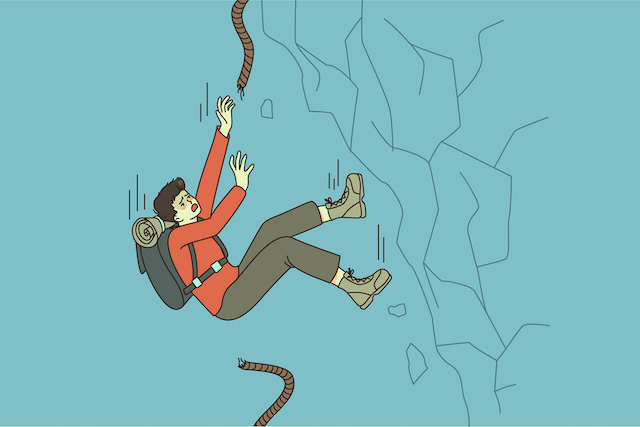
    All goes well as we gain altitude above the crevasse, until one fateful moment when the crampon on my left boot suddenly pops loose and I lose my footing.

    Tumbling headfirst downhill, I instinctively grab my ice ax with both hands and prepare to stop. Landing hard on my back, however, my ax bounces loose from my hands and I slide uncontrollably down the steep slope towards the crevasse.

    In a moment of frozen terror, my life flashes before my eyes and I am going to die! Then suddenly my flailing body slams into something solid, knocking the wind out of me.

    Stunned and disoriented on my back with my head pointed downhill, I’m unable to get a bearing on how close to the edge I’ve come and how close to death I am.

    Looking up, I see a blur of movement and shifting dark images. Clearing the snow and ice off my glacier glasses, I realize Hank and my fellow climbers have formed a human net, catching me just a few yards before I careened over the edge of the crevasse!

    I’m in shock, numb, and completely speechless. I’m also totally embarrassed and feeling extremely vulnerable. I’ve spent years being a strong and independent man, priding myself on not needing the help of anyone. Needing help always seemed like a sign of weakness to me, so this emergency situation is deeply disturbing.

    “We’ve got you, VJ! Hold on buddy, we’re not gonna let you fall!” I fidget around trying to stand myself up and respond, “Thanks guys, I can take it from here.” “Lay still, you’re pushing us back towards the edge!” Hank barks at me. “No, really, I’m okay guys, I’ve got this.” There was no way I was going to be the weakest link in this chain! This time, however, a number of my team members replied, “No you don’t have it VJ, you need to stop right now or you’re going to kill us all!”

    That message got in. The reality of killing my fellow climbers so I can stay in control is just too much for me to bear. The humbling realization shatters my macho control mechanism and I suddenly relax into letting them help me.

    As they reattach my gear, stand me up and reassure me with pats on the back, I realize it’s nearly impossible for anyone to support me. Experiencing them caring for me this way is both wonderful and wrenching.

    My chest tightens and tears come to my eyes as I realize how many times in my life I’ve not let others help or support me. I would always say, “No problem, I can do it myself.” I didn’t want to burden anyone or put anyone out.

    The deeper truth, however, is that if I let someone support me, I would be obligated to them in the future. The result might be that they could then somehow control me the way my father controlled me as a child.

    Looking into the caring faces of my fellow climbers, I suddenly see superimposed images of my mother, sister, and little brother, my friends, and exes who I’ve shunned and alienated with my stubborn macho independence

    I reflect on the pain and frustration that not being able to help me must have caused all these people in my life. So many opportunities I have had to accept the support of those who love and care for me, but no, I have to be strong and independent.

    How selfish and arrogant of me to rob them of the opportunity to contribute to my life! And how easy it would be for me to slide into humiliation over this display of narcissism.

    Standing here among those who just risked their lives to save mine, I realize I have a choice; I can dramatize my humiliation and hide behind my rugged individualism, or I can humbly open myself to their care and support.

    I choose to set humiliation aside and open with humility, and as I do, a wave of emotion fills me. For the first time in my life, as far back as I can remember, I’m able to see that accepting help from others is not a sign of weakness, it’s an act of humility.

    I also realize that rather than being a burden to people when I’m in need, it allows them to feel useful and to make a difference by offering their support and care. There’s no doubt that my fellow climbers are ecstatic about having just saved my life; I can see the joy and exhilaration on their faces.

    Still surrounded by a human net of care, I thank each member of my team for saving my life, and I apologize for placing them in additional danger. Each one of them nods in recognition, and nearly everyone assures me that having the chance to help save my life was far more important to them than blaming me for being a bit heedless.

    As I allow myself to be vulnerable and let their care in, my defensive armor melts, then drops away. We resume our ascent, and tears fill my glacier glasses as I reflect on the experience of my life being saved by this remarkable group of friends.

    How strange and new this is for me. I don’t need to see out of my glasses because I have the full support of those behind me as well as those in front to help me along if I need it.

    I’ve always been the one to give support to others, but now I can receive support as well. I breathe into this new awareness and suddenly have a profound realization that has remained with me for years.

    As I exhale, it’s synonymous with the movement of giving support, and as I inhale, it’s synonymous with the movement of receiving support. Engaging in both inhaling and exhaling doesn’t mean I’m weak, it means I’m human.

    Without further incident, we all ascend to the 14,179-foot summit of Mt. Shasta where a crystalline blue sky embraces the curve of the earth. The summit perch looks like a small crater and is no more than about twenty feet in diameter. Its outer rim is composed of a ring of rocky crags with one high point that signifies the very pinnacle of the mountain.

    Shining, sunburned faces grinning from ear to ear sit together in a blissful exchange of laughter and tears.

    After celebrating our joint accomplishment, we begin the ritual of reading and signing the register book stowed atop most climbable mountains in the world. The one at the summit of Mt. Shasta is contained inside a green metal canister under the Western crag.

    Each member of the team, like those before us, takes the opportunity with the book. After finishing, Hank hands it to me. As the last to see the register, I flip through its yellowed pages and my eyes fall on a passage written by a climber on October 23rd, 1972. I’ll never forget the inscription:

    “Father, I dedicate this climb to you. I’m standing at the top of Mount Shasta today because of the love, support, and encouragement you gave me as I was growing up. It’s because of your commitment and love that I was able to make it to the summit today. And although you lost your legs in the Korean War and have never been able to stand beside me. Father, I want you to know that today I stand on the top of this mountain for both of us. I love you with all my heart and all my soul, your son John.”

    How beautiful this dedication is! I take in the grandeur of the Earth’s curve from this high summit, close the book, and clutch it firmly to my chest. A wave of inspiration fills me, and I feel deep abiding compassion for all the world’s fathers, sons, mothers, and daughters . . . and I am challenged to act upon the humility that was moving so deeply within me.

    You see, up until this very moment I’ve coveted a deep wound in my psyche. As a boy, I was violently abused by my father, and as a result, I cut myself off from him in my early twenties vowing to never speak with him again.

    But now I am faced with a choice . . . should I maintain my position and continue to empower all the reasons why I should not reach out to him? Or should I humble myself and take a chance by reconnecting after all these years? It is here, within these deeply challenging life choices, that we both test the authenticity of our inspirations and discover what we are truly devoted to.

    I made my choice, and not only did I resurrect my relationship with my father, I affirmed that there is nothing more important to me than living with an open heart and honoring the humility I was gifted with high atop the summit of humility.

  • Why I’m Done Fishing for ‘Likes’ on Social Media

    Why I’m Done Fishing for ‘Likes’ on Social Media

    “There is nothing noble in being superior to your fellow man; true nobility is being superior to your former self.” ~Ernest Hemingway

    Recently I was invited to listen to a recorded presentation about humility, and it literally rocked my world.

    As I listened intently, the words “complete and whole” popped into my head. And then came the light bulb moment: “Yes!” I thought. “When one feels whole and complete, they’re more humble.”

    As the presenter talked about the “look at me” culture of selfies and social media I felt my toes begin to curl and my stomach tighten.

    Oh look, there’s you posting with your plate of food. And the next day, there’s you posting a picture of you on the beach. And then the next day, there’s you posting a picture of you and someone you just met. Has your face changed from one day to the next? Because if not, I promise I haven’t forgotten what you look like.”

    Those examples were funny at first, until I realized I haven’t always been that humble, whole person that I’ve aspired to be. The most recent example of my own “look at me” behavior, the one posted to all of my social media apps, paraded itself in front of me: a before and after side-by-side of me now and forty-five pounds heavier.

    Now, don’t get me wrong; I’m not trying to diminish that accomplishment in any way, or suggest it’s wrong to share our successes. I’m super proud, but the issue is why I took to social media:

    I needed that external validation that I’d done some good work. I needed that external “stuff” to help me feel whole and complete. I wanted those “thumbs up” and the “You look amazing!” comments to make me feel good.

    Did it?

    For a moment it did, but it wasn’t long lasting. What I was looking for needed to come from something and somewhere much deeper and more important than the number of likes or comments received.

    The Lesson in My “Look at Me” Behavior

    As I replayed the presenter’s words days later it all started to make sense. The lack of humility, for me, equated to the lack of wholeness and completeness I’ve sometimes felt.

    But here was the real lesson…

    If I can’t be my own cake (whole and complete), compliments and likes, which are really just icing, don’t have anywhere to sit. Which means their impact is going to be fleeting and short-lived.

    And whether the comments are good, bad, or indifferent, not being whole and complete within myself is most likely going to lead to more “look at me” behavior. It has the potential of becoming a perpetually draining loop that I want no part of.

    Using Humility to Be the Best Version of Me

    Humility has now become my gauge and my trigger. If I’m not being humble, that’s my “nod” that I need to do some inner “tweaking.”

    So, to leverage my own humility, here is what I’ve been doing. As a result of these changes, I’ve compared myself to others less, I’ve felt more grounded, and the best result, I’ve felt more whole and complete with who I am and what I do.

    Feeling my worth, not proving it

    I don’t have to prove my worth to anyone, ever! I have to own it by being proud of the things I do and the person I am and sitting with those feelings and enjoying them.

    As an example, if I give to a person in need, I can sit with the awesome feelings that giving produces without taking to social media and posting about it. (e.g.: Today, I gave money to this homeless man in the picture so he could buy some lunch.)

    Humbly celebrating success

    I’m a big fan of celebrating successes because a) it feels good and b) it builds up “I can do it” evidence for future projects and goals. When it comes to celebrating success, however, I’m reminded of this quote from Criss Jami, “The biggest challenge after success is shutting up about it.”

    So, I take to my journal and write down my successes instead of posting about them. That way I can re-read them any time I need a little boost.

    Some of the coolest people I know are the ones who own their successes without flaunting them. And they use their successes not as a “look at me” device but to inspire others and help them succeed as well.

    Reining in the old ego

    I’ve turned the word “ego” into an acronym that stands for:

    E = Edging

    G = Goodness

    O = Out

    Basically, when I’m disconnected from whatever grounds me, makes me feel good, and keeps me centered I’m more prone to lack, fear, and “look at me” behavior, which all come from the ego. So, anytime I am depleted, that is when I’m more apt to look outward, like to social media, for ways to make me feel good about myself.

    One of the best ways to rein in the old ego is to do something self-care related. For example, I’ll meditate, take some deep breaths, or soak in a hot bath. This always recharges me, leaving me less susceptible to “look at me” behavior.

    Now It’s Your Turn

    At the end of the day, humility is awesome! It enables us to create a sense of wholeness from within instead of constantly seeking validation from other people. It helps us create a connection with ourselves and others. And it prevents us from draining ourselves and the people we care about with attention-seeking behavior..

    So, my friends, I just have one simple question to ask you: How are you going to engage your own humility to feel more whole and complete?

  • 5 Ways to Show Your Love to Others (and Yourself)

    5 Ways to Show Your Love to Others (and Yourself)

    “Love isn’t everything. It’s the only thing.” ~Steven Hayes

    Things go wrong in life. Distress and confusion can take root, sometimes leading to harsh self-criticism, depression, or anxiety.

    We sense that love heals, and it does.

    I once visited an orphanage for abandoned infants, and every toddler who I carried clung tightly to me. I can still feel their little arms clasping me desperately.

    We crave love as we crave oxygen.

    But what is love?

    Is it something you wait for?

    What if love is more than a feeling?

    What if your choices and actions can bring the spirit of love to life?

    Love has many shades and nuances. Here are some forms of love that you can start creating today.

    Love as patience

    I used to be obsessed with outcomes. A perfectionist intolerant of failure, I was constantly trying to prove my worth. This made me unpleasant to others, and to myself.

    One day our little son was running around noisily while I tried to concentrate. Irritated, I put an arm out and he crashed into it. He started crying, and I felt deep shame.

    I resolved to change. I’d been sacrificing what made life worth living: relationships, health, talents, and even family happiness. I’d been neglecting everything and everyone, including myself, in my headlong rush toward outcomes and goals.

    What’s the alternative to focusing on outcomes and neglecting others? Patience. Patience expresses love by treating every individual as priceless, not just an aid or obstacle to some goal.

    Patience embraces more than outcomes. It empowers you to enjoy the journey of life instead of disregarding what makes your life worth living as you rush toward your latest destination. It attracts friends for the journey, improving work, play, and all of life.

    Patience with your own mistakes gives you a chance to heal and learn. Mistakes are not seen as confirmation of worthlessness.

    Importantly, patience allows you to be more fully present in the moment. That’s great for your relationships, your well-being, and your brain, according to scientific research. A more patient life reduces the sense of being overwhelmed or confused.

    Patience brings love to life and makes all aspects of life go better.

    Love as kindness

    When my father fell seriously ill, I needed an airline ticket urgently. He’d been in perfect health and wasn’t very old. I was desperate to reach him quickly.

    I picked up the phone. The first lady I spoke to made it her personal mission to get me there.

    “Get to the airport as quickly as you can,” she said.

    I was put on a plane within hours. I reached his bedside, held his hand, and sang to him softly. He died hours later.

    I’ll never forget that lady’s kindness.

    Even less dramatic acts of kindness can powerfully express love, such as listening to someone who needs a sympathetic ear.

    A swiftly flowing river can have a calm surface, even as it grinds the rough edges off rocks. Kindness is like that. It calmly smooths out the rough patches in life and helps lubricate friction between people.

    In the heat of an argument, kindness can heal with the “soft answer that turns away wrath,” as the proverb reads. Once the temperature is lowered, it’s easier to explore sensible solutions.

    Even if everything goes wrong in life, you can still express kindness to yourself and others. You remain powerful as a source of love. Kindness displaces rudeness, harsh self-criticism, anger, and resentment.

    Cultivate more kindness, to yourself and others, and experience how the darker parts of life become illuminated by love.

    Love as delight in others’ successes

    When I measured success in dollars, I often grew envious of others. Why did someone else have more money, a nicer house, more stuff, better looks, more exotic vacations, a happier family, and healthier parents? I became a restless comparer.

    Once I cultivated a stronger sense of my uniqueness and worth, I started appreciating other people’s success. Each of us was on our unique path, and it would be nice if we all enjoyed the journey.

    Love as delight in others’ successes attracts friends. It breeds joy.

    Long ago, I visited an elderly uncle for my vacation. News arrived that I’d passed a university exam. He bought firecrackers and set them off in celebration, even though he’d never been to university.

    I was embarrassed by the noisy fuss, which alerted the neighbors, but it opened my eyes to how very much he loved me.

    Try developing a stronger sense of your uniqueness and core values, and you’ll more easily celebrate others’ successes. The bitterness of envy will gradually give way to more peace of mind and warmer relationships.

    Love as humility

    I once saw an orchestra and chorus perform Beethoven’s Ninth Symphony. It was awesome, with hundreds of musicians performing as one. But the human body has trillions of cells working in harmony.

    It took billions of years and gazillions of molecules for the first human being to emerge. Yet we often have greater awe for the trinkets and baubles that a human being possesses than for the person.

    Instead of being grateful for eyes, liver, brain, and other miracles of biology, we feel entitled to all that and more. A sense of entitlement suppresses our gratitude.

    Further, if I boast about having a bigger house than someone else, then I imply that I’m inferior to someone with an even bigger house. It’s the same for any of my boasts. But the emergence of human beings is so awe-inspiring that appearance, fashion, houses, cars, and other stuff all pale by comparison.

    Boasting can temporarily quell my insecurity, but it still brings me one step nearer to feeling inadequate. It’s as if I’m ashamed of my unadorned self. Boasting also tends to repel others.

    For years, I would gloss over my faults because I felt insecure and needed to maintain a veneer of perfection. Now I’m quicker to admit my faults, seeing myself as a life-long learner. I’m also slower to judge others and quicker to forgive, since we’re all imperfect and still learning.

    Love as humility implies deep respect for the intrinsic worth of every human being. Deep respect for every individual, regardless of their status, helps banish feelings of inadequacy, encourages forgiveness, reduces a feeling of entitlement, and boosts gratitude.

    Humility brings love to life.

    Love as empathy

    We would incubate eggs and hatch tiny chicks at home. Our little daughter adopted one. This chicken would run and jump into her arms.

    Our daughter once tried to feed her chicken some bread. The chicken choked, and died within minutes.

    We comforted her, reminding her that she didn’t knowingly do harm, and that we understood her feelings of grief and guilt. We held a funeral ceremony, lovingly burying the chicken in the garden. Love, as empathizing, can bring comfort to a relationship or home.

    Stepping into the shoes of another is the powerful first step to serving them. This is true of customers too. Love, as empathizing and service, is at the heart of successful businesses.

    I know a middle-aged executive in a tech company who spends most of her time in an office. When asked what she does, she says she helps people to enjoy life more. She’s referring to the software which her company markets.

    Empathy can transform your work. Instead of being just a wage slave, you can express love through empathizing with, and serving, your company’s customers.

    Empathizing brings love to life. Even some otherwise boring chores, at work or at home, can light up with meaning.

    Love isn’t just something that happens to you. You can cultivate love, especially the five forms described above, starting today. In doing so, you’ll open the door to calmer acceptance of yourself, of others, and of life’s inevitable disappointments.

    You’ll also be able to enjoy the journey of life, in the company of friends, with more gratitude and forgiveness.

    Create more love today, and start experiencing the difference.

  • When Things Go Right: Dealing with Success with Humility

    When Things Go Right: Dealing with Success with Humility

    Jumping for Joy

    “We cannot live only for ourselves. A thousand fibers connect us with our fellow men.” ~Herman Melville

    Recently I experienced a triumph in my career. The details are not important and frankly, many people might even consider it a trivial accomplishment, but it was important to me.

    Usually when things go our way there are two ways someone might react: humility or boasting. I decided to try something completely different.

    Boasting isn’t really part of who I am. Raised to be humble, take praise with many grains of salt, I play down accomplishments. But, this course never seems to get me anywhere.

    Humility leads to self-doubt and self-deprivation. It also gets in the way of future success.

    In the past when I’ve experienced success I told no one, because that might be bragging. What happens then is no one knows of my accomplishments; therefore, I lack credibility, which undermines future efforts. Being too humble is self-sabotage.

    It minimizes my accomplishments in my own eyes. When I say things like, “Gee, it was nothing,” or “Anybody can do that,” what I’m really telling myself is I’ve accomplished nothing.

    So instead, I sit back and watch the loud girl or guy tell everyone how they saved the day or how much their boss loved their report or how smart their dog is, while I sit quietly buying the hoopla and then thinking how mediocre I am.

    This time, however, I had no space in my mind for either humility or boasting. Instead, I was filled with gratitude. And gratitude allowed me to sing praises, not for my own awesomeness alone, but for everyone who assisted in helping me reach my goal.

    From my husband to casual acquaintances, I told each person the part they played in helping me realize this success. I’m not kidding, and I didn’t just do this in my head.

    I told my yoga instructor how her guidance helped me relax in my body so my mind could do its work. I thanked my Facebook friends for giving me small entertaining distractions to lighten my days. I thanked the members of my meditation group for helping me find strength to put myself out there.

    I gave thanks with sincerity, and not just to let people know I’d achieved my goal, but to help others too. I publicly gave recognition to the company that had shown appreciation for my work, besides helping promote their business would ultimately promote my work.

    As I doled out this gratitude, I did lose one thing. I lost the feeling of being alone in my awesomeness. Me, myself, and I! I did it! Instead I felt I was part of a bigger community.

    My small achievement strengthened my connection in the world. Things really had gone right. Even if for one small blip in the history of the world. At that moment, all the people connected to me and I got it right.

    These feelings of love and gratitude paid off like no amount of humility or self-back-patting ever could. Gratitude encouraged me to keep working and keep reaching for accomplishments.

    No One Gets There Alone

    Sometimes we might think accomplishments come only from our effort and hard work. “If you want something done right, you gotta do it yourself.” But the truth is, none of us ever reaches any accomplishment without others.

    You might be inspired by the encouragement of others, or by the poor actions of others. Good or bad, like it or not someone helped you.

    Start being grateful and you’ll feel like you’re running downhill laughing with freedom.

    1. Thank yourself.

    You deserve it. You really do.

    Don’t knock yourself down by minimizing your accomplishments, no matter how small. Doing so constricts your soul with underlying disbelief or inferiority.

    2. Thank the person/entity who recognized your work.

    Outside of yourself, those who appreciate your work are the first you should thank. Without their light being spotlighted onto you, there would be no accomplishment.

    3. Thank all the supporting players.

    When we think of the ways others support us, our hearts open to love. We become encouraged to offer equal support to others.

    You might be grateful for the mechanic who keeps your car in working condition, which allows you to get to work. The barista who makes your morning coffee supports you by helping start your day.

    Being grateful for everyone who assisted your success is true humility.

    Photo by Rama V

  • Create New Opportunities by Challenging Your Judgments and Reactions

    Create New Opportunities by Challenging Your Judgments and Reactions

    New Day

    “Taking responsibility for your beliefs and judgments gives you the power to change them.” ~Byron Katie

    “Alright, it’s time to break into groups,” said the professor.

    Immediately, I thought, “I hate group work. I can’t trust other students.” Before even meeting the other members of the group, I was sabotaging the opportunity with negativity.

    How often do you do this?

    The six of us waited, looking at each other with blank faces.

    “Okay, now it’s time to pick a group leader,” said the professor. “Each group will be assigned a psychologist to present his or her major contributions to psychology. You all have ten minutes to present, no more. AND NO READING OFF POWERPOINT OR NOTECARDS,” he screamed. “We present in four weeks. Be prepared.”

    Without even realizing it, I let out a huge sigh and dug my face into my hands. “Finals, papers, work, and now this?” The moment I realized what I was doing, I was embarrassed, because what kind of body language was I signaling? How automatic was that?

    I took a breath. I thought, “Is this how you want to lead by example? How ridiculous are you acting right now? Look back on your principles and follow them.” And so I did: one of my principles in life is learning how to flip negative situations into positive.

    Adversity is really a challenge in disguise. And challenges build character, facilitate growth, and teach us important lessons in life.

    My professor also said something that motivated me: “Out of all my years of teaching, I have never given a group a 100.”

    Challenge accepted.

    Be Mindful Of Your Default Setting

    David Foster Wallace talked about our “default settings” in his “This Is Water” Kenyon Commencement speech.

    Our default setting is how we react to the events in our lives. When we’re bored, we find solace in our phones. When someone cuts us off on the road, we drive up next to their window to see what they look like. And for me, when told that there is group work, I let out huge sighs and roll my eyes.

    This is, however, something we ought to overcome; we decide what has meaning in our lives or what doesn’t.

    I went home really thinking about this assignment—is this really about getting an A, or is it something more meaningful, like practicing organization, leadership, communication, teamwork, and, most of all, public speaking?

    Throughout our lives we will meet people that we don’t like right away or may be in a situation where we feel uncomfortable

    Instead of reveling in this negativity, it would be infinitely more rewarding to take a step back and realize what we’re telling ourselves about this particular situation or person. Is this how we really want to look at it or perhaps is there another way?

    1. Pause and focus on being mindful.

    Take a breath. What are you telling yourself? What do you feel? Getting to the bottom of your feelings, becoming self-aware, is step one; making the conscious decision to change your mind will be tough but necessary.

    Once you become aware of what you’re telling yourself, only then can you start changing the inner dialogue.

    2. Let go.

    Okay, so there was no way of getting out of this presentation, not unless I was okay with failing the class. So now I accept what I cannot change. What can I do to make this moment better? Keep dancing in my discomfort and insecurities or step up and lead?

    Our default setting is to complain and whine, but we’ve all done this so many times in our lives that it’s obvious it doesn’t lead to anything fruitful. Probably best to do the more difficult task instead.

    Negative Judgment Into Compassion & Humility

    We all, to an extent, judge people automatically. We look at their clothing, body language, skin color, and age. This isn’t necessarily bad; this is just how our minds work. We process and organize information in categories to save mental energy, process new information, avoid danger, or approach new friends.

    But this automatic prejudging could be self-defeating at times. I automatically judged one of my group members to be the least active because of her demanding medical job and being a mother of two.

    And I was dead wrong. They were passionate, organized, and although tired after a long day of work, attentive and committed. I was humbled.

    1. Give chances.

    This is where empathy plays a big role: How would you want to be treated? Would you want strangers to give you a chance or not? From a leadership standpoint, I had no choice but to remove my negative judgments and exercise compassion and humility.

    You will have expectations, sure, but don’t let it cloud your judgment so deeply that you forget you’re working with human beings.

    2. Teamwork is also about compassion and humility.

    Depending on the way you are, working with others is difficult because your ideas get challenged. People may not agree with you, and the very feeling of friction against what you contribute is enough to put you on the defensive.

    The idiosyncratic and often deluded belief that we are the most important and knowledgeable person is something we have to let go. Once I truly embraced the suggestions and feedback from my group members, the presentation evolved in ways I couldn’t have previously imagined.

    Choose What Has Meaning

    After many weeks of rehearsal, I’ve never felt more confident in my group. I reflected on how I was thinking, feeling, and behaving just weeks ago, and I realized how foolish I acted and how I nearly sabotaged a great opportunity to exercise important, fundamental skills in life.

    I learned how to work with other people, how to listen, how to give and take feedback, and how to turn strangers into friends.

    We were the last group to present. One by one groups would go up and follow very similar routines, read off their notecards, and hide behind the podium.

    “Is this what you were so afraid of?” I thought to myself. My group, during our rehearsal, was the complete opposite: strong eye contact, no words on the PowerPoint, barely any notecards, and lots of engagement. How? A lot of practice.

    When it was our turn to present, of course, the fear crept right in; I even saw it in the eyes of my group members. Before we all walked up, I looked at each of them. We didn’t even have to say anything. We all gave each other a little nod, smiled, and walked up to the front of the room.

    One by one, each of us presented our section, and by the end the class roared with applause, even a few murmurs like, “That was the best one.”

    At the end of the class the professor walked up to us and said, “I have a problem with your presentation. You didn’t read off notecards, you didn’t read off the PowerPoint slide, and you didn’t have blocks of text on it either. I’m going to have to give you all a 100.”

    My group jumped with joy, hugging one another and congratulating each other. As I was soaking in the moment I thought, “See? What were you afraid of? Why those negative judgments? Look at what was accomplished and how it was done. Now apply this in other areas of your life.”

    To me, this wasn’t so much about the grade, although I originally believed it to be. No, the real joy was the experience of overcoming my fear of public speaking, turning strangers into friends, exercising teamwork, leadership, humility, and compassion.

    The challenge, of course, is applying this same mindset to new and upcoming endeavors. It’s easy to fall back on our default setting without being aware of it, but the more we practice mindfulness, the more likely it will become our new default setting.

    Just imagine if I stuck to my default setting? Imagine if I let negativity overwhelm me and guide my actions? This experience, this story, would have ceased to exist. So would the lessons that I’ve shared.

    Photo by Alejandra Mavroski

  • The Difference Between Setting Boundaries and Shutting People Out

    The Difference Between Setting Boundaries and Shutting People Out

    Fence

    “The most important distinction anyone can ever make in their life is between who they are as an individual and their connection with others.” ~Anne Linden

    After growing up in a household with extremely loose emotional boundaries, I soon learned the importance of establishing my own personal boundaries as quickly and clearly as possible. And, in recent years, I have even managed to become more eloquent about when and how to set them.

    I grew up in a home with my grandmother, mother, and older sister. Grandmother was an immigrant from Hungary who came to America right after WWI. Her husband also came from Hungary a few years later, opened his own butcher shop in New Jersey and died right before the wedding of their only child, my mother.

    My grandmother moved into my mother’s newly established household right away. Although she contributed to expenses, and eventually childcare, she had a very strong personality and tended to dominate the emotional climate of the household, sometimes with a mere look or a snide word. 

    Because of this, my mother felt habitual anxiety and quiet judgment, while my father eventually left.

    Throughout her failing marriage, my mother made the best decisions she could for her family, in the midst of my grandmother’s steadily voiced opinions, while my sister and I acted as the emotional sponges of the household, as all children do.

    And as the younger sister, I had three strong, female personalities trying to temper uncertainty with an attempt to control whatever and whoever they could, resulting in an invasiveness that seemed to soak into my skin.

    Nevertheless, I established an underlying anxiety with a quietly strong and outwardly mellow personality.

    But whenever I became slightly aware that a person around me crossed into my zone of emotional intrusiveness, I would institute a quick and firm boundary, be it a mean word or complete disregard, often at the expense of kindness. 

    At times this seemed necessary and effective, and other times, the solid and immediate boundary was slightly aggressive, mostly pointless, and my anxiety turned inward to anger anyway.

    More often than not, the person I was dealing with had made a simple error in judgment, or I perceived the situation incorrectly.

    Nevertheless, I continued on this path until my mid-thirties when I was introduced to Buddhism and the idea that empathy, kindness, and the credence of fundamental goodness were paramount to living an authentic life.

    Although I thought my quick reactions and unyielding boundary setting for myself were based in genuineness, I was wrong.

    Rigid boundaries were my way of trying to swiftly rid myself of uncomfortable feelings, like anger and fear, often before I had all of the information, and never in a way that evoked compassion.

    As it turned out, I was unequivocally avoiding the present moment and trying to make it less prickly, while I focused on asserting my great, big self. It turned out to be mostly about me, not much about reality, and nothing about kindness.

    Overall, I believe that being assertive is a useful personality trait. But, when unnecessary assertion of self became my go-to reaction in daily situations, it began to feel somewhat silly and clearly was not the person I intended to be.

    Asserting yourself when all that is required is kindness and compassion is not assertiveness at all;  it is selfishness.

    Today, my initial motto in most situations that bring me discomfort is, “Do no thing.” This is not the same as passivity, because it is followed up for four additional habits that allow my values of kindness and compassion to be more in line with my actions and reactions.

    1. Do no thing.

    I was a witness to 9/11. When I saw the buildings go down and looked up at the Empire State Building from my office window, I knew that structure was the next likely target and an immediate, quick decision needed to be made.

    The directors at my office told us to “stay put” in the building, because they believed it was even more dangerous on the street.

    So we sat for the next two hours, and no other planes crashed into the city. In that moment of clear and present danger, the best thing that could be done was nothing and to just reside in the moment as it unfolded.

    I have rarely been in personal situations that needed to be handled immediately. Nevertheless, more often than not, I did handle every social exchange immediately, just to avoid the anxiety of not taking care of that situation.

    I spoke from an impulsive reaction and acted in a similar way. Many times, this resulted in regretful words or behaviors as well as hurt feelings. If only I had done nothing, waited to react, then decided to respond when the words and the time were right, I might have felt more authentic and better more often.

    2.  Self-ish may be too selfish.

    When our only concern is the skin on our backs, we neglect to see the vast picture, including those around us and the earth. In fact, we only see a very minute part of the picture, our own selves.

    When we respond to a situation as a whole, we are not sacrificing ourselves; in fact we are becoming our authentic self and surrendering to the whole of the circumstances, which is closer to the truth.

    3. Clarity can be gentle.

    Most reactions happen with only part of the information. One helpful way to gauge when and how to set a boundary, and avoid shutting the world out, is to ask further questions such as, “Did you mean to say that in this way?” or, “Do you intend to give this inconsiderate message?”

    When the answer is “no,” then you and the other person can communicate and find the real message, a common ground and hopefully mutual, social fulfillment.

    4. Humility goes a long way.

    When we feel sad, bad, or scared, we often blame the behavior of someone else and establish our emotional boundaries around that censure. But most times, this seemingly thoughtless or intrusive person is rarely intending to hurt us, and simply doing the best they can with what they have in their own social climate.

    In fact, whatever anyone else does or says usually has very little to do with us.

    We sometimes believe we are the center of the universe, the star actor in our own dramatic movie. We worry about what others think of us, how others treat us, and what we are getting from each situation.  Actually, we are just one of a few billion ordinary people who all want the same things like love, attention, and happiness.

    When we set boundaries with the realization that we make mistakes too, being kind is much easier. We hear it all the time: “No one is perfect.” Well, this includes us, and when we remember that, the behavior of others becomes less poignant to our ego, and we can act out of compassion rather than anger.

    5. “I’m sorry” is a perfectly perfect last resort.

    I use this one, and I use it often. I make mistakes in my interpersonal interactions and inevitably cross the emotional boundaries of others. Sometimes this happens to me daily.

    Mostly, the best I can do when I have crossed a boundary by saying an unkind word, disregarding the feelings of another, or snipping at my husband is to simply say, “I’m sorry,” and move on.

    When we finally realize that everyone is constantly just doing their best to live among other people, we have fewer resentments, less moments of anger, and can then have the emotional space to generate compassion instead of resentment.

    Photo by Bob Jagendorf