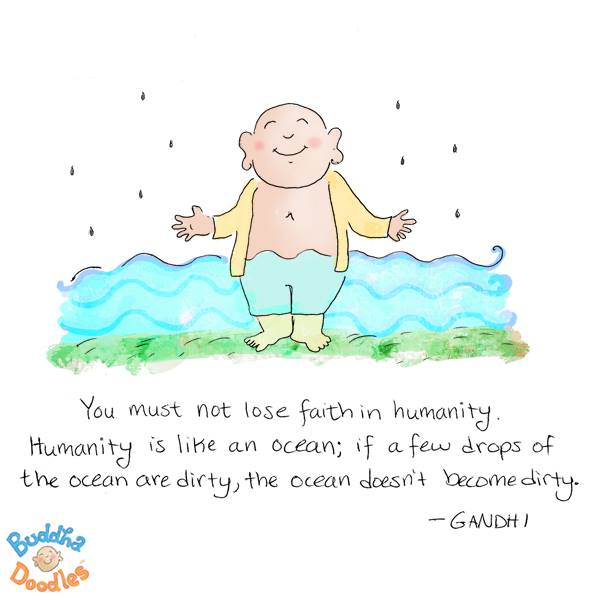
Source: Buddha Doodles
“Faith is taking the first step even when you don’t see the whole staircase.” ~Martin Luther King, Jr.
When we hear someone speak about faith, we usually expect to hear about some kind of subjective encounter with supernatural forces. In our skeptical age, we tend to look at faith as “believing in something you know not to be true,” as Mark Twain expressed.
Before we dismiss any talk of faith, however, we should remember that there are many ways to understand the word. You can have faith in a benevolent, loving deity guiding your every move. But you can also have faith that you’ll wake up in the morning. Or that the dollar in your pocket today will be worth as much tomorrow.
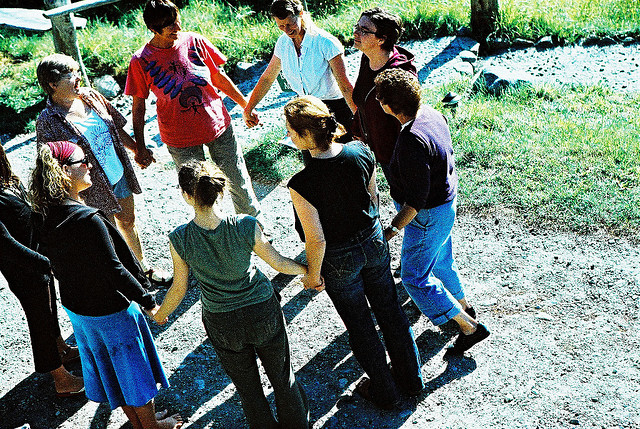
For me, a “revelation” of faith came while sitting around a table with a group people determined to respond to violence with love.
I didn’t realize it at the time, but this experience reaffirmed my faith that human beings are fundamentally loving and good, and will help and care for each other when given the chance.
I think that faith really is the right word here, because holding onto this viewpoint in light of so much evidence to the contrary does indeed requires a “leap,” to borrow Kierkegaard’s famous line.
This understanding emerged at a visioning process for the “Dawson Peace Center.” To its great credit, the Dawson College community has chosen to respond to the 2006 shooting not by putting bigger locks on the doors and stockpiling weapons, but by spearheading meaningful initiatives designed to cultivate peace.
For my part, at this meeting, I spoke about the contributions that meditation might make in addressing the roots of destructive behavior, and how we might be able to integrate it into the college’s culture.
During the meeting, I didn’t really feel like anything was out of the ordinary. Sure, I was inspired by many of the ideas that the other 20 people in the room put forth, but toward the end, my attitude began to shift as I realized that what was happening here was truly extraordinary.
Here, we had a group of committed people seeking, however imperfectly, to affirm that the power of love is stronger than fear.
Here, at least a few people understand that responding to violence in kind makes us no different than the perpetrator. Here, a group has resisted the temptation to let the violent imagination of a disturbed individual hijack our own.
It takes strength and courage to stand up and say, despite all the evidence to the contrary, that human beings are fundamentally decent, kind, and caring, and that we have the responsibility to nurture these attributes.
This audacious belief in basic goodness takes guts. It takes faith. And that’s what I saw around that table.
We’ve all seen how human imagination has the power to create scenes of terror and violence (just open up the newspaper). But it also has the possibility to respond to those who unleash the demons with compassion and understanding, which to me seems the greater power (and usually gets far less media attention).
This is the truth that every saint and sage has communicated: hatred never ceases through hatred. Only love has the power to heal. This is not really a “spiritual” or “religious” truth; even a jaded, secular humanist can see this at work.
It’s up to each and every person to develop the understanding that no matter how far removed someone might seem from this basic goodness, no one is beyond redemption.
Buddha and Jesus hung out with murderers, prostitutes, lepers, and other types of people who society had “thrown away” and given up on. What these marginalized people needed was compassion and understanding, not ostracization and judgment.
And when a teacher who had discovered his own “enlightened nature” spoke to them, they were able to discover that within themselves.
These people who had lead lives of violence and impropriety often went on to become exemplary disciples; the mistakes they had made in their lives were not sufficient to corrupt their essence and potential.
In the eastern traditions, this is expressed through the image of a gem covered with mud, or a lamp coated in dust. These images affirm that the treasure/light is always there, and has only temporarily become obscured.
But in order to sustain the commitment and diligence to undertake the “polishing” process, you must first have an inkling that there is something valuable waiting for you underneath.
Meeting an enlightened teacher can certainly arouse this faith, but coming into contact with the enlightenment that flows through us all when we seek to act with love and compassion is also a catalyst.
It’s by no means certain that we will uncover this treasure in ourselves, much less be able to help others discover it in themselves. But as I felt very deeply around that table, there is intrinsic value in the effort itself.
Everyone’s face communicated the determination to love, despite everything. We understand that the alternative of powerlessness and despair is not really an alternative at all.
Whatever we think about the world becomes a self-fulfilling prophecy, so if we really want to create a world of peace, then we truly have to believe that it’s possible. Even very optimistic people like myself occasionally need boosters of faith to maintain this truly revolutionary attitude.
Photo by kris krug
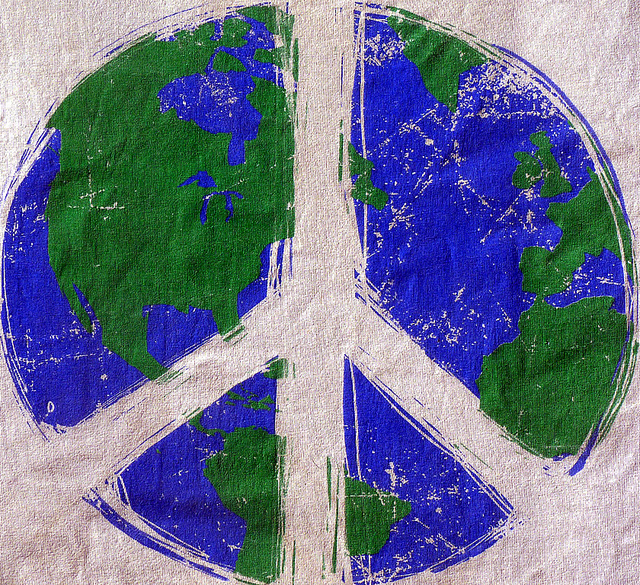
“All great changes are preceded by chaos.” ~Deepak Chopra
We live in an eternally pregnant present, full of possibilities for a bright future. I believe it has always been that way throughout the history of the world. That’s just how the universe works. Unfortunately, we haven’t always experienced our lives the way the universe intended, especially right now.
Humanity seems to be forever in a time of chaos, marked by violence against one another, and most of us do not know how we got that way or when it will end.
I admit that sometimes I long for the good old days of the status quo, when I could navigate daily ugliness with a shrug and sit through dicey evening news with a steadfast, glassy stare. It was easy to ignore my feelings and stay mired in dark indifference. I just turned off my heart to survive it all. It was safer that way.
But it is also very clear to me that the days of dark indifference are over. I think you might feel it too. Yes, life is filled with the same old problems and yes, life is fast. But we now move too quickly to rely on the same old solutions. Our survival tools are obsolete because humanity has upgraded. We are becoming more balanced. We are becoming our better selves.
Six years ago, when my small family moved to Denver for my husband’s job, I fought it tooth and nail. I hated the harsh, dry climate that made my nose bleed and the 1100-mile distance that kept me from the rest of my family and friends. The culture shock and the intense high altitude sun forced me to retreat, literally, to the inside of my house and the inside of my soul for comfort.
That was the beginning of creating my own better self. I read, meditated, and read some more. And I finally started to learn to balance my head and my heart.
My effort started an inward journey that continues still, even though my days in Denver are long gone from my personal map. But the experience of relying on my heart to inform my thoughts forced me to evolve.
I suspect the entire world is evolving, one person at a time. We are reaching a critical mass, a beautiful tipping point for humanity. We are leaving behind the outdated Handbook of Life, with all its heavy-handed solution of war, judgment, and oppression, and writing a new one from our hearts. (more…)