Tag: Hope

  • Micro-Faith, Huge Benefits: Reasons to Believe in Something Bigger

    Micro-Faith, Huge Benefits: Reasons to Believe in Something Bigger

    “Faith is taking the first step even when you don’t see the whole staircase.” ~Martin Luther King Jr.

    My grandmother passed away a few years ago after a long battle with cancer. Even as her health deteriorated, she never lost her spirit. She’d still get excited about whether the Pittsburgh Steelers might finally have a decent season after Ben Roethlisberger’s retirement. She’d debate the Pirates’ chances with the kind of passionate optimism that only comes from decades of loyal disappointment.

    But what I remember most are the afternoons she’d spend napping in her favorite chair with my son curled up against her. He’d drift off clutching some random object, like a wooden spoon or random toy from my parent’s basement. She’d just smile and close her eyes too. Even when she was tired, even when the treatments were wearing her down, she found joy in those stolen moments.

    In her final years, she lived with my parents, but she brought her faith with her.

    Her rosary beads found new homes on nightstands and windowsills. Her worn Bible sat open on the end table, bookmarked with a picture of her husband. The little curio cabinet filled with angels followed her too, a portable shrine to stubborn hope. Wherever she was, the air around her carried that same indefinable quality that I later realized was simply peace.

    My grandmother had the kind of faith that could part emotional storms with a single glance. She didn’t need to preach it. She lived it. You could feel her belief before you even stepped through the front door. She believed in prayer, in miracles, in second chances. In the Steelers. And in Diet Pepsi.

    After she was gone, I expected to feel completely untethered. Instead, I discovered something surprising. Things seemed to hold together. The sadness was real and deep, but underneath it was something solid. A foundation I’d never realized she’d built in me.

    My mother always said I “lived with my head in the clouds,” and it wasn’t until after Grandma passed that I understood where that came from. While I was raised in the Catholic church and spent years as an altar boy, my faith had always been fuzzier than hers. Less certain. More questions than answers.

    But it was there, hidden under the surface, because of her. I’d been benefiting from her quiet influence in ways I never fully understood or appreciated until she was gone. Her faith hadn’t just surrounded me. It had somehow taken root in me, even when I wasn’t paying attention.

    Learning to Recognize What Was Already There

    The months after her death weren’t filled with the existential crisis I expected. Instead, I found myself noticing things. How I naturally looked for the good in difficult situations. How I held onto hope even when logic suggested otherwise. How I moved through the world with a kind of quiet optimism that I’d never really examined before.

    I was still a professional overthinker, still a card-carrying worrier. But underneath all that mental noise was something steadier. Something that whispered, “This too shall pass,” even when I wasn’t consciously thinking it.

    It took time to understand that this wasn’t something I needed to build from scratch. Grandma hadn’t just modeled faith for me; she’d been quietly cultivating it in me all along. Through her example, through her presence, through those countless afternoons when she’d choose hope over fear, even when the odds were stacked against her health and her beloved sports teams.

    Discovering My Own Messy Version

    What I came to realize was that my faith was never going to look like Grandma’s. Hers was rooted in tradition, in ritual, in the comfort of centuries-old prayers. Mine was more scattered, cobbled together from different sources and experiences.

    My faith, I discovered, is held together with hope, a healthy dose of skepticism, and about six different kinds of sticky notes. It’s not the neat, organized kind. It’s more like a spiritual junk drawer full of useful things, but you’re never quite sure where anything is.

    I believe in second chances and fresh starts. I believe in the power of afternoon sun to reset your entire day. I believe that kindness is contagious and that sometimes the universe sends you exactly what you need, even if it arrives late, confused, and covered in cat hair.

    Some days, my faith is a whisper: “Maybe things will get better. Maybe I’m not alone. Maybe I can try again tomorrow.” Other days, it’s louder: “This is hard, but I can handle hard things. I’ve done it before.”

    My faith doesn’t look like Grandma’s, but it carries her DNA. It’s messier, less certain, but it has the same stubborn core, a refusal to give up hope, even when hope seems foolish.

    The Science of Belief

    Here’s what I wish I’d known during those dark months: You don’t have to be religious to benefit from faith. Science shows that belief in something greater than yourself can be a powerful tool for mental and emotional well-being.

    Faith literally reduces stress. Studies show that people who report a strong sense of meaning or spiritual belief have lower levels of cortisol, the hormone associated with stress. Translation? Faith helps your brain pump the brakes on panic.

    It improves emotional regulation by activating the brain’s prefrontal cortex, which helps you pause before spiraling. It builds psychological resilience by reminding you that you’re not at the center of every catastrophe. Whether you believe in God, the universe, karma, or cosmic duct tape, faith acts as a buffer against hopelessness.

    Acts of spiritual reflection can trigger the same brain regions involved in feelings of safety and joy. And faith often leads to rituals or conversations with others, building the connections that are crucial for well-being.

    Here’s the kicker: You don’t have to get it right. Wobbly faith counts. Uncertain, whispered-in-a-closet faith is still valid. Half-hearted “Okay, Universe, I trust you… kinda” mutterings are welcome here.

    The Power of Micro-Faith

    Big transformations feel great in theory but hard in practice. That’s why I’ve learned to embrace what I call “micro-faith,” these small, digestible moments of intentional belief. Like appetizers for your spirit.

    Today, try believing in something small:

    • The possibility of a good cup of coffee
    • The strength hiding inside your own weird little heart
    • The fact that what you need might already be on its way
    • The idea that this difficult season won’t last forever
    • The chance that tomorrow might feel a little lighter

    Faith doesn’t have to be grand or glowing. Sometimes it’s just showing up anyway, even when you’re not sure why.

    What Grandma Taught Me

    Years later, I realize Grandma didn’t just give me faith; she showed me how to live it. She taught me that faith isn’t about having all the answers. It’s about trusting that you’ll find your way, even in the dark.

    She taught me that belief can be quiet and still be powerful. That faith isn’t a destination but a traveling companion. That sometimes the most profound act of faith is simply getting up and trying again.

    Most importantly, she taught me that faith isn’t about perfection. It’s about showing up. Showing up to your life, to your relationships, to your own healing, even when you feel completely unprepared.

    I carry pieces of her faith with me now, mixed in with my own messy, imperfect beliefs. Some days I feel like I’m floating through life with my head in the clouds. But thanks to Grandma, and a whole lot of trial and error, I’ve learned to float up here without getting totally fried by the sun.

    If your faith feels fractured, fuzzy, or faint, you’re not doing it wrong. You’re just human. Faith isn’t a finish line. It’s a floating device. It won’t always steer you straight, but it might keep you above water long enough to find the shore.

    So go ahead and believe in something today. Even if it’s just the idea that the clouds will eventually clear… and the coffee won’t taste burnt this time.
  • From Loss to Hope: How I Found Joy Again

    From Loss to Hope: How I Found Joy Again

    “Although the world is full of suffering, it is also full of the overcoming of it.” ~Helen Keller

    The phone call arrived like a silent explosion, shattering the ordinary hum of a Tuesday morning. My uncle was gone, suddenly, unexpectedly. Just a few months later, before the raw edges of that loss could even begin to soften, my mom followed. Her passing felt like a cruel echo, ripping open wounds that had barely begun to form scabs.

    I remember those months as a blur of black clothes, hushed voices, and an aching emptiness that permeated every corner of my life. Grief settled over me like a suffocating blanket, heavy and constant. It wasn’t just the pain of losing them; it was the abrupt shift in the landscape of my entire world.

    My cousin, my uncle’s only child, was just twenty-three. He came to live with me, utterly adrift. He knew nothing about managing a household, budgeting, or even basic self-care. In the fog of my own sorrow, I found myself guiding him through the mundane tasks of adulting, a daily lesson in how to simply exist when your world has crumbled.

    Those early days were a testament to moving forward on autopilot. Each step felt like wading through thick mud. There were moments when the weight of it all seemed insurmountable, when the idea of ever feeling lighthearted again felt like a distant, impossible dream. My heart was a constant ache, and laughter felt like a betrayal.

    Then, the losses kept coming. A couple of other beloved family members departed within months, each passing a fresh cut on an already bruised soul. It felt like the universe was testing my capacity for heartbreak, pushing me to the absolute edge of what I believed I could endure. I was convinced that happiness, true, unburdened joy, was simply no longer available to me.

    For a long time, I resided in that broken space. My days were functional, but my spirit felt dormant, like a hibernating animal.

    I went through the motions, caring for my cousin, managing responsibilities, but internally, I was convinced my capacity for joy had been irrevocably damaged. The idea of embracing happiness felt disloyal to the people I had lost.

    One crisp morning, standing by the kitchen window, I noticed the way the light hit the dew on a spiderweb. It was a fleeting, unremarkable moment, yet for a split second, a tiny flicker of something akin to peace, even beauty, stirred within me. It startled me, like catching my own reflection in a darkened room. That flicker was a subtle reminder that even in the deepest shadows, light still existed.

    This wasn’t a sudden epiphany or a miraculous cure. It was a slow, deliberate crawl out of the emotional abyss. I began to understand that healing wasn’t about erasing the pain, but about learning to carry it differently. It was about allowing grief its space while simultaneously creating new space for life to bloom again.

    The first step was simply acknowledging the darkness without letting it consume me.

    I stopped fighting the waves of sadness when they came, allowing them to wash over me, knowing they would eventually recede. This acceptance was pivotal; it transformed my internal struggle from a battle into a painful, but necessary, process.

    I also learned the profound power of small, intentional acts. This wasn’t about grand gestures of self-care. It was about consciously noticing the warmth of a morning cup of coffee, the texture of a soft blanket, the simple comfort of a familiar song. These tiny moments, woven into the fabric of daily life, began to accumulate, like individual threads forming a stronger tapestry.

    Another crucial insight was the importance of letting go of the “shoulds.” There’s no right or wrong way to grieve, and no timeline for healing. I stopped judging my feelings, stopped comparing my progress to an imaginary standard. This liberation from self-imposed pressure created room for genuine recovery, allowing me to be exactly where I was in my journey.

    I started to actively seek out moments of connection. This meant leaning on the friends and remaining family who offered support, even when I felt too exhausted to reciprocate. It was about sharing stories, sometimes tearful, sometimes unexpectedly funny, that honored those we had lost and reminded me that love, even in absence, still binds us.

    Embracing vulnerability became a strength. Allowing myself to be seen in my brokenness, to admit when I was struggling, paradoxically made me feel more grounded. It revealed the immense capacity for compassion that exists in others, and in myself. This openness fostered deeper connections, which became vital anchors in my recovery.

    The concept of “joy” also transformed. It wasn’t about constant euphoria but about finding contentment, peace, and even occasional bursts of laughter amidst the lingering sorrow.

    It became less about an absence of pain and more about a presence of life, in all its complex beauty. I learned that joy is not a betrayal of grief but a testament to the enduring power of the human spirit.

    Ultimately, my journey taught me that resilience isn’t about being tough or never falling. It’s about being tender enough to feel, courageous enough to keep seeking light, and brave enough to get back up, even when every fiber of your being wants to stay down. It’s about collecting the pieces of your broken heart and finding a way to make it beat again, perhaps even stronger and more appreciative of every precious moment.

    I now stand in a place where I truly believe I am stronger and happier than ever before. Not despite the pain, but because of the profound lessons it taught me.

    Every challenging step, every tear shed, every quiet moment of discovery contributed to the person I am today—a little wiser, a little braver, and with a way better story to tell.

    My hope is that anyone facing similar darkness knows that the path back to joy is always possible, and that your story, too, holds immense power and purpose.

  • Magic in the Ordinary: Finding Glimmers and Hope in Everyday Life

    Magic in the Ordinary: Finding Glimmers and Hope in Everyday Life

    “If today gets difficult, remember the smell of coffee, the way sunlight bounces off a window, the sound of your favorite person’s laugh, the feeling when a song you love comes on, the color of the sky at dusk, and that we are here to take care of each other.” ~Nanea Hoffman

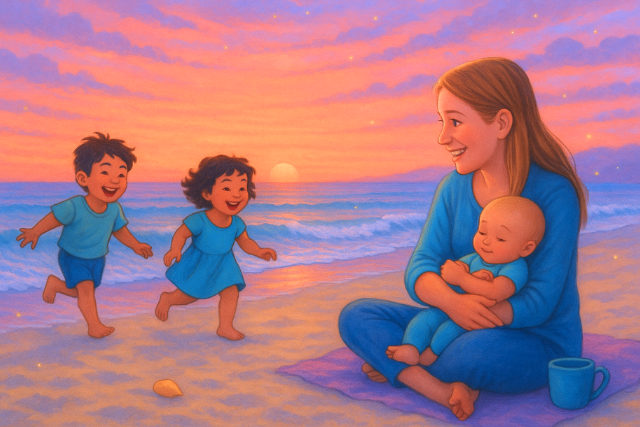
    The beach breeze brushed against my skin. I felt the warmth from the sun, and I could hear the crashing waves and wild shrieking laughter of my toddlers.

    I looked down at my perfect ten-month-old with his adorable chubby cheeks, snoring softly in my arms. My chest ached as if my heart physically hurt from the amount of love I felt toward my children in that moment, and my eyes shimmered with tears at the force of that love. “This was a glimmer,” I thought.

    Many people are familiar with the idea of triggers. Triggers are any scenarios or stimuli that stir up negative emotions, which are usually rooted in a past hurt or trauma.

    Less familiar to most people is the concept of glimmers. Glimmers are the opposite of triggers. They’re little moments that spark calm and connection. The idea was originally introduced by Deb Dana, who is a prominent figure in the application of Polyvagal Theory, which is a scientific framework for understanding the nervous system.

    We are less inclined to look for glimmers than triggers, and the reason is evolutionary.

    In the past, our caveperson brains benefited more from remembering the time we ate poison berries or the places that hungry lions lurked than from savoring a beautiful sunset. But most of us are buying our groceries at farmers’ markets and grocery stores now—and don’t have to worry about lions, so we can practice changing our brains.

    There’s an idea in psychology that “what we water will grow” in reference to what thoughts we attend to. The more we practice noticing the positives, the more naturally our brains will make and strengthen those pathways.

    I’m a mental health therapist, and I learned about glimmers through a continuing education course. At the time, I was struggling with my own anxiety. I had feelings of guilt show up as I guided my clients through their mental health challenges while still learning how to manage my own.

    When I have a moment to take perspective, though, I can show myself grace as a mom of a three-year-old, a two-year-old, and a ten-month-old, who happened to be a miraculous little surprise.

    With three small humans, two dogs, and a fish, life is loud, messy, chaotic, and beautiful. Balancing work, house chores, and the needs of others can feel exhausting and overwhelming.

    I don’t have hours to do all the self-care activities that you are “supposed to” do in a day—journal, exercise, meditate. But glimmers? They fit into my life.

    I love Harry Potter, fantasy, and magic. I like to look at glimmers as more than calm and connection and more like sparkly little moments in our ordinary life. Glimmers can be sensory—a beautiful sunset, a warm breeze, the flicker of a candle, the scent of lavender, or the first sip of a really delicious coffee.

    They can be internal—a deep exhale, a comforting memory, a moment of self-compassion, or being proud of an accomplishment.

    They can be a social connection—a long hug from your partner, a rambling story from your three-year-old, or hearing your two-year-old tell his sister, “I love you, Evy.”

    The idea of glimmers reminds me a bit of the Danish concept of hygge. Hygge’s closest English translation is a concept of coziness and contentment. I love the idea of connecting these two ideas because it would seem to me that engaging in hygge practices would set you up to have even more glimmers.

    Creating more hygge in your life would include whatever feels cozy for you. For me, it’s big comfy blankets, candlelight, a warm drink, and clothing with the softest fabrics. The values behind hygge are a sense of presence, slowness, and connection. Hygge is about setting an environment to invite glimmers in.

    These days, I collect glimmers like fireflies in a jar. They’re nothing fancy, but they’re tiny moments that reassure me that I’m okay. They bring me home inside my own body. There is magic in the ordinary, after all. You just have to look for it.

  • How My Mother’s Alcoholism Shaped Me and How I’m Healing Now

    How My Mother’s Alcoholism Shaped Me and How I’m Healing Now

    “The journey of the perfect daughter is not about perfection; it’s about finding the courage to be imperfect, to be human.” ~Robert Ackerman, Perfect Daughters

    Growing up in a home shadowed by addiction is like living in a house with no foundation. The ground beneath you is unstable, the walls feel fragile, and the roof could collapse at any moment. For me, this was my reality. My earliest memories of my mother’s alcoholism are tied to confusion and worry—a child’s attempt to make sense of an adult world filled with unpredictability and silence.

    Her moods were erratic, swinging from one extreme to another, I recall. I remember one night, she came into my room, woke me up, and told me not to worry, but she was going back to work. The way she spoke, her entire presence, was off. It wasn’t her usual self. I didn’t understand she was drunk. I just felt pure, childlike concern.

    This confusion was only the beginning. As I grew older, the challenges multiplied. The embarrassment of comparing my home life to my friends’, the isolation of a family that never spoke about the elephant in the room, and the lack of safety in my own home left me feeling utterly alone.

    I didn’t feel comfortable reaching out to any adult. My dad wasn’t approachable, and my mom wasn’t emotionally available. I felt like I had to solve everything on my own.

    The Roles We Play 

    In the chaos of addiction, children often take on roles to survive. For me, these roles became my identity. I became the peacemaker, mediating between my mother and younger sister. I became a second mother, guiding my sister in ways my mom couldn’t. And I became the “good daughter,” believing that if I loved my mother enough, I could save her.

    I thought that by loving her more, investing my attention in her needs, and avoiding confrontations, I could make her feel better. But it was an impossible burden.

    My relationship with my father also suffered. I blamed him for allowing my mom to continue her behavior and for not doing anything for us. He became the enemy, and I pushed him out of my life.

    The Long Shadow of Childhood Trauma 

    The impact of my mother’s alcoholism didn’t end in childhood. As an adult, I found myself repeating patterns in friendships and romantic relationships. I’ve struggled with codependency, boundaries, and trust issues. I’ve had manipulative partners and found myself drawn to selfish, narcissistic people.

    But my journey toward healing began when I hit rock bottom. I was drinking excessively, showing up to work after long nights out, and even driving drunk. I dated a partner who was emotionally abusive and almost physically violent—and my parents had no idea.

    A pivotal moment came during a surprise party my sister organized before I left to study abroad. I arrived hungover and exhausted, and when everyone shouted “surprise!” I had an anxiety attack. It was the first time I realized how many feelings I’d buried—sadness, frustration, anger, and underneath it all, a deep, overwhelming grief I had never allowed myself to feel.

    The Path to Healing 

    Healing didn’t happen overnight. It began with therapy—though my first experience was far from ideal. That therapist was deeply narcissistic, mirroring the types of people I’d been drawn to all my life. But I didn’t give up. I found another therapist, and she’s been my steady guide for seven years.

    Through our work, I learned that I was not alone and that I could reach out for help—and trust that help. I also learned to recognize what trust feels like, to move away from extremes, to distinguish love from codependency, and to take responsibility for my part in my experiences. At twenty-seven, I was finally ready to stop blaming others and take accountability—not just for my present, but for all the years I had abandoned myself. I began to reframe my past, not through the lens of a victim, but from the perspective of the self-aware adult I’d become.

    One of the most profound breakthroughs came when I decided I was ready to confront my mother. Preparing for that moment shifted everything—it marked the beginning of reclaiming my voice and stepping into my own power.

    Support groups like Al-Anon also played a crucial role. When I arrived at Al-Anon, I started crying within minutes. For the first time, I heard people speak openly—almost casually—about having a loved one with alcoholism. I had never experienced that kind of openness in such a “normal” environment.

    Listening to the speaker share their story, I realized I wasn’t alone. We were all carrying the same grief, frustration, and helplessness. In that room, I felt seen. I felt like I belonged.

    Through therapy, meditation, exercise, and books, I began to rebuild my sense of self. I learned to be with myself in a peaceful, serene way. I stopped looking at my mom as someone weird or lost and started seeing her as someone with a disease. I took off the impossible burden of having to save her.

    Surrendering to Hope 

    One of the most profound lessons I learned was the power of surrender. For me, surrender meant admitting I needed help—that my own resources weren’t enough to handle the situation I was facing at home. It meant being humble enough to admit that this was bigger than me, that trying to fix my mother was not only ineffective but was also destroying me.

    In my daily life, surrender meant walking away from arguments, especially when my mother was drinking, letting go of the exhausting mission to make her happy, and accepting that her happiness wasn’t something I could guarantee.

    There’s a phrase in Al-Anon that became my mantra: “I didn’t cause it. I can’t control it.” I surrendered my expectations of who I wished my mother would be and allowed myself to grieve the mother I didn’t have. That surrender saved my life.

    My journey is a testament to the resilience of the human spirit. When you choose to surrender, everything will start feeling better. It’s a leap of faith, and trust me, you’re not alone.

    Today, I’m still on my healing journey, but I’m no longer defined by my past. I’m learning to trust myself, set boundaries, and embrace my worth. My story is a reminder that even in the darkest moments, there is hope—and that healing is possible, one step at a time.
  • The Truth About Rainbows: Hope Doesn’t Always Look Like We Expect

    The Truth About Rainbows: Hope Doesn’t Always Look Like We Expect

    “If you have ever followed a rainbow to its end, it leads you to the ground on which you are standing.” ~Alan Cohen

    There’s nothing more exhilarating than riding in a Jeep through masses of standing water. With each push forward, my friend Angela expertly maneuvered through enormous puddles, sending fountain-like arcs of aquatic glory past my passenger-side window.

    This was joy to me.

    It was a welcome reprieve considering the past couple of years had unraveled in ways I never saw coming. In fact, this watery wonder, cruising through the quaint streets of the beloved beach island I called home, was a rare outing for me.

    I wouldn’t call myself a shut-in exactly, but if you had spotted me out and about in recent months, you might have likened it to a unicorn sighting—rare and a shock to the system. Rare, because leaving my house required something other than pajamas. Shocking, because it meant I had somehow rallied after a morning of ugly crying.

    These days, the ugly cries came less frequently, but getting out the door still required careful planning and a healthy dose of positive self-talk. Angela, sensing all I had been through, didn’t attempt to fill the space between us with mindless chatter. She let the air breathe, allowing our hearts to settle into a comforting silence.

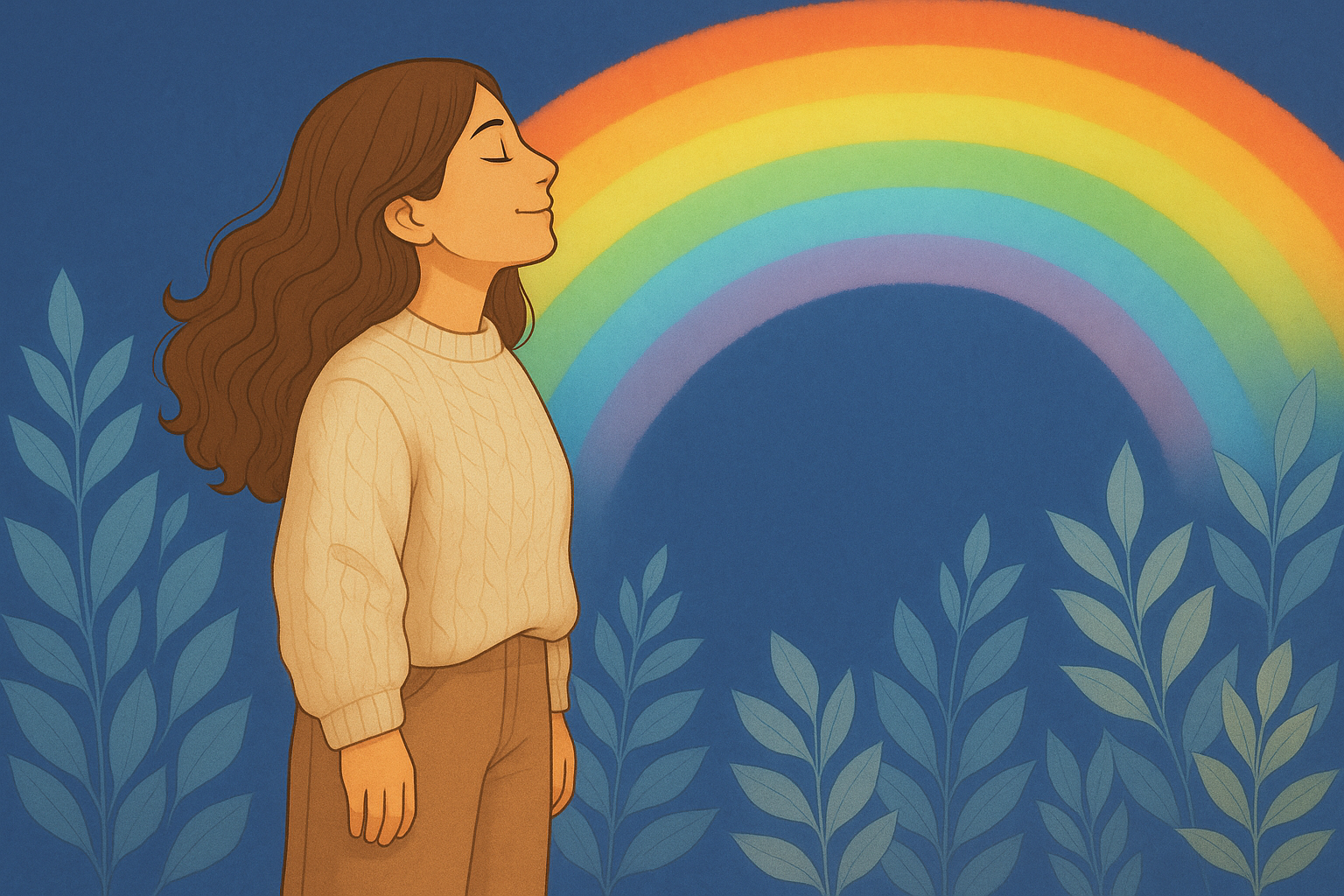
    And wouldn’t you know it? In that silence, as we rolled forward over the waterlogged road, a rainbow appeared.

    It was magnificent. A full curve stretching across the sky, untouched by a single cloud. We both took it in, wordless at first, until Angela finally spoke the thought we were both holding:

    “This has to mean brighter days are ahead.”

    I nodded, hoping with everything in me that she was right. Not just for our community, which had been pummeled by weeks of relentless storms, but selfishly, for me. I needed this to mean something. The universe wouldn’t place something so breathtaking in my path if life wasn’t about to shift in a meaningful way… right?

    At that moment, although I wasn’t ready for it, a tiny doorway of hope cracked open in my heart.

    Angela pulled into my driveway, gave me one of those deep, soulful hugs she’s known for, and I stepped onto the sand-packed pavers, feeling something I hadn’t felt in a long time: the possibility of relief.

    But relief never came.

    The next morning, I woke up expecting transformation. I brushed my teeth, looked in the mirror, and waited for the shift. And then it hit me. Nothing had changed.

    Worse yet, everything that had once shattered me remained intact, as if locked in a forgotten pause. My father was gone—forever. And instead of the clarity or closure I had hoped for, I was left with the unsettling reality that some pieces of life can never be fully mended.

    By some unknown force of grace, the years, months, and weeks leading up to our last conversations allowed them to be light, even warm. A reminder that the love we shared, though imperfect, continued to move freely in both directions. And still, his sudden departure sent shockwaves through my family, shifting fault lines in ways I couldn’t control. Unable to bear it, like a sea turtle stunned motionless after a sudden freeze warning, I collapsed inward and began my retreat from the external world.

    Then, there was my future looming over me, a blank slate waiting to be filled. My identity had been tethered to raising my boys, but soon, my nest would be empty.

    I had no roadmap for what came next. I had tried to carve out a new path through writing and building a mindful and self-compassionate community, but since my father’s death, that dream and the energy for it had faded.

    My reflection met my gaze, uncertain and hesitant. Fifty years etched into my skin, fine lines tracing both laughter and worry, a strip of silver roots marking the passage of time, yet I felt invisible in a world that had seemingly moved on.

    What now, rainbow? What now?

    And beyond the grief, beyond the exhaustion, there was something else.

    Anger.

    How dare that rainbow give me hope? How dare it let me believe, even for a moment, that things were about to get better? I felt tricked, betrayed by my own willingness to believe in something beyond my suffering.

    But as I spiraled deeper into my chasm of despair, something else took shape on the edges of my soul. A truth so simple, so unshaken by my sorrow, that it stopped me in my tracks.

    I finally learned the truth about rainbows.

    Rainbows do not exist to change our lives. They do not come with promises or guarantees. They are not here to tell us whether things will get better or stay the same.

    A rainbow’s only purpose is to illuminate what already exists. To take the ordinary and, for a fleeting moment, drench it in color. It does not erase the rain, nor does it undo the storm. But it shifts our perception. It allows us to see the world, and ourselves, in a way that feels momentarily brighter.

    And maybe, just maybe, that is enough.

    Maybe healing is not about waiting for life to change but about learning to be with life exactly as it is. Maybe it’s about making space for the full spectrum of our emotions—grief and wonder, despair and hope, pain and beauty—without needing to force one away to make room for the other.

    Maybe the rainbow was never a promise of transformation. Maybe it was simply an invitation to see my life, my grief, and even myself through a different lens.

    And so, instead of cursing the rainbow for failing to fix me, I let it teach me something else.

    That I am still here.

    That even in grief, I can experience awe.

    That even in uncertainty, wonder can still find me.

    That even in the hardest moments, light doesn’t disappear. It refracts, scattering in ways I might not have expected but still can choose to see.

    And maybe, just maybe, hope isn’t about believing something external will come along to save us. Maybe hope is simply the courage to keep going, even when we don’t yet see the path ahead.

    So, I will keep going.

    Not because I know what’s next.

    Not because I believe everything will suddenly fall into place.

    But because there is still light in this world. Light that is beautiful, redemptive, and multi-faceted, and I want to keep searching for it.

    Even in the rain.

    Even in the in-between.

    Even in me.

  • Why You’re Not Happy (Even If Life Looks Fine)

    Why You’re Not Happy (Even If Life Looks Fine)

    Do you sometimes see people running around enjoying life and wonder what you’re missing? Sometimes I used to think I must be a horrible person. I had so many things going for me, and I still couldn’t be happy. I would ask myself, is there something wrong with me? Am I a narcissist?

    Then sometimes I would decide I was just going to be happy. I would fake it until I made it and just accept that’s who I was. But it wouldn’t take long for me to feel overwhelmingly depressed.

    I had a little dark hole that would constantly pull at me, and I didn’t have the energy to keep ignoring it. My attempts to do so just made it scream louder, and then I really was in a mess. This, of course, made me feel worse because it would remind me that I must be crazy.

    As I worked through my healing journey, I discovered there are three key reasons why we can’t just muscle up and be happy. We need to work through these three obstacles to move from just surviving and having moments of happiness to thriving and living a life full of joy and inspiration. To living a life where we love who we are and what we are doing and have hope for the future.

    Life is never perfect, but it sure is a lot more enjoyable and fun when we love, enjoy, and fully experience the present moments we are in.

    So what are these obstacles? And what strategies can you use to work through them?

    1. Validate Past Experiences

    When you don’t fully validate and process painful past experiences, the energy of those experiences gets trapped and contained within your body.

    It takes consistent and continual emotional energy to keep the walls around those experiences high and the energy within contained. The energy and emotion inside are deep and strong, and to keep these feelings away from our consciousness. we can’t allow ourselves to experience any deep or strong feelings, even the good ones.

    Allowing yourself to pull down these walls and grieve all the deep and strong feelings inside will free your emotional energy to feel deep and strong happy feelings too.

    For me, this meant feeling and processing the sexual abuse I endured as a child.

    For years I convinced myself that I was fine and that it happens to almost everyone. I tried to minimize my experience and leave it in the past. The walls I had built to keep all the grief and pain of those experiences out of my conscious daily awareness drained me and prevented me from feeling life in real time. I was guarded, with very shallow access to my feelings.
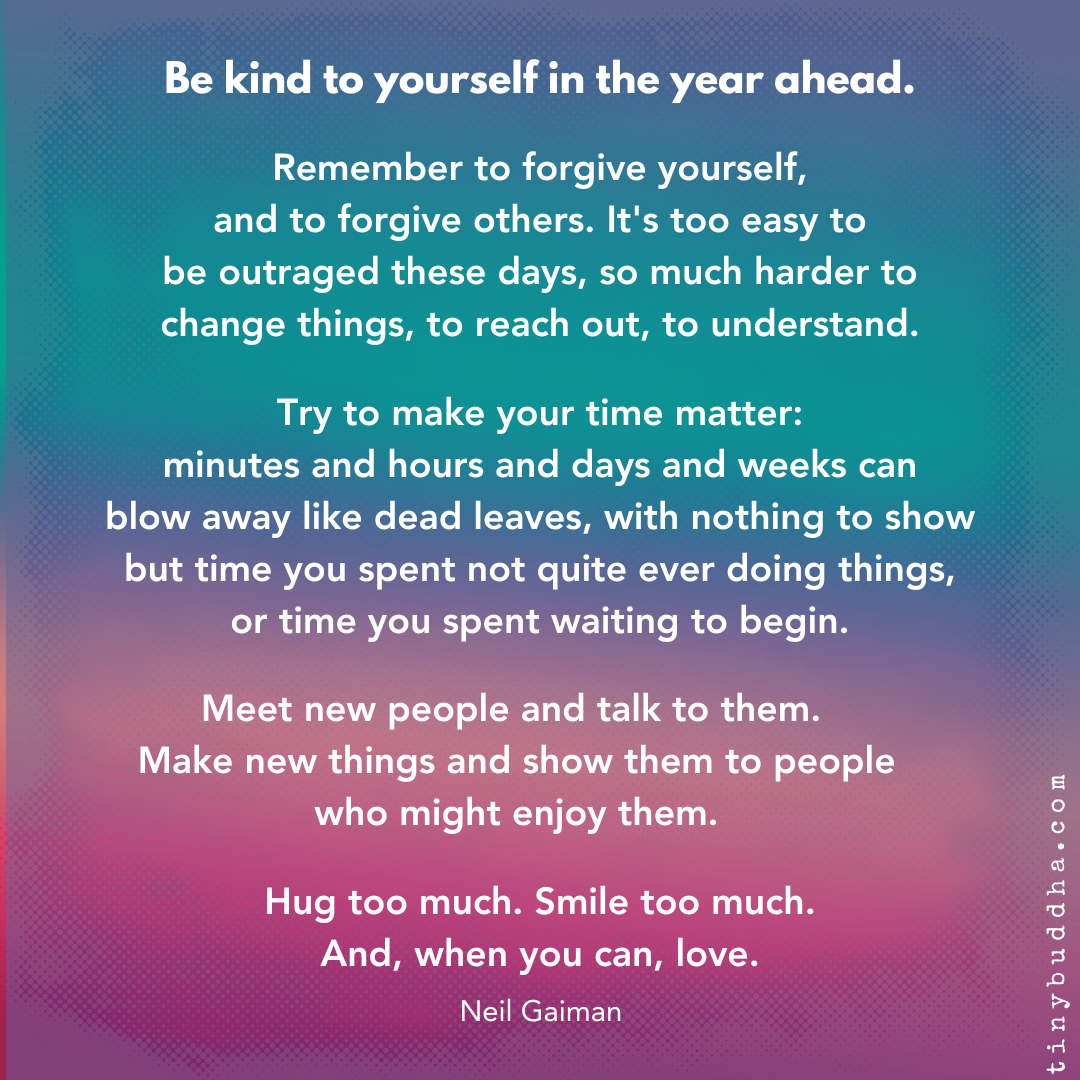
    No one wants to go back and work through the pain of the past, but I discovered that doing grief work with my therapist allowed me to truly let go of the pain and thrive in the present.

    2. Let Go of the Need for Control

    When you’ve been hurt in the past, it is normal to want to curate a life where you can’t get hurt again. We create a sense of safety by ensuring our life is as predictable as possible. Any time someone in our circle acts in a way that is outside our control, we ensure they “get back in line” so we feel safe.

    For example, if your partner doesn’t immediately return your text, you might get upset and lash out about how disrespectful he is being. If your kids don’t seem to be as concerned about their grades as you think they should be, you might panic and shame them, saying they will be stuck working in fast food restaurants for the rest of their lives. We want everyone to act as we think they “should,” so our world feels nice and safe and predictable.

    Zoom out and look at this scenario… Could it be any more boring? No wonder it’s impossible to feel true joy and happiness. Joy and happiness come from the ability to be spontaneous, light, free, and unpredictable.

    I think a lot of people mistake feeling safe for feeling happy. Being in a constant search for safety keeps us in survival mode. Knowing you are safe with yourself no matter what allows you to move out of survival and into a higher consciousness that brings joy, pleasure… and happiness.

    It is true that many of us have very real pain from the past, and it is perfectly normal to want to protect ourselves from feeling that pain again by attempting to curate a life we can fully control. This is an unconscious decision we make out of self-protection.

    Choose to make the conscious decision to let go of control. Trust that you now have all the resources within yourself to feel safe, no matter what happens. Releasing the need to control will bring you the ability to feel joy, pleasure, and fun again.

    This one was difficult for me and took a long time to integrate. Because of my abusive childhood experiences, I overcompensated for my feelings of worthlessness and lack of safety with a drive for success and perfectionism to try to control how others perceived me.

    If my co-worker wasn’t pulling her weight, I would stay late and work weekends to ensure the work was done, and done well. If my husband wouldn’t spend time with me or plan dates, I would plan dates and put all the reservations in his name so it looked like he was investing in me and our relationship. If my kids were not interested in wearing outfits that I thought would make our family look perfect, I would bribe them with candy so we could look good and put together as a family.

    I thought that making myself and my family look like we had it together meant that we did, and we would therefore be happy. Man, this couldn’t be further from the truth, and it actually drove not just myself but everyone in the family system in the opposite direction.

    No one likes to be manipulated, and even if we can’t exactly identify that’s what is happening, we feel it. Honestly, I had a bit of an identity crisis as I let go of how I wanted life to look and embraced living and feeling life in real time. What I can say is that since I’ve let go of control, life has been full of more peace and joy than I knew possible.

    3. Look for Happiness

    What we look for, we will find. There is a reason we constantly hear people talk about gratitude. When we look for things we’re grateful for, things we enjoy or love, we create more of those things in our lives. We begin to see how much joy and happiness we already have.

    We so often completely overlook the goodness that’s all around us because we are preconditioned to see and experience all the things that are going wrong.

    This third step is caused by not working through the first two. When we haven’t validated our past painful experiences, we look for validation in all our current painful experiences.

    It’s like those experiences keep haunting us until we take the time to turn around and look at them. They cloud our ability to see the happiness we already have all around us. We can’t experience the innocence and joy in our children. Nor can we accept the love and connection our friends want to offer us or appreciate all the amazing things we are doing well at work.

    When we are stuck in the need for control, we look for all future outcomes that will help us to stay safe instead of looking for all the joy and pleasure that is already in our life. We don’t have enough bandwidth to do both, at least not all at once; so, for example, if we spend all our time subconsciously looking for ways someone else might hurt or abandon us, then we don’t have the energy left to look for joy and pleasure in our relationships.

    One day I had to make a choice. I decided I had had enough of being tired, frustrated, and miserable. I knew it would take a while for my circumstances to change, but that didn’t mean I had to stay stuck and feel isolated, frustrated, and lonely.

    I made the hard choice to look for happiness. At first, I would journal things I found happiness in, and over time it became more subconscious than conscious. It also helped to talk about it with a good friend, as we both challenged each other in looking for happiness.

    Sometimes I still struggle. If I haven’t been taking care of myself, this one is the first to slip. I start to slide back into an old pattern of looking for how life is screwing me over. I know that I’m better able to keep my mindset in happiness when I engage in self-care as often as possible.

    If enough is enough and you are ready to move on from feeling like you are just surviving life, implement the following three strategies to overcome the obstacles to joy.

    First, start journaling or processing your feelings about past experiences. It could be a good idea to do this step with a professional, depending on what you have been through.

    Next, start identifying how much control you have over your life and the people around you and see where you can loosen up the reins a little.

    I can almost hear you saying back to me, “But everything will fall apart if I let go!” Let it fall apart. You don’t want a partner and kids who live only to make you satisfied and “happy.” Let life get a little messy. They (and you) will be so much happier if they just get to be themselves, make mistakes, and develop connections out of genuine love and respect… not out of fear of failure or mistakes.

    This last one is pretty simple: start looking for joy. Get curious when you find it hard or upsetting to look for joy. Often, turning things around is simply a choice. Change your subconscious conditioning from looking for what is going wrong to looking for what is going right.

    These three steps will help you attract the people and experiences that will bring you everything you are looking for.

    Before you know it, your past pain will be a distant memory that doesn’t impact your day-to-day life. Instead, you will feel a sense of freedom and joy because you’ll be able to live life in the moment rather than in your head trying to predict outcomes, and because you’ll have reset your pre-conditioning to look for the good in life everywhere you go.

    This is what it takes to be one of “those people” who just seem happy and full of life. Which strategy will you try first?

  • How Grieving a Dream’s Loss Built Hope for a New Life

    How Grieving a Dream’s Loss Built Hope for a New Life

    “Our painful experiences aren’t a liability—they’re a gift. They give us perspective and meaning, an opportunity to find our unique purpose and our strength.” –Dr. Edith Eger, The Choice: Embrace the Possible

    The loss of an unrealized dream sent me spiraling down, down into the darkness. A darkness filled with a despair and hopelessness that I had not known before.

    It was safer and more comfortable for me to attribute all my grief to losing a loving mother-in-law suddenly in the beginning of 2023. Her abrupt absence not only in my life but also in my husband’s and daughter’s lives was incredibly hard.

    Though the loss opened the portal of grief, there was more I hid. When I was still in a tender place, intangible losses and a health scare came.
    The loss that completely broke my heart was when my husband and I made the joint decision to end our dream of trying to have a second child. A shared dream since early on in our relationship and a dream of mine since long before.
    Neither of us could have anticipated my unexplained infertility diagnosis and the four-year-long, beautiful, broken, and growth-filled road to parenthood. Throughout the entire journey, I still held onto hope that we would one day have two children.

    The visceral, raw grief that came after we made the decision shocked me. When we had first honestly discussed this idea, I felt excited to build our life as a family of three. I deeply knew our family was complete.

    But once we made the decision, grief I did not want or know how to feel consumed me. Grief for all that had been lost. For all that wouldn’t come into being in the future. Invisible to the outside world.

    At first, my negative, self-critical talk took over, giving me a hard time for what I was going through. Full of self-judgment, regret, anger, and shame. Overcome with grief, I had forgotten I didn’t have to believe that voice and could be kinder to myself.

    Mornings were the toughest. Each day, I would wake up with the weight of unshed tears under my eyes. Though I had slept well, my whole body was heavy and weary. My mind felt foggy. I’d forget small things, which wasn’t like me. Seemingly simple tasks took so much energy.

    After dropping off my daughter at preschool, I would sit in my living room alone. I had no motivation to do anything. If I didn’t have a work meeting to prepare for or immediate deliverables to complete, I’d distract myself on my phone, numbing. This unhealthy morning cycle would continue for a while.

    Once I started working, I would get in a rhythm and focus on the projects in front of me, which I did enjoy.

    My body and psyche knew what had happened was significant. It would take time for my rational mind to catch up. I would need to allow myself to have my full experience of grief.

    An Expanded View of Grief

    Developing an expanded view of grief and processing my experience with a grief therapist began to help.

    One of the first concepts I learned is that there are different types of grief. Through Atlas of the Heart, a book by research professor, author, and podcaster Brené Brown, I understood I was dealing with both acute and disenfranchised grief.

    Acute grief is the intense grief that occurs during the initial period after a loss. I was not familiar with disenfranchised grief.

    Brown writes, “Disenfranchised grief is a less-studied form of grief: grief that ‘is not openly acknowledged or publicly supported through mourning practices or rituals because the experience is not valued or counted [by others] as a loss.’ The grief can also be invisible or hard to see by others.”

    My grief not only felt invisible to the outside, but also, I hadn’t valued the end of an unfulfilled dream as a loss at first.

    A second concept was to focus on integrating grief into my life. My therapist shared that it’s not about moving on after experiencing a loss; it’s about moving forward, integrating our losses with how we live our lives.

    A third concept came from psychologist and Holocaust survivor Dr. Edith Eger’s book The Choice: Embrace the Possible. Though she had been through unimaginable suffering, she gave a message of hope and healing.

    She shared, “When we grieve, it’s not just over what happened—we grieve for what didn’t happen… You can’t change what happened; you can’t change what you did or what was done to you. But you can choose how you live now.” We could choose freedom, joy, and love over suffering.

    What Helped Me Cope and Rebuild

    I began to shift my experience from resistance to instead supporting myself during this period of grief. I started to accept that simply getting through my day was enough. These approaches can be beneficial to anyone experiencing grief, especially if it feels invisible.

    1. Support myself and be supported

    Once I remembered that I could support myself, my entire grief experience became more manageable. I already had tools to be kind and compassionate to myself. It was a matter of intentionally using them.

    I began a practice of noticing and bringing in. Noticing my self-critical voice and, instead of getting caught up in it, bringing in self-compassion and kindness. I would say statements to myself like: It’s okay to feel this way. This is really hard. May I be kind to myself. Sometimes, I visualized wrapping myself in love.

    I began to turn toward myself with kindness and love. To be there for myself. To process my experience through writing.

    I opened up in close relationships and with my therapist, where I did feel listened to and accepted to share my struggles.

    2. Feel my difficult feelings and bring in the light

    One day, when I was meditating, I noticed what was happening in my body. I opened to the intense sensations. Before I knew it, I’d gone through a shorter version of Tara Brach’s RAIN practice. This had been a fundamental practice of mine when dealing with infertility, but I likely hadn’t done the full practice in years. The practice remembered me.

    This framework means:

    • Recognize what is happening.
    • Allow the experience to be there just as it is.
    • Investigate with interest and care.
    • Nurture with self-compassion.

    Once the exercise came back to my consciousness, I spent time each morning feeling my painful feelings.

    One morning, at the end of the RAIN practice, I intuitively brought in light and love. Another time, I started saying a lovingkindness meditation to myself. I began to incorporate bringing in aspects of positivity after feeling my difficult feelings.

    3. Go on awe walks

    My grief was the heaviest in the darkness of the winter in Colorado. Toward the beginning of spring, still overcome with grief, I started going on awe walks. Awe walks, a term from Dacher Keltner, are walks where you shift your attention outward. Your task is to encounter something that amazes and transcends. Every day, I looked for new signs of spring at the trail near my house.

    I would have missed most of the early signs if I hadn’t been seeking them: flower buds, tiny green leaves forming on branches, the first yellow wildflower blooms that peeked out from behind tangled branches. Then one day, I looked up and saw a canopy of green covering the trees overlooking the trail. Spring had fully arrived.

    I discovered that growth starts small; it’s barely noticeable at first. Pay attention to changes happening, to what’s building slowly. It’s the foundation for what wants to come forth. And the bigger message is that winter comes first; only after going through winter is spring possible.

    4. Embrace fallow time

    Toward the end of the spring, I was getting tired of the heaviness of continued grief. I journaled frantically that I wanted a project. Something new to give my attention to. I longed to experience the energy of summer.

    Grief still had more to teach me, though. The next day, my deepest wisdom instead shared with me to embrace “fallow time.” The term is from farming. Allowing the land to lie fallow is a technique where nothing is planted for a period of time. The goal is for the land to rest and regenerate.

    Fallow time was asking me to continue to honor the nothingness where dreams once were. To rest in the space before building the next beginning.

    I opened to allowing the vastness of where there once was something linger without trying to rush to the next thing.

    I discovered that this clearing is where the potential for what’s next would emerge.

    5. Reconnect with hope

    I had attached so much hope to the outcome of having two children. While hope for a realistic outcome is important and kept me going, I found out its limitations when I let go of the dream.

    But hope is so much vaster than that.

    One day, I unexpectedly felt the energy of expansive hope. Called transcendent hope, it is broad hopefulness that something good can happen. This form of hope reignited a light deep within me.

    Hope to build the beautiful life in front of me that I had once longed for, honoring the dreams, losses and imperfectness.

    6. Rebuild possibilities and dream again

    Grieving and dreaming felt at odds with each other initially. It turns out, grief would create an opening and space for what wanted to emerge next. Grief was my winter season, my fallow time. It was like planting flower seeds in the fall that won’t bloom until the next spring.

    I would first need to accept the past and close this chapter of my life. Then, I could connect with the potential of dreaming again.

    The dreams I most wanted to nurture in 2023 were coaching and writing. In the first half of the year, the dreams moved ever so slowly or seemingly not at all.

    During this time, I was taking the Playing Big Facilitator’s Training coaching program but had no energy or motivation to start building coaching as I intended.

    I also kept trying to write a personal essay about aspects of my infertility journey but felt blocked. I started but kept getting stuck. So instead, I journaled, with writing prompts such as a few things I don’t know how to write about.

    Something profoundly shifted within me in September 2023. I became drawn to rebuilding what could be possible in my life.

    The personal essay I had attempted to write for months flowed. A story about choosing to focus on personal growth and well-being amid the challenges of burnout and infertility. The final piece would later be published in Tiny Buddha in 2024: How I Found the Good in the Difficult.

    As Dr. Egar shared in her book, it was about an experience where I had choice.

    September was also the month I started a positive psychology coaching certification program. One reason I selected this coaching program is because positive psychology and mindfulness had been so impactful to me while facing infertility and burnout. Simultaneously, I began offering career, life, and well-being coaching.

    I had to go all the way through the intensity of the grief to understand Dr. Egar’s wisdom: “Our painful experiences aren’t a liability—they’re a gift. They give us perspective and meaning, an opportunity to find our unique purpose and our strength.”

    I received so many gifts when facing infertility and burnout. Transforming my relationship with myself and my life was the most wondrous. This painful time period was the gateway, on so many levels, for me to connect with a greater sense of meaning and overall well-being. To shift to work that felt more fulfilling. To rediscover my creative self-expression, especially writing, which surprisingly impacted my personal life and work. To uncover a dream to coach others in creating change that matters to them.

    My experience in a grief cocoon profoundly changed me. On the other side, I have felt more at home in myself. More at peace with my past challenges. I have sensed wholeness. With a deeper appreciation of integrating it all—the grief, pain, gifts, gratitude, and joy. I am choosing to move forward with renewed hope for fully living my life and honoring my dreams.

  • Life After Abuse: A Story of Hope and Healing

    Life After Abuse: A Story of Hope and Healing

    TRIGGER WARNING: This post deals with an account of domestic violence and may be triggering to some.

    Growing up, I learned early on how to be aware of the little things that spoke volumes. My mom wasn’t just an alcoholic; she was also bipolar, and I never knew if I’d come home to a mom who was cheerful and loving or to one who would say hurtful things and obsess over cleaning.

    I grew up in AA, surrounded by people trying to rebuild their lives. My parents were both recovering alcoholics, and while I didn’t fully understand it at the time, it made sense later in life. The environment made it easier for me to fall into drugs.

    When I was fifteen, my first experience with meth came at the hands of adults who, in hindsight, should have known better. At the time, I couldn’t understand why they would lead me down that path. However, as I’ve gone through my healing journey, I’ve come to realize that those individuals were deeply broken themselves. They were trapped in their own struggles, in a place of darkness and pain, and they simply didn’t know any better.

    For six years, meth controlled my life. My addiction led me into a toxic, abusive relationship with my now ex-husband.

    He was supposed to save me. He was my knight in shining armor, my prince, the person I thought would protect me, love me, and help me heal. He was once my best friend, someone I trusted more than anyone else. But all of that changed.

    I remember the first time he hit me. It was a moment I’ll never forget. I had broken his picture on purpose, trying to send some sort of message, trying to make him feel the anger and hurt I had inside me. But in return, he punched me in the face.

    I went down, stunned, but then I got up. I hit him back. He hit me again, and I got up again, hitting him back in an attempt to defend myself. This went on a few more times before I couldn’t get back up anymore. He stood over me, telling me, “Stay down, stay down,” and in that moment, I felt broken.

    It was the first time I truly saw how deeply our relationship was damaging me, but even then, I couldn’t see a way out. There was something inside of me that had already started to shatter, piece by piece. It was as if the very foundation of who I was was crumbling, but I couldn’t figure out how to rebuild it. I had spent so much time in survival mode that I couldn’t recognize the destruction.

    The abuse had taken its toll on me, eroding my sense of self, and I didn’t know how to escape the cycle. I had once believed in this person, believed that he would protect me, but in that moment, I saw that he was the very one hurting me. Yet, I was still stuck in the relationship, still hoping for a change that would never come.

    Trauma has a way of blurring the lines between love and pain, and in that moment, I couldn’t see that the person who was supposed to be my protector had become my abuser.

    It was a crushing realization, but at that time, I didn’t know how to fight my way out. I was trapped in a world of emotional and physical turmoil, and it felt like a prison I couldn’t escape from.

    I don’t know why I ever allowed it. I know that the person in that relationship was not me. The things I did and the things I allowed were not who I truly was. I was not weak because I was in that relationship, and I was not weak because I stayed.

    Abuse and trauma do things to you that you would never imagine. It’s not just the emotional scars that leave a mark—it’s physical, too. Your body becomes so attuned to constant stress, to the fight or flight that never stops, that it begins to break down.

    The tension, the fear, and the anxiety all build up and stay with you. Your heart races, your muscles tighten and stay that way, your sleep is restless, and your body is in a constant state of exhaustion. Trauma doesn’t just affect your mind; it takes a toll on your body, making you feel physically sick, tired, or overwhelmed without knowing why.

    You are so broken down, piece by piece, that you are just stuck. Every part of you—your body, your mind, your soul—becomes conditioned to expect pain. Your sense of self diminishes, and you start to believe that this is the way things will always be.

    But it’s not weakness. That’s strength. That is survival. The strength to keep going, even when every part of you is begging to give up.

    Trauma rewires you. It changes how you see the world and how you see yourself. It takes away your ability to trust, to feel safe, to love without fear. It leaves you questioning your worth, but deep down, there is a flicker of strength, a small voice telling you that you are more than the broken pieces. It tells you that you are worthy of healing, worthy of peace. And eventually, you start to listen to that voice, even though it feels so small. That voice, that strength, is what ultimately pulls you out of the darkness.

    Our relationship was destructive on both sides. His hands were violent, and my words were sharp, cutting deep into both of us. It wasn’t just the abuse—it was the shame, the hopelessness, and the feeling that things would never get better. But there were also moments of love, moments that reminded me of the three beautiful kids we brought into the world. They were my light, the reason I kept going even when everything around me seemed to be falling apart.

    I couldn’t bear the thought of them growing up in that environment, witnessing violence, and believing that it was normal. My son, only eleven, had to hit his dad with a broom to get him off me—it hit me harder than anything. It wasn’t just about me anymore; it was about their futures.

    If I stayed, I knew my daughters were going to experience the same kind of abuse. They would believe that they deserved it, that this was what love looked like. And my son—he was learning that this was how men treat women. The cycle was being set. It was a terrifying realization, and I couldn’t let it happen.

    That day, when my son stood up for me, it was as if I saw the future laid out in front of me—a future where my children, like me, would be broken.

    That was the moment I knew I had to leave. I knew that getting out was the only way I could protect them—and heal myself in the process. If I didn’t, I would be condemning them to the same broken, destructive life I had lived, and I couldn’t allow that. They deserved better, and so did I.

    We stayed together for twelve years, but eventually, my ex took the kids. I was too scared to fight for them, too broken to believe I could do better. For a long time, I carried the weight of that loss, feeling like I had failed them. But I’ve spent the years since working to repair the damage, to rebuild the trust, and to be the best mom I can be for them.

    After my ex took the kids, I spiraled into a place darker than I ever thought possible. My heart ached, not just from the loss of my children, but from the emptiness that consumed me. I turned to alcohol, a familiar crutch that numbed the pain for a little while. But the numbness never lasted, and the deeper I sank, the more I made terrible choices. My life became a series of bad decisions, one after another, and every one of them felt like a reflection of how broken I was inside.

    My ex-husband used my kids to hurt me. He told them I didn’t want them, twisting the truth to create more distance between us. He took any money I sent them, using it to make me feel powerless, like I had no control over anything, not even the small ways I tried to help.

    When they called to talk to me or I called them, the name “incubator” was what they saw on the phone—it was the name my ex had saved for me. Every time they called, or I reached out, I was reminded of how little I seemed to matter, how distant and cold I had been reduced to in his eyes.

    For a long time, I only saw my kids for six weeks in the summer. The summers were nice, but I didn’t have a car or money, and I couldn’t offer them experiences or fun. I wish I could’ve done more; I wish I could’ve been better for them. I wanted to give them everything, but I couldn’t. It was heartbreaking, knowing I was limited in so many ways, knowing my kids deserved so much more. I felt like I was failing them every single day.

    I finally reached a point where I couldn’t just keep wishing I had done better. I had to take action. I knew I had to work to rebuild the relationship with my kids and show them that, despite all the mistakes I made, I could still be there for them. I started finding ways to improve, to create a stable life, even if it meant small steps forward. I realized that as long as I was trying, I wasn’t lost. And if I could get myself to a place where I was better for them, then that was all that mattered.

    I was diagnosed with complex PTSD, and dealing with it has been a long and painful journey. I still deal with flashbacks and nightmares that take me back to moments I wish I could forget. There are times when I still don’t feel like I can make my dreams come true. I struggle with the feeling that I don’t deserve it, that I’m not worthy of a life beyond the pain I’ve known. Sometimes, I continue to live in fear, afraid of failing, of being stuck, of letting the past define me.

    But I don’t give up. I keep pushing forward. I started with therapy. I began looking inward, facing the things I’d been avoiding for so long. But therapy wasn’t enough. It wasn’t until I started seeking something deeper, something spiritual, that I began to feel like I was truly healing.

    I began exploring meditation, shadow work, and candle work, and these practices began to offer me more than just a temporary escape. They became tools to reconnect with myself in ways I had never imagined.

    Healing wasn’t just about working through the pain—it was about building a deeper connection to something beyond the physical. It was about tapping into a power greater than myself, learning to trust it, and surrendering to the process.

    These spiritual practices helped me find peace and clarity, but more than anything, they helped me rebuild my sense of self-worth.

    For so long, I thought I was just a broken, empty shell of a person. But I wasn’t. I was a strong, loving, and amazing person. I just had to find her again. And that’s what I’ve been doing—slowly but surely. It hasn’t been easy, and it hasn’t been quick, but with each step, I’ve been reconnecting with the woman I was always meant to be. And through it all, I’ve realized that I am enough, just as I am.

    I worked for years, digging into the deep, dark stuff. I thought it all stemmed from my broken marriage, but I soon realized it was much deeper than that—it was rooted in a lifetime of struggles, traumas, and wounds.

    It was years of healing, and there were times when I wanted to quit. The weight of it all felt suffocating, and the journey seemed too long to keep going. But I couldn’t quit. I had to heal for others—more than for myself. I had to show my kids that we could overcome anything, that we could build a new life despite everything we’d been through.

    And as I healed, I also worked on healing my relationship with my kids. I knew I had to be present for them, not just in the physical sense but emotionally and mentally as well. I made sure to show up as the mom they deserved, someone who could be there to listen, to support, and to love them unconditionally.

    The spiritual practices I had learned gave me the tools to create these deeper connections with my children, helping me become the mother I had always longed to be. With time, the bond between us grew stronger, and I began to see that the love we had for each other was unbreakable, no matter what had happened in the past.

    I got a job. I started paying my own bills. I dug myself out of the hole that I had created, a hole that was shaped by both my actions and what I had allowed to be done to me.

    It wasn’t easy, and it didn’t happen overnight. But each day, I became a little more independent, a little stronger. I took responsibility for my life, for my choices, and for the changes I needed to make. And though I still have moments where I struggle, I know I’ve come so far, and I’ve proven to myself that I can rebuild.

    And then, I went back to school. I knew I had finally figured out what I wanted to do with my life. I started working toward a degree in psychology, a field that had always fascinated me and a way I could help others the way I had helped myself.

    I realized that my own healing journey had sparked something inside me. It wasn’t just about recovering from my past; it was about using my experiences to make a difference in the lives of others. I knew this was my path, and it felt like everything I had been through had led me here.

    I will continue to work on myself, healing the parts of me that still need to be healed. We are always working to be better, always continuing to heal, and we are not alone in this world. So many people have stories like mine, stories of pain and survival, and I know we can all rise above it together.

  • The Most Important Pieces of My Cancer Coping Plan

    The Most Important Pieces of My Cancer Coping Plan

    “Health is the greatest possession. Contentment is the greatest treasure. Confidence is the greatest friend.” ~Lao Tzu

    When dealing with a serious health issue or life challenge, we can choose to navigate through it to the light or bury ourselves in its darkness. While it’s not always easy to find the light, it’s a much easier place to survive in and, in the long run, is much healthier. This way of being has helped me on my recent health journeys.

    Twice in the past twenty-three years, I have received the news of a breast cancer diagnosis. Both incidences were completely different and unrelated. This is my story, and how looking for the light is so important in the face of adversity.

    My first cancer diagnosis was in 2001 when I was forty-seven, received days before the horrific events of 9/11.

    DCIS, an early form of breast cancer, was discovered through my annual mammogram. I was given the choice to have a lumpectomy and radiation or a mastectomy and reconstruction. I opted for the latter because I didn’t want to spend subsequent days, months, and years worrying about a possible recurrence. Plus, back then, radiation was more dangerous and not as refined and focused as it is today.

    At the time, I was living in a small town in Florida and decided to travel to California for the best doctor to treat this type of cancer. It wasn’t easy being separated from my three children under the age of eighteen. In the end, it was the right choice and eventually led to a subsequent move to California, the place of my dreams. So sometimes going through difficult challenges can lead to better things.

    After I had surgery, my husband Simon and I stayed in California for two weeks before returning home to Florida. I slowly got used to my new body’s landscape since my diagnosis and diligently continued to go for my annual mammograms, watching my only breast being squished between those two sheets of glass.

    Tears would trickle down my face, triggered by the loss of the breast that fed my three children. During my meditations, I expressed gratitude for my life and remaining breast.

    I tried to bring the light into my life whenever possible by engaging in self-care activities. I surrounded myself with loving and thoughtful people and tried to disconnect from those who had less hopeful attitudes.

    Five years later, during a routine blood test, I found out that I had multiple myeloma, a rare type of blood cancer affecting the plasma cells. In short, it turns healthy cells into unhealthy ones.

    I had no symptoms at the time, but was told that I’d need bloodwork every three months to make sure that the disease did not progress, and that down the road there was a chance I would need to undergo treatment for this incurable type of blood cancer.

    The fear of enduring another cancer overcame me, and I researched the best integrative physicians in Los Angeles to help me navigate this new terrain. For eighteen years my myeloma was what was called “smoldering” because I had no symptoms, but my blood test continued to show high protein levels—a sign that the disease was present.

    Each day I swallowed handfuls of vitamins to ward off any further disease progression. I met and consulted with the best doctors and researchers at the Mayo Clinic and Cedar Sinai Hospital in Los Angeles. I was told that everybody’s case was different, but at one point treatment would be unavoidable.

    My second breast cancer diagnosis came in 2024, not long before celebrating my seventieth birthday. I was feeling fine, and it was still a few months before my scheduled annual mammogram when I noticed that my right nipple had inverted.

    A mammogram, biopsy, and MRI revealed lobular breast cancer, which is more aggressive than DCIS. I ended up having another mastectomy and reconstruction. Much to my chagrin, I also needed radiation. Thankfully, because my Onco Type DX Score—a score given from 0 to 100 indicating the likelihood of breast cancer returning—was low at only 9, I did not need chemotherapy.

    I am not generally a fearful person, although I am prone to depression and holding feelings in. I continued to try to keep clear of those who were living more in the light than in the dark because it triggered feelings of depression. The entire experience triggered reminders of my first breast cancer experience, coupled with increasing fear and sadness.

    Once again, I had to get used to my new personal physical landscape of implants taking the place of my real breasts. Much had evolved surgically in the twenty-three years since my last surgery, and the recovery seemed easier.

    The radiation, however, took a lot out of me. In addition to shrink-wrapping my newly constructed breast, I encountered sheer exhaustion during the six weeks of radiation five days a week.

    Unfortunately, during my hospitalization for this second mastectomy and reconstruction, my hemoglobin dropped significantly. This signaled to my doctors that my myeloma might be becoming active.

    They scheduled a bone marrow biopsy and found that 90% of my marrow had cancer cells. This was shocking news. My oncologist had been suggesting treatment to ward off progression, but I declined and said that I would rather wait until I was symptomatic.

    He had been very patient with me wanting to do it my way, combining Eastern and Western medicine, mainly because he knew that each case was different, and he honored my intuition about my body. However, he did tell me that there would be a time when he would say that I had no choice but to begin treatment, and unfortunately, it had arrived. He suggested I heal from my surgery before beginning.

    The hemoglobin drop made me feel very uncharacteristically tired. I had been an active person, hiking and working out with a trainer, so having no energy was very difficult for me, plus being active is also a way to fend off depression.

    I’d always been an advocate of listening to my body, and now I felt that my body was telling me that it was time for treatment that involved weekly injections at the hospital and taking a handful of medications at home to fend off any side effects.

    I never really understood the concept of “chemo brain” until now, but I truly feel I cannot think clearly. It challenges my lifelong passion for writing and creating.

    I’ve decided to continue to listen to my body—to rest when it asks to rest and move when it’s time to move.

    During the course of my three cancers, I went from being mad at my body for putting me through all of this to respecting the temple that has kept me alive. I’ve accepted that I cannot be as productive, and that spending a day with one or all of my six grandchildren was more healing than writing any article or a book.

    All in all, my healing had many layers—emotional, psychological, and physical. Compounding that with the fact that I was to live with an incurable cancer that would probably need treatment for the rest of my life, I was left feeling quite depressed.

    I decided I could not manage alone without the assistance of an antidepressant, which would just keep my head above water. I wanted to thrive and just needed that little bit of support.

    I maintained my sanity by deferring to self-care modalities, many of which I used in my younger years and during challenging times in my life, such as writing, meditation, listening to music, exercising, and connecting with friends.

    There’s one song that inspired my way of being, and that was Gloria Gaynor’s song, “I Will Survive.” The lyrics became my mantra.

    Cancer survivors can wear many faces. We might have a public face, and we might have a private face. True healing and recovery depend on the support of loved ones and trusted medical professionals.

    My physicians were very caring and kind, and I’ll never forget the words of my first oncologist when he gave me my diagnosis: “If this experience doesn’t rivet you, nothing will. You’ll never look at life in the same way.” He was right.

    My oncologist’s words continue to echo in my mind. From a physical standpoint, I can acknowledge and accept that my body will never look and feel the same. My daily glances in the mirror are a constant reminder of my journey. In spite of looking a little better when I’m dressed, when I’m unclothed, there’s no escaping the fact that I’ve had breast cancer—I have the scars to prove it.

    I can hide under my clothing, my covers, or in my closet, but in the shower and during lovemaking, I cannot hide, so I’ve taught myself to accept my newly transformed body.

    People say that scars give us character, and I’ve worked hard to convince myself of this supposed truth. I tell myself that the scars don’t really matter because the important thing is that I’ve survived, even though the moment I heard my doctor’s words, all I wanted to do was hide.

    As survivors, we go through many mood changes, but in the end, I believe in the old adage, “From all bad comes good.” I’m cognizant of the importance of being mindful of life’s priorities.

    As mentioned earlier, I’ve come to realize that my writing grounds me, makes me happy, and helps me survive. I also know that I need to surround myself with people who make me feel good about myself and who provide healing energy.

    I suppose this is what intuitively happens when you come face-to-face with your own mortality—you try not to allow people into your life who drain you of the vital life force that is essential for your own healing. For me, doing so made me feel that I was shoring up my spirit’s natural defense mechanisms.

    I’d always been a productive person, and my first cancer diagnosis brought with it a new sense of urgency to continue my writing practice and to share my words and passions with the universe.

    While working on my latest memoir, I made a point of trying to relax and remind myself not to overdo it. I made sure to meditate and work out every day and get a massage and/or acupuncture when I was able to fit these forms of healing into my schedule.

    I decided to express gratitude for my life and all the things I’d taken for granted, such as my family, friends, home, and the time I was able to spend in nature. Given my lifelong commitment to the care of others (I was trained as a registered nurse), I decided to turn that compassion inward and indulge in more self-care. For years I’d put everyone else’s needs first, so it felt good to offer gratitude and kindness to myself.

    Of course, when we’re diagnosed with something like cancer, the possibility of a recurrence is always in the back of our minds—but we have no way to predict the future, so we can only do our best and be compassionate with ourselves and others.

    I have repeatedly told myself that cancer was no longer welcome in my life. I realized that I would thrive as long as I continued to love and, like what psychic Sonia Choquette says, “When you name it, you claim it.” And I am naming to be in the light. That’s my choice.

  • Finding Light in the Shadows of an Invisible Illness

    Finding Light in the Shadows of an Invisible Illness

    “In the depth of winter, I finally learned that there was in me an invincible summer.” ~Albert Camus

    Life has a way of throwing us curve balls when we least expect them.

    For years, I had been managing the usual ups and downs of life when I was blindsided by a diagnosis that would forever change the way I lived: psoriatic arthritis. It’s one of those illnesses that most people don’t quite understand because it doesn’t always show on the outside. I looked fine, but inside, my body felt like it was on fire. The pain was constant, an unwelcome guest that wouldn’t leave, and it was compounded by the invisibility of it all.

    I’d wake up each morning, bracing myself for the pain that would greet me like a familiar adversary. Simple tasks like getting out of bed or opening a jar became monumental feats. My energy levels were erratic; some days I could barely make it through the afternoon without needing to lie down. It was as if my body had declared war against itself, and I was caught in the crossfire.

    The Burden of Silence

    One of the hardest parts about living with an invisible illness is the isolation that comes with it. People around you can’t see what you’re going through. They see you smiling, trying to maintain a semblance of normalcy, and they assume you’re okay. But inside, there’s a storm raging.

    I didn’t want to be seen as weak or as someone who complained all the time, so I put on a brave face. I pushed through the pain, ignored my body’s pleas for rest, and pretended everything was fine.

    But the truth was, I was struggling. I felt like I was on a sinking ship, frantically trying to bail out the water with a teacup. The pain and fatigue were unrelenting, and the emotional toll was even greater. I found myself withdrawing from social activities, avoiding conversations, and slowly shrinking into myself. The vibrant, energetic person I once was seemed like a distant memory.

    The Turning Point: Embracing Vulnerability

    One day, I reached a breaking point. The pain was so intense that it felt like my entire body was on fire, and I could no longer keep up the facade of strength. I realized I couldn’t do it alone anymore. I needed help. So, I decided to open up to my family and friends about what I was going through. It was one of the hardest things I’ve ever done—admitting that I was struggling and needed support.

    To my surprise, my vulnerability was met with compassion and understanding. Sharing my pain didn’t make me weaker; it made me stronger. It allowed me to let go of the burden I’d been carrying and made room for love and support to enter my life. My loved ones rallied around me, offering help in practical ways—whether it was preparing meals, helping with chores, or just being there to listen when I needed to vent.

    Finding a New Normal

    With the support of those around me, I began to navigate my new reality. I learned to listen to my body and honor its needs. I started meditating and practicing mindfulness, which helped me find a sense of peace even amidst the chaos.

    I realized that while I couldn’t control my illness, I could control how I responded to it. I shifted my focus from what I had lost to what I still had—a loving family, the ability to write, and a deep desire to help others.

    I also began exploring alternative therapies. Meditation became a daily practice, allowing me to find a quiet place within myself, free from pain. On days when the pain was unbearable, I would meditate, focusing on my breath, letting go of the tension in my body, and visualizing myself surrounded by healing light. This practice didn’t take the pain away, but it gave me the strength to endure it.

    Lessons Learned: Finding Light in the Darkness

    1. Embrace vulnerability.

    Opening up about my struggles was a turning point for me. It’s okay to ask for help. Being vulnerable doesn’t make you weak; it makes you human. Allowing others to see your pain can create deep and meaningful connections.

    2. Listen to your body.

    For years, I ignored my body’s cries for help, pushing through the pain and fatigue. I’ve since learned the importance of listening to my body and honoring its needs. Rest when you need to. Take breaks. It’s not about being lazy; it’s about being kind to yourself.

    3. Find your anchor.

    Life with a chronic illness is unpredictable. Having something to hold on to—whether it’s a hobby, a spiritual practice, or a passion—can provide a sense of stability. Writing has always been my anchor, my way of processing the world around me. Finding something that brings you joy and peace can be a lifeline during difficult times.

    4. Focus on what you can control.

    Living with an invisible illness can make you feel powerless. I’ve learned to focus on the things I can control—my attitude, my response to pain, and how I treat myself. By focusing on what I can control, I’ve found a sense of empowerment.

    5. Be kind to yourself.

    Living with a chronic illness is hard. There will be days when you feel like you can’t go on. On those days, remember to be kind to yourself. Treat yourself with the same compassion you would offer to a friend. You are doing the best you can, and that’s enough.

    Moving Forward with Grace and Resilience

    Living with psoriatic arthritis has taught me more about myself than I ever thought possible. It’s taught me resilience, patience, and the power of vulnerability. It’s shown me that I am stronger than I ever knew. While the pain is still there, I’ve found a way to coexist with it, to find moments of joy and peace amidst the struggle.

    To anyone reading this who is battling their own invisible illness, know that you are not alone. There is light in the darkness, even if it’s hard to see sometimes. Hold on to hope. Reach out for support. And remember, you are stronger than you think.

  • A Little Hope and Encouragement for Hard Times

    A Little Hope and Encouragement for Hard Times

    “If your path demands you to walk through hell, walk as though you own the place.” ~Unknown

    Trigger warning: This content contains references to self-harm and suicide.

    It was in the spring semester during graduate school. I was living alone in a one-bedroom apartment and working nearly full-time hours at night.

    The anti-depressants weren’t working so well. I was keeping up with my therapist, but I suppose it was too much.

    I felt too much. It hurt so much and couldn’t handle it. You could list out the symptoms of depression, and I had them all.

    Unable to deal with the stress of college, broken relationships, or other life events, any added stressor seemed unbearable. I cried a lot, had terrible neck pain, and even failed one of my classes.

    I’d hurt myself more with wild hope that the physical pain would outweigh the emotional. It was a low point at the bottom of the pendulum swing.

    When I began to feel like eternal sleep was the only peace in sight, I turned myself in by telling my therapist exactly what I was planning to do. They wasted no time and had me in safe hands quickly.

    That was the second time I went to the mental hospital within a year. I stayed in my room mostly and cried a lot, but the staff were kind and helpful.

    My psychiatrist was concerned about the underlying cause. He eventually landed on clinical depression and general anxiety disorder. After a three-day stay and medication adjustment, I was released.

    Over the next while, I did well enough. Eventually finishing my graduate degree had a positive effect on my chronic migraines.

    I’d had multiple treatments to ease the headaches. Once a migraine attack lasted for two weeks. When they suddenly eased, my doctor basically shrugged and attributed them to stress.

    About a year later, I had a new therapist and psychiatrist. Finally, I was diagnosed with treatment-resistant depression, general anxiety disorder, and borderline personality disorder.

    It explained why I had been through so many medication adjustments, the bouts of insomnia, and the frequent mood swings. I believe that simply having some answers helped.

    My medication was adjusted again, and I began to feel much better. There was no more self-harming, and I grew my support group. I am with the same therapist and on the same medication several years later.

    During all of this, I changed jobs twice, lost a mentor to COVID, and moved to a new house. There were also things going on in my family that were out of my control.

    What was obvious was that I was able to cope with life events much better than before. I learned to adopt a lot of tools to help combat old habits.

    For example, instead of freaking out over a situation, I could take a moment and meditate if able. I was able to considerably lower my stress and anxiety this way.

    Instead of isolating after a rejection, I could seek out a close friend to talk to or go out with. To help me stop thinking negative thoughts about myself, I’d write positive things on sticky notes and place them around the house. Like:

    “You have a good work ethic.”

    “You are a loyal friend.”

    “You have a beautiful smile.”

    Yes, they felt like lies after listening to self-hatred for so long, but perseverance made the difference.

    At some point, I had a moment. A realization.

    Sometimes we go through things and feel like we don’t have the strength to make it through.

    “This is how I go out,” was often a phrase I’ve uttered to myself in defeat. It’s easy to focus on the negative and let ourselves be overwhelmed. That’s why reflection is so important.

    The beauty of it is that if we can push through, the current struggle will shrink behind us like a bend in the road.

    Everything we endure serves to make us stronger and much more fit to face the next challenge.

    Currently, I’m experiencing some things that would have crushed the old me. Obstacles I’ve never faced before. People have repeatedly asked if I am all right.

    “I will be,” is a favorite response of mine. It signifies faith and the belief that things are not static. Things always change.

    Sure, I get sad sometimes, but giving up is out of the question. I’m constantly reminded of the saying:

    “I didn’t come this far to only come this far.” ~Matthew Reilly

    Hope is a beacon I keep burning in my soul. I feed it daily, and it illuminates an otherwise deep darkness.

    I had to go through all of that to be strong enough for right now. All of this—the waiting, the sleepless nights, the hard work—it’s all going to be another bend in the road. A story to share. It’s muscle to climb the next hill.

    I guess you could say I’m owning this struggle. Walking through ‘hell’ like I own the place.

    When new stressors and worries come up, I put them in the pile of things I can’t do anything about. If so-called obligations arise, I am at liberty to decline for my peace of mind.

    When good news comes around, it’s a glimmer of light. Daylight piercing through the other end of my dark tunnel.

    It combines with the light of hope inside and urges me onward and upward. I’m expectantly moving toward it and looking for the next stage in my journey.

    As a final thought, those tough experiences made it possible for me to help and encourage people today.

    There were times that I thought no good could possibly come from the pain. Looking back though, I feel only gratitude. I’m grateful for myself for persevering, for the professionals that helped me, and for my support people that listened.

    If you are facing something difficult, own it in the knowledge that you will get through it. One day you will look back on it and smile.

    Live it.

    Feel it.

    Own it.

    Overcome it.

  • If You Aren’t Happy with Yourself and Your Life Right Now…

    If You Aren’t Happy with Yourself and Your Life Right Now…

    “For the person that needs to see this today: Your heart will heal, your tears will dry, your season will change. Rest tonight knowing the storm will end.” ~Unknown

    When I was fifteen, I officially started engaging in the diet scene. As a teenager who was trying to fit in, feel pretty, and gain acceptance, I thought that food was the fix. Food—or the lack of it—would be the solution to all my problems. All that thought really did was make everything worse.

    As a child, I would visit Europe every other year, to visit family. The culture and the outspoken nature of the people there, often relatives or family friends, were sometimes soul-crushing to me. I understood the language, so I knew that when I would meet someone, they would inevitably say, (not in these exact words, but pretty bluntly, if I do say so myself), “She’s chubby.”

    I would cringe inside. I would want to hide. I would want to cry.

    But instead, I just smiled and pretended I didn’t understand. It was easier to do that than to show them how I really felt inside, which was awful.

    Disgusted with myself. Embarrassed. Ugly.

    When I think about it now, thirty years later, I feel so bad for my younger self. I took all of the criticism from these unknown people and turned it inward.

    I absorbed it. I believed it was true. How could I be anything but chubby?

    And if I was chubby, and that was the first thing people noticed about me (other than my blue eyes), wasn’t that the most important thing?

    It didn’t matter that I was kind, creative, or sensitive. Just chubby. That was the theme of my life once I became aware of it.

    It got to the point where I started restricting what I was eating. At the time, it felt like I finally had willpower. I felt in control.

    It was the beginning of the chaos for me. I lost about forty pounds in a short time and ended up with some health complications. But I felt skinny! I felt pretty.

    Over time, I found myself in a high school relationship and gained some weight back. I don’t remember too many of the details after this point, but I remember that when that relationship failed, I reverted right back to bad habits with food.

    My eating disorder reared its ugly head throughout college. I kept it mostly to myself. I tried to deal with my problems alone, too embarrassed to tell anyone.

    Again, it caused a health flare-up that finally pushed me to get the help I needed. I knew I needed to change. I knew the life I was living was not good for me anymore.

    I wanted to find peace in the new. I wanted to change my life and move forward. I worked really hard on changing my mindset, pushing myself to be uncomfortable, and healing myself from the inside out.

    I found Reiki, a type of energy healing, and it helped me focus my energy on something positive. Instead of worrying about what I ate for the day, I focused on filling my body with positive energy.

    I started thinking about my thoughts. I changed the negative thoughts into slightly more positive ones. Then, as I got practice, the slightly positive thoughts turned into actual positive thoughts.

    I began healing my thoughts by changing my mindset, focusing on my health, and making choices that my mind, body, and spirit would approve of. It was not easy, but man, was it worth it.

    Looking back, I am proud of who I am, who I was, and how I transformed. I know it was a long ten years of self-punishment, but I think it shaped me into who I am today.

    It helped me become more empathetic. It helped me learn coping skills. It helped me learn that it’s okay to feel my feelings (and share them with others!).

    My experience living with an eating disorder could have ruined me. It could have physically, mentally, and emotionally ruined me. Instead, I used it and turned it into a lesson of strength.

    I learned to put myself first. I learned to put my health first. I learned to fight for myself. I learned that hard work was THE work. There is no getting around it.

    Nothing in life comes easily. I think if something come easily for us, it is easy to forget about it. In a way, it loses its value.

    For the things that we need to work at are the things that bring the most growth. Blood, sweat, and tears they say, right? That’s the value. That’s growth.

    This story is a reminder, for me as much as for anyone else who needs to hear it, that you can do the hard things. You are not stuck. There is always room for change, for growth.

    If you are not happy with yourself or your life right now, take some steps to make yourself happy. Find someone you trust and talk to them. Find a mentor or a therapist. Practice self-care.

    Immerse yourself in something that uplifts your energy. Read a self-help book. Get your body moving. (Physical movement can really help shake up stagnant energy!)

    Empower yourself to make the changes you need to make. Picture your life as you want it to be, then take steps to turn that vision into reality.

    Baby steps are still steps. Slow growth is still growth. Keep moving forward. Keep growing.

    When the life you had is not good for you anymore, do something—anything—to change it. You don’t need to remain stuck or unhappy.

    Once you start taking care of yourself in this way, a whole new world will open up for you.

    A world where self-love, self-compassion, and self-growth surround you. A world where you can finally love the parts of you that you never thought were worthy of love. A world where you are wonderful, just the way you are.

    Oh, what a wonderful new world that would be.

  • 20 Inspiring Messages to Take into New Year

    20 Inspiring Messages to Take into New Year

    It’s the beginning of a new year, full of promise and possibility. Maybe you have a good feeling about the year ahead and big plans to bring to life. Or maybe you’re coming out of one of the toughest years you’ve ever had, and you’re just hoping this year will hurt less than last.

    I’ve been in both situations before, as I imagine we all have. But no matter our unique situations, a new year often brings a sense of rebirth and hope. Hope that things can change, or that we can change, or maybe that we can just change how we see things. So we can struggle less, enjoy more, and show up more often as the people we want to be.

    With this in mind, I put together this collection of quotes that might comfort, encourage, uplift, and inspire you. I hope these messages help you start your day (and your year!) feeling good about yourself and what’s possible.

  • One Thing We Need to Survive Crisis, Loss, and Trauma

    One Thing We Need to Survive Crisis, Loss, and Trauma

    “What man actually needs is not a tensionless state but rather the striving and struggling for a worthwhile goal, a freely chosen task.” ~Viktor Frankl

    A couple of years ago, I was sitting in my little mountain cottage, writing away on a new novel. It was a cold and dark February afternoon. So, first, I felt pleasantly surprised when I saw something bright lighting up behind me: I thought it was the sun coming out. But when I turned around, I noticed that my porch was on fire!

    Before I knew what was happening, I was standing out in the snow in my slippers, looking back at the entrance and facade completely engulfed by flames.

    It was like a near-death experience. My mind quickly took an inventory of all the things that were inside the cottage now burning down—pretty much all of my personal belongings. However, in that moment, I realized that nothing else mattered but the manuscript I’d been working on.

    Hours later, after the fire-brigade had left and I took one last look at the charcoaled ruins of what used to be my home, I finally got into the car with Marius, my border collie. (The car key survived by nothing short of a miracle.)

    I was on my way to my mother’s house, nearly 100 miles away, where I would, or so I thought, crash, cry, get drunk, whatever. Any sort of self-care—bathing in chocolate or drugs, massive allowance for self-pity— seemed justified under these circumstances.

    Luckily, it occurred to me that some meditation and self-hypnosis may be a good idea also. And as I tried, I immediately received some deeper intuition about what to do.

    A voice of inner wisdom (or Higher Self, if you want to call it, that has access to cosmic intelligence) gave me some rules to follow in order to remain in a high state of mind, despite the misfortune that had happened.

    These were the rules given to me:

    • Do not, under any circumstances, drink alcohol.
    • Eat a vegan, fresh fruits and vegetables-based diet. Cut all sugar. Your system is under shock and won’t be able to eliminate the toxins without further damage.
    • Go to the gym every day and work out for an hour, vigorously. That will flush out the stress hormones and make you stronger.
    • For now, forget about the house. Live as simply as you can and concentrate on the project that carries the highest energy and greatest hope for the future; i.e., writing your novel. Make it your highest priority, give it regular time and attention, and protect the space in which it is happening.

    For sure, these were words of tough love. Wouldn’t it be, in moments of a great crisis, loss, or trauma, only natural to seek comfort and distraction? However, I’ll remain forever grateful to have received this different kind of inspiration at the right time. Otherwise, it would have been too easy to fall into a dark pit of self-pity, victimhood, and destructive patterns.

    In Andersen’s fairy tale The Little Match Girl, the orphaned child is trying to make a livelihood by selling matches on the street. It’s winter and she’s suffering from the freezing cold, so eventually gives in to the temptation to light one of those matches to warm her hands.

    In the moment of ignition, she feels like being back in her late grandmother’s living room, cozy with a fireplace, roast dinner, and a luminous Christmas tree. Her short-term escape, however, has a price. She gets addicted to lighting the matches; eventually, she wastes all her merchandise and dies. So can we, if we give in to temporary temptations of relief, live up all our resources, and slowly waste away.

    There is, however, a high path out of a crisis. Etymologically, the word crisis goes back to the Ancient Greek κρίσις, which means decision. In moments of great danger, loss, or threat, we are forced to focus our attention and see what really matters

    To me, it was in the moment when I stood there out in the snow, watching my house burn, that I realized what was the most important thing. Even before that, I took writing seriously, but only in the crisis did I learn to prioritize my soul’s calling against all odds.

    The essential question of decision that arises from the crisis is:

    Do we let our lives be determined by the trauma of the past, or do we have a future vision strong enough to pull us forward?

    Once I was at a conference on consciousness where a very interesting idea was brought forward.

    Many of us have heard of entropy: the tendency of closed physical systems to move forward in time, toward increased levels of chaos. (For example, an ice cube being heated up to liquid water (increased entropy as molecules are freer to move) and then brought to a boil (as the molecules in the vapor move around even more randomly.)

    It is, however, less often discussed that—following from the mathematical equations—there also must be a counterforce to it.

    This counterforce is called syntropy. Being the symmetrical law, it moves backward in time toward increased levels of harmony.

    It has been suggested that if entropy governs physical (non-living) systems, syntropy must be true for consciousness (life), which hence, in some strange and mysterious way, must be (retro-) caused by the future.

    Although intriguing, first, this sounded very much like science-fiction to me…

    However, when I began to think about it deeper, I realized how much practical truth there was in this. Psychologically, the future indeed can have a tremendous harmonizing and organizing effect on our present lives.

    Think, for instance, of an athlete who spends several hours a day swimming up and down the pool. When you ask them why they do that, they say because they are training for the Olympics. The Olympics is in the future, but it causes the swimmer in the present to follow an organized and structured training regime instead of just fooling around all day long.

    The life-saving effect of having a worthwhile future goal has been documented ever since the early days of psychology.

    World famous psychotherapist Viktor Frankl observed his fellow sufferers while incarcerated in Nazi concentration camps. Later, he taught that those who had a purpose to keep on living (e.g., a study or manuscript to complete or a relationship to rekindle) were also the ones most likely to survive even under those horrendous circumstances.

    Having worked for years with battered women, I made similar observations. In hypnotherapy we have a set of techniques under the umbrella of future life progressions, which gives the subconscious mind a chance to explore alternative futures. In one exercise, the women were asked to just imagine that overnight a miracle happened, and they were now waking up in their best possible future.

    Shockingly, the individuals most resistant to change were the ones who could not imagine any future day different from their current reality. As it turned out, even more important than healing the trauma of their past, was to teach their brains to imagine a new future

    If we want to take the high path out of a crisis, we must learn that—to imagine our future in the best possible way. It begins by focusing not on the trauma, the pain, and the past, but on the single thing that feels most valuable and worthwhile to pursue in our lives. Once we have found that, our worthwhile goal will serve as a light tower for us to safely sail into the future, no matter how obscure our present circumstances are.

    And what is my most worthwhile goal, you may ask. Ultimately, as Viktor Frankl also said, that is not something we must ask, rather realize that in life it is we who are being asked: “In a word, each man is questioned by life; and he can only answer to life by answering for his own life; to life he can only respond by being responsible.”

    What will your best response be?

  • I Don’t Know Who I Am: How I’m Finding Myself Again After the Abuse

    I Don’t Know Who I Am: How I’m Finding Myself Again After the Abuse

    “When you turn the corner / And you run into yourself / Then you know that you have turned / All the corners that are left.” ~Langston Hughes

    Nearly two years ago I left a long-term controlling and abusive relationship.

    I didn’t know that I was in one. I just knew that I was desperate.

    Abusers take everything away from you. I don’t just mean your money or your home or your children, although they take those as well. I mean everything, including your sense of self.

    Toward the end of the relationship, I wrote in my journal: “I have nothing. Nothing. No future. No family. No home. Nothing. I don’t know what to do any more. There seems to be no hope.”

    When I first left I had nowhere to go. I stayed in a hotel for a while and then moved to a pay-by-the week residence. I genuinely could not see any future for myself at that time.

    When you read about leaving an abusive relationship, there is a lot of information about how hard it is to leave. It takes someone, on average, seven attempts.

    It also can be dangerous to leave. Abusers escalate their behavior when they fear that they are losing their control over you. These are important things to be aware of.

    What nobody seems to talk about, and perhaps there are good reasons why, is how hard it is to recover once all the dust has settled.

    I have spoken to the police and been to court and had some excellent support from a domestic abuse charity. I have been to support groups. I feel like I’ve processed a lot of the abuse and that I am now able to move on from that trauma.

    I have a truly amazing therapist, who recognized the situation I was in even when I was trying to hide it from myself. He helped me escape. I credit him with saving my life.

    I have my own flat now that feels safe. I live in a nice area. I’ve made new friends and I am starting to feel part of the local community.

    But two years on from this relationship, I still don’t know who I am.

    Someone recently asked me what I like to watch on TV. I have no idea. I surrendered all TV-watching decision-making to my ex-partner because he had a tantrum if I put something on that he didn’t like.

    I don’t know what I want to do for a job. Up until recently, I worked in my ex-partner’s field, even though it is a field I know little and care less about, because that’s what he wanted me to do. I don’t know what I care about.

    Why am I telling you this? Because I am certain that I am not alone, but sometimes I feel very alone. And if you out there reading this also feel this terrible confusion about who you are and what you want to do, and you also feel alone, I want to tell you something…

    You are not alone.

    This is normal. This is okay. Not okay in the sense that it’s enjoyable or good, but okay in the sense that it is an understandable consequence of your journey.

    You don’t have to feel like there is something especially wrong with you that you aren’t now skipping through the fields gleefully enjoying your freedom. Hooray! I can do whatever I want!

    This is, I think, what people expect a domestic abuse survivor to do once they’ve gotten away from their partner. It’s what I wanted to do. The idea of finally having the freedom to do what I wanted was so exciting.

    It fell down pretty quickly when I realized I didn’t know what I wanted.

    Other than pancakes. I love making and eating pancakes. Hot pancakes with fresh lemon juice and sugar.

    And therein lies an anchor that you can use to start rebuilding yourself and your life.

    Start with something small.

    When you are rebuilding yourself, it feels like this should be profound. You should find out what your values are. What your aspirations and dreams are.

    This is like running a marathon without having done any training. You can’t start with the massive things. Start with the small things.

    What do you like to eat for breakfast?

    Even that is a big question for me because my ex-partner controlled my eating. I wasn’t always allowed to have breakfast. He didn’t do mornings, and if I woke him up making breakfast, he’d start screaming and threatening suicide.

    One day I discovered by pure chance that I like pancakes. And I am sure of this. This is something small but something solid and real.

    I can use this with other things in my life, to find out whether I like them or not. Do I feel about this the way I feel about pancakes? It sounds ridiculous but it works for me.

    It’s okay to change your mind.

    This is a big one. When your life has been unstable because you’ve been constantly gaslit, and subject to the shifting and changing rules that a controlling person indulges in, you want stability.

    You want things to stay the same. And you think that who you are and what you want should stay the same.

    Pro tip: It doesn’t. Not even for “normal” people. And your mind has been infected with the thoughts and ideas of another person.

    When you ask yourself what you want, sometimes it’s not your voice that replies. You may not recognize this at first. Later, you think, wait, that doesn’t feel right anymore.

    You can change your mind. It’s okay. It’s normal.

    I desperately wanted a cat for months. I bored everyone to tears telling them how much I wanted a cat. I looked up pictures of cats and mooned over cats and planned out names for my cats.

    Now I don’t want a cat. Not that I don’t like cats, I just don’t feel ready to take on the commitment of a pet. And that’s okay.

    Try stuff out.

    Do you really like chocolate, or is it that your ex-partner liked chocolate? How do you know?

    Try it out.

    Do you like to sing? Try that out.

    Maybe you find that you love to sing and you hate chocolate. Great. You’ve learned something about yourself.

    I like pancakes, chocolate, and singing. I do not like marmalade.

    Give yourself time.

    I am eternally thankful that a lady in one of my support groups said, “It took me about six years to start feeling like myself again.” At that point I was about nine months out of the relationship and convinced I was a failure because I still felt completely unstable.

    At this two-year point I catch myself feeling frustrated with myself for not having made more progress. Come on, Lily. Why don’t you know what you want to do with your life yet?

    I don’t know because someone emptied out my mind and filled it with their ideas. And made the consequences for thinking differently from them completely catastrophic. I am still scared to hold the “wrong” opinion, even though these days nobody is going to throw heavy objects if I do.

    My brain was rewired over a long period of time and it’s going to take time for me to fix that. This is okay. It’s not fun. It’s hard work. But it’s okay.

    In the meantime, I am going to sing, make pancakes, and eat chocolate.

  • How I Found Hope in my Father’s Terminal Cancer

    How I Found Hope in my Father’s Terminal Cancer

    “Without realizing it, the individual composes his life according to the laws of beauty, even in times of greatest distress.” ~Milan Kundera

    When my father received a terminal cancer diagnosis, I went through a wave of different emotions. Fear, anger, sadness. It opened a completely new dictionary that I had not had access to before. A realm of experiences, thoughts, and emotions that lie at the very bedrock of human life was suddenly revealed to me.

    After the initial horror and dread at hearing the news had subsided, I was surprised to find a new sense of meaning and connection in the world around me.

    In part, dealing with this news has been profoundly lonely. But the truth is, cancer is a human experience, and it’s been overwhelming and humbling to walk into a reality shared by so many people across the world.

    I was immediately confronted with how much I had avoided other people’s experiences because cancer frightened me.

    Our minds are fickle when confronted with terminal illness. It can be difficult to untangle the horror and pain we associate with cancer from someone’s very rich and dignified life despite it. 

    We see cancer as a deviation from what human life is supposed to offer. A part of this can be found in the values we hold in our culture and our idealization of productivity as proof of our worthiness, with pleasure as the ultimate symbol of success. In this fast-paced, luxury-crazed world, there’s no room for hurt, pain, and mortality.

    On a personal level, I understand that it can be difficult to avoid thinking of cancer as an evil intruder that steals away the ones we love, that disrupts any chance at a good life with its debilitating symptoms and treatments. Cancer is a frightening reminder of limitations and loss.

    I was greatly affected by my expectations of cancer, in that when I found out about my father’s terminal diagnosis, I instantly began grieving a person who was still very much alive. As if life with cancer wasn’t really a life at all.

    After all, terminal means there is no cure. It means that if left untreated, it kills you. It also means that treatment won’t keep you alive forever. You will die of it, unless you die of something else in the meantime, which is likely, considering the risk of infection and complication associated with the aggressive treatment and a deteriorating immune system. It’s a death sentence.

    My first reaction to the news was that my parents had to make the most of the time they had left together. They have always been ardent travelers, and as far back as I can remember, talked excitedly about the trips they were going to take when they were older.

    I instinctively felt existential dread on their behalf and encouraged them to take out their bucket list and start packing their suitcases, to start traveling while they still had the chance.

    Now I see how misplaced my reaction was. To my parents, the whole appeal of traveling vanished when it was motivated by the ticking clock of imminent death. In telling them to go travel, all they heard was “you’re going to die, and you haven’t gotten to the end of your bucket list!”

    It turns out, life is so much more than the collection of ideas we have about what we’re going to do and where we’re going to go. Life is not about getting through a list. Sometimes only the gravest of situations can show us what is sacred in our lives. 

    By living through a pandemic and then receiving a cancer diagnosis, my father’s life came to a bit of a standstill. But despite my original anxiety on his behalf, it wasn’t really the sad ordeal I thought it would be.

    On the contrary. My father woke up from a life of constant traveling and planning for the future, only to find that he loves the life he is already living in the present moment.

    The abundance of life is not out there on a beach in Spain, it’s in the first home he ever owned, next to the forest he loves, where on a wind-still day you can hear the ocean; it’s drinking coffee in the garden with his wife, and reading books in the company of a devoted, purring cat; it’s using the fine china for breakfast and playing board games on rainy evenings.

    I’m sure that my father has moments of fear about his disease and about death, but for the most part, he’s just dealing with the existential and human need of wanting to be treated with dignity, of being more than a disease he happens to have, being more than a symbol of a death that comes to us all eventually anyway.

    Cancer brings with it a whole new world of thoughts and feelings; a lot of it is heavy, a lot of it is fear and pain, but there is also dignity, humility, connection, love, and acceptance. It demands new ideas about life and death, about people, about where we come from and who we are. 

    I cannot imagine anything more human and more dignified than that.

    As I led with, I have gone through a wave of emotions since I found out that one of my favorite people in the world has terminal cancer. It has in no way been easy, but life doesn’t always have to be easy to be good. I have journeyed somewhere deep and unfamiliar and found something there that I never expected to find—hope.

    Hope doesn’t always mean the promise of a better future or of finding a cure to our physical and psychological ailments. Hope is knowing that we are flawed, that we suffer, that we are finite. It dictates that every moment is sacred, and every life has dignity.

    Before we die, we live. The cause of our deaths will be any number of things. Cancer could be one of the reasons we die. We might have cancer and die of something else. That’s not what defines us. And we must make sure not to define each other by it either.

    When someone looks at you and utters the word “terminal,” you might be surprised to find hope. Hope, it turns out, wears many hats. Personally, I found it in the insurmountable evidence of human dignity.

  • How to Make Things Better When It Seems Like Everything Is Going Wrong

    How to Make Things Better When It Seems Like Everything Is Going Wrong

    “You can never be happy if you’re trapped in the past and fearful of the future. Living in the present is the only way to be happy.” ~Unknown

    Have you found that the local and world events of the last couple of years have taken their toll on you and your family and friends? With fires, floods, shortages of food, fuel, and medicine, illnesses, job losses, and more, all occurring in a short space of time, it can be hard to find anyone who has not been affected in some way.

    Many people are experiencing feelings of hopelessness and living in constant fear about the future. And unfortunately, if not managed, over time these feelings can lead to depression, anxiety, and numerous other health conditions.

    We’ve all heard that a build-up of stress hormones in our body contributes to illness, but how can we possibly improve our health when we are living in survival mode and feel like the situation is hopeless?

    I lived this way for most of my life, wishing I could clone myself a million times so I could get on with changing the world, but feeling sad and frustrated knowing that I could not, no matter how hard I tried.

    I was also in my own little bubble of survival, working way too many hours to prove to myself I could be a mum and have a career and save the world, all while my health was deteriorating.

    From time to time I found myself thinking, why is it that no matter how hard I try to make things better for myself and my family, something else always comes along and makes everything worse? I was always striving, not even for perfection, but to make things better.

    I really wanted a different way, to live a life without the stress, struggle, fear, and health issues.

    Fortunately, a friend introduced me to the benefits of guided meditation and how to shift your mindset, and once I understood how powerful these practices could be in helping me to improve my quality of life, I didn’t look back.

    Even though it was a struggle for a while, as I made the changes I needed to make—which included restructuring my business, moving three times in twelve months, managing my chronic health issues, and working through the trauma—I have now found a place where I can notice and find joy in the small things, and I have hope for the future.

    I learned that, if we can keep a positive outlook and focus on ourselves and how we respond in any situation, we can change how we feel about everything. But how can we do this when we are feeling stuck?

    The first thing to realize is that you can’t change others. You can only change yourself and the way that you respond or react.

    You can only alter the choices you make in your life and how you can make the world a better place. And the good news is you don’t need to do anything big to do that.

    What if you can find small ways to improve:

    • Your relationships with family and friends. (For example, by being more present and listening to their interests and needs.)
    • Your kindness and care in relating to people you meet. (For example, by questioning your judgements rather than reacting immediately.)
    • The way you feel about yourself. (For example, by expressing gratitude for everything you’re doing right.)

    What if you can change the way that you look after your environment in your home and community?

    What if doing these things has a flow-on effect to everyone else you meet?

    What if you say or do something, even a seemingly small thing, that makes others feel more love and joy?

    What if they then go on to change something about themselves that gives them more joy and happiness in their lives?

    What if each person pays it forward a little more?

    We are so much more powerful than we think. Just by changing our perceptions and our actions we have an exponential effect on the people around us.

    Did you know that your thoughts and memories are just perceptions of your reality, based on your own life experiences, with some unconscious conditioning thrown in? Every single person in this world experiences life in a different way based on their past, as well as patterns of behavior that developed from a need to feel loved, nurtured, or a sense of belonging as a young child.

    Studies have even shown that people who witness an event, e.g., a crime, will always have a different interpretation of what happened compared with anyone else, because we all have our own biases. Often, our memories, when compared with actual video footage of the crime, will be completely inaccurate.

    How does this relate to you and lowering your stress and anxiety?

    It means that in any given moment you can choose how to perceive the events going in your life, in the community, and world around you.

    You can choose to wallow in fear and frustration about things that are outside of your control, or you can choose to empower yourself by focusing on the good and all the things within your control. Like the things that make you feel better. Because when you feel better, you do better, for everyone and everything around you.

    Ask yourself, what do I need to do to feel more joy and happiness and hope?

    Be consciously aware of your thoughts and notice what comes to you. What do you want to keep and what does not serve your own happiness and joy?

    For me, I decided to stop spending as much time looking at news feeds and social media. Most of it is not positive or just made me feel like I was inadequate, so I cut it right back.

    I actively sought to change conversations with family and friends that were fear-driven, by changing the subject. Unless the person really wanted help or advice that was going to support them in moving forward.

    I also made the decision to stop working so hard and enjoy whatever time I have left on this earth. I decided to focus on things that bring me health and happiness.

    Here are some of the things I like to do to feel happier, healthier, and more hopeful. Feel free to take what works for you and leave the rest. If none of these resonate, then take some time to sit and ask yourself, what can you do differently? What makes you feel good?

    • Take a bath.
    • Call a friend.
    • Play a musical instrument or create some art.
    • Listen to music.
    • Find a space on your own, even for just a few minutes, and use some gentle background music to soothe your mind and help you gather your thoughts. Doing this can often help us release the tension, even just a little, and give us some space to work out what is important to us.
    • Spend some time creating a dream board, a bucket list, or even a list of things you’d love to have or do in your life. Even though it might seem like some of those things are impossible to achieve, writing down our dreams and desires can lift our mood and gives us hope and something to look forward to.
    • Plan a treat for yourself or your family—go out for ice cream and sit by a river, lake, or beach; find a recipe that you and your family would love and work together to make it; or take a bike ride.
    • Find a spot to sit outside and observe nature and the world around you. Notice something you’ve never looked at properly before. Observe and appreciate its beauty. Look at it like a child might, with wonder and curiosity.
    • Don’t be afraid to ask someone to support you or to help out, whether it’s for a chat or some physical assistance. Most often, people are more than willing and enjoy helping. You just need to ask.

    Choose just one thing that you can do differently to improve your mood and outlook and commit to making it happen. Trust the ripple effect will happen and be proud that you are making a difference for yourself and others.