Tag: holiday
-

10 Reasons and Helpful Tips to Make It a Dry December

“The very best thing you can do for the whole world is to make the most of yourself.” ~Wallace Wattles
In all my years of drinking, I never thought I’d hear myself suggesting a Dry December. Nor could I have predicted that the month I’d eventually decide to embrace my sober curiosity would be the holiday month.
Before I decided to give an alcohol-free lifestyle a chance, I had completed many Dry Januarys, occasional Sober Octobers, and even one Dry July. (Dry July was the hardest for me because I really felt like I was alone in trying to embrace that one.) But now I see any month as a great choice to choose less alcohol and see the physical, emotional, and spiritual benefits in all their glory.
Here is what really helped me in my very first Dry December and some pieces of advice that might help you too.
1. I recognized that within my social calendar at the time, December was the booziest month of the year, and I decided that if I could successfully complete December without a drink, then all other months of the year would be easy in comparison. The same could be true for you.
December meant several office parties, neighborhood drinks, dinner parties with friends, nights in bars and restaurants with other friends, and then the Christmas Eve, Day, and Boxing Day entertaining. There were a lot of places to be, a lot of socializing to do, and with that came an expectation (both external and internal) to drink.
No wonder we are happy to talk about a Dry January—we’ve often had enough alcohol at that point! Aim to feel good about this holiday period without alcohol. You are not depriving yourself; you are doing yourself a huge favor.
2. December could really work for you from a goal/intention setting point of view. Why not rethink New Year resolutions and have year-end resolutions?
What if we started the upcoming year clearheaded, more emotionally stable, physically feeling better, and with more cash in our pockets? That would be an amazing start. If we’ve already tucked a sober month under our belts by the time Dry January comes around, we are going to be feeling like we’re one step ahead already.
3. You could use December to prepare yourself for the gentle wintering you might need.
Imagine enjoying the holiday break feeling relaxed and restored. I know it sounds strange, but it is possible, I promise. Some of my most relaxing Christmases have happened since being sober.
4. A Dry December could help you make the most of the season.
In the northern hemisphere, winter is for hunkering down. It’s about cozy fires and warm blankets. It’s also the time for bracing walks in the fresh air. It’s a delight in color and texture. A break from drinking means no hangovers, which means you’re better able to enjoy the season.
5. You can treat yourself with the money saved from not drinking.
Get into a new habit of spending your alcohol money on what you might want or really need. Is it a monthly massage? Is it some delicious alcohol-free drinks? How about a personal trainer? What about a new book? Or a sober coach for support? You are worth every single penny. Spend it wisely.
6. Discover alternative drinks to your usual holiday favorites.
There is an array of wonderful non-alcoholic options available. Whether it’s experimenting with mocktails, alcohol-free beers or gins, infused waters, herbal teas, or flavorful juices, you’ll find alternatives that will still allow you to enjoy a long cold drink without the added toxins.
Use your fancy glass, get the ice, and clink your glasses. The atmosphere, the people, and the conversation matter so much more than what is in your glass.
7. Create new traditions and rituals.
Replace your drinking Christmas traditions with new ones. Traditions come and go, they change at various points in our lives, and that’s a lovely thing to embrace.
8. If you are finding December to be emotionally charged, seek out previously tested ways to soothe yourself and/or experiment with some new ways.
Perhaps you could explore some new and different communities for support. This really helped me during my first Dry December.
9. Use Dry December as an excuse, if you need one, for friends and family.
Say you’re joining a revolution and reclaiming December as a month without excess alcohol as a fierce act of rebellion! You can say I’m taking a break because NOW is as good a time as any. Then gently roll into Dry January feeling altogether calmer, more peaceful, and empowered.
10. Find and take note of all the positive glimmers as you go through the month.
Use a journal or an app on your phone to keep a record. Does your brain fog lift a bit? Are you sleeping more deeply? Do you notice you have a few extra hours in your week? Do your eyes look a bit brighter? Where can you see the benefits? Use those pieces of great news to propel you further through the month.
When Dry January rolls around you’ll feel like an expert, and your friends and family may even ask you for advice and tips. Enjoy the ripple effect!
-
How to Reduce Holiday Stress by Setting Strong Boundaries
I love the holidays. I eagerly anticipate the first snowfall, adore the scent of pine, and watch It’s A Wonderful Life every year without fail.
That said, even the merriest among us know that the holidays can be emotionally, physically, and psychologically taxing. In addition to buying gifts, negotiating travel plans, and shuttling from gathering to gathering, many of us spend extended time with our families—and every family, no matter how loving, has its fair share of challenges.
When these difficult family dynamics combine with holiday-season stress, we may find ourselves at a crossroads. Do we burn out, freak out, and spend the holidays in a state of discomfort? Or do we set boundaries around our time, space, and energy?
Setting Boundaries With Family Members
For many of us, breaking the people-pleasing pattern and setting boundaries poses a unique challenge. Personally, I was taught that my value lay in how much I gave, and so speaking up for myself—or setting limits on my giving—at first felt mean and inconsiderate.
Setting boundaries among family members can be doubly challenging. For years, we may have felt burdened by unspoken expectations that have made it hard to put our own needs first.
For most of my life, I struggled to set boundaries with my parents because they raised me, fed me, clothed me, and supported me financially until I reached adulthood. At first, it was hard to instate boundaries because I felt I owed them everything.
Likewise, many parents would leap out in front of a train for their kids, and many siblings would go to great lengths to keep one another safe and happy. As a parent or sibling, you may feel obligated to offer your time, money, space, or energy without limitation.
Boundaries illuminate and challenge these unspoken expectations. Whereas before you may have been the resident people-pleaser or over-giver, setting boundaries changes your role in your family system. They enable you to prioritize your own needs and give at a sustainable rate.
Boundaries can protect your material possessions, your emotions, your physical space, or your spiritual beliefs. They are not “mean.” They simply draw a line between what belongs to you and what belongs to others.
As I prepare to have difficult conversations about boundaries, I like to keep these four key principles in mind:
When we refuse to set a boundary, we prioritize other people’s comfort over our own needs. Setting boundaries is a courageous act of putting ourselves first. It’s a great way to break the people-pleasing habit and practice the art of self-care and verbal self-defense.
Difficult honesty is not unkindness. It’s not mean to stand up for yourself. It’s actually the most truthful and authentic way to interact with others.
You can manage your boundaries or manage other people’s feelings, but you can’t do both. The bottom line is, your boundaries might make people feel frustrated or resentful. That burden is not yours to bear.
Other people are not mind-readers. Don’t expect them to be. There is no shame in directly asking for your feelings to be acknowledged or your needs to be met. Even our loved ones need ongoing instruction in how to care for us because we are always changing—as are our needs and boundaries.
This holiday season, practice setting boundaries in your family to give yourself the gift of feeling joyful, peaceful, and empowered. Here are some common holiday scenarios in which boundaries might come in handy:
Example #1: It’s okay not to go home for the holidays.
Maybe your adult children have finally fled the nest and you want to spend the holiday in Cancun with your spouse. Maybe you want to visit your fiancé’s family instead of your own. Maybe home is a toxic environment and you’d prefer to stay home and enjoy the company of your dog, Bobo.
You are not selfish for wanting to spend the holidays in the way you’d like. You are allowed to have desires that differ from your parents’ or siblings’. You are allowed to have a different understanding of what makes the “perfect” holiday.
It can be tough to buck traditions that have been in your family for decades. Sometimes, finding the right language is the hardest part.
My favorite way to communicate a boundary is the “I-statement” approach developed by clinical psychologist Thomas Gordon in 1970. It centers your feelings and experiences, reduces the likelihood of defensiveness in the listener, and offers concrete suggestions for change.
Here’s how it works:
- I feel _________________________________________.
- When you _____________________________________.
- Because _______________________________________.
- I need ________________________________________.
In the case offered above, you might try this: “I feel sad and overwhelmed when I come home for Christmas because there’s a lot of unresolved tension in our family. I need to spend a peaceful Christmas on my own this year.”
Example #2: It’s okay to need a break if you’re hosting.
Holiday hosting is no small feat. In my extended family, Christmas Eve was always a bonanza, complete with platters of hors d’oeuvres, mountains of gifts, and screaming kiddos hopped up on Neapolitan cookies. My grandma, our gracious hostess, would start preparing the moment summer vacation was over. It was a big deal.
Whether you’re hosting the extended family for one evening or hosting your kids for two weeks, you are offering your time, space, and energy in a big way. It’s taxing for your nervous system and your body, and it’s okay to take a break. “Taking a break” might mean spending a day by yourself, enjoying an afternoon nap, or outsourcing host responsibilities for an hour in the midst of the party.
Try this: I feel stressed when I host the family for Christmas Eve because it’s a ton of work to cook the food, mingle with guests, and clean up afterwards. I need someone to help me clean up when the guests start to leave.
Example #3: It’s okay to need alone time if you’re visiting.
Visiting entails fewer responsibilities than hosting, but it’s not always a walk in the park. As a visitor, you’re out of your comfort zone. You’re in a new environment, away from your routines and creature comforts. Even if you haven’t seen the folks you’re mingling with in months or years, it’s perfectly normal to take some time to be alone.
Try this: I feel overwhelmed by the non-stop festivities when I visit for Christmas because I’m used to having a lot of time to myself at home. I need one day where I can be alone so I can rest and recharge.
Example #4: It’s okay to disengage in controversial conversations.
Despite the litany of horror stories that illustrate the dangers of talking politics/religion/etc. around the dinner table, some of our loved ones can’t seem to help themselves. I know from personal experience: Some family members get a kick out of instigating uncomfortable conversations.
This year, you don’t have to choose between entering a heated conversation or forcing a chuckle on the sidelines. You can set a boundary that simultaneously protects your values and limits your involvement.
Try this: I feel uncomfortable when you talk about politics over Thanksgiving dinner because it creates an atmosphere of tension. Let’s change the conversation to something less controversial so we can enjoy one another’s company.
Example #5: It’s okay not to be okay with your family’s dynamics.
Every member of every family changes over time. Habits or routines that you loved as a child might not feel comfortable as you get older. Certain family tensions may have worsened as the years have passed.
Bottom line? Just because you accepted these behaviors and dynamics before does not mean you need to accept them now.
Maybe your brother always comments on your weight, and you’d really like him to stop. Maybe your grandmother constantly asks you why you’re going to school for music instead of medicine. Maybe certain family members get really drunk at your annual Christmas party and, this year, you’re not comfortable with them attending.
By addressing these discomforts in a straightforward manner, you can give yourself the gift of prioritizing your own feelings and needs.
But What If They Don’t Like My Boundaries?
The question I get most often is, “Okay, so I set a boundary. But what if they don’t like it? What if they don’t do what I ask?”
Your family members might not like your boundaries. Your boundaries may activate their deepest fears and insecurities, and they might wonder, “Does she still love me? Is he angry? What does this mean for our relationship?”
Your family members may get angry or upset. They may need time to adjust. They may even use guilt in an attempt to make you change your mind.
It’s important to enter these challenging conversations with realistic expectations for how your loved ones may react. Preparing for surprise, anger, or sadness will make it easier to hold firm to your boundary when faced with resistance.
During the conversation, acknowledge that your boundary may be difficult to hear. This helps your loved one feel seen and included in the process.
I also like to offer positive alternatives to the behaviors I’m trying to quelch. I want to make clear to my loved ones that I care about our relationship and I’m willing to work to find ways of interacting that feel good for both of us. For example:
- “I will be staying at a hotel when I come home for Christmas this year. I would love to carve out a day to spend together, just the two of us.”
- “Talking about this topic is difficult for me. Can we change the conversation? I’d love to hear how work’s been going for you.”
- “It’s really important to me that I meet my need for alone time. That said, time with you is really important to me. Can we work together to find a balance that works for both of us?”
Sometimes, no matter how firmly you hold to your boundary, others will be unwilling to change. Perhaps you express that your brother’s toxic behavior is no longer acceptable to you, but he carries on anyhow. Perhaps you explain that you’re no longer willing to host the annual holiday party, but nobody else steps up to volunteer.
You cannot change other people. You only have control over your own reactions and behavior. Sometimes, you may have to choose between tolerating the unacceptable behavior or evacuating the environment (e.g., not attending the family’s holiday gathering, ceasing contact with a family member altogether, etc.)
Though deeply challenging, making the bold decision to evacuate a toxic environment is a phenomenal act of self-care. Organizations like Stand Alone offer support and community to individuals who have had to make that difficult decision, and can be a wonderful resource this time of year.
—
Remember: you can simultaneously set boundaries and be loving, compassionate, and kind. You can sit with your loved one’s pain, hold space for their reaction, and reiterate how much they mean to you—all while making clear that your boundary is non-negotiable.
It takes a great deal of courage to speak up and alter old ways of relating to others, especially in your family. Every time you set a boundary, you bring your outer world into alignment with your inner needs. It is a gift that only you can give yourself—and a gift unlike any other.
-
Introducing Backpack Buddha: Meditation Tools and Spiritual Gifts
Hi friends! Since we’re well into December now, I imagine many of you may be either starting or rounding out your holiday shopping. If you’re not yet familiar with Backpack Buddha, I highly recommend checking them out!
What I love about Backpack Buddha is that they not only offer beautiful fair-trade, eco-friendly products, supporting craftsmen and women in Nepal, they also donate 10% of their profits to a number of worthy causes.
Started in 2015, they base their entire business model on good karma, and it shows in how they operate.
Below I’ve shared a number of their products, starting with my personal favorite (which I’m currently using daily):
Buddha Packs
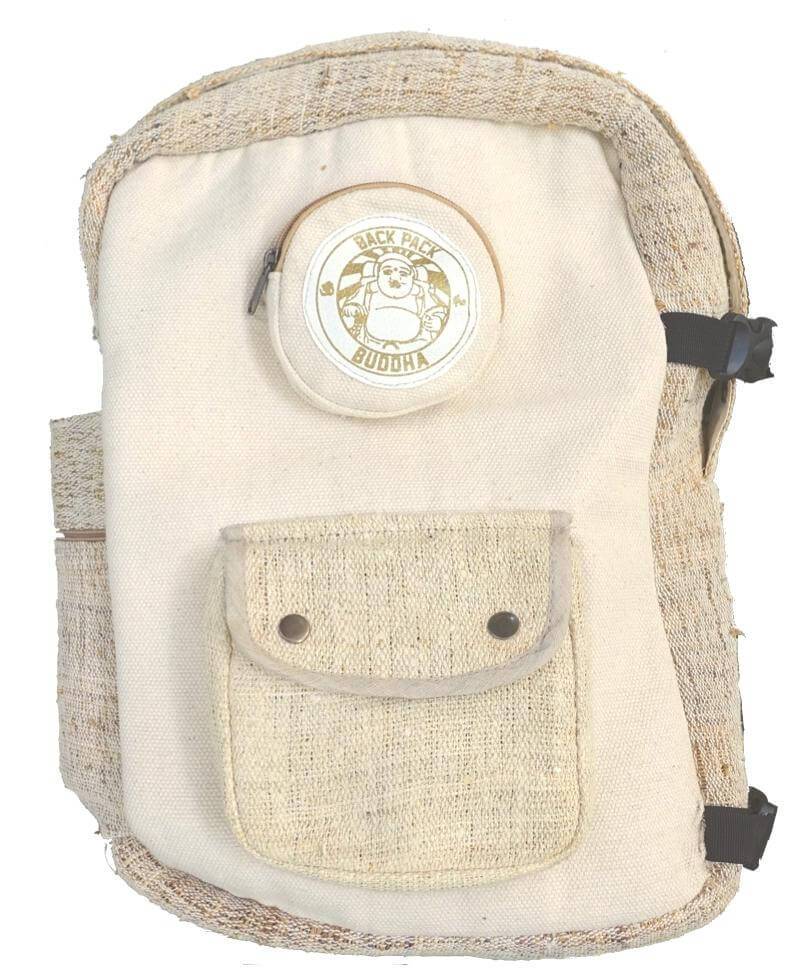
These come in four sizes, ranging from $27 to $57. I own the Himalayan Hemp #1, pictured here. Handcrafted from 100% Himalayan hemp and cotton from the foothills of the Himalayas, this practical day bag can carry up to two full mala strands in a dedicated Mala pouch, a laptop up to 15 inches, a standard sized yoga mat, and a reusable water bottle.
The Chakra Collection
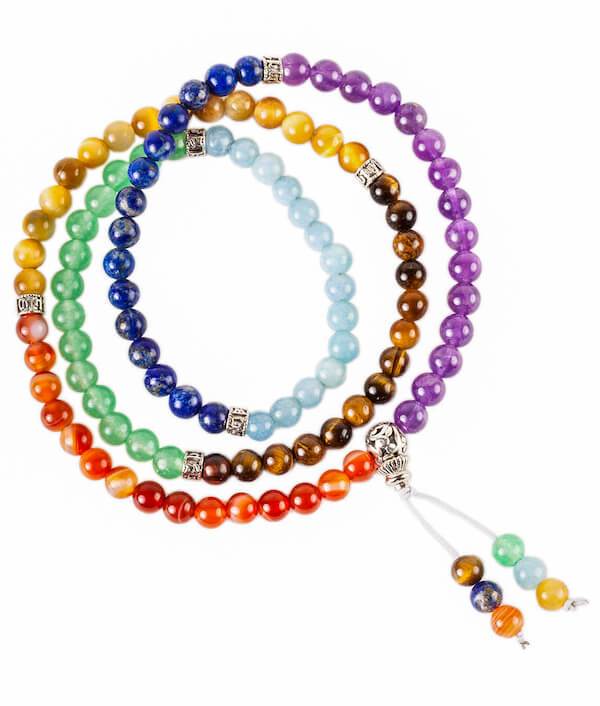
This unique collection of chakra crystals, jewelry, and tools includes a number of beautiful options including a 7-chakra dream catcher that’s currently hanging right next to my front door and the 108-bead chakra mala pictured above ($37).
As you’ll see if you click through to the site, each of the seven crystals corresponds with a different mantra, which can be a nice addition to your daily meditation practice.
Each mala comes with a 7-page eGuide to help you use your beads as a medium for mindfulness, tranquility, and contentment.
Buddha Bear’s Enlightenment Coloring Book
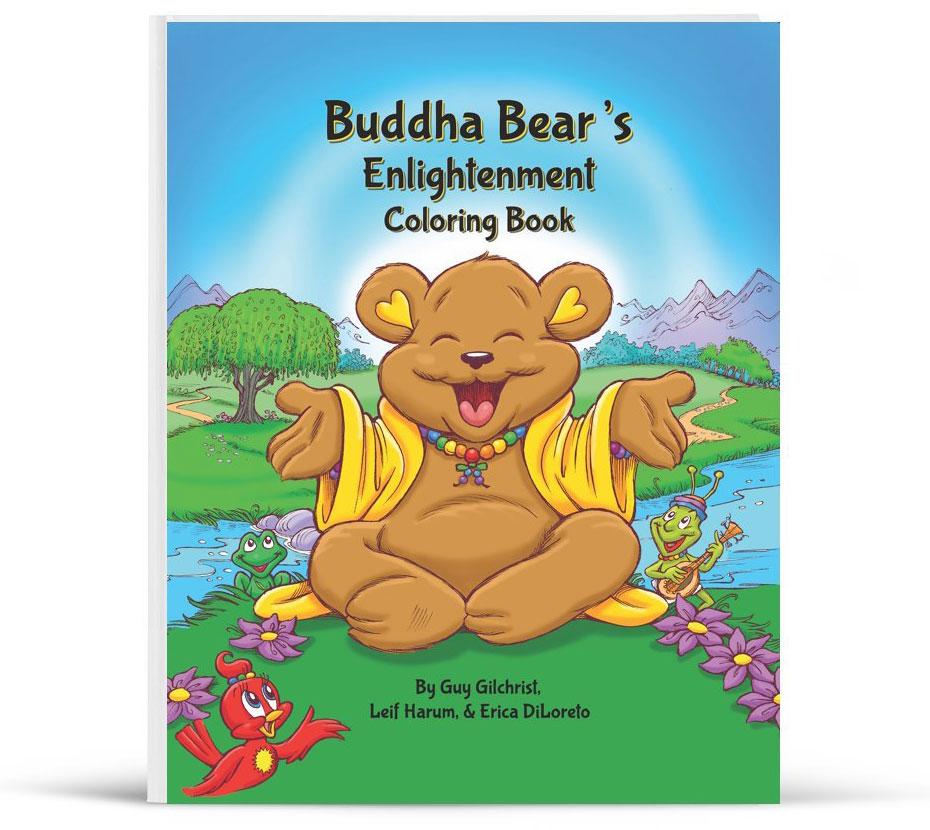
As a huge coloring fan, I’ve seen some pretty cool coloring books in recent years, but none by Jim Hensen’s cartoonist. World-renowned illustrator Guy Gilchrist had a hand in Fraggle Rock, Looney Tunes, Muppet Babies, Tom & Jerry, and more, and has illustrated over sixty children’s books.
His latest offering, recommended for kids age five to twelve, is intended to foster positive emotional growth through concepts of compassion, gratitude, and love.
Kids will love following the adventures of Buddha Bear, whose goals are to be kind to everyone he meets, to breathe and stay calm when he’s frustrated, and to appreciate all his blessings.
For every copy of Buddha Bear’s Enlightenment Coloring Book sold, Backpack Buddha will provide a school grade notebook and pencil for an underprivileged student, grades 2-8, in the Kathmandu valley.
Enlightenment Journals
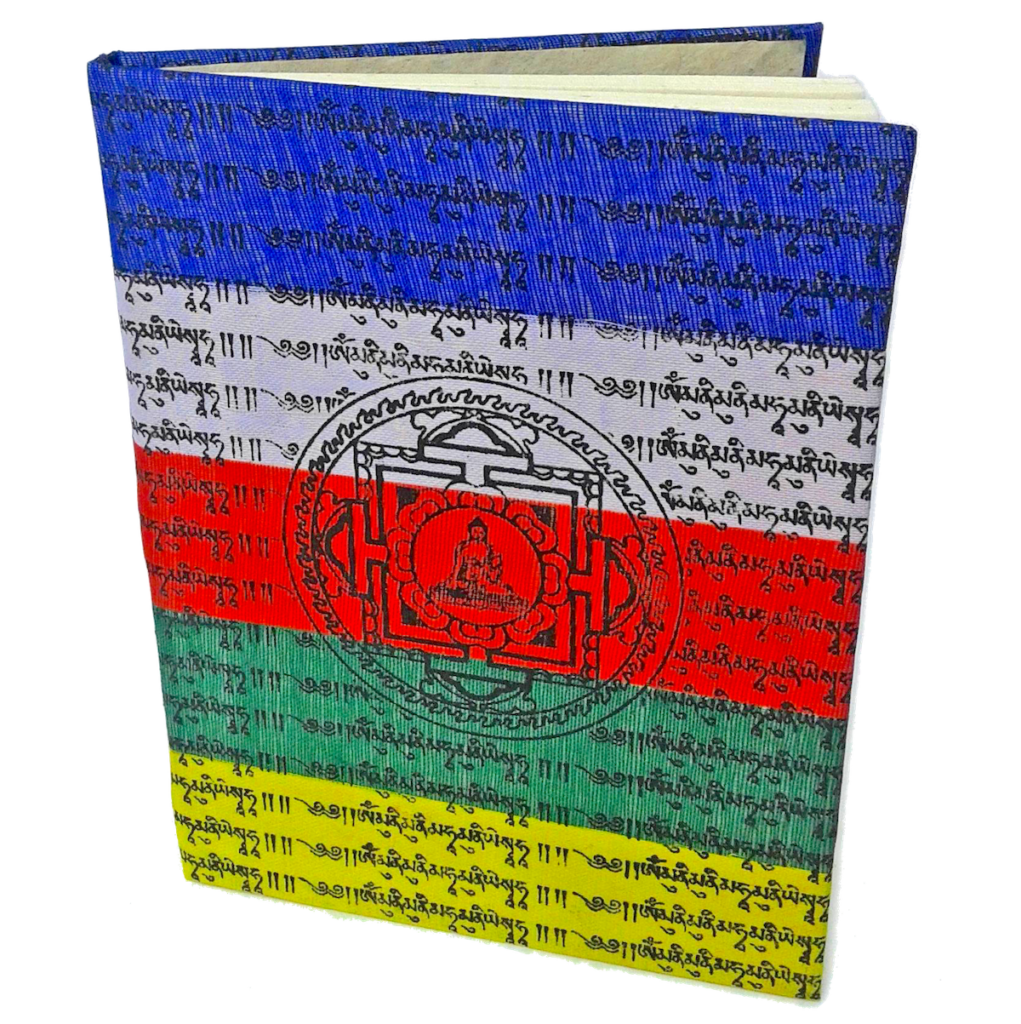
While the Everyday Enlightenment Journal is designed to help you calm anxiety, find purpose, and love your life in twenty-one days, the Everynight Enlightenment Journal can help you relax your body and mind and get better sleep—and it may also inspire positive dreams.
Above you’ll find the Prayer Flag Journal ($14), which I recently gave to my boyfriend as a gift. Made from Lokta bark paper—by hand, in a village with a 2,000-year history of making this special paper—this journal is covered in the five elements of traditional Buddhist prayer flags: sky, air, water, fire, and earth.
Monk-Blessed Malas and Jewelry

Blessed by monks from the Woechen Thuk-Je Choeling Monastary, Swayambhu Temple, in Kathmandu, Nepal, these unique mala offerings include the conch shell mala above ($97).
These beautiful malas come with 108 om-engraved shell beads.
—
I’m a huge fan of Backpack Buddha, and their founder Leif Harum, who’s been a pleasure to connect with. I hope you, or your loved ones, will enjoy their offerings as much as I have!
**Though this is a sponsored post, you can trust I only promote products and services I personally love!
-

Introducing Buddha Groove: Meditation, Yoga, and Inspirational Gifts
Hi friends! I hope you’re all enjoying the holiday season so far. Since I know a lot of us spend the beginning of this month looking for the perfect holiday gifts for the people we love, I wanted to take this opportunity to introduce you to Tiny Buddha partner Buddha Groove.
A family-owned business, Buddha Groove was one of Tiny Buddha’s first sponsors many years back.
Buddha Groove partners with artists all over the world to offer products that feed the spirit, inspire the mind, and revive the body. Many of their designs originate from artisan traditions in places such as South America, India, Indonesia, Tibet, Nepal, Thailand, and several other world regions. Buddha Groove also partners with many independent artists across the U.S.
Their wide assortment of spiritual and wellness items and meditation gifts include…
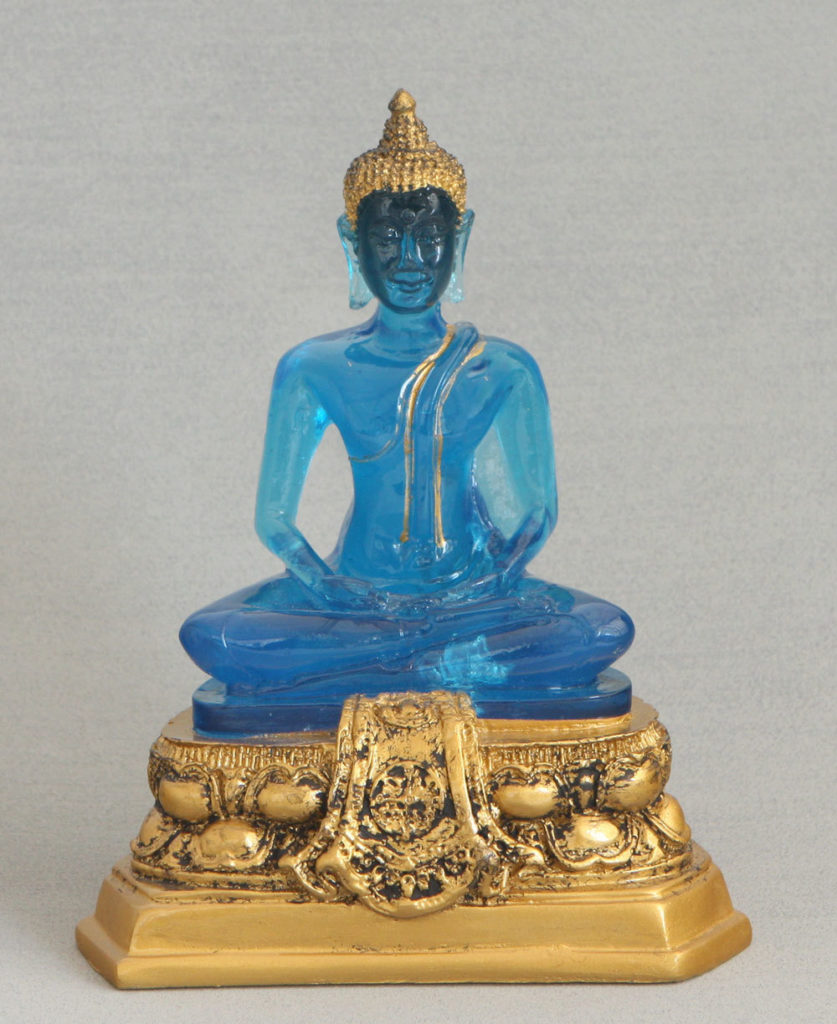
Buddha statues, like this:
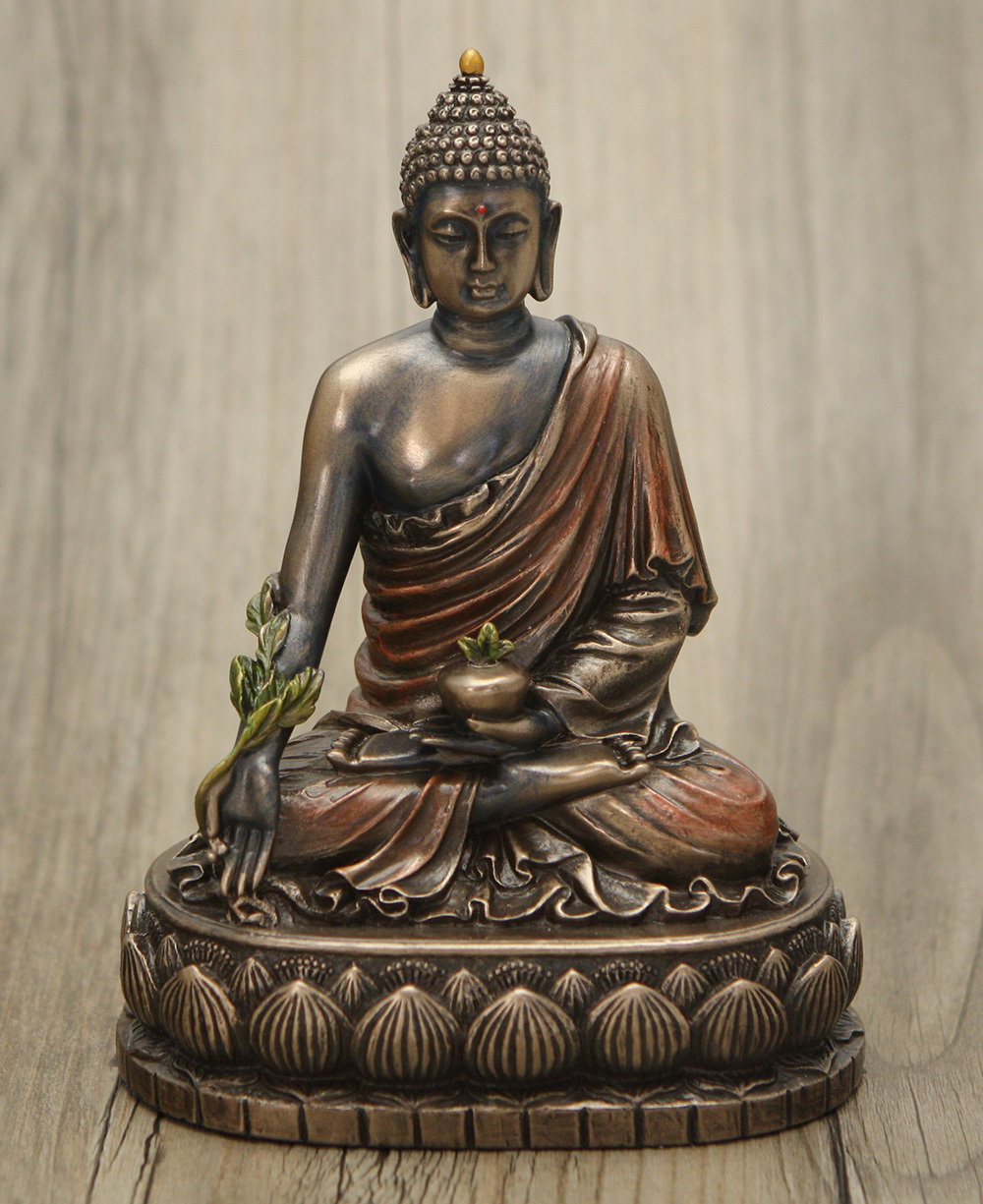
Meditation malas, like these:
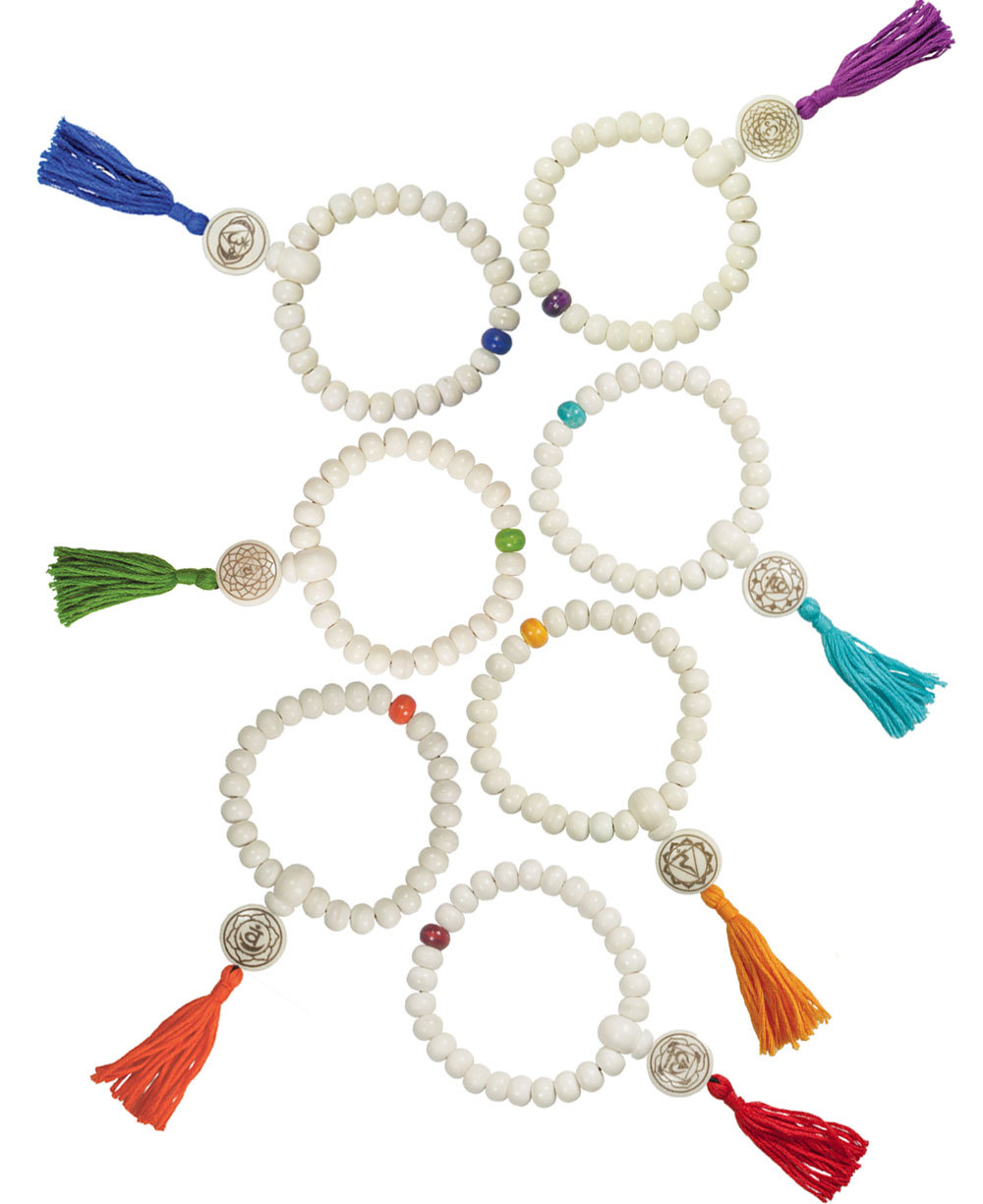
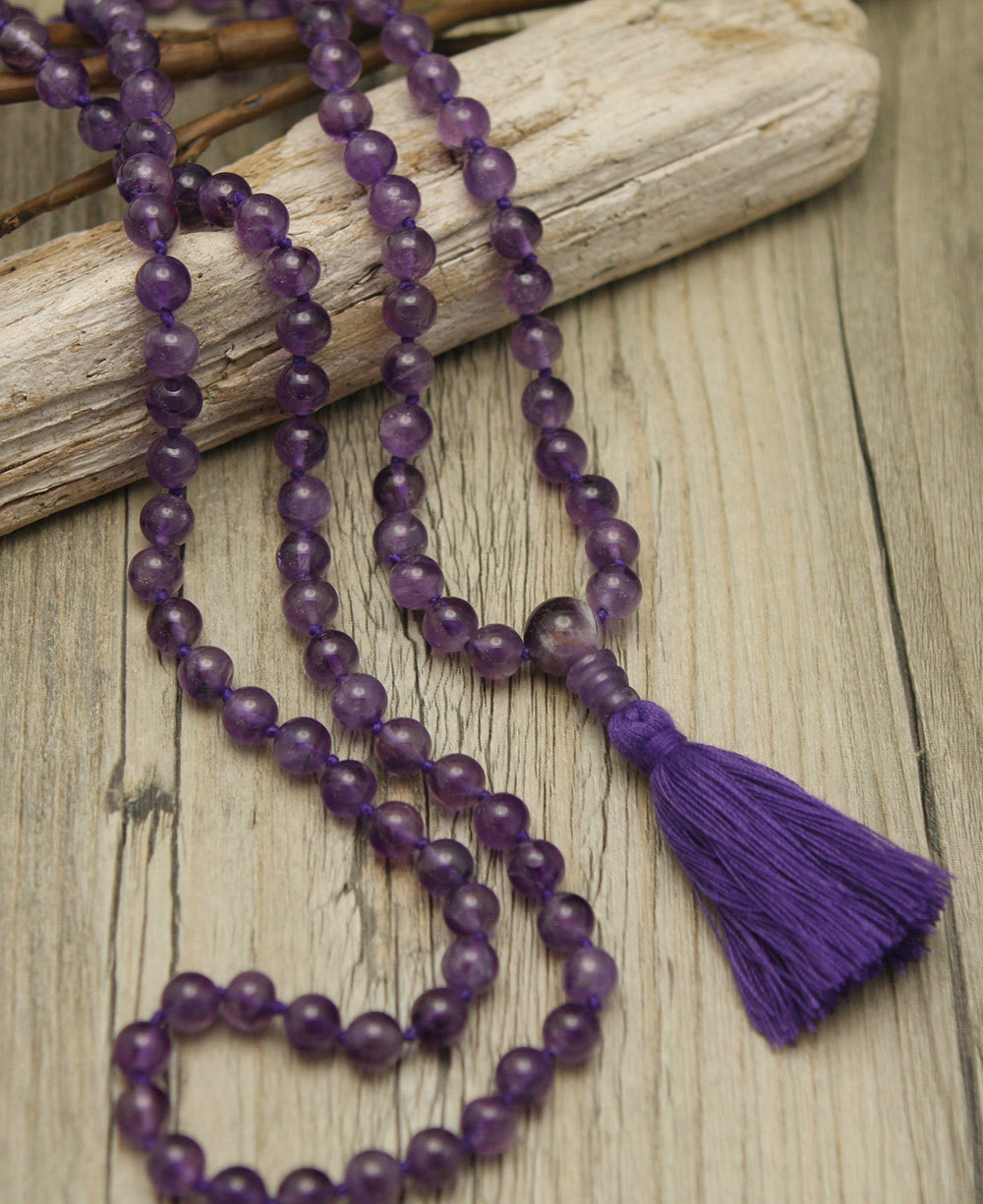
Singing bowls, like these:
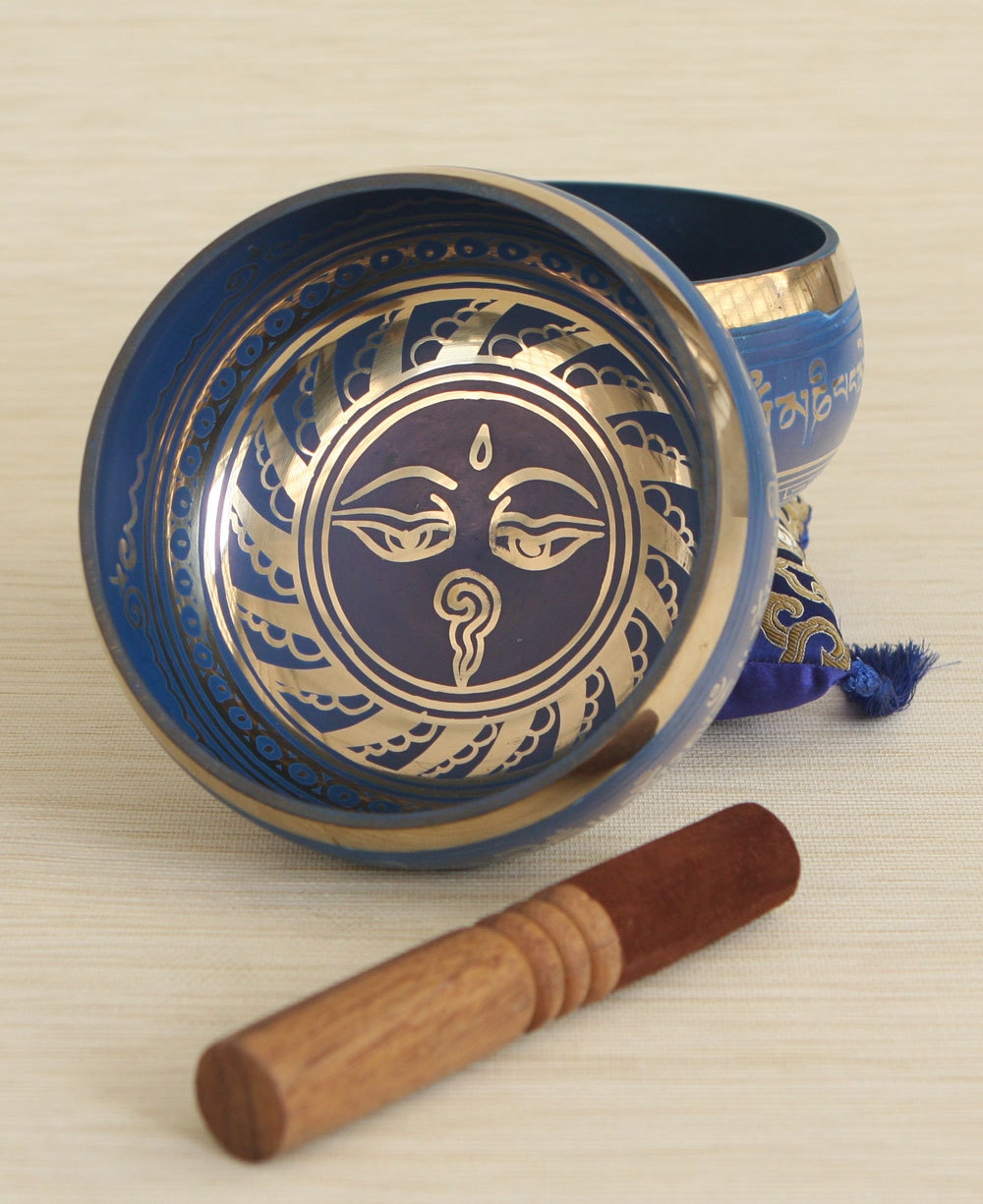
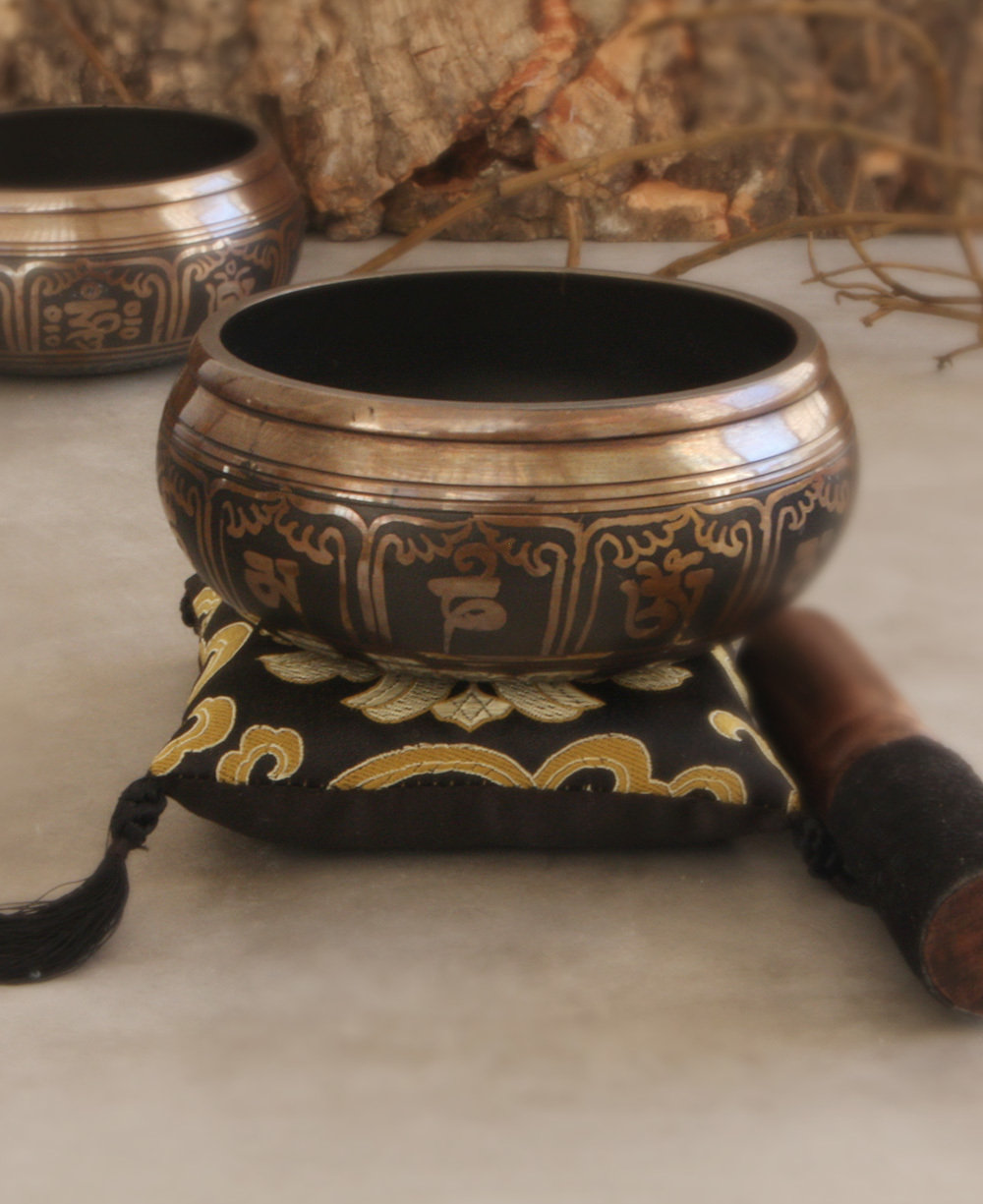
Spiritual jewelry, like these pieces:
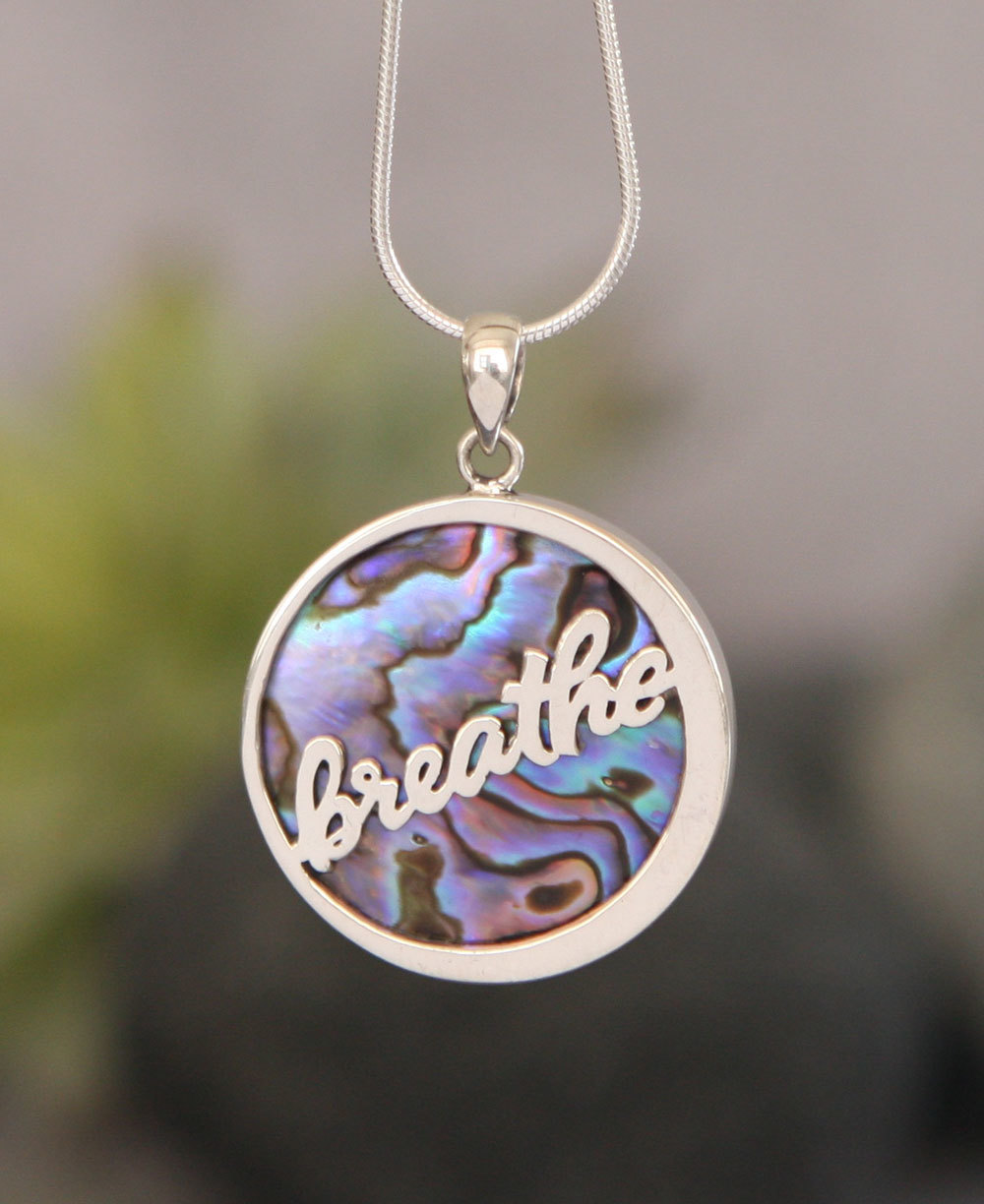
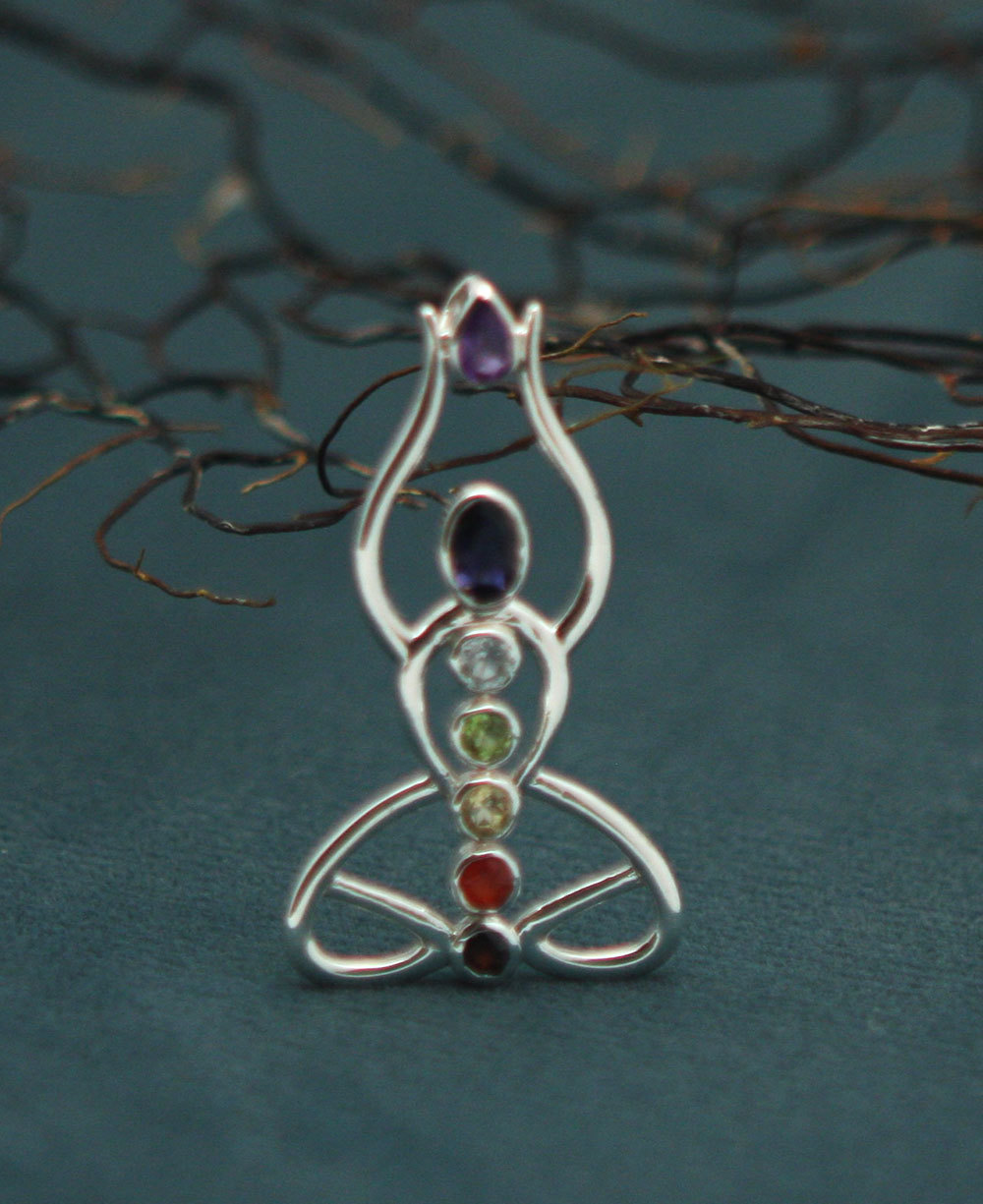
Books and coloring books, like these:
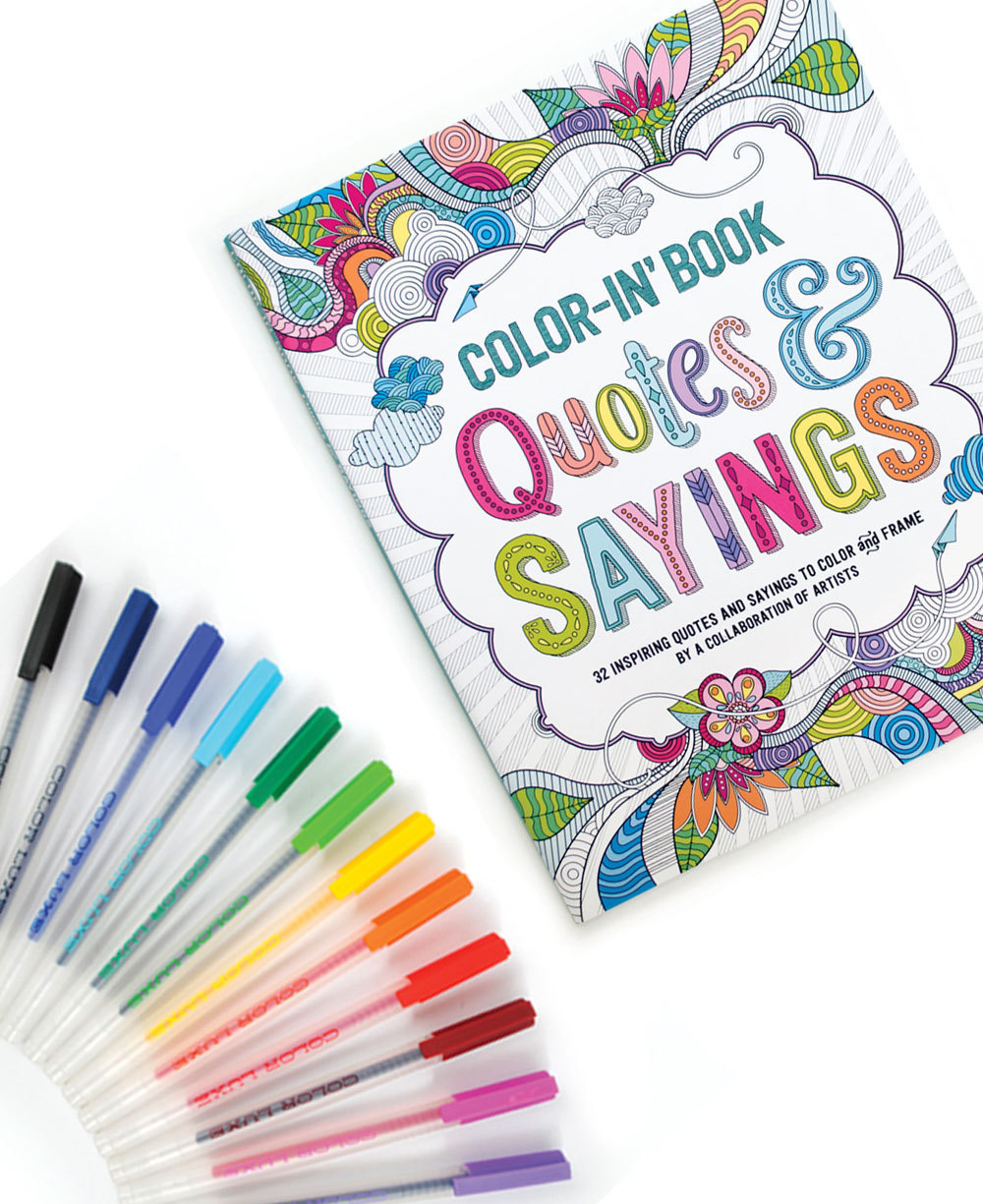
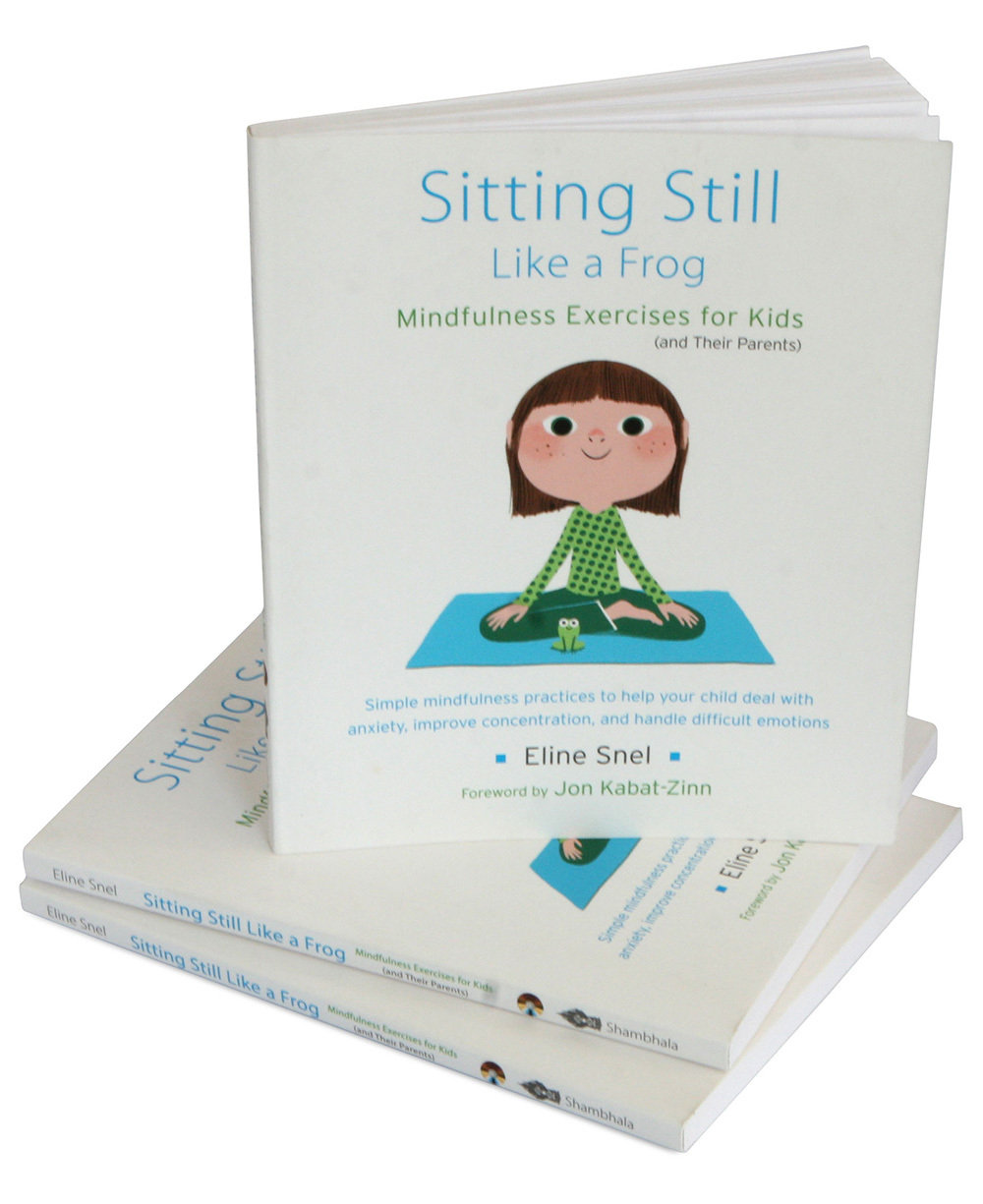
Yoga gifts, like these:
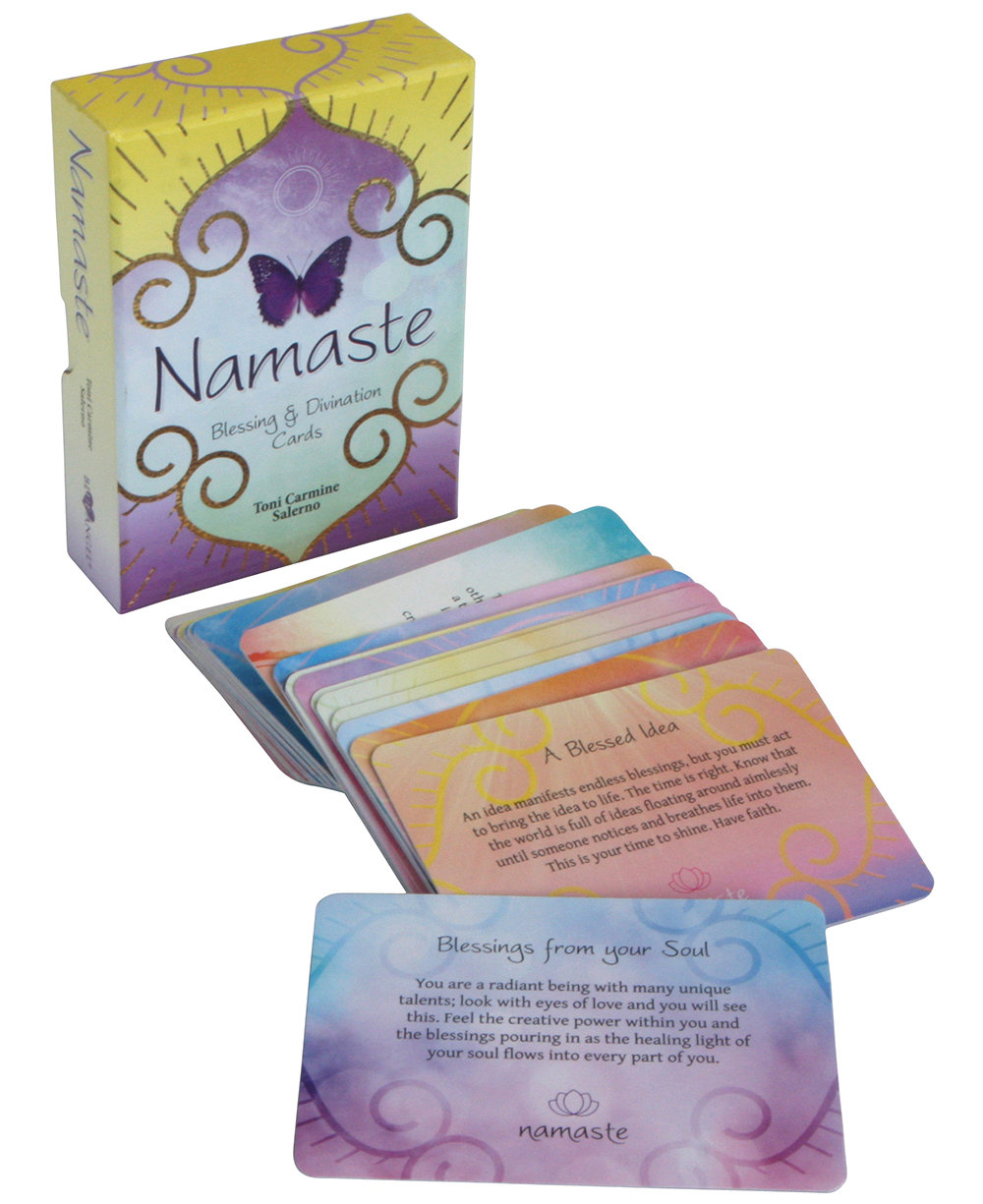
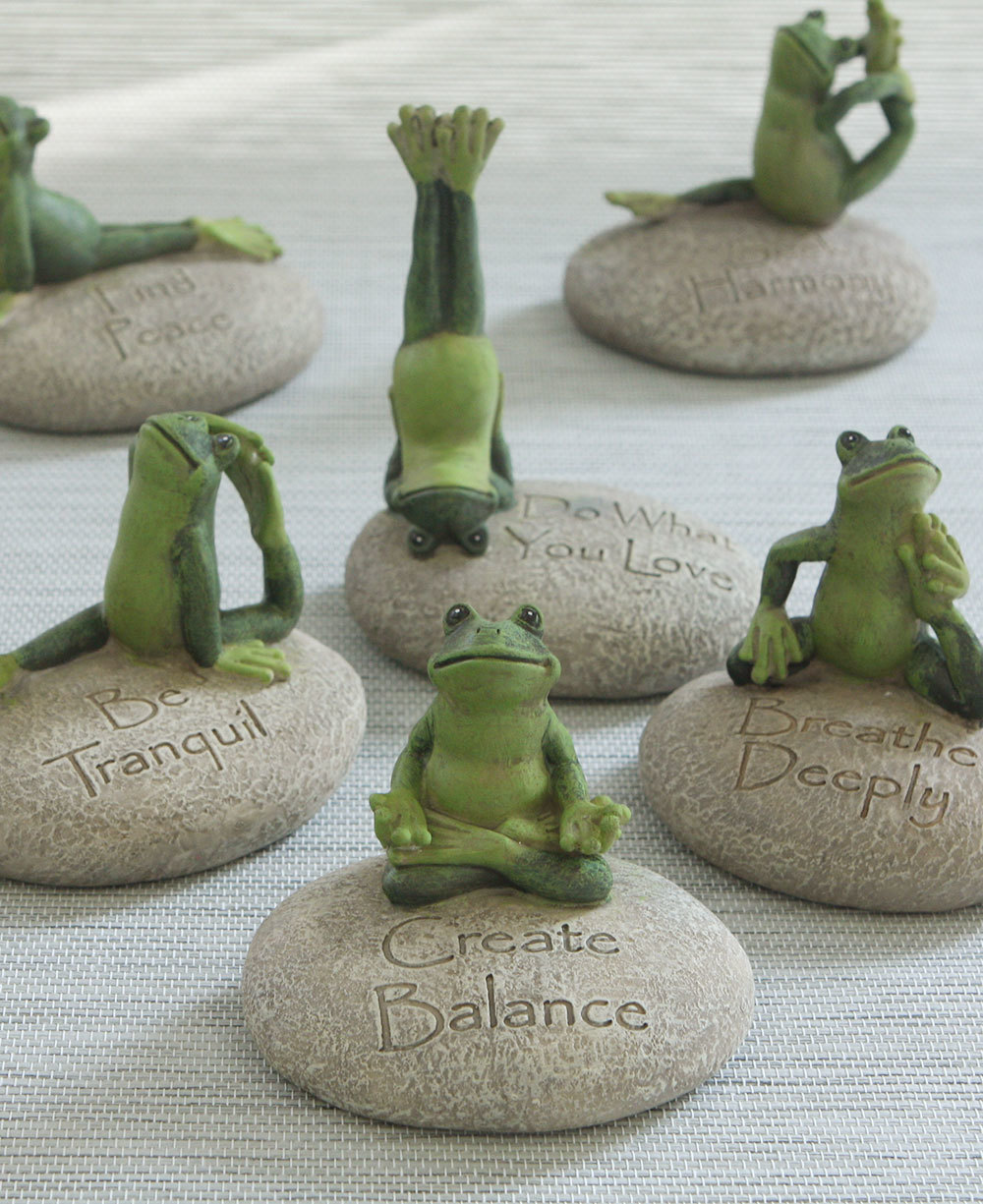
Although I consider myself a minimalist, I know that creating a tranquil environment can go a long way in fostering a sense of inner peace. And I also know that it’s much easier to be mindful and consistent with my meditation practice when I have lovingly chosen tools to support me.
The same is true of the people we love. What better gift to give than a gift that aids in creating calm and comfort?
Buddha Groove offer free shipping within the continental USA and ships internationally through a third party company. They also offer no-hassle returns within 30 days on all items except media, books, cards, and products containing plants.
You can browse their full collection here and read a long list of reviews from happy customers here.
I hope you’ll enjoy browsing through their site, and also hope you find something that speaks to you for the spiritually inclined individuals on your holiday gift list!
**This is a sponsored post containing affiliate links. That means that a small percentage of each sale supports Tiny Buddha and helps keep the site going.
-

7 Strategies to Stay Sane This Holiday Season
“Accept what is, let go of what was, and have faith in what will be.” ~Sonia Ricotti
It’s that time of year again. The fresh scent of an evergreen fills the house. Strains of “Silent Night” and “Jingle Bells” permeate the airwaves. Once again, I unpack the fragile, ceramic Santa that I made as a gift for my mom when I was five. Suddenly, I’m transported back in time—for better or for worse.
The holidays should be joyous times filled with family and friends, but sometimes the very traditions that give meaning to this season also trigger old fears, hurts, and anxieties. (And if you’re prone to Season Affective Disorder (SAD), the lack of warmth and sunshine can zap your goodwill toward men, and women, too.)
Then last year—after lots of recovery and mindfulness practice—I determined to navigate the holidays in a healthier manner. I decided to accept the reality of my Christmas crazies and choose to respond differently when things (inevitably) became stressful.
Since I was so good at making lists of gifts to buy others and errands to run and obligations to fulfill, why not make a list of ways to manage my emotional well-being? If you’re like me and tend to succumb to the holiday crazies, these strategies may help maintain your sanity, too.
1. Stock up on sanity savers.
When I went through my divorce, my therapist had me make a list of things—such as taking a hot bubble bath or calling a good friend—to do when I became anxious. Even when I’m not in all-out crisis mode, this form of self-care helps me maintain a more peaceful perspective. By thinking of these soothing activities ahead of time, I know exactly what to do when stressful situations appear.
2. Reel in expectations.
Repeat after me: “There is no such thing as a perfect holiday.” Something will go wrong. My brother-in-law will say something inappropriate at the family dinner. Gifts will get lost in the mail. The turkey will be raw in the middle. The ornaments will not all be evenly spaced on the tree—and it will be okay.
3. Keep a meltdown journal.
When something or someone inevitably pushes my buttons, I make note of it in my “meltdown” journal. I include details about what occurred before my meltdown and record if I was hungry, tired, lonely, or hormonal. Writing it all down helps me recognize patterns and also serves as a safe way to vent my frustrations.
4. Check motives at the door.
Do not, I repeat, do not give anything to anyone if you expect so much as a “thank you” in return. Seriously. One of the worst holiday meltdowns I’ve had in recent years was when a friend didn’t express (what I felt was) the proper amount of gratitude for my gift. This year, my presents may be decorated with ribbons, but they will not come with strings attached.
5. Own your inner Grinch.
If you’re feeling cranky because it seems like you always give more than you receive, or visa versa, set a limit for spending or call a truce on personal gift-giving. My very generous friends and I did this years ago, and it immediately improved my holiday spirit because I didn’t have to fret that my Christmas gifts were “good” enough.
6. Break up with tradition.
If you’re doing the same thing over and over again and expecting a different outcome, you’re going to become nuttier than a fruitcake. (Albert Einstein wasn’t necessarily talking about the holidays when he coined the definition of insanity, but it applies.)
Hearing “Jingle Bells,” the smell of gingerbread, or seeing your friends’ cheesy family photo holiday cards may inspire warm feels, or be cruel reminders of stressful, lonely times.
For example, when I was single, it was hard being the third-wheel at New Year’s Eve dinner parties, so rather than accept invitations that made me uncomfortable, I established a new tradition. New Year’s Eve became a time for quiet contemplation. (And now share that tradition with my honey.)
7. Be mindful for goodness sakes.
When anxiety strikes, it’s easy to stuff feelings, along with a mountain of sugar cookies. Over the holidays I double my effort to stock up on healthy snacks and non-alcoholic beverages. Then I post the question “Why?” on the fridge to help remind me of my motivations before I indulge. If I really want that treat, then I proceed; but if I’m eating because I’m anxious, I try to sooth myself with a more healthy activity. (See Tip 1.)
—
Simply reflecting on this list, makes me aware of how the holidays can affect my mood, and helps me reclaim the festive season. Now I can revision the season as a time to be grateful for all the positive aspects of my life, and the progress I’ve made since I made the decision to release the ghosts of Christmas’ past.
-
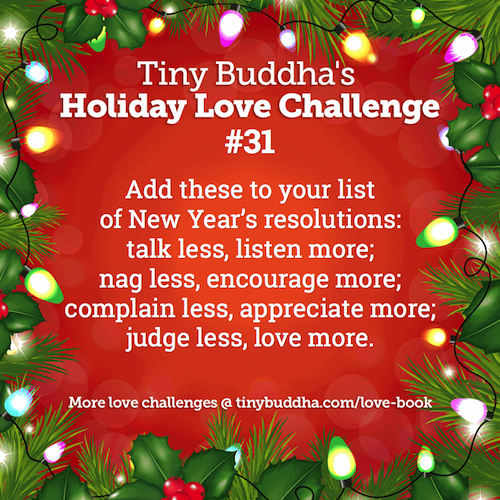
Holiday Love Challenge #31: Set These Resolutions
Want more ideas to strengthen your relationships? Get Tiny Buddha’s 365 Tiny Love Challenges.
-
Holiday Love Challenge #30: Put Down Your Phone
Want more ideas to strengthen your relationships? Get Tiny Buddha’s 365 Tiny Love Challenges.
-
Holiday Love Challenge #27: Smile at a Stranger You’re Tempted to Judge
Want more ideas to strengthen your relationships? Get Tiny Buddha’s 365 Tiny Love Challenges.
-
Holiday Love Challenge #25: Tell Someone Their Presence Is the Best Gift
Want more ideas to strengthen your relationships? Get Tiny Buddha’s 365 Tiny Love Challenges.
-

25 Powerful Acts of Love and Kindness
The holiday season has the potential to bring out the best in us. Though the days get shorter and colder, somehow our hearts get bigger and warmer.
Maybe it’s the thoughtfulness handwritten on Christmas cards, maybe it’s the focus on giving over receiving, or maybe it’s the anticipation of celebration with people we love.
For many, it’s the reminder of what’s important in life—not what we do, what we earn, or what we buy, but how we treat each other, how we help each other, and how we use our gifts to make the world a better place.
Yes, the season inspires us not just to believe in magic, but also to create it.
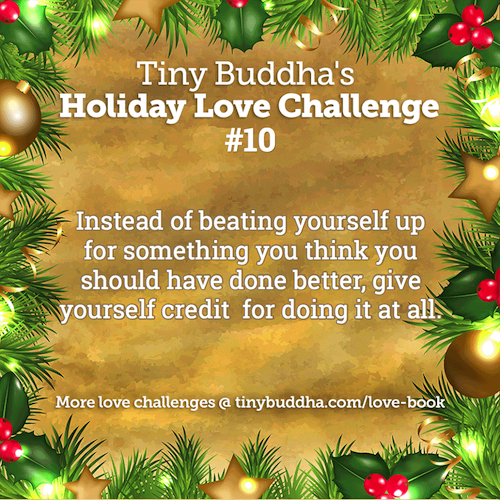
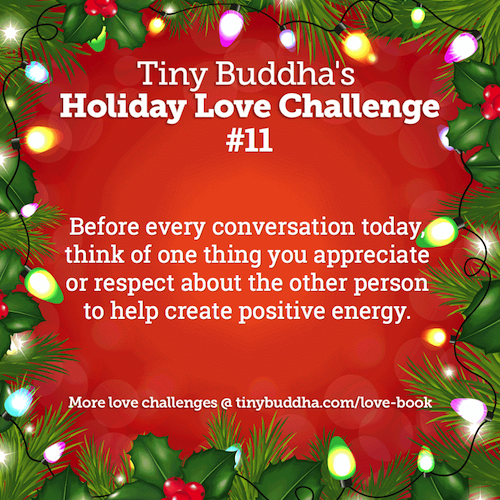
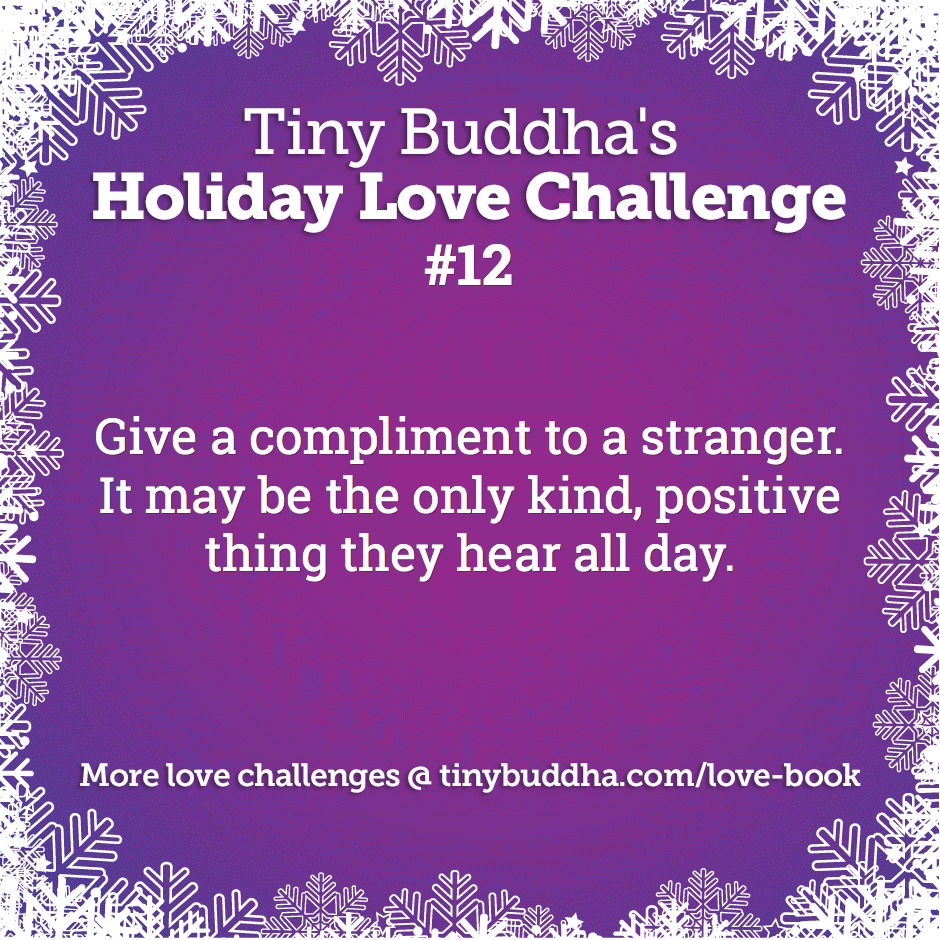
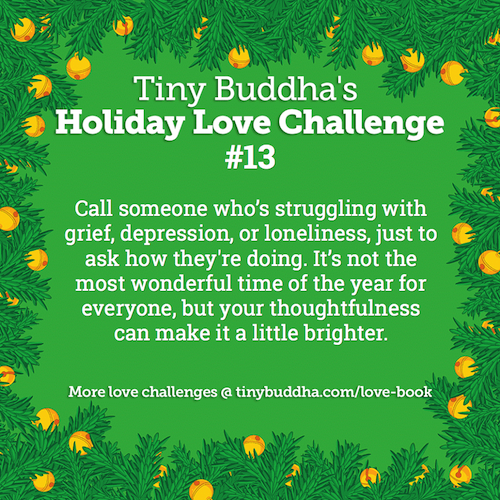
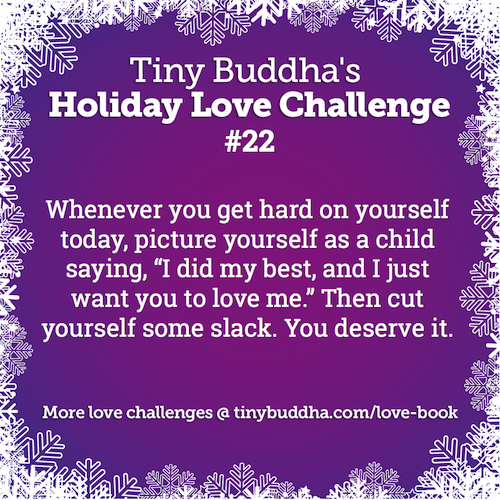
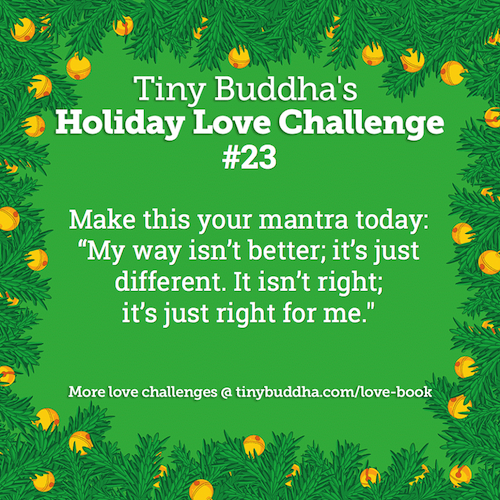
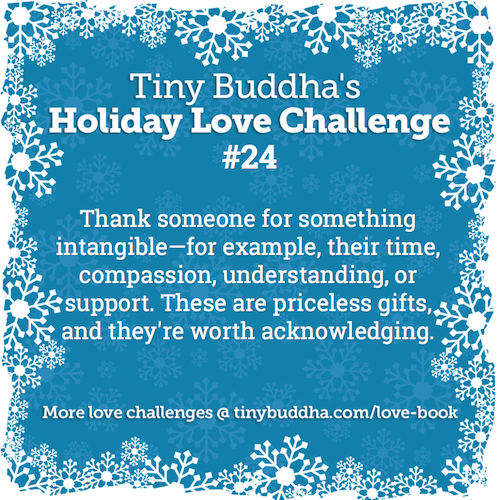
It’s for this reason I created a series of “holiday love challenges” (some taken from Tiny Buddha’s 365 Tiny Love Challenges), to inspire more acts of love and kindness.
Some focus on giving, others on appreciation, and others on giving ourselves the same compassion we strive to offer others.
I hope some of these inspire you to create a little magic in your world, one tiny act of love at a time!
-
Holiday Love Challenge #22: Cut Yourself Some Slack
Want more ideas to strengthen your relationships? Get Tiny Buddha’s 365 Tiny Love Challenges.
-
Holiday Love Challenge #21: Give the Gift of Forgiveness
Want more ideas to strengthen your relationships? Get Tiny Buddha’s 365 Tiny Love Challenges.
-
Holiday Love Challenge #4: Give Yourself the Gift of Peace
Want more ideas to strengthen your relationships? Get Tiny Buddha’s 365 Tiny Love Challenges.
-
Holiday Love Challenge #2: Wrap Your Brain Around Someone’s Point of View
Want more ideas to strengthen your relationships? Get Tiny Buddha’s 365 Tiny Love Challenges.
-
Secret Santa’s Layaway Gift
Three mothers got the best holiday gift ever this year: the gift of renewed faith in people. It’s something we can all give year round, not just at the holiday season, and not just with our wallets. In fact, you may already give it regularly without even realizing it.
For all the angels who give it here, through kindness, consideration, and support, in comments or in the forums, I thank you. You remind me that people are good, and people care!
-
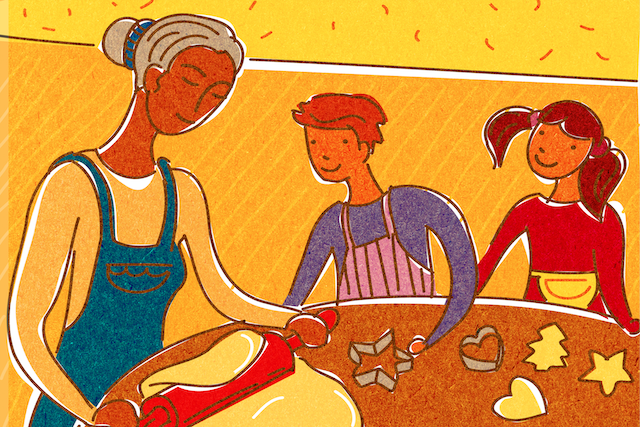
50 Ways to Show You Care Without Spending a Dime
“Friendship isn’t a big thing. It’s a million little things.” ~Unknown
This hasn’t been an extravagant holiday season for me. Like everyone and their mother, I lost a lot of income last year and I just don’t have the means to give expensive presents.
Yet I feel I’ve received a lot of gifts this year. Most notably, I’ve realized how many of the people in my life mean more to me than any of the things I’m trying to accomplish.
The friends and family members whose love and support far eclipse the achievement of any goals I set. The people who are my home, whether I can afford a pricey apartment or not.
I’ve come up with fifty ways to show them how much I care within my current means.
If you’re looking for a few meaningful gifts that don’t require a debit card, you may find these creative ideas helpful this season: (more…)