Tag: hiking

  • Nature is Our Greatest Teacher: Lessons from atop an 8,263-Foot Volcano

    Nature is Our Greatest Teacher: Lessons from atop an 8,263-Foot Volcano

    “Deep in the forest I stroll to hear the wisdom of my soul.” ~Angie Weiland-Crosby

    In October 2021, my partner and I embarked on a journey to summit Mt. St. Helens, an 8,263-foot active volcano in Washington State.

    We have hiked thousands of miles across the United States, Costa Rica, and Mexico, but this was our first attempt at a summit hike. I was bubbling with excitement and nervousness!

    Mt. St. Helen’s greeted us with grace and gentleness. The sky was clear, the views of Mt. Adams to the east were stunning, and the temperature was moderate.

    We were chatting and climbing with a sense of ease and joy, grateful to be hiking over the packed snow, which is relatively easy to walk on.

    We enjoyed the tracks left by hikers ahead of us.

    We stopped to refill our water bottles in a mountain stream.

    It was all smooth sailing at first.

    As soon as we reached 7,500 ft, that gentleness was replaced with fierceness.

    We were suddenly bombarded with 50mph winds, pelting snow and ice on our exposed faces, and nearly zero visibility.

    We tried to traverse a little bit further, as we were only 800 feet from the summit. I thought, “We’re so close, we have to make it!”

    When the pelting snow and ice became too much to bear, we took a short refuge behind an outcropping. We put on warmer clothes, gloves, and goggles, and then assessed the situation. (Images of Into Thin Air were reeling through my brain!)

    We quickly made the decision to turn around and begin the descent to calmer, warmer, and safer conditions. We met other hikers who had made the same decision. I was disappointed, but also grateful, because time and time again, mother nature shares her wisdom with us.

    During my Mt. St. Helen’s adventure, and during numerous other journeys into the wild, nature has taught me the importance of…

    1. Humility

    We are part of the natural world. We did not come into it, we came out of it, and, at the same time, there are forces far more powerful than us out there in the wilds. Those forces are scary and beautiful. Invigorating and potentially dangerous. Humbling and empowering.

    The natural world offers us boundless opportunities for realizing and practicing humility. When navigating our day to day lives, our problems seem so acute and so important. And they are important, because they are our experience of the world. However, when we zoom out from the minutiae of our lives, we are offered a different perspective.

    We are reminded of our sheer physical smallness. We are reminded of the paradox that we are both important and unimportant. And this truth is not depressing, it is liberating. Nature reminds us that we are not the center of the universe, and that it’s all really not that serious.

    During my Mt. St. Helen’s journey, humility was essential for survival. I knew I was no match for the powerful winds. I thought I had a plan and was in control of my day, but mother nature demoted my ego and reminded me how little control I really have, both on the mountain that day and in my daily life.

    Practicing humility and releasing control does not mean we stop taking action toward our goals, but rather that we learn to steer the ship with the current, not against it. We learn to adjust and pivot and be in partnership with forces outside of ourselves.

    I practice humility when navigating roadblocks and challenges in my life. For example, in my business, every time I reach a new milestone, I celebrate it first. Then, I view it as a portal into learning something new and perfecting my craft.

    Humility prevents me from becoming complacent and from thinking I have all the answers. The more I learn and know, the more I learn that I don’t know. And what a beautiful experience it is to be a forever student of the universe.

    2. Intuitive Discernment

    I didn’t let fear guide me on that summit hike; rather, I stayed calm, listened to my intuition and my body, and quickly discerned the potential danger ahead.

    These two words, “intuitive” and “discernment,” might seem at odds with each other, but I have found the combination of intuition and logic to be powerful.

    Intuition stems partly from past experiences, allowing us to act quickly, when necessary, to keep ourselves safe, whereas logic can help us determine the best steps to do so. To make wise decisions, we need to both listen to our gut and analyze the facts.

    On Mt. St. Helen’s, my intuition was telling me to turn around. I allowed space for this to come through, and I took a few moments to also think logically about what to do. It was from this space that we made the safe decision to turn around.

    Similarly, in my professional world, my intuition is guiding me toward writing more. I am also using discernment to list all of the past evidence that writing is the path for me. In other words, I am combining intuition and logic, and I’ve found that this combination offers great alignment among all parts of me.

    3. Impermanence

    Seasons, weather, circumstances, and emotions are all temporary. It’s all in flux. When we can accept this, and release attachments to people, events, and outcomes, then we can begin to discover inner peace. When we accept impermanence, we open ourselves to gratitude and presence.

    This isn’t always easy. We tend to define ourselves in relation to other people and our roles, and we often interpret endings as failures. But every ending brings with it lessons and new beginnings.

    And the beauty of embracing impermanence is that this reminds us that everything eventually ends—including times of struggle.

    My partner and I plan to summit Mt. St. Helen’s again this year. Who knows what the volcano will have in store for us in a few months, but whatever it is, I know it will be in service to me.

    In my day-to-day life, last winter, I found myself in a dark place, but I trusted that this space was temporary, and that proved to be true. Now, as now the seasons have changed, I am feeling grounded and light. I am savoring it, and I know that other challenges and hardships will come my way. I am open to it all, knowing none of it will last forever.

    So my invitation to you is to deepen your relationship with the earth. Go outside. Sink your bare feet into the grass. Dig your hands into the soil. Let the sun kiss your face. Breathe. Open your heart to the wisdom of our earth.

  • The Healing Power of Nature: How Walking in the Rain Saved My Life

    The Healing Power of Nature: How Walking in the Rain Saved My Life

    All truly great thoughts are conceived by walking.” ~Nietzsche

    A recent study by the National Academy of Sciences found that a ninety-minute walk in nature slows our worried, troublesome thoughts about ourselves and our lives. Even better, it reduces the neural activity in parts of the brain linked to mental illness.

    On the other hand, if you spend your time walking down city sidewalks, don’t expect much. The science says you’ll have no change whatsoever in your neural activity. Or even in your thoughts about yourself.

    This means that if you’re inclined to be anxious, depressed, grieving, or harried, go find the nearest nature trail.

    But I could have told you that.

    I road tested this concept at the very worst moment in my life, in the year following the sudden death of my daughter. At the time my life had fallen apart completely. Not only had my daughter just dropped dead from a medically unexplainable cardiac arrest, but a few months earlier I lost my relationship and the home that came with it.

    I’d also recently closed a successful business that had pushed me to the point of burnout. So not only did I need to grieve, I needed everything to grind to a halt. Then I needed to do a radical reboot of my entire life.

    Unable to fathom how to even begin, I found my way north to the country. Once there, I moved in with a friend.

    A nearby park with rambling blackberry lined paths beckoned to me—even in the rain soaked northern California winter. Unable to even keep two thoughts in my head at the time, the only thing I could do was to walk.

    Every day, I would pull on my rain gear and my big rubber rain boots and walk along the park’s muddy trails for hours. It was a rough and tumble place, but it was beautiful, as well. More importantly, I was alone out there as I slowly memorized every dormant blackberry bush, every rain puddle rut, and every sweeping field of grizzled grape vines.

    Sometimes I sobbed as I walked. Sometimes I smiled at the pileup of bittersweet memories that poured through my body. Sometimes unexpected ideas would pop up for things I wanted to write, or places I wanted to go. Sometimes I’d remember lost wisps of memory from my childhood, things once said to me or stories I’d been told.

    These walks became nothing less than a time of reckoning.

    Most of the time, I just needed the active motion of my legs pumping and my feet moving through the mud. I needed to feel my feet on the ground in order to somehow get a grip—and to be reminded, perhaps, that everything would eventually be okay.

    By the time summer came, I knew every path, every rock, and every tree. Gradually, my grief began to lift as my walks in nature gradually worked their magic.

    I felt held out there by something bigger than myself. More importantly, I reveled in the sheer predictability of my surroundings. It was important that I walked in this park, at this time, down these paths every day. In the absence of a job, walking these trails and letting my thoughts and feelings pour through me became my work.

    Turns out there is science behind my random decision to hike in the rain.

    Stanford University researchers have found that walking of any kind—outdoors or on a treadmill—increases our ability to hatch creative ideas. Yet, they’ve also found walking in nature actually produces the most high-quality, unique ideas. Not only that, the effect lasts when you sit down to do your work afterwards.

    I happened to have proof for this as well. Because as I walked, ideas would descend on me. I’d stew over things that bothered me. But then I found myself plumbing those experiences for some sort of meaning or lesson learned. As I uncovered these insights, I realized I needed to share them. So I began to unravel the mystery of what was to come next.

    Each day as I came back to our house, renewed and rain-soaked, I would I sit down at my computer. Then I’d write through what I’d discovered. By the following fall, I was working again in earnest. The ideas that had drifted into my consciousness as I walked now fomented into something real and tangible. So, slowly, I began again.

    These days I live in a city, though I still walk several times a week. But researchers say that’s okay, too.

    Just a stroll in a nearby park will help to clear your head. Yet, if you can’t get to the park, views of green space can also help. Simply gazing out a window at nature has been proven to yield better memory,

    This could be why the first thing I did every morning during that bleak period was to spend several moments just looking at the meadow behind my friend’s house. In the winter, a natural pond would pop up, becoming home to all manner of visiting birds.

    The scene was simple and serene, and it was so beautiful to see a white snow goose come flying in and land to take a drink. Little did I know my neurons were appreciating this as well.

    The NAS study suggests that having access to nature may become increasingly critical to our mental health as the years go on. All I know is that I now rely on a regular walk to carry me through my day. And not just any walk.

    I walk where there is natural beauty, even if it’s the small lake in the middle of my city. I’ve found it to be nothing short of a healing miracle. This truly is one that anyone can enjoy.

  • How to Calm Your Mind Without Sitting to Meditate

    How to Calm Your Mind Without Sitting to Meditate

    “Our way to practice is one step at a time, one breath at a time.” ~Shunryu Suzuki

    Sitting meditation has always been challenging for me; practicing mindfulness, even harder.

    As a self-confessed worrywart who has contended with constant ruminations, flashbacks, and nightmares for most of my life (more on this later), all prior attempts at being fully present and not thinking merely served as reminders of how little control I had over my mind. Then I took up hiking and stumbled upon a form of meditation that literally transformed my life.

    Initially, just being out in nature on scenic trails cultivated calmness and cleared my head. Almost immediately, I realized that hiking provided a respite from intrusive thoughts that have plagued me since I was a tyke.

    They include flashbacks of my mother’s numerous suicide attempts in our decrepit Chinatown apartment, my father’s drunken rages, and recurring images of shootings, savage beatings, and other gory crime scenes from my gangbanging days.

    Ruminations include the sound of gunfire along with the replaying in my head of toxic utterances in Cantonese that translate to “Giving birth to you was my biggest mistake,” “I wish you were never born,” and my own father yelling “You bastard!”

    Somehow, walking in nature enabled my mind to slow down and rest, which felt liberating.

    Unfortunately, the novelty soon wore out. Merely walking and hiking wasn’t enough to prevent symptoms associated with post-traumatic stress from returning. I reverted to rehashing the past and worrying obsessively about the future.

    However, I had gotten a taste of the benefits of mindfulness meditation and discovered that it can be practiced while engaging in an activity I enjoyed. These revelations motivated me to keep at it.

    After reading what was available on walking meditation, which typically advise focusing on the flow of our “in” and “out” breaths, I developed my own techniques for practicing mindful walking and hiking.

    My favorite is to look ahead and select a destination point or object and stay focused on it. It can be a shadow on the ground, boulder, bush, tree, manhole cover, light pole, store awning, mailbox, and so on. Once I reached it, I chose another landmark or object, usually a little further away.

    Rough or uneven trails forced me to concentrate on each step for safety reasons. My brain automatically blocked out discursive thoughts; otherwise I could slip, trip, or fall. Other techniques I came up with include fully feeling the ground of each step, following the flight pattern of birds and insects, observing cloud patterns, and being conscious of sounds and scents—moment to moment.

    Zen monk Thich Nhat Hanh, often called “Thay,” which means “teacher” in Vietnamese, is revered throughout the world for his teachings and writings on mindfulness and peace.

    He has brought the practice into institutions, including maximum-security prisons, helping inmates attain calmness and inner peace while being confined up to twenty-four hours daily. Many of them have professed that mindfulness meditation is the most difficult endeavor they have ever engaged in.

    We live in a culture where many of us want quick results with as little effort as possible. This applies to how we approach our work, health, pastimes, social interactions, and problems. This mindset is the antithesis of mindfulness.

    In my opinion, it is virtually impossible to tackle mindfulness meditation without patience and discipline. Fortunately, these attributes can be enhanced by engaging in the art itself.

    When I started mindful walking and hiking, my ability to stay present was measured in feet and seconds.

    As a highly competitive, emotionally undisciplined, and impatient person, I could have easily succumbed to my frustrations and given up. But the short periods of calmness and inner peace I attained—supplemented by my stubbornness—provided the necessary resolve for me to stick with the program.

    As I continued my mindfulness “training,” catching my mind when it wandered occurred sooner, and the ability to refocus took less effort. Using kind, positive messages such as “rest” and “focus” was more effective than phrases such as “don’t wander” and “don’t think.”

    Insight and mindfulness meditation are usually practiced separately. Personally, when I am procrastinating about something or seeking a solution to a problem, ideas and answers usually emerge effortlessly during or immediately following my walks and hikes.

    These epiphanies and aha moments tend to be inspired by kindness and compassion, as opposed to ego.

    I was severely beaten by a rival gang member as a teen. For over forty years, I suffered nightmares, flashbacks, and ruminations of the attack. Both conventional and unconventional modalities of therapy failed to provide much relief.

    One morning, I was enjoying a relaxing hike when the familiar image of my attacker suddenly appeared. For the very first time, I remained calm and found myself viewing my lifelong enemy as a kindred spirit. I saw him as someone like me, most likely abused as a child, who desperately sought empowerment by joining gangs.

    This awakening, along with my spiritual practice, enabled me to cultivate compassion and forgiveness. The nightmares and flashes of the attack ceased at that point and have not returned.

    Mindfulness can be practiced pretty much anywhere and at any time. I do it first thing in the morning when I wake up while still lying in bed, in the kitchen, in the shower, at my desk, and most recently while getting dental work done.

    Whether I devote a few seconds by pausing and taking a deep belly breath—or hiking for several hours—benefits are reaped.

    As I mentioned at the beginning of this post, practicing mindfulness has transformed my life. With a family history of mental illness and a violent upbringing, I have been diagnosed and treated for multiple mood disorders, including manic depression, post-traumatic stress, addiction, and rage.

    My mindfulness practice has empowered me to rest and calm my mind, as well as intercept and suppress negative thoughts. It serves as a powerful coping mechanism for me.

    For the majority of my life, I was at the mercy of gambling urges and other cravings. When I encounter them now, I pause, acknowledge what is happening, take a few deep breaths, focus on my surroundings, and allow the urges to pass.

    Staying relaxed enables me to respond instead of react, which places me in a better position to reflect and gain insight into the underlying issues that triggered the desire to self-medicate.

    My mood is much more stable and I have better control of my emotions. The benefits I received from mindful walking and hiking has inspired me to practice it throughout the day.

    I used to loathe driving because of my road rage. I was terrified of myself, often wondering when I left the house if I would end up in jail or the morgue. My level of stress rose in proportion to the amount of traffic I encountered.

    Practicing mindfulness meditation in the car keeps me mellow as well as alert. I have become a patient and compassionate driver, smiling at other motorists and limiting use of the horn for safety purposes. Another insight I gained is that my past aggressive behavior on and off the road attracted like-minded people.

    The mental discipline I gained also enabled me to embrace Buddhism, which has interested, yet eluded me for many years. All of this empowers me to attain and maintain equanimity. Now, I can even sit and meditate for long periods without feeling restless or irritable.

    So for those who find sitting meditation challenging, or for individuals seeking different ways to practice mindfulness, I recommend mindful walking and hiking.

    Not only is it a fun way to quiet the mind while getting some exercise, but it can be life-changing—helping us let go of worries, stress, tension, and even the most painful memories from the past.

  • 5 Lessons on Living a Happy Life from Hiking in the Himalayas

    5 Lessons on Living a Happy Life from Hiking in the Himalayas

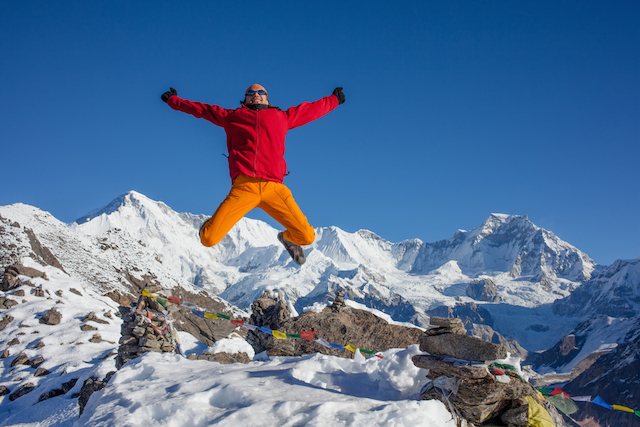
    Man Hiking in Himalayas

    “All seasons are beautiful for the person who carries happiness within.” ~Horace Friess

    This year I felt a calling to explore the beauty of nature in a different way. I enrolled in a program where I would be hiking in the Himalayas.

    I would be living in camps and guest houses, away from any communication or technology, and even away from almost all people. I would not have a shower or “standard” toilets, and I would experience a different lifestyle for some time where very limited resources are available.

    My heart is full of gratitude for what I experienced during those two weeks over there. Not only did I meet wonderful people in my travel group, but also interacting with the locals was an eye opener for me.

     I reconnected with the meaning of true happiness.

    The simplicity of their way of living made me question my own needs.

    The kindness of their hearts made me realize that we are really connected and capable of sharing, even when we don’t have much for ourselves.

    Their strength while facing challenging weather conditions made me realize that I too had the power to become stronger, and that I could overcome any obstacle in life.

    Today I want to share with you five valuable lessons I learned while I was there so you too can live a happier life.

    1. Simplicity amplifies.

    The less you have, the less you worry and the more you appreciate what you do have.

    When I was living in the guest houses I didn’t consider the local people poor.

    The truth is, they had limited resources and they would spend most of their year in the cold weather, eating what they harvested, and the rest of the time harvesting their fields, taking care of their cattle and living a very simple life with what they had.

    But they’re happy. You can sense an inner peace that is not present in the busy streets of London, where we are supposed to “have it all.” I believe that when there is less to choose from, there is more to value.

    2. Love is all around.

    When we open our hearts to truly feel and see love, it’s very easy to recognize random acts of kindness. In the Himalayas, people who don’t know you help you cross a river. People get help when you’re stuck in the middle of the mountain.

    It might be easier to notice when you are away from the buzz of the city, but random acts of kindness are everywhere if you start paying attention to them. You might notice a person offering a seat to someone on the bus, or holding the door open for you when you have your hands full.

    You might also want to start thinking about how you can be kinder to others or perhaps acknowledge kindness shown toward you more often. Kindness leads to happiness. The more you accept help from others, and the more you offer help to people in need, the more kindness and happiness you will experience in your life.

    3. You don’t need wings to fly.

    Fly where? Fly to achieve your dreams, feeling connected to the possibility of achieving something you truly want.

    When there is an obstacle, but there is enough will and persistence and you believe in yourself unconditionally, you can truly fly and reach for the stars. It all starts with self-belief.

    When I started believing that I was strong and I could actually climb mountains and go farther than I initially thought, things became possible. Of course, belief didn’t make me an expert climber overnight, but it enabled me to take a chance and push myself to learn and grow.

    So, my question is: What do you want to achieve? Start believing in yourself first and everything else will follow.

    4. Don’t keep expectations.

    Several things didn’t go to plan on my trip. For example, we ended up hiking for fewer days than originally planned because the weather changed unexpectedly, and that caused several delays, which affected our route. Now I feel that it was a blessing rather than a curse.

    It allowed me to practice living in the present moment and avoiding disappointment.

    There will always be situations where things don’t go to plan or are out of your control. Clinging to your expectations only brings worry, suffering, and unnecessary drama. When you live in the present, you allow yourself to flow with the unexpected and learn from the situation.

    By being fully present and not hanging on to expectations, I was able to enjoy and immerse myself in the experience rather than holding on to negative feelings. I had extra time to reflect on things that were important to me while I was waiting for the rain to stop. Rather than feeling disappointed, I asked myself: What can I learn from this?

    On this trip, I also discovered that I love hiking—and, rather than seeing the inclement weather as completely negative, in the end it became a motivation to start hiking more once I returned to the UK.

    5. Life is short. Live it now.

    When we leave our regular environment, especially when we go on vacation, far from our routine, many questions arise. What am I doing with my life? What do I truly want?

    For me, being in nature is like being in a meditative state. I get time to reflect and evaluate the direction of my life.

    And I know that life is short. We don’t know how long we are going to be on this planet, so each time I remind myself about the things I truly want to do before I die, and I re-plan to make them happen. Don’t wait for tomorrow; it might not come.

    Happiness is not something you can measure, but you can feel it by sharing your heart with others. We can improve our lives through simple things such as walking in nature, meeting kindred hearts, or living in the moment and learning from what might have gone wrong.

    I know that I will be trekking more paths in this life. Life is a journey of discovery. In each step we take we learn new things and we grow. That growth is what brings true meaning and happiness to our lives.

    Man in Himalayas image via Shutterstock