Tag: hiding

  • How I Stopped Hiding Myself for Love and Approval

    How I Stopped Hiding Myself for Love and Approval

    TRIGGER WARNING: This post includes a brief mention of childhood physical abuse and may be triggering to some readers.

     “The person who tries to keep everyone happy often ends up feeling the loneliest.” ~Unknown

    It’s Christmas morning. I’m seven years old. I sit on the hardwood floor with my sisters, in my nightgown surrounded by crumpled wrapping paper. I grab the next present to open. I tear off the paper. It’s a ballerina costume with a pink leotard, tutu, and pale pink tights.

    As soon as I thank my adoptive parents, I leave the room with my new gift, keeping it hidden behind me. I get upstairs to my bedroom and stand in front of the mirror, rushing to get it out of the package and put it on, struggling to get the different fabrics to cooperate.

    When I finally get it on my body, I run back downstairs with a big smile, excited to surprise everyone and maybe even earn some laughs. My heart races with excitement. I enter the living room. My adoptive parents look at me. I scan their faces for smiles. The smiles don’t come.

    “What the hell did you do! You ain’t supposed to put it on yet!” Mom yells.

    My heart’s beating loud. Why are they angry? I can’t understand the mean words my parents hurl at me. Dad gets up from his chair and attacks me. When he’s done, my face is hot and my hair disheveled. I hang my head and go back upstairs to my bedroom to change out of the costume. I look in the mirror at myself. ‘I’m so stupid.’ I think. I will never misread them again.

    I was taken from my birthmother at ten months old and placed with foster parents who abused me, and despite this being common knowledge, they were allowed to adopt me.

    Adoptees, even without abuse from adoptive parents, become experts at adapting. We know our family arrangement came to be because our birth parents weren’t up for the task of holding onto us; the reason doesn’t matter because children can only point inward. Beneath the surface, many adoptees carry an unconscious belief that sounds something like this:

    “I am bad and unlovable. That is why I was not worth keeping the first time. If I can become whoever my adoptive parents want me to be, I will prevent being abandoned again.”

    So, adoptees learn to bend and shift, careful not to incite disappointment or anger from their adoptive parents. For example, I didn’t dream of being a dancer as a child. I’d never taken a ballet class or even expressed an interest in it. So when I opened that costume on Christmas morning, I saw it as a clue. My eagerness to be a show pony in a ballet costume was an instinctual reaction because it meant earning a higher approval rating from my scary adoptive parents. But obviously, I read it all wrong.

    This life-saving skill of adaptation permeates any relationship that poses a risk for leaving adoptees with a broken heart. It can become so pervasive that by the time adoptees enter adulthood, they’ve had little to no experience exploring their own needs, wants, or desires—because they’ve spent their entire lives becoming who the person in front of them wanted them to be.

    My husband and I gave our daughter a “yes day” a couple of years ago, where she created a list of fun things to do, and within specific parameters, we had to say “yes.” This involved her choosing our outfits for the day, a trip to Dave and Busters, a silly string fight, designing specialty chocolates at the Goo Goo Cluster shop downtown, and a candy buffet for dinner. My husband and I delighted in her joy that day.

    Later, when my daughter asked, “Mom, what would you want to do if you had a ‘yes day?’”

    I felt a burning in my chest, realizing I couldn’t answer her. And when an idea did come, like seeing a concert or dining at a specific restaurant, I knew I’d feel guilty for asking the rest of my family to join me because it wasn’t their thing. My inability to tell my child what I like was a powerful teaching moment, and a call for change.

    I began therapy in my early thirties, intent on resolving the thick layers of trauma and loss that created this barrier between the me that operated out of fear of abandonment, and my true self. Traditional talk therapy with a therapist specializing in trauma, EMDR, EEG neurofeedback, and accelerated resolution therapy slowly chipped away at that barrier. With every victory, I learn more about myself and feel more at ease in the world.

    Resolving trauma is dissolving shame. For me, shame has kept me from knowing myself and focusing solely on the happiness of the people around me for fear of being left or in danger if I fail.

    Loneliness is a consequence of being a chameleon who doesn’t know who she is. How can I expect genuine connection if I’m not allowing people to accept the real me? As a shame-filled person, I chose relationships with people who mirrored my low self-worth back to me. How can I expect genuine connection in relationships like that?

    Authentic relationships are a natural consequence of dissolving shame. Being seen, loved, and accepted for our true selves is the antidote to loneliness.

    For anyone out there who bends and shifts to maintain connection with the people they care about, ask yourself, “If I had a yes day, how would I spend it? Do the people in my life care enough about me to come along and delight in my joy?”

    If that question feels uncomfortable—if the people who come to mind would groan, flake, or dismiss it—I see you. I’ve been there. But healing begins with allowing yourself to imagine something different. Imagine being surrounded by people who celebrate and cherish the real you. Imagine what it would feel like to be loved that way.

    Because that kind of love is possible, and you deserve it.
  • When It’s Time Tell Your Story: How to Step Out of Hiding and Into Healing

    When It’s Time Tell Your Story: How to Step Out of Hiding and Into Healing

    “One day you will tell your story of how you overcame what you went through, and it will be someone else’s survival guide.” ~Brené Brown

    “Hey, can I call you?” read the text from my cousin Dani.

    “Of course,” I responded, nervously drawing in a deep breath.

    I had recently shared some painful experiences with a family member we are both close to. I assumed Dani had heard what I’d said about our family, and I wasn’t sure if she’d be upset by the secrets I had exposed.

    Throughout my life I had always been told to put a smile on my face and pretend that everything was just fine. I was taught that expressing ‘negative’ emotions may upset others. God forbid.

    My mother died from breast cancer when I was only twelve, and on my last visit with her, I was told, “Don’t cry; you don’t want to upset your mother.” The “suppress all emotion” mentality continued after her death while I was conditioned to hide the verbal and emotional abuse I endured as a teen/young adult.

    In my mid-forties I began trauma therapy and was diagnosed with complex PTSD. I began journaling to process the various ordeals I had experienced throughout my life. I am a list-person and found cataloging each incident with its associated emotions a beneficial way to absorb all that I had endured.

    When the full inventory of traumas was complete, I just sat there and stared at the paper, my hand over my mouth. Seeing them together, the pain and the scars, I was stunned by the sheer volume. It was as if a blindfold had been removed, and I could see it all so clearly now.

    I had spent my entire life keeping quiet and acting like everything was okay. I would alter myself, lessen myself, bend to placate others and suit whatever narrative would keep the peace. When that blindfold fell away, I knew I was done.

    I purposefully made the choice to stop abandoning myself. I was tired of being the version of myself that everyone found tolerable. To keep the peace? Whose peace? I certainly wasn’t at peace, and I didn’t want to live like that for one more second.

    I would step out of hiding and bravely bare my scars and tell my story. I have heard the stories others have been bold enough to share and found such comfort in the similarities; I felt like maybe I wasn’t alone.

    I now felt the call to tell my truth in the hopes of being a source of encouragement for others who struggle with childhood trauma and mental illness.

    It was scary, but I hesitantly began telling those closest to me. My husband and children knew the main pieces of my trauma, but I filled them in on all the rest of it. I became more courageous after that and slowly confided in other friends and family, exposing generational trauma, abuse, and abandonment. I was fully transparent and spared no one, not even myself.

    As anticipated, there were unfavorable reactions where I received criticism over my sharing of this type of content. However, those negative responses were the exception, not the rule. I was pleasantly surprised that the majority were positive and incredibly validating. Some even thanked me for sharing my story, telling me what an impact it made or how helpful they found it.

    Some family members, including my cousin Dani, corroborated the trauma and abuse. That was so healing for me to hear, especially when facing disapproval from others. What happened to me was true, even if there are some who want to dismiss or minimize it. A handful even shared their own stories of survival with me after hearing mine.

    One critic asked why I felt the need to put all this negativity out there. They understood the need to journal to process my trauma, but talking to others about it seemed outlandish to them. They felt it would do more harm than good.

    My entire life I had been conditioned to hide the truth and pretend like all was well, ignoring my own needs in favor of everyone else:

    • Never be sad, even if your mom dies when you are a kid.
    • Never be disappointed, even if your dad doesn’t step up for you.
    • Never be angry, even if your stepfather screams at you.
    • Never be upset, even if your stepmother demeans and excludes you.

    In trauma therapy, I learned that hiding ‘bad’ emotions (spoiler alert, there are no ‘bad’ emotions) only causes more pain. The saying “the only way out is through” is popular for a reason. I had to walk through my emotions, honor my pain, and shine a light on it.

    I will no longer put my abusers’ needs above my own. I will no longer be silent. I will no longer hide. I will tell my story of survival and healing with the world in the hopes of it being a guide for others who struggle. A map, an atlas.

    Stepping out of hiding can be terrifying, and sometimes it needs to be done in baby steps. If you are at a point in your life where you feel it is time to shift from pain to healing, try the following.

    1. One Small Step

    • Start small: Reveal one minor secret, experience, or trauma.
    • Tell one person: a close friend, a trusted family member, or anonymously online.
    • Be transparent: Share that you are nervous; say this is difficult for you.

    2. Assess and Appreciate

    • Give yourself credit: Pat yourself on the back for taking a small, brave step.
    • Note how you feel: Proud? Relieved? Lighter?
    • Realize: You did it and survived, and you can do it again.

    3. Repair and Repeat

    • Hits: talking in person, via text, anonymously online?
    • Misses: online trolls, friends offended, certain family upset?
    • Continue: It becomes more comfortable and more healing with each shared connection.

    My reason for sharing my story with the world is that I will never be silent again! I stepped out of hiding to heal and you can too! Tell your story; show your scars. It may be just the map someone else needs to find the way to their own healing.

  • How to Wake Up from the Painful Trance of Unworthiness

    How to Wake Up from the Painful Trance of Unworthiness

    “When we experience our lives through this lens of personal insufficiency, we are imprisoned in what I call the trance of unworthiness. Trapped in this trance, we are unable to perceive the truth of who we really are.” ~Tara Brach

    Breaking free from the trance of unworthiness is a key part of our evolution process, both at an individual and collective level.

    Let me explain why.

    What I observe with clients and what resonates with my own experiences is that most (if not all) triggers, limitations we impose on ourselves, and fears of failure or success stem from a deep and profound trance we all find ourselves in at various points in our lives: the trance of feeling “not good enough.”

    Once we’re enmeshed in this trance, where we truly feel that low vibration of unworthiness, and the shame that comes with it, we want to hide.

    We want to ensure that no one discovers our perceived worthlessness, because that would mean rejection. And rejection is oh so painful. Because we still feel it as being abandoned from the tribe in our emotional body, emotion that’s imprinted during our formative years when our samskaras (impressions or patterns of thinking/feeling/reacting) are being created.

    Therefore, humans naturally want to avoid rejection as much as possible.

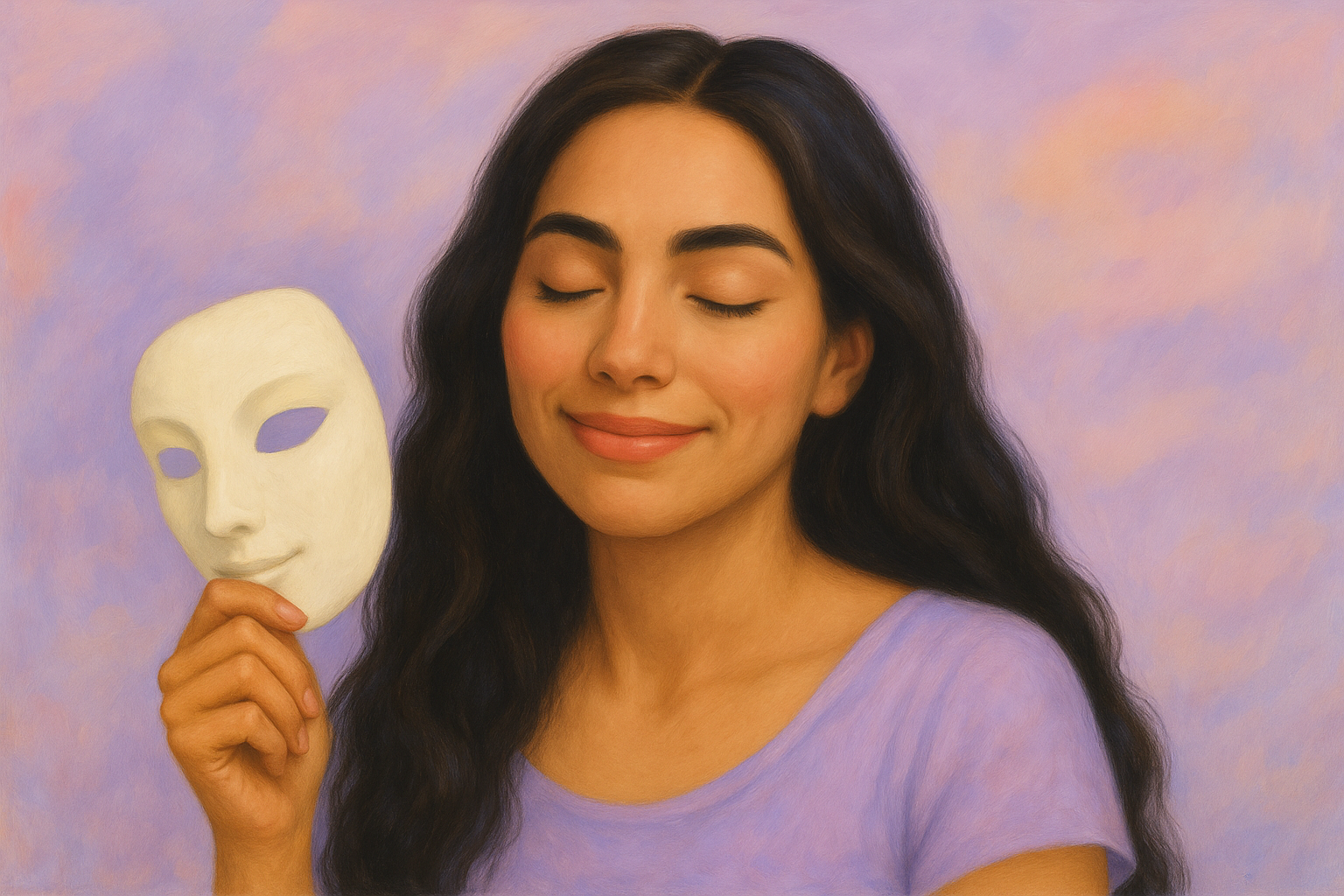
    From then on, we mask. We hide. We reject our true selves and put on a façade that we believe is valuable to the tribe, thinking that we’ll be loved for it. There are different types of masks we can opt for depending on our “culturescape” and family patterns of beliefs.

    Your mask might resemble being an achiever. Constantly doing, constantly setting yourself up for success in whatever way your tribe defines it (a university degree, money in your bank account, the size of your house…).

    Or your mask might be that of a “good girl” or “good boy,” a people pleaser. Staying nice, acting nice, not too ambitious, not too lazy, making sure you do not make mistakes or get in trouble because getting in trouble would be bad.

    Or it could be a mask of service. You serve others, forgetting yourself in the process because thinking of yourself might be seen as selfish.

    But all masks have limits. There comes a time when your mask does not serve you, or them. It serves no one because it is not you. So you end up fooling yourself and others into believing that the mask is you. And this misalignment feels awkward, tight, rigid, and stressful because it is stressful not to be yourself. It takes effort to constantly put on an act. It is tiring.

    So there comes a time when you get really tired of it. Maybe you call this the mid-life crisis or the dark night of the soul.

    It’s just that your soul is tired of the constant acting.

    But your mask is really holding on, fearing that if it were to fall off, everyone would discover how worthless you are. So it works hard to stay and punishes you with harsh self-criticism each time you go off track and maybe show a bit more vulnerability, a bit more of yourself.

    So how do you remove your mask? Well, it’s not easy. It takes effort and dedication. It’s a long, non-linear journey, more like a spiraling up and down movement. But it’s oh so worth it.

    I too had a big mask on for a long time, and figuring out who I was without it was uncomfortable. So much resistance. So much fear. So many limiting beliefs.

    I wore a perfectionist mask to keep myself safe for years.

    I had a perfect body (according to the standards that were imposed on me at the time through magazines, society’s comments, women’s comments on their bodies), a perfect level of fitness (monitoring what I ate, struggling with anorexia), a perfect job (engineering, as per my family’s expectations).

    I was a feminist, working woman (the strict version of feminism that was transmitted to me was to work full-time and not be at home because it was not valued) and an independent woman (able to do everything myself).

    On the other side of the trance of unworthiness, life is so different from what your mask was expecting you to live. Maybe the big house you live in is not what lights you up anymore, or maybe it is. But you might find more joy and love in the small moments of life.

    It’s so much nicer on the other side, so much more authentic; more energizing, fluid, and beautiful. Not all happy. But authenticity brings some lightness to your life even in the midst of life’s messiness.

    Here are a few key steps to practice to break free from the trance and rediscover your true self.

    1. Check in with your readiness.

    First you need to be ready for it. You need to be willing. You need a strong energy of yes to change and no to staying the same, in that loop of constant self-doubt and feeling unworthy.

    2. Practice radical honesty.

    Be radically honest with yourself that you have been wearing a mask that kept you safe for a while but was inauthentic.

    Feel the mask in your body. How do you feel when you wear it? What physical sensations do you experience? What’s the voice in your head like? What is your inner critic telling you?

    Observe all of it. Each time you are back in this sensation, with this inner voice, catch it. Thank it for all the good work and beautiful protective intention all those years but be firm: you are in charge now.

    3. Allow the feeling of discomfort.

    Spend some time in the discomfort of removing the mask and being formless. Feel the resistance. Observe the internal battle. Feel it in your body.

    After the internal resistance, there will be grief. Feel the grief fully. You are letting go of a part of yourself that defined you for most of your life. You will need to feel the loss. Take your time. There is no rushing grief.

    4. Ask yourself: Who do I choose to be?

    In your redefinition process, ask yourself who you want to be, what quality of being you want to embody. What lit you up when you were young, and what is lighting you up now? How do you want to show up in the world? How do you want to feel? You have the power to be whoever you want to be. What will you choose?

    5. Remember your inherent worth.

    Remember that you are inherently worthy of love. You were born worthy—a little newborn, a bubble of love. And you still are. Just as worthy of love, regardless of your age and the mistakes you made along the way. You are worthy of love because you exist.

    6. Embrace forgiveness.

    Forgive yourself for your mistakes. Forgive yourself for abandoning yourself so many times. Forgive others for anything they said or did that caused you to want to hide.

    7. Decide that it’s time to shine.

    It’s time to wear that new skin. It will feel weird for a while, but it will settle into something beautiful and relaxing. Eventually. Like when you meet someone you can be yourself with, it feels so easy and beautiful. Same feeling.

    The world needs the whole of you. Your unique identity. Your unique vibration. Live authentically. Cry when you need to cry. Share how you feel with love and courage, without blaming others. Shine brightly when you feel that energy. Follow those steps that take you toward the vision of yourself you’ve set, those inspiring, energizing steps.

    The journey is not going to be all rosy, but acknowledge the impermanence of the ebbs and flows in life so you can move through the challenging parts with trust.

    8. Do what lights you up.

    Do the things that make you feel awesome, whatever they are. For me, it’s yoga, walks, nature, spending time with good friends, and connecting with my kids.

    9. Spend time in nature.

    Nature brings out our authentic nature, our worthy nature, because nature is non-judgmental. Nature is authentic. Nature is powerfully beautiful. Nature is healing.

    10. Surround yourself with a supportive tribe.

    As you remove your masks, as you grow and heal, your relationships will shift. You might find that you cannot hang out with the same people you used to—because they might still be wearing their masks, and because they might struggle with your “new” vibration. That is okay and part of the process. Learn to let go. This will create space for new relationships to come through.

    Find a tribe where you feel worthy and valued!

    11. Be compassionate to yourself. 

    Because the mask will want to come back for a while, on and off, in different forms. Your inner critic will get loud. Be patient. Hold this part of yourself and the part s/he is protecting tight. You got this… until the next time where you peel another layer and release another mask.

    Don’t forget, the journey isn’t meant to be tackled alone. Getting support from friends, a coach, or therapist is incredibly valuable. It speeds up growth and makes it easier to have someone to guide and cheer you on along the way.

  • How It Got Better: My LGBTQ+ Journey from Shame to Pride

    How It Got Better: My LGBTQ+ Journey from Shame to Pride

    2003 was when the “gay devil” (as I referred to him at the time) made his first appearance inside my unprepared thirteen-year-old mind. On a trip to Mexico that year, he sat perched on my shoulder while my family and I were out to lunch at an outdoor taqueria. The girl at the table next to us had tan skin and brown-blond hair, and wore sunglasses and a spaghetti-strap black tank top.

    My “gay devil” noticed her and made sure I did too. As the words “She’s hot” crash-landed from his taunting lips into my unsuspecting mind, I flinched—then turned around to make sure no one had heard.

    Luckily no one had. My dad simply smiled kindly into my worried eyes before passing me the bowl of tortilla chips.

    Over the next few years, the gay devil made frequent reappearances, continuing to deliver crushes to me that I wasn’t ready or willing to identify for what they were.

    He was often pretty rude in his delivery. At a Stevie Brock concert, when I realized my feelings for one of his fan club members far surpassed anything the boy pop star had ever made me feel, the gay devil taunted me: You’re not really here for Stevie, huh?

    At summer camp, after a girl I liked gave me a hug, he whispered: You liked that a little too much, didn’t you?

    **

    There were several reasons I didn’t feel safe coming out (not even to myself). One was that even though LGBT people had gained notable acceptance by the early 2000s, it still seemed like relatively few people were out”—fewer still in high school.

    Another was that despite my attending a fairly liberal high school, it still felt to me like a place where going against the grain—no matter if your difference came in the form of sexual orientation, temperament, or the way you looked and talked—was to open yourself to judgment and ostracizing.

    Some rare people are completely comfortable in their skins from a young age, blessed with rock-solid peer support groups and unshakeable self-confidence. I wasn’t one of them.

    So I hoped I could “wait the gayness out,” as if it were a passing affliction that might resolve with time.

    This concept of homosexuality as a sickness traces back to centuries ago. At one point (before it even started to be pathologized), it was simply so taboo that it wasn’t even spoken about.

    In Walt Whitman’s time, for instance, no discourse existed for understanding or discussing itfor which reason Whitman himself remained in denial, despite developing attractions to the wounded soldiers he treated during the Civil War. (Though Whitman had many relationships with younger men, his writing only implied this, rather than explicitly stating it.)

    After Whitman’s time, a dialogue around homosexuality finally began to emerge, but it was always in the context of illness. Psychiatrists like Richard von Krafft-Ebing described it as a “degenerative sickness.”

    The “homophile” movement emerged in the late 1950s to early 1970s to fight back against this, eventually promulgating a “Gay is Good” message (inspired by the Black Pride Movement) and seeking to build gay culture by way of theaters, music, and newspapers catering to the LGBT population.

    The movement also promoted and encouraged gay affirmative therapies (whose goal was not to change but be happy with one’s orientation) over gay conversion therapies.

    Still, homosexuality was listed as a psychiatric disorder in the DSM until 1973. In 2005, remnants of that disdain still seemed alive and well at my high school.

    Because shame kept me from putting it into words, for years I danced around the gay/lesbian label, filling the pages of my diary with circumlocutory fawning over my crushes, all of it coded as admiration.

    After finally taking the plunge—first to my diary at age fifteen, then to friends and family at eighteen—my self-acceptance slowly grew. Many firsts and milestones followed.

    Years earlier I never could have imagined I’d be interviewing a married lesbian Australian pop duo while interning for Curve Magazine, or that I’d attend queer prom with and then date a girl I’d met through my college campus’s LGBT Center, or that such a varied community of beautiful LGBT individuals awaited me, particularly in college but also in the years after.

    Little by little, as the years went on, pride replaced shame—and by now, all the shame is gone. But I still remember how it felt. I remember how it stifled me.

    I remember the negative effect it had on my mental health, how it exacerbated my feelings of isolation. As Colin Poitras wrote in his 2019 article (for the Yale LGBT Mental Health Initiative) The Global Closet is Huge: “Concealment takes its toll through the stress of hiding.”

    I also recognize that many queer people are still actively fighting to overcome their own shame. People like the many friends in the LGBT community I’ve known through the years—one whose mother, after he told them, cried inconsolably while his grandma accused him of being possessed by demons.

    Another whose mom, while out to lunch with her, tried to set her up with their male waiter right after she’d come out to her for the third time. Still another whose parents simply refused to ever speak about it with him.

    Referring to a new study by the Yale School of Public Health, Poitras writes that, “even with the rapidly increasing acceptance in some countries, the vast majority of the world’s sexual minority population—an estimated 83% of those who identify as lesbian, gay, or bisexual—keep their orientation hidden from all or most of the people in their lives.

    For these reasons, Pride and community spaces are still very much necessary.

    **

    If given the chance to speak to my teenage self, I’d say to her now: it gets better for you—and once it does, you’ll see that it doesn’t end with you. Celebrate the victories we’ve made—but don’t let them lull you into complacency.

    Not when many young queers—both in rural towns and more urban areas—remain in the closet, compartmentalizing who they are out of fear of familial rejection. Not when in some countries, people can still be killed for living openly as gay.

    And not when the rights of some members of our community (such as queer people of color and transgender people) remain under threat. A Black man who can marry his partner but still has to worry about violence at the hands of police isn’t experiencing equality in the full sense of the word.

    Keep living with eyes, heart, ears, and hands open to the issues affecting members of both our queer community and the larger human family—because if there’s one thing being LGBT has taught me, it’s the importance of not leaving people to suffer in silence. And it’s the power that community, support, and the pride fostered within them can have over combating shame.

  • Why We Need to Stop Hiding and Let People See Who We Are

    Why We Need to Stop Hiding and Let People See Who We Are

    Woman Hiding Face

    “To help yourself, you must be yourself.” ~Dave Pelzer

    I spent a lot of my life being someone else. Playing the part of someone I didn’t fully recognize.

    Looking back, there were lots of reasons why I avoided being me, my mum’s suicide being one of them.

    Her death shaped me, like a rock in a tumbler, and my life, as I knew it, bore no resemblance to the one I once knew.

    I was ashamed of being the girl whose mum left her in such a violent way. What would people think? Maybe that she didn’t love me enough to stay? That I didn’t do enough to help her? That I wasn’t enough of a daughter to her?

    I started to believe that maybe I just wasn’t enough, period. That I was a bad person somehow. Because if you’re a bad person, people don’t want to be near you. They just up and leave. And that’s what she did.

    When you don’t feel enough, there’s anywhere and everywhere you’d rather be than right there, with yourself.

    I became a master at escaping myself and putting on an act in order to feel accepted. Accepted by people I believed would think things about me that I didn’t want them to think. I was too scared to let people see the real me because I believed the real me was so obviously fundamentally flawed.

    My escape artist act was compounded aged twenty-one, when I realized that I was gay.

    I wanted to hide. I didn’t want people to know. I felt different from other people, the people I already felt different from because their mums were still alive and kicking, and most definitely hadn’t killed themselves.

    And so I pretended, again.

    It’s hard, pretending to not be gay.

    People ask questions and get curious. About why you don’t have a boyfriend. Or why you spend so much time with your friend, “You sure do see each other a lot. You’re practically joined at the hip, aren’t you?”

    I spent a lot of time deflecting questions. My answers, which were always lies, became a shield that I hid behind.

    And as my lies got bigger, I became smaller, crouching behind the shield until I couldn’t see over or around it anymore.

    I had completely lost sight of who I was.

    And losing sight of me was the emptiest, most isolating feeling I have ever experienced. It felt like I was living my life behind a glass screen, like I wasn’t quite there, unable to take anything in.

    I was massively unsure of what I liked or didn’t like, and was scared to say what I thought. I mean, who was I to say? What did I know anyway? My thoughts and opinions felt lukewarm and grey. Not enough to add heat or a splash of color to a conversation.

    I didn’t dare try new things. I stuck to the same routine. I avoided anything that challenged me, for being challenged would mean crawling out from behind the shield, and I would be too exposed—and this might mean that people would see the me I didn’t want them to see.

    And we all do it, don’t we? In some part of your life right now is an area you’re avoiding. A place tucked away, deep down—a part of you that you don’t want other people to know about or see.

    So you don’t talk about it, you draw attention away. By being the life and soul of the party, even though you’re not really laughing on the inside.

    Or in your shiny, flash car that you drive faster than you should, because it’s the only way you ever feel truly alive.

    Or in your relationships with others—where you spend so much time caring for them so you don’t have to care for yourself, and yet you feel the quiet resentment creeping up when they don’t empty the dishwasher or thank you for the dinner you made.

    We avoid being exposed for who we really are while, at the same time, not knowing who we really are.

    And yet the reason we so often don’t know who we are is because we’re not being who we are.

    Over ten years later, I know this. And I see now how, bit-by-bit, and without realizing it at the time, I slowly came out from behind the shield that had protected me for so long.

    The shield that had protected me from me.

    “Figure out what you want from your life,” A friend advised. “Just get to know yourself.”

    “How the hell do I do that, though?” I asked.

    “Just do things. Anything!”

    And so I did. There were no huge, adventurous leaps, nothing particular to write home about. I just allowed my curiosity, even if it was just a smidgen of curiosity, to lead me.

    First up, I started to do things I’d never done before, like going to the cinema alone, or for lunch, with just a book for company. I read, vicariously, and mostly in the bath, mountains of self-development books.

    I wanted to understand myself better; to know why I did the things that I did and thought the things that I thought.

    In later months, I joined a barbershop harmony chorus (it didn’t last very long) and signed up for a five-kilometer race and started a blog which eventually became a website—a place where I could write openly about life, and being human.

    And slowly, very slowly, my life started to show signs of color again, and I didn’t use the shield so much. All of the things that I was doing, the “Just doing things!” were where I discovered who I was.

    We spend so much time looking outside of ourselves to find who we are, because it’s easier that way.

    When we don’t have to put ourselves on the line, when we don’t have to say how we really feel, we get to avoid the things we, as humans, don’t find very comfortable. Things like conflict, having a hard conversation, asking for what we need or offending someone.

    We get to avoid failing and messing up and risk. We get to avoid people not agreeing with us and our opinion, being different, being ‘weird.’ Being truly who we are.

    And yet, we cannot truly know who we are without being who we are.

    Only by being who we are can we experience connection—to life, to other people, and most importantly, to ourselves.

    Woman hiding face image via Shutterstock

  • Drop the Mask: How to Slowly Lower Your Guard and Change Your Life

    Drop the Mask: How to Slowly Lower Your Guard and Change Your Life

    Man with Mask

    “The less you open your heart to others, the more your heart suffers.” ~Deepak Chopra

    The root of my inability to be open stems from my childhood. (I guess much of who we are comes from childhood, right?)

    I remember around the time I was eight years old going to a party at my aunt’s house. Even though I don’t remember the details of the party, I do remember what happened after.

    We got home that night and my dad asked me, ”Don’t you think you should be a little more reserved or have a little mystery to you?”

    I was thinking, “Huh?” What did I say or express at this party that made him say that?

    I’m sure I needed to hear that, because who knows what the heck I was saying. And I do believe having some boundaries is important.

    But I was a little expressive girl sharing my insides and sharing what I saw and experienced. I don’t believe we should share everything with everybody and “emotionally vomit” on people, but for some reason, that moment really defined me.

    I looked up to my father, and since I grew up without a mother, I looked to him for guidance.

    But now as an adult, I realize that my father was a private, closed person himself. So he was projecting that onto me.

    As I got older, I continued little by little closing parts of me off.

    People used to always tell me, “Lisa, you are such a great listener.” And yes, that is one of my best qualities, and I truly do enjoy people and want to see and hear them. But I rarely give people the chance to see me and hear me.

    If someone I don’t know very deeply asks me a question, I usually think before answering and feel uncomfortable talking about myself. Even if there is an opening or opportunity to share one of my experiences in a social setting, sometimes I choose not to.

    Why? Some guesses I have are:

    • I didn’t want to give up the illusion of having it all together.
    • I didn’t want to be seen as weak or needy.
    • I didn’t want to be vulnerable.

    And I’m an extrovert! I have always made friends easily and have always had friends. But recently, I took a look at my adult friendships, and I discovered that I only have a handful of friends that I would consider deep and extremely connected and meaningful, where I can totally be myself and feel comfortable completely trusting them with everything.

    Yes, I know many people say they don’t need a lot of deep relationships and only need a few. But is that BS we tell ourselves? Is that really true?

    Why can’t every relationship we have be as deep and connected? Aren’t most of us mirrors of each other and struggling for the same things?

    The reality is that I don’t want distance between me and anyone in my life. What I really crave is closeness to others and my community and many real connections.

    Being more open at the same time I feel vulnerable is like learning a second language for me.

    I know I will never be the person to spill my guts and be expressive the way others can be, and I’m okay with that.

    But I know it’s possible to open up your blinds for all people to see while remaining authentic.

    Here are a few strategies that have worked for me that may also work for you.

    1. Determine what masks you wear and why you truly are guarded.

    Did you have a bad experience as a child? When you open up, do people receive it negatively? Do you have certain insecurities that hold you back? Are you an introvert and really have a different process for connecting with people?

    Asking yourself these questions will help you get to the root of your insecurities. Just like doctors don’t treat illnesses before they understand the cause of your symptoms, you can’t change yourself without knowing why you are the way you are.

    Take some time—whether it’s just a half hour or a full weekend—to self-reflect. Consider writing down your feelings if you think it will help. Use this time to learn more about yourself and figure out why you’re guarded.

    2. Notice when you become closed, shutdown or guarded.

    Now that you know why you’re guarded, it’s time to become attentive to it.

    A few months ago, I went to a conference and had the opportunity to meet all kinds of amazing people. When the part came toward the end of the first day to “network” and talk and meet people, I ended up going to get a drink with someone I already knew because it was easier and I didn’t have to meet anyone new.

    But what made this time different was that I noticed and became aware of it in the moment. I completely shifted my mindset while I was there, and I can’t say I regret it.

    I met the most amazing people. We got past surface and business talk quickly, and I still keep up with many of them.

    You may find similar experiences equally rewarding. If you can’t work up the courage to take action yet, that’s okay. At this point, it’s about becoming aware of yourself.

    3. Let go of control.

    It sounds counterintuitive. How can you take off your masks if you aren’t in control? Let me explain.

    I’m reading this book called Courage: The Joy of Living Dangerously by Osho. In it, Osho says:

    “If you understand, insecurity is an intrinsic part of life—and good that it is so, because it makes life a freedom, it makes life a continuous surprise. One never knows what is going to happen.

    It keeps you continuously in wonder. Don’t call it uncertainty—call it WONDER. Don’t call it insecurity—call it FREEDOM.”

    It takes courage to dig into who you really are and share that with other people, to completely cut yourself open to others. But it means you have to let go of being in any kind of control and trying to predict the outcome of what happens.

    When you’re in control, fear consumes you, and you follow it. Be courageous and let the situation control itself. Then your fears and masks will subside on their own.

    4. Be unattached to the possible outcomes when sharing your thoughts and feelings.

    It’s one thing to let go of control. It’s another to become unattached to the outcomes.

    It’s tough, I know, but when fears of what might happen next are holding you back, you have to stop worrying about the outcomes.

    It’s not about what people think of you. It’s not about whether they judge you because you are stating a truth and being yourself.

    It’s about your own personal growth. The only outcome that matters is the strength you gain from opening up. Remind yourself of that and all other possible outcomes will worry you less.

    Share yourself and your voice and let go.

    5. Take action in small steps until you become more comfortable.

    The tips above simply won’t happen overnight. You aren’t expected to let your guard down immediately and magically become willing to share your feelings and your voice. It’s going to take time.

    That’s where baby steps can help you.

    Instead of throwing yourself head-on into sharing your feelings or conversing with strangers, start out small:

    • Attend a social event, such as a party or conference, but bring a friend along for support. Make it a point to pitch in a comment or a strong opinion and talk to someone you don’t know.
    • Make it a habit to write in a journal every day for two weeks. Then, read excerpts to someone close to you so you can practice sharing the deeper things that you are thinking about.
    • Join a group where sharing is part of the platform, such as a business mastermind or hobby associated group.

    As you get more comfortable in these situations, take bigger steps:

    • Strike up a one-on-one conversation with a stranger. If this scares you, you can minimize some of your fears by talking to someone you know you’ll never see again. That way, the possible outcomes won’t scare you as much.
    • Share your story with a group of people. Talking with a supportive group of people or to your spiritual leader is a good place to start because these are safe environments where people won’t judge you.
    • Write about your experience and share it online—even if you publish it anonymously or under a pseudonym.
    • Write an article for a community like Tiny Buddha about an experience you want to share.

    Lowering your guard and being completely vulnerable in a meaningful way is incredibly difficult for people like me. But when you have a desire to change and you look inside yourself for courage, becoming the person you want to be is far less frightening.

    Man with mask image via Shutterstock

  • How to Be Your Real Self and What’s Been Stopping You

    How to Be Your Real Self and What’s Been Stopping You

    Hiding

    “The more of me I be, the clearer I can see.” ~Rachel Andrews

    This past year has felt a lot like I was running through a supermarket, naked.

    But not as chilly.

    As a life-coach for women, one of my brilliances has to do with supporting women in showing up fully as their shining, marvelous selves—and guiding them through all the work of facing fears, looking at self-worth, re-training brains to focus on abundance and feeling powerful, vs. scarcity and victim-hood, and so many other powerful pieces.

    I make no secret out of the fact that I have had to do all this myself in order to lead women through their own work.

    And working on visibility—showing up as my unique, in-progress, human self—has been at the center of most of the deeply transformational work I’ve had to do in the last year.

    As I’ve worked on building my ability to serve women, I noticed that I, myself, was hiding from shining fully. I was not showing up authentically, not speaking my whole truth, not reveling in who I am and how uniquely different from other coaches I am (as each one of us is!).

    Why was I hiding? What was going on that I was standing halfway in the shadow, afraid of shining in my brilliance, afraid of being 100% revealed as who I am and what I’m here to say?

    I was hiding for several reasons:

    • I had stories about what a successful female business owner “looked” like—and I wasn’t it.
    • I had stories about how I handle (or don’t handle) money—and deep fears about my ability to be responsible if I made a lot more money.
    • I had stories about showing up as an example of a woman building a life I love living because I told myself women wouldn’t look at my life and want to create something similar.
    • I had deep, unhealed wounds from being little, when I felt like I wasn’t seen or heard, when I felt like making my needs known didn’t necessarily get them met.
    • I also found powerful fears around being seen that were created as a pre-teen walking around the streets of NYC and feeling like a target for verbal abuse from men, which made me shrink myself really small so I wouldn’t be attacked.

    When you figure out what’s keeping you from showing up, you can learn how to heal it and move forward, into the light of what you love.

    Why might visibility as your authentic self be important for you?

    • Visibility as your authentic self enables you to create work you love.
    • Visibility as your authentic self allows you to form satisfying romantic relationships and rewarding and supportive friendships.
    • Visibility as your authentic self affects your ability to be generously compensated for the work you do.
    • Visibility as your authentic self affects your ability to create healthy boundaries for yourself.
    • Visibility as your authentic self reflects in your self-care and health—how clear you are about what you need, and then how fully you’re able to ask for what you need and prioritize it for yourself.

    Here’s what I’ve learned:

    The more authentic, honest, and visibly I show up in my life, my business, my friendships, my parenting, and my relationship, the better everything gets. Because everything I create is being built on a rock-solid foundation—a foundation of who I am at my wonderful, loving, talented core.

    And that stuff doesn’t wash away.

    So why are you hiding? See if any of the following reasons resonate for you:

    • It didn’t always feel safe for you to be visible.
    • You’re afraid you might offend, alienate, or intimidate people if you show up authentically.
    • People might not like you, might be jealous of you, or might get angry at you if you said what you think.
    • Success is terrifying.
    • You’re afraid of failure.
    • You have stories about why you’re not _____ enough to be who you are, have what you want, do what you love.
    • You’ve spent so much time hiding who you are, you’re not even sure what’s underneath anymore.
    • Who has time to be authentic?

    Take a second and write down for yourself, right now, how hiding from visibility or your authentic self has seemed to serve you.

    Now, write down how letting go of any fear or resistance to showing up fully you could serve you—what might become possible if you were to show up fully, 100% visible, and authentically you? What might be yours?

    When you are able to see how it once might have served you to hide, to be small, to stay quiet, you’ll be able to begin the work of releasing those old fears and beliefs and step out, into your light.

    Photo by findingtheobvious