Tag: Help

  • Why I Never Let Anyone Support Me Until the Day I Almost Died

    Why I Never Let Anyone Support Me Until the Day I Almost Died

    “Why don’t you get up and make the coffee, while I stay in my sleeping bag and plan our ascent route?” I half-heartedly ask my climbing partner Hank.

    He just looks at me with that unassuming, “give-me-a-break Val Jon” look of his. It’s three o’clock in the morning, cold, dark, and damp, and neither of us wants to leave the comfort of our tent. But we’re committed to this climb, so we don our parkas and gloves and confront the bitter cold.

    In silence, Hank and I gather up our gear and join the rest of our climb team assembled at base camp, which is located at eleven thousand feet.

    Thirty-three climbers in all have come together for this extraordinary ice climb to the summit of Mount Shasta in Northern California. During our team meeting, we decide to make our ascent via “Avalanche Gulch,” a treacherous glacier route up a steep icy slope. This particular route is shorter than others, but it’s also notorious for its deep crevasses and unstable blue fractures, so one wrong move could mean sudden death.

    Ice climbing requires crampons for the boots and ice axes for leverage and braking. Ropes, carabiners, and belays are reserved for near-vertical climbs, which we may or may not need for this particular ascent route.

    For those unfamiliar with ice climbing, braking is used when a climber loses their footing on steep slopes. It’s done by grabbing the ax with both hands, flipping onto one’s side, and plunging the sharp metal tong into the ice.

    A firmly planted ax serves as an anchor and stabilizes the fallen climber’s position until they can regain their footing. Everyone on the team has practiced the braking procedure many times over along with other vital safety and life-saving protocols.

    As the full moon casts a bluish glow over the ice, we begin our ascent to the summit. At about twelve thousand feet, we come upon a massive fissure running horizontally across the steep glacier face. We traverse around its left edge and cross back about thirty feet above it. Climbing to the slope’s center, we zig-zag our way up to gain altitude and distance from the crevasse.

    Traversing around crevasses is a treacherous activity. If one climber slips, the entire group could be pulled into the abyss. For this reason, we are untethered and climbing independently. We are, however, organized into small teams of six to provide each other support if needed.

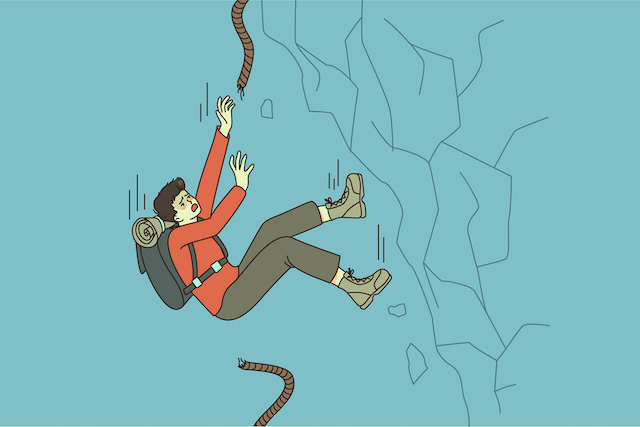
    All goes well as we gain altitude above the crevasse, until one fateful moment when the crampon on my left boot suddenly pops loose and I lose my footing.

    Tumbling headfirst downhill, I instinctively grab my ice ax with both hands and prepare to stop. Landing hard on my back, however, my ax bounces loose from my hands and I slide uncontrollably down the steep slope towards the crevasse.

    In a moment of frozen terror, my life flashes before my eyes and I am going to die! Then suddenly my flailing body slams into something solid, knocking the wind out of me.

    Stunned and disoriented on my back with my head pointed downhill, I’m unable to get a bearing on how close to the edge I’ve come and how close to death I am.

    Looking up, I see a blur of movement and shifting dark images. Clearing the snow and ice off my glacier glasses, I realize Hank and my fellow climbers have formed a human net, catching me just a few yards before I careened over the edge of the crevasse!

    I’m in shock, numb, and completely speechless. I’m also totally embarrassed and feeling extremely vulnerable. I’ve spent years being a strong and independent man, priding myself on not needing the help of anyone. Needing help always seemed like a sign of weakness to me, so this emergency situation is deeply disturbing.

    “We’ve got you, VJ! Hold on buddy, we’re not gonna let you fall!” I fidget around trying to stand myself up and respond, “Thanks guys, I can take it from here.” “Lay still, you’re pushing us back towards the edge!” Hank barks at me. “No, really, I’m okay guys, I’ve got this.” There was no way I was going to be the weakest link in this chain! This time, however, a number of my team members replied, “No you don’t have it VJ, you need to stop right now or you’re going to kill us all!”

    That message got in. The reality of killing my fellow climbers so I can stay in control is just too much for me to bear. The humbling realization shatters my macho control mechanism and I suddenly relax into letting them help me.

    As they reattach my gear, stand me up and reassure me with pats on the back, I realize it’s nearly impossible for anyone to support me. Experiencing them caring for me this way is both wonderful and wrenching.

    My chest tightens and tears come to my eyes as I realize how many times in my life I’ve not let others help or support me. I would always say, “No problem, I can do it myself.” I didn’t want to burden anyone or put anyone out.

    The deeper truth, however, is that if I let someone support me, I would be obligated to them in the future. The result might be that they could then somehow control me the way my father controlled me as a child.

    Looking into the caring faces of my fellow climbers, I suddenly see superimposed images of my mother, sister, and little brother, my friends, and exes who I’ve shunned and alienated with my stubborn macho independence

    I reflect on the pain and frustration that not being able to help me must have caused all these people in my life. So many opportunities I have had to accept the support of those who love and care for me, but no, I have to be strong and independent.

    How selfish and arrogant of me to rob them of the opportunity to contribute to my life! And how easy it would be for me to slide into humiliation over this display of narcissism.

    Standing here among those who just risked their lives to save mine, I realize I have a choice; I can dramatize my humiliation and hide behind my rugged individualism, or I can humbly open myself to their care and support.

    I choose to set humiliation aside and open with humility, and as I do, a wave of emotion fills me. For the first time in my life, as far back as I can remember, I’m able to see that accepting help from others is not a sign of weakness, it’s an act of humility.

    I also realize that rather than being a burden to people when I’m in need, it allows them to feel useful and to make a difference by offering their support and care. There’s no doubt that my fellow climbers are ecstatic about having just saved my life; I can see the joy and exhilaration on their faces.

    Still surrounded by a human net of care, I thank each member of my team for saving my life, and I apologize for placing them in additional danger. Each one of them nods in recognition, and nearly everyone assures me that having the chance to help save my life was far more important to them than blaming me for being a bit heedless.

    As I allow myself to be vulnerable and let their care in, my defensive armor melts, then drops away. We resume our ascent, and tears fill my glacier glasses as I reflect on the experience of my life being saved by this remarkable group of friends.

    How strange and new this is for me. I don’t need to see out of my glasses because I have the full support of those behind me as well as those in front to help me along if I need it.

    I’ve always been the one to give support to others, but now I can receive support as well. I breathe into this new awareness and suddenly have a profound realization that has remained with me for years.

    As I exhale, it’s synonymous with the movement of giving support, and as I inhale, it’s synonymous with the movement of receiving support. Engaging in both inhaling and exhaling doesn’t mean I’m weak, it means I’m human.

    Without further incident, we all ascend to the 14,179-foot summit of Mt. Shasta where a crystalline blue sky embraces the curve of the earth. The summit perch looks like a small crater and is no more than about twenty feet in diameter. Its outer rim is composed of a ring of rocky crags with one high point that signifies the very pinnacle of the mountain.

    Shining, sunburned faces grinning from ear to ear sit together in a blissful exchange of laughter and tears.

    After celebrating our joint accomplishment, we begin the ritual of reading and signing the register book stowed atop most climbable mountains in the world. The one at the summit of Mt. Shasta is contained inside a green metal canister under the Western crag.

    Each member of the team, like those before us, takes the opportunity with the book. After finishing, Hank hands it to me. As the last to see the register, I flip through its yellowed pages and my eyes fall on a passage written by a climber on October 23rd, 1972. I’ll never forget the inscription:

    “Father, I dedicate this climb to you. I’m standing at the top of Mount Shasta today because of the love, support, and encouragement you gave me as I was growing up. It’s because of your commitment and love that I was able to make it to the summit today. And although you lost your legs in the Korean War and have never been able to stand beside me. Father, I want you to know that today I stand on the top of this mountain for both of us. I love you with all my heart and all my soul, your son John.”

    How beautiful this dedication is! I take in the grandeur of the Earth’s curve from this high summit, close the book, and clutch it firmly to my chest. A wave of inspiration fills me, and I feel deep abiding compassion for all the world’s fathers, sons, mothers, and daughters . . . and I am challenged to act upon the humility that was moving so deeply within me.

    You see, up until this very moment I’ve coveted a deep wound in my psyche. As a boy, I was violently abused by my father, and as a result, I cut myself off from him in my early twenties vowing to never speak with him again.

    But now I am faced with a choice . . . should I maintain my position and continue to empower all the reasons why I should not reach out to him? Or should I humble myself and take a chance by reconnecting after all these years? It is here, within these deeply challenging life choices, that we both test the authenticity of our inspirations and discover what we are truly devoted to.

    I made my choice, and not only did I resurrect my relationship with my father, I affirmed that there is nothing more important to me than living with an open heart and honoring the humility I was gifted with high atop the summit of humility.
  • Want to Help Someone Through Depression? Here Are a Few Things to Try

    Want to Help Someone Through Depression? Here Are a Few Things to Try

    “There were two classes of charitable people: one, the people who did a little and made a great deal of noise; the other, the people who did a great deal and made no noise at all.” ~Charles Dickens

    “It’ll be okay, just…”

    If I could have taken that expression and thrown it at each person who said it to me when I was struggling with depression, it would have felt much better than hearing it each time.

    Here are a few ways people ended that sentence:

    “Try not to think about it.”

    “Cheer up.”

    “Get some exercise.“

    “See someone about it.”

    All well-intentioned, true, and completely unhelpful.

    I didn’t need to hear advice, or pointers or solutions. I just needed them to be present, to remind me I wasn’t alone.

    I was in a new town, totally broken, in despair, having had no physical rest for weeks. I couldn’t pray, couldn’t read (I tried), couldn’t sleep, and felt like moving forward was the most insurmountable task of my life.

    I could write a book about my journey to and through depression; I could list all the unhelpful things people said and did, but instead I just want to share a few things that did make a difference for me personally while I was at my lowest point. If someone you love is struggling with depression, here’s how you might be able to help.

    Be present.

    It is so difficult when we don’t know what to do or say to help. Just being present is so valuable. Make it a point to be there physically whenever you are able. And if you’re not able to be there in person, be present from afar.

    My best friend Crystal lived very far away at the time. But she knew about my struggle. One day she called, and when I was too drained to even talk, she started praying for me on the phone. She continued to call every weekend and prayed on the phone for about thirty to forty minutes, while I just sat there and listened, often crying. For a year! That was like someone picking me up and carrying me. I am so grateful to her.

    You may not do exactly the same thing, but if you can, make yourself present. Physically be with the people you want to help. You don’t even need to say much. If you are unable to do that, call or write. A quick note that will only take thirty seconds to write, a text that reads, “I love you.” Or “I’m thinking about you.” Or “I’ll see you soon.” Or “You are such a good…” (friend, mother, person, artist, whatever …

    This will remind them that they are not alone or forgotten.

    Let them talk.

    Without judgment or interference. There may not be too many insights you can provide, especially if you haven’t been through the same struggle, but listening is such a priceless gift to offer.

    Most of their thoughts or perspective may be flawed—depression can distort our perception—but they need the freedom and safety to express them. Then, you can gently and graciously challenge their thinking if you think that would be helpful.

    Let them cry too, it’s okay. It’s a release. Feelings need to be felt in a safe environment until they’re processed. It’s better than holding them inside and letting them weary and crush you.

    Take them for a walk.

    Somewhere beautiful, if possible, and if you can throw a dog into a mix, even better.

    Nature and animals are so healing! When Winston Churchill said, “There is nothing better for the inside of a man than the outside of a horse,” he knew what he was talking about.

    I personally felt like I was being rebuilt from the inside every time I was around trees, or just touching a horse or a puppy.

    Help with what they need.

    Find out what they need, not what you think they need. Maybe it’s to watch their kid while they sleep, or perhaps bring them a meal they would enjoy. Maybe you can help them clean their desk or a bedroom, a kitchen, a closet. Find out from them what would be helpful.

    One time, when I was struggling, an older woman who met my husband at work learned that I was in a rather tough spot in life and insisted that she and I talk because she really “wanted to help.” This lady, knowing I had just had a baby, asked if I “could get a babysitter so she could visit with me and teach me some things” about life and parenting. It seemed like it was more about her than me. Needless to say, I didn’t want anything to do with her or her “wisdom.”

    Hug and hold.

    A good hug fills a gap between loneliness and belonging and triggers oxytocin, along with the rest of the “happy” hormones. It’s so comforting and therapeutic.

    Remind them of all they have overcome.

    They may resist your attempts to show them their strength, but you can state the facts that prove they are strong or determined, and that these qualities are already in them and will assist them in getting well.

    Celebrate little victories.

    Because they probably won’t.

    Accomplishing anything is a victory for someone who is barely motivated to do anything at all. Help them see that they are progressing, even if it doesn’t feel like it. Hope is what is so needed in order to keep moving forward.

    Then, after doing these things, you can tell them: “it will be okay.” And maybe then they’ll believe it.

    I wish you well in encouraging those you love.

  • Please Don’t Fix Me: What True Empathy Is (And Isn’t)

    Please Don’t Fix Me: What True Empathy Is (And Isn’t)

    “No one mentioned until I was in late middle age that—horribly!—my good, helpful ideas for other grown-ups were not helpful. That my help was in fact sometimes toxic. That people needed to defend themselves from my passionate belief that I had good ideas for other people’s lives. I did not know that help is the sunny side of control.”  ~Anne Lamott

    I’m a well-meaning empath.

    If you share your problems with me, I’ll quickly make them my own. I’ll listen intently, feel deeply, and want to help. I’ll give you advice and solutions you didn’t ask for, then be annoyed when you don’t do what I suggest.

    I used to think this was being helpful.

    When my partner told me his joints were aching, I thought he wanted me to teach him yoga poses to ease the pain. When my friend told me how much she hated her job, I thought she wanted me to tell her how to find a career she’s passionate about. When my colleague told me about his breakup, I thought he wanted me to encourage him to get back out there.

    Now I know better.

    We Don’t Want Advice (Unless We Ask for It)

    Most people who call themselves “empaths” also suffer from this affliction.

    We think because we feel another’s pain as if it were our own—and find it easy to put ourselves in other people’s shoes—that it’s our responsibility to fix that pain. We believe we need to offer a solution because sitting with the pain is uncomfortable for us and for them. We want to rescue them. We think advice is what they need.

    Turns out, this isn’t true. I learned this lesson when my sister told me about a big argument she was having with her best friend.

    As we sat eating noodles over dinner, she shared how hurt she felt and how unsure she was about whether their friendship would recover. I offered a few suggestions: “Have you tried calling her instead of texting? Could you ask her to meet for coffee so you can talk it out? Maybe when you do, you should take it in turns to speak to each other, while the other listens without interrupting?”

    She looked at me with a flash of annoyance.

    “Becki, I don’t need you to fix this for me. Please don’t give me advice about it. I just want you to listen.”

    Admittedly, this took me aback. She just wants me to listen? As in, sit there and say… nothing?

    “Yes, that’s exactly what I want,” she said. “Maybe you can tell me what you heard so I know you’ve been listening. But I don’t want any tips. Thanks.”

    Honestly, this was a total revelation. Since my sister is pretty direct, she has no problem asking for what she wants and needs from me (or anyone else). But most of us are too polite—or too scared—to ask for what we really want.

    When I thought about it, I realized that when I share my inner world with someone, I don’t want a solution, unless I explicitly ask for one.

    What I actually want is to be heard.

    Wait, so just listening is enough?

    We don’t share parts of ourselves with others in an effort to receive tips and tricks. When that’s what we want, Google has us covered.

    Personally, I share with people because I want to receive support. That support can be as simple as someone looking me in the eye and saying, “I get it.” Letting my pain exist between us and letting it be okay that it’s there. Making me feel less alone.

    The need to be seen, heard, and understood—the need to matter—is universal.

    Ironically, when we try to help others by rescuing them, we don’t meet this need at all. In fact, what we’re saying is, “I don’t believe you have the resources you need to find your own solution to this. Here’s what I know, so do this instead.”

    We’re saying their pain isn’t okay. That it needs fixing.

    I’m also ashamed to say that, more often than not, I make someone else’s problems about me. If they tell me what’s on their mind, I might share my experience of a similar situation (and how I dealt with it) or emotionally react to what they’ve said (so they end up taking care of me instead of the other way around).

    Recently, my partner said he’s having an issue with our relationship.

    “I want to tell you this, but it would be great if I could talk without you reacting to it,” he said. “If you could just listen—without sharing your thoughts—and give me space to be open about this with you. Then we can have a dialogue afterwards. Is that okay?”

    Now, let me be clear. It’s been years since my sister taught me to quit giving advice and calling it “empathy.” I thought I’d become so much better at listening. As it turns out, I’m better at not trying to fix people. But I still have a tendency to react to people’s stories with my own thoughts and opinions, instead of showing that I’m actually hearing them.

    “He knows I’m an emotional creature, though,” I said to myself. “What the hell does he expect?!”

    On some level, this is true. We empaths are emotional creatures. It’s how we’re wired.

    But I decided not to use this as an excuse. If I wanted to experience the kind of love, intimacy, and connection I really craved, I needed to learn how to be there for people—without inserting myself into their problems.

    What True Empathy Is—and Isn’t

    In my studies, ranging from the work of Marshall Rosenberg and Nonviolent Communication to everything by Brené Brown, here’s what I’ve learned about empathy so far.

    First of all, empathy is something we do. Not something we are.

    Yes, some of us are more naturally empathic and find it easier to relate to others. But true empathy is a skill. It’s something we can learn and improve at. Plus, many of us who call ourselves “empaths”—myself included—think we don’t need to work on these skills. Trust me, we do. We all have blind spots.

    Let’s say a friend comes to us and says they’re having a hard time right now. They’re in piles of credit card debt and feel like they’re drowning. They’re working extra hours and even started a side hustle to pay it off, but they still feel stressed, overwhelmed, and burnt out.

    Feeling the urge to offer advice already? Yeah, me too.

    Instead, let’s pause and think about what our friend wants. They might be feeling ashamed, so it’s vulnerable for them to share this with us. Since they’re already actively working to solve the problem, they probably don’t need our best debt-clearing tips, either.

    Here’s what true empathy might look like in this situation:

    • Consciously staying centered, grounded, and present with our friend
    • Paying attention to what they’re saying and reminding ourselves it’s about them, not about us
    • Maintaining eye contact, nodding, and offering non-verbal cues so they know we’re listening (“mmm”)
    • Reflecting what they’ve told us (“I’m hearing you feel really stressed about this and you’re worried about paying your rent next month”)
    • Using this magic question: “Is there more you want to say about that?”
    • Asking before offering advice and being okay with hearing a “no” (“I have an idea that might help. Do you want to hear it?”)
    • Asking before jumping in with our thoughts (“I’d like to share my perspective on this with you. Are you open to hearing it?”)

    And here’s what it wouldn’t look like:

    • Offering judgments, analyses, or opinions on what they could—or should—be doing differently (“You should read this great personal finance book.”)
    • Dismissing their feelings and therefore invalidating them (“It will be fine.” Or “Yes, but at least you have enough money to get by; some people don’t even have that.”)
    • One-upping them by sharing a personal experience which seems worse (“I know what you mean, I got myself into twice that amount of debt a few years ago…”)
    • Explaining why we think it’s happening and trying to pinpoint the reasons (“Your parents never taught you how to manage your money.”)
    • Sympathizing with them (“Oh, you poor thing, what a mess you’re in.”)
    • Educating them about what we’ve learned and how this can be applied to their situation (“I started by saving 20% of my paycheck; that might work for you.”)
    • Sneakily “coaching” or interrogating them—especially if we’re qualified coaches (“How are you getting in your own way here? How has been in debt kept you feeling safe in some way?”)

    Looking at these two lists, it’s clear what I’d like to receive from another human in response to the debt situation. The first list feels far more intimate, affirming, and nourishing. Despite this, I still find myself doing things on the second list all the time.

    Luckily, I get tons of practice to develop my empathy skills.

    I get daily practice with my partner, my family, and my friends. I even get it with the elderly woman who sits next to me on the bus, the friendly barista at my local coffee shop, and the cashier at my nearest supermarket. I don’t always do it perfectly, and that’s alright.

    I’m just trying to remember that people don’t need me to fix them. They’re not broken.

    What they need is for me to present with them. To be with them—to listen—without the need to do anything. For us to dance in the pain, together. And maybe, just maybe, that’s more than enough.

  • How to Stop Rescuing Other People to Feel Good About Yourself

    How to Stop Rescuing Other People to Feel Good About Yourself

    “If your compassion does not include yourself, it is incomplete.” ~Jack Kornfield

    It seemed like the natural thing to do.

    A middle-aged man had dropped his keys near me. I jumped up, hopped over, picked the keys up, and gave them back to him.

    Not so unusual, except I had a badly twisted ankle after slipping on a walking holiday and needed to rest it while the pain and swelling went down. I struggled back to my seat, wincing.

    It was a small incident but symbolic of my rescuing, codependent, instinctive habits at the time. If something needed doing, I would be the one to do it. If there were a problem around, I’d jump to fix it.

    Of course, I could have just called out to the man and pointed at his keys from where I was sitting. But I felt like I had to do it myself.

    I thought that’s what ‘being good’ was. And the harder something was for me, the more ‘good’ I thought I was being.

    When Trying Harder Makes It Worse

    It was part of a whole guilt-driven people-pleasing pattern. Other people’s appreciation gave me brief relief from feeling bad about myself. It was a temporary pass into being okay.

    Over the years came relationship breakdowns, career misfires, and increasing anxiety and insecurity.

    Whenever there was a problem in a relationship, I considered it my job to fix it. Though my intentions were good, this actually created a sense of separation. Instead of being in the relationship, I became more like a mechanic looking at it from the outside.

    As for work, I took on so much that it left me stressed and created a distance from my colleagues. I thought they were acting coolly toward me because I wasn’t doing enough, but the opposite was actually true—I was doing too much.

    I didn’t recognize at the time how my actions were affecting the balance of my relationships. I couldn’t understand why I kept failing.

    I’d always been taught that if I wasn’t succeeding, the answer was to try harder, but the harder I tried, the worse it got.

    So I tried therapy. Naturally I tried to be the best therapy client.

    I did all my homework, read all the books, and often turned up with ‘helpful’ notes for the therapist. Of course that didn’t work either.

    Learning about what I was doing wrong made it worse. Now I had a whole new set of things to beat myself up about. I was even failing at therapy!

    I was pointing in the wrong direction, so going further just got me more lost.

    Seeing Through New Eyes

    “The real difficulty is to overcome how you think about yourself.” ~Maya Angelou

    The turning point was realizing my cruelty. My kindness to others had blinded me to how cruel I was being to myself. Trying harder and beating myself up for where I was failing was just more cruelty.

    However much I did, no gold star was ever going to come from outside to officially certify I was “enough.” If I was to become a truly kind person, I needed to start learning to be kind to myself.

    It was hard. I had to stop constantly being the most helpful person around. But in my mind, at least, that’s who I was. My profession, my relationships, and my identity were all based on that. If I wasn’t that, what was left?

    I was like an addict in withdrawal. Without the regular feel-good boosts of appreciation from others, I had to face all the difficult feelings I’d had about myself for as long as I could remember—the guilt, fear, and insecurity I’d developed when I was a sensitive kid who felt like he didn’t belong and always thought he had something to compensate for, atone for, or prove.

    But at least I was now pointing in the right direction, so every step was progress.

    Each week was a little better than the last. Spotting when I was being too self-critical and learning to be kinder. Holding back from fixing a problem someone could easily fix for themselves.

    For example, unless my partner specifically asked me to help solve a problem for her, I learned to empathize, encourage, and support her so she could work it out for herself.

    Stepping back meant some things didn’t get done, took longer, or went wrong. But sometimes they went better than if I’d tried to fix them. Who knew? And sometimes the person asking decided it wasn’t important after all.

    More importantly, though, by learning to hold back, I was allowing others the space to develop while weaning myself off the quick, feel-good boosts I got from helping others.

    Of course, this didn’t happen overnight. Changing deep patterns takes time. But each small change sets you up for the next one. It’s a gradual positive, self-reinforcing cycle.

    So what did I learn?

    Be Your Own Best Friend

    If people tell you that you are your own worst enemy, how about becoming your own best friend?

    Many of us are better friends to others than we are to ourselves. We’re kinder, more supportive, and more willing to stand up for their needs.

    You’ve heard the “golden rule”: “Treat others how you would like to be treated.” That holds true the other way too. Treat yourself how you would treat a good friend.

    If you wouldn’t say something to a good friend, don’t say it to yourself.

    If you wouldn’t ask a friend to put up with something, don’t put up with it yourself.

    You’re as much a part of nature as they are and just as important. Plus, looking after yourself is your job!

    Make Friends With Your Flaws

    You’re not perfect.

    Big news: No one else is either.

    Even bigger news: You don’t have to be. Thinking you have to be perfect is part of the problem.

    You don’t have to make up for simply existing. You don’t have to be gooder than good.

    No one can give you the gold star that certifies you as “enough.” And you can’t get it through your accomplishments, how good you have been, or how many people you have helped today. You have to learn to give it to yourself. It’s your basic pass for being part of nature.

    This doesn’t mean you’re perfect. You’re not. It means making friends with your flaws.

    Support Yourself

    There’s a humorous office sign that reads, “The beatings will continue until morale improves!” We laugh at the sign, but many of us carry an idea that the harsher we are to ourselves, the more likely we are to change.

    The opposite is true. Research shows that people who are compassionate toward themselves are better able to take on feedback, grow, and change. They find it easier to adapt because they’re already comfortable with themselves.

    They’re less fragile because their whole sense of identity isn’t on the line. They know that what they did isn’t who they are. They can open up, connect, and learn.

    Self-compassion doesn’t mean glossing over your failures or challenges. It means supporting yourself while you’re putting them right.

    Stop Putting Yourself Last

    You’re not so special that you need to be last.

    This isn’t about becoming selfish. It’s about balance. You’re as deserving of love and good things as anyone else. Not more. Not less.

    You might need to learn how to be more assertive. That could be difficult at first. Support yourself while you’re learning.

    Be Patient

    It isn’t always easy. It takes time. But once you’re pointing in the right direction, you’ll start feeling better each week. And as you feel better about yourself, you’ll feel less of a need to be everyone else’s hero in order to receive their appreciation and validation. And you’ll become as good a friend to yourself as you are to everyone else.

    **This post was originally published in December, 2018.

  • Toxic Help: 3 Signs Your Support Is Doing More Harm Than Good

    Toxic Help: 3 Signs Your Support Is Doing More Harm Than Good

    “There is no exercise better for the heart than reaching down and lifting people up.” ~John Holmes

    As someone who people often come to seeking help or advice, I recently encountered a new situation for me: one in which I chose to stop helping someone and walk away entirely because I determined it wasn’t good—for the other person or myself.

    It felt like the wrong thing to do, but once I had some distance, I knew I had made the right decision. Throughout the helping, I soldiered on and helped and helped and helped until it no longer felt good, and sometime after that I determined it was no longer help at all—it was enablement.

    My good friend—let’s call him Jack—has had a series of extremely toxic relationships. Infidelity, dramatic and very public confrontations, drug abuse, police involvement…. Jack has always played the role of victim in these cases, and in the three relationships I saw him in during the time of our friendship, he was cheated on, dumped, thrown out of the house, and physically abused. He can’t seem to help himself in this regard.

    Last year, he entered a relationship that was problematic before it even began. The very first official date with Henry, the guy who later became his partner, Henry stormed out of a dinner with a group of people, got extremely intoxicated, and got into a fist fight (with a legally blind person no less) and thrown out of another establishment later. This was all on the first date mind you!

    In a sense, this was very lucky. When someone shows you their worst selves, that is often after years together, a shared home, or maybe even a marriage. At that point, it’s usually emotionally and perhaps even logistically very difficult to walk away. On date #1, not so much!

    And yet, Jack persisted.

    Over the course of the next few weeks, Henry, who was already living paycheck to paycheck, was fired from his new job (for which he relocated internationally) for having a shouting match with the boss, and had a dramatic fight with his older sister, who was his only acquaintance in this new country and perhaps his only source of financial support.

    It also became clear the guy was an alcoholic and drug addict. Without a job or the help of his sister, who do you think he immediately turned to for money? Yup, Jack.

    Before too long, Henry’s temper tantrums were directed at Jack’s friends, including myself. The first day I met him, Henry screamed and yelled at me over dinner. In short order, the temper tantrums were turned on Jack, and soon the words became closed fists. He beat up Jack a few times—once leaving Jack with a pair of black eyes—and yet, it was Henry who dumped Jack. Jack kept coming back for more!

    This all unfolded over the course of about six months. During this time, Jack frequently sought my advice. Whenever we talked, I of course let him know how unacceptable Henry’s behavior was, but also tried to get Jack to accept the deeper reality of the situation—that no one who was okay with themselves would tolerate this type of behavior from someone else and that Jack needed to really work on himself.

    As the situation became more threatening and then violent, I counseled Jack in no uncertain terms that it was time to get the hell out of there. Had I been aware shortly after the physically violent episodes (Jack only told me weeks after the fact), I very likely would have become directly involved and called the police.

    After each of these conversations, Jack’s mood brightened from despondent to anywhere from determined to energized. He was going to take action. He was going to see a therapist. He was going to stop giving Henry money and leave him. He was going to make sure not to speak with him alone. And each time… nothing. Same story each time. Each time I saw Jack, Henry was there, often belligerent, and always intoxicated with something.

    However, as incomprehensible as Jack’s behavior and decision-making seemed, it’s not uncommon for victims of abuse, who often suffer from past traumas and therefore have underlying emotional and psychological issues that require professional attention. In fact, it has a name: trauma bonding. I was aware of that, so beyond trying to help protect Jack’s physical safety, I was patient in nudging him toward seeing someone.

    What finally did it for me—the last straw—was after the second or third incident of physical abuse. Jack’s friends, some of whom I knew, were very happy to gossip and complain about the situation behind Jack’s back, especially insofar as it affected their social plans. However, they didn’t intervene or offer him help in any way that I could see.

    Likewise, Jack lived at home with his parents and siblings. Even after coming home black and blue and bleeding, they took no action and never discussed the situation.

    A week later, there were social media postings of Jack and Henry back together again, all smiles. The friends who knew of the abuse? They awarded those posts with smiley faces, hearts, and thumbs up.

    At that point, I realized that I just couldn’t fight this battle alone. It’s difficult enough to try and help someone who is not able to help themselves and indeed seems intent on hurting themselves, but when such a person’s self-destructive behavior is supported and enabled by a whole community of people surrounding them? That is an impossible situation, so I took myself out of it and broke contact. I was out of the country at the time, so it was easier to do this at that point.

    I thought about why I did this. It wasn’t because Jack was so intent on his self-destructive behavior—that just made it difficult, and it’s hardly a unique circumstance. It wasn’t because it was unpleasant—helping someone who really needs it often isn’t pleasant or glamorous, however good it might feel after the fact. And it also wasn’t that I felt in danger from Henry—he was a classic bully, beating up on people weaker than he was, but I didn’t have to see him.

    No, this was something else entirely. This was “toxic help,” and I thought about it and figured out three ways to identify it as such. With these conditions, it’s difficult for me to imagine any help actually being helpful, in which case it’s better for you and indeed everyone else if you extricate yourself.

    3 Ways to Identify Toxic Help

    1. You check yourself and don’t like what you find.

    Whenever you help someone, you should always check yourself first to ensure that this help is coming from a good place, from the standpoint of both your mind and emotions.

    The ego often plays a critical role in instances of toxic help. If you delve deep, you may find that you are actually pushing some agenda or subconscious ulterior motive on the other person.

    For example, you may be helping in part because you are re-enacting some past trauma or mistake you made and trying to fix your past self. Or, you may be trying to impress the person or make yourself feel superior. There are a lot of ways your ego could be manipulating the situation.

    In my case, I didn’t find any evidence of a subconscious ulterior motive. However, what I did find was that I had developed a lot of negative emotions around the whole situation.

    I was frustrated with Jack for making the same error over and over and over again. I was angry with Jack for constantly disregarding my advice—my advice… and that is where my ego started showing through.

    I was furious with his friends and family for allowing and even encouraging the situation to continue and tired of seemingly being the lone voice of care, concern, and sanity. If I was at a more evolved state, that negativity would not have arisen, so that’s probably something I should work on myself. But that was the best I could do at that time.

    Help can never come from a place of anger, any more than it can frustration, resentment, or greed. Negative emotions are part of life, but acting on them pollutes the world with that negativity. I realized that my efforts to “help” were becoming increasingly hostile in nature, and at that point nothing I would do was likely to be successful, because it was no longer coming from a place of love.

    Moreover, negativity transfers, as life is not compartmentalized. My anger, frustration, and other negative emotions were surely spilling over into other facets of my life—my work, friendships, and causal interactions. At that point, even if I was still in a position to help Jack, I’m not sure if it would have been a net positive for the world if, while doing that, I was not honoring the other people and responsibilities in my life.

    2. Your help is causing the other person to stagnate.

    Jack, as I mentioned, normally seemed to brighten a bit after each of our little talks. He would come away feeling more determined, agreeing with my analysis, and sure he was going to do something about it. Walking away from each of those interactions, his back seemed a little straighter and his head held higher. And yet, nothing changed in the situation.

    However, that’s normal with intractable problems and deep-seated behavioral patterns—they’re difficult to change! I realized that my help was not merely failing to have a positive impact, it was making things worse.

    It became clear that each time Jack spoke to me, he mentally tagged that as “doing something.” He felt better that he’d talked through the issues, apparently made some decisions, and probably because he got a lot off his chest—all healthy things. Yet, in his mind, that represented action and progress. When he spoke to me after the fact about what concrete decisions and steps he’d taken, he would offer up our last talk as an example.

    In this way, our talks became like a drug—a little pick-me-up that provided a brief high but did nothing to actually move Jack forward.

    Our talks were counter-productive in this way because they made him feel better, when in fact it is discomfort that typically spurs people to take difficult action. Our talks made him feel more comfortable, when what he needed was to feel less comfortable with the situation. The result was that Jack was avoiding taking the positive steps he needed, such as seeking professional help.

    3. You start role playing “savior” and “person in distress.”

    Any truly close relationship with someone must be authentic. It doesn’t involve role-playing or people doing what they’re “supposed to do” just because it’s something they’re “supposed to do.” It is an exchange, a give-and-take, an open dialogue, and a two-way street.

    Surely, in a long-term relationship, there will inevitably be periods in which one party is the needy one and the other is the helper. Yet, when those roles calcify into giver and taker, and every interaction is one of helping and being helped, that’s no longer a friendship—it’s a co-dependence.

    In my case, Jack had become stagnant. He was not moving forward. If ever he was looking for just some social interaction or “chill time,” he would call Henry or one of his other friends, and this often involved substance abuse. My role just became the helper and advisor, and in truth, our “sessions” had just morphed into pick-me-ups for Jack, so it was no longer even helpful for him.

    So, our relationship became boxed in this way with no clear way forward. Jack got fulfilment of his complex and unhealthy emotional needs from Henry, he got his social needs fulfilled by his enabling friends, and he got his help from me. We all had our parts to play, and indeed the other parties in his life encouraged this system to continue by enabling his behavior.

    The only way I saw to break the mold was for me to change the dynamic, and so I did.

    Not surprisingly, after Henry left the picture, Jack stopped calling for help. He didn’t notice that I wasn’t at his birthday party because I was out of the country, but then again, he didn’t even know that I was out of the country. He hadn’t needed help for a few weeks, so the calls stopped. as my role was temporarily written out of the script… until his next toxic relationship, when he’ll need to find a new helper.

    None of this was easy for me, and it didn’t feel good or natural. I am not one to turn my back on anyone in need, especially not a friend. But I learned and came to accept that I can’t do everything and should not take responsibility to fix what is beyond my ability.
    I really wish the best for Jack, and it would be nice to one day re-establish a relationship, but I needed to create distance in order to restore my own well-being, break the co-dependence that had developed, and banish the helper/person in distress roles that had hardened. In this way, I could be my best self, which ultimately is what’s most helpful to the world.

  • What I Really Mean When I Say I’m Fine (Spoiler: I’m Not)

    What I Really Mean When I Say I’m Fine (Spoiler: I’m Not)

    “Tears are words that need to be written.” ~Paulo Coelho

    It was lovely to see you today. I haven’t seen you in such a long time. So much has happened since the last time we saw each other.

    You asked me how I was. I politely replied, “I’m fine” and forced a smile that I hoped would be believable. It must have worked. You smiled back and said, “I’m so glad to hear that. You look great.”

    But I’m not really fine. I haven’t been fine for a very long time, and I wonder if I will ever know what “fine” actually feels like again.

    Some days are good, some not so good. I’m doing my best to stay optimistic and to keep faith that tomorrow will be better. Sometimes it is, sometimes it’s worse. I’m never prepared for either outcome.

    I’m doing my best to pretend I’m fine.

    The mask I wear hides my pain very well. I’ve been wearing it for so long now that no one can see through it anymore. It’s my new face, and it smiles on demand.

    Some days I wish I didn’t have to pretend to smile. I long for the day when it will come naturally, sincerely, and genuinely.

    When I say I’m fine this is what I really mean…

    I’m sad. I’m really having a hard time right now. I wish I could tell you. I’d like to think that you might even care. And maybe you do truly care. But I don’t want to tell you. I don’t want to bother or burden anyone with my troubles.

    My troubles are big and ugly. I can’t burden you with them. You are facing demons of your own. You don’t need to be exposed to mine. That would be so selfish of me. To think that your demons are not as important or debilitating as mine.

    So I just tell you I’m fine. I’m protecting you when I say I’m fine. Because I’m afraid my pain is just more toxicity.

    I want to tell you my troubles. I want you to take them away. I wish someone could fix everything that hurts, though I no one else can do that for me. Still, I wonder, does anyone have all the answers to these questions that are pounding in my head and causing me grief and anxiety?

    Anyone?

    There’s a tightness in my chest that won’t go away. There’s a darkness in the pit of my stomach that makes me nauseous. My shoulders feel weighted and my arms long for human touch. A body to wrap around tightly to comfort me and ensure me that everything will be okay.

    My troubles have completely consumed my life.

    Inside, I’m crying all the time. My soul is crushed, and my heart is full of holes that I’m desperately trying to patch up as best I can.

    I’m full of anxiety inside, and no matter how hard I try to find peace, it eludes me. I feel there are a million demons inside of me, and I don’t know which one needs my attention the most.

    So I ignore them all. It’s too much for me to bear most days.

    When I say I’m fine I really wish you could hear my inner voice screaming, “I’m not fine, and I need help. Please stay and talk to me, comfort me, help make this overwhelming pain stop.” I want to say this to you. But I open my mouth, and “I’m fine” comes out instead.

    I’m not really fine. I’m not sure how to handle today, and I fear what tomorrow may bring. It’s constant anxiety. I wish it would go away if only for a day.
    I want to be fine, honest I do.

    One day I would love to sincerely tell you how fine I am. That all my anxieties, worries, and fears are gone, or at least less overpowering. That I walk with a skip in my step and a song in my heart. I want to feel that. I may have felt this once before a long time ago, but I don’t really remember it.

    Every day I’m doing my best to smile and make the day better. I’m thinking positively, I’m taking big deep breaths when I need to. I’m reading inspirational blogs and quotes. I’m even listening to guided meditations.

    Today I went shopping and bought myself something nice. I know, a temporary fix. But it worked.

    It all works. For the moment. And then the moment is gone, and it all comes flooding back. All the turmoil, the anguish, the anxiety, the pain. I breathe deeply again. And I’m okay for a few more minutes.

    But for now, I’m doing my best. I know that everything in life is temporary. The good, the bad. Even life. It’s all temporary. If I can just get through today, I’ll be fine.

    I’m doing my best to see the bright side. I can see it some days. But it doesn’t take away the turmoil brewing inside of me. It only masks it with a Band-Aid. A temporary fix.

    Everything is just a temporary fix until I finally become brave enough to get to the bottom of my demons. I need to face them one at a time. I need to bring them to the surface, dust them off, address them, heal from them, and then let them go.

    This I know. But it’s such a daunting task. Just thinking about doing that is overwhelming and causes me a great deal of anxiety. I know it’s up to me to be able to say, “I’m fine” and really mean it.

    One day I will. When I feel strong enough to do so. Until then, I may say I’m fine when I’m really not. But I will try to find the courage to say, “Actually, I’m sad,” even though I know you don’t have a magic wand to take all my troubles away.

    Maybe just opening up and letting you support me will help. Maybe if I stop painting a smile on my face and telling you “I’m fine, really I am,” one day soon I will be.

  • I Was Addicted to Helping People – Here’s Why It Made Me Miserable

    I Was Addicted to Helping People – Here’s Why It Made Me Miserable

    “As you grow older, you will discover that you have two hands, one for helping yourself, the other for helping others.” ~Maya Angelou

    Growing up in Africa, I was told that the virtue and worth of a woman lies in her ability to take care of everyone around her; that a woman was considered good or worthy when everyone around her was happy and pleased with her. I took this advice to heart, especially since I watched my mother meet this standard to a T. Putting everyone else, including strangers, above herself.

    Most of the Things We Learn as Kids Shape Us

    As a kid, I was taught how to cook, clean, and care for others. As a teenager, I got a lot of practice caring for my younger siblings; at first, it was great, being a caregiver, being the one who everyone went to when they needed something. I loved being needed, and I relished in the label I was given as dependable.

    Family, friends, and even strangers knew that I was the go-to girl for whatever they wanted. If I couldn’t help them with whatever they needed, I would find someone who could. I was determined to never leave anyone high and dry. I loved being needed, and if anyone needed me, I believed that I was their last resort.

    The Joy of Giving

    You see, one thing about giving is that it feels good… until it doesn’t. The moment you get to a place where giving doesn’t feel good anymore, it means that you need to turn the giving around and start giving to yourself. But how does someone who is addicted to being needed realize this?

    When helping people started feeling more exhausting than exhilarating, my first instinct was to give more because I believed that the more I gave to others, the more I would receive from them. But that was not the case. The more I gave, the less I received, and this prompted me to label most of my friends as bad friends because I wasn’t getting as much as I was giving to them.

    When I became isolated from cutting friends off because they were “bad” to me, I realized the problem wasn’t that I was not getting as much as I was giving; the problem was that I was giving to everyone but myself. I had put myself in the back burner and abandoned myself. How can I abandon myself and not expect others to abandon me?

    The Guilt That Comes with Giving to Yourself

    Realizing my deep-seated issues was easy, but addressing them was a whole other thing. Because I was conditioned to believe that my worth was in pleasing others, I always said yes to everyone who needed my help; saying no was extremely difficult.

    This was because I was suppressed by intense guilt and ended up caving in to finding help for the person at my own expense. Everything changed for me when a former classmate said to me out of the blue: “You are nobody’s last resort.”

    You are nobody’s last resort, no matter how bad it is. If you cannot help someone with their problem, another person will. And more importantly, it’s not your responsibility to ensure they get the help they need—it’s theirs.

    This was a turning point in my life because now I knew that telling someone no because I needed the time to invest in my own needs did not mean that they were never going to get help.

    The guilt was still there, but little by little, I persevered in choosing myself over and over again. I started with little things, like saying no to helping a friend walk their dog to stay at home, to take a long bath and read a book (I enjoy reading). And over time I was able to get better at saying no to larger requests that would have been draining and would have negatively impacted my mental health.

    Give to Yourself and You Won’t Expect Too Much From Others

    Slowly but surely, I learned that my worth is determined by me and me alone—by how much love and care I direct toward myself. Guilt still visits me sometimes, but it is not as intense as it used to be.

    I know now it is better to feel guilty for taking care of yourself than to expect others to anticipate your needs and take care of you. News flash: if you don’t take care of yourself from the inside out, no one will.

    Don’t get me wrong, I still take care of my loved ones and help others as well as I can, but I now do it from a complete place, a place of wholeness, knowing that I will be fine whether they invest in me or not.

    I don’t expect much from people, and I don’t get disappointed much because I have learned to prioritize myself. Frankly speaking, I have noticed that the people around me enjoy me more now that I am not a self-righteous person who resents her giving and selflessness.

    “I give and give and give, and what do I get? Nothing.” If you have heard yourself say or think these words, then you are expecting people to make you happy just because you are bending over backwards to make them happy. If you keep bending backwards to make others happy, one day you will break your back. A broken back is very painful to bear, take note.

    Life’s a Journey, Not a Race

    This is not an overnight process; it will take time and patience. I have learned that part of taking care of myself is being nice to myself, whether I’m making progress or not. I’m done talking down to myself. Everything I wouldn’t do or say to another person, I’ve vowed never to do or say to myself.

    There is no glory in stomping all over yourself to please the world, there is no glory in self-deprecation and self-hate. It is not humble to call yourself terrible names or to live in suffering because you don’t want to hurt some else’s feeling or because you want to be called a nice/polite person.

    Our feelings and needs matter as much as anyone else’s, but we can only honor them if we recognize this and prioritize them.

  • The Key to Helping a Person Who Is Depressed

    The Key to Helping a Person Who Is Depressed

    “Don’t look for someone who will solve all your problems. Look for someone who won’t let you face them alone.” ~Unknown

    Depression for me is like constantly walking up a hill.

    Most of the time the hill has only a one percent gradient. You can hardly even tell it’s a hill. I walk, run, jump, skip along, doing cartwheels and stopping to smell pretty flowers and listen to bird-calls; it’s sunny and warm, with clear blue skies.

    Even though I have to put in a little bit of effort to walk up, times are good.

    And then something happens in my life, like I lose my job, I have to move, or I’m having ongoing arguments with my partner, and my hill starts to get a bit steeper.

    It’s still reasonably easy climbing, but it takes a little more effort. It gets a bit darker around me, like the sun has just gone behind the clouds. But it’s fine. I can do it.

    And then some other things happen, like I’m feeling stressed out because it’s exam time, and I call my friend to hang out but she doesn’t have the time, and I injure myself and can’t do my usual activities anymore—and my hill gets even steeper.

    And then all of a sudden, almost without me realizing it, I’m on hands and knees, crawling up this really steep hill.

    It gets kind of dark around me, and pretty windy, like a storm is brewing. The temperature drops, I get goosebumps. But I don’t look at the darkness around and behind me. I am still aiming for the spot of brightness at the top. I know I’ll get there soon.

    I struggle to make eye contact with people, go out to social events, or call friends back, because I’m so focused on just making it up the hill.

    And then some other things happen, like I get a virus, or someone I love dies. And then my hill is so steep it’s like climbing a ladder, but slippery and made of grass and dirt and rocks.

    I freak out a little bit now, because it’s really hard! I’m scared of falling, but I still keep trying, to keep going up. Even though I’m barely moving.

    I can’t talk to you. It’s like I retreat right into the depths of my mind, and I can’t connect with anyone. I really need all my concentration not to fall.

    And then it starts raining. Really heavily. It’s become pitch black, like the middle of a moonless night. It’s still crazy windy. I try to grab a tuft of grass, to hold on to something, anything. But it’s slippery and wet, it slides through my grasping fingers, and I fall.

    And I fall, down the hill; sometimes not so far, sometimes a long way before I can grab a hold of something and stop myself. And I’m scared. Because that far down the hill, it’s dark, it’s rainy and stormy, and I feel so alone.

    And at that point, people around me—my friends, my family—get frustrated with me. Because I’m crying all the time, at this point. (Wouldn’t you, stuck in a storm in the dark?).

    People think they need to, or they think I want or expect them to, fly down on a helicopter, throw me a rope, and haul me straight back up to daylight. Fix me. Save me.

    I can understand people wanting to do that, because you know, I would like it to be that easy. It would be nice. But no one can do that for me. It’s my hill. I have to climb it—myself.

    And what is so comforting, at this point, is someone to just climb next to me. That’s all I want.

    Just someone to sit it out with me, dry my tears and hold my hand, and give me words of encouragement and feed me occasionally, while I start to make the trek back up from so far down.

    Because it’s a whole hill I have to walk up! It’s really steep that far down! It’s going to take me a little while. It’s hard for me to even remember what it feels like to be near the top.

    But I’m trying, I’m forever climbing, and eventually I do get back up to the daylight, where it levels out and it’s not so steep and hard at all.

    Though it can be tough climbing next to me, because when I’m down I’m inclined to do things like cry or ignore you or get angry with you over nothing, its worth it! Because when I get back up and I’m skipping along in the sunshine, I’m a really great person.

    If you have someone in your life that’s struggling up their own hill in the dark, could you not worry about fixing them and instead just offer to be there with them? Sometimes that’s the most meaningful thing.

    Depressed woman image via Shutterstock

  • Compassion Is the Key to Overcoming Hardship (and Insomnia)

    Compassion Is the Key to Overcoming Hardship (and Insomnia)

    “You can never know how many lives you’ve touched, so just know it’s far more than you think. Even the tiniest acts of love, kindness, and compassion can have a massive ripple effect. You have made the world a better place, even if it doesn’t seem like it.” ~Lori Deschene

    I never had trouble sleeping until I got divorced. I never had a nervous breakdown either. Bankruptcy, fighting for custody of my children, and losing my business and my home definitely pushed things over the edge.

    What made matters worse is that unabated, stress-related sleep deprivation can lead to difficulty functioning, depression, and incredible self-loathing.

    In other words, insomnia completely messes with your mind.

    Having a psychiatrist in the family should have been helpful; at least he was well-intended. And, while it’s not exactly best practice to prescribe for a relative, I was literally frozen in my bed, eyes wide open for way too many nights in a row, with two small children to care for.

    I was living in Las Vegas and desperate for help. He was in New York, near the rest of my family. Out of love and pity, he conceded.

    We started with Ambien for the first few nights. Nothing. We tried Lunesta which made me more wakeful. I am pretty sure the move into Restoril is what made me break. 

    According to rxlist.com, Restoril can “cause paranoid or suicidal ideation and impair memory, judgment, and coordination.  “

    Taking Restoril did not restore my sleep. It caused me to temporarily lose my mind.

    Lying in bed, my eyes were glued wide open in panic. I was convinced that my children would be taken away to be raised by their father and his girlfriend, while I would be locked up in some random psych ward, forever wearing a white hospital gown.

    I would lose everything and bring complete shame to myself and my family.

    What had gone wrong?

    I was born happy and easygoing; nothing much ever fazed me. I was an independent, self-assured child who had grown into a strong, grateful woman. I was a free-spirited artist, always known for “looking on the bright side.”

    Now, lying in sleepless wait, taking my own life frequently floated in and out of my extremely messed-up mind. Thankfully, I always concluded that I could never abandon my children or destroy my family.

    Still, I was so completely traumatized that I literally could not move unless absolutely necessary. My meditation cushion was next to my bed; I had just started this practice and did not yet have strong skills. All I knew was that after I sat, I could gather myself enough to care for my sons.

    I can’t recall if it was two or three weeks that passed in what I now refer to as my “psychotic break.”

    I do remember my relative, the doctor, saying, “Elizabeth, I’ve given you enough sedatives and tranquilizers to take down an elephant, and you’re still not sleeping. There is a chance you are bipolar. It can have a very fast onset, and it runs in our family.”

    Bipolar? Me? Little Miss Sunshine?? That was all I needed to hear.

    I had started a business designing clothes that had taken off too quickly, requiring me to spend time in Los Angeles. Since my children were with their father two weeks of the month, I had rented a tiny studio in Topanga Canyon, a beautiful, peaceful, hippie enclave between the Valley and Malibu.

    I knew my only hope for sanity was in that canyon, but my lease was up and I had no money. My mother, terrified for my sanity, gave me the last month’s rent.

    I tossed out the meds, got into my car (against better judgment), and drove the four hours from Vegas to Topanga. On the way, I stopped at Whole Foods and bought at least three different natural sleep remedies with clear instructions on how to use them.

    The first few nights I tossed, sweated, and pitched. My meditation cushion was the only place I could find relief, so I was sure to sit on and off, even just for a few minutes, whenever I could drag myself out of bed.

    During the day, I forced myself to take short walks because I knew if I did things that were “normal,” eventually I would be.

    After four days and nights detoxing, I finally slept. Not soundly and not all the way through, but the spell was clearly broken. I was taking Valerian, a remedy called “Calms,” and melatonin. 

    By the end of the week, my nightmare seemed to be over.

    Months later, I realized I’d had a nervous breakdown. My nervous system was shot, and I suffered tremendous repercussions for well over a year.

    After that, my meditation practice grew stronger by the day. And, while my sleep improved, the rest of my life was still extremely challenged. My business failed badly. My former business partner sued me and put a lien on the house I had purchased with borrowed money. My ex-husband filed bankruptcy, which fell onto me.

    With no business, no income, and no way to sell my house because of the lien, I was looking at huge debt plus a mortgage I had no way of paying. I had very little alimony or child support. The relationship with my ex had become a battleground, littered with the torn parts of our once happy life.

    I had one choice: to step up or give up.

    I remember wondering, if I was having such a hard time getting through a divorce, how did people overcome the worst things imaginable? 

    How could a mother survive losing a child?

    I made up my mind to find out that answer and share it with others.

    I knew I could write but needed help with marketing. An ad on Craigslist led me to Angela Daffron, who ran a small marketing business. She was a stalking victim who had become an advocate for other victims.

    Angela’s story was devastating, and she clearly had become empowered through helping others. But I needed to understand surviving pain on an even deeper level.

    I tracked down Candace Lightner, whose fourteen-year-old daughter Cari was killed by a drunk driver with four prior convictions. Candace had led a one-woman, grassroots, pre-Internet crusade against drunk driving and founded MADD (Mothers Against Drunk Driving). Today, MADD has been estimated to have saved close to 600,000 lives.

    More recently, Candace had founded “We Save Lives,” another non-profit devoted to ending drugged, drunk, and distracted driving.

    I needed to know how Candace got out of bed the day after Cari was killed.

    I found her email online and reached out. Candace was incredibly generous with her time—that conversation was the first of many that evolved into a deep, lifelong friendship.

    Keeping others safe on the highway was Candace’s life’s mission, and she let nothing get in her way.  Cari’s life had to serve a purpose; through that, Candace discovered a path through her pain.

    I continued interviewing women who had been through hell and back, so I could learn. So I could share. So I could recover. A pattern emerged:

    Mary Griffith’s son Bobby was gay, and Mary could not accept him. Bobby killed himself by jumping off an overpass into ongoing traffic.

    Mary became one of the greatest LGBT advocates of her day.

    Eva Eger had been forced to dance for famed SS leader Joseph Mengele in Auschwitz. She survived the Holocaust but lost her entire family.

    Eva became a psychotherapist.

    Deanne Breedlove’s son Ben passed from heart disease at just eighteen years old. Before he died, unbeknownst to anyone, Ben made a video that shared a near death experience with all of the peace, love, beauty, and angels that he experienced.

    Ben passed on Christmas Day 2011. By the next morning, his video had gone viral around the world.

    Deanne devoted her days to volunteering at Dell Children’s Hospital, where Ben had spent so much of his life. She offers love and support to parents with sick and dying children.

    My learning continued. Writing stories about loss, rape, and homelessness with everything in-between, made it clear: Compassion was key to overcoming hardship.

    And, it wasn’t necessary to write a book, change laws, or start a non-profit. Compassion could mean showing up for anyone in some small way… even if that “anyone” was you.

    I became more compassionate. I meditated, spent more time in nature, and took better care of my body. I paid more attention to my roles as a daughter, sister, friend, and mother. I learned to pause and make sure that, if someone needed me, I was there.

    I became a much better listener, especially with my children.

    I was also fired up with the purpose of sharing what I had learned with others.

    With all of these changes, my outer world hadn’t yet caught up with my inner world. My spirit was stronger, but I was still struggling financially and emotionally. I still could not reconcile the mess I had made of my life. 

    I fell into the bad habit of continually beating myself up for my mistakes, spending sleepless nights doing the life review of all the ways I had messed up, over and over again.

    I also did not know that the unconscious mind cannot differentiate the past and the present.  Somewhere deep in my psyche I believed that difficulty sleeping meant I would go off the deep end again.

    The anxiety around sleep became worse than the insomnia itself.

    I went to a sleep specialist to ensure there was nothing physically wrong. My internist prescribed medication for when insomnia hit really hard. I found a hypnotherapist who helped re-train my subconscious. When I woke in the night, I meditated so my body could find rest.

    This time, sleep deprivation was not taking me down. 

    I was referred to a website called WIFE.org, which stands for the Women’s Institute for Financial Education. WIFE was the nation’s longest running non-profit devoted to female financial literacy. On the home page, I saw that, for $1, I could order a bumper sticker that read, “A Man is Not a Financial Plan.”

    In that moment, I understood that if I could personally help women through their divorces, I would survive.

    Two days later, I landed on co-founder Candace’s Bahr’s doorstep. She and her partner, Ginita Wall, were two of the nation’s greatest advocates in helping women become financially literate. They had also been running a workshop called “Second Saturday: What Every Women Needs to Know About Divorce” for almost twenty-five years.

    Second Saturday provided free legal, financial, and emotional advice for women in any stage of divorce, beginning with just thinking about it.

    I let Candace and Ginita know I was going to advocate, volunteer, and work for them. I told them they were “never getting rid of me.” Within one year, I raised enough money to help them roll Second Saturday out nationally.

    Three years later we had gone from two locations to over one hundred and twenty.

    Every Second Saturday, I bared my soul and told my awful tale to groups of women in the most vulnerable possible way I could. Just as I had been, they were terrified. I wanted them to know that they were not alone, and they would survive.

    I also wanted to let them know that their lives would unfold in remarkable ways.

    In sharing my darkest moments, I helped them get through theirs. From that space, my true healing began.  

    When I was helping others, I forgot my own pain. And, when I saw how my story helped others, my journey of forgiveness began, beginning with myself.

    With all of this new awareness and an amazing, supportive community, my struggles had less and less impact. I continued working with Candace and Ginita, and slowly but surely, my outer life began to shift.  I made art to soothe my soul and created a program to share artmaking with other women.

    My children were the true center of my world, and I made the most of every moment I had with them. I became more and more grateful for every part of my life, including—and especially—the struggles.

    Had I not gone through a terrible divorce, I never would have met Candace Lightner, Mary Griffith, Eva Eger, Deanne Breedlove, Candace and Ginita, and so many other remarkable people.

    I never would have helped thousands of women get through their own struggles.

    I would never have understood that we are all born with infinite gifts that we were meant to share with others.

    Insomnia had led to compassion and purpose.

    Eventually, I fell in love and married again. This time with a man who supported every part of my being, including my artist’s soul. My purpose in helping others transformed to our joint purpose: sharing the healing benefits of art.

    We founded “The Spread Your Wings Project,” a non-profit with a mission of being an uplifting response to the tragedies faced by our nation today. We are blessed to make massive pairs of angel wings in community with children.

    We are humbled and grateful to have worked with Dell Children’s Hospital, and the city of Las Vegas, in honor of lives lost on 10/1/17.

    Today, we are incredibly honored to be partnering with Dylan’s Wings of Change, a foundation borne of the Sandy Hook shooting. Ian Hockley lost his beautiful six-year-old Dylan on that tragic day. In Dylan’s honor, he founded DWC and “Wingman,” an educational curriculum that teaches children compassion, empathy, and inclusion.

    What could be more important than that?

    We are launching “Spread Your Wings with Wingman,” where we will build massive angel wings with schoolchildren across the country.

    What an incredible gift for someone who believed her life was worthless!

    Two weeks ago, I had a few rough nights. Instead of spiraling down the insanity vortex, my older, wiser self took over. I embraced my sleep struggles as a sign to practice more self-love.

    I slowed down. I listened to the trees. I created more boundaries with people and technology. I counted my blessings that everyone I love is healthy and well, at least in this moment. I sent more prayers and gratitude to the amazing people who, through their stories, helped me re-write mine.

    I dove into preparation for “Spread Your Wings with Wingman,” and remembered everything I learned, beginning with this:

    Compassion—beginning with self-compassion—is the key to a good night’s sleep.

  • When People Want to Help but Just Make Things Worse

    When People Want to Help but Just Make Things Worse

    When I was fourteen years old, my family spent a week of vacation in the northwoods of Minnesota. We rode horses, sailed on the lake, sang songs around a campfire, and all the other things most teenagers tell their parents is lame. Even if they are having fun.

    After this week of boring, according to me, my family loaded up into our van and began what should have been a five-hour drive home.

    Except it wasn’t five hours.

    Thirty minutes into the drive we were in a head-on car collision. Triaged and transported to different hospitals around the area, it wasn’t until a few hours later—when my question, “What happened to my dad?” was met with silence from nurses, physicians, and my extended family who found me in the ER—that I knew he didn’t make it out. Not alive, at least.

    Two weeks later, I started high school.

    While I would have liked everything that had suddenly made my life “not normal” to fly under the radar, that was easier said than done. I was walking with crutches. I had crunching, paper bandages around my neck from the seat belt, and the whole story had been on the front page of the newspaper.

    What I was going through was my business, and yet I became surrounded by people offering this and bringing me that and giving me hugs when I just wanted to get back to normal.

    A few weeks later, my uncle showed up at our house and wanted to take us apple picking, something my dad had taken us to do at the local orchard every year.

    This time, when my uncle said apple orchard, he meant the Mecca of all apple orchards near Pepin, Wisconsin.

    As instructed by my mom, I pulled open the door to the garage and loaded into the car, suddenly finding myself sitting behind the driver’s seat. The exact same spot I was sitting during our crash. And not only was I sitting in the driver’s seat for the first time since the crash, I was sitting behind someone who, from behind, looked just like my dad, and who was trying to help by taking me to the apple orchard just like my dad.

    My heart was pounding. I focused on the seat back pocket in front of me, tried my best to breathe and sit facing forward while not looking any longer at the driver and his seat in front of me.

    The longer we drove, the angrier I became.

    My uncle was trying to help, but this, this was not helpful.

    I was tense the entire ride, wrought with worry the car might explode in front of me again, and when we returned home a few hours later, I shot out of the car, slammed the door behind me, muttered, “Thank you,” ran to my room, closed the door, and burst into tears.

    Going to the apple orchard with Dad was our business. Not my uncle’s. Driving that car was Dad’s job, not his.

    While he thought he was doing something so helpful to keep my dad’s memory alive, his one time trip to the Mecca of apple orchards, for me, was the opposite of helpful.

    That’s the thing about any business that’s important to you.

    Whether it’s someone you’ve lost or something you’ve loved and now lost, when things are special to you and other people see those things causing you hardship, they want to help.

    It’s a natural human reaction to want to help. But when you’re the one who’s receiving the help, there are so many times when something that was meant to be helpful turns out the be… the opposite of helpful.

    The truth is just because someone meant well with their actions that does not mean you have to feel good about their actions.

    In fact, most of the time, if someone does something that does make you feel good, it’s because they’ve taken the time to know you really, really well (like asking you if you prefer a compliment during a team meeting or a thank you card in your mailbox), or it’s just luck.

    And all the times when someone means well but it doesn’t feel well are so very normal.

    That’s okay.

    Instead of feeling bitter and angry about what someone did, whatever their intentions, and instead of becoming disillusioned about whether you can do anything to help someone else, it’s important to know the one thing you can know for certain in any interaction: you. Your thoughts, feelings, intentions, and expectations.

    So the next time someone is trying to help with something that is your business. Try this:

    1. Take a time out.

    We tend to use this as a tool for disciplining kids, but honestly, it works just as well, if not better, on ourselves as adults. And it’s not about giving yourself a time out from something you want to be part of. What you do is notice when you are feeling a growing sense of anger, frustration, overwhelm, and use your words to say something like, “I’m going to need some time to think this through. Let’s pick up this conversation at another time.”

    And then take the time away from the situation.

    2. Remind yourself of the intentions in the room.

    Why are you doing what you are doing?

    Why do you think they are doing what they are doing?

    Most of the time, people are doing something because they think it is a good thing or a helpful thing or something that will make the situation better. So, know that the people who are wanting to help are doing so because they care. There is something in it for them to help you and they want to help you.

    Even if the way they are helping now is the opposite of helpful, you can use this reminder about their intention as a key to making the situation helpful for you again.

    3. Speak out. Ask. Use your words.

    You have a person that wants to help you. So use your words. Tell them what would be helpful (or if you don’t know, tell them what is not helpful, and why).

    Say something like, “When you came to take me to the apple orchard, I felt like you were replacing my dad. I already feel worried that I am going to forget him, and I felt even more scared when we did something that made it feel like we were trying to replace him.”

    Notice the “When _______ happened, I felt ________.”

    This is intentional language.

    When you speak this way, you keep the focus on the goal: helping you to feel better, because you have identified a specific situation when that did not happen.

    Then say, “To make this feel better to me, I would need ________.” And say what you would need.

    Is it any apology? Is it that you want them to talk about things more? Do you not want to talk about it more? Do you want to do something you’ve never done before instead?

    It’s your business. So make it your call. And help them help you by showing why unhelpful things are unhelpful and suggesting what would have made the unhelpful things… well, helpful. Because at the root of every relationship is love.

    So, even during times when things aren’t as good, it’s important to separate the actions other people do to help with the intention that’s behind it all: love for you.

  • What to Do When Someone You Love is Struggling

    What to Do When Someone You Love is Struggling

    “Sometimes the easiest way to solve a problem is to stop participating in the problem.” ~ Jonathan Mead

    I don’t think I’m alone in having someone in my life whom I wish I could change. Someone I see struggling, who ignores or resents any lifesavers I send their way. I can clearly see how this person contributes to their own struggles, but they remain totally unaware of it. Sometimes, I want to shake some sense into this person; I think, “If only they would get their life together…”

    For many of us, this person is a relative: a sister, brother, parent, or child. For others, it’s a close friend or coworker. A lot of times, it’s someone we want in our lives, even if it’s painful to keep them there. No matter who it is, it certainly isn’t easy to see someone you care about struggle.

    Being in the presence of another’s pain used to provoke a deeply emotional response from me. And I know others feel the same. Sympathy and the desire to help someone in distress are naturally instinctual responses.

    According to Darwin, humans and animals alike take comfort in one another’s company, protecting one another and defending each other against threats.

    I get that. It makes total sense to me. I would have gone to the ends of the earth to see the people I care about happy. I did just about anything to try and change them; I read books and articles, reaching out for experts’ advice on how I could get them to see the light. In fact, I became one of those “experts” myself, and if I’m honest with myself, it’s because I was looking for a way to help the ones I love.

    You see, I didn’t just have one person in my life who was struggling. At one point, it seemed like the majority of my family members were having a tough time. That led me to feel desperate and helpless, unable to live my own life while sensing their pain.

    I always hung on to the hope that the people in my life would somehow change. That something I had overlooked would prove to be the magic bullet to help them live a good and fulfilling life.

    I kept buying more books, reading more articles, and encouraging them to go to therapy, whether they wanted to or not. I reasoned, pleaded, led interventions. Dreamed of my ideal relationships with them, imagined them happy and full of life. Yearned for their smiles and enthusiasm for life. Believed that I couldn’t be happy until they were.

    I made it my life mission to change others, becoming a therapist to help make changes in other people’s lives, fixing what was broken.

    Well, as you can imagine, that never worked. When you have people in your life whom it hurts to love, the only logical solution seems like trying to help them change. But I had to learn the long and hard way, by running into dead ends and facing many disappointments, that you can’t make other people change. You can’t make other people happy. And you can’t rescue another person.

    The only person you can change is yourself. So that’s what I did. I learned to manage my anxiety around other people’s discomfort. I decided that other people’s struggles and journeys were just that: their struggles and journeys. I stopped trying to be helpful and instead decided that I had a right to be happy.

    It’s so important to understand that you can’t make somebody change. You can inspire them to change. You can educate them toward change. You can support them in their change. But you can’t force them to change just so that you can feel more comfortable around them.

    Maybe that sounds like giving up. Maybe that even sounds a bit uncaring. However, I didn’t stop trying to be helpful to those struggling because I stopped loving them. I stopped because I saw it was not only not working, it was also contributing to their problems.

    When I made efforts to take on other people’s problems I would do too much. I relieved them for a moment of their pain; however, I wasn’t providing them with the space they needed to solve their own issues. If I kept jumping in to help them, they would keep relying on me, instead of themselves, which wouldn’t allow them to better deal with life’s many difficulties on their own.

    After years of doing the same things over and over again, with very little result, I decided it was time to change my approach. I was doing the very thing I wanted to see other people stop doing: I was contributing to my own problems. And it was time to stop doing that. It was time to be happy, not only for me, but for those that I cared about. It was time to be less helpful.

    Our efforts to be helpful might be based on good intentions, but those good intentions don’t always yield good results.

    By committing to learning what real help is, I came to understand that if I could manage my anxiety about other people’s problems and invest my time thinking about real solutions, I could change my responses and do something that was legitimately helpful.

    As the first step in this process, I began to define my true beliefs, values, and ideas about helping others.

    I’ve learned that in crisis situations, it’s best for me to calm myself down and respond as wisely as possible—when it’s needed and, of course, when it’s welcomed. The ability to manage my emotions in the highly anxious and emotional presence of another, especially a loved one in pain, is a lifelong mission of mine, because I truly believe it’s what will be helpful.

    If we can all manage ourselves in the face of other people’s problems, we can truly be present and accountable.

    On my journey to find out what it means to be truly helpful, I’ve found some tools I keep in my back pocket when the going gets tough.

    First, stay in touch.

    This isn’t easy to do in the presence of someone who’s very anxious and upset. Some people naturally create distance when anxiety is high. Thinking that you can’t help, or that the situation is too large, can lead you to run in the other direction.

    I try to stay in contact with people I care about, even if their problems are too big for me to solve or aren’t solvable at all, like having an illness. Staying in touch helps me manage myself around the big stuff I can’t solve, and learn to accept people as they are.

    Second, see the person past the problem.

    When I was walking around with a hammer, I was basically seeing everyone in my life as a nail. There was more to them than the issues they were facing, but I wasn’t relating to them as whole people. Now I look for other people’s strengths, and their ability to solve their own issues. People are more resilient than we tend to think.

    Third, respect others’ boundaries and ability to solve their own problems.

    Many people are vulnerable when they face life’s stressors, and some people look to others to solve their problems for them. These days, I try to respect other people enough to let them come up with their own answers.

    Determining how much to say or not say in each situation we face is not an exact science. I respect others’ boundaries by supporting their autonomy, being there for them but staying out of the way when my opinion isn’t needed. I make sure that any ideas for possible solutions come from them. I offer useful information without telling anyone what to do.

    Fourth, know your own limitations.

    It was humbling for me to find out how little control I have over the way others decide to live their lives. I changed my thought process from thinking I knew what’s best for my loved ones, to defining what I really could and couldn’t do; then my responses became clearer.

    I was able to be more open and honest about the reality of my own life and how available I could be for others. I learned the hard way that, most of the time, my limits of time and energy were reached before other people’s needs were met.

    Fifth, become more objective.

    Boy, is it hard to think objectively when it comes to our important relationships. In intense emotional situations, it’s easy to get pulled into it all and feel pressured to do something instead of taking a step back and seeing the bigger picture.

    With each situation I face, I work on getting more objective about it, reflecting on how I can remain calm and not feel the need to solve anything immediately.

    Remaining objective is about seeing the difference between reality and what you feel. So, for example, instead of thinking you need to break your best friend’s unhealthy relationship pattern because it hurts you to see her in the same painful situation over and over again, you might step back and recognize she’s making progress, even if it’s slow, and we all need to learn our own lessons in our own time.

    Sixth, work toward being open and honest.

    We all have a need to feel seen, heard, and understood. However, way too many people aren’t open and honest in their relationships. When we can be open about our vulnerabilities and share our own experiences, it can be healing and calming. We can let others know that we can relate to them. When we’re trying to solve and fix everything, we aren’t connecting with others at a deeper level. We’re acting as if we’re above them.

    By making an effort to stop trying to be helpful, I saw many changes in my life. I no longer felt the pressure I once put on myself to be responsible for other people. I no longer made other people’s struggles about myself. And through all of that, I was able to foster better relationships with the people I care about—relationships based on reality, versus fantasies of who I wished they would be.

    What I describe here is my own personal experience. I share it as a way to get you thinking, but there’s no one-size-fits-all method for determining what real help is.

    The biggest lesson I learned in all of this is that I wasn’t helping anyone when I was swooping in trying to solve every problem without looking at the bigger picture. I understand now that when my “helping” is rooted in anxiety and an urge to smooth things over, it isn’t coming from a genuine place.

    I now know it’s okay to not have all of the answers; it’s okay to take my time to think things over; it’s okay to throw my hands up and say, “This situation really stinks right now, and it’s going to be hard for a while.”

    It’s okay for you to do all those things, too. Not every struggling person needs saving. Knowing that, and accepting it, might be the most helpful thing you can do.

  • How to Help Without Hurting Yourself and Avoid Healer Burnout

    How to Help Without Hurting Yourself and Avoid Healer Burnout

    “Compassion is not a relationship between the healer and the wounded. It’s a relationship between equals.” ~Pema Chodron

    The technical term is Baader-Meinhof phenomenon. This is when one stumbles upon a new, unfamiliar, or unusual piece of information, and soon encounters that same subject again, within a short time, sometimes repeatedly.

    So, for example, you decided to take the plunge for that hipster, purple hair streak that you thought was so punk rock, but now you see it on everyone.

    You have recently been car shopping, narrowing it down to a couple of choices, and now Honda Fits are having babies everywhere you look.

    Or you just stumbled on the amazing word “phantasmagorical.” See, I passed it along and now I bet you are going to see this word everywhere.

    The Baader-Meinhof phenomenon has been showing up for me within the context of healing, helping, and service. They seem to be popping out of the woodwork: people who are searching, no longing, to have their occupation better reflect their desire to help others. And it is a gorgeous, hopeful thing.

    Whether it is a natural paradigm swing related to politics, racial injustices, our climate crisis, or just a general craving to hold the warm pulse of our shared humanity, people are wanting to do more. We know the planet does not need more stockbrokers. But we feel an urgent need for more peacemakers, storytellers, teachers, healers, dreamers, activists, and lovers of all kinds.

    I have been swimming in this world of service for the last fifteen years, tending to people’s hearts, minds, and bodies through my work as an acupuncturist and herbalist.

    I came to this work with a very open heart, deeply wanting to bring a balm of medicine to the suffering of those around me. Even now I can feel the give-the-shirt-off-my-backness that I possessed in the beginning. It was very beautiful, but not very sustainable.

    It continues to be a very fulfilling journey, but there are a few things I wish I had known from the beginning. Because only a few short years into my practice, I began to feel the effects of going “all in” without knowing how to hold healthy boundaries for myself and others.

    My slow lowering into the fiery pit of burnout began in subtle ways, like taking more naps. Which turned into not being able to make it through a single day without figuring out when I could get horizontal.

    I would often spend the weekend afternoons with my friend the couch, not wanting to leave my perch of pillows. A lifelong exerciser, I no longer had the energy for even a stroll with my dogs around the block. And getting in regular snacks and meals became a new part-time job for fear of blood sugar crashes, with shakes and nausea. My physical form was in full revolt, and I was crispy fried exhausted.

    I wish I could say that I have only experienced one bout of adrenal fatigue over the last many years, but the truth is, there have been several. And there are a few words of advice that I wished someone had given me a long time ago, that I pass along to you now.

    1. Take time every morning to set up your boundaries.

    The topic of energy boundaries is vast, but in the simplest of terms, we need to have practices in place so that we don’t absorb the energy, emotions, or vibrations of those around us.

    I don’t care if you are a doctor, a firefighter, a teacher, a health coach, a social worker, a massage therapist, or a hospice nurse, when you work with other people, you will sometimes pick up their stuff. We all experience this in our everyday lives.

    For example, you are driving home from work, feeling tired but settled, when your best friend calls you. Without warning she launches into her most horrific day, her delayed work project, her demeaning boss and her backstabbing coworkers. At the end of the conversation she apologies for “dumping on you” and hangs up. And how do you feel? Completely slimmed.

    Depending on the exact work you do, the intensity level, the number of interpersonal interactions you have daily, and your own health and sensitivity level, you may need more practices than others. But here is a simple one to start off with.

    Every morning before you start your day, take ten minutes to set up your “container.” Your container is really a mirror into your attitude toward yourself. You can see it as a bubble, an egg, or the semi-permeable membrane of a cell. It is not an armoring, but a reflection of your own internal fullness. And most importantly you are arranging your container so that it only contains your vibration or higher, that everything else will shed away.

    The more time you allow your imagination to create with this, the stronger your container will feel.

    2. Take time every evening to clear and let go of anything that is not yours.

    Will your container function perfectly all day long? Not usually. It’s natural that when we get tired, overwhelmed, or overworked, your container starts to get some little holes in it. That’s why it’s important to clear all of the energetic debris from your day.

    Take ten min before falling asleep to let go of anything you’ve been carrying, or anyone else’s energy that is not yours to hold.

    You can do this by welcoming in the elements—letting the water of a shower wash you clean, imagining wind blowing you clear, or seeing your entire old container compost into the earth, like a skin that you are shedding. And then in your mind, make the simple internal request to call your own energy back, any power that you lost over the course of the day while you were in giving mode.

    3. Recognize what self-care really is.

    Self-care is not some kind of entertainment that allows you to zone out from the challenges of your life. It can’t be bought by shopping therapy. It can’t be applied to the body in the form of more manis and pedis. It is not something that you search for in your external world that you hope will make you feel full and rich inside.

    Real self-care is something that fills up your internal well. It’s something that breathes vitality and life force into your container. It adds energy to your system instead of glossing over the surface or giving out more.

    Some examples of worthwhile self-care include Qi Gong, Tai Qi, many forms of yoga, chanting, meditation, prayer, and, my favorite of all, being in nature. There is a reason that naturalist, John Muir, so many years ago, figured out that, “into the forest I go to lose my mind and find my soul.”

    4. Know that you don’t need to save the world.

    Whatever you are doing, it is enough. However small it seems at this time, it’s plenty. When we are really driven by a desire to help others it can often feel like there is always more to do. Or anything we actually do is just a drop in some endless ocean.

    Even the word service can be misused and misunderstood. Merriam-Webster defines service as the “occupation of serving,” like you are someone’s servant, or even subservient, which means “below, compliant, obedient.”

    Zen Buddhist teacher, Joan Halifax, describes how “it’s sometimes challenging to keep altruism healthy; as we stand at this cliff’s edge, we can be vulnerable to falling into harm.” This is when are we are so excessively focused on helping others that we ignore our own needs. And the truth is that most altruists are really good at giving and really terrible at receiving.

    Dr. Barbara Oakley created the term pathological altruism, which she describes as “behavior in which attempts to promote the welfare of another, or others, results instead in harm that an external observer would conclude was reasonably foreseeable.”

    This is the teacher that eats a five-minute lunch everyday in order to be ready for her next class and all of her extra responsibilities. This is the nurse that holds her bladder for ten hours, purposely not drinking water, because her rounds are so slammed. This is the activist who “sleeps” on her desk for days and days during a busy voting season.

    When the original heart of our giving fades into a kind of exhausted fog, we begin to find our service being dangerously driven by fear, compulsion, and cynicism. When we expect ourselves to save the world, we will inevitably be met with a sense that our work is ultimately of no benefit to anyone, including ourselves.

    5. No more wounded healers allowed.

    It is time to ask now: What is my original motivation of being in service? How does my own need to feel of value, and ultimately my ego, stand in the way of more authentically doing my work?

    Continue to do the deep, personal work of healing and transforming your own wounds, traumas, and dramas so that the lens that you see and heal through is no longer about you.

    Continue to strengthen your own rooted sense of confidence and inherent worth so that you don’t need to find it through “helping” other people.

    As painter, Georgia O’Keeffe, once said, “I have already settled it for myself so flattery and criticism go down the same drain and I am quite free.” Because it is an extremely shaky way to live when your sense of self is entirely tied up in your perceived outcome of helping others.

    We live in a very results-driven, outcome-oriented society. But the truth is that we have no control over how and what another person does with our help. Allow it to be an offering with no accolades attached. Every treatment, every session, every day teaching, or every kindness extended. That once it is given, it is gone, and it is no longer about us.

    I once tried to explain this idea to a friend who was just starting off teaching meditation. She was having a hard time understanding how you could let go of the outcome of your work.

    “Isn’t the entire point to provide value and service? Isn’t your ultimate goal to want to help” she asked?

    “Well yes,” I said, “of course your intention is to help. But you don’t have any control over the outcome. So stop ruminating and obsessing over ‘giving people their money’s worth or providing results.’ ”

    We had a laugh together a few weeks later when she confessed that while still resisting this idea, she had a session with a new client. During the session, she felt really inspired, like she was making a big impact on this woman, like she said all of the right things. When the session was finished the client felt great, but only because she had fallen asleep and not heard a single word my friend had said.

    This story still plays out in my head occasionally when I catch my intentions shifting off course. And then I remember to reorient my work from a place of offering, a candle contained in a little floating basket, gently rocking and drifting out into the sea of life.

    I wish this for you too. May you always believe in your unconditional value so that your insecurities or doubts never cloud your highest work. May you continue to feel your own humanness as you more fully connect with the humanness of others. May you enjoy many, long years meeting others with empathy, respect, and integrity.

  • The Art of Saying No: Lessons from a Caregiver

    The Art of Saying No: Lessons from a Caregiver

    “When you say yes to others, make sure you are not saying no to yourself.” ~Paulo Coelho

    There it is again. Another person asks me for help. There’s a sharp pull inside of me to stop what I am doing and give.

    And the internal struggle comes up.

    I should just say yes and help them. What’s it take to write out a few text lines? An extra phone call? It’s not so bad, I tell myself. You are, after all, a caregiver.

    My internal voice is so strong. It has been with me for a long time, this voice.

    Then I feel my shoulders tense. I feel my breath begin to shorten. And a lightheaded feeling takes over. These are my early warning signs that I am taking on too much.

    It has taken me some time to realize that this is what happens when I take on a lot and say yes—and that there is a significant cost to me. It stops me from getting my work done. I am not engaged and present when I am playing with my children. I am short with my husband. It derails my priorities. And it stops me from looking after myself.

    If the above sounds familiar, then you can probably relate to being a natural caregiver. Perhaps you are someone who seeks approval from other people. Maybe you are a people pleaser. You might even describe yourself as a “do-er.” You do for others, but sometimes, or maybe always, you forget to just be.

    You put the needs of others ahead of your own at the cost of yourself. You thrive on caring for others. You love to give. In fact, you probably hold yourself to high standards, and one of those standards is that you give to others.

    Before my first child was born, and even in the first year or so of his life, I continued to give and say yes to others. I was the person that would tell others, “What do you need? I’ll make it happen!” or “Tell me what you have in mind for that day, I’ll be there.” Or if someone needed something, help with anything, I would quickly say yes. I would give up my own thoughts, feelings, and needs in hopes of ensuring the other person was happy. To ensure that “we” were happy, and “we” were “good.”

    And then it started to hit me in the fall days of long walks with my newborn child—the second child to join our family. With the wind swirling around me, the crunch of the leaves beneath my feet and stroller wheels, and the brightness of the leaf colors, I realized that I was giving so much to others to fill up my self-worth. I was defining who I am, and what I am worth, by what I give to others and what I can do for others.

    Give more. Be more present for others. Be there for them. This was my mantra.

    It’s not an unfamiliar role. I’m a clinical psychologist, after all. It is what I spend my day doing—caring for others.

    My older sister recalls me being this way since my early formative years. She will tell the story of coming to me with her problems, and I would explore ways to solve them or cope. I loved watching others and trying to understand their thoughts and feelings, and their behaviors behind them.

    It didn’t take much to find my “calling”—my sharp perception for relationships, how I use my sensitivity and empathy. I find it meaningful to spend my days helping others change, process hard and difficult experiences, and live a life that is filled with meaning and authenticity.

    But I’ve noticed the impact of caring for others all the time. It’s a cost. And it was a cost to my own self-worth. I held myself to rigid standards—“If I don’t give then I’m not a good friend.” And yet I spend hours working with clients to help them develop more adaptive ways of viewing themselves. I wasn’t upholding this to myself. Would I think this of my friends? Absolutely not. They are “good,” just as they are, but not me.

    I know I am not alone in this challenge. Most of us struggle with communicating our needs and setting healthy boundaries. And many of us need to explore the role of caregiving, what it does for us, and how we can find other ways to build our sense of self.

    So, here’s the thing. Gaining insight into this pattern, this behavior, this desire to be in this role, is the first step. I had to understand what it was that I was doing, and what it was providing me. If you are reading this post, you likely identified with the challenge of saying no, and being a caregiver. So here are my eight tips to help you say no.

    1. Tune in to when you are feeling overwhelmed.

    These signs might be like mine where you experience increased physiological arousal. Or maybe they are emotional (feelings of being frustrated, anxious, hurt), cognitive (holding rigid thoughts; telling yourself you’re not enough), or even changes in your relationship (decreased sex; increased arguing). Identifying your emotional experience will help you identify when you need to change.

    2. Acknowledge that you have different thoughts, feelings, and opinions from other people.

    You have your own internal experience. And your partner/friend/parent/coworker has their separate internal experience. You are a separate individual from the other person in your relationship. It is not for you to change their internal world, and it is not for them to change your thoughts or feelings, or desires and wishes.

    You are responsible, however, for communicating your needs to the other person. If you need to take space for yourself because you have too much on your plate, or perhaps you simply do not want to do a requested task, it is your job to communicate this, with respect, to the other person. More on how to do this in the next step.

    3. Start saying no.

    You have the right to say no. You do not have the right to be aggressive to someone or to criticize them. “How could you ask me to do that when you know I have so much going on?” That’s critical. You have the right to say no—and you do not have to explain your no.

    You can provide empathy for the difficulties that the other person is in. “I see you’re having a hard time right now.” You can also express what can happen next time. “Next time, perhaps we can find a way through this together.” And you can express your feelings. “I’m feeling overwhelmed and I am not able to do that.”

    Note that sharing feelings starts with “I.” But remember, saying, “I feel like you don’t understand” is not a feeling. Feelings are sad, happy, mad, fearful.

    4. If saying no is difficult, try giving yourself the twenty-four-hour rule.

    So often we respond with emotion, and this leads us to taking on too much. If saying no in the moment is really hard, let the other person know that you will get back to them in twenty-four hours. Or, if the request comes through an email and it’s not urgent, allow yourself a day to reflect on what it is that the request entails and how this would impact you professionally and personally. Remember, we often overestimate what we can get done in a day, or even a year.

    5. Maintain your boundary.

    If you start to assert yourself and begin to say no and then you change your mind, others learn to not take your no seriously. This isn’t anyone’s fault. We all do this at times—we all have our own motivation for asking for help.

    A boss asking you to stay overtime to help with a project? Or asking you to take on more work? A partner wanting you to complete a task in the home? Helping a friend? Saying no and being a broken record, “Unfortunately I am not able to at this time,” over and over again can help you hold that boundary.

    6. Challenge the internal dialogue or bring acceptance to it.

    If you hold yourself to a standard that you need to help others, try finding other ways of viewing your no. Does being a good friend mean that you have to always give? This would be what cognitive therapists view as all or nothing thinking. Can you try living in the grey?

    Shift perspectives—what would you tell a friend if they were struggling to say no? Or maybe you are using emotional reasoning—you feel bad, so you tell yourself you are bad. What other ways do you show up as a significant other?

    Challenge that old dialogue. And if you continue to struggle, perhaps try bringing a stance of acceptance to this old internal dialogue. I bet it has been with you for a long time. And I challenge you to ask others if they have the same dialogue!

    7. Give yourself permission to struggle.

    This will not change overnight. You will feel guilty. And it will be hard.

    The best way to address guilt is to do exactly what it is that you feel guilty about. Feeling guilty for saying no? Say no! If you continue to avoid feeling guilty, guilt will continue to knock on your door. And the way others respond to your new stance of saying no will not change overnight. In fact, I can predict that if you have been in this role for quite some time, the other person will not know what to do at first, and will try to revert back to old patterns.

    8. Ask for help.

    This is a tough one, especially for someone who always keeps helping others. Often, we are so busy giving help and responding to others that we minimize our needs, and they are not aware that we, too, need help in some way.

    Help might come in all forms. Perhaps you start by setting thirty-minutes of you time during the week away from the family. Or you share a task with someone. You could also try letting others know how you are feeling.

    Learning to say no has helped me re-focus my priorities. It doesn’t mean that I always say no, but rather I allow myself to be flexible.

    There are times when I can give and times when I cannot. Instead of feeling tied to giving as a symbol of self-worth, I shifted my focus to living a life that is connected to what is important to me and to being my authentic self. And when we can be authentic with ourselves and those around us, we feel the most connected between our mind and body.

  • Why My Chronic Illness Can’t Stop Me from Making a Difference in the World

    Why My Chronic Illness Can’t Stop Me from Making a Difference in the World

    “We are each gifted in a unique and important way. It is our privilege and our adventure to discover our own special light.” ~Mary Dunbar

    What is one eye-opening experience should everyone have?

    I stumbled upon this question a few weeks ago and it got me into deep introspection.

    The first thing that came to my mind made me feel both happy and sad. The smile faded as soon as it crossed my face.

    Let me explain…

    My Eye-Opening Experience

    One eye-opening experience I had and believe everyone should have is spending time with poor kids.

    I love children.

    I’m one of those people who gets wowed when kids can count one to three or recite the alphabet by heart. I was a teacher, and the kids were my favorite students. I’ve met and played with a lot of kids, but my experience with poor kids was extra special.

    In 2012, my friend invited me to visit some kids in a community that I had never heard of. I wasn’t from an affluent family, but I had never seen real poverty up close.

    Tiny and crowded homes made with light materials, no electricity and/or running water for many families, and malnourished, sick, and dirty kids.

    We visited them at least once a week to teach family values, spirituality, and hygiene. We fed them, played with them, and most importantly, we loved them. These were fifty to a hundred kids ages two to sixteen.

    Our leader tasked me to interview ten kids in a span of ten months. The organization that sponsored our feeding program for two years required us to submit these reports monthly.

    I had the privilege to choose which kid to interview per month. I chose kids with different personalities. The shy ones. The playful ones. And the wallflowers.

    I will treasure those interviews forever. The one-on-one talks with these children were life-changing for me. They were the intimate encounters I looked forward to every month.

    I got the rare chance to know their stories in a deep way.

    It was heartbreaking to hear that some kids missed schools because they didn’t have food to eat. Some kids were made fun of because of how they looked. Others had to scavenge and collect recyclables in the streets to sell and help their families earn some money.

    Despite the cold meals and floors, lack of basic needs, and other daily struggles, they had a sparkle in their eyes and sweetness in their smiles. Their resilience was so unbelievable that I had no doubt that one day, they will change the world.

    Words are not enough to explain my thoughts and feelings through this experience. But this experience has given me a new set of lenses that allowed me to see the world in a different way.

    I learned to be more generous, self-giving, loving, and compassionate. The words “gratitude” and “appreciation” became deeper and more meaningful. I learned to view this life beyond me.

    This was my weekly routine for three years until…

    I Had A Relapse

    I stopped going and seeing these kids. Now, this is why the thought of this eye-opening experience gave me mixed emotions. You see, I’ve been fighting chronic illnesses for about ten years, but in 2016, my health took its turn for the worse.

    My dizzy spells became more intense and frequent. I couldn’t stand the outdoors because it was either too hot or too cold for me. I was like a battery that wouldn’t charge up.

    I’ve accepted that my doctors couldn’t give me straight answers (yet) on what has been going on with me. But it was frustrating when my world came to a halt. Again.

    While my recovery has been consistent (slow and steady), I still don’t know if I can go back and serve these kids again. I don’t know if my body could still handle it.

    In a way, I felt my chronic illness robbed my purpose and self-worth once again. I just wanted to serve. What’s wrong with that?

    But one day, I thought that service to humanity takes different forms, shapes, and sizes. Nothing is too big or too small. As long as you give with all your heart.

    I realized I could get around my chronic illness and still help make a difference one life at a time.

    Nothing fancy. Nothing grand. Just me and my warm and sometimes wimpy heart.

    Modern Calligraphy

    Initially, I did this for myself. It was out of boredom, stress, and frustration.

    When I was mostly homebound, I looked for a new hobby that would help me get out of my head and feel the excitement of trying something new again.

    Affirmations, verses, quotes, and words of encouragement that spoke to me took me on a whole new level when I see them beautifully written in bouncy and flowy letters. Every stroke helped me focus, meditate, and relax. Even when the strokes were shaky, I was amused by the work of my hands.

    When I became a little more confident, I decided to share my creations with the world. I set up a public IG account with the goal to edify women with chronic illness through modern calligraphy.

    I also make notes for family and friends extra special with the beautiful and free strokes of modern calligraphy.

    World Vision

    I may not be able to serve and spend time with dozens of kids all at the same time, and that’s okay. Changing one kid’s life would be more than enough.

    Last year, I decided to sponsor one child through World Vision. It was another opportunity for me to have a personal connection with a child from a poor community.

    It’s a humbling experience to help the child to pay for school supplies, uniform, and other expenses. Through this program, her community benefits, too.

    My eyes and heart well up when I get their regular updates with photos, community reports, child’s progress, and more.

    Writing

    I’m introverted. I’ve kept a lot of my deepest thoughts to myself. Last year, I decided to be a little bolder and vulnerable by sharing my journey through writing.

    I’ve realized that every story matters. Every story is special. Every story heals.

    Most importantly, we can learn from each other.

    What’s Next

    You don’t need to do something huge to make a positive difference in the world. Regardless of your time, resources, and individual limitations, you can make an impact.

    I encourage you to create a small service project before the year ends. Before that voice of doubt whispers that it’s impossible or it won’t make a dent in the world, let’s sit down and plan for this project.

    Below, you will see a list of questions that serve as your starting point.

    Skills/Talents/Passion: What can I offer?

    1. What did I love to do as a child?
    2. What types of things do family or friends usually seek my help for?
    3. What are my interests?
    4. When do I feel most joyful?
    5. What do I do most naturally?
    6. What is the idea or vision that keeps me up at night?
    7. What am I doing when I feel the most authentic?

    Time: When will I do it?

    1. How much time can I set aside for this project?
    2. How often do I want to do this?
    3. How long can I do it?
    4. When can I start?

    Recipient: Who will I serve?

    1. Where do I feel the happiest?
    2. Who do I care about?
    3. Who are the people going through what I’ve been through? Or going through similar challenges?
    4. Who needs my skills and talents?

    You may not know the answers to all of these questions right now, and that’s okay. Take all the time you need and go through them again whenever you can.

    And remember…

    Small things add up. Small things make bigger things. Small things create ripples.

    Start where you are with what you have.

  • You Can’t Change or Fix People, So Listen Instead

    You Can’t Change or Fix People, So Listen Instead

    “When people talk, listen completely. Most people never listen.” ~Ernest Hemingway

    The chances are good that at some point in your life you had to deal with a loved one who consistently frustrated you. They were caught in a destructive pattern of behavior that made life difficult for them and everyone around them. How do you cope when this happens?

    Perhaps you start avoiding them. And when that’s not possible, you choose to check out of any difficult conversation or interaction you’re having with them. You resign yourself to the belief that your loved one cannot and will not change their behavior.

    Or perhaps you attempt a more active approach to the situation. You try to analyze your loved one the way a therapist might. You develop what you believe are perfect solutions for their problems and present them in the most convincing way you know how. Then you get frustrated when they reject your sage advice out of hand.

    Here’s the thing: It’s not about changing or fixing them; they are your parents, siblings, or partners, after all—not broken machines in need of repair. And the best thing you can do in these situations is to give your loved one the space to expand their capacity for change.

    I learned this the hard way with my mother. She’s struggled throughout her life with unchecked anxiety. She’s caught in a pattern of pessimism, which she frames as “realism.”

    There’s rarely a day that goes by when she’s not consumed by one worry or another. And once she latches on to a concern, she can’t seem to let it go. It has to run its course. She’ll vent endlessly about her latest worry to any family member who happens to be available.

    As a problem solver by nature, I’ve tried to offer advice and suggestions that I believe will help her to deal with her anxiety more effectively. Unfortunately, it’s an approach that has often backfired. My mother can get extremely defensive and lash out in ugly ways when confronted with the negative consequences of her behavior.

    I remember a time when I suggested she’d benefit from the support of a counselor or therapist. Her memorable—and intensely hurtful—response was, “Therapy? Look at you! Ten years of talking to a shrink, and you’re still a crazy bipolar!”

    After a number of these unpleasant interactions, I decided enough was enough. I had to step back, if only to preserve my sanity and well-being. I avoided getting into anything but the most mundane conversations with my mother. I didn’t talk about politics, religion, or other potentially divisive issues. And when she chose to rant about the way the world was conspiring against her, I’d tersely say, “Okay, Mom” or “Whatever” before recusing myself from the discussion.

    But this coping mechanism was only viable for a limited time and had diminishing returns. I certainly didn’t want to see my mother in a near-constant state of emotional distress, trying to swim against an overwhelming tide of anxiety.

    I had to do something different than what I’d done in the past. So instead of jumping back into the fray, I paused. I used the time to examine how my behavior in our past interactions contributed to the problem. I took ownership of the part I’d been playing.

    I realized that a lot of it came down to the way I’d been listening to my mother. Or, more accurately, the fact that I wasn’t listening to her. Here’s what I needed to learn: sound listening skills can give a loved one the room to change destructive behaviors that adversely impact their lives—and yours.

    Are you listening?

    Do you think of yourself as a good listener? I certainly did. Unfortunately, if you’re anything like me, odds are that you overestimate how much listening you do during a conversation.

    Here’s a test. The next time you find yourself in a difficult conversation with a loved one, approach it mindfully. When they are speaking, are you really paying attention? Or are you formulating your response before they’ve even finished their sentence?

    If you catch yourself doing this, don’t be too hard on yourself. It’s natural to want to share insights and suggestions that we believe will help loved ones in emotional distress. Unfortunately, our caring and concern can become impediments to the best, and often only, help we can offer them—our ability to listen.

    When my mother would pour out a tale about her latest worry, I’d too often be preoccupied with crafting solutions for her problems.

    Sometimes I’d interrupt in an attempt to keep her from dwelling on negative thoughts. I thought I could save her from getting caught in a downward spiral by offering suggestions for better managing her anxiety; for example, “Hey Mom, instead of fixating on the inevitability of worst-case scenarios, why not concentrate on what’s happening right now?”

    I couldn’t understand why my advice was often met by resistance (“That will never work, I know it”) or even defiance (“That’s easy for you to say! You’re not the one dealing with this terrible situation.”).

    But here’s what I had failed to understand in that interaction and many others: My mother wasn’t asking for advice. She just wanted me to listen. And she absolutely did not want to be lectured about managing her emotional reactions to anxiety.

    I learned some important lessons when I took the time to examine my actions, and I knew that my behavior had to change if I expected my mother to embrace change as well. And I needed to start by listening more effectively.

    Message Received, Loud and Clear

    When my mother is in the grip of anxiety and reaches out to me, I’ve learned to remind myself that in many cases, the less said, the better. It’s about being present, being mindful; this is what listening is all about.

    Here are just a few ways to improve your ability to listen to a loved one:

    1. Acknowledge and validate.

    Sometimes a simple nod of the head can be a powerful and validating signal of support for your loved one. The same goes for a well-placed “Mm-hmm.” These seemingly small acts show that you’re focusing on what they are saying. They also indicate that, at least for the moment, you are prioritizing their feelings over your own. And they are subtle enough expressions to avoid interrupting their train of thought.

    I’ve found it helpful to remember that validation does not equal approval. I’ve learned that I don’t have to agree with my mother or approve of her behavior to effectively acknowledge her feelings.

    2. Take a breath.

    Notice your breath as you interact with your loved one. Are you holding it in as you anxiously await your turn to speak? If you’re out of breath when you respond, it can change your tone and perceived meaning. There’s a good chance you’ll sound harsher or more impatient than you intend to be.

    In the past, I’ve noticed myself running out of oxygen in the middle of challenging conversations with my mother. I’ve since learned to take it as a sign that I need to take a step back and bring myself into the present.

    3. Sometimes the best advice is none at all.

    It’s not easy to resist the temptation to dispense advice to a loved one who we perceive as needing the benefit of our counsel. But the danger of offering unsolicited advice to a loved one is this: it shows a lack of faith in them. And the more advice you dispense, the more you are suggesting that your ideas and solutions are better than any they can come up with themselves. You also risk condescension, no matter how noble your intentions may be.

    My well-intentioned but untimely suggestions for my mother came across as directives and judgments. My mother interpreted them as challenges to her competency and doubts in her ability to manage her life. I was indirectly telling her that I didn’t believe in her capacity to change.

    As I learned, our faith or lack thereof in our loved ones changes our behavior, often in significant yet subtle ways. And a change in our behavior can lead to a corresponding change in our loved one. When they know we are in their corner, they begin to develop a belief in their ability to grow.

    Seeing is Believing

    I’ve seen some encouraging signs of growth in my mother since I decided to examine and adapt my behavior. While she still struggles with anxiety, she’s taken some big steps toward better managing it. She’s taken up meditation. She has a yoga practice. And yes, she’s even been willing to talk to a therapist.

    I certainly can’t claim credit for her decision to take her emotional and mental health more seriously. But I don’t think it’s a coincidence that these developments have come during a period in which I’ve given her the room to change.

    So pause. Take a breath. Relax. And the next time a loved one is about to drive you out the door, give them some space to speak and express their emotions. Listen and be present. Trust your loved one to do the best they can at that moment. Embrace the notion that just like anyone else, they can change, and yes, they even have a right to do so. Just like you.

  • Why No One Wants Unsolicited Advice (and What Actually Helps)

    Why No One Wants Unsolicited Advice (and What Actually Helps)

    “To meet complaint with unrequested council earns for the advisor a fortune of hidden contempt.” ~Greek Proverb

    When people start dumping their complaints and woeful stories on you, how do you respond?

    Do you see it as your golden opportunity to be of help to them?

    Do you make it your mission to put your wealth of knowledge and wisdom to good use by coaching them through their difficulties?

    I mean, isn’t this a great chance to share the extent of your wisdom and understanding, and also be of help to someone in their time of need?

    But the most important question of all is this:

    When you’ve encountered this situation, did they ask you for your assistance before you started advising them?

    When people dumped their complaints on me, there was a time when I took the initiative and voluntarily started counseling them on their problem, even though they never asked me for my guidance.

    I thought I was being helpful.

    But then I made an important breakthrough discovery in maintaining the connections I had with others without accidentally destroying them.

    Let me start at the beginning of my story…

    When someone used to dump their problems on me, I used to think:

    “Oh, they have this problem. I have the answers. I’ll be a good friend or family member and help them solve it, all because I care about them.”

    I remember this one time, a friend of mine was having trouble dating women and he would complain about it to me.

    Guess what I did?

    Did I listen and seek to understand him, where he was coming from, and how he felt about the situation?

    Nope.

    What did I do?

    I started right in on giving him unsolicited advice about how he could get better at dating women.

    I thought I was being helpful.

    But you know what?

    I noticed a very curious thing happening as I did this…

    I observed that his body language and voice tone started showing signs of irritation. I could tell he wasn’t welcoming and responding positively to my advice, even though I knew it was solid, and even though he was verbally agreeing with what I was saying.

    Later, I started to wonder why this was.

    Here he had a problem, I thought. Didn’t he want a solution?

    Surely, he wanted one, right?

    After all, why gripe about something if it’s not going to lead to a constructive outcome that brings about the desired results?

    This investigation led me to question how I reacted when I shared my own problems with people and they responded by giving me unsolicited advice—which, incidentally, only happened for the first time after the incident with my friend and his dating problems.

    Isn’t it funny how we sometimes don’t know that something’s annoying and maybe even condescending until we’ve been on the receiving end of the very same behavior ourselves?

    I find it interesting that we often don’t know that we’re acting in ways that are turn-offs to others until we’ve had someone behave or treat us in the exact same way.

    Isn’t it often only then that we have the epiphany?

    Well, that’s what I learned about giving people unsolicited advice, especially in response to them dumping their problems on me—it’s patronizing and condescending.

    Reacting to people who complain by telling them how they should solve their problems “forcibly” places us in the “superior” role to them. It frames us as the person with the “higher social rank” in the interaction, and lowers the complainer down into an inferior role.

    And who likes to feel inferior to others?

    But what do we think?

    Isn’t it this:

    “Oh, aren’t I being a great friend? I’m helping them out!”

    But is it possible that we’re actually sending them a completely different message from the one we think we are?

    Could it be possible that what they end up hearing is something else?

    And could it also be possible that that message is something offensive and insulting to them?

    Want to know what the recipient of unsolicited advice really hears?

    I’ll warn you…

    It’s not too flattering, and you may be ashamed of yourself to discover the true message behind your actions.

    Between the lines, they hear you saying this to them:

    “I think you’re inadequate and incompetent, and you require my superior knowledge and wisdom to make progress here. Without my help and intervention, you are a helpless victim incapable of dealing with your own problems. You should feel lucky that I’m even putting in my precious time and effort to give you some assistance. Furthermore, I don’t accept you the way you are. I’m making it my mission to change you so that you fit into my ideal of who I think you should be instead of accepting you as you are.”

    Now imagine if someone said that directly to your face.

    How would you feel?

    Probably not very good, right?

    Well, guess what?

    That’s exactly how you’re making people feel when you give them unsolicited advice in response to their complaints.

    So wouldn’t it greatly improve your ability to connect with people and win their esteem if you stopped making them feel this way?

    For what’s more important than earning the love and respect of others?

    Or, would you rather sacrifice their love and respect just so you can have your chance in the spotlight to prop yourself up as a “knowledgeable” and “wise” person?

    And all for what?

    Just to get an ego boost, at someone else’s expense?

    After all, what does it profit us to share our “superior” wisdom and guidance with someone if all it earns us is their contempt?

    And how does that really benefit us and our relationship with that person?

    It doesn’t, does it?

    Now let me ask you this:

    Have you ever asked yourself why people dump their problems on others in the first place?

    What do you think they really want by doing so?

    Do you think they do it because they want a solution to their problem?

    Do you think they do it because they want your help?

    After all, isn’t that what we tell ourselves is the truth of the matter?

    But are those the real reasons?

    After all, if they wanted a solution and some help, wouldn’t they ask us for our feedback, opinions, or advice somewhere in there?

    But do they?

    Well, guess what?

    Almost every time people complain, they’re not doing it because they actually want a solution to their problems. They’re not doing it because they want our help. They’re doing it for another reason altogether.

    And what do they want exactly?

    Simply this:

    To be understood and receive sympathy.

    That’s what they really want.

    And more specifically, what they want is for someone to understand how difficult what they’re going through is for them.

    That’s the response they really want from us.

    Not unsolicited advice.

    Trust me, that’s the last thing they want.

    I mean, are you aware that people secretly hate and resent unsolicited advice, even though they’ll probably never tell us that to our face?

    Instead, they’ll just put on a polite smile while perhaps they secretly fume about it behind their cordial mask.

    I’ve discovered an important lesson in fostering healthy relationships is to stop trying to help people with their problems when they complain about them—unless they specifically ask for it. Instead, I’ve found it much wiser to seek to understand what they’re going through and what they must be feeling.

    Then focus on that.

    What people really want when they complain is to have their feelings not only understood but at the same time validated.

    In short, people simply want affirmation on how much whatever they’re going through sucks and how hard it is.

    If what you want is to connect with people in these types of situations instead of earning their resentment, don’t treat them like they’re a useless person who can’t do anything for themselves with your unrequested guidance.

    Instead, identify the emotion they’re feeling, and then ask them about that.

    Let me give you an example…

    If someone is complaining that a person in their life isn’t giving them enough attention, instead of advising them and giving them tips on how they can get more attention from that person, try to identify what they must be feeling and then ask them about that.

    In this case, you might say:

    “So you’re feeling unloved?”

    Their eyes will probably light up as if you’ve just read their mind, as they exclaim, “Yeah! That’s exactly it!”

    Then you might follow-up with some kind of affirmation and then maybe even tell a very short story that relates to their situation.

    Perhaps you might say:

    “That really sucks, and I think I know what you’re going through. I once had a partner who would only pay me attention when they wanted something from me. I felt like I didn’t really matter to them, like they didn’t really care about me as a person.”

    Why not let people work through their own problems and issues—even if you can see the error of their ways, and even if the solution seems obvious to you.

    Why not respect them and let them figure it out on their own time, on their own terms, and in their own way unless they ask you for help?

    When people dump their complaints and problems on you, if you really care about them, why patronize them with your unsolicited advice?

    Why add fuel to the fire?

    Aren’t they probably already feeling stuck or down enough as it is to have to endure someone’s condescension on top of it?

    So why not try this approach to dealing with others’ complaints?

    I encourage you to test this out the next time you find yourself in a situation where someone is dumping their problems on you.

    Instead of “jumping to their rescue” with your saving grace and advice, seek to discover the emotion they must be feeling.

    Then ask them if that’s how they feel.

    If they confirm your suspicion, affirm how bad that must be, and maybe even share your own short story about the same or similar experience.

    Then I suggest changing the subject at the first opportunity. Maybe even use your story to lead into it—because I wouldn’t advise focusing an entire conversation around how negative something is.

    I believe in nurturing a positive outlook on life, yet at the same time being realistic, honest, and understanding that, yes, life does sometimes suck and it’s wise to accept that rather than living in an illusion where the world is filled with rainbows and lollipops.

    There are, of course, ways of truly helping people with their problems without giving them unsolicited advice, but that’s an article in itself.

    Ultimately, it all comes down to this…

    What would you rather have:

    A strong connection with the people in your life, or the certain knowledge that they harbor hidden feelings of resentment toward you due to your unwanted, condescending advice?

    The choice is yours.

  • There Are Some People You Just Can’t Help

    There Are Some People You Just Can’t Help

    “Be there. Be open. Be honest. Be kind. Be willing to listen, understand, accept, support, and forgive. This is what it means to love.” ~Lori Deschene

    A few months ago, I was totally freaked out.

    I was having a cup of tea with a soul-sister friend, and we were in deep conversation. I was crying.

    I was explaining, between hiccupping sobs, about how there was someone in my life who was suffering deeply.

    Sitting at the café that day, I said to her, “There is this person in my life that I love so deeply, but he is suffering.”

    I told her about all the ways I was connected to this very special person, and told her about how I was committed to helping him.

    My friend was empathetically listening, and my story went on and on.

    “He’s so depressed. When I’m around him, I just suddenly feel so sad. I feel his pain. It’s so deep. I have tried to share my wisdom with him, to help him evolve out of his depressed rut, but he won’t listen. I know he can make a change, but he just won’t listen to me. It’s like his ears are closed to me. What do I do? How can I help him?”

    It was then that my dear friend replied in a way that I will never forget.

    She placed her hand on my shoulder, and looked deeply into my eyes.

    We sat in silence together for a moment.

    Finally, she spoke, with such a gentle tone in her voice. “Anya, your lesson is to learn in this situation is simple, yet difficult. Your lesson is that you cannot help this person. Sometimes, there are people that you just can’t help.”

    I gasped. Chills ran down my spine. Her words resonated through every cell of my body.

    It was all so simple.

    There are people in my life that I just can’t help.

    So simple, yet so profound. Why hadn’t I realized this before?

    And how had I somehow fallen into the trap of taking on someone else’s burden as my own? Why had I gotten trapped in suffering by trying to “fix” someone who was suffering?

    These traps are, unfortunately, all too common for those of us with big open hearts. They are quite common for those of us who are caregivers, lovers, amazing friends, healers, spiritual way showers, and all those who wish to use our lives in service to a higher good.

    Since that day at the café, I’ve been thinking a lot about my sweet friend’s advice. And I’ve come to a few insights of my own.

    First, in order to be helped, a person must first ask for help. A person must make themselves available, vulnerable, open, and humble.

    And this is not easy! It’s not easy to be open. It’s not easy to say, “I don’t know; please help me.”

    Second, in order for you to help someone with your words, that person must first resonate with the kind of wisdom you have to share.

    As a matter of fact, my depressed friend has a totally different worldview than I do, so it’s no wonder he wasn’t open to my words of advice.

    There are a thousand paths and a thousand ways to interpret the world.

    My way may not be your way, and your way may not your neighbor’s way. We are often so different in our concepts and language for interpreting this mysterious thing called life.

    In short, for a person to want your help, that person must be somewhat already aligned to your philosophical or spiritual worldview.

    Further, in order for a person to receive your help, they also must present themselves to you in the most perfect, synchronistic moment.

    Indeed, they must be standing before you in the most precise, delicate moment: the moment just before the blossoming, just before the great change occurs. It can be as small as a split second of opening.

    Timing is everything.

    In that moment of perfect timing, they will be not only ready but hungry for evolution, hungry for growth, hungry for truth, hungry for new ways of seeing the world beyond their limited old perspective!

    My dear friend who is suffering does not want to grow in the way I wish he would (consciously evolve out of suffering through spiritual practice)—at least, not at this time.

    He is suffering and he does not even want to admit that he is suffering. He believes he can achieve no higher or better state in this lifetime.

    Once I realized that there are some people I just can’t help, I felt a tremendous relief. A giant stone lifted from my heart, and I could suddenly breathe again.

    I realized that I had unwittingly taken on his suffering as my own, in a misguided attempt to figure out how to “fix” him. I had allowed my natural empathy to become a wound in my own energetic body.

    If a person you love is stuck in a place of denial to their own suffering or their own addictions or stuckness, then there is a strong possibility that what you say won’t make a bit of difference.

    Denial is an incredibly strong force. And if your worldview differs too much from theirs, then it may not be your place to plant any seeds of wisdom. It may be your place to step back from trying to speak at all.

    That’s a tough lesson of love, I know, but if you can remember it, it will save you a lot of heartache.

    Indeed, if someone is in denial to their own suffering, then that very denial may very well block them from truly hearing you speak.

    So, what do we do in these kinds of situations?

    Can we take any action at all?

    The answer is yes.

    When we deeply love someone and we are invested in them (such as a lover, a friend, a child, or a business partner), what we can do is simply radiate love.

    When we are in their presence, we can be as light, happy, and conscious as possible.

    This light, this presence, this subtle vibration, will subtly shift their energetic field. And though no words are spoken, they will feel a little bit more peace while they are near us (whether they consciously know it or not).

    And we can of course listen to them. When they need to talk, we can listen, and we can offer a hug or a gentle, reassuring smile.

    Indeed, sometimes, when we love someone, the best thing we can do is shut the heck up.

    The best thing we can do is simply be.

    Friends painting by Jerry Weiss